




Abstract
This article presents the methodology and partial results of a study on the creative processes underlying nine performers’ interpretations of a single musical work. Data were collected by videotaping rehearsals and soliciting musicians’ verbalizations of the rehearsal process. Musicians also completed a reflexive questionnaire, and an independent third party observed and described the musicians’ actions. The data were first assessed through content analysis. Subsequently, interview techniques borrowed from phenomenology were used: self-confrontation interviews, which enable the verbalization of the action a posteriori; and explicitation interviews, which facilitate access to the preconscious processes and enable a detailed description of the action. Preliminary results for two performers demonstrate the varied strategies that musicians use to create original interpretations. The strategies observed were congruent with the existing literature and include alternation between divergent and convergent thinking and creative associations. Nevertheless, our results also suggest the existence of a phase step of artistic appropriation specific to each musician.
The interpretation of a given musical work may differ substantially from one artist to another. Consider, for instance, three magnificent but distinct performances of Chopin’s Prelude in E minor (Op. 28, no. 4) by pianists Sviatoslav Richter, Alfred Cortot, and Claudio Arrau. Each goes far beyond simple mechanical reproduction of the score and generates a unique atmosphere through tempo variation and use of tone. These performances were created from the same set of symbols written in the score; their differences are the outcome of aesthetic reflections.
We can suppose that the aesthetic predispositions, musical education, and broader culture of a musician will exert a strong influence on his or her interpretive approach. We may also assume that the technical and expressive abilities of each musician, and his or her individual musical choices, play an essential role in shaping each interpretation. In this paper, we investigate the specifics of the rehearsal process: what musicians do in rehearsal in order to produce distinctive interpretations of a given piece, and how this creative process operates in expert musicians.
Literature review
During the first half of the 20th century, the primary subjects of music psychology were the perception of musical parameters (e.g., tone, pitch) and the musical development of the child. With the emergence of cognitive psychology in the 1950s, scholarly attention turned toward “performance planning,” or the mental representation of music and the planning and instrumental work of musicians (Gabrielsson, 2003). In the 1990s, scholars began using the concept of “deliberate practice” to designate the highly structured instrumental work required to achieve a high level of musical performance, or “expertise” (Ericsson, Krampe, & Tesch-Römer, 1993).
With the objective of identifying exactly what constitutes structured work on an instrument, some studies attempted to define the cognitive style of professional musicians and determine the strategies they use (Hallam, 1997; Hultberg, 2007; Nielsen, 1997, 1999a, 1999b, 2001; Williamon, Valentine, & Valentine, 2002). This research revealed that the metacognitive abilities of planning, organization, and evaluation of work play a more important role in the quality of instrumental playing than either the time devoted to practice or talent (Barry & Hallam, 2002; Williamon et al., 2002). Furthermore, the refinement of metacognitive abilities is one characteristic that differentiates experts from beginners (Barry & Hallam, 2002; Hallam, 1997). Experts also use the musical structure of a work (e.g., form, harmonic structure) to organize their practice sessions, memorize a musical text (Chaffin & Imreh, 2002; Williamon et al., 2002), and heighten the expression of emotion (Gabrielsson & Lindström, 2010). Musical expressivity is perceived as having a double function: it makes the structure of a work audible to the listener (Friberg & Battel, 2002; Friberg, Colombo, Frydén, & Sundberg, 2000), and it communicates emotion through various indices, including tempo, articulation, tone, dynamics, and timbral effects such as vibrato (Juslin & Sloboda, 2010).
Mental image and work patterns
Scholars have also studied the rehearsal steps by which musicians create a musical interpretation. In 1950 Wicinski interviewed 10 eminent Russian pianists, including Neuhaus, Richter, and Gilels. Although the methodology he used was not particularly rigorous, the data he collected enabled him to determine that seven of the pianists had similar work patterns: each would first read a piece to develop a mental representation of the work, then focus on technical problems, and finally return to a global vision of the parts in relation to the sequencing of the entire piece. The idea that the mental representation of a work guides the actual practicing of it was taken up again by Miklaszewski (1989), Sloboda (2005), and Chaffin (Chaffin & Imreh, 2002; Chaffin, Imreh, Lemieux, & Chen, 2003). Given the consensus in the literature regarding the presence of a representation of the work in the musician’s mind, and the recognition that this representation may guide the musical task, scholars have sought to distinguish its components. Some authors (Chaffin et al., 2003; Miklaszewski, 1989; Wicinski, 1950) use the phrase “artistic image” as synonymous with the mental representation of both the form and the character of a work: “An artistic image might be reflected in attention to structure, performance cues, or interpretation” (Chaffin et al., 2003, p. 472). On the other hand, according to Héroux and Fortier (2014), it is important to distinguish two main aspects of the mental representation of a work: the “formal image” and the “artistic image.” The formal image refers to the work’s structure, including notes, rhythms, harmonies, and nuances – in short, everything indicated in the score. Nattiez (1987) defines these elements as the components of the internal language of the music, or that which the music contains in itself. The artistic image refers to the character of the work and includes everything not written in the score. For example, an interpreter might decide to use a particular tone in a given passage in order to evoke a particular emotion and create a certain atmosphere. Nattiez (1990) defines these elements as the components of the external language of the music. The formal image and the artistic image are thus two facets of the overall representation of a particular work (Héroux & Fortier, 2014).
Adopting certain elements from Wicinski (1950), Chaffin et al. (2003) specified the various stages of the task of interpreting a work. The first stage, “scouting it out,” involves reading the musical text slowly to acquire a mental representation of the work by identifying its various aspects (structure, technical difficulties, etc.). In the second stage, “section by section,” musicians rehearse the work by concentrating on small sections. This enables the acquisition of necessary physical movements and facilitates automaticity, and it is in this stage that musicians make their main technical and aesthetic choices. The third stage, the “gray stage,” is characterized by the task of linking together the musical sections into larger blocks and assuring the automaticity of the playing. The goal of the fourth and final stage, “maintenance,” is to consolidate what has been learned and to polish the musical details in line with the mental representation of the work, all with a view to public performance.
Creativity and music
Most studies have approached the task of interpreting a musical composition from the angle of monitored learning while neglecting the dimension of creativity. This is in spite of the fact that one of the most frequently-used criteria for evaluating the quality of a musical interpretation is its degree of originality, often considered one of the essential characteristics of creativity: “creativity is the interplay between ability and process by which an individual or a group produces an outcome or product that is both novel and useful as defined within some social context” (Plucker, Beghetto, & Dow, 2004). We might thus assert that an interpretation of a musical work is judged to be creative to the extent that it offers something original and personal while still conforming to established codes and traditions of the musical world.
Webster (2002) is one of the few researchers to have associated creativity with interpretation. His general model of creative thinking postulates four forms of creative products in music, including interpretation. This model rests on two types of thought: divergent and convergent. Divergent thought, a concept elaborated by Guilford (1950, 1968), is brought into play when a musician explores different expressive possibilities in a given context by using his or her imagination. Convergent thought occurs when the musician analyzes and evaluates his or her own actions and makes interpretative choices. Although Webster’s model traces the main guiding lines of creativity, it does not explain the creative processes that accompany the task of interpretation. In addition, most of the researchers who have investigated the place of creativity in musical interpretation have studied it as a kind of creative product. For instance, Clarke (2012) and Spiro, Gold, and Rink (2010) are interested in creativity in musical performances and on recordings. Musical creativity has been studied more from the perspective of improvisation (Johansson, 2012; Kenny & Gellrich, 2002; Pressing, 1988) or composition (Collins, 2005; MacDonald, Wilson, & Miel, 2012; Theureau & Donin, 2005), or the two combined with popular music (Burnard, 2012), than from the perspective of interpretation.
Héroux & Fortier (2014): Creativity in music interpretation – pilot study
This pilot study assumed that an expert performer’s interpretative task was more than a mere act of learning. Although musicians start from the same material conditions – the sounds represented by the notes on the score – the end results can be quite different from one performer to another; therefore, we hypothesized that the stages, strategies, and creative processes that characterize the expressive work of musical interpretation are quite different from those required to realize a musical text on an instrument. We developed a practice-based methodology that enabled us to study the creative processes of musical interpretation in situ (Héroux & Fortier, 2014). Through this investigation of the elements of interpretative work, we were able to delineate some aspects of the creative process that had not been previously reported by music researchers.
In this pilot study, conducted on a single subject, we observed a stage of the musician’s interpretive work. This “artistic appropriation” stage (Héroux & Fortier, 2014) was dedicated to creativity and evolved in parallel with other stages that had already been identified in the literature (Chaffin et al., 2003). It began when the subject had a clear mental representation of the structure of the composition and a sense of the desired sonic results, and when his memorization of the musical text was sufficient and he had acquired a certain technical mastery. The kind of work carried out during the “artistic appropriation” stage is related to the process of realization, the nature of the instrument, and the interiorized “artistic image” (Héroux & Fortier, 2014). It is characterized by a quest for a feeling of expressive precision and balance in the playing and by an exploration of musical character, nuance, sonority, phrasing, etc. The difficulty of reproducing the artistic image of the composition systematically led the subject to use extra-musical elements not present in the score (e.g., analogies and fictional stories from his experience) as strategies to personalize the musical text. In his opinion, the narrative he developed out of the musical discourse of the piece allowed him to bring a more personal sensibility to the music, maintain concentration throughout the piece, and systematically produce a more convincing result.
Furthermore, during the construction of the mental image of the composition, our subject had auditory recalls of the piece between practice sessions. These auditory recalls became more and more precise and prolonged, and reproduced the music with increasing fidelity. They ceased when the composition had been memorized and the formal image of the work was in place. This phenomenon implies a period of incubation, one of the phases in the creative process identified by Wallas in 1926 and taken up by later writers (Kozbelt & Beghetto, 2010; Runco, 2011). Our subject used divergent thinking (Guilford, 1983) during the artistic appropriation stage in order to generate analogies and metaphors with the musical text. For instance, he pictured an argument between a man and a woman to illustrate the dissonant harmonies and contrasting registers in question–answer passages of the piece. He used convergent thinking (Guilford, 1950) when he evaluated his choices or checked them against the score while constructing his interpretation of the composition. It is therefore reasonable to believe that the artistic appropriation stage represents an important aspect of the creative process of interpretation (Héroux & Fortier, 2014; Héroux, Fortier, & Lambert-Chan, 2013).
This article presents partial results of a research project carried out with nine expert musicians. The project sought to answer the question: How does the process of creation take shape? More precisely, what are the strategies used by expert musicians to create an original interpretation of a previously unheard composition? This article describes the results for two of the nine musicians.
Method
This research project used the methodology developed in a pilot study (Héroux & Fortier, 2014) and consisted of observing the interpretative work on a piece for guitar, Why (1987) from the cycle Kinderlight by Andrew York. The piece was unknown to the musicians when the experiment began so they did not already have a mental model of it at the first reading. We chose a piece that is technically simple but still complex enough that all the stages of the interpretative task would be represented during the time devoted to the experiment. This piece is only one page (34 bars) long, thus minimizing the practice time required to master it on both technical and expressive levels. The subjects were instructed to end the experiment when they had achieved an interpretation that they found satisfying and that they felt was ready to be recorded and broadcast to the public.
Selection of subjects
Participants in this study were required to hold a master’s degree in performance from a university or a conservatory and have at least five years of professional concert experience. Our two subjects (S2 and S3) are from different generations: S2 is about 40 years old and S3 is about 60 years old. Both teach at the university level, have released CDs, and have extensive experience as concert performers. They come from different “guitar schools”: S2 is, to some degree, from a Spanish classical guitar tradition, while S3 is embedded in the French tradition. The total rehearsal time for the piece was similar for both subjects, but spanned four rehearsals for S2 and two rehearsals for S3.
Data collection
The data collection was carried out in two rounds. In the first round, we used the data collection methods pertaining to learning music on an instrument; these methods have been validated by various authors in cognitive psychology (Chaffin & Imreh, 2002; Hultberg, 2007; Lisboa, Chaffin, & Logan, 2011; Nielsen, 2001). This included audio-visual recordings of the rehearsals and the first reading of the concert setting of the composition. At the rehearsals, the participants were told to “think aloud” while they played. This allowed us to collect data relating to their private thoughts. In addition, before and after each rehearsal, the participants responded to a reflective questionnaire. We used this questionnaire to collect information that would be difficult to gather by other means, and that related especially to the non-verbalized subjective elements during the recordings.
We asked questions about their experiences during the videotaped rehearsals, for example, had they felt inspired, or lost awareness of the passage of time? We also asked questions about related experiences between rehearsals, e.g., had they thought about the music or found themselves mentally analyzing the piece, or heard the music in their heads? These questions allowed us to ascertain what had worked for them during the rehearsals and to check whether that corresponded to something they had said or that had been recorded on the rehearsal videotape. They also allowed us to target important moments related to the creative process.
We based the questionnaire on Cszikszentmihaly’s (1990) flow theory because some components of “optimal experience” are close to what musicians refer to as a notably creative “inspiration.” For this reason, we collected data with respect to: 1) degree of concentration, 2) loss of a sense of self-awareness, and 3) distortion of time perception. We also looked for evidence of an incubation phase by asking our subjects if anything occurred between rehearsals.
As some authors (Chaffin & Imreh, 2002; Williamon et al., 2002) have indicated, the technique of verbalizing is not always productive when reporting a real-life rehearsal situation because musicians are not always conscious of their actions, or they forget to verbalize them. We therefore supplemented the data collection by having an observer watch the videos and describe the subjects’ actions and the particular elements that they were working on. This procedure enabled us to identify certain key moments that appeared to constitute the heart of creative activity during the task of interpretation. The most frequent observation was that the subjects forgot the instruction to “think aloud” while they were playing. Thus we were confronted by a fact highlighted in the literature: External observation of the interactions of an agent with his or her environment (including the social environment) is insufficient from two points of view. On the one hand, these actions are not completely observable from the exterior. On the other hand, it is not possible from the exterior to confirm the relevance of the agent’s description in relation to his or her internal organization. (Theureau & Donin, 2005)
To mitigate this problem and to obtain additional data about what happens during these moments, we adopted a methodological approach that gives preference to the subject’s a posteriori verbalization of the action. This approach uses self-confrontation interviews and was inspired by Theureau (2010).
A self-confrontation interview involves simultaneous recall technique. Several variants of this technique have been used by researchers in analyzing the ergonomics of work (Clot, 2004) and in education (Tochon, 1996; Trudel, Haughian, & Gilbert, 1996; Yvon & Garon, 2006). In music, self-confrontation interviews have been used especially to study the activity of musical composition (Theureau & Donin, 2005) by documenting action (via video recordings, work notes, etc.) to stimulate the recollection of a lived situation. In our study, the records consisted of excerpts from the video recordings as selected by the independent observer.
To help the subject resituate, the self-confrontation interview process was guided, as Theureau (2010) suggests, by several rules established by Vermersch (1994) within the context of the technique of explicitation interviews. For example, we used expressions related to the description of particular actions at specific moments: “At this particular moment, what are you doing?” or “What is going through your head?” We carefully avoided asking “Why?” because we did not want to engage the subjects in a more general discourse involving justifications of their actions, theories, or knowledge of formal procedures.
To acquire information about the creative process of musical interpretation from our two participants in a context outside that of the study, we used the explicitation interview technique. This technique focuses on the detailed description of an action (Vermersch, 1994). It aims to help subjects verbalize their action as it is being experienced at a specific moment. Thus, the interviewer attempts to increase the subject’s awareness by accompanying him or her through a process designed to bring into the subject’s reflective consciousness those aspects of lived experience that are predominantly buried in the pre-reflective consciousness, or consciousness in action. According to Vermersch (2012), “lived experience need not necessarily accompany its simultaneous reflective execution to be fully an experience adapted to the world” (p. 145). For him, the pre-reflective consciousness is the usual, normal consciousness of our life. While in this mode, we pay attention only to the information that is important or particularly pressing for us so that we may carry out an action at any given moment. Thus, several aspects of our experience remain at the level of the pre-reflective consciousness, which involves silent or preverbal levels that are not named by the subject at the moment they are experienced, as well as the aspects that exist only in the private language of the subject and have not been articulated in the social language (cf. Vygotski). (Vermersch, 1994, p. 5)
During an explicitation interview, the interviewer uses a precise method of guiding in order to facilitate the expression of these non-conceptualized aspects of the experience, as a means of identifying professional knowledge that is unconscious but nonetheless important (Bénetière, 1997). We therefore asked our two subjects to recall one or two situations in which they felt they had been particularly creative in the work of interpretation. In addition to elucidating our subjects’ ideas about creativity in the interpretative process, this data enabled us to reconstitute the action performed at the exact moment of creative spark during the process of learning a composition. We were able to compare this data to that which we collected in relation to the piece under study, Why, and we retained those elements common to both projects. This allowed us to paint a more complete picture of the strategies employed by our two participants and their uses of the creative process.
These data were supplemented by semi-structured interviews in which we collected our subjects’ ideas about various aspects of the work of interpretation. In particular, we asked about the characteristics, in their opinion, of an excellent and original interpretation; the role of the interpreter in relation to the score and the degree of interpretive freedom permitted; and the place of expressivity in musical playing.
Method of analysis
Analysis of rehearsal content and of reflective questionnaire responses
We first analyzed the contents of the rehearsal recordings. The total rehearsal time for the piece was similar for both subjects but spanned four rehearsals for S2 (100 minutes) and two rehearsals for S3 (103 minutes). In order to analyze the contents of the rehearsals similarly for both participants – for example, to find work stages – we divided the rehearsals into segments of about 10 minutes. We then edited the cuts to avoid splitting a musical phrase or a subject’s comments in half; as a result, the segments are slightly asymmetric in length, the shortest being 7 minutes and the longest 12 minutes.
We then examined the interviews and the subjects’ verbalizations during the rehearsals as they related to the reflective questionnaire responses and to the actions identified by the external observer. We divided the data pertaining to rehearsal content (both the content of the verbalizations and the description of the actions made by the external observer) into four main categories based on the length of the passages worked on. For this division, we used categories from Chaffin et al. (2003): short passages (4 bars maximum), medium passages (5 to 14 bars), long passages (15 to 34 bars), and the complete sequence (34 bars). Then we separated out the actions performed by the subjects and regrouped them according to the following themes: reading, structural analysis, choice, evaluation, assimilation, memorization, and visualization. These themes were associated with the following more specific elements of work: nuances, attack, fingering, sonority, leading movement, voice discrimination, phrasing, tempi, expressivity, and looking for extra-musical inspiration. The identification of the elements worked on and the length of the passages played permitted us to connect the subjects’ work with the stages described in Chaffin et al. (2003).
Rehearsals and reflective questionnaire
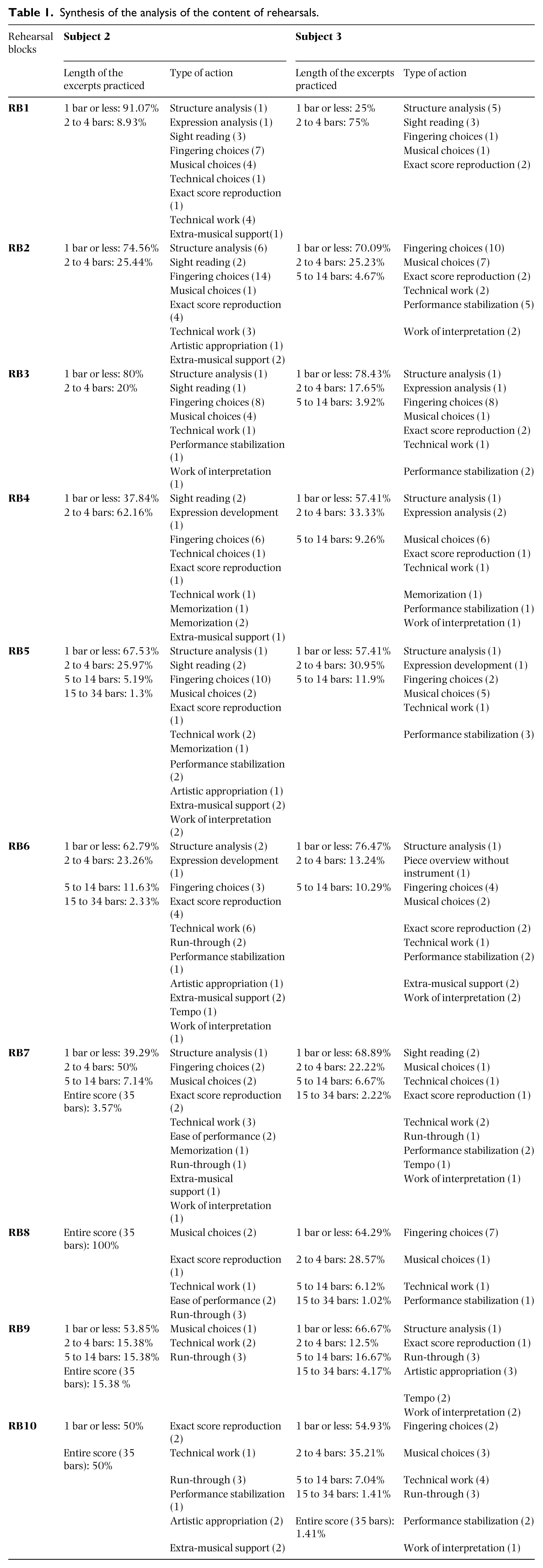
Table 1 synthesizes our analysis of the rehearsal content for each of our two subjects. It provides information about the length of the passages that they worked on and the type of work done in each rehearsal block. The first column shows the rehearsal blocks from which the data were drawn. The second column shows the length of the passages worked on as a percentage of the given rehearsal block. This is one of the criteria that enable the identification of work stages (Chaffin et al., 2003). The types of action and the elements worked on are also criteria by which the work stages can be defined; they are shown in the third column.
Synthesis of the analysis of the content of rehearsals.
Length of passages worked on
The data for S2 demonstrate that the percentage of work on short passages is higher in the earlier rehearsal blocks. In the fifth block, S2 began working on longer passages; this block also includes the first complete sequencing of the piece. This is a characteristic of the third, or “gray,” stage. In the case of S3, it is difficult to identify a rehearsal pattern with respect to passage length. The first work on a long passage (15 to 34 bars) occurs in block 7 but work on shorter passages recurs quite often in the following blocks.
Auditory reminiscence
Both subjects experienced auditory recall of the piece. For S3, this occurred only once and he was only partly aware of it. For S2, it occurred three times and he was fully aware of it. He worked through his musical ideas by thinking about a message, or storyline, that could guide his interpretation. Both participants reported that they felt focused and inspired, and that they lost their sense of self-awareness and time perception during the rehearsals.
Analysis of the whole data set according to Analyse par théorisation ancrée
To analyze the data set as a whole, we used Paillé’s (1994) Analyse par théorisation ancrée, which is based on grounded theory (Glaser & Strauss, 2010). The Analyse par théorisation ancrée differs from the analysis of content inasmuch as it is not concerned with recurrences and frequencies in the content but rather with conceptualizing it in order to explain the phenomena as they present themselves and to define their modalities (Paillé, 1994). The chief tool in this approach is the creation of conceptualizing categories that enable the researcher “to raise the analysis to the level of understanding a behavior, phenomenon, or event or a component of a psychological or social universe” (Paillé, 1994, p. 160). This is an iterative approach that allows the integration of new data throughout the process. It therefore offers scholars the possibility to re-examine, and perhaps further elucidate, the analysis in light of the overall research question. Moreover, it involves constant validation of the data by the participants either through subsequent observations or direct questioning: Does the analysis make sense? Do I thoroughly understand the phenomenon identified?
We began by coding the research materials for each subject: 1) the transcriptions of the verbalizations; 2) the observer’s descriptions of the content of the rehearsals; 3) the responses to the reflective questionnaire; 4) the self-confrontation and explicitation interviews; and 5) the semi-structured interviews. This procedure allowed us to identify and reorder the fundamental elements (in relation to the overall research question) present in our data, and thereby create personalized rubrics for each of our subjects. We determined the conceptualizing categories by grouping the data according to the wider phenomenon to which they point. Whereas the personalized rubrics regroup the data and enable their classification, the conceptualizing categories go beyond content and constitute an interpretative analysis of the observed phenomena. The conceptual analysis of the rubrics led us to separate out more conceptually dense categories, such as “Feeling the accuracy of expression in the playing.” For each of these, we created a definition and noted the category’s properties, as Paillé and Mucchielli (2008) suggest.
We connected these categories using new data that had emerged during the initial analysis. Next, we connected them with the data collected during the validation of the categories by the subject, and re-examined them in light of the original research hypothesis. These additional steps enabled us to model the creative process and interpretative work of our subjects during their rehearsals, as detailed below.
Limitations
We would like to underline the fact that this paper presents two case studies taken from a broader study involving nine participants. The results presented in this research cannot be generalized, but they do provide an interesting insight into the creative processes of two professional guitarists and their work on Andrew York’s composition Why.
The choice of repertoire undoubtedly influenced the results of this study. Why presents a low level of difficulty, is short, and was written in a modern style inspired by American folk music. The results would have been quite different if we had chosen a piece by Bach, or had allowed the subjects to select the piece. Our objectives in imposing a specific piece of music were to minimize factors of differentiation between subjects and to ensure that we had a shorter rehearsal time to analyze. Had we chosen a longer, more difficult piece, however, the section by section and gray stage phases would probably have been easier to define. (These stages appear simultaneously in the case of S3.) Indeed, because Why is composed of short and easy phrases, the type of work typically found in the second stage, section by section, may be confused with that of the gray stage.
To attempt to summarize or synthesize the artistic thought of a musician can be a reductive exercise. Although we cross-referenced data, our results remain an interpretation, albeit one that is as rigorous as possible. We also have yet to confirm with the subjects our interpretation of their creative processes.
Our goal was to study the creative process in situ under conditions that would resemble a real-life situation. Nevertheless, we are aware that many factors contributed to a less-than-natural experience: the requested verbalizations, the reflective questionnaire, the presence of a camera, and the fact that the participants know the researcher and may have wanted to please her or to portray themselves in a positive light.
Results
Data set analysis results using théorisation ancrée
Using the data collected from the rehearsals and interviews, we summarized the creative process of interpretation for each subject. The results presented take into account four types of data: 1) the content of the rehearsals of the piece Why (including the subjects’ verbalizations during the rehearsals and the actions performed as they were categorized by our external observer); 2) supplementary comments, obtained during self-confrontation interviews with the subjects, about certain moments in the rehearsal; 3) information, obtained during the explicitation interviews, on other compositions; and 4) data, gathered during the semi-structured interviews, regarding the subjects’ awareness of the stages of their interpretative work. By cross-referencing these different data, we were able to obtain an overall picture of each subject. The various data analyses were validated by the subjects.
Table 2 presents a synthesis of the results obtained by analyzing the data set using anchored theory. With this information, we were able to model the process of interpretation creation in each subject. The table shows the work stages.
Synthesis of the results obtained from the analysis of the whole data set.

Discussion
In this section, we discuss our results in relation to 1) the work stages identified by Chaffin et al. (2003), and 2) the idea of artistic appropriation as described in Héroux and Fortier (2014). We consider the development of the mental image, the characteristics of each of the work stages as experienced by the subjects, the characteristics of the artistic appropriation, and the strategies that the subjects used as they worked on an interpretation.
Mental image
For both participants, the elaboration of the mental image occurs throughout their work on a piece. In general, however, S2 prefers to get acquainted with a new piece and listen to recordings of it before starting work on the instrument; this process helps him clarify the message he intends to convey via that piece. (This was not the case for Why because, as prescribed by the terms of the study, he did not listen to a recording of the piece prior to rehearsing it.) S2 explained the importance of finding a message, or storyline, as a preliminary step: To me, it is really important, because it is the whole purpose of what we are doing: being able to communicate something. … For me, it is much more enjoyable to play those elements when I have my storyline. When I have a REASON to play them. (S2.EE1b:8)
S2 thus tries to develop an artistic image of a composition even before beginning to work on it on his instrument.
In discussing Why in the self-confrontation interview, S2 went into greater detail about the story that emerged from the first readings of the piece: I had already begun to think of two people walking in autumn. I had also begun to have it as a clear idea. … I was thinking we were in the month of November. The leaves were falling on the already leaf-covered ground. Then there were two people. … First, I saw a man and then a woman. For the most part, there are only two voices in this piece. I already saw how to characterize the two voices. I said to myself, “I am going to assign one to the man and the other one to the woman and we shall see what happens.” Already … I already saw my ideas… (S2.EA.P11)
For S3, the genesis of a general conception of a piece occurs in the first stage, or “scouting it out.” He seeks his own appreciation of a piece, rather than a scenario or message, while reading or listening to it. In the case of Why, he stated, “It is interesting music in relation to mode and resonance” (S3.R1:1). By “resonance,” he is referring to a harmonic atmosphere that highlights the qualities of the instrument by matching the key of the piece (E minor) with the tuning of the instrument in order to generate sympathetic string resonance. The idea of resonance guided his interpretation throughout the piece because, as he said, “one can see a search for resonance in the composition. The composer himself is really targeting and looking for resonances” (S3.EA.B22). We observed certain statements that indicated that he was beginning to develop an artistic image of the work, such as, “There is nevertheless a meaning to the music, a certain construction … even a form … in relation to a certain interiority” (S3.R1.B6). He would then use a summary analysis of the piece to determine its structure and to define its formal image. In his interpretative work on Why, for example, he stated: There is inevitably a crescendo here with the new harmony. The arrival of G. Afterwards, there is also going to be a trick with F-G-C-B, another ascent. Then it is the sharp that ascends. Clearly, the passage is harmonic. The form is ABA. (S3.R1:1)
Scouting it out
The kinds of action performed in the rehearsal block enable us to identify the work stages. Sight-reading, structural analysis, fingering, and technical and musical choices are characteristics of the first stage, “scouting it out.” For S2, we found a greater presence of these elements until block 7. By contrast, S3 worked on these elements throughout the 10 blocks, with the exception of blocks 8 and 9.
For S2, this stage involved clarifying what, in his opinion, the piece was meant to communicate and then determining the technical means to accomplish this. This participant attached great importance to the message he wished to convey through the piece. He identified the piece’s idiomatic elements and technical difficulties, and made choices about fingerings, instrumental techniques, styles, and tone colors that enabled him to render his idea of the piece and its musical intention. In the self-confrontation interview, he explained this as a process of self-questioning, “Did I want something darker, more out of tune, or did I want something more for the guitar itself? Did that fit into my scenario? What is actually happening in the scenario? Where are we in this scenario?” (S2.EA: 33:56). For S2, his technical choices and musical interpretation were validated by reference to a fictional story that itself unfolded according to the execution possibilities permitted by the piece.
S3 performed a structural analysis using the title and the composer’s indications. For instance, he explained in the rehearsal: This ending of phrases would tend to always slow down, because it is in respect with the two words that are there. Hence, there is a questioning aspect in the act of slowing down. We are no longer certain. We issue something and after that, we are no longer sure. […] Here lies the “sorrow.” It is coherent. (S3.R2.3)
In this phase, he looked for qualities to highlight in the piece – resonance, balance between voices, and form – and made technical and musical choices that would allow him to do so. He used similar tone colors for similar chords to create a compelling interpretation, but contrasting fingerings in identical passages to vary emphasis (of melody and of resonance): The relation between an element in one place and an element in another place, even if it isn’t exactly the same […] what I am trying to put my finger on are the common elements. Then at the moment when you want to emphasize it, you try a common tone. (S3.EA.24:59)
Section by section
Reproducing musical symbols, making fingerings, and dealing with technical and musical issues are the primary actions of this second stage. This stage was more or less evenly distributed for both participants. With S2, however, we noticed a significant drop in activities related to this stage after block 8.
In this stage, S2 favored fluency of musical gesture over technical perfection because he wanted to incorporate, from the very beginning, the musical intention of his playing: I am trying as best as I can to do everything at the same time. I have the articulation, the phrasing, the vibrato on a given note for as long as the vibrato lasts, the reason why, and the nuances if there are any. (S2.EE.60)
More specifically, he isolated the melody: “It is essential that the ease of the melody be there, especially in my ear. Then afterwards, there is getting this kind of ease in the fingers” (S2.EE.60).
Overall, S3 spent more time on this stage. He continued to change his fingerings until the end of the rehearsals (block 10). In fact, in relation to S3’s work, it is difficult to separate the second stage, section by section, from the gray stage. S3 sought to refine the implementation of his ideas but he also liked to search for different options, try them, and eventually choose or not choose them. As he said in the semi-structured interview, he was “trying out all the possibilities in all the directions. And I was prolonging this period of elaboration. I was trying to have the longest possible period of elaboration” (S3. EDS.93).
Gray stage
The gray stage, which includes memorization and the work done for the run-through, was more important for S2 than for S3. Indeed, for S2, the process of sequencing the long passages (bars 15–34) began at block 5, and systematic work on sequencing the whole piece began at block 7 and occupied all of block 8. Furthermore, S2 began memorizing the piece from block 4. He did so even as he continued section by section work, and focused simultaneously on phrasing, articulation, tone color (vibrato and timbre), dynamics, and fingering. He isolated the melody to avoid technical difficulties that might unduly influence the phrasing. He listened to his instinct, intuitions, impressions, and sensations; at this stage, he set aside analysis: When my instinct tells me it’s good, it’s done. Move on. I don’t think of it in an over-analytical [manner] at this point. Rigorous analysis … that’s over. I have to feel it and hear it in a metaphysical way, to some extent. (S2.EE1:64)
S2 worked at rendering the scenario through the accuracy of his playing. At times during this process he experienced “magical moments” (S2.EE1:66): Whether it is a reaction to the sound, or a reaction of my body, physical: the hair, shivers. It doesn’t happen all the time, but now and then. Or, sometimes, it is just something exciting. It excites you, you say: “Wow! This is cool. I will keep that.” (S2.EE1:68)
S3, by contrast, worked on the sequencing of short passages throughout the 10 blocks. He did not do any memorization work, but nonetheless worked on sequencing the whole piece in blocks 7, 9, and 10. For S3, as mentioned earlier, we could not differentiate the second stage, section by section, from the gray stage. We did, however, observe a development of the artistic image of the composition that was more abstract than in the case of S2, and that was connected with the composer’s indications rather than a fictional story. Although he did not necessarily deepen this connection in his interpretation, the following remark confirms his choice of the notion of “utterance” or “statements” to describe the form: The conjunction of Why and sorrow is interesting. Because […] there is the aspect of sadness, but there is the aspect of questioning around it, so … it is peculiar to link the two concepts. Well, it can bring us back to the notion of statement. […] It is like thoughts, a little scattered, in some ways. And that goes with questioning. We often ask ourselves questions; we are a bit lost and we question something. We ask ourselves questions, but asking oneself questions doesn’t necessarily mean having an absolutely straight path. (S3.R2.03)
Maintenance stage
The maintenance stage is characterized by the sequencing of long passages, but also by the search for stabilization of the resulting sounds. For S2, the desire for stabilization of the sound results began in block 3, then disappeared and reappeared throughout the subsequent blocks. For S3, this stage was definitely more prominent. It was present from rehearsal block 2 and was the most worked-on element. S3 seemed to want to produce a perfect musical result from the very beginning and, as we can see from Table 2, he kept changing his fingerings until the end.
S2 sought to stabilize the sound results and the expression of his storyline by sequencing the piece: “At the stage where I am, it is better for me to do sequencing from the beginning to the end for me to get used to the ‘flow’ of the whole piece” (S2.R4.2). It is interesting to note that he reflected on certain interpretative options in relation to the context in which the piece would eventually be played – in this case, a recording: “I am going to let the note sound […] and I can do a ‘fade’ in post-production, if it is necessary. In my opinion that will sound better. A little surreal” (S2.R4.3). This shows that the subject’s creative process was influenced by recording techniques, and these became another dimension in the development of his interpretation.
S3 worked on his final version, making changes in fingering and musical ideas, up until the very end. He said that he hoped that he would never completely fix these elements, so as to let his interpretation of the work continue to evolve: “The version becomes good at a given moment, but it is temporarily good as well” (S2.ESD.99). S3 does not think of the interpretation of a work as definitive: “There always has to be a little spontaneity, even then” (S3.ESD.109).
Artistic appropriation
According to Héroux and Fortier (2014), artistic appropriation is characterized by interpretative work on a piece or, more precisely, a quest for rightness of expressivity in playing. This results from, among other things, having recourse to extra-musical elements such as images and analogies.
For S2, the artistic appropriation of a composition appears even before the instrumental work begins, by listening to a recording. With the piece Why, this was not possible because S2 had never heard it before this study: If I had had access to a recording of Why, I would have listened to it all the time. There, I would have had my story, what I wanted to say. Everything would have been very, very, very clear before I even touched the guitar. (S2.EA.7:30)
Thus, with Why, the work of artistic appropriation occurred at the first readings of the score: “I am going to read the whole piece, whatever the result, in order to try to create a story. I need a story, something to say, that can guide most of my interpretation, my fingerings, my colors, everything” (S2.R1.P1). This allowed S2 to be more efficient in his subsequent work. He added, “When I can make it very descriptive [the fictional story from the beginning of the piece], that helps me to memorize the piece much more quickly” (S2.R1.P1). He then feels much more involved emotionally in the playing and finds his interpretation more convincing. In Why, the use of extra-musical support is present from the first readings of the composition and continues in blocks 4, 5, 6, 7, and 10.
For S3, by contrast, there were only two occurrences of artistic appropriation, at block 6 and block 9. For S3, artistic appropriation reveals itself differently. There is no development of a fictional story or use of analogy, but rather a desire to understand the meaning of the work in itself: “The work in itself is a message, of a certain kind” (S3.EDS.b350:1:20:00). S3 defines this message by the form and the character of the work, but he is careful not to make a simplistic analogy with the message of a screenplay or a painting: “It is an association that can be made, but that is because we are not otherwise able to latch onto and define a musical work” (S2.EDS.b.1:53:00).
This being said, S3 sought to understand the meaning of the musical phrases, which he associated with utterances or statements, and attempted to play the piece in such a way as to express the title Why and the subtitle With sorrow, which he associated with questioning and uncertainty: With sorrow, probably this has to be very, very … with a certain rubato, I think, in the utterance […]. This ending of the phrases would constantly bring a slowing down because it is connected with the two words sorrow and Why. Therefore, there is a questioning aspect to the fact of slowing down, but one is not completely sure. One says something; and after that, one is not quite sure. […] It’s that that is sorrow. (S3.EA:12)
Nevertheless, during the self-confrontation interviews, S3 expressed concern about the use of such creative associations with the title and the meaning of the words. Although he found the association of extra-musical ideas to be a valid approach, S3 seemed uncomfortable when he saw himself using this approach during the self-confrontation interviews. He felt as though he had placed himself above the piece, as if he had figured out the best way to play it. Yet he clarified that he did not disapprove of musical ideas he found coherent: “It may be a little far-fetched. […] Maybe it’s a little … too much, I would say. […] It can become overacted at some point. But in itself, no. Per se, it is okay” (S3.EA:12). He added: It raises questions with respect to your study, which is extremely interesting, but at times odd … One must not OVER-analyze, either. There are many creators, cinematographers, people who have absolutely no wish to give interviews, or to speak about their art. […] Or to understand … Or … above all, to explain. (S3.EA:12)
Strategies
Finally, what strategies do these two expert musicians use to create an original interpretation? At first glance, they take different approaches. S2’s creation process begins before the rehearsal of a piece, either by listening to different recordings of it or by finding a story, or message, inherent in the musical structure of the piece. This storyline guides his technical and aesthetic choices in the interpretation of the piece, and he tries to tell the story through the musical text. Formal analysis is the most intellectual work done by S2 and it is primarily, though not exclusively, limited to the first two stages of the work. This leaves room for more intuitive work in the remaining two stages. S2 confirms the correctness of his interpretative choices and the quality of his playing according to the emotions felt and to physical sensations rather than through reflection or by re-referencing the musical text.
S3 prefers to consider all musical and technical possibilities and experiment with them before deciding how to execute the piece at the moment of performance, so he continuously questions all parameters. The artistic appropriation stage appears only momentarily. To validate his choices, S3 constantly seeks coherence in the interpretation, which he finds in the musical text, but also in a body of knowledge about the piece, its period, and its composer. S3 takes more time to make his interpretative choices. These also allow him to convey a message, but this message is located in the piece itself and is somewhat abstract; it is not a symbolic representation of a story.
Conclusion
These two case studies were extracted from a study of nine expert musicians working on a composition they had not previously heard, Why, by the American composer Andrew York. This study argues that the interpretations achieved by expert musicians comprise a dimension of creativity that extends beyond the simple monitored learning of a work (namely, the action of learning to play the score), and that there exist stages, strategies, or creative processes that belong especially to the work of producing an expressive performance.
The process of creating an interpretation
Our results enabled us to locate in our two subjects the stages of instrumental work already reported by Chaffin et al. (2003), the presence of the artistic appropriation stage (Héroux & Fortier, 2014), and various elements characteristic of creative work, such as loss of a sense of time, great concentration, a feeling of inspiration, and the presence between rehearsals of auditory recalls of the composition being worked on.
Nevertheless, the present results oblige us to revisit our idea of the artistic image as a component of the global image. In fact, contrary to what we observed in previous studies, the appearance of the artistic image can be concomitant with the formal image and may even precede playing the piece on the instrument, as with S2. Furthermore, the artistic image may remain fluid, as in the case of S3, whose desire not to fix this image (as demonstrated by his ongoing changes to fingerings and musical ideas) seems to be an important part of his creative process. On the other hand, this image became fixed at a certain point for S2 and his interpretative work consisted of reproducing it faithfully and expressively; this approach is in line with our previous studies.
Certain elements of artistic appropriation seemed to be specific to each of our participants: the moment at which it first appears, the means used to render a convincing interpretation, the criteria for evaluating rightness of expression, and the very foundations of what constitutes a correct interpretation. In our previous studies, this stage appeared when the subject had a clear formal image of the composition and had achieved a certain level of technical mastery. In this study, however, we found that the artistic appropriation stage may appear at the musician’s initial contact with the work and even before the development of the formal image, as in the case of S2. 1 In addition, having recourse to extra-musical aids as a strategy for developing rightness of expressivity does not automatically involve using concrete descriptive analogies or fictional stories, as we had previously suggested. In the case of S3, this kind of creative association (Lubart et al., 2003; Schubert, 2012) was not used and, in fact, was avoided; rather, he sought to transmit the message of the composition in the most rigorous manner possible and with a minimum of interference by the interpreter. He drew on historical information about a composer or used an abstract analogy (e.g., between a musical phrase and the concept of utterance). Furthermore, although the means of validating the rightness of expressivity in playing for both subjects are feelings of joy and well-being, S2 trusts his instincts and physical sensations, whereas S3 relies upon reflection and seeks coherence between the musical text, the indications of the composer, and his own interpretative choices.
The two cases presented in this article suggest two conceptions of expressivity in music. One is referential and believes that “music is capable of referring to the non-musical,” for example, to a fictional story about two people. The other is closer to an absolutist-formalist view for which “music is self-referential” (Nattiez, 1987, p. 146) and believes that the role of the musician is to understand and express the “message” inherent in the musical text. Beyond their distinctive ways of seeing music and their roles as performers, both participants demonstrated a constant swing between divergent thinking and convergent thinking, the essential cognitive operations in creativity (Guilford, 1950, 1968). Indeed, our subjects tried different fingerings, tone colors, and dynamics not written in the score (divergent thinking) and then questioned the relevance of their choices (convergent thinking). Therefore, in order to validate the rightness of the expressivity of his playing, S2 asked, “Are my choices giving a good feeling of the musical text and the narrative I’m trying to express?” By contrast, S3’s question was, “Are my choices serving well the musical text and its inner message?”
Footnotes
Funding
This research received a grant from Social Sciences and Humanities Research Council of Canada. Ref: 430-2013-000120.