




Abstract
Sensorimotor integration tasks, such as body movements in time with music, can foster the experience of flow – a pleasurable state of full engagement and concentration occurring during a seemingly effortless and automatic activity. As it can be argued that both music and flow are embodied phenomena, perception-action coupling might be the core of the intimate relationship between flow and music. The current study examines the relationship between the subjective experience of flow and sensorimotor synchronization accuracy/stability in a finger-tapping task with music. In a between-subjects design, participants tapped in time with the beat of music clips with either low, medium, or high rhythmic complexity. After the tapping task, they rated their flow state on the Flow Short Scale with the two subscales fluency of performance and absorption by activity. Tapping accuracy and stability were assessed by the circular variance and the SD of inter-tap-intervals (ITIs), respectively. Both tapping accuracy and stability were significantly correlated with fluency of performance for music clips with medium and high rhythmic complexity, but not for music clips with low rhythmic complexity. No significant correlations were found between tapping accuracy/stability and absorption by activity. The findings add to evidence that perception-action coupling plays a key role in explaining the relationship between flow experience and musical activities. They also suggest that absorption by activity is not as relevant to the experience of flow during musical activities as one might initially assume.
What is flow?
When we experience flow, we are in the zone – immersed in a focused, productive, creative mental or physical activity that feels like it is running automatically. According to Csikszentmihalyi (1975), the experience of flow is characterized by the following states: the merging of action and awareness, the feeling of having everything under control, the centring of attention and concentration, intrinsic motivation, and the loss of ‘the self construct, the intermediary which one learns to interpose between stimulus and response’ (Csikszentmihalyi, 1975, p. 43). Being in such states can lead to a distorted perception of time, typically creating the impression that time passes faster than usual (Csikszentmihalyi, 1975). The experience of flow can be induced by any physical or mental activity that provides unambiguous feedback, clear goals and a good balance between challenge and skill; examples of such activities are work, games, sports and musical activities (Csikszentmihalyi, 1975, 1997; Csikszentmihalyi & LeFevre, 1989). Typical by-products of flow are positive affect, creativity and satisfaction (Csikszentmihalyi & LeFevre, 1989).
The relationship between flow and embodied interactions with music
Moving one’s body in time with the beat of music is a typical example of a sensorimotor integration task demanding the coupling of perception and action. During the last few decades, sensorimotor coupling has increasingly been viewed in light of embodied cognition, an approach that understands cognition as functionally dependent upon the entire body of the living system in its constant interplay with the environment (Clark, 1999; Engel, Maye, Kurthen, & König, 2013; Thompson, 2007; Varela, Thompson, & Rosch, 1991). Embodied approaches have become increasingly important in music cognition as well (Leman, 2010; Leman & Maes, 2014; Maes, 2016; Schiavio, Menin, & Matyja, 2014). In a radical form, embodied theories claim that ‘music cognition emerges from the real-time interaction of modality-specific processes serving perceptual or sensorimotor functions in the brain, bodily states and dynamics, and environment’ (Maes, 2016, p. 1; see also Kiverstein & Miller, 2015). Embodied approaches to music cognition are supported by evidence suggesting that listening to music engages movement-related brain regions, such as the basal ganglia, supplementary motor area, premotor cortex and cerebellum (Chen, Penhune, & Zatorre, 2008; Grahn & Brett, 2007; Zatorre, Chen, & Penhune, 2007). In turn, moving in time with music can shape and improve rhythm perception (Manning & Schutz, 2013; Morillon, Schroeder, & Wyart, 2014; Stupacher, Witte, Hove, & Wood, 2016; Su & Pöppel, 2012). When infants and adults listen to an ambiguous rhythm, moving their body in time with a specific beat (passive movement in infants, passive and active movements in adults) influences their interpretation of musical meter (Phillips-Silver & Trainor, 2005, 2007, 2008). These findings suggest that vestibular and proprioceptive inputs can at least partially explain the tight interaction between body movement and rhythm perception. Additionally, auditory, visual and vibrotactile rhythms all engage the putamen, suggesting that rhythm is processed supramodally in a common neural network (Araneda, Renier, Ebner-Karestinos, Dricot, & De Volder, 2017).
In sum, previous evidence suggests that music cognition is highly dependent on – or might even emerge from – perception-action coupling in real-time interactions of an agent (including his/her body) with the environment. Embodied approaches reject the conception of our body and environment as sole input-providers and output-receivers. This rejection of a strict input/output dichotomy might be related to the feeling of nonmediation in a flow state (Csikszentmihalyi, 1975; Leman, 2010). The illusion of nonmediation arises from a heightened sense of presence within the environment in which the technical aspects of an activity fade into the unconscious background (Nijs, 2017).
Embodiment is also highly relevant for the experience of groove, which is often defined as the wish to move one’s body in relation to the rhythm (Janata, Tomic, & Haberman, 2012; Madison, 2006). On a (neuro-)physiological level, music with high subjective groove ratings increases the excitability of the motor cortex (Stupacher, Hove, Novembre, Schütz-Bosbach, & Keller, 2013), leads to more accurate sensorimotor synchronization (Janata et al., 2012), and results in harder finger taps in time with the beat (Stupacher, Hove, & Janata, 2016). Similarly to the loss of the self as intermediary when experiencing flow (Csikszentmihalyi, 1975), Danielsen (2006, p. xi) describes the experience of groove as ‘a highly pleasurable state of being, a presence in both the music and the body at once’ (italics added).
The relationship between the experience of flow and musical activities, such as music listening or musical performance, has been investigated in various empirical studies (for a review, see Chirico, Serino, Cipresso, Gaggioli, & Riva, 2015). When playing in a band, the averaged flow state across the band members can predict self-evaluated global performance and perceived competence (Gaggioli, Chirico, Mazzoni, Milani, & Riva, 2017). However, in the same study, the bands’ flow states could not predict more objective performance ratings of experts. In a study of pianists who played self-selected pieces, de Manzano, Theorell, Harmat, and Ullén (2010) found that some flow dimensions in a subset of the Flow State Scale (Jackson & Eklund, 2004) – such as challenge/skill balance or feedback – were not as statistically conclusive as others. This was probably due to participants’ difficulties in estimating challenge/skill balance and feedback-related questions (de Manzano et al., 2010).
In sum, previous studies indicate that the vagueness in evaluations of one’s own performance and estimations of specific flow dimensions introduce uncertainties in the description of the relationship between flow state and music.
Experimental overview
Although various studies investigated the relationship between flow and music making or music listening, evidence on the specific relationship between flow and sensorimotor synchronization to music is scarce (Chirico et al., 2015). Thus, in this study, I examine whether more accurate and stable sensorimotor synchronization (i.e. tapping in time with the beat of music) is associated with stronger experiences of flow. This hypothesis follows from the assumption that the close alignment of musical rhythm and body movements (i.e. correct predictions) leads to feelings of pleasure and reward (Salimpoor, Zald, Zatorre, Dagher, & McIntosh, 2015; Vuust & Witek, 2014) and a sense of agency (Leman, 2016). Additionally, the hypothesis relates to the finding that tighter sensorimotor coupling is associated with higher levels of experienced groove (Janata et al., 2012).
The simplicity and specificity of the tapping task and the objectivity of measures of sensorimotor synchronization might reduce the vagueness of performance evaluations and flow ratings found in previous studies (e.g. de Manzano et al., 2010; Gaggioli et al., 2017). Because flow is a multifaceted phenomenon, I compare the relationship between sensorimotor performances and the two flow dimensions fluency of performance and absorption by activity of the Flow Short Scale (Engeser & Rheinberg, 2008; Rheinberg, Vollmeyer, & Engeser, 2003). Additionally, I explore which items of the Flow Short Scale can best predict sensorimotor synchronization accuracy and stability.
Method
Participants
Sixty-nine right-handed participants (34 female, 35 male, M = 24.5 years, SD = 4.1) took part in the experiment. Three additional participants were excluded because the circular variance of their tapping performances was higher than three times the interquartile range of the group’s circular variance. Participants had M = 15.9 years (SD = 2.5, range 12 – 22) of formal education (school and university). Based on the Goldsmiths Musical Sophistication Index (Gold MSI; Müllensiefen, Gingras, Stewart, & Musil, 2013; Schaal, Bauer, & Müllensiefen, 2014), the participants’ musical training (M = 24.4, SD = 10.3) was below the 43rd percentile of the norm group and the general musical sophistication (M = 72.5, SD = 19.9) below the 33rd percentile. Participants provided written informed consent.
Musical stimuli
Four different audio clips were written and recorded by a professional drummer and a professional pianist with MIDI instruments (Yamaha DTXtreme e-drum set, Nord Wave keyboard). They were instructed to play groovy 1 and repetitive rhythms and melodies at different tempi: 100, 110, 120 and 130 BPM. The optimal tempo for the experience of groove has recently been estimated to range from 107 to 126 BPM (Etani, Marui, Kawase, & Keller, 2018). The music clips consisted of bass drum, snare drum, hi-hat, bass (left hand of keyboard) and organ (right hand of keyboard). The four different music clips were then adjusted to conform to three different levels of rhythmic complexity (low, medium, high) with the software Ableton Live 8 (Ableton AG, Berlin, Germany). Low complexity clips had accented notes on the beat level and did not include syncopated notes. Medium complexity clips included some syncopated notes and some accents on the off-beats. High complexity clips were heavily syncopated and included many accents on the off-beats. Pulse clarity for the three complexity levels was computed with the MIR toolbox for Matlab (mirpulseclarity; Lartillot, Eerola, Toiviainen, & Fornari, 2008; Lartillot & Toiviainen, 2007): Low complexity rhythms had a clearer pulse (M = 0.917, SD = 0.009) – that is, stronger beats – than medium (M = 0.843, SD = 0.089) and high (M = 0.750, SD = 0.041) complexity rhythms. All clips were quantized on a sixteenth note level. Each clip lasted 16 measures of 4/4 time (31 –40s, depending on the tempo) and was introduced by four hi-hat quarter notes in the time of the corresponding beat. Audio files of the stimuli can be found in the supplementary material section.
Design and procedure
In a between-subjects design, participants were randomly assigned to one of three rhythmic complexity groups (low [N = 21], medium [N = 24], high [N = 24]). The participants’ level of musical training did not significantly differ between the three groups (F(2,66) = 1.85, p = .166, η2 = .05; pairwise comparisons: all ps > .2). Data were collected as part of a larger study, which investigated the influence of sensorimotor synchronization on neurofeedback training. There were three main blocks: a first tapping block, a neurofeedback training block and a second tapping block. Directly after each block, participants filled out the Flow Short Scale (Rheinberg et al., 2003), a seven-point scale with 13 items that measures the flow state. After the three blocks, participants filled out a series of questionnaires including the Gold-MSI. MAX/MSP 5 software was used to present the clips and to record the taps. Participants were instructed to tap their right index finger as synchronously as possible with the beat. Taps were recorded with an Arduino-based circuit board (Makey Makey, JoyLabz) connected to a 3×3 cm aluminium pad. The first tapping block consisted of 12 trials; the second block consisted of eight trials. In the first block, four to eight practice trials were monitored by the experimenter to ensure that participants understood the task. In total, the experiment took approximately 90 minutes.
Data analysis
Flow state
For the analysis of the flow state, participants’ mean ratings of the two Flow Short Scale dimensions fluency of performance (six items) and absorption by activity (four items) (Rheinberg et al., 2003; Engeser & Rheinberg, 2008) were used. Ratings given after both tapping blocks were combined for statistical analyses. Means and standard deviations of the individual flow items in the three rhythmic complexity groups can be found in the supplementary material section.
Finger tapping performances
Tapping data of both tapping blocks were combined for statistical analyses to reduce noise (trials 5– 12 from the first tapping block and trials 1– 8, i.e. all trials, from the second block). Tapping stability was assessed by the standard deviation of inter-tap-intervals (ITIs). Doubled or missing taps with ITIs shorter or longer than two-thirds of the quarter note interval of the corresponding music clip were removed from the analysis (M = 1.3%, SD = 2.5, range 0 – 12.9%). Tapping accuracy was assessed by the circular variance of taps based on circular statistical methods implemented in the CircStat toolbox (Berens, 2009) for Matlab. The analysis was based on the same data used for the analysis of the SD of ITIs. The circular variance provides information about the variability of the phase of the taps in relation to the beat. The circular variance is zero when all taps fall directly on the beat of the stimulus and one when the phase of the taps in relation to the beat is evenly distributed between 0 and 360°.
Statistical analyses
Differences of flow dimensions and tapping performances between the three rhythmic complexity groups were assessed by one-way ANOVAs. The relationship between flow dimensions and tapping performance measures within the three rhythmic complexity groups was assessed by Pearson’s correlations. The stability of Pearson’s correlations between flow dimensions and tapping performances was evaluated by performing bootstrapping using k = 10,000 estimations with replacement and reporting the resulting 95% confidence intervals. Effect sizes are reported as η2 for ANOVAs (benchmarks: small: .01, medium: .06, large: .14) and r for Pearson’s correlations (small: .1, medium: .3, large: .5) (Cohen, 1992; Maher, Markey, & Ebert-May, 2013).
Results
Finger tapping performances
The circular variance did significantly differ between the rhythmic complexity groups (F(2,66) = 12.32, p < .001, η2 = .27) with higher variances for high rhythmic complexity (M = 0.25, SD = 0.24) compared to medium (M = 0.08, SD = 0.06) and low complexity (M = 0.05, SD = 0.02). Figure 1 depicts the circular histograms of taps for the three different complexity groups. The circular mean (i.e. the mean of the phase of the taps relative to the beat) did not significantly differ between the rhythmic complexity groups (F(2,66) = 0.19, p = .829, η2 < .01; ANOVA performed with the ‘circular’ package in R). The mean SD of ITIs also did not significantly differ between the groups (F(2,66) = 1.31, p = .277, η2 = .04; overall mean = 28.57 ms, SD = 6.88).
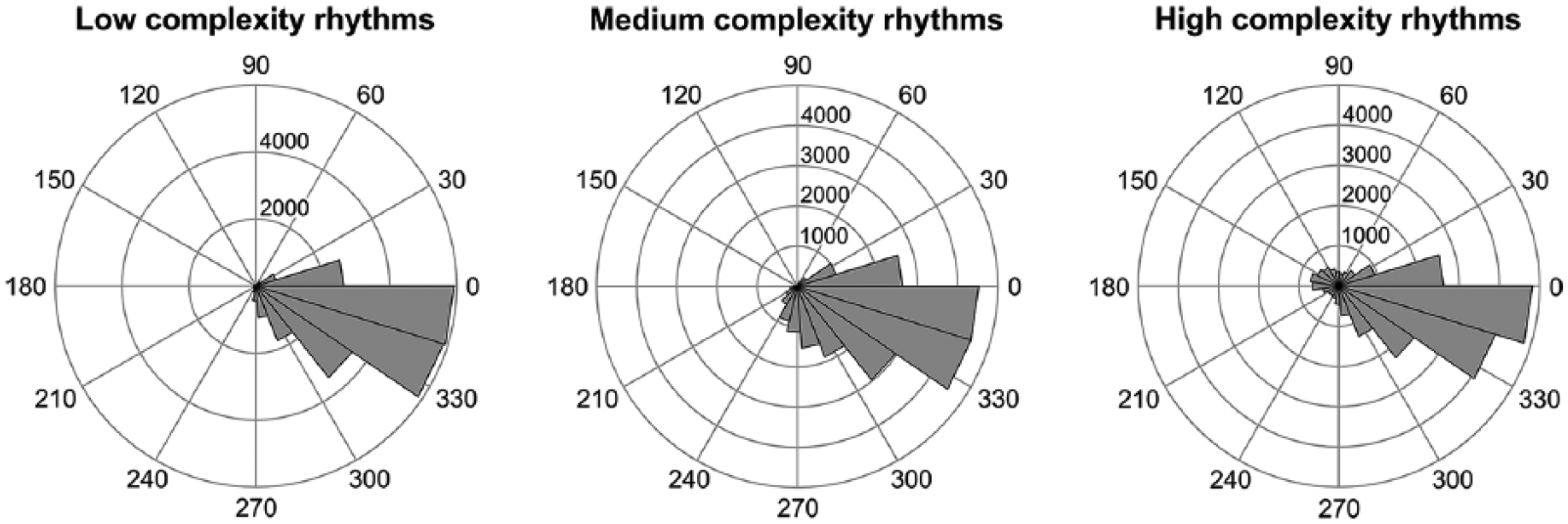
Circular histograms of the taps of participants in the three different rhythmic complexity groups. The length of each bin represents the total number of taps as indicated by the radial coordinates. The value 0° represents the beat position of the music clips. The distribution of taps between 330 and 0° indicates that participants anticipated the beat and successfully tapped in time with the beat.
Relationship between flow state and finger tapping performances
Across all groups, the mean level of fluency of performance was 5.20 (SD = 0.88) and the mean level of absorption by activity was 4.88 (SD = 0.88). Neither fluency of performance nor absorption by activity differed between the rhythmic complexity groups (F(2,66) = 0.77, p = .467, η2 = .02 and F(2,66) = 2.68, p = .076, η2 = .08, respectively).
Figure 2A depicts the relationship between the ratings of the flow dimension fluency of performance and tapping accuracy (circular variance). The circular variance was significantly negatively correlated with fluency of performance in the high rhythmic complexity group (r(22) = –.46, p = .022, 95% CI [–.67, –.19]). Additionally, a trend was found in the medium complexity group (r(22) = –.38, p = .067, 95% CI [–.73, .06]). No significant correlation was found in the low complexity group (r(19) = –.10, p = .657).

Observed data points and linear regression lines describing the relationship between the flow dimension fluency of performance and A) the circular variance of tapping performances (lower values mean more accurate tapping), and B) the standard deviation of inter-tap-intervals (lower values mean more stable tapping) in each rhythmic complexity group (low, medium and high complexity).
Figure 2B depicts the relationship between the ratings of the flow dimension fluency of performance and tapping stability (SD of ITIs). The SD of ITIs was significantly negatively correlated with fluency of performance in medium (r(22) = –.42, p = .040, 95% CI [–.67, –.13]) and high rhythmic complexity groups (r(22) = –.49, p = .016, 95% CI [–.69, –.22]). No significant correlation was found in the low complexity group (r(19) = .15, p = .518).
No significant correlations between circular variance or SD of ITIs and the flow dimension absorption by activity were found (all rs between –.24 and .29, ps > .2). Spearman’s rank correlations validated the results of Pearson’s correlations.
To predict sensorimotor synchronization accuracy and stability, two separate stepwise regression analyses with the 10 individual items of the Flow Short Scale as predictors were conducted: one with the dependent variable circular variance (accuracy) and one with the dependent variable SD of ITIs (stability). Because no significant interaction between tapping performances and flow was found in the low rhythmic complexity group, the dataset was reduced to medium and high complexity groups. As can be seen in Table 1, for both dependent variables, regression models that included the item ‘The right thoughts/movements occur of their own accord’ and excluded all other items were significant (F(1,46) = 15.03, p < .001, for the dependent variable circular variance; F(1,46) = 16.45, p < .001, for the dependent variable SD of ITIs). The included item explains 25% of variance of tapping accuracy and 26% of variance of tapping stability.
Results of the two separate stepwise regression analysis for the dependent variables circular variance and SD of ITIs.
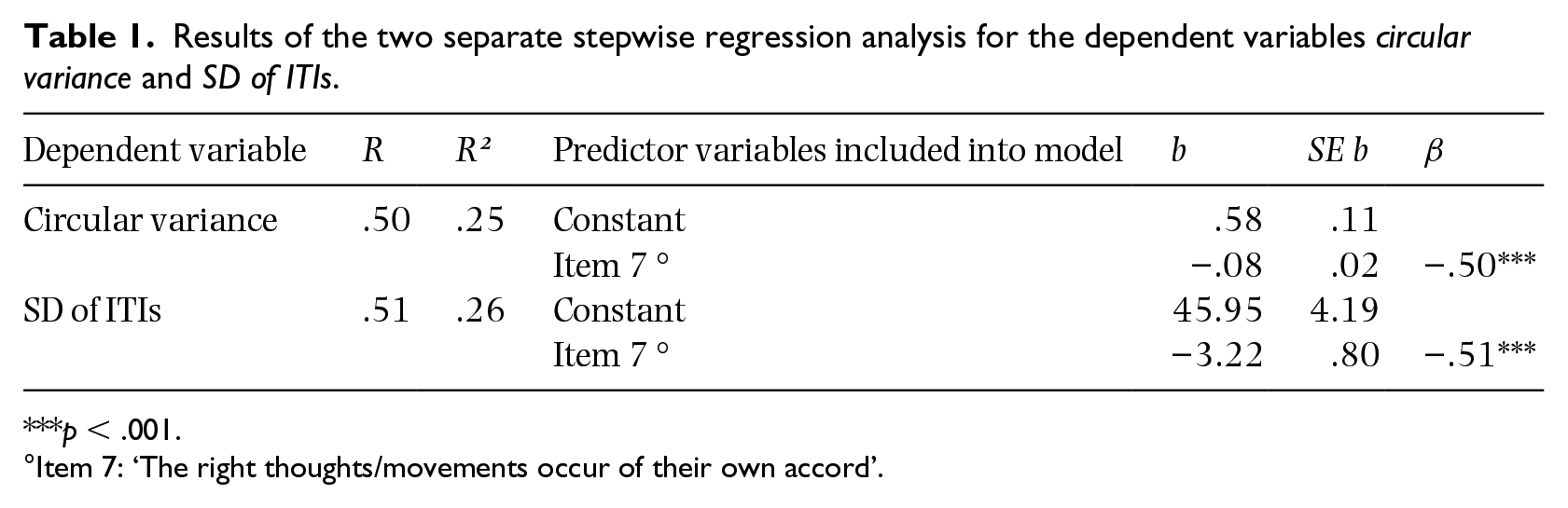
p < .001.
°Item 7: ‘The right thoughts/movements occur of their own accord’.
Based on the same dataset (medium and high rhythmic complexity groups), correlations between tapping performances and the 10 individual flow items were computed. As can be seen in Figure 3, every item of the fluency of performance dimension was correlated more strongly with tapping accuracy (Figure 3A) and tapping stability (Figure 3B) than the items of the absorption by activity dimension. Proceeding from the individual items’ correlations, the most relevant flow items for sensorimotor synchronization with music are:

Pearson’s correlation coefficients between the individual items of the Flow Short Scale subdivided into the two dimensions absorption by activity and fluency of performance (Engeser & Rheinberg, 2008; Rheinberg et al., 2003) and A) circular variance (lower values mean more accurate tapping), and B) the standard deviation of inter-tap-intervals (lower values mean more stable tapping).
‘The right thoughts/movements occur of their own accord’ (accuracy: r(46) = –.50, p < .001; stability: r(46) = –.51, p < .001). ‘I feel that I have everything under control’ (accuracy: r(46) = –.45, p = .001; stability: r(46) = –.46, p = .001). ‘My thoughts/activities run fluidly and smoothly’ (accuracy: r(46) = –.35, p = .015; stability: r(46) = –.36, p = .011). ‘I know what I have to do each step of the way’ (accuracy: r(46) = –.28, p = .053; stability: r(46) = –.35, p = .016). All other correlations on the item level were nonsignificant.
Effects of musical training
A final analysis investigated the influence of musical training on the experience of flow and tapping performances in participants who were synchronizing to rhythms with medium and high rhythmic complexity. The Gold MSI subscale musical training was negatively correlated with circular variance (r(46) = –.44, p = .002) and SD of ITIs (r(46) = –.46, p = .001). Additionally, musical training was positively correlated with the flow subscale fluency of performance (r(46) = .45, p = .001). However, in partial correlations controlling for musical training, the relationship between fluency of performance and SD of ITIs remained stable (r(45) = –.33, p = .023, 95% CI [–.54, –.04]). When controlling for musical training, the relationship between fluency of performance and circular variance revealed a strong trend (r(45) = –.28, p = .062) with a confidence interval that did not include zero (95% CI [–.47, –.04]).
Discussion
In this study, higher subjective fluency of performance was associated with higher sensorimotor accuracy and stability when tapping in time to musical stimuli with medium and high rhythmic complexity. In contrast, no such effect was found for stimuli with low rhythmic complexity. The flow dimension absorption by activity was not significantly correlated with tapping performance measures.
Music, flow, groove and embodiment
Out of 10 items of the Flow Short Scale (Rheinberg et al., 2003), the answers to the statement ‘The right thoughts/movements occur of their own accord’ of the fluency of performance dimension have been identified as the best predictor for tapping accuracy and stability. In intense experiences with music, instrumentalists sometimes feel as if ‘the fingers move by themselves’ (Gabrielsson & Lindström Wik, 2003, p. 176). The automaticity and fluency with which the right movements occur at the right time can be viewed as a connecting piece between musical rhythm and the psychological constructs of flow and groove. Both flow and groove are closely related to feelings of pleasure and perception-action coupling (Csikszentmihalyi & LeFevre, 1989; Dietrich, 2004; Janata et al., 2012; Witek, Clarke, Wallentin, Kringelbach, & Vuust, 2014). Additionally, both constructs can be viewed as embodied experiences: One is in control and aware of the situation, but in a feeling of nonmediation 2 in which the role of the body as an intermediary is lost and auditory and corporeal rhythms flow into each other (Csikszentmihalyi, 1975; Danielsen, 2006; Leman, 2010). In such an embodied interaction with music, one is able ‘to corporeally resonate with the music and to rely on the experiential – corporeal – basis to give meaning to the music and to develop musical understanding’ (Nijs et al., 2012, p. 239). Based on embodied theories of music cognition, the current findings might suggest that the coupling between perception and action – that is, entrainment between musical rhythm and body movements – induces a deeper musical and temporal understanding (compared to temporally incorrect or absent movements), which leads to a more intense experience of the flow dimension fluency of performance.
Music, flow and skill
The current findings also provide evidence for the importance of skill-based processes for the experience of flow, as participants with longer musical training experienced higher fluency of performance. Nijs and colleagues (2012) argue that perception-action coupling is related to flow dimensions such as skill-challenge balance, immediate feedback, sense of control, and merging of action and awareness. In line with this argument, the current study showed significant correlations between tapping performances and the fluency of performance items ‘I feel that I have everything under control’ and ‘I know what I have to do each step of the way’. Successful perception-action coupling is an important factor for the experience of flow and previous finger tapping studies indicate that musical training improves rhythm perception and production (Cameron & Grahn, 2014; Drake, Penel, & Bigand, 2000; Matthews, Thibodeau, Gunther, & Penhune, 2016). Therefore, in the current study, participants with longer musical training and higher musical skill levels might have experienced higher fluency of performance because they were better at detecting sensorimotor synchronization errors and evaluating their own tapping performance. Findings of a recent metasynthesis including various tasks and performance measures suggested that self-perception accuracy improves with increasing task familiarity and expertise (Zell & Krizan, 2014).
It is important to note that the correlations between tapping performances and the absorption by activity item ‘I feel just the right amount of challenge’ were nonsignificant. At first glance, this seems to contradict the assumption that flow experiences occur during mental or physical activities matching one’s personal skills (Csikszentmihalyi, 1975; Csikszentmihalyi & LeFevre, 1989). However, the findings support the adapted assumption that flow states might represent matching high-skill/high-challenge situations (Custodero, 2002; Nakamura & Csikszentmihalyi, 2002). First, as already discussed, participants with more musical training experienced more flow. Participants without musical training might have had difficulties in judging both their own skill level and the task’s challenge level. It has already been shown that even for pianists playing well-known pieces of music, the estimation of skill/challenge and feedback-related questions can be difficult (de Manzano et al., 2010). Secondly, significant correlations between fluency of performance and tapping accuracy/stability were only found for stimuli with medium and high rhythmic complexity. Tapping in time with low complexity (i.e. low-challenge) stimuli might have been too easy for an optimal experience of flow and might have led to relaxation in participants with high skills or boredom in participants with low skills (Nakamura & Csikszentmihalyi, 2002).
Music and the different dimensions of flow
The flow dimension absorption by activity includes the items ‘I feel just the right amount of challenge’, ‘I don’t notice time passing’, ‘I am totally absorbed in what I am doing’ and ‘I am completely lost in thought’. Naively, one would probably relate all four items to musical activities and would expect that the better the tapping performance, the higher the scores on these items. However, the current study shows that in contrast to fluency of performance, absorption by activity was not significantly correlated with tapping accuracy or stability. This finding is in line with the conclusions of Chirico and colleagues (2015) who, in their recent review, observed that ‘time transformation’ and ‘loss of self-consciousness’ are the least relevant flow dimensions for musical activities. It may be that the items of the Flow Short Scale are not specific enough to assess absorption in musical activities. More domain-specific absorption scales exist, for example, in sports research (Measure of Absorption in Sport Contexts, Koehn et al., 2017).
Limitations and future directions
The correlational nature of the main analysis – like that of most studies investigating the experience of flow (Keller & Bless, 2008) – introduces the problem that a conclusion about causality is impossible. Additionally, the relationship between tapping performances and flow might be mediated by a third factor (see e.g. Moller, Meier, & Wall, 2010 for a discussion of the limitations of correlational methods in flow research). To reduce this uncertainty, the current study controlled the relationship between the flow dimension fluency of performance and sensorimotor synchronization accuracy/stability for the potentially mediating factor musical training. The partial correlations still revealed a stable positive relationship between fluency of performance and tapping accuracy/stability.
Another limiting factor might be the low ecological validity of the experiment. A tapping task cannot substitute the experience of a real music performance with more complex sensorimotor and social interactions. The strict formulation of the instruction and the specificity of the task might have emphasized sensorimotor aspects of fluency of performance and inhibited absorption by activity. Consequently, future studies on the experience of flow in embodied interactions with music should utilize designs with higher ecological validity, such as real music performances, group performances, or dancing. An example for a musical activity emphasizing absorption by activity might be shamanic drumming. This type of monotonous drumming can be used to enter a state of trance in which internal thought might be increased and sensory processing decreased (Hove et al., 2015).
To disentangle the multifaceted nature of flow in the musical domain, future research should compare measures of flow, as assessed, for example, through the Flow Short Scale (Engeser & Rheinberg, 2008; Rheinberg et al., 2003) or the Flow State Scale (Jackson & Eklund, 2004; Jackson & Marsh, 1996), with more specific measures of absorption, presence and nonmediation in ecologically valid environments. A better understanding of flow experiences during sensorimotor interactions with music will shed further light on the embodied approach to music cognition.
Supplemental Material
MSX836720_suppmat1 – Supplemental material for The experience of flow during sensorimotor synchronization to musical rhythms
Supplemental material, MSX836720_suppmat1 for The experience of flow during sensorimotor synchronization to musical rhythms by Micheline Lesaffre, Edith Van Dyck, Marc Leman and Jan Stupacher in Musicae Scientiae
Supplemental Material
MSX836720_suppmat2 – Supplemental material for The experience of flow during sensorimotor synchronization to musical rhythms
Supplemental material, MSX836720_suppmat2 for The experience of flow during sensorimotor synchronization to musical rhythms by Micheline Lesaffre, Edith Van Dyck, Marc Leman and Jan Stupacher in Musicae Scientiae
Footnotes
Acknowledgements
The author thanks Andrea Schiavio, Guilherme Wood, Matthias Witte and Katie Steen for comments on previous versions of this manuscript.
Funding
The author was supported by a DOC fellowship of the Austrian Academy of Sciences at the Department of Psychology, University of Graz.
Supplemental material
Supplemental material for this article is available online.
Notes

References
Supplementary Material
Please find the following supplemental material available below.
For Open Access articles published under a Creative Commons License, all supplemental material carries the same license as the article it is associated with.
For non-Open Access articles published, all supplemental material carries a non-exclusive license, and permission requests for re-use of supplemental material or any part of supplemental material shall be sent directly to the copyright owner as specified in the copyright notice associated with the article.
