




Abstract
The aim of our experiment was to investigate the effect of a music training program on motoric inhibition in German preschoolers. Studies have shown that in children, music lessons and inhibition are associated, and that music training might have the potential to improve inhibition. Improving executive functions is particularly useful in young children as they are highly relevant for success in school. We conducted an intervention study to investigate the potential impact of music training on motoric inhibition, establish causality, and demonstrate the usefulness of music training to enhance motoric inhibition. In particular, we compared the effects of two interventions, one involving music and the other sport, on motoric inhibition. In total, 25 preschoolers (15 girls, 10 boys) were randomly assigned to the two training programs. Preschoolers were trained three times per week for 20 minutes over a period of 14 weeks. Inhibition was assessed before and after the 14-week intervention period. We used the “statue” subtest of the NEPSY II, a developmental neuropsychological assessment for children, to measure inhibition. Analysis of variance with repeated measures revealed a significant interaction between intervention type (music vs. sport) and time (pre- vs. post-test). The music training, but not the sports training program, led to improved inhibition. Our findings suggest that a music training program can enhance inhibition in preschoolers.
Keywords
Introduction
Many studies have investigated the potential transfer effects of music lessons on cognitive abilities (Schellenberg & Weiss, 2013). In most of these studies, “music lessons” refers to learning an instrument individually or in small groups. One focus of research has been on potential associations between music lessons and executive functions (Schellenberg & Peretz, 2008), an obvious topic of investigation because executive skills such as monitoring, planning, inhibition, selective attention, and mental set shifting (shifting) are involved in active music making (Jäncke, 2009). Some studies investigated the effects of music lessons on executive functions (Bugos & DeMarie, 2017; Moreno et al., 2011), and suggest that music training affects inhibition (Bugos & DeMarie, 2017; Holochwost et al., 2017; Jaschke et al., 2018; Moreno et al., 2011), shifting (Bugos et al., 2007), and planning (Jaschke et al., 2018). Because music lessons and inhibition have shown consistent associations across the literature, our work aims at the important next step of establishing causality between music training and inhibition under experimentally controlled conditions. In contrast to prior studies, we assessed the impact of music training on motoric inhibition, a relatively “pure” measure of inhibition.
Motoric inhibition is a form of response inhibition that involves volitional suppression of unwanted movement (Coxon et al., 2006). This form of inhibition is an important prerequisite for effective participation in school (e.g., by allowing children to stay in their places and listen attentively). This, in turn it is argued, leads to better learning and achieving academic milestones. Past studies, by contrast, used inhibition measures that relied to a greater extent on cognition (such applying complex rules in a go/no-go paradigm (Moreno et al., 2011)), which is a much more complex task for children.
In this study, we tested empirically the influence of music training on a purer form of inhibition, namely motoric inhibition. To this end, we randomly assigned preschoolers (individually) to a music training program (including music perception and production) or a control group receiving sports training. Both groups were trained three times a week for 20 minutes over a period of 14 weeks (both kinds of training were based on written protocols provided to the trainers in the form of a manual). Training sessions took place in two kindergartens in Giessen, Germany. Inhibition was assessed before and after training by research assistants blind to the training received by the children.
Music lessons and executive functions
Making music is a complex activity (Jäncke, 2008) that draws on several different cognitive abilities. In particular, executive functions play an important role, especially if playing a musical piece has not yet been automatized through extensive practice (Jäncke, 2009). Active music making requires selective attention as well as set shifting. Selective attention is needed, for example, when the musician listens carefully to the sound of another player. Shifting is important when unforeseen events require quick adjustments, such as the application of a new rule. Furthermore, planning is needed to monitor practice and achievement. But first and foremost, inhibition is required, for example to initiate the correct movements on an instrument or to use hands and feet independently to play instruments such as the drumkit or organ. Empirical, experimental evidence supports these assumptions about the associations between executive functions and active music making, and points to a potentially crucial role for inhibition (Bugos & DeMarie, 2017; Degé et al., 2011; Holochwost et al., 2017; Jaschke et al., 2018; Joret et al., 2017; Moreno et al., 2011; Roden et al., 2014; Zuk et al., 2014).
Correlational evidence
In a study with 9- to 12-year-old children, music lessons were found to be significantly related to several executive functions such as inhibition, shifting, selective attention, planning, and fluency (Degé et al., 2011). Similarly, broad associations were revealed in another study with 9- to 12-year-old children, in which children taking music lessons outperformed musically untrained children in processing speed, verbal fluency, and shifting (Zuk et al., 2014).
However, other studies with children of the same age found only some of these associations. In one study, children attending music lessons outperformed untrained children only on tests of working memory (Schellenberg, 2011), and in another study, only inhibitory control was related to music lessons (Joret et al., 2017). Another study reports an association between working memory performance and music lessons in younger children (7- to 8-year-olds; Roden et al. 2014).
Taken together, there is evidence for positive associations between music lessons and several executive functions. However, the studies supporting this are correlational or quasi-experimental in nature. The direction of causation thus remains unclear. It is possible that music lessons influence executive functions, or that high-functioning children tend to take music lessons. This problem of cause and effect cannot be solved in studies using a correlational or quasi-experimental design. Hence, for those studies, differences in executive functions might result from selection bias in that children with higher executive functions, who are probably also good at school, have time for time-consuming hobbies, and are therefore more likely to take music lessons.
Experimental evidence
Causal relationships can only be revealed by experimental or training studies if they use random assignment (no systematic differences between groups), trained control groups (no Hawthorne effect), and more than one measurement point (to control for general development). So far, only a few such studies have been conducted.
In a study with preschoolers, children were randomly assigned to either visual arts or music training (Moreno et al., 2011). Both kinds of training were delivered using interactive computer programs. The preschoolers took part in the training for 20 days. Inhibition was measured using a go/no-go paradigm, involving motoric inhibition and cognitive inhibitory control, before and after training. The authors found that only the children in the music group improved their performance on the go/no-go task from pre- to post-test. This study therefore showed that music training using a computer program can enhance inhibition. However, the training involved only musical listening tasks; the children did not take part in any active music making using musical instruments or carry out any tasks requiring musical interaction. It would therefore be going too far to conclude that real-life music training promotes inhibition, as music lessons usually involve many activities other than listening training.
In a study involving real music training, school-age children from grades one to eight were randomly assigned to a treatment group receiving music lessons, or to a control group receiving no lessons (Holochwost et al., 2017). The results showed an improvement in inhibition, as measured using a go/no-go paradigm and a Stroop task, shifting, and visual working memory for the children in the music education program compared to the controls. This study showed a potential influence of music lessons on inhibition but, as the control group did not receive any control training, it cannot be concluded beyond doubt that it was the music training that led to the effect.
Similar results were obtained by Jaschke and colleagues (2018), who studied different measures of executive function in a longitudinal study of 147 primary school children who received music lessons (music theoretical and historical information, singing, playing instruments), music lessons “plus” (same curriculum as music lessons group plus private music lessons), visual arts lessons (painting, sculpting, arts history), or no lessons (randomized block-wise based on schools). Their results showed that both music groups improved from pre- to post-test on the tests of inhibition (using the go/no-go paradigm), planning, and verbal memory, and outperformed the control groups. Nevertheless, the assignment to condition was only pseudo-random, depending on the school attended by the child. Hence, differences between the treatment groups might be due to systematic differences between schools instead of the different treatments.
In a comprehensive study with 4- to 5-year-old children, Bugos and DeMarie (2017) showed that a short-term music intervention involving 6 weeks of training can enhance inhibition in children. In their study, children were randomly assigned to either a music group receiving 45-minute music classes twice a week, or a control group receiving 45-minute classes of Lego training twice a week. Bugos and DeMarie used two measures of inhibition, one a task relying on a verbal response, and the other a task producing ratings of a child’s reflectivity-impulsivity. Both tasks relied heavily on cognition and did not require extensive motor control.
Taken together, there is evidence that music lessons have a potential impact on children’s executive functions. However, further experimentally controlled studies are needed to establish causality. Findings of an association between music lessons and inhibition are relatively consistent across studies. However, in all studies, inhibition was assessed with a combination of motoric inhibition and complex cognitive rules.
Objectives
Like Bugos and DeMarie (2017), we used a strictly experimental design aiming to reveal a causal relationship between music lessons and inhibition. We used a motoric inhibition task, which has not been done before. Motoric inhibition tasks are less likely than other kinds of task to be influenced by experience in educational settings and place lower demands on working memory. They therefore provide a “purer” measure of preschoolers’ inhibitory abilities. When measuring executive functions, it is difficult to test only one particular executive function at a time, because for the most part more than one executive function is needed for successful test taking (this has been described by Miyake et al., 2000, as the “task impurity problem”). We therefore decided to use a measure that relies heavily on motor control and very little on working memory. As we were measuring motoric inhibition, we decided to use sports training as a control training with the strong potential for training motoric inhibition.
An experimental intervention study has high practical significance. Because executive functions and especially inhibition undergo essential development in early childhood (Best & Miller, 2010), and executive functions are important for educational success (Diamond, 2012), training inhibition at preschool age might be particularly beneficial. Preschoolers are at the very beginning of their school career, and it is argued that formal education requires a considerable amount of motoric inhibition for successful participation in the classroom. This makes the preschool years a promising time to improve motoric inhibition to support success at school (Best & Miller, 2010; Garon et al., 2008; Klenberg et al., 2001).
In this small-scale experimental study we investigated the influence of an active group music program on motoric inhibition in preschoolers. Our music training program involved a high proportion of drumming, which provides a straightforward connection to motoric inhibition. We randomly assigned individual preschoolers to the music program and a control group, who took part in a sports training program. Both training programs were designed to be similarly engaging and demanding: they included individual and group tasks, trained a broad range of abilities, and included tasks of different levels of difficulty. Both training programs followed a schedule of 20 minutes of training three times a week for a period of 14 weeks. Both groups thus received the same amount of training at the same frequency and by the same trainer. The training interventions were carried out with groups of similar size in every participating kindergarten.
We chose the “statue” subtest of the NEPSY (Korkman et al., 2007), which measures motoric inhibition in a relatively pure form, as no complex rules had to be stored in working memory (Korkman et al., 2007). Participants had only one simple rule to remember: “Do not move.” Hence, the inhibition task relied heavily on motoric inhibition and very little on working memory—an advantage in the light of the task impurity problem. Inhibition was tested before the training began and after it was completed. This approach, together with the recruitment of a control group that received a different kind of training, enabled the causal influence of music training on executive functions to be inferred without being confounded with a possible attention effect. Moreover, the music training program included active music making on instruments as well as listening tasks. In this way the impact of complex music training on motoric inhibition can be established.
Materials and methods
The study was conducted in full accordance with the ethical guidelines of the German Association of Psychologists. In accordance with these guidelines, informed consent was obtained from the parents or caregivers (henceforth “parents”) of each participant.
Participants
The sample consisted of 25 (15 females, 10 males) preschoolers. Children were recruited in local kindergartens in Giessen, Germany. At the beginning of the study, children had a mean age of M = 71.44 months (SD = 4.91). A pre-study power-analysis using G*Power (Faul et al., 2007) that took into account published effect sizes estimated that a total sample size of 18 would be sufficient (f = 0.36 in a mixed within/between-subjects design with repeated measures α = 0.05, 1-β = 0.80, r = 0.50). Our sample size should therefore have sufficed to show the expected effect.
Regarding socioeconomic status (SES) as measured by parents’ education, the sample consisted of 88.2% children who had parents without a university degree, whereas 11.8% of the children had at least one parent with a university degree. For eight participants, parents did not indicate their highest educational achievement. The criterion for enrolment in the study was no current or former music education.
Participants were randomly assigned to a music group (n = 11) or a sports group (n = 14). Importantly, both kinds of training were delivered at each participating kindergarten, so that participants in each of the two groups comprised children from all the kindergartens. The results of the experiment could not therefore be influenced by any systematic differences between the kindergartens. As shown in Table 1 there were more girls than boys in both groups. The majority of the parents of the children in both groups held no university degrees, and none of the parents had received music education.
Distribution of females and males, parents’ education as a measure of socioeconomic status, and parents’ music education within the music group and the sports group.
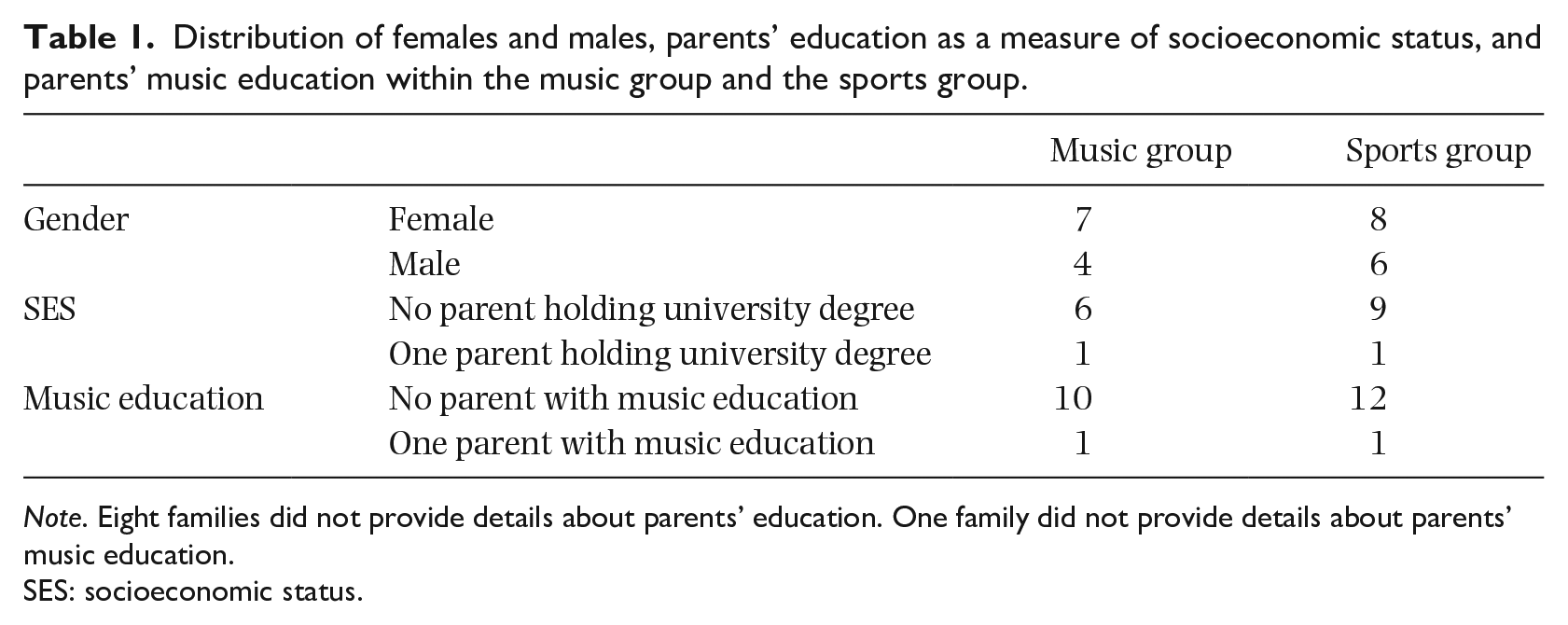
Note. Eight families did not provide details about parents’ education. One family did not provide details about parents’ music education.
SES: socioeconomic status.
Intervention
We took great care to keep the nature of the training delivered in both interventions as similar as possible. This way, we made sure that in our comparison we could disentangle the effects of the different kinds of training from any other potential effects of trainer, duration or times and places of training. All children were trained for 20 minutes three times a week for 14 weeks, irrespective of which program they received. Trained research assistants delivered the different programs, with each research assistant delivering both. To ensure fidelity to the treatment, the research assistants met weekly to go over the protocols as set out in the manual. They carried out the tasks and were evaluated by the authors, who emphasized the importance of compliance with the correct order and execution of tasks, and continuous reflection on the training sessions. The preschoolers were trained in groups of five to seven children. The training sessions took place in a quiet room at the kindergarten. The regular procedure consisted of a short welcome, attendance check, and three to four different tasks.
The music program was similar to the one used by Degé and Schwarzer (2011), comprising the same musical tasks. Only the schedule was different: instead of 10 minutes of daily training, the children received 20 minutes of training three times per week. Also, the overall duration of the training was different: participants received 14 rather than 20 weeks of training. The training program included singing and drumming together, different rhythmic exercises on drums, meter execution tasks, and dancing to different songs. Furthermore, the children were familiarized with pitch intervals in a playful way. Children got the opportunity to play on different percussion instruments. They either had to drum along with given rhythms, or invented their own rhythms. Finally, they learned and performed new songs together.
The sports program consisted of exercises that trained balance, physical strength, endurance, coordination, fine-motor skills, body perception, and relaxation. This program was also similar to the one used by Degé and Schwarzer (2011). The schedule was the same as for the music program, but no further modifications of the tasks were made. As with the music program, the sports program included tasks involving problems that had to be solved individually, such as balancing objects on different body parts, and group tasks, such as playing crab soccer on hands and feet with the belly up.
Both programs were designed to be equally demanding and engaging, with similar numbers of individual and group tasks, progressing from easy to more difficult. And finally, different aspects of the domain of training were covered. In music, these included rhythm, meter, and singing; in sports, they included balance, physical strength, and endurance.
Measures
The dependent variable was inhibition, with age, gender, intelligence, SES, and parents’ music education as control variables. Although random assignment should have ruled out any systematic differences between the groups, we assessed several control variables to confirm this.
The “statue” subtest from the NEPSY-II (Korkman et al., 2007) was used to measure inhibition. The NEPSY-II is a developmental neuropsychological test battery that is extremely engaging and has been used successfully in previous music research (Degé et al., 2011; Frischen et al., 2019). For each test, the NEPSY-II provides age-corrected norm values that were used for scoring. The “statue” subtest assesses motoric inhibition. Children were asked to stand like a statue with their eyes closed, holding a flag, for 75 seconds, and told to suppress the impulse to respond to distracting sounds. The experimenter produced the following distractors: dropping a pencil on the table (at 10 seconds), loud cough (at 20 seconds), knocking on the table (at 30 seconds), and saying “ho hum” (at 50 seconds). After 75 seconds, the experimenter finished testing by saying: “Time’s up.” For the purposes of scoring, the 75 seconds period was divided into five-second intervals. For each interval, the following errors were counted: any body movements, eye openings, and vocalizations.
Children received two points for no errors during the interval, one point for one error during the interval, and zero points for two or more errors during the interval. The maximum score for this subtest was thus 30 points, transformed into age-appropriate scaled scores for statistical analysis. Its test-retest reliability is r = 0.88 for children aged from 5–6 years.
Age, gender, and SES were assessed using a questionnaire. Parents were asked to provide details about their education as a measure of SES. For the purposes of statistical analysis, mothers’ and fathers’ education were coded as a dichotomous variable, with zero for “no university education” and one for “university education.” Parents’ education was then collapsed into a single variable (zero, one, or two parents with a university degree).
To measure intelligence, we used the culture-fair test (Weiss and Osterland, 1997), which measures fluid intelligence. Its five subtests (substitution, mazes, classification, similarities, and matrices) were administered to groups of up to eight children per group. Testing took 60 minutes including instructions and breaks. Age norms were used to determine the intelligence score for each participant. Test-retest-reliability is r = 0.88 for the first part, r = 0.94 for the second part, and r = 0.95 for the whole test.
Design
The study was an intervention study with pre- and post-test using a between-participants design. After completion of the pre-test, all children were randomly assigned either to a music group or a sports control group. Random assignment was implemented using random numbers generated by the Research Randomizer tool (available at https://www.randomizer.org/). The intervention took place after the pre-test and lasted 14 weeks. Training was of same intensity and frequency in both groups. The post-test was carried out after the intervention.
Procedure
After providing their informed consent to their child’s participation in the study, parents completed the demographic questionnaire. This was followed by the pre-test during which the children’s intelligence and inhibition were assessed. The intelligence test was a group test, whereas inhibition was measured individually. The testing was performed on consecutive days by well-trained research assistants who were blind to the training group to which children were assigned. After the pre-test, the children were trained for 14 weeks, and then underwent the post-test. At the post-test, inhibition was assessed again by research assistants blind to the children’s training. After completing the study, each child received a gift (toy, book, or game) and a certificate to thank them for their participation.
Results
Control variables
We checked whether randomization had resulted in two comparable groups by controlling for potential differences in gender, age, intelligence, SES, and parents’ music education.
Gender: The difference between the ratio of girls to boys in the two groups was not significantly different, χ2(1, N = 25) = 0.11, p = .74 (see Table 1 for more details).
Age: The difference between the ages of the children in the music group (M = 71.91 months, SD = 6.07 months) and sports group (M = 71.07 months, SD = 3.97 months) was not significant, t[23] = 0.42, p = .68.
Intelligence: The difference between the measured intelligence of the children in the music group (M = 100.20, SD = 12.93) and those in the sports group (M = 95.18, SD = 15.80) was not significant (t[19] = 0.79, p = .44). The data for this analysis were incomplete as four children (one from the music group and three from the sports group) were not available for the intelligence test.
SES: The difference between the SES of the two groups, as measured by parents’ education, was not significant, χ2(1, N = 17) = 0.07, p = .79. The data for this analysis were incomplete as the parents of eight participants did not report their educational status (see Table 1 for more details).
Parents’ music education: The difference between the music education of the parents of the children in the two groups was not significant, χ2(2, N = 24) = 0.83, p = .66. The data for this analysis were incomplete as the parents of one participant did not provide the relevant information (see Table 1 for more details).
Taken together, these analyses indicate that the music and the sports group were comparable with respect to all control variables, and that randomization ruled out systematic differences in these variables between groups.
Inhibition
Inhibition scores were entered into a 2 (group: music vs. sport) x 2 (condition: pre-test vs. post-test) analysis of variance with repeated measures on the last factor. There was no significant main effect of condition, F(1,23) = 2.61, p = .12, η2 = .10, or group, F(1,23) = 0.04, p = .84, η2= .002. There was, however, a significant group x condition interaction, F(1,23) = 11.77, p= .002, η2 = .34, illustrated in Figure 1. We subsequently calculated dependent t-tests for both groups. For the music group, the inhibition score increased significantly (t[10] = -2.83, p= .02) from pre-test (M = 10.82, SD = 3.79) to post-test (M = 13.00, SD = 1.55). The inhibition scores for the sports group did not change significantly (t[13] = 1.67, p = .12) from pre- (M = 12.50, SD = 2.18) to post-test (M = 11.71, SD = 2.70).

Mean inhibition score at pre-test and post-test in the music group and the sports group.
Discussion
In a small-scale experimental study, we investigated the influence of a music training program on executive functions. In particular, we tested the effect of a group music training on motoric inhibition in preschoolers. We found a significant enhancement in inhibition from pre- to post-test in the musically trained group, whereas the sports control group did not show any improvements. Our findings indicate that 34% of the variance in the inhibition score can be explained by the music training program. Because we randomly assigned individual children to the groups, recruited a trained control group, delivered equally demanding and engaging protocol-based training programs for both groups, the same amount and schedule of training, the same trainer for both groups, and same group sizes for both programs, we are confident in our conclusion that the music training had an impact on motoric inhibition.
Music training and inhibition
Our results are in line with the existing literature on music lessons and executive functions. The studies that have investigated this relationship found that in adults as well as children, music lessons were associated with executive functions (Bialystok & DePape, 2009; Degé et al., 2011; Moreno et al., 2011). In accordance with former results (Degé et al., 2011; Joret et al., 2017; Moreno et al., 2011; Zuk et al., 2014) we found an association between music lessons and inhibition in children. Beyond this positive association, we could demonstrate that music lessons influence inhibition in preschoolers. Our results are congruent with findings from previous studies with school-aged children (Holochwost et al., 2017; Jaschke et al., 2018) reporting an influence of music training on inhibition. Moreover, because of the experimental (albeit small-scale) nature of our study, our findings add to those of earlier studies on the basis of solid evidence. In an experimental study with preschoolers, for example, Moreno et al. (2011) demonstrated the influence on inhibition of computer-based music listening training. In our study with children of a similar age, we also found that music training influenced inhibition, but our training involved group music lessons using real instruments; thus, active music making increases inhibition. Furthermore we argue that the active music making delivered in our training program (closer to real-life music lessons) was more effective than the computer-based music training delivered by Moreno et al., given the difference between the effect sizes reported in the two studies: η2 = .34 for the former and η2= .12 for the latter. Our results also complement the findings by Bugos and DeMarie (2017). Both studies describe the impact of music training on inhibition in a preschool population, although there may have been a difference between the SES of the children in Bugos and DeMarie’s sample and ours. We found a similar effect even though our control group received a different kind of training, further corroborating the influence of music training on inhibition. Additionally, our study could be said to have a broader scope than that of the two other studies insofar as, unlike Bugos and DeMarie who report the influence of music lessons on more cognitively demanding measures of inhibition, we used a task measuring a relatively pure form of motoric inhibition. Our finding that the musically trained preschoolers surpassed those in the sports control group is all the more interesting, as the latter had received training likely to enhance their balance and therefore also their ability to perform the motoric inhibition task. This was not the case. It could be speculated that the musically trained preschoolers were probably not better at balancing, however, but less easily distracted.
Considering the three studies together, we used a similar age group, and randomized children to groups in a similar way, to Moreno and colleagues, and Bugos and DeMarie; these factors might have been particularly important in uncovering the effect. The three studies differed in the kinds of music program and measures of inhibition used. This might point towards the impact of music training on several facets of inhibition, and suggest that several aspects of music training can have an influence.
Taken together, our findings are in line with previous reports that music training and inhibition are associated for children (Dege et al., 2011; Joret et al., 2017; Zuk et al., 2014) as well as adults (Amer et al., 2013; Bialystok & DePaper, 2009). They provide evidence, on the basis of longitudinal research, that music training affects inhibition (Holochwost et al., 2017; Jaschke et al., 2018) and evidence, on the basis of experimental research, that an active music training program (Bugos & DeMarie, 2017) is more likely to promote inhibition than a listening-based program (Moreno et al., 2011). Although different tests were used in these studies, they consistently show the effect of music training on inhibition, indicating a robust association.
Music training and executive functions
There is evidence that music lessons are associated with executive functions other than inhibition (Amer et al., 2013; Bugos et al., 2007; Degé et al., 2011; Jaschke et al., 2018), including shifting, selective attention, fluency, working memory, and planning. However, these results need further exploration to establish a clear causal relationship. Although there is growing evidence for an association between music lessons and executive functions, and for the influence of music lessons on executive functions, the design of most studies does not allow causality to be inferred, therefore more experimental or intervention studies are needed.
An association between music lessons and executive functions is highly plausible, because music making involves the use of selective attention, switching, inhibition, and monitoring (Jäncke, 2009). All these abilities are aspects of executive functions. As we have seen, inhibition (at least) is not promoted only by active music training, but also by a training involving listening tasks only. This might indicate that attentive listening and the inhibition of automatic responses, which are likely to have been developed in the computer-based music training, also play an important role in music making. Yet our music-training program had a considerably bigger effect than the computer-based training program. This could indicate that music making puts a higher demand on inhibition than training in music listening only.
The influence of a music program on inhibition, especially on motoric inhibition, in preschoolers is of high practical significance, because good motoric inhibition skills might be vital for successful participation in the classroom from the beginning of formal schooling.
Music training might represent a playful, engaging way to prepare children for some of the demands of school.
Limitations and future directions
First, it is important to note that our findings need to be replicated with a larger sample size. This would show how generalizable our findings are and provide further insight into the relationship between music lessons and inhibition as an aspect of executive functions. Second, we cannot draw any conclusions about the longevity of the reported effect. Because there was no follow-up after the post-test, we can only speculate on how long lasting the effect might be.
Future studies are needed to investigate the long-term effects of music lessons on inhibition. Third, we used only a single measure of motoric inhibition. Our results would have been stronger if we had used more than one measure. A fourth limitation is the missing data, particularly in relation to SES (eight children) and intelligence (four children). These represent a high proportion of the sample. This information was only used to check that the randomization of children to the experimental and control groups had been successful, however, and because they were randomly assigned, it is very likely that the groups really did not differ systematically.
A good way to investigate the longevity of a potential impact of music training on (motoric) inhibition would be through intervention studies that apply one or more follow-up tests.
Larger samples and more measures of (motoric) inhibition in future studies would support the generalization of the finding that music training enhances (motoric) inhibition. Future studies should try to establish a causal relation between music lessons and executive functions other than inhibition; potential candidates are shifting and working memory. Besides the potential benefit of preschool music training for school success through the enhancement of executive functions, future studies investigating the positive social aspects of music at school and preschool, such as integration, cooperation, and inclusion, are warranted. Finally, besides the association between music training and executive functions and the potential value of music training as a tool to train executive functions, it should never be forgotten by researchers, teachers, parents, and caregivers that music is valuable in and of itself.
Supplemental Material
appendix_(1) – Supplemental material for The Influence of Music Training on Motoric Inhibition in German Preschool Children
Supplemental material, appendix_(1) for The Influence of Music Training on Motoric Inhibition in German Preschool Children by Franziska Degé, Hanne Patscheke and Gudrun Schwarzer in Musicae Scientiae
Footnotes
Acknowledgements
The authors would like to thank the participants and their parents or caregivers for participating in the study, the research assistants who helped with data collection and the anonymous reviewers as well as the editor for their helpful comments.
Declaration of Conflicting Interests
The authors declare that there is no conflict of interest.
Funding
The author(s) received no financial support for the research, authorship, and/or publication of this article.

Supplemental Material
Supplemental material for this article is available online.
References
Supplementary Material
Please find the following supplemental material available below.
For Open Access articles published under a Creative Commons License, all supplemental material carries the same license as the article it is associated with.
For non-Open Access articles published, all supplemental material carries a non-exclusive license, and permission requests for re-use of supplemental material or any part of supplemental material shall be sent directly to the copyright owner as specified in the copyright notice associated with the article.
