



Abstract
This article chronicles the history of the Controller Verein, the professional association of German-speaking controllers, from 1975 to 1989. The association was founded by alumni and trainers of the Controller Akademie, the first institute for advanced studies of controlling in Germany. The article connects the development of the association to the concept of professionalisation of accounting, thereby analysing the path of an association that differs from its Anglo-American counterparts. We used data from the archives of the association, personal archives and conducted more than 20 interviews with protagonists from the association and its institutional context. The article shows how the association has experienced the tension between being an informal club and becoming the primary professional association for controllers in German-speaking countries. However, the results of this study indicate that, due to external circumstances and individual preferences, the original club character dominated the association in the period under investigation.
Keywords
Introduction
Although globalisation harmonises organisational aspects around the world, some organisational characteristics still diverge between countries. This is also the case for (management) accounting, as it varies internationally in terms of occupational identity (see, for example, the differences between the United Kingdom (UK) and Germany described by Ahrens, 1997; Ahrens and Chapman, 2000). Because “[s]tructures of and behavior in present organizations reflect culture-specific historical developments” (Kieser, 1994: 609), analyses of these historic developments can help shed light on the different practices we see internationally. When looking more specifically at the question of how the profession is organised, Carnegie and Edwards “emphasise the need to examine professional formation within its local, time-specific contexts” (2001: 302).
While professionalism as a concept to explain the development of certain occupations originated in English-language scholarship (Macdonald, 1995: 71), it has been transferred to different cultural environments. Prior professionalisation research widely acknowledges that the concept can be used to understand the development of different occupational groups in different institutional settings, even if the institutional environment differs from the Anglo-American one (Abbott, 1988; Macdonald, 1995). Sociologists in areas of continental Europe, particularly Germany, developed an adapted version of professionalisation (Jarausch, 1990; McClelland, 1990a, 1990b; Siegrist, 1988, 1996). The most notable differences in this adapted professionalisation concept are the state as an important actor, the lower importance of questions of professional autonomy in non-Anglo-American settings, and – connected to this – the less important role of professional associations. These characteristics hold true in many cases of professionalisation in continental Europe (on, for instance, the professionalisation of accountants, see Barbadillo et al., 2000; Bocqueraz, 2001; De Beelde, 2002; Evans and Honold, 2007; Ramirez, 2001; Vieten, 1995; Zelinschi, 2009) and may also be the reason for a lack of research on the influence of professional associations in continental Europe. While these associations often lack traditional sources of power, like education and control over work standards, they still have an impact as lobby organisations, exercising “soft” power.
In this article, we therefore present the history of the Internationaler Controller Verein, the closest equivalent to a professional association for controllers in German-speaking countries, which was founded under the name Controller Verein (CV). The article describes the history of the association’s foundation in 1975 and traces its development until 1989 (see Figure 1 for an overview of the main events in the CV’S development).
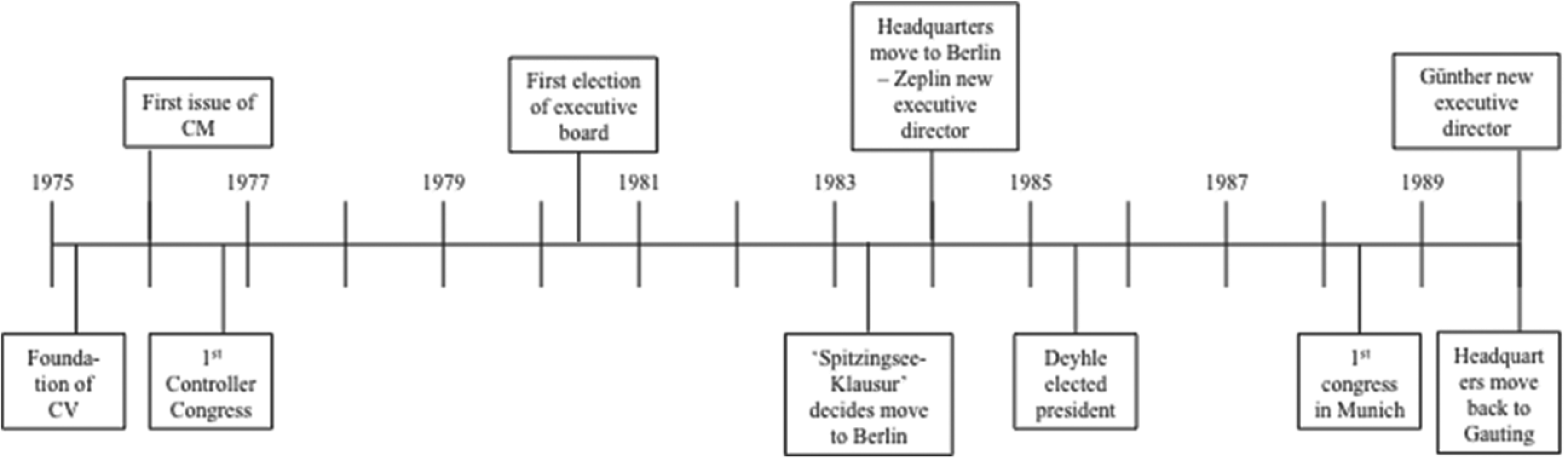
Main events of the CV development between 1975 and 1989.
The history of the association is not only strongly tied to the development of the profession itself, which emerged at the beginning of the 1970s, but also with one of the most prominent protagonists of the emergence of German controlling: Albrecht Deyhle. Deyhle was owner and managing director of the Controller Akademie (CA), a private institute of advanced studies in controlling, whose alumni were the initial reason to found what quickly evolved into an association open to all controllers. As Deyhle played a vital role in both the CA and the CV, we limit our period of interest to the years he was formally in charge of the CV’s development, which means that our investigation stops in 1989 when Dr Deyhle was (for the first time, with the short exception of 1984) neither president nor executive director of the association. We show how important Dr Deyhle was for the association; with him out of office, the association started to change its character, even though he has remained an important player “behind the scenes” right up to today.
During the period under review, the association never tried to gain any official status, for example, by intervening in regulatory processes or by licensing controllers; however, it was a factor in the professionalisation process inter alia as it offered pioneers of the profession a platform on which to come together. Giving a detailed account of this development will contribute to our knowledge of professional associations in countries which follow a form of professionalism other than the “associational professionalism” (Abbott, 1988: 70) dominant in England and former settler colonies. In investigating a professional association that does not have a monopoly over (or even a voice in) the education and licensing of its practitioners, as the British and the United States (hereafter US or USA) accounting bodies do (cf. Annisette and Kirkham, 2007), we cannot necessarily rely on our knowledge about those well-researched associations. Considering the purpose, structure, and actions of this different type of association will advance our understanding of the diversity of the accounting profession and our knowledge about different “sites of professionalism” (Cooper and Robson, 2006).
After a short review of the literature on professional associations in accounting, and a description of the employed method, the article follows a largely chronological order. The foundation of the association out of the CA and the status of the profession at that time are analysed in more detail. The following sections each explore a five-year period of the association, corresponding to the term of the executive board, as well as (roughly) to the development phases of the association. Within these sections, we look at internal developments and external activities. The article concludes with a discussion of the development of the association and puts this in the context of the professionalisation process of accountants.
Professionalisation of accounting in the literature
Professionalisation of accounting remains a key framework for the history of accounting (Birkett and Evans, 2005). Within the professionalisation of accounting literature (see Walker, 2004, for an overview), there are multiple accounts of histories of professional associations, many of which deal with the foundation and early phase of the association. These studies primarily analyse accountants in the United Kingdom, USA, and former settler-colonies (Carnegie, 1993; Carnegie and Edwards, 2001; Edwards et al., 2005; Kedslie, 1990; Lee, 1996; Loeb and Miranti, 2003; Loft, 1990; Parker, 1986; Warnock and Pierce, 2006; Willmott, 1986). The aforementioned studies are mostly concerned with the development of the profession, taking the association as an indicator and representation of this development. In addition to these studies, the “official” histories of the institutes (e.g. Howitt, 1984) give detailed accounts of their respective evolutions. While there is an increasing body of literature on professionalisation in other settings (e.g. continental Europe – see e.g., Caramanis, 2002, 2005; De Beelde, 2002; Ramirez, 2001), these works do not focus on professional associations, because – as mentioned above – these professional associations have a different status and role than those in Anglo-American settings. Edwards and Walker (referencing Kocka, 1990 and Sciulli, 2005) conclude that: occupational sociologists in continental Europe, where the term profession is associated with broader conceptions of the middle class, often understand professionalization processes to encompass more than attempts to establish organisations, institutionalise expert knowledge and entrench occupational monopolies. (2010: 2)
An exception is Bocqueraz’s work (2001), which analyses the development of two French accounting bodies, showing that the professionalism of accounting in France dates back to the end of the nineteenth century, rather than the twentieth century, as previously believed. Knowledge about the social organisation of the profession is important for understanding other accounting phenomena (Cooper and Robson, 2006). By analysing the development of the professional association of controllers, we contribute to “the identification of multifarious experiences across nations and occupations [that] will inform broadly conceived and grounded theorizations of professionalism” (Walker, 1995) and expand the knowledge about the professionalisation of accountants across the globe.
In Germany, a concept of accounting 2 that includes public, financial, and management accounting does not exist. Instead, there are (at least) three distinct professions or occupations with different educational and career paths: Wirtschaftsprüfer (auditor), Buchhalter (financial accountant), and Controller (management accountant). This can largely be explained by the fact that financial and cost accounting are strictly separated within companies (cf. Ewert and Wagenhofer, 2006). However, there is little knowledge about the professional bodies of accountants in Germany. The analyses of the professionalisation of German auditors by Evans and Honold (2007) and Vieten (1995) only touch on the history of the different associations, without shedding light on their roles in the professionalisation process. The same holds true for Markus’s (1996, 1997) history of the auditor profession in Germany. For controllers, the literature lacks any history of the association so far, which limits our understanding of the professionalisation efforts of this branch of German accountants, and consequently of today’s practice.
Method
In order to give a rich and detailed account, multiple sources are exploited. We use archival data from the association as well as from the private archive of the founding member, Albrecht Deyhle. This data includes protocols of general meetings (we use today’s official English terms of the Internationaler Controller Verein as translations for the original German terms) and the managing committee, correspondence of key personnel, budgets of the association, etc. It also encompasses the complete protocols of a regional workgroup, the Arbeitskreis West I (West I workgroup), of which complete protocols were preserved, allowing insight into the rank and file realities of the association. The protocols of the general meetings are particularly helpful documentation because they describe not only decisions made, but also discussions among the members and past activities. This primarily archival material has not been exploited by the literature so far. Articles and textbooks about controlling serve as a second kind of source, giving insight into the institutional environment in which the association operated. This is especially important as our analysis covers the early development of the association, a period during which the evolution of the profession was rapid (cf. Binder, 2006; Schäffer and Binder, 2008). At that time, jurisdictional claims were not settled and there was a dispute involving protagonists from the association about the nature of the profession and the type of work it did.
Additionally, we conducted more than 20 interviews with founding and early members, former and current executive board members of the association, and protagonists of the professionalisation process, mainly early professors of controlling. This was possible due to the fact that the profession in question is comparably young, and the key protagonists of developments are still accessible. From a methodological point of view, interviews allow for insights into historic events, offer new perspectives (Parker, 1999), and facilitate a “better understanding [of] the actions and motivations of those involved” (Parker, 1997, cited in Parker, 1999: 33). The interviews were of huge value for interpreting the archival data and putting them into context. The interviews also allow us to gain insight into the realities of the association and the motives behind developments. While inevitably impacted by all flaws of oral history (Haynes, 2010), the interviews allow us to understand not only the “how”, but also the “why” of the historic development at hand. All of the interviews were conducted in person, either in the (current or former) work environment or the home of the interviewee. Our semi-structured interviews started with open questions to encourage the interviewees to share their experiences. In order to get detailed information about some specific key events, we added more structured questions at the end of the interviews. All of our interviews were audiotaped and transcribed for further analysis.
The emergence of controllers/controlling and the Controller Akademie as forerunner of the Controller Verein
At the beginning of the nineteenth century, business administration emerged as an academic discipline in Germany. Due to the humanistic tradition of German universities and their goal of educating Universalgelehrte (polymaths), which makes them rather lethargic to new developments and reduces their ability to react quickly to new educational demands made by German industry, business administration have their origin at the Wirtschaftshochschulen or Handelshochschulen (business schools) (von Colbe, 1996). One of the first lecturers at those business schools (Cologne) was also one of the most prominent German scholars in management and accounting: Eugen Schmalenbach. He saw that annual accounts should not reflect the value of assets and liabilities at the end of the year but rather show the result of the accounting period, so as to enable managers and holders to manage and monitor the firm’s activities (Schmalenbach, 1920). Schmalenbach accepted the importance of completeness, reliability, verifiability and conservatism in financial accounting (Schildbach, 1997), but he saw the need to separate the elements of cost accounting, that is, costs and benefits, from the elements of financial accounting, that is, expenses and revenues. This idea of separating financial and cost accounting was vital and had a strong influence on the understanding of German cost accounting in particular, and on decision-oriented business administrated in general (Schildbach, 1997).
Based on the work of Eugen Schmalenbach and a strong engineering tradition that brought scholarly work in accounting and the world of manufacturing together, scholars in the 1950s, 1960s and 1970s developed the concept of Kostenrechnung further (Mattessich, 2008; Schäffer, 2013). They did not limit themselves to design systems, but also emphasised the role cost accounting should play in future-oriented decision-making (e.g. on pricing or on the production programme), as opposed to a more backward-looking perspective of the past, or mere documentation (Bungenstock, 1995; Mattessich, 2008; Schildbach, 1997). One example is the concept of Grenzplankostenrechnung (GPK), which was developed by Professor Wolfgang Kilger and Hans-Georg Plaut, a consultant (Kilger, 1976, 1980; Plaut, 1953). It is characterised by a separation of variable and fixed costs (based on production theory), the concept of profit contribution as direct revenues minus direct costs (based on decision theory), and a focus on the planning and controlling efficiency in cost centres.
While academic research on cost accounting thrived and cost accountants were employed in most companies, the concept of the controller remained largely unknown in Germany until the 1960s. After the end of World War II, the foreign minister of the US set up the European Recovery Program (ERP) – also known as the Marshall Plan. In the course of the ERP, the US helped European professionals to go to the States to experience and learn from the American economy and its organisations, which were perceived as superior during that time. Due to this American support, more than 236 study trips by 1,386 professionals (mostly top managers, entrepreneurs, and unionists) were realised between 1950 and 1957 (Pohl, 1996), and documented in 90 books called the Blaue Reihe (Blue Volumes). The broad scope of topics of these trips ranged from “management by planning and monitoring” (Betriebsführung durch Planung und Kontrolle) to “women’s outer garments industry in the USA” (Damenoberbekleidungsindustrie in den USA). British industrial accountants, as members of the Anglo-American Council on Productivity, visited the US in the early 1950s as part of the ERP exchange, where they analysed financial accounting, cost accounting, and company management at different hierarchical levels. The British report was translated into German in 1951, and it contains the first German reference to the term “controller” can be found (RKW, 1952). The report addresses the different roles of accounting, the decentralisation of responsibility, and the control mechanisms of managers that enabled decentralisation. According to the report, the tasks that were assigned to the controller are the analysis of accounting data and the reporting function. The German epilogue to the translated Council of Productivity report contains comments by the translators describing the terminological difficulties they encountered due to conceptual differences, and explanations of their choices for key terms. While they translated “accountant” as “Fachmann für Rechnungswesen”, they left “controller” untranslated because the “term, denomination, position and function [… were not] known or [were known] only as the unshaped beginning of a partial function in Germany” (RKW, 1952: 109–110). Though the translators emphasised that the English word “control” does not mean the same thing as the similar German word Kontrolle, (monitoring/surveillance), the similarity between the two words remained closely associated with the use of the term “controller” in Germany for the next 40 years. These initial study reports were followed by other articles published throughout the 1950s on the US concept of the controller (Ahearn, 1954; Auffermann, 1957; Gälweiler, 1957; o.V., 1956; Pochmann, 1958; Weilenmann, 1958; Zastrow, 1955).
Even in the 1960s, controller positions in Germany were mostly limited to German subsidiaries of US companies (Weber and Schäffer, 2011). This changed quickly afterwards: according to a McKinsey survey, 90 per cent of the 30 largest German companies already had controller positions established in 1974 (Henzler, 1974), although they were not always named that way. Other studies provide supporting evidence for a strong increase in controller positions in the late 1960s and the 1970s (Richter, 1987; Weber and Kosmider, 1994). This increase was mainly due to a combination of three factors (Binder, 2006; Schmidt et al., 2012). First, a shift from seller to buyer markets towards the end of the Wirtschaftswunder and also external shocks, such as the first oil crisis in 1973, increased cost pressure and the demand for future-oriented analyses. Second, an increasing pressure to be closer to the consumer and to react flexibly to market changes, as well as the increased internal complexity of companies, resulted in divisionalisation. The dominant control structure moved to cost and profit centres; this new organisational form required planning and control procedures different from a functionally organised firm (e.g. Chandler, 1973) and thus contributed to the spread of Grenzplankostenrechnung with its focus on planning and controlling efficiency in cost and profit centres. Third, the invention of office machineries and the development of information technology enabled the collection and analysis of far more information than before, leading to new tasks like condensing new information, as well as making some former cost accountants’ tasks, such as consolidating cost accounting sheets, redundant (see e.g., Holzer and Norreklit, 1991).
Cost accountants were increasingly aware of the demands associated with these developments and claimed jurisdiction by stretching their role to perform the new tasks (Schmidt et al., 2012). Also, public visibility of the controller debate increased in the mid-1960s. First, university professors became interested in the new concept, and the first dissertation on the topic was published in 1965 (Kröckel, 1965). The first merely scientific monography can be interpreted as important “because professions rest on knowledge, and universities are the seat of knowledge in modern society” (Abbott, 1988: 195). However, the fact that this dissertation analyses the controller in the US rather than Germany can be seen as evidence of the slow diffusion of the concept in Germany.
This situation changed, that is, the audience grew significantly when the discussion spread from specialised journals and dissertations to another medium – a major economic newspaper. In 1965 and 1966, the Frankfurter Allgemeine Zeitung Verlag, which also printed one of the largest newspapers in Germany, published two articles about the US controller in its economic newspaper Blick durch die Wirtschaft (Greitz, 1965; Heimann, 1966). These articles are particularly interesting due to the reach and importance of the economic newspaper within the discourse of public opinion (Abbott, 1988: 59f.). The article by Greitz summarises the controller debate and describes the points stressed within it, such as the difficulties in translating the terms “controller” and “control”, the difference between the controller and the (chief) accountant, the low relevance of historic cost information, the importance of the budgeting process and the role of the controller in this process, and the prioritisation of reporting speed over the 100 per cent accuracy of figures. The article generated many questions among readers (Horváth, 1979: 68), leading to a second article one year later (Heimann, 1966).
Another important step for the diffusion of the controller concept was the foundation of the CA in 1971 by Deyhle, who was familiar with Grenzplankostenrechnung because he had worked for Plaut Consulting from 1962 to 1963. Most seminars were in-house at that time; only rarely did Deyhle hold public seminars. This changed with the foundation of the CA: now it became part of the value proposition for attendees from different companies to visit a seminar and exchange their day-to-day work experiences – a principle that can later be found in the CV. In 1970 and early 1971, Deyhle gave mainly one-day (and, occasionally, two-day) seminars, often named “information days”, to inform the interested public about the work of the controller. This reflects the fact that controlling (in fact, the term did not even exist during that period) and controllers were not that prominent in Germany at that time. Thus, assigning the name Controller Akademie was a risk at a time when controllers were still “alien” in German corporate practice. The term “controller” was used again in the name of the association and the magazine. In addition to Deyhle’s seminars about controlling, the academy offered seminars on “soft skills”, for example a rhetoric seminar. These were abandoned a few years later.
The first seminar lasting a full week was held in November 1971. Deyhle incorporated his view on the controller and the tasks of the controller into his seminar, which also became the understanding of controller and controlling held by the CA. The controller was seen as: […] an economic pilot or navigator […] he is someone who supports the captains of sales, production, R&D or purchasing to navigate their ships through rough seas by using the information out of numbers. […] The controller does not monitor anyone, rather he enables everyone to control the performance of himself/herself against the corporate targets – particularly the profit target. […] The controller’s work is customer-oriented. He is an information purchaser. He is performing a management service in the sense of planning and controlling. (Deyhle, 1971: 9–10)
As the quote illustrates, Deyhle and, accordingly, the CV assigned the controller a supporting role for managers. Particularly, the controller’s tasks encompass cost accounting, corporate planning, profit-centre organisation, and decision support for managers. This interpretation of the controller role was incorporated into the five-stage programme of the CA that was soon to be developed – and was not yet planned. Quite the opposite: Deyhle found it very risky to offer a full-week seminar. However, the seminars were well received, and participants wished to continue with the seminars so as to practise the content further. Deyhle recalls: And then the participants said, “That was very much content, you should elaborate this more. We need to deepen our understanding. You told us about costing, but we need to know more. And we need to practice. And we want to implement this, and need to discuss between each other how this worked”. (Deyhle, Interview)
The seminar participants’ wish to discuss the experience with one another stemmed from the same motive that would lead to the foundation of the CV four years later and would remain a leitmotiv for the association. Deyhle decided to build a staged, five-course programme, in which each course would last one week, and build on the others. The first course contained an introduction to the concept of controlling, the second focused on cost accounting and finance, the third focused on leadership, and stages four and five focused on controlling in practice. This course programme guaranteed that the attendees would meet each other again and again in the courses, because all stages had to be done sequentially.
The demand for courses was so high that the CA needed a second trainer, Blazek, who started in 1974. The CA now had two trainers for the controlling seminars; additional trainers were used for specific content, for example, a psychologist for certain aspects on leadership and feedback sessions. In the same year, the first stage-five course took place, and this was planned to be the final seminar of the series. It was jointly held by Deyhle and Blazek; Deyhle recalls how the participants were in a depressed mood on the last evening, and he was worried that they were unsatisfied with the seminar. Instead, however, the participants wanted to meet again after having spent so much time (five seminars each lasting a week) together.
The first years of the Controller Verein: The foundation
The CA participants wanted to organise a regular get-together where they could meet to discuss problems they were facing in their day-to-day jobs. Deyhle suggested founding an association instead, largely for practical reasons. For meetings with a professional association, members’ employers could pay travel expenses, allow special leave for the meetings, etc. This would not have been possible if the participants had met in a less organised way. In order to be able to meet regularly, it was suggested that regional workgroups should be set up. The foundation of the association was in part “bottom-up” through the work of early professionals; people who understood themselves to be “controllers” wanted to meet on a regular basis to discuss problems they faced in their work. It was Deyhle who organised the whole process of creating the association.
The association was founded on 15 February 1975, after the initial appointment with the notary public on 29 January of the same year had to be cancelled. The association was officially founded before the notary public Dr Friedrich Kastenbauer in Augsburg. In Germany, every association has to be founded by at least seven persons. The founding members who met in Augsburg were Dr Alfred Blazek, Dr Albrecht Deyhle, Mr Heinz Dietz, Mr Erwin Helffenstein, and Dr Kurt Jehle. In addition, Dr Erwin Küchle and Dr Walther Germeroth each signed a power of attorney to found the new association. Dr Deyhle and Dr Blazek were both trainers at the CA, Mr Dietz and Mr Helffenstein were controllers and attendees of the five-stage course, and Dr Jehle was a close friend of Deyhle. Dr Küchle was a psychologist and was responsible for certain elements of the CA courses, and Dr Germeroth was a director at Suchard, one of Deyhle’s first customers, from even before the CA was founded. Mr Rudolf Rieger became the first ordinary member, and he also became the internal auditor for the CV (and would keep the position during the period under review). At the time of its foundation, the association had to have a constitution, which was written mainly by Deyhle and Jehle. The constitution contained many elements that were important for the CV, and indicated much about the governing principles of the association. The purpose of the association according to the constitution was:
§2 (1) […] support and diffusion of state-of-the-art techniques and tasks in the area of controller-activities, in company practice, on a practical and scientific basis. (2) This includes especially
the scientific and practical support of modern leadership (especially leading by objectives) the scientific and practical development of corporate planning and of cost accounting the information about controller tasks and techniques for business the support of the scientific and practical education for employees in the controller task area the support of relationships to similar organisations in Germany or abroad (3) Theses tasks are fulfilled by
implementation of groups to exchange experiences and workgroups conducting talks, conventions, and congresses publishing of journals and other outlets holding of exams, including licensing, which everyone is able to take, through special committees.
The CV was an informal club of CA alumni that claimed tentatively to be the professional association of controllers in German-speaking countries. Early members during the pioneer stage of CV were typically top or middle-level managers, not always with “controller” as their official occupational title. Together with the growth in membership, the structure changed somewhat, including more junior positions as well as more consultants and trainers, who used the CV as a platform. The goals of the association included elements with an internal focus on supporting its members, which is not surprising for an alumni club. These elements encouraged the group members to exchange experiences with one another. In addition, many elements had an external focus such as the annual congress, which is more typical for a professional association. Although the CV was founded by seven people who were closely tied to the CA, and arose out of the CA alumni’s wish to meet again, the association understood itself, to a certain extent, as an association for controllers in general. However, this claim to being the professional association was never followed up systematically due to the individual preferences of the main protagonists (mainly Dehyle); this will be explained in the course of this article. Nevertheless, the efforts of the CV to assist “the support and diffusion of state-of-the-art … techniques” indicate that the CV tried to lobby for the controller role, which is also exemplified through the means by which the goal should be fulfilled: only point (3) a) of the CV constitution has a focus on members; all other points are externally focused to make the concept of the controller more familiar in business, especially through congresses and journals. Point (3) d) of the constitution is interesting because it touches on the question of “closure”, one of the key concepts of professionalism (Larson, 1977; Macdonald, 1995). However, our interviews showed that the internal purpose of the association was the main aspect stressed, which also corresponds with the activities in the initial years. “Exchange of experience” and “mutual consulting” were two frequently repeated phrases from the interviews. These goals were mainly pursued at meetings of the regional workgroups.
Full membership was only granted to people who “work in business and perform or have performed activities in the controller area or similar areas” (§3, (1)). Technically, this excluded people working in public administration, an area in which controllers were unknown at the time in Germany. Additionally, it excluded consultants and trainers, a rule that was never strictly applied. Both persons and legal entities, such as companies, could become sustaining members. Companies did not have the right to vote, however, which guaranteed that companies would not gain too much influence over the association – this was particularly important from Deyhle’s perspective.
It was agreed in the constitution that three bodies were responsible for the governance of the association: the general meeting, the board of trustees, and the managing committee. The board of trustees would not be implemented for more than 25 years after the foundation of the association and is therefore not assessed further in this article. The managing committee consisted of three members: a president, a vice-president, and an executive director (see Appendix 1 for an overview of office holders). The general meeting would elect two members of the managing committee for a term of five years. They would then appoint an executive director for four years, and the managing committee would elect which of its members would become president and vice-president. Everyone but the executive director worked on an honorary basis. This constitution concentrated a lot of power in the hands of only a few individuals. The managing committee, with only three members, was comparably small. Further, only two out of its three members were elected in the general meeting. There was no mechanism to vote any managing committee member out of power before the term ended. The constitution reflected the strong influence Deyhle wanted to have on the association; it was not an association steered closely by its members. The term of five years for the honorary president enforced this notion. This is a long term compared, for instance, to a professional association like the National Association of Accountants, which Deyhle knew well at that time.
According to the constitution, the first members of the managing committee were elected by the founding member(s). In reality, the first members were picked by Deyhle strategically to represent controllers working not only centrally in headquarters, but also locally in plants or business units. Dietz became president; he was the chief controller at Lurgi, a plant engineering company based in Frankfurt. Helffenstein, who worked as a controller for a business unit at Henkel in Düsseldorf, became vice-president. Deyhle became the first executive director.
The attendees of the stage-five course were invited to join the CV in a letter sent out by Deyhle shortly after the association was founded. Attached were the constitution of the association and an application for admission. Deyhle’s letter formulated, for the first time, a condition for members that was not in the constitution, but regulated the admission of new members for the next several years. It stated: It is consensus also in the currently on-going stage five that full membership can only be granted to people we got to know through work – that are attendees of stage five and members of the workgroups of the Controller Academy.
This principle was stressed by Deyhle several times during our interview, and was applied in the first years of the association to guarantee the alumni character of the association and protect the association against external (political) influence. This policy changed when Dr Zeplin became the executive director of the association in 1984. The revised invitation letter stressed both the alumni-type character and the external dimension of the association.
The association should, as you know, be a platform to exchange ideas and experiences; but it should as well shape the image of controller tasks and controlling in the public.
The annual membership fee amounted to 60 DM, including a subscription to Controller Magazin (CM). Publishing a magazine about controllers was (again) Deyhle’s idea, independently of the association; at that time an unpublished pilot issue had already been produced. Deyhle had founded a publishing house a few years earlier when he started to work as a freelancer, with a printing machine in the cellar of his house; this publishing house was well suited to publishing the magazine. It was planned that the magazine would increase the perceived value of membership and serve as a selling point for the association; on the other hand, a large share of the membership fee was needed for the magazine, a point that caused some discussions between members of the association. The association guaranteed a base of subscribers, even if they paid a significantly reduced price, and enabled the foundation of the magazine. The first regular issue was published in January 1976. This again illustrates the intertwining nature of the association with Deyhle’s other activities, and his strong influence on the diffusion of the controller and controlling across Germany.
In addition to the magazine, the annual Controller Congress was an element that was visible to the public; the congress, as a central element of the CV, was planned by Deyhle right from the very beginning, as evidenced by a letter from him that includes the date for the first congress: 24 May 1976.
The beginning
In the following pages, we will analyse the setting-up of four elements of the association which defined the association over the next 15 years: the congress, the general meeting, the controller magazine, and the regional workgroups. The magazine and the congress were the two most influential ways to lobby for the controller and to be visible to the interested public. Because the association did not control the education or licensing of its members, and because professional standards did not exist, these two elements became vital for the CV. Moreover, the congress was the main source of income for the association. In the first year, regional workgroups were implemented and met frequently, thus fulfilling the members’ wish to see each other regularly.
The congress
The first congress took place on 24 May 1976 at the Steigenberger Airport Hotel in Frankfurt, with the title “Current tasks and the position of the controller in company practice”. The role of the controller and related questions like their tasks, organisation of the department, and responsibilities were the focus of the congress, rather than specific technical questions. All speakers came from corporate practice; in 1979; the first academic speaker made an appearance in 1979. While the attendees were primarily practitioners, an analysis of the attendance list reveals that some professors and doctoral students were also present. In total there were 217 attendees, making it a big event for the young association. The participants came from large corporations and smaller companies alike, with middle to upper management forming the larger part of the audience. Members of the CV received a discount of 70 DM off the normal fee of 235 DM.
The congress was a success for the CV in several dimensions. The congress, with more than 200 attendees, was a good stage from which to introduce the association as an institution to the interested community. Additionally, the congress made a profit of more than 15,000 DM according to the annual accounts of the CV, and had a turnover of more than 46,000 DM. This was a valuable and necessary source of income for the association.
While legally the CV was the sole host, legally, the marketing flyer mentioned both the association and the CA. The CA was clearly the stronger “brand name” at that time and was a well-known institution for controllers. It is not clear whether this was the reason for including the CA on the flyer, whether the CA was to profit from such an event, or whether a mix of motives was responsible for the decision. Certainly, it tied the CV to the CA in the public eye.
The first general meeting
The first general meeting took place on Sunday, 23 May 1976 at the Steigenberger Airport Hotel in Frankfurt. It took place on the day before the congress – an arrangement that is still in place today. Thirty-eight members were present (in comparison with 88 members at the end of 1976). The meeting was preceded by a meeting of the workgroup leaders and the managing committee. A debate took place around the question of whether to keep the subscription to the CM as a part of the membership of the association. The status quo was that the subscription to the magazine was included in the membership fee of 60 DM. However, the subscription fee for the magazine paid by the association, while cheaper than the normal subscription fee, was almost as high as the membership fee. In 1976, income from membership fees was 5,280 DM, and the subscription income from the magazine was 4,590 DM. The only other source of income was the congress, which generated the lion’s share of the income, but was not a secure source. The general meeting produced a unanimous vote (with one abstention) to include the magazine in the association fee. More controversial was the following debate on the level of the membership fee. Since subscription to the magazine was maintained, there was a need to increase the fee; however, the suggestion to increase the fee to 100 DM was rejected by a vote of 21 to 16. The following suggestion to increase the fee to 80 DM was accepted.
Questions related to the activities of the association and its character were discussed as well. One central question affected the acceptance of members in the association and in regional workgroups. The protocol records the answer of the president that the meeting of the workgroup leaders backed the strategy that “the acceptance of new members and a certain rotation is welcome, but that this should be done selectively”. The principle that “full members can only be those whom we got to know through work” was affirmed. Membership applications by letter from people unknown to the association or the CA were thought to be undesirable. The second, and longer, discussion point was the question of whether the association should try to achieve a voice in regulatory processes. While Deyhle supported this in principle and suggested that one of the tasks of the association one day would be the formulation of “generally accepted controlling principles”, he stressed the point that this would be a long way off, and the congress would be an important element in this process.
The Controller Magazin
The first issue of the CM appeared in 1976. This new monthly magazine was the first professional magazine with “Controller” or “Controlling” in the title in Germany. The publisher was the Management Service Verlag, founded by Deyhle a few years earlier. The official publisher was not the association, as planned in the constitution, but the CA. The masthead, however, noted that “CM is an organ of the Controller Verein e. V., München”. This kept the magazine de facto in the hands of Deyhle, but connected it to the association. It is doubtful whether the association would have had the resources, that is, in terms of finances and personnel, to publish a magazine, so this arrangement was not debated and Deyhle’s influence was affirmed.
The way in which the association participated in the magazine was not very formalised. There was no regular column, page, or anything similar through which the association reported. However, in the first pages of every issue, the purpose of the CM was stated as a “collecting point for work results of the Controller Akademie and Controller Verein” (CM, 1976: 2). In addition, the first CM editorial was written by Dietz, then the president of the association – a clear sign of the bond with the association. He introduced the association and connected it to the academy and the magazine: On this difficult and interesting career path, the Controller Akademie wants to be your partner for the “training”, and the Controller Verein for the “clearing”, which means an exchange of experience between well-respected professionals. Through the Controller Magazin, you will have the possibility to follow us and to participate actively, as well as improving your professional work.
The first issue provided a brief report on a CV event, which was called “Controller’s Erfahrungsaustausch” (“Controller’s Experience Exchange”) in October 1975. This article did not include much general information about the association, and there was no active advertising of it.
The articles that were published within our time period of interest (1976–1989) cover some core topics and more en vogue themes, which were only of interest for a short time, meaning that they were only covered by one or two articles in total. In the first issue, the CA and CV’s understanding of controlling was published in the CM. From their perspective, controlling means: … calculation and planning and convincing employees to support these activities. [The person] who is executing the controller function has a service task: In [the] sense of accounting’s and corporate planning’s tool shop as well as [in the form of] tool setter for the management where controlling tools are needed. (CM, 1976: 38)
In the sixth CM issue in 1976, the understanding of controlling was picked up again and corroborated: Controlling, interpreted from a business administration perspective, means the translation of tasks in numbers; or requesting tasks because of the numbers. The structure of numbers defines the feasibility of the tasks and, accordingly, the firm’s ability to survive. […] The controller is offering a service function. He has to be able to offer the instruments [for] navigating […] and a controller has to persuade for the consequences that are based in the numbers. (CM, 1976: 214)
Due to the strong connection between the CM and the CV, that is, the fact that the CM was characterized as a collecting point for the work results of the CA and CV, the abovementioned descriptions reflect the CV’s understanding of controlling to a large extent.
Moreover, from 1976 to 1978 several articles in different issues of the CM focused on the controller role, and gave attention to topics such as whether the controller is a professional or not, how controllers support the executive board, whether controllers are “stressors”, the transition from bean-counter to controller, and a role comparison with the certified management accountant (CMA). During the later 1970s, these topics were supplemented by en vogue themes such as “pricing”, “budgeting and cost monitoring”, “internal transfer prices”, “investment controlling” and “controlling and electronic data processing”. At the beginning of the 1980s, the core topics of the CM changed from the “role model of the controller” to “controllers’ tasks and [the] controllers’ organization”. Tasks and organization remained recurring topics until 1989. Articles covered topics such as “controlling for the controller him/herself”, “controller and evaluation analysis”, “controlling in multinational firms” and “organization of the controlling department”. In addition to the controller him/herself, a couple of regular topics focused on the functional perspective – that is, controlling. From 1984 to 1989, “marketing controlling” and “project controlling” articles were published frequently, and the German controlling community discussed aspects like “market information and demand planning”, “customer profit accounting”, “customer controlling”, “sales force controlling by marginal costing” and “controlling within the R&D department”. Overall, the CM as a journal was an important step for the profession, serving as a “signal of movement” (Lee, 2006: 7) and as a platform for open discourse about important aspects of the new controller profession, such as the role of controllers or their tasks.
The regional workgroups
One of the main activities in the initial years was the foundation of regional workgroups. By the first general meeting on 23 May 1976, the workgroups South (led by Mr Kohlbauer), South-West (led by Mr Neidlinger), Central (led by Mr Trosch), North (led by Mr Kühl), Switzerland (led by Mr Real) and Vienna (led by Dr Blazek) had already been founded. A workgroup normally consisted of 15 to 30 people; members of workgroups were also meant to be members of the association, but this rule was frequently neglected. A workgroup had a leader, appointed by the managing committee, who was responsible for administrative tasks, like the compilation and update of member lists. Most workgroups met twice or three times a year at the company offices of one of the workgroup members; meetings typically lasted a full day. The bulk of the meetings was reserved to discuss technical topics and open questions from members, complemented by a presentation by the hosting company. The regional workgroups were very important for the CV; they were the core of the association’s activities. The CV was founded out of the wish to meet and discuss frequently, and the regional workgroups offered the possibility to do this.
While the workgroups met independently of the managing committee and organised their meetings on their own, they sent protocols of their meetings to the headquarters. This guaranteed that the headquarters was informed about what was going on in the workgroups, and could see how many members of the workgroup were members of the association. The fact that the leaders of the workgroups were chosen by the managing committee, and the tight information policy due to the meeting protocols, allowed close control of the regional groups by the headquarters. On some occasions, managing committee members (mostly Deyhle), or trainers of the CA (Blazek in the first years) visited the meetings to give talks or lectures about certain topics. The members also met on a supra-regional level at the “Controller’s Experience Exchange” on 9 and 10 October 1976 in Feldafing, near Munich. In previous years, a similar event with the same name was organised by the CA, but now the association took over the organising role.
The workgroup leaders, although not an official body of the association, formed a very important group within the CV. They met once a year with the managing committee to discuss the strategy of the association. These workgroup leaders worked on an honorary basis as well, and usually used the infrastructure of their employers, including their assistants, to administrate their workgroups. This group of people, who were handpicked by the managing committee, was the backbone of the association; it was their dedication that constituted the association. To further advance the cohesion of the group, Deyhle organised frequent, typically once a year, family social events (e.g. a raft ride).
One more regional workgroup (the seventh) was founded in 1976: the workgroup “West”. Mr Helffenstein, the vice-president, was the workgroup leader. Deyhle sent out a letter on 21 October 1976 to those alumni of the CA who lived near Düsseldorf, advertising the new workgroup. According to the letter, which was sent out to 23 people, the main goal of the workgroup was “professional small talk, the chance to ask questions, discuss technical problems, and compare experiences with a group of people who have the same concept in mind and use the same language”. The first experience exchange, as the meetings were called, took place on 28 January with 18 participants, of which five came from Henkel, the company at which Mr Helffenstein worked. The results of the meeting were put in writing under quite a formal protocol, stating the aim of the workgroup: The work group West pursues the goal of bringing work-related problems of the controller’s work closer to a solution.
The protocol stated the means as well: A problem-oriented discussion with an exchange of participants’ experience should serve this purpose. “Purely” seminar-like work should be avoided to a large extent.
The locations of the meetings varied, but were meant to be the company offices of the participants or “neutral” places, which presumably indicated hotels. It was planned that the workgroup would meet three times a year. The group wanted to discuss multiple topics at each meeting, and decided on a perpetual list of prioritised topics, of which the first three would be discussed at the next meeting:
Planning assumptions, coverage of planning, detail of planning
Purchasing, renting, leasing
How to deal with fluctuations in market prices in the earnings statement and planning.
The workgroup alternated between being demonstratively informal and using very formalised language, like that used in corporate board meetings, mirroring the association’s efforts at that time. While it was stressed that the meeting took place “between colleagues”, with the peer-level character of the meeting emphasised, a formal protocol with formalised group goals was written and distributed. However, these formalised aspects could also be interpreted as a result of Deyhle’s ambition to be in charge of all activities of the CM, CA, and CV.
The build-up
The terms of the managing committee provide a good frame for analysis of the development of the association as they represent natural phases of the CV’s development due to the elected persons in charge, who had a strong impact on the CV. This time could best be described as producing slow but steady growth, without drastic changes in the direction of the CV.
Activities
The congress remained the main event for the association. Over the next seven years it took place in the same hotel in Frankfurt. The number of participants increased slightly, but remained relatively stable. In 1977, the congress had about 240 participants. Topics still involved the broad concept of controlling: “The collaboration of the manager and the controller in corporate control” (1977), “Controlling in action” (1978), “The controller […] and others” (1979), and “Controller practice as a team” (1980). Speakers came mainly from company practice. In 1979, the first professor, Professor Popp from the University of Bern, spoke about “Optimal budgeting”.
In 1980, the organisation of the congress changed marginally. For the first time, the congress lasted over two days. It included not only speeches or a panel discussion, but also workshops, which took place in smaller groups of participants and were more interactive. The workshops were called PROLÖT, an acronym for Problem-Lösungs-Team (problem-solving team). The speeches were still mostly on quite broad topics, but the workshops dealt with concrete technical questions. The new congress format was quite successful, with 254 participants.
On a supra-regional level, the CV hosted an annual symposium in 1976 and 1977. This was abolished in 1978, due to opinions expressed in the general meeting that the regional workgroups were already quite time consuming – an indication that these workgroups were well established. Instead, an expert symposium was organised in 1978, which was open to the public but included reports from the regional workgroups as well. This symposium had the function of a small congress. It took place in late autumn, while the official congress took place in the spring. It bumped along and made a small surplus of ca. 400 DM. The symposium took place in 1979 and 1980 as well, but always remained very small. In 1980 it had only 17 participants, with similar attendance in the years before.
Apart from these efforts, the association was not greatly visible to the outside world. Public relations did not take place on a systematic level, and therefore the association was mentioned only rarely in articles about controllers. One exception is a short article by Klaus Neidlinger (Neidlinger, 1977), himself a member of the CV, in the Wirtschaftswoche, an important weekly business magazine in Germany. The article describes the new profession of the controller; a small box on the same page mentions the CV as the official professional association. The lack of public relations work was due to various reasons. First, the association did not aim to grow aggressively; it was not keen on members who heard about the association and applied for membership anonymously. Second, the association did not have the resources for active public relations work, since the managing committee members worked on an honorary basis. The same applied to the workgroup leaders, who, while very active internally, did not have the authority to speak for the association. Only one person was granted the right to speak for the CV as an institution: Deyhle himself, who was a well-known figure in the community and was frequently cited in articles.
The main work took place in the regional workgroups; this is reflected in the protocols of the general meetings. In all protocols from 1976 to 1980, the report about the activities of the association, presented by the president, started with a report about the activities in the workgroups. Some of the presentations and discussions were made public in the CM, for example, the Central workgroup discussed questions of R&D-controlling and published an article about that topic in the CM (Controller Magazin, 1977).
Internal developments
The membership base grew steadily from 152 members in 1978 to 254 in 1980. Still, the CA was the main source for new members, which strengthened the alumni character of the CV. A reason for the limited application outside the CA could be that there was no active marketing for new members who were non-CA. However, the CV’s constitution arranged for the possibility of companies becoming long-term members. This was debated, especially in relation to the fee level, at the general meeting in 1977. While no fixed fee was decided on, a minimum of 500 DM was set. Companies could, in principle, decide how much they were able to give, with 1,000 DM as a guidance level. There was a broader debate about whether company membership was needed at all, but because of the tight budget, there was no strict decision against this. Some members agreed to support such memberships for their companies, however this was not implemented within the next several years. The issue was discussed at the general meeting in 1978, but due to time constraints on Deyhle who as executive director and face of the CV was the key figure in this effort, no progress was made. Over the next several years it was neither implemented nor discussed. Support for company membership was never high, as interviews revealed the association understood itself as a club which was owned and governed by member. This would be threatened by the implementation of company memberships. Particularly, Deyhle saw a danger that firms would call for more rights to control the direction of the CV, as Dr Zeplin said: Dr Deyhle mentioned “if a corporation pays more than an individual member, the corporation wants to contribute or control more, that’s natural. And the membership fee could be written down and we could say: X percent or shares or voting rights or so. However, this would mean that we wouldn’t be able to determine the direction [of the CV]”. (Zeplin, Interview)
Additionally, Deyhle interpreted the CA and the CV as his lifework, and was therefore keen to keep it protected from extra-associational influences (such as firm influences) in the long run. Therefore, he was mindful that firm memberships could limit the possible options in terms of transforming the current organisation of the CA and CV into something that was in his interest.
Administration of the CV was done by the staff of the CA. Deyhle did not want the association to incur labour costs, for formal reasons and because of the volatile earnings situation of the association, so the CA took over the administrative tasks and invoiced the cost to the association. In the early years the association was not charged the full cost, but only the amount it was able to pay while making a small surplus, as Deyhle officially stated at the general meeting. Although no one could check the correctness of the claim and the bill, because Deyhle was the owner of the CA and executive director of the CV, the amount seems plausible if one analyses the development of the administrative costs in those years and compares it to the costs a few years later (for example, after the move to Gauting, the administrative costs tripled), when the CA was no longer responsible for the administration.
The question of formally licensing controllers arose at the general meeting in 1978. This was a recurring question for the association, as it was concerned with the structure of the profession and the role of the association. In only the second issue of the CM, Deyhle wrote on the question “Is the management-calculator (Management-Rechner) a profession?”. He mentioned that for financial accountants there is an exam and a diploma, while there is no equivalent for controllers. The article mentioned that a “Certified Management Accountant” similar to the CPA had emerged three years previously, and it went on to ask the following: Question: Are there tendencies for something similar to emerge here? Maybe the introduction of the “Licensed Controller”? The training programme of the Controller Academy is only constructed to accomplish the job in companies in the area of accounting, planning, and leadership. But the factor of a systematic education towards the controller is included in our five-stage programme – maybe one day including examination. (Deyhle, 1976)
Deyhle’s short statement clearly reflected the fact that the CV compared itself to the Institute of Management Accountants (IMA) rather than other associations like the Financial Executives Institute (FEI) that were more focused on top-level managers that control the organizational accounting function. The discussion about some kind of certificate was connected to recent developments in the CA. Up to this point, there had been no further advanced courses after stage five; this changed in 1978, when a series of three seminars, mostly for alumni of the stage-five course, took place. The seminars focused on accounting (seminar 1), planning (seminar 2) and leadership (seminar 3). The CA considered the possibility of ending this seminar with an exam leading to, which would lead to the “Controller’s Diploma CA”, a private certificate which should reflect the competency of the certified controller rather than indicating a closing of the profession. The examination board was comprised largely of members of the CV. Deyhle introduced the project at the general meeting in 1978, mentioning the constitution of the CV, which envisioned this licensing. The CA experimented with exams but did not implement them. The five-stage programme led to a “controller’s certificate”, which was given to every participant without them having to take an exam. The didactic concept of the CA was built on very interactive coursework, and it was not easy to implement exams within this workshop style. Of the CA’s experience with exams, Blazek recalls: […] that harms the relationship [with] our customers. The exam does not fit into how we market our products. So we abolished it. But the topic was still on, so we said, if we do something like an exam, everybody should be permitted to take it. Not only members of the association or attendees of the Controller Akademie; that is not going to work. Everybody is permitted and the association could do it. But it never happened. […] I believe we already said in the late 1970s this could only be done by the association. (Blazek, Interview)
Deyhle was confirmed as the executive director by the president and vice-president in 1979. Also in 1979, the general meeting decided that the managing committee was too small for the CV, which had grown to 195 members and 13 regional workgroups – a significant increase compared to four years before. Thus, in order to enlarge the size of the managing committee, the constitution needed to be changed. The general meeting increased the size of the committee to five persons, adding two members without any specific title or responsibility to the committee. While the term of managing committee members (with the exception of the executive director) was five years, it was decided that if new members were elected mid-term, they would serve only for the remainder of that term. The vote was unanimous with three abstentions. In the following election, Mr Herbert Heller from Vienna, Austria, and Mr Hansruedi Kehl from Zurich, Switzerland, were elected. In the next years, an Austrian and a Swiss member were always represented in the managing committee. Although the association was founded and maintained its registered office in Germany, it did not consider itself as a German association, but rather an association for German-speaking countries. This was not specified in the constitution, but was visible very early on, as the regional workgroups founded in Vienna and Zurich were among the first to be established.
In 1980, the general meeting had to elect a new managing committee for the first time in the history of the association. Deyhle’s appointment as the executive director had been extended the year before, so four members needed to be elected. While the general meeting technically elects the managing committee members, who then elect the president and vice-president, these roles were discussed prior to the election and proposed to the members. The invitation to the meeting sent out by Deyhle stated: The term of the founding Managing Committee ends in May 1980, so we need to elect a new Managing Committee. First, I should inform you on behalf of Mr Dietz that he does not wish to stand for a position in the Managing Committe of the CV due to changed professional responsiblities, he does not want to run for a position in the Managing Committee of the CV. The other Managing Committee members, Helffenstein, Heller, and Kehl, seek re-election. The body of workgroup leaders, which act as an advisory board in the CV, proposes the election of Dr Karlheinz Hillenbrand to the Managing Committe as successor to Mr Dietz.
This once again shows the power held by the workgroup leaders, who proposed the successor. Moreover, Deyhle stressed the importance and influence of the work group leaders. Hillenbrand was head of the business management and organisation department at Reemtsma. As a controller working at head office, he maintained the balance between head office and plant controllers.Hillenbrand ranked highly in the firm hierarchy, which was important in representing the CV. At the general meeting, Deyhle emphasised the point that the candidacy had been approved by the board of Reemtsma, and he stressed the importance of such an agreement. He asked the members for further suggestions for the managing committee. Hillenbrand had not visited the CA but had sent many employees to the courses and knew Deyhle quite well. Additionally, he represented the workgroup leaders. As the leader of the North workgroup, he was an active member of the association rather than only a figurehead.
The general meeting took place after the congress, which, for the first time, lasted two days. Of the 254 members of the association at that time, 83 were present. Only those mentioned in the invitation were running for the managing committee, so the election was a mere formality. It was therefore held openly, and all candidates were elected without dissenting votes. Hillenbrand, as the designated president of the association, took over as chairman of the meeting.
Establishing the association
Over the next several years, the strategy of the association did not change very much in terms of its core activities and membership policy. In the following pages, we will analyse the developments until the end of 1983 when a new executive director was appointed.
Activities
The main activities continued to take place in the workgroups. The workgroups, and especially their leaders, remained the organisational backbone. The most visible activity, and the one which required the lion’s share of the resources, remained the congress. In 1981 and 1982, the topics for the congress remained broad: “Controller work today” and “Controller: quo vadis?”.
While the list of speakers was still dominated by practitioners from industry, there was greater variety. Professors (Professor Männel from the University of Dortmund), members of institutes for advanced studies (Mr Stengl from VA-Akademie für Führen und Verkaufen) and consultants (Dr Roever from McKinsey & Company) were among the presenters at the congress. The increased importance of the congress was evident in the press. The Frankfurter Allgemeine Zeitung, one of the major German newspapers, covered the event on their business pages, and mentioned the CV as well (FAZ, 1981). A total of 260 participants visited the congress, which was a small increase on previous years but far below the growth in membership. The CV stopped organising the symposium, which was quite small compared to the congress, in the autumn; the congress was now the only main activity of the association.
Due to the higher costs and lower margins of the two-day congresses, the general meeting in 1981 decided to alternate between one and two-day congresses. Thus, the congress in 1982 lasted for one day only. The general meeting took place the day before the congress, so the organisation switched back to the way it had been between 1976 and 1979. A large number of the speakers came from the CV or the CA; in addition to Deyhle and Hillenbrand, Blazek and Küchle both gave presentations. Only three external speakers from corporate practice were present at the congress. With 327 participants, this was the biggest congress so far. The congress was established as a brand, controlling was more established than in the years before, and there was not yet the competition that would arise later in the 1980s. The main reason for the large number of participants was probably that a one-day congress took less time and cost less. The fee was only 285 DM (225 DM for members of the CV), compared to 485 DM (435 DM for members of the CV) the year before when the congress was longer. In 1983, The number of participants decreased to 207 in 1983 when the congress was again held over two days.
Internal developments
Hillenbrand as president was a little more independent from Deyhle because he never visited the CA and ranked highly in the hierarchy of his company. Deyhle was still in charge of the day-to-day operations and remained the powerful core of the association. Most members came through the CA after finishing the five-stage course, having experienced Deyhle as a trainer with a charismatic training style.
A policed growth was still the association’s strategy. The protocol for the general meeting in 1981 states: The executive director Dr Deyhle adds to the report of Dr Hillenbrand about the question of how the association finds new members: The rules of the game remain the same, only people “we know through work” can become members of the CV. This means that we have a strategy of limited growth in the association. Participants of stages 4 and 5 of the Controller Academy are asked systematically whether they want to become members of the Controller Verein. The workgroup leaders resolved to check whether the members in the workgroup have become members of the association as well.
The following discussion signalled agreement with this strategy, but also concluded that a membership campaign should be undertaken. The membership base rose from 293 in 1981 to 330 in 1982 and 378 in 1983. While the absolute growth in members remained relatively constant compared to the years before (roughly 40 new members a year, with the exception of 1980 which had 59 new members), the relative growth declined from around 30 per cent to approximately 15 per cent. New workgroups were founded if necessary; in 1981, the workgroup “Berlin” was founded. This closed the last geographic gap, which existed because of the island status of Berlin due to the existence of the German Democratic Republic, or East Germany (GDR). The workgroup leader was Dr Zeplin, an associated (freelancing) trainer of the CA and an acquaintance of Deyhle. The close connection through Deyhle of the CV, the CA, and the CM remained. Deyhle was still the dominating figure in the association.
Two questions repeatedly came up for debate: whether the CM should be included in the membership fee and remain a members’ magazine, and, related to the first question, what the right amount was for the membership fee. In 1981, the first question was discussed at the general meeting. Deyhle stressed the point that the magazine was a tangible benefit of membership in the association and had been an important cornerstone since the beginning, when other benefits of membership in the association were less clear. Meanwhile, the association had become established enough that affiliation with the magazine was no longer necessary. The discussion among the members indicated that the CM should remain with the association. This led to the question of the membership fee. The deficit per member out of the ordinary budget was 39 DM in 1980, which was, which was an untenable situation for the association due to the uncertain amount of profit from the congress. After some discussion, opinions about the right amount varied between the status quo of 80 DM and 130 DM. A middle-ground solution of 100 DM was suggested and accepted, with 83 yes votes and 30 no votes.
In 1983, the first workgroup organised by industry rather than region was founded. The “Controlling in insurance companies” workgroup was the eighteenth workgroup founded. Representatives of insurance companies from all over Germany joined the workgroup and changed (or complemented) an organisational principle that workgroups covered certain regions. An industry workgroup had the potential to professionalise the association further by issuing industry-wide opinions, and this was a tentative sign of a further departure from the CA alumni concept.
The year 1983 brought the first major change for the CV since its foundation. In addition to the regular meeting that the workgroup leaders had twice a year with the managing committee, a strategy conference took place from 12 to 14 May 1983, the so-called “Spitzingsee-Klausur”, named after the location of the meeting. Seventeen out of the 18 workgroup leaders were present, as well as the complete managing committee. The workgroup leaders were very active in the discussion, which can be seen as another indicator of their influence within the CV in that time. In a similar fashion to the congress, problem-solving teams worked on four different topics. The protocol of the general meeting in 1983, which took place four weeks later, recalled the topics of the conference:
Content and activities of the workgroups/what motivates a workgroup leader?
Should the CV concern itself with granting a diploma as an “entry requirement” for the controller profession?
Tasks and responsibilities of the controller
Future management and administrative organisation
The range of topics is diverse. Points (a) and (d) are concerned with internal organisational issues, (b) is an overarching question about the structure of the profession and the role the association should have in this, whereas (c) is a content question that had concerned the association, workgroups, and members since the association’s foundation. Point (c) did not have any consequences, so we will focus on the remaining three. The role of the workgroups was defined as creating: Goals like experience exchange; alignment of methods; mutual consulting: leadership-oriented work packages like mutual help; assur[ance of] the feeling of being up to date; and the advancement to further delineation of generally accepted controlling principles.
This was hardly a change from the factual status quo. The role of the workgroups had never been formalised, but the implicit understanding captured these tasks. Only the last point deserves attention: the delineation of generally accepted controlling principles was not the official role of the association and implied an involvement with legislation, which the association had not had thus far. The fact that the workgroups had this responsibility reflected the organisational structure of the association; other than the workgroups, there was no body or organisation that could possibly have done this.
The second question had been discussed before. Licensing as a means to formal closure was a frequent topic in debates within the association. The protocol of the general meeting in 1983 states clearly: The Controller Verein, with its workgroups, and the controller congress should concentrate on clearing and advocating controller tasks. With regard to the question of granting a diploma, the workgroup leaders suggested leaving this to educating institutions in the area of controlling.
This was a clear answer to the question and ended the discussion for some time. The reasons for this can only be speculated upon. It is important to note that the group did not abolish the idea of a formal diploma, but rather delegated this to training institutions. At that time, the CA was the leading institution in this area. A different strategic choice, that is, to involve the association with the education and licensing of controllers, or even to lobby for a license as a legal prerequisite for controllers, would have meant a huge change for the association. It is questionable whether the CV would have been able, resource-wise, to engage in this kind of activity.
It is the last question that had the most impact on the CV over the next several years. The slow growth, the tight bond between the association and the CA, and the high profile of Deyhle and his individual preferences for the CV were a concern for some members. The workgroup leaders decided that the association should become more self-contained; therefore, a detachment from the CA was necessary. It should be noted that 1983 was also the last year of Deyhle’s term as executive director; it either had to be renewed, or a new executive director had to be chosen. While formally this was a decision for the managing committee, the workgroup leaders were involved in it as well.
The workgroup leaders voted on the question of whether Deyhle should remain executive director, and whether the administration of the association should be done by the CA. With a narrow margin of ten votes to eight, the workgroup leaders decided that “the currently existing office and executive director arrangement should not be maintained. A corresponding recommendation was sent to the Managing Committee” (Protocol General Meeting, 1983).
There was already a new designated executive director among the workgroup leaders: Dr Zeplin, leader of the Berlin workgroup. Together with a partner, he had a small consulting and training firm, Dr Zeplin & Frische. This ensured that he had access to the necessary resources without the association needing to hire new staff, rent a new office, etc., because the day-to-day operations of the association and the administrative work had to be done from the place in which the executive director was based. The choice of Zeplin was an explicit decision to separate the CV from the CA, which meant a disentanglement of the CV from Deyhle’s individual influence. Associated with this decision was a stronger focus on growth and external visibility. The protocol states: With Dr Zeplin, the statutory duties of the Controller Verein will be strengthened. There is a need to win new members systematically. Additionally, it proved to be necessary to build a big clearing topic database out of the rich material collected in the workgroups […] The association should report more systematically in the Controller Magazin compared to now.
Deyhle agreed to work as the executive director for a transition period until the end of 1983, when Zeplin would take over. It was planned that the congress would take place in Berlin, which was beneficial for a variety of reasons. It was easier from an administrative standpoint, because the executive director was mainly responsible for the organisation of the congress. Second, Berlin was a desirable location for participants, turning the congress into more of a social event, with the possibility of an exciting social programme. Third, events in West Berlin were subsidised by the government, which made it financially attractive to hold the congress in Berlin.
However, it was not planned for the CV to separate completely from the CA, or even from Deyhle, because he was still too important and well known in relation to the entire CV. Nevertheless, Deyhle was left without any official position after his term as executive director expired at the end of 1983, but he would still participate in managing committee meetings with an advisory vote.
The Berlin years
For the first (but temporarily limited) time, Deyhle did not manage the association, although he still had a lot of influence. The executive director, as manager of operations of the association, held a powerful position, and his office as well as the headquarters of the association were now in Berlin. Zeplin remained leader of the Berlin workgroup, which strengthened his position even further. It was the hope of members that the association would focus more on representing controllers externally and less on its role as the alumni organisation of the CA.
Activities
The congress remained the main activity of the association. The congress venue was the ICC, a monumental congress centre in Berlin, built five years previously. The congress lasted only one day, as the decision to alternate between one and two-day congresses was still effective. The title of the congress was “Controlling on track”, and Deyhle and Zeplin were among the six speakers. The ICC was a far bigger venue than the airport hotel in Frankfurt where the congress had been held before. The atmosphere of the Berlin congress was perceived by some members as less “family-like” than previous congresses, as the protocol and a letter from Deyhle reveal. Some members also noted the increased travel effort.
In 1984, the first year of his term as executive director, Zeplin initiated the production of a short leaflet which contained the basic facts about the CV (“The Controller Verein introduces itself”, see Appendix 2). It consisted of two pages of description and the professional contact details of the managing committee and workgroup leaders. The document is interesting for a variety of reasons. It was the first material for a membership campaign in the history of the association, even though it was not very sophisticated. The mere fact that the association now had a flyer that prompted people to become new members signalled a change in its strategy and a shift in its self-concept. A section entitled “Who is a member of the Controller Verein?” referenced the foundation through alumni of the CA, however this was the only reference to the CA in the whole document. The document did not refer to Deyhle personally, even though he was still the public face of the association. A section called “What happens in the Controller Verein?” referred to three points: the regional workgroups as a platform from which to exchange experiences; the congress; and the general meeting. Another section called “How is the Controller Verein organised?” stated: The Controller Verein consists of the members, the Managing Committee, the executive director, and the workgroup leaders. The Managing Committee consists of 4 members and the executive director. At the moment, 20 workgroups exist. More workgroups are planned.
It is interesting that the executive director is mentioned separately and is distinct from the managing committee (to which he formally belonged) in the first sentence of the excerpt above. The workgroup leaders are mentioned as a special group of people within the association, although not a formal organ of the association. This reflects again the strong position and importance of this group. The section “How do you become a member?” reads: Everyone who carries out a controller role in business can become a member. Beyond that, individuals who carry out or carried out a role in near or similar areas can apply for membership.
This is a visible departure from the strategy that “only people we know through work” can become members of the association. Although this rule had been unofficially softened in previous years, it had still been the normal case for membership. Only now was the association explicitly open to all controllers.
In 1985, the congress title was “Ten years on- after – Controlling today”. This title seems to allude to the foundation of the CV in 1975 and gives the impression that controlling was invented – or at least officially introduced – by the CV, a sign of the self-understanding of the CV as the professional association for controllers and not simply an alumni organisation of the CA.
The congress in 1986 had the title “Controller’s quality ’86 [English in original]: Topics, trends, tendencies”. Again, it lasted two days – a change from the rule to alternate between one and two-day congresses. The 367 participants meant small growth compared to the year before, so the congress had a high and stable attendance in Berlin despite emerging competition, for example, from the “First German controlling congress” organized by Professor Thomas Reichmann from the University of Dortmund.
In 1987, the title of the congress was “Controller & information management”. The attendance of 400 participants again marked growth. It was the last congress held in Berlin; after that, the congress moved back to Munich due to internal developments in the CV described below.
Internal developments
With Zeplin in the position of executive director and the separation from the CA, the management of the governance of the association became more formalised and more professional. While the cost of administration was kept artificially low by Deyhle, in order to enable the foundation and growth of the association, now with Zeplin, the association had to bear its own costs. The administrative costs (personnel and non-personnel) increased from 25,845 DM in 1983 (in Gauting) to 38,550 DM in 1984 and 52,200 DM in 1985 (in Berlin). The expectation of this cost increase and the increased costs of the CM made an increase in membership fee necessary if the subscription was to stay part of the membership. This led to major discussions at the general meeting in 1984. Hillenbrand suggested disassociating the magazine from the association so that every member could decide whether or not to order the magazine. He also suggested keeping the membership fee on its current level of 100 DM – but without the CM. This suggestion raised some protest in the meeting. After some discussion, Hillenbrand suggested keeping the magazine as part of the affiliation with the association, and increasing the fee to 170 DM. The proposal was accepted with 52 yes votes and 28 no votes.
Another step in formalising the association was to compile first detailed statistics on the members of the workgroups in autumn 1984, which included recording members and prospects for each workgroup. In addition, the document recorded who among the workgroup members was also a member of the CV. The systematic recording of CV members and workgroup participants revealed that several participants were not CV members, although this should not have been the case. While in the previous years this situation had been allowed, the managing committee tried to change it by requesting that workgroup leaders invite the participants to become a member of the association. As a result, the managing committee reported 81 new members, a growth of 21 per cent to 459 members, at the general meeting in 1984.
The separation of the association and the CA was complete; Zeplin was responsible for the day-to-day management of the association. As a consequence, Deyhle, who had run the association so far, felt that things were moving in the wrong direction because the association and the congress had become more formal, and the “family-like” atmosphere of previous years was gone. Deyhle could attend meetings of the managing committee, but only with an advisory vote, and he was not elected by the members and thus was in a formally weak position. Nevertheless, he was still the most popular figure internally and externally, as a trainer, head of the CA, and editor-in-chief of the CM. Deyhle felt that he needed more formal control over the association. In 1985, elections for the managing committee were scheduled, which opened up the possibility for Deyhle to become a member of the managing committee and to control the association – and the executive director – more closely. Deyhle saw the need for a president who could devote more time to the administration of the CV – and the only person who would be able to do this was Deyhle himself. To make this happen, a managing committee-member had to step down. Mr Heller volunteered, but he represented the Austrian members and would need to have been replaced by an Austrian. Thus, it was either Hillenbrand or Helffenstein who had to step down for Deyhle to become a member of the managing committee. Different solutions were discussed in personal meetings and correspondence; one alternative was to establish a board of trustees, as already planned in the constitution, with Hillenbrand as the first chairman. Another solution would have been for Helffenstein to step down as vice-president – a solution Hillenbrand seemed to favour. In the end it was Hillenbrand who did not run for office again; the official reasons stated in the general meeting were new professional responsibilities. To replace him, Deyhle was elected president at the general meeting. This solution had been arranged prior to the general meeting and largely behind closed doors; there was no competitive election at the meeting. Deyhle was elected unanimously, with one abstention, a sign that the struggle was solved in a friendly manner. Manfred Blachfellner took over Heller’s position, and Helffenstein and Kehl, the remaining members of the managing committee, were elected in the same manner as Deyhle.
Thus, Deyhle was now once again the most powerful figure in the association, in terms of being both the executive director and the dominating character in the managing committee. This can be illustrated by the fact that some managing committee meetings, for example, on 17 and 18 August 1985, were held just between Deyhle and Zeplin. This meeting confirmed the priority of winning new members for the association first, and only then, after they became CV members, allocating them to workgroups. This was different from the beginning of the association, when, in order to make the regional workgroups attractive, it was accepted that participants did not have to be members of the CV.
Although Deyhle took over responsiblilty for the CV again, professionalisation of the administration of the association continued, and the basic decision to open membership to everyone was not officially revised; the association remained open to every controller who wanted to become a member. Further proof of that development was the key figures chart presented at the meeting of the managing committee following the general meeting (see Appendix 3). This chart documents the development of key indicators, such as the number of members, the number of workgroups, the number of congress participants, and key financial figures for 1980 to 1985. Such a formalised tracking of developments was new for the association.
It is, however, questionable as to whether the opening-up and of the association was a priority for Deyhle. The association’s new flyer was more focused on an explanation of controlling and its benefits for companies than on advertising for new members. The flyer explicitly discussed whether the controller is a role within a company or a profession: Has the controller – initially understood as a role – become a profession? Is it both a profession and a role […]? (Flyer CV, 1985)
The generally accepted controlling principles, discussed at the very beginning of the association but neglected in the following years, were mentioned again, together with an allusion to licensing:
The CA is mentioned more prominently than previously, and not only as the foundational core of the association, but as connected to the CV. However, the last sentence in this section reads: Due to the seminars of the Controller Akademie, new members are consantly dropping in at the Controller Verein and the workgroups, but the membership in the Controller Verein is not dependent upon a prior visit to the Controller Akademie.
In the following two years, the agreed strategic direction was maintained, leading to a steady growth of 80 people each year; in 1987, the association had approximately 700 members. In order to offer workgroups for the new members, two new workgroups were founded in 1985/1986 (North III and Austria III). However, the CV was still not able to pay a competitive salary to the executive director. Zeplin’s consulting business increased in volume, making it increasingly difficult for Zeplin to invest enough time in the administration of the association and the organisation of the congress. The congress in 1987 was shortened to one day. Zeplin’s term as an executive director expired at the end of 1987, and the managing committee and Zeplin decided in a meeting in Bremen in 1987 that the office and administration of the association should move back to Gauting, the city in which the CA was based, so as to be reunited with the administration of the CA. In order to guarantee a proper takeover, Zeplin agreed to serve for two more years as executive director, until the end of 1989. The 1988 congress took place in Munich and was largely organised by Deyhle and the staff of the CA.
Back to Munich
With Deyhle as the president of the association, the expiration of Zeplin’s term already decided, and the congress already taking place in Munich, Gauting was again the centre of the association even though the office remained in Berlin until 1989.
Activities
The congress took place at the Sheraton Hotel in Munich. For the first time it did not have a title but instead considered three main topics: “corporate planning”, “accounting”, and “leadership by objectives”. It lasted for two days, with the structure largely following that of the previous two-day congresses, and the problem-solving teams doing their work on the afternoon of the first day. The congress had a couple of high-profile speakers, for example Roland Berger, head and owner of a large German consultancy, and Manfred Remmel, head of the controlling department of Daimler-Benz and member of the CV. The invitation and programme for the congress contained a greeting from Franz Josef Strauß, then the prime minister of Bavaria, highlighting the role of the controller. It was important for the association and for Deyhle that the first congress in Munich was a success. For the first time, the association conducted systematic public relations exercises, led by Mr Krug, leader of the Central workgroup. With ca. 500 participants, more than 100 more than the year before in Berlin, the congress was also quite successful. This was the case despite the fact that the fee more than doubled compared to that in Berlin. In 1986 (the last two-day congress), the fee for non-members was 485 DM. This increased to 980 DM in 1988. The growth of the congress continued; in 1989 the congress had more than 700 participants, by far the highest attendance in its history. The topics for this congress were “accounting”, “information”, and “communication”, and the congress was held in a manner that was very similar to that of the year before.
Internal developments
In the workgroup leader strategy meeting, which was still conducted annually, the managing committee and the workgroup leaders discussed whether the CV was an official professional body which would issue a formal position on technical questions – the often-discussed generally accepted controlling principles. At that time, the legal status of the association was that of a registered association, not an official professional body. This debate was presented to the members at the general meeting in 1988, together with considerations about whether the association would need a full-time executive director. Deyhle mentioned competition from universities, which were hard to compete with, given the decentralised nature of the association. However, no decision was made. The association experienced the strongest growth thus far in absolute terms with 852 members. It is likely that this was partly due to the congress, which was connected to the CV in flyers and the programme in a more visible way.
The debate about the role of the association continued in 1989. At the annual strategy meeting in 1989, it was finally decided to develop generally accepted controlling principles in the 1990s. The principles were to be developed on certain topics. The association now had almost 1,000 members (956 members at the general meeting on 11 June) and was not comprised solely of CA alumni.
The year 1989 served as a sort of transition. The position of executive director needed to be filled, and in 1990 a new managing committee was up for election. With regard to the executive director, the 1983 decision to separate the association from the academy, something Deyhle called a “strategic mistake” in a 1987 letter, was revised. The deputy managing director of the CA, Conrad Günther, was made the executive director of the association. As in the period from 1975 to 1983, both organisations were managed by the same person. This decision by the managing committee was announced at the general meeting in 1989. At the same meeting, and of more significance for the association, Deyhle publicly suggested Manfred Remmel, the head of the controlling department of Daimler-Benz, as his successor as the president of the association. Remmel said in the general meeting that he: […] would consider it and align this with the company; as of now his decision would be “rather yes”. (Protocol General Meeting, 1989)
Remmel was an important figure in the German business world as the chief controller of what may have been the most prestigious company in Germany. He was, however, not very active in the association. Deyhle’s predecessor Hillenbrand, for example, had been a workgroup leader, and while his status in the company had clearly mattered in the decision, it was more his work in the CV that made him president. This pattern now changed; the new status of the association demanded a more prominent face for the outside world.
Discussion
Our article provides a detailed account of the first years of a professional association – the Controller Verein in Germany. It details the CV’s development from a small association comprised of the alumni of a training institute (CA) into a professional association of controllers in Germany. Most elements employed by the association existed from the very beginning, but with a different emphasis over the 15 years in focus. The association looks very different from its counterparts in the US (IMA) and UK (CIMA), emphasising differences in the forms of professionalism in the institutional environment (McClelland, 1990a), and the fact that it did not have the traditional means of influence for professional associations, such as control over education and work standards. It never seriously tried to gain these, focusing instead on other means of influence, like congresses and get-togethers for members. As we have shown, the history of the association is not only strongly tied to the development of the profession, which emerged at the beginning of the 1970s, but also to one of the most prominent protagonists of the emergence of German controlling – Albrecht Deyhle, who was owner and managing director of the CA. The CV was founded as the alumni club of the CA before it opened to all controllers. Although the association never systematically tried to gain any official status during the period under review, it was an important factor in the professionalisation process inter alia by offering pioneers of the profession a platform on which to come together.
By illustrating and analysing this development we have tried to contribute to the understanding of professional associations in countries which follow a form of professionalism other than the “associational professionalism” (Abbott, 1988: 70) dominant in England and former settler colonies. The institutional context and the organisational form of professionalism (Jarausch, 1990; Kocka, 1990; Macdonald, 1995) differs from that of its Anglo-American counterparts to such an extent that it is debatable whether the label “professional association” leads to false conclusions by evoking different connotations. The main difference between subjects of prior studies about the organisation of professions and the case at hand is that the closest equivalent to a professional association in Germany, the CV, is until today more similar to an informal alumni club than to a completely organised professional association that represents controllers systematically in the public discourse. For example, at a meeting in 2012 the CV discussed the problem that it is losing its balance between the processes and structures of an informal alumni club and an increasing tendency to become a large professional association. The classic activities of such an association include defining and claiming for the jurisdiction, defending and maintaining the profession’s jurisdiction against other professions or occupations, ensuring the education and determining the relevant knowledge for the profession, and being a coordinating and representative body for the association with respect to political bodies and other professions (e.g. Willmott, 1986). In the case of the CV, almost none of these tasks were performed systematically by the “association”. The reasons for this, which allowed the CV to stay an informal alumni club and to be inactive with regards to the classic themes of a professional association, can be seen as twofold.
First, reasons external to the CV have to be mentioned. Particularly, the role of universities in educating controllers and the forerunners of the controllers is important for the non-professionalisation development of the CV. The profession of controller emerged out of cost accountants that saw a vacant jurisdiction due to changes in German business life that occurred in the 1950s and 1960s, which created new sets of problems for corporate managers of bureaucratic organisations (see Schmidt et al., 2012 for a detailed discussion of the emergence of the German controller profession between 1910 and 1975): the increased importance of costs after the oil crises; the divisionalisation trend of German firms and the accompanying need for new planning and control procedures; technological changes such as the invention of office machineries that made the routine tasks of cost accountants obsolete; and, finally, the advancement of “cost accounting theory”, which resulted in a more abstract body of knowledge. These developments enabled cost accountants to make a claim for a vacant jurisdiction and to develop into a new profession. Historically, cost accountants have been educated at business schools and universities. This did not change after controllers emerged; rather, new university chairs that had a controlling focus evolved (Messner et al., 2008). In addition, access to universities was not restricted in general, but for some degree programmes the German government had limited the total number of students. Business administration, which was the degree programme that covered cost accounting and, later on, controlling, was restricted for the first time in 1976. Accordingly, the profession was indirectly closed to a certain extent by the German government via restriction of the business administration degree, and the CV had no need to secure the closure in order to keep a strong market position. In addition to a diverging education system and other factors, variations in the legal system led to a different role for controllers in Germany compared to accountants in other countries. For example, while a series of bankruptcies in the British economy led to the British Bankruptcy Act in 1869 (Walker, 2004) and created the need for independent professional accountants that secured the transparent and truthful accounting of British firms, German firms were subject to the Allgemeines Deutsches Handelsgesetzbuch (General German Commercial Code) from 1861 onwards. Within this Code, the Vorsichtsprinzip (the prudence principle) was implemented so as to effectively secure the needs of the stakeholders of German corporations such as banks or suppliers. In combination with a less distinct capital market orientation and the aforementioned factors, these differences in legislation resulted in a relatively strict separation between financial accountants and management accountants. Due to the two different occupational task areas, no external demand evolved for a professional body that controls the education, supply, and work of controllers. As a result, the emergence of controllers was dominated by intra-organizational needs which distinguished the controllers’ development from other professions and the classicals themes of professions in general (see also Schmidt et al., 2012).
Second, the individual preferences of Albrecht Deyhle as main protagonist within the association contributed to the remaining alumni character. Deyhle founded the CA, which was the forerunner of the CV, in 1971. He was also editor-in-chief of the CM and, with the exception of 1984, he had always been either the executive director or the president of the CV. However, his influence did not only come from the administrative offices he held; the fact that he was the trainer of most members, and the founding father of the association, was at least as important. Deyhle always had a very charismatic training style, drawing people in with his attitude, and was an inspiring speaker. For example, over the years the drawings that he used in the CA courses became coveted collector’s items, which he signed with his name, like an artist. Additionally, Deyhle was a pioneer of German controlling and an authority in that area (Braunstein, 2004), something no one else in the association could claim. Dr Berger-Vogel, who was president of the association from 1998 to 2005, characterises Deyhle’s role as follows: He was the heart and soul. Without him, there wouldn’t be an association. Alumni of the Controller Akademie have founded the first workgroup. He pulled himself out of the administration [after 1990]; there were other presidents … but he managed from the background. He managed the presidents from the background as well. […] That’s the way it is with founding fathers. And he has a dynamic, motivating style, which can inspire people. […] He created something admirable. (Berger-Vogel, Interview)
In the initial years, until the move to Berlin, the association was financially dependent on Deyhle, who seems to have subsidised it indirectly through the CA. He picked the first two presidents of the association, with the first being an alumnus of the CA and the second a good customer of the CA who had sent his employees on the courses. Deyhle, as a trained public speaker, also spoke at the congresses, establishing his role as the public face of the association even though the introduction to the congress was done by the CV president. While there were attempts to detach the association from Deyhle and the CA, the most important being in 1984 with the move to Berlin, there was never a clear separation and he remained the dominant person in the years analysed.
Deyhle was instrumental in setting up key institutions for the transformation of an institutional field, founding the first training institute and the professional magazine, and co-founding an association that could develop into the professional association for German controllers. While his role changed during the early period of professional formation, that is, between 1975 and 1989, from inspirational entrepreneur to a more presidential role, as reflected in the change from executive director to president, he remained the key figure for the association. Strongly connected to, and constitutive of, his influence is the connection between the association, the CM and the CA. Only the interplay between the three institutions and Deyhle’s individual passion for the development of controllers and controlling in Germany enabled the CV to grow and develop into a more association-like organisation, which influenced the path of German controlling. However, the vital role of Dehyle and his personal preferences had, and still has, some side effects that counterbalance the advancement of the CV in the direction of a professional association. He continues to appeal to the alumni character of the CV, in which the atmosphere is family-like and the language colloquial. As a consequence, he has long defended the principle that admittance of new members follows the idea that “only people we know through work can become a member of the CV”, where work refers to attending either the courses of the CA or a workgroup. Deyhle explained an additional motive for this practice: I did not want members to join [an organisation] that would discuss “what is a controller?”. That must not happen among members. […] in the beginning, I fought with the question […] ?? And the association must not continue fighting in its own ranks. (Deyhle, Interview)
Only if the association remained comparably small, would it be possible to guarantee that everyone had the same idea about what a controller was, given that there was no fixed meaning for the term (Binder, 2006). Although Deyhle invested a lot of passion and private resources in the advancement of his “lifework – a collective organisation that stands on its own – he also wanted to be in control of the future direction of the CV. For example, corporate memberships would have threatened his power due to the bundled influence of these organisations. Therefore, he prevented the introduction of corporate memberships during his “period of office”, although this kind of membership could have strengthened the position of the CV as a representative body of the controller profession. Another example of Deyhle’s personal preferences can be seen in the CV’s internal communications. On the one hand, communication was quite informal: colloquial terms were used in official protocols, invitations and events. On the other, communication was standardised, and protocols of regional workgroups had to be sent to the headquarters to inform the managing committee (which was, for the most part, chaired by Deyhle) about local activities. This indicates that Deyhle preferred the family-like character, but also had to maintain control of the organisation. Overall, while this perhaps constrained the association, the personal influence of Deyhle and the alliance between CA, CM and CV provided a background for development by securing financial stability and ensuring publicity for the association.
Our article is only a first step in understanding professional associations that do not have a monopoly over (or even a voice in) the education and licensing of its practitioners, as do British and US accounting bodies (cf. Annisette and Kirkham, 2007). We cannot necessarily rely on our knowledge about those well-researched associations. To understand the purpose, structure, and actions of this different type of association, further research could contribute to our understanding of the diversity of the accounting profession and our knowledge about different “sites of professionalism” (Cooper and Robson, 2006). Moreover, “contemporary accounting cannot be understood without reference to the key personalities who have contributed to accounting development” (Carnegie and Napier, 1996: 23). Our study analyses a case in which the development not only of a professional organisation, but also of the profession itself, was strongly influenced by a single protagonist. However, prior research has mainly focused on the procedural development of the profession and professional associations. Therefore, we encourage scholars to focus on the vital individuals behind the scenes of the development processes.
Footnotes
Appendix 1
Managing committee members.
| 1975 | Heinz Dietz President |
Erwin Helffenstein Vice-president |
Dr Albrecht Deyhle Executive director |
||
| 1976 | Heinz Dietz |
Erwin Helffenstein |
Dr Albrecht Deyhle |
||
| 1977 | Heinz Dietz |
Erwin Helffenstein |
Dr Albrecht Deyhle |
||
| 1978 | Heinz Dietz |
Erwin Helffenstein |
Dr Albrecht Deyhle |
||
| 1979 | Heinz Dietz |
Erwin Helffenstein |
Dr Albrecht Deyhle |
Herbert Heller | Hansruedi Kehl |
| 1980 | Dr Karlheinz Hillenbrand |
Erwin Helffenstein |
Dr Albrecht Deyhle |
Herbert Heller | Hansruedi Kehl |
| 1981 | Dr Karlheinz Hillenbrand |
Erwin Helffenstein |
Dr Albrecht Deyhle |
Herbert Heller | Hansruedi Kehl |
| 1982 | Dr Karlheinz Hillenbrand |
Erwin Helffenstein |
Dr Albrecht Deyhle |
Herbert Heller | Hansruedi Kehl |
| 1983 | Dr Karlheinz Hillenbrand |
Erwin Helffenstein |
Dr Albrecht Deyhle |
Herbert Heller | Hansruedi Kehl |
| 1984 | Dr Karlheinz Hillenbrand |
Erwin Helffenstein |
Dr Jürgen Zeplin |
Herbert Heller | Hansruedi Kehl |
| 1985 | Dr Albrecht Deyhle |
Erwin Helffenstein |
Dr Jürgen Zeplin |
Manfred Blachfellner | Hansruedi Kehl |
| 1986 | Dr Albrecht Deyhle |
Erwin Helffenstein |
Dr Jürgen Zeplin |
Manfred Blachfellner | Hansruedi Kehl |
| 1987 | Dr Albrecht Deyhle |
Erwin Helffenstein |
Dr Jürgen Zeplin |
Manfred Blachfellner | Hansruedi Kehl |
| 1988 | Dr Albrecht Deyhle |
Erwin Helffenstein |
Dr Jürgen Zeplin |
Manfred Blachfellner | Hansruedi Kehl |
| 1989 | Dr Albrecht Deyhle |
Erwin Helffenstein |
Dr Jürgen Zeplin |
Manfred Blachfellner | Beat Steigmeier |
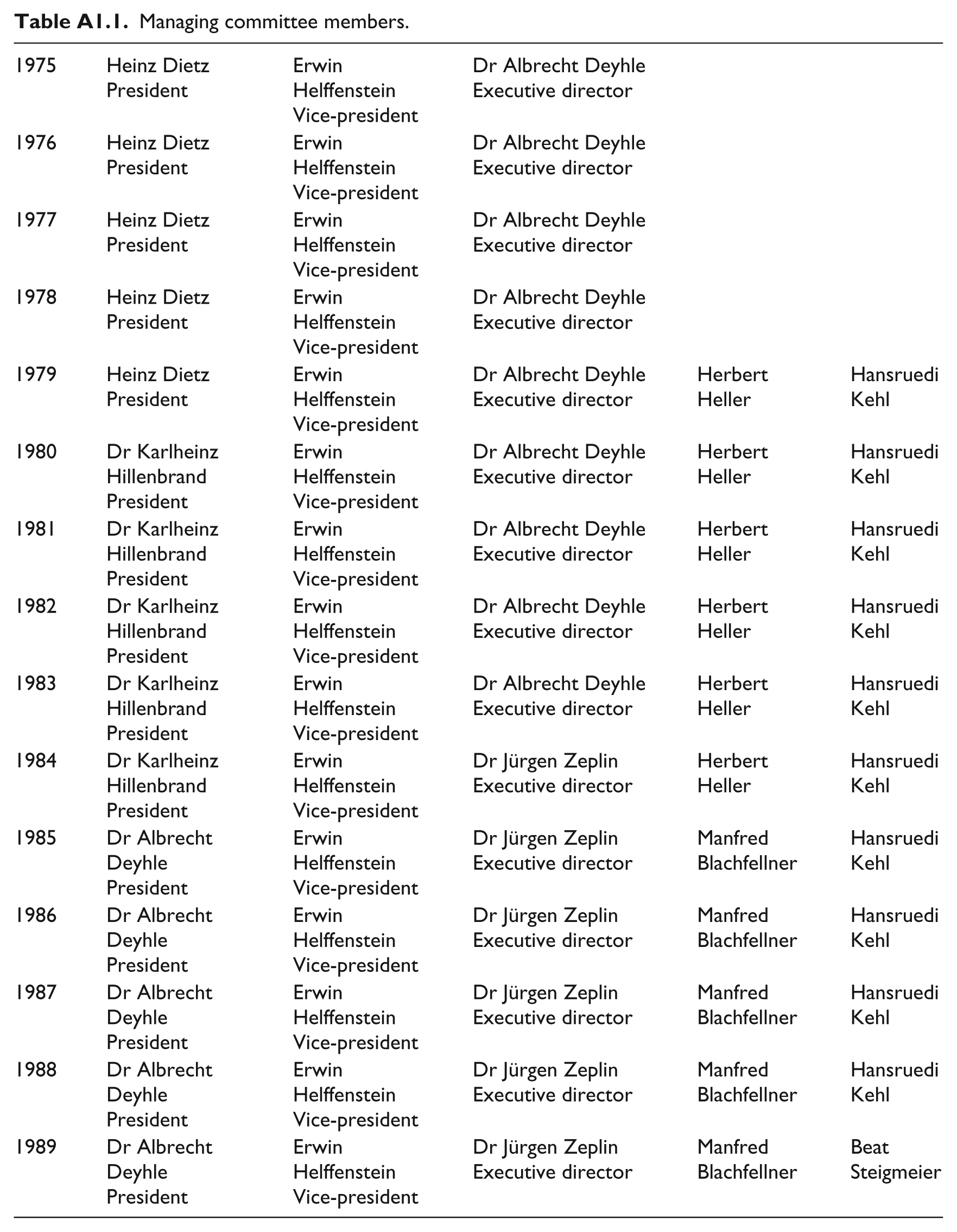
First presentation of the CV in 1984.
|
|
| Mitglied kann jeder werden, der eine Controlling-Funktion in der Wirtschaft ausübt. Darüber hinaus können auch natürliche Personen die Mitgliedschaft beantragen, die in nahestehenden oder ähnlichen Gebieten eine Funktion ausüben oder ausgeübt haben. |
|
|
| Die Mitgliedschaft für ordentliche Mitglieder beträgt zu Zeit DM 170, – pro Jahr und berechtigt:
– zur kostenloses Teilnahme an den Arbeitskreissitzungen eines aufnahmefähigen Arbeitskreises – zum Bezug des Controller-Magazins – zur verbilligten Teilnahme an Veranstaltungen des Controller Vereins (z. B. Controller-Kongreß, Fachseminare u. a.) |
| Aber nicht nur die aufgezählten Dienstleistungen stehen auf der Habenseite des Mitglieds; es erschließen sich noch weitere Möglichkeiten:
– aktive Teilnahme am Entscheidungsprozeß des Controller Vereins und der Arbeitskreise – fachlicher Erfahrungsaustausch in den Arbeitskreisen – Zusammenarbeit mit Kollegen und Freunden – Präsentation eigener Arbeitsergebnisse vor einem fachkundigen, interessierten Zuhörerkreis. |
|
|
| Sollten Sie noch zusätzliche Informationen benötigen, rufen Sie einfach die Geschäftsstelle an. Das Sekretariat gibt Ihnen gerne Auskunft. |
| Falls Sie Interesse an Veranstaltungen oder aber am Controller-Kongreß haben, so besteht die Möglichkeit, Einladungen sowie Informationen ebenfalls über das Sekretariat des Geschäftsführers in Berlin (030/323 80 45) zu erhalten. |
| Controller Verein e. V. |
| – Geschäftsführer – |
| Dr. Jürgen Zeplin |
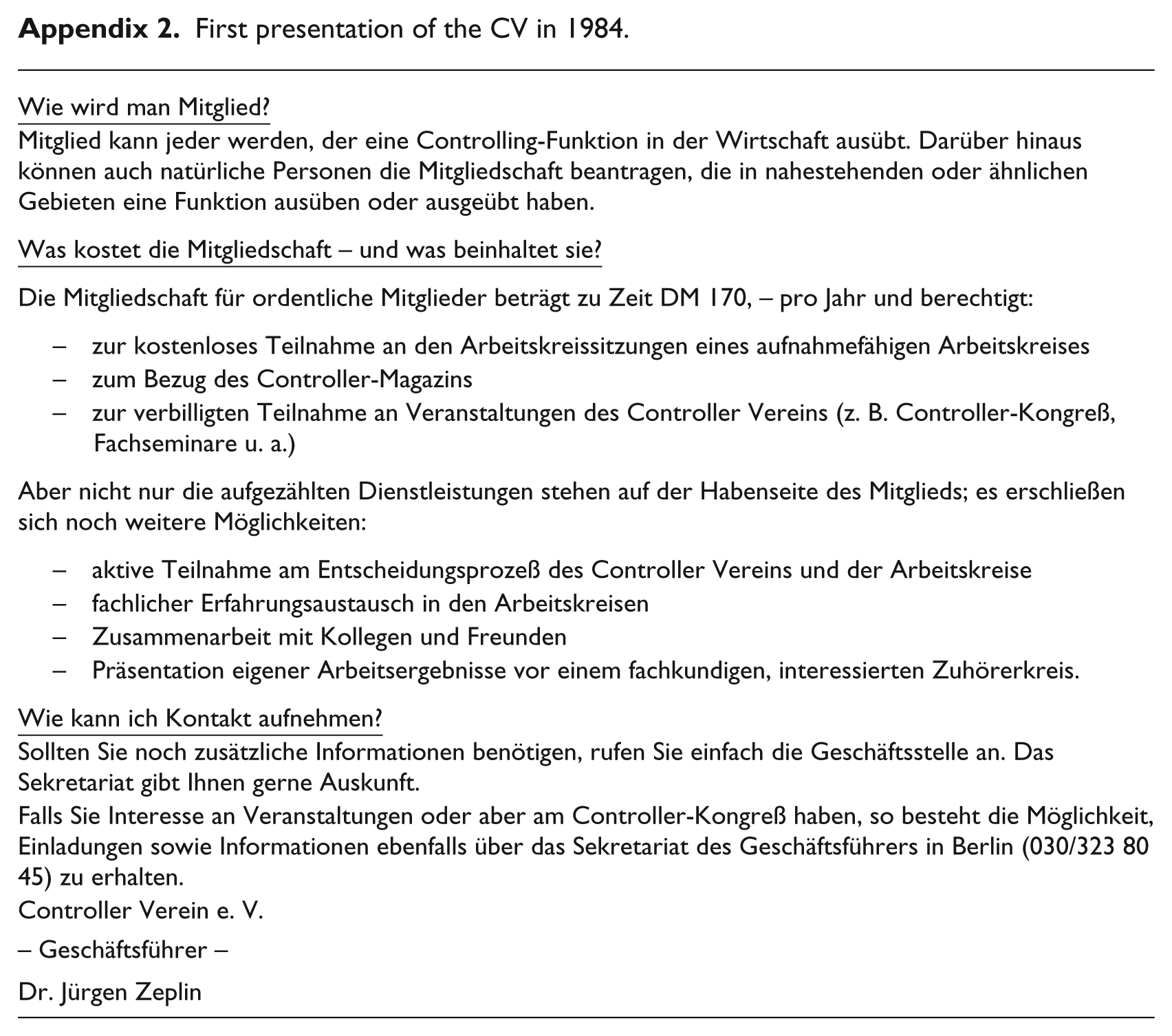
Appendix 3
Key indicators, Controller Verein.
| KENNZAHLEN CONTROLLER-VEREIN E.V. | ||||||
|---|---|---|---|---|---|---|
| 1980–1985 | ||||||
| 1980 | 1981 | 1982 | 1983 | 1984 | 1985 | |
| Anzahl Mitglieder | ||||||
| Absolut | 276 | 330 | 377 | 407 | 496 | 540 |
| (Relativ) | (100) | (120) | (137) | (147) | (180) | (196) |
| Anzahl Arbeitskreise | 18 | 18 | 18 | 19 | 21 | 21 |
| Anzahl Konreßteilnehmer | 254 | 260 | 327 | 207 | 230 | 330 |
| Finanzen (TDM) | ||||||
| Saldo Ein-/Ausgaben Ordentl. Etat | −11.3 | −1.0 | −5.4 | −17.8 | −26.0 | −3.0 |
| Kongreßergebnis | +10.7 | +16.5 | +1.0 | +30.0 | +13.6 | +10.0 |
| Gesamt | −0.6 | 15.5 | −4.4 | +12.2 | −12.4 | +7.0 |
| Vereinsvermögen | +30.1 | +45.6 | +41.2 | +53.4 | +41.0 | +48.0 |
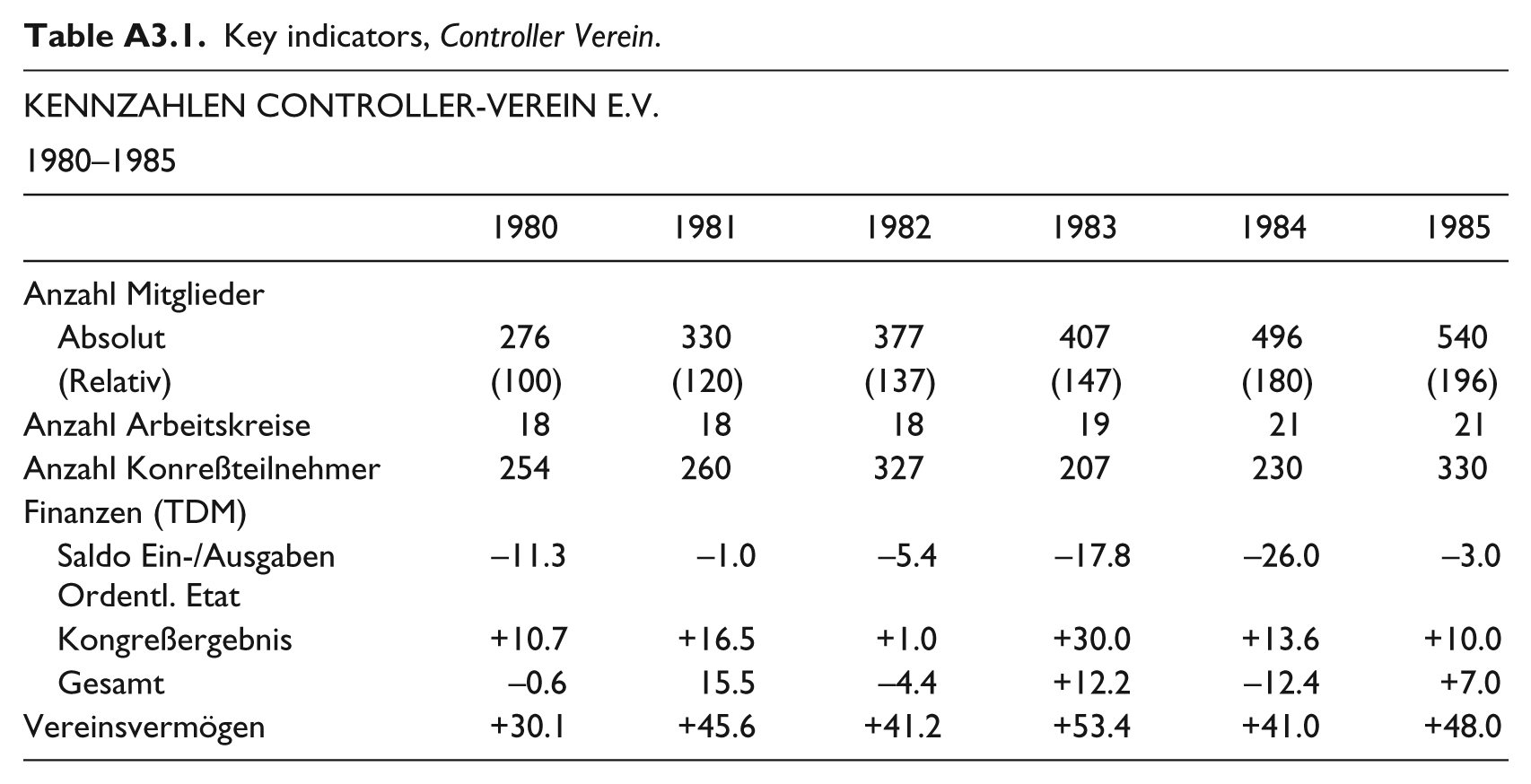
Appendix 4
List of interviews.
| Dr Dr h.c. Albrecht Deyhle | Founder of the CA, CV and Controller Magazin | January 2010, April 2010, Gauting, two interviews, of 2 hours 15 minutes and 3 hours 30 minutes |
| Dr Alfred Blazek | First trainer at the CA, founding member CV | January 2010, April 2010, Gauting, one interview of 1 hour 30 minutes |
| Monika Nebel | Assistant to Albrecht Deyhle at the CA and CV | January 2010, April 2010, Gauting, one interview of 1 hour 15 minutes |
| Conrad Günther | Executive Director CV (since 1990) | April 2010, Gauting, one interview of 1 hour 15 minutes |
| Prof. Dr Rolf Eschenbach | Controller in the 1970s, former controlling professor at University of Wien | Vienna, May 2010, one interview of 1 hour 30 minutes |
| Prof. Heimo Losbichler | Controlling professor at the University of Applied Sciences Upper Austria, Vice-president of the CV | Steyr, May 2010, one interview of 1 hour 15 minutes |
| Prof. Rainer Bramsemann | Controller in the 1960s/1970s, controlling professor at the University of Applied Sciences Bielefeld | Bielefeld, June 2010, one interview of 2 hours |
| Siegfried Gänßlen | Former controller, President of the CV (2005–present) | August 2010, one interview of 1 hour 15 minutes |
| Prof. Dr Dr h.c. mult. Péter Horvath | First controlling professor in Germany | Stuttgart, August 2010, one interview of 1 hour 30 minutes |
| Hillert Onnen | Former controller, member of the Board of Trustees CV, | Bremen, August 2010, one interview of 1 hour |
| Dr Walter Schmidt | Member of the Managing Committee CV | Via telephone, September 2010, one interview of 1 hour |
| Alfred Biel | Long-time member of the CV | Vallendar, September 2010, one interview of 1 hour 45 minutes |
| Prof. Günther Ebert | Controller in the 1960s/1970s, controlling professor at the Nürtingen–Geislingen University | Nürtingen, October 2010, one interview of 1 hour 15 minutes |
| Prof. André Zünd | Former accounting professor at the University of St Gallen | St Gallen, October 2010, one interview of 1 hour |
| Prof. Thomas Reichmann | Controller in the 1970s, former controlling professor at Dortmund University | Dortmund, October 2010, one interview of 1 hour 15 minutes |
| Prof. Dr Dr h.c. Hans Ulrich Küpper | Controlling professor at LMU Munich | Munich, November 2010, one interview of 45 minutes |
| Rudolf Rieger | Early member of the CV, long-time auditor of the CV | Munich, November 2010, one interview of 2 hours 30 minutes |
| Manfred Blachfellner | Controller in the 1970s, early member of the CV, former member of the managing committee of the CV | Innsbruck, November 2010, one interview of 2 hours |
| Prof. Dr Dr h.c. Jürgen Weber | Controlling professor at WHU – Otto Beisheim School of Management | Vallendar, December 2010, one interview of 1 hour |
| Dr Wolfgang Berger-Vogel | Controller in the 1970s, former president of the CV (1998–2005) | Graz, January 2011, one interview of 1 hour 45 minutes |
| Manfred Remmel | Controller in the 1970s, former president of the CV (1990–1998) | Vienna, February 2011, one interview of 2 hours |
| Dr Jürgen Zeplin | Former executive director of the CV (1984–1989) | Berlin, May 2011, one interview of 1 hour 45 minutes |
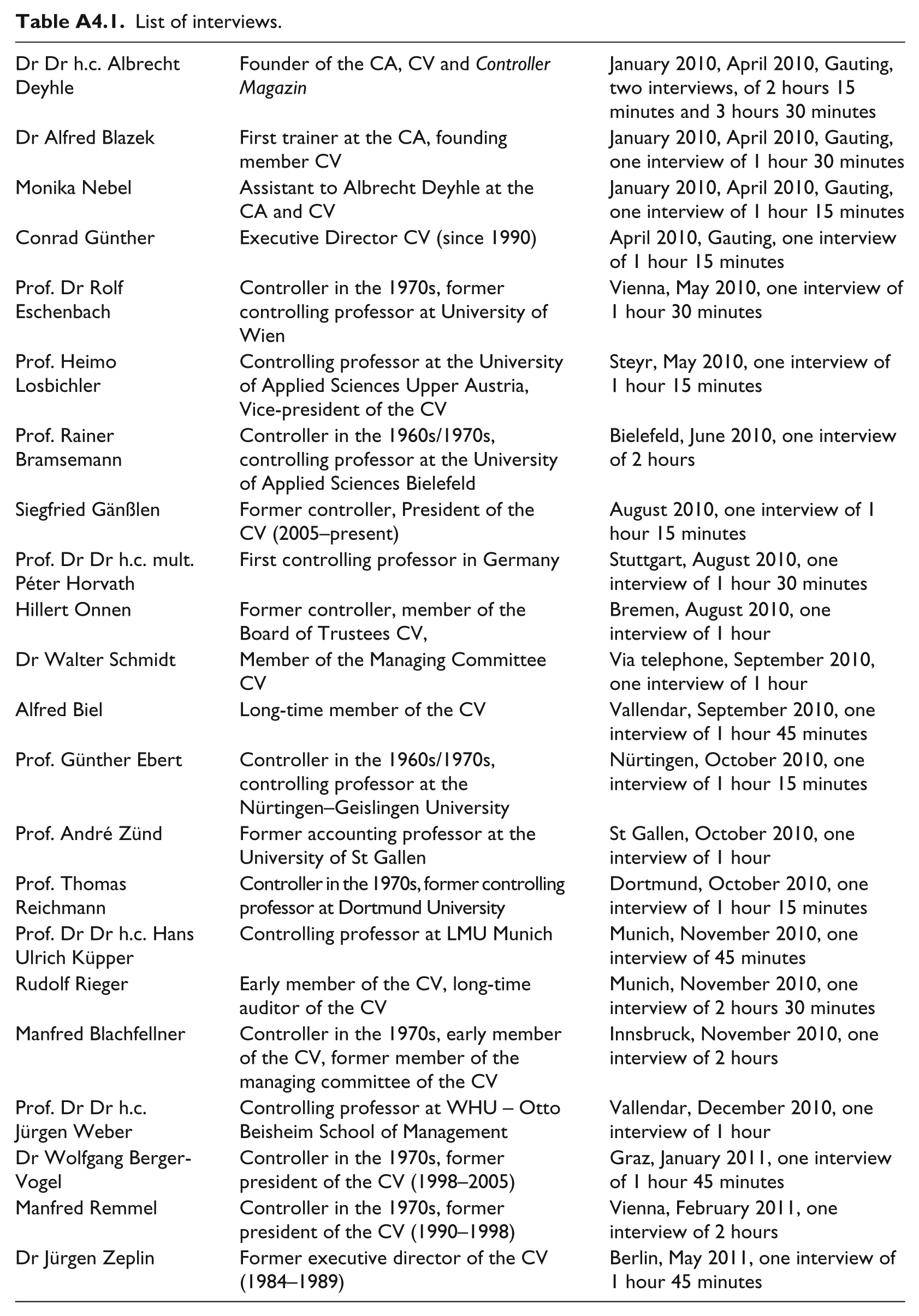
Acknowledgements
The authors wish to thank John Burns, Lukas Goretzki, Jürgen Weber and two anonymous reviewers as well as for their advice and suggestions. Furthermore, the authors are thankful to the Internationaler Controller Verein for granting access to their archives.
Funding
This research received no specific grant from any funding agency in the public, commercial, or not-for-profit sectors.