




Abstract
Accounting artefacts are a useful source of information on the history of accounting techniques. However, as this article discusses and demonstrates, they can also contain rich narrative that provides additional historical insight. This article describes a journey of discovery to understand the contextual historiography surrounding an accounting artefact, looking at how the artefact came into being and its ramifications for the two main protagonists: a Creek Chief, Hillis Hadjo, and a British Officer, Lieutenant-Colonel Edward Nicolls.
Introduction
The objective of this article, set in North America and Britain, is to demonstrate how an accounting artefact from the British colonial era can be used to augment knowledge of the past by providing a rich source of historical information. In particular, this article describes how opportunistic findings helped stimulate our journey of discovery to better understand the historical context, provide insights into the principal actors, and understand the events surrounding the artefact.
This article seeks to contribute to the literature in two ways. First, it demonstrates the importance of accounting artefacts as a source of history and emphasizes the importance of relying on primary rather than secondary sources when undertaking research, particularly where those secondary sources provide conflicting evidence. Second, through the history of Hillis Hadjo, this article illustrates how the provision of presents played a part in what Neu (2000b) describes as influencing how Indigenous peoples used them.
Accounting in the North American context and in particular with Native Americans has been considered previously in the literature. When discussing imperialism, Neu (1999, 2000a, 2000b) describes the role played by hardware and software technologies in implementing colonial policies. As a software technology, accounting (including censuses) was used by colonial governments to help ensure imperial policies and objectives were put into practice (Davie, 2000; Neu 2000a, 2000b). In a North American context, Neu (2000a) documents the role accounting technology played in the “subjectification and control” of the indigenous First Nations people (Neu, 2000a: 164). In a second study, Neu (2000b) re-emphasizes the role accounting played in ensuring colonial objectives were met. Additionally, Neu (2000b: 269) illustrates how genocide of Indigenous peoples was in some instances facilitated by the “deployment of accounting and accountability mechanisms”.
This article is structured as follows. It commences with an overview of the importance of artefacts in accounting research. A historiography of the War of 1812 as well as the role Native Americans played in the conflict is then detailed to contextualize the article. This includes a review of the Creek War of 1813–14 and the First Seminole War of 1818–19. The artefact that is the subject of this article is then detailed. This section includes an explication of its discovery in the War Office records of the War of 1812 held at the National Archives in London. An overview of the Creek Chief, Hillis Hadjo, mentioned in the artefact is then provided to facilitate an understanding of him. The role of Lieutenant-Colonel Edward Nicolls, the creator of the artefact is then detailed. This information includes a description of how the hopes for a draft treaty, which accompanied the artefact, foundered due to changing diplomatic priorities following the end of the War of 1812. A discussion of the role that accounting artefacts play as a source of primary information in accounting research, as well as how drawing on prior research can assist us to understand particular events follows. The article ends with conclusions and potential avenues for further research.
The use of accounting artefacts as sources of historical information
Surviving accounting records are important sources of information as they form the basis from which past practices can be critiqued (Parker, 1997). They provide additional empirical evidence that augments current understanding of past events. Accounting records should, however, not be seen as the sole or primary source of information (Napier, 1989). As Parker (1997: 114) observes, “Further sources include publicly available documents such as legal cases, journalistic writings and also private documents such as minute books of directors’ meetings, correspondence between owners and managers, managers [sic] notebooks and so on”. Howell and Prevenier (2001: 18) explain that relics or artefacts were normally “created for the specific purposes of the age in which they were made … and were usually not designed for the use of posterity”.
The use of artefacts as a source of information in accounting research is well documented. Prior research includes Jeacle (2009: 680) who uses ledgers as accounting artefacts to “illustrate a significant period of twentieth century cultural history”. To support that position, Jeacle (2009) argues that a bookkeeping ledger not only records past transactions, but also provides a historical context for social events. For example, Fleischman and Tyson (2000) use artefacts in the form of Hawaiian sugar plantation records for the period 1835–1920 when exploring the interface of race and accounting. Additionally, Bisman (2009) explains how a census can take the form of an artefact to be used in accounting studies and in setting a research agenda. Using accounting artefacts can, therefore, be seen as being consistent with Carnegie and Napier’s (1996: 7) view that “our notion of what constitutes the archive, and our ways of communicating, explicating and interpreting the archive, should not be taken as fixed”.
Method
This article results from the opportunistic discovery (Freeman, 1987) of an accounting artefact whilst undertaking research for a different project (Francis, 1999). The item had resided for nearly 200 years amongst the boxes of the War Office: War of 1812 papers, now stored at the National Archives in London. The artefact is a document providing “Estimates of Clothing for the Creek Indian Chief Hidlis Hadgo” and is reproduced here as Figure 1. Being accountants we were drawn to examine it further and discovered the accompanying “draft treaty”.
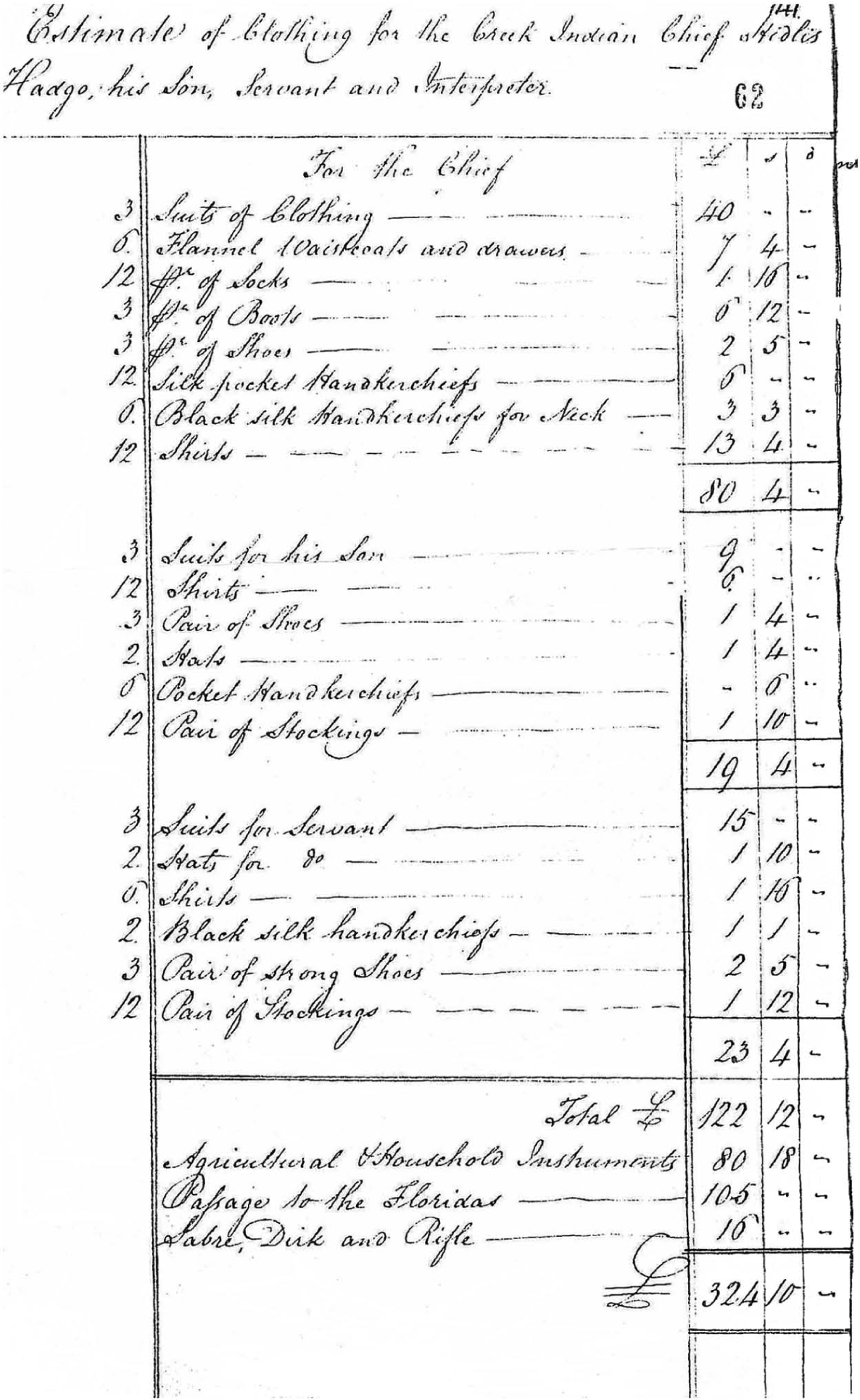
Estimates of clothing for the Creek Indian chief Hillis Hadjo.
In line with Parker’s (1997) thinking, the artefact that is the subject of this article cannot be considered in isolation. The artefact is, therefore, considered together with the “draft treaty” and the correspondence which accompanied it. The archive WO 1/143 1 which contained the artefact and draft treaty is extensive and diverse. It includes, amongst other items: various correspondence to and from Lieutenant-Colonel Nicolls; Vice-Admiral Alexander Cochrane, 2 Commander-in-Chief of the Fleet on the North American and Jamaica Stations; the Treasury Chambers; a British Agent to the Creeks; a brief receipts and payments account for the entertaining of Indian Kings and Chiefs at Pensacola and the Bluff; as well as a muster (or census) 3 detailed as a “Return of Muscogee or Creek Indians” under the command of Nicolls and a “Return of those who had yet to join the British” (WO 1/143: 175). Although the artefact was found in WO 1/143, contemporary archives WO 1/144 4 and FO 5/140 5 were also consulted to obtain further clarification and insight into the artefact and accompanying draft treaty.
Although it was initially difficult to find information on Hillis Hadjo, a genealogical website (Bell, nd) as well as a number of secondary sources (for example Frost, 1847) provided the alternative names he was known by. While examining the archives a number of inconsistencies between the primary and secondary sources became apparent. These related to Hillis Hadjo’s opinion of the “white man”, the presents he received from the British Government, and his journey to England, including his appointment as a brigadier general. In an attempt to clarify these inconsistencies, a number of additional primary and secondary sources were examined. These various sources enabled a historical understanding to emerge that was, if anything, richer than that provided by the original document itself.
Historiography
This section commences with a review of the wider conflict before focusing on literature that details the background to Creek involvement in the War of 1812, the Creek War 1813–14 and the First Seminole War 1818–19. This contextualizes the timeframe and events surrounding the changes within British–Creek relations and the circumstances in which the accounting artefact and the accompanying treaty were created.
The War of 1812
The events in this article relate to the aftermath of the so-called War of 1812. 6 Any review of the literature of this conflict should include the three bibliographical works by Fredricksen (1979, 1985, 1997). These reveal the extent of literature covering the war, despite Hickey’s (1990, 1995) notion that it has become a “forgotten conflict”. Hickey (1990, 1995) identifies two reasons for the obscurity of the war. First, no great president was associated with it and second, there is mystery surrounding the causes, and consequently the outcomes, of the war.
The relative lack of British work on the War of 1812 is probably best explained in terms of the context of the concurrent war with Napoleon in Europe being of more concern to the British military at the time and British military historians since. The battlefields of Europe are perhaps also a more fertile ground for study due to the much grander scale of events that took place there. Even British studies of American wars tend to focus less on the War of 1812 than other conflicts, such as the American War of Independence and the American Civil War. Sweeny (1996: 40) explains the lack of a British focus on the War of 1812 as follows:
Historical work on the war of 1812 is still largely confined to operational histories of the entire war. Substantial campaign and battle studies appear only occasionally, while related political and social questions or the institutional development of the services still attract little attention.
Native Americans and the War of 1812
Starkey (1998) argues that while historians, such as Horsman (1969), recognize the importance of the contribution of militia forces, they fail to give sufficient credit to the role played by the Native American forces. British commanders in the War of 1812, however, were well aware of the importance of the role that the Native Americans could play (see Black, 2009 and Starkey, 1999). 7 Although there is a substantial literature on Native American history, there is somewhat less in terms of their military history. Such literature that is available tends to focus on the earlier French Indian War of 1754–63 (see for example Schwartz, 1995) and the later Plains Wars, rather than on the military aspects of the War of 1812.
The Creek War of 1813–14 and the First Seminole War
The Creek War is often merged into the historiography of the War of 1812 (see Starkey, 1999). However, it had its own causes and roots in events that predate the War of 1812. In addition to the British actively seeking Creek assistance during the War of 1812, they had their own motivations for war. The causes of the war and the differences between the Red Sticks and White Sticks are covered by Hassig (1974), Wright (1968, 1986) and Braund (2008). Although there are differences given in the accounts for the causes of the war there are common elements, with the catalyst being a visit by Tecumseh 8 in October 1811 (Starkey, 1999). The Creeks had a number of grievances. The militant Red Stick Creeks were resentful of American encroachment (Wright, 1968). Red Stick Creek leaders including Hillis Hadjo opposed what they saw as attempts to assimilate them into “white culture” (Wright, 1986). Creek leaders encouraged their followers to put aside the white man’s gun and powder when hunting and rather rely on the traditional bow and arrow. They argued that this would be the “best way to escape from commercial hunting, the local factor, and his account books” (Wright, 1986: 162). Creek leaders were also concerned over their indebtedness and how they had ceded land in order to cover their debts (Braund, 2008). 9 Following the War of 1812, many surviving Creeks withdrew to Florida (which was then still Spanish) and went on to take part in the hostilities known as the First Seminole 10 War of 1818–19 (Field, 2009; Wright, 1968,1986).
The accounting artefact
The accounting artefact, reproduced with permission from the National Archives as Figure 1, details an array of items provided to the Native American Chief, Hillis Hadjo, his son, servant and interpreter by the Royal Marine officer Lieutenant-Colonel Edward Nicolls. 11 Within the same archive is a proposed treaty drafted and drawn up by Nicolls in March 1815, on his own initiative (Black, 2009; Heidler and Heidler, 1997).
The artefact was created in the aftermath of the War of 1812 in which some Creeks had assisted the British in the run up to the First Seminole war of 1818–19. There would be two further wars (1835–42 and 1855–58) in which Creeks, as part of an amalgamation of Native Americans and others including escaped slaves, would fight on without direct British support for 40 years in Florida. 12 The end of the War of 1812 and the conclusion of the Napoleonic Wars in Europe at Waterloo in 1815 led to a change in the political environment and a potential rapprochement in relations between Britain and the United States of America. Britain became reluctant to honour treaties (such as the one accompanying the accounting artefact) and commitments made to the Creeks.
When we compared the accounting artefact with the presents purported to have been given to Hillis Hadjo while he was in England as detailed on a genealogy site (Bell, nd), we were struck by the extent of the differences between the accounts. This motivated us to investigate whether the differences were only confined to this account or whether substantial differences existed between all secondary sources as none of the documents contained in the archive WO 1/143 or in the other archives we examined (WO 1/144 and FO 5/140) made reference to the items detailed on the genealogy site (Bell, nd).
The first secondary source we were able to find that made reference to the presents was the Niles’ Weekly Register 13 (1817). In this account Hillis Hadjo was reported as being introduced to the Prince Regent while “dressed in a most splendid suit of red and gold, and by his side he wore a tomahawk, mounted in gold” (Niles’ Weekly Register, 1817: 46). This same account appears to have been accepted and reproduced by a number of contemporary American publications and authors (Croffut, 1909; Davis, 1943; The National Register, 1819; Trumbull, 1828), who use almost identical wording. Parton (1860: 397), in his biography of Jackson, escalates the number and amount of the presents to include “a gold-mounted tomahawk, a diamond snuff-box, and a sum of money”. Croffut (1909: 153) also expands on the extent of presents received to include an account of Hillis Hadjo’s daughter receiving “handsome presents of dresses, shoes, and bonnets and much unaccustomed finery”. Boyd (1937) and Cave (2006) rely on Parton (1860) for their accounts, while Owsley (1985a) appears to most accurately reference the material in the National Achieves. Finally, the genealogy website (Bell, nd) further escalates the presents to include “a diamond-studded snuff box, a gold-mounted tomahawk, five hundred pounds in gold, and some jewels for his daughters”.
Expanding our search to other relevant archives in WO 1/144 we found supporting documentation in the form of a list drawn up by Nicolls that provided further insight. This list detailed the nature of the agricultural and household “instruments” gifted to Hillis Hadjo together with their costs. The agricultural implements included: 2 ploughs and 2 harrows; 2 dozen spades and handles; 2 dozen hoes; 1 dozen stock axes; 1 dozen felling axes; 1 dozen hand axes; 1 dozen chopping knives; 6 scythes; 6 rakes; 12 hammers; and £5 worth of nails, while the household implements included: 6 gridirons; 6 tin kettles; 2 tea and coffee kettles; 2 dozen knives and forks; 4 razors and two strops; 12 combs and brushes; 20 blankets; and 25 yards of cotton (WO 1/144: 9-12; WO 1/144: 409).
During our search of the archives, we came across additional items that may have been presented to Hillis Hadjo but which did not appear in the secondary sources we examined. These include a pair of pistols from the Prince Regent (WO 1/143: 144) and a “Pipe Hatchet” manufactured by Holtzapffel & Deyerlein, a company that described itself as an “Engine Lathe & Tool Manufactory” (WO 1/144: 415).
The chief: Hillis Hadjo
Other than a short biographical piece by Owsley (1985a), academic information regarding Hillis Hadjo – the main “actor” of this article – is relatively sparse. He is mentioned in several books and articles, with Wright (1986) devoting several pages to his exploits. Given his involvement in the Creek Wars he is also mentioned in a number of American books of the time. His execution is also detailed, possibly in part due to it being at the hands of a future American President.
Hillis Hadjo (Crazy Medicine) was known by many other names such as Hidlis Hadgo, Hillis Haya, Josiah Francis, Hillis Hadsho and Francis Hillishago.
14
He was born during the 1770s in Autauga Town in Alabama. His father, David Francis, was a white trader (an Englishman)
15
and blacksmith who made silver ornaments and implements for the Native Americans (Cave, 2006; Owsley, 1985a). His mother was a Creek woman. (See Owsley, [1985a] for a more complete discussion of the uncertainties surrounding his background.) Not much is known of his early life.
16
As Owsley (1985a: 273) explains:
Evidence suggests that Francis and his parents followed the teachings of traditional Creek religious leaders. He was significantly influenced by the conservative religious beliefs of his elders. Francis was to become the most ardent advocate of war against the white man, for he believed in the supremacy of the Creek culture over that of the whites.
A picture of Hillis Hadjo appears in Frost (1847: 381) and a self-portrait painted while he was in England also exists. 17 It is likely that neither of these do him justice. The picture in Frost shows him as portrayed by whites, while the self-portrait is described as a first attempt. The only other description of Hillis Hadjo is one made just prior to his execution by General Jackson, where he was described by an officer of Jackson’s army as: “a handsome man, six feet high; would weigh say one hundred and fifty pounds; of pleasing manners; conversed well in English and Spanish; humane in his disposition; by no means barbarous – withal, a model chief” (Parton, 1860: 457).
Although of mixed blood, contemporary American accounts and American secondary sources (Owsley, 1985a) claim that Hillis Hadjo hated the “white man” and his culture and refused “to wear the white man’s clothing while on a trip to New Orleans with the British army” (p.273). This idea would appear to be consistent with Hillis Hadjo’s support of Tecumseh who also encouraged the Creeks to abandon the ways of the white man and drive them from their lands (Owsley, 1985a). Hillis Hadjo’s support of Tecumseh was manifested through his apparent supernatural powers. As Owsley (1985a: 274) explains:
Francis used his position to foster support for Tecumseh, and many Indians who opposed Tecumseh died under strange circumstances, often at night. The deaths were often accompanied by strange sounds and shadows and objects that flew through the air, thus adding to the fear of the supernatural.
Hillis Hadjo’s ascent to power and influence occurred prior to the Creek War, which began in 1813 at Fort Mims in Alabama (Millett, 2007), and occurred during the wider conflict of the War of 1812. Until his death, Hillis Hadjo was the most important Creek proponent of war (Cave, 2006; Owsley, 1985a: 273). He also took an active part in the Seminole War.
The treaty maker: Lieutenant-Colonel Edward Nicolls 18
In the aftermath of the War of 1812, and concerned that the United States would not return Creek land, the British Royal Marine officer Lieutenant-Colonel Nicolls attempted to establish a powerful Native American enclave on the Gulf Coast.
19
Nicolls had fought with the Creeks during the War of 1812 against the United States of America,
20
and continued to act as an advocate for them. When the Fort at Prospect Bluff on the Apalachicola River was evacuated, a large quantity of arms and ammunition was left behind by the British.
21
Heidler and Heidler (1997: 389) suggest Nicolls’ interaction with the Creeks,
[w]as a further illustration of how white contact even altruistic, wronged these Indians. He had left a fort full of arms and supplies for their protection, but the presence of this fort and the hundreds of runaway slaves it contained so unnerved the Americans that the following year, a joint US army–navy expedition attacked it and blew it up.
Acting on his own volition on 10 March 1815, Nicolls drafted an offensive-defensive treaty with the Creeks which, if ratified, would have implied British support for restoring Creek lands (Black, 2009; Owsley, 1985b; WO 1/143: 147–150). Although only speculation, there were perhaps two reasons for Nicolls’ actions. The first was the United States of America’s refusal to honour the provisions of the Treaty of Ghent. This can be seen from Nicolls’ letter to Baker, H.R. Majesty’s Chargé d’Affairs, Washington 18 June 1815 where he states (WO 1/143: 168):
From the very hostile and rancorous hatred of this inhabitants of Georgia bordering on the Indians, I am led to think that the 9th Article of the treaty of peace will not be carried into effect – You will see by my correspondence with Col. Hawkins how careful I have been to prevent a shadow of complaint from the United States, well knowing the least thing will suffice as an excuse for their attacking the Indians or robbing them of their Lands. I assure you Sir, that not one half or even a third part of the Chiefs signed the Capitulation between them and general Jackson and those that did protested against any cession of Lands, they even refused to sign the Capitulation unless the Protest was noted on the other side …
This would tend to be confirmed by the letter from Vice Admiral Cochrane (Nicolls’ commanding officer) to the Right Honourable Earl Bathurst
22
dated 12 March 1816 in which he highlighted that under the guise of a trumped up or fraudulent treaty entered into between General Jackson and a number fugitive Indians, the United States of America continued to dispossess the Creeks of their lands. There is a suggestion that perhaps the Earl of Bathurst was aware of Nicolls’ actions in Florida, when Cochrane goes on to say (WO/ 144: 123–124): “I feel it a duty incumbent upon me, as the person who, under your Lordship’s authority formed the alliance with those people”. The second reason was ensuring an alliance with the Native Americans in any future war with the United States of America. It appears that Cochrane believed that another war was likely when he states in the same letter (WO 1/144: 128):
With respect to the last mentioned Colonies, I am desirous of availing myself of this opportunity to notice to your Lordship that the policy of the United States is now directed towards forming a Republican Party in the Canadas; which, if not speedily counteracted will make those Colonies in any future War an easy conquest to America …
In the draft of the treaty found accompanying the accounting artefact (WO 1/143: 149), the “Muscogee Nations” agreed to give “grants of land to all such British Men as our good father shall give his permission to stay among us, and that we will do our best to protect and defend them in their Laws and Property” (WO 1/143: 149). The chiefs of the “Muscogee Nations” had their representative, Hillis Hadjo, accompany Lieutenant-Colonel Nicolls to London to ratify the treaty. Hillis Hadjo, his son,
23
servant and interpreter
24
accompanied Nicolls to London.25,26 Evidence of Nicolls’ feelings about the draft treaty was found in the accompanying letter where he stated:
I should consider myself guilty of the strongest ingratitude to the men with whom I fought and bled in my country’s
27
cause as well as being guilty of neglect to my King and Country if I did not faithfully recommend for remuneration and protection these two Chiefs. (WO 1/143: 61)
In relation to the British Government’s reluctance to ratify the treaty, we also found correspondence between Nicolls and Downing Street in which he emphasized the role played by Hidlis Hadjo and the Muscogee in the war (FO 5/140). Nicolls seems to have become frustrated and sought and obtained backing from Admiral Alexander Cochrane who also wrote a letter to the Earl of Bathurst acknowledging the Creek contribution to the War of 1812 (WO 1/144: 123–129; WO 1/144: 198). When reviewing Nicolls’ motivations for his actions, Heidler and Heidler (1997: 389) suggest “he truly believed the Creeks were victims and after making so many promises he felt obliged to keep some of them”.
Their treaty dashed on the rocks of international diplomacy
On arrival in Britain in August 1815, Nicolls and Hillis Hadjo would have been disappointed with the British attitude. The British did not officially receive Hillis Hadjo as an emissary of the Creeks. Additionally, in what Heidler and Heidler (1997: 389) describe as “the reality of post-war diplomacy”, Nicolls’ treaty was not ratified. 28 So as not to antagonize the Americans, the British kept Hillis Hadjo in England as long as possible by not permitting him passage on the ships of those merchants prepared to transport him and his entourage back to Florida (Owsley, 1985a) in exchange for licences to import goods into England. 29 The records in the National Archives 30 also show the reluctance of Bathurst to accede to Nicolls’ representations on behalf of Hillis Hadjo. Nicolls made a number of requests on behalf of Hillis Hadjo, including education in Britain for his son, and a specific ship to transport him back to Florida. These were all rejected.
Given that Hillis Hadjo was acting as the representative of the Creek kings and chiefs while in England, the official British treatment of him could be considered appalling. This was in part due to the British government arguing that Nicolls had acted outside his authority when entering into an “offensive and defensive treaty” with the Creeks as well as in bringing Hillis Hadjo to England (FO 5/140: 99; FO 5/140: 106; Monroe 1819: 14; 50; 53).
31
Contemporary American secondary sources, however, portrayed the visit very differently. These sources suggest that Hillis Hadjo was well treated by the British Government (see for example The National Register, 1819; Niles’ Weekly Register, 1817) as well as being given the rank of brigadier general (Buell, 1904; Frost, 1847; Parton, 1860; Trumbull, 1928). The account in the Niles’ Weekly Register (1817: 46–47) provides the American perspective:32,33
We see a pompous account of a ball given on board a Russian frigate lying off Woolwich, (Eng.) on the anniversary of the emperor’s birth – we notice it on account of the following paragraph: “The double sound of a trumpet announced the arrival of the patriot Francis,
34
who fought so gloriously in our cause in America: he was dressed in a most splendid suit of red and gold, and by his side he wore a tomahawk, mounted in gold, presented to him by the prince regent; he appeared much delighted with the appearance of the frigate. We suppose this ‘patriot Francis’ is a savage”.
While Hillis Hadjo was in London, the Americans under Andrew Jackson successfully attacked and destroyed the Fort at Prospect Bluff. After his return from Britain to Florida in June 1817, Hillis Hadjo encouraged the Creek chiefs to make peace with the United States as it had been made clear to him that the British would not support the Creeks in any further conflict with America (FO 5/140: 100; FO 5/140 110–111; Owsley, 1985b; Owsley and Smith, 1997).
However, in April 1818 Hillis Hadjo was duped into boarding a US armed schooner flying the flag of Great Britain. Thinking that the schooner carried arms from Nicolls, Hillis Hadjo and another leader paddled out and boarded it (Buell, 1904; Frost, 1847; Parton, 1860). Once on board they discovered that the schooner was an American vessel under the command of Captain Isaac McKeever (Frost, 1847; Owsley, 1985b; Parton, 1860). 35 Without the formality of a trial Jackson ordered him to be hanged (Buell, 1904; Frost, 1847; Mahon, 1998; Owsley 1985b; Parton, 1860; Rosen, 2008; Wright, 1986).36,37
The events are described in Buell (1904: 125) as follows:
That same night General Jackson communicated with Lieutenant McKeever and the chiefs were sent ashore the next morning. The General, upon being satisfied of their identity, ordered them to be hanged without even the formality of a court-martial: Francis for his complicity in massacres during the Creek war and for inciting the fugitive Creeks in Florida; Himollomico for torturing Lieutenant Scott, who had been captured some time before.
Criticism and concern was expressed over Jackson’s action at the time. For example, Frost (1847: 401) believed that in executing Hillis Hadjo, Jackson not only hanged an Indian “but a British officer also”. 38 With this summary execution, Wright (1986: 207) explains that “The great aspirations held by Hillis Haya in 1811 when he ranged throughout the Mississippi Valley with Techumseh and in 1814 when British Officers hadfeted him in Pensacola, were dashed”.
Discussion
This article details the discrepancies between the items detailed in the accounting artefact and secondary sources and thereby highlights the benefits of referring to original documentation when undertaking historical research. Part of our journey of discovery involved trying to triangulate between, and make sense of, the differences in the primary and secondary sources (and also between the various secondary sources). The secondary American sources, in particular, required us to exercise particular care as they may have been subject to the dark art of propaganda. Nevertheless, they all contributed to the richness of our journey that started with the original accounting artefact.
The accounting artefact (Figure 1) shows that the two major presents included clothing for Hillis Hadjo, his son, servant and interpreter, as well as agricultural and household implements. The British Government was very specific in how it viewed the value of these, as can be seen by the following statement: “In the month of April following, presents exclusively confined to clothing & agricultural implements (to the value of about £200) were also given by order of this Department” (FO 5/140: 100–101).
Our examination of the archives highlighted two additional presents made to Hillis Hadjo not mentioned in the contemporary secondary sources. These were a brace of pistols and a “pipe hatchet”. Evidence in the form of a letter from the Foreign Office to Nicolls requesting that he deliver a “brace of pistols” to the “Chief as a present from His Maj’s Govt” 39 (FO 5/140: 113; WO 1/144: 143) suggests that Hillis Hadjo received them. Additionally, in a letter to Goulburn 40 dated 21 December 1816, Nicolls states that he had forgotten to mention that he had ordered an ornamental pipe hatchet for Hillis Hadjo. In his letter, Nicolls explains: “I sent the pipe hatchet to you and request that you will be please to order the payment of it and return it to the bearer as the Chief will certainly leave me on Monday” (WO1/144: 400; FO 5/140: 136–137). The account in The Times (1816) provides further evidence of Hillis Hadjo receiving the “pipe hatchet” made for him by Holtzapffel & Deyerlein (WO 1/143: 194; WO 1/144: 415).
No evidence was found in the archives to support the secondary source claims of the presents including a diamond-studded snuff box, five hundred pounds in gold, and some jewels. However, with the passage of 200 years it is perhaps not surprising that nothing was found. Although this does not mean that such presents were not made, it is unlikely given that the Foreign Office saw the value of presents confined exclusively to clothing and agricultural and household implements amounting to approximately £200 (FO 5/140: 100–101). Additionally, the archives would not contain details of presents Hillis Hadjo may have received from private individuals.
The secondary source accounts of Hillis Hadjo meeting the Prince Regent also need to be viewed with caution. Although Hillis Hadjo went to England with the intention of presenting a calumet of peace to the Prince Regent, “as directed by the Kings of the four Nations” (WO 1/143: 137; 143), evidence from the archives we examined suggests that in spite of numerous requests made on his behalf by Nicolls (For example WO 1/144: 19), this may not have occurred. Although the Prince Regent was made aware of the communication from the Chiefs, Hillis Hadjo was advised through Nicolls and Earl Bathurst to make peace with the government of the United States of America (FO 5/140: 100; FO 5/140: 110). 41
We were also unable to find any account in the National Archives of Hillis Hadjo being made a brigadier general. 42 The first mention we found of this appointment was in the Niles’ Weekly Register (1818: 269). This was an extract of a letter from Major General Jackson where he stated that Francis had a new commission of brigadier general from the British government in his pocket when he was hanged. It is therefore possible that this appointment was a fictional propaganda created by Jackson or the Niles’ Weekly Register and perpetuated by American authors of the day.
The provision of suits of clothing is also noteworthy when secondary sources are considered. For example, Owsley (1985a) argues that Hillis Hadjo hated the “white man” and provides evidence of his refusal to wear white man’s clothing. This observation is perhaps inconsistent with the western clothing detailed in the accounting artefact provided to him by Nicolls, as well as contemporary reports of his wearing extravagant garments (Croffut, 1909; Parton, 1860). Perhaps this demonstrates pragmatism on his part when dealing with the British.
From a macro perspective, Neu (1999, 2000a, 2000b) describes the struggle between colonial governments and Indigenous people. Neu (2000b: 274) describes how accounting technologies were designed as a method of both “encouraging the containment of Indigenous peoples and the appropriation of wealth by [the] settler society”. This is evidenced by Red Stick Creek grievances, such as their indebtedness forcing them to cede land in order to cover their debts (Braund, 2008), escaping “from commercial hunting, the local factor, and his account books” (Wright, 1986: 162). This led to the Creek War and the Red Stick Creek’s alliance with the British, which led to the creation of the accounting artefact and treaty which accompanied it.
A review of the items detailed on the accounting artefact provides evidence of how the containment of Indigenous people occurred. Neu (1999, 2000b) describes how colonial governments provided Indigenous people with “presents”. These included clothing and agricultural implements. These were forms of manipulation designed to “encourage certain action” (Neu, 2000b: 274), namely whether to hunt, farm or engage in warfare. During our study, we found evidence, consistent with Neu (1999), of the British Government cultivating the Creek nation as allies. Initially this included giving presents to the Creeks in the form of the arms, ammunition and other military stores left at the Prospect Bluff (WO 1/143: 38). However, the realities of post-war diplomacy and the changing British relationship with the United States of America later saw the provision of the clothing and agricultural implements to Hillis Hadjo detailed in the artefact (Figure 1) and carpentry tools to the Native American chief George Perryman.
Further support for the containment position is that the Creeks would not find the agricultural implements particularly useful in the forthcoming Seminole wars. Additionally, the nature of the goods provided may be indicative of the British stance that they would not support the Creeks in any future conflict with the United States. Other than a musket, a sabre and a brace of pistols, the goods had no military value. Given that the British government was looking to repair its relationships with America following the end of the War of 1812, the provision of goods that could have been used for military purposes would have been diplomatic folly.
Conclusions
Artefacts are a rich source of historical information as they provide insights into the lives of individuals and organizations. As such, they are able to provide the stimulus for future research. The objective of this article was to demonstrate how a single accounting artefact found in the same archive as the treaty, can augment knowledge of the past. The discovery of the artefact and draft treaty that forms the focus of this article was the catalyst that encouraged us to embark on our journey of discovery to better understand the historical context of the documents as well as obtaining insight into the two protagonists of this article. To understand the historical context of the artefact through the haze of 200 years of propaganda, our journey led us through contemporary American newspapers, out of print books, biographies, a nineteenth-century obituary, a “message book” from the President of the United States (Monroe, 1819), the Holtzapffel & Deyerlein archives held by the Edinburgh University Libraries, Special Collections Division, as well as a source as obscure as an 1820 report from the Secretary of State of the United States that appeared in the Sydney GazetteandNew South Wales Advertiser. By accessing primary sources, this article was able to illuminate the inconsistencies between primary and secondary sources as well as between various secondary sources. This process reinforces the importance of relying on primary sources when undertaking research.
The items included on the accounting artefact would be familiar to individuals in England, while also not being seen as providing the Creeks with any significant assistance in any future war with the United States. Nevertheless, the artefacts prompted a journey of discovery to investigate who Hillis Hadjo was, and also acted as a stimulus to investigate the context in which the accounting artefact and its supporting documentation were produced.
The ramifications for the two main protagonists were very different. After not being accepted as an emissary from the Creek kings and chiefs by the British and being forced to remain in England for a length of time, Hillis Hadjo returned to Florida via the Bahamas. Here he was robbed of at least one of his cases containing crockery by a Captain Woodbine (Letter from Alexander Arbuthnot to Colonel Edward Nicolls 26 August 1817, reproduced in Parton [1860: 415]). After he was executed by General Jackson, the Creeks were to fight in the various Seminole Wars for a further 40 years without British help. Although Nicolls was cast in a less than positive light by the American press and authors of the day for his actions in leaving the Fort at Prospect Bluff with arms and ammunition, and entering into the “offensive and defensive” treaty with the Creeks, it is clear that he acted under orders for the first incident and possibly believed he was doing his duty for the second. Although Nicolls was left out of pocket financially for hosting Hillis Hadjo while he was in England, his actions as detailed in this article do not appear to have resulted in any serious long-term career consequences. He achieved the rank of General and his final honour was being awarded a KCB on 5 July 1855 (Urban, 1865: 646).
Although this article has focused on one particular artefact, its limitations must be acknowledged. While the link between the treaty and the artefact was useful in understanding the context surrounding the granting of the presents, further research from a British colonial perspective would be useful to help us understand how hardware and software technologies were used to implement colonial policies.
Although the focus of this article was the accounting artefact, we were able to identify areas for future accounting research. While Neu (1999, 2000a) focused on Canada, from an American and British perspective, exploration of the role that the white man’s account books played in colonialism, and in particular in the causes of the Creek War referred to earlier in this article, would be useful. The Forbes Purchase and the ceding of lands to the American government in exchange for annuities as a result of the general indebtedness of the Creeks (see Braund, 2008; Wright, 1986) would benefit from an in-depth study such as that undertaken by Neu (1999, 2000a, 2000b).
Footnotes
Acknowledgements
The authors are grateful for the assistance of the British Museum, the National Archives London, Garry Carnegie, Annika Schneider, and also Steve Ellis from the Society of Ornamental Turners who provided useful insight into the Holtzapffel & Deyerlein archive.
Funding
This research received no specific grant from any funding agency in the public, commercial, or not-for-profit sectors.