



Abstract
Goldin hypothesised women’s transition from evolution to revolution, where they claimed increasing dominion over their careers. Such change is salient for the professions such as accounting, where gender inequality persists. This qualitative study reports on how a group of 36 male and female accounting professionals employed by Big Four firms and in academia in New Zealand decided to redefine, disassemble and reconstruct their careers. Gender and role expectations strongly influenced their career pathways. Despite spousal and organisational support, most females in the study retained a flexible focus on career. These decisions were mainly influenced by how they thought about life, work, and career, and relationships with significant others. These results re-confirm traditional career patterns and to an extent, broader traditional gender role expectations in the profession. Acknowledging that inequality in the accounting profession appears entrenched makes it clear that the changes Goldin hypothesised have not yet been fully fulfilled.
Introduction
Having roots in twentieth-century feminism, the argument that gender is something more than simply biological remains relevant to discussions of sex roles and the behaviours that define them. Simone de Beauvoir (1993 [1949]) argued that ‘One is not born a woman, but rather becomes one’ (p. 281). By this view, gender is something that emerges from a person’s everyday life rather than something inborn. West and Zimmerman (1987) were more explicit; gender is constructed from psychological, cultural and social components. Butler (1990: 33) asserted that the category of ‘woman’ is variable and culturally defined. These views clearly note that the individual woman is a person in process; open to intervention and resignification. While this process is a general one, arguably defining each person in a like manner, it is the individual who determines how she performs the role behaviours that are required of her. This is no less the case for women who pursue a career.
In The Feminine Mystique, Friedan (1963) argued that women never realise their potential, as they believe that truly feminine women do not want careers. This view presents a stark decision – one is either feminine or gainfully employed. There is little room for both. Yet the inclusion of wilfulness, wanting a career, is recognition that people are free to choose. The choice of either path is ultimately dependent on adaptability. One makes a choice and then adapts to it.
Commenting on women’s increased involvement in the economy, Goldin (2006) argued that the character of women’s labour force participation had undergone a major transition, from evolution in the work women did to an ongoing revolution in what they do. Goldin (2006) characterised this as, . . . a change from agents who work because they and their families ‘need the money’ to those who are employed, at least in part, because occupation and employment define one’s fundamental identity and societal worth. It involves a change from ‘jobs’ to ‘careers’, where the distinction between these two concepts concerns both horizon
1
and human capital investment. (p. 1)
The evolution from job to career implies a high degree of agency for women in deciding what constitutes their work and thereby careers. In that case, they pursue careers offering satisfaction, self-respect and pride in accomplishment rather than simply accepting work bound by traditional gender role expectations to just earn an income. A revolution in women’s status would necessarily be characterised by widespread self-determination and equal access to opportunity.
If women’s participation in the labour force is in a revolutionary phase as per Goldin (2006), then there should be distinctive evidence of historical change in how women have renegotiated their relationships to work, home and family. We should be able to see this in the ways in which women have taken greater control of their careers. This article explores whether women in accounting have done so in the New Zealand context.
Goldin (2006) argued that a career is more than simply a series of jobs. O’Neil et al. (2008) described a career as a complex, convoluted thing embedded in the larger context of family, relationships and employment. As such, ‘career success’ alone can be complicated, with the elements defining it likely to change substantially across a career (Seibert et al., 2016). Furthermore, the relative importance of different success correlates will change across a career. The priority accorded to different opportunities and outcomes will be in response to the circumstances and experiences one encounters along the way and can lead to a redefinition of roles and behaviours. In effect, a comprehensive redefinition of self will depend upon integrating a range of adaptive behaviours (Lent and Brown, 2013) that impact both work and family. Thus, it is this expression of self-determination and the achievement of one’s personal and professional goals that constitutes success 2 in one’s career and family. It is this self-management aspect of career redefinition that serves as the focus of this study.
The following section discusses gendered career patterns in general and in the context of accounting. This is followed by the research questions that frame this study and a description of the research methods we employed. Findings are then presented and discussed, followed by conclusions and implications for practice.
Gender inequalities
Gender and career has been researched extensively, though the phenomenon of women pursuing professional careers is relatively recent. Several studies have commented on the gender inequalities that exist across countries and in different sectors (Burke and Mattis, 2005; McGregor, 2005; McKinsey & Company, 2017), with the ‘glass ceiling’ used as the explanation for why women hold disproportionately fewer positions at the top levels of many business organisations. As an indicator of career success, climbing the corporate ladder to the upper echelons of an organisation would seem to be characteristic of Goldin’s (2006) revolutionary phase. However, for many professions, there is limited evidence that the revolution has been widespread.
The Sex and Power Index (Jewell and Bazeley, 2018) highlighted that the positions of power in every sector in the United Kingdom are dominated by men. Furthermore, the number of businesswomen at senior levels is low and does not reflect the growing number of women graduating from university or those who join organisations at junior and professional levels (Holton and Dent, 2016). An online survey conducted in New Zealand in 2017 presents findings about gender attitudes of individuals aged 18 years and older (Gender Equal NZ, 2018). Of the total 1,251 respondents, about 55 per cent thought that the nation does poorly in terms of gender equality in senior management, and 43 per cent rated its gender equality in the home as poor. Furthermore, Thornton (2018) placed New Zealand among the 10 worst-performing countries for gender equality in senior management, with women holding only 18 per cent of the nation’s leadership positions. Tracked annually since 2004, Thornton (2018) notes that this proportion is an all-time low, decaying from 20 per cent for 2017. These numbers reflect poorly on New Zealand, ironically, the first nation to grant suffrage to women.
Inequalities in accounting
Accounting has a similar imbalance. Gender is a complex, global issue for accounting researchers. It has been over a century since women were granted admission to the profession in some of the world’s developed countries – Australia (Ikin et al., 2012), Canada (McKeen and Richardson, 1998), New Zealand (Devonport, 2008; Graham, 1960), the United Kingdom (Jeacle, 2011) and the United States (Lehman, 1996). However, several researchers have commented on the gendered nature of a profession that has been dominated by males (Anderson-Gough et al., 2005; Brody et al., 2016; Emery et al., 2002; Kornberger et al., 2010; Whiting, 2008). In a review of 25 years of critical accounting research on gender, Haynes (2017) commented that ‘ . . . much has changed and yet little has changed’ (p. 110).
One global study (Catalyst, 2016) reported that although more than half of the accountants sampled were women, only 22 per cent of the partners were women. A study in the United States (Accounting MOVE Project, 2017) revealed that while 47 per cent of all candidates entering accounting are women, overall, women comprise just 24 per cent of partners and principals in accounting firms. These findings are corroborated by another US study (AICPA, 2017), where women represented only 22 per cent of partners in Certified Public Accounting firms. The relatively consistent low proportion of women in the highest levels of accounting across the profession is telling.
The New Zealand Institute of Chartered Accountants (NZICA, 2013) listed a 42 per cent female membership in 2013. In contrast to this, the New Zealand branches of the ‘Big Four’ 3 accounting firms had an overall average of 15 per cent female partners in 2012 (New Zealand Census of Women’s Participation, 2012). NZICA suggested it would take around a decade for the rise in the number of women in accounting firms to translate into equivalent numbers of women in partner roles (Patterson, 2016). Our recent review of the websites of the Big Four firms in New Zealand (done in September, 2018) reveals that the proportion of female partners has gone up to 20.23 per cent. The low representation is compounded by pay disparity. Chartered Accountants Australia and New Zealand (CAANZ, 2017) 4 report, on average female Chartered Accountants (CAs) in New Zealand earn 71 per cent of their male counterparts.
The relationships between gender, profession and career position among academics also show an imbalance. New Zealand women outnumber men (61%) in their participation in tertiary education careers (Education Counts, 2018). This ratio, however, is not reflected in the hierarchy of academia. Our tally of the accounting departments’ teaching staff from the New Zealand university websites in April 2018 showed a 22.8 per cent female representation at the professorial and associate professorial level. Thus, the gender disparity remains in the twenty-first century (Gammie et al., 2007) and despite significant gains a set of issues to address persists in relation to women’s career progression (Broadbent and Kirkham, 2008).
Explanations of inequality
Possible reasons for this lack of women’s representation in higher positions have been thoroughly discussed in the literature. There are diverse influences operating to depress their representation, including the gendered functioning of the profession, the historical progress of women in it and their career trajectories (Anisette et al., 2017). Acker (2006) argued that traditional role expectations are present in most large organisations. Despite changing socioeconomic landscapes, women’s career strategies remain tied to the rhythms of family life (Hostetler et al., 2007) and the demands that dependents place on both career and family. Career plans in terms of preferred work and where these appear in their lives are strongly linked to life stages (Hakim, 2004; Heiligers and Hingstman, 2000; Johnson and Mortimer, 2002). The expectations on the rigid ordering of educational, work and family paths throughout the life course are being reconsidered. Yet even though there is recognition that expectations are evolving, it is clear that ‘lock-step’ rules remain for most women (Sweet and Moen, 2015: 193).
The ongoing struggle for balance between agency – the individual, and communion – the individual as a part of a larger group (Bakan, 1966) has been argued to be a central barrier to women’s career development (Lips-Wiersma, 2002), leading to a view that motherhood has a regressive and thus detrimental effect on women’s career progression (McIntosh et al., 2012). One example of this effect is in the research evidence examining women’s career decisions 5 – family time is the first of the five primary reasons women give for leaving the fast track of careers. Conversely, it is the last of the five primary reasons given by men (Hewlett and Luce, 2005).
A study of CAs in New Zealand discovered that those with the fewest family responsibilities ‘showed relatively higher levels of career success’ (Whiting, 2008: 127). For example, one of our study’s participants, Mandy, 6 remarked that ‘. . . of the women at my firm who were in relatively senior roles, there were lots who did not have any children’. Evidence from a Scottish study suggests that despite reaching partnership status, females put in unequal effort and have greater responsibility with general household and family duties (Gammie et al., 2007). An Australian study of small- and medium-sized accounting firms discovered that ‘doing gender’ continues to be reinforced as women’s aspirations are constrained by the daily activities that continue to shape behavioural expectations (Adapa et al., 2016).
Of such constraints, children are especially important, forming the nucleus of much work–family conflict. Looking after them adequately when the parents need or want to work outside the home is a powerful concern (Bianchi and Milkie, 2010). Theresa Gattung (2010) was the first woman CEO of the publicly listed company Telecom in New Zealand; she held, ‘I knew I could not get to the top and have children’ (p. 237). It appears to be a very difficult task to separate motherhood from career advancement, as it is intertwined with expectations of motherhood and the organisational norm of longer hours for those with higher levels of responsibility (Haynes, 2017). Clearly, work and family responsibilities are powerful influences on career progression.
It has been claimed that successful women accountants are so by adapting to or adopting masculine occupational values and norms (Flynn et al., 2015; Lehman, 1996). A more inclusive view factors in the invisible barriers that create the glass ceiling; attitudes and beliefs, both individual and social, interact with situational barriers that hinder the career progression of women accountants (Gammie et al., 2007). In addition to such social and organisational factors, it has been noted that female accountants impose significant limitations on themselves when taking on senior roles (Adapa et al., 2016).
The stereotypes that compromise women’s participation at the highest levels of responsibility are ripe for challenging. Mothering is defined as a kind of gendered performance that demands ‘repeated acts within a highly rigid frame’ (Longhurst, 2008: 146). Longhurst argues that it is time to trouble that frame, to de-essentialise mothering and extend the nurturing role further into the expectation set for men. The evolutionary changes in work trajectories and gender arrangements have created new patterns of living, working and family-building (Gerson, 2010) for both men and women. Although gender roles appear to be somewhat resistant to change, women today find their partners more understanding of the problems created by the work–life balance dilemma (Dambrin and Lambert, 2012).
At the organisational level, it has been suggested that in order to move closer to gender equality, partners in accounting firms need to be more proactive in changing the predominantly male culture. This is especially important, as female partners should act as role models for younger generations of women (Gammie et al., 2007). This is recognised as a desirable change by women already well into their careers – one of the younger participants in this research, Alice, noted that ‘It’s definitely a nice change having a female here that’s higher up, because the whole management structure was male dominated’.
The impediments to greater equality in rank and contribution lie not only in organisational and societal structures but also within individuals. They chart their own course and define which goals best fit their lives, values and dreams (Sandberg, 2013). The perceptions that contribute to the maintenance and reproduction of gendered structures are also held by the women affected by them, at least to a degree (Lupu et al., 2018). Getting women managers to senior executive and board levels can at least be partly achieved by women taking more responsibility for and ownership of their own career development (Holton and Dent, 2016), characteristics that would seem to be necessary to Goldin’s (2006) view of a revolution.
Research questions
We view career and personal life not as two distinct, disconnected components, but a combination of varying arrangements that individuals negotiate for themselves. The presumed outcome of such a process is a choice that yields greater satisfaction with one’s personal life and work. Both reflect gender, which leads to the development of two main research questions:
1. Are there gendered patterns in designing and redesigning career and family goals?
In in-depth interviews, participants were asked to elaborate on their initial and subsequent career objectives, and how their family commitments influenced these. We also asked about other factors influencing their goals, which helped determine the career patterns they pursued and the changes they made to their contributions to their families and their work contexts.
2. What strategies did women use to alter their careers, and what components did they adapt that were most central to the evolution of their careers?
Given the historical inequality noted above, we were interested in discovering the strategies developed by women in our study. What were the elements needing change, what sacrifices did they make to change, what did they gain from the realignment of their careers and what changed in their lives outside work as a consequence of redefining their career-self?
Research method
The primary focus on our participants’ lives in their career and family contexts determined the data collection method. As we were primarily concerned with depth and variety in their responses, we adopted the qualitative perspective (Denzin and Lincoln, 2008). Relying on in-depth interviews, we emphasised biographical background as well as the events and challenges in their daily lives at work and home. Purposive sampling ensured that participants shared a reasonable degree of commonality in their demographic backgrounds. Participants were selected with the ‘purpose’ of representing a type in relation to three key criteria:
Gender. Accounting professionals were approached with an intention of equal representation of females and males and sufficient in numbers to provide a basis for a reasonable comparison.
Type of organisation and position. People working in the Big Four accounting firms and universities, and their position in their organisations. These two sectors were chosen as a flow from accounting practice to academia has been observed. (We confirmed that assumption; 10 of the 15 academic accountants migrated out of corporate positions.)
Regional location. Participants were from four major cities in New Zealand (Auckland, Wellington, Dunedin and Christchurch).
Generally, qualitative studies using the interview as their method use samples of around 40 respondents (Liamputtong and Ezzy, 2005; Ritchie et al., 2003a). With this as our target, we contacted 99 prospective participants. Names and contact details were drawn from publicly available sources (corporate and university websites). Interviews were set up with the 36 respondents who had replied affirmatively and whose time preferences could be accommodated.
A semi-structured interview guide was used to ensure that the same basic lines of inquiry were pursued with each person interviewed (Remler and Van Ryzin, 2011; Riach, 2009). The guide covered the main topics and allowed the researchers to probe for depth within the framework. It also allowed respondents some latitude to talk about what influenced their decisions. Pseudonyms ensured anonymity in reporting our findings and conclusions.
Data analysis
A challenge throughout qualitative data analysis is to classify, compare, weigh and combine material from interviews to discover common meanings and to reveal consistent patterns among the participants (Ritchie et al., 2003b). NVivo software was used to code the large volume of data into internally consistent themes. Interpreting these provided us with a framework for exploration (Rubin and Rubin, 2005). Raw, non-numerical data make comparisons challenging. Therefore, value coding was used to quantify the textual information in a systematic manner, enabling meaningful comparisons (Bernard and Ryan, 2010).
Because of the interpretive nature of qualitative research, it was important to establish the validity of findings. We relied upon triangulation to ensure internal validity (Kvale and Brinkmann, 2009) by cross-examining interpretation of the data by involving two other researchers. External validity was demonstrated through respondent validation (Gobo, 2008) by discussion of findings with a subset of participants.
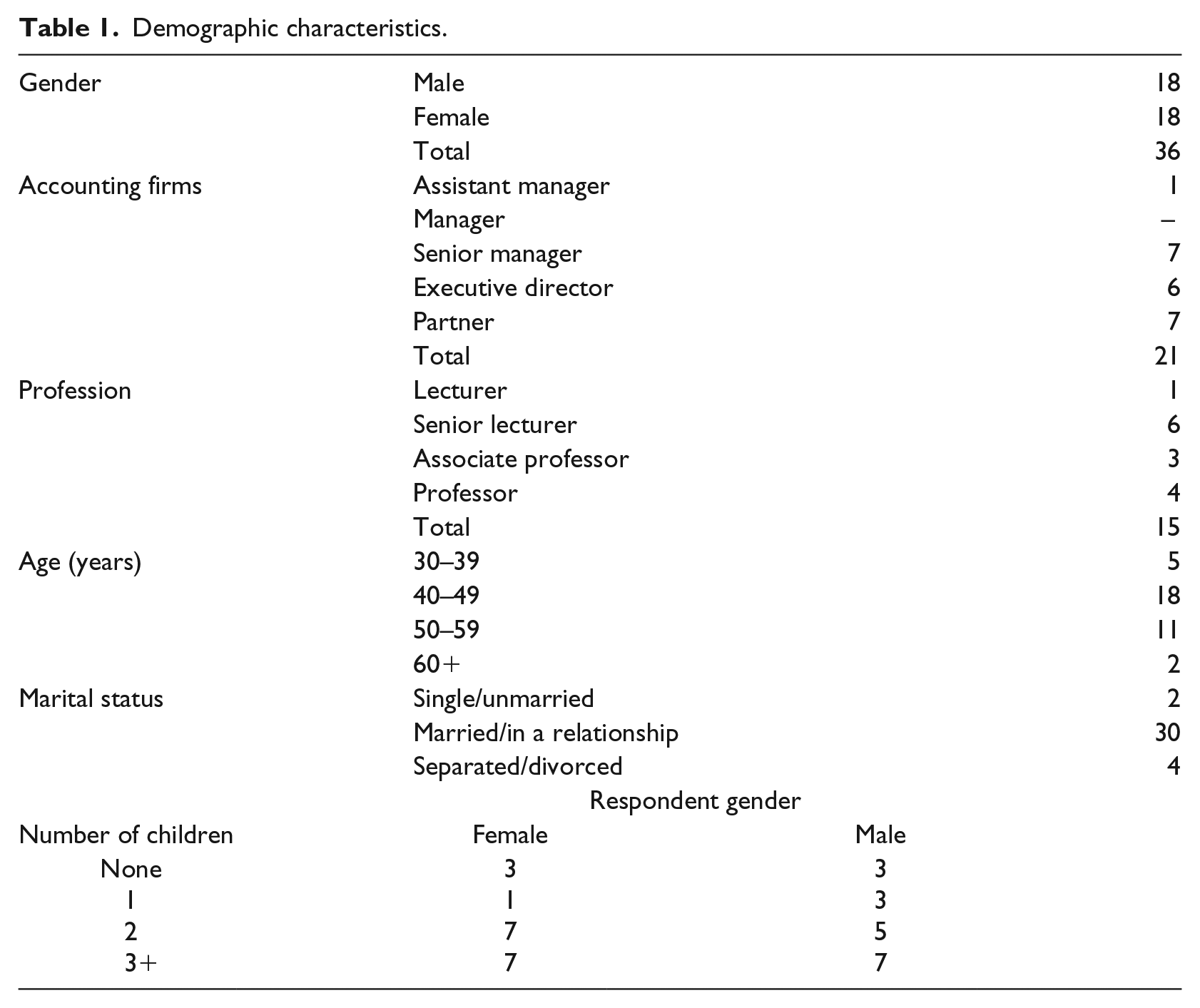
Table 1 presents an overview of the demographic profile of the sample. The participants of this study were overwhelmingly Pākeha (of European descent). Although females and males are equally represented, more accounting professionals agreed to contribute than academics. All of the practicing accountants were employed at the management level in their firms, though one reported a lower level of responsibility. Seven of the 21 professionals were partners in their firms (three females and four males), indicating a strong and enduring focus on career achievement. Of the 15 academics, four had achieved the highest rank professor (one female and three males). Although the ranks of ‘partner’ and ‘professor’ represent the top-echelon positions in business and academia, respectively, they are not directly comparable. Nearly all of the sample were married (94.44%), nearly all were parents (83.33%), and all but two participants were between 30 and 60 years of age.
Demographic characteristics.
Results and discussion
It is apparent from our study that the barriers to women’s achievement in the field of accounting appear to have changed little over the recent past. Our findings align with several other studies; individual, family and organisational barriers continue to exist (Brody et al., 2016; Flynn et al., 2015; Hakim, 2004; Holton and Dent, 2016). That such barriers remain simply means that the women facing them must find ways to overcome or compensate for them. The women in our study, for the most part, utilised strategies that integrated their work and family lives. The role of the external factors impinging upon them is undeniable, important and powerful; this article highlights the agential role played by the women participants and the mechanisms they developed to deal with these challenges. It was clear that there was no single ‘best’ path, embraced by all. We therefore focussed on tracing the career journeys of the participants to understand how their career focus was formed and the pathways were paved. The following discussion will identify and expand upon the ways our participants dealt with their career dilemmas.
Career breaks
The degree to which one’s career continued in an unbroken and smoothly running path we interpret as an indication of the type and strength of the participants’ career focus. The question of whether participants had to deal with start-stop situations was a critical one, as this sort of career interruption might have undesirable consequences. Did our participants follow a steady succession of increasingly responsible positions along the pathway or was their career interrupted, and what were the reasons for interruptions?
Only 3 of the 18 female participants reported steady career progress, they were to a great degree atypical of the others in the sample – they were in the younger age group (30–39) and did not have children. Of the 15 women reporting interrupted paths, only one participant, Virginia, took a career break to further her education, and she did not have any children at the time. Even later, with family commitments, Virginia could focus on her career. She said, ‘I was back to work in six weeks. My husband is not in paid work, so he’s brought [their son] up’. The remaining 14 women participants interrupted their career primarily because of their family responsibilities. For all of them, this meant arranging childcare for their children; they took a break from employment (Sullivan, 1992), worked part time or delayed their careers until after their children were older. For example, Carol stated, ‘I started my family, and then I did actually resign . . .’ Only one female participant, Sarah, reported the responsibility for an elderly parent. She was fortunate in having a ‘very accommodating and understanding’ employer along with supportive colleagues when she had to be away to look after her ailing father.
The story was different for the 18 male participants, perhaps reflecting traditional gender roles. Of these, 15 did not need to interrupt their careers, while the remaining three pursued further education for enhancing career opportunities. None of the 18 had to interrupt their careers for family responsibilities. This shows that gender and family responsibilities can have a major impact on an individual’s career flow and it is primarily determined by how partners apportion work and family tasks. Therefore, we investigated the work status of the partners and its impact on the work–family arrangements made by the couples.
Spousal support
Both men and women participants with children repeatedly reported that their careers depended on the spousal support to a major degree. Family responsibilities were at issue in this regard. The division of labour necessary to care and provide for a family and for one another has clear implications for gainful employment and career advancement. Table 2 below indicates the distribution of labour in the family, where total support indicates that the spouse relieved the partner from the bulk of family responsibilities. Partial support therefore indicates sharing of responsibilities. We did not ask respondents for numerical estimates of the household division of labour (e.g. ‘50/50’ or ‘65/35’), but value coded (nil, partial, total) the support on the basis of the textual data.
Spousal support.

It is evident from Table 2 that having a stay-at-home or a part-time working spouse does not appear to work the same way for the female participants as it does for their male colleagues. Unlike the male counterparts, even with a stay-at-home partner, women still seem to share family responsibilities. This interferes with their ability to fully focus on their career. The evidence from our interviews is that though the prevalence of the male breadwinner might be weakening today, the traditional role expectation of a male breadwinner in the family retains a firm hold and impacts upon identity and expectations (Warren, 2007). This remains, even when the husbands are not the main breadwinners as was the case of six female participants. Virginia said, ‘Even with him [husband] at home, there are still things [I must do] . . . it doesn’t shift all the work to him. There’s still things that only mums can do. And he gets sick of doing things too, so . . .’
Virginia thus contributed to the family in a way that tilted the balance of responsibility, weighing more heavily on her than her partner. Amanda felt constrained as well. ‘My husband, he doesn’t really like me getting home too late. I get a bit of negative feedback if I get home late, he doesn’t like that. So I do have to kind of consider him as well, because he is kind of running the house a bit more’.
In contrast, male participants with stay-at-home wives or part-time working wives felt fully supported and did not feel the same sense of responsibility. For example, James stated, ‘she starts at nine, so she gets them off to school, and is there for them after school to do the after school things, and I’m home by six o’clock. It’s all done . . . so that works quite well’. These findings led to the question of how gender influences the focus on career versus that for family.
Career focus
None of the participants focussed exclusively on career; their ‘focus on career and family’ attitude exhibited a variety of patterns. There was an element of family consideration to a lesser or a greater degree, but all participants described a balance of sorts between the two pulls. The focus was not found to be equal, but it was situational, dynamic and adapted to suit the demands of the individual’s circumstances. In fact, these situations can be described as a continuum wherein the career focus kept shifting with changes in life stage, family situation, and other responsibilities and priorities in the lives of our respondents.
The textual analysis led to the following Figure 1, which displays the asymmetry noted above with regard to the work flow and spousal support reported by the participants. It clearly shows the different gendered patterns reported by participants. The pattern is reversed, further emphasising the role gender plays in determining the proportions in the work–life balance mix.

Career versus family focus.
Figure 1 portrays the differing proportions contributing to the mixes of career–family balance for all of the participants, female and male alike. In no case was there an absolute focus on one of the other, but rather, all accommodations were a matter of degree, with differences in the proportions varying across participants. Notably, gender and family responsibilities played a major role in determining the individual participant’s location on the continuum – at the time of the research most female participants with children could be placed in the middle, representing an even balance of career and family. However, when their children were younger, nearly all in this group were more focussed on family responsibilities. This was expressed through taking a career break or delaying the start of their careers to a later time.
Greater focus on career
Female participants. Four female participants demonstrated a greater focus on career. Three were in their early 30s and did not have children. Cheryl was very clear about her goals. ‘My husband would like to have children’, she said, ‘but at the moment I am focussed on my career, so I have no plans for having children in near future’. The fourth participant was Virginia, whose stay-at-home partner was the primary care giver to their young son. She could therefore continue her career uninterrupted. Virginia recalled the discussion with her partner about the importance of her career. ‘We sat down and we had a wee bit of discussion about this, and I couldn’t give up the job at that time, as even at that point I was earning $20,000 a year more than he was’. She also noted that her drive to advance in her career played a major role in their division of labour. ‘Oh, yes, very much so. That went into the discussion too. I’m far more ambitious than he ever will be, or ever has been’.
Male participants. As documented earlier, it is not unusual to see men focus more on their career. All male participants who belong to this category (n = 14) confirm the traditional male career pattern, possibly because, as Carol suggested, ‘They have their wives or their partners to look after their children, so they can stay in here and work for long hours’. Laura corroborated, So they [her male colleagues] are working weekends and evenings and things, which I guess works for them because they have got wives at home that are looking after the kids, they are not working. Whereas I think for most women, for our situation, even though my husband is at home more, he is still never going to run the home. So you are still dealing with all that as well.
Of these 14 male participants, one is single; two do not have children and the remaining 11 have a supportive wife taking care of the family responsibilities. For example, Roger could focus on his career because, ‘She [his wife] stopped working . . . and almost recently just this year, in January, went back to work, full time now. She had fourteen years out of the workforce, yes, but she’s back now . . .’.
Flexible focus on career and family. Nearly all of our study participants had deliberately modified the mix of their work and family responsibilities. However, these accommodations tended to conform to a more traditional view of gender roles. Figure 1 shows that the males of our sample were more highly focussed on career. The fact that women in our sample were in career trajectories and also contributed much to the family documents that they were unable or unwilling to entirely relinquish either their career or family role.
Women shift to focus on career/family. The female participants exhibited a variety of patterns, with some shifted towards the right of Figure 1 indicating a more blended approach to the family–career mix. The direction of the shift in focus depended on their life situation and personal goals. Some went part-time or took a career break and re-joined after their children were older; some started their careers after their children had reached ages when a return to their career was more acceptable. It was evident with this participant group that they tended to rely on the prevailing gender schema (Blair-Loy, 2009), placing primary care-giving and household responsibility with the wife. Sweet and Moen (2015) discovered in their study of 1,500 working couples that individuals mould their lives to accommodate their existing contexts. So, for example, Mary initially had a family focus, noting that ‘. . . at that time in the 70s when I got married, everyone was going to . . . stay at home and have children’. This changed once her children were older; she pursued a career in accounting. ‘I have studied later, after I have had my children, because I wanted a better position . . . and a career’. The shift from a predominant family focus to one that incorporated career might also reflect evolution in the more generally accepted role expectations and norms in society.
Thus, the female participants in the flexible focus on career and family group at least initially conformed to the traditional expectations, with some changing at a later time. This can be construed as evidence of a role reversal, though it is neither a complete reversal nor broadly demonstrated by our sample. Five women participants of this group were the family ‘breadwinners’, where their husbands played a complementary role. This confirms findings of Shafer (2011) that wives’ hourly wage relative to their husbands is highly predictive of their career behaviour; the more they earn, the more likely they are to focus on work.
In this study, couples’ working arrangements appear to reflect a complex interplay of economic ability, aspirations and communication between the spouses and is powerfully influenced by the women’s levels of education and the strength of their drive for fulfilment. These factors can determine change, as for Yvonne. She noted, Eventually in terms of salary, I was making more than him, so it made sense to me, and I wanted to go and work fulltime, and he was quite happy to reduce his hours and go part time, so we did a bit of a role reversal, which was good.
In contrast, some participants who were focussed on their career moved in the other direction. Mandy initially delayed having children; promotion and progression were more important in the early stages of her career. However, her focus changed once she had children. She continued working, but did not deliberately take on greater responsibility for the firm as time passed and her experience grew. She said, The role came up to me to manage tax nationally, and I just went no, that’s not the right time. I’ve two young children, and I am not going to go for that role. When the kids are a bit older, they are doing their own thing, then you can step up.
Males and a rightward shift
A forced move. Research points to a career first attitude for men (Hakim, 2004; Hewlett and Luce, 2005; Whiting, 2008). This attitude is confirmed by our research, but it is readily apparent that they are able to do so only because they have supportive wives. This is not necessarily the case when relationships dissolve. Three of the male participants shifted to the centre-right of the continuum (Figure 1), as they had separated from their wives. As single parents, they were no longer able to focus exclusively on their careers. For example, Martin struggled with regaining his equilibrium after the separation. When asked about his future career plans, he said, ‘At the moment I am still trying to get my [personal] life back in order’.
Thus, when they lose that support, they must make adjustments to accommodate their responsibilities. Our respondents emphasised that even on a typical ‘one week on, one week off’ basis, they had sole care of their children. Ryan adjusted his work schedule to suit his changed circumstances. He said, ‘The responsibility of my children has definitely been [substantial] for the past six years, since the separation, so it’s had a huge impact. I have them every second week, my life is really quite full-on’. This recognises that coordination of a shared custody arrangement means added complexity in the lives of all concerned.
While we did not probe for the causes of separation, Daniel’s comments were quite telling: I was probably more the traditional, misogynistic partner, [our relationship] very much fell along the traditional lines, that my career came first, and in terms of responsibility . . . cooking, cleaning, and stuff like that, well, my wife would do that.
This clearly indicates that Daniel had to redefine his life as his wife also reinvented hers. The separation required him to shift his focus: Well, I have joint custody of the kids, so basically . . . this week is not my week so I can work longer, and when I do have the kids, that means I have to get up, get them up, get them breakfast, make their lunches . . . deal with moody teenagers in the morning, and get back home in [time] for dinner.
In this context, childcare responsibilities are an artefact of the decision to separate and might not have featured as a major consideration in that decision.
A willing outlier. The fourth rightward participant, Keith, is an academic. He was the only one in the male group who has willingly adopted a more balanced adaptive approach via a rightward shift. His wife was in full-time employment, and he was happy to manage both his academic work and the family front. He said, This job is more flexible than her job, so I mean I can [adapt]. As long as the work gets done, and I have done the classes, and did the lectures and I do the marking, then it doesn’t really matter when I am here, so I can pick her [their baby daughter] up or be late or whatever, you can be flexible.
Thus, the male participants adjusted their career focus to accommodate their family responsibilities, and in doing so adopted the traditional female career pattern. This documents a type of fluidity in role behaviours where gender is less important than for traditional role expectations. It is also an example of how work-role flexibility can provide a solution to the career-versus-family dilemma women might face.
Greater focus on family. Angela was the only participant working part time, focussing on family at the expense of her career. She was quite clear on her decision, saying, ‘I think I do balance my life well. I think probably to the detriment of my career path. On the whole I have made a point of trying to work it around my family’. This choice felt forced upon her somewhat, as her husband was less flexible in his career at the time. She thus accommodated his career by compromising her own, conforming to the more traditional role expectations for women. Although she gave up a substantial portion of her employment to look after her family, it is important to note that she did not completely abandon her career. In effect, she remained ‘flexible’ in this regard, though at the family-focussed end of the range. Her choice emphasises family over career to a very high degree, but is able to accommodate at least a small measure of career.
Thus, the importance of a career focus results from the interaction between attitudes towards one’s work and family, tempered by role expectations. For women, the traditional expectations of wife and mother have a large impact on a decision to alter their career. Responding to the enduring male dominance in accounting, some women participants in this study changed how they saw themselves professionally, the direction they took their careers and the contributions they made to family.
Strategic realignment
In redesigning and managing their work and family lives, all of our participants thought about both career and family. They assessed how well or poorly they were satisfied with their arrangements, examined their goals and evaluated the likelihood of achieving these. They then found ways to alter their behaviour to better align these to their preferences and better manage their relationships with the key people in their lives. Thus, three main factors came into play when our participants altered their contributions to family life and work: cognitive, task and relational factors.
Cognitive processes
Conceptualising and redetermining personal and professional goals result from the mental processes of perception, judgement, reasoning and decision-making. For example, in our study, 10 participants decided to shift from accounting firms to academia, predominantly to gain flexibility and a better work–life balance. Their experience with accounting firms, where they had restricted autonomy, motivated their move. The academic environment allowed freedom in how they organised their work, making it easier for them to manage personal and work commitments (Doherty and Manfredi, 2006). This illustrates the most frequently reported motive for choosing an academic career, ‘the ability to do what I want, when I want and how I want’ (Lindholm, 2004: 611).
Five male participants who shifted to academia did so largely for job satisfaction, control, independence and flexibility. Arthur expressed this view, saying, Yes, I just felt it [academia] was really much more satisfying. I could have that much more control over what I was doing. I could decide what was important, and I liked the idea of doing research, and was curious about things.
In contrast, five female accounting practitioners switched to academia primarily because of family responsibilities. Mary said, You could work from home, or you could take time off, and go and see the children at sport or do reading, but you just worked late or you worked at the weekends . . . to catch the time up. So, [the decision to move to academia] was probably for the sake of my kids.
Sarah reoriented her career goals and shifted to accounting academia to accommodate her career and family focus. She found the reality of working as an accounting practitioner quite challenging, and eventually rejected it: I was quite naïve, I thought that it’d leave me completely free for family obligations. But what I had underestimated was that accounting is very demanding, and that it does take up a lot of time. In practice there are times when there are deadlines, and you are just required to keep working nights, weekends, evenings . . . to get something finished. It’s not family friendly.
For Sarah, the cognitive process of evaluating her current state and choosing an alternative after making the shift to academia resulted in a change of responsibilities that redressed her work–family balance. Although she admitted that academic life was just as demanding, ‘There are still pressures that make it difficult to balance life and family. It is easier just to focus on career, and not to have a family’.
Other participants chose different solutions. Nancy, for example, adjusted her career focus to bring it into accord with changes in her personal and professional goals. Initially, she gave up her top position in a firm when she was pregnant. Nancy said, I had this thing in my head that I would be this real earth mother, because I enjoyed arts and crafts, but after a year I had itchy feet . . . I had this ‘if I have to do this for the next 20 years, I will kill myself’ type of thing.
Realising that she could not adapt, Nancy invented a new goal of creating a business. This resulted from her attendance at a motivation course. As she was a professional accountant, she started her own accounting firm. After running it successfully for a number of years, she realised she needed to devote more time to her family, and so she redesigned her career again. She sold her company to a larger firm and began working as a partner with the new owners. Thus, Nancy actively oscillated her focus between family and career to achieve her personal and professional goals.
Managing tasks
In addition to the cognitive process, it is important to select and manage the tasks of daily family life and work in order to maintain the desired balance. Both career and family present numerous task-based demands in one’s life, requiring the management of personal and professional activities over what might be a compressed time frame. Jane, who was in the middle of the continuum (Figure 1), managed her work–family balance by re-organising her day: Now I leave here [the office] at 2.45 in the afternoon, and then till about 7.30 it’s family time. I take my daughter to her classes, I pick my son up from school, and then from 7.30 onwards, however much work I have got to do, I do.
Virginia had to travel a considerable distance to get to her work, but she developed a way of making better use of this time. She maintained that ‘. . . it [commuting] gives you a chance to do work; I use it as work time’. Transit time is not necessarily unproductive for Virginia.
Sue pursued a university education and subsequently her career once her children were older. She formulated a way to maintain her career focus, ‘So I’d come back [to the office] after they were all in bed at nine at night and did a couple of hours’. Later Sue reorganised the household’s duties when the children were growing up, ‘I don’t do all the cooking, I only cook once a week, and everyone’s got chores’. Thus, this redistribution of household activities has freed her time up considerably, and it has had a big impact on her professional life. These evolve as the family matures, and changes in them lead to the development of different mechanisms for accomplishing family and work-related tasks.
Managing relationships
The managing of relationships is a dynamic and a two-way process, which changes with the people involved, life stage and the circumstances. Personal relationships, mainly family, featured prominently in adjusting the career focus of the participants. As stated above, Nancy gave up her thriving practice when she realised that she preferred to emphasise her mother role. She said, ‘So my son, 12 going on 13, he was my primary reason for selling [the accounting practice] to make sure I would be available for him’. Selling her practice to a larger firm while becoming a partner in the purchasing firm allowed her to reduce some of the stress on her relationships while she could still engage with her career.
Professional relationships also play an integral part in career progression. Sharon has benefitted from consciously creating good relationships with her superiors – ‘I’ve always been really well supported within the firm. In whatever firm I have worked in, I did actively build relationships with the partners and my co-workers’. This enabled Sharon maintain a career focus while working at a high level in the firm and allowed her to manage her work relationships in a flexible manner. ‘I was working in that pseudo partner role for quite a long time, particularly the time I was having the children, and having bits of time off for parental leave and the like and working part time’.
Sally now conducts her personal and professional life in a different way after her previous unpleasant marital experience – ‘I have been much more stroppy with my [second] husband about [my work]. I have been through all these things before . . .’. This has helped Sally to have a greater focus on her career, shifting to the left of the career focus continuum.
An equilibrium of three factors: cognition, tasks and relationships
The three components of career change – cognitive, task and relationship – are intertwined such that changes to one require adjustment by the others. This is characteristic of those redefining themselves. Mandy, for example, insisted that she had negotiated a work pattern that suits her both professionally and personally. She reflected on the expectations of working full time in a partnership capacity with her previous Big Four firm. The notion that career must always come first, before family and relationships, was disagreeable and prompted her to modify her work orientation: That’s ridiculous; it’s quality not quantity. So I had this thought process, am I going to be a Partner [in her previous firm], what does life look like and am I going to be fighting to try and leave at 4 o’clock to go see my daughters swimming? That’s a problem. Because I don’t want my daughters growing up thinking mum just worked. She was never there. Then I have done something really wrong.
Hence, Mandy searched for a firm where she did not have to work full time and was still able to reach the top position of Partner. She found a firm that was willing to be flexible with her needs while still valuing her contribution, thus she could maintain both her career and family focus. This rearrangement of her priorities involved refining her cognitive approach to work and family, to the tasks that comprise her everyday life, and the relationships within which she works and lives.
Mandy looks after her personal and family needs by conscientiously following a routine: I get up at 5:00 in the morning, at 5.30 I am on the rowing machine for an hour, or I go for a run for an hour and a half. Sort of, 5.30 in the morning, that’s my time to do what I want to do. I make sure that I’m there [for the children], and if there’s a mothers’ help needed in the morning then I go to it.
Mandy is one of the few participants who has hired house help: At least I can ring Anna and say that, ‘I am going to be late, or Anna can you grab this this and this, and can you cook dinner and blah blah blah’. She is almost like a home P.A./nanny, and that’s the only way it works [emphasis added].
Thus, by managing how she thought about her career, family and work relationships, and organising the tasks, Mandy was able to achieve her personal and professional goals. Hers is a life in balance.
Conclusion
This study has investigated the ways in which a group of accounting professionals in New Zealand has redesigned their careers and adjusted their lives in response. With regard to the evolution-to-revolution model proposed by Goldin (2006), we have delineated the actions that both women and men take when deciding to change the way they work along with their orientation to their long-term careers and goals. We found that they restructured their lives by making relatively small changes, exemplifying accommodation rather than reinvention. This confirms the observation that traditional roles are only being gradually re-constructed (Whiting, 2008). The changes we observed are not transformative and thus do not indicate a ‘revolution’.
It is clear from our work that individuals are strongly influenced by social and situational forces. For example, the impact of family on career is substantial and differs by gender and individual aspirations. Family responsibilities vary as well, with children and spousal support influencing career aspirations. These variables were found to be the major factors in reforming career focus. These seem to be particularly acute for female participants, as their career focus is determined primarily by their parental status and their dedication to the care-giving aspect of their family role. Despite having spousal and organisational support, most of the women in this study had a flexible focus on career and continued to put their families first in their career decisions. Even with stay-at-home spouses, female breadwinners continued to contribute at least some of the traditional female role behaviours in the home when away from their work. This contrasts with the situation for men, who were able to focus on their careers to a greater extent as a consequence of their spousal support.
These results re-confirm the existence of traditional career patterns and to an extent, broader traditional gender role expectations in the profession. In the realignment of career, both women and men have adjusted some of the components of the roles they perform. In spite of these changes, however, they do not abandon traditional role behaviours. This can be seen as a fundamental tension in the system, pointing to the question of larger scale change in the framing of gender and career patterns. Indeed, it may be time to more thoroughly question the status quo, to de-essentialise mothering and extend the nurturing role further into the expectations set for men and others (Longhurst, 2008).
The decisions to change expressed by our sample were in response to the interactions of multiple, substantial influences – the ways they think about life, work and career; the tasks that these require; and the relationships they have with their significant others. Although different in the ways in which they pick apart these influences, all of our participants found that the change they desired depended on how they resolved the demands made by the interaction of these factors. It is clear that the impediments to greater equality in rank and contribution lie not only in organisational and societal structures but also within individuals themselves.
Regardless of gender, however, the redefining of one’s professional self – pursuing a different career trajectory – is a considerably more intricate activity than simply changing jobs. Such comprehensive change is likely to be a difficult task, requiring women to break the executive mould through negotiation, increase their career capital (Inkson and Arthur, 2001) and more firmly exercise voice and agency (Sen, 1999). For the men as well, a realignment of traditional role behaviours and expectations will be necessary. Acknowledging that substantial inequality in the accounting profession remains and appears entrenched makes it clear that the revolution Goldin (2006) hypothesised has not yet been fully accomplished, but rather is still underway.
Implications for practice
Motherhood and its attendant responsibilities is not an everlasting phenomenon. In this study, after the children were more independent, many women returned to the career track or they chose to migrate from the Big Four firms to smaller firms or academia. These may be considered career environments where the gender-bound rules are somewhat more flexible than in larger firms. Thus, to accommodate this migration, organisations of any size may need to become more flexible in their expectations and practices, to recognise that planning for and allowing for time away, even protracted periods, may be in their best interests.
This study has been concerned with the ways in which accounting professionals, and women professionals in particular, emancipate themselves from careers they feel that a significant change is necessary. Although primarily concerned with the how and why of people redefining and remaking their professional selves, it must be acknowledged that the narrow focus of the study might not represent the means and mechanisms people in other professions rely upon to alter their career paths. Thus, the investigation of career change for people in other professions such as law and medicine is warranted. This would address the question of whether what we have found would describe a rather more general approach to redefining the self, one that operates across professions. Future research that investigates the participation of Māori (the indigenous people of New Zealand) accountants could also inform strategies directed at improving access in this field.
There is also the question of whether those in work not normally described as ‘careers’ – working at ‘jobs’, as Goldin (2006) described them – would pursue a similar strategy in their attempts to redefine themselves. This would address the larger question of to what degree we have witnessed the transformational quiet revolution proposed by Goldin (2006).
