



Abstract
Although little is known about accounting activities within educational institutions, even less is known about their relevance to local governments. By adopting an Anglo-Foucauldian perspective, an archival-based study is conducted in this article to investigate the accounting practices adopted by a religious congregation for the management of two vocational schools in Brescia, Italy, between 1886 and 1907. In such a context, which lacked an efficient and effective educational system and underwent socio-economic changes as a result of an incipient industrialisation process, the accounting practices proved to be crucial not only to ensure the proper functioning of the institutions under investigation, but also to deal with educational poverty. This study demonstrates that accounting practices have a constitutive role in pursuing equilibrium strategies within the dynamics of local government.
Keywords
Introduction
The relationship between accounting and local government (hereby referred to as LG) is attracting a growing number of scholars (see, e.g. Gomes and Sargiacomo, 2013; Sargiacomo and Gomes, 2011). While prior research has focussed on the role of institutions such as hospitals, theatres, prisons and charities (Baskerville and Servalli, 2016; Gregorini, 2016a; Rossi, 2018), less attention has been paid to vocational educational institutions (hereby referred to as EIs) that operate at a regional level (Detzen and Hoffmann, 2019; Maran and West, 2017; Sian et al., 2019 are exceptions). These EIs play important economic and political roles (Helliwell, 2001; Storesletten and Zilibotti, 2000). The process of accumulating human capital through primary and secondary education is recognised as a driving force of economic development (Glaeser et al., 2011; Hanushek and Woesmann, 2010).
This study focusses on Brescia in eastern Lombardy, Italy, where the need for a vocational education system emerged during the nineteenth century. This problem was of particular importance to the working classes, who lacked access to effective vocational education that could adequately prepare them for work (Cappelli, 2017; Onger, 1993). At that time, it was necessary to ensure a balance in the local labour market, which would mitigate the risks of widespread social hardship from what could be described as rampant and growing ‘educational poverty’. 1 To meet this need, a number of vocational EIs were created in the late nineteenth century including the Istituto Artigianelli in 1886 (Artigianelli Institute; Artigianelli hereafter), and the Colonia Agricola in 1895 (Agricultural School; Colonia hereafter; Salini, 2005).
This study has two key objectives. First, it explains the important role played by accounting techniques of EIs in their educational activity and administrative functioning. Second, it demonstrates that these techniques were crucial from a governmentality perspective (Foucault, 1982, 1991, 2009); this entails studying how the techniques fulfilled the information requirements of the LGs and assisted them in achieving their objectives of reducing educational poverty.
In the case considered in this article, LGs such as the municipality of Brescia, central government at the local level, provincial administration, Provincial Labour Inspectorate and Provincial Inspectorate of Agriculture had an interest in the vocational training of young people. The information elaborated and made available by the vocational EIs concerned these local subjects in a number of different ways and circumstances, described in this study using archival documentation. Reference is made to all the information produced by the accounting processes, which incorporate economic, financial (assets, annual revenue and periodic cash flows) as well as non-financial (people, resources, forms of social need and types of intervention) information.
Two aspects should be noted about the vocational EIs. First, they were founded by religious Catholics within the context of a progressive diocese that was open to modernity and was involved in social work (Gregorini, 2016b) within Lombardy. 2 Two cases of non-State public schools run by religious congregations (hereafter known as RCs) are examined. Examining these two cases makes it possible to overcome the traditional dichotomisation between the private and public sector organisations that generally exists in accounting history studies. Second, the EIs commenced operation in the late nineteenth century, a period characterised by unresolved shortcomings in state intervention, particularly in terms of assistance and vocational education (Cappelli, 2017; Pruneri, 2009: 129).
The study focusses on the years between 1886 and 1907, as in 1886, the Artigianelli – the first of the two EIs – was established, and in 1907, following laws n. 242 promulgated on 8 April 1906 and n. 414 on 30 June 1907, vocational education was included in the Italian public school system (Morandi, 2014: 101; Pruneri, 2009: 133–134). From 1907, new schools could only be established after approval by an ad hoc law and the process of aligning the local curricula to national requirements began. Local educational initiatives no longer depended on individual municipalities, but involved the creation of consortiums between municipalities, provinces and chambers of commerce, all under the control of the state (Varini, 2002: 212).
In summary, this study contributes to the accounting history literature on LGs focussing on two important non-State EIs during 1886–1907. Although Italy experienced significant transformations in central government institutions and policies during this period, there was continuity with regards to private and public local institutions 3 (Cappelli, 2017; Taccolini, 2013; Zaninelli, 1999).
The article is organised as follows. The following two sections provide a review of the essential literature and set the theoretical basis of the study. The fourth section describes the methodology and sources used in the article. The fifth section focusses on the context in which the LGs and EIs operated. Two further sections review the accounting systems implemented by the EIs under investigation, and evaluate their relational efficiency (internal and external) and contribution to LGs. The last section presents the study’s conclusion.
Literature review
The literature on the general relationship between accounting and LG has been reviewed by Gomes and Sargiacomo (2013). This review recognised the importance of public institutions that operate locally. These entities, ‘largely neglected in historical research’, deserve particular attention as they ‘provided and continue to provide structure and order to collective lives’ and ‘represent the action of the government at the micro level, thus impacting upon the lives of the governed and the connections between these institutions and other local entities’ (Gomes and Sargiacomo, 2013: 439).
Gomes and Sargiacomo (2013: 442) highlight the importance of promoting robust and rigorous work on accounting in LGs and in community organisations that operated within LG settings (e.g. hospitals, schools, charity institutions, theatres and prisons). 4 The connection between LG and other local bodies, particularly EIs, is the subject of this study in light of the important role of accounting and accountability ‘in the administration and governance of such organizations and, consequently, in the process of ordering activities within local communities’ (Gomes and Sargiacomo, 2013: 439). In particular, this study focusses on the accounting interrelationship between LGs and non-business and non-governmental associations, which resulted from citizens’ efforts to improve state and LG operations (Daniels et al., 2010; Pridgen and Flesher, 2013).
For this research, two elements were adopted from the work of Napier (1991). First, the importance of considering the local nineteenth-century context, and second, the relevance of the interactions between social classes (aristocracy in Napier, 1991, compared with the religious class in this article) and public needs addressed by the LGs. Two further elements were adopted from the work of Guinnane (2003: 237). The consolidation of a positive evaluation on the non-governmental and non-business entities (cooperative credit in Guinnane and EIs in this article) by LGs; and the valorisation of resources (human and material) that these same entities made in the local context.
Other studies focussing on LG referenced in this article include Servalli’s (2013) examination of the Misericordia Maggiore in Bergamo between the sixteenth and seventeenth centuries and Gregorini’s (2016a) study of the Congregation of Apostolic Charity of Brescia in the early twentieth century. Both works draw attention to the role of charities and their accounting practices in collecting useful information for LGs and outlining measures to control and combat material poverty.
The few studies on the relationship between EIs and accounting studies can be divided into two main strands. The first is concerned with the issue of allocating public funding (see, e.g. Agyemang, 2010; Edwards et al., 1995, 1996, 1997, 2005). Edwards et al. (2005) reviewed the Education Reform Act of 1988 which sought to reduce the role of Local Education Authorities through the introduction of an objective budgetary formula for the allocation of resources, as well providing greater autonomy to school managers. The study highlights the ability of these institutions to adapt and survive while maintaining their position in the national educational system.
The second strand analyses accountability issues (see, e.g. Bracci, 2009; Broadbent et al., 1999; Connelly et al., 1995; Fowler, 2010; Fowler and Cordery, 2015; Ntim et al., 2017) focussing on the education systems of the United Kingdom, New Zealand and Italy.
Connelly et al. (1995) examine Scottish education boards and structure, financing, accounting procedures, auditing, financial reporting and community accountability changes between the nineteenth and twentieth centuries. These boards, which operated at a parish level, were responsible for ensuring universal primary education by collecting taxes and charging school fees. While the reforms allowed greater standardisation of the educational expertise available, they engendered a loss of local downwards accountability (Connelly et al., 1995).
The studies by Fowler (2010) and Fowler and Cordery (2015) analyse the Nelson School Society (NSS), a non-profit educational provider in the newly established settlement of Nelson, in mid-nineteenth-century New Zealand. Fowler (2010) underlines how, financing, accounting and accountability practices aimed not only at reporting pupils’ school performance to governing branch committees, but also at obtaining the necessary resources to become providers of educational services. Fowler and Cordery (2015) scrutinise accountability changes as the provision and control of education moved from private non-profit organisations to a public sector operation. The results confirm Fowler’s (2010) findings regarding the building of downwards relationships of the NSS to gain approval and resources from the community. They emphasised that, ‘when subsumed into a public sector framework, the schools accounted primarily to their government funder and [. . .] lost the community accountability that had been evident when operating as a private nonprofit enterprise’ (Fowler and Cordery, 2015: 147).
These works underline the important role that accounting has for both the functioning of the EIs analysed, and for the intermediation of their relationships with governmental institutions and private subjects. This study aims to contribute to the research in both these fields by focussing on the impacts of accounting in fostering the interplay between EIs and LGs from a governmentality perspective. More specifically, in this article, the role that the accounting practices adopted by EIs can have in the control, management and resolution of educational poverty problems by supporting schools’ activities, and providing relevant information to local actors with whom the schools interact, is examined.
Theoretical framing
The accounting interrelationships between LGs and non-business and non-governmental associations can be understood by adopting a theoretical framework – the Foucauldian concept of governmentality – to interpret the findings (Carmona and Zan, 2002: 291, 304; Carmona, 2004; Gomes and Sargiacomo, 2013: 443; Sargiacomo and Gomes, 2011: 270, 273). As Carnegie and Napier (2012: 352) explain,
“a well-articulated theoretical position can help researchers to abstract from the particular data with which they are presented or which they uncover, to posit the key variables or factors that may be relevant to understanding and explaining the specific phenomena of interest, and to suggest relationships among those variables or factors that may be investigated.”
The Foucauldian concept of governmentality is based on three cornerstones. The first includes the institutions, procedures, analyses, reflections, calculations and tactics used to exercise a complex form of power whose target is the population, the main form of knowledge is the political economy and the fundamental technical instruments are the apparatuses of security. Second is the existence of a trend affirming the superiority of the power called government on all others (sovereignty, discipline), with the consequent development of specific apparatuses and a series of know-hows. Third is the process through which the state of justice of the Middle Ages became an administrative state during the fifteenth and sixteenth centuries, and which found itself gradually becoming ‘governmentalized’ (Foucault, 2009: 108–109).
In Foucault’s reflection, the art of government is pluralised; it goes beyond the government of the State, becoming governmentality when the population turns into its main subject of interest, together with the improvement of its fate, health, wealth, and lifespan (Senellart, 2006: 25). The set of practices through which governmentality intervenes in the population outlines a new meaning of ‘police’ (Foucault, 1984a: 241, 2009: 312). In the fifteenth and sixteenth centuries, the term police defined a community over which a political power or a public authority had exercised their rights. However, since the seventeenth century, ‘police’ has been intended as ‘the ensemble of mechanisms serving to ensure order, the properly channelled growth of wealth and the conditions of preservation of wealth “in general”’ (Dean, 1992: 224; Elden, 2003: 247–248; Vagnarelli, 2017: 152; Foucault, 1984b: 277).
Within governmentality, a strictly institutionalist and functionalist approach to power is replaced by a new governmental rationality: governing does not mean coercing subjects, but rather leading, directing and orienting the conduct of subjects towards goals that are considered convenient; thus, it works in accordance with the art of soft government, rather than a coactive one (Chignola, 2006: 57). From this perspective, government becomes the government of society because the object of its action is the social environment, and its objective is to introduce the market economy as the new regulatory principle: governmentality as the generalisation of the market economy and of its imperative effectiveness (Foucault, 2007: 129).
Foucault conceives of power not as a simulacrum or domination, but as an open weave of infra-legal relations that become the foundation of governmentality (Chevallier, 2014; Foucault, 1995; Jolly and Sabot, 2013); these relations also involve the institutions of a region extending the field of politics to the role of techniques such as accounting (Chignola, 2006: 57; Laborier, 2014: 171–177; Vagnarelli, 2017: 155). In this view, the concept of what government entails is widened, and within it, multiple regulation practices of social processes must be included, going beyond the exercise of political sovereignty, therefore, involving the educational field as well. This occurs because every individual spends a significant portion of their life inside EIs, which contribute to defining the cultural features of a local, national, and international community (Foucault, 1991, 2002). Through discipline, schools train and develop individuals to desirable standards and principles of conduct. The instruments of discipline are hierarchical observation, normalising judgement, and examination. Hierarchical observation is a hierarchised, continuous and functional supervision based on an analytical division of space and a surveillance apparatus. Normalisation comprises a double system of gratification-punishment that trains and corrects individuals by comparing, differentiating, hierarchising, homogenising and excluding them. Examination is the combination of the first two instruments: it is a normalising gaze, a surveillance that makes it possible to qualify, classify and punish. It establishes a visibility over individuals through which they can be differentiated and judged (Foucault, 1995: 170).
Therefore, the concept of population and its knowledge are relevant. The population becomes the object of observation, comparison and information collection (Dean, 1992: 227; Foucault, 1991: 99–101). Providing information on the observed object is a way of operating in the area of interest it represents; a way of making it possible to evaluate, calculate, and intervene. Indeed, governmentality requires both representation and intervention. It entails intrinsic connections between the ways of representing and knowing phenomena, and the ways of working to transform them. Government is based on ‘forms of knowledge’ (positive knowledge of what is to be governed) and ‘regimes of practices’ (specific forms of intervention include assisting, curing, punishing, schooling, etc.; Miller and Rose, 1990: 7–8, 2008: 15–16; Servalli, 2013: 1312).
A fundamental link between forms of knowledge and regimes of practices are the ‘technologies of government’ (Dean, 1996: 52). Technologies assemble human, technical and natural beings as resources in the generation of powers that can be unlocked, stored, transported and distributed. Technologies of government are mechanisms through which authorities seek to direct the conduct and instantiate government (Miller and Rose, 2008: 15). ‘Practical rationalities’ (programmes, policies) and ‘specialist knowledge’ (the know-how that makes government possible) characterise the technology of government. In the Anglo-Foucauldian scholars’ analysis of governmentality, there are various kinds of technologies of government including notation, computation, calculation, assessment and tables (Rose and Miller, 1992: 177–178, 183). Through these technologies, the authorities seek ‘to shape, normalise, and instrumentalise the conduct, thought, decisions, and aspirations of others in order to achieve the objectives they consider desirable’ (Miller and Rose, 1990: 8).
The technologies of government can be investigated using a set of four indicators or ‘technological thresholds’ (Dean, 1996: 63), which illustrate the level of technologisation of a government. The ‘threshold of assemblage’ (Dean, 1996: 64) refers to the assemblage of diverse elements concerned with the direction of conduct: techniques of governing the body or self; annotation tools for generation and use of information; space-time coordination mechanisms; means for creation of authority forms; practical rationalities – such as programmes, policies, plans – that invest technologies with purpose and codify their functioning and expertise for calculation; planning; and evaluation. The ‘threshold of system’ (Dean, 1996: 64) indicates the relation between technologies of government and other types of technologies (communication, production and consumption) for composing technological systems. The ‘threshold of force’ (Dean, 1996: 64) refers to the fact that capacities and forces are qualitatively different from a simple augmentation process; in this perspective, a technology of government transforms places into ‘power containers’ (for the independent generation of goods, energy, information and services, as well as forms of social authority, control and regulation) and ‘power storers/generators’ (for the coordination of activities realised across different places in a space-time dimension). The ‘threshold of the orientation of government’ (Dean, 1996: 65) denotes that a technology of government considers the skills and force of individuals, groups or populations, as factors to be intensified and optimised.
Methodology and sources
This study draws primarily from the large collection of documents located in the Archivio Storico Sacra Famiglia di Nazareth (ASSFN) and Archivio di Stato di Brescia (ASBS) institutional archives. Thus, the research undoubtedly falls within the category of an investigation ‘grounded firmly in the archive’ (Carnegie and Napier, 1996: 30, 2012).
The Holy Family of Nazareth (hereafter, Piamartini) is an all-male RC that was founded in Brescia by Father Piamarta in 1886, and was formally recognised by the diocese of Brescia in 1902 (Salini, 2004). It remains active and is present both in Italy and globally. Its activities are primarily dedicated to educational apostolate. Its archive contains more than 5,000 documents about the life of the RC (particularly its foundation, institutional developments, charitable initiatives, and economic and financial management). The historical origins of these RCs (as well as their EIs) indicate that they attract significant income from diverse sources, 5 creating a complex nexus of accountability relationships (Leardini and Rossi, 2013; Semeraro, 2017).
For this study, documents relevant to the period (1886–1907) and the entities in question (i.e. Artigianelli, Colonia, the municipality of Brescia, representations of the central government at local level, provincial administration, Provincial Labour Inspectorate and Provincial Inspectorate of Agriculture, Brescia Chamber of Commerce) were examined. The non-financial EI information collected included lists, tables and surveys concerning pupils and activities of the schools. Financial information included accounting journals, balance sheets and income statements of the Artigianelli and Colonia (ASSFN, 3A-1/15-33; ASSFN, 2E-1/2).
The research is grounded in a historical narrative that adopts the perspective in which ‘phenomena are shaped by specific environmental conditions concerning location and time’ (Bracci et al., 2010: 464). It was carried out in accordance with the steps of the historical-critical method (Bloch, 1949; Cipolla, 1988; Marrou, 1954; Tosh, 1984). First, sources considered useful for the research were identified in the historical archives of the institutions. Second, the documents were critically evaluated, in terms of reliability and intrinsic correctness on the basis of: their coherence and seriality with respect to available archival documentation; whether they had indeed been produced by the institutions under investigation; the homogeneity of their content with respect to the existing literature; and a philological analysis. It was also important to provide a deeper appreciation of the overall background against which these sources were generated, to grasp their relevance to the context of the time (Taccolini and Gregorini, 2013).
The context
Educational system in Post-Unification Italy
The school system and the accumulation of human capital in Italy are chronically disadvantaged when compared with advanced economies (Felice and Vecchi, 2015; Nuvolari and Vasta, 2015). The country does not achieve good results in international education rankings and the national performance also hides considerable differences between regions (Bertola and Sestito, 2013: 249–270; Cappelli, 2017: 75–76). It is equally indisputable that poor educational performance occurred as early as the mid-nineteenth century, well before the unification of Italy.
The pre-unification governments left a challenging legacy for the new Kingdom of Italy (Vigo, 1971). While some regions had seen a significant diffusion of primary education and had partly succeeded in achieving an educational level at par with more developed countries, no public school systems had even been envisaged in other areas of the peninsula. In the first decades of the nineteenth century, in the areas under the Austrian administrative system (including Brescia as part of the Kingdom of Lombardy–Venetia), the village parish priest was designated as the local head of public schooling, and tasked with providing basic literacy and numeracy education to children. The development of educational initiatives promoted by private individuals, particularly Catholics, was permitted at a regional level. However, a supervisory role was maintained by the central state (Agosti, 1961).
Within this framework, the Casati law of 1859 6 established the organisational model of the Italian school system which existed up to Daneo-Credaro’s reforms in 1911 7 and Gentile’s reforms in 1923. 8 Although the structure conceived by the Casati law introduced a clear distinction between classes and initiated the move from local schooling to a national system (on the basis of the one established in the Kingdom of Sardinia in 1848), vocational education was largely ignored (Genovesi, 1999; Pruneri, 2009; Semeraro, 1996; Taccolini, 2007: 129; Tonelli, 1964: 9–10). Compulsory primary education was free for families and guaranteed by the individual municipalities based on their resources and the needs expressed by their inhabitants. However, municipalities were often poorly resourced, the quality of teaching was poor, while low family income also impacted school attendance (A’Hearn et al., 2011; Cives, 1990; De Fort, 1996; Ricuperati, 2015). This meant that few pupils had the chance to attend secondary education where they could acquire the knowledge and skills needed to work in a factory or a farm (Bevilacqua, 1995).
Between the nineteenth and twentieth centuries, vocational training became a primary focus. This branch of the Italian school system lacked both infrastructure and teaching staff (Ministero di Agricoltura Industria e Commercio, 1869, 1885; Monzilli, 1885). A lack of post primary education jeopardised the development of industries, and undermined the growth. As reported by the politicians and experts at the time, an absence of vocational education represented one of the most critical contributions to educational poverty in Italy (Colombo, 1985; Moroni, 2002: 386).
In a speech to Parliament on 27 May 1861, Italian Prime Minister Camillo Benso claimed that:
in order to favour industries, it is appropriate to favour vocational education, not only for high-skilled, but also for low-skilled workers. We are still lacking good foremen in our factories; we are encountering a great deal of difficulty in recruiting mechanical engineers [. . .]. To have this class of foremen, it is necessary to open technical schools, where workers – not just any workers, but true workers with a natural talent – can acquire the essential skills to become foremen, good foremen (Bertagna, 2013: 60).
Five years later, Pasquale Villari (1866), a well-known historian and senator of the Kingdom of Italy, focussed on the educational problem of the country when highlighting the importance of vocational education:
Italy should begin to realise that there is an even more powerful enemy than Austria within the nation itself, and it is our colossal ignorance, the illiterate crowds, the mechanical bureaucrats, the ignorant professors, the childish politicians, the impossible diplomats, the incapable generals, the inexperienced workers, the patriarchal farmers and the rhetoric eroding our bones. It is not the quadrilateral of Mantua and Verona which was able to halt our journey, but it is the quadrilateral of 17 million illiterates and 5 million peasants (p. 31).
In September 1908, Bevilacqua (1995) – an expert of vocational education and workers’ law – again denounced the lack of vocational education opportunities. In particular, he emphasised the lack of a specific apprenticeship contract (which has already been available in France since 1857, Austria, 1883, and Germany, 1897) and the strong educational dispersion.
Religious congregations and educational institutions
To address the absence of educational opportunities, several EIs were established in the main provincial capitals of Lombardy. The majority of these EIs were promoted by Social Catholics; RC was an essential element of Social Catholicism (De Giorgi, 1994; Raponi, 1997, 2004).
As the historiographic literature has shown (De Giorgi, 2000, 2002; De Maeyer et al., 2004; Rocca, 2008, 2014, 2018; Taccolini, 2003), RC is an innovation of the late modern period, a product of a society (including the Church) that attempts to respond to the societal changes in the areas of health, welfare, education and religion. The social origins of RCs are markedly evident in the case of the Italian institutes established during the nineteenth and twentieth centuries, in particular along the axis of Milan, Bergamo, Brescia and Verona. Lombardy in particular was home to 50 of the 200 institutes born in Italy between 1809 and 1900 (Rocca, 1988: 21, 59). These were among the largest in terms of assets, income and members (Gregorini, 2008; Van Dijck et al., 2012).
To perform their activities, RCs opened small communities (daughter-houses) where they managed several operations (schools, hospitals, orphanages, workers’ boarding houses, boarding schools, soup kitchens). This led to the establishment of a network that was institutionally and economically dependent on the mother-house. This was a case of charity lived in poverty that was so widespread it contributed to the effectiveness of local welfare systems in Northern Italy (Gregorini, 2016a: 7–10), where RCs cooperated with institutions and governing classes to develop local communities (Gregorini, 2012). Despite this innovation, the relationship between religious institutions and accounting is still an under-researched topic (Carmona and Ezzamel, 2006; Cordery, 2015). The article contributes to filling this gap by considering a specific activity promoted by the investigated RC, namely that related to schooling and EIs.
During the early nineteenth century, a number of RCs in the Brescia area commenced a variety of initiatives in the field of primary education (Taccolini, 2004). This phase was followed by the foundation of important non-state secondary and boarding schools, forming a school of pedagogy that culminated in the creation of the famous Scuola Italiana Moderna journal in 1893, and the La Scuola publishing house in 1904. Brescia proved to be a fertile ground for educational charity and, the provision of schools that served the requirements for local social equilibrium and development (Caimi, 2006).
In this favourable context, some pioneering educational initiatives, aimed at preparing students for work, were born. One of the most important of these was the Artigianelli, founded by Giovanni Piamarta, in Brescia in 1886. This represented the founding initiative of the Piamartini. At the Artigianelli, young people were offered boarding at a quality school that would prepare them for work. Pupils were assigned a series of training and manufacturing workshops, called officine. The training was provided by high-skilled maestri d’officina (masters of the workshops; Salini, 2005). Their activities were not purely educational, but included production, thus involving customers, competition, wage levels and everything else related to work at that time. The skilled workers educated at the Artigianelli included shoemakers, tailors, silversmiths and chisellers, bookbinders, lathe-turners and carpenters.
Having successfully promoted a publishing house (now Queriniana), in 1895, Father Piamarta used his own means to purchase large plots of land in Remedello Sopra, 9 where he set up the famous Colonia (VvAa, 1998). Following the experimentations of Giovanni Bonsignori, a famous agrarian innovator, this became a model for other agricultural schools (Fappani, 1965; Fossati, 1965). Visits by priests and lay people interested in setting up similar initiatives were frequent. The experience of Remedello, coupled with the related spread of scientific knowledge, was essential both in setting a framework for a completely new type of agricultural education, and promoting its multiplication (Gregorini, 2011). The Colonia distinguished itself and became a model to follow. First, it developed innovative farming techniques through crop renewal increasing land yield. Second, it spread new knowledge through conferences, exhibitions and the publication of the weekly newsletter, La Famiglia Agricola. Third, it adopted high standards in educating young farmers through a selection of essential subjects. Finally, it had an efficient and effective administration (Fumi, 1998; VvAa, 1999).
Artigianelli and Colonia soon attracted the attention of different LGs. Indeed, in Brescia, during the late nineteenth century, peripheral state institutions and private actors were debating the ongoing economic changes. Their attention focussed on two main issues: the qualification of workers; and the innovation of local production (Corsini and Zane, 2014; Varini, 2001, 2002: 113). LGs’ interest and debate in educational poverty issues acquired three concrete results: the provision of subsidies for the development of the local educational system (Varini, 2002: 202–205); the creation of a network (based on strong ties between LGs, the Brescia Chamber of Commerce, cultural institutions and other prominent individuals) that consistently tried to monitor and develop the local educational offerings, fostering of new schools and adopting updated educational and production practices (Failla and Fumi, 2006; Varini, 2001, 2002; VvAa, 1999); and the establishment of a supervisory board of vocational education (two out of three members were municipal councillors; Boccingher, 2017: 32–33; Varini, 2002: 202).
The network and board elaborated school policies converging on the two most sought-after educational strands: commercial and manufacturing (Bertagna, 2013; Varini, 2001). The principles that inspired the network and board were the following: institutional pluralism (i.e. space for the action of private non-profit organisations); training activities in accordance with the needs of the emerging industrial society (targeting relevant sectors, technical and administrative skills); containment of management costs; and establishment of courses alternating between school and work. The network and board established that students should undertake: workshop training (weaving, turning, mechanics, carpentry, bookbinding and printing); industrial technical drawing; electrical engineering; and theoretical-scientific principles (for department and technical supervisors; Ferrari, 2009; ASBS, Comune di Brescia, rub. XV, b. 20/1a; Varini, 2002: 203–204, 209–210).
As will be demonstrated, Artigianelli and Colonia played a crucial role, not only as a consequence of the services they provided, but also due to the corpus of financial and non-financial information that they made available. Likewise, the LGs could perform their duties of monitoring and intervening in educational poverty, through consistent dialogue with the RC schools.
Accounting practices and institutional dialogue
Institutional norms
The institutional profile of male RCs, founded in Italy after the French Revolution, was structured autonomously until the Conditae a Christo, the Apostolic Constitutio issued by Pope Leo XIII on 8 December 1900 (Rocca, 2018). The Piamartini adopted an organisational structure common to other RCs (Figure 1). Their management was regulated by Norme di Amministrazione Economica (Rules of Economic Administration) and Norme di Cancellaria (Rules of Bookkeeping), approved by the congregations. The norms received the content from the Costituzioni (Constitutions) and the regulations of the EIs (ASSFN, 3B-5; ASSFN, 3B-1/7d).
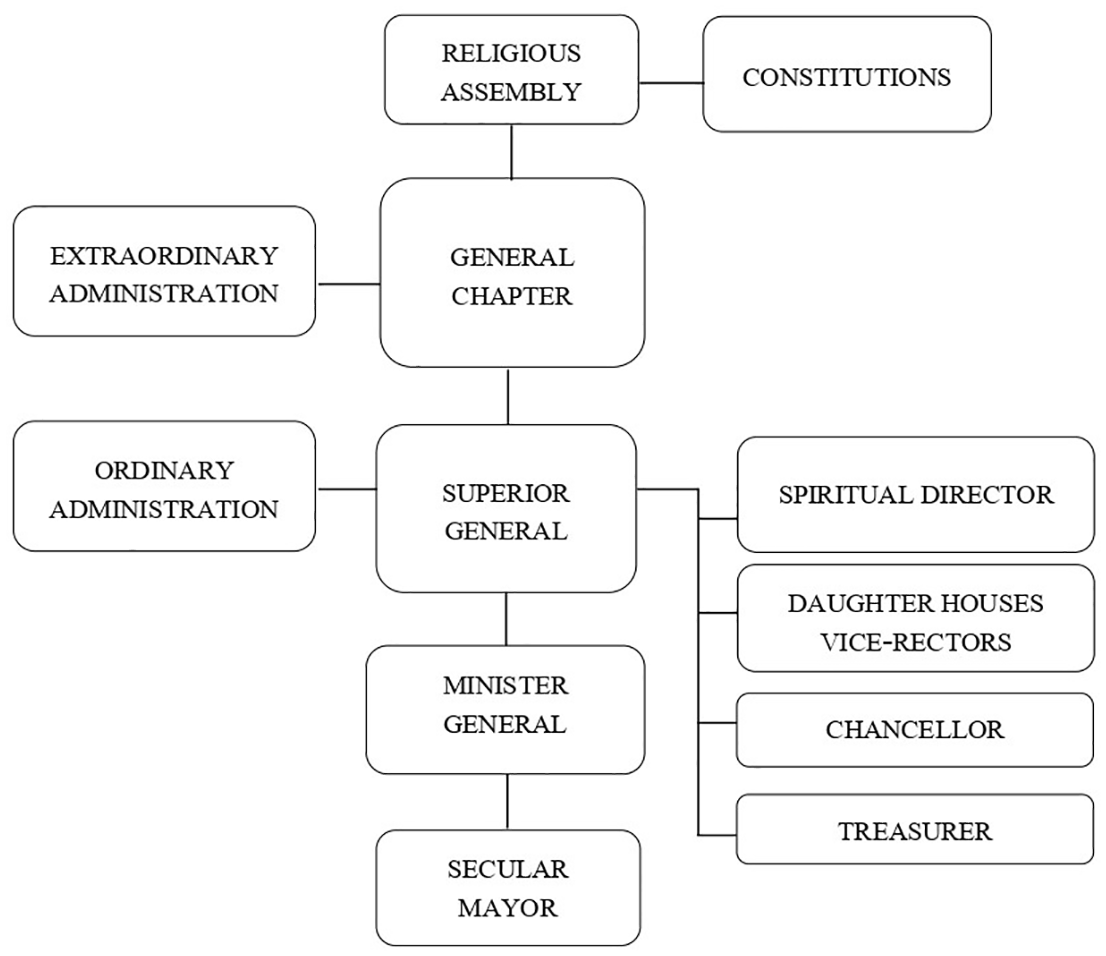
RCs’ governance.
The Norme di Amministrazione established that the ordinary administration of the assets of the congregation was assigned to the Superior General, who performed this function in collaboration with the Minister General and the secular Mayor. Any extraordinary administration (property sale, loans) required the consent of the general chapter which represented all the components of the RC. Each daughter-house had a local vice-rector who had to draw up a special registro di controlleria (control register) on the economic activities.
In the case of the schools, the local vice-rector received monthly reports from the workshop masters based on the records compiled in accordance with the debit and credit model. He also had to supervise the activity of the masters and was responsible for the petty cash in each workshop. The workshops earnt money for the sale of manufactured articles, while payments had to be made for the purchase of raw material and for the weekly wage of external workers. A libro maestro (general ledger) was used to document the monthly movements of all the petty cash in each workshop, thus creating a cassa comune (cash pool). The internal verification of the correctness of these procedures, called controlleria, took place in the presence of the local vice-rector and the congregation’s chancellor (it consisted of a comparison of the general ledger managed by the central treasurer and the monthly reports of the masters). It is worth mentioning that the masters enjoyed substantial independence in the day-to-day running of their respective activities, such as the purchase of materials, acceptance of commissions and the stipulation of specific contracts.
The Norme di Cancellaria formalised practices and procedures to be followed by those involved in the economic administration of the institute. Aided by the chancellor, the local vice-rector, the custodian of all funds, had to compile a libro giornale (journal) recording all the daily movements, and detailing them in the cash pool register. A monthly report was also drawn up by the vice-rector and the chancellor by comparing the registers of all the masters with the journal of the cash pool and the receipts of the individual payments. The same rigour was required from the masters, who had to keep an exact record of all the manufactured products, purchased material and wages paid from the petty cash, and to document this with the receipts needed for the preparation of the monthly report (ASSFN, 3A-1/6-13; ASSFN, 3B-1/2-3; ASSFN, 17B-1).
There were both implicit internal control procedures (the rotation in the roles of responsibility ensured by the renewal of the general chapter every six years) as well as explicit controls (the role of the chancellor in verifying the effectiveness of the system). The only form of external control was that exercised by the bishop of the diocese where the congregation was canonically erected and formally recognised. On specific occasions (financial difficulties, disputes with bodies outside the Church), the ordinary had the power to issue an ordinance that aided the Minister General in his responsibilities by consulting with a ‘commission of praiseworthy gentlemen’ (Catholic lay figures with expertise in the economic, financial and legal fields). However, it should be noted that the agricultural enterprise (Società Anonima Agricola Bresciana; SAB hereafter) established to manage the Colonia was subject to the regulations of business corporations, as it had been founded in the form of a bearer share-owned company (ASSFN, 3B-1/1-3).
Financial and non-financial information
On the basis of these norms, part of the activity of the congregations’ schools consisted of collecting financial and non-financial data and information.
Non-financial information was represented by lists, surveys and tables detailing the recipients of the educational programmes and the territory in which the schools operated. From the moment of enrolment, the institutions regularly collected social information on the conditions of each pupil. Particular attention was paid to the total number of students, their origin, their job specialisation, their orphan status and the need to host them in boarding facilities (Figure 2). In addition, the schools also collected and consistently updated information on the state of the health of the children in their care, their school level, their job opportunities at the end of their training and whether they had the necessary permits to work (ASSFN, 3B-5; ASSFN, 3B-1/4-7; ASSFN, 3B-11 and ASSFN, 3B-12/1-4).

Artigianelli: list of pupils, 1904.
The non-financial information covered the manufacturing and agricultural activities performed in the schools. The EIs gathered information about manufacturing, land yields, fertilisation effects, use of hay and balance of the annual agrarian income. Such operations were managed through the use of accounting techniques (i.e. lists, surveys and tables), showing resources, methods and results of the manufacturing productions in the city and crops cultivated in Remedello (Figure 3; ASSFN, 3B-1/2-3).

Colonia: overview of the type and value of the land, 11 November 1904.
This corpus of non-financial information was useful to the schools themselves, in terms of monitoring their activities and their effects, which attracted the attention of LGs. The schools provided the information to LGs to account for intertwined issues relating to education, introducing young people to work and the innovation of local production.
Financial information was collected through registers and financial statements prepared according to the principles of double-entry bookkeeping. In 1894, the Piamartini hired an accountant, Fausto Fasser, to supervise the complex administrative machine, monitor the performance of the workshops and prepare annual accounts following the principles of the double-entry bookkeeping (ASSFN, 3A-1/8-12b).
Using these accounting records and techniques, the congregation and its schools monitored and economically quantified the effort for an intervention in the field of vocational education. In particular, the records and techniques represented investments and the costs incurred by manufacturing (workshop accounting) and agriculture (accounting of different crops on the land) that were necessary to train the youth. The financial statements also displayed important financial management elements. In this respect, items related to loans and mortgages received by Banca San Paolo deserve special notice, as did those relating to the maintenance of the real estate. Finally, the statements provided both social information on the services related to the training provided (e.g. the expenses for the boarding school and the newsletter La Famiglia Agricola) and information on the dynamics of the sectors involved in manufacturing and agricultural training (i.e. selling books is more financially rewarding than bricklaying and producing feed is more financially rewarding than selling grapes; Figure 4; ASSFN, 3A-1/6-13).

Artigianelli: financial statements, 1898.
Information circulation
All this financial and non-financial information was of public interest. Several LGs habitually requested this information, as they were interested in understanding the manners and costs of effective action aimed at reducing educational poverty. The practices established to manage the relationship between LGs and the RC schools are now detailed.
In light of its educational efficacy and its social role, the Artigianelli attracted the interest of the institutional network and supervisory board in charge of school policies. The advantages that the EI’s workshops provided to many unemployed workers were recognised by the town council. The municipality periodically requested that the EI provide information on managerial and social aspects of its activities (ASBS, Comune di Brescia, rub. XV, b. 19/1a), details of the economic performance of the workshops, teaching methods and alternation between school and work (ASSFN, 3A-1/4; ASSFN, 3A-1/29). This information was used to interpret and address the transformations that were taking place at the time. Reports that described the educational and productive state of the province were drafted. They also aided in the education and production decision-making processes (Carli, 1906; Foresti, 1905; Salini, 2005: 38).
The Artigianelli also had to provide the municipality with certificates on state of health of the pupils (normally attesting to their vaccinations and immunity from contagious diseases). The Provincial Labour Inspectorate also had to receive two documents for each student, the compulsory school leaving certificate and the certificate of admission to regular work (with the latter also sometimes being called the employment record card 10 ). The transmission of such documents was integrated with tables and lists that categorised the information contained in the documents detailing origin and the family status. Each school year was, therefore, marked by a constant transmission of data that the institute provided to LGs in charge of public health and job market regulation (ASSFN, 3A-1/6-13; ASSFN, 3B-5; ASSFN, 3B-1/19).
As far as Colonia was concerned there were other requirements imposed by laws on limited companies. The financial statements of the SAB, set up to manage the Colonia, had to be made public (ASSFN, 3B-1/2). Furthermore, the financial and non-financial accounting results of land yields, tests on agricultural and manufacturing raw materials and crops were widely advertised through two channels created by the Piamartini. These were the weekly newsletter La Famiglia Agricola – published in Italy and abroad since 1896 – and the Unione Agraria (Agricultural Union) – a non-state entity made up of a social dairy, a consumer cooperative, a machinery warehouse and a seed shop promoted by the Colonia in 1898 (ASSFN, 3B-1/3-5). Other entities including the Provincial Inspectorate of Agriculture of Brescia, a peripheral body of the Ministry of Agriculture (responsible for the establishment of the Cattedre Ambulanti di Agricoltura 11 (Itinerant Chairs of Agriculture); VvAa, 1998), were also interested in this information as they had similar economic development responsibilities.
Discussion
Accounting for programmes to combat educational poverty
To address problems associated with workers lacking qualification and the innovation of the local production system in Brescia during the late nineteenth century (Onger, 2011), the LGs established programmes for the government of educational poverty based on the idea that such poverty was a field in which to operate ‘by calculating and normalising intervention’ (Rose and Miller, 1992: 183). Such intervention consisted of identifying and monitoring pupils, providing subsidies for the enhancement of the educational system and fostering continuous communication (on both the most appropriate educational practices and the most advanced production techniques adopted throughout the province; Varini, 2001, 2002). The role of the vocational schools run by the Piamartini proved to be essential in terms of both controlling the territory and people and social intervention, as they were crucial for collecting information on educational poverty and providing educational services.
In a dialogic context in which LGs constantly supervised EIs and acquired their information, these entities employed technologies to deal with educational poverty (Miller and Rose, 1990: 8; Rose and Miller, 1992: 183). The technologies were represented by an institutional network and supervisory board on vocational education, their directives on training standards and objectives, and reporting to the central government. In the case of EIs, the technologies were represented by both financial and non-financial information that were central to the management of these entities and the social objectives of LGs in terms of human capital training.
Financial information was disseminated by journals that were logging financial transactions, and a double-entry bookkeeping system that allowed crucial assessments on the costs and investments necessary to operate vocational schools. Journals provided detailed information on workshops, their daily financial transactions and their inputs and outputs. This enabled the constant monitoring by EIs and LGs of the relationship between expenses for raw materials, tools, machinery and teachers. A balance sheet and an income statement had to be prepared annually. Balance sheets allowed EIs and LGs to observe which workshops and crops – and consequently training and crafts – required the highest fixed costs, and what investments for boarding and infrastructure were necessary (dormitory, canteen, land reclamation, improvement of hygienic-sanitary conditions, canalisation for irrigation, territorial levelling). The income statements showed the overall costs incurred by both administrative (bureaucracy, insurance, taxation) and training activities, and they also gave details on the revenues obtained from tuition and products (as well as their absorption by the local market; ASSFN, 3A-1/6-13).
Non-financial information was represented by lists, surveys and tables, which categorised pupils according to social and educational variables (numbers, origin, health, school level, job specialisation, work permits and job opportunities), and records of agricultural and manufacturing productivity. The social and educational variables enabled EIs and LGs to learn about aspects of local society and demography that had never been examined previously (ASSFN, 3B-5; ASSFN, 3B-1/4-7; ASSFN, 3B-11 and ASSFN, 3B-12/1-4). In addition, productivity records provided EIs and LGs with details on production timing, average energy and raw material consumption (ASSFN, 3B-1/2-3).
These technologies had multiple implications: they fostered the creation of new educational entities (Itinerant Chairs of Agriculture; VvAa, 1999); a configuration of the local vocational school system based on technical drawing, steel manufacturing, mechanics and typography (Varini, 2001, 2002); and a specialisation of training courses which outlined the dynamics of the regional primary and secondary sectors (the EIs were part of the local market dynamics, meaning they sold the products of their teaching activities, and therefore had to provide training to their students; Salini, 2005). Furthermore, these technologies contributed to steering the conduct of those with poor education towards more desirable behaviours. They supported the educational activities of EIs, thus removing the youth from vagrancy and involving them in the dynamics of the socio-economic development (Salini, 2004).
Technological thresholds
Using the technological thresholds identified by Dean (1996: 63–65), the macro effects of the EIs’ activities can be evaluated.
To address the threshold of assemblage (Dean, 1996: 64), this article describes the assembling of diverse elements which aligned the pupils’ conduct in terms of the political objective of combating educational poverty. These included various annotation tools (lists, surveys, registers, reports) to generate information on individuals, social classes and resources; and the process of information collection and use which relied on the coordination of time and space mechanisms. The processes characterised by coordination of time and space mechanisms included scheduled times for enrolment and evaluation, distinct workshops for various vocational paths and the year of attendance. Those involving cash flows and educational/working activities were marked by precise moments for the preparation of registers, ledgers and journals. Finally, it was also shown that the EIs adopted a wide series of registrations and double-entry bookkeeping, which required specialist knowledge and expert staff.
To address the threshold of system (Dean, 1996: 64), the EIs intervened and provided information on educational poverty, but this entailed connections between government technologies and other technologies. As a result of the educational activity, connections arose relating to the management of raw materials, work tools, intermediate products, acquisition of financial resources at local credit institutions and the daily management (including debits and credits) of workshops and crops. All these were constantly monitored through the registration and financial statements periodically prepared by the schools.
To address the threshold of force (Dean, 1996: 64), this article has provided evidence that the EIs were power containers and power storers/generators. They were power containers in that they were sites for an independent generation of financial and non-financial information, goods (including artefacts, agricultural products, money) and services (vocational training and boarding) for pupils lacking the (minimal) skills to participate in economic and social activities. Furthermore, EIs were power storers/generators because they coordinated different activities, which were performed in different places (identification and classification of the educational poor, allocation and use of raw materials and products to train them) and were useful to the government of educational poverty.
Finally, to address the thresholds of the orientation of government (Dean, 1996: 65), the EIs in the province of Brescia actively contributed to the wide public debate and programmes on the ongoing national industrial transition (Zaninelli, 1988–1992; Zamagni, 2003). Through their activity and the adopted technologies, they played a role in qualifying local workers and innovating local production. In other words, EIs improved and optimised factors (people, training/manufacturing/agricultural activities and resources) involved in governmentality. Accounting represents a technology of government as it consistently monitored all the elements involved in training activities to enhance both their management capability and their potential. Constantly updated lists, surveys and financial statements were notational and computational technologies which concretised educational poverty. The way in which EIs’ accounting techniques improved and optimised factors in the context under investigation is three-fold. First, they offered a virtuous model of financial (and non-financial) management of an EI as opposed to the previous failed attempts (ASBS, Comune di Brescia, rub. XV, b. 6/2a; Varini, 2002: 206–207). Second, they provided the information to initiate new vocational education experiences, such as Itinerant Chairs of Agriculture, which impacted the training of the local population and the production techniques adopted by firms (Gregorini, 2011). Finally, they fostered the monitoring and training of qualified labour, which often distinguished itself from an entrepreneurial point of view with direct effects on the economic and social fabric of the province (Mantovani and Scotuzzi, 1987; Onger, 2010).
The detection of the thresholds and their network links provide evidence of the institutional integration of power relations, where the interaction between LGs and EIs functioned as ‘police’ (Foucault, 2009: 326–327). By virtue of this effective interaction, the skills to approach the pupils’ educational distress increased and contributed to local welfare. These results allow for a better understanding of governmentality by highlighting its pillars in the context of nineteenth-century Italy (Foucault, 2009: 108). The presence of private and public bodies adopting various calculations and processes centred around the educational poor, together with the development of knowledge as a result of the employment of technologies – comprising financial and non-financial accounting – represent an administrative government of educational poverty.
Conclusion
The case depicted in this study is a story of power exercised at a local level by LGs that were interested in the social development of the community. By extension, this implied a concern about the lack of vocational training, unemployment, labour exploitation and delinquency among the youth (Corsini and Zane, 2014: 101–102). For these reasons, the LGs came into contact with a recently established ecclesiastical entity (RC) and its schools, to acquire information and establish models of intervention through the accounting practices adopted by these bodies. This interface between LGs and EIs, based on the circulation of accounting information, represents the main subject of the analysis. With the aim of addressing and containing social hardship and fostering development, LGs debated and elaborated programmes for the government of educational poverty. The article has demonstrated that the EIs of the RC provided an important contribution to this debate and programmes through their educational action, the dissemination of innovative skills and techniques, and the sharing of a large body of information.
The training activity was supported by the preparation and availability of financial and non-financial information on the educationally poor youth to efficiently manage the EIs and effectively address human capital issues related to the ongoing industrial transition. Such information was categorised according to geographical coordinates and constantly updated and integrated through periodical review. In this sense, the EIs contributed to a ‘hierarchical observation’ of the province, which consequently permitted LGs to interpret what was lacking educationally, and prompting mechanisms, including the verification and direct review of the situations (Foucault, 1995: 170–177).
The EIs also had a ‘normalizing’ effect on the youth experiencing educational poverty (Foucault, 1995: 177–184). They transformed individuals and their conduct making them identifiable and modifiable, preventing them from adopting behaviour that was potentially dangerous to society, and, above all, training them in crafts and professions that were both relevant and useful. Indeed, in the schools, masters and people in charge of surveillance and educational duties trained pupils through an apprenticeship and directed their educational path according to their personal vocations, labour market demands and recommendations from LGs (Cabra, 1998). A preventive rather than a repressive educational method was adopted to improve the pupils’ education, rather than maintain order. This was based on programmes and explicit rules, constant surveillance by the director and assistants, a system of gratification-punishment grounded on the binomial praise-reprimand scheme, which – by differentiating and judging – stimulated the pupils towards learning and improving their conduct (Braido, 1997: 363–371).
All this was also possible as a result of the preparation and use of lists of students, surveys on training activities and reports, which aided in the identification of pupils in need of vocational training and the subsequent monitoring of their health, social, educational and working conditions. In other words, such a survey system represented a precious ‘examination’ instrument of educational poverty. In this way, the educational poor emerged as a ‘describable entity’, as each pupil became a ‘case’ (individualisation) and, concurrently, an overview of the educational poverty phenomenon in the local community (homogenisation) was achieved (Foucault, 1995: 184–192).
The article has provided evidence of the existence of practices and technologies for the government of educational poverty: accounting information and practices through which the EIs shaped, normalised and instrumentalised the conduct of pupils, which in turn made them measurable and governable (Miller and Rose, 1990: 8; Miller and O’Leary, 1987). Furthermore, owing to Dean’s framework (Dean, 1996), the study has demonstrated that such technologies and the government of educational poverty formed part of a broader context and contributed to the political economy dimension. Indeed, people (pupils, EI educators, public authorities), resources (raw material, money), goods (artefacts, agricultural products), accounting and managerial skills and a network of public and private bodies devoted to the enhancement of local vocational training, constituted a technologically complex system. From this perspective, the research has underlined the crucial role played by the circulation of financial and non-financial accounting information in reinforcing the network and in pursuing its objectives, thus contributing to local welfare. Therefore, it is worth mentioning that accounting goes beyond a merely reflective position to show its constitutive role (Gomes, 2008: 492). In this case study, it has emerged as a social practice able to foster control on people and resources, and to provide a contribution to the achievement of LG aims. In this sense, accounting practices proved themselves useful for governing economic and social life of communities and states (Miller, 1998, 2001, 2008).
By showing this interplay between LGs and EIs, the study has offered insight into the concept of governmentality, confirming the results of both Servalli (2013) and Gregorini (2016a) on charities, and concurrently extending the analysis to the field of educational poverty. In other words, the article has provided an extension of the governmentality framework (Antonelli et al., 2019; Baños et al., 2005; Funnell et al., 2016; Lai et al., 2012; Miller, 1990; Miller and Rose, 1990; Sargiacomo, 2008; Servalli, 2013); by supporting the idea that ‘what is really important for our modernity – that is, for our present – is not so much étatisation of society, as the ‘governmentalization’ of the state’ (Foucault, 1991: 103).
Footnotes
Acknowledgements
The authors gratefully acknowledge the anonymous referees for their detailed and helpful comments. In accordance with Italian academic requirements, the paper is the result of an equal joint effort by the two authors. Their primary individual contributions are reflected in the following sections of the paper. Riccardo Semeraro: ‘Introduction’, ‘Literature review’, ‘Theoretical framing’, ‘The context’ and ‘Conclusion’. Giovanni Gregorini: ‘Methodology and sources’, ‘Accounting practices and institutional dialogue’ and ‘Discussion’.
Funding
The author(s) received no financial support for the research, authorship and/or publication of this article.
