



Abstract
In elaborating on accounting and work, this study focuses on the distinctive arena of the household to uncover details regarding how relationships with paid subordinates were managed in the eighteenth century. To delve more deeply into the topic, this article focuses on the case of Silvia Rabatta, a widow in a noble family living in Friuli (Italy). Drawing on primary archival sources, this study shows that Silvia managed work relationships with her subordinates like business relationships, instrumental in nature and based on contractual agreements. However, her emotional attachment and attention to the subordinates’ wellbeing were also evident in the accounting books and correspondence of this Friulian noblewoman.
Introduction
Since the call of Walker and Llewellyn (2000) to expand our understanding of household accounting as a social and institutional practice, accounting history research has made great progress. Related studies have covered different domains, including didactic literature on domestic management (Carnegie and Walker, 2007b; Llewellyn and Walker, 2000); household accounting practices (Carnegie and Walker, 2007a, 2007b); the interplay between household accounting and gender (Harvey, 2009; Komori, 2007, 2012; Komori and Humphrey, 2000; Vickery, 2006); accounting, patriarchy and male domination (Bernal et al., 2018; Walker, 2003); and the control of emotional, extravagant and frivolous expenses (Maas, 2016; Walker and Carnegie, 2007). Despite these significant contributions, the potential of accounting research in the household domain has not been completely developed from a historical perspective (Carnegie and Napier, 2012). Specifically, work relationships within the domain of the family home deserve a deeper investigation and offer opportunities for ongoing research. By keeping track of the wages paid, provisions given, money loaned and similar items, accounting records can offer important insights into the working climate and ‘the socio-economic relationships between the family and those who were employed to service it’ (Walker, 1998: 486).
This study intends to use accounting documents to outline how relationships with paid subordinates were maintained in an eighteenth-century Italian household managed by Silvia Rabatta, a widow in a family of landed nobility living in Friuli. After the death of her husband Filippo in 1767, Silvia took on the responsibility of raising their children and managing their land and properties to ensure the family’s survival and prosperity. Adopting a micro-oriented approach that investigates the lived experiences of a single individual or groups of individuals in a small area (Carnegie and Walker, 2007a; Szijártó, 2002; Williams, 1999), this study elaborates on the work relationships between Silvia, and her domestic servants and farm agents as they emerge from account books and correspondence kept by the State Archive of Udine (SAU), which survived the fires, wars and earthquakes that have repeatedly struck the Friulian region in the past centuries. As previous accounting history studies have tended to mainly focus on Anglophone countries in the nineteenth and early twentieth centuries (Carmona, 2017), evidence from other contexts allows us to improve our knowledge about household accounting and work relationships in other settings and time periods. Specifically, using an Italian example here provides an opportunity to gain insight about a country with a long historical accounting tradition and a collection of archives while also offering the possibility to enrich and promote the cross-cultural development of accounting history within the household domain (Maran and Leoni, 2019).
Focusing on the micro level of the ‘little facts’ (Szijártó, 2002: 209) drawn directly from primary archival sources, this study aims to contribute to the international debate on household accounting in several ways. First, it offers more specific evidence of work relationships within a household of the landed elite managed by a widowed woman in which consumption activities are associated with production processes. Second, focusing on eighteenth-century Italy, the study contributes to the household accounting history literature – mainly focused on English-speaking countries in the nineteenth and early twentieth centuries – with a different time–space setting. Third, based on Carmona’s (2017) call for deepening the examination of accounting–gender relationships within the household, this study offers the opportunity to explore how gender-based values and attitudes can be reflected in household accounting records keeping track of work relationships (Broadbent, 1998; Dillard and Reynolds, 2008; Hines, 1992; Komori, 2012).
The remainder of this article is organised as follows. The next two sections summarise the historical context underpinning the study, including the figure of Silvia Rabatta, and provide an overview of the work relationships as they emerge from the primary literature on household accounting. The archival sources and research method are then described, and the main evidence from the archival sources for servants and agents is presented and discussed. The final section offers some concluding comments.
The case of Silvia Rabatta
Silvia Rabatta was born on 23 August 1717 in Friuli – a region in the north-east of the Italian peninsula – to a noble family of the County of Gorizia. At that time, Friuli was a border land split between the Venice Republic and the Habsburg Empire where many noble families derived great opportunities from the movement of men, goods and ideas and developed intense relationships with different administrative, political and cultural systems (Casella, 2012; Morassi, 1997; Trebbi, 1998). Unlike the southern Italy context, nobles of the region were actively involved firsthand in the running of their households and properties – located in both the Venetian and the Habsburg areas (Ferrari and Vivenza, 2009). In such a dynamic context, when she was 17 years old, Silvia married Filippo, the only heir to the counts of Colloredo – then one of the most important families of the Friulian landed nobility. As Filippo was an only child, he and Silvia devoted themselves to preserving the Colloredo family’s continuity, playing different roles in the household, as was typical at the time (De Martin Pinter, 2013; Pepoli, 1838). Filippo had the main responsibility of governing the household’s real estate, which consisted of land and houses scattered throughout the region, while Silvia’s main task was to provide the education for their nine children (seven boys and two girls) and manage the domestic finances.
Upper-class and noble households in eighteenth-century Italy were complex organisations that included not only parents, children and relatives but, more generally, all those who lived in the same house, including servants, carers and other paid household workers (Bettoni, 2016; Cavaciocchi, 1990). Although some studies showed an emotional attachment of the housewife to her servants (Caffiero, 1997; Sarti, 1999), the relationships with servants constituted an employer–employee relationship based on a superior–subordinate hierarchy managed with a business-like approach, with contractual, occupational and instrumental foundations (Caffiero, 1997; Tadmor, 1996, 2004). As prescribed in the Italian instructional literature on household management (Pandolfini, 1734; Pepoli, 1838), the everyday domestic administration entailed the women’s close supervision and control of domestic labour and required the avoidance of excessive familiarity with the servants. However, the prescriptive literature also exhorted housewives to care for their servants’ wellbeing by providing them with plenty of food and employing kind words and gentle manners with them to consistently obtain their benevolence and willing cooperation.
Despite the distribution of roles between Silvia and Filippo, decision-making processes within the household were based on cooperation between the spouses (Shaw, 2018). As revealed by prior studies (Casella, 2014; Casella and De Martin Pinter, 2017; De Martin Pinter, 2013), since the beginning of her married life, Silvia was quite familiar with the management of the household’s properties, thus indicating that eighteenth-century Italian women were often actively involved – perhaps with different degrees of autonomy – in the management of their family’s economic interests (Cavaciocchi, 1990; Fontaine and Borello, 2011; Pomata, 2002). Alongside being daughters, wives and mothers, women in this time were responsible for making decisions, conducting transactions, hiring and dismissing workers, keeping accounts, and writing and answering letters related to management of the household.
When Filippo died in 1767, Silvia was charged with both the duty of raising their children and managing the family’s land and properties. Silvia was thus encumbered with not only the minutiae of domestic affairs but also the complex activity of running the economic and financial matters primarily related to land ownership (De Martin Pinter, 2013). During the years of her widowhood, she demonstrated a strong sense of herself as the head of the household, keeping track in accounting books of the most important aspects related to its management. Specifically, she recorded food consumption and other everyday expenses, maintained accounts for the goods bought and sold (e.g. equipment, seed, forage, grape and harvest goods), documented contractual agreements with subordinates, noted the payment of wages, saved notes documenting transactions with traders and preserved the instructions sent to at least five agents who helped her manage the properties farthest from her typical residence (Casella, 2014; De Martin Pinter, 2013). Employing services of agents – especially farm managers – for the management of the estates was customary for Italian landed families (Rossi, 1934). These figures enjoyed management rights and handled agricultural lands and other properties on behalf of the owner, who usually resided elsewhere. Farm managers thus played a mediating role between the absentee landlord and the farmers who worked in the land (Alessi, 2011). Silvia had begun giving directions and writing to the farm managers when her husband was still alive (De Martin Pinter, 2013) – which must have helped her in managing family estates on her own after his death – and continued to direct these agents when her role in the household family was redefined by her widowhood. Such a role in the management of households, estates and other financial matters has been highlighted by certain studies on eighteenth- and nineteenth-century widows as property owners and managers in the rural Italian landscape (Calvi, 1994; Miscali and González, 2015). Although the specific situation varied depending on the family, class, fortune and rules in force, archival documents charted the experience of widowed women in setting and collecting rents, giving directions related to hands-on aspects of estate management to agents and tenants, supervising farms and otherwise determining estate policy.
As can be clearly seen from her letters and account books, in the years of her widowhood, Silvia was actively involved in managing the household economic and business affairs in such a way that the financial wellbeing of the family was preserved for over 30 years following the death of her husband. Archival documents show that she carried out her multiple duties until her death in 1801, thus making her an example of a careful manager serving the household’s continuity (Casella, 2014; Casella and De Martin Pinter, 2017; De Martin Pinter, 2013).
Literature review
Prior accounting history studies have offered limited and incidental evidence regarding the work relationships within the household – a particular kind of social and economic entity where consumption and production processes are combined to secure a family’s continuity (Carnegie and Walker, 2007a; England and Farkas, 1986; Harvey, 2009; Walker and Llewellyn, 2000). Moreover, this evidence mainly comes from Anglo-Saxon countries, featuring only very sporadic insights into different contexts (Bernal et al., 2018; Ezzamel, 2002).
In his initial contribution to the literature on household accounting, Walker (1998) referred to this practice as being constitutive of socio-economic relations in middle-class families in nineteenth-century Britain. In particular, accounting mirrored and supported the relationships between the family and those who were employed for its service. Domestic labour was formalised through contractual agreements, emphasising the existence of an employer–employee relation that replaced the authoritarian paternalism typical of master–servant interactions of earlier aristocratic households (Tadmor, 1996). A need for close supervision and the appropriate management and control of paid household workers thus emerged, and servant wage books were used for monitoring labour costs ‘to prevent, for example, spending on unnecessarily lavish food for staff or waste in the kitchen’ (Walker, 1998: 493). In a superior–subordinate relationship, servants themselves were often required to maintain and present accounting books to their master/mistress so that they could inspect the regular use of goods and other resources assigned to the servants to prevent and detect abuses.
Exploring the potentialities for accounting research on the household, Walker and Llewellyn (2000) recognised that, in eighteenth-century bourgeois and upper-class households, productive functions were increasingly performed by paid house workers and carers. Consequently, forms of accounting and accountability in the domestic arena emerged to reflect the nature of domestic labour. Thus, according to Walker and Llewellyn (2000), the accounting literature can make a significant contribution to this field by taking a historical perspective.
In their review of the book The Gentleman’s Daughter: Women’s Lives in Georgian England by Amanda Vickery (1998), Kirkham and Loft (2001) emphasised how the detailed account books maintained by genteel women in eighteenth-century English households – including those regarding the wages paid to subordinate workers – were a means by which these women managed their households and ‘exert[ed] their power over their domestic dominions’ (p. 85).
Moreover, in a study of household accounting in eighteenth-century England, Vickery (2006) reported that household account books of the gentry were designed to catalogue income and tabulate outgoings from running the house, farm, stables and estate, including the wages paid to household workers. While the husband maintained records to control the wages paid to both salaried workers and odd-job men, domestic management was a woman’s responsibility, with account books listing the wages of domestic servants typically maintained by the wife.
In their study of the accounting practices in Australian households from the early nineteenth century, Carnegie and Walker (2007b) reported that household wages accounts could be found only in one out of 76 sets of surviving accounting records they analysed. These were usually prepared by women on an irregular basis. Although typical household advice manuals of the time recommended using records for ensuring the careful management of the home, evidence shows that wages accounts were provided when servants left the service of the household. In most cases, accounts showed the amounts already paid to the servant either in cash or in kind, those still to be paid and the final settlement. A signature or mark indicated that the employee agreed with the final amount payable. In the second part of their study, Carnegie and Walker (2007a) adopted a micro-historical approach and thoroughly examined 18 sets of records, including wage accounts prepared by an Australian elite woman who presided over multiple-servant households in the early nineteenth century. From her notes, it was possible to deduce the number of servants employed, their gender and literacy, how long they stayed in her service and how much they were paid. Moving from the investigation of individuals and their lived experiences, Carnegie and Walker (2007a) concluded that domestic accounting – including accounting for paid domestic labour – contributed to the notion of the household as a unit where consumption activities are associated with production processes.
Outside the Anglo-centric household accounting research, Ezzamel (2002) examined the role of accounting in running the household economy and private estates in ancient Egypt. He found that account records and letters were used for facilitating the management at a distance of the private estate when the head of the household was absent and entrusted its everyday running to his agents. The owner performed a careful monitoring of the costs sustained for those working in his interest, and business letters sent to the agents specified clear and strict instructions concerning the wages to be paid to other members of the household as well as other issues, such as land rental and the cultivation or valuation of goods.
Occasional evidence from household accounts regarding work relationships can also be found in the study by Bernal et al. (2018), which offers insight into a Spanish upper-middle-class Catholic family in the early nineteenth century. Accounting – including records of servants’ wages – was performed by both men and women in Spanish upper-class families to control the cost of living and facilitate short-term decision-making regarding acceptable expenses for domestic workers as well as for food, accommodation and clothes to avoid unnecessary expenses and ensure their families’ continuity.
The case of Silvia Rabatta addressed in this study can help enhance knowledge related to work relationships in the accounting history domain through the examination of accounting and related records of an eighteenth-century Italian household. Besides revealing relationships with servants and household agents, this case study also elaborates on Silvia’s attitudes towards her servants and agents, as they are reflected in her account books and letters. According to prior studies, household accounting records can reveal gender-based values and attitudes (Broadbent, 1998; Dillard and Reynolds, 2008; Hines, 1992; Komori, 2012). Accounting usually reflects a masculine representation of the world that is related to a materialistic and reductionist view of a divisible and quantifiable reality (Hines, 1992). By framing and measuring the world through a cold, rational and efficient manner offered by hard numbers, accounting reveals a masculine depiction of a life spent working in the service of economic goals. Numbers are used to objectively quantify size, stability, health, growth and productivity and to retain control over things. Accounting, thus, can be considered a means of domination (Dillard and Reynolds, 2008). As opposed to the values generally associated with the masculine gender stereotype (e.g. hard, dry, impersonal and objective), feminine dominant values typically include subjectivity, complexity, caring and sharing (Hines, 1992). Accounts incorporate this more subjective dimension and reveal emotional aspects underlying the facts and relationships represented by hard numbers (Broadbent, 1998). Thus, despite accounting being typically considered a masculine representation of the world, such practice transcends the masculine and feminine by integrating them both into a more balanced, holistic union (Dillard and Reynolds, 2008). Regardless of who actually keeps the accounts (a man or woman), traces of these different but integrated natures can be found in the analysis of accounting documents and artefacts, including those aimed at managing work relationships with subordinates within the household domain.
Archival sources and method
This archive-based research used accounting and related records to elaborate on work relationships in an eighteenth-century Italian household. It specifically adopted a micro-oriented approach (Carnegie and Walker, 2007a; Szijártó, 2002; Williams, 1999) governed by the idea that the intensive investigation of lived experiences of a single individual or groups of individuals in a small area can help to gain insight into the wider aspects of a society through the examination of ‘little facts’ (Szijártó, 2002: 209). In this case study, such ‘little facts’ of history are retrieved from surviving accounting records and other documents from Silvia’s household to provide a realistic description of how she managed work relationships with her servants and household agents.
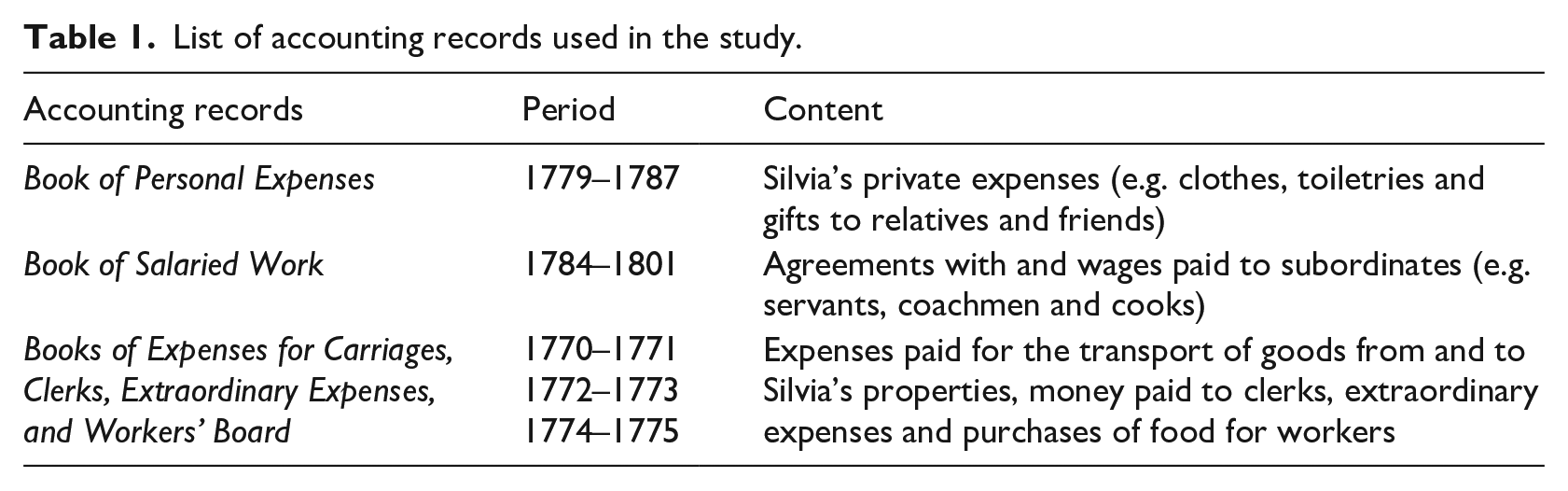
The primary archival sources considered in this study were kept by the SAU There are only a few Colloredo family documents that survived over the centuries, with most of them having been dispersed or destroyed by the fires, wars and earthquakes that repeatedly struck the Friulian region over time. Traces of relationships with paid workers can be found in Silvia’s surviving account books and handwritten letters to agents and suppliers concerning the management of her household and estates. Account books, in general, are a source of great interest, as they could re-create for the present-day reader the emotional climate that characterised the management of the household in the past (Casella, 2015). It has been observed that account books usually offer a cold, impersonal picture of economic vicissitudes and lack the emotional expansiveness of diaries and letters (Vickery, 2006). Still, household account books bear witness to household stories and are often the only surviving documentation of the socio-economic relationships between the family and those employed to service it. The accounting books that were mainly useful for the aims of this study are listed in Table 1.
List of accounting records used in the study.
To extend the analysis beyond the entries in Silvia’s accounting records, a collection of surviving handwritten letters addressed to agents and suppliers was also considered in this investigation. As noted by Miley and Read (2016), limiting the examination to the financial accounts can hide aspects of household and estate management that only the narrative of correspondence can reveal. The SAU houses about 380 letters written by Silvia from April 1734 to January 1801, most of which are related to her involvement in household management (Casella, 2014; De Martin Pinter, 2013). The copiousness of this primary source is also due to Silvia’s habit of saving rough drafts of letters to agents, dealers and other people with whom she had business relationships – which was at the time an uncommon practice – demonstrating a resolute desire to keep track of all actions and decisions that could affect the management of the household (De Martin Pinter, 2013).
A number of translated quotations from account books and letters are provided to increase understanding of the results of this study. The quotations are representative of the contents of these books and letters and were selected to exemplify the attitude of Silvia towards her subordinates. Biographies of Silvia and additional secondary sources were also used to better contextualise the analysis.
Servants and other paid workers
Most of the information useful for understanding the relationships between Silvia and her servants and other paid workers came from the Book of Salaried Work, which contained notes on the contractual agreements with subordinates and the wages paid for their work, grouped neatly on individual pages for each servant to whom the notes refer. The details in the surviving account records show the numbers and composition of the paid servants. From 1784 to 1801, Silvia employed 26 people, most of whom were linked through family relationships (e.g. spouses, children), whose ages remain unknown. Six men were employed as generic servants, coachmen and gardeners, while 20 women worked as maids, cooks and kitchen servants. The staff composition varied over time but usually included at least a cook, maid and servant. The other positions were filled occasionally, suggesting that the family’s needs and available financial resources varied over time.
An annotation for each paid worker opened with a record summarising the salient points of the contractual agreement. These records shed light on the emoluments paid to the staff and the relative importance of their roles. On average, the men had significantly higher wages than women, as was typical at the time (Fraternita dei Laici, 2001). The coachman was the male figure with the highest wage: 44 lire per month – versus 19 lire for a gardener and 16 for a servant. Among the women, the cook was the highest paid at a little more than 15 lire a month. The records documented the workers’ names and surnames, sometimes accompanied by their place of provenance, along with their occupation within the household, the date upon which they entered service and their agreed remuneration.
Servants and other paid workers lived in the same house as Silvia, so their remuneration typically consisted of a cash component as well as an in-kind payment accurately detailed in the accounting book in terms of type and quantity. For example, when Mrs Sabata came to the family as a kitchen servant in June 1797, her service agreement was recorded as follows: On the 18th of June, Sabata from Moruzzo came to my service as a kitchen servant for 10.00 lire per month – that is, 4.00 lire for wages and 6.00 lire for food as follows: no. 1 carafe of wine per day, no. 1 bread per day, and soup, as the other servants. (Book of Salaried Work, p. 85)
The record was followed by a list of notes keeping track of the money Silvia spent monthly on each subordinate. In the case of Mrs Sabata, for example, Silva recorded the following:
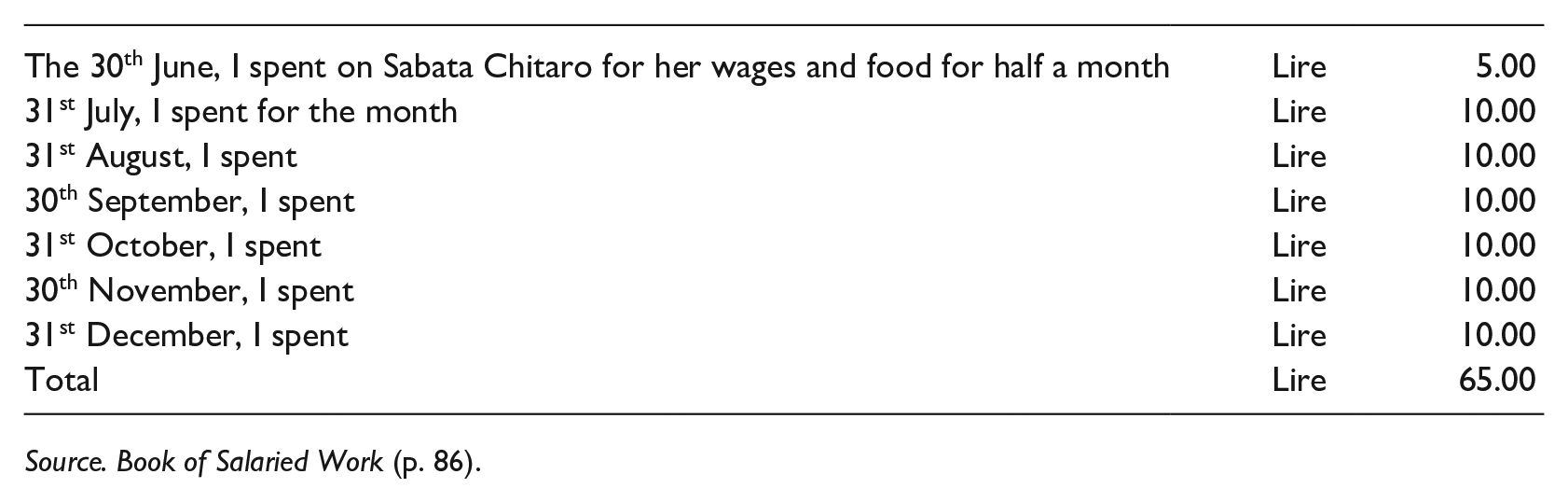
Source. Book of Salaried Work (p. 86).
The note ended with a final record documenting the date on which the employment relationship ended and a record of the final balance paid:

Source. Book of Salaried Work (p. 86).
The Book of Salaried Work reveals that Silvia paid attention to her subordinates’ needs. Several records demonstrated Silvia’s great consideration for the state of health of her servants. For instance, in May 1784, the coachman, Antonio Bresan, was sick, and Silvia tried to help him by paying for his medicine (a natural laxative called cassia) from her own pocket. The next year, Leonardo Patriarca, who had replaced Bresan after he left Silvia’s service, fell from the coach and injured his leg. On this occasion, she noted the following:

Source. Book of Salaried Work (p. 12).
Silvia also used to grant advanced pay to her subordinates when they needed money for personal necessities. For example, in the winter of 1784, she noted, The 2nd of November, I counted to my maid Barbara Rafaela as advance on her wages at the All Saints fair in Gemona to buy a flannel dress 27.00 lire. (Book of Salaried Work, p. 4)
For the maid, Rosa Morana, who had lived in the house for more than 10 years, Silvia paid three months’ salary in advance to allow her to redeem the earrings: The 13th of July, I counted to Rosa in advance on the wages of July, August and September for getting out of pawn earrings 30.00 lire. (Book of Salaried Work, p. 25)
The lists of payments also mentioned the fate of some staff members, including a couple who died while on duty. The first case was that of Giuseppe Desio, the gardener: January 1796. Money counted for Giuseppe Desio who passed away. On the 20th January, I celebrated no 14 masses and spent 19.12 lire. (Book of Salaried Work, p. 78)
In the second case, when the long-employed servant Antonio Perati died after 12 years of service, Silvia paid 6 lire to his widow, Elena, who had worked for the family as a cook in the past.
Additional insights into Silvia’s relationship with her servants can be gained from the Book of Personal Expenses, which contained notes on Silvia’s expenditures related to her own needs and pleasure. Among the entries giving glimpses into the private life of this eighteenth-century noblewoman, the book tracked discretionary expenses for house workers not included in the employment agreement or recorded in the Book of Salaried Work. According to the Book of Personal Expenses, household workers received extra rewards when they carried out tasks not part of their typical duties, such as accompanying Silvia and her children in their movements. Consistent evidence over time also indicated that Silvia regularly gave bonuses at the beginning of the year to her servants as well as to her children. For example, in January 1778, she noted the following:

Source. Book of Personal Expenses (p. 4).
Silvia paid particular attention to her personal maids by often reserving for them special treatment. For example, she granted to the maid Teresa Todesca the privilege of having lunch with the ‘soup and food like I eat’ (Book of Salaried Work, p. 1). Moreover, Silvia commonly tipped her personal maids when they left her service. For instance, when the maid Barbara left Silvia’s service in the summer of 1785, the balance of 9.50 lire due for services performed was noted in the Book of Salaried Work, while tips and extra rewards were documented among Silvia’s personal expenses as follows: The 24th August I tipped my maid Barbara, who left me, 3.00 lire. (Book of Personal Expenses, p. 65)
The Friulian noblewoman’s bonds with her personal maids become even more evident in the case of Mrs Margarita Macaferi. A footnote in the section of extraordinary expenses at the end of 1783 showed that Silvia bore the costs of Margarita’s funeral: Record about the expenses made for the funeral of my maid Mrs Margarita Macaferi Gabario. 24 December 1783. I spent for the masses, the sacred ritual of accompanying the body, the candle wax and other things, as shown in the list, a total of 46.17 lire. (Book of Personal Expenses, p. 54)
A scrap of paper secured to the book with a pin provided a detailed list of the expenditures incurred.
In addition to the servants who worked at the home, other paid workers were employed by Silvia. These included cart riders, clerks, bird catchers and other generic workers recruited according to the needs of the household. The Books of Expenses for Carriages, Clerks, Extraordinary Expenses, and Workers’ Board kept orderly track of the money spent each month, highlighting the reasons for the payments with a high level of detail (e.g. the number of eggs collected by the bird catchers). But, unlike the servants mentioned in the Book of Salaried Work, the names of these workers often remained unknown, and the entries were recorded in more of a detached manner.
Household agents
Landed noble families in eighteenth-century Italy used to employ farm managers for running their properties and real estate. Typical manuals of household management of the time urged a close supervision of these agents, recommending, however, to avoid showing suspicion or distrust towards their work. Rather, land owners were exhorted to treat agents well to gain their favour and facilitate their easy cooperation (Pandolfini, 1734).
A picture of Silvia’s relationships with household agents emerges from her handwritten correspondence. She sent more than 150 letters over a period of about 40 years to at least five farm managers who handled land and other properties throughout the region on her behalf (Casella, 2014; De Martin Pinter, 2013). The letters were used for giving firm instructions because agents had to make decisions in a context of subordination and respect for the head’s wishes. Most letters contained directions concerning the sale of land products (e.g. wine, corn, and livestock), as the following example shows: If you can sell the cow with the calf bought from Lizi, sell it. (Letter of 6 October 1757)
Silvia also wrote to give instructions on crop management, as in the following example: With regard to the grape harvest, when others start it, we must start with them as well. (Letter of 13 September 1767)
Regardless of the content, all Silvia’s missives to the farm managers were characterised by courtesy and familiarity. They usually began with the formula ‘Dearest Mr [name of the agent]’, fostering a sense of confidence in the recipient, and often included an expression of thanks or appreciation for the work done, as in the following case: You did well to send someone knowing our decision regarding the sale of the wine barrel at 36 lire. (Letter of 13 September 1767)
Similar arrangements were also used to manage relationships with other individuals (e.g. traders) who could not be strictly considered subordinates but were, in some way, asked to satisfy Silvia’s requests. For example, in the following letter, Silvia announced to a shopkeeper that she had chosen him to be a supplier of goods for her family: Please deliver to the houseboy whom I will send to your shop the goods I will list in a handwritten note and send me the receipt so that I can pay you the amount due month by month. About the prices charged, I know that you are an honest person and that you will do all that you can to my advantage. (Letter of 19 April 1787)
Again, a mix of flattery and determination to set the rules of the delivery process characterised the content of the missive.
Such letters also highlighted that Silvia did not spare harsh criticism of the agents when they did not act properly. For example, she complained to an agent about the poor quality of the wine he sent her, intimating to him, Send a bottle of wine but not vinegar, since that you sent me is true vinegar that no person of the house or outside would even taste. (Letter of 8 June 1775)
Similarly, after providing some suggestions to the agent for solving a problem of salami poorly preserved, Silvia concluded the letter sharply: ‘Just do what is best’ (Letter of 5 May 1775).
Discussion
The case described in this archive-based study presented the experience of a widow in a landed noble family who was encumbered not only with the management of domestic affairs but also with the complex activity of running the economic and financial matters primarily related to land ownership. This micro-historical study indicated that Silvia used accounting for monitoring labour costs and performing an effective management of paid household workers (Bernal et al., 2018; Kirkham and Loft, 2001; Walker, 1998). Evidence from accounting books and letters showed that Silvia’s relationships with her subordinates were managed with a business-like approach (Caffiero, 1997; Tadmor, 1996, 2004; Walker, 1998). Silvia’s attitude towards her servants and other paid workers was characterised by a degree of formality, as these relationships were always certified through detailed agreements establishing the servants’ tasks and remuneration. Silvia used accounting figures and detailed records of the wages paid, salary advances, food and other expenses to help her control and rationalise the management of the household work. Wages accounts were not prepared on an irregular basis, as has been found in other studies (Carnegie and Walker, 2007b), but were rather drawn meticulously each month to enable Silvia to foster the long-term development of the family (Casella, 2014; Casella and De Martin Pinter, 2017; De Martin Pinter, 2013). Economic interests and respect for roles also characterised the relationships between Silvia and the agents who helped her run her land and houses throughout the region. As reported by Ezzamel (2002) and highlighted by prior studies on Italian widows who were property owners (Calvi, 1994; Miscali and González, 2015), letters were used for facilitating the management of the household’s real estate at a distance and for monitoring and directing agents’ activities. The missives Silvia sent to the farm managers always included firm instructions, as the agents were still her subordinates who had to respect her will. Moreover, when they did not act properly, Silvia used letters to communicate harsh criticism and reiterate that they were employed in her service. In this way, maintaining an informed correspondence with the agents regarding financial issues and carefully cataloguing the various letters and receipts she generated allowed Silvia close personal scrutiny of estate finances.
Accounting records and letters, thus, were used as means of domination of a superior over her subordinates. Work accounts reflected Silvia’s attitudes and values generally associated with the masculine gender stereotype, often described as materialistic, hard and objective (Broadbent, 1998; Dillard and Reynolds, 2008; Hines, 1992; Komori, 2012). She maintained accounts to materialise and objectively quantify her relationships with her paid subordinates through the use of hard numbers related to wages and other staff expenses, the thorough annotation of contractual agreements and the retention of hard copies of the business letters sent to her agents. All these artefacts allowed Silvia to monitor and retain control over work relationships.
However, such account books and letters also revealed Silvia’s attitudes and values generally associated with the feminine gender stereotype, including empathy, benevolence, caring and sharing (Broadbent, 1998; Dillard and Reynolds, 2008; Hines, 1992; Komori, 2012). From the archival documents, it can be reasonably concluded that some degree of sentiment and emotional attachment characterised Silvia’s attitude towards her servants and household agents as well (Caffiero, 1997; Sarti, 1999; Tadmor, 1996). Domestic workers lived in close proximity to Silvia and her relatives and were considered to be part of the extended family regardless of when they had joined it. There is no evidence that the Friulian noblewoman had read domestic management manuals; nonetheless, as recommended by the didactic literature at the time (Pandolfini, 1734; Pepoli, 1838), Silvia cared for the servants’ wellbeing. Both new and long-standing servants received kind gestures, such as gifts, the sharing of food, and help in redeeming pledges and purchasing of medicaments. Taking care of the servants’ needs had convenience motivations for Silvia. Some expenditures she made for her household workers could have been aimed at ensuring that they could continue working in the interest of the family, as in the case of procuring medications to restore her workers’ health. However, concern for the servants’ wellbeing was also a display of affection, as some expenses with no apparent economic benefit for Silvia seem to suggest. This is the case, for example, of the expenses recorded regarding the spirits for the coachman who injured his leg, the masses celebrated for the soul of the gardener and the funeral of her personal maid. Unfortunately, as studies on Italian eighteenth-century households do not offer a basis for comparison, it is difficult to ascertain whether this attitude towards subordinates was typical or not. Sentiment and familiarity also characterised the relationships between Silvia and the agents who helped her run her household. Her letters demonstrate a sort of courtesy that was not unique to Silvia or the Italian context (see Miley and Read, 2016) but rather a normal practice at the time that was also evident in the correspondence of other Friulian noblewomen (De Martin Pinter, 2013). The letters analysed displayed esteem and appreciation for the work of agents and revealed relationships halfway between the proprietorial and the familial, the subordinate and the confidential. It might be supposed that flattery and courtesy included in these letters may have been a way for Silvia to operate within the acceptable parameters suggested by the instructional literature and increase her likelihood of being successful in the management of work relationships with agents.
The emotional and the subjective, characterising the feminine nature (Broadbent, 1998), thus, are reflected in Silvia’s accounting records. Solidarity, empathy and care for interpersonal relationships with subordinates emerge from accounting documents to combine with economic reasoning and a strong sense of duty to maintain capital to ensure the family’s survival and prosperity. In this way, the case of Silvia supports the assumption that accounting contributes to revealing the integrated coexistence of both masculine and feminine values irrespective of the gender of the person keeping the accounts (Dillard and Reynolds, 2008).
Conclusion
Aiming to contribute to the debate on household accounting practices in the domain of the family home, this study elaborated on work relationships with paid subordinates in an eighteenth-century Italian household of the landed nobility managed by a widowed woman. The case of Silvia revealed that keeping detailed records of staff expenses and meticulously documenting the instructions provided to the farm agents were practices integral to her household management.
Although the evidence of this archive-based study can neither be generalised nor taken out of context and applied to all households, it offers some reflections on the role of accounting in maintaining work relationships within the household domain as well as on how gender-based values and attitudes can be reflected in household accounting records aimed to keep track of work relationships.
In the example of Silvia, account books and correspondence were used for her exercising authority over subordinates, facilitating the management of landholdings at a distance and maintaining tight control over servants and farm agents. As accounting information enabled the identification of ineffective stewardship, it also contributed to Silvia’s decision of continuing or ending work relationships with servants, agents and other individuals asked to satisfy her requests. Moreover, the practice of storing accounts, letters, memoranda and receipts in the so-called family books created a valuable collection of records that could be handed down to the family’s next generations to help in the management of future work relationships.
The examination of Silvia’s letters and account books also uncovered that domination over subordinates and economic reasoning to ensure the family’s survival coexisted with familiarity, emotional attachment and attention to subordinates’ wellbeing. Account records and related documents, thus, indicated that both masculine (e.g. dominating, controlling and rationalising) and feminine attitudes (e.g. caring and sharing) were integrated in a holistic union to manage work relationships with servants and farm agents.
Although the case of Silvia is limited by its time and place, it enables a richer understanding of how household accounting can reveal and maintain work relationships while also contributing to enrich the cross-cultural development of accounting history within the household domain from both temporal and spatial perspectives.
Footnotes
Acknowledgements
I wish to express special thanks to Angelo Piccini for his inspiring feedback on the earliest version of the paper, and Garry Carnegie for his encouragement and valuable commentaries. I am also grateful to the two anonymous reviewers for their detailed and insightful suggestions. Finally, I would like to thank the participants at the 10th Accounting History International Conference, Paris, 3-5 September 2019, for the constructive comments received.
Funding
The author(s) received no financial support for the research, authorship and/or publication of this article.
