



Abstract
IFRS and their implementation are being associated with globalisation and the increasing influence of global institutions such as the World Bank. This article investigates the challenges of IFRS implementation in Lebanon, an Asian, Middle-Eastern, and an emerging economy. The findings are theoretically framed within the system, society and dominance (SSD) framework. The analysis demonstrates that system and dominance effects have driven the initial phase of IFRS implementation in Lebanon. However, societal factors have created challenges to this implementation. The article proposes a framework that categorises these challenges as schisms within the local field of accounting, associated with practice, education, and regulation.
Keywords
Introduction
This article explores the challenges of implementation of International Financial Reporting Standards (IFRS) in Lebanon, an Asian, Middle Eastern and an emerging economy. The factors that have pressured the initial decision to adopt IFRS, and those that influence its implementation are investigated. Cognisance is given to external pressures as well as socioeconomic and cultural factors that are associated with the implementation process. In so doing, the article explores the circumstances surrounding the initial decision to adopt IFRS in 1996, and the related challenges thereafter. The purpose of researching IFRS in Lebanon is to establish a comprehensive understanding of IFRS implementation and challenges in an emerging economy that is different from the West, where IFRS have originated. The differences are not only associated with the level of economic development, orientation and the structure of the business environment, but also with culture, society and values (Hopper et al., 2017).
The literature highlights that different local settings will react differently to global standards, as countries themselves are likely to be heterogeneous, with inconsistent social constructions (Albu et al., 2014). While the article does not negate or criticise this, it aims to provide a more systematic theorisation of these environmental factors in relation to the implementation of IFRS. Exploring IFRS in Lebanon provides more richness to the literature and is informative for other emerging economies with similar characteristics. The article addresses the following principal research question: What challenges influence the implementation of IFRS in Lebanon?
Lebanon has always possessed different characteristics compared to its region, among which, its sectarian diversity, constitutional democratic system, and its free-market economy are prevalent. Lebanon legally adopted IFRS in 1996, during the aftermath of a 15-year civil war which ended in 1990. According to the issued order, IFRS (IAS at that time) had to be adopted by the Central Bank of Lebanon and large firms in 1996; by insurance and other large firms in 1997; by medium firms in 1998; and by all other establishments in 1999 (Longuenesse, 2006). The primary reason was to provide Lebanon's economy with the financial resources necessary for its reconstruction project during the mid-nineties.
This study is motivated by the widespread adoption of IFRS in emerging economies during the past decades. There is a rich repertoire of international accounting research examining IFRS in numerous contexts (Assenso-Okofo et al., 2011; Chapple, 2018; Elad, 2015; Hassan et al., 2014; Irvine, 2008; Judge et al., 2010; Moscariello et al., 2014; Nobes, 2008; Perera, 2012; Tyrrall et al., 2007; Wysocki, 2011). This literature primarily explores how the implementation of international accounting standards is encountered in the local context, whether it leads to redefining local practices (standardisation), or otherwise whether local contexts maintain their diversity of accounting practices. The literature has assessed whether the implementation of IFRS is successful or not, in a holistic and country-level approach. This article adds more nuance to this body of literature by providing a framework about the main types of challenges related to IFRS implementation in emerging economies. The article gives cognisance to divisions inherent in the field of accounting between local and global practices and explores how these divisions might create challenges to IFRS implementation.
Accounting and IFRS are central to the new global economy characterised by the ubiquity of global capitalism, financialisation of the global economy, and the neoliberal suppression of indigenous interests (Chapple, 2018). However, the local environment might create challenges that prevent the full or successful implementation of IFRS. Therefore, the power of international bodies and global hegemonies might well materialise initially in the initial implementation decision but might be encountered by societal conditions at later stages. Therefore, the adopted standards might not be suited with indigenous needs and requirements, and thus remain unused or even utilised for unintended purposes (van Helden and Uddin, 2016). It was demonstrated that ‘whilst sound accounting and accountability systems were often adopted and maintained, in actuality, they played a ceremonial role to gain legitimacy from the populace and external funders’ (Hopper et al., 2017: 128). Given the global attempts of universalising and standardising accounting practices (Leuz, 2010), we should have a better understanding of the role assumed by the political-economic system, history, education and culture in sustaining diversity within the field of accounting (Nobes, 2013).
This article utilises the System, Society and Dominance (SSD) framework (Smith and Meiksins, 1995) which argues that the interaction between the nature of the political-economic system (system effects), the societal and cultural attributes of the national context (societal effects) and the dominant economy, practices and leading firms (dominance effects) all influence the nature of practices in any country (Barkemeyer et al., 2015; Belal et al., 2017). This framework connects global and local influences and demonstrates that each of the three factors should be considered in understanding practices.
While the economic, political and historical factors in Lebanon might not resemble other contexts, much of its experiences are useful to other non-Western countries. This article provides two main contributions.
First, Lebanon is considered a code-law country, in a relatively under-researched region whose history is replete of political, religious and sectarian struggles and diversity. This article contributes to a general understanding of Lebanon's political, economic and regulatory environments, and more specifically, its accounting and financial reporting environment in relation to IFRS.
Second, this article provides a theoretical foundation that systematically relates IFRS implementation to societal and cultural attributes of the implementing country. Existing literature has assessed IFRS implementation on a country-level, and in general terms as being successful or not. This article does not understand this process as being holistic or at country level, rather, it illustrates how the field of accounting within a particular context can be divided between local and global practices, with this division being in itself, a challenge to IFRS implementation in that context. Such challenges are regarded as societal factors that maintain diversity within the field of accounting, and are related to accounting practices, accounting education and accounting regulation, with each of them being itself divided between different needs, objectives and actors. This divided nature of practices, regulation and education establishes a major challenge to successful IFRS implementation.
The article proceeds as follows. The next section is a literature review. Section three presents a background about Lebanon's business, accounting and regulatory environments. Section four explains the theoretical framework utilised in this article. Section five addresses the methods and methodology. Section six presents the findings. Section seven theorises IFRS implementation challenges in light of the SSD framework. Section eight presents a discussion and conclusion of the article.
Literature review
IFRS in relation to globalisation and neo-liberalism
IFRS and globalisation
International Financial Reporting Standards (IFRS) and their implementation worldwide are widely being positioned within the broader political economy of globalisation (Graham and Neu, 2003; Sikka, 2008), capitalism and neo-liberalism (McGuigan, 2005). The main objective of IFRS is the international standardisation of financial information (Botzem, 2014; Chua and Taylor, 2008; Sunder, 2011), which serves the needs of capital markets and potential investors and creditors. In this respect, with the advance of technology, financial markets have been increasingly integrated, which necessitates a common set of financial statements for the decision making process of investors and creditors. Thus, IFRS contributes to this unification and standardisation of accounting practices and reports worldwide. Having originated from Western societies and capitalist ideologies, international standards are now infiltrating other, less-developed and emerging economies.
Significant concerns are raised whether global accounting practices being implemented in indigenous settings are able to replace and eliminate local practices under the umbrella of the global harmonisation of accounting practices (Hoarau, 1995; Lehman, 2005). It is argued that nation-states have relinquished their sovereignty in the realm of standard setting, established alliances with global powers and interests, and abided by rules that are favourable to global capital (Hopper et al., 2017).
Some studies have indicated that International Accounting Standards and issuing bodies (IASB) have superseded the power of nation-states and have assumed a significant role in instituting global bureaucracy, thereby preventing the development of a robust indigenous accounting profession (Hopper et al., 2017). However, other scholars are more sceptical about this approach, and indicate that, given the specific and the unique cultural and societal attributes of each country, it might be more difficult for global accounting practices to dominate the local field of accounting (Leuz, 2010; Nobes, 2006).
The role of IFRS in advocating neo-liberal economic policies
The strive for the international harmonisation of accounting standards is not only driven by globalisation, but is also a consequence of the policies of global institutions which are embedded in capitalism (Annisette, 2004) such as the World Bank, the International Monetary Fund (IMF), the World Trade Organisation, as well as the European Union (Bengtsson, 2011). In this respect, emerging economies’ need for foreign aid has put them under the mercy of international donors such as the World Bank (WB) and the IMF (Hopper et al., 2009), which often requested structural economic reforms (Vreeland, 2003) as a pre-condition for granting their loans. These structural reforms have aimed at advocating neo-liberal economic policies (Friedrichs and Friedrichs, 2002) such as privatisation, deregulation, open markets, free-trade and attracting foreign direct investments (Gordon et al., 2012), with an eye primarily aimed at substituting political patronage with private ownership (Hopper et al., 2017), thereby extracting power from the state towards the market.
Serving mainly the needs of capital markets and investors, IFRS are means for the execution of these reforms. The technical details are usually transmitted to indigenous contexts through international and local professional accounting bodies (PABs), transnational standard setters such as the IASB and IFAC (Loft et al., 2006), as well as international accounting firms such as the Big 4 (Hopper, 2012; Morgan, 2009). However, when IFRS are adopted in institutional contexts that are different from the West or developed countries, this may lead to different, unintended outcomes (Karampinis and Hevas, 2011).
After addressing how the literature has understood IFRS in relation to globalisation and neoliberal policies, the following sub-section addresses IFRS in relation to emerging economies and highlights the challenges of IFRS implementation in these economies.
Challenges of IFRS in emerging economies
Emerging economies share many similar characteristics and are reported to face difficulties in IFRS application because of their traditional rule-oriented approach, the significance of taxation over auditing, as well as the immaturity of the local accounting profession (Albu et al., 2014; Irvine, 2008). The literature has concentrated on environmental factors that have most likely affected IFRS implementation such as political, economic and legal systems, taxation, culture, religion, education as well as other national and international forces (Al-Htaybat, 2018). In this respect, the accounting environment has societal, organisational, professional and individual dimensions (Gernon and Wallace, 1995). A holistic analysis was used in relation to environmental factors and the adoption of IFRS in emerging economies (Perera and Baydoun, 2007; Poudel et al., 2014). One set of studies addresses the motivations and reasons why emerging economies should adopt IFRS (Hassan et al., 2014; Perera and Baydoun, 2007; Poudel et al., 2014). In this line of inquiry, IFRS are believed to improve the accounting systems and regulations of emerging economies on the one hand, and increase foreign investments and capital markets of these countries, on the other hand (Al-Akra et al., 2009).
The literature also highlights that the implementation of IFRS implies the subordination of local accounting standard setting to the global (Annisette, 2004; Arnold, 2005; Chapple, 2018; Graham and Neu, 2003; Lehman, 2005). This literature understands IFRS in relation to processes of globalisation and neoliberalism, and illustrates how indigenous forms of accounting and regulation are suppressed in this process (Annisette, 2004; Arnold, 2005; Chiapello and Medjad, 2009; Lehman, 2005). Global forces that pressure the adoption process in emerging economies include capital markets, international donors, standards boards, and the accounting profession represented by the Big 4 (Irvine, 2008) which often leads to the redefinition of local practices (Mennicken, 2008). Other challenges of IFRS implementation arise from the differences in cultures, societies and values between developing countries and the West. For example, the adoption of IFRS in Nepal was problematic because it was imposed by the Asian Development Bank, the WB and IMF, and did not come as a response to local needs, as the local accounting profession was immature and there was a lack of qualified accountants (Poudel et al., 2014). In a similar vein, the accounting profession in former communist countries is characterised by lower levels of professional judgment and more compliance with technical rules, which did not cohere with international standards (Nobes, 2008).
Institutional theory was utilised in many studies of IFRS implementation, highlighting coercive, normative and mimetic pressures (Chapple, 2018). For example, the decision to implement IFRS in Iraq came as a result of isomorphic pressures characterised by coercion of international financing agencies (Hassan et al., 2014). In Bangladesh, IFRS aimed at maximising shareholder wealth rather than being related to the social aspects of accounting, and the implementation process came as a result of institutional legitimisation and pressures of international donors to provide more credibility for foreign investors (Mir and Rahaman, 2005). In addition to coercive pressures, the Big 4 accounting firms have also created significant normative pressures associated with best practices (Irvine, 2008), and have led to the decision to adopt IFRS in Jordan (Al-Omari, 2010). In addition to country aspects, company aspects were also considered in understanding IFRS adoption (Nobes, 2008). Internal and external factors were also considered to influence accounting regulation and practices (Nobes, 1998). In Romania, legal mechanisms for IFRS enforcement were weak, and consequently, auditors became the source for enforcement (Albu and Albu, 2012).
It should be highlighted that the adoption of IFRS varies among countries (Nobes, 2011; Zeff and Nobes, 2010), and ‘the particularities of individual contexts or the manner in which these characteristics interfere with IFRS application were generally overlooked’ (Albu et al., 2014: 506). In this respect, convergence with IFRS was considered successful in some countries such as China, Zimbabwe and Mauritius, and less successful in other countries like Bangladesh, Fiji, Kuwait, Papua New Guinea and Pakistan (Albu et al., 2014; Mir and Rahaman, 2005). Even in the same geographical area such as the European Union, differences were reported with respect to IFRS implementation, in relation to accounting quality of publicly listed entities (Chen et al., 2010).
The literature has not given attention to how the local field of accounting in emerging economies and the way it is structured, may create challenges to the implementation of IFRS. The field of accounting encompasses different practices, needs, goals and users where some of them might be more acquainted with global standards while others more acquainted with other, local practices. This schism within the field is not only related to practices, but also to education and regulation. Thus, there is a need to explore the implementation of IFRS in relation to these factors. This approach will overcome the holistic perspective in the literature that addresses whether IFRS were successful or not in a certain country. Rather, this approach will help us understand how IFRS may be successfully implemented or not, but in certain factions of the field of accounting, given that this field includes different groups, practices, and orientations.
Therefore, it is crucial to add to the repertoire of studies of IFRS implementation in emerging economies. Certain studies argue that there is no full implementation of IFRS in emerging economies, despite claims otherwise (Albu and Albu, 2012; Ali et al., 2009). As emerging economies have different socioeconomic, political and cultural aspects compared to the West, the challenges of implementation of IFRS in these contexts should be explored and reflected upon. The case of Lebanon adds empirical nuance to these studies because of the different events it encountered, and the unique societal factors and diversity. Therefore, much of the experiences faced by Lebanon may be reflected upon, especially in the context of emerging economies.
Background of the Lebanese business environment and the accounting profession and regulation
International accounting research has dedicated significant attention to how accounting regulation and patterns develop in countries worldwide, given the different and hybrid political and economic environments, as well as the different histories, cultures and business ownership structures. The literature has demonstrated how the development of accounting regulation takes different paths across different contexts, as accounting regulation is significantly associated with general factors such as political, economic and cultural factors. The following two sub-sections provide a contextual background about the Lebanese business environment as well as its accounting profession.
Business environment of Lebanon
Lebanon is characterised by certain cultural modes which, if well understood, provide an explanation of how and why some aspects of business and accounting are conducted the way they are. Lebanon is characterised by interpersonal relationships, informality, power of family networks, political connections and sectarian affiliations. Instead of merit, these informal networks provide the basis for the allocation of resources and jobs within the state. Sectarian (and regional) quotas dominate over meritocratic principles in the recruitment and promotion of civil servants (BTI, 2020: 33).
This has created an environment pervaded by corruption, as citizens mostly depend on a small group of sectarian elites, rather than depending on the nation state (UKgov, 2019). Lebanon applies the civil law system, and most of its judicial and legal systems were adopted during the French mandate and are still applied today (PwC, 2021).
The Lebanese economy is service-oriented (the services sector is almost 70 per cent of GDP and employs more than 75 per cent of the labour force), and its main sectors include, among others, banking and tourism (PwC, 2021). The private sector, especially small and medium enterprises (SMEs) which are mostly family-owned, are the bedrock of the Lebanese economy and the main source of employment. Over 90 per cent of Lebanon's private enterprises have less than 50 employees and a majority have less than five employees (BTI, 2020).
Sectarian considerations infiltrate into non-public institutions as well, such as universities. Accordingly, the balance of power is understood in terms of sectarian allocation of positions and resources, which are in turn allocated to individuals based on their political or family/sectarian networks. The outcome is the pervasion of clientelist logics at all levels of the public administration, which established an economy in Lebanon that is ultimately built upon informal relationships. The Lebanese Code of Commerce (1954) and its amendments deal with joint stock companies, limited liability companies and partnerships, and set out the rules and regulations related to auditor appointments and audits of financial statements (World Bank, 2003: 1). Traditional patron-client dynamics, built around confessional and kinship relations, are the real substance of power in Lebanon and constitute the main obstacle to effective democracy (BTI, 2020: 15).
This culture of informality has its repercussions manifested on accounting practices in Lebanon, where intimate relationships between the auditor and the client jeopardise the principle of objectivity and ultimately the public interest and the accounting profession. In certain cases, the auditor and client make decisions about the accounting treatments and prepare the appropriate disclosures for reporting in the financial statements with an eye primarily to ensuring favourable tax outcomes (World Bank, 2003: 11).
External auditors are therefore interested more in taxation work than in audit, as all types of entities are required to pay taxes, but not all of them are required to perform audits. Thus, there is a better market for local accountants for taxation as compared to audits. Most external auditors in Lebanon are concerned about tax accounting, with the objective of reducing their client's tax liability (World Bank, 2003: 10).
Lebanon has always been and is still characterised by its free economy. Lebanon's ideals have always considered the private drive of wealth accumulation to be not only legitimate, but also associated with the preservation of social order. As mentioned in the fundamental provision of the Lebanese constitution: The economic system is free and ensures private initiative and the right of private property (Lebanese Presidency, 1995, Preamble: Subject F).
Freedom to launch and withdraw investments is largely realised, especially for non-residents. Legal discrimination based in ownership (state/private, foreign/local), and size is widely absent, and legal entry barriers in product and factor markets are rare as well (BTI, 2020: 21).
Despite this liberal economic stance, there are certain obstacles to market freedoms such as, inter alia, corruption and political turbulences, and the prevalence of the informal sector, all of which are associated with weak economic governance (BTI, 2020). With the end of the Civil War in 1990, Lebanon did not change its neo-liberal stance, as its government embarked on the reconstruction project of the devastated economy. During that period, foreign direct investment increased, the Beirut stock market was reopened and additionally, Lebanon adopted IFRS in 1996 (IAS at that time). The government has always maintained and protected the private initiative, and has encouraged foreign investments, as foreign investors have the freedom to exchange capital and goods into and outside Lebanon (PwC, 2021). However, some limitations to foreign participation exist. For example: General limitation on management participation: the majority of the board of directors of a joint stock company should be Lebanese. The Chairman can be a foreign national subject to adequate residency and work permits (Code of Commerce) (Reuters, 2018, Section 3).
Lebanon has also established agreements for promoting its trade, be it through forming regional trade agreements or joining regional free trade areas, and it was a founding member of the Greater Arab Free Trade Agreement (GAFTA) in 1997. However, Lebanon is not a member of the World Trade Organization (WTO), whose application was reiterated in 2018 (BTI, 2020).
The other camp: Rejection of privatisation
In Lebanon, law number 228 was issued in the year 2000 concerning the privatisation project, entitled ‘Organizing Privatization, its Requirements and Fields of Applicability’. However, privatisation is not yet applied in Lebanon. Within such experiences, a Public-Private Partnership (PPP) was established within the telecommunications sector, and which ultimately failed to contribute to that sector (Jamali, 2004), but nothing more than that was applied in Lebanon.
The main reason that privatisation was not successful in Lebanon, despite being successfully applied within the region, is that the balance of power in Lebanon is composed of two (broad) political groups, and these groups’ divergent political perspectives are ultimately reflected in their social and economic perspectives. The two camps differ on economic and social policies, with March 14 veering toward market liberalism and March 8 (and other nationalist/Pan-Arab parties) toward statism. Yet both tendencies are little developed in the political platforms and remain subordinated to foreign policy stances (BTI, 2020: 5).
Therefore, societal effects are also manifested in the rejection of a portion of society towards this kind of economic liberalism, which explains why privatisation has not reached advanced stages despite its law being issued more than two decades ago. Similar to the infant stock market, failure to apply privatisation in Lebanon also contributes to the low demand for financial information, and thus, minimal reliance on IFRS in practice. Moreover, international economies such as petroleum and oil would establish an environment of foreign investments and stimulate the demand for IFRS-compliant financial information. However, Lebanon has no international economies such as the Gulf countries. This is another feature of why IFRS is not being implemented or even demanded by decision makers.
In addition, there was a political conflict pertaining to the competition law, drafted by the Ministry of Economy and Trade, which was sent to the parliament in 2009, and which aimed at eliminating monopolies and restraining abusive oligopolies. This law did not pass in the parliament, as those who operate monopolies and oligopolies are either politically supported or are the politicians themselves. Some experts would say that failure to amend the competition law is an impediment for Lebanon to join the World Trade Organization. So, this incident is another illustration of how political blogs are preventing Lebanon from enjoying liberal economic activities.
History of the accounting profession and accounting regulation in Lebanon
Following the end of World War I, Western powers took over the region. Lebanon was mandated by France from 1919 until 1943, while Britain mandated the nearby Palestine (Crow and Iskandar, 1961; Dueck, 2007). Two different colonial legacies with different professional models have therefore affected the accounting profession in Lebanon (Longuenesse, 2006; Sadaka, 2017).
The first schools of accounting in Lebanon were French schools. These schools came as part of many reforms and missions that the mandate introduced in Lebanon. Accordingly, there was a group of Lebanese accountants who belonged to this French culture and who were educated in French accounting schools (AbouChakra, 2015). In 1963, this group established the very first union of accounting in Lebanon, The Union of Owners of Accounting and Auditing Offices (Sharara, 2006). This union was able to implement an accounting regulatory framework in Lebanon in 1983, the Unified Accounting System, in collaboration with the French Ministry of Finance and accounting union. This system was based on the French Unified Accounting System and was adopted in Lebanon because of the good relationship between Lebanese accounting practitioners and France (Sharara, 2006). This system was primarily associated with taxation procedures, and it was a static form that accountants used to fill. Therefore, the field of accounting at that time had this group of accounting practitioners, who had established their own accounting firms, or who have worked in small firms. Their clients were mainly local firms who were small and medium-sized enterprises. However, this group of accountants was not the only group in the field of accountancy.
In addition to those who had their accounting education in French schools, there was another group of accountants who were mostly from Palestinian origin, and who belonged to the Anglo-American model, who studied at the American University of Beirut and who had international certifications such as the CPA and the CA (Longuenesse, 2006). These practitioners established another group of accounting practitioners, The Middle East Society of Certified Accountants, in 1964 (Longuenesse, 2009). This group of practitioners worked mainly in international accounting firms, and their clients were big firms such as banks, corporations and foreign companies. Their work was mainly related to auditing, involving more professional judgement in practice, compared to the static approach of the other group of accountants.
This schism can still be witnessed today, although not understood in terms of French/British models, between local accounting firms working mostly in taxation and whose clients are small businesses, versus Big 4 accounting firms working mostly in auditing and whose clients are banks, corporations, and multinationals (Sadaka, 2017).
The two separate accounting bodies were dissolved upon the establishment of the Lebanese Association for Certified Public Accountants (LACPA) in the year 1994, which became the sole accounting body responsible for regulating and overseeing the accounting profession and professionals in Lebanon (LACPA website). According to Article 4 of the Profession Act (1994), the LACPA is responsible for the following:
Protecting the profession, promoting it and preserving its image. Promoting cooperation and solidarity among members, protecting their interests and defending their legitimate rights. Undertaking scientific research projects and improving accounting principles and techniques. Formulating and proposing accounting and auditing principles as well as professional conduct rules in accordance with international standards, including those set by the Arab and international unions that the Association belongs to. Imposing sanctions on members who do not comply with its statutes or the ethics of the profession. Working on resolving conflicts and disputes that arise among members.
Therefore, the regulation of the accounting profession and the monitoring of the professional accountants in Lebanon is independent from the state and is the function of the LACPA.
After providing a contextual background of Lebanon, the following section presents the theoretical framework utilised in this study and explains how this framework is particularly relevant to understanding the implementation of IFRS in emerging economies and the potential challenges to this implementation.
Theoretical framework
The theoretical frameworks utilised by studies of IFRS in emerging economies have concentrated on external forces and demonstrated the involvement of Western regulation bodies (IASB), international institutions (WB, IMF) as well as accounting firms such as the Big 4 (Hopper et al., 2017). Many of these studies have utilised institutional theory, highlighting normative, coercive and mimetic pressures in this process (Chapple, 2018; Hassan et al., 2014).
While institutional theory has indeed enhanced our understanding of IFRS in emerging economies, it nevertheless provides little concentration on the role of internal or local factors in the implementation of IFRS. Studies utilising institutional theory have not overlooked environmental factors such as the role of political and socio-economic conditions, but they have assumed that such factors have been shaped by the coercive, mimetic and normative pressures, in other words, internal forces were considered subservient to external ones.
Therefore, there is a need to consider a more active role of local conditions in shaping accounting practices rather than being shaped by external/global pressures. This approach is timely because the diffusion of international accounting standards is currently synonymous with ‘best practices’ and is considered as a taken-for-granted reality. For that reason, there is a need for a theoretical base which takes into consideration both the global and the local forces (Smith, 2008) and their interaction, in attempting to understand how IFRS are adopted, and the manner in which they are executed within the local environment.
This article therefore utilises the System, Society and Dominance (SSD) framework (Belal et al., 2017; Smith and Meiksins, 1995) to address this gap. The SSD framework will help explore how system and dominance effects explain the adoption of particular practices such as IFRS, and at the same time assess how these practices are mediated by societal effects within which they are embedded.
Figure 1 presents a diagram about the SSD framework. While this framework has been utilised to understand organisational practices in MNCs, this article applies the same forces on a macro level to better understand IFRS practices in the field of accounting.
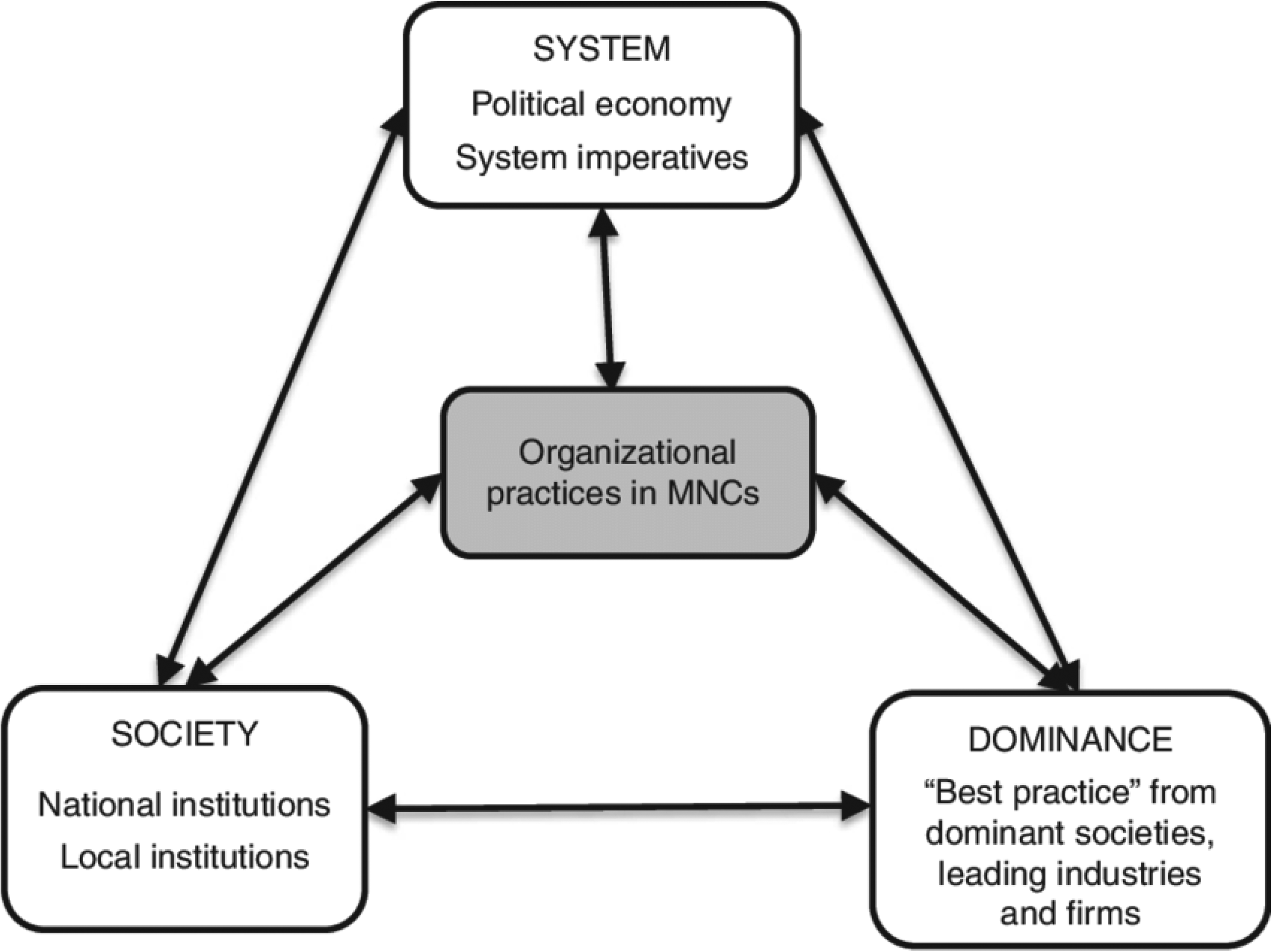
Elements of the SSD framework.
System effects are related to the political-economic system of a country, such as capitalism or state socialism. The political-economic system is characterised by particular social relations and forces (Smith and Meiksins, 1995), which have an impact upon a country's accounting environment. For example, a country with a capitalist orientation would favour private capital accumulation and foreign investment, thereby fostering a better financial reporting environment. This might not be the case in a country where state socialism prevails over the market and capital accumulation. Therefore, system effects tend to be aligned with a particular form of financial reporting and accounting practices within a particular context. In this respect, considering system effects enables a better understanding and visualisation of the conditions which preceded and which lead to the decision to adopt IFRS within any local setting.
Dominance effects are manifested in the hierarchy that has always existed between economies and societies (Elger and Smith, 2005), where those in dominant positions have always developed standards and practices which have invited global interest (Smith and Meiksins, 1995). With the increasing integration of economic activity, these standards have been diffused on an international level, and have ultimately been regarded as best practices. ‘How the techniques and practices exported from these particular countries interact with national institutional arrangements, and what hastens and impedes their diffusion, also requires further investigation’ (Smith and Meiksins, 1995: 258). What makes dominance effects particularly relevant in exploring IFRS adoption is that global institutions such as the WB might oblige nations to abide by these standards as a pre-requisite for granting loans, thus being imposed on countries as structural reforms. Therefore, there is a need to understand the nature of the interaction between dominance effects and the indigenous culture and how this interaction shapes how IFRS are being practiced and used.
System and dominance effects are mediated through the context specificity of each society, which establishes another level of influence, societal effects. Societal effects can be explained as ‘a level of institutionalisation which encultures systemic forces with unique qualities’ (Smith and Meiksins, 1995: 256). Therefore, societal effects are the unique formal and informal institutions that characterise each society. Differences can be distinguished between developed and non-developed countries with respect to informal institutions, such as informal relationships, family networks and nepotism, which are more significant in non-developed contexts (Belal et al., 2017). Similarly, societal effects can also be reflected in the nature of the business environment, such as business ownership, debt versus equity financing, maturity of the stock market, privatisation, as well as education systems. Therefore, societal effects can provide a better understanding of how global standards such as IFRS will be welcomed within the local field of accounting, and the extent of its application and usefulness in practice.
In addition to identifying the influences of system, society and dominance, there is a need to address the nature of interactions between them, which enables a better understanding of how global forces interact with local ones (Sassen, 2003). Globalisation is enabling a fast diffusion of standardised best practices from dominant economies. While system and dominance effects are associated with global circumstances, societal effects demonstrate that practices not only mirror the adopted international standards, but also resemble the local context. The analysis of societal effects is not limited to a specific historical time, but to norms and informal institutions being structurally embedded in society. Thus, the analysis would demonstrate the clash between the push towards the global harmonisation of accounting standards on the one hand, and the local institutions, culture, and business environment, on the other hand. The uniqueness of every society indicates that the global infiltration of international accounting standards is not able to reduce the unique character of social relations and eliminate cultural diversity of the society. This provides a theoretical underpinning of investigating the extent to which local settings affect the adoption and implementation of the global standards and best practices.
The SSD framework has been utilised in accounting research but has tackled the organisational level and not the societal level. In this respect, the SSD framework was utilised in understanding the practices of Big 4 accounting firms in emerging economies, such as Bangladesh (Belal et al., 2017). It helped explain how practices of Big 4 are not being genuinely global due to the pervasiveness of local culture and practices. The SSD framework might be an interesting field of research that may enhance our understanding of IFRS implementation outcomes especially in emerging economies whose societies, norms and cultures are structured in a different way, compared to the West where these standards emerged. The article therefore applies the SSD framework to investigate how local culture might influence the successful (or otherwise) implementation of IFRS in emerging economies.
After discussing the theoretical framework utilised in this article, the following section explains the methods and methodology adopted in order to address the research objectives of the article.
Methods and methodology
This article relies on semi-structured interviews (Ritchie, 2014) as well as on reports such as published laws, regulations, and minutes of parliamentary discussions to address the research objectives. The author obtained special access to the library of the parliament for the minutes. The article also relies on two books related to the history of the accounting profession in Lebanon (Abou Chakra, 2015; Sharara, 2006) which include all regulations related to the accounting profession in Lebanon. This data is mainly related to IFRS adoption, privatisation, foreign loans following the Civil War, the reopening of the Beirut Stock Exchange (BSE), as well as other economic policies. In addition, the article relied on the Report on Observance of Standards and Codes for the Republic of Lebanon, and other reports on the Lebanese economy and its business environment prepared by the WB and the IMF, as well as the BPI report about Lebanon. The purpose of utilising these reports is twofold. First, they provide a visualisation of the general business environment of Lebanon, such as its stock market, privatisation, the banking sector and the dominant form of financing. These factors are highly related to the financial reporting environment and explain the high -or otherwise- demand on financial reports. Second, this data delineates the circumstances surrounding the initial decision to implement IFRS in Lebanon.
In addition, 20 semi-structured interviews were conducted during the period between 2018 and 2019, to understand the influence, significance and implementation of IFRS on different levels: accounting practice, education and regulation. The author relied on personal connections as well as snowballing techniques to arrange the interviews. This aims to assess the extent of which IFRS are supported –or otherwise- by the local environment. Semi-structured interviews are particularly relevant in this avenue, as participants are asked to delineate IFRS-related experiences and are given the freedom to discuss anything related to these standards. This enabled a better understanding of how local factors might impact the actual implementation of IFRS in the local field of accountancy.
First, to assess IFRS in relation to accounting regulation, interviews were conducted with two former board members and five former Presidents of the LACPA. The purpose of these interviews was twofold. Early Presidents provided background information about the history of accounting regulation and former accounting bodies. In addition, these interviews primarily aimed to understand the nature of conflicts that take place within the LACPA, especially given that the board minutes are not accessible for the public or for research purposes.
Second, to assess IFRS in relation to accounting education, three semi-structured interviews were conducted with accounting coordinators of two different university systems in Lebanon: the two Lebanese American Universities and the only state university in Lebanon, the Lebanese University. These interviews aimed to provide information about the accounting curriculum that is being taught in these universities (IFRS related vs. local laws).
Third, to assess IFRS in relation to accounting practice, five interviews were conducted with two different sets of employers of accounting graduates, the Big 4 (four interviews) and state institutions (1 interview). This aimed to provide insights about where accounting graduates of each university system were mostly employed. Additionally, five interviews were conducted with auditors (current and former) of Big 4 firms in Lebanon in order to explain the impact on the adoption of IFRS on the auditing practices in this context.
The reports demonstrate that during the post-civil war period, there was funding from international donors such as the WB and IMF. This was analysed as a variant of system (liberal economy of Lebanon) and dominance (power of leading institutions) effects. However, parliamentary minutes demonstrate the societal effects which, in some instances, stood against the dominance of global institutions, such as the political rejection of privatisation. This provides a counter to the system and dominance effects.
Semi-structured interviews primarily aim to provide a better picture about societal influences, and how these were related to the accounting environment, as well as to understand the divisions existing within the field of accounting, the education system, and the exclusive body of accountants.
Together, documents and semi-structured interviews were theoretically framed within the interconnectedness between system, society and dominance effects, thereby enabling a better understanding of how system and dominance effects come into play with respect to the adoption of IFRS, and how these effects are mediated by societal influences when it comes to the implementation and the use of IFRS-compliant financial information.
The data demonstrates numerous divisions, both within the general economic and political environment such as attitudes towards privatisation, and within the field of accounting more specifically, such as policy, education, and practices. Analysing this data from the lens of the SSD framework supported analysing and understanding these divisions in terms of a global, neoliberal stance that is being confronted by a local, traditional one. This has implications on the status of the decision to adopt IFRS in Lebanon as well as its implementation and usefulness.
The challenges of IFRS implementation in Lebanon: An SSD analysis
Informed by the SSD framework, this section discusses the conditions preceding and following the implementation of IFRS in Lebanon. The findings demonstrate that system and dominance effects are related to conditions surrounding the initial phase of IFRS implementation in Lebanon. However, societal effects have created the main challenges to IFRS implementation. The following figure presents a framework of how accounting practices in general, and IFRS in particular, are influenced by system, society, and dominance effects (Figure 2).

SSD effects and accounting practices in Lebanon.
System and dominance effects: Understanding the forces surrounding IFRS implementation in Lebanon
The decision to adopt IFRS in Lebanon took place in 1996, starting with the Central Bank and large firms in the year 1996, insurance and other large firms in 1997, medium firms in 1998, and all other establishments in 1999 (Longuenesse, 2006).
According to the SSD framework, to understand why certain practices were implemented at a particular time, there is a need to understand the political economy (general economic and political orientation) of the country, as well as particular events and forces that occurred during the implementation process (Elger and Smith, 2005). ‘A political economic system, such as capitalism, feudalism or state socialism, contains distinct social relations and forces which impose themselves upon a country's organisations as a disciplinary mechanism’ (Smith and Meiksins, 1995: 253). System effects are those associated with the general economic orientation, while dominance effects are related to particular relations and forces that contribute to the implementation of certain practices.
In the case of Lebanon, system effects are associated with the political-economic system and orientation of Lebanon. Lebanon has always been a free-market economy, compared to its region which historically was characterised by planned and socialist economies (although many of them have diverted into market economies). Thus, Lebanon's system has always been characterised by the drive for market competition and the private accumulation of wealth, to the extent that one might describe it as a family capitalism system, as the majority of businesses are small and medium enterprises which are owned by families. These general system effects mirror the political system in Lebanon, which is a liberal democratic system. Thus, it is arguable that in systems not controlled by monarchs as it is the case in most of the region, the economic system will, to a greater extent, favour competition and the private accumulation of wealth. As IFRS have emerged from, and promote capitalist ideologies, this was more compatible with the free-market economy of Lebanon which created the distinct forces surrounding the decision to adopt IFRS.
Dominance effects are manifested in the period and the conditions surrounding the implementation of IFRS in Lebanon. The decision to implement IFRS in Lebanon took place in 1996, when Lebanon was recovering from one of its worst experiences, the civil war, which began in 1975 and ended in 1990. For purposes of funding the reconstruction project, Lebanon had to rely on debt, both local and foreign. The debt was from local banks and from international lenders. Lebanon conducted, among others, three important conferences (Paris I, II, III) for the purpose of borrowing money. There was a need to reconstruct the devastated economy and infrastructure. This was the primary mission of the elected government at that time, led by Prime Minister Rafic Hariri. Rafic Hariri was a billionaire; he was elected in 1992 as the Prime Minister of the first government following the end of the civil war. During the reconstruction period, there was a demand for foreign financial aid to support the reconstruction project. In addition, the Beirut Stock Exchange (BSE) was reopened following the end of the civil war, and among the few listed companies was SOLIDERE, whose majority of shares were owned by the Prime Minister at that time. These forces reflected a need for foreign aid as well as a drive towards equity financing with the opening of the capital market in Lebanon, which is when dominance effects manifested.
On 10 August 1994, the Lebanese government signed a contract to borrow $57.2 million from the WB to fund the project of repairing and modernising the irrigation sector. On 7 March 1995, a similar contract was made with the WB to borrow $35.7 million to support and repair the health sector. Other agreements were made in the second half of the 1990s with other international donors such as the European Bank, to support the reconstruction of Beirut International Airport in 1995, as well as the IMF. As international donors cast doubt around granting debt unaccompanied by structural reforms such as the adoption of IFRS, the Lebanese Minister of Finance, Fuad Siniora, issued decree 1/6258 related to the implementation of IFRS, in 1996. Dominance effects are manifested when the government of Lebanon was, as a condition for accessing foreign debt, were required to implement IFRS as part of the structural economic reforms, usually requested by foreign donors to make sure that the debtor country would be able to pay back the loan.
Overall, the general political-economic system of Lebanon characterised by a free market and the private accumulation of wealth, and the need for foreign debt for the reconstruction project following the civil war, underpin the government's initial decision to implement IFRS in Lebanon in 1996. However, the initial decision to implement IFRS does not necessarily mean that these standards are not free from challenges, as illustrated in the following section.
Challenges: Societal effects mediating system and dominance effects
According to Smith and Meiksins (1995: 254), societal effects are ‘a level of institutionalisation which encultures systemic forces with unique qualities.’ Unlike system and dominance effects which explain the decision to implement IFRS in Lebanon, societal effects create challenges for its implementation. The following sections elaborate on the numerous societal influences that were not aligned with the basic objectives of IFRS.
Local way of doing business: Acquaintance with debt rather than equity financing and the related low demand of IFRS-compliant financial statements
One of the perceived benefits of the adoption of IFRS is the contribution it makes to the stock market (Brown, 2011). In the case of Lebanon, societal influences manifest themselves in the structure of the business environment in Lebanon, led by the private sector, and dominated by small and medium-sized enterprises (SMEs). Most of these SMEs are owned by families, and around 85 per cent of these firms employ less than 50 people (BTI, 2020: 24). Accordingly, one can talk about family capitalism when it comes to the structure of business ownership in Lebanon. The market structure is highly biased towards the interests of powerful families and business interests, which limits the redistributive effect of the market across diverse social groups. This exacerbates inequalities and the entrenchment of sectarian groups (BTI, 2020: 41).
Due to this family ownership structure, the business environment in Lebanon is highly reliant on debt rather than equity financing, which explains why the banking sector in Lebanon is the most resilient (IMF, 2017). This also explains why the only stock market in Lebanon, the BSE, is a very small market. The BSE was established in 1920 by a decree of the French Commissioner (BSE). It initially opened in 1920, closed in the year 1983 due to the civil war, and then reopened in 1996, during the reconstruction period post-civil war, and during the same year that the Lebanese Minister of Finance issued a decree pertaining to the adoption of IAS/IFRS. The infancy of equity financing in Lebanon is explained by the hesitance of families to list their shares on the market. In 2020, only 10 firms were listed on the BSE, out of which six are banks, two cement companies, one car dealer, and one real estate company. This illustrates that equity financing is still not a trusted means of financing businesses in Lebanon, at least if compared to debt financing, where the banking sector in Lebanon is among the top sectors. The Lebanese financial system is dominated by banks. Sixty-six banks account for 97% of financial system assets, which, at 397 percent of GDP (as of December 2015), are large for a middle-income country (World Bank, 2016, Section 7).
The reason is that equity financing is not yet widespread in Lebanon, because, for those in need of financing, access to bank loans is relatively easy. Lebanese capital market is relatively small as the financial market is dominated by the banking sector. The Beirut Stock Exchange (BSE) has only 11 listed entities with a total equity market capitalization of US$ 10 billion or 24% of GDP, smaller than its peer countries (both in the region and among countries with similar income level); and trading is very thin among these stocks. Lebanon has a sizeable government bond outstanding, but the secondary market is not very active. Meanwhile, the non-government debt market is very small and fully dominated by banks. It is apparent that banks dominate financial intermediation in Lebanon to the extent it may inhibit the development of capital markets. (World Bank, 2013, Section 1).
IFRS are often applied only on a limited number of listed firms and banks, and these do not represent the total field of accounting. In the case of Lebanon, there are only 10 listed firms, among which six are banks. Neither the Ministry of Finance nor any other organization has the authority to enforce IFRS, except with listed companies and banks (World Bank, 2003: 7).
There is no enforcer agency or body of IFRS in Lebanon. Furthermore, neither the government, the central bank, Beirut stock exchange, nor any other body responsible for enforcing the IFRS standards in Lebanon. However, whenever there are IFRS updates related to the banking sector and insurance companies, circulars about these updates are issued. Circulars for banks are issued by the central bank and circulars for insurance companies are issued by the ICC (Partner at a Big 4 firm in Lebanon).
This situation demonstrates that there is relatively low demand over financial reports because of the infancy of both equity financing and the stock market (Zeghal and Mhedhbi, 2006). In other words, auditing is being conducted as a legal requirement more than it is a value-added activity for investors and creditors as it is the case in countries with mature stock markets. In addition, the Report on the Observance of Standards and Codes (2003) demonstrated that users of financial information rely on other sources of information. Local banks base their lending decisions on other information that they obtain, in addition to the financial statements…Most external users of financial statements indicated that they depend mainly on personal contacts within the company to gather reliable information (p. 11).
While the main purpose of IFRS is directed towards decision makers such as investors and creditors, the case of Lebanon is characterised by the over-reliance of debt rather than equity financing, and the reliance on other sources of financial information, demonstrating that IFRS-compliant financial statements are not even demanded in Lebanon.
Schism in IFRS-compliant education and practice in the field of accounting
Being a former French colony, Lebanon has inherited the Unified Accounting System from France, which was adopted in 1982 and is still being implemented in practice. Although the Ministerial Order mandates the use of IAS, Law No. 27 (1980) still requires all commercial entities, except banks, to follow a unified chart of accounts (World Bank, 2003: 1–2).
In this respect, societal effects related to the colonial legacy establish another barrier for the implementation of IFRS in Lebanon in non-listed entities, because of the existence of another accounting system. The unified accounting system is characterised by a strong legal orientation, which mirrors the long-established French model or the continental European Approach (Elad, 2015). This contradicts with the Anglo-American approach, which is more directed towards the needs of investors and capital markets. Nobes (2008) describes the Anglo-American approach as a judgemental accounting approach, and differentiates it with a Franco-German approach, and described it as a uniform accounting model.
Thus, IFRS were adopted in Lebanon within an accounting field that was already established and structured around the continental accounting model. It is unlikely that IFRS will completely overtake the unified accounting system because of the societal effects which favoured debt over equity financing and rejection of privatisation, and thereby decrease the demand for IFRS compliant financial statements. General-purpose financial statements are often influenced by taxation rules and regulations. The tax laws and decrees provide accounting requirements and the chart of accounts that companies must follow in determining taxable income. In order to satisfy the requirements of taxation authorities regarding the recognition of taxable revenues and deductible expenses, the preparers of general-purpose financial statements often tend to deviate from applicable financial reporting standards, preferring to follow the tax rules. As a result, treatment of certain items in the general-purpose financial statements may be different from that which should apply under IAS (World Bank, 2003: 2).
The continental-Anglo/American schism is further manifested in accounting education and training in Lebanon. The accounting education system is currently divided between Lebanese American Universities whose accounting syllabi reflect the Anglo/American approach and who concentrate on GAAP and IFRS in their accounting curricula. The curriculum we teach is mainly adopted from the CPA. Our undergraduate program covers the basics of the CPA exam and even more (Coordinator of accounting programme at one of the Lebanese American universities).
However, the only state university in Lebanon, The Lebanese University, which reflects the French education system, concentrates more on local rules and taxation, as opposed to GAAP and IFRS. Therefore, the Lebanese University focuses more on Lebanese laws, and not on international accounting standards, The Lebanese University is the only national university, and our main preference is to educate students according to our local law. We teach subjects related to Business Law, Taxation, National Accounting, Budgeting, and NSSF laws. We apply the Lebanese Unified Accounting System (Dean of Business, LU).
This is also reflected in the job markets of candidates of these systems, where American universities’ graduates are more likely to work in Big 4 accounting firms, whereas graduates of the Lebanese University are more likely to work in state institutions. The majority of our newly recruited employees come from two universities, for many reasons. If we are assessing applicants, those coming from American universities have more chances of performing better than other candidates in our recruitment process such as examinations, interviews and assessments (Partner at a Big 4 firm).
On the other hand, accounting graduates of the Lebanese University are most likely to be admitted to work in state institutions, as indicated by a director at the Council of Civil Service (a state directory responsible for the recruitment of employees in state institutions), It is not because graduates of American universities don't pass our examinations; it is because they don't even apply. The results of those who passed the exams indicate that the majority are students of the Lebanese University (Director at the Council of Civil Service).
The interviews conducted with auditors of the Big 4 accounting firms explain the lack of IFRS-knowledge and expertise of their clients (corporate accountants) and inform how this has changed the nature of the auditing process in Lebanon. For example, to cope with IFRS knowledge shortage among corporate accountants, auditors in Jordan have encroached practices of the corporate accounting field whilst corporate accountants have relinquished some of their major practices to the knowledgeable and skilful auditors of the Big 4 (Aburous, 2019). A similar stance was noticed in Lebanon. In this respect, the practice of financial statement preparation, which is normally the duty of corporate accountants, is now the practice of auditors, given the lack of knowledge in IFRS among corporate accountants. A senior director at one of the Big 4 firms in Lebanon clearly explained that the Big 4 are actually involved in the preparation of financial statements on behalf of their clients, This lack of IFRS knowledge is the problem in Lebanon, which is why we prepare the financial statements. However, we say that the client is preparing those statements (Senior Director at a Big 4 firm).
This was also explained by a Partner at another Big 4 firm, Small to medium companies are the most common size firms in Lebanon, and they lack the proper expertise in IFRS. They always seek the support of the auditors to confirm for them the financials. On the other hand, large institutions (banks and listed firms) have a more equipped staff to prepare the financials. However, they still use support from their auditors, in the technical part of preparing financial statements (Partner at a Big 4 firm).
In this regard, auditors have explained that they demand the trial balance and the general ledger of the client in order to prepare IFRS-compliant financial statements on behalf of their clients. This demonstrates that IFRS have expanded the auditing field, with the opportunity of higher economic benefits to Big 4 accounting firms, and has simultaneously shrunk the corporate accounting field, as corporate accountants have relinquished some of their most important practices to Big 4 auditors. This situation is explained by the lack of interest in IFRS among corporate accountants, the government (being more interested in tax returns), as well as the nature of the business environment which is heavily composed of Small and Medium Enterprises as well as an immature stock market.
Therefore, while IFRS are implemented in big firms, there is still lack of adequate knowledge among corporate accountants. However, this is not the situation in smaller firms, who mainly utilise the unified accounting system. This indicates that IFRS are implemented in a faction of the field of accounting, that of the big firms and international firms operating in Lebanon, thus a partial implementation of IFRS.
The divided accounting education system in Lebanon, as well as divided job market, are societal features which present challenges to IFRS implementation in Lebanon. Thus, we cannot talk about IFRS implementation in a holistic manner, as it could be applied in a faction of the field of accounting, related to institutions associated with the Anglo-American model of accounting practices and education:
The field of accounting is divided between global Anglo-American practices (Big 4) working mainly in auditing and consultation and who clients are large businesses, banks, insurance companies and multinationals on the one hand, and local practices (local accounting firms) who work mainly in taxation and whose clients are small businesses. The field of accounting is divided between global accounting education (IFRS and GAAP curricula) taught mainly in Lebanese American Universities on the one hand, and local accounting education (taxation) taught mainly in the Lebanese University.
As the accounting field of education and practice is itself divided between the global and the local, with each having different orientation, education, practice, goals and users, this creates a challenge towards the full implementation of IFRS. Rather, we can only talk about a partial implementation of IFRS, more specifically in the faction of the field related to the global orientation.
Schism among regulators in the LACPA towards IFRS
The interviewees indicated that there is a recurring political schism within the LACPA, manifested within two groups in the board. This schism is not only related to the current board but has been there ever since the LACPA was established in 1994. Although the two groups are divided based on political considerations, they are also divided according to professional considerations. On top of these considerations are issues related to nationalism and resentment of foreign influence. In this respect, while the LACPA is a member of IFAC, there is a group of practitioners who are also represented on the board of the association, who showed willingness to leave IFAC because it puts the association under foreign dominance. Moreover, this group has cultural differences with international bodies and standards, such as language issues: Although LACPA is a member of IFAC, it is not able to carry out some important functions that are required by IFAC, including supervision of members, and setting and implementing ethical standards and disciplinary procedures (World Bank, 2003: 5).
In this respect, the LACPA is composed of a group who can be identified as having a traditional-oriented professional identity, who are more familiar with local laws and regulations, and who mostly have small accounting firms that mostly work in taxation for small businesses. On the other hand, there is another group within the LACPA who are more acquainted with international accounting standards, and who mainly work with Big 4 accounting firms or with multinational corporations operating in Lebanon. A former president of the LACPA demonstrated this division talking about a group within the LACPA: They do not even know what IFRS is. They did not study IFRS, nor do they know its details. However, they know that IFAC imposes on them rules, and they cannot easily adapt because they first have a language barrier, and second the issue of training. How will they understand what is required and what should be done. They don't know, so they feel that you are exposing them to a system controlled by foreigners; they do not know how to assess whether it is for their benefit or not and they are afraid. So they say that they don't like the model, they don't like the content, let's think of a way to stop it (former President of LACPA).
It is also important to note that, if the majority of these groups can be divided based on religious or sectarian lines. These groups will always be represented in the board of the LACPA, hence removing the possibility of the association being dominated by one group/professional perspective. This is because of an institutionalised religious system of circulation within the LACPA whereby the board is always split in half between Christians and Muslims (sometimes sectarian allocations are also applied within each religion). In addition, the position of the president of the union is also circulated between Christian and Muslim positions such that no one of the same religion can be elected to president in two consecutive rounds. This norm copes with the general political environment in Lebanon and is believed to prevent the association from being overtaken by one group. It is not possible for those who have the Big 4 and IFRS mentality to take over the elections, because of the institutionalised religious/sectarian composition of the board of the LACPA. Some groups will not elect them because they have no idea about IFRS or any related stuff. All what they know is the Unified Chart of Accounts (Unified Accounting System) and most of their work is related to taxation for small clients (former President of the LACPA).
Thus, societal effects of traditional versus globally oriented identities, and the preservation of the rights of all groups through the religious system of circulation are preventing IFRS from being applied to all enterprises, because of a group of practitioners in Lebanon who are not acquainted with it, who have not studied it, who deem it unnecessary in their practices, and ultimately, who perceive it as a foreign influence.
Theorising challenges of implementation: IFRS and the divided field of accounting (practice, education, regulation)
Supported by the WB, IMF and the UN, global accounting institutions such as IASB and IFAC produce and reproduce a particular orientation premised on neo-liberalism and associated with the harmonisation/standardisation of accounting practices. While this global orientation has affected non-Western economies, the relatively complex field of accounting, as well as the different societal dynamics, have created challenges which have ultimately mediated the dominance effects of the neo-liberal/global orientation.
The dichotomies of the global and the local were present in accounting field in Lebanon even prior to the implementation of IFRS. Such division was witnessed in the early 1960s with different groups of accounting practitioners, one reflecting the French model and the other reflecting the Anglo-American model, and who established two different accounting bodies at that time. Even with the unification of these bodies, this clash is still inherent in the LACPA between two groups, one group possessing a globally-oriented identity who opt for international standards, and the other group possessing a traditionally-oriented identity who opt for local accounting practices.
The findings of the case of Lebanon provide more nuance about the implementation of IFRS in emerging economies, that the presence of a local perspective related to accounting education, practice, and regulation prevents the full and successful implementation of IFRS. IFRS are indeed implemented, but only by certain institutions and actors within the field of accounting: those who have studied in Lebanese American Universities, and those who work in big accounting firms, with the rest advocating a local perspective of accounting practice, education and regulation.
No group/perspective is able to dominate or overtake the other. This situation might be more preserved in Lebanon because of the religious system of circulation within the LACPA. Thus, the global-local dichotomy is entrenched within the history of Lebanon, and the adoption of IFRS came not to change this particular history, but to add another episode of it. Therefore, dominance effects are not totalising ones, thus we should not create an essentialist polarisation of state versus the market, global versus the local, Big 4 versus local firms, because the field is hybrid and encompasses all these poles.
According to Smith and Meiksins (1995: 257), There is no natural tendency for this tension to be resolved ultimately in favour of one or the other dynamic. Rather, it is an inherent feature of the historical process for both dynamics to operate simultaneously within actual societies. The structural pressures set up by the underlying political economy are real: however, they are expressed through and conditioned by national histories, so that simple convergence is an unlikely outcome.
The idea of the national ‘business system’ is relevant for this discussion, which argues that, national economies are shaped by social and economic institutions which can be quite specific to particular societies and regions; and that, despite pressures for internationalisation and regionalisation from economic and political coordination and control created by MNCs and the EU or other regional forces, national specificity continues to be reproduced (Whitley, 1992 in Smith and Meiksins, 1995: 252).
The notion of ‘best practices’ accompanying IFRS has increased with the increasing integration of economic activity. The interaction between imported ‘best practices’ and the local institutional arrangements, and what stimulates or prevents their diffusion should not be overlooked. However, when a particular country does not have the solvents for an integrated economic activity such as privatisation (Josiah et al., 2010; Parker and Kirkpatrick, 2005; Uddin and Hopper, 2001), capital markets (Zeghal and Mhedhbi, 2006) and membership in WTO, then these best practices become increasingly irrelevant to the needs of that particular country. In addition, best practices might not be fully integrated locally because of the embeddedness of other existing practices, such as practices based on the continental model, as opposed to the Anglo-American model (Nobes, 2011).
The SSD framework considers the long-histories and pre-existing institutional arrangements which will ultimately encounter global aspirations of standardisation which ‘may flow from the capitalist dynamics and can only ever fit into the existing divergence of national recipes, and therefore perpetuate non-identical reproduction of existing specificity’ (Smith and Meiksins, 1995: 256).
The SSD framework demonstrated a tension between system/dominance effects on the one side, and societal effects, on the other side. While system and dominance were more aligned with global pressures and explained the initial decision to implement IFRS in Lebanon, these were mediated with societal effects reflecting the long-established local history, culture and institutions.
Discussion and conclusion
The literature has mainly stressed that nation states have relinquished their sovereignty by abiding to rules favourable to global capital (Hopper et al., 2017), among which, IFRS implementation is a major tenet. While this article does not negate this, it adds further nuance by indicating that the power of globalisation happens to a greater extent in the early implementation phase of IFRS (system and dominance effects) and to a lesser extent at later implementation stages (society effects).
Furthermore, numerous local factors such as political, economic, legal systems, taxation, culture, religion and education have maintained diversity among accounting systems in emerging economies (Al-Htaybat, 2018). This article contributes to this body of scholarship by theorising challenges of IFRS implementation to occur in relation to the local field of accounting and how it is structured, being itself divided between different practices, regulations, and education. Such divisions within the field are characterised by different orientations: those that are favourable to globalisation and global capital and those that are compatible with local practices. Each faction of the field has its own users, objectives and modes of work.
Studies of IFRS implementation in emerging economies have largely remained polarised between convergence and divergence, culture-bound and culture-free, as well as universal and relative (Albu et al., 2014; Mir and Rahaman, 2005). The current study has stepped out of this one-sided explanation to illustrate how the accounting field within the same country is itself, divided:
When it comes to accounting regulation, certain groups of regulators have the IFRS culture and promote it, while other groups of regulators have the Unified Accounting System and taxation culture and promote it. Both groups are within the same accounting body, the LACPA. When it comes to accounting education, those who study in Lebanese American universities are exposed to IFRS, unlike those who study in the Lebanese University who are more exposed to local accounting laws and regulations. When it comes to practice, those who work in the Big 4 have continuous IFRS training and updates, unlike those who work in small and local firms, who are involved in taxation procedures of their clients.
Therefore, unlike studies that have reported how IFRS was successful in some countries and less successful in others (Nobes, 2011; Zeff and Nobes, 2010), this article enables a reconsideration of how we assess IFRS implementation in emerging economies, on the level of the field of accounting. In other words, IFRS may be successfully implemented in a portion of the field of accounting that has a global orientation, while at the same time not implemented in the other portion of the field of accounting that has a local orientation.
The business ownership structure in Lebanon is characterised by family-owned businesses that are mostly SMEs, with only a small proportion of listed firms. A major consequence to that is the immaturity of the stock market in Lebanon, with less than 10 listed entities. Due to these factors, there is little enforcement and supervision of applying IFRS, aside from the Beirut Stock Exchange authority, which is just concerned with listed entities. SMEs might and might not use IFRS in their financial statements. Therefore, while IFRS are obligatory for all business entities in Lebanon, the little enforcement just addresses a small proportion of the field of accounting, leading to partial implementation of IFRS in practice.
IFRS are highly complex and continuously updated, which presents knowledge imbalances for local accountants. This provides competitive advantage for international accounting firms such as the Big 4, who are provided with the technological platforms and updated software for IFRS. It was also reported that the Big 4 assume the role of financial statement preparation in emerging economies because of the unqualified local accountants, which shrinks the field of accounting and expands the field of auditing (Aburous, 2019), which also resembled the case in Lebanon. As the data suggests, the Big 4 firms hire mostly from the two Lebanese American universities, which presents only a small portion of the graduate workforce, leaving the others with less IFRS-related knowledge and expertise. This presents another hurdle of the successful implementation of IFRS in emerging economies.
The prevalence of family-owned SMEs in the business ownership structure, and as owners are not willing to relinquish ownership by going public, indicates that there is small demand on IFRS-compliant financial statements. This is accompanied by the dominant form of financing being debt rather than equity financing, thus little need and demand for IFRS-compliant financial statements. In that case, banks, being creditors, are those who require information about their clients, and this information is usually not through their clients’ financial statements, but through other sources of information. Thus, the overall mentality is not oriented towards equity financing, thereby lessening the scope and success of IFRS over the field of accountancy.
These factors add to our knowledge by demonstrating a partial influence of globalisation and neoliberalism whose role was the trigger point at the early stages of IFRS adoption. The remaining is a function of society and the structure of the accounting field. While the SSD framework has been utilised in understanding practices of the Big 4 firms in emerging economies (Belal et al., 2017), this study presented an opportunity to apply this framework in exploring IFRS in such contexts.
The distinction between global ‘best practices’ and local traditions reveals more diversity, hybridity and pluralism, rather than one best way (Hellman et al., 2015; Nobes, 2013). As this case illustrates, despite the decision to implement IFRS, there were no imperatives capable of eliminating national differences. The widespread discourse is that IFRS diffusion is associated with capitalist ideologies which address the needs of international financial capital that underpins globalisation. However, scant attention has been dedicated to how these global processes, which opt for standardisation and harmonisation, are mediated by societal influences which preserve diversity and national differences (Nobes, 2013).
The incomplete implementation of IFRS is understood in terms of the interplay between System, Society and Dominance (SSD) influences. System and dominance effects have driven the initial adoption of IFRS in Lebanon following the civil war and the need for foreign debt, however, societal effects have mediated system and dominance effects, and prevented IFRS from being fully implemented and demanded.
In the era of globalisation, global factors such as granting foreign aid and the increasing integration of markets of goods and services explain why most emerging economies are adopting IFRS. However, this could only be for legitimacy purposes with no significant resonance in implementation and practice (Hopper et al., 2017). At that point, addressing societal factors provide the explanation as to the real implementation of IFRS in the local arena. Policy differences in the adoption of IFRS worldwide cast doubt on the comparability of financial reports, which is a primary objective of IFRS.
The case of Lebanon adds further knowledge to the literature by shedding light on factors that help explain why the IFRS experience might not be successful in emerging economies, or at least did not significantly improve the local accounting profession. For instance, one societal effect in Lebanon illustrated that general-purpose users of accounting information are relying more on their own networks to gather information about companies, rather than considering the financial statements reported by these entities. Moreover, the polarisation between two big blogs of political powers and its reflection on economic policies have also affected the significance of accounting regulation in Lebanon. As the implementation of IFRS usually accompanies major economic changes such as privatisation, this was not the case in Lebanon.
Finally, the SSD framework can be utilised in other non-Western settings implementing IFRS. While these settings share similar circumstances such as the need for foreign debt and the adoption IFRS as part of structural economic reforms requested by international donors, societal influences might have different paths and different relations with system and dominance effects, thereby affecting the manner in which IFRS are being executed. This provides a more comprehensive understanding of both the processes through which these standards are being implemented, as well as the reasons of their complete, partial or even ceremonial implementation in practice.
Footnotes
Declaration of conflicting interests
The author(s) declared no potential conflicts of interest with respect to the research, authorship, and/or publication of this article.
Funding
The author(s) received no financial support for the research, authorship, and/or publication of this article.
