




Abstract
In 2018, the Corrective Services Administrators’ Council updated the Standard Guidelines for Corrections in Australia (2012), renaming them the Guiding Principles for Corrections in Australia. This was an opportunity to ensure alignment with the 2015 United Nations Mandela Rules. However, the Guiding Principles are less aligned with the Mandela Rules than the 2012 Guidelines were. That is, they represent a step backwards. This article examines this missed opportunity to improve prison practice in three areas of frequent human rights violations of imprisoned people: (1) solitary confinement, (2) bodily searches and (3) use of restraints. It argues that the ACT Standards for Adult Correctional Services provide an excellent model for national guidance that should replace the Guiding Principles.
The United Nations (UN) modernised and updated the 1955 Standard Minimum Rules for the Treatment of Prisoners and reissued the Rules in 2015. The new Rules were named in honour of Nelson Mandela, which is how they became known as the ‘Mandela Rules’ (Rules). 1 The Rules provide guidance for interpreting Australia’s treaty obligations under the UN’s International Covenant on Civil and Political Rights (ICCPR) 2 and Convention Against Torture and other Cruel, Inhuman or Degrading Treatment or Punishment (CAT) 3 (signed by Australia in 1980, and 1985, respectively).
It was envisaged that the Rules would be tailored for local conditions in each country. In a 2017 article, published in the Alternative Law Journal, I argued that Australia’s 2012 Standard Guidelines for Corrections in Australia (Guidelines) 4 – which were current at the time and had tailored the previous UN Rules for Australian conditions – were seriously out of alignment with the 2015 Rules. It was contended that not only were changes required to the Guidelines, but that changes to prison policy and operations would be needed in order for Australia to comply with the Rules. 5
Since then Australia has committed to additional international human rights law obligations in relation to prisons. Significantly, in December 2017 Australia ratified the UN Optional Protocol to the Convention against Torture and Other Cruel, Inhuman or Degrading Treatment or Punishment (OPCAT), which sets up a system of dual-level monitoring of places where people are deprived of their liberty (including, but not limited to, prisons). The first level of monitoring is international: by the Subcommittee for the Prevention of Torture and Other Cruel, Inhuman or Degrading Treatment or Punishment (SPT). The second level is domestic: by a National Preventive Mechanism (NPM). Both levels of monitoring are focused on preventing torture or other cruel, inhuman or degrading treatment or punishment (TCID) (Article 1, OPCAT) and the Rules assist with understanding how such practices might be avoided in prisons specifically. For example, the Rules stipulate that indefinite or prolonged solitary confinement may amount to TCID and should therefore be prohibited: Rule 43.
It was therefore very concerning when, in 2018, the Corrective Services Administrators’ Council replaced the 2012 Guidelines with the Guiding Principles for Corrections in Australia (Principles) 6 that they paid little more than lip-service to the Rules and the OPCAT. In the introduction to the Principles both are referred to as a ‘framework’ that has been ‘considered’, 7 but there is no further reference to the Rules or the OPCAT in the document. The Principles do not provide the level of specificity that correctional administrations require for identifying treatment and conditions that amount to TCID, making them an inadequate tool for mitigating the risk of TCID.
The Guidelines were not binding, 8 but the term ‘guidelines’ suggests that they should at least provide guidance, whereas the term ‘principles’ suggest that the document is more aspirational. The introduction to the Principles states that they ‘represent a national intent around which each Australian state and territory will develop its practices, policies, and performance standards’. 9 The websites of two corrections departments further clarify that the Principles do not have any legal effect. 10
This article will demonstrate that the Principles are not aligned with the Rules and do not assist with the prevention of TCID in Australian prisons, as required by international law. The practices that can and do occur in Australian prisons, and which are not prohibited by the Principles, leave Australia open to significant criticism by the SPT when they visit Australia for the first time. 11
This article will outline three specific areas of concern where the Principles, prison policy and practice are all out of step with the Rules. These are: (1) solitary confinement, (2) bodily searches and (3) use of restraints. The article will then refer to an example of Australian guidelines that are better aligned with the Rules – the Australian Capital Territory’s (ACT) Inspector of Correctional Service’s Standards. 12 It will be argued that the ACT Standards would provide an excellent model for the development of national guidance that should urgently replace the Principles, as part of Australia’s OPCAT implementation. This argument is supported by a recent report by the Australian Human Rights Commission that recommends two sets of national principles: one set for NPM inspection and a second for ‘minimum conditions of detention’. 13 The proposals contained in this article will be of assistance with development of guidance, specifically for prisons, that could complement the broader principles.
Solitary confinement

The Rules are clear – solitary confinement is not to be standard practice and should certainly not be prolonged. It is to be used in ‘exceptional cases as a last resort, for as short a time as possible and subject to independent review’ (Rule 45(1)). The 2012 Guidelines stipulated that ‘Prolonged solitary confinement … should not be used’; although there was no definition of ‘prolonged’. 14
In contrast, the Principles neither discourage the use of solitary confinement nor do they prohibit prolonged solitary confinement. The Principles contain several references to ‘segregation’ and principle 3.3.6 requires that a person’s mental health be ‘recognised and considered’ where segregation is ‘continued’. 15 Furthermore, there is a weakly worded entitlement to one hour per day of time out of a cell – weakly worded because this has a caveat of ‘weather permitting’, 16 which gives prison managers an easy way to avoid providing one hour per day outside. Rule 44 defines 22 hours a day in a cell as constituting ‘solitary confinement’ and under the Principles all people in Australian prisons could be subjected to this.
This is not a theoretical concern. In 2018 Human Rights Watch (HRW) published a report of its findings about the treatment of people with disabilities in prisons in Western Australia (WA), Queensland and New South Wales (NSW) over a 17-month period from September 2016 to January 2018. As reported, ‘[n]early all solitary confinement units Human Rights Watch visited were full and the (sic) most prisoners with disabilities interviewed had spent time in one. This indicates that placement of prisoners in solitary confinement is a regular occurrence in Australian prisons’. 17
HRW reported multiple instances of people with disabilities who had been in protracted solitary confinement for periods lasting years – in one instance 19 years. 18 They found an example of a woman being kept in a padded cell that was ‘windowless [and] perpetually lit’ for more than a month. 19
In September 2019, the Victorian Ombudsman produced a report about solitary confinement of children and young people in three facilities in Victoria. In the Port Phillip maximum security prison, the Ombudsman was informed about widespread use of solitary confinement on individuals aged between 18 and 24 years, with ‘265 separation orders … issued on young people within the 12-month reporting period’. 20 Similarly to the findings of HRW, the solitary confinement was ‘prolonged’ within the meaning of the Rules, with ‘the median length of … 49 days’. 21 The Ombudsman noted that ‘[s]everal young people reported being isolated for multiple months, and one young person reported that he had been isolated for a period of 15 consecutive months’. 22
Bodily searches
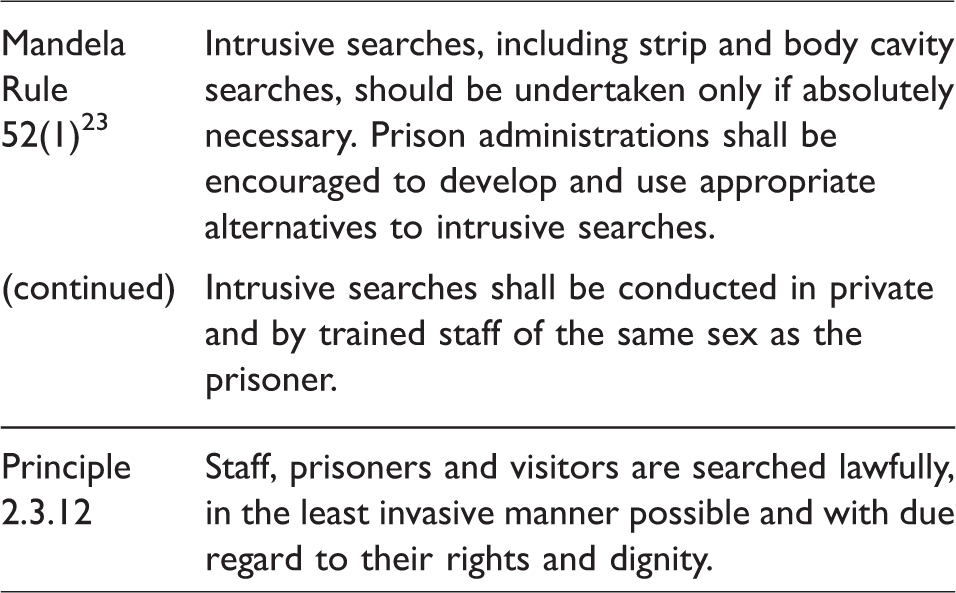
Rule 52 stipulates that intrusive searches are to be ‘undertaken only if absolutely necessary’. The 2012 Guidelines required that such searches be conducted by a staff member ‘of the same gender, wherever practicable’ and only for the purpose of checking for contraband. 24 The Principles provide no such restrictions on invasive searches, simply specifying that searches be carried out ‘lawfully, in the least invasive manner possible’. 25
The lack of discouragement of intrusive searches is more concerning when current practice is taken into account. In Western Australia, the Office of the Inspector of Custodial Services (OICS) found that 900,000 strip searches had been conducted in WA prisons across a five-year period, 26 equating to 180,000 searches per year of a prison population of 6943 in 2019. 27
The OICS found that 97 per cent of the strip searches were ‘routine’, rather than because there was a reasonable suspicion of contraband 28 (as required by the Rule), and ‘[o]nly 571 contraband items were found’ in the relevant timeframe. 29 The OICS also found that strip searching is being used as a means of punishment or control. 30 The OICS recommended that routine strip searching be phased out and that instead new technology be explored 31 but neither of these recommendations were supported by the government. 32
Thus it cannot be said that the strip searches in WA prisons are only being carried when ‘absolutely necessary’ or in any other way within the parameters of Rule 52. ‘Appropriate alternatives’ are also not being explored.
The Anti-Discrimination Commission Queensland recently prepared a report about women in prison, but the data they collected about strip searching was for all prisons in Queensland, rather than being restricted to women’s prisons only. The Commission reported that ‘[d]uring the selected week (29 May to 4 June 2017) a total of 282 removal of clothing strip searches were undertaken within BWCC [Brisbane Women’s Correctional Centre] and TWCC [Townsville Women’s Correctional Centre], and 3488 searches were conducted in the men’s prisons’. 33 The average number of women in the two centres referred to is 508 and 200, respectively. 34
Similar to the findings of the OICS, there is little contraband being located by these searches. In the same week ‘[s]ix articles were seized from women as a consequence of the searches, compared to 10 articles from men’. 35
In addition to the Mandela Rule requiring appropriate alternatives to intrusive searches be used, the United Nations Bangkok Rules 36 also apply to the treatment of imprisoned women and Rule 20 requires alternatives to be used ‘in order to avoid the harmful psychological and possible physical impact of invasive body searches’. 37 This is an area where there is at least a slight glimmer of hope. From late 2018 Queensland introduced non-invasive searches in the Southern Queensland Correctional Centre, when this centre opened. 38 Unfortunately similarly less invasive procedures are not being adopted in the other two secure women’s prisons in Queensland, but the Commission recommended that Queensland Corrective Services ‘actively investigates and implements new, non-invasive screening technology to replace routine removal of clothing searches in women’s prisons’. 39
Use of restraints
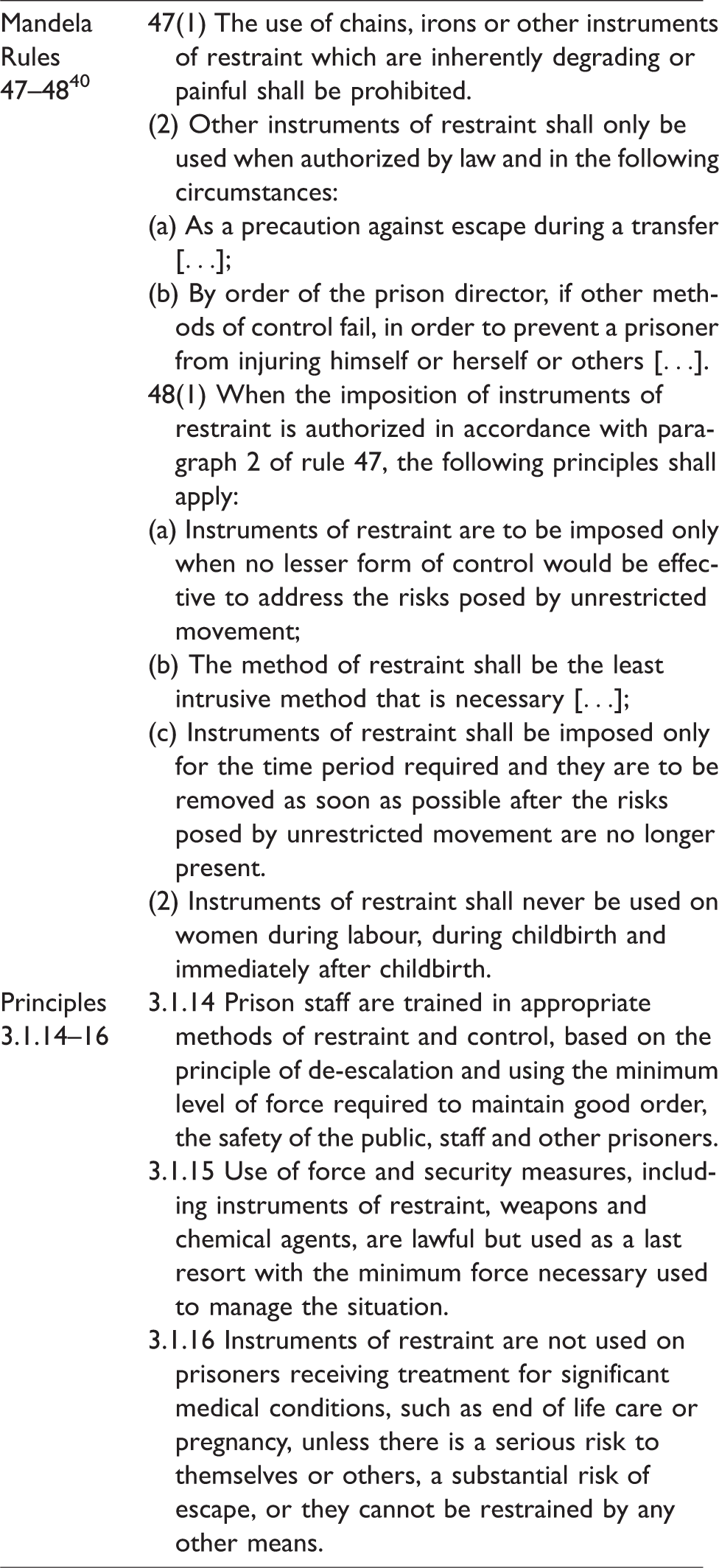
The Rules also require that restraints are only used for ‘the time period required’ and that they should be ‘removed as soon as possible after the risks posed by unrestricted movement are no longer present’. The Principles require that restraints ‘are lawful but used as a last resort’. There are no restrictions on the types of restraints that may be used.
Coroners around Australia have expressed concern about the use of restraints on imprisoned people while receiving medical care; particularly in instances where the person is unconscious and could not possibly escape (the permissible circumstance for use of restraint under the Rules). A 2020 example from NSW is illustrative. Mr Whittaker had been shackled to a hospital bed while unconscious, having suffered what the Coroner described as ‘a catastrophic brain injury and organ failure’. 44 It was incredibly distressing for his family to see him restrained under the circumstances and the Coroner concluded that ‘shackling of an unconscious man in hospital is horrific’. 45
The Coroner’s inquest findings noted that new policies have been introduced in NSW that provide for handcuffs and restraints to be removed when an imprisoned person is ‘severely incapacitated’, 46 and it remains to be seen how this policy is applied in practice. Regardless, it is concerning that such a policy was only introduced recently. 47
Alternative option
Given the Principles do not align with the Rules or provide specific guidance on how to prevent TCID in Australian prisons, it is necessary to consider alternatives. There is a very good Australian option, which is the ACT Standards for Adult Correctional Services (Standards). The Standards are designed for use during monitoring and inspections of the single prison in the ACT (the Alexander Maconochie Centre) carried out by the Inspector of Correctional Services under the Inspector of Correctional Services Act 2017 (ACT).
The Standards are a 110-page document containing 116 standards. Each of the standards has several indicators to guide interpretation, as well as evidence sources that may be used to make an assessment. The Standards are based on the four pillars of the World Health Organization (WHO) ‘healthy prison’ test. This test has been used by Her Majesty’s Inspectorate of Prisons in the United Kingdom (UK) as a basis for prison inspections for more than a decade. 48 The four pillars are:
Safety: detainees, particularly the most vulnerable, are held safely and staff and visitors feel and are safe;
Respect: all persons are treated with respect for their human dignity;
Purposeful activity: detainees engage in activity that is likely to benefit them;
Rehabilitation and preparation for release: detainees are supported to connect with their family and the community; supported to rehabilitate; and prepared for release back into the community. 49
The Standards are built on the expertise of prison inspection standards in operation in other states and territories in Australia. The ACT is the most recent jurisdiction to establish a prison inspectorate. There have been inspectorates (with their own inspection standards) in WA since 2003, NSW since 2013 and Tasmania since 2017.
50
In the introduction to the Standards, the ACT Inspector acknowledges that they build on this expertise, as follows. The Inspector acknowledges the expertise and experience of these oversight entities, the value that their standards bring to benchmarking treatment and care in closed environments, and is grateful to be able to draw on these standards in developing the ACT Standards.
51
In the three areas of frequent human rights violations discussed in this article, the Standards are aligned with the Rules and the preventive focus of the OPCAT. 52 They also provide a lot of detail – significantly more detail than that found in the 37-page Principles.
As noted above in the discussion about solitary confinement, the Rules stipulate that this is to be used in ‘exceptional cases as a last result, for as short a time as possible and subject to independent review’. The Standards refer to confinement for a range of purposes (such as for ‘health purposes’ or a ‘disciplinary breach’) and set out that this should only be used ‘where absolutely necessary’, ‘where there is no restrictive alternatives’ and in all instances ‘for the shortest time possible’ (indicators 12.4 and 12.5). 53 The Standards require that ‘segregation is never used for disciplinary purposes’ (indicator 16.1), require anyone who is confined to be ‘regularly visited by health professionals’ (indicator 16.7) and that there be ‘regular review’ and ‘a right to appeal’ (indicator 17.1). 54
In relation to bodily searches, Rule 52 requires that, if ‘intrusive searches’ occur, they be ‘undertaken only if absolutely necessary’ and be carried out by ‘trained staff of the same sex as the prisoner’. The Standards align with this Rule. Indicator 24.5 requires ‘alternative screening methods, such as scans’ to be used instead of invasive searches, and indicator 24.7 requires that only staff of the same gender carry out ‘scanning, frisk or ordinary searches’. 55 There is an indicator particularly discouraging searches of women, noting that searching may be ‘particularly traumatic’ for women and requiring that, where this does occur, ‘staff are trained in trauma informed searching techniques’ (indicator 28.2). 56 This also reflects the Bangkok Rules.
The Standards repeat the prohibition contained in the Rules of the use of restraints that are ‘inherently degrading or painful’ (indicator 14.2) and the use ‘on women during labour, childbirth and immediately after childbirth’ (indicator 14.6). They also echo the Rule that restraints are only to be used ‘when no lesser form of control would be effective’ (Standard 14).
The Standards go further than the Rules in stipulating that restraints are ‘never’ to be used ‘for disciplinary action’ (indicator 14.3), are to ‘be removed during medical tests and procedures unless there are compelling security grounds to retain them’ (indicator 14.5) 57 and are used ‘always in accordance with law, appropriately recorded, used in the least restrictive manner possible, and in a way that is mindful of detainee dignity’ (indicator 14.1). 58
Conclusion
As Australia implements the OPCAT monitoring regime and anticipates its first visit by the SPT, prison policymakers and managers will need detailed direction on how to prevent TCID. Unfortunately, the national Principles do not provide such direction. They also do not achieve the objective of tailoring the Rules for local conditions, which was the stated aim of the 2012 Guidelines that they replaced.
Detailed national-level direction is required, first, for consistency (the OPCAT requires coordinated national-level monitoring by the NPM 59 ) and secondly because not every state and territory has a dedicated prison inspectorate with published standards. This means that the jurisdictions relying solely on the Principles have inadequate guidance – particularly those without human rights legislation. The ACT’s Standards would ideally form the basis of a national document. The Standards are aligned with the Rules and draw on the expertise of WHO and the UK inspectorate, which has been inspecting a large number of prisons since its establishment in 1982. 60
The Commonwealth Ombudsman would be the ideal organisation to develop national guidance because they are the coordinating body for Australia’s NPM (a role that commenced from 1 July 2018 61 ). This could be done as part of the development of the broader principles recommended by the Australian Human Rights Commission that need to apply to all the places of detention covered by the OPCAT. 62
This article has only canvassed three areas of frequent human rights abuses in Australian prisons. The brief overviews provided in this article demonstrate that each area is concerning enough on its own, but there are many other practices that are not consistent with Australia’s international human rights obligations (or domestic obligations in the ACT, Victoria and Queensland, 63 which have human rights legislation). 64 A national document that aligns with the Rules, draws on the Standards and – importantly – includes the same level of detail as the Standards, would be a significant step in the right direction towards preventing TCID in Australian prisons. This would complement the international and national-level monitoring requirements to which Australia is now subject, due to ratification of the OPCAT.
Footnotes
Declaration of conflicting interests
The author(s) declared no potential conflicts of interest with respect to the research, authorship, and/or publication of this article.
Funding
The author(s) received no financial support for the research, authorship, and/or publication of this article.
1
United Nations Standard Minimum Rules for the Treatment of Prisoners (the Nelson Mandela Rules) UN Doc A/RES/70/175 (17 December 2015).
2
International Covenant on Civil and Political Rights (ICCPR), art 9; opened for signature 19 December 1966, 999 UNTS 171 (entered into force 23 March 1976). On the relationship between the ICCPR and the Standard Minimum Rules see Nigel Rodley and Matt Pollard, The Treatment of Prisoners Under International Law (Oxford University Press, 3rd ed, 2009) 384.
3
Convention Against Torture and other Cruel, Inhuman or Degrading Treatment or Punishment (CAT), opened for signature 10 December 1984, 1465 UNTS 85 (entered into force 26 June 1987).
4
The Corrective Services Ministers’ Conference (Cth), Standard Guidelines for Corrections in Australia (2012) (Guidelines).
5
Anita Mackay, ‘The Relevance of the United Nations Mandela Rules for Australian Prisons’ (2017) 42(4) Alternative Law Journal 279.
6
Corrective Services Administrators’ Council (Cth), Guiding Principles for Corrections in Australia (2018) (Principles).
7
Ibid 6.
8
Matthew Groves, ‘The Second Charters of Prisoners’ Rights’ in Matthew Groves and Colin Campbell (eds), Australian Charters of Rights a Decade On (Federation Press, 2017) 192.
9
Principles (n 6) 4.
10
The websites note that the Principles contain ‘goals to be achieved by correctional services, rather than a set of absolute standards or laws to be enforced’: Corrections, Prisons and Parole (Victoria), Guiding Principles for Corrections in Australia (Web Page) https://www.corrections.vic.gov.au/guiding-principles-for-corrections-in-australia; see also Prison Service (Tasmania), Publications (Web Page)  .
.
11
This visit was scheduled to occur in mid-2020 but was postponed due to the closure of Australian borders because of the COVID-19 pandemic: ‘UN torture prevention body suspends Argentina visit over Covid-19 concerns. Postpones scheduled visits to Bulgaria, Australia and Nauru’ (Web Page, 11 March 2020) https://www.ohchr.org/en/NewsEvents/Pages/DisplayNews.aspx?NewsID=25710&LangID=E
12
ACT Inspector of Correctional Services, ACT Standards for Adult Correctional Services (2019) (ACT Standards).
13
Australian Human Rights Commission, Implementing OPCAT in Australia (2020) 9.
14
Guidelines (n 4) Guideline 1.80.
15
Principles (n 6) 18.
16
Principle 2.3.2: ibid 12.
17
18
Ibid 43.
19
Ibid 50.
20
Victorian Ombudsman, OPCAT in Victoria: A thematic investigation of practices related to solitary confinement of children and young people (2019) 243.
21
Ibid 244. The Ombudsman concluded that this was contrary to Mandela Rule 43(b).
22
Ibid 91. These are the most recent reports about solitary confinement in Australian prisons. For a discussion of earlier policies and case law, see Mackay (n 5) 281–82.
23
The Mandela Rules governing bodily searches are detailed and it is not possible to reproduce all the text here. See also Rules 50, 51 and 52(2).
24
Guideline 1.55 and 1.56, Guidelines (n 4).
25
Principle 2.3.12, Principles (n 6).
26
Office of the Inspector of Custodial Services (OICS), Strip Searching Practices in Western Australian Prisons (2019) iii.
27
This data is based on the prison census conducted on 30 June 2019: Australian Bureau of Statistics, Prisoners in Australia 2019 (5 December 2019).
28
OICS (n 26) iv.
29
Ibid ix and 7.
30
Ibid 12–13.
31
Ibid xi, Recommendations 8 and 10.
32
Government response (reported by OICS), ibid 32–33.
33
Anti-Discrimination Commission Queensland, Women in Prison 2019: A Human Rights Consultation Report (2019) 126. For an earlier report about the Townsville Women’s Correctional Centre, see Queensland Ombudsman, Report of the Queensland Ombudsman, The Strip Searching of Female Prisoners Report (2014).
34
Anti-Discrimination Commission Queensland (n 33) 127.
35
Ibid 126. Concerns about routine strip searching of women have also been raised in Victoria. See Victorian Ombudsman, Implementing OPCAT in Victoria: Report and Inspection of the Dame Phyllis Frost Centre (2017); Human Rights Law Centre, Total Control: Ending the Routine Strip Searching of Women in Victoria’s Prisons (2017).
36
United Nations Rules for the Treatment of Women Prisoners and Non-custodial Measures for Women Offenders (the Bangkok Rules) (2010). The Bangkok rules make the following observation about the interrelationship with the Standard Minimum Rules: ‘The present rules do not in any way replace the Standard Minimum Rules for the Treatment of Prisoners or the Tokyo Rules and, therefore, all relevant provisions contained in those two sets of rules continue to apply to all prisoners and offenders without discrimination’ (Preliminary observation 3).
37
See discussion by Queensland Ombudsman (n 33) 15–16.
38
Anti-Discrimination Commission Queensland (n 33) 126.
39
Ibid 19.
40
The Mandela Rules governing the use of restraint are very detailed and it has not been possible to reproduce all the text here. Areas where omissions have been made are marked. See also Rule 49.
41
This is repeated in identical terms in Rule 24 of the Bangkok Rules, thus there can be no doubt as to the international law position on this matter.
42
Restraint is dealt with by Guidelines 1.67–1.69; Guidelines (n 4).
43
Principle 3.1.16, Principles (n 6). Restraints are used on women during childbirth in Australia and this is policy in South Australia. The SA Ombudsman has criticised the use of shackling of imprisoned people requiring medical treatment consistently since 2012: see, eg, Ombudsman South Australia, Ombudsman Investigation into the Department of Correctional Services in Relation to the Restraining and Shackling of Prisoners in Hospitals (2012); Ombudsman South Australia, Department for Correctional Services – Shackling of a prisoner in hospital (2016); Ombudsman South Australia, Restraint of Prisoner During Hospitalisation – Compliance with Standard Operating Procedures in Relation to Checking of Restraints (2019).
44
Coroners Court of NSW, Inquest into the death of Eric Whittaker, 28 February 2020, 26.
45
Ibid.
46
Ibid 27.
47
Coroners in other states and territories have expressed concern about the use of restraints on imprisoned people receiving treatment in hospital. See, eg, Coroners Court of South Australia, Findings of Inquest into death of Anthony Stephen Gibson 2019, 8–14; and in relation to a terminally ill imprisoned person: Inquest into the death of Peter Alexander Clarke (Senior) [2014] NTMC 004. See also the recent WA report on this topic: Office of the Inspector of Custodial Services, Routine Restraint of People in Custody in Western Australia (2020).
48
The expectations based on the ‘healthy prison’ were well established by 2006: Anne Owers, ‘The Protection of Prisoners’ Rights in England and Wales’ (2006) 12 European Journal on Criminal Policy and Research 85, 88.
49
ACT Standards (n 12) 5 (emphasis in original).
50
WA Office of the Inspector of Custodial Services, Code of Inspection Standards for Adult Custodial Services, Version 1 (19 April 2007); NSW Inspector of Custodial Services, Inspection Standards for Adult Custodial Services in New South Wales (2014); Office of the Custodial Inspector Tasmania, Inspection Standards for Adult Custodial Services in Tasmania (2018).
51
ACT Standards (n 12) 6.
52
OPCAT is referred to in the Standards: ibid 7. The Standards have also been developed within the human-rights legislative framework provided by the Human Rights Act 2004 (ACT) and the Corrections Management Act 2007 (ACT). For a discussion about the ways that this framework protects imprisoned people see Lorana Bartels and Jeremy Boland, ‘Human Rights and Prison: A Case Study from the Australian Capital Territory’ in Leanne Weber et al (eds), The Routledge International Handbook of Criminology and Human Rights (Routledge, 2017).
53
ACT Standards (n 12) 21.
54
Ibid 25–26.
55
Ibid 33.
56
Ibid 35. In relation to both solitary confinement and searches, the Inspector has noted that the AMC needs to improve their record-keeping: ACT Inspector of Correctional Services, Report of a Review of a Correctional Centre: Healthy Prison Review of the Alexander Maconochie Centre (2019) 30 (Recommendation 1).
57
The point about medical care is dealt with in Principle 3.1.16: Principles (n 6).
58
ACT Standards (n 12) 23.
59
Australian Human Rights Commission (n 13) 51.
60
ACT Standards (n 12) 5.
61
Australian Human Rights Commission, OPCAT in Australia Consultation Paper: Stage 2 (June 2018) 5.
62
Australian Human Rights Commission (n 13) 9.
63
Human Rights Act 2004 (ACT), Charter of Human Rights and Responsibilities Act 2006 (Vic) and Human Rights Act 2019 (Qld).
64
For more detail see Anita Mackay, Towards Human Rights Compliance in Australian Prisons (ANU Press, forthcoming 2020).