




Abstract
The recent deployment of ‘the Rule of Law’ by the Prime Minister and Attorney-General relies upon a shared notion that the Rule of Law is a good thing. While everyone is in favour of it, do we really know what it is? Even if we do, is it the case that we take it to mean the same thing as other people? By adopting a critical view of Rule of Law conceptions that are accepted as constituting the meaning of the concept of the Rule of Law, I expose the problems in thinking that we all know, or agree, what the Rule of Law is.
In March 2021 and in response to rape allegations made against the then Attorney-General, both the Attorney-General and the Prime Minister deployed ‘the Rule of Law’. 1 Their doing so relies upon an uncontroversial notion of the Rule of Law as being a good thing. 2 However, if we simply rely on the ‘good’ of ‘the Rule of Law’ in these or other deployments, we miss something important – critical reflection is needed on exactly what is meant by the concept generally and/or by a speaker or writer specifically. It is fundamental that we check and understand that we know both what is meant when ‘the Rule of Law’ is deployed and, further, that we are consciously aware of what others mean when they deploy it – particularly when the concept is deployed at the highest levels of public discourse.
The Rule of Law is a vitally important concept. It is seen as a concept that, broadly, operates to limit a state’s exercise of arbitrary power. This functional importance, coupled with the prominence of the concept around the world, means the appreciation of its extent and nature, and the potential variance, is of fundamental importance. This is never more apparent than when it is deployed by senior government Ministers. While the idea that the Rule of Law is contested is familiar to some, by critically reflecting on the meaning and use of core conceptions, the aim is to not only understand that the meaning of the concept of the Rule of Law is contested, but also to stimulate a conscious awareness that another’s ‘Rule of Law’ may be something different to the idea we personally hold. The increased critical awareness that results is particularly relevant for the Rule of Law because its contested nature and its universal good-ness lends the concept to frequent misuse and misapplication.
What I am going to do – and what I am not going to do
It is important to start by saying what I am not going to do. I will not seek to provide – yet another – definition or account of the meaning of the Rule of Law. Instead, merely to contextualise the start of the discussion, I rely on the notion outlined above: that the Rule of Law is a concept opposed to arbitrariness in the exercise of power.
While it is common to assume that the Rule of Law is a good thing, this is not without problems. These problems come to the fore when we consider the conceptions that are frequently invoked when deriving our Rule of Law concept. I consider conceptions of the Rule of Law in terms of a broadly stated model shown in Figure 1: the cycle of awareness (the Cycle). By considering Rule of Law awareness and competence in terms of the Cycle, I stimulate critical reflection and move readers – wherever they may start – clockwise around the Cycle.
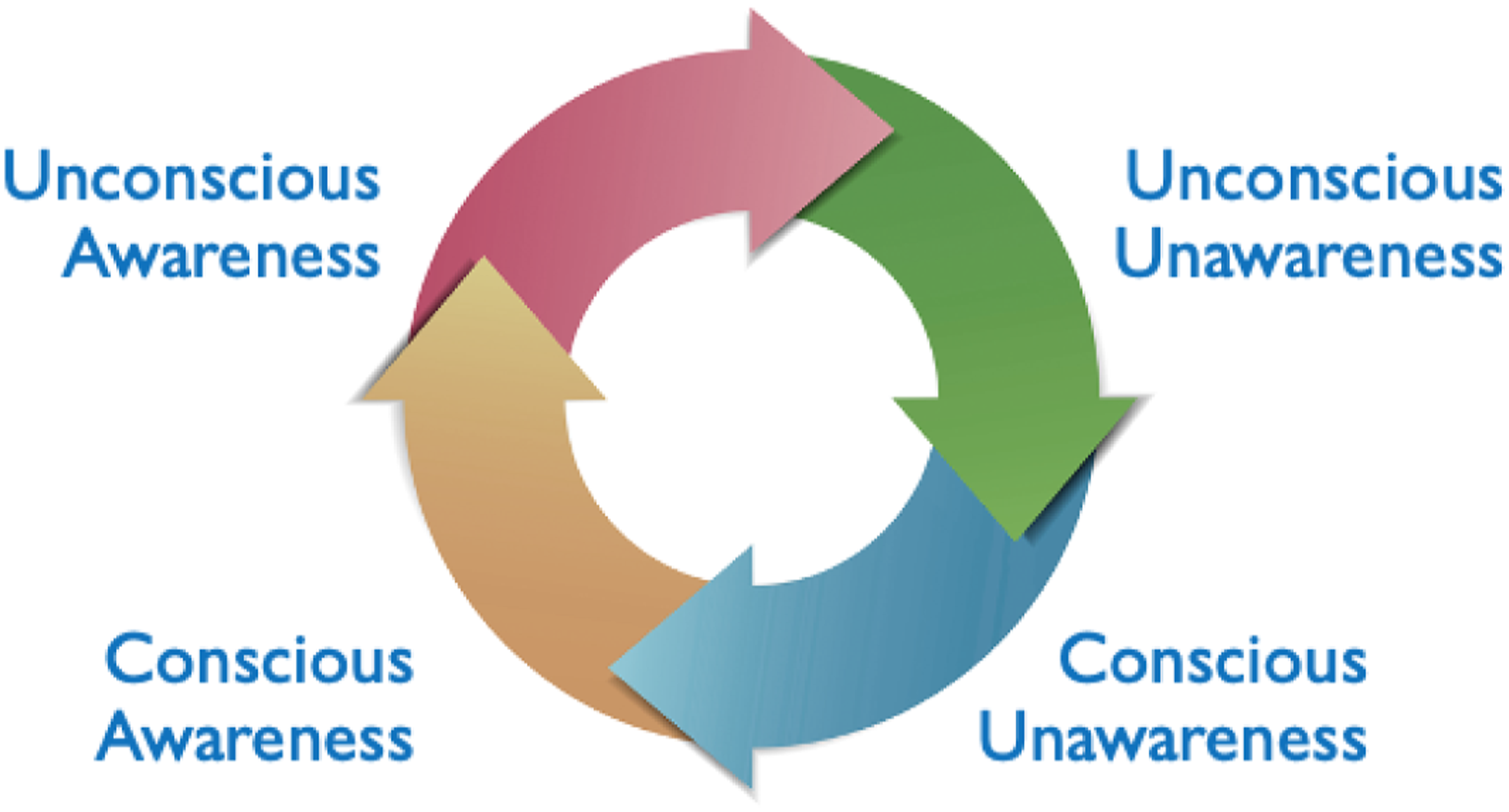
The Cycle of Awareness. 3
The Cycle describes a process by which awareness and competence develops over time. It can be explained in terms of starting a new job. On day one, we are unconsciously unaware of the skills required – we do not know what is entailed in the job. (The infamously stated Rumsfeldian ‘known-knowns’ sentiment could be used as another way to describe the Cycle. 4 ) After a short period, we become consciously unaware – we realise what we don’t know. This is a scary place as the enormity of the task looms. Yet, with practice and experience, we become consciously aware – we come to know what we know, but it takes effort and executing tasks requires considerable concentration. After extensive practice, we become unconsciously aware of the skills required to be competent – we can execute tasks, even complex ones, without significant conscious effort. (Consider learning to ride a bicycle; while the skill seems initially impossible, with practice it becomes so intuitive it is difficult to explain exactly how you do it.)
The Rule of Law and the Cycle
There is a vast range of experience across people who have encountered ‘the Rule of Law’. Some have only read a single headline; others have spent decades building academic careers around the concept. While this article will be most relevant to those between the extremes, even outliers may benefit.
Stating that the Rule of Law is a good thing could be made from a position of unconscious unawareness: there may be no awareness that the concept itself is contested. This is problematic. By recognising that there is a contest, we appreciate that different people hold a different view of the Rule of Law – meaning we may be able to recognise common ground. This is an improvement. Even this simple recognition creates a clockwise movement around the Cycle to conscious unawareness.
Further critical reflection stimulates further movement. By appreciating the nature of the contest, a greater understanding is fostered of the conceptions that delineate the concept of the Rule of Law. Through this nuanced appreciation of the nature of different people’s ideas of the Rule of Law, we can more critically appreciate – and challenge or accept – the concept of the Rule of Law. Movement to conscious awareness results. In stimulating further critical reflection when the concept is deployed, this article may be of most benefit to those of us who are consciously unaware. Through critical consideration, we can be more effective in our use and deployment of the concept of the Rule of Law. (Progression to the fourth segment would be beneficial; but that goal is impossible to achieve in a short article like this as deeper consideration of the conceptions is necessary. Progress of this sort must await another day.)
Is the Rule of Law a good thing?
Everyone is for the Rule of Law; the Rule of Law is something that should be promoted everywhere; the Rule of Law is universally associated with good vibrations. 5 At some level, this idea seems to be true. If, using the broad definition noted above, the Rule of Law means the absence of the exercise of arbitrary power, that seems to be a good thing. Broad acceptance of the basic premise seems likely because people are in the unconscious unawareness segment. The premise does not hold where there is disagreement about what, precisely, the Rule of Law is and about what it means. By exploring conceptions of the Rule of Law, I will demonstrate that there is not agreement on what the Rule of Law is and suggest this means it is not the case that we all agree that the Rule of Law is a good thing. In reasoning our way to this conclusion, we move around the Cycle.
I must first explain the argumentative idea that I start with: if we all accept that the Rule of Law is a good thing, then there must be agreement on what the Rule of Law is. This is based on the basic definition of the Rule of Law outlined above. In circumstances where we may all agree that the prevention of arbitrary exercise of power is a good thing, and if the Rule of Law is against this, then the Rule of Law is a good thing. Here, we would all agree on what the Rule of Law is: it is something against arbitrary exercises of power.
There could be a flaw in this argument – but it is one that does not impact the wider argument I make below. It could be that there are two groups of beliefs: Group A are the anti-arbitrariness Rule of Law people described above; and Group B think that the Rule of Law is, for example, pro-predictable laws, and that is a good thing. Here, there would be a disagreement about what the Rule of Law is, but still agreement that the Rule of Law is a good thing. I account for this difference in the wider argument stated below (in the argument about the Rule of Law being a good thing, but just not the same good thing).
To move around the cycle, and to show we don’t all agree that the Rule of Law is a good thing (or, at least, the same good thing), I must first show that there is not agreement about what the Rule of Law is. To do this, I follow this chain of argument: if there are a number of widely accepted accounts of the Rule of Law, and the widely accepted accounts are all different, then it is not the case that we all agree on what the Rule is; where this is the case, it follows that it is not possible to all agree on the Rule of Law being a good thing (at least, not the same good thing). I explore each in turn.
There are a number of widely accepted accounts of the Rule of Law
If a number of (different) canonical accounts exist, then there are a number of widely accepted accounts of the Rule of Law. When the content and meaning of the Rule of Law are discussed, the same authors are frequently cited. These canonical accounts describe the shape of the concept of the Rule of Law. Notwithstanding any controversy about the specific form of the concept, authors such as Aristotle, Locke, Dicey, Hayek, Fuller, Raz and the UN are well-known. These people have previously been described as the usual suspects of the Rule of Law. 6 (Different jurisdictions often include others. For example, in Australia, Geoffrey de Q Walker or, in the UK, Lord Bingham. 7 ) The frequency of reliance on the usual suspects indicates that the accounts, while not definitive, are canonical, and that there are a number of widely accepted Rule of Law accounts.
The widely accepted accounts are all different
If there are clear differences across the content of canonical accounts, then the widely accepted accounts are all different. Each of the usual suspects’ Rule of Law conceptions are different. To illustrate the differences, I briefly outline their conceptions. While a more detailed exploration would pay dividends, the briefest of considerations suffices to illustrate the differences. (There is a detailed literature that explores the contested, or essentially contested, nature of the Rule of Law as a concept. 8 )
By considering the accounts, I illustrate both that the concept of the Rule of Law is contested as well as the significance of the nature and scope of the differences across the conceptions that are relied upon to illustrate what the Rule of Law is. Thus, we move around the Cycle.
Aristotle
Aristotle is frequently held out as the originator of the Rule of Law. He says things like: ‘The laws should Rule and not man [sic]’ and ‘Man [sic] is governed by the beast.’ 9 His point is, broadly, that we need to have cool heads – especially in legislative decision-making and that law-making is subject to controls (including those imposed by the scope of pre-existing laws).
Locke
Throughout his Two Treatises of Government, but especially in the second treatise, Locke’s Rule of Law-relevant ideas are immediately recognisable due to his use of language synonymous with the concept to this day. Locke’s account of the move from a state of nature constrains the exercise of power by requiring rule to be by ‘established and promulgated laws’, ‘settled standing laws’, ‘declared and received laws’, and ‘stated rules’, and that ‘absolute arbitrary power’ should be avoided. 10 He provides more specific content than Aristotle’s more vaguely stated ideas and gives an account more identifiable as being anti-arbitrariness.
Dicey
Dicey was the first to provide a clear list of ideas that form his Rule of Law conception (and he was the first to give a specific name to the concept). He outlines three facets of the Rule of Law: nobody is above the law; all are equal under the law; and the principles of the constitution result from courts’ decisions. 11 Dicey saw the concept as being significantly under threat from the expansion of the administrative state. The form and reason for his conception clearly distinguishes his account from the accounts that came before.
Hayek
For Hayek, predictability is key. Government actions should be ‘bound by rules fixed and announced beforehand – rules which make it possible to foresee with fair certainty how the authority will use its coercive powers’. 12 Predictability in the laws is essential to avoiding coercion. His ideas (in the 1940s) were motivated by fears of both totalitarian rule and what he saw as the excessive nationalisation of assets. While Hayek’s need for predictability is broadly related to anti-arbitrariness sentiments, they are not necessarily the same; the goals and the function are different.
Fuller
Fuller’s Rule of Law idea is conveyed in the allegory of King Rex. (Unlike Dicey and Hayek, however, Fuller does not adopt the phrase.) Rex fails because he does not appreciate that laws must be: general; public; prospective; intelligible; consistent; practicable; stable; and, congruent. 13 Fuller was the first to provide an extensive list of desiderata that could be associated with the Rule of Law. The list is clear and concise – which, doubtless, has contributed to the popularity of his conception. It is formal and relates to how laws should be made. 14 While there are aspects of commonality with the other conceptions, Fuller’s idea is both broader and more fine-grained.
Raz
Like Fuller, Raz provides a list-based formulation – also with eight desiderata. Raz requires: prospectivity, stability; law-making guided by rules; judicial independence; natural justice; courts’ review powers; accessible courts; and, discretions should not pervert the law. 15 While the list initially covers familiar ground, notable differences arise toward the end; Raz includes ideas that are not seen – directly at least – in other lists.
The UN
The UN’s Rule of Law is not likely to be a usual suspect for everyone. This may be because the UN has not adopted a single meaning of the Rule of Law. It is included here, however, as the UN’s ideas of the Rule of Law have impacted the concept’s global operation. Here, only one UN Rule of Law definition is considered. (This is sufficient for the argument made.) This accepts that all institutions are accountable to laws that are publicly promulgated, equally enforced and independently adjudicated (echoing conceptions outlined above), and also requires adherence to the principles of supremacy of law, equality before the law, accountability to the law, fairness in the application of the law, separation of powers, participation in decision-making, legal certainty, avoidance of arbitrariness and procedural and legal transparency.
16
The UN’s Rule of Law is a substantive idea. It goes beyond the – largely formal – ideas explored so far; the UN sees the Rule of Law as something that can – and should – be deployed to accomplish other things (like the achievement of Human Rights).
The Usual Suspects: Summary
Even on this brief outline, it is clear the accounts are different. An obvious difference exists between the formal/substantive conceptions – procedural ideas (where it does not matter whether the law has a ‘good’ outcome) contrast to substantive ideas (where the idea is to achieve a ‘good’ outcome) – but, there is more to the differences than this. There are also differences in the content of what is included in the conceptions. While ‘predictability’ may be present in one form or another in several conceptions, other factors are not held in common; for example, judicial independence (Raz); the courts as a source of rights (Dicey); or, legislative due process (Aristotle). There are also differences in what they are trying to do: Hayek seeks certainty due to a fear of nationalisation of state assets; Dicey fears for the destruction of the Rule of Law due to the rise of the administrative state; Aristotle sees a danger of allowing the ‘beast’ of human control to reign; and, the UN is trying to facilitate democracy and human rights more broadly. Accordingly, it is clear the canonical accounts represent very different projects.
Trying to invoke these ideas together seems problematic. The context of each account is very different. Not only are they separated by more than two thousand years, but there are some that are borne of revolution and war and some are not; suggesting, for example, Aristotle and Raz are talking about the same precise concept is – for these reasons – problematic.
There are clear differences across canonical accounts that go to the nature and scope of the conceptions. This feeds into the wider argument. Where there are widely accepted accounts of the Rule of Law, and the widely accepted accounts are all different, it is not the case that we all agree on what the Rule of Law is.
We do not all accept that the Rule of Law is a good thing
If it is not the case that we agree on what the Rule of Law is, then it is not the case that we all accept that the Rule of Law is a good thing (at least, not the same good thing). In the introduction I stated an initial argument in different terms. Initially, I put the argument in this – relatively uncontroversial – way: if we all accept that the Rule of Law is a good thing, then there must be agreement on what the Rule of Law is. However, after illustrating – in the previous section – that there is no agreement on what the Rule of Law is, I have reframed the argument to make the conclusion more intuitive: where we do not agree on what the Rule of Law is, it is not the case that we all accept that the Rule of Law is a good thing (at least, not the same good thing).
The brackets that close out the argument are important. As noted briefly earlier, it could be that we all accept the Rule of Law is a good thing – but our view of what is ‘good’ differs. I don’t think that is what happens. It is clear enough that the goods that are being pursued and promoted in the usual suspects’ conceptions are all very different.
Conclusion(s)
By demonstrating that there is a contest between, and a difference in, conceptions that go into defining the concept of the Rule of Law, this means that anyone who was unconsciously unaware of the conflict will have been moved to a conscious unawareness of the contest.
By going beyond merely illustrating that there is an argument and, albeit briefly, by illustrating the differences both in the content of the canonical conceptions as well as in the nature and scope of those ideas, the aim has been to start to understand and appreciate the nature of different people’s ideas of the Rule of Law. Doing so enables us to actively challenge, accept or state, a Rule of Law position more clearly. In this respect, further clockwise movement to conscious awareness can be achieved.
Why is this important? I touched on this in the introduction. I worry that we talk past one another (a lot) whenever we invoke, deploy, read or hear the words ‘the Rule of Law’. Or that the ‘good’-ness together with its concept and its contested nature is used to misdirect. Critical reflection is needed on exactly what is meant by the concept generally and/or by a speaker or writer specifically. Being consciously aware we are better placed to assess deployments of the concept.
The above argument demonstrates not only that canonical accounts are different, but also that our understandings of the meaning of those accounts may differ from others’ is crucial in critical reflection. Accordingly, whenever you or someone else invokes ‘the Rule of Law’, there should be a moment of brief critical consideration to ensure that you both understand what you are talking about and that there isn’t merely an assumption, just because both of you agree that the Rule of Law is a good thing, that you both mean the same good thing.
What does this all mean for the deployment of ‘the Rule of Law’ by the Attorney-General and the Prime Minister? Their prominent positions suggest neither individual should be unconsciously unaware of the debate around the concept’s content. It may even be hoped they are consciously aware of the concept’s contested nature. This is not the place to infer motivations into the concept’s deployment. This is, however, the place to reflect on how the concept’s deployment should be received from our position of conscious awareness.
In critically engaging with the concept’s deployment by both Ministers, the first stage relates to knowing what they meant when they invoked the concept. In the context in which the statements were made, the need for the idea of innocent until proven guilty seems to be inherent in both Ministers’ conception of the Rule of Law. While there have been a number of comments and criticisms of the idea of ‘the Rule of Law’ deployed in the public discourse, critical assessment is vital where reasoned arguments can be provided in support of both sides. 17 In doing this, we may find they hold a very different idea of the concept than we personally hold. While this may be unsurprising given the concept’s contested nature, we avoid talking past one another and, by being consciously aware, we may see beyond – or through – any deployment that merely trades on the universal good-ness of the concept.
Footnotes
Acknowledgments
I am grateful to the anonymous reviewers for their excellent and helpful comments and questions relating to the initial draft of this article.
Declaration of conflicting interests
The author(s) declared no potential conflicts of interest with respect to the research, authorship, and/or publication of this article.
Funding
The author(s) received no financial support for the research, authorship, and/or publication of this article.
1
Christian Porter, ‘Full Statement by Christian Porter Denying Historical Rape Allegation', The Guardian (online, 3 March 2021) https://www.theguardian.com/australia-news/2021/mar/03/full-statement-by-christian-porter-denying-historic-allegation; Jennifer Hewett, ‘Morrison Defends Rule of Law over the Tribe’, The Australian Financial Review (online, 4 March 2021)  .
.
2
Martin Krygier, ‘Four Puzzles About the Rule of Law: Why, What, Where? And Who Cares?’ in James E Fleming (ed), Getting to the Rule of Law (New York University Press, 2011) 64, 64.
3
Adapted from Heather Getha-Taylor et al, ‘Competency Model Design and Assessment: Findings and Future Directions’ (2013) 19(1) Journal of Public Affairs Education 141.
5
These ideas are noted, sometimes with palpable cynicism, by Jeremy Waldron, ‘Legislation and the Rule of Law’ (2007) 1(1) Legisprudence 91, 118; Brian Z Tamanaha, ‘The History and Elements of the Rule of Law’ [2012] Singapore Journal of Legal Studies 232, 232; Jeremy Waldron, ‘Is the Rule of Law an Essentially Contested Concept (in Florida)?’ (2002) 21(2) Law and Philosophy 137, 139; Joseph Raz, ‘The Rule of Law and Its Virtue’ in The Authority of Law: Essays on Law and Morality (Oxford University Press, 2nd ed, 2009) 210, 210.
6
Paul Burgess, ‘You Say It Best When You Say Nothing At All: “[The Rule of Law]”’ (2021) 25(1) Edinburgh Law Review 1, 5.
7
Tom Bingham, The Rule of Law (Allen Lane, 2010); Geoffrey de Q Walker, The Rule of Law: Foundation of Constitutional Democracy (Melbourne University Press, 1988).
8
For a summary of the various positions and debates, see Waldron (2002) (n 5); Paul Burgess, ‘The Rule of Law: Beyond Contestedness’ (2017) 8(3) Jurisprudence 480.
9
Aristotle, The Politics, tr T A Sinclair and Trevor J Saunders (Penguin, 1981) Book III, XI, 1287a.
10
John Locke, Two Treatises of Government, ed Peter Laslett (Cambridge University Press, 1988) II–137.
11
AV Dicey, Introduction to the Study of the Law of the Constitution (Palgrave Macmillan, 10th ed, 1979) 188, 193, 195.
12
Friedrich A von Hayek, The Road to Serfdom, ed Bruce Caldwell (University of Chicago Press, 2007) 112.
13
Lon L Fuller, The Morality of Law (Yale University Press, 1964) 38.
14
Even though Fuller is frequently considered to be a thin or procedural account, law in the way he suggests could be seen as a moral good as it enhances individual dignity or autonomy. Ibid 157–159.
15
Raz (n 5) 210, 214–219.
16
17
See, eg, Geoffrey Watson, ‘Why Christian Porter and Scott Morrison are utterly wrong about the "Rule of Law"’, The New Daily (online, 6 March 2021) . For arguments against and for a potential enquiry’s conformity with the concept of the Rule of Law, see ‘Against Rule of Law to Hold Separate Inquiry into A-G’, Rule of Law Institute of Australia (29 March 2021) https://ruleoflawaustralia.com.au/against-rule-of-law-to-hold-separate-inquiry-into-a-g/; Justice François Kunc, ‘Current Issues’ (2021) 4 Australian Law Journal.