




Abstract
The most common basis for sentence appeals in Victoria is that the original sentence, or some part of it, was manifestly excessive. To date, no empirical research has been undertaken examining the bounds of manifest excess. When is a sentence not just excessive, but manifestly so? This article fills that gap by examining 100 successful manifest excess sentence appeals between 2014 and 2020, finding that the minimum reduction in a manifestly excessive sentence is about 10 per cent, but that even then, such small reductions are rare and usually in the context of sentences of four years or more.
What sentence should be imposed on this offender, for this offending? It is a question judges and magistrates in Victoria (and elsewhere) grapple with daily, and there is never one correct answer. Instead, it is accepted canon that reasonable minds can differ on the appropriate outcome in any given case, and there are therefore a range of sentences that are permissibly open to them in sentencing. 1 If an offender believes the sentence that they received exceeded those bounds, they can appeal. 2 When that appeal is from the County or Supreme Court, the offender must make good one of two arguments to succeed. First, that the judge made a specific and apparent error. Or second, that while it is not apparent that the judge made a specific error, the sentence imposed is so far beyond the permissible range of sentences within which reasonable minds may differ that the judge must clearly not have given proper weight to all the various considerations in the case, 3 with the end result that the sentence is manifestly excessive.
There are a number of oft-asserted principles that govern manifest excess sentence appeals: • sentencing is a discretionary exercise by first instance judges, with appellate courts only intervening if error is established, not simply because they would have imposed a different sentence;
4
• it is a stringent ground, difficult to make good
5
(despite this, it is the most common basis for sentence appeals in Victoria
6
– for instance, it was argued in 81 per cent of offender sentence appeals in 2021);
7
and • the requirement of consistency in sentencing requires consistent application of principle,
8
rather than outcome (however it has recently been observed that this should logically result in at least some level of numerical consistency).
9
It is also often said that a sentence is either manifestly excessive or it is not, and that ‘arguments of manifest excess do not allow for much argument or elaboration’. 10 On its face, this assertion seems to stand in stark contrast to the detailed arguments made by counsel in manifest excess appeals, 11 as well as the extensive reasoning proffered by the Court of Appeal when it finds a sentence manifestly excessive. However, perhaps what is being said here is not that such findings of manifest excess are ineffably incapable of explanation, but instead that the sentence has exceeded the permissible (and fuzzy) bounds of the appropriate sentencing range to the point where it is in a territory where no reasonable minds could disagree. 12 That is, the sentence is not just excessive; it is manifestly so.
Aim and method
With that in mind, our research aimed to identify how much a sentence must stray from the permissible range in order to attract the classification of manifestly excessive. To do so, we identified the minimum numerical and proportional changes made to sentencing orders in Victoria as a result of successful manifest excess sentence appeals. Almost a decade ago, Krasnostein and Freiberg suggested that ‘in a large number of cases, the changes are minor when considered against the jurisprudential adjectives applied to the appellate process in relation to manifest error’ but that ‘until a closer analysis is possible … these conclusions must be tentative at best’. 13 Our research attempts that closer analysis. We examined all 100 sentence appeals from the higher courts 14 in the seven years from 2014 to 2020 in which an offender successfully argued manifest excess 15 and the pre- and post-appeal sentence was a term of imprisonment. 16
For the purpose of this analysis, we identified four different types of sentences which may be challenged as manifestly excessive: • a charge-level sentence; • a cumulation order; • the non-parole period; and/or • the total effective sentence (recognising that this is not technically a ‘sentence’).
17
We then examined the difference between the targeted pre- and post-appeal sentences to investigate the extent to which those sentences were adjusted following a conclusion of manifest excess.
We limited our attention to cases where a sentence of imprisonment was replaced with a new sentence of imprisonment 18 to ensure the difference between the two was quantifiable, as raw numeric comparisons between imprisonment and other sanctions, such as combined orders, suspended sentences, community correction orders, fines or some other sanctions, overlook the intensity of different sanctions and so would not be valid comparisons. 19 We also limited our attention only to the particular sentences within those cases that were expressly deemed to have been manifestly excessive, excluding sentences that were amended either due to specific error 20 or as a necessary consequence of the successful manifest excess argument. 21 There were some cases where we would have inferred from the reasoning that it was only a charge-level sentence or cumulation order that was manifestly excessive, and not the total effective sentence, but in which the court expressly stated that the total effective sentence was (or was also) manifestly excessive. Where this occurred, we treated those cases as a successful challenge to the total effective sentence. 22 As the Court of Appeal has described, the sentencing discretion for the entire case will sometimes need to be reopened even when only a single charge-level sentence is found to be manifestly excessive, because the ‘“omelette” is difficult to “unscramble”’. 23
For each of the 100 cases, we then coded: the sentence type(s) targeted by the successful manifest excess argument, the original and new total effective sentences and non-parole periods (regardless of whether they were specifically targeted), the original and amended charge-level sentences and cumulation orders for each offence subject to a successful manifest excess argument, and a brief description of the basis upon which the court found the targeted sentence(s) manifestly excessive.
Minimum rates of change in successfully appealed sentences
Across the 100 cases we reviewed, there were 285 unique imprisonment sentences successfully appealed as manifestly excessive: 39 total effective sentences (in 39 cases), 24 25 non-parole periods (in 25 cases), 25 150 charge-level sentences (in 76 cases) 26 and 71 cumulation orders (in 30 cases). 27
The smallest proportional changes in any sentence as a result of a finding of manifest excess were: • an 8.3 per cent reduction in a non-parole period (a non-parole period of 6 years was manifestly excessive because it represented 80 per cent of the 7.5-year total effective sentence);
28
• a 10 per cent reduction in a total effective sentence (3 years’ cumulation for recklessly causing serious injury in addition to a 12-year base sentence for manslaughter ‘resulted in a head sentence that is manifestly excessive’, so the court reduced the total effective sentence from 15 to 13.5 years);
29
• a 10 per cent reduction in two charge-level sentences (5 years’ prison for intentionally causing serious injury was reduced to 4.5 years on what seem to be parity grounds but also because the sentence was manifestly excessive,
30
and a 20-year prison sentence was reduced to 18 years because a 20-year prison sentence for an offence ‘within the lowest category of seriousness for … murder’ was inconsistent with current sentencing practices);
31
• an 11.1 per cent reduction in a charge-level sentence (two charge-level sentences for defensive homicide were reduced as manifestly excessive, one from 9 years down to 8 years);
32
• an 11.1 per cent reduction in a cumulation order (for an arson charge, from 9 months down to 8 months);
33
• a 12.5 per cent reduction in a total effective sentence (the same case in which a charge-level sentence for defensive homicide was reduced by 11.1 per cent above);
34
• a 12.5 per cent reduction in two charge-level sentences (in one case, a charge-level sentence for armed robbery was reduced from 4 years to 3.5 years because the original court had not given adequate weight to the offender’s frank admissions and assistance to authorities,
35
and in another case the charge-level sentence for a rape offence was reduced from 8 years to 7 years because the offence occurred as part of a course of conduct);
36
and • a 13.3 per cent reduction in a non-parole period (reducing a 7.5-year non-parole period to 6.5 years, alongside a reduction in the total effective sentence from 10.5 years to 8.5 years, because the sentencing judge had given insufficient weight to mitigatory factors).
37
The smallest numerical changes for each sentence type were: • a 4-month reduction in a 20-month total effective sentence;
38
• a 5-month reduction in a 3-year total effective sentence;
39
• a 6-month reduction in a 6-year non-parole period;
40
• a 10-month reduction in three non-parole periods (2 years, 30 months and 82 months);
41
• a 3-week reduction in two 1-month charge-level sentences;
42
• a 1-month reduction in a 2-month charge-level sentence;
43
and • a 1-month reduction in six cumulation orders of 1 month (2), 2 months (2), 6 months and 9 months.
From these examples, we see that the minimum change is best understood in terms of a percentage reduction, rather than an absolute reduction. Cases such as Younan and McPhee stand at opposite ends of the scale in absolute terms (original sentences of 4 years vs 20 years) but converge to a minimum percentage reduction of 10 per cent to 12.5 per cent. This is unsurprising. While the impact of imprisonment has been said to increase exponentially with length, 44 a proper allowance for a first-instance judge’s discretion must recognise the scale of offending. It would, we suggest, be manifestly unfair if the range were conceived on a raw numerical basis, such as plus or minus 1 year, given this could, for example in relation to a low severity offence, justify a sentence anywhere between 6 months and 2.5 years.
While the focus and purpose of our study was to examine the minimum extent of change where a sentence was found manifestly excessive, we also gathered data on the extent of change across all manifestly excessive sentences within our dataset. Figure 1 shows that proportional reductions of less than 20 per cent were far rarer for cumulation orders (2.8 per cent) and charge-level sentences (10.0 per cent) than they were for non-parole periods (26.1 per cent) and total effective sentences (21.1 per cent). This seems to be because cumulation orders and charge-level sentences are typically shorter than non-parole periods and total effective sentences. For instance, as can also be seen in Figure 1, reductions of less than 20 per cent were rare for sentences shorter than 2 years (1.9 per cent) but became more common among longer sentences: 6.0 per cent (2- to <4-year sentences), 9.8 per cent (4- to <6-year sentences), and then 25.3 per cent (+6-year sentences). In effect, shorter sentences required less absolute change to be declared manifestly excessive (eg a few weeks or a month off a 1- or 2-month sentence). Proportional decrease (%) in manifestly excessive sentences.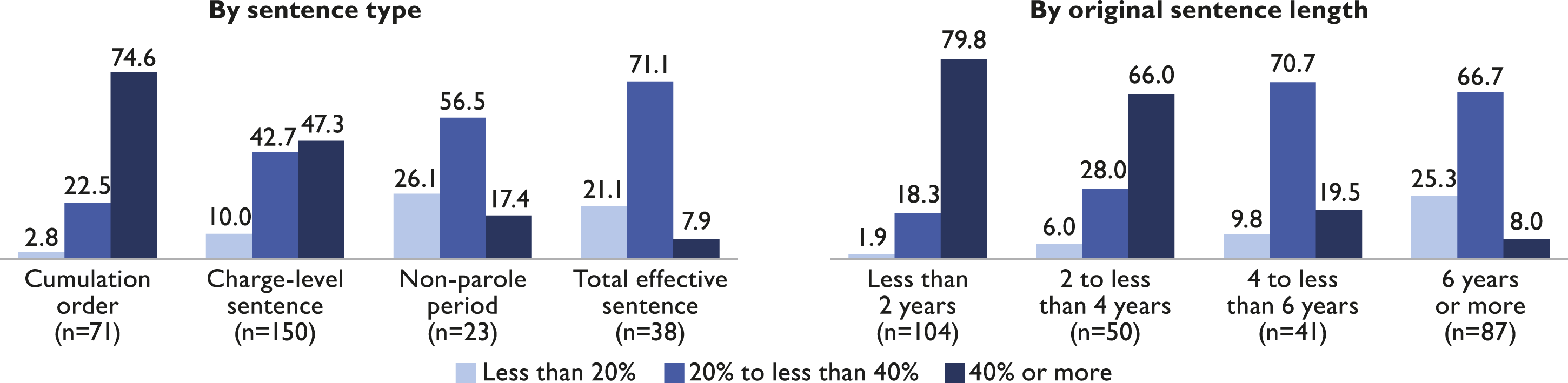
It’s manifestly excessive, but is it ‘tinkering’?
There is, of course, no magic formula for determining when a sentence breaches the elusive boundary of the permissible sentencing range. However, there appears to be a spectrum along which sentences approach a finding of manifest excess. First are sentences that are at ‘the upper end of the range’ 45 (high, but within the permissible scope of discretion), then sentences that are excessive but for which any change would amount to ‘pointless tinkering’ 46 (just outside the permissible scope of discretion), and finally, sentences that are so manifestly excessive as to require rectification (unacceptably beyond the permissible scope of discretion). Precisely when a sentence traverses from one category to the next will be dependent on the context of each case. But the above analysis of 100 successful sentence appeals suggests that (in general) a sentence would need to receive at least a 10 per cent reduction, and even more if the sentence is a short one. For the most part, this seems consistent with the types of sentence changes that the Court of Appeal has described as either amounting to tinkering or not, with 10 per cent being the cut-off in most cases.
The Court has stated the following would amount to tinkering, in the circumstances of each case:
In contrast, the Court has held the following would not amount to tinkering, in the circumstances of each case: • ‘doubling’ a total effective sentence from 1 to 2 years (100 per cent);
50
• increasing a total effective sentence from 6.5 to 7.5 years (15 per cent);
51
• increasing a total effective sentence from 16.5 to 18 years (9 per cent);
52
• reducing a charge-level sentence from 4 to 3 years (25 per cent);
53
and • reducing a non-parole period from 2.5 years to 2 years (20 per cent).
54
There is, though, an unresolved issue about whether tinkering is viewed via the effect of interference on the successfully challenged sentence (which would require a lower threshold for appellate intervention), or from its effect on the total effective sentence as a whole (which would require a higher threshold). For instance, both Bieljok 55 and Young 56 involved a proposed 3-month reduction in a cumulation order. However, this was considered tinkering in Bieljok where it would reduce the total effective sentence from 2.75 years to 2.5 years, but was considered appropriate in Young, despite reducing the total effective sentence from 7.75 years to 7.5 years. It would, of course, be both over-simplistic and contrary to principle to reduce the sentence appeal process to a mere mathematical exercise. 57 However, this example reflects the imprecision that exists in the notion of ‘tinkering’ and the uncertainty around whether it is assessed at an individual sentence level or its effect on the total effective sentence.
Conclusion
To date, there has been no empirical research identifying the boundaries of judicial discretion in sentencing. How much must a sentence stray from the permissible range in order to attract the classification of manifestly excessive, thereby justifying appellate intervention? Or expressed another way, how wide really is the sentencing judge’s discretion? We found that the minimum rate of change required for a declaration of manifest excess is about 10 per cent, but even then, that rate of reduction is rare and typically only available for longer sentences (at least 4 years).
The significance of these findings on the scope of a judge’s discretion is difficult to assess. On one view, they suggest that the window of discretion is quite narrow, possibly as low as 10 per cent. However, what is unknown is where the appellate re-sentencing sits within a wider permissible range. For example, in Younan, the Court of Appeal reduced a sentence for armed robbery from 4 to 3.5 years (12.5 per cent). If the appellate court re-sentences at the top of the range, by implicitly following a principle of least disturbance so that it makes the smallest change necessary to correct the erroneous sentence, then it remains possible that any sentence between, for example, 2.5 to 3.5 years would have been permissible. The other possible view is that appellate courts sentence in the middle of the permissible range once the discretion is re-opened. That would be consistent with appellate statements that an error in the original sentence (including manifest excess) re-opens the sentencing discretion, 58 with the court considering for itself what sentence is appropriate.
Regardless of what these findings ultimately demonstrate about the width of sentencing judges’ discretion, they do suggest that practitioners should be clear about precisely which sentence/s within a case are targeted as manifestly excessive. As the diametric outcomes in Young and Bieljok illustrate, it may well be that targeting a smaller sentence (such as a cumulation order or charge-level sentence), rather than the much longer head sentence in a case, will mean the difference between success or not, particularly given the Court of Appeal’s willingness (in Tran) to acknowledge the lived reality of an extra day, week or month in prison.
Footnotes
Acknowledgment
The views expressed in this article are the views of the authors, and do not necessarily reflect the views of the Victorian Sentencing Advisory Council or the Judicial College of Victoria.
Declaration of conflicting interests
The author(s) declared no potential conflicts of interest with respect to the research, authorship, and/or publication of this article.
Funding
The author(s) received no financial support for the research, authorship, and/or publication of this article.
