



Abstract
Despite evidence of efforts to embed Indigenous cultural competencies in law degrees there is a distinct absence of an instrument to measure a university’s performance. Currently, broad statements are the norm, with a subjective assessment focus. Instead, a tool that objectively measures embeddedness is required. This article raises the concept of a decolonising continuum measure with basic, intermediate and advanced attributes. It embraces the inclusion of Aboriginal and Torres Strait Islander scholarship and the possible risks of poor implementation.
Keywords
My concern for the restoration of cultural self-esteem was triggered by the way my great-grandfather, Mabua, was treated by LMS missionaries. He did not bother to go to Sunday church services so the missionaries sent converts to destroy his gardens. He was told that angels had caused the destruction because he did not attend church. He was one of the last on Mabuiag to convert and when others saw him joining the new system they joined as well. This story was passed on through my family and I was told at my initiation when I was 15 years of age. This story stayed with me and when I saw it in one of the church journals it was written as if in mockery of a powerful chief. From this time on I vowed to promote, preserve and research Islander culture.
E Bani 1
For the first time, in 2020, the Council of Australian Law Deans (CALD) published a set of standards
2
which included a standard for the inclusion of Aboriginal and Torres Strait Islander perspectives in the law school curriculum (‘Aboriginal and Torres Strait Islander standard’). It stated: The Standards have been revised in 2020 to include an additional area of curriculum content. Standard 2.3.3.a now includes a direct statement that the curriculum will seek to develop knowledge and understanding of Aboriginal and Torres Strait Islander perspectives on and intersections with the law. This means that the Law School curriculum should be designed with a view to fostering Indigenous cultural competency, and that the Law School will need to show evidence of this. This inclusion is in part informed by the Behrendt Report (2012), which recommends that universities develop Indigenous cultural competency in staff and students. The Indigenous Cultural Competency for Legal Academics Program (‘ICCLAP’) responds to this in a recent report (Burns et al. 2019), and offers resources that promote the inclusion of Indigenous cultural competency in legal education and that build Indigenous cultural competency among students. Additionally, as raised above, Universities Australia has been instrumental in ensuring Aboriginal and Torres Strait Islander content becomes part of the law curriculum.
3
In discussing this landmark inclusion in the CALD standards, this article reflects, first, on the standard in the broader common law context. Secondly, it situates the Aboriginal and Torres Strait Islander standard in the longer, historical view of the phenomenon of embedding Aboriginal and Torres Strait Islander perspectives into law school curricula. Thirdly, it argues the need for a measure for law school performance against the Aboriginal and Torres Strait Islander standard. Fourth, it proposes a decolonising continuum as a potential measure which reflects Aboriginal and Torres Strait Islander scholarship in this space. Finally, it draws attention to the possible risks to Aboriginal and Torres Strait Islander people as a possible consequence of law schools poorly implementing this CALD standard.
A common law reality check
‘Decolonised law degrees’ is a misnomer. A common-law law degree in Australia can never become decolonised. His Honour, Brennan J was unequivocal in his view when he wrote in Mabo v Queensland (No 2)
4
(Mabo) that: [i]n discharging its duty to declare the common law of Australia, this Court is not free to adopt rules that accord with contemporary notions of justice and human rights if their adoption would fracture the skeleton of principle which gives the body of our law its shape and internal consistency. Australian law is not only the historical successor of, but is an organic development from, the law of England.
5
Since the Mabo 6 decision, several Aboriginal and Torres Strait Islander scholars 7 have led a discourse that articulates the legal reality of seeking to decolonise the Australian common law system in the law school context. Universally, it is recognised that there is importance in teaching ‘decolonised’ perspectives in the law school curriculum because of the role future law graduates will play as lawyers, judges and makers of government policy. Nicole Watson has argued that there is a ‘profound obligation to ensure that the future profession can accommodate the legal needs of our entire society, including Indigenous communities’. 8 Marcelle Burns has highlighted the critical importance of Indigenous cultural competency in law school curricula ‘to both support Indigenous student success and to ensure that future legal professionals are able to provide culturally sensitive legal services for First Peoples’. 9
However, against this backdrop of positive recognition of the imperative for law graduates to possess a ‘knowledge and understanding of Aboriginal and Torres Strait Islander perspectives on and intersections with the law’ 10 and ‘Indigenous cultural competency’, 11 is a sharp awareness that the architecture of the common law in Australia stands fixed. Aboriginal and Torres Strait Islander scholars know that routinely and predictably, when met with Aboriginal and Torres Strait Islander claims for equality or sovereignty, the common law’s denial is flat, dispassionate and ‘right’. 12
Irene Watson has contended that ‘before Mabo, most people knew justice had been denied to our peoples, now post-Mabo most people believe we have gained justice. … It is this un-truth we need to engage with critically in both our studies and teachings of the law.’ 13 Nicole Watson expressed the view of the traditional law degree curriculum and its delivery in law schools as ‘fermented racism’. 14 Marcelle Burns has written that ‘the most common form of discrimination in law school settings was disrespect’. 15 This was characterised by Burns as the ‘inability to properly engage with forms of Indigenous knowledge and perspectives as they relate to the disciplinary and professional context’. 16 With such realities in the common law and law schools, the imperative for a measure for the Aboriginal and Torres Strait Islander standard becomes profound.
Ad hoc embedding phenomenon
Albeit that the Aboriginal and Torres Strait Islander standard is a recent inclusion in the CALD standards, the experience of embedding Aboriginal and Torres Strait Islander perspectives into law school curricula is not. It is an experience had by many if not all Aboriginal and Torres Strait Islander law academics at one time or another in their careers. Aboriginal and Torres Strait Islander Elders have generally also been part of this experience. For at least the past two decades, law schools and universities more generally have been seeking to have their graduates leave with ‘knowledge and understanding of Aboriginal and Torres Strait Islander perspectives on and intersections with the law’ 17 and ‘Indigenous cultural competency’. 18 As a Torres Strait Islander academic, I have been involved in three separate projects embedding Aboriginal and Torres Strait Islander perspectives in the law school/faculty curricula at three different Australian universities over the last 20 years.
Reflecting on the embedding Aboriginal and Torres Strait Islander perspectives phenomena, my experience points to a measure as a fundamental gap. There has been an absence of an assessment tool which allows for the objective assessment and measurement of ‘embeddedness’. 19 With variability and subjectivity in the meaning of ‘embeddedness’, there has been a tendency to ‘perform’ assessments of ‘embeddedness’ as part of a report against the university’s Reconciliation Action Plan (RAP), an Aboriginal and Torres Strait Islander employment strategy, an Aboriginal and Torres Strait Islander student retention program, a general law school curriculum review or the like. Assessments of ‘embeddedness’ performed under such conditions are destined to be ad hoc in nature, with vague connections between inputs and outcomes.
Honest assessments against the Aboriginal and Torres Strait Islander standard are needed. A measure is one way to challenge honesty. Guidance from the revised CALD standards on the way this might be achieved is unfortunately limited, as it states fairly broadly that law schools will need ‘to demonstrate how [the] curriculum addresses each of the TLOs [threshold learning outcomes] and each of the elements of the requirements’ 20 and that this demonstration ‘will ideally take the form of a curriculum map or spreadsheet’. 21 Noting the reflections of leading Aboriginal and Torres Strait Islander scholars in this space, a measure that contains both objective and subjective elements (not only subjective, as has traditionally been the case) is essential to ensure transparency of effort, robust engagement, and meaningful fulfilment of the standard. As Borrows observed, the reference point for inclusion and embedding must be an ‘Indigenous’ one. 22
Significantly, and despite the time, effort and money spent by law schools on Aboriginal and Torres Strait Islander perspective embedding processes, it is hard to know whether such processes, over time, have left a lasting imprint on the law school curriculum or whether their impact has faded. Asmi Wood and Nicole Watson have observed that, even with the passage of time and an increased participation of Aboriginal and Torres Strait Islander students and academics in law schools, ‘[c]ultural change within law school […] remains elusive’. 23 Observations such as this by experienced Aboriginal and Torres Strait Islander scholars (who have practised law) makes the presence of a measure even more critical. Greater accountability becomes imperative.
The decolonising continuum
The decolonising continuum is inspired by the work of Karen Martin who developed a model of embedding Aboriginal and Torres Strait Islander perspectives in curriculum in the university context in the discipline of education. 24 It sets up basic, intermediate and advanced levels in the inclusion of Aboriginal and Torres Strait Islander perspectives. As a measure with different levels, it promotes the continued deepening and widening of knowledge and understanding and competency of Aboriginal and Torres Strait Islander perspectives. Adapted here as a decolonising continuum, it encourages law schools to benchmark their efforts and chart their growth (or stagnation) over time. Decolonising the law school curriculum thus is an ongoing process and not an end point.
As a measure, adopting a decolonising continuum facilitates accountability. It can act as an ‘objective’ measure not only for determining law school performance against the Aboriginal and Torres Strait Islander standard but the standard together with the decolonising continuum creates the possibility for comparative analysis across law schools. Currently, there is no means by which CALD member institutions or law school stakeholders such as students and the legal profession can objectively assess or measure a law school’s performance against its CALD peers on the inclusion of Aboriginal and Torres Strait Islander perspectives or the Aboriginal and Torres Strait Islander standard.
Figure 1, following, is my proposed decolonising continuum measure, devised based on decades of professional, legal and academic experience and a lifetime of being a Torres Strait Islander. Operating from left to right it identifies attributes of law school curriculum which reflect basic, intermediate and advanced levels of Aboriginal and Torres Strait Islander perspectives. Under each of the column headings – ‘Basic’, ‘Intermediate’ and ‘Advanced’ – are attributes which correspond to that level on the decolonising continuum. It is these attributes that can differentiate between the levels of Aboriginal and Torres Strait Islander perspectives included in law school curriculum. The attributes perform the function of the objective measure. Decolonising continuum.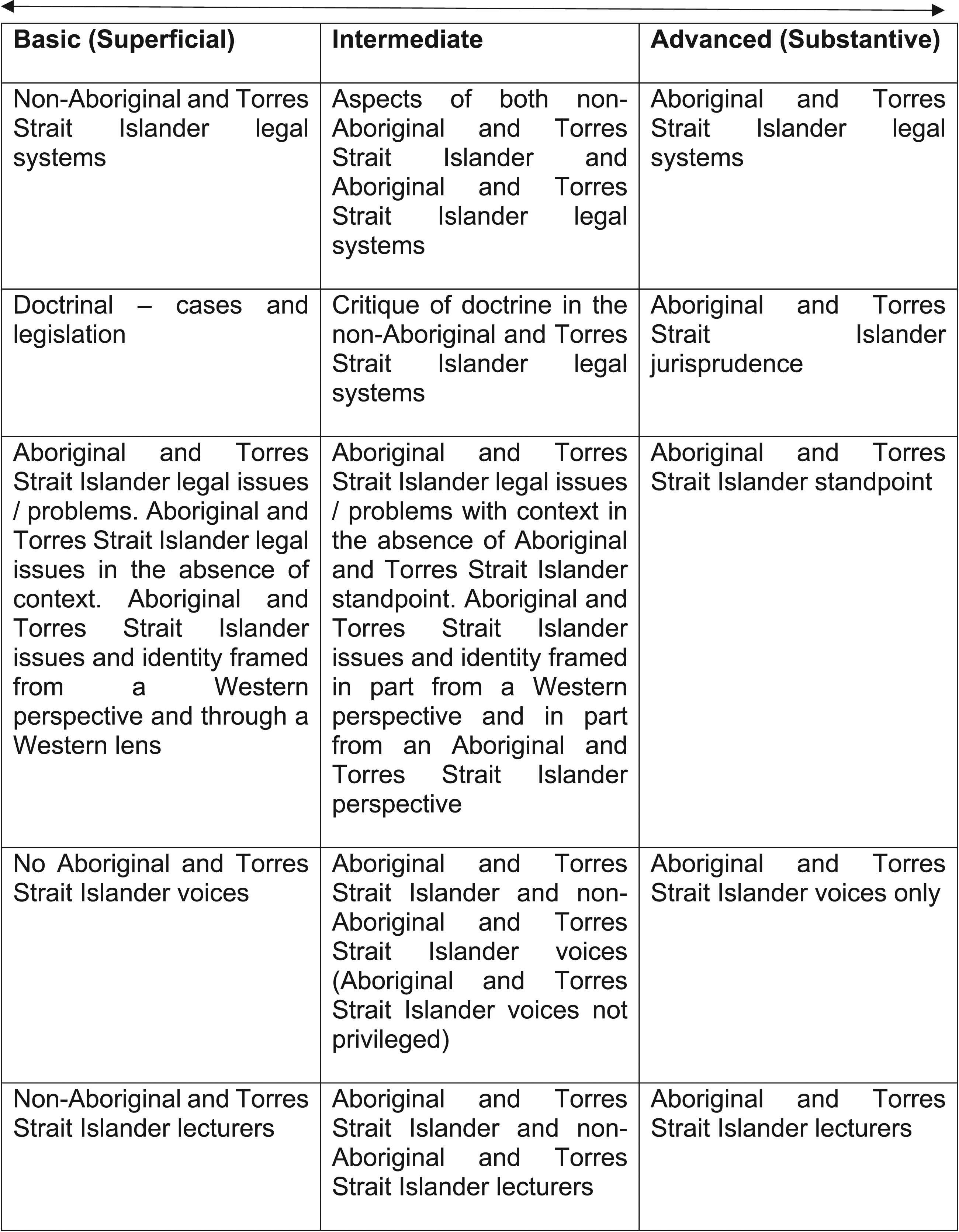
Caveats
This measure is intended for use in assessing law school curricula against the Aboriginal and Torres Strait Islander standard. It is about performance and accountability. It is not intended to be a theoretical framework by which to interrogate the Australian common law. It is not intended to be a lens through which to critique legal theory. Rather, it is a measure for benchmarking and reporting against the standard on the inclusion of Aboriginal and Torres Strait Islander perspectives in the law school curricula. It is a way to ask questions.
The decolonising continuum measure is also not a comprehensive pedagogical tool. Research on using and applying non-traditional methods of teaching Aboriginal and Torres Strait Islander perspectives is readily available in the literature. 25 Scholars in Australia and internationally have published widely on such methods providing advice, insights and examples about the use of ‘non-traditional’ methods such as storytelling, 26 art, circle discussions, self-analysis and reflection. 27 Appropriate use of pedagogical tools are not merely a means of addressing the challenge of ‘translation’. Rather they are a non-negotiable requirement if Aboriginal and Torres Strait Islander perspectives are to be brought into law school curricula in a way that is respectful and enduring.
In one sense, the easy part is identifying the Aboriginal and Torres Strait Islander perspectives to be included and the appropriate Aboriginal and Torres Strait Islander pedagogical tools required. Aboriginal and Torres Strait Islander knowledge holders are ready, willing and able to engage with law schools to operationalise the CALD standards. Universities and law schools, however, in reporting against the CALD standards (as they are required to, as part of their operational activities) must, consistent with the standards, do so ethically. 28 Any engagement with Aboriginal and Torres Strait Islander knowledge holders must be remunerated. Expecting Aboriginal and Torres Strait Islander knowledge holders to act in a voluntary capacity, to do the work of law schools and universities in meeting the CALD standards, is disrespectful, discriminatory and exploitative. Managing the unequal relationship between the CALD standards, law schools and Aboriginal and Torres Strait Islander people is but one risk.
Risks to Aboriginal and Torres Strait Islander people
Decolonising the law degree curriculum is not without risks. At least two key challenges arise in seeking to include Aboriginal and Torres Strait Islander perspectives into universities as Western institutions. One, there is the risk of the assimilation, appropriation and distortion of Aboriginal and Torres Strait Islander perspectives, when situated in the law school setting. Irene Watson writes about such distortions as a consequence of ‘a construct which is best understood from a western euro-centric viewpoint’. 29 Anker (a non-Indigenous law academic) has observed that universities seeking to teach Indigenous perspectives ‘will always have to confront the issue of translation’ 30 including actively questioning ‘who is doing it, how, and for what purposes’. 31 Two, there are concerns about adequate resourcing in light of the rise of managerialism in universities with its attendant cost-cutting measures. 32 Nevertheless, law schools must invest the necessary resources if an assimilationist outcome is to be avoided.
Law schools must also foster self-awareness and move forward carefully and respectfully in order to better understand Aboriginal and Torres Strait Islander perspectives, and to act without harm or detriment. 33 Christie writes about the risk that removing aspects of Indigenous knowledge such as stories from the Indigenous community context and teaching them within a Western law school setting, can result in an over-intellectualisation of Indigenous knowledge resources. 34 Martin Nakata has described the contested space between the Aboriginal and Torres Strait Islander and non-Aboriginal and Torres Strait Islander knowledge systems as a ‘cultural interface’. 35 He has similarly argued that unless universities address the difficulties of translation, they risk simplifying Aboriginal and Torres Strait Islander knowledge and entrenching its subordination as an inferior tradition. 36
Concluding remarks
Reporting mechanisms and standards provide quality assurance and accountability. This is the very rationale for the CALD standards. However, the absence of a measure in respect of the recently introduced Aboriginal and Torres Strait Islander standard is a gap that must be filled if its implementation is to be meaningful. The goal of the decolonising continuum measure proposed in this article is truth and honesty. Honesty requires accountability of performance (avoiding ‘tick and flick’ exercises) and acknowledges that, where there is genuine apprehension about addressing the Aboriginal and Torres Strait Islander standard, even a limited level of knowledge, understanding and competency counts, can be measured, and creates a benchmark. Without robust honesty the Aboriginal and Torres Strait Islander standard becomes tokenistic, performative, and ineffectual.
Footnotes
Declaration of conflicting interests
The author(s) declared no potential conflicts of interest with respect to the research, authorship, and/or publication of this article.
Funding
The author(s) received no financial support for the research, authorship, and/or publication of this article.
