



Abstract
Despite a series of education programs and initiatives, mental health stigma persists across the community. This is due, in part, to the law’s silence on whether mental health stigma should be considered vilification. This article analyses current Australian anti-discrimination and anti-vilification protections, finding that the latter needs enhancing to include protections against mental health vilification.
In February 2022, a series of private texts from a Commonwealth government Cabinet Minister were leaked, describing then Prime Minister, Scott Morrison, as a ‘complete psycho’. 1 This leak precipitated the use of ‘psycho’ as a pejorative term for Morrison, with the hashtag #ScottyTheCompletePsycho trending in online Australian politics discussions. 2 That the term ‘psycho’ remains a common phrase to insult the integrity, character and predictability of someone is revealing about the operation of mental health stigma in our community. Ultimately, the uncritical and stigmatising use of the term in the media was criticised by key mental health anti-stigma organisations. 3
Despite common discussions of stigma – the shaming or marginalisation of people based on a protected attribute – the law has a confused relation to it. On the one hand, stigma often overlaps with, or leads to, discrimination, which refers to unfavourable treatment (such as decisions) based on that attribute. The law regulates this conduct through discrimination and equal opportunity law. 4 On the other hand, the law is generally silent on whether the shaming or use of derogatory terms alone should be regulated or eliminated. In most jurisdictions there are vilification protections against conduct that causes harm, or which incites ridicule, disgust or contempt for individuals and communities based on race, 5 religion, 6 sexuality, gender identity 7 and other attributes. Cullen Mandikos and Vario called for protections against disability-based vilification 12 years go. 8 However, despite these calls, only three Australian jurisdictions protect people against conduct that is disability-based vilification, which extends to people with mental health issues. 9
This article reiterates the call for existing vilification protections to be extended to people who identify with, or are labelled as having, mental health issues. The article begins by outlining the nature and prevalence of mental health stigma in the Australian community. Next it provides an overview of anti-vilification laws in Australia, noting their strengths and limitations. Following this, it illustrates that – although there are notable exceptions in Tasmania and, to a lesser extent, the Australian Capital Territory (ACT) and at the Commonwealth level – most Australian jurisdictions have inadequate legal protections against mental health vilification. Finally, the article puts forward the central argument for implementing mental health-specific anti-vilification laws. These proposed laws should draw on the legal test in Tasmania, be based on consultation with people with lived experience, and form part of a range of educative and systemic interventions to eliminate stigma and vilification.
The nature, prevalence and impact of mental health stigma (or vilification)
Mental health stigma is difficult to understand and measure because the term remains unclear. This is in part because researchers use differing definitions of stigma, and also because stigma often overlaps or is confused with discrimination. 10 Discussing stigma within the context of law is further complicated by the fact that anti-discrimination and anti-vilification laws deal with complex and overlapping phenomena. 11
While there are many definitions, 12 Livingston describes stigma ‘as a social process that excludes, shames, rejects and devalues groups of people based on particular characteristic’. 13 Examined at the level of the individual, stigma has cognitive (thoughts), affective (feelings) and behavioural (actions) manifestations or dimensions. 14 These behavioural features – such as statements or imputations that devalue a person based on stereotypes – are phenomena that may invite legal regulation, while cognitive and affective features would not. These behavioural expressions of stigma – statements and imputations – therefore may constitute what is termed ‘vilification’. Vilification refers to conduct that causes harm to, or incites others to develop feelings of hatred against, an individual or group protected by law (see Table 2).
Mental health stigma and associated discrimination is widespread. In 2020, Sane Australia released the Our turn to speak report, 15 revealing mental health stigma and discrimination against people diagnosed with ‘complex mental health issues’ 16 across virtually all areas of public life in Australia. For example, 95.6 per cent of participants stated that they had experienced some level of stigma or discrimination in their relationships, 17 78.1 per cent reported that they had experienced this in employment within the past year, 18 while 84.6 per cent reported that they had experienced it on social media in the past year. 19
There are many examples of the behavioural dimensions of stigma. A commonly cited issue is that people are ‘blamed’ for their mental health issues. 20 However, examples of stigma are much broader than this. Seemingly neutral language such as mental health diagnoses can become stigmatising if used to discredit a person or their views. 21 For many, psychiatric classifications themselves are stigmatising and othering, 22 with strong evidence suggesting that biological explanations of distress increase rather than reduce stigma. 23 The way that difficult topics are discussed, and whether people with lived experience are included in those discussions, matters too. A recent Royal Commission raised concerns that the Australian Broadcasting Corporation had produced a Four Corners report on the purported links between mental health and violence, without interviewing a single person with lived experience, is a poignant example of stigma and discrimination. 24 There were subsequent warnings from mental health stigma organisations around responsible reporting on these topics. 25 In other settings discussing women’s issues, such approaches would be described as ‘manels’, that devalued the expertise and knowledge of women. 26 Other examples may be the tendency to characterise people with lived experience who are critical of the mental health system as Scientologists. This claim tends to discredit and stigmatise people who raise concerns about their human rights while using the mental health system, yet is still published in mainstream media. 27 The extent to which these examples of stigma will fall within the scope of anti-vilification laws rests in part on the legal tests used.
The impacts of stigma are profound. The emotional consequences are obvious to infer, with stigma being associated with anxiety and worsening mental health. 28 Legal services see how stigma intersects with, and worsens, other forms of disadvantage such as homelessness, poor education, social isolation and physical health. 29 More broadly, stigma drives individuals into the shadows, as they no longer feel safe to participate in public life. 30 Given the breadth of stigma across areas of public life, as well as the impact it has on individuals, there are questions about whether the law could better regulate or eliminate it through anti-vilification laws.
Australia’s anti-vilification framework(s)
Civil vilification protections by jurisdiction.
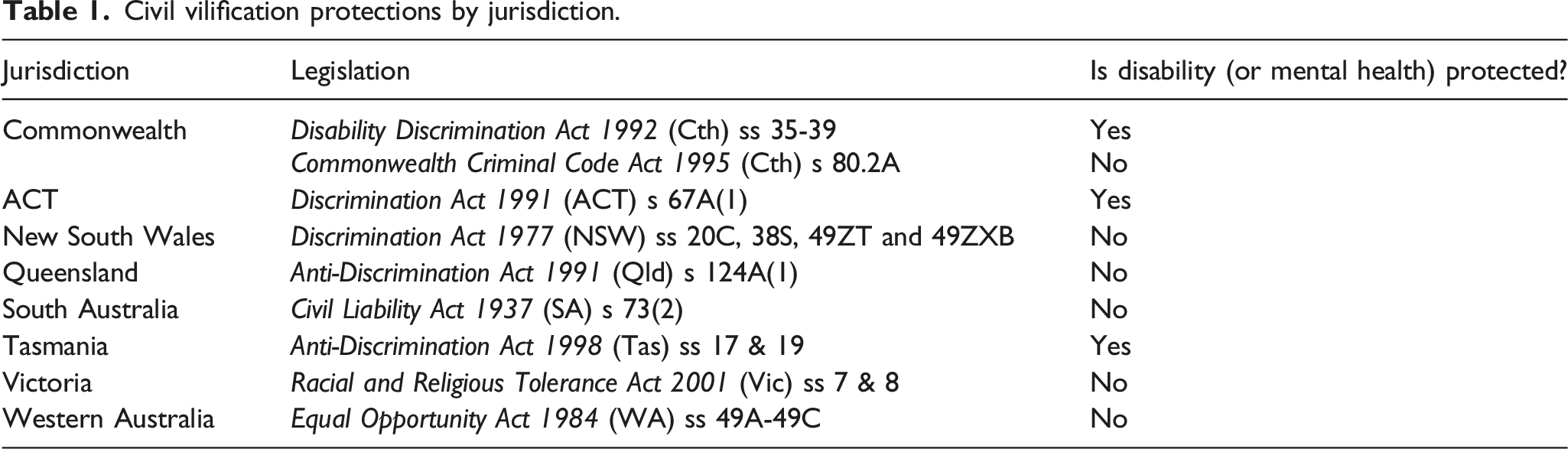
There are significant differences among these anti-vilification provisions, particularly regarding what kinds of conduct are unlawful. Two main distinctions between legal tests are ‘incitement’ and ‘harm’ based tests. For example, Victoria’s legislation, which protects against racial and religious vilification, uses an incitement test that requires a person must not ‘engage in conduct that incites hatred against, serious contempt for, or revulsion or severe ridicule of, that other person or class of persons’. 35 By contrast, section 17 of Tasmania’s Anti-Discrimination Act 1998 (Tas) contains a harm-based test that regulates conduct against various groups which ‘offends, humiliates, intimidates, insults or ridicules’ a person from that group or the group. 36 Although at times contentious in political debates, 37 the harm-based tests have been preferred by some recent inquiries and experts as being more focused and responsive to the harms experienced by complainants. 38
Irrespective of the test, anti-vilification protections usually retain a series of exceptions that make certain conduct lawful if it is fair reporting of a public act, is subject to absolute privilege or done in good faith for academic, artistic or research purposes, or in the public interest. 39 Practically, these protections are likely to relate to good-faith journalism. 40 In contrast to criminal provisions that place the duty on the State to pursue action, civil vilification protections rely on victims to pursue action, either through a complaint to a relevant regulatory body such as the Australian Human Rights Commission (AHRC) or the Victorian Equal Opportunity and Human Rights Commission, or through the Federal Court or a relevant state or territory tribunal.
These laws have received mixed evaluations regarding their effectiveness. Proponents of anti-vilification protections claim that they carry moral or symbolic force, highlighting the conduct or speech that the community does not accept. 41 Vilification provisions have also provided redress, such as the 50 per cent of around 7000 matters that were successfully conciliated by the AHRC between 2013–14 and 2017–18, with outcomes including apologies, monetary settlements and systemic responses to discrimination. 42 Moreover, evidence suggests there is some reduction in the number of examples of vilification in news outlets following the introduction of anti-vilification laws – although there was less evidence that it reduced vilification in the broader community. 43
While there are benefits to these laws, they are by no means a single-step solution to addressing vilification. A central criticism focuses on the significant enforcement burden placed on the individuals who have already experienced harm and discrimination. 44 This enforcement burden can become more onerous when the thresholds for determining vilification – such as those occurring in Victoria – are unnecessarily high, meaning few cases are successful and many potential complainants are deterred from pursuing justice. 45 Broader criticisms of anti-discrimination laws – which operate in many similar respects to anti-vilification laws through complaints-based and civil redress pathways – find that they fail to address the underlying power relations which give rise to discrimination. 46
There are moves to address these shortcomings. Some recommendations have suggested that greater information and education should be provided to the community on vilification, including what conduct is lawful or unlawful. 47 Other recommendations, aimed at reducing the enforcement burden on harmed individuals, have suggested that complaints bodies need enhanced regulatory powers 48 and access to better data on vilification to address it systemically. 49 Whatever the imperfections of these laws or their dependence on broader non-legal or systemic efforts, they have communicated the moral value of, and provided varying degrees of redress to, individuals who have been harmed. Unfortunately, very few of these laws extend to people experiencing the behavioural dimensions of mental health stigma.
Mental health stigma and anti-vilification laws
At present, the law has had minimal direct engagement with mental health stigma. Part of the reason for this may be due to ongoing confusion on the core concepts of mental health stigma, mental health discrimination and mental health vilification. First, some conceptions of mental health stigma see it as primarily an attitudinal issue, while this article uses definitions of stigma that also include the behaviour or conduct that accompanies those attitudes. This means calls to legally regulate (the behavioural components of) stigma could be misunderstood as regulating thoughts and beliefs, when in fact it aims to regulate behaviours. Secondly, some behaviours that arise from those attitudes will be discrimination rather than vilification, such as decisions or policies that unfairly disadvantage people with mental health issues. Thirdly, some behaviours may constitute both mental health discrimination (decisions, rules, or policies) and mental health vilification (statements or imputations). However, in the absence of laws to deal with mental health vilification, these third set of phenomena remain unregulated when they would be regulated for other protected attributes.
Differentiating stigma, discrimination and vilification.

A parallel example of racism may assist in elucidating these issues. Racism is a broad social phenomenon. From a legal perspective, some forms of racism constitute racial vilification (statements and imputations), whereas some forms of racism constitute discrimination (unfair treatment). Similarly, the mental health vilification (statements and imputations) is distinguishable from mental health discrimination (unfair treatment). The relationship between these phenomena is reflected in Figure 1. Highlighting the relationship between stigma, discrimination and vilification.
This article argues that some forms of mental health stigma should constitute mental health vilification (statements and imputations) from a legal perspective, whereas some forms of mental health stigma already constitute discrimination (unfair treatment). 54
At present, there are insufficient vilification protections across Australian jurisdictions. As highlighted in Table 1, all Australian states and territories – bar the Northern Territory – contain civil vilification protections. However, only Tasmanian law, and to a lesser extent the ACT and Commonwealth laws, provide vilification protections for people with a disability, and by extension people with mental health issues.
The limited Commonwealth protections are found in the Disability Discrimination Act 1992 (Cth), which makes it unlawful to ‘harass’ a person with a disability in areas of public life. 55 However, there is no available case law on this to illustrate how this has been applied. It is unclear whether ‘harassment’, which is undefined in the legislation, would reflect the at times episodic nature of stigma, such as the use of the term ‘psycho’, being described as violent, or being discredited because of a mental health diagnosis. Because the test focuses on ‘harassment’, it is also unlikely to capture harms that occur when mental health terms are used to denigrate a third party. The lack of case law on this as it applies to mental health suggests that it has not been utilised by people with lived experience.
The ACT also makes it unlawful to ‘incite hatred, revulsion of, serious contempt for, or severe ridicule of’ people with a disability (including mental health). 56 However, such incitement tests have already been criticised. First, they lack a focus on the harms experienced by victims by instead focusing on whether a person’s conduct would incite hate from an observing third party. 57 Second, and in connection with the first, such standards have proven difficult to establish in courts, meaning the standard of protection is low. 58 Like current incitement tests, they risk placing the threshold for establishing unlawful conduct so high as to provide minimal real-world protection.
Tasmania’s anti-discrimination laws provide an alternative. These laws are similar to s 18C of the Racial Discrimination Act 1975 (Cth), in that they focus on the harm to the victim. Section 17 of the Anti-Discrimination Act 1998 (Tas) (‘ADA’) states that: A person must not engage in any conduct which offends, humiliates, intimidates, insults or ridicules another person on the basis of an attribute [including disability] in circumstances in which a reasonable person, having regard to all of the circumstances, would have anticipated that the other person would be offended, humiliated, intimidated or insulted.
The test is similar to that set out in s 18C of the Racial Discrimination Act 1975 (Cth), although with some differences. The reasonable-person test risks being narrower in s 17 by not requiring harm to be assessed from the vantage point of a reasonable person within the affected group as occurs in s 18C. 59 This means that the assessment of harm in s 17 would come from a reasonable person within the general community, 60 while the assessment of harm in s 18C would be from a reasonable person within the affected community or group. Given the nuanced nature of mental health stigma – such as the ostensibly neutral use of mental health diagnoses to discredit someone – it is crucial that those who have experienced mental health stigma (or are at greater likelihood because of a mental health diagnosis) are positioned as the vantage point from which a reasonable person is drawn. Doing so will ensure that the law captures harms as they impact those with lived experience.
Such a test would likely provide greater protection for individuals experiencing the behavioural components of mental health stigma. Although the case law is limited, the state regulator of the ADA has indicated that it protects people against a wide range of disability-based vilification, including bullying at school. 61 Conduct that would be reasonably likely to offend, humiliate, intimidate, insult or ridicule a reasonable person from the mental health lived experience community would be considered unlawful if no exemptions applied. Like previous s 18C matters, 62 panels with no representation of people with lived experience, and which denigrate people with lived experience in their discussions, may be considered unlawful. Using a person’s mental health diagnosis as a means of disparaging them or denigrating their concerns may be another example of unlawful conduct under such a test. 63 Similarly, the use of colloquial terms such as ‘psycho’ 64 – although often not targeted at people with mental health issues 65 – would very likely fall foul of the law. 66
Bringing in anti-vilification protections for people with mental health issues
Australians experiencing mental health stigma warrant greater legal protection. At present, there is minimal reflection of the community’s disapproval for mental health stigma in law, meaning it is out of step with other laws against racial or religious vilification that reflect similar community disapproval. This is particularly important in jurisdictions which hold that all people – including those with mental health issues – should enjoy equal protection from the law. 67 At present, there are also limited pathways for legal redress for the harms caused by mental health stigma, and few mechanisms to drive improved media discussions of mental health. 68 Embedding anti-vilification protections for people with mental health issues will in part address these issues, as well as enable states to fulfill their obligations under the Convention on the Rights of Persons with Disabilities (CRPD). 69
An amended version of existing harm-based vilification tests would address this. Section 17 of the ADA provides a starting point, although it should be clarified so that the assessment of harm comes from a reasonable person from within the mental health lived experience community. A harm-based test of this nature is preferable to incitement tests, given their limited efficacy, 70 and the Commonwealth harassment protections, given their limited scope and uptake.
Such harm-based protections should capture or extend to people with mental health issues via a disability attribute or a stand-alone mental health attribute. One reason for making a separate attribute for mental health may be to give visibility to these protections, as some human rights agencies have queried whether people with lived experience identify as having a disability, meaning they may not conceive of themselves as enjoying protection. 71 In either case, the development and definition of such attributes should be drafted in close consultation with people that have lived experience of mental health issues. This involvement of people with lived experience is both an obligation under the CRPD 72 and an opportunity. The opportunity is to ensure that any terms drafted in law best reflect the diverse ways in which people understand their mental and emotional distress 73 and avoid the use of terms that may themselves be stigmatising.
While anti-vilification provisions may enable formal equality for people with mental health issues, more will be needed to ensure substantive enjoyment of these rights and a change in community attitudes. Several measures can address this. People with lived experience should co-design and lead anti-vilification programs, as has been recommended elsewhere regarding anti-stigma programs. 74 Part of this should focus on legal information about duties and rights regarding vilification, and the nuanced ways in which language and conduct may cause harm. 75 The enforcement burden should not just sit with individual complainants but be shared with regulatory agencies with appropriate systemic powers to drive cultural change. The introduction of a new regulator in Victoria with public inquiry powers and a focus on mental health stigma provides one such example. 76
Conclusion
Several Australian jurisdictions are working hard to address stigma. For example, the National Mental Health Commission is leading the development and implementation of the National Stigma and Discrimination Reduction Strategy, as recommended by the Productivity Commission. 77 Victoria’s Royal Commission has also made a recommendation to establish community-led approaches to stigma reduction and to evaluate existing anti-stigma programs. 78 To succeed where past stigma campaigns failed requires a more robust approach: one that responds with legislative protections.
This article contends that mental health stigma and vilification continue in part because there are few legal protections against it. It highlights that Tasmania – and, to a lesser extent, the ACT and the Commonwealth – are the only jurisdictions to provide protections against mental health stigma through anti-vilification laws. Tasmania’s anti-vilification laws provide a starting point – with further amendments needed to ensure that the reasonable person test is taken from the perspective of the community of people with lived experience of mental health issues – to develop protections against mental health stigma. This should be done alongside people with lived experience, both to improve the outcome, but also to uphold obligations under the CRPD. Such a process will be crucial to assist law makers and judicial officers to translate what is commonly understood as mental health stigma, into the legal arena. Done successfully, it will mean some of the behavioural elements of stigma – some statements and imputations – will be regulated by anti-vilification laws. In the long-term, through advocacy, contemporary mental health vilification may be eliminated.
Footnotes
Declaration of conflicting interests
The author(s) declared no potential conflicts of interest with respect to the research, authorship, and/or publication of this article.
Funding
The author(s) received no financial support for the research, authorship, and/or publication of this article.
