



Abstract
The main purpose of this study was to determine the level of career maturity in a sample of university students in one public university in Jordan. The study also sought to determine differences in career maturity based on gender and educational level. The sample of the study consisted of 284 students enrolled in social studies classes. Results of the study indicated that participants had high levels of career maturity on self-knowledge, career decision-making, and career implementation. However, participants exhibited moderate levels of career maturity on knowledge of occupations, knowledge of the world of work, and career planning. The results also showed no differences in levels of career maturity based on gender and educational level except for the career planning dimension where juniors and seniors were more mature than sophomores. Finally, this study provided several recommendations with regard to preparing university students for the work environment.
Introduction and theoretical framework
In today’s globalized economy, higher education institutions are responsible for helping students make appropriate career choices to better prepare them for the national workforce and to enhance their employability (Heckman, 2000). Students who make the right career choices and understand their majors are more able to adapt and succeed in future careers (Wanberg & Muchinsky, 1992).
The phase of university education is a period where students explore themselves and suitable careers to form personal and career conceptions (Beauchamp & Kiewra, 2004; Super, 1957). Career development of university students is an important area of inquiry that attracted the attention of both researchers and practitioners for the past 50 years because of its importance for the success of students. One outcome measure that has proven effective in determining the career development of university students is career maturity which emerged from Super’s (1957) theory (Biller, 1988; Luzzo, 1995; Ohler, Levinson, & Hays, 1996).
Career maturity has been defined as individual readiness to make educated, age-appropriate career choices and decisions, and awareness of what is required to make a career decision and the degree to which one’s choices is both realistic and consistent over time (Crites, 1978; Jackson & Healy, 1996; King, 1990; Levinson, Ohler, Caswell, & Kiewra, 1998; Luzzo, 1995; Powell & Luzzo, 1998; Savickas, 1984, 1999; Super, 1983). Crites (1974) defined career maturity as the degree of students’ development for engaging, making independent career choices, maintaining enthusiasm, and understanding the process of selecting a career. Super (1990) defined career maturity as an “individual’s readiness to cope with the developmental tasks with which he or she is confronted because of his or her biological and social developments and because of society's expectations of people who have reached that stage of development” (p. 213). Hoyt (1977) defined career maturity as the degree to which an individual understands and unites the self and the career world.
Based on the above definitions, career maturity implies that students have positive attitudes toward his or her readiness to make career choices that are appropriate to age and/or developmental stage and cope with demands of the work environment at any given life stage (Brown & Lent, 2005; Burkhead & Cope, 1984; Niles & Harris-Bowlsbey, 2002).
The concept of career maturity can be classified as both affective and cognitive (Crites, 1978). The affective domain is represented by students’ attitudes and feelings about making a career choice and whether this choice remains the same as they enter the workforce (Healy, O’Shea, & Crook, 1985). This domain includes decisiveness (students are definite about making a career choice), involvement (students are actively participating in making a career choice), independence (students rely on self in making a career choice), orientation (task orientations in students’ attitudes toward work), and compromise (the extent to which students are willing to compromise between needs and reality) (Kidd, 2006). On the other hand, the cognitive domain is represented by personal skills, educational abilities, and decision-making knowledge about the world of work (Crites, 1965, 1971, 1978; Niles & Harris-Bowlsbey, 2002).
According to the above classification, when university students are lacking career maturity prior to graduation, they possess inadequate information about career choices; do not understand their own aptitudes, interests, and majors; and are often pessimistic, unsatisfied, and unsuccessful (Huang, 2003; Yang & You, 2010). Further, students who possess high levels of career maturity are more likely to acquire successful and satisfying careers because they have high awareness levels of their own careers, think about alternative careers, rely highly on self in making career decisions, have acquired the necessary knowledge and skills to make a realistic career choice that compromise their own needs, and understand the reality and demands of the workforce (Betz, 1988; Crites, 1978; Levinson et al., 1998; Super, 1990).
Another classifications of career maturity is provided by Super (1974) who mentioned that career maturity is composed of five dimensions as follows: (1) orientation to career choice, (2) information and planning about preferred occupations, (3) consistency of career preferences, (4) crystallization of traits, and (5) wisdom of career preferences. On a later date, Super (1983) renamed those dimensions as follows: playfulness, exploration, information gathering, decision-making, and reality orientation.
A more recent classification of career maturity that mirrors Super’s (1983) theory of life stages was established by Liptak (2008) and included six categories: knowledge of the world of work, self-knowledge, knowledge of occupations, career decision-making, career planning, and career implementation. The Liptak (2008) classification of career maturity was used in this study because it is grounded in Super’s Life Stage Theory and mirrors the stages of growth, exploration, establishment, maintenance, and disengagement (Liptak, 2008).
Knowledge of the world of work refers to the level of individual preparation and understanding of uncertainties involved with future careers such as the global economy and technology (Liptak, 2008). Self-knowledge refers to the level of awareness of personal interests, values, characteristics, and skills in relation to the ability to identify careers that align with them (Liptak, 2008). Knowledge of occupations refers to the individual awareness of time and variety of resources used to explore career interest (Liptak, 2008).
The knowledge of the world of work and knowledge of occupations categories are points where an individual begins to identify possible careers, job titles, job functions, job requirements, and begins to explore how they may perform in various environments. Individuals can reach this stage when they have mentorship, experiential education, student involvement in training workshops, and on-and-of campus employments (Liptak, 2008). Career decision-making, career planning, and career implementation stages focus on a student’s awareness of what it takes to create and implement a career plan. They might include the ability to create a resume, prepare for a personal interview, and identify how to apply for employment (Liptak, 2008).
Researchers have also suggested that career maturity is influenced by a number of demographic variables such as gender and educational level (Hardin, Leong, & Osipow, 2001). With regard to gender differences in career maturity of university students, most studies have found that female students scored higher on career maturity measures than did male students (Constantine & Greer, 2003; Creed & Patton, 2003; Lee, 2001; Luzzo, 1995; Weiler, 1997). Another study concluded that the “great majority of studies, conducted over two decades, has found that females of a number of age groups and in several countries have higher scores on career maturity measures than males” (Patton & Lokan, 2001, p. 37).
With regard to educational level, results showed that the higher the year of study, the higher students’ ability in making career choices and decisions (Ren, 2004; Zhang, 1994). Crites (1974) also found that career maturity increases as students advance in educational levels. For example, McCaffrey, Miller, and Winston (1984) found that university seniors are more mature than freshman students.
Statement of the problem
The university system is an important place to prepare students for the national and international workforces. During those years, students engage in career exploration with regard to their aptitudes, interests, abilities, and personality to make the best career choices for successful employability in the future (Beauchamp & Kiewra, 2004). Moreover, research on the career maturity of university students is outdated and few comparison studies exist worldwide. Further, to the researcher’s best knowledge, little or no studies exist in Jordan on the career maturity of university social studies students. Therefore, the primary purpose of the study was to determine the maturity level of university social studies students in Jordan.
Research objectives
To achieve the primary purpose of the study, the following research objectives were formulated:
To determine the level of career maturity among university social studies students from one public university in Jordan based on Liptak’s career planning scale (CPS); To determine if significant statistical differences exist on each of the six dimensions of the Liptak’s CPS based on differences in gender and educational level.
Importance of the study
The present study is significant for a number of stakeholders. First, university administration can use the results obtained from this study to understand the level of their students’ career maturity. Further steps may be taken to us the instrument to determine the career maturity of all students on a continuous basis so as to be able to take proactive measures where necessary. For example, areas of weakness can be determined and needed workshops may be implemented to improve career maturity of students. Second, faculty members can advise students on the importance of making correct career choices for their future success. Third, vocational centers on the university campus can use the results of the study to help students make educated career choices that are aligned with their aptitudes, interests, abilities, and personality.
Methodology
Study participants
The participants of the study were university undergraduate students who were enrolled in social studies classes offered by the Faculty of Educational Sciences at one public university in Jordan. The total number of students who completed the survey was 284 students with a 100% response rate. The sample distribution was 24 males (8.5%) and 260 females (91.5%). There were 59 sophomores (20.8%), 175 juniors (61.60%), and 50 seniors (17.60%).
Instrumentation
The instrument used in this study was the CPS developed by Liptak (2008) to assess career maturity among university students. The CPS is grounded in the same theoretical framework as Super’s theory of life stages (Super, 1957). The CPS is comprised of 48 items distributed equally on six subscales as follows: self-knowledge (e.g. “I know what kind of occupation appeals to my personality”); knowledge of the world of work (e.g. “I have researched the types of skills employers expect in new employees”); knowledge of occupations (e.g. “I have observed workers in occupations that interest me”); career decision-making (e.g. “I have collected enough information to make effective career decisions”); career planning (e.g. “I have discussed my career plan with a career professional”); and career implementation (e.g. “I know how to find openings for the jobs that interest me”).
The CPS has proven to have acceptable validity and acceptable reliability coefficients for the subscales as follows: self-knowledge (α = 0.86), knowledge of the world of work (α = 0.92), knowledge of occupations (α = 0.87), career decision-making (α = 0.90), career planning (α = 0.86), and career implementation (α = 0.92) (Liptak, 2008). The instrument takes approximately 15 min to complete.
An Arabic version of the CPS was achieved through a translation from English to Arabic by a faculty members who is fluent in both English and Arabic languages. Then, one faculty member evaluated the translation to verify the accuracy and validity of translation. For this study of university students, a 4-point Likert-type response format was used: 1 = strongly disagree, 2 = disagree, 3 = agree, and 4 = strongly agree.
The CPS was pilot tested with a group of 20 students from the faculty of educational sciences to determine necessary modifications to the wording and understanding of the instrument questions. Additionally, a demographic questionnaire was developed to collect general background information about the participants such as gender and educational level. As this was the first time that the CPS was used with Jordanian students, we conducted an exploratory factor analysis, which resulted in six factors based on 34 items (see Appendix 1).
Data collection and analysis
The survey data were collected during the first term for the academic years 2015/2016 from students enrolled in social studies classes. The nature and purpose of the study was explained to students who were assured the confidentiality of and voluntary nature of the study. During class sessions, students completed and returned the surveys to the researcher. To achieve the first objective of the study, descriptive statistics were used including means and standard deviations. To achieve the second objective, independent sample t-test and one way analysis of variance (ANOVA) were utilized.
Results
Results related to research objective 1
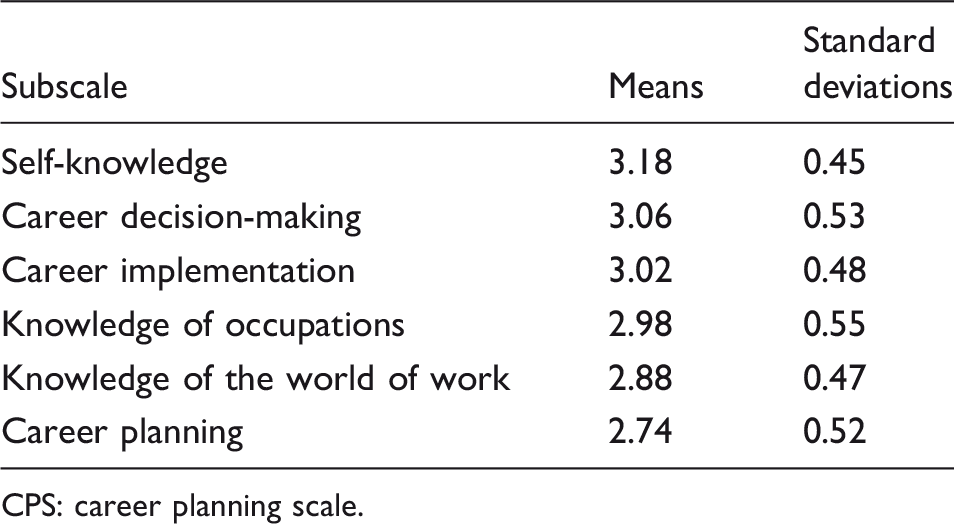
Means and standard deviations for the six subscales of the CPS.
CPS: career planning scale.
Higher mean values indicate a higher level of students’ career maturity whereas lower mean values indicate a lower level of students’ career maturity. With regard to the classification of mean scores, three ranges were used: mean scores of 1–1.99 were considered a low level of career maturity as these scores reflected the “disagree” range on the test; mean scores of 2–2.99 were considered an above-average level of career maturity as 2–2.99 reflected the “agree” range on the test; and mean scores 3–4 were considered high levels of career maturity as these represented the “strongly agree” range on the test. As shown in Table 1, the mean of the self-knowledge subscale is higher than all other means, followed by career decision-making, and career implementation. These three factors all had a high level of career maturity. The rest of the factors had an average level of career maturity. Note, however, that all means were either in the above-average or high range.
Results related to research objective 2
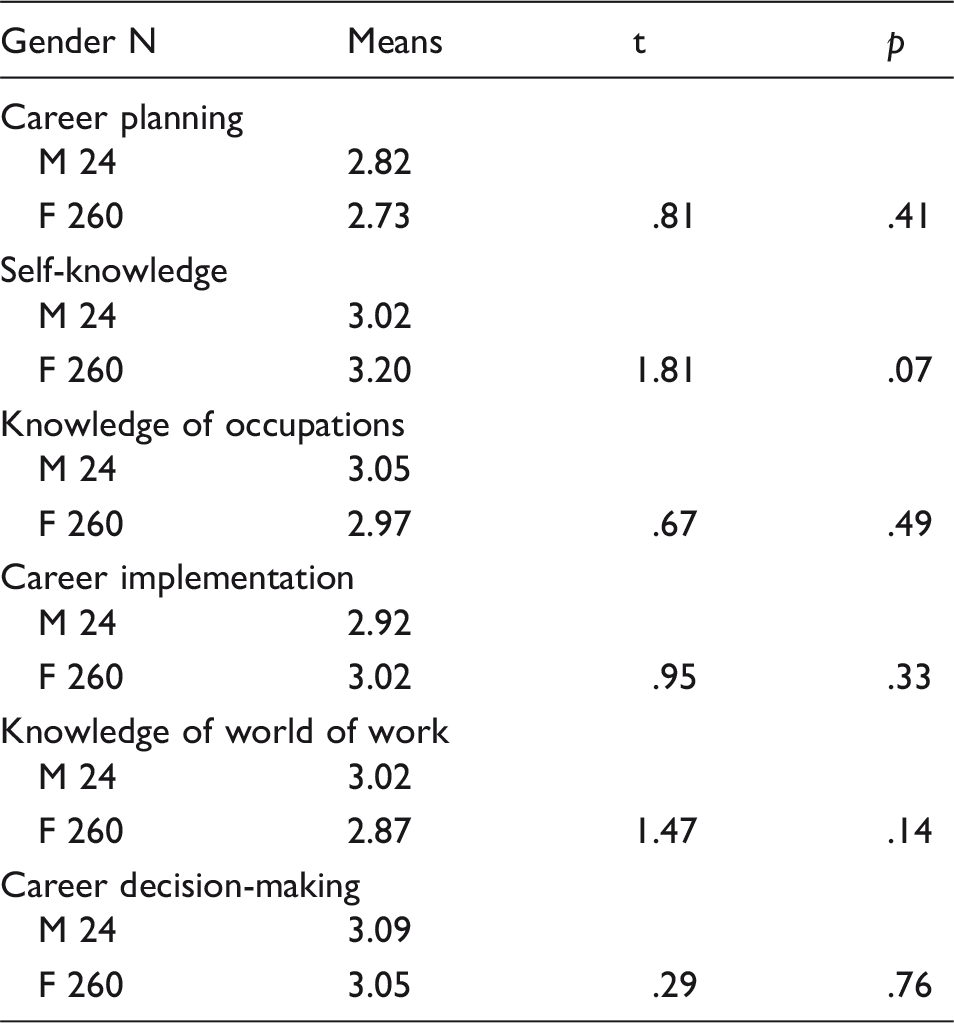
Gender differences on the six dimensions of Liptak’s career planning scale.
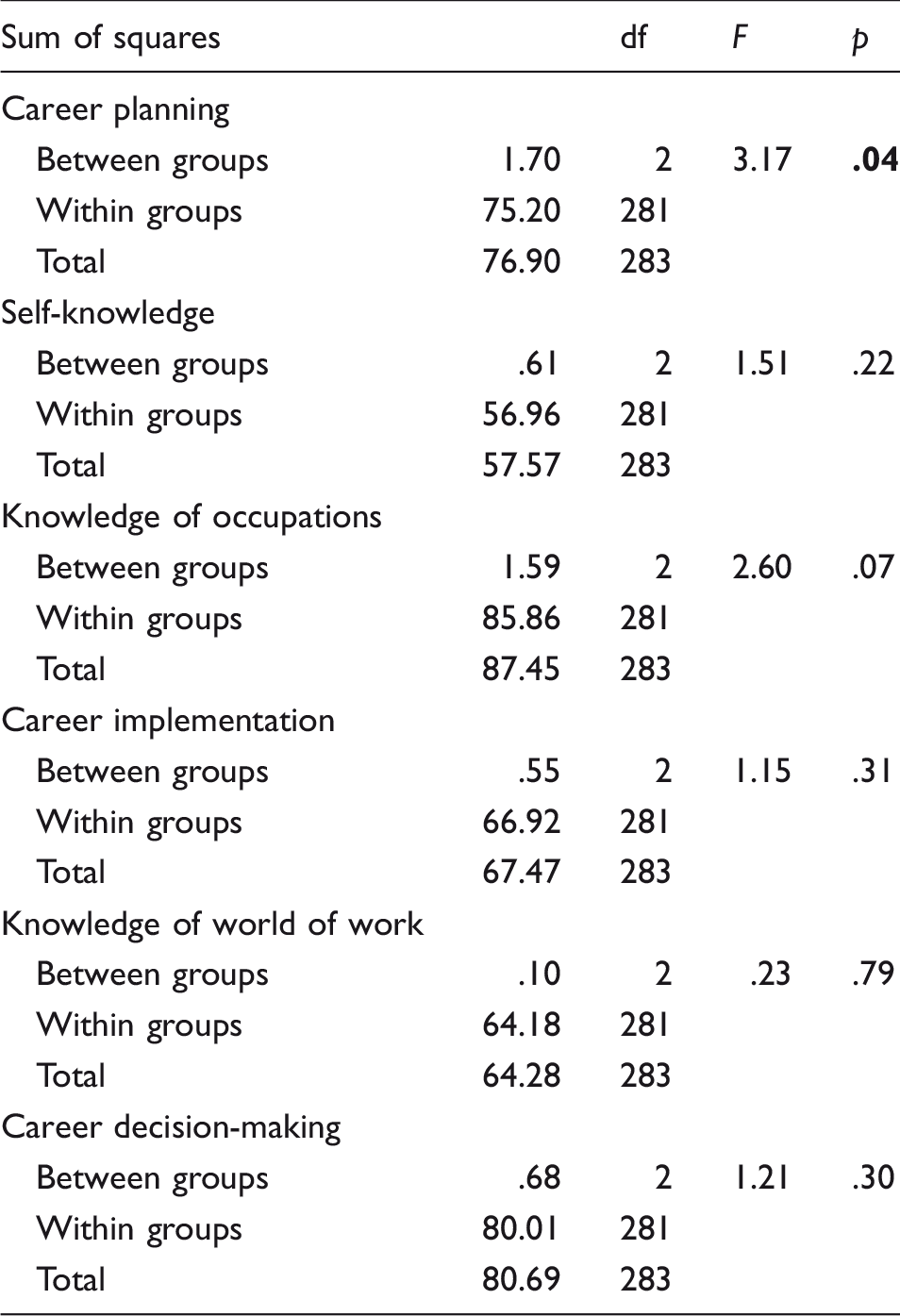
Group differences among sophomore, junior, and senior university students on Liptak’s career planning scale.
Discussion
Career maturity of university students is an important area of inquiry that deserves attention. It is noted that global research on this issue is outdated and little or no research exists in Jordan especially in higher education. Based on that, the purpose of the present study was to determine the level of career maturity among university students from one public university in Jordan. The study also sought to determine the impact of gender and academic level on career maturity of university students.
Discussion related to research objective 1
The results related to objective 1 indicated that the university students under study had mean levels of career maturity for all domains in the “agree” (i.e. > 2.0) endorsed range, with self-knowledge being the highest (see Table 1). Under the self-knowledge heading, students were able to identify their talents, interests, skills, and abilities related to their future careers; identified careers that appealed to their values and personalities, identify how to transfer their skills from one job to another, and identify the working conditions that motivated them to do well on a job, as the most important.
Also, students exhibited high levels of career maturity on career decision-making and career implementation. With regard to career decision-making, students had collected enough information to make effective career decisions that matched their interests, values, skills, and abilities with their chosen careers, and discuss career options and decisions with friends and family. As far as career implementation is concerned, students knew how to convey their skills on a resume and in an interview, demonstrated the skills and behaviors necessary for a successful job interview, knew how to use computer software and the Internet to assist in job search, knew how to find openings for jobs that interested them, and knew how to develop and maintain an effective network to find jobs. The above results are consistent with previous research (Levinson et al., 1998; Super, 1990).
These results are justified by the fact that the university under study had a vocational and training center that prepares students for the world of work. Within this center, students can attend training workshops during their university years that can help them identify their talents, skills, abilities, values, personalities, and match them with the desirable career. Also, students have the option to learn about job descriptions, job specifications, and working conditions for their future careers and can discuss these career options and decisions with trained counselors. Further, this center offers students training workshops that teach them how to write effective resumes, succeed in a job interview, and use technology programs to search for job openings.
Students exhibited above-average levels of career maturity on the rest of the dimensions (knowledge of occupations, knowledge of the world of work, and career planning). With regard to knowledge of occupations dimension, this reflected that students talked with and observed workers who occupied the same career that are of interest to them, researched the earnings of workers in careers that interested them, and read books and magazines about jobs that interested them.
With regard to knowledge of the world of work dimension, students “agreed” that they were aware of the changes that were taking place in the job market, researched the type of skills employers expected from new employees, were aware of the costs of training programs related to their chosen career, and explored the job growth trends affecting their careers in the future. As far as career planning was concerned, students agreed that they had developed short- and long-term career goals; developed time lines for accomplishing each of their career goals; discussed their career plans with career professionals; read about or attended classes or programs on career planning; and had a comprehensive plan for integrating work, family, and leisure roles. The above results are consistent with the views of Liptak (2008).
The reason why students exhibited moderate level on the above three dimensions is potentially because university students do not have the time and money necessary to observe workers in the job market. Also students might not have specific documentation on the internet that can refer them to job category earnings. Moreover, students might not be able to keep up with the job trends due to fluctuating economic trends and job growth trends that take place in the world today. Finally, students might not have sufficient information (e.g. grades) to fully develop future plans.
Discussion related to research objective 2
The results related to the second research objective indicated that significant differences were not present on the six dimensions of the Liptak’s CPS based on gender. This result is not consistent with previous research which indicated that female students scored higher on career maturity measures than did male students (Constantine & Greer, 2003; Creed & Patton, 2003; Lee, 2001). This outcome might reflect cultural differences (i.e. this is the first study of this kind conducted in Jordan), might reflect community changes generally (i.e. today’s university students are more aware of equal opportunities across gender), or it might reflect our sample, which contained only a small proportion of males (91.5% female versus 8.5% male), and thus might be biased in this respect.
With regard to the educational level, students differed only on the career planning dimension. Based on the mean values, juniors and seniors were more mature than sophomores. This result is consistent with previous studies (McCaffrey et al., 1984; Ren, 2004).
Based on the above discussion, a number of recommendations are provided for the field of study. First, this research is important to university personnel who work closely with university students to prepare them for the world of work. For example, the study’s instrument can be used to measure students’ levels of career maturity on six aspects as they progress from freshmen levels to senior levels. This information can be used to determine the value of benefits provided to students by the university system. Proactive measures can be taken to determine gaps and to remedy them in due time.
Second, career professionals should focus on three important aspects of career maturity (knowledge of occupations, knowledge of the world of work, and career planning) when guiding students. Based on that, arranged visitations to the workplace should be set during their freshmen years so that they can talk with and observe workers who occupy the same careers that interest them. Third, students should be provided with information about job descriptions, job specifications, working conditions, expected changes in supply and demand for their careers, training needed in the future, and expected earnings of different careers. Further, the university system should establish career maturity courses that help students succeed in their future careers. Fourth, more research should be undertaken in the area of career maturity as follows: determining career maturity of a sample of students starting from their freshmen years to their senior years, comparing career maturity of students from public and private universities, comparing career maturity of students across cultures, and investigating factors impacting career maturity through qualitative studies.
Footnotes
Declaration of Conflicting Interests
The author(s) declared no potential conflicts of interest with respect to the research, authorship, and/or publication of this article.
Funding
The author(s) received no financial support for the research, authorship, and/or publication of this article.