



Abstract
Previous research on protean and boundaryless careers has been variable centred, testing the outcomes of the dimensions of protean and boundaryless careers separately. Following the career typology of Briscoe and Hall (2006), this study aimed to explore the combined effect of protean (self-directedness and values orientation) and boundaryless (psychological and physical mobility) career dimensions on various career competencies, including identity awareness, adaptability, career planning, proactive job search behaviour, and external networking behaviour. Using cluster analysis with a sample of 285 professionals and mid-level managers, five of the eight career profiles in Briscoe and Hall’s (2006) typology emerged: protean career architect, hired gun, solid citizen, the wanderer, and trapped/lost. Results showed that the most positive career competencies were associated with protean career architect. Additionally, it was found that higher levels of self-directed career management and psychological and physical mobility were not sufficient to enhance identity awareness when the values-driven orientation was lower.
Introduction
Protean (Hall, 1996, 2002, 2004) and boundaryless career concepts (Arthur & Rousseau, 1996) have gained considerable popularity among researchers and practitioners over the last two decades with respect to their relevance to the contemporary working life that is characterized with mobility and uncertainty (Briscoe & Hall, 2006; Gubler, Arnold, & Coombs, 2014; Inkson, 2006). Protean career refers to a career that is driven by the person not the organization (Hall, 1996, 2002). According to Briscoe and Hall (2006), there are two dimensions of protean career: self-directed career management and values-driven career orientation. Self-directed career management reflects taking an independent role and personal initiative for career options instead of seeking direction from the organization. Values-driven career orientation refers to being aware of, and pursuing, internal values rather than the socially imposed values in terms of managing one’s career and assessing one’s career success (Briscoe & Hall, 2006).
Boundaryless career represents ‘a sequence of job opportunities that go beyond the boundaries of any single employment setting’ (De Filippi & Arthur, 1994, p. 370). Even though Arthur and Rousseau (1996) have noted that there are multiple meanings beyond this general meaning, the reviewed literature demonstrates that the boundaryless career is typically examined with regard to crossing organizational boundaries and characterized by physical mobility (Gunz, Evans, & Jalland, 2000; Inkson, 2006; Sullivan, 1999; Sullivan & Arthur, 2006). Sullivan and Arthur (2006) generalized the boundaryless career to include psychological as well as physical mobility. They define psychological mobility as the perceptions of capacity to move (Sullivan & Arthur, 2006). Previously, protean and boundaryless career concepts were used interchangeably due to the complexity and ambiguity of the concepts (Briscoe & Hall, 2006; Inkson, 2006). However, it is clearly established that protean and boundaryless careers are related, yet distinguishable constructs (Briscoe, Hall, & Frautschy DeMuth, 2006). While protean career reflects a mindset regarding the self-directedness and values orientation in career management, boundaryless career emphasizes mobility across boundaries (Inkson, 2006).
Research into protean and boundaryless careers has increased in recent years (Gubler, Arnold, & Coombs, 2014; Sullivan & Baruch, 2009). Previous research has been variable centred, testing the outcomes of the dimensions of the protean (self-directed career management and values-driven career orientation) and boundaryless career concepts (physical and psychological mobility) separately, by using multiple regression analysis or structural equation modelling (e.g. Briscoe & Finkelstein, 2009; Briscoe, Henagan, Burton, & Murphy, 2012; Briscoe, Hoobler, & Byle, 2010; Çakmak-Otluoğlu, 2012; De Vos & Soens, 2008; Enache, Sallán, Simo, & Fernandez, 2013; Verbruggen, 2012; Waters, Briscoe, Hall, & Wang, 2014). However, Briscoe and Hall (2006) have argued that there is a need for empirical research to examine a combination of the protean and boundaryless careers that reflects the person-centred approach. These authors have noted that the different combinations of high and low levels of the protean and boundaryless career create different career profiles.
Even though there are 16 career profiles based on the possibility that every individual can be either high or low on levels of self-directed career management, values-driven career orientation and physical and psychological mobility, Briscoe and Hall (2006) identified eight career profiles, arguing that the other profiles tend to not occur in real life. According to the authors, the eight career profiles range from trapped/lost (low levels of self-directedness, values orientation, physical mobility, and psychological mobility) to protean career architect (high levels of self-directedness, values orientation, physical mobility, and psychological mobility). The other six career profiles fall between these two profiles (cf. Briscoe and Hall, 2006). Consequently, Briscoe and Hall (2006) have asserted that there is a need for empirical research on all combinations of protean and boundaryless careers.
A review of the literature demonstrated that various career competencies have been associated variously with protean and boundaryless career orientations. For example, identity awareness and adaptability are generally linked to the protean career (Hall, 2002; Lips-Wiersma & Hall, 2007). Networking behaviours (Eby, Butts, Lockwood, 2003) and active coping (Briscoe et al., 2012) are associated with the boundaryless career. Even though Briscoe and Hall (2006) proposed that different career profiles would have different implications for career competencies, the combined effect of protean and boundaryless career dimensions on career competencies remains empirically under-researched. The only study that explored this combined effect related the career variables to potential motivators (Segers, Inceoglu, Vloeberghs, Bartram, & Henderickx, 2008). Hence, this study seeks to address this research gap in the careers literature by examining the combined effect of the protean and boundaryless career dimensions on career competencies.
This study specifically focused on five career competencies, including identity awareness, adaptability, career planning, proactive job search behaviour, and external networking behaviours, which are consistent with previous research (e.g. Briscoe & Hall, 2006; Briscoe et al., 2012). I used cluster analysis in order to identify the career profiles and to investigate their implications for these career competencies. This study therefore provides an empirical investigation of Briscoe and Hall’s (2006) typology of career profiles.
Literature review
Combinations of protean and boundaryless careers
Regarding the protean career, Hall (2002, 2004) stated that a person could exhibit varying levels of self-directed career management and values-driven career orientation, and suggested four different career profiles of dependent (low levels of both self-directedness and values orientation), rigid (low levels of self-directedness and high levels of values orientation), reactive (high levels of self-directedness and low levels of values orientation), and protean (high levels of both self-directedness and values orientation) by using the combinations of protean career dimensions.
In their study focusing on boundaryless career, Sullivan and Arthur (2006) claimed that a person could display varying levels of both physical and psychological mobility. Based on being mobile physically and psychologically, Sullivan and Arthur (2006) proposed four different career profiles of Quadrant 1 (low levels of both physical and psychological mobility), Quadrant 2 (high level of physical mobility and low level of psychological mobility), Quadrant 3 (low level of physical mobility and high level of psychological mobility), and Quadrant 4 (high levels of both physical and psychological mobility).
Career profiles: Combinations of protean and boundaryless careers.
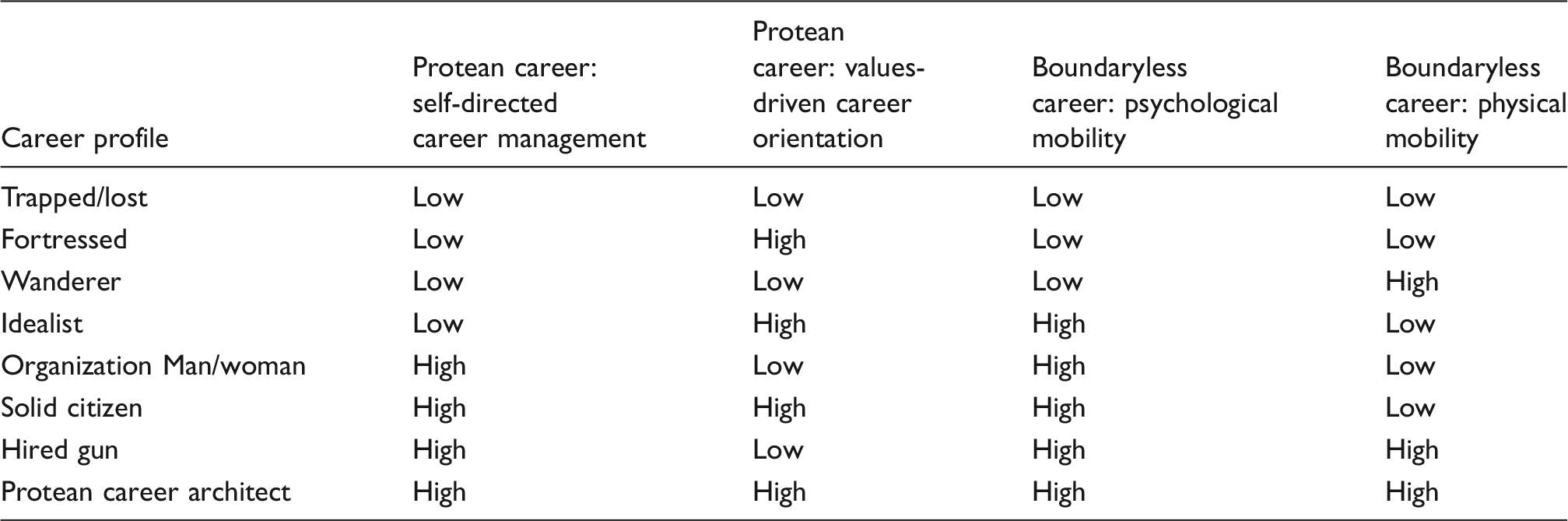
Although Briscoe and Hall (2006) asserted that the eight career profiles can be possible in real life, the existence of the career profiles might be affected by the structure of labour markets and cultural factors (e.g. collectivist/individualistic and feminine/masculine cultures) (Segers et al., 2008; Sullivan & Arthur, 2006). Regarding the structure of labour markets, physical mobility tends to be more common in insecure and competitive labour markets. Physical mobility also becomes more significant in the individualistic cultures that highlight the importance of personal goals (Sullivan & Arthur, 2006). On the other hand, psychological mobility can be linked to collectivist cultures that focus highly on group goals (Sullivan & Arthur, 2006). Self-directedness can also be associated with individualistic cultures that emphasize autonomy and freedom (Gelfand & Realo, 1999). Values orientation can be more dominant in feminine cultures that have less focus on status and money (Segers et al., 2008).
The present study was conducted in Turkey, which is poised between Europe and the Middle East, and is a developing country with a distinct culture. After liberalization in the 1980s, Turkey experienced severe economic and financial crises in 1994, 2001, and 2008. Because of those economic and financial crises, the structure of Turkish labour markets has changed dramatically. Currently, the Turkish labour market is more competitive, insecure, and challenging (Çakmak-Otluoğlu, Ünsal-Akbıyık, & Otluoğlu, 2015). Çakmak-Otluoğlu (2012) therefore argues that employees have been experiencing more mobility during their careers. Regarding culture, Turkey has close political, economic, and industrial relations with the Middle East. According to Hofstede’s (1980) research, Turkey has higher scores on feminine culture. Leisure time is extremely important for families and friends to come together.
Also, Turkey is differentiated from Western culture in terms of collectivism, and in this regard is closer to Eastern cultures. However, the dynamics of globalization have transformed the Turkish sociocultural environment. For instance, a study by Aycan et al. (2000) found that Turkish culture has become less collectivist and has become more aligned with the Western culture. These authors also indicated that managers assumed and believed in employee malleability, responsibility seeking, and participation. Aycan (2001, p. 253) concluded that ‘Turkish societal and organizational culture is a blend of “Western” and “Eastern” values’. Therefore, I predicted that I would find five career profiles including the trapped/lost (low levels of self-directedness, values orientation, physical mobility, and psychological mobility), the wanderer (low levels of self-directedness, values orientation, psychological mobility, and high levels of physical mobility), the solid citizen (high levels of self-directedness, values orientation psychological mobility, and low levels of physical mobility), the hired gun (high levels of self-directedness, physical mobility, psychological mobility, and low levels of values orientation), and the protean career architect career profiles (high levels of self-directedness, values orientation, physical mobility, and psychological mobility) in this present study. These five career profiles have the potential to reflect both the structure of Turkish labour markets and the transformed Turkish culture, which is a blend of Western and Eastern values.
H1: The five career profiles including trapped/lost, wanderer, solid citizen, hired gun, protean career architect will be identified in the present study.
Career competencies
The reason for focusing on identity awareness and adaptability is that these two competencies are the meta-competencies of protean career orientation (Hall, 1996, 2004). While identity awareness refers to the ability to display accurate self-insight and to change one’s self-concept as appropriate (Briscoe & Hall, 1999; Hall & Chandler, 2005), adaptability can be defined as the perceived ability and willingness to adapt changing work conditions (Briscoe & Hall, 1999; Morrison & Hall, 2002; Morrison & Hall, 2002; Savickas, 1997). Hall (2004) stated that identity awareness allows individuals to consider their own values to guide their careers. Briscoe et al. (2012) have demonstrated that self-directedness is correlated with identity awareness. Also, Verbruggen and Sels (2008) found that adaptability and identity awareness help individuals to become more self-directed in their own career paths.
Career planning refers to the deliberate efforts of individuals to outline future career developments and to establish and pursue clear career goals and strategies (Gould, 1979). Considering the fact that individuals with a protean career orientation prefer to control their careers behaviourally and meet their career goals (Briscoe et al., 2006; Hall, 2002), career planning plays an important role in protean career orientation. For instance, Direnzo, Greenhaus and Weer (2015) found that individuals with a high protean career orientation demonstrated more career planning activities.
Proactive job search behaviours can be defined as the proactive and purposeful efforts of individuals to find a new job. Boundaryless career orientation (physical and psychological mobility) emphasizes seeking external opportunities in order to transcend the organizational boundaries (Sullivan & Arthur, 2006). For example, a recent study conducted with unemployed individuals by Vansteenkiste, Verbruggen and Sells (2013) reported that psychologically mobile individuals spent more time on job search behaviours.
On the other hand, networking behaviours refer to individuals’ efforts to develop and maintain relationships with others who have the potential to support them in their careers (Forret & Dougherty, 2001, 2004). Networking behaviours can be conceptualized as external and internal networking behaviours. While internal networking behaviours focus on engaging in networking behaviours inside the organization, external networking behaviours concentrate on demonstrating networking behaviours outside of the organization (Michael & Yukl, 1993). Logically, external networking behaviours become more central to the boundaryless career orientation (Forret & Dougherty, 2001). Also, De Fillippi and Arthur (1994) have conceptualized knowing-whom competencies, the extent to which individuals develop and utilize a wide network of relationships, as one of the necessary career competencies for boundaryless career orientation. For instance, Wolff and Moser (2010) found that physical mobility was related to external networking behaviours.
The combined effect of protean and boundaryless careers on career competencies
This study is grounded in Briscoe and Hall’s (2016) career typology. According to this typology, the trapped/lost career profile demonstrates low levels of self-directedness, values orientation, physical mobility, and psychological mobility. As a result of having a lack of an independent role, internal values, and boundaryless perspectives in their careers, individuals with a trapped/lost career profile tend to be reactive and to depend on luck to get them anywhere in their careers (Briscoe & Hall, 2006). I therefore proposed the following hypothesis:
H2: The trapped/lost career profile has significantly lower levels of career planning, proactive job search, and external networking behaviours compared to all career profiles.
H3: The protean career architect career profile has significantly higher levels of identity awareness, adaptability, career planning, proactive job search, and external networking behaviours compared to all career profiles.
H4: The hired gun career profile has significantly higher levels of career planning, proactive job search behaviours, and adaptability compared to the wanderer career profile.
H5: The solid citizen career profile has significantly higher levels of identity awareness compared to the wanderer and hired gun career profiles.
Method
Participants and procedure
The data were collected from 285 professionals (without managerial responsibility) and mid-managers who were working for several private sector organizations located in Istanbul, Turkey. The respondents voluntarily participated in the survey after attending a managerial workshop. They were from 58 private sector organizations that varied broadly in terms of industry and size. The response rate was 45%. The participants were mostly male (81%) and highly educated. Of these, 58% had bachelor degree, 38% a master’s degree, and 4% a PhD. Further, 66% were professionals and 34% were mid-managers. The average age of participants was 34.80 years (SD = 3.32; range 25–48), with an average work experience of 9.80 years (SD = 4.12; range 3–24), and an organizational tenure of 4.15 years (SD = 3.56; range 1–12).
Measures
Self-directed career management
Self-directed career management was measured using the 8-item scale developed by Briscoe et al. (2006). A sample item is ‘Overall, I have a very independent, self-directed career.’ Cronbach alpha for this scale in the present study was .87. Responses were made on a 5-point scale ranging from 1 (to little or no extent) to 5 (to a great extent).
Values-driven career orientation
Values-driven career orientation was measured using a 6-item scale developed by Briscoe et al. (2006). A sample item is ‘It does not much matter to me how other people evaluate the choices I make in my career.’ Cronbach alpha in the present study was .76. Responses were made on a 5-point scale ranging from 1 (to little or no extent) to 5 (to a great extent).
Psychological mobility
Psychological mobility was measured using the 5-item scale of organizational mobility preferences developed by Briscoe et al. (2006, p. 33), which assesses ‘the strength of the interest in remaining with single (or multiple) employer(s)’. A sample item is ‘I like the predictability that comes with working continuously for the same organization’ (Reverse scored). Cronbach alpha in the present study was .80. Responses were made on a 5-point scale ranging from 1 (to little or no extent) to 5 (to a great extent).
The Turkish translated versions of the self-directed career management, values-driven career orientation, and psychological mobility scales were successfully validated by Çakmak-Otluoğlu (2012), who conducted in-depth interviews with five Turkish employees from various organizations to ensure an accurate interpretation of the translated items. Subsequently, the items were back-translated from Turkish to English and adjusted again in the Turkish translated version based on feedback from the first author of the original English version of the scales.
Physical mobility
In order to measure physical mobility, participants were asked how many times they had changed their employers in their career up to now. This measure is consistent with previous research (e.g. Briscoe et al., 2006; Colakoglu, 2011; Verbruggen, 2012).
Identity awareness
Identity awareness was measured using the 5-item scale developed by Stumpf, Colarelli and Hartman (1983). A sample item is ‘I have understood my past behavior in a new way that will help with my future career.’ Cronbach alpha in the present study was .82. Responses were made on a 5-point scale ranging from 1 (to little or no extent) to 5 (to a great extent).
Adaptability
Adaptability was measured using the 5-item scale developed by London (1993). A sample item is ‘To what extent are you able to adapt to changes in your career?’. Cronbach alpha in the present study was .81. Responses were made on a 5-point scale ranging from 1 (to little or no extent) to 5 (to a great extent).
Career planning
Career planning was measured using the 4-item scale developed by Gould (1979). The scale assesses the degree to which participants engaged in identifying specific career goals and have a strategy to achieve these goals (Gould, 1979; Zikic & Klehe, 2006). A sample item is ‘I have a strategy for achieving my career goals.’ Cronbach alpha in the present study was .88. Responses were made on a 5-point scale ranging from 1 (strongly disagree) to 5 (strongly agree).
Proactive job search behaviour
Proactive job search behaviour was measured using the 5-item scale developed by Kinicki and Latack (1990). The scale measures the extent to which participants engaged in proactive attempts to find a new job (Kinicki & Latack, 1990). A sample item is ‘I devoted a lot of my time and energy on job search activities.’ Cronbach alpha in the present study was .91. Responses were made on a 5-point scale ranging from 1 (to little or no extent) to 5 (to a great extent).
External networking behaviour
External networking behaviour was measured using the 7-item scale of building external contacts developed by Wolff and Moser (2006). The scale assesses the extent to which participants engaged in building contacts outside the organization (Wolff & Moser, 2009). A sample item is ‘I develop informal contacts with professionals outside the organization, in order to have personal links beyond the company.’ Cronbach alpha in the present study was .89. Responses were made on a 5-point scale ranging from 1 (to little or no extent) to 5 (to a great extent).
The data were collected in Turkish. Identity awareness, adaptability, career planning, proactive job search behaviour, and external networking behaviour scales were translated into Turkish by one English–Turkish bilingual. The translated scales were back-translated into English by the author using established techniques (Brislin, 1986) and adjusted again in the Turkish version.
Results
Descriptive statistics and intercorrelations among study variables.
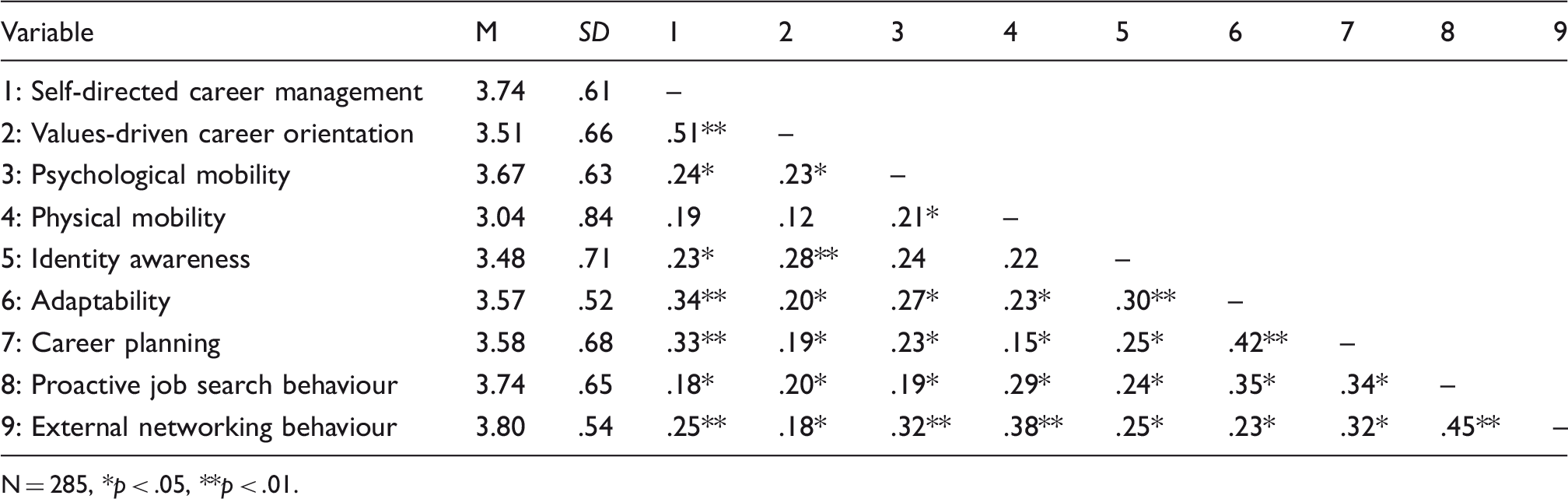
N = 285, *p < .05, **p < .01.
Means and cluster size (n) of self-directedness, values orientation, psychological, and physical mobility across career profiles.
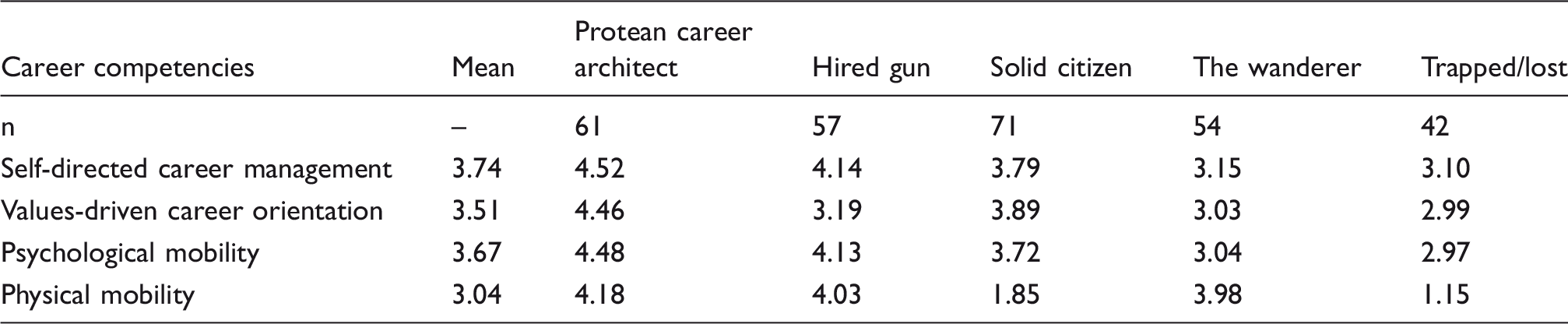
The labelling of the clusters was based on Briscoe and Hall’s (2006) typology of career profiles. One career profile comprised individuals with high scores on each scale; this was labelled ‘protean career architect’. A second career profile consisted of individuals with low scores on each scale and was labelled ‘trapped/lost’. A third career profile comprised individuals with low scores on values-driven career orientation, self-directed career management, psychological mobility, and high scores on physical mobility; this was labelled ‘the wanderer’. A fourth career profile consisted of individuals with low scores on physical mobility, and medium scores on self-directed career management, values-driven career orientation, and psychological mobility, and was labelled ‘solid citizen’. A fifth career profile included individuals with low scores on values-driven career orientation, high scores on self-directed career management, physical, and psychological mobility, and was labelled as ‘hired gun’. Hence, five of the eight clusters suggested by Briscoe and Hall (2006) were replicated in the present study. These results provided support for H1.
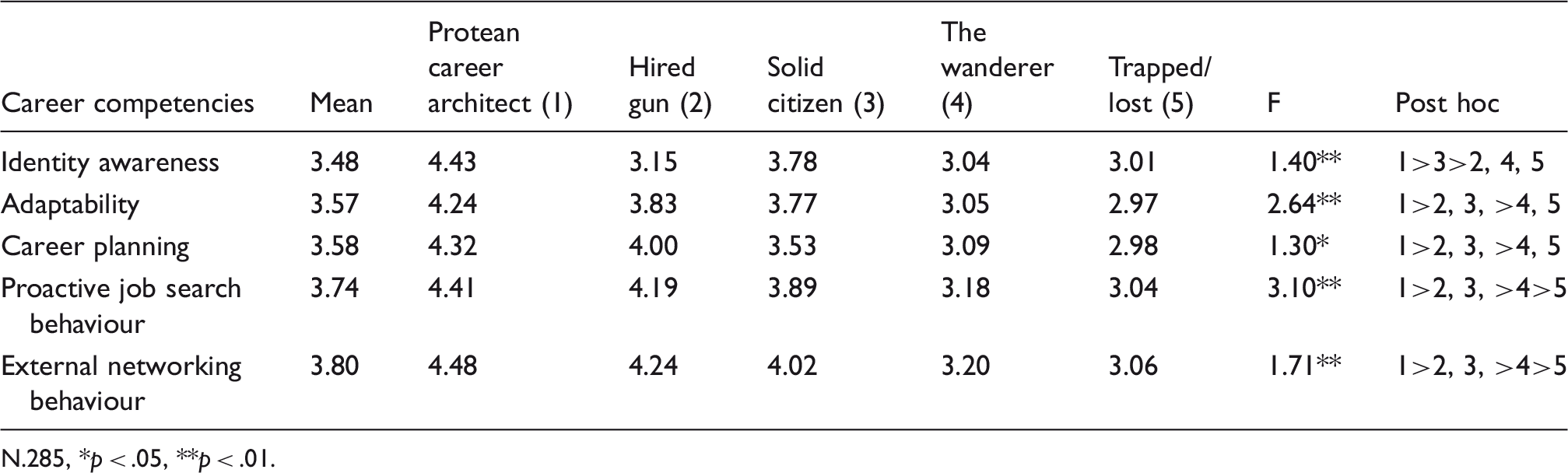
Means, F values, and Bonferroni post hoc comparisons for career competencies across career profiles.
N.285, *p < .05, **p < .01.
The trapped/lost career profile had significantly lower levels of proactive job search and external networking behaviours compared to all other career profiles, as expected. However, the trapped/lost career profile had significantly lower levels of career planning compared to the solid citizen, the hired gun, and the protean career architect career profiles. These results provided partial support for H2. The protean career architect career profile demonstrated significantly higher levels of identity awareness, adaptability, career planning, proactive job search, and external networking behaviours compared to all other career profiles, as expected. H3 was therefore supported. The hired gun career profile demonstrated higher levels of career planning, proactive job search behaviours, and adaptability compared to the wanderer career profile, as expected. This result provided support for H4. The solid citizen career profile showed significantly higher levels of identity awareness compared to the wanderer and the hired gun career profiles. H5 was therefore supported.
Even though I did not hypothesize some comparisons, I found several significant results. For example, the wanderer career profile demonstrated significantly lower levels of adaptability, career planning, proactive job search behaviour, and external networking behaviour compared to the solid citizen, the hired gun, and the protean career architect career profiles. The solid citizen career profile had significantly higher levels of identity awareness compared to the trapped/lost career profile. The hired gun career profile exhibited significantly higher levels of career planning compared to the trapped/lost career profile. In addition to these significant comparisons, there were some non-significant results as well. There were no significant differences in adaptability between the trapped/lost and the wanderer career profiles. There were no significant differences for identity awareness among the trapped/lost, the wanderer, and the hired gun career profiles. Also, there were no significant differences for career planning between the solid citizen and the hired gun career profiles. Similarly, there were no significant differences for career planning between the trapped/lost and the wanderer career profiles.
Discussion
The aim of this study was to extend the recent research on protean and boundaryless career concepts by determining the career profiles and examining their implications for specific career competencies of identity awareness, adaptability, career planning, proactive job search, and external networking behaviours. In contrast to Briscoe and Hall’s (2006) career typology, I found five career profiles, including trapped/lost, the wanderer, solid citizen, hired gun, and protean career architect. I believe that those five career profiles have a capacity to reflect both the structure of Turkish labour markets (e.g. insecure and competitive) and the transformed Turkish culture, which is a blend of Western and Eastern values.
Career profiles provide new insights into how combined effects of protean and boundaryless career dimensions affect career competencies. Individuals with a trapped/lost career profile tend to be reactive and to depend on luck to get them anywhere in their careers. Results therefore show that the trapped/lost career profiles significantly exhibit less proactive job search and external networking behaviours compared to all other career profiles. It can be argued that individuals with a trapped/lost career profile should engage in external career exploration activities in order to reduce the reactiveness. However, the trapped/lost career profiles had no significant differences compared to the wanderer career profiles in terms of career planning. The possible reason for this non-significant result is that the individuals with a wanderer career profile are more likely to be directed by opportunities like the trapped/lost individuals. Yet, such people tend to use more opportunities than the trapped/lost ones due to the higher levels of physical mobility in the wanderer career profile. Nevertheless, results suggest that when higher levels of physical mobility are combined with lower levels of values-driven career orientation, self-directed career management, and psychological mobility, as in the wanderer career profile, external networking and proactive job search behaviours improve. Individuals with both career profiles therefore could be trained regarding values clarification and self-directedness in order to help them navigate their careers more successfully, as Briscoe and Hall (2006) suggested.
Results related to the hired gun career profile show that higher levels of self-directed career management and psychological and psychical mobility might not be sufficient to enhance identity awareness, if the values-driven orientation is low. For example, individuals with a hired gun career profile have lower levels of identity awareness compared to those with the solid citizen career profile. However, the similar results did not exist in terms of adaptability. Even though adaptability of individuals with a hired gun career profile is higher than the wanderer ones, their adaptability is significantly lower than the individuals with a protean career architect profile. There were also no significant differences in terms of adaptability between the trapped/lost and the wanderer career profiles. These results are meaningful considering that both adaptability and identity awareness are seen as core elements of protean career (Hall, 1996, 2002). Results show that the most positive (the highest means) career competencies were exhibited by the protean career architect career profile. The solid citizen career profile had more positive career competencies than the trapped/lost and the wanderer career profiles. This means that even medium levels of self-directed career management, values-driven orientation, and psychological mobility are related to positive career competencies.
Some limitations of this study should be noted. First, all data were self-reported and cross-sectional. Second, the sample consisted of highly qualified, mostly male, and highly educated white-collar professionals and mid-managers. The findings therefore might not generalize to unqualified, female, and less educated employees. Third, the study was conducted in a single country, namely Turkey. Fourth, because this study focused only on career competencies, I included identity awareness, adaptability, career planning, proactive job search, and external networking behaviours. Future research could benefit from using important individual and organizational outcomes, such as career satisfaction, work–life balance, life satisfaction, and organizational commitment.
Footnotes
Declaration of Conflicting Interests
The author(s) declared no potential conflicts of interest with respect to the research, authorship, and/or publication of this article.
Funding
The author(s) disclosed receipt of the following financial support for the research, authorship, and/or publication of this article: This work was supported by Scientific Research Projects Coordination Unit of Istanbul University. Project number: 23254.
Acknowledgement
I acknowledge Douglas T. Hall and anonymous reviewers for their insightful comments on earlier drafts of the manuscript.