



Abstract
This study examined the interactive effect of organizational career management practices and different types of work experience on career satisfaction and intention to quit the organization in 386 Indian employees. The results showed that after controlling for the effect of the demographic variables and organizational career management practices, different types of work experience played unique roles in predicting career satisfaction and intention to quit the organization. It was found that that organizational career management practices correlated positively with career satisfaction and negatively with intention to quit the organization. The results further showed that organizational experience moderated the relationship between organizational career management practices and career satisfaction, and organizational tenure moderated the relationship between organizational career management practices and intention to quit. These findings carry implication for research and practice on career satisfaction and intention to quit the organization.
Keywords
Given the shortage of qualified human resources in several job markets, and the importance of people as a source of completive advantage, organizations are now realizing the challenge in developing and retaining valuable employees (Allen, Bryant, & Vardaman, 2010). The presence of efficient systems and programmes is required to respond to internal needs and contextual complexities of the organization (de Oliveria et al., 2017). This has brought human resource functions, especially career management, back into the light. Although employees highly value access to developmental opportunities and career growth (Towers, 2012), this area appears to be the largest misfit between expectations of the employee and organizational conditions (de Oliveria et al., 2017).
The majority of career concepts have shifted from the notion of traditional careers, which were considered stable and within a single organization (Sullivan & Baruch, 2009), to contemporary concepts that emphasize individual agency. This shift has led to the development of career models that focus on individual behaviours of career activity, such as the boundaryless career (Arthur, 1994) and the protean career (Hall, 2002), which downplay organizational career management (OCM) practices. The foundation of such new career models is based on the argument that the responsibility for career success has moved from the organization to individuals (Ballout, 2015). While previous literature has identified that individuals differ in career values, and that career success varies according to individual characteristics (Sullivan & Baruch, 2009), there is little evidence about how organizational support for employee career development contributes to the career success of individuals (de Oliveira, Cavazotte, & Alan Dunzer, 2017).
Despite the growing importance of individually managed careers, organizations are still responsible for managing employees’ careers, because organizations form the context in which career development takes place (Guan et al., 2014). Moreover, career self-management and OCM are not mutually exclusive (Sturges, Conway, Guest, & Liefooghe, 2005). Shifts in career development systems do not imply that organizations have no say in career management, as much remains for the organization to manage. Careers, to a certain extent, are still managed by organizations as a part of human resource management (HRM; Baruch, 2003; De Vos & Cambre, 2016), and, in many cases, career planning is primarily carried out by organizations (Budhwar & Baruch, 2003; De Vos & Cambre, 2017). A wide variety of career practices, career management programmes and techniques are applied by organizations within the HRM area (Baruch & Budhwar, 2006). Hence, it is crucial to better understand the career management practices adopted by various organizations.
OCM practices
OCM practices refer to the practices that organizations employ to facilitate and promote employees’ careers in the organization (De Vos, Dewettinck, & Buyens, 2009). Such practices include a variety of programmes and interventions to manage the careers of employees. Baruch (1996) defined OCM as ‘a comprehensive approach to all the activities and techniques facilitated by the organization which are concerned with the career development of its employees’. OCM practices provide support to employees and form the context in which careers can develop. Contemporary OCM includes a wide range of activities and interventions that focus on matching organizational and individual needs.
To investigate OCM in any context, it is important to understand what those practices are. As many as 10 different lists of OCM practices are available in the literature. For example, Baruch and Budhwar (2006) and Baruch and Peiperl (2000) conducted detailed reviews of different OCM practices and developed comprehensive lists of OCM activities that have been documented in the literature. The OCM practices adopted for the present study are those developed by Baruch and Budhwar, which contain 19 OCM practices, such as performance appraisal, assessment centres, peer and other appraisals, career counselling, and job rotation.
OCM in the Indian organization – Why is it important?
As the globalization of world markets continues to grow, firms are entering into a more dynamic world of international business (Budhwar & Debrah, 2009). The significance of understanding and examining career management practices suitable to different parts of the world has been acknowledged by both academics and practitioners (Budhwar & Sparrow, 1998). Moreover, the role of the organization in shaping individual careers has been questioned in Western countries, where it is argued to be declining, particularly in the US (Leana, 2002), although the situation is less clear in the rest of the world. Hence, the need to explore career management practices in different parts of world is crucial for understanding relevant management practices for organizations globally. There is still a scarcity of research in the field of career management, especially from the perspective of developing countries (Guchait & Cho, 2010).
India is considered an exemplar among emerging economies and is one of the largest emerging markets with its economic liberalization and dynamic growth. According to World Bank forecasts, India could become the fourth largest economy by 2020 (Budhwar & Baruch, 2003). The competition from overseas firms in and outside of India has forced Indian firms to develop their human resources, although their HRM policies and career management practices have been strongly influenced by the sociocultural context of India (Budhwar & Sparrow, 1998). The mix of diverse religions, ethnicity, linguistics, and regions is reflected in rules around occupational pursuits and succession (Sharma, 1984). For example, strong family ties and greater dependence on others result in a strong emphasis on collectivism (Kanungo & Mendonca, 1994), and, at times, transfers or promotion decisions are taken based on ascribed status or social connections (Baruch & Budhwar, 2006).
However, these established norms are being challenged in the present dynamic environment, and changes are being initiated towards the development of formal HRM systems (Baruch & Budhwar, 2006; Budhwar & Khatri, 2001). As the emerging economies like India grow and integrate into global markets, they seek to adapt and transfer HRM practices from companies in more developed countries (Stumpf, Doh, & Tymon, 2010). The resulting landscape creates a setting to explore the strength of HRM practices, more specifically career management practices (Baruch & Budhwar, 2006), because the type and nature of such practices are indicative of the HRM approach adopted in developing economies.
OCM practices: The two outcomes
The current study examines the effects of OCM practices on employees’ career satisfaction and intention to quit the organization. Prior research has shown that the perception of OCM practices correlates positively with employees’ career success and negatively with intention to quit the organization (Guan, Zhou, Ye, Jiang, & Zhou, 2015; Stumpf et al., 2010). However, there is paucity of research on the reasons and the processes by which OCM practices impact the outcome variables: career satisfaction and intention to quit (Guan et al., 2015).
Subjective career success has been operationalized as either job satisfaction or career satisfaction (Heslin, 2005; Ng et al., 2005). Review and meta-analytic studies by career scholars (Arthur, Khapova, & Wilderom, 2005; Ng et al., 2005) are split over the relevance of one construct over the other. For example, Arthur et al. (2005) found that out of 49 studies operationalizing subjective career success, 20 included measures of career satisfaction, while 11 studies included measures of job satisfaction. A perspective on career satisfaction suggests that since subjective career success indicates satisfaction over a longer time frame, job satisfaction might not be an adequate measure of career success (Heslin, 2005).
OCM practices highlight employees’ subjective perception of organizational support for their career development (Guan et al., 2015). These practices indicate the extent to which employees have access to career development opportunities. Thus, career satisfaction can be expected to adequately measure the subjective perception of career success as an outcome of supportive organizational career practices. Consistent with the predictions of beneficial effects of OCM practices on subjective indicators of career success, this study considered career satisfaction as the indicator of career success.
Hypothesis development
OCM practices, career satisfaction, and intention to quit
When it becomes difficult for organizations to attract employees with the necessary skills, organizations seek creative ways to motivate and retain them (Heslin, 2005). Organization might meet this challenge by providing support to their employees in developing their own career, and, thus, increasing career satisfaction. Goal-specific resources and environmental support, such as OCM practices, provide assistance and social and material support for personal goal realization, which is an identified predictor of career satisfaction (Lent & Brown, 2006). OCM practices signal the proactive recognition of opportunities, developmental exercises, and future support from the organization. For example, Baranik, Roling and Eby (2010) showed that mentors are viewed as organizational agents, and supportive interactions with mentors lead to the development of favourable perceptions of the organization. Beliefs about the extent to which the organization values and cares about the well-being of its employees are perceived favourably by the members of the organization (Eisenberger, Huntington, Hutchison, & Sowa, 1986). Such favourable career development practices increase employees’ positive evaluations and expectancies of career development (Guan et al., 2015).
OCM programmes (e.g. training and development opportunities, career sponsorship, and supervisor support) were found to be strongly related to employees’ career satisfaction (Ng et al., 2005), and Schmidt (2007) demonstrated that satisfaction with workplace training was positively related to career satisfaction. However, apart from two meta-analytic studies suggesting positive relationship between career practices and career satisfaction (Allen, Eby, Poteet, Lentz, & Lima, 2004; Ng et al., 2005), several additional studies have also found moderate support for a positive relationship between OCM practices and employee career satisfaction (Barnett & Bradley, 2007; de Oliveira et al., 2017; Guan et al., 2015). Consistent with theoretical predictions and empirical findings the following is hypothesized: OCM practices will be related positively to career satisfaction (Hypothesis 1a; see Figure 1).

The hypothesized research model.
OCM practices have been found to have positive effects on employee’s skills, such as self-awareness and career planning (Noe, 2002). Organizational career initiatives are interpreted by employees as an investment by the organization, and this strengthens their commitment towards the organization and leads to a lower intention to leave (Koster, de Grip, & Fouarge, 2011). Accordingly, scholars have established a negative relationship between OCM practices and employee intention to quit the organization (de Oliveira et al., 2017; Guan et al., 2014, 2015). Thus, it can be hypothesized that perceived OCM practices will be related negatively to intention to quit the organization (Hypothesis 1b; see Figure 1).
The moderating role of experience
Experience improves job performance (Quinones, Ford, & Teachout, 1995), develops sophisticated habits and routines (Dokko, Wilk, & Rothbard, 2009), and is used by employers as a proxy for skill and knowledge (Huckman & Pisano, 2006). Work-related experience is expected to provide opportunities to develop relevant knowledge that an employee can transfer and apply to other contexts (Dokko et al., 2009). This transfer of learning from one context to another can be self-fulfilling and can increase a sense of satisfaction.
It is important to note that most studies on experience considered work experience in terms of time spent in a job or organization, that is job or organizational tenure (Beus, Jarrett, Taylor, & Wiese, 2014). However, scholars have criticized time-based operationalizations of work experience as it fails to capture other indicators of experience (Quinones et al., 1995), which add more depth and meaning to work experience as a construct. Accordingly, to test work experience as a multidimensional construct, the present study operationalized experience based on Quinones et al.’s (1995) conceptual framework to enhance the understanding and measurement of work experience as a construct at the individual level.
These authors developed a 3*3 matrix framework on the dimensions that specify the domain of interest: measures of work experience (amount, time, and type) and level of specificity (organization, job, and task). Quinones et al. (1995, p. 891) suggested that ‘the appropriate level of specificity measured should depend, not on the available data, but on the theoretical linkages between experience and outcomes of interest’. The dependent variable in the present study was career satisfaction, which indicates satisfaction over a longer time frame, and the experience of the present job and task might not be an appropriate linkage. Thus, for the purpose of the present study, the measures of experience focused on the number of organizations worked for, length of time in the current organization, total work experience, and type of organization (i.e. private versus public).
Experience is considered as a proxy of knowledge (Huckman & Pisano, 2006). Work experience (within and/or outside present organization) increases task-related knowledge and can develop cognitions, habits, and behaviours that might be useful for performance, which can further enhance satisfaction among individuals (Dokko et al., 2009). Similarly, professionals having longer organizational tenure are likely to acquire greater social and human capital in terms of skill, knowledge, and network, which further enhances their success and productivity within organization (Becker, 1964; Slaughter, Ang, & Boh, 2007). By staying longer in the organization, individuals acquire more knowledge about the organizational environment, which might further enhance their performance and thus can facilitate satisfaction. Further, it can be expected that experience will strengthen the relationship between OCM practices and career satisfaction and weaken the relationship between OCM practices and intention to quit, and this will be more noticeable for individuals working in private sector organizations compared to public sector organization. Private sector organizations do not guarantee a secure job. So in order to survive in a competitive market, OCM practices would enable employees to reskill themselves and enhance their performance and satisfaction. For someone with little experience, the structure of organizational subsystems, formal policies, rewards, and penalties dictate to a larger degree. More experience in terms of number of organization worked for, organizational tenure, and total work experience would allow an employee to take advantage of OCM practices, and thus strengthen the relationship between OCM practices and satisfaction, and weaken the relationship between OCM practices and intention to quit (H3).
Method
Procedure and participants
The data for the study came from questionnaire responses collected online and a small number of responses that were collected in person from working professionals in India. A total of 504 responses were collected. Out of these, 64 were removed because they were only partially completed, 28 were removed as the responses were either pattered or registered the same value for most questions, and 26 influential outliers were deleted (Aguinis, Gottfredson, & Joo, 2013). This left 386 participants in the study (73.8% male, 61% were single, 38.4% had bachelor degrees, 53.5% had masters degrees, 6.5% had a doctorate, and 1.6% had other education qualifications such as a diploma).
Measures
Preliminary analysis
An EFA comprising all items was conducted to assess construct validity of the measures. This resulted in the elimination of three OCM practice questionnaire items (performance appraisal as a basis for career planning; pay-related performance appraisal; postings regarding internal job openings). Thus, the totals for this scale were based on summing 18 rather than 21 items. To test for common method variance, an unmeasured latent method factor analysis was performed (Podsakoff, MacKenzie, Lee, & Podsakoff, 2003). A common latent factor (CLF) was retained and items were allowed to load on their theoretical construct as well as on the latent common method variance factor. As the unconstrained common method model was significantly different from the zero-constrained model (difference in chi square = 204.599; difference in df = 51; p < .001), indicating that the data had significant shared variance, the CLF variable was retained, and the scale scores were imputed with the retained CLF. Analyses were performed with these imputed scores.
Results
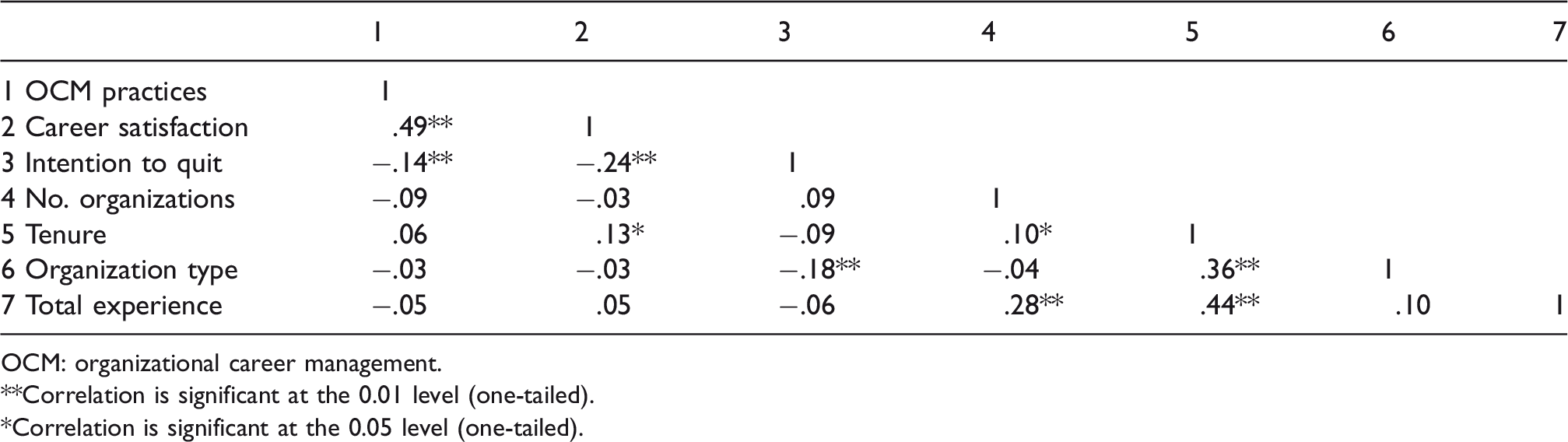
Summary data and correlations among all variables are provided in Table 1. As hypothesized, OCM practices were positively related to career satisfaction (r = .49, p < .001), and negatively related to intention to quit (r = −.14, p < .001), and career satisfaction was negatively correlated with intention to quit (r = −.24, p < .001).
Intercorrelations among study variables (N = 386).
OCM: organizational career management.
**Correlation is significant at the 0.01 level (one-tailed).
*Correlation is significant at the 0.05 level (one-tailed).
Test of hypotheses
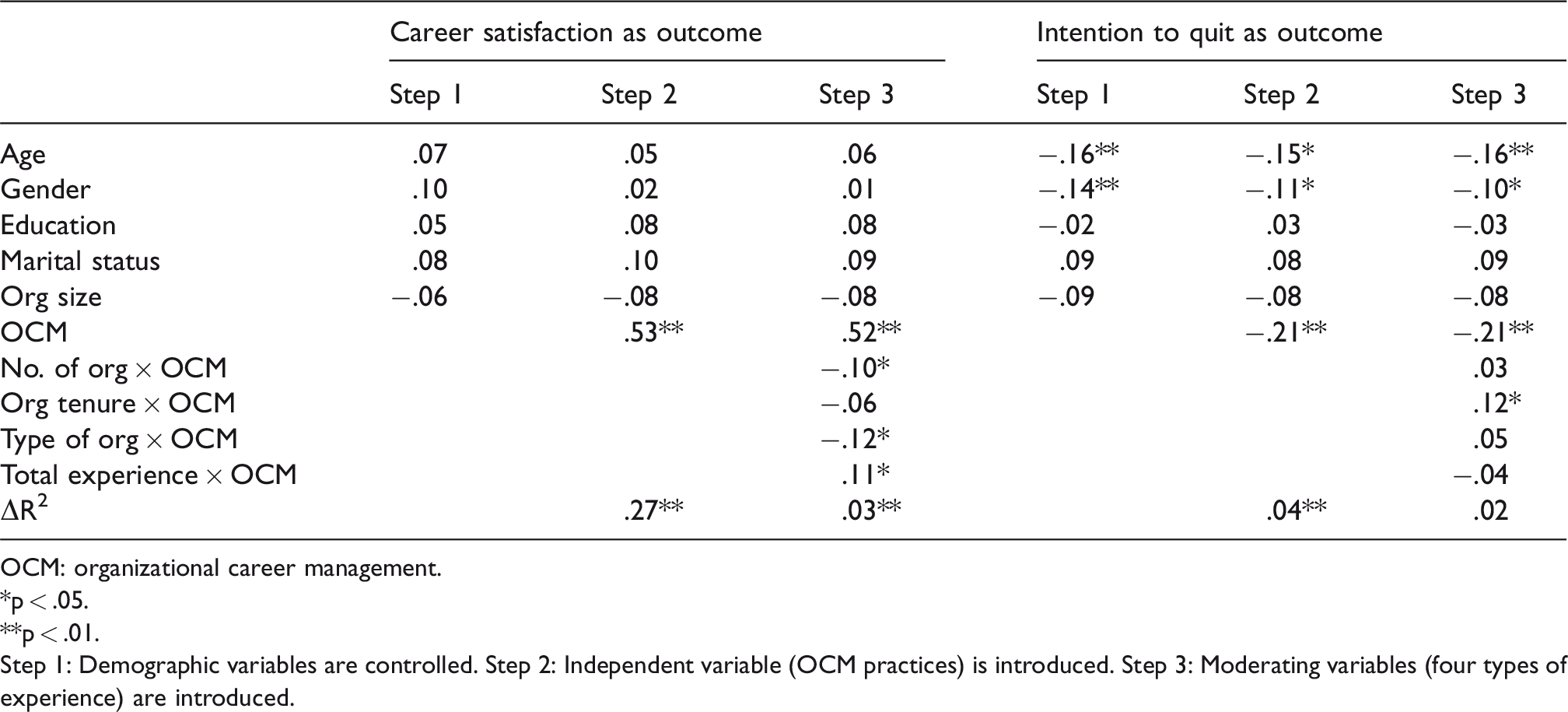
H1and H2 were that OCM practices were positively related to career satisfaction and negatively related to intention to quit. The hypotheses were tested using a hierarchical regression analysis (SPSS v21). As the results show (Table 2), OCM practices related positively to career satisfaction (β = .53, p < .01) and negatively to intention to quit (β = −.21, p < .01). Thus, H1 and H2 were supported.
Results of hypothesis tests using hierarchical regression (N = 386).
OCM: organizational career management.
*p < .05.
**p < .01.
Step 1: Demographic variables are controlled. Step 2: Independent variable (OCM practices) is introduced. Step 3: Moderating variables (four types of experience) are introduced.
H3 was that experience moderated the relationship between OCM practices and the two outcomes (career satisfaction and intention to quit). Four indices of experience were tested (i.e. number of organizations worked for, type of organization, organizational tenure, and total experience). Moderation effects were analysed by including interactive terms to the regression. The results indicated (Table 2) that the interaction of OCM practices and number of organizations worked for (β = −.10, p < .05), type of organization worked for (β = −.12, p < .05), and total experience (β = .11, p < .05) moderated the relationship with career satisfaction. On the other hand, only organizational tenure (β = .12, p < .05) moderated the relationship between OCM practices and intention to quit the organization.
As evident from Figures 2 to 4, experience (number of organizations worked for, type of organization, and total experience) moderated the relationship between OCM practices and career satisfaction. The number of organization worked for dampened the positive relationship between OCM practices and career satisfaction, the type of organization affected the relationship (more positive for public sector employees), while overall experience strengthened it. Organizational tenure moderated the relationship between OCM practices and intention to quit (Figure 5): the relationship is strengthened for those with low tenure.
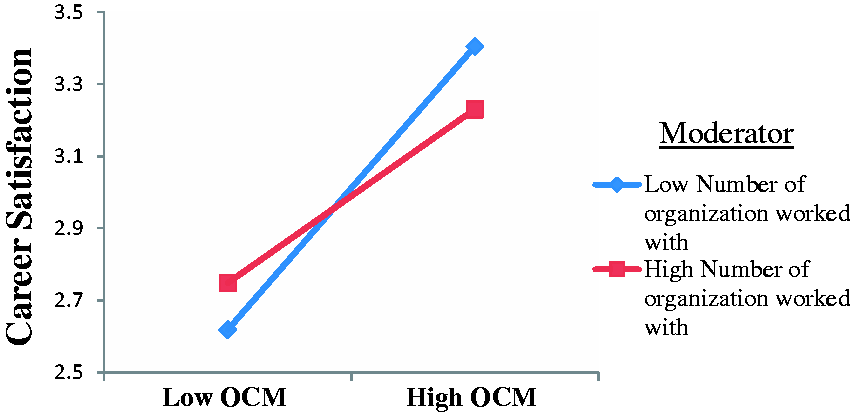
Moderating effect of number of organizations worked with on career satisfaction. OCM: organizational career management.
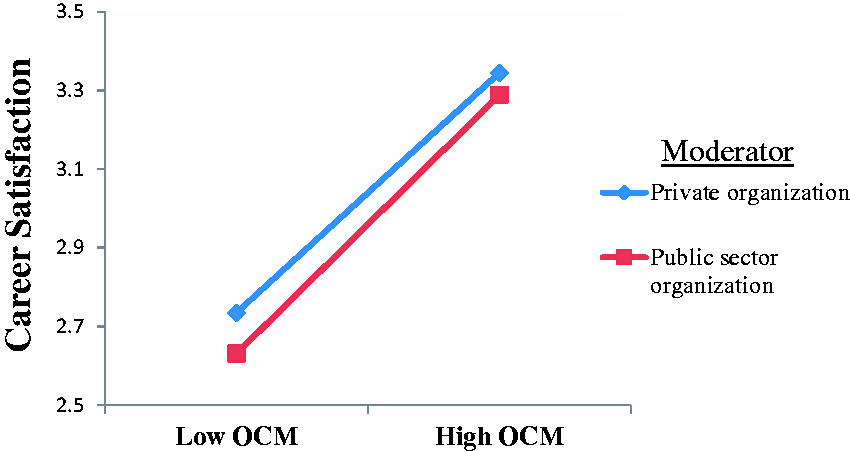
Moderating effect of type of organization worked with on career satisfaction. OCM: organizational career management.

Moderating effect of overall experience on career satisfaction. OCM: organizational career management.
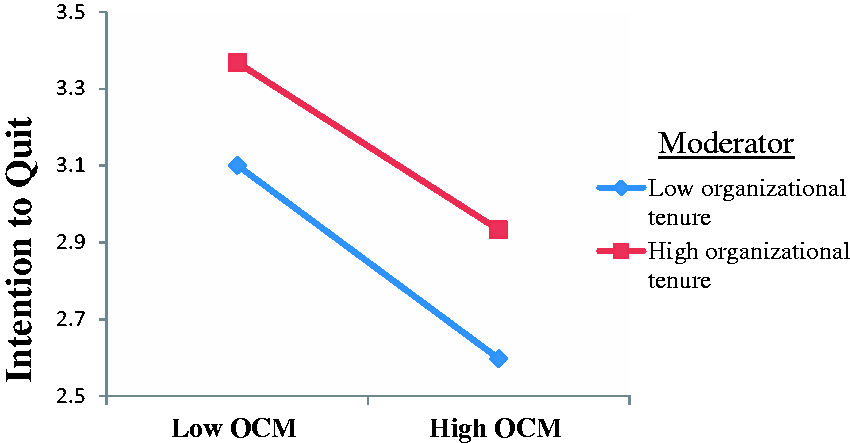
Moderating effect of organizational tenure on intention to quit. OCM: organizational career management.
Discussion
The results showed that the number of organizations worked for dampened the positive relationship between OCM practices and career satisfaction. One reason for this is that career satisfaction might be affected by the number of organizational changes, as this could disillusion workers or increase their stress levels. The finding is consistent with Arora (2015), who reported decreases in the level of satisfaction as the number of organizational changes increased. The second moderation effect revealed that the relationship between OCM practices and career satisfaction was stronger for those working in public sector organizations, which might reflect the better conditions in public service jobs. Third, the relationship between OCM practices and career satisfaction was stronger for those with more experience. Experienced employees can deal better with new information and situations (Walsh, 1995) and have developed sophisticated habits that help them work more efficiently (Dokko et al., 2009). They might be able to benefit by being more selective in the work they do, and have better support networks and access to knowledge and strategies, which can give them a better sense of accomplishment in their career. Experience also moderated between OCM practices and intention to quit, which was weaker for those with more tenure. Organizational experience helps the individual to know the type of support to draw upon, under what circumstances they can draw on support, and from whom they can get it (Reagans & McEvily, 2003). Further, employees with longer organizational tenure will have enhanced their ability to mobilize organizational resources, which can enhance their willingness to stay longer in the organization.
Implications
In order to ensure organizational continuity, careers are an important vehicle associated with investment of time and money. This raises concerns about benefits an organization can realize from career management. Given the rise of career patterns across organizations rather than within organizations, it is not unusual for organizations to doubt whether and how they should manage their employees’ careers. This study is a response to the call for attention to organizational benefits of managing careers for employees. Consistent with previous studies, this study found that OCM practices were related to increased career satisfaction and decreased intention to quit the organization among employees (e.g. Guan et al., 2014). The findings from the study provide support for the idea that supportive career practices can be an important predictor of career satisfaction and withdrawal behaviour of employees.
This study can be distinguished from previous studies on several grounds. First, the study introduced experience as a moderator to explain the patterns of links between OCM practices and their outcomes. The results demonstrated the roles of four types of work experience in predicting career satisfaction and intention to quit, and added new evidence on the predictive validity of work experience. Future research should continue to examine the effects of work experience on other relevant career outcomes, and continue to examine the underlying mechanisms for these effects, and should continue to explore the cultural factors that might shape the interactions among these variables.
Limitations and conclusions
First, the data collected were self-report. This might have contributed to common method bias, even though we endeavoured to minimize these effects. Second, future studies can also consider longitudinal studies to examine the underlying mechanisms for the relationships between OCM practices and its outcomes, as temporal precedence designs are better ways to determine the causal linkages between variables (Mathieu & Taylor, 2006).
To conclude, this study investigated the relationships between OCM practices and job satisfaction and turnover intention of Indian employees, and tested the moderating effects of four types of experience. The findings provide new insights into how various experiences can affect the link between career practices and satisfaction and turnover intentions of employees.
Footnotes
Declaration of Conflicting Interests
The author(s) declared no potential conflicts of interest with respect to the research, authorship, and/or publication of this article.
Funding
The author(s) received no financial support for the research, authorship, and/or publication of this article.