




Abstract
This paper utilises the national Survey of Disability Ageing and Carers to summarise the educational disadvantages and vocational inequalities for those with disabilities in Australia. Amongst persons with a disability, there is a decidedly lower rate of school completion. Distinctly fewer persons with a disability obtain degrees. Income is markedly reduced. Labour force participation is significantly lower, and the unemployment rate in 2015 was twice that of those without a disability. Alternate duties were provided in only 2% of cases and workplace accommodation made in 4% of instances. Supported employment was available in only 2.2% of cases. A disconcerting conclusion is that, over the past decade, the unemployment rate for those with a disability has been consistently higher. Suggestions are made for career development professionals to reverse some of the disadvantages reported.
Although the centrality of work for the individual, as well as the economic consequences of unemployment, apply as much to persons with a disability as they do for those without a disability, there is scant acknowledgement of disability in nearly all theories of vocational development (Athanasou, 2017). While it is well known that a disability emanates from a physical or behavioural condition, it encroaches on broader biopsychosocial functioning. Limitations can include cognition, emotion, communication, health care, household chores, meal preparation, mobility, property maintenance, reading or writing, self-care, or transport. For the layperson, however, a fundamental metric of disability is the extent to which such restrictions have an ultimate impact on the educational or vocational life of a person.
Background
For government agencies such as the Australian Bureau of Statistics (ABS, 2017), a disability is defined formally as a limitation, restriction, or impairment, which has lasted, or is likely to last, for at least six months and restricts everyday activities. The levels of restriction within this classification are categorised along a continuum as profound, severe, moderate, mild, and no disability (see Table 1 for a definition). By way of background, the level is defined in relation to the extent of ‘core activity limitation’, which is a limitation in the three key areas of (a) communication, (b) self-care, or (c) mobility.
Disability status, Australia.

Total excludes any persons who have an educational or employment restriction but not a core activity limitation.
Source: ABS (2017, Table 3.1).
The numbers involved are significant. Around 1.3 million are categorised as having a profound or severe core activity limitation. For the most part, the disabilities comprise mainly physical conditions (78.5%), but also mental and behavioural disorders (21.5%; ABS, 2017).
Typically, the effects of disability might first become apparent in the realm of education, schooling, or qualifications. A person is considered officially as having an education restriction (ABS, 2017) if he/she has difficulty participating, needs assistance from another person, or uses an aid or equipment in schooling or employment.
Naturally, the focus of career development practice has been on work, and within this context an employment restriction is defined (ABS, 2017) according to nine criteria. It involves someone being: (a) permanently unable to work, (b) restricted in the type of work they can or could do, (c) needing at least one day a week off work on average, (d) restricted in the number of hours they can work, (e) requiring an employer to provide special equipment, (f) modifying the work environment or making special arrangements, (g) requiring assistance from a disability job placement programme or agency, (h) needing ongoing assistance or supervision; or (i) finding it difficult to change jobs or get a better job. In this report, career development is examined through the lens of earnings, labour force status, types of occupations, workplace restrictions, and discrimination.
There is an overriding issue of the extent to which the restrictions in core activities (communication, self-care, or mobility) might affect earning and learning. First, the employment prospects for people with a disability have been considered on a continuum along which those higher functioning and needing less intensive employment support attained the same social outcomes as typical others (Holwerda, van der Klink, de Boer, Groothoff, & Brouwer, 2012; Mpofu & Mpofu, 2017). This expectation is tested in the Australian context. Second, the high rates of unemployment suggest a need for a firmer understanding of work participation. Eckstein, Purvi, and Wright (2017) surveyed 2804 vocational rehabilitation clients and reported that barriers to employment such as job seeking, transferable skills, or accessibility interacted with health barriers. Burgess and Cimera (2014) indicated the paradox of a high rate of unemployment persisting among people with disabilities despite an increase in their number seeking vocational rehabilitation services. Third, while various contextual socio-political factors are partly responsible for the suboptimal rates of employment of those with a disability, there are still attributes of the individual that are amenable to proactive change. For example, Choe and Baldwin (2017) merged data from the Survey of Income and Program Participation with O*NET data on job requirements. They found that good job matches resulted in higher wages and working longer hours.
In the absence of a coherent and structured theory of vocational development for persons with a disability, this paper seeks to document the learning and earnings consequences. It does this within the spirit of a type of dust-bowl empiricism (Miner, 2006, p. 17), that is, without an a priori theory (Nugent, 2013). Instead, it focuses on the consequences of disability through a secondary summary of the official statistics on disability and employment in Australia. It will be argued that – as in previous analyses (Athanasou, 1999, 2014, 2015) – the findings have implications for the earning and learning of Australians with a disability.
Method
Sources of data
The data for this study are based on the Survey of Disability Ageing and Carers, which is a randomly selected household sample throughout Australia (ABS, 2017). The survey was first conducted in 1998 and has been repeated in 2003, 2009, 2012, and 2015. The latest 2015 results were released in January 2017.
The advantage of this dataset is that it is formal, standardised, and collected on an agreed international basis. Moreover, it provides a nationally representative and historical dataset that is rare in the social sciences. It depicts inter alia, the broad landscape of disability, and the purpose of this report is to highlight those aspects that are most relevant to career development.
Data analysis approach
We applied a descriptive profiling approach to examine educational outcomes, employment restriction, earning capacity, labour force, occupation status, and discrimination. Our analysis aimed to consider the absolute or singular influence of the social inequality variables with no restrictions by their interactions.
Results and discussion
Educational restrictions
There are fewer factors in life that affect career development as much as educational preparation, and this is especially the case for people with disabilities. A schooling restriction arises if someone is: (a) unable to attend school, (b) attends a special school, (c) attends special classes at an ordinary school, (d) needs at least one day a week off school on average, or (e) has difficulty at school. The net outcome has been that people with disabilities have a lower rate of school completion and obtain fewer qualifications.
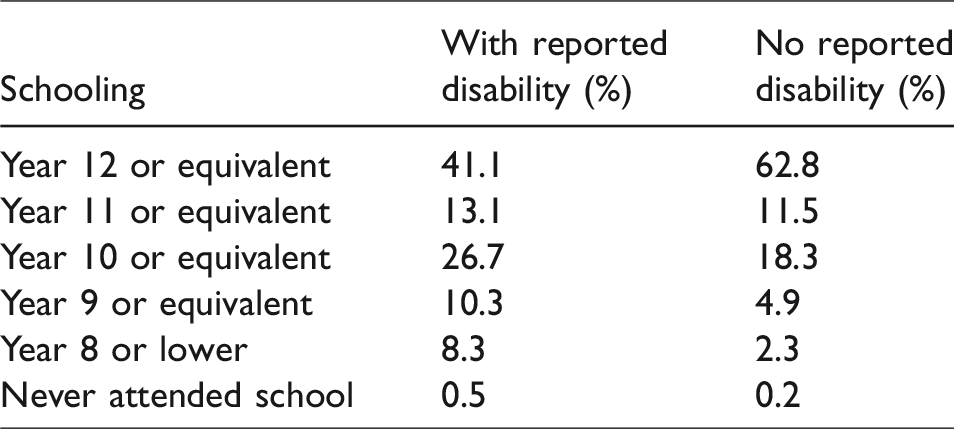
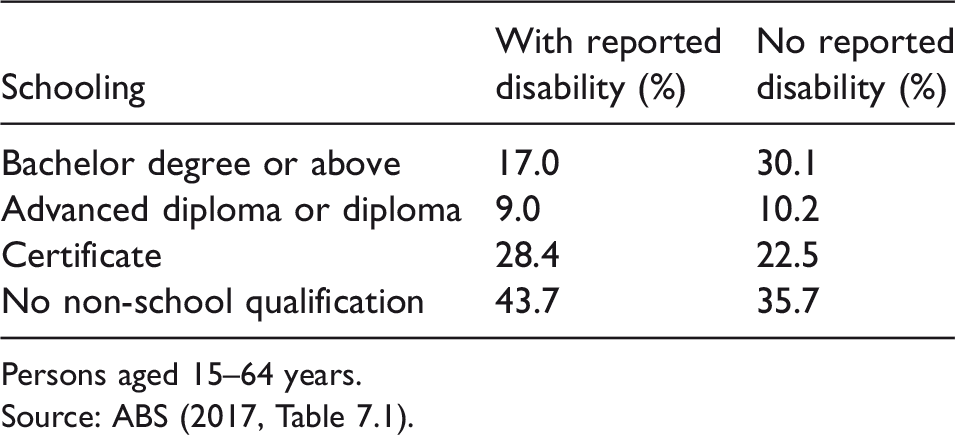
Completion of the highest level of secondary schooling (Year 12 or equivalent) is an important educational watershed and is achieved by 62.8% of those without a disability, but only 41% of those with a disability. This difference is shown in Table 2. In the area of non-school qualifications, people with disabilities fare worse for university degrees and diplomas (see Table 3). The higher level of certificate qualifications might reflect the fact that people with disabilities obtain lower-level Certificate I or Certificate II qualifications than the higher-level Certificates III or IV.
Disability status and highest year of schooling completed.
Disability status and level of highest non-school qualification.
Persons aged 15–64 years.
Source: ABS (2017, Table 7.1).
Employment restrictions
Earnings
There is a distinct and obvious implication of disability for earnings potential. The effect increases with the extent of the disability. First, the median gross personal income per week for persons aged 15–64 years with a disability was $465, compared with $950 per week for those without a disability. Second, there is a direct link between the extent of disability and earnings potential, which is illustrated in Figure 1. For those with a profound restriction, the median weekly gross income is $379, rising to $400 per week for those with a severe limitation, then $430 for those with a moderate limitation, and $500 per week for those with a mild limitation.
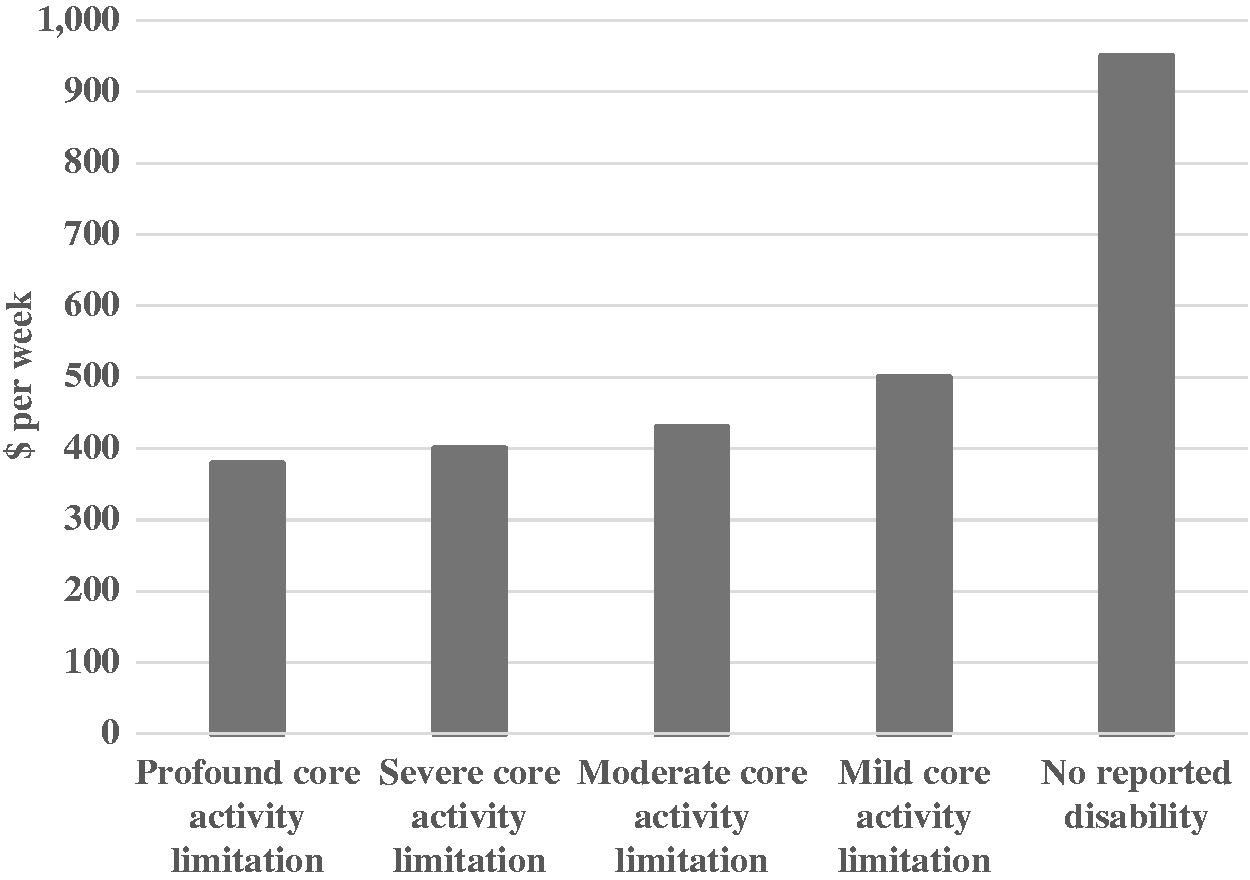
Median gross personal income per week ($) persons aged 15–64 years. Source: ABS (2017, Table 8.1).
Consequently, there is a huge difference in income over a working life. This effect can be described hypothetically. Someone with a disability who worked for 45 years would, on average, earn around $1,088,100 (in theory), compared with an average of $2,223,000 (in theory) for someone without a disability. In practice, the differences are likely to be far greater, given the lower labour force participation rate of persons with a disability and the shortened working life expectancy.
Labour force status
Disability has an overall impact on labour force participation, but also on the chances of obtaining work. First, a smaller proportion of people with a disability are in the labour force (53.4%) compared to those without a disability (83.2%). Second, even when they are able to participate in the labour market, persons with a disability have a much higher unemployment rate (10.0%) than those without a disability (5.3%). Third, the extent of labour market disadvantage increases directly with the extent of disability. This is shown in Figure 2 for labour force participation and Figure 3 for unemployment. Fourth, a higher proportion of persons with a disability are employed part-time (44%) compared to (32%) for those without a disability. The saving grace of these figures, and the undeniable positive aspect of these findings, is that persons with a disability do have employment potential.
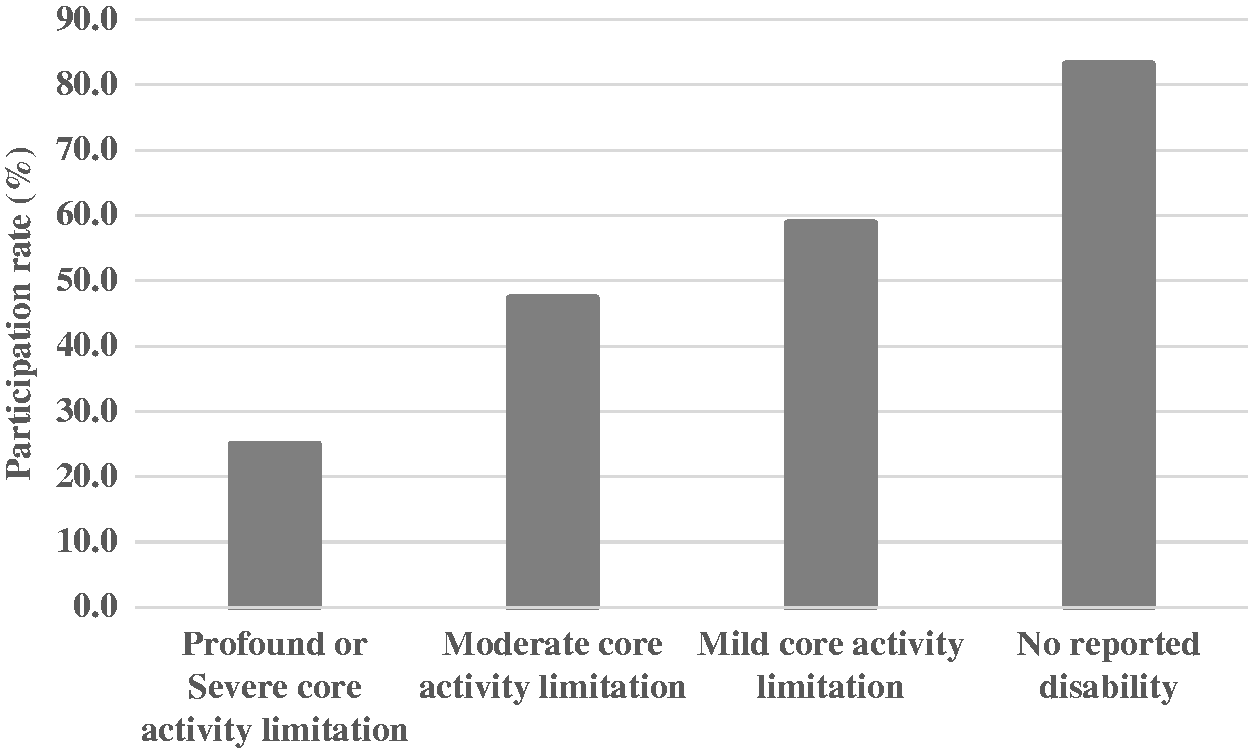
Disability status and labour force participation rate. Source: ABS (2017, Table 9.1).

Disability status and unemployment rate. Source: ABS (2017, Table 9.1).
Types of occupations
Employment amongst those with a disability is dominated by those in professional occupations, followed by clerical occupations, and then labourers. For the most part, the pattern of employment is consistent with that in the general population. There is a statistically significant difference (z = 3.81, p < .001) in the proportion of those with a disability who are labourers (.13) compared with the proportion of labourers in those without a disability (.09). The overall pattern of employment is summarised in Figure 4.

Occupation of main job and disability status. Note: Top bar in each category indicates ‘No reported disability’. Source: ABS (2017, Table 10.1).
The industry that accounted for the highest proportion (.04) of employees with a disability was Health Care and Social Assistance (see Figure 5). While it might be thought that government would also be a major employer of people with disabilities, there was a statistically significant lower proportion of employees with a disability working in Public Administration and Safety compared to those without a disability (.08 versus .07, z = 2.10, p < .01).

Industry of main job and disability status. Note: Top bar in each category indicates ‘No reported disability’. Source: ABS (2017, Table 10.1).
Workplace restrictions
The three general types of workplace restrictions that are encountered by those with a disability range from (a) restrictions in the type of job (32%), to (b) restrictions in the number of hours (21%), and (c) difficulty in changing jobs or getting a preferred job (26%) (ABS, 2017, Table 11.3).
In compensation contexts, it is a common idea that alternative duties (e.g. lighter duties) could be provided for injured employees, but the overall picture for persons with disabilities is that only around 2% of those working full-time or part-time were allocated different duties. There are government provisions for reasonable accommodations (e.g. aids or modifications) in the workplace, but only 4% of those employed were provided special equipment. Finally, the development of supported employment has been introduced into disability services, but it is used by only 2.2% of those employed (ABS, 2017, Table 11.3).
Discrimination
As a consequence of the results on education and training, it might not come as a surprise that some 8.6% of persons with a disability claim that they have experienced discrimination (ABS, 2017, Table 23.3). Of those who had experienced discrimination, almost one quarter (24%) experienced it from employers, and about 16% from work colleagues. Paradoxically, this discrimination from employers was less (14%) for those with profound or severe restrictions than for those with moderate or mild core activity limitations (25%; ABS, 2017, Table 24.3). Employer discrimination was fairly even across all the different types of disabilities (see Figure 6). As a result, some 24% of persons with a disability said that they avoided work situations due to their incapacity (ABS, 2017, Table 26.3).
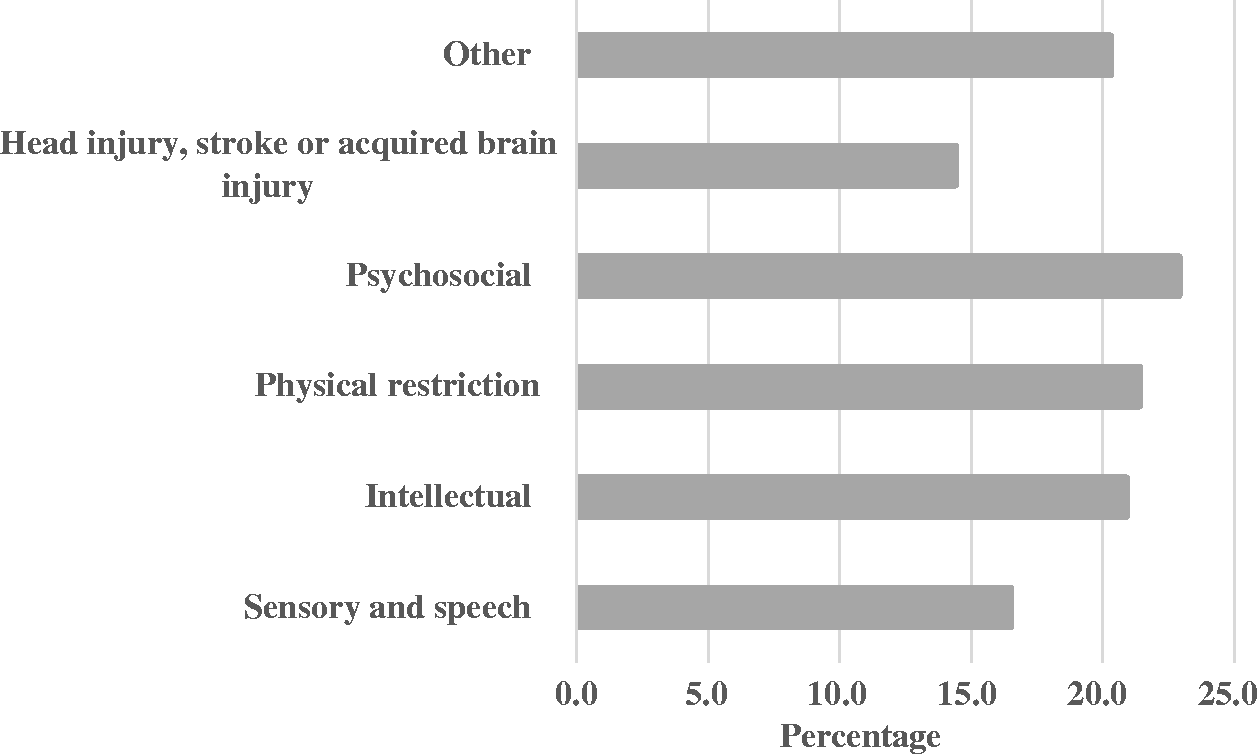
Proportion of those who experienced employer discrimination across disability groups. Source: ABS (2017, Table 24.3).
Career development and people with a disability
The basic finding of this report is one of educational and vocational disadvantage for persons with a disability. There is a decidedly lower rate of school completion. Distinctly fewer persons with a disability obtain degrees. There is a markedly reduced income. Labour force participation is reduced significantly, and the unemployment rate is clearly higher. Table 4 provides a succinct summary of these disadvantages. As if these factors were not enough, alternate duties were provided in only 2% of cases, and workplace accommodation made in 4% of instances. Effective services such as supported employment (i.e. on-the-job training) were available in only 2.2% of cases. It is as though there is no conscientious national effort to allay disability. To top it off, the discrimination experienced in 8.6% of cases is likely to be the tip of an iceberg of neglect and negativity (Ameri et al., 2018).
Summary of educational and vocational disadvantages for persons with a disability.

At the outset of this paper, it was stated that this evaluation was never more than a dust-bowl empiricism. Accordingly, no claim is made that this report is a complete analysis of the earning and learning implications of a disability in Australia. Nor is it asserted that the overall findings will automatically apply to every person with a disability, or to a particular chronic illness or condition. For instance, there is evidence that some persons with a disability will complete school, obtain a degree, participate in the labour force, or be employed at above a median level of income, but in each instance the comparable proportions are smaller.
One advantage of the latest official statistics is that they permit a historical analysis. It is of some concern that Figure 7(a) and (b) indicate: (a) a decline in the proportion of persons with a disability who are employed since 2005 (Figure 7(a)), but also (b) a corresponding increase in the proportion of persons with disabilities who are unemployed (Figure 7(b)). Despite a nationwide policy emphasis on reducing discrimination and enhancing affirmative action, there appears to be some evidence that overall, the career development prospects of persons with disabilities have not been helped. The causes for this are beyond the scope of this paper, but it might well serve as an indictment of a society that claims to be civil.

(a) Proportion of those with and without a disability who are employed 1995–2015 (persons aged 15–64 years, living in households) and (b) proportion of those with and without a disability who are unemployed 1995–2015 (persons aged 15–64 years, living in households). Source: ABS, 1990, 2014, 2017.
Implications for career development interventions
Career efforts that are consistent with (a) the promotion of self-efficacy (Bandura, 1986) or (b) the use of the psychological factors specified in the Theory of Reasoned Action and Theory of Planned Behaviour (Ajzen, 1988) might be worthy of consideration. When career development services have been designed consistent with those theoretical frameworks (see Murphy, 2009), they have (albeit half a century ago) achieved vast increments to the labour force participation rates of those with various chronic conditions.
Furthermore, the issue of increased labour force participation is of priority importance for those who wish to work. A promotion of effective job seeking by someone with a disability is consistent with the ‘value-laden beliefs and principles’ of the social psychologist Beatrice Wright whose classic, 1983 monograph ‘Physical disability: A psychosocial approach’ stressed the importance of human services to facilitate full community participation, including labour force participation, of those living with disability.
Perhaps a key issue for Australian career development professionals is how to improve the labour force participation rate of someone with a disability. Although it is beyond the specific remit of this paper, it is still apt to reiterate the first 10 of the general principles outlined by Wright more than 30 years ago. These might well form a modus operandi for enhancing the learning and earning potential of persons with a disability, viz.:
Every individual needs respect and encouragement; the presence of a disability, no matter how severe, does not alter these fundamental rights. The severity of a handicap can be increased or diminished by environmental conditions. Issues of coping and adjusting to a disability cannot be validly considered without examining reality problems in the social and physical environment. The assets of the person must receive considerable attention in the rehabilitation effort. The significance of a disability is affected by the person’s feelings about the self and his or her situation. The active participation of the client in the planning and execution of the rehabilitation programme is to be sought as fully as possible. The client is seen not as an isolated individual but as part of a larger group that includes other people, often the family. Because each person has unique characteristic and each situation its own properties, variability is required in rehabilitation plans. Predictor variables, based on group outcomes in rehabilitation, should be applied with caution to the individual case. All phases of rehabilitation have psychological aspects (Wright, 1983, pp. xi–xvii)
Although there have been remarkable developments in modern medicine (e.g. greatly increased survival rates from injury) and progress in work-related technology (e.g. prostheses, communication equipment), there still exists a “disability paradox” in western nations such as Australia (Aylward, 2016). The paradox is that the medical and technological advances have not seen a correlated decrease in ‘work incapacity’. The career and vocational prospects of persons with a disability are disadvantaged.
Footnotes
Acknowledgement
The helpful comments of two anonymous reviewers are gratefully acknowledged.
Declaration of conflicting interests
The author(s) declared no potential conflicts of interest with respect to the research, authorship, and/or publication of this article.
Funding
The author(s) received no financial support for the research, authorship, and/or publication of this article.