



Abstract
The fit between the values of an individual and the work environment (person–organisation fit) is related to organisational citizenship behaviours and counterproductive work behaviours. Research has found that job satisfaction is a predictor of organisational citizenship behaviours and counterproductive work behaviours. Meanwhile, person–organisation fit is highly predictive of job satisfaction; thus, it is unclear if person–organisation fit relates to the use of organisational citizenship behaviours and counterproductive work behaviours beyond its shared relationship with job satisfaction. This study aimed to determine the extent to which person–organisation fit relates to the use of these behaviours outside of relations with job satisfaction. Results from an online sample of 392 employed adults found worker person–organisation fit was related directly to engaging in organisational citizenship behaviours and indirectly through increased job satisfaction. However, engagement in fewer counterproductive work behaviours occurred only as a function of being dissatisfied with one’s job. Implications about the importance of fit are discussed.
Keywords
Prosocial behaviours that benefit the organisation or coworkers, such as helping colleagues voluntarily, are known as organisational citizenship behaviours (OCBs; Organ, 2018). Alternatively, behaviours that violate social norms and potentially harm coworkers or the organisation, such as stealing from work or leaving early without permission, are known as counterproductive work behaviours (CWBs) or workplace deviance behaviours (Bennett & Robinson, 2000). Research on OCBs and CWBs has received considerable attention in the organisational literature, partially due to motivation to discover ways to curb CWBs given the high cost of losses of both time and property for employers because of these behaviours (Association of Certified Fraud Examiners, 2018). This focus has helped to ascertain that there are individual characteristics (e.g. age, gender, personality and trait affect) as well as situational factors (e.g. organisational injustice) that can influence these deviant and prosocial behaviours (Dalal & Carpenter, 2018). For example, OCBs and CWBs have previously been shown to relate differently to specific personality traits such that agreeableness, emotional stability (the opposite of neuroticism) and conscientiousness, which have negative relationships with CWBs (Pletzer, Bentvelzen, Oostrom, & de Vries, 2019), while having positive relationships with OCBs (Chiaburu, Oh, Berry, Li, & Gardner, 2011). Other studies have found differences in these behaviours between genders (e.g. Berry, Ones, & Sackett, 2007; Dalal, 2005; Hershcovis et al., 2007), indicating that men perform more CWBs than women.
Despite the benefit of establishing these connections between personality, gender and engagement in OCBs and CWBs in the workplace, these static variables present a challenge to manipulate for intervention. Emerging research investigating the connection between person–environment fit (P–E fit) and OCBs and CWBs may provide a promising avenue for intervention. Globally, the construct of P–E fit refers to the match between an individual and his or her vocation or work environment, and dates back to Parsons’ (1909) discussion of fit in the scope of vocational guidance. Since that time, more specific aspects of fit with one’s environment have been discussed. Of particular relevance is person–organisation fit (P–O fit), which is understood as the compatibility that an individual has with his/her organisation, including fit between personalities, values or goals (Kristof-Brown, Zimmerman, & Johnson, 2005). While there has been much discussion in the literature regarding the relevance of different characteristics, one common operationalisation of P–O fit is the perceived fit between one’s values and that of his/her organisation (Kristof-Brown et al., 2005).
P–O fit has been shown to be relevant in understanding engagement in both OCBs and CWBs (Hershcovis et al., 2007; Hoffman & Woehr, 2006; Iliescu, Ispas, Sulea, & Ilie, 2015; Organ & Ryan, 1995). Specifically, it has been found that P–O fit predicts greater OCBs (Hoffman & Woehr, 2006) and lower CWBs (Iliescu et al., 2015). Other research supports that employees who report higher job satisfaction also engage in more OCBs (Organ & Ryan, 1995) and less CWBs (Hershcovis et al., 2007). However, P–O fit is highly related to job satisfaction (Kristof-Brown et al., 2005), so it is unclear if fit relates to use of OCBs and CWBs solely due to the relationship between P–O fit and job satisfaction, or also because it is independently associated with use of these behaviours. Initial research investigating this hypothesis in a sample of salespersons by Vilela, González, and Ferrín (2008) suggests that job satisfaction mediates the relationship between P–O fit and OCBs; yet, no research has been applied to the case of CWBs. To advance understanding of the role of fit in workplace behaviours, the current study examined the mediating role of job satisfaction in the relationships between P–O fit and these workplace behaviours to further inform interventions in this area.
Counterproductive workplace behaviours
Intentional behaviours that violate workplace norms and threaten the overall wellbeing of fellow employees or the organisation are considered deviant workplace behaviours (Bennett & Robinson, 2000; Robinson & Bennett, 1995). These actions are also known as counterproductive workplace behaviours (CWBs), as they are counterproductive to the interests and mission of the organisation, whether or not the behaviour ultimately results in harm (Sackett, 2002).
Robinson and Bennett (1995) made a distinction that the targets of these behaviours can be distinguished, as some behaviours are directed towards other individuals, and thus are interpersonal in nature (CWBs-I), while other behaviours are directed toward the organisation (CWBs-O). Research has supported the distinction of these two forms of CWBs based on factor analysis (Bennett & Robinson, 2000) and evidence of discriminant validity, given correlations among CWBs-I, CWBs-O and other constructs (Berry et al., 2007; Dalal, 2005).
The separate dimensions of CWBs (i.e. CWBs-I and CWBs-O) have differing relationships with both individual difference variables and situational variables. Hershcovis et al. (2007) reported that men engaged in more CWBs-I (p = .21) and CWBs-O (p = .13) than women. Furthermore, results from Berry et al. (2007) suggest that conscientiousness is more strongly related to CWBs-O (p = –.42) than CWBs-I (p = –.23), while agreeableness is more strongly related to CWBs-I (p = –.46) than CWBs-O (p = –.32).
Organisational citizenship behaviours
In contrast to CWBs, OCBs are voluntary workplace behaviours that benefit or improve the organisation that employees are not required to perform (e.g. coming in to work early to further productivity; Organ, 2018). Much of the research concerning OCBs has examined possible antecedents that positively influence this extra-role behaviour. Examples of these include personality traits, employee attitudes and leadership behaviours (Organ, 2018; Organ & Ryan, 1995).
Similar to CWBs, the construct of OCBs has been theorised to include two dimensions, interpersonal or altruistic citizenship behaviours (OCBs-I), enacted to help coworkers, and organisational or generalised compliant citizenship behaviours (OCBs-O), enacted to help the organisation (Dalal, 2005; Smith, Organ, & Near, 1983). These two dimensions of OCBs have been found to have different relationships with other constructs. Smith et al. (1983) found that OCBs-I had stronger relationships than OCBs-O with job satisfaction, education and neuroticism. In that study, results also indicated that performance of OCBs-O was more directly affected by age, birth order of siblings and leader supportiveness. OCBs-O also have been shown to generate more positive job performance ratings than that of OCBs-I or even task performance itself, indicating that individuals who perform more OCBs-O gain more approval than those who have better task performance (Podsakoff, Whiting, Podsakoff, & Blume, 2009).
Researchers also have identified a strong negative relationship between OCBs and CWBs (Sackett, 2002). As such, individuals who perform more OCBs tend to perform fewer CWBs and vice versa. This is especially true with CWBs-O and OCBs (Berry et al., 2007). However, Dalal (2005) found that the relationship between OCBs and CWBs is modest at most, given a mean correlation of –.32 from a meta-analysis of 49 studies. Furthermore, in Dalal’s (2005) meta-analysis of the relationship between OCBs and CWBs, stronger relationships between OCBs-I and OCBs-O (ρ = .64) as well as CWBs-I and CWBs-O (ρ = .70) were found rather than between OCBs-I and CWBs-I (ρ = –.11) or OCBs-O and CWBs-O (ρ = –.33). Therefore, examination of the separate components of workplace behaviours directed at individuals and the organisation is warranted.
Person–organisation fit
Both theory and research support the relations between P–O fit and counterproductive and citizenship behaviours. Iliescu et al. (2015) posit that P–O fit’s effect on CWBs can be attributed to self-regulation theory (Lord, Diefendorff, Schmidt, & Hall, 2010). Self-regulation theory explains that frustration can arise as a result of the discrepancy between one’s experienced versus ideal state, where individuals are then motivated to reduce this discrepancy. As a result, individuals can either adjust their expectations or influence the environment. Consequently, CWBs are behaviours directed towards the environment and/or others to lessen this discrepancy and reduce negative feelings. In a similar vein, other scholars have suggested that P–O fit’s relationship with citizenship behaviours can be explained by cognitive–affective personality system (CAPS) theory (Resick, Giberson, Dickson, Wynne, & Bajdo, 2013). This theory suggests that individuals recognise qualities of their workplace environment that have personal relevance. This insight increases their perception of fit, and, depending on their expectancies, goals/values, affect and self-regulation of behaviour, they enact discretionary citizenship behaviours. This adds to their self-evaluations and observations about themselves, increasing their perceived fit. Resick et al. (2013) also suggest that perceived fit within one’s vocation can influence the belief that the fate of the organisation is equivalent to the fate of the individual, increasing one’s motivation to enact OCBs. Additionally, this research proposes that positive affect, which can be due to P–O fit (Isen & Baron, 1991; Mischel & Shoda, 1995), can help to generate more prosocial behaviour.
The mediating role of job satisfaction
Job satisfaction also appears to play a key role in the use of OCBs and CWBs. Job satisfaction can be understood as one’s outlook or evaluative judgement about one’s job or job experiences ranging from negative to positive (Locke, 1976; Weiss, 2002). While a number of different theories exist on the nature of job satisfaction as derived from dispositions, affect or cognitive processes (Judge, Weiss, Kammeyer-Mueller, & Hullin, 2017), most relevant to the current study are dispositional theories that also address trait affect. This group of theories explicates that the origin of job satisfaction is based on dispositional affective experiences, such as one’s tendency to experience positive and negative affect overall, leading to individuals having generally more positive or negative appraisals of their job (Judge & Larsen, 2001). This assertion has been supported by meta-analytic studies (Connolly & Viswesvaran, 2000). Moreover, Judge and Larsen (2001) note the role of situational factors, such as one’s everyday experiences at work, as also having influence on subsequent appraisals of job satisfaction.
Increased job satisfaction seems to influence an individual’s tendencies of enacting OCBs (Organ & Ryan, 1995). Although studies document wide variability in the relationship between job satisfaction and overall performance (Judge et al., 2017), high job satisfaction is prevalent in individuals who perform OCBs (Organ & Ryan, 1995). Furthermore, Huang, You, and Tsai (2012) found that when satisfaction with one’s coworkers increases so does citizenship behaviours directed at coworkers, but not those directed at the organisation. While personality traits relate to both job satisfaction (Judge, Heller, & Mount, 2002) and OCBs (Chiaburu et al., 2011), Ilies, Fulmer, Spitzmuller, and Johnson (2009) found that job satisfaction explained the use of OCBs more than agreeableness or conscientiousness in a meta-analytic study. In the same study, they showed that job satisfaction related more to OCBs-O than OCBs-I (Ilies et al., 2009). The relationship between job satisfaction and citizenship behaviours also can be understood as a function of fit within an organisation (Verquer, Beehr, & Wagner, 2003). Vilela et al. (2008) argued that P–O fit, defined as value congruence or how closely one’s values are compatible with the values of an organisation, predicts employees’ job satisfaction alongside the use of OCB.
While job satisfaction has been shown to have a role as an antecedent of OCBs (Huang et al., 2012; Organ & Ryan, 1995; Vilela et al., 2008), previous research also has indicated that deviant behaviours, or CWBs, are negatively associated with job satisfaction (Dalal, 2005; Judge, Scott, & Ilies, 2006; Mount, Ilies, & Johnson., 2006). Mount et al. (2006) indicated that employees may retaliate or enact revenge when dissatisfied with their work environment or conditions. Dalal (2005) found negative correlations between job satisfaction and CWBs (ρ = –.37). The assumption is that employees who are dissatisfied with their jobs may become aggressive towards the organisation attempting to regain some form of control over their job (Judge et al., 2006). Overall, job satisfaction is an important predictor of workplace behaviours (i.e. OCBs and CWBs). Comparatively, job satisfaction seems to have a stronger, albeit negative, relationship with CWBs (ρ = –.37) than OCBs (ρ = .16; Dalal, 2005).
Job satisfaction is strongly predicted by P–O fit (Kristof-Brown et al., 2005), and because OCBs arise as a consequence of P–O fit (Hoffman & Woehr, 2006), it is likely that job satisfaction mediates the relationships between P–O fit and work behaviours. As mentioned previously, the CAPS theory suggests that as individuals make cognitive appraisals of their fit with their work environment, they enact behaviours that are demonstrative of that fit (Resick et al., 2013). Theories of job satisfaction also note that situational factors, such as P–O fit in this case and dispositional affect (Judge & Larson, 2001), predict one’s appraisal of being satisfied or dissatisfied in one’s job. Further examination of the role of job satisfaction in the relationship between P–O fit and counterproductive/citizenship behaviours may provide meaningful evidence that job satisfaction is the conduit by which P–O fit affects workplace behaviours. Verquer et al. (2003) posit that individuals with higher P–O fit can be expected to have higher levels of job satisfaction, which, in turn, may cause them to perform more OCBs. P–O fit theory proposes value congruence between employees and their organisation leads to job satisfaction and favourable outcomes in achieving organisational goals by enacting OCBs (Vilela et al., 2008). Initial research has examined these links finding support that job satisfaction mediates the relationship between P–O fit and OCBs (Vilela et al., 2008). Additionally, P–O fit has been shown to be positively related to employee need satisfaction, which then positively predicts OCBs-I (Yen, 2015). However, this research, along with Vilela et al.’s (2008) research, has been limited to few occupational samples, such as salespersons. Therefore, further study of these relationships in diverse occupational samples can contribute to the literature and examine the generalisability of these findings.
Despite evidence that job satisfaction mediates the relationship between P–O fit and OCBs (Verquer et al., 2003; Vilela et al., 2008), research on a possible mediation between P–O fit and CWBs by job satisfaction has been neglected. However, as aforementioned, individuals who are satisfied as well as fit with their jobs enact less CWBs (Demuth, 2006; Iliescu et al., 2015; Judge et al., 2006). It is important to investigate these relationships further to understand the mechanisms by which P–O fit relates to both counterproductive and citizenship behaviours.
The current study
While much research has been produced that examines antecedents of both CWBs and OCB, less research has investigated these behaviours in combination, or in response to perceived P–O fit. Additional attention on these constructs is critical as deviant acts can harm organisations and the individuals that work within them (Robinson & Bennett, 1995). Behaviours such as stealing or vandalising property can be costly for employers; therefore, a better comprehension of why they occur and how to prevent them is essential. This is imperative given estimates that around 5% of business revenues are lost to fraud and theft, which when applied to global revenues, amounts to a staggering estimated $4 trillion in losses (Association of Certified Fraud Examiners, 2018). Furthermore, if individuals can be screened during the hiring process for their potential fit with the organisation, then the necessity to fire/rehire employees based on counterproductively can be avoided.
Conversely, engagement in OCBs not only benefits the organisation and other employees, but also the individual him/herself. Employees who perform these prosocial acts have increased wellbeing at work, while experiencing increased vigour and energy at the end of the workday (Lam, Wan, & Roussin, 2016). As Lam et al. (2016) suggest, work environments with higher levels of OCBs can be expected to have better employee relationships and vice versa. In addition, a good work environment (e.g. good social atmosphere, fair and competent supervision and organisational satisfaction) predicts engagement in more OCBs (Turnipseed & Murkison, 2000). Podsakoff and MacKenzie (1997) indicate that work groups that are more successful (i.e. higher sales, higher production quantity and quality, higher revenue, lower costumer complaints and higher customer satisfaction) are performing more citizenship behaviours. Overall, fostering work environments that may increase OCBs can help an organisation to reduce costs and increase productivity, which speaks to the importance of furthering this area of research.
The goal of the current study was to examine if job satisfaction mediates the relationship between P–O fit and workplace behaviours (i.e. CWBs and OCBs) with a broader representation of occupations. As separate dimensions of workplace behaviours (i.e. interpersonal and organisational) have been shown to relate differently to job satisfaction and P–O fit (Ilies et al., 2009; Smith et al., 1983), the current study examined the magnitude of this difference within a mediation model. Considering evidence that the relationship between P–O fit and OCBs is positive (Hoffman & Woehr, 2006), while a negative relationship between P–O fit and CWBs exists (Iliescu et al., 2015), we expected to replicate these findings. Since P–O fit pertains to perceptions of the organisation, it was expected that the relations between P–O fit and counterproductive and citizenship behaviours directed towards the organisation would be stronger, relative to behaviours directed towards individuals. As depicted in Figure 1, we made the following predictions:

The relations between person–organisation fit and workplace behaviours as mediated by job satisfaction.
Hypothesis 1a. P–O fit will relate to increased use of OCBs and decreased use of CWBs.
Hypothesis 1b. The magnitude of the relationships between P–O fit and OCBs-O and CWBs-O will be greater than those between P–O fit and OCBs-I and CWBs-I.
Given theoretical assumptions that the relationship between P–O fit and workplace behaviours arises out of affective experiences, and additional evidence of direct relationships between job satisfaction and OCBs or CWBs (Dalal, 2005; Judge et al., 2006; Kristof-Brown et al., 2005; Organ & Ryan, 1995), we sought to examine the possibility that job satisfaction mediated the relationships between P–O fit and workplace behaviours. Hypothesis 2a. Job satisfaction will mediate the relationship between P–O fit and OCBs. Hypothesis 2b. Job satisfaction will mediate the relationship between P–O fit and CWBs.
Method
Participants
A sample of 392 employed adults (60.7% men and 39.3% women) with a mean age of 32.18 years (SD = 9.97) from across the United States of America was recruited through Amazon’s Mechanical Turk (MTurk) service. MTurk is a crowdsourcing service where individuals can earn money by completing tasks that require human reasoning, such as categorising photos (Amazon Mechanical Turk, 2018). The sample was 75.5% White or Caucasian, 9.4% Black or African American, 6.4% Hispanic/Latino and 5.9% Asian American. Native Hawaiian, American Indian, Pacific Islander and Multicultural/Multiracial individuals comprised the remaining 2.9%. Participants reported residing in one of 44 states or USA territories. Educational attainment varied with 0.5% reporting not having a high school diploma, 13.5% having only completed high school, 28.6% having some college, 11.3% having a vocational certificate or associate’s degree, 34.4% having a bachelor’s degree, 11.0% having a master’s degree and 0.8% having a doctoral or professional degree. On an average, participants reported being in their job for 56.6 months (SD = 55.6, range 1–456 months) and working 37.8 hours (SD = 12.25) per week. The most frequently reported occupational categories were marketing and sales (15.8%) and education (9.7%), while government (2.6%) and law and public safety (2.6%) were the least frequently reported categories.
Measures
Demographics. Questions concerning participants’ age, race, sex, educational level, state of residence and information on participants’ jobs (e.g. tenure, occupational category and full or part-time status) were collected.
P–O fit. An individual’s perceived fit was assessed using a three-item measure of perceived organisational fit from Cable and DeRue (2002). Participants responded to statements with Likert scale responses (1 = strongly disagree to 7 = strongly agree). An example item is, ‘The things that I value in life are very similar to the things that my organisation values.’ Satisfactory evidence of validity based on relationships between this measure and measures of work attitudes (Cable & DeRue, 2002) has been found. Cable and DeRue (2002) report an internal consistency of α = .91 for the three items in a single-firm sample and found α = .92 in a multiple-firm sample. The current sample had alpha coefficient of α = .97.
Job satisfaction. Respondent job satisfaction was measured using a five-item inventory from Brayfield and Rothe (1951), which assesses overall job satisfaction. Participants responded to statements using a five-point scale (1 = strongly disagree to 5 = strongly agree). One example of an item from the inventory is, ‘I feel fairly well satisfied with my present job.’ Brayfield and Rothe (1951) reported a split half reliability coefficient of .87. A Cronbach’s alpha of .93 was found for the current sample. Supportive evidence of validity and reliability for scores on this measure has been found (Judge, Locke, Durham, & Kluger, 1998).
CWBs. Counterproductive behaviours were assessed using 19 items from a measure of workplace deviance by Bennett and Robinson (2000). Items assess the frequency (1 = never engaging in such behaviours in the last year to 7 = daily engaging in this behaviour in the last year) of engaging in deviant behaviours in the workplace. There are two subscales within this measure: seven items measuring organisational (e.g. ‘taken property from work without permission’) and 12 items measuring intrapersonal (e.g. ‘made fun of somebody at work’) deviance. Favourable evidence of convergent validity of this measure has been found given high correlations (i.e. r = .59 to .79) between this measure and other scales examining deviant workplace behaviours, and supportive evidence of divergent validity given low correlations (r = .23 to .42) between this measure and scales examining non-deviant workplace behaviours (Bennett & Robinson, 2000). The alpha coefficient for the current sample was .87 for the interpersonal scale and .88 for the organisational scale.
OCBs. OCBs were measured using a 16-item questionnaire created by Lee and Allen (2002). The two subscales of this measure assess positive organisational behaviours (e.g. ‘keep up with developments in the organisation’) and behaviours directed towards individuals (e.g. ‘go out of the way to make newer employees feel welcome in the work group’). Lee and Allen (2002) report favourable evidence of construct validity for the subscales given correlations with personality traits, affect and CWBs. Acceptable evidence of internal consistency has been found as well (α = .83 for the individual subscale and α = .88 for the organisational subscale; Lee & Allen, 2002). Internal consistency for the interpersonal scale was α = .89 and α = .94 for the organisational scale for the current sample.
Procedure
Online advertisement of the study on MTurk was used to recruit participants. Buhrmester, Kwang, and Gosling (2011) found that MTurk allows for diverse and more representative sample than usual Internet and normative samples. Only individuals indicating that they were currently employed were recruited to participate. After individuals attested to being over the age of 18 years, employed and consented to participate, they were directed to start the survey administered via Qualtrics, an online survey system. Once participants finished the survey, they were compensated $1.50 for their time. Study procedures were approved by an institutional review board.
Data analysis
Prior to conducting data analysis, data were examined for missingness and normality. During this process, cases where a participant was missing data for an entire measure (n = 5) were removed. Additionally, validity checks were performed on the data by examining participant responses across measures. Data were also removed (n = 15) for participants that appeared to not be attending to questions (e.g. selecting the same answers across most items and completing the survey in an unrealistic amount of time). After deleting these cases, a final total of 392 surveys remained for study analyses.
Among the final sample of participants, the highest amount of missing data for a particular question was .02% (n = 6; equally for three items on the OCBs measure). All missing data points were replaced with sample mean substitution given the recommendation for use of this method in cases with little missing data (Parent, 2013).
Results
Correlations for all variables (Table 1) ranged from −.28 to .69, which suggests that discriminant validity among the variables was sufficient. Internal consistency for all measures (diagonal in Table 1) ranged from .87 to .97, indicating high reliability for each measure. Age and sex (0 = female and 1 = male) were entered as control variables within the analysis, with direct paths to OCBs and CWBs modelled based on previous literature suggesting relationships between workplace behaviours and these variables (Berry et al., 2007; Dalal, 2005; Hershcovis et al., 2007), which was confirmed in the current sample. Using AMOS 23.0 Structural Equation Modelling programme (Arbuckle, 2014), a model was produced which incorporated the hypothesised pathways between fit and workplace behaviours, as mediated by job satisfaction using the observed total scores for each measure. OCBs-I and OCBs-O as well as CWBs-I and CWBs-O were allowed to correlate. The model depicted in Figure 1 was tested, finding Chi square was significant, χ2 (8, N = 392) = 15.63, p < .05. Other fit indices support that the model was an excellent fit (CFI = .99, RMSEA = .05 with a 90% confidence interval ranging between .00 and .09) to the data.
Correlations among study variables.
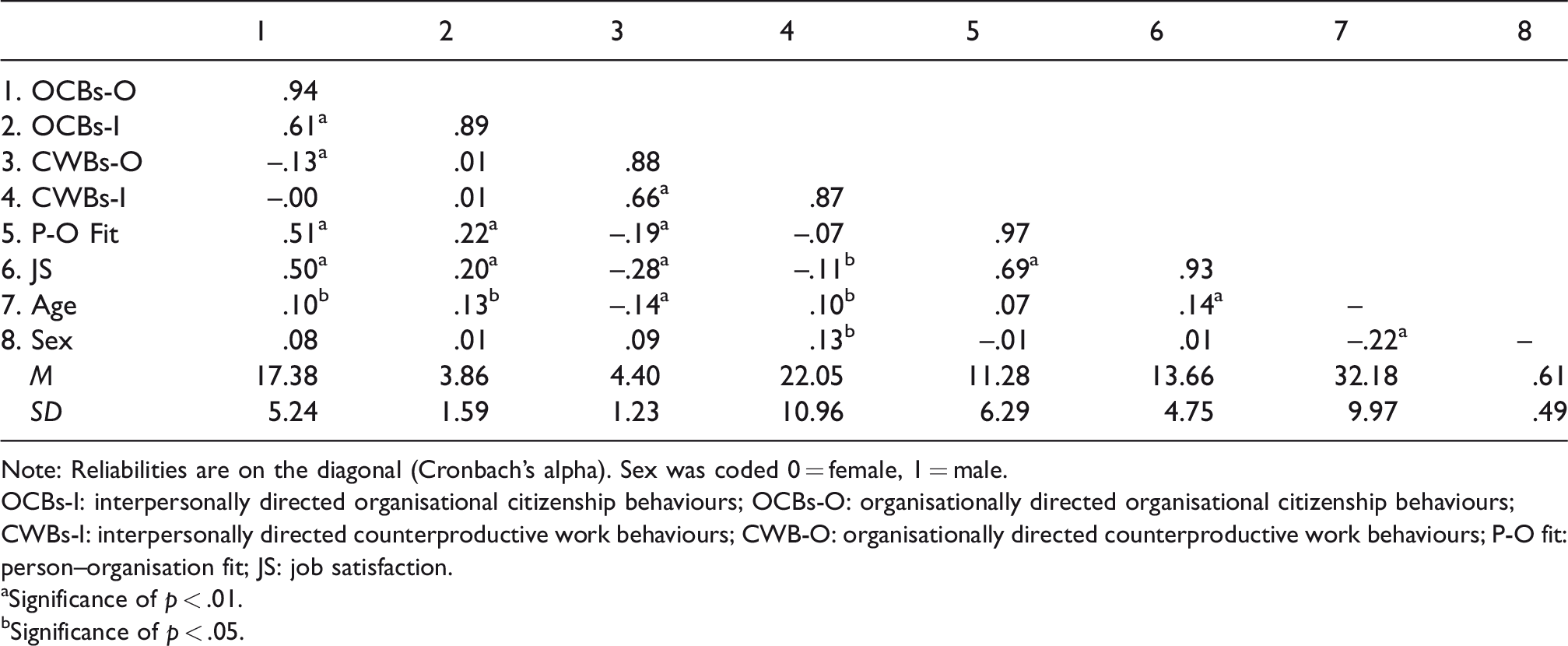
Note: Reliabilities are on the diagonal (Cronbach’s alpha). Sex was coded 0 = female, 1 = male.
OCBs-I: interpersonally directed organisational citizenship behaviours; OCBs-O: organisationally directed organisational citizenship behaviours; CWBs-I: interpersonally directed counterproductive work behaviours; CWB-O: organisationally directed counterproductive work behaviours; P-O fit: person–organisation fit; JS: job satisfaction.
Significance of p < .01.
Significance of p < .05.
A significance level of p < .05 was used for interpretation. P–O fit was related to use of more OCBs-O (β = .11, p < .001) and OCBs-I (β = .04, p = .05), but not related to less CWBs-O (β = –.01, p > .05) and CWBs-I (β = .01, p > .05). Therefore, Hypotheses 1a and 1b were partially supported. P–O fit related to increased job satisfaction (β = .76, p < .001). Furthermore, job satisfaction explained significant variance in organisationally-directed workplace behaviours (OCBs-O, β = .08, 95% CI = .03 to .09 p < .001; CWBs-O β = –.57, 95% CI = –.66 to –.19, p < .001), while interpersonally-directed workplace behaviours were not significantly explained by job satisfaction (OCBs-I, β = .02, 95% CI = –.02 to .04, p = .34; CWBs-I, β = –.13, 95% CI = –.22 to –.03, p = .13). Additionally, significant relationships were found for sex with CWBs-I (β = 1.49, p < .05), sex with OCBs-O (β = .30, p < .05) and age with OCBs-I (β = .01, p = < .05).
Mediation was tested by examining the direct effects (i.e. the relation of P–O fit to OCBs/CWBs) and indirect effects (i.e. the relation of P–O fit to OCBs/CWBs through the effect of job satisfaction), as suggested by Preacher and Hayes (2008) when multiple dependent variables are included in the model. Interpretation of significance of the indirect effect (e.g. mediation) was done by examining the 95% confidence interval of 10,000 bootstrap samples, where a confidence interval that does not contain zero indicates a significant mediation (Hayes, 2013). Results found support for partial mediation by job satisfaction on the relationship between P–O fit and OCBs-O given the significance of both the direct (β = .11, 95% bootstrap CI = .07 to .15, p < .01) and indirect effects (β = .06, 95% CI = .03 to .09, p < .01). Results also found that job satisfaction did not mediate the relationship between P–O fit and OCBs-I (direct effect β = .04, 95% CI =.01 to .08, ns; indirect effects β = .01, 95% CI = –.01 to .04, ns).
Concerning CWBs, full mediation of the relationship between fit and CWBs-O by job satisfaction was found given the non-significant direct effect (β = .00, 95% CI = –.32 to .33, ns) and significant indirect effect (β = –.43, 95% CI = –.68 to −.22, p < .001). However, job satisfaction did not mediate the relationship between P–O fit and CWBs-I (direct effects β = .01, 95% CI = –.17 to .20, ns; indirect effects β = –.10, 95% CI = –.22 to .02, ns). In sum, Hypotheses 2a and 2b were partially supported as job satisfaction did mediate the relations between P–O fit and OCBs-O and CWBs-O, but did not mediate relations between P–O fit and OCBs-I and CWBs-I.
Discussion
Results highlight that workers’ perceived fit with the values of their organisation is related directly to engaging in citizenship behaviours, directed at both other individuals and the organisation. In addition, P–O fit related to engaging in more citizenship behaviours directed at the organisation when job satisfaction is also reported. However, engagement in more organisationally-directed counterproductive behaviours occurred only as a function of being dissatisfied with the job.
Consistent with prior research, the results of this study highlight that P–O fit is strongly related to counterproductive and citizenship behaviours (De Clercq et al., 2014; Demuth, 2006; Hoffman & Woehr, 2006; Iliescu et al., 2015; Liao et al., 2004). As postulated by CAPS theory (Resick et al., 2013), our results suggest that discretionary OCBs may be engaged in as a result of appraising one’s organisation to be a good fit, but also in response to being satisfied with one’s job. Satisfaction has been thought to lead to increased use of OCBs as way of reciprocation to the organisation (Organ, Podsakoff, & MacKenzie, 2006). The results of this study are consistent with this proposition.
In the case of CWBs, however, results indicate there may not be a significant relationship between P–O fit and CWBs when accounting for job satisfaction, despite prior research suggesting a direct relationship between P–O fit and CWBs (Iliescu et al., 2015). Individuals who perceive not fitting well with their organisation may be more likely to engage in counterproductive behaviours, but mostly as a result of also being dissatisfied with their job. Put another way, the relationship between P–O fit and CWB-O is primarily a result of the overlapping variance between P–O fit and job satisfaction (Kristof-Brown et al., 2005; Verquer et al., 2003), which to date, had not been examined in prior research. Therefore, this suggests a potential mechanism to prevent engagement in CWBs, particularly those directed at the organisation, is via job satisfaction.
These differences in findings regarding OCBs versus CWBs may be a result of the nature of the relationships between P–O fit and these behaviours. Fit theories posit that satisfaction is less relevant to performance of OCBs and thus are performed independent of high job satisfaction (Kristof-Brown, Li, & Schneider, 2018). The assumption is that extra-role behaviours are performed to increase social connectedness and affiliation as a result of increased perceptions of fit or due to social-exchange where citizenship behaviours are methods of reciprocating the benefits of a good fit with the work environment. Alternatively, the assumptions of CAPS theory (Resick et al., 2013) and self-regulation theory (Lord et al., 2010) is that P–O fit relates to CWBs due to both cognitive and affective appraisals of one’s job as a response to frustration. Similarly, theories of job satisfaction articulate that satisfaction is a consequence of both dispositional affect and situational factors (Judge & Larson, 2001). Therefore, it may be that P–O fit relates to performance of CWBs as a result of cognitive and affective processes that also underlie appraisals of job (dis)satisfaction and not independently as with performance of OCBs. This hypothesis is further strengthened given meta-analytic evidence that the magnitude of relationship between affect and CWBs is larger than the relationship between affect and OCBs (Dalal, 2005; Kaplan, Bradley, Luchman, & Haynes, 2009). A meta-analysis by Kaplan et al. (2009) found that job satisfaction partially mediated the relationship between negative affect and CWBs providing additional insights about the nature of these relationships.
Of note, these mediation relationships only existed with OCBs-O and CWBs-O while not extending to OCBs-I and CWBs-I. Both job satisfaction and P–O fit are based on one’s perceptions about one’s job or organisation, so it is unsurprising that they were most related to behaviours directed at the organisation. Therefore, the interpersonally directed behaviours may be better predicted by other social variables, such as fit or satisfaction with one’s work group, which yet have been empirically examined.
Limitations
As with all research, there are some limitations to note. As these data are cross-sectional and collected from one source, there are concerns to the generalisability of the results. More research is essential to determine if perceived P–O fit precedes or is a result of being satisfied. Furthermore, theories on the relationship between P–O fit and OCBs (Kristof-Brown et al., 2018; Resick et al., 2013) propose that this process may be cyclical, meaning that while perceptions of increased P–O fit lead to enacting OCBs, further performance of OCBs may increase perceptions of fit. Longitudinal designs that can examine these pathways are needed to solidify the causal chain of these relationships. Additionally, other variables may play a role in the prediction of workplace behaviours directed specifically at individuals, such as social or interpersonal variables. Further examination of the precipitants of these behaviours is needed.
Implications
Results suggest some potential avenues for interventions to reduce CWBs and increase OCBs. According to these data, individual job satisfaction is likely to be the most relevant factor in the engagement of CWBs-O while an individual’s engagement in OCBs appears to be related to both job satisfaction and P–O fit. Essentially, ensuring that one’s fit translates into satisfaction with one’s job is important for maintaining a work environment with more prosocial behaviours and less counterproductive behaviours. Attending to P–O fit in the hiring and onboarding process may be extremely important given the possibility of a poor fit relating to reduced satisfaction and increased use of CWBs, which can result in greater financial loss (Association of Certified Fraud Examiners, 2018). Strategies that determine if an individual’s values, goals and personality traits are congruent with that of the organisation may help during the hiring stage to enable the hiring of employees who will be satisfied with their positions. Cable and Judge (1997) found that interviewers’ perceptions of applicants’ P–O fit was strongly related to their actual P–O fit as well as subsequent hiring decisions. This signifies that employment interviews may be accurate and advantageous methods for identifying employees who likely share the same values as the organisation. Once employed by an organisation, socialisation practices, such as mentoring and providing positive support, have been shown to increase perceptions of P–O fit, which in turn relate to increased job satisfaction (Cooper-Thomas, van Vianen, & Anderson, 2004). Developing processes of hiring, acclimating new employees and maintaining employee training to increase job satisfaction may relate to increased OCBs and guard against low job satisfaction that leads to CWB. Research on interventions targeting P–O fit that includes changes in OCBs and CWBs as outcomes is needed to support these assertions.
Findings also support the theoretical assumptions of both self-regulation theory (Lord et al., 2010) and CAPS theory (Resick et al., 2013), which propose that workplace behaviours may be in response to affective states that result in the cognitive appraisal of the environment falling short or exceeding one’s expectations. In this case, the current results provide some support that the affective experience of job satisfaction mediates the relationship between perceived organisational fit and engagement in counterproductive and citizenship behaviours. This is consistent with existing research supporting that performance of OCBs and CWBs is driven by affect (Dalal, Lam, Weiss, Welch, & Hulin, 2009). Specifically, this mediation appears to be more powerful in the case of negative affective states, such as dissatisfaction, as low job satisfaction appears to fully mediate the relationship between P–O fit and CWBs-O, whereas only partial mediation was found in the case of increased satisfaction and engagement in OCBs. This is consistent with meta-analyses finding a larger relationship between negative affect and CWBs than positive affect and OCBs, and mediation of the relationship between affect and CWBs by job satisfaction (Dalal, 2005; Kaplan et al., 2009). Further investigation is needed on how the continuous appraisal of one’s fit with the organisation relates to the affective experience of satisfaction or dissatisfaction and engagement in behaviours to align one’s expectations with reality. Moreover, this research may lead to further theory refinement as the particular mechanisms by which job satisfaction mediates the relationships between P–O fit and workplace behaviours are uncovered.
Conclusion
Findings from this study indicate that perceived organisational fit relates to the use of citizenship and counterproductive behaviours. Mediational analyses clarified that while P–O fit relates to OCBs-O both directly and indirectly via job satisfaction, the relationship between P–O fit and CWBs-O is primarily a result of decreased job satisfaction. Examining engagement in both citizenship and counterproductive behaviours as potential outcomes of interventions to increase job satisfaction is likely a worthwhile focus of further empirical study. Furthermore, more effective methods for ensuring organisational fit may be helpful for organisations to maintain a satisfied work force and, in turn, produce more prosocial behaviours while reducing engagement in counterproductive behaviours.
Footnotes
Declaration of conflicting interests
The author(s) declared no potential conflicts of interest with respect to the research, authorship, and/or publication of this article.
Funding
The author(s) received no financial support for the research, authorship, and/or publication of this article.