




Abstract
Policymakers are challenged to advance diversity and inclusion throughout the Australian academy. Informing this issue, this study aims to (a) identify proportions of staff in Australian universities that are publicly reported as being represented by persons with disability; (b) identify categories of actions supporting the employment and career development of people with lived experience as reported within Australian university plans and (c) critically examine contemporary policy efforts of Australian universities by exploring the scholarly evidence base for measures with potential to support disability recruitment and advancement in the academy. The study is informed by thematic analysis as applied to 17 action plans retrieved from an internet search and 7 scholarly articles obtained from Scopus, ProQuest Central and ProQuest Social Science databases. This research offers policymakers a preliminary guide containing good practice features that they should consider when designing and developing policy endeavouring to increase the representation and advancement of persons with disability in staff at Australian universities.
Introduction
A basic right of citizenship is that of employment (Riches et al., 2018). However, many persons with disability are challenged to find and sustain work (Bonaccio et al., 2019). While there is an increasing acknowledgment of disability as an element of diversity, barriers to full participation endure (Beatty et al., 2019). Of particular relevance to this paper are obstacles that stand in the way of disability employment and advancement.
According to Krzeminska et al. (2019), disability employment barriers included those of stereotypes and harmful attitudes from managers and colleagues. Part of the problem might also stem from traditional ideology that influences the way in which disability is legally defined. Sargeant et al. (2018, p. 406) offer the following statement in this regard, analysis of legal definitions of disability in the countries examined shows that although there are some distinctions in wording and differing levels of detail between countries, on the whole they interpret disability within the context of the medical model and associate it with the same key features: (1) impairment of different types that (2) substantially affects an individual’s ability to carry out normal activities.
The Australian concept of university fails to include many persons with disability (Davis, 2017 cited in Slee, 2018). Nonetheless, the Australian academy is making policy efforts to be more inclusive of these individuals. Responding to the Disability Discrimination Act of 1992, numerous universities have created action plans to eliminate obstacles to participation (Hartley, 2015). However, the effectiveness of disability action plans in the academy has been brought into question. While universities regularly place much energy and resources into generating their disability action plans and annual equity reports, there has been a lack of significant influence upon participation rates (Ryan, 2011). Ryan (2011) also cautions that in the Australian academy, staff are frequently unaware of their legislative obligations and at times act in ways that defy the intent of university policy.
Furthermore, Seale (2017) reports a marginalisation of the voices of faculty with disability across dimensions of research and practice. Crucially, it is proposed that the Australian academy is presently failing to meet best practice in regards to supporting the recruitment and career development of persons with lived experience (Mellifont et al., 2019). Hence, this exploratory study aims to (a) identify proportions of staff populations in Australian universities that are publicly reported as being represented by people with disability; (b) identify categories of actions supporting the employment and career development of persons with disability as reported within Australian university plans; and (c) critically examine contemporary policy efforts of Australian universities by exploring the scholarly evidence base for measures with potential to support disability recruitment and advancement in the academy.
Method
In order to locate publicly available documents from Australian universities that report on percentages of staff with disability, the following search terms were applied purposefully in an internet search: ‘university’ AND ‘equity and diversity’ AND ‘progress report’ AND ‘pdf’. Supporting this enquiry about disability employment in the Australian academy, a supplementary internet enquiry using the search term of ‘percentage of university staff with disability’ was also performed. Enabling access to disability employment policies in the Australian academy that are currently being implemented, an internet investigation was conducted using the search term of ‘disability action plan university’. The inclusion criterion consisted of action plan measure(s) with potential to support the employment and/or career development of persons with disability.
A traditional literature review was then undertaken to critically explore the evidence base for measures with potential to support disability recruitment and advancement across Australian universities. This particular type of review was chosen purposefully as it is designed to critique and summarise a collection of literature on a selected topic (Cronin et al., 2008). The search term of ‘disability employment’ AND (‘university’ OR ‘academy’) AND TITLE-ABS-KEY|NOFT AND all years AND type = journal article AND language = English AND no duplicates was directed towards three scholarly databases (i.e., Scopus, ProQuest Central and ProQuest Social Science). The inclusion criterion being – article contains evidence relating to measures with potential to support the employment and/or career development of people with disability in the academy.
Following on, a qualitative thematic analysis was applied to the action plans and journal articles that were deemed relevant. This process involved (a) reading the texts and identifying disability employment and advancement support themes and (b) recording themes, coding rules and supporting text in analytical tables. The process was iterative and continued until no additional relevant information could be identified by the author.
Results
The internet search for disability employment percentages in Australian universities produced 130 possible and 4 relevant results. The supplementary internet search revealed 149 possible and 3 relevant results. Table 1 summarises these results by providing a list of Australian universities and their reported percentages of staff with disability.
Publicly reported percentages of Australian university staff with disability.

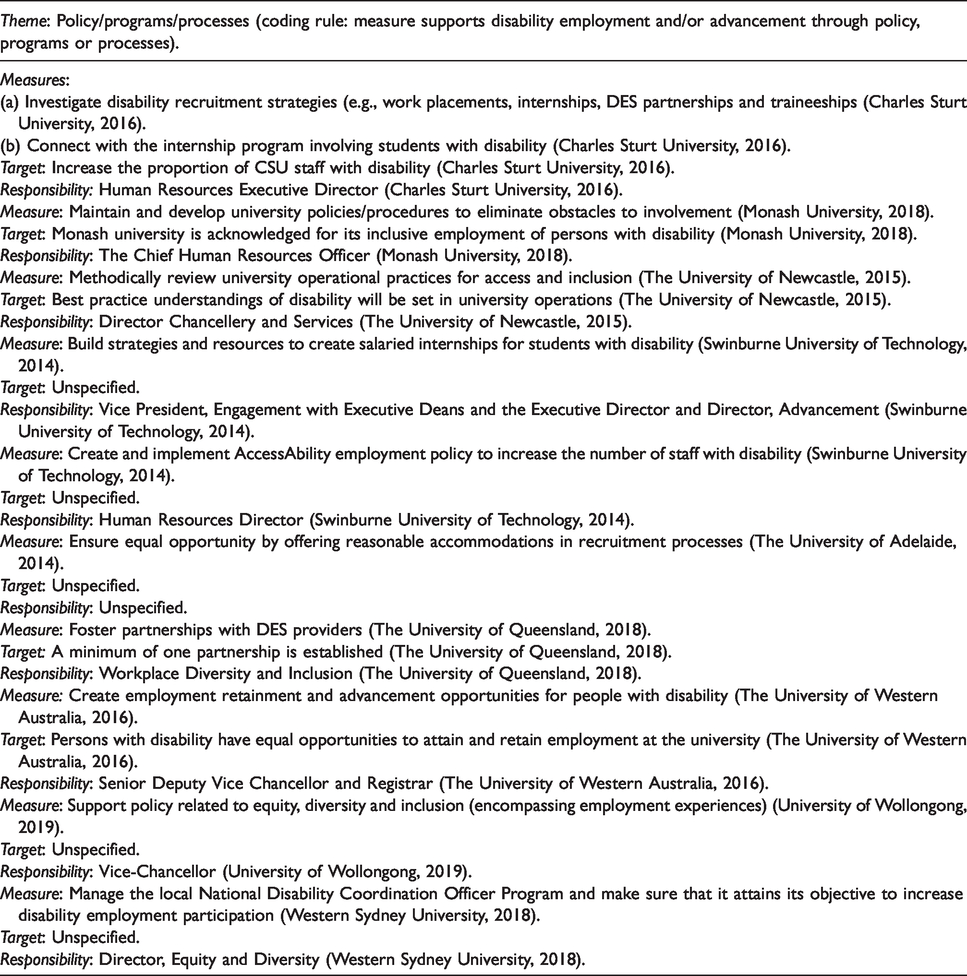
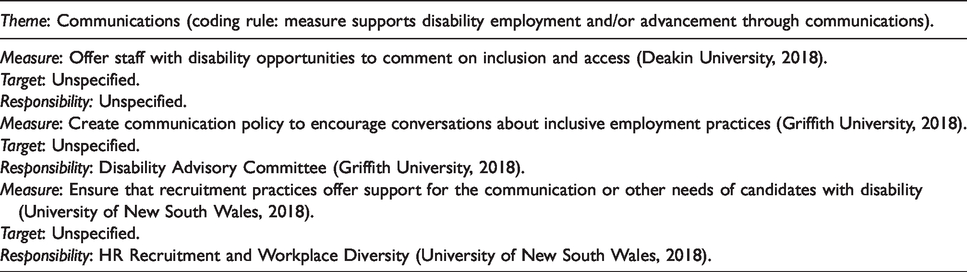
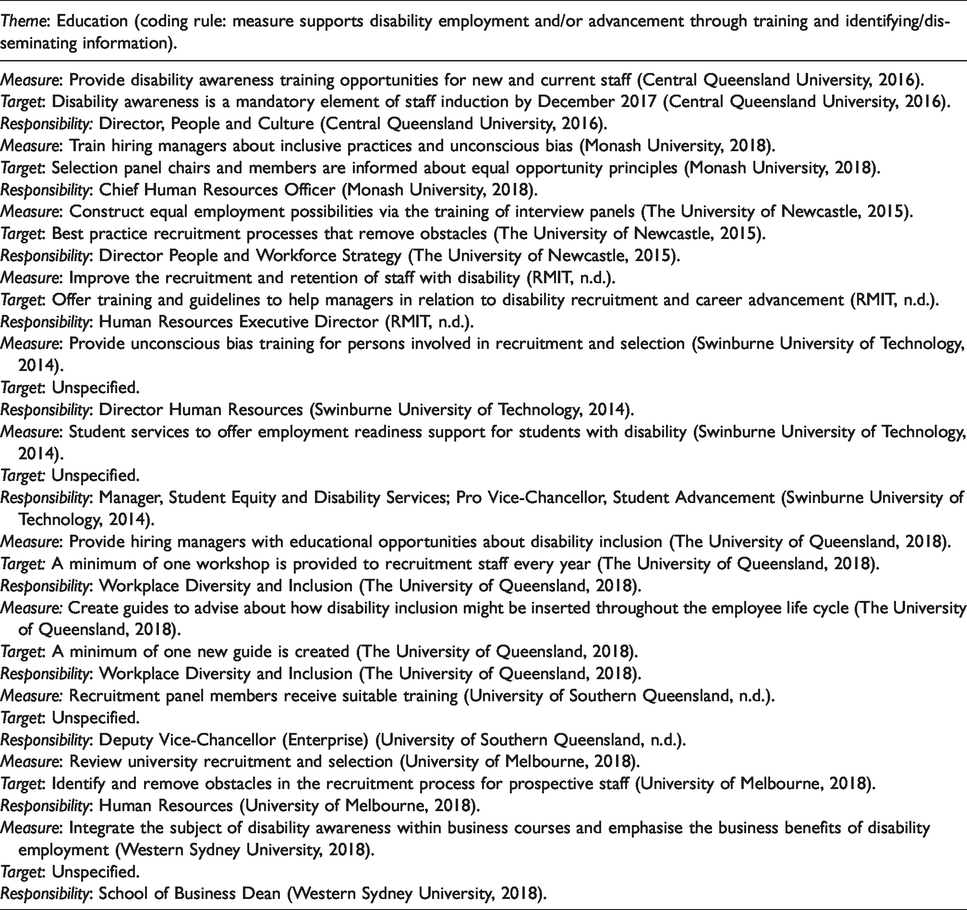
The internet search for current policy (i.e., action plans) supporting the employment and/or advancement of persons with disability in the Australian academy produced the following: 124 possible and 17 relevant results. Tables 2 to 4, respectively, show themes of policy/programs/processes, communications and education, their coding rules, text, illustrating policy measures as well as policy implementation details (i.e., action targets and responsibilities), wherever these were available.
University policy, program or process-based disability employment and/or advancement measures.
University communications-based disability employment and/or advancement measures.
University education-based disability employment and/or advancement measures.
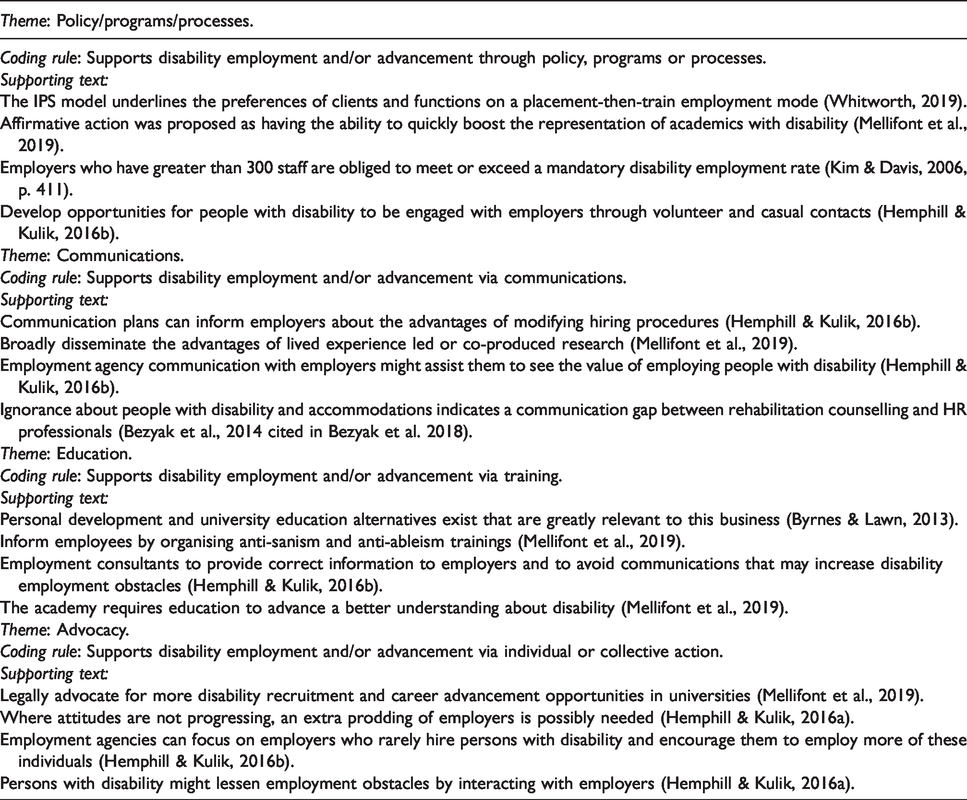
Scholarly database searches for articles that include measures with potential to support the employment and/or career development of persons with lived experience in Australian universities produced a total of seven relevant results (i.e., Scopus – three relevant, ProQuest Central – two relevant and ProQuest Social Sciences – two relevant). Table 5 reports on scholarly-based themes (i.e., policy/programs/processes, communications, education and advocacy), coding rules and supporting text.
Scholarly evidence supporting disability employment and/or advancement in the academy.
Discussion
This section will firstly examine the representation of disability employment in the Australian academy. Following on, discussion will focus on policy, communications and education as practical ways by which the academy is attempting to increase this representation. Importantly, these efforts are to be critically considered on the basis of scholarly literature. The discussion is to also include advocacy as a measure that was identified in the literature but was missing from current policy efforts to increase disability recruitment and advancement across Australian universities.
Representation of disability in the Australian Academy as a proportion of staff
According to publicly available Equal Employment Opportunity reporting, the Australian academy has a long way to go before it can claim to be inclusive of staff with disability. While scarce, the data that are openly available contain a low of 2% of general staff with disability up to a maximum reported percentage of 10% of academic staff (The University of Sydney, 2013, p. 7; University of Wollongong, 2006, p. 48). As approximately 20% of Australians have disability (Australian Network on Disability, 2019), improvements on these employment performances are needed if universities are to be representative of the contemporary Australian public.
Shortfalls in publicly accessible employment statistics (e.g., missing and outdated data) also suggest a need to invest in an independently conducted disability hiring audit across Australian universities. This audit could provide a national snapshot of current proportions of university staff and academic staff who have disability. In addition, the audit might be extended to provide more detailed information by including the proportions of university staff and academic staff who have physical and/or mental disabilities. This expanded investigation could allow policymakers to investigate the possible extent to which neurodivergent persons might be fairing worse in terms of representation and career development opportunities in the academy than persons with physical disabilities.
Policy, programs and processes
Universities attempt to advance employment diversity in the Australian academy through a range of inclusive measures. Specifically, actions support the review of policies and practices to remove obstacles to disability recruitment while promoting reasonable accommodations in hiring processes (Monash University, 2018; The University of Adelaide, 2014). It is important that current recruitment and advancement practices in the academy are flexible in reasonably accommodating mental and physical diversity.
The literature, however, notes a need for stronger policy direction in relation to disability employment. This path is that of affirmative action. Mellifont et al. (2019) recognise quotas as a means of promptly raising the representation of staff with disability in the academy. Broad application of this assertive policy measure is not without precedence. For example, the Korean government applies a ‘carrot and stick’ approach to disability employment. In this way, employers who exceed a quota target can qualify for an employment subsidy while those that do not meet the target are fined for all positions that are not filled (Kim & Davis, 2006). However, Hemphill and Kulik (2016a) caution that prescriptive actions including quotas might trigger undesirable attitudes involving persons with disability.
Failing to embrace affirmative action, some Australian university policies do at least support opportunities for other ‘softer’ disability employment options. These alternatives include work placements, paid internships, as well as collaborations with disability employment service (DES) providers (Charles Sturt University, 2016; Swinburne University of Technology, 2014; The University of Queensland, 2018). Importantly, while university policies endeavour to promote productive DES relationships, Byrnes and Lawn (2013, p. 48) recognise that providers might focus on achieving employment outcomes at the expense of the ‘individual client’. The possibility therefore exists that suitably qualified DES clients who are seeking employment in the Australian academy might have opportunities compromised by the work pressures as experienced by their case managers to attain a quantity of placements.
This challenge is potentially redressed through the Integrated Placement and Support (IPS) approach to disability employment. Whitworth (2019, p. 518) explains that under this model, employment against ‘well matched jobs’ is the objective, where support is provided by employment specialists who have manageable caseloads and who are incorporated within mental health teams. This individualised approach that appreciates the importance of matching job roles with personal skills might help to see more DES clients establishing their professional careers in the academy. Nonetheless, should university leaders be genuine about advancing a greater representation of staff with lived experience across the Australian academy, investment in stronger, evidence-based programs is urgently required. Because of the publicly reported underrepresentation of staff with disability in the Australian academy, as revealed by this study, quotas warrant serious consideration among these strong measures.
Communications
Communications play a vital part in promoting the employment of persons with disability in the academy. However, this policy direction was explicitly acknowledged within only three of the action plans considered by this study. The University of New South Wales (2018) sees a need for recruitment practices to accommodate the possible communication needs of candidates with disability. Deakin University (2018) includes an action to promote opportunities for staff with disability to communicate feedback on topics of access and inclusion. Possibilities thus exist to provide current employees with disability an avenue in which to express any challenges that they might have experienced during and after their recruitment, together with their suggested ways forward. More broadly, policy support is directed towards developing ‘a complementary communication strategy’ to generate conversations about inclusive employment practices (Griffith University, 2018, p. 7). A qualifier on the potential effectiveness of this measure is that discussions about disability employment and career building would need to translate into welcoming behaviours if improvements in these areas are to be achieved. Indicating a communications gap between human resource (HR) and counselling professionals, HR managers with hiring power can be ignorant about topics of persons with disability and employment accommodations (Bezyak et al., 2014 cited in Bezyak et al., 2018).
Nevertheless, the literature supports opportunities for communication strategies to promote the advantages of inclusive employment. Hemphill and Kulik (2016b) advise that these strategies could inform employers about the benefits of altering hiring practices. Mellifont et al. (2019, p. 16) also note the need for a greater emphasis upon the ‘demand side of disability employment’ in the academy by broadly circulating the advantages of studies that are co-produced or led by scholars who have lived experience. The unreasonable alternative is to have knowledge production about disability continue to be dominated by scholars without lived experience. It is the employers who are open to the advantages of diversity and inclusion and who act accordingly to accommodate disability in hiring and career advancement activities that might find themselves well positioned to benefit from a diverse workforce.
Education
Education as a measure to support a greater representation of disability across Australian universities targets diverse audiences including those of employers, DES consultants, as well as people with lived experience. Hemphill and Kulik (2016b, p. 539) note that recruiting people with lived experience is not necessarily as difficult as employers might imagine. Several Australian universities sought to encourage the hiring of persons with disability through the training of selection panel members. This includes informing hiring panels about inclusion-related issues such as advancing equal employment opportunity, redressing unconscious bias and removing recruitment barriers (Monash University, 2018; The University of Newcastle, 2015; Swinburne University of Technology, 2014; The University of Queensland, 2018; University of Southern Queensland, n.d.). Mellifont et al. (2019) also indicate that education is required in universities to advance a better comprehension of disability, to rectify concerns about disability, and to encourage courteous and inclusive discourse involving disability. Education supporting a greater representation of disability also holds relevance for DESs. Employment support consultants have a role to play in providing accurate information to employers and to avoid offering information that might raise disability employment obstacles (Hemphill & Kulik, 2016b). However, Byrnes and Lawn (2013) warn that DES staff requests for extra training might be overlooked.
Opportunities for education supporting greater disability employment in the Australian academy extend to individuals with lived experience. Student services can offer ‘employment readiness’ support for persons with disability (Swinburne University of Technology, 2014, p. 9). The scope of this assistance should encompass academy employment readiness training for those students with lived experience who desire to have university-based careers. Critically, for this training to be successful, graduates with disability who choose to disclose their lived experience in university recruitment and selection processes must be able to do so confidently and without fear of stigma or discrimination.
Policy should paint a clear picture about how the Australian academy is to become more inclusive of staff with disability. Hence, when developing action plans aiming to promote accessibility and disability employment in the academy through education (or any other measure), it is appropriate that policy actions are clearly spelled out. For instance, a disability inclusion objective of The University of Sydney (2019, p. 10) reads as, ‘the University is an employer of choice for people with disability’. Accompanying text indicates that this objective is to be supported by providing, ‘a barrier free and inclusive recruitment process’ (The University of Sydney, 2019, p. 10). While the education of hiring panels would appear to hold relevance here, details around how to attain this inclusive recruiting environment are not apparent.
This study also reveals gaps with action plans not consistently providing targets and responsibilities. With these fundamental policy shortcomings in mind, it appears that some policymakers in the Australian academy might benefit from education about good policymaking techniques. In addition to availing details that are fundamental to policy implementation, plans should endeavour to incorporate innovative measures. For instance, Western Sydney University (2018) supports the inclusion of disability awareness material within its business-oriented courses while also emphasising the commercial benefits of recruiting persons with lived experience. It is this kind of educational innovation that holds possibilities for advancing a more inclusive Australian academy.
Advocacy
The review as conducted by this exploratory study reveals a category of measures that were not explicitly addressed in any of the Australian university action plans. This involves the theme of disability advocacy. Advocacy is supported in the literature across three levels of self, group and agency-based advocacy. Self-advocacy should be encouraged in disability employment action plans, for as Hemphill and Kulik (2016b, p. 539) state, ‘subtle discrimination against disabled people is difficult to eradicate because victims rarely complain’ (Beauchemin et al., 2010). Hence, people with disability are challenged to openly and assertively resist any covert forms of discrimination that can block their recruitment into and career development within the academy. Byrnes and Lawn (2013, p. 52) note how clients can be included as ‘collaborative partners’ in decisions concerning employment choices. DES clients who are self-advocating for careers in the academy that align with their abilities should therefore be actively encouraged by their case managers to follow this path.
The literature also supports the role of group advocacy in advancing a more inclusive academy. In this regard, Mellifont et al. (2019, p. 15) support a measure to, ‘lawfully advocate (either individually or collectively) for greater employment and career development opportunities in the academy’. Furthermore, Hemphill and Kulik (2016b, p. 538) suggest that employment agencies might target ‘light hirers’ (i.e., those employers who rarely hire people with disability). On the basis of publicly available data involving disability employment in the academy (and pending any possible future research evidence to the contrary), the term ‘light hirers’ might be an apt descriptor of many Australian universities. The Australian Government should therefore consider availing additional resources to DES providers enabling case managers more opportunities to advocate for a greater representation of their clients across the Australian academy. To lay any serious claim of being places where diversity and inclusion are truly valued, Australian universities cannot continue as disability employment laggards.
Evidence-based policy implications for Australian universities
Box 1 displays the good practice features that policymakers should consider when designing and developing actions plans endeavouring to increase the recruitment and advancement of persons with disability among staff at Australian universities. These features are categorised according to generic design inclusions that should be recognised by policymakers and proposed ways forward. Preliminary policy guide promoting disability employment and advancement in the academy.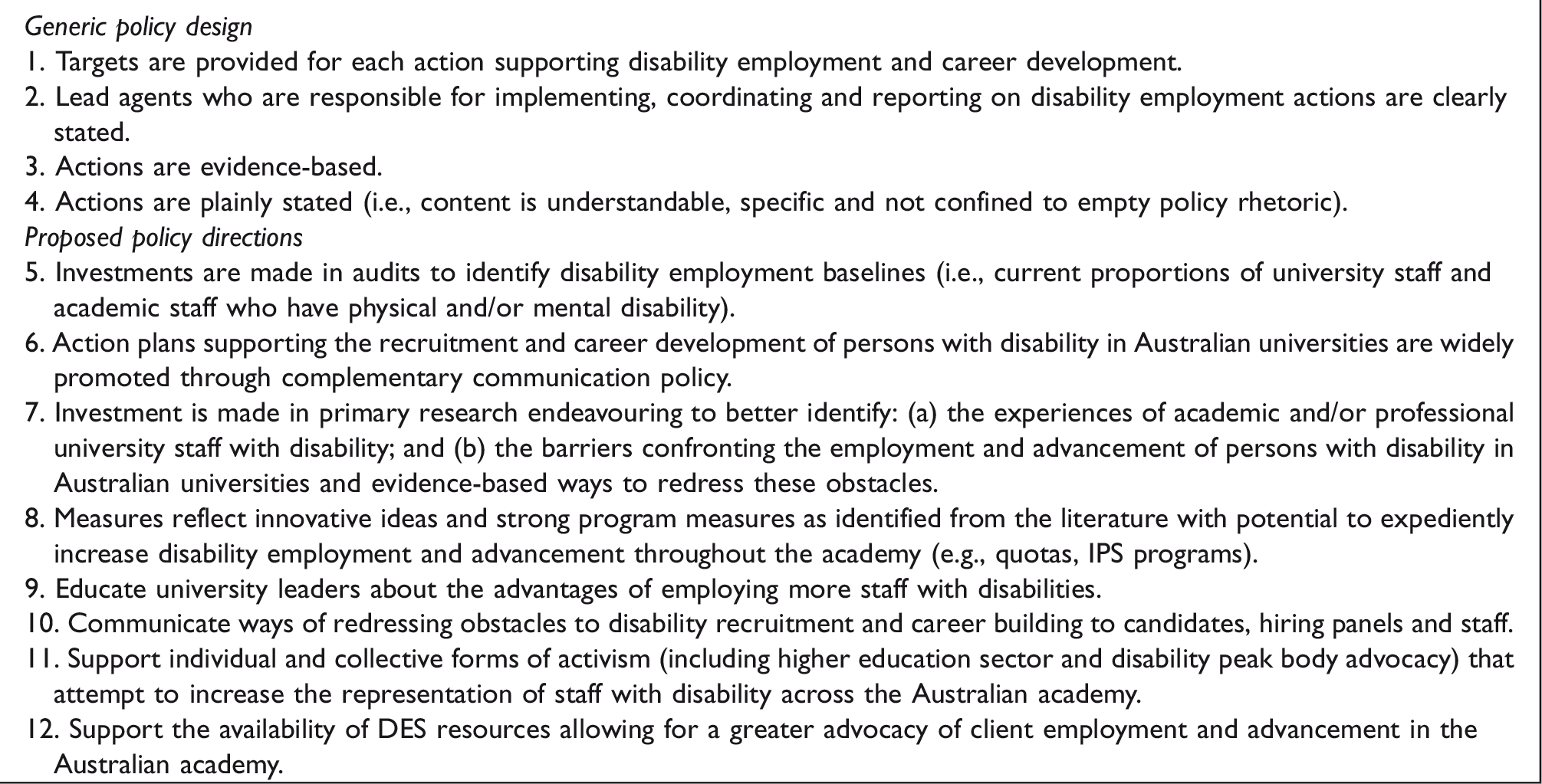
Limitations
Disability employment statistics in the Australian academy as described within this investigative study are constrained by gaps in the contemporary public reporting of this information. Moreover, identification challenges exist in regards to differing definitions of disability as well as the stigma that might lessen self-reporting among university staff with lived experience. Themes of policy/programs, communications and education supporting disability employment and career advancement are also limited to those reported in university policies (i.e., employment action plans). Furthermore, on the basis of the databases and search term applied, there is a scarcity of literature reporting on evidence-based measures with potential to support the employment of persons with disability in the academy. Hence, the guide as provided by this investigation, while offering a sound foundation for policymakers, should be considered preliminary in nature. Investment in future research that utilises different search terms and databases might reveal additional employment data and evidence-based ways in which to enhance disability employment and career development across Australian universities.
Conclusion
Universities, as places of enlightenment, should be leading the way in promoting diversity and inclusion by employing and advancing more persons with lived experience. However, on the basis of publicly available data, the Australian academy generally resembles a ‘light employer’ of disability. Recognising the exploratory nature of this research, the findings presented nevertheless offer evidence-based ways to expediently increase the representation of disability throughout Australian universities. University leaders who wish to see more than empty policy rhetoric about disability employment should be keen to invest in strong recruitment and advancement measures. For it is these actions that hold the capacity to increase the representation of disability throughout Australian universities in a timely, equitable and responsible way.
Footnotes
Declaration of conflicting interests
The author(s) declared no potential conflicts of interest with respect to the research, authorship, and/or publication of this article.
Funding
The author(s) received no financial support for the research, authorship, and/or publication of this article.
