



Abstract
This longitudinal study explores the relationships between glass ceiling beliefs (i.e. denial, resilience, resignation, and acceptance) and the outcomes of work commitment and work turnover intention, mediated via work engagement, across two time waves. Using data collected from 400 women employees (mean age = 36.67 years) from the banking sector in India, the study found support for the mediating role of work engagement between glass ceiling beliefs and both work commitment and work turnover intention over time. Glass ceiling beliefs of denial and resilience were related positively to work engagement and commitment and related negatively to turnover intention over time. Resignation and acceptance were related negatively to work engagement and work commitment and related positively to work turnover intention over time. Apart from theoretical implications to the career literature, the organizational implications of this study include framing policies that focus on development of optimistic beliefs and transformation of pessimistic beliefs.
Keywords
Introduction
Women employees can contribute positively to organizations owing to their skills and attitudes (Glass & Cook, 2016). Although this gives enormous opportunity and hope for women around the world, women remain unrepresented in corporate positions due to the ‘glass ceiling’ (Baumgartner & Schneider, 2010). The metaphor of glass ceiling refers to discriminatory processes that obstruct the advancement of women to higher posts in an organization (Bendl & Schmidt, 2010). Various studies in this area explain the reasons for the glass ceiling, including discrimination, bias, tokenism, lack of mentoring, and lack of social and informal networks (Cook & Glass, 2014). However, a psychological approach to the glass ceiling that accounts for the beliefs of women can provide a more detailed understanding of women’s perspective on the concept of glass ceiling (Smith, Caputi, & Crittenden, 2012).
Work engagement, commitment, and turnover intention are important considerations for organizations, which have received much research attention in recent times (Bhatnagar, 2012; Poon, 2013; Seligman & Csikszentmihalyi, 2014). However, their applicability to women’s issues, such as the glass ceiling, has been investigated less. Considering the lack of glass ceiling studies with respect to these constructs, this study examined the relationships between glass ceiling beliefs and outcomes of work commitment and turnover intention via work engagement. For this, data were collected from 400 women employees in the banking sector in India.
The right to equality was provided both legally and constitutionally to Indian women during the early period of the 20th century (Chaudhary et al., 2012; Nath, 2000), but due to cultural and societal influences and patriarchal attitudes, women still struggle in their career (Nath, 2000). While increasing education levels and the entry of more women into the labour market has helped reduce these struggles, a woman’s journey to higher levels at work remains difficult, demanding our attention to address the issues of glass ceiling (Agrawal, 2013).
Theoretical background and hypothesis development
The under-representation of women in high posts in the corporate sector is reflected in the metaphor of glass ceiling, coined by Hymowitz and Schellhardt (1986). Glass ceiling refers to the invisible, artificial barrier created by attitudinal and organizational prejudices that block women from reaching leadership positions (Michailidis et al., 2012). Women hold four types of beliefs about the glass ceiling: denial, resilience, resignation, and acceptance (Smith, Caputi, & Crittenden, 2012). ‘Denial’ is the belief that both men and women face the same issues during their career progression; ‘resilience’ suggests that women are able to break the glass ceiling; ‘resignation’ implies that women do not try to break the glass ceiling because they face more issues than men in career advancement; and giving preference to other life goals over career development is represented through the glass ceiling belief of ‘acceptance’.
According to social cognitive career theory, beliefs lead to career expectations, which in turn lead to interests, choice of goal, choice of action, and career outcomes (Lent et al., 2002). Lent et al. (2002) argued that people construct their own career processes and outcomes through their beliefs. From this perspective, women’s beliefs about the glass ceiling can act as a precursor to career outcomes. Positive glass ceiling beliefs (denial and resilience) are more likely to lead to positive career outcomes; negative glass ceiling beliefs (resignation and acceptance), on the other hand, have detrimental effects on career activities and outcomes. Thus, glass ceiling beliefs are likely to be linked to career outcomes.
It can be proposed that glass ceiling beliefs influence both positive and negative career outcomes based on the beliefs that women hold. These beliefs might lead to either enhancement of engagement and commitment towards work, or induce the want to leave the organization. Beliefs and behaviour have an important role in goal setting and wellbeing (Sheldon & Cooper, 2008; Smith, Caputi, & Crittenden, 2012; Wrosch & Scheier, 2003). In addition to this, work beliefs can predict both negative outcomes and positive outcomes (Ho et al., 2010).
Work engagement is a motivational construct with three distinct, yet correlated dimensions: vigour, dedication, and absorption (Schaufeli et al., 2006). Development of an engaged workforce is an organizational priority due to the positive outcomes it provides to organizations (Saks, 2006; Seligman & Csikszentmihalyi, 2014). Bakker and Demerouti (2008) reported that optimistic employees engage more in their work and are more productive. On the other hand, employees’ pessimistic thoughts lead to negative work outcomes (Innanen et al., 2014).
Considering the above literature, the researcher framed the following hypotheses: glass ceiling denial (H1a) and resilience (H1b) are related positively, and resignation (H1c) and acceptance (H1d) are related negatively, to work engagement.
Work engagement, commitment, and turnover intention
According to Kanter’s (1993) theory of structural empowerment, some structural changes in an organization, such as opportunity for advancement, access to information, access to support, access to resources, and formal and informal power can empower employees. Providing these conditions to employees can lead to greater work engagement (Cho et al., 2006). Organizational commitment is an attitude or orientation towards the organization that links or attaches the identity of the employee to the organization (Sheldon, 1971). Recent studies have affirmed the positive relationship between work engagement and commitment (Field & Buitendach, 2011; Hakanen et al., 2008; Poon, 2013). Turnover intention is the strongest predictor of actual turnover behaviour (Cohen et al., 2016). Many recent studies in the area of work engagement have reaffirmed its negative relationship with turnover intention (Bhatnagar, 2012; Halbesleben & Wheeler, 2008).
Hence from the above literature, the researcher framed the following hypothesis: work engagement is related positively to commitment (H2a) and negatively to turnover intention (H2b).
The relationship between glass ceiling beliefs and commitment
Commitment is a force that binds an employee to a course of action that is of relevance to a particular goal (Meyer & Herscovitch, 2001). Optimistic employees are committed to their work (Akhtar et al., 2013; McColl-Kennedy & Anderson, 2005). For example, some successful women believe that there is no glass ceiling for them as they are hardworking and able. This denial attitude helps them move towards success (Wrigley, 2002). Such abilities and work engagement help women become committed to their organization (Field & Buitendach, 2011; Hakanen et al., 2008; Poon, 2013). Resilience, being an optimistic belief, indicates that the glass ceiling can be broken by women. Resilience leads to an increase in the levels of commitment (Simons & Buitendach, 2013).
On the other hand, pessimistic thoughts affect commitment negatively (Nicholls et al., 2008). The majority of women in the ‘adaptive’ category, according to Hakim (2006), prefer to give importance to both family and work. Women with the ‘acceptance’ belief give importance to family views over work. Both views potentially lead to conflict. The conflict between family and work (i.e. work–family conflict) negatively affects their commitment towards work (Netemeyer et al., 1996).
Based on these rationales, the researcher formulated the hypotheses as follows: glass ceiling denial (H3a) and resilience (H3b) are related positively, and resignation (H3c) and acceptance (H3d) are related negatively, to commitment.
The relationship between glass ceiling beliefs and turnover intention
An optimistic attitude reduces turnover (Karatepe & Karadas, 2014; Siu et al., 2015). Regarding resilience, its negative relationship with turnover intention has been supported (Avey et al., 2009; Karatepe & Karadas, 2014).
In order to achieve job satisfaction and autonomy, women often choose self-employment (Walker & Webster, 2007). However, those who find self-employment impractical can become resigned and dissatisfied. They survive passively in an organization. This can have negative consequences on their career and potentially increases turnover intention (Hom & Kinicki, 2001). With regard to acceptance, women often give preference to their family roles over their career roles (Kiaye & Singh, 2013). This is because women have more family responsibilities, and thus interference with work, than men (Allen & Finkelstein, 2014). Such work–family conflicts lead to increased levels of turnover intention (Boyar et al., 2003; Chen et al., 2015).
Based on this, the researcher formulated the following hypotheses: glass ceiling denial (H4a) and resilience (H4b) are related negatively, and resignation (H4c) and acceptance (H4d) are related positively, to turnover intention.
Mediating role of work engagement
To fully understand how glass ceiling beliefs influence commitment and turnover intention, the nature and extent of any mediation by work engagement need to be examined. As the relationships between glass ceiling beliefs with commitment and turnover intention have not been established previously, mediation is proposed as an explanatory mechanism in this model.
The preceding discussion suggests a mediating role for work engagement in the glass ceiling beliefs–commitment relationship, with optimistic glass ceiling beliefs – denial and resilience – increasing work engagement (Bakker & Demerouti, 2008), which in turn positively influences commitment (Field & Buitendach, 2011; Hakanen et al., 2008; Poon, 2013). On the other hand, pessimistic glass ceiling beliefs – resignation and acceptance – decrease work engagement (Innanen et al., 2014), and thereby reduce commitment (Netemeyer et al., 1996; Nicholls et al., 2008). The mediating role of work engagement with commitment has been studied using various input variables, such as job responsibility, job demands, work load, etc. (Hakanen et al., 2008; Karatepe et al., 2014).
Thus, the author proposed the following hypotheses: work engagement mediates the relationship between denial (H5a), resilience (H5b), resignation (H5c), acceptance (H5d), and commitment.
The scope of the mediating role of work engagement in the glass ceiling beliefs–turnover intention relationship suggests two things. First, denial and resilience increase work engagement (Bakker & Demerouti, 2008) and hence are related negatively to turnover intention (Hom & Kinicki, 2001). Second, resignation and acceptance reduce work engagement and thus are positively related to turnover intention (Chen et al., 2015). Previous studies provide support for the mediating role of work engagement on turnover intention (Bhatnagar, 2012; Schaufeli & Bakker, 2004). Based on this, the following hypotheses were formulated: work engagement mediates the relationship between denial (H6a), resilience (H6b), resignation (H6c), acceptance (H6d), and turnover intention.
The present study
To the best of my knowledge, there are no longitudinal studies that have investigated the mediating role of work engagement in the relationship between glass ceiling beliefs and commitment and turnover intention. By using a longitudinal design, the researcher tested for such mediation using both cross-sectional (i.e. at Time 1 and Time 2) and longitudinal data analyses (i.e. in the relationships between Time 1 and Time 2 measures). Hence, the following hypothesis was proposed: glass ceiling beliefs predict commitment and turnover intention through work engagement over time (H7). The hypothesized model is depicted in Figure 1.
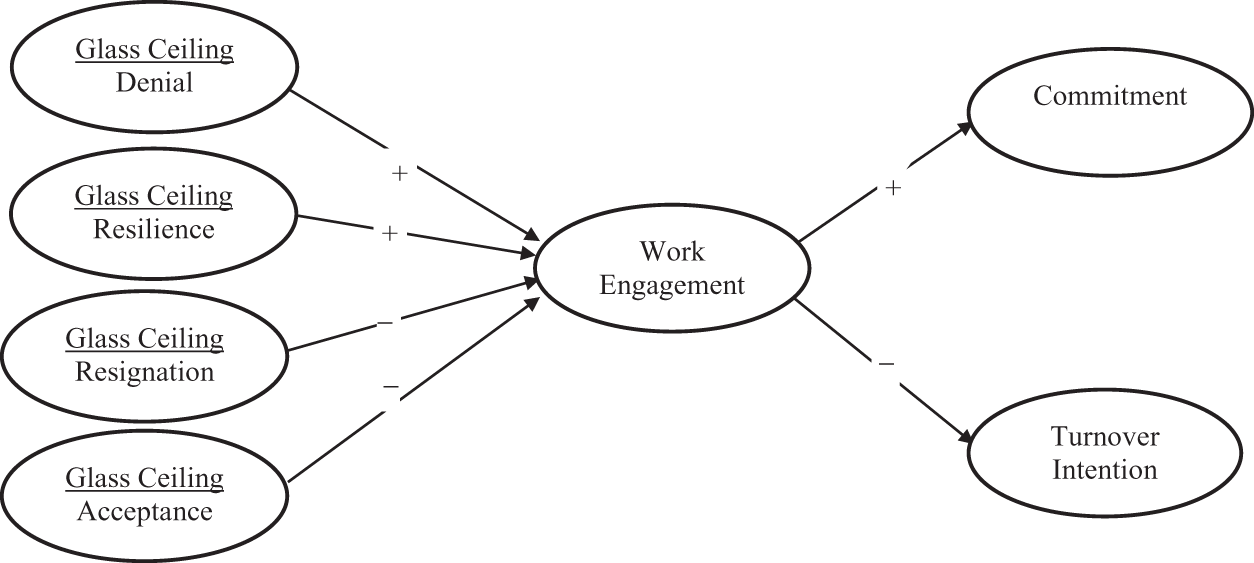
Hypothesized model.
Study hypotheses were tested with cross-lagged analyses based on two waves of data over a two-year period, which was considered sufficient time for beliefs to change, for example as a result of emotional or environmental factors (Ford & Gross, 2019). The research extends earlier research in the field (e.g. Smith, Caputi, & Crittenden, 2012) as it examines the relationship between glass ceiling beliefs and work commitment and turnover intention via work engagement.
Method
Participants
Data for the study were collected from women employees in the banking sector in India. At baseline, 500 questionnaires were distributed to women participants who held executive positions, including those on probation. Hence the minimum qualification of participants was graduation. Of the 500 questionnaires distributed, 448 were returned (response rate = 89.60%). Following list-wise deletion of missing data, 420 questionnaires were retained for analysis (response rate = 84%). A total of 400 participants responded one year later (i.e. at T2; response rate = 88%). The average age of these respondents was 36.67 years (SD = 8.61).
Measures
Glass ceiling beliefs
Glass ceiling beliefs were measured with the Career Path Survey (Smith, Crittenden, & Caputi, 2012), which assesses levels of denial (10 items), resilience (11 items), resignation (10 items), and acceptance (7 items). All items were measured on a 7-point scale ranging from 1 (strongly disagree) to 7 (strongly agree). Sample items were as follows: ‘Women and men have to overcome the same problems at the workplace’ (denial); ‘Women have strength to overcome discrimination’ (resilience); ‘Women believe they have to make too many compromises to gain highly paid positions’ (resignation); and ‘Motherhood is more important to most women than career development’ (acceptance). Sound Cronbach alphas for denial (αT1 = .87, αT2 = .89), resilience (αT1 = .91, αT2 = .89), resignation (αT1 = .93, αT2 = .91), and acceptance (αT1 = .95, αT2 = .94) were recorded for the two waves.
Work engagement
The 9-item Utrecht Work Engagement Scale (Schaufeli et al., 2006) was used to measure three closely related workplace engagement factors: vigour (αT1 = .91, αT2 = .89), dedication (αT1 = .90, αT2 = .89), and absorption (αT1 = .84, αT2 = .87). All items were rated on a scale ranging from 1 (strongly disagree) to 7 (strongly agree). Cronbach alphas for the aggregated scale were .89 (T1) and .85 (T2). Sample items were as follows: ‘At my work, I feel I am bursting with energy’ (vigour), ‘I am enthusiastic about my job’ (dedication), and ‘Time flies when I’m working’ (absorption).
Commitment
The 6-item Affective Organizational Commitment Scale (Meyer & Allen, 1997; Meyer, Allen, & Smith, 1993) was used for the study. A sample item was ‘This organization has a great deal of personal meaning for me’. Cronbach alphas were .86 (T1) and .88 (T2).
Turnover intention
Turnover intention was measured with a 3-item scale developed by Mitchell et al. (2001). All items were rated on a scale ranging from 1 (strongly disagree) to 7 (strongly agree). A sample item was ‘Do you intend to leave the organization in the next 12 months?’. This scale exhibited reliabilities of .83 (T1) and .81 (T2).
Procedure
The participants were contacted directly through approaching the higher officials in the bank branches in India. With the permission from these authorities, the required number of questionnaires and the accompanying cover letter assuring confidentiality were handed over to the employees directly in two waves. Participation in this study was purely optional restricted to female employees. Researcher explained the concept glass ceiling and the purpose of the study while distributing questionnaire. The co-operation and response among the respondents were highly appreciable for the research to proceed with, even without offering any reimbursement or gifts for participating which is against the organizational policies. The data collected were only used for the research purpose and confidentiality of personal data maintained throughout.
Data analysis
Structural equation modelling (SEM) techniques AMOS 21.0 (Arbuckle, 2012) were employed to test the cross-lagged, longitudinal relationships (i.e. tested the model connecting glass ceiling beliefs, work engagement, commitment, and turnover intention). When the research goal is to model effects of latent variables at a given level of generality, then the appropriate selection of scales or parcelling of items can minimize nuisance factors at a lower level of generality (Little et al., 2002). Hence, for each of the unidimensional constructs of glass ceiling beliefs (denial, resilience, resignation, and acceptance), commitment, and turnover intention, the researcher combined the highest and lowest loading items based on exploratory factor analyses by averaging until there were three indicators for each construct (Hau & Marsh, 2004). For the multidimensional construct of work engagement, the domain represented parcelling approach was adopted, which creates parcels by joining items from different dimensions into one item set (Kishton & Widaman, 1994).
The researcher then tested a measurement model that defined the relationships among all observed and unobserved study variables. A measurement model specifies the pattern by which each measure is loaded on a particular factor (Byrne, 2016). The various models and nested models were compared by means of the χ2 statistic, the goodness-of-fit index (GFI), root mean square error of approximation (RMSEA), standardized root mean square residual (SRMR), the comparative fit index (CFI), and the Tucker–Lewis index (TLI). Values >.80 for GFI, >.90 for CFI and TLI, and ≤.08 RMSEA indicate acceptable model fit (Byrne, 2016; Hu & Bentler, 1998).
Next, the researcher applied the approaches suggested by Cole and Maxwell (2003) and Taris and Kompier (2006) to test the hypothesized structural model with two time waves. To test mediation with two-wave designs, these authors recommended longitudinal tests that can detect partial mediation. Hence, the researcher tested several competing structural models to investigate the cross-lagged effects: (a) the stability model (Mstab) included autoregressive effects over time for each variable, but did not include the cross-lagged relationships; (b) the causality model (Mcause) included the autoregressive effects combined with the cross-lagged paths from T1 to T2; (c) the reverse causation model (Mreverse) included the autoregressive paths as Mstab combined with reverse pathways; and (d) the reciprocal model (Mrecip) was a combination of Mcause and Mstab.
Results
Descriptive statistics
The pattern of correlations was as expected. Denial and resilience (synchronously and over time) were positively related to work engagement and were negatively related to turnover intention. Resignation and acceptance were correlated both synchronously and negatively over time to work engagement and commitment, and positively to turnover intention. In addition, work engagement was related positively to commitment and negatively to turnover intention over the two waves. Table 1 reports descriptive statistics of the variables over time.
Means, standard deviations, and intercorrelations among study variables (N = 400).
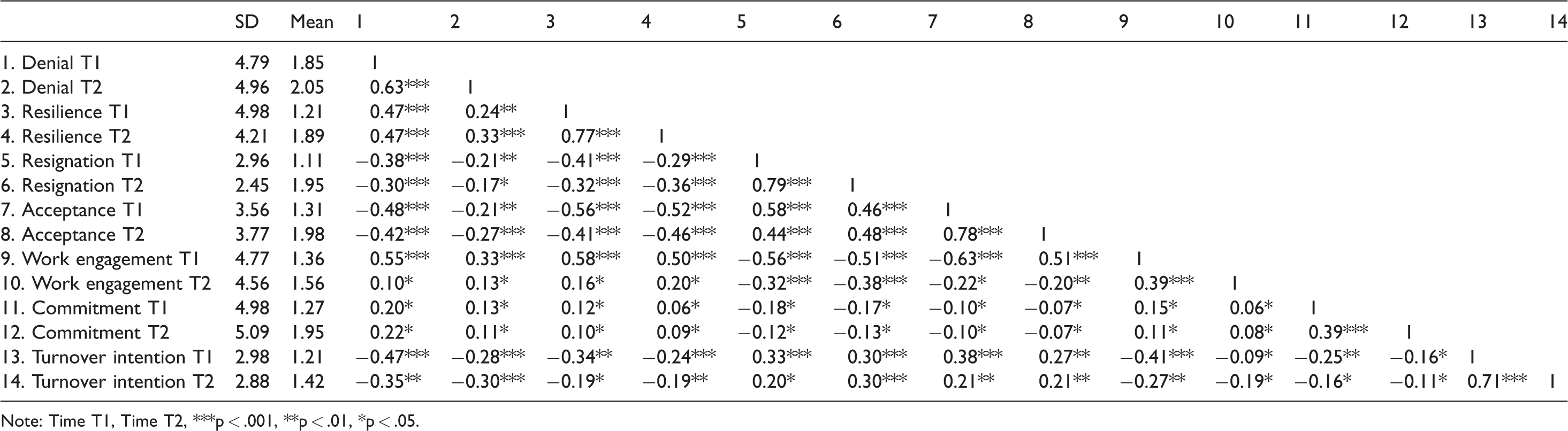
Note: Time T1, Time T2, ***p < .001, **p < .01, *p < .05.
Cross-sectional testing of the model
Since the data were self-reported from one source, Harman’s one-factor test was conducted to check the influence of common method variance on the results (Podsakoff et al., 2003). The one factor model resulted in a poor fit to the data, with χ2 = 5370.32, df = 860, p < .001, GFI = .38, CFI = .42, TLI = .39, RMSEA = .16, and SRMR = .12 for the first wave model, and χ2 = 5784.48, df = 860, p < . 001, GFI = .34, CFI = .32, TLI = .30, RMSEA = .16, and SRMR = .15 for the second wave model. To confirm these results, additional analyses were performed following the procedure recommended by Podsakoff et al. (2003). This involved adding to the theoretical model a first-order factor with all of the measures as indicators. The results revealed that the model fit improved, although none of the path coefficients corresponding to relationships between the indicators and the general method factor was significant. These findings suggested that while method bias might be present, it should not affect results or conclusions significantly (Conger et al., 2000; Doty & Glick, 1998).
Measurement models for cross-sectional analysis
The goodness-of-fit statistics obtained from the analyses of parallel indicators for the two waves of the study are reported in Table 2. As evident from the indices, the measurement model provided a satisfactory fit to the data at T1 and T2.
Goodness-of-fit indices for measurement and structural models.

CFI: comparative fit index; GFI: goodness-of-fit index; RMSEA: root mean square error of approximation; SRMR: standardized root mean square residual; TLI: Tucker–Lewis index.
Note: N = 400.
Structural models for cross-sectional analyses
Next, the full structural model was tested. The hypothesized model yielded a good fit for the data, both at T1 and T2, as shown in Table 2, with the majority of hypotheses supported. SEM provides the basic data analysis strategy when a mediation model involves latent constructs (Baron & Kenny, 1986; Judd & Kenny, 1981). The researcher considered two models – the hypothesized structural model and an alternative model which included the direct effects. See Table 2 for fit statistics. The significant relationships between glass ceiling beliefs and commitment and turnover intention at T1 and T2 in the alternative model demonstrated a partial mediation by work engagement over the two waves in the study. This supported the hypotheses H5a–H5d and H6a–H6d. The results show that all hypotheses related to glass ceiling beliefs, work engagement, commitment, and turnover intention were accepted: hypotheses H1a–H1d, H2a, H2b, H3a–H3d, and H4a–H4d (see Table 3).
Structural equation modelling results for cross-sectional analyses at T1 and T2.
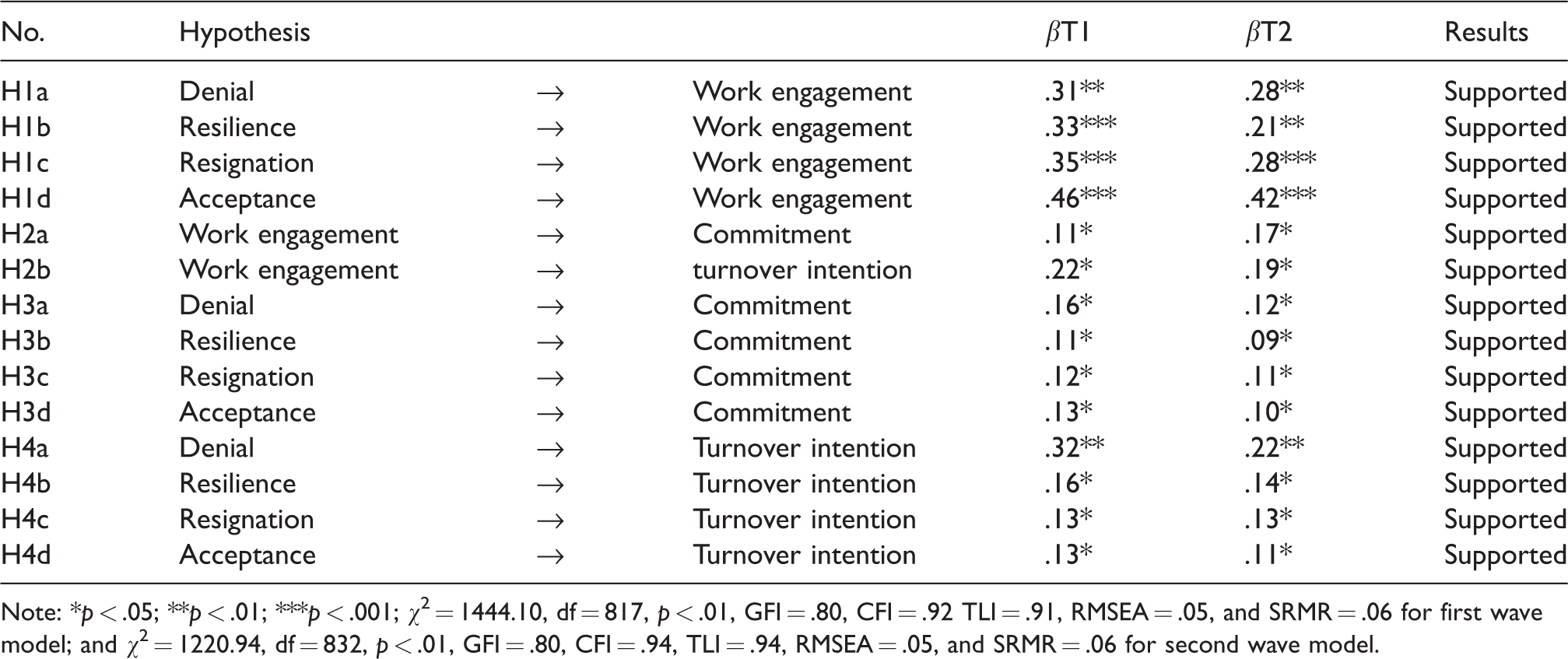
Note: *p < .05; **p < .01; ***p < .001; χ2 = 1444.10, df = 817, p < .01, GFI = .80, CFI = .92 TLI = .91, RMSEA = .05, and SRMR = .06 for first wave model; and χ2 = 1220.94, df = 832, p < .01, GFI = .80, CFI = .94, TLI = .94, RMSEA = .05, and SRMR = .06 for second wave model.
Longitudinal model
As seen in Table 4, the causal model (M1cause) with cross-lagged associations between T1 glass ceiling beliefs (TI denial, T1 resilience, T1 resignation, and T1 acceptance) and T2 work engagement provided a better fit to the data than the stability model without the cross-lagged associations (M1stab; Δχ2 = 21.28, Δdf = 5, p < .001), whereas the reversed causation model (M1reverse) did not improve the model fit with M1stab (Δχ2 = 11.10, Δdf = 5, p < .01). Furthermore, the reciprocal model (M1recip) did not improve model fit with M1cause (Δχ2 = 18.89, Δdf = 5, p < .001), suggesting that M1cause was the best fitting model. In the M1cause model (see Figure 2), denial at T1 had a positive, longitudinal, cross-lagged effect on future work engagement (β = 0.24, p < .001). As expected, resilience at T1 also showed a positive, cross-lagged relationship with work engagement at T2 (β = 0.11, p < .01). Resignation at T1 showed a negative, longitudinal, cross-lagged effect on work engagement at T2 (β = −0.10, p < .01). Acceptance at T1 also showed a negative effect on future work engagement (β = −0.16, p < .001).
Fit Statistics for investigating the model.
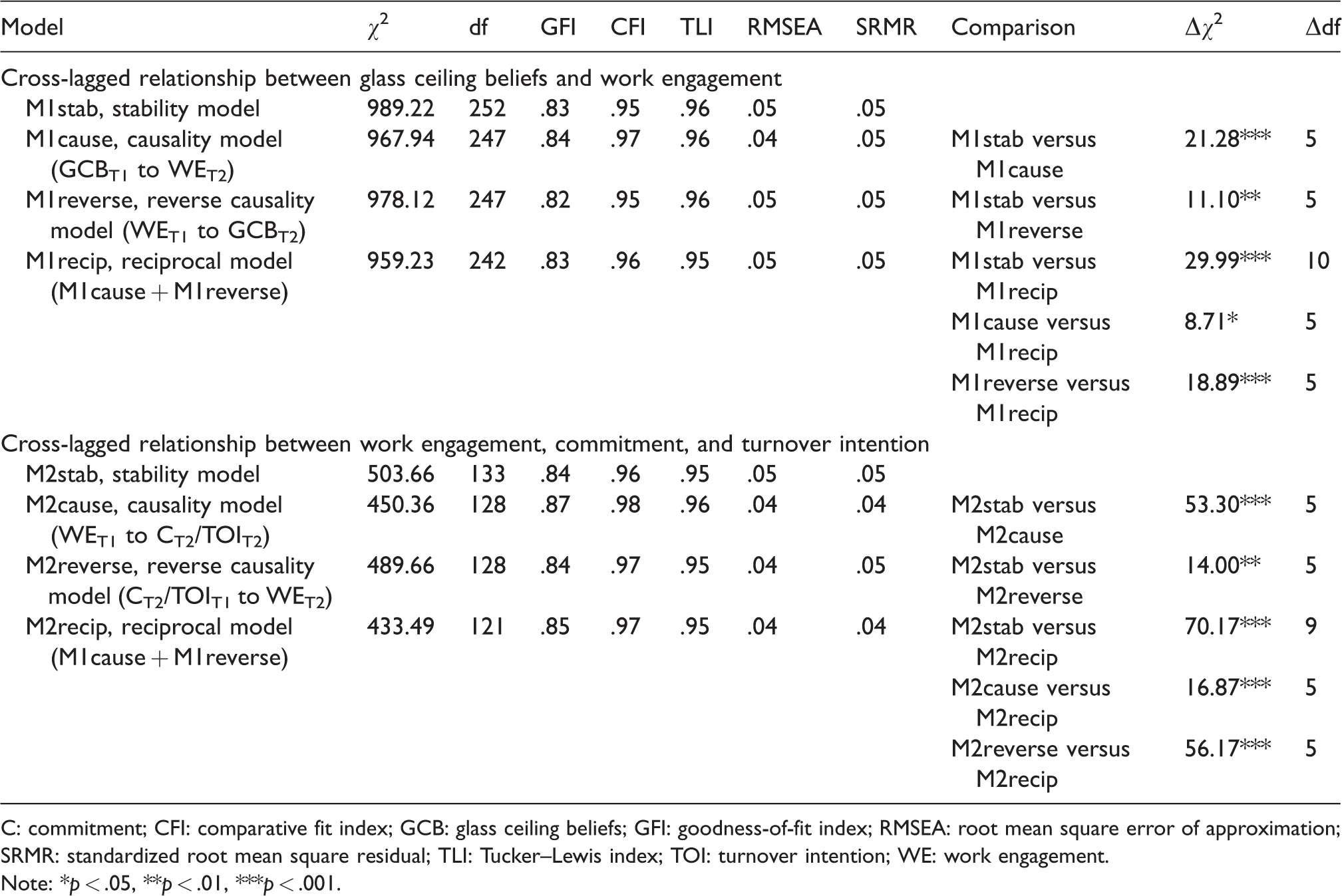
C: commitment; CFI: comparative fit index; GCB: glass ceiling beliefs; GFI: goodness-of-fit index; RMSEA: root mean square error of approximation; SRMR: standardized root mean square residual; TLI: Tucker–Lewis index; TOI: turnover intention; WE: work engagement.
Note: *p < .05, **p < .01, ***p < .001.

Cross-lagged relationship between glass ceiling beliefs and work engagement (N = 400). χ2 = 967.94, df = 247, GFI =.84, CFI =.97, TLI =.96, RMSEA =.04, SRMR =.05. **p < . 01, ***p < . 001.
Table 4 shows that the causal model (M2cause) with the cross-lagged associations between T1 work engagement and T2 commitment and T2 turnover intention presented a better fit to the data than the stability model (M2stab; Δχ2 = 53.30, Δdf = 5, p < .001), whereas the reciprocal model (M2recip) had a better fit than M2stab (Δχ2= 70.17, Δdf = 9, p < .001) and M2reverse (Δχ2= 56.17, Δdf = 5, p < .001). Last, M2cause was significantly better than M2reverse (Δχ2= 16.87, Δdf = 5, p < .001), suggesting that M2cause was the best fitting model. Accordingly, Figure 3 shows that work engagement had a positive cross-lagged effect on commitment one year later (β = 0.13, p < .05), whereas work engagement at T1 had a negative cross-lagged effect on future turnover intention (β = −0.08, p < .05).
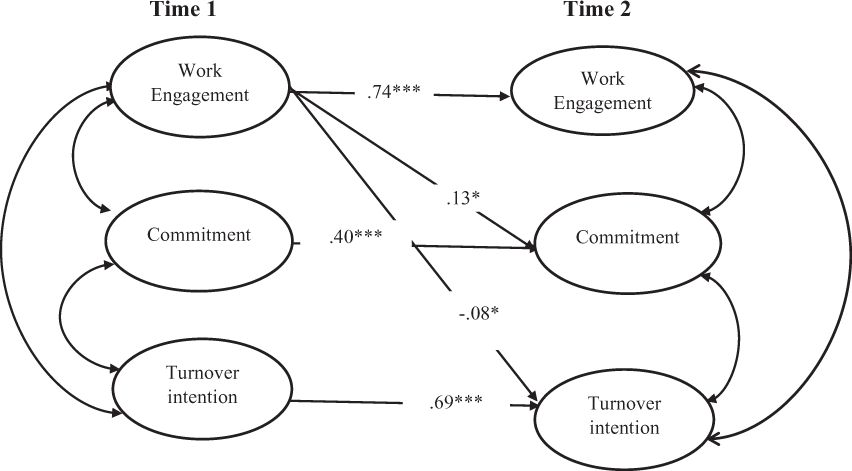
Cross-lagged relationship between work engagement, commitment, and turnover intention (N = 400). χ2 = 450.36, df = 128, GFI = 0.87, CFI = 0.98, TLI = 0.96, RMSEA = 0.04, SRMR = 0.04. *p < 0.05, ***p < 0.001.
To summarize, the two-phase, cross-lagged panel supported the expected partial mediation from glass ceiling beliefs via work engagement to commitment and turnover intention. Moreover, work engagement related positively to commitment and negatively to turnover intention over a one-year follow-up period. Thus, H7 was supported.
Discussion
Theoretical contribution
This study involved longitudinal testing of the relationships between glass ceiling beliefs and commitment and turnover intention, through work engagement. By using a two-wave, one-year, cross-lagged panel design in a typical sample of women employees from Indian banks, the results provided support for, and new insights into, career and organizational theory. First, longitudinal support was found for the relationship between glass ceiling beliefs and commitment and turnover intentions through work engagement. Although India provides constitutional and legal protection to women employees, previous studies from India have shown the existence of a glass ceiling (Agrawal, 2013; Kiaye & Singh, 2013). This study is the first to approach the psychological aspects of glass ceiling through a longitudinal study.
Second, this study extends the literature on commitment by exploring the relationship between glass ceiling beliefs and commitment. Denial and resilience were related positively to commitment, while resignation and acceptance were related negatively to commitment. Not being alert to the existence of a glass ceiling in an organization might make women employees work more for the organization without any attitudinal change, which enhances their commitment. In the case of those with high resilience, even if they were aware of the existence of a glass ceiling, they were confident enough to face the issues and challenge them, which boosts commitment.
Third, the findings contribute to literature on turnover intention. Denial and resilience negatively predicted turnover intention, while resignation and acceptance predicted them positively. Since women employees high on denial and resilience beliefs engage well in their work, their intention to leave their job is low. On the other hand, women who are more resigned and hold acceptance beliefs were not engaged and reported stronger intentions to turnover. In the latter case, women working passively in the organization could be thinking about alternate opportunities or their family commitment, and thus hold greater intention to leave their job.
Fourth, this study extends the literature on work engagement. Denial and resilience were related positively to work engagement, and resignation and acceptance were related negatively. When downplaying or confident about glass ceiling help, women actively engage in their work; whereas family responsibilities and concern about a glass ceiling potentially reduces engagement in work.
Fifth, the mediating role of work engagement between glass ceiling beliefs and commitment and turnover intention is an important contribution of this study, and extends previous findings on the relationship between glass ceiling beliefs and work engagement, work engagement and commitment, and work engagement and turnover intention (Hakanen et al., 2008; Halbesleben & Wheeler, 2008; Smith, Caputi, & Crittenden, 2012).
Practical implications
The performance of an organization depends upon their employee’s positive emotions, work engagement, commitment, and absence of intention to leave the organization (Mowday et al., 2013; Saks, 2006; Staw et al., 1994). Since optimistic glass ceiling beliefs lead to positive organizational outcomes, organizations can focus on policies and plans that encourage such beliefs and attitudes. Organizations can take steps to develop employees to reduce their pessimistic attitude towards their work, and thus improve engagement and enhance their performance. Such methods can include flexible time or work-from-home in order to enhance work engagement.
Regarding the societal implications of the study, the study will inform policies and laws that empower women.
Limitation and future research directions
Although the findings provided noteworthy conclusions, a few limitations should be addressed. First, all data were acquired through self-reports, which might have increased common method bias, although testing for this did not identify it as a major problem (cf. Podsakoff et al., 2003). Moreover, all study variables were measured with established scales, which can reduce measurement error and, thereby, decrease common method bias (Spector, 1987). In addition, the study was based on a longitudinal design, which diminishes the risks for common method bias (Doty & Glick, 1998). The results of the confirmatory factor analysis showed that the hypothesized seven-factor model provided a significantly better fit to the data than a one-factor model, which indicated that common method bias was not a serious concern. To minimize the adverse effects of common method variance, it is recommended to collect data from different stakeholders, such as supervisors, colleagues, subordinates, and/or customers.
Second, the researcher tested our mediation across two points in time only. Although it is possible to examine pairs of cross-lagged associations in a full panel design (Cole & Maxwell, 2003; Taris & Kompier, 2006), a comprehensive testing of mediation requires at least three waves. Moreover, testing across two waves enables the investigation of only partial mediation (Taris & Kompier, 2006). However, as suggested by Zapf et al. (1996), the two waves enabled the use of a full cross-lagged panel design, and is thus an improvement on cross-sectional designs, which make up the majority of studies.
Finally, the study was conducted in only one sector and considered only a few career aspects of work engagement, commitment, and turnover intention. Future studies can focus on other occupational sectors and career aspects in order to contribute more to literature.
Conclusion
The results of the study provided evidence that optimistic glass ceiling beliefs – denial and resilience – enhanced commitment and reduced turnover intention over time. The pessimistic glass ceiling beliefs – resignation and acceptance – reduced commitment and enhanced turnover intention. Furthermore, by highlighting the mediating role of work engagement in glass ceiling beliefs – for both commitment and turnover intention relationships, this study offers useful insights into the underlying processes by which work engagement can influence career outcomes. Finally, the introduction of a new concept, glass ceiling beliefs, and its impact on career outcomes, and the role of work engagement as a critical determinant of organizational outcomes over the time, are highlights of the study.
Footnotes
Declaration of conflicting interests
The author(s) declared no potential conflicts of interest with respect to the research, authorship, and/or publication of this article.
Funding
The author(s) received no financial support for the research, authorship, and/or publication of this article.
