



Abstract
This study investigated concern, control, curiosity, and confidence serially mediated the associations between psychological flexibility (PF) at work and career commitment, based on the career construction model of adaptation and gender, age, education level, and tenure differences in career commitment. The white-collar employees (N = 353, 55% female) completed the Career Commitment Scale, Work-Related Acceptance and Action Questionnaire and Career Adaptabilities Scale-Short Form, and a Demographic Information Form. A multiple serial mediation model indicated that PF at work was related to concern, control, curiosity, and confidence, which in turn, contributed to career commitment, serially. The results of one-way ANOVA showed that career commitment differs according to education level, only. These findings suggested implications for theory, research, and practice, responding to the cultural context.
Keywords
Individuals face many diverse adversities and difficulties in their work life today more than ever. Thus, in the current era, to manage the changes and challenges of the world of work, employees need to master their career development by taking major responsibilities. In the uncertain and fluid world of work, employees need to commit to their careers rather than to organizations (Carson & Carson, 1998). Hall (1971) mentioned that the loss of organizational commitment resulted in employees’ redefining their self-concept to fulfill themselves psychologically in the career life by developing new competencies such as career commitment.
Carson and Bedeian (1994) defined career commitment as “one's motivation to work in a chosen career” (p. 240), drawing on Hall's (1971) conceptualization and London's career motivation theory (London, 1983). Hence, it was associated with employees’ subjective career vision from a longer perspective (Colarelli & Bishop, 1990), rather than their intentions to pursue their vocation (Blau, 1985). Following London (1983), Carson and Bedeian (1994) underlined multidimensional structure of career commitment, consisting of three components as career identity, career planning, and career resilience. Career identity is associated with the establishment of emotional bonds with one's career (London, 1983, 1993), reflecting the direction of motivation (Noe et al., 1990), hence the career commitment (Carson & Bedeian, 1994). Career planning refers to setting career goals based on one's developmental needs, indicating the energizing dimension of career commitment (London, 1983). Career resilience means resisting career barriers or disruptions under discouraging or disruptive circumstances (London, 1997) and hence indicates the persistence component of career commitment (Carson & Bedeian, 1994). There are alternative conceptualizations of career commitment such as Blau's (2003) model consisted of four components: affective commitment, normative commitment, accumulated costs, and limited alternatives, and the model of Meyer et al. (1993) included three constructs: affective (want to stay), continuance (need to stay), and normative (ought to stay) commitment. Yet, compared with Carson and Bedeian's conceptualization (1994) that was adopted in the current study also, they have some limitations and weaknesses such as mentioning intentions to remain in a career or leave the career, and the lack of discriminant validity of components (see Zhu et al., 2021).
Career commitment, considered among career meta-competencies (Hall, 1971), prompts developing new skills and pursuing career goals (Zhu et al., 2021), which in turn may contribute to positive outcomes in the workplace (e.g. productivity, job involvement, job withdrawal, career motivation, career progression, and career success) (e.g. Ballout, 2009; Chang, 1999; Lin, 2020; Najib et al., 2020). Particular to the components of career commitment, research showed that career planning and career resilience predicted intents to change career, yet career identity did not (e.g. Carless & Bernath, 2007). Career identity, planning, and resilience were related with intrinsic motivation, goal orientation, and learning goals as well as meaning in life (De Klerk et al., 2006). Considering that, career commitment has gained more importance now as an important asset in individuals’ career development in a demanding work life ever-changing, it is crucial to focus more attention on career commitment and the relevant variables associated to determine further steps to foster it. Beyond the existing knowledge of the predictors of career commitment (e.g. Aryee & Tan, 1992; Katz et al., 2019; Zhu et al., 2021), this study aimed to explore direct and indirect relations with career commitment by testing a mediation model.
In addition, previous meta-analytic studies addressed some particular demographics as the antecedents of career commitment such as gender, age, education level, and tenure (e.g. Katz et al., 2019; Lee et al., 2000; Zhu et al., 2021), which could be contextualized as the dimensions of worker identity (see Duffy et al., 2016). It was underlined that individuals who are older, more educated, and have longer tenure in career would be committed to their career more as they have more experience and knowledge (Lee et al., 2000; Zhu et al., 2021). Although their effect size, including gender, was reported as small to medium (Zhu et al., 2021), the current study explored if career commitment differs according to gender, age, education level, and years in a profession with a Turkish sample. This examination could offer a more nuanced understanding of those demographic identities within sociocultural and political contexts influencing the career development of Turkish employees. Bringing all together, the currents study could provide new insights to examine direct and indirect antecedents of career commitment, including demographic identities, obtained from a sample from a developing country (e.g. Noordin et al., 2002) that could seem as a mix of individualist and collectivist cultures (Kağıtçıbaşı, 1994).
Briefly, highlighting work and employment issues in Turkey will provide a rationale and significance of the current study within the context. Turkey is located between Asia and Europe and has approximately 83.6 million people (TurkStat, 2020). The proportion of the population in the 15–64 age group, defined as the working age, was 67.7% (TurkStat, 2020), yet the employment rate was 44.9% in 2021 (TurkStat, 2021a). Turkey has a higher unemployment rate, 10.6% among people 15+ years old (TurkStat, 2021a), compared with European Union countries (6.7%; European Statistics, 2020), and the US (5%; International Labor Organization, 2019). The unemployment rate of university graduates, who could be considered as white-collar employees, was reported as 12.8% in 2020 (TurkStat 2021b). The general profile of the workforce showed that 17.2% work in the agricultural sector, 21.8% in the industry, 6.4% in construction, and 54.5% in the service sector (TurkStat, 2021a).
Recently, the COVID-19 crisis affected the tourism and hospitality sectors mostly, comparing other sectors in Turkey (OECD, 2021). In addition, the impacts of the outbreak are expected to pull down growth and household income levels and affect the stability of the exchange rate and inflation as well as access to finance, given the uncertainties along with rapidly rising risks (World Bank, 2021). With this brief but not comprehensive overview of the working life in Turkey, we aimed to emphasize the importance of studying career commitment and its relations with PF at work through career adaptability in this context including nationwide challenges as well as global ones in this era.
Psychological flexibility at work and career commitment
Psychological flexibility (PF) within Acceptance and Commitment Therapy (ACT; Hayes et al., 1999) is defined as the ability to directly stay in contact with experiences in the present moment, fully aware of feelings, thoughts, and sensations, and also taking actions in the service of consciously chosen values (Hayes & Smith, 2005). Instead of trying to get away from problems or taking actions to solve them, ACT stands for noticing all experiences, as they are (Hayes et al., 1999). A great number of experimental and longitudinal studies affirmed this ability as a crucial support for mental health (Bond et al., 2006; Lloyd et al., 2013).
Yet, it was mentioned that Institutional Review Board (IRB) could vary according to contexts, such as workplace (Hayes et al., 1999). Work-related PF supports the idea of approaching difficult internal experiences including feelings, thoughts and sensations emerged at work with a more acceptance and mindful understanding. Instead of taking an elaborative, suppressive, and judgmental action, people who are psychologically flexible at work follow the inner experiences through careful attention. It is the present-moment awareness that supports individuals in facing the fears, anxiety, or anger to live fully value-oriented work goals, which in turn leads to higher job satisfaction, performance, and engagement (Bond & Hayes, 2002), thus it could be associated with career commitment also. Bond et al. (2013) suggested assessing PF at work of employees as a stable psychological/cognitive process like the Big-Five factors of personality (Bond & Bunce, 2003). Considering the previous work indicating personality (e.g. conscientiousness, proactive, neuroticism, and locus of control), motivational attributes (e.g. need for achievement) (Zhu et al., 2021), and psychological capital (Singhal & Rastogi, 2018) as the antecedents of career commitment, it was assumed that PF at work would affect career commitment. This assumption could be supported by the viewpoint that commitment helps individuals to construct values motivating them to achieve their goals by utilizing their strengths (Stairs & Galpin, 2012), somewhat mentioning the links between commitment and values that could evocate PF at work.
Career adaptability as a mediator variable
Career adaptability (CA) is another critically important capability that employees need to have to navigate the twenty-first century's world of work. CA refers to psychosocial coping resources for mastering career-related tasks, occupational roles, career transitions, and work traumas within career construction theory (CCT) (Savickas, 1997). CA has highly correlated, yet theoretically and empirically distinguishable dimensions (Hirschi et al., 2015), including concern (planning for future), control (having sense of control over one's own future), curiosity (exploring self within environmental alternatives), and confidence (having self-efficacy feelings to overcome career-related problems and barriers) (Savickas, 1997; Savickas & Porfeli, 2012). These competencies serve as key resources to manage and adapt to unfamiliar and complex situations successfully (Savickas, 2013).
Based on the CCT, adaptation occurs through a sequence of processes (Savickas, 2013). According to the career construction model of adaptation, adaptive readiness (or adaptivity) affects adaptability resources (or career adaptability) that contribute to adapting responses, which in turn trigger adaptation results (Savickas, 2013, Savickas & Porfeli, 2012). Adaptive readiness, considered as antecedents of career adaptability, reflects some particular psychological characteristics or personality traits involving readiness and willingness to adapt to changes. Aforementioned, PF at work is linked with personality traits such as the Big-Five factors (Bond & Bunce, 2003; Bond et al., 2013), and the previous research indicated the relations of core-self evaluations (Zacher, 2016), conscientiousness, openness (Pajic et al., 2018), and proactive personality (Hirschi et al., 2015) with career adaptability. Hence, PF at work could be considered as adaptive readiness affecting career adaptability, as assumed in this study.
Career adaptability, on the other hand, contributes to adapting responses, which in turn affects adaptation results, indicating the fit between the person and the environment through the indicators such as commitment, success, and satisfaction (Hirschi et al., 2015; Savickas, 2013). Research showed positive influences of career adaptability on career commitment (e.g. Negru-Subtirica et al., 2015; Omar & Tajudeen, 2020) or vice versa (e.g., Najib et al., 2020). Based on the CCT, the previous work suggested that career planning and career resilience were indicators of adapting responses, but career identity was placed under adaptation results (see Hirschi et al., 2015; Rudolph et al., 2017). However, considering that career identity, planning, and resilience were suggested as the sub-dimensions of career commitment, together (Carson & Bedeian, 1994), the current study assumed career commitment as adapting responses—“performing adaptive behaviors that address changing conditions” (Hirschi et al., 2015, pp. 3) rather than adaptation results, which was tested before (see Omar & Tajudeen, 2020). It could be plausible especially considering the previous results indicating that job withdrawal, career success, productivity, and job involvement, which were suggested as adaptation results affected by career adaptability based on the career construction model of adaptation (Rudolph et al., 2017), were the outcomes of career commitment aforementioned (e.g. Ballout, 2009; Chang, 1999; Lin, 2020). Hence, career commitment could be considered as adapting responses, triggering adaptation results. Bringing all together, the current study assumed that PF at work (adaptive readiness) affects career adaptability (adaptability resources), which in turn contributes to career commitment (adapting responses), hypothesizing career adaptability as a mediator variable on the relationship between PF at work and career commitment, based on the career construction model of adaptation.
Method
Sample and procedure
The sample included 353 white-collar workers who had a graduate degree (196 female, 157 male) from different occupations, including managers, engineers, freelancers, accountants, doctors, teachers, and psychologists from different cosmopolitan cities of Turkey such as İstanbul, Ankara, Gaziantep, and İzmir, mostly. The ages of the participants ranged from 22 to 70 years old (M = 36.99, SD = 9.83). The education levels of participants were 64% undergraduate (N = 224), 24% (N = 85) master's degree, and 13% (N = 44) doctoral degree. Total years of work experience included 25% 1–5 years (N = 87), 23% 6–10 years (N = 80), 19% 11–15 years (N = 67), 11% 15–20 years (N = 39), 7% 21–25 years (N = 25) and 15% 26 years and above (N = 55). While 57% (N = 207) work for the government, 41% work in the private sector.
After obtaining the Institutional Review Board (IRB) from Hasan Kalyoncu University, data were collected through online survey by using convenient and snowball sampling, from September to November in 2019, before the COVID-19 pandemic was raised. As the targeted sample was white-collar workers with a graduate degree, online platforms were preferred to distribute the link of the survey, considering the high possibility of reaching out to the prospective participants. Thus, the online link of the survey including study measurements was distributed through WhatsApp and social media such as LinkedIn, Twitter, and Instagram. There was not any compensation offered for completing the study. Preliminary analysis indicated that there was not any missing data thanks to online data collection procedure. However, five data were excluded from the analysis because the participants reported that they were working abroad, mentioning Cyprus, London, Paris, and France. It took approximately 15 minutes to complete the online survey.
Measures
Psychological flexibility at work
PF at work was measured by using Work-Related Acceptance and Action Questionnaire (WAAQ) with seven items developed by Bond et al. (2013). A sample item was “I am able to work effectively in spite of any personal worries that I have” (1 = never true to 7 = always true). Confirmatory factor analysis (CFA) ensured the one-factor structure. The convergent validity of the WAAQ was ensured by showing correlations with the Acceptance and Action Questionnaire-II and Big-Five factors of personality (i.e. negative correlation with neuroticism and positive correlations with conscientiousness and extraversion). The WAAQ was related with lower levels of psychological distress and better workplace functioning, indicating concurrent validity (Bond et al., 2013). For the internal reliability of the scale, α value was reported as .84. The Turkish adaptation of the WAAQ (Aydın et al., 2019) confirmed a one-dimensional structure, and α indicated .84 like the original scale. In the current study, α displayed .89.
Career adaptability
A 24-item Career Adaptabilities Scale (CAAS) with four subscales (concern, control, curiosity, and confidence) was developed to assess career adaptability by Savickas and Porfeli (2012). A sample item was “Thinking about what my future will be like” (5 = strongest to 1 = not strong). This international form yielded a four-hierarchical structure and sufficient internal reliability (.92 for the whole scale and concern = .83, control = .74, curiosity = .79, and confidence = .85) (Savickas & Porfeli, 2012). Then, the 12-item CAAS Short Form developed by Maggiori et al. (2017) indicated a four-factor solution. The internal reliability scores of this version ranged from .76 to .90 for the subscales and the total scale with French and German samples (Maggiori et al., 2017). The Turkish adaptation of the CAAS Short Form (Işık et al., 2018) confirmed four-dimensional structure and internal reliability (α = 0.91 for working adults). In the current study, α's displayed .78, .74, .80, .70, and .89 for the subscales and the total scale, respectively.
Career commitment
Career commitment was measured using the Career Commitment Scale with three dimensions: career identity, career planning, and career resilience with four items at each, developed by Carson and Bedeian (1994). A sample item was “Given the problems I encounter in this line of work/career field, I sometimes wonder if I get enough out of it” (1 = strongly disagree to 7 = strongly agree) (α = 0.85). The Turkish adaptation of the Career Commitment Scale (Cicek et al., 2016) had 11 items, including three dimensions. The sixth item was excluded from the Turkish version as this item was loaded into three dimensions with a value under 0.1. The internal reliability of the whole scale indicated α value of .71 for the Turkish adaptation form and .76 in the current study.
Statistical analysis
After data screening and ensuring assumptions, means, standard deviations, and bivariate correlations between study variables were examined. Next, to test the serial mediation role of concern, control, curiosity, and confidence (as adaptability resources) on the relationship between PF at work and career commitment, PROCESS macro for the SPSS (Model 6, Hayes, 2013) was employed (see Figure 1). Using 10,000 bootstrap resamples and the 95% confidence intervals (CI) for the unstandardized indirect relations, the rule of thumb was applied that CI excluded zero to assume statistically significant indirect relation at the .05 level (Shrout & Bolger, 2002). One-way ANOVA was administered to explore the differences of career commitment according to demographics, including gender (male and female), age (three groups including 15–24 years, 25–44 years, 45–65 years (i.e. exploration, establishment, and maintenance, see Super, 1990)), and education level (bachelor, master's, and doctorate degrees), and tenure (i.e. 1–10 years, 11–20 years, and 20–30 years and above). All analyses were done by using IBM SPSS 20.0.
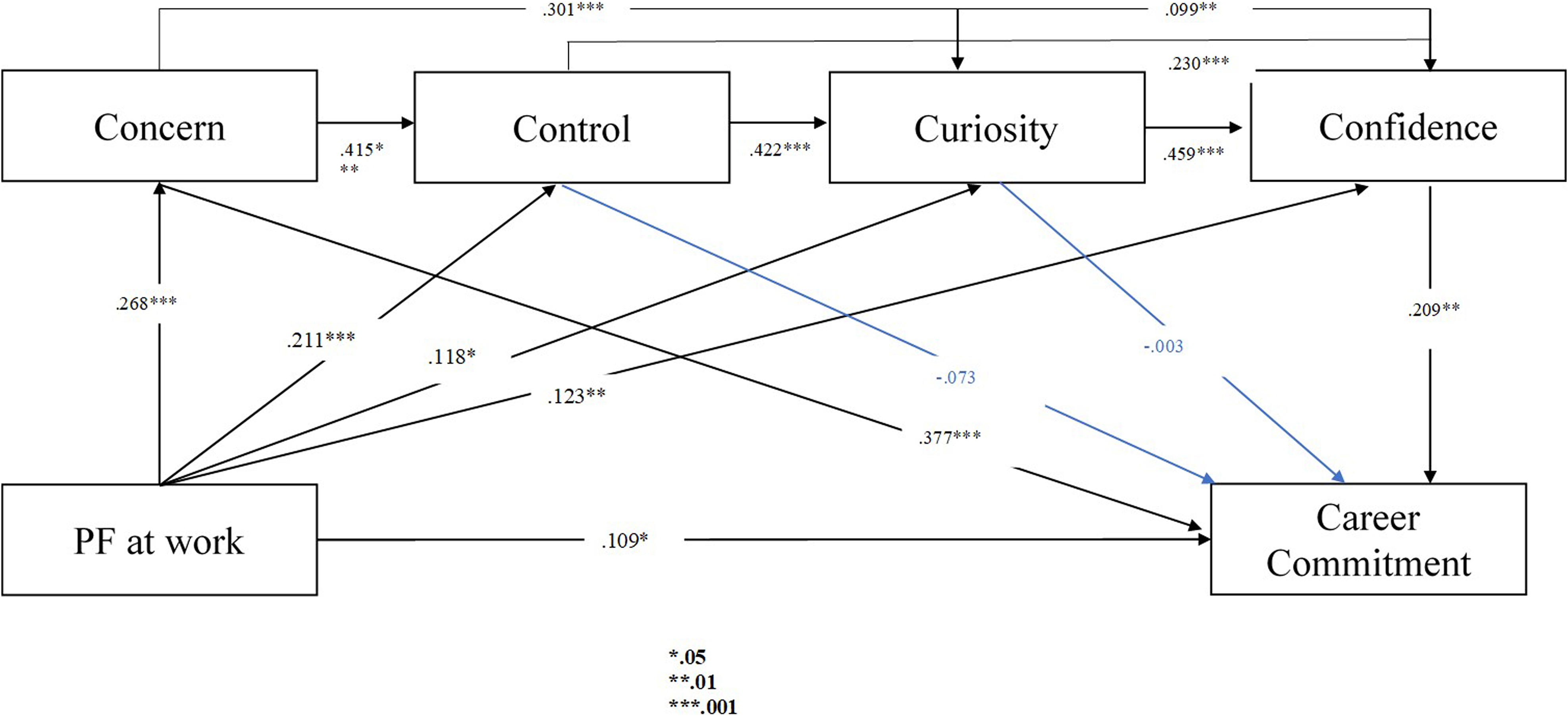
Adaptability resources including concern, control, curiosity, and confidence serially mediating the relationship between PF at work and career commitment.
Results
Preliminary analysis
Table 1 summarizes descriptive statistics including means, standard deviations as well as inter-reliabilities and bivariate correlations of study variables. The Cronbach's alpha reliability coefficients of the variables (N = 353) ranged from .70 to .89 as seen in Table 1, referring to an acceptable α level (Nunnally & Bernstein, 1994). The correlations between variables ranged from small to high, all were positive and significant. Career commitment was significantly correlated with PF at work (r = .26, p < .01) and with all mediator variables, concern (r = .47, p < .01), control (r = .26, p < .01), curiosity (r = .34, p < .01), and confidence (r = .39, p < .01). In addition, the relationships from PF at flexibility to concern (r = .27, p < .01), control (r = .32, p < .01), curiosity (r = .34, p < .01), and confidence (r = .38, p < .01) were significant. The associations among mediator variables were also significant (r = .47, p < .01 between concern and control; r = .49, p < .01 between concern and both curiosity and confidence; r = .60, p < .01 between control and curiosity; r = .59, p < .01 between control and confidence; and r = .69, p < .01 between curiosity and confidence), as expected.
Mean, standard deviations, and bivariate correlations of the variables.
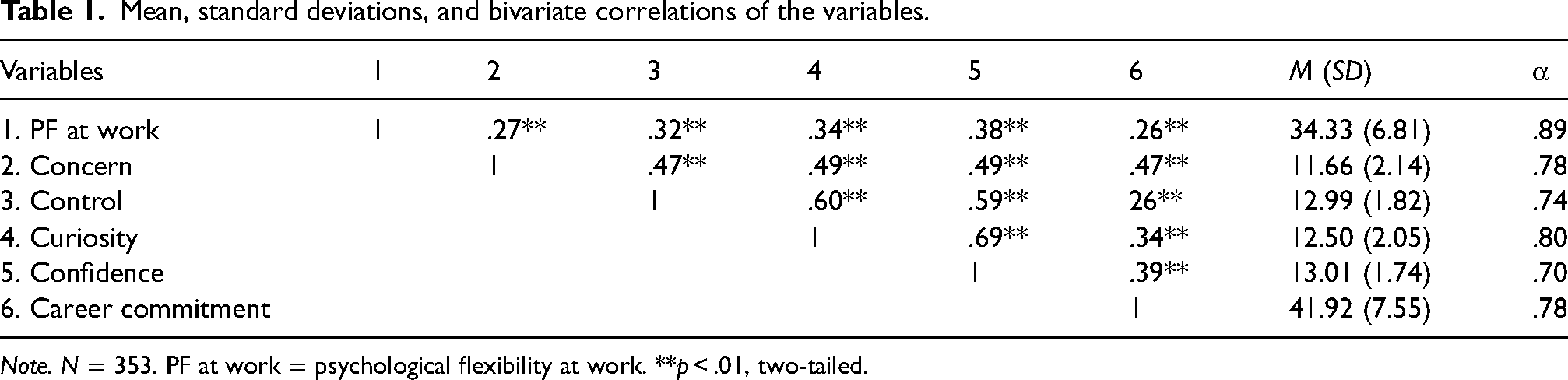
Note. N = 353. PF at work = psychological flexibility at work. **p < .01, two-tailed.
Mediation analysis
The analysis of multiple serial mediation (PROCESS Model 6, serial mediation with four mediators) entailed five separate regression models for each of the outcomes: concern (mediator 1), control (mediator 2), curiosity (mediator 3), confidence (mediator 4), and career commitment (dependent variable). The first model tested the relationship between PF at work and concern. Second estimated model anticipated the relations of PF at work and concern with control. Third tested the relations of control in addition to PF at work and concern with curiosity. Fourth anticipated the relations of PF at work, concern, control, and curiosity with confidence. Finally, fifth tested the relations of PF at work, concern, control, and curiosity with confidence on career commitment.
Table 2 summarizes the results for each model. In the first model, the results indicated positive association between PF at work and concern, B = .27, SE = .02, t(351) = 5.21, p = .000. The Model 2 indicated a positive significant association between PF at work and control, B = .21, SE = .01, t(350) = 4.44, p = .000, and between concern and control, B = .42, SE = .04, t(350) = 8.70, p = .000. In Model 3, a positive significant relationship was found between PF at work and curiosity (B = .12, SE = .01, t(349) = 2.80, p = .005), between concern and curiosity (B = .30, SE = .04, t(349) = 6.66, p = .000), and between control and curiosity (B = .42, SE = .05, t(349) = 9.16, p = .000). In Model 4, positive significant associations of PF at work (B = .12, SE = .01, t(348) = 3.16, p = .002), concern (B = .10, SE = .04, t(348) = 2.27, p = .02), and control (B = .23, SE = .04, t(348) = 4.92, p = .000), and curiosity (B = .46, SE = .04, t(348) = 9.41, p = .000) with confidence emerged. Finally, in Model 5, PF at work (B = .11, SE = .06, t(347) = 2.16, p = .03), concern (B = .38, SE = .20, t(347) = 6.69, p = .000), and confidence (B = .21, SE = .30, t(347) = 3.06, p = .002), except of control and curiosity, were significant predictors of career commitment. Hence, five direct paths of interest in multiple serial mediation were all significant.
The significance test of serial mediation with three mediators.
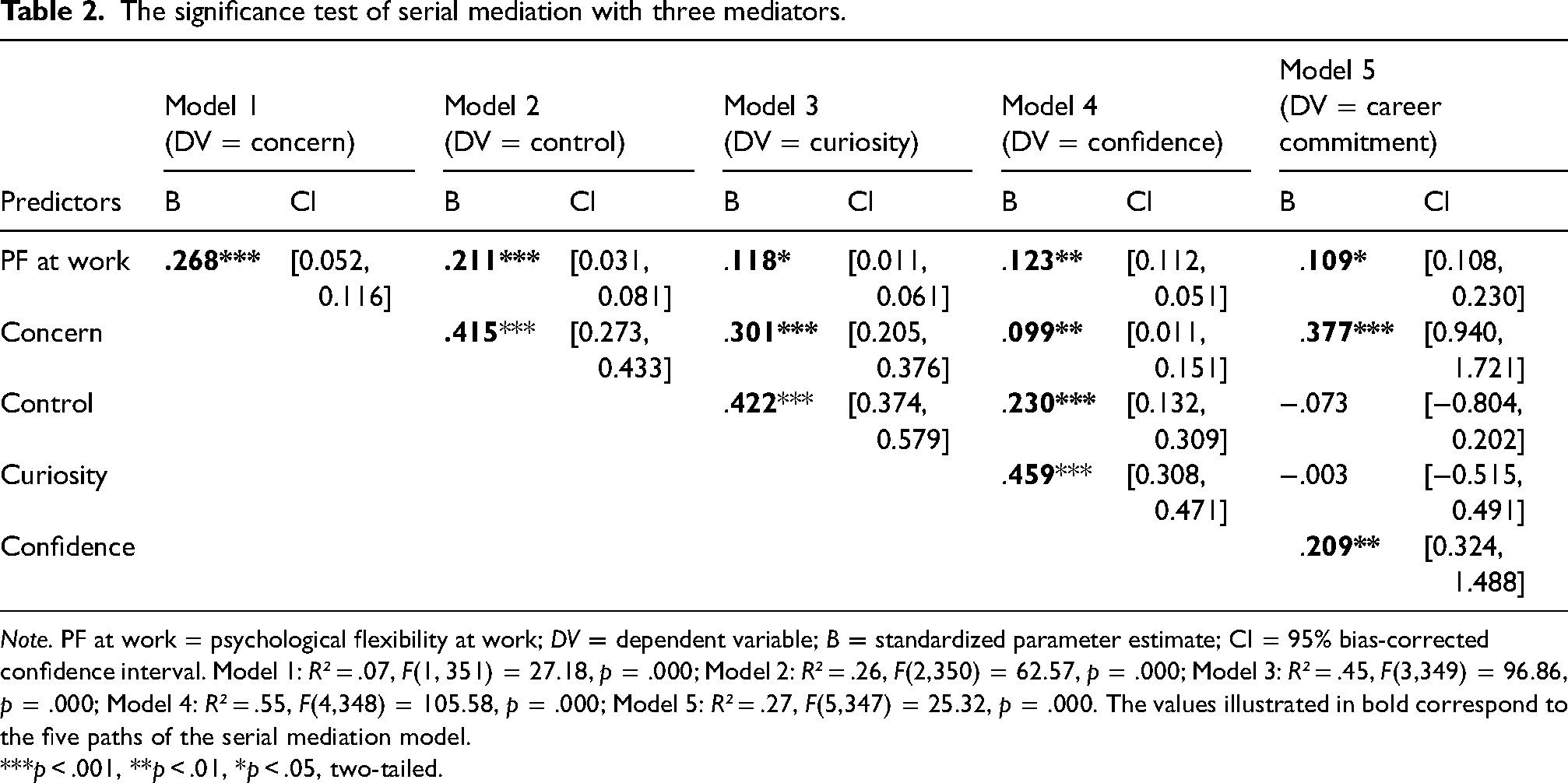
Note. PF at work = psychological flexibility at work; DV = dependent variable; B = standardized parameter estimate; CI = 95% bias-corrected confidence interval. Model 1: R² = .07, F(1, 351) = 27.18, p = .000; Model 2: R² = .26, F(2,350) = 62.57, p = .000; Model 3: R² = .45, F(3,349) = 96.86, p = .000; Model 4: R² = .55, F(4,348) = 105.58, p = .000; Model 5: R² = .27, F(5,347) = 25.32, p = .000. The values illustrated in bold correspond to the five paths of the serial mediation model.
***p < .001, **p < .01, *p < .05, two-tailed.
In addition, the total effect of PF at work on career commitment was significant, B = .26, SE = .06, t(351) = 5.13, p = .000. Moreover, as presented in Table 3, the bootstrap result indicated a significant indirect relation (PF at work → concern → control → curiosity → confidence → career commitment), 95% bias-corrected CI = [.096, .217], confirming serial mediation. This result suggested that employees’ higher psychological flexibility at work was related to higher career concern, control, curiosity, and confidence, serially, which in turn led to higher career commitment.
The bootstrapped results of indirect effects.
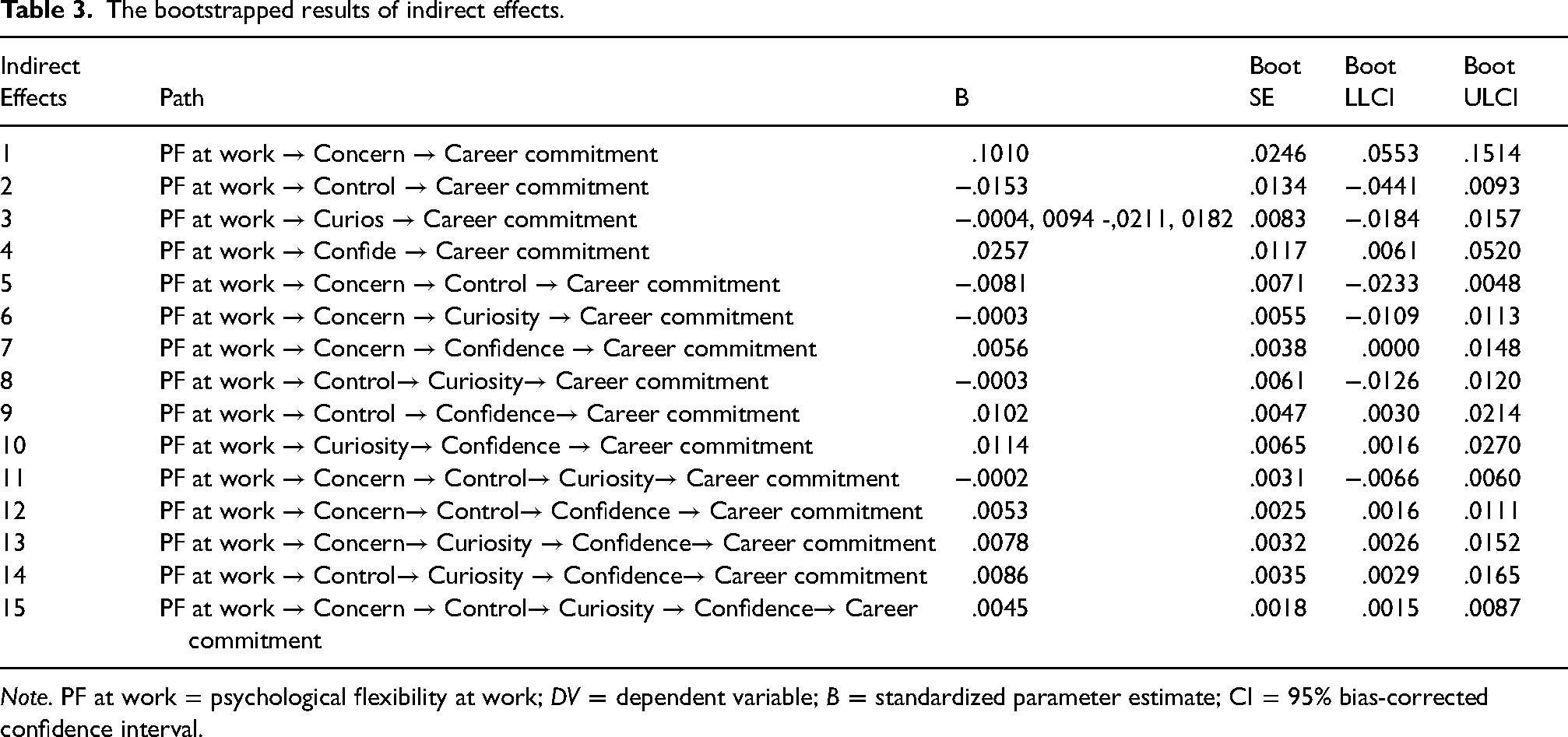
Note. PF at work = psychological flexibility at work; DV = dependent variable; B = standardized parameter estimate; CI = 95% bias-corrected confidence interval.
Career commitment across demographics
Additional analysis was conducted to check whether career commitment differs according to gender, age, education level, and years in profession. The results of one-way ANOVAs showed that career commitment differed according to education level (F(2,350) = 3.17, p = .04) and post hoc analyses using Scheffe (for not homogeneous sample sizes) indicated that there was a significant difference in the means between participants who had doctorate degree and bachelor degree, only (MD = 3.11, SE = 1.24, p = .04). Hence, this result suggested that employees who had doctorate degrees committed to their career higher than those who had bachelor degrees. Yet, career commitment did not change according to gender (F(1,351) = 2.57, p = .11), age (F(2,350) = 0.15, p = .87), and tenure (F(2,350) = 0.69, p = .50).
Discussion
We aimed to examine direct and indirect associations among PF at work and adaptability resources including concern, control, curiosity, confidence, and career commitment based on the adaptation model of career construction. Specifically, we tested a multiple serial mediation role of adaptability resources on the relationship between PF at work and career commitment. Firstly, our results indicated a positive direct relation of PF at work (adaptivity) with concern, control, curiosity, and confidence, as the components of career adaptability (adaptability resources). This result could be plausible within the theoretical basis of PF at work and career adaptability. Conceptually, PF encompasses six components, including present-moment awareness, values, committed action, self as context, cognitive defusion, and acceptance (Hayes et al., 1996), which could have theoretical interceptions with components of career adaptability, including self-regulatory skills such as self-awareness, goal orientation, being persistent, and acting toward to goals (Savickas, 2013). In addition, Hayes et al. (1996) underlined psychological inflexibility as the opposite end of PF and the lack of capacity to adapt to changes in demands or environmental conditions. Thus, our findings were consistent with this assumption by showing the positive relation of psychological flexibility at work with each adaptability resource. In addition, the relevant literature, underlying that PF was proposed to be related with coping, yet different from coping (Karekla & Panayiotou, 2011) can also provide a baseline for our results considering that adaptability resources refer to self-regulatory, psychosocial coping skills (Savickas & Porfeli, 2012). Moreover, PF at work was associated with personality variables such as Big-Five factors (Bond & Bunce, 2003; Bond et al., 2013), and previous studies found these personality variables (e.g. proactive personality, extraversion, agreeableness, conscientiousness, openness to experience, and emotional stability) as the antecedents of adaptability resources (e.g. Pajic et al., 2018; Woo, 2018; Zacher, 2016). Hence, these associations can provide a baseline for our results showing relations between PF at work and career adaptability resources. Lastly, our findings also supported that there is an overlap between adaptability and PF as well as the fact that adaptability was associated with well-being, but PF accounted for distress more (Waldeck et al., 2021), as confidence dimension encompasses useful skills for handling distress and adversities in career life (Savickas, 2012).
Second, our results indicated the direct relations of concern and confidence (adaptability resources) with career commitment (adapting responses), yet not of control and curiosity. Concern means looking ahead and planning the future (Savickas & Porfeli, 2012), which could be associated with the career planning dimension of career commitment (i.e. setting career goals) within career motivation theory (London, 1993). The previous research addressed the associations between concern and career striving and motivation (e.g. Neureiter & Traut-Mattausch, 2016; Pouyaud et al., 2012). In a similar vein, confidence is related with having self-efficacy feelings to overcome difficulties to achieve career goals and implement career choices (Savickas & Porfeli, 2012), which could be associated with career resilience dimension of career commitment (i.e. resisting career barriers or disruptions) (Carson & Bedeian, 1994; London, 1983), also. Supportively, although all adaptability resources were found negatively related with intentions to leave the career, the analysis addressed specific negative relations of control and confidence with it (Omar & Noordin, 2013), partially supporting our findings. Similarly, the previous work indicated specific cross-sectional relations of concern and confidence with career satisfaction and self-rated career performance (Zacher, 2014), consistent with our results, considering the aforementioned relations of career commitment with career success and satisfaction (e.g. Ballout, 2009; Lin, 2020). Hence, it could be interpreted that looking ahead and having confidence contributed to Turkish employees’ career commitment through their skills for planning the future and tackling obstacles and solving problems in their career.
Control, on the other hand, refers to having a sense of control over the future (Savickas, 2013), which did not predict career commitment according to our results. It could be explained within the Turkish context. In Turkey, employees face many uncertainties, economic insecurity, and an increase in unemployment rates, which might prevent them from feeling a control over personal futures or cause to have a belief that taking responsibility is not enough to achieve career goals under discouraging economic circumstances. In addition, control has been associated with being autonomous and independent, and having decision-making skills (Savickas, 2013; Savickas & Porfeli, 2012) and negatively predicted career decision-making difficulties (Hirschi et al., 2015). At that point, culture affects the characteristics of decision-making processes by providing answers to who are involved in this process (Sagie & Aycan, 2003). In Turkey, it is assumed that there is a high power distance between managers and employees with a masculine culture, in which managers have power and control (Parnell et al. 2013). Hence, an authority figure (i.e. father or a manager) is expected to make the right decisions for the benefits of employees, which is called a paternalistic relationship (Sagie & Aycan, 2003). These altogether can provide explanations regarding no significant association between control and career commitment within the Turkish context.
Similarly, it could be tentatively assumed that curiosity, which is related with exploration of possible alternatives and roles (Savickas & Porfeli, 2012, Savickas, 2013) might be intervened with career identity dimension of career commitment, referring to establishing emotional bond with one's career and reflecting the dimension of motivation to pursue the career (London, 1983). Hence, any association between them might have emerged in our results. Zacher et al. (2015) addressed that career adaptability resources, especially curiosity, were negatively related to unwillingness to pursue other options, meaning the possibility of considering other career options. This could provide another explanation for the insignificant path between curiosity and career commitment.
Moreover, our results confirmed the serial mediation role of adaptability resources—concern, control, curiosity, and confidence, consecutively—on the relationship between PF at work and career commitment. This supported career adaptation model proposed that PF at work (adaptive readiness) contributed to adaptability resources—that is career adaptability including concern, control, curiosity, and confidence—which in turn promoted career commitment (adapting responses) within CCT (Savickas, 2013). Based on this sequence, adaptive readiness or adaptivity reflected individuals’ being proactive and flexible toward unpredictable and fluid conditions and processes as well as uncertain tasks of the world of work (Rudolph et al., 2017). It was associated with “personality traits of flexibility and willingness to change” (Savickas & Porfeli, 2012, p. 662), like PF at work that is associated with personality variables (Bond et al., 2013, 2016) in our study. PF reflects being in the present moment by contacting internal and external issues by engaging in behavioral regulatory processes without experiential avoidance (Bond et al., 2006). Hence, as aforementioned, it has been associated with distress (Masuda et al., 2009), including career-related ones, which also requires people to have adaptability resources such as concern, control, curiosity, and confidence to manage them (Savickas, 2013). In turn, concern, control, curiosity, and confidence contributed to career commitment, respectively, indicating serial mediation role of adaptability resources, which was consistent with the hierarchical nature of the dimensions of career adaptability (Savickas & Porfeli, 2012) as well as the results of previous work (e.g. Hirschi et al., 2015; Johnston, 2018) to some extent. In addition, the meta-analysis study of Zhu et al. (2021) conceptualized attitudes toward career (i.e. future time perspective, regarded to concern) and motivational attributes (i.e. need for achievement, self-efficacy, and self-esteem, which could be related to control and confidence) as the antecedents of career commitment. Hence, our results implied that to promote career commitment, adaptability resources, which are more changeable competencies compared with stable traits (Savickas & Porfeli, 2012), should be fostered together, compatible with its multidimensional and hierarchical structure (Savickas, 2013). Moreover, our results indicated that while each individual dimension of career adaptability did not affect career commitment, these dimensions serially mediated the associations between PF at work and career commitment. This could be explained by the fact that composite correlations show higher reliability compared with their individual dimensions, which might result in their higher associations with the relevant variable or criteria (Hunter & Schmidt, 2004).
Finally, our findings indicated that career commitment differed according to the education level of participants (between bachelor and doctorate degree), consistent with the previous work (e.g. Benligiray & Sonmez, 2013; Zhu et al., 2021). It means that employees who have higher education committed to their career more. The possible reason for that might be that employees with higher educational status might invest more to their career, and hence they may not want to quit their professions (Weng & McElroy, 2012) and obtain more desirable and satisfactory career options (Benligiray & Sonmez, 2013). Particular to our study, the results differed between bachelor and doctorate degree, only, which could be understood cultural and political contexts. In Turkey, the number of universities and bachelor degree programs has been increased, so university graduated employees do, which poses a risk for increasing the unemployment rate of university graduates, also (TurkStat, 2021b). It could be tentatively interpreted that an increasing amount of unemployed university graduates might cause them to obtain a master degree to increase their chance to find a job and/or postpone the job search process which is highly stressful for new graduates, instead. Hence, career commitment might not differ between bachelor and master degrees, considering that obtaining a master degree might not mean committed to their career more. Obtaining a doctorate degree, on the other hand, has not increased too much, compared with bachelor and master degrees, which might mean that individuals prefer to continue their education when they committed to their career more.
Our results also indicated that career commitment did not change across gender, age, and years in profession, somewhat consistent with the previous work (e.g. Zhu et al., 2021), although there were also contradictory findings which had small effect size though (e.g. Lee et al., 2000; Katz et al., 2019). Our finding showing not difference across gender could be explained by changing cultural dynamics in Turkey. Especially considering higher education, the statistics indicate that the rates of success on the university entrance exams were close between female and male students (OSYM, 2020). In addition, the rate of women in higher education was reported as 46.3%, while this rate for men was 40.6% (TurkStat, 2021c). Hence, in this privileged sample consisting of university graduates, no gender difference on career commitment might infer that women who obtain higher education committed to their career, just as men did. However, this result might change with socioeconomically disadvantaged women with lower education levels.
Regarding no age and tenure differences on career commitment, the results could be understood in the Turkish context, also. Although the older adults in Turkey represented 9.5% of the population in 2020 with an increase of 22.5% within the last five years, Turkey ranked 66 out of 167 countries in terms of population of older people (i.e. 28.5% in Japan and 22.9% in Germany) (TurkStat, 2021d). The statistics indicated demographic transformation in Turkey as the young population has decreased and the rate of older adults in the population has increased. In addition, it was reported that the median age occurred 32.7 in 2020 (TurkStat, 2021d), indicating not much age difference in the working population. Hence, this might provide an explanation that age divergence among working adults might not pose statistically significant differences in terms of their career commitment. Moreover, considering education level, older people who graduated from higher education represented 7% only of older adults, yet 45.5% graduated from elementary school and 32% were reported as analphabetic or unschooled (TurkStat, 2021d), which might justify this tentative assumption. In sum, as aforementioned, rather than viewing demographics as stable and predictive variables, these results also indicated how sociocultural and political contexts might intersect with these demographics (see Duffy et al., 2016). The education level (i.e. obtaining doctorate degree) could be considered a key marker of societal privilege, even among a privileged group in terms of being university graduated employees who had a job. Whether gender, as another social identity, functions as a key marker of marginalization should be examined with employees with lower education levels in this context.
Implications, limitations, and future directions
Our study contributed to CCT (Savickas, 2013) by showing the role of PF at work based on ACT on career adaptability. Regardless of the nature of the problem that employees face, it is essential to understand the coping mechanisms rather than the adversity or psychological distress itself. In this regard, ACT (Hayes et al., 1999), called one of the third-wave psychotherapy approaches and has received a great attention over the past two decades (Dimidjian et al., 2016), stands for noticing all experiences, as they are, instead of trying to get away from problems (Hayes et al., 1999). ACT favors psychological flexibility, which brings a different viewpoint for problems and emphasis on valued living and committed action (Hayes et al., 2005). The CCT also underlines the importance of being on one's own center by focusing on self-making, meaning making and direction in the life in this challenging, uncertain, and fluid world of work as well as enormous developments of this era by increasing psychosocial coping skills called as career adaptability (Savickas, 2012, 2013). At that point, it could be said that our results implied the fundamental concept of the ACT serves for beliefs, attitudes, and competencies of career adaptability as employees’ much-needed skills in the current world of work within the CCT. In addition, our results indicated that career adaptability resources (concern, control, curiosity, and confidence), which were also examined within motivational systems theory, previously (Hirschi, 2009), contributed to career commitment based on career motivation theory (London, 1983, 1997) hierarchically.
Practically, our results could imply that interventions for fostering PF at work based on ACT, as a cognitive and learnable trait (Bond et al., 2013), can improve the career adaptability of employees and hence their career commitment. PF at work could be considered a more malleable antecedent of adaptability resources as shown in our results, compared with other stable and constant personality characteristics. Bond et al. (2013) suggested organizations/employers to assess and foster employees’ PF at work that can change, instead of stable Big-Five variables. Thus, considering previous results indicating a negative correlation among neuroticism as a factor of Big-Five personality and career adaptability (Teixeira et al., 2012), PF at work can be improved in employees who obtained higher scores on neuroticism dimension to foster their career adaptability in the workplace, hence their career commitment also. In addition, PF at work on reduced work stress and emotional burnout and increased job performance and presenteeism at work (Bond & Bunce, 2003; Lloyd et al., 2013), which have been mentioned among adaptation results affected by career adaptability within the career adaptation model (Savickas, 2013; Rudolph et al., 2017) as well as the outcomes of career commitment (e.g. Zhu et al., 2021). Hence, our results implied that fostering PF at work would contribute to adaptability resources and adaptation results more prominently.
In addition, our results practically implied that developing each source of career adaptability, hierarchically would contribute to career commitment. This implication would be compatible with the evidence suggesting that the components of career adaptability are distinguishable, yet highly correlated with each other (e.g. Hirschi et al., 2015). In addition, considering that the literature mentioned the link between skill development and career commitment (Colarelli & Bishop, 1990), our findings suggested that career development programs should contain implementations fostering career adaptability skills including concern, control, curiosity, and confidence in a package by integrating interventions for supporting PF at work to promote career commitment. Finally, considering that developing career commitment is a longitudinal process, the implementation for increasing PF at work and career adaptability skills could be provided to employees, especially those who had lower educational degrees.
There are some limitations of the current study. First, the cross-sectional design does not support causal inferences, and hence the directions of paths in the tested model are based on theoretical considerations. Further longitudinal research is needed to provide evidence for these proposed associations. Second, the model included person-related variables such as PF at work and career adaptability, only although there could be influences of social context on the development of these psychological factors. Thus, future research can include socio-environmental variables (e.g. perceived social support and supervisors’ support) into the model, considering the impacts of cultural variation in the self-systems (Markus & Kitayama, 1991), especially in more collectivist cultures or mixed ones like in our study. Third, career commitment was evaluated by using the conceptualization of Carson and Bedeian (1994), yet there are also some other models (e.g. Blau, 2003; Meyer et al., 1993); hence, future research can explore direct and indirect influences on career commitment based on different conceptualizations. Last, the participants of our study included university graduated white-collar workers, only. Considering career commitment changes according to education level, future research can investigate the antecedents of career commitment of workers with different educational backgrounds. In addition, PF at work, as a cognitive variable, might be affected by education level, thus the current results should be interpreted considering this possibility.
All in all, PF at work was significantly related to career adaptability resources (concern, control, curiosity, and confidence); and career commitment was predicted by concern and confidence. These findings should be comprehensively taken into consideration from various perspectives including but not limited to cultural, psychosocial, cognitive, and environmental aspects.
Footnotes
Declaration of conflicting interests
The author(s) declared no potential conflicts of interest with respect to the research, authorship, and/or publication of this article.
Funding
The author(s) received no financial support for the research, authorship, and/or publication of this article
