



Abstract
Mycobacterium avium subsp. paratuberculosis (MAP) infection in deer causes paratuberculosis (PTb; Johne disease), a slowly progressive chronic granulomatous enteritis. Accurate and rapid detection of MAP shedding by subclinical animals is essential for effective control of infection in deer herds. The VetMAX MAP 2.0 qPCR assay targeting IS900 was developed for cattle, sheep, and goats. However, the performance of the assay in sika deer (Cervus nippon) has not been evaluated. Here, we describe the use of the VetMAX MAP 2.0 qPCR assay on fecal samples from sika deer for the detection of MAP and its correlation with bacterial culture. DNA was extracted from fecal samples from 115 sika deer with known culture results (79 from a PTb-endemic herd and 36 from a PTb-free herd), using the QIAamp PowerFecal Pro DNA extraction kit. Diagnostic sensitivity and specificity were 100% (76 of 76) and 92.3% (36 of 39), respectively, with an overall accuracy of 97.4% compared with bacterial culture. A strong positive correlation was observed between culture time to detection and the qPCR Cq-value (r = 0.70, area under the curve = 0.96). Our findings offer correlation between bacterial culture and VetMAX MAP 2.0 qPCR assay results in feces of farmed sika deer and highlight the quantitative value of the qPCR assay as a rapid indicator of bacterial load and shedding intensity.
Paratuberculosis (PTb; Johne disease)—chronic granulomatous enteritis caused by Mycobacterium avium subsp. paratuberculosis (MAP)—affects ruminants worldwide. 7 In farmed deer, PTb manifests as progressive weight loss, diarrhea, reduced productivity, and ultimately, mortality, 16 inflicting significant economic and welfare losses. Animals often remain chronically infected without overt disease, yet intermittently shed MAP. These subclinically affected deer are considered the main source of intra-herd transmission. 16
Accurate and timely diagnosis of MAP infection is critical for disease control. Culture of MAP from feces has high specificity but is hampered by very long incubation times (often weeks to months), the need for decontamination incubations, and variable sensitivity, particularly in low-shedding or subclinical individuals.15,21 Molecular assays, especially quantitative real-time PCR (qPCR), offer a faster route for detecting MAP DNA in fecal samples. Beyond speed, qPCR enables quantification of bacterial load through the quantification cycle (Cq) value, providing semi-quantitative insight into shedding intensity and potential infectiousness. 8 qPCR assays targeting the IS900 insertion sequence (commonly present in ~14–20 copies per genome of MAP) have enhanced analytical sensitivity compared with single-copy targets such as F57, 4 and are widely used in cattle, sheep, and goats. Numerous validation studies for these species have demonstrated good sensitivity, specificity, and correlation with bacterial load.10,11 However, qPCR performance can vary depending on sample matrix, DNA extraction efficiency, qPCR assay, and the disease status of MAP infection. 12 Further, fecal samples are likely to contain qPCR inhibitors, which can compromise amplification and reduce sensitivity. 12 Therefore, standardization of extraction protocols and assay parameters is essential to ensure reproducible quantification and comparability of results among studies and host species. 2
No data are available for any MAP assays used in sika deer (Cervus nippon). A comprehensive literature search using Google Scholar, PubMed, CAB Direct, Web of Science, and Scopus with the keywords “sika deer”, ”Cervus nippon”, “qPCR”, “IS900”, “Johne’s disease”, and “MAP” identified no published reports describing the detection of MAP in fecal samples of sika deer by qPCR.
The commercial IS900-targeting qPCR assay (VetMAX MAP 2.0 qPCR kit; Applied Biosystems) has been used widely for MAP detection in cattle, sheep, and goats, but its use in MAP-infected sika deer has not been reported previously, to our knowledge. Our objective was to assess the VetMAX MAP assay combined with a DNA extraction kit (QIAamp PowerFecal Pro; Qiagen) for the detection of MAP DNA in feces from farmed sika deer. We also examined the correlation between bacterial culture and qPCR-based quantification of MAP in sika deer fecal samples.
We collected 115 fecal samples from 39 clinically affected deer obtained at postmortem and from 40 apparently healthy deer originating from the same MAP-infected herd and collected at slaughter. The diseased animals had either been found dead or were euthanized by intravenous overdose of sodium pentobarbital and phenytoin sodium (Euthasol; Virbac). In addition, we obtained 36 fecal samples at postmortem from a PTb-free herd. We stored all samples at −80°C until analysis. The study protocol was approved as exempt from full ethical review by the UCD Animal Research Ethics Committee (AREC; ethical approvals AREC-E-16-48-Jahns and AREC-E-22-31-Jahns).
We cultured all fecal samples using an automated microbial detection system (VersaTREK system, TREK para-JEM; Thermo), as described previously.
1
MAP in culture-positive samples was initially confirmed by Ziehl–Neelsen (ZN) staining for acid-fast bacilli and subsequently verified by qPCR targeting the F57 locus (
For qPCR, we extracted DNA from each fecal sample with the QIAamp PowerFecal Pro DNA kit, following the manufacturer’s instructions. Extracted DNA was analyzed with the VetMAX MAP 2.0 qPCR kit targeting the IS900 element, following the manufacturer’s instructions. We analyzed all samples in duplicate. Negative template controls included an extraction blank, water, and DNA extracted from a culture-negative fecal sample from a healthy sika deer. Additional positive controls were an external positive control provided in the qPCR kit as well as DNA obtained from a culture-positive sample from clinically affected sika deer with PTb (
We conducted all statistical analyses in R Studio 2025.09.0 18 running R v.4.5.1. 19 We performed the analysis using the packages blandr v0.6.0, dplyr v1.1.4, 24 ggplot v4.0.0, boot, cutpointr, and psych v.2.5.6.3,20,23,24 We assessed the relationship between time to culture positivity and qPCR Cq values using Spearman rank correlation with bootstrapped 95% CIs. Using culture as the gold standard, we conducted receiver operating characteristic (ROC) analysis to determine the diagnostic performance of the IS900 qPCR and identified optimal Cq value cutoff points using the Youden index in the cutpointr package. We used similar ROC-based approaches to derive thresholds distinguishing between different levels of bacterial shedding (none, low, moderate, high) in feces. Statistical significance was set at p ≤ 0.05 for all analyses.
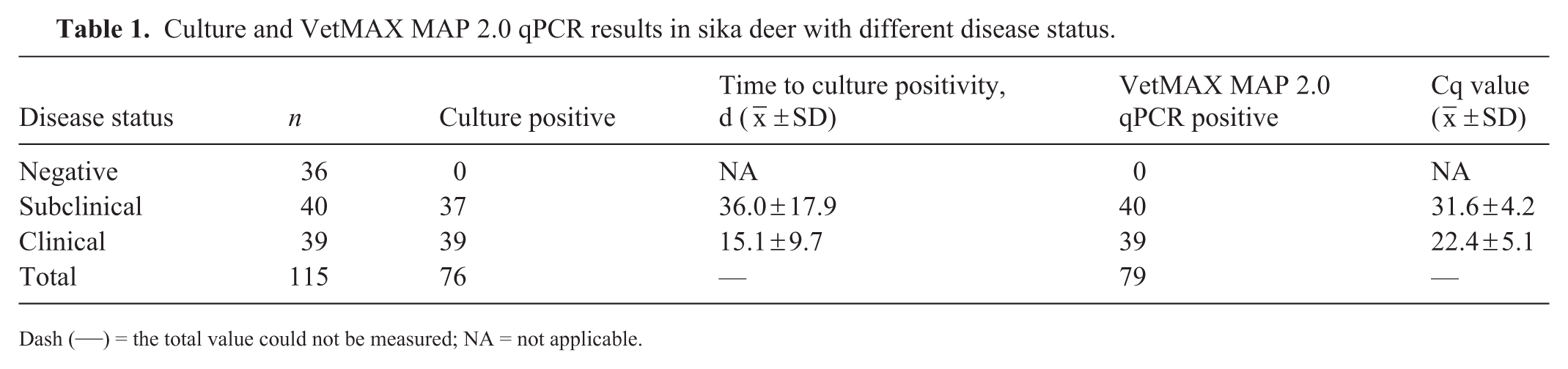
All clinical fecal samples (39 of 39; 100%) were culture positive, with a mean time to culture positivity of 15.1 ± 9.7 d (
Table 1
). In the subclinical group, 37 of 40 fecal samples (92%) were culture positive, with a longer mean time to culture positivity of 36.0 ± 17.9 d (Table 1). As expected, none of the fecal samples from the negative group (0 of 36) yielded positive culture results (Table 1;
Culture and VetMAX MAP 2.0 qPCR results in sika deer with different disease status.
Dash (—) = the total value could not be measured; NA = not applicable.
The DNA yield was adequate in the fecal samples (10.6–362 ng/µL,
For all positive fecal samples, a statistically significant positive correlation was observed between time to culture positivity and average Cq value (Spearman ρ = 0.90, 95% CI [0.82, 0.96]; p < 0.001). Hence, fecal samples with lower bacterial loads (higher Cq value) required longer incubation periods to yield positive culture results ( Fig. 1A ). Strong correlations were observed between qPCR Cq value and the time to culture positivity for subclinical ( Fig. 1B ) and clinical ( Fig. 1C ) fecal samples.
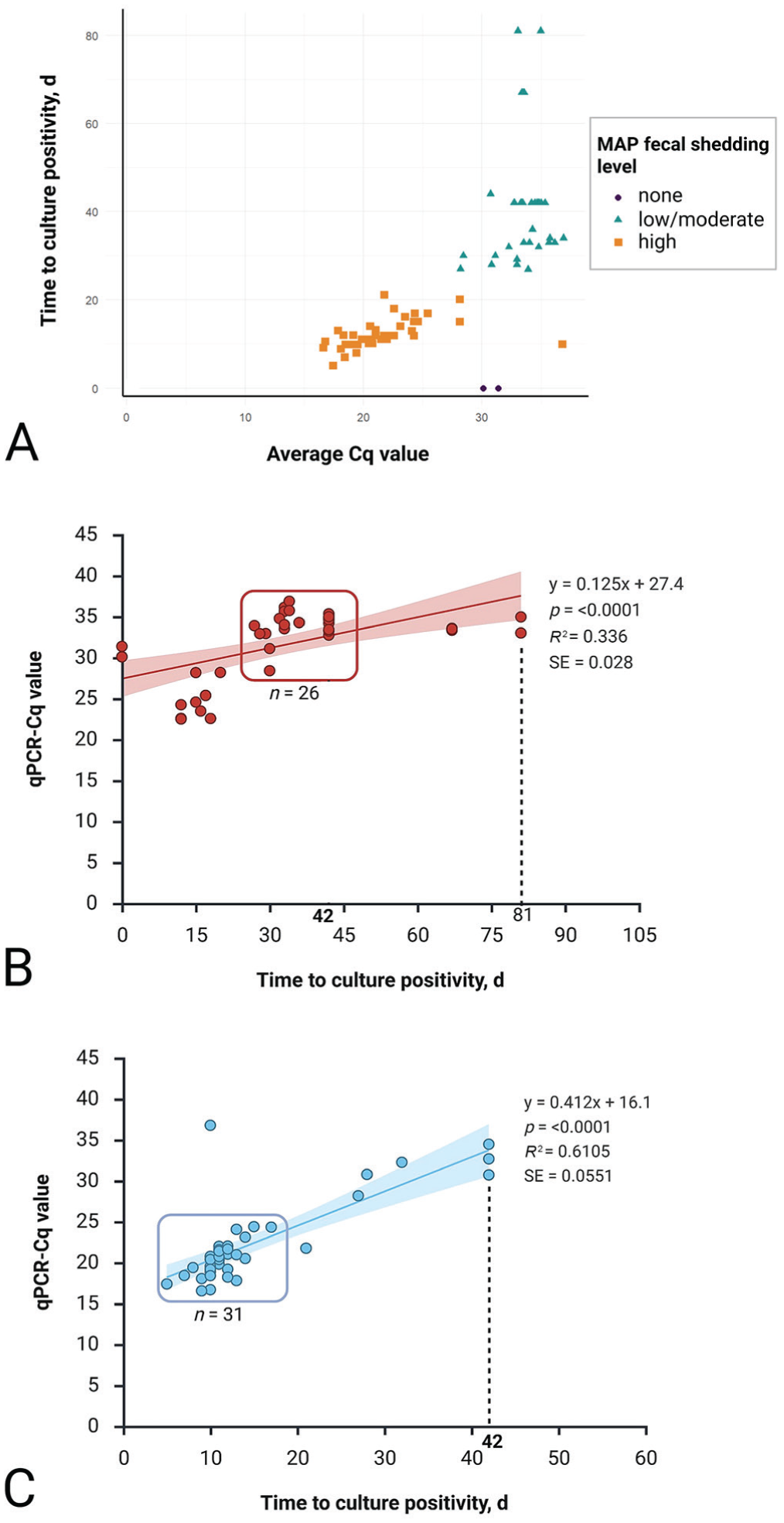
Relationship between IS900 qPCR Cq values and time to culture positivity.
We found excellent correlation between the liquid MAP culture and the qPCR assay. Our findings are not surprising, given that the sika deer were infected with the cattle type (C) strains of MAP (GenBank SRA bioproject PRJNA1284643), which are closely related to cattle strains circulating in Ireland. 1 Our findings suggest that species, sample matrix, and DNA extraction efficiency did not interfere with the test.
When fecal culture was used as the gold standard, the specificity of the VetMAX MAP 2.0 qPCR kit was only 92% in our study. This may be because culture itself is an imperfect method for MAP detection. Decontamination of the sample by removing commensal bacterial and fungal flora exposes MAP to chemicals and antibiotics that can inhibit or even kill large proportions of the viable MAP load.6,11 Therefore, our culture-negative but qPCR-positive results could reflect the ability of qPCR to detect non-culturable or low-viability MAP, a pattern also reported in captive white-tailed deer, 16 sheep, 9 and cattle, 10 or these may be false-positive results. In cattle, fecal IS900 qPCR has been reported to have high diagnostic sensitivity (~93–96% relative to culture), often surpassing culture performance, 5 which can drop to 38–42% on a single fecal culture in infected cattle. 22 Similarly, in sheep, culture sensitivity is known to decline with low-level shedding, whereas IS900 qPCR maintains consistent detection capability. 17 The QIAamp PowerFecal Pro DNA extraction kit appeared to be very effective in removing PCR inhibitors from sika deer feces, given that DNA yields and the ratios of absorbance were excellent and the sensitivity for the qPCR was 100%.
The AUC of 0.98 that we found demonstrates near-perfect discrimination between low or medium and high shedders, comparable to findings in red deer in which qPCR quantification effectively stratified infection burden. 15 In cattle, qPCR-derived Cq values have been used successfully to categorize shedding and estimate transmission risk. 14 Similar trends in sheep suggest that qPCR quantification can serve as a semi-quantitative indicator of disease stage and infection potential. 8 Moreover, the lower mean Cq value in clinically infected sika deer indicates higher bacterial shedding, aligning with trends documented in captive white-tailed deer, 16 in which advanced lesions result in higher fecal loads and lower Cq values. Establishing species-specific Cq values in deer populations could improve targeted control strategies and early culling of high shedders.
Our results confirm that the VetMAX MAP 2.0 qPCR kit offers a robust, sensitive method for detecting and quantifying MAP infection and is a reliable alternative to culture for routine diagnosis and herd-level surveillance of PTb in sika deer. The main limitations of our study are the small sample size, the low number of negative samples, and the lack of genetic variability in the isolates. Future studies involving multiple herds, different bacterial isolates, and repeated sampling are needed to strengthen and generalize these findings in sika deer.
Supplemental Material
sj-pdf-1-vdi-10.1177_10406387261455839 – Supplemental material for Correlation between bacterial culture and IS900 qPCR to detect Mycobacterium avium subsp. paratuberculosis in the feces of sika deer
Supplemental material, sj-pdf-1-vdi-10.1177_10406387261455839 for Correlation between bacterial culture and IS900 qPCR to detect Mycobacterium avium subsp. paratuberculosis in the feces of sika deer by Nasser Alotaibi, John A. Browne, Emily A. Courcier and Hanne Jahns in Journal of Veterinary Diagnostic Investigation
Footnotes
Acknowledgements
We thank Brian Cloak and Daniel O’Sullivan from the Pathobiology Section, School of Veterinary Medicine, University College Dublin, Dublin, Ireland, for their technical assistance. We are grateful to the owners of the sika deer herds for supporting our study.
Declaration of conflicting interests
The authors declared no potential conflicts of interest with respect to the research, authorship, and/or publication of this article.
Funding
Nasser Alotaibi thanks the Government of Saudi Arabia for the PhD research scholarship (grant 49651).

Supplemental material
Supplemental material for this article is available online.
References
Supplementary Material
Please find the following supplemental material available below.
For Open Access articles published under a Creative Commons License, all supplemental material carries the same license as the article it is associated with.
For non-Open Access articles published, all supplemental material carries a non-exclusive license, and permission requests for re-use of supplemental material or any part of supplemental material shall be sent directly to the copyright owner as specified in the copyright notice associated with the article.
