



Abstract
We study how the proximate and distal sociocultural environments affect the well-established relationship between entrepreneurial self-efficacy and entrepreneurial intentions. We focus on the institutional individualism–collectivism orientation of nations and the presence of nascent entrepreneurs as moderators of this relationship to account for the multilayered nature of the context. We observe that for individuals with entrepreneurial self-efficacy the positive effect of knowing nascent entrepreneurs as a driver of entrepreneurial intentions is weaker than for individuals who do not believe to be able to successfully launch a business venture. This effect is contingent on the individualistic–collectivistic character of the national culture.
Keywords
Intentions as “the best single predictor of an individual’s behavior” (Fishbein & Ajzen, 1975, p. 369) are subject of much research in entrepreneurship. What shapes entrepreneurial intentions? Recent advancements, building on the seminal work of Shapero and Sokol (1982), suggest that in order to understand the formation of entrepreneurial intentions, attention has to be paid to the interplay between their individual (micro) and contextual (macro) antecedents (Kibler, 2013; Liñán & Fayolle, 2015; Schlaegel & Koenig, 2014; Shinnar, Giacomin, & Janssen, 2012; Siu & Lo, 2011; Wennberg, Pathak, & Autio, 2013). Untangling the way context shapes individual behavior, however, remains a challenge (Thornton, Ribeiro-Soriano, & Urbano, 2011; Welter, 2011) and it becomes even more difficult when the multilayered and nested nature of the socioeconomic environment is recognized (Erez & Gati, 2004; Leung & Bhagat, 2005). Welter (2011) highlights the importance of such a multilayered approach, pointing at the proximate social interactions and the distal political and cultural systems previously proposed by Mowday and Sutton (1993). Therefore, entrepreneurial intentions are properly studied only when we account for the multiple interactions among the individual predisposition and the proximate and distal context. Despite the rising awareness of these complexities, the potential interplay between individual and nested contextual antecedents and their influence on entrepreneurship have only started to get explored (Abebe & Alvarado, 2016; Hain, Johan, & Wang, 2016; Shinnar et al., 2012; Siu & Lo, 2011; Wennberg et al., 2013).
As an individual antecedent of entrepreneurial intentions, (entrepreneurial) self-efficacy appears to play a particularly important role (Barbosa, Gerhardt, & Kickul, 2007; Boyd & Vozikis, 1994; Krueger, Reilly, & Carsrud, 2000; Shapero & Sokol, 1982; Zhao, Seibert, & Hills, 2005). Self-efficacy represents the individual’s judgment of her ability to perform a certain task within a specific domain (Bandura, 1982), with entrepreneurial self-efficacy denoting her belief of being able to successfully launch a business venture (McGee, Peterson, Mueller, & Sequeira, 2009). The impact of (entrepreneurial) self-efficacy on entrepreneurial intentions has been extensively studied (Boyd & Vozikis, 1994; Chen, Greene, & Crick, 1998; Douglas, 2013; Fitzsimmons & Douglas, 2011; Sequeira, Mueller, & McGee, 2007; Zhao et al., 2005) and is taken as axiomatic today. Albeit Chen and colleagues (1998) already called the attention to the environment as a potential moderating factor of this relationship, few empirical studies have evaluated this impact (e.g., Wennberg et al., 2013).
Parallel to that, entrepreneurship is progressively understood as a social phenomenon (Aldrich & Zimmer, 1986; Hoang & Antoncic, 2003) rooted in social interactions (Newbert & Tornikoski, 2011, 2012). Actors within an individual’s proximate social environment such as peers who engage in entrepreneurship (Nanda & Sørensen, 2010; Qin & Estrin, 2015), entrepreneurial role models (Lafuente, Vaillant, & Rialp, 2007; Roach & Sauermann, 2015; Wyrwich, Stuetzer, & Sternberg, 2016), mentors (Eesley & Wang, 2017) or simply entrepreneurs an individual knows (Arenius & Minniti, 2005) are key influencers and providers of both tangible and intangible resources who shape entrepreneurial attitudes and behavior (Hoang & Yi, 2015), and convey legitimacy and social norms to determine the perceived social value of entrepreneurship (Kacperczyk, 2013; Lafuente et al., 2007; Saxenian, 1994). Most previous research on proximate social environment has focused on the exchange of resources and information, often overlooking the influence on cognitive structures (Autio, Pathak, & Wennberg, 2013; Krueger et al., 2000; Mitchell et al., 2002) and the majority of empirical studies remain silent about the role of context in shaping these cognitive structures (Wyrwich et al., 2016).
Besides the impact of the proximate social environment, there is bountiful empirical research suggesting that cultural traits can alter entrepreneurial intentions and activity (e.g., Davidsson & Wiklund, 1997, 2001; Davidsson, 1995; Kreiser, Marino, Dickson, & Weaver, 2010; Mueller & Thomas, 2000). In that, individualism/collectivism is one of the most extensively studied cultural dimensions within the entrepreneurial domain as it is one of the elements of the “profound structure” of culture differences (Triandis & Suh, 2002). The need to examine the heterogeneous aspects of the distal cultural context has been well identified (Zahra & Wright, 2011), but its interaction with other contextual layers is yet to be understood (Liñán & Fayolle, 2015).
Following this line of reasoning and the call for more integration of the macro and micro level variables in entrepreneurship research (Bamberger, 2008), we study how the proximate and the distal environments shape the relationship between entrepreneurial self-efficacy and entrepreneurial intentions. We focus on this relationship because little is known as to how the confidence in one’s own capabilities to start a business venture is shaped by different layers of context (Mauer, Neergaard, & Linstad, 2009). We rely on the widely held understanding that entrepreneurial self-efficacy is a key driver of entrepreneurial intentions, gradually mortaring the proximate social and the distal cultural layers. We argue that (a) the impact of an individual’s self-efficacy on entrepreneurial intentions is understood better if we account for the presence of a nascent entrepreneur as a transmitter of entrepreneurial values, norms and legitimacy and that (b) it is moderated by individualism.
We test our hypotheses by using the Global Entrepreneurship Monitor (GEM) surveys in 39 countries for a pooled sample of 2002–2010, combining it with data from the Global Leadership and Organizational Behavior Effectiveness (GLOBE) project. We employ multilevel analysis to account for the hierarchical structure of the data. The use of data for countries of all continents and of all socioeconomic development stages enables us to widen the geographic scope of entrepreneurship research, which has often been restricted to developed countries only (Bruton, Ahlstrom, & Obloj, 2008).
Overall, this study makes three contributions. First, it takes to the forefront the under-researched role of interacting proximate and distal contexts in the entrepreneurial cognition processes. Prior research (Fayolle & Liñán, 2014; Hayton & Cholakova, 2012; Hisrich, Langan-Fox, & Grant, 2007; Liñán & Fayolle, 2015; Schlaegel & Koenig, 2014) called for expanding the set of known antecedents of entrepreneurial intentions, focusing on psychological factors such as individuals’ beliefs and perceptions. Additionally, studies that use the theory of social cognition (Mitchell & Smith, 2002; Mitchell et al., 2002; Mitchell, Smith, Seawright, & Morse, 2000) emphasize the potential of contextual contingencies that shape the cognitive processes. Our research extends the knowledge in that we not only study such contextual contingencies but also distinguish between different layers of context. Additionally, by combining ideas from the theory of socialization and social influences 1 with entrepreneurship literature, we are among the first to theorize about the relationship between different layers of sociocultural context for shaping the cognitive structures of potential entrepreneurs.
Second, empirically, we combine several of the most widely used and rich datasets including GEM, GLOBE, and World Bank data to produce a large-scale multilevel multi-country estimation of the drivers of entrepreneurial intentions. By introducing a cross-level moderation model, we are able to demonstrate that the individual (micro) level effects are contingent upon national culture at the macro level, testifying to the importance of overcoming the often present micro–macro level divide in entrepreneurship research (Bamberger, 2008). The possibility that individuals with similar cognitive processes may behave differently depending on their proximate and distal context revealed in this study, testifies to the importance of contextualizing entrepreneurship (Welter, 2011). The empirical results provide further insights as to why inconclusive or even conflicting results regarding the fundamental role of social influences or cultural predispositions abound in prior studies (e.g., De Clercq, Danis, & Dakhli, 2010; Kibler, 2013; Stephan & Uhlaner, 2010).
Our results also offer ideas for policy makers. With entrepreneurship being one of the main pillars for public policies that promote economic development (Lundström & Stevenson, 2005; OECD/European Union, 2017), decision makers seek ways to influence context in order to improve outcomes. By providing evidence about the differential and interacting impact various layers of context exercise on forming entrepreneurial intentions, we give directions about how entrepreneurial support programs can and should be revised.
Theoretical Development
Entrepreneurial Intentions, Entrepreneurial Self-Efficacy, and the Role of Context
Deeply rooted in psychological antecedents (Hindle, Klyver, & Jennings, 2009), entrepreneurial intentions are a cognitive state that precedes entrepreneurial action (Krueger, 2005). Two important strands in the development of the entrepreneurial intention literature can be distinguished (Liñán & Fayolle, 2015). First, theoretical developments stemming from social psychology analyze intentions and behaviors in general. Examples of prominent contributions include Fishbein and Ajzen’s (1975) Theory of Reasoned Action, Ajzen’s Theory of Planned Behavior (1985, 1991), as well as the construct of self-efficacy as one of the essential elements of Bandura’s Social Learning Theory (1971, 1977, 1982; Wood & Bandura, 1989). The second strand of theoretical developments is specific to the field of entrepreneurship. Within it, various entrepreneurial intention models emerged (Bird, 1988; Boyd & Vozikis, 1994; Shapero & Sokol, 1982; Shapero, 1984). While both strands of research have increasingly converged (Liñán & Fayolle, 2015) and some scholars acknowledge that constructs related to drivers of entrepreneurial intentions overlap to a large extent (e.g., Krueger & Brazeal, 1994), others disagree.
In the context of this on-going debate, the influence of self-efficacy on intentions is taken as axiomatic. Self-efficacy, a concept developed in Bandura’s Social Cognitive Theory, is defined as the individual’s estimate of his or her “capabilities to mobilize the motivation, cognitive resources, and courses of action needed to exercise control over events in their lives” (Wood & Bandura, 1989, p. 364). As such, self-efficacy influences individuals’ differences regarding how they feel, think, and act. It mirrors a sense of “can-do.” Boyd and Vozikis (1994) were among the first to bring the concept of self-efficacy into the entrepreneurship literature. The subsequent empirical research provided ample evidence that both the broad concept of general self-efficacy and entrepreneurial self-efficacy are essential drivers of entrepreneurial intentions (e.g., Autio et al., 2013; Chen et al., 1998; Fitzsimmons & Douglas, 2011; Krueger & Brazeal, 1994; Scherer, Adams, Carley, & Wiebe, 1989; Sequeira et al., 2007; Zhao et al., 2005). While the disagreements about which one is the best construct to be used in entrepreneurial research remains (McGee et al., 2009), we follow Bandura’s approach in that self-efficacy should be focused on a specific context and activity domain (1977; 1997). In this study, entrepreneurial self-efficacy is seen as the individual’s belief to be able to successfully launch a business venture (McGee et al., 2009).
Entrepreneurship, according to the institutional perspective, depends on the individual’s relationship with her external environment (Thornton et al., 2011; Veciana & Urbano, 2008). In particular, Welter (2011) points out that in order to better understand entrepreneurship, the interaction between contexts at a higher level of analysis with the phenomenon at a lower level of analysis needs to be taken into consideration and differentiates between distal societal and proximate social contexts. This call for contextualization of entrepreneurship research is backed by the view that social cognitions regarding career choice in general (Lent, Brown, & Hackett, 2000) and entrepreneurial intentions in particular (Siu & Lo, 2011) are contingent upon context. For example, Mitchell and colleagues (2000) state that “because each culture may have unique values and norms about venture creation, culture may also be expected to moderate the relationship between cognitive scripts and the venture creation process” (p. 980). We take this idea further and rely on the concepts of social norms and social legitimacy in order to evaluate the impact of proximate nascent entrepreneurs and distal national culture on entrepreneurial intentions. Based on the notion that the social status of entrepreneurship (Begley & Tan, 2001) and the recognition of entrepreneurship as an acceptable career path (Busenitz, Gomez, & Spencer, 2000) influence an individual’s interest in becoming one (e.g., Etzioni, 1987), we argue that the transmission of entrepreneurial values, norms and legitimacy comes with exposure to peers (Kacperczyk, 2013) as well as with exposure to the distal cultural context. This distinctive treatment of the entrepreneurial environment expands our knowledge about the effect entrepreneurial self-efficacy has on the intentions to start a new business venture.
Knowing a Nascent Entrepreneur and Entrepreneurial Intentions
Entrepreneurship is understood as a social phenomenon (Aldrich & Zimmer, 1986; Hoang & Antoncic, 2003) and the process of founding a business venture is rooted in social interactions (Newbert & Tornikoski, 2011, 2012). In that, different strands of literature have analyzed the influence of social context and have led to the emergence of key research themes such as the influence of social networks (e.g., de Carolis, Litzky, & Eddleston, 2009; Hoang & Antoncic, 2003) and social capital (Davidsson & Honig, 2003; de Carolis & Saparito, 2006; Gedajlovic, Honig, Moore, Payne, & Wright, 2013); household and family context (Chlosta, Patzelt, Klein, & Dormann, 2010; Dunn & Holtz-Eakin, 2000; Nicolaou, Shane, Cherkas, Hunkin, & Spector, 2008); employers (Sørensen & Fassiotto, 2011), mentors (Eesley & Wang, 2017), peers (Nanda & Sørensen, 2010; Qin & Estrin, 2015), and role models (Lafuente et al., 2007; Roach & Sauermann, 2015; Wyrwich et al., 2016).
A common thread in this literature is that (potential) entrepreneurs may benefit from their proximate social environment by gaining access to both tangible and intangible resources (Hoang & Yi, 2015). On the one hand, social ties facilitate access to information, knowledge, skills, advice, and financial resources which enable the (potential) entrepreneurs to recognize entrepreneurial opportunities (Anderson, Park, & Jack, 2007; Ozgen & Baron, 2007), to internationalize (Al-Laham & Souitaris, 2008; Tang, 2011) and grow (Rindova, Yeow, Martins, & Faraj, 2012). On the other hand, network relations also grant access to intangible assets which provide emotional support for entrepreneurial risk-taking (Brüderl & Preisendörfer, 1998), facilitate persistence to remain in business (Gimeno, Folta, Cooper, & Woo, 1997), and create trust (Aldrich & Zimmer, 1986). In this context, social norms and legitimacy are established and they operate as a prism that alters the individual’s intentions to engage in entrepreneurship.
Social norms, the unwritten rules of conduct of a group (Hechter & Opp, 2001), determine the opportunity cost for specific behavior and define sanctions for defecting from it within a given community (Kandori, 1992). Social norms have long been considered an important source of influence of individuals’ attitudes towards a specific career option or professional activities (Merton, 1968). Similarly, social legitimacy is understood as the perception that a specific activity or behavior is “desirable, proper, or appropriate” (Suchman, 1995, p. 574). Social networks are one important way to acquire legitimacy (Aldrich & Zimmer, 1986; Zimmerman & Zeitz, 2002), while they also facilitate the emergence of social norms (Portes, 1998).
Altogether, peers who engage in entrepreneurship, entrepreneurial role models, and mentors who form part of an individual’s social network are seen as key influencers. In particular, it is proposed that entrepreneurial intentions interplay with cognitive perceptions because actual entrepreneurs act as references for potential entrepreneurs who learn to attach greater value to this activity (Kacperczyk, 2013; Lafuente et al., 2007; Saxenian, 1994). While it is debatable to what extent such effects hinge on a personal interaction (Eesley & Wang, 2017; Gibson, 2004), several authors suggest that these individuals convey social value to specific careers such as entrepreneurship even though no active interaction takes place. For example, Nanda and Sorensen (2010) show that an employed individual is more likely to transition to entrepreneurship if their coworkers had a prior self-employment experience “even if they do not choose to be friends with them” (p.1120). Qin and Estrin (2015) provide evidence that sharing the same dormitory positively influenced alumni’s engagement as migrant entrepreneurs and that this social influence spanned over time and space. One of the alleged mechanisms behind this result is the “increase of visibility of (returnee) entrepreneurship as a career option” (p. 237), which is not bound to interpersonal interactions. These outcomes are consistent with a research line that evaluates the non-pecuniary impact of narratives on entrepreneurship (Hjorth & Steyaert, 2004) such as story-bound or symbolic role models (e.g., Laviolette, Radu, & Brunel, 2012; Radu & Redien-Collot, 2008). Based on the theory of social constructivism and social identity building, this literature argues that narratives convey motivation, inspiration, and confidence and thus pave the way for developing entrepreneurship in general and entrepreneurial intentions in particular.
Against this backdrop, we argue that social norms and social legitimacy associated with knowing a nascent entrepreneur determines the perceived social value of the entrepreneurial activity. For example, it can manifest itself in greater admiration or a higher social status of entrepreneurs (Begley & Tan, 2001) and can positively affect an individual’s intention to start a business venture. Moreover, Etzioni (1987) suggests that “the extent to which entrepreneurship is legitimate, the demand for it is higher; the supply of entrepreneurship is higher; and more resources are allocated to the entrepreneurial function” (p. 175). In fact, from these lenses entrepreneurship is seen as a self-reinforcing phenomenon (Minniti, 2005). We therefore contend that
Cognitive theories of entrepreneurial intentions and behaviors support the notion of contextual variables as potential moderators of entrepreneurial intentions (Boyd & Vozikis, 1994; Busenitz & Lau, 1996; Liñán & Chen, 2009; Mitchell & Smith, 2002; Mitchell et al., 2002). In particular, a relatively recent line of research advocates for the inclusion of contextual factors that moderate the relationship between antecedents of (entrepreneurial) intentions at the individual level (Conner & McMillan, 1999; Cooke & Sheeran, 2004; Kibler, 2013; Liñán, Urbano, & Guerrero, 2011). Following these arguments, we contend that social values, norms, and legitimacy, embodied in available nascent entrepreneurs and entrepreneurial self-efficacy jointly influence entrepreneurial intentions. The presence of such an interaction suggests that these social influences shape the impact of self-efficacy on entrepreneurial intentions.
Entrepreneurial self-efficacy is the degree to which an individual is confident that he or she is capable of performing the activities of the entrepreneur (McGee et al., 2009). It reflects the self-belief, willingness, and persistence to overcome the initial anxiety associated with the creation of a new start-up (Alvarez, DeNoble, & Jung, 2006) and it is linked to the perception of entrepreneurship as a “credible” career choice (Wennberg et al., 2013). As such, it influences an individual’s success expectation and the cognitive estimate as to whether she will be able to motivate herself (Boyd & Vozikis, 1994). However, while the positive relationship between entrepreneurial self-efficacy and intentions is broadly confirmed in empirical research (Barbosa et al., 2007; Boyd & Vozikis, 1994; Chen et al., 1998; Douglas, 2013; Fitzsimmons & Douglas, 2011; Sequeira et al., 2007; Zhao et al., 2005), little is known as to how the confidence in one’s own capabilities to start a business venture is shaped by the social context (Mauer et al., 2009). In fact, recent empirical works suggest that the relationship between entrepreneurial self-efficacy and intentions is not as simple as frequently articulated (Chowdhury & Endres, 2015; Fitzsimmons & Douglas, 2011; Wennberg et al., 2013), partly because contextual factors exert powerful moderating effects (Kibler, 2013).
We argue that knowing a nascent entrepreneur represents such a contextual factor, which conveys, as argued above, motivation, inspiration, and confidence. Available nascent entrepreneurs act as social referents and shape the value that an individual adheres to the career option of becoming an entrepreneur in the way symbolic or story-bound role models do (Laviolette et al., 2012). These non-pecuniary benefits of available entrepreneurs may have a decisive influence on occupational choice because social status, prestige or, simply, the desire to conform increase the utility from being an entrepreneur (Bernheim, 1994; Cole, Mailath, & Postlewaite, 1992).
We propose that people with high self-efficacy form their expectations regarding the value of entrepreneurship differently than those with low self-efficacy. Intuitively, one may think that knowing a nascent entrepreneur can invite a positive moderation effect to the relationship between self-efficacy and entrepreneurial intentions. We, however, rely on socialization theory and argue that this relationship is analogous to the behavioral tactics of newcomers adjusting to organizations argued by Jones (1986). Looking at a sample of new hires, this author argues that the influence of organizational socialization tactics on role and personal outcomes is moderated by the individual’s self-efficacy. As a result, he establishes that those with high level of self-efficacy interpret situations as they see fit while people with low level of self-efficacy conform to the definitions of the situation provided by others. The latter are more likely than the former to adhere to a value definition provided by others such as an available nascent entrepreneur. We, therefore, contend that those individuals who lack entrepreneurial self-efficacy will be more likely to rely on clues from their proximate social context to form their intention, leading to a greater influence of knowing a nascent entrepreneur, than those individuals who possess entrepreneurial self-efficacy. This suggested influence in forming entrepreneurial intentions is independent of the degree of identification with the reference entrepreneur, the favorability of attitude towards the activity or whether the nascent entrepreneur represents a positive or negative example (Laviolette et al., 2012). Hence in the context of entrepreneurial intentions,
Institutional Individualism and Entrepreneurial Intentions
Albeit no single definition of culture is accepted by social scientists (House, Javidan, Hanges, & Dorfman, 2002), it is generally understood as a “set of parameters of collectives that differentiates one collective from others in a meaningful way” (House et al., 2002, p. 5). There is bountiful empirical research suggesting that cultural traits can enhance or pose barriers to entrepreneurial intentions and entrepreneurial activity in general (e.g., Davidsson & Wiklund, 1997, 2001; Davidsson, 1995; Kreiser, Marino, Dickson, & Weaver, 2010; Mueller & Thomas, 2000). Individualism/collectivism is one of the most extensively studied cultural dimensions in the entrepreneurial domain constituting the “profound structure” of culture differences (Triandis & Suh, 2002). Individualism is associated with the notion that individuals seek and pursue personal goals and that the individual’s needs take precedence over the needs of the group. According to GLOBE (House et al., 2002), two kinds of individualism exist: institutional and in-group individualism/collectivism. The first is defined as “the degree to which organizational and institutional practices encourage and reward collective distribution of resources and collective action,” whereas the latter refers to the degree to which “individuals express pride, loyalty, and cohesiveness in their organizations and families” (House, Hanges, Javidan, Dorfman, & Gupta, 2004, p. 12). These two distinct dimensions emerged—in the context of GLOBE—from a factor analysis based on items intended to identify individualism in general, which were derived from the cultural dimension collectivism/individualism as used by Geert Hofstede (1980) (House et al., 2004). We rely on institutional collectivism because the construct of in-group collectivism reflects mostly family collectivism (Brewer & Venaik, 2011) and as such it is too narrow to represent distal sociocultural context. In the light of our research objective, this nuanced treatment of the construct provides an advantage over the approach of Geert Hofstede.
The notion that individualism favors entrepreneurship is based on the theoretical argument that the achievement orientation and the pursuit of personal goals inherent in individualistic countries are likely to favor entrepreneurship. More specifically, in individualistic societies, which value personal needs over those of the group and where personal relations are loose, opportunity recognition is likely to be biased towards opportunities that individuals (as opposed to groups) can take advantage of (Mitchell et al., 2000). Additionally, these values resonate with the proactiveness, individualistic, and competitive orientation usually ascribed to entrepreneurs (Lumpkin & Dess, 1996) and the individual agency that is central for entrepreneurship (Baumol, 1990).
While this positive correlation between individualism and entrepreneurship has received some empirical support (McGrath, MacMillan, & Scheinberg, 1992; Mueller & Thomas, 2000; Shane, 1992; Wennekers, Uhlaner, & Thurik, 2002), results remain conflicting (Baum, Olian, & Erez, 1993; Hunt & Levie, 2003; Pinillos & Reyes, 2009). Some authors argue that the mixed empirical evidence can be partially attributed to varying research methodologies or an oversimplification of the channels through which national culture is expected to influence entrepreneurial intentions or behaviors (Wennberg et al., 2013). Additionally, it is argued that collectivistic societies not necessarily discourage entrepreneurship and instead collectivistic cultural values may lead to different motivations for and forms of entrepreneurship. Erez and Early (1993), for example, point out that Israeli entrepreneurs satisfy their need for affiliation through the creation of new ventures. Trulsson (1999) observes that for entrepreneurs in Tanzania employing (extended) family is a fundamental aspect of the local labor market, an observation that goes in line with (in-group) collectivistic values which emphasize benefits for the society. On the other hand, societal norms in collectivistic societies may discourage entrepreneurship. In a society where group loyalty and group adhesion are highly valued (House et al., 2004), entrepreneurship can be seen as a manifestation that the individual puts her needs above those of the group, undermining the social legitimacy of the entrepreneurial behavior. Additionally, laws and norms in collectivistic cultures often limit private property and idea protection (Mitchell et al., 2000) and tax systems are often designed to benefit society as a whole (Cullen & Gordon, 2007). These elements may potentially discourage individuals to engage in setting up a business venture. We follow the argumentation of Autio and colleagues (2013) who contend that institutional collectivistic values are likely to inhibit entry into entrepreneurship and, therefore, we propose that
Societal cultural dimensions such as individualism/collectivism may also alter the influence of cognitive mechanisms on entrepreneurial intentions, such as self-efficacy (Earley, Gibson, & Chen, 1999). In essence, we argue that while the institutional individualism positively shapes the perceived value of entrepreneurship it will also interact positively with self-efficacy to shape entrepreneurial intentions. The quest for freedom and autonomy in individualistic cultures is likely to shape a normative system where entrepreneurship is a culturally legitimized behavior and where the perception that it is proper and appropriate is fully crystallized (Suchman, 1995). In institutionally individualistic countries, there are scarce social norms and complementary systems that reduce variance in individual behavior (House et al., 2004). Rephrasing these authors, in individualistic societies, individual income maximization is favored over group loyalty. As a result, entrepreneurship confers more positive social value in individualistic societies.
Based on the assertion that in collectivistic cultures people focus on norms, obligations, and duties rather than on personal attitudes, needs, and rights as guidance for their social behavior, Bontempo and Rivero (1992) hypothesized that in individualistic countries, personal attitudes are more likely to predict social behavior than social norms. Therefore, institutional individualism may enhance the effect of an individual’s self-efficacy for entrepreneurial intentions because the self-centered motivation to engage in entreprepeurship is more influential for institutionally individualistic societies. Taking together these arguments, we conjecture that the effect of self-efficacy on entrepreneurial intentions will be stronger in intitutionally individualistic societies.
Interacting Contexts
A small set of empirical studies has investigated the impact of national culture on the social dimension of entrepreneurship, “suggesting a degree of generic universal entrepreneurial behavior, and some heterogeneity, highlighting the importance of cultural differences” (Dodd & Patra, 2002, p. 119). These studies point to a potential moderation of culture in the relationship between aspects of the proximate social context and entrepreneurial behavior (Klyver, Hindle, & Meyer, 2007). For example, Van Auken and colleagues (2006) show that the influence of business owners on the intention to become an entrepreneur is far greater for Mexican students than for U.S. American students pointing to a difference in the mechanism that influence career thinking in these individuals. Laspita and colleagues (2012) demonstrate in a study of entrepreneurial intentions across 12 countries that the influence of parents and grandparents is moderated by the national culture. Similarly, we propose that knowing a nascent entrepreneur as a mechanism that transmits entrepreneurial values is also shaped by national cultural predispositions.
The concept of “shared mental models” developed by Denzau and North (1994) helps understand how the proximate and distal social environments jointly influence entrepreneurial intentions. Mental models, according to these authors, can be seen as internal representations originating in their cognitive system, which help the individual to interpret their environment and determine their decision making. Through learning processes, these mental models evolve and diverge over time. The authors stress that the cultural heritage of an individual’s social environment leads to shared mental models. We contend that these shared mental models determine the perception and interpretation of entrepreneurship as a career choice. Take an individual in an individualistic country where entrepreneurship as a career choice is widely accepted. In such a country, knowing a nascent entrepreneur is likely to have a stronger positive effect on entrepreneurial intentions because the proximate environment shaped by the presence of nascent entrepreneurs fits within the shared mental model in the country. On the contrary, in a collectivistic society, knowing a nascent entrepreneur might trigger a weaker reaction due to the misfit between the influence of the proximate environment and the shared mental model in the sociocultural environment. As a result, knowing a nascent entrepreneur as a transmitter of social norms and legitimacy is likely to have a stronger positive influence in individualistic countries.
Additionally, relationships in individualistic cultures are assumed to operate on an equality basis and to mutually benefit the individuals involved (Triandis, 1995). In collectivistic cultures, on the other hand, the individual is defined as part of a larger whole; as part of a group of people connected through relationships. The relationships are understood as necessary and obligatory rather than pleasant and for mutual benefit (Oyserman, Coon, & Kemmelmeier, 2002). These cultures value relatedness and communal relationships and discourage the interaction with knowledgeable others belonging to another referent group (Matsumoto & Fontaine, 2008). Thus, while the importance of social embeddedness in collectivistic cultures may increase the influence of others (Aldrich & Cliff, 2003), the presence of nascent entrepreneurs is likely to exert a stronger influence on entrepreneurial intentions in individualistic countries than in collectivistic ones. Therefore, we contend that
Knowing a nascent entrepreneur and institutional individualism/collectivism independently condition the effect of self-efficacy on entrepreneurial intentions; they shape the social norms and legitimacy of entrepreneurship. Because social influences are present in both the proximate and distal environments (Morris & Schindehutte, 2005) and because these contextual layers interplay (Johns, 2006), the question as to how the impact of available nascent entrepreneurs and the national culture jointly affect the well-established relationship between entrepreneurial self-efficacy and entrepreneurial intentions becomes important.
We conjecture a three-way interaction where institutional individualism strengthens the negative moderating effect of entrepreneurial self-efficacy on the linkage between knowing a nascent entrepreneur and entrepreneurial intentions. We argue in Hypothesis 2 that a person who possesses entrepreneurial self-efficacy is less reliant upon social contextual factors such as knowing nascent entrepreneurs in order to form entrepreneurial intentions. At the same time, in countries with individualistic cultures “every man is for himself” (Tiessen, 1997) and “cognitions that focus on attitudes, personal needs, rights, and contracts guide social behavior” (Triandis, 1995, p. 44). As a result, we conjecture that in individualistic countries, personal attitudes as opposed to social norms are more likely to predict intentions, including the social norms and the legitimacy associated with available nascent entrepreneurs. In this regard, earlier empirical studies have found first evidence that social norms predict to a greater extent (entrepreneurial) intentions in more collectivistic countries (Abrams, Ando, & Hinkle, 1998; Autio, Keeley, Klofsten, Parker, & Hay, 2001). Arguably institutional individualism potentiates entrepreneurial self-efficacy as it stimulates self-reliance and diminishes the reliance on others in shaping entrepreneurial intentions. Even though knowing a nascent entrepreneur in these contexts is a powerful predictor, we contend that the tendency of a lower influence of knowing a nascent entrepreneur for individuals who possess entrepreneurial self-efficacy on entrepreneurial intentions is more pronounced in individualistic countries.
Taken together, these six hypotheses suggest that the positive relationship between entrepreneurial self-efficacy and entrepreneurial intentions is shaped—independently and jointly—by the proximate and distal sociocultural environments. The theoretical framework is summarized in Figure 1.
Proposed hypothesis.
Research Methodology
Data and Variable Description
We construct a dataset to test the proposed hypotheses relying on several sources. Individual-level data about entrepreneurial activity and its determinants are taken from the Global Entrepreneurship Monitor’s (GEM’s) Adult Population Survey (Reynolds et al., 2005). This dataset, though characterized by some limitations, is one of the few standardized datasets on entrepreneurial activity that enables cross-national entrepreneurship research. It has been used in recent research (Aidis, Estrin, & Mickiewicz, 2008; Anokhin & Schulze, 2009; Autio et al., 2013; De Clercq, Lim, & Oh, 2013; Estrin, Korosteleva, & Mickiewicz, 2013; Estrin, Mickiewicz, & Stephan, 2013; Klyver, Nielsen, & Evald, 2013; Kwon & Arenius, 2010; Stenholm, Acs, & Wuebker, 2013; Thai & Turkina, 2014; Wennberg et al., 2013). We use the sample of 2002 through 2010 covering 39 countries and almost 390,000 observations. 2 With very few exceptions, the data for each country contain a representative sample of the work-aged population of 2,000 or more individuals. Appendix 1 contains the list of countries included in the sample and the respective number of respondents. This large-scale empirical approach facilitates the inclusion of a high number of emerging countries of which entrepreneurs’ behavior relatively little is known (Bruton et al., 2008).
In order to determine how the cultural context influences entrepreneurial behavior, we adopt the framework developed by the GLOBE study (House et al., 2004, 2002). The GLOBE study is a multiphase and multi-method research program. Based on the data collected in the mid-1990s from middle managers in 62 countries, the study yielded nine distinct cultural dimensions (House et al., 2004). Despite all its limitations and expressed criticism (e.g., Leung, 2006), it is an established framework for cross-cultural studies, also in the field of entrepreneurship.
Data Description and Sources.

Dependent Variable
Entrepreneurial intention is the dependent variable of interest. Deeply rooted in psychological antecedents (Hindle et al., 2009), intentions are a cognitive state that precedes action (Krueger, 2005) and as such are believed to (imperfectly) predict behavior (Ajzen, 1991). Entrepreneurial intentions are measured as a dummy variable that takes value of 1 if the respondent answers affirmatively to the following question “Within the next 3 years, do you expect to start alone or with others a new business, including any type of self-employment?” and 0, otherwise. The approach to measure entrepreneurial intentions by a single-item proxy has been widely accepted (Díaz-García & Jiménez-Moreno, 2010; Graevenitz, Harhoff, & Weber, 2010; Krueger et al., 2000; Veciana, Aponte, & Urbano, 2005) because for constructs that are measured in a narrow and unambiguous way, a single-item measure might suffice. For the particular case of measuring expectations, this is seen as appropriate (Wanous, Reichers, & Hudy, 1997) and we argue that the intention measure used in this study is also acceptable for our purposes. This dichotomous variable has been used by a large number of researchers who explore the GEM database (Guzmán-Alfonso & Guzmán-Cuevas, 2012; Klyver et al., 2013; Wennberg et al., 2013).
Key Explanatory Variables
There are three independent variables of interest. These are knowing a nascent entrepreneur (know entrepreneur), self-efficacy (self-efficacy), and institutional collectivism (institutional_collectivism_p). The first two variables vary at the individual level whereas the latter variable varies at country level.
Self-efficacy (self-efficacy) is measured as a dummy variable that takes value of 1 if the respondent answers affirmatively to the following question “Do you think to possess the knowledge, skills and experience to start a new business?” and 0, otherwise. Following Bandura (1977), who advocates that self-efficacy should be focused on the specific context or activity domain, we argue that the employment of an entrepreneurial self-efficacy measure as opposed to a general self-efficacy measure will generate better predictive results (Pajares, 1996). However, we acknowledge that the dichotomous variable employed in this study is limited in that it does not reflect different dimensions of entrepreneurial self-efficacy (Barbosa et al., 2007; McGee et al., 2009). Nevertheless, this variable has been widely adopted by researchers (Autio et al., 2013; Bosma & Schutjens, 2011; Estrin, Korosteleva et al., 2013; Guzmán-Alfonso & Guzmán-Cuevas, 2012; Wennberg et al., 2013).
Knowing a nascent entrepreneur (know entrepreneur) is a dummy variable that takes value of 1 if the respondent answers affirmatively to the question: “Do you personally know someone who started a business in the past 2 years?” and 0, otherwise. While in some studies this variable has been used as a proxy for an individual’s social network (e.g., Klyver et al., 2007) others treat it as a proxy for entrepreneurial role models (e.g., Lafuente et al., 2007). We are aware of the limitations of this variable as it was not designed to capture the complexity of social networks nor (entrepreneurial) role models. By attributing no more than what the variable measures, namely knowing a nascent entrepreneur, we refrain from common but nonetheless overreaching interpretations, while still being able to study the role of individual’s proximate social context.
We rely on the GLOBE study to measure institutional collectivism (institutional_collectivism_p). The multiplicity of nuances in the definition of culture are reflected in the different approaches to operationalize national culture in empirical research, mainly the cultural dimensions provided by the work of Hofstede (1980) and the works of the GLOBE project (House et al., 2004). 3 We follow recent research and rely on the treatment of culture of the GLOBE project (Autio et al., 2013; Thai & Turkina, 2014; Wennberg et al., 2013). There, cultural practices are distinguished from cultural values (Redfield, 1945). Cultural practices represent the “way things are done” (House et al., 2004, p. XV). As such, cultural practices—in contrast to cultural values, which are artifacts representing the “way things should be done” (House et al., 2004, p. XV) —are better suited for our research purposes as they represent an individual’s view of how a society’s norms and values are actually enacted (Segall, Lonner, & Berry, 1998).
GLOBE’s method of measuring cultural dimensions is a bipolar 7-point Likert scale. The cultural dimensions scores are provided as regression-predicted scores allowing the correction for response bias.
Control Variables
The empirical test of the proposed hypotheses compels the use of control variables at both individual as well as country level. At the individual level we include six control variables: Fear of failure (fearfail), Opportunity Perception (opport), Age (age), Age squared (age_sq), Gender (sex), Formal Education (educ), and Labor Status (laborstat).
We include two individual perceptual variables which have been shown to affect entrepreneurial intentions (Arenius & Minniti, 2005). Opportunity Perception (opport) is the most distinctive and fundamental characteristic of entrepreneurship (Kirzner, 1978). This dummy variable takes the value of 1 if the individual expects good business opportunities in the next 6 months in his or her area of residence. A low fear of failure (fearfail), reflecting part of the risk attached to starting a new business, is expected to increase levels of entrepreneurial activity (Weber and Williman, 1997). We, therefore, include a dummy variable taking value of 1 if for the individual fear of failure would prevent him or her from starting a new business and 0, otherwise. Following previous research (Johansson, 2000; Langowitz & Minniti, 2007; Singh & Verma, 2001; Wennberg et al., 2013), we include the following five demographic variables that potentially influence entrepreneurial intentions: Age, Age Squared, Gender, Formal education, and Labor Status.
At the country level we account for the general economic context related to the process of creating business ventures. Several authors have reported a negative impact of economic development on entrepreneurship (Kuznets, 1971). We, therefore, include GDP per capita at purchasing power parity (gdppercap) representing the economic development stage of the country. Additionally, because export-oriented entrepreneurship increasingly receives more attention (Oviatt & McDougall, 2005), we included a variable, which reflects the openness of a nation’s economy by measuring the percentage of exports of the total GDP (exportspergdp). Variables related to the country’s human capital also reflect the economic development of a nation because human capital is accumulated in the structural transformation process of economic development (Syrquin, 1988). Enrollment in primary school (primaryenroll) is, therefore, included as a control. It is uncontested that there exists a correlation between a nation’s unemployment rate and entrepreneurship, though the relationship is characterized by high ambiguity (Faria, Cuestas, & Mourelle, 2010). We included the rate of unemployment (unemployment) as a control variable in order to account for this influence. Furthermore, we controlled for the size of population (population), as this reflects a larger internal consumer market, which may drive entrepreneurship as well. Additionally, we included the concentration of a nation’s population in urban areas (urbanpop_per) as entrepreneurship opportunities are expected to differ between urban and rural areas (Freire-Gibb & Nielsen, 2014; Lafuente et al., 2007). Following earlier research (Autio et al., 2013; Wennberg et al., 2013), we included the remaining cultural dimensions as defined in GLOBE as control variables.
Empirical Multilevel Model
Given the hierarchical nature of the data—individual-level data are embedded in country-level data—we employ a multilevel analytical method. This allows controlling for clustering of the individual data per country. Failure to do so would violate the assumption of independent observations (Snijders & Bsoker, 2012) and lead to biased standard errors and unreliable regression coefficients (Rabe-Hesketh & Skrondal, 2012; Raudenbusch & Bryk, 2002). Besides solving the problem of clustered data by differentiating between the individual-level and country-level error component, the multilevel design of this study allows us to provide information regarding the variance of the effect of institutional collectivism across countries by allowing the effect to vary at the country-level (Hox, 2010). Additionally, we hereby avoid the individualistic fallacy of ignoring the broader context within which individuals are embedded, often present in studies of entrepreneurial behavior (Stenholm et al., 2013) while at the same time bypass the ecological fallacy, which assumes that variables at a collective level, such as that of a nation, are directly reflected in individual behavior (Peterson, Arregle, & Martin, 2012). This study relies on several years for both the data regarding the individual entrepreneurial intentions, antecedents, and control variables as well as for the control variables at the country-level. Therefore, for each country we have a series of repeated annual cross-section observations that vary over time.
Since the dependent variable is dichotomous (entrepreneurial intentions), we use a logistic regression with random intercepts that vary across countries and over time. We observe a binary indicator, 
with the outcome variable, 
Xijtk is a vector containing a set of k individual characteristics, β0jt and βkjt are the coefficients to be estimated and ɛijt is a random error term. If we assume the logistic distribution for ɛijt then:

The hierarchical structure of the data into two levels implies that over T (t = 1,…,T) periods at the first level n individuals (i = 1,..,n) are clustered in J countries (j = 1,…,J) at the second level. At the first level, the causal relationship is determined by equation (2). Without clustering at the country level, we could estimate the model with a standard logistic regression and in this case β0j and βkj would be β0 and βk. However, applying a multilevel regression allows β0j and βkj to be modeled as outcomes that depend on a number of contextual factors which pick-up information regarding the second level, that is, countries; therefore, β0j and βkj are treated as random variables. Here we consider the simplest case, where the slopes βkjt are assumed to be fixed but the intercept β0jt is assumed to be determined by


Results
Descriptive Statistics
Descriptive Statistics and Comparisons at Individual-Level.

Note. For proportions the test statistics follows a normal distribution. For means the test statistics follows a t-student distribution. Obs = observations.
Correlation Matrix for Country-Level Variables.

Regression Results
Estimation Results for Entrepreneurial Intentions. Multilevel Random Intercept Logistic Model.

Note. Marginal effects are reported (mean). Standard deviations in parentheses (SD).
*p < .1. **p < .05. ***p < .01. †p < .001.
Overview on the Estimation Results.

We are confident in our regression specifications because the model statistics are satisfactory. While the Pseudo-R2 is increasing only slightly beyond Model 3 with an increase in the Pseudo-R2 from Model 4 to 5 to 6 being almost negligible, the minor increase is common among multilevel models (Aguinis, Gottfredson, & Andrew, 2013) because of the deficiencies of the Pseudo-R2 as a measure of model fit in multilevel modeling (Nakagawa & Schielzeth, 2013). Note also that the difference in these models is the inclusion of a two-way (Model 5) and three-way (Model 6) interactions of variables, which have already been included and therefore dramatic shifts in any goodness of fit measure cannot be expected. At the same time, the variance component of the random intercept decreased from 1.03 in Model 1 to 0.7 in Model 4, indicating that the inclusion of the country-level variables as well as the interactions account for a share of the variance in entrepreneurial intentions across countries. Additionally, it is remarkable that the pairwise likelihood ratio test is statistically significant for Models 5 and 6, indicating an improvement in the model fit, even when only interactions of variables that are already in the model are added.
Hypothesis 1 (H1) proposes that knowing an entrepreneur is positively correlated with entrepreneurial intentions. Overall, the results are consistent with the hypothesis and therefore the hypothesis is partially confirmed. While in Model 1, the marginal effect on entrepreneurial intentions is somewhat greater for entrepreneurial self-efficacy (0.16) than for knowing a nascent entrepreneur (0.1109), both strongly and significantly influence entrepreneurial intentions. In essence, ceteris paribus, the probability of having entrepreneurial intentions is 11.1 percentage points higher for individuals who know a nascent entrepreneur compared to individuals who don’t. The results reported in Model 6, however, are not consistent with Hypothesis 1: the direct influence of knowing a nascent entrepreneur on entrepreneurial intentions ceases to be statistically significant when taking into consideration the influences of the distal sociocultural environment. Thus Hypothesis 1 is partially confirmed.
Hypothesis 2 (H2) suggests that for individuals with entrepreneurial self-efficacy, the effect of knowing a nascent entrepreneur on entrepreneurial intentions is lower. This hypothesis is partially confirmed. Model 3, Model 4, and Model 5 show a negative and statistically significant interaction effect between self-efficacy and knowing a nascent entrepreneur. In essence, when not taking into account the broader societal context the positive effect of self-efficacy on entrepreneurial intentions is 4.2 percentage points lower (Model 2) for those individuals who know a nascent entrepreneur than for those who don’t. However, when taking into account the distal sociocultural context, this interaction ceases to be significant, thus Hypothesis 2 is partially confirmed.
Hypothesis 3 (H3) suggests that a high level of institutional individualism (low levels of institutional_collectivism_p) positively correlates with entrepreneurial intentions. This hypothesis is partially confirmed. When taking into account only the direct effect of this societal variable (Model 4), we do not find evidence that institutional individualistic/collectivistic values per se correlate with entrepreneurial intentions, as the effect is not statistically significant. However, when taking into consideration the moderating effects in Model 5 and Model 6, the variable institutional collectivism_p significantly and negatively correlates with entrepreneurial intentions. That is, the probability of having entrepreneurial intention decreases by 5 percentage points with a one unit increase in the level of institutional collectivism practices, thus confirming Hypothesis 3.
Hypothesis 4 (H4) proposes that in societies characterized by a high level of institutional individualism, entrepreneurial self-efficacy will be a more powerful predictor of individual’s entrepreneurial intentions. This hypothesis is confirmed as Model 5 and Model 6 show that institutional collectivism significantly moderates the relationship between entrepreneurial self-efficacy and entrepreneurial intentions, implying that the effect of possessing entrepreneurial self-efficacy depends on the level of institutional collectivism. Based on the estimated coefficients, we can confirm that the marginal effect of entrepreneurial self-efficacy for countries with a mean level of institutional collectivism is 3.5 (Model 5). This relationship, however, becomes stronger by 2.5 percentage points for every one-unit drop of institutional collectivism. However, cross-level interaction coefficients do not provide clear indications regarding the direction or the size of the effect on the dependent variable as the coefficients are individual-level disaggregates (Bliese & Britt, 2001). In order to make a more adequate evaluation of the interactions effects, we provide plots of the predictive margins and their respective confidence intervals for entrepreneurial intentions. The interaction of self-efficacy and institutional collectivism is shown in Figure 2. It plots the predictive margin of entrepreneurial intentions separately for those individuals who report self-efficacy and those who don’t for a range of values for institutional collectivism. Individuals who possess entrepreneurial self-efficacy generally tend to have a higher probability of having entrepreneurial intentions than those who don’t possess it. Second, for the group of individuals who possess entrepreneurial self-efficacy the slope is steeper than for the group of individuals who do not possess entrepreneurial self-efficacy, thus implying that the influence of institutional collectivism is more pronounced for individuals who possess entrepreneurial self-efficacy than for those who don’t. The difference between the slope of the group of individuals who possess entrepreneurial self-efficacy and those who don’t is more pronounced for low levels of institutional collectivism. This evidence provides support for Hypothesis 4 that for more individualistic societies with low levels of institutional collectivism (and high institutional individualism), entrepreneurial self-efficacy has a larger effect on entrepreneurial intentions.
Predictive margins of self-efficacy (suskill) by institutional collectivism with 95% confidence interval.
We advanced in Hypothesis 5 (H5) that institutional individualism also moderates the relationship between knowing a nascent entrepreneur and entrepreneurial intentions. This hypothesis is confirmed. Model 5 and Model 6 provide empirical evidence that the effect of knowing a nascent entrepreneur depends on the level of institutional collectivism as the interaction term is statistically significant. Based on the estimated coefficient, the marginal effect of knowing a nascent entrepreneur for countries with a mean level of institutional collectivism increases the probability of possessing entrepreneurial intentions by 1.8 percentage points (Model 6). This relationship, however, becomes stronger by 2 percentage points for each one-unit decrease of the institutional collectivism variable. Figure 3 contains the illustration of this interaction. First, knowing a nascent entrepreneur generally leads to a higher probability of reporting entrepreneurial intentions. Second, for the group of individuals, who know a nascent entrepreneur, the slope is steeper than for the group of individuals, who do not know an entrepreneur. Therefore, the influence of institutional collectivism is more pronounced for individuals who possess entrepreneurial self-efficacy than for those who don’t. Third, the difference between the slope for the group of individuals who know a nascent entrepreneur and those who don’t is bigger for low levels of institutional collectivism. Knowing a nascent entrepreneur, therefore, seems to enhance to a greater extent entrepreneurial intentions in more individualistic sociocultural contexts. In sum, the effect on entrepreneurial intentions of both self-efficacy and knowing an entrepreneur is stronger in countries with high institutional individualism (low level of institutional collectivism), confirming Hypothesis 5.
Predictive margins of availability of knowing an entrepreneur (knowent) by institutional collectivism with 95% confidence interval.
We advanced in Hypothesis 6 (H6) that the individualistic nature of the sociocultural context significantly affects the interplay between self-efficacy and knowing a nascent entrepreneur as drivers of entrepreneurial intentions. The lower positive effect of knowing an entrepreneur for those who possess entrepreneurial self-efficacy will be more pronounced in individualistic countries. This moderating effect cuts across the individual, proximate, and distal contexts. This hypothesis is not confirmed. In Model 6, the effect of the interaction between knowing an entrepreneur and self-efficacy ceases to be statistically significant when the cultural dimension of institutional individualism/collectivism is considered. Additionally, the coefficient of the moderation changes its sign, implying that contingent on institutional collectivism/individualism, entrepreneurial self-efficacy and knowing an entrepreneur reinforce each other; this is confirmed by the statistically significant coefficient of the moderation (three-way). The analysis of the marginal effects suggests that the complementary effect between knowing a nascent entrepreneur and entrepreneurial self-efficacy is 1.4 percentage points higher for each one-unit drop in institutional collectivism, thus contradicting Hypothesis 6.
Figure 4 provides a graphical representation of this result. It contains the four possible combinations of the moderation between entrepreneurial self-efficacy and knowing a nascent entrepreneur for various levels of institutional collectivism. The graph provides evidence that in light of the conditioning effect of institutional collectivism, possessing entrepreneurial self-efficacy and knowing a nascent entrepreneur are complementary. That is, the effect of knowing an entrepreneur is stronger for those individuals who possess entrepreneurial self-efficacy than for those who don’t. Additionally, the effect of entrepreneurial self-efficacy on entrepreneurial intentions is higher compared to the effect of knowing an entrepreneur. Lastly, the complementary effect between entrepreneurial self-efficacy and knowing an entrepreneur is greater for lower levels of institutional collectivism.
Predictive margins of availability of knowing an entrepreneur (knowent) and self-efficacy (suskill) by institutional collectivism practices with 95% confidence interval.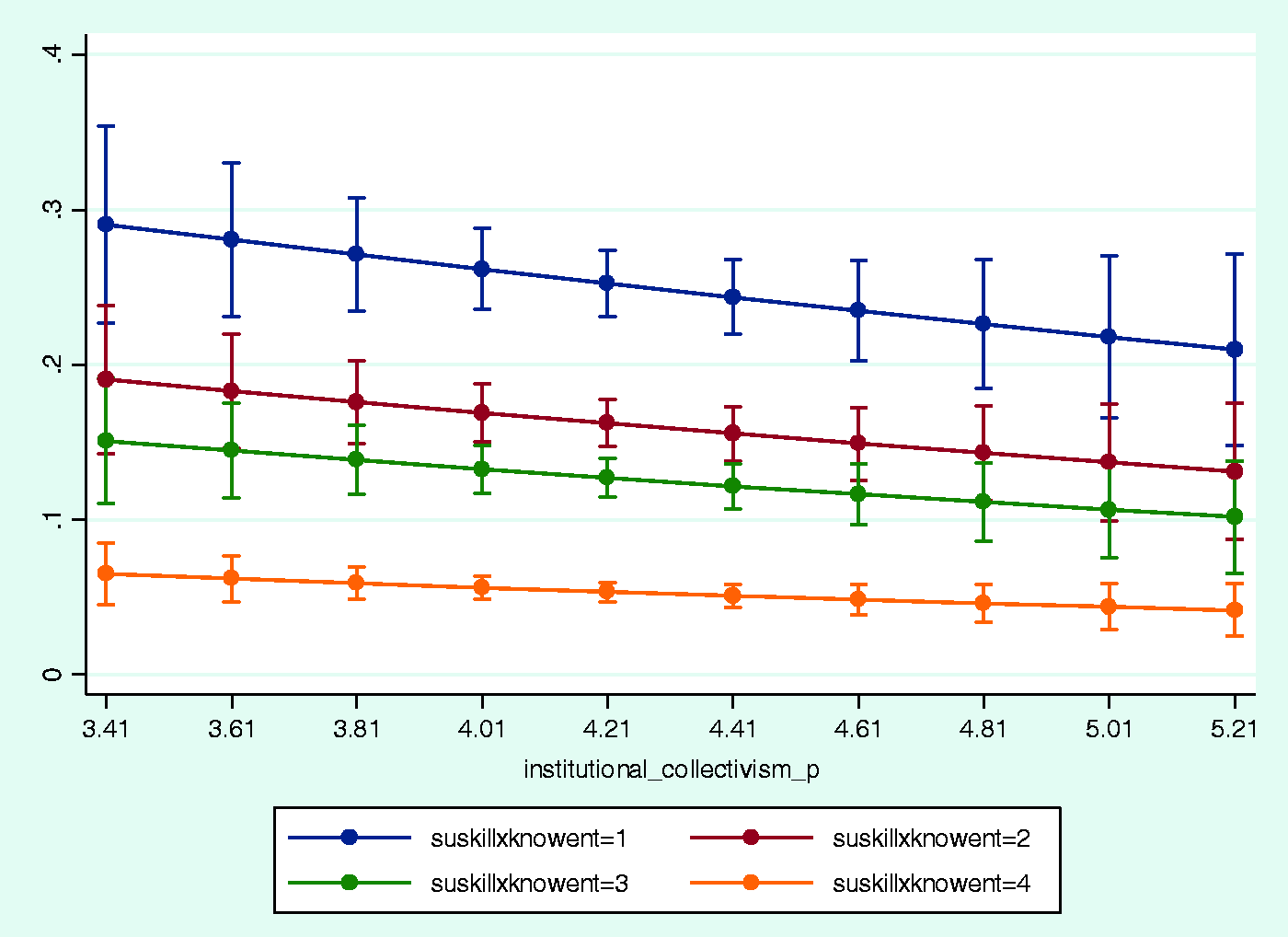
Turning to the control variables, we find that the two perceptual variables Fear of Failure and Opportunity Recognition show a statistically significant effect on entrepreneurial intentions. The results provide evidence that the individuals’ fear of failure suppresses the probability of having the intention to start a new business venture by almost 2 percentage points whereas the recognition of opportunities increases this probability by 7.6 percentage points. Additionally, we can confirm that many demographic variables are important in determining entrepreneurial intentions. Younger individuals, male, and individuals with at least post-secondary education have a higher propensity to form entrepreneurial intentions. Moreover, individuals who are not full-time employees are more likely to show entrepreneurial intentions compared to full-time employees, with the exception of pensioners or disabled.
Several country-level control variables capturing the economic status quo and the quality of human capital show statistically significant effects on entrepreneurial intentions: the coefficient for GDP per capita is very small and positive, while a higher share of urban population positively affects the formation of entrepreneurial intentions. On the other hand, there is a significant negative impact of the percentage of individuals enrolled in primary education as a measure for a country’s human capital on entrepreneurial intentions. Size of the population, exports as a percentage of GDP and the unemployment rate do not show a statistically significant influence on entrepreneurial intentions.
Sensitivity test
The analysis of the results reported in Table 4 indicates that the potential bias that might arise from the omission of variables, if there is any, should be modest. Altonji et al. (2005) and Oster (2013) show under the assumption of proportional selection that shifts in the coefficient of interest, with controls that rise concerns about omitted components, are revealing about the remaining bias. In particular, Oster (2013) proves that if the coefficient of interest does not change much after considering such controls, it is indicative of a limited bias. Finally, the remaining high level of correlation between some of the country-level variables calls attention to the challenges of simultaneously analyzing multiple country-level variables as this can generate inflated standard errors of the regression coefficients. Such problems appear to be modest in our case given the robust and statistically significant coefficients across the different model specifications. In fact, we reran the different models excluding the highly correlated variables at the country-level and were able to largely replicate the results.
Discussion
Contributions
This article is a first attempt to evaluate the influence of a multilayered context on the cognitive processes of potential entrepreneurs. We hereby not only dovetail with a broader research domain overcoming the micro–macro divide in management but also more importantly respond to two different calls in the entrepreneurship literature: first, to contextualize entrepreneurship taking into consideration the multilayered characteristic of the environment (Welter, 2011) and second, to evaluate potential contextual contingencies on cognitive processes (Mitchell & Smith, 2002; Mitchell et al., 2002, 2000). As such, this article makes several theoretical, empirical, and practical contributions.
One of the important contributions to the entrepreneurship literature of both sociology (e.g., Shane, 2003; Thornton, 1999) and institutional theory (e.g., Welter, 2011) is the theoretical argumentation that context significantly shapes entrepreneurship. Rich empirical evidence has shown the importance of studying contextual elements, such as social networks (e.g., Stuart & Sorenson, 2005), the workplace (Sørensen, 2007), or educational institutions (e.g., Kacperczyk, 2013) and in that the role of peers, mentors, role models, or simply entrepreneurial acquaintances (Eesley & Wang, 2017; Lafuente et al., 2007; Nanda & Sørensen, 2010; Wyrwich et al., 2016). Our arguments enrich the current understanding of how the proximate social context shapes entrepreneurial intentions by focusing on the transmission of intangible resources such as social norms, values, and legitimacy. In particular, we provide empirical evidence that knowing an entrepreneur is sufficient to exercise a significant influence on entrepreneurial intentions. Hence, our work enriches the discussion about the necessity to achieve closeness among the elements of entrepreneurial ecosystems (Stam & Spiegel, 2018) and fits neatly with related findings demonstrating that the influence of social context persists in time (Kacperczyk, 2013) and is not necessarily dependent upon intensive personal interactions (Laviolette et al., 2012; Radu & Redien-Collot, 2008).
Moreover, we argue that the influence of the proximate social environment is not only direct, but that it also exercises an indirect effect. In that, we highlight the role of the sociocultural environment as an important influence on the cognitive processes and structures of would-be entrepreneurs (Mitchell et al., 2000). Using socialization theory, we advance that individuals with low levels of self-efficacy rely more on their proximate social context for clues regarding entrepreneurial behavior. With most empirical studies remaining silent about this relationship (Wyrwich et al., 2016), our results provide first evidence that the influence of the proximate social context is not universal but rather interacts with the individual’s cognitive processes.
More importantly, we show that the distal sociocultural context is yet another layer that shapes entrepreneurial behavior and we provide an empirical illustration for the importance of Welters’ call (2011) to take into consideration the multilayered nature of context. We show that the impact of the proximate social environment on entrepreneurial intentions hinges on the national cultural context. While collectivistic societies may provide a more appropriate institutional setup for personally knowing an entrepreneur (Siu & Lo, 2011), we show that in individualistic countries knowing an entrepreneur produces a greater positive influence on entrepreneurial intentions. Our evidence is also consistent with earlier results that personal attitudes are stronger predictors of intentions in individualistic contexts (Markus & Kitayama, 1991). We show that the individualistic cultural orientation strengthens the positive impact of self-efficacy on entrepreneurial intentions and confirm and extend the empirical results of Wennberg and colleagues (2013) who show this effect for nascent and early entrepreneurs. At the same time, our work is the first to show the amplifying effect that institutional individualism exerts on an individual’s self-efficacy when nascent entrepreneurs are available. Taken figuratively, the distal sociocultural environment behaves as a magnifying glass for the interaction between personal characteristics and proximate cultural context in molding entrepreneurial intentions.
In summary, we show that environmental influences moderate the well-established relationship between entrepreneurial self-efficacy and entrepreneurial intentions adding to previous research on entrepreneurial intentions (Kibler, 2013). We contribute to the research stream that studies the contingent effect of contextual variables (van Auken et al., 2006; Wennberg et al., 2013) by emphasizing the role that different layers of context play and providing empirical evidence for Johns' (2006) approach of cross-level effects between the different layers of sociocultural context.
Finally, our results carry important practical implications as they confirm the social nature of the entrepreneurial process and invite a reflection about the design of public policy programs that stimulate entrepreneurial behavior. Many, if not most, governments recognize the potential for economic and social transformation that entrepreneurship holds (OECD, 2007) and are actively seeking to promote it through public policy by lowering barriers in order to increase chances of success along the entrepreneurial process and by improving the business environments (OECD/European Union, 2017). The latter is especially important during the awareness and nascent phase of the entrepreneurial process, where the main objective of policy instruments is to raise the level of interest people have in entrepreneurship and a resulting increase of intention to start a new venture (Lundström & Stevenson, 2005). In particular, among public policies and initiatives which aim to promote entrepreneurship, role models have been ascribed a substantial role (Lundström & Stevenson, 2002). For example, the importance of personally knowing an entrepreneur is frequently highlighted in GEM country reports while at the same time the lack thereof is proclaimed as a deficiency of a country’s entrepreneurial ecosystem as well as a barrier for potential women entrepreneurs specifically (e.g., Hindle & Rushworth, 2003; Kelley, Brush, Greene, & Litovsky, 2012). Based on this research, a generalized strong negative impact of such a deficiency can be questioned; policy initiatives which foster awareness about entrepreneurship as a career option through an increased interaction between entrepreneurs and non-entrepreneurs will have a varying degree of impact on the cognitive process of citizens of countries with different levels of institutional collectivism. Additionally, policy makers should be aware that such policies need to be evaluated in the light not only of national culture but also be segmented at the level of the individual to take into account differences in the the individuals’ cognitive processes. In this sense, our research extends recent findings regarding the necessity of adjusting public policies to regional specificities (Wyrwich et al., 2016) and design more customized approaches to entrepreneurship. Evidently, effective policies to stimulate entrepreneurial behavior, no matter how generously funded such as the Horizon 2020 with a total budget of almost €80 billion and a specific branch supporting entrepreneurship (Societal Challenges and Leadership in Enabling and Industrial Technologies), necessarily need to account for the cultural predispositions. Moreover, within the EU, social legitimacy of entrepreneurial activities provided by the proximate social context and the degree to which European educational systems contribute to the consolidation of self-efficacy strongly varies. For example, a program focused on building up entrepreneurial self-efficacy is likely to have a higher impact in Greece and Italy, both of which belong to the lower end of institutional collectivism, than in Finland or Sweden. Similarly, Radu and Redien-Collet (2008) provide evidence of how the French media constructs social legitimacy for entrepreneurs by highlighting their contributions to job creation. Such a message is likely to positively contribute to the formation of entrepreneurial intentions in more institutionally collectivistic societies but not necessarily in individualistic ones. Eventually, understanding the role the proximate and distal social environments play may be instrumental for building the social legitimacy of entrepreneurship across diverse cultural environments and for groups with diverse cognitive processes and increasing entrepreneurial intentions. However, in order to better guide policy makers in this aspect, much more research untangling the mechanisms of these influences is needed. Improved measures and data availability are going to enhance our knowledge and the impact of public policy in all respects.
Limitations and Future Research
We acknowledge that our investigation is not free of caveats and that many of the limitations of this study offer venues for future research. In particular, the use of rather simple constructs instead of psychometric measures of knowing a nascent entrepreneur, entrepreneurial self-efficacy, and entrepreneurial intentions can be subject to criticism. Ideally we would not only use complex constructs such as social networks or entrepreneurial role models but also rely on well-established scales of these constructs. In this way, we would be able to infer whether the role model is successful or the nature of the relationship between the respondent and its social network. Additionally, we would be able to control for similarities between key influencers and the individual, a fact that has been argued to strongly affect the adoption of a specific behavior (Bandura, 1977). Similarly, the complex and multidimensional nature of self-efficacy (Drnovšek, Wincent, & Cardon, 2010) is not fully respected. Likewise, we adopt measures of national culture from the GLOBE study (House et al., 2004), a framework that has been criticized for being overly simplistic. The coarse-grained measures we use are reasonable for a study that is among the first to look into the moderating role of proximate and distal environments in forming entrepreneurial intentions. The scarcity of valid measures has been addressed in the past (e.g., Schjoedt, Renko, & Schaver, 2014) and we recognize that more fine-grained and richer measures are essential for continuing the research agenda we propose.
Second, the data we are using do not allow uncovering the cognitive processes through which the traits of national culture alter the effect of self-efficacy and knowing and entrepreneur on entrepreneurial intentions. Qualitative research may shed light on such individual cognitive mechanisms. Third, adopting an entrepreneurial process view and differentiating between different stages of entrepreneurial action, may allow further insights on how national culture influences individual cognitive structures when deciding to engage in entrepreneurial activity. The recent research of Wennberg and colleagues (2013) evaluates, among others, the moderation between institutional collectivism and self-efficacy on early-stage entrepreneurship. Their study yields results that are consistent with ours; however, the effect that knowing an entrepreneur has on this relationship is not taken into consideration.
Fourth, some omitted variables bias can be remaining. For instance, recent research highlights the importance of individual’s financial capital (Danis, De Clercq, & Petricevic, 2011), the individual’s access to venture capital (Colombo & Grilli, 2010) as well as cultural capital (Elam & Terjesen, 2010) which are not included in this study. Eventually, the team nature of the entrepreneurial process is not accounted for.
While improvements in all these directions are welcome, there are venues for future research that appear to be particularly desirable. Studying local concentration of entrepreneurship (Minniti, 2005) and determinants of regionally and locally relevant entrepreneurial practices (Stenholm et al., 2013) connects entrepreneurship scholarship with the research and practice of economic development and competitiveness. The inclusion of interacting layers of contextual variables in this research line not only better informs the work of development agencies and policymakers but also in the light of the present research it will be necessary in the future.
Disentangling the mechanisms through which interacting layers of contextual variables shape entrepreneurial intentions remains to be fully understood and the complexity of the task is significant. One advancement in this direction was made by McCloskey (2006) who proposed and vividly illustrated how bourgeois virtues gave rise to entrepreneurial initiatives that were instrumental for the economic take off in 1800’s Europe. Arguably, in this historical period entrepreneurship and innovation blossomed and triggered an unprecedented increase in the economic well-being because of the particular balance among seven market-supportive entrepreneurial (“bourgeois”) virtues that originated in three distinct spheres of living: economic self-interest, social regulation, and the theological dimension, namely, prudence, temperance, courage, justice, love, hope, and faith. By studying the interaction between the individual, the proximate and the distant contexts, this research offers a framework for analyzing entrepreneurial predispositions in line with that of McCloskey (2006) albeit our treatment lacks a well-defined system of virtues and accompanying behavioral outcomes such as care, patience, courage, courtesy towards others, honesty, and so on, that make the ground fertile for entrepreneurship. Arguably, the ideas shared by opinion-leaders and social media at present and the verbalization and symbols that fill with meaning the virtues of hope and faith as well as the praise of courage are seamlessly woven into the texture of societies with supportive entrepreneurial environments. From this outlook, the distinction between individualism and collectivism as treated in the present work does not appear to provide enough guidance as to how to go beyond the understanding that “Individuals need the nurture of groups that carry a moral tradition reinforcing their own aspirations.” (Bellah, Madsen, Sullivan, & Swidler, 2007, p. 286). The articulation of a more powerful and actionable framework that is encompassing of the individual and her social and theological contexts and that is both positive and normative thus remains a pending assignment of social scientists. Our research is but a small step to draw the attention to the different contextual layers where the virtue and dignity of entrepreneurship are shaped. It must now be taken to the next level.
One possible direction of advancement is a stronger focus on the contextual forces and cognitive processes of specific classes of entrepreneurs such as women (Koellinger, Minniti, & Schade, 2013; Langowitz & Minniti, 2007) or technological entrepreneurs (Marvel & Lumpkin, 2007) as it holds the potential to provide the levers for fine-tuning that would enable targeted entrepreneurial initiatives. The study of these questions at later stages of the entrepreneurial process calls for further investigation, too.
Another venue for future research that offers the promise of actionable and specific insights on how to encourage entrepreneurship is the consideration of legal and regulatory features (Armour & Cumming, 2008) in the study of entrepreneurial intentions. The success of such endeavors depends critically the measurement approach, availability of suitable instruments, and data for a diverse group of countries. Lastly, our study also relates to the rich body of research on person–environment fit. Defined as compatibility between the individual and environment, this theory brings forward the idea that different notions of fit play a significant role for job or career choices (Kristof-Brown & Jansen, 2002). The present research can be extended by evaluating the values adhered to entrepreneurship and transferred by the proximate and distal context and their fit with the individual’s attitudes, values, knowledge, and skills.
Conclusion
How do the proximate and the distal environments shape the relationship between entrepreneurial self-efficacy and entrepreneurial intentions? Based on this study, the answer is that the contextual variables matter both independently and jointly. By influencing the social norms and the legitimacy of entrepreneurship, nascent entrepreneurs, as an element of the proximate sociocultural environment, and the individualism–collectivism caveat, as a factor of the distal sociocultural environment significantly influence the effect of entrepreneurial self-efficacy on intentions. We establish that knowing a nascent entrepreneur positively drives entrepreneurial intention, though it has a smaller impact for those individuals who possess entrepreneurial self-efficacy. However, the effect is reverted by the individualistic character of the national culture. These insights extend and deepen our understanding about drivers of entrepreneurial intentions, pose some new questions and give rise to puzzling trade-offs among drivers of entrepreneurial intentions. We believe that both the novelty as well as the practical implications of this research will provoke scholars to ask new questions and equip policy makers with actionable knowledge. In conclusion, this study makes a strong case that entrepreneurship cannot be comprehended and much less purposefully influenced without proper understanding of the interactive layers of proximate and distal contexts that enable and constrain the process of forming entrepreneurial intentions. Much remains to be done before we are able to articulate a conceptual framework of entrepreneurial behavior that accounts for the different layers of contexts and critically approaches the essential categories in the existing models.
Footnotes
Appendix 1. Observations Per Country
Acknowledgments
The authors thank Anita McGahan, Roberto Gutierrez, Jonathan Levie, Maria Minniti, Simon Parker, Raul Quiroga, Nina Rosenbusch, Eduardo Wills, and the discussants of the SMS Tel Aviv Conference in 2014, the editor and two anonymous reviewers for comments and suggestions.
Declaration of Conflicting Interests
The author(s) declared no potential conflicts of interest with respect to the research, authorship, and/or publication of this article.
Funding
The author(s) disclosed receipt of the following financial support for the research, authorship, and/or publication of this article: The first author acknowledges the financial support from Colciencias through grant 776(2017) – 57885 as well as the financial support from Universidad del Norte through grant 2017-18 and the Business School Faculty Grant 2017. The third author acknowledges the financial support from the Spanish Ministry of the Economy and Competitiveness through grant ECO2014-57131-R and from the Recercaixa research program, granted by the Obra Social “La Caixa” through grant 2014ACUP0130.