



Abstract
We follow one advisor and five family firm succession cases over 4 years to capture emerging emotions during the succession process. Using inductive analysis, we investigate how the advisor’s mediation of these emotions affects individual-level satisfaction with the succession process. Interviews, observation, meeting minutes, and archival data reveal an iterative process: the advisor first unearths the incumbent’s and successor’s emotions to surface emotional tensions before alleviating them. Unearthing and alleviating emotions speeds role adjustments and advances succession, especially when the incumbent becomes “stuck” in the process. Emotion mediation and role adjustment appear to foster individual-level satisfaction with the succession process.
Emotions are of crucial importance for family firms (Stanley, 2010). Due to the familial component, many activities and decisions are influenced by emotions of the involved actors (e.g., Shepherd, 2016) and are especially prevalent in times of change such as succession (Shepherd, 2003; Stanley, 2010). Specifically, disagreement between senior and junior generation about values and activities regarding the forthcoming succession can engender negative emotions (Eddleston, Otondo, & Kellermanns, 2008), which, in turn, impact succession outcomes (Filser, Kraus, & Märk, 2013). Indeed, prior studies regarding family firm succession often refer to the importance of emotions throughout the process (Salvato & Corbetta, 2013). However, despite the growing scholarly interest in emotions in family firms (e.g., Shepherd, 2016), we lack a nuanced understanding of the emotions that occur throughout seminal extended periods of change. In particular, we do not well understand how emotions are managed during succession and how they affect outcomes of the succession process. As a large number of family firm successions fail (Ward, 1987) due to unsolved conflicts among family members, the management of emotions during succession remains a crucial research gap.
In this study, we aim to obtain a better understanding of emotions in the succession process. In particular, we focus on how a trusted, third-party advisor impacts the incumbents’ and successors’ emotions throughout succession. Family firm decision makers frequently rely on the support of advisors (Strike & Rerup, 2016), as they can positively influence important outcomes (Salvato & Corbetta, 2013). During succession, advisors play a particularly important role in aiding firms that are struggling to master this critical process (Miller, Steier, & Le Breton-Miller, 2003) and the subsequent outcomes.
One of the most important individual-level outcomes of succession is the involved parties’ level of satisfaction with the succession process (Sharma, Chrisman, & Chua, 2003; Sharma, Chrisman, Pablo, & Chua, 2001), as this crucially affects further individual- and firm-level outcomes such as the incumbent’s feelings of integrity toward the transfer (Sonnenfeld & Spence, 1989), the successor’s future work satisfaction as well as the occurrence of tensions among family members and the firm’s effectiveness (Sharma et al., 2001). An emerging research stream centers on how advisors affect individual-level outcomes (Strike, Michel, & Kammerlander, 2018). Yet, although prior research has revealed the advantages of involving advisors in guiding changes, we know surprisingly little about the activities in which they engage to address emotions and their consequences. We thus ask the following research questions: how do the advisor’s interventions interplay with the incumbent’s and successors’ emotions during succession, and how do they ultimately affect the level of satisfaction of the incumbent and successor with how the succession process was executed?
To answer the research questions, we conduct an inductive case study about family firm advising to provide an in-depth examination of the emotions of incumbents (henceforth: senior generation—SG) and successors (henceforth: junior generation—JG) throughout the succession process and the activities of their advisor targeted at addressing emotions and thus increasing the subsequent satisfaction of the individuals. Our analysis is based on multiple data sources and follows one advisor and five recent family firm succession cases. Interviews with the SGs, JGs, and their advisor along with an expanse of archival data were collected as part of a 4-year participant-observation study by the first author. The findings were subsequently scrutinized in discussions with 15 additional family firm advisors with varying cultural and educational backgrounds and differing levels of experience. Our data reveal how negative emotions emerged among the SGs and JGs during succession and how the advisor mediated those negative feelings by employing mechanisms that first unearthed and subsequently alleviated the latent emotions. Moreover, we show how the advisor’s mediating activities are related to the role adjustment of all involved parties. Ultimately, our findings indicate that variance in emotion mediation and role adjustment may explain differences in satisfaction with the succession process.
This study contributes to family firm and entrepreneurship research in at least four ways. First, it advances our understanding of how an advisor can address emotions during succession. Whereas theories from psychology (social interaction model, Coté, 2005) would predict amplifying and suppressing emotions to regulate them, we reveal an iterative model of unearthing and alleviating emotions. Moreover, in contrast to prior research regarding emotion regulation (Gross, 1998), we find that the advisors we interviewed focused on the internally felt, often latent, emotions instead of the externally displayed ones. As such, we differentiate and label the process emotion mediation, in which advisors do not suppress emotions but rather address their internal experience, exploring their roots and alleviating them. Second, we advance the knowledge about how an advisor can mediate emotions (Strike & Rerup, 2016) by teasing apart the specific mechanisms utilized to unearth and alleviate negative emotions. Although the focus of our study is family firm successions, similar mechanisms may also inform advisors of entrepreneurial ventures addressing negative emotions such as fear or frustration. Third, we contribute to the literature about an advisor’s impact on individual-level outcomes (e.g., Salvato & Corbetta, 2013; Strike, 2012 , 2013, 2018), specifically family firm members’ satisfaction with the succession process (Sharma et al., 2001, 2003). In this context, we also reveal the important role of trust, defined as “a psychological state comprising the intention to accept vulnerability based upon positive expectations or behavior of another” (Rousseau, Sitkin, Burt, & Camerer, 1998, p. 395) for successful succession. Trust is not only a necessary precondition for emotion mediation by an advisor but also is strengthened by emotion mediating activities. Fourth, our findings contribute to the literature about family firm succession (Daspit, Holt, Chrisman, & Long, 2016) by refining prior work regarding incumbent’s tensions during succession (Sonnenfeld & Spence, 1989), by extending research on the mutual role adjustment of the incumbent and successor (e.g., Handler, 1990; Salvato & Corbetta, 2013) to include advisors, and by suggesting that emotion mediation might aid in speeding up the role adjustment processes and increase individual satisfaction.
Theoretical Background
Family Firm Succession: Emotional Challenges and Role Adjustment
Succession, defined as the transfer of leadership responsibility and ownership to a succeeding generation member, is one of the most important processes during the life cycle of a family firm (e.g., Breton-Miller, Miller, & Steier, 2004; Handler, 1994). Family firm succession is often perceived as challenging due to the complexity of the different tasks (e.g., Chua, Chrisman, & Sharma, 1999), the incumbent’s resistance to letting go (Dyer & Handler, 1994; Lansberg, 1988), the uncertainty regarding the firm’s future, and potential communication or interpersonal conflicts among the involved parties (e.g., Eddleston et al., 2008).
Hence, the succession process bears unique challenges that can affect the incumbent’s and successor’s emotions (Cardon, Foo, Shepherd, & Wiklund, 2012). Emotional reactions throughout the succession process, which may be expressed verbally or nonverbally, refer to enduring feelings and moods in addition to transient affective responses to certain stimuli (Rafaeli & Sutton, 1987) that often last only a short time but at a rather intense level (Cardon et al., 2012). Prior research has demonstrated that emotions can be positive, neutral, or negative (Rafaeli & Sutton, 1987) and differ in intensity. The process of succession is often perceived by family firm members as a loss to which they react with intense negative emotions, such as grief, from which they have to recover (Shepherd, 2009).
To cope with the challenges of succession, the incumbent and the successor must assume various roles throughout the process and pass through a mutual role adjustment 1 (Handler, 1990; Sonnenfeld, 1991). The business can only be effectively handed over if the incumbent is willing to let the business go (changing from an active to a passive role) and the successor has the ability and willingness to become the new leader (changing from a passive to an active role; Sonnenfeld & Spence, 1989). Role adjustment, if achieved, increases the successor’s self-esteem and motivation and may be associated with positive emotions (Salvato & Corbetta, 2013). Yet researchers have also argued that the process of mutual role adjustment itself can induce negative emotions such as uneasiness, strain, and fears (Handler, 1990).
The Role of Advisors During Succession and Individual-Level Satisfaction
Owing to the challenges and the consequential failure rates of the succession process, family firm research has started to emphasize the important role of third-party advisors throughout change processes such as succession (e.g., Salvato & Corbetta, 2013; Strike, 2012 , 2013). Advisors are external sources that provide neutral, competence-based, expert knowledge alongside subtle tactics and behavioral suggestions to family firm leaders while understanding concerns and helping the family to facilitate collective action (Strike, 2013). Throughout succession, an advisor can positively influence the relationship and reduce interpersonal disagreement between the incumbent and the successor by mentoring (Salvato & Corbetta, 2013) and acting as an intermediary who mediates the needs of these two parties (Lane, Astrachan, Keyt, & McMillan, 2006). Prior research reveals that by mediating sensemaking processes among family firm members, advisors slow down the decision process and achieve critical rethinking and consideration of new, outside perspectives among family members (Strike & Rerup, 2016). This reframing of perspectives enables a more detached judgment of the situation, which advisors can take advantage of to anticipate and mediate conflicts among the involved actors (Barbera & Hasso, 2013; Lane et al., 2006).
Despite the positive impact an advisor can have on the succession process, this intervention can also lead to negative emotions, especially of the incumbent, who might not feel ready to hand over the business (e.g., Kellermanns & Eddleston, 2004). In such situations, an advisor is challenged by feelings of strain and discomfort (e.g., Michel & Kammerlander, 2015). However, to date, we lack a comprehensive understanding of how advisor involvement affects emotions in family firms and affects individual-level outcomes (Strike et al., 2018).
One of the most important, and also most studied, individual-level outcomes of succession is the incumbent’s and successor’s satisfaction with the succession process. We define succession process satisfaction as a subjective assessment by an individual based on perceptions and feelings, rather than objective criteria about the manner in which the process of the firm’s transfer to a younger generation is executed (Sharma et al., 2001). Prior research has focused on the positive effects of individual role acceptance—in particular, the willingness to step aside (incumbent) and to take over (successor)—as important determinants of individual-level satisfaction (Sharma et al., 2003). The findings of those studies, however, indicate diverging perceptions of incumbents and successors regarding the succession process, which could lead to conflicts and ultimately lower satisfaction. Despite the relevance of satisfaction as an individual-level outcome, as it, for instance, can affect family relationships, their harmony and thus the effectiveness of the succession process (Sharma et al., 2001), we know surprisingly little about how it is associated with the emotions experienced during succession. This is surprising, given that prior research has repeatedly emphasized the potentially destructive nature of emotions throughout succession and asserted also the need for an external, third party to manage them for successful outcomes (e.g., Michel & Kammerlander, 2015; Strike et al., 2018).
Social Interaction Model as a Theoretical Basis to Understand Advisors’ Effects on Emotions
Theories from psychology, in particular the social interaction model (Coté, 2005) that builds on Gross’ (1998) emotion regulation theory, provide promising first insights into how an advisor addresses emotions during succession. This research stream offers evidence that individual emotions can be affected in terms of their intensity and duration (Gross, 2013). Whereas earlier work on emotion and its regulation focused on intraindividual processes (Gross, 1998), Coté (2005) developed a social interaction model that acknowledges interindividual processes and related feedback loops, similar to the feedback loops observed in family firm advising studies (Strike & Rerup, 2016). The display of emotions in interindividual processes, however, requires trusting the others (e.g., the advisor) to provide honest and high-quality feedback (Coté, 2005).
In particular, Coté (2005) proposes that activities of one individual can lead to the amplification or suppression of emotions. Emotion amplification thereby consists of initiating or enhancing emotions, whereas emotion suppression is the reduction or elimination of emotions. In general, emotion regulation differentiates between two different approaches to affect another individual’s emotions (Gross, 1998): first, deep acting targets an emotion “before [it] is fully under way” (Coté, 2005, p. 510). When an emotion is addressed via deep acting, both the internal feeling and the external display of the emotion will be changed. According to this theory, fully developed emotions can only be addressed via so-called surface acting. In contrast to deep acting, surface acting does not affect the internally felt emotions, yet (merely) their external display. A further central tenet of this theorizing is that regulating emotions can affect individual-level outcome levels such as strain (Coté, 2005). When analyzing our data, we used the social interaction model as a theoretical lens for interpretation of interpersonal activities regarding emotions and adapted it where necessary.
Methods
Empirical Setting
Owing to the nature of our research questions, which focus on understanding a process and answering “how” questions, we conducted an inductive, qualitative, multi-case study (Yin, 1994). We follow the succession process of five small and medium-sized enterprises (SMEs) whose majority shares were owned by a family and that had annual sales between 2 and 8 million EUR. The firms were located in a specific region of Switzerland, thereby mitigating problems of environmental variation (Eisenhardt, 1989). All firms were privately owned and had the same legal form (limited privately owned). Table 1 provides an overview of the firms, which are referred to as Alpha, Beta, Gamma, Delta, and Zeta for confidentiality reasons.
Overview of the Sample.
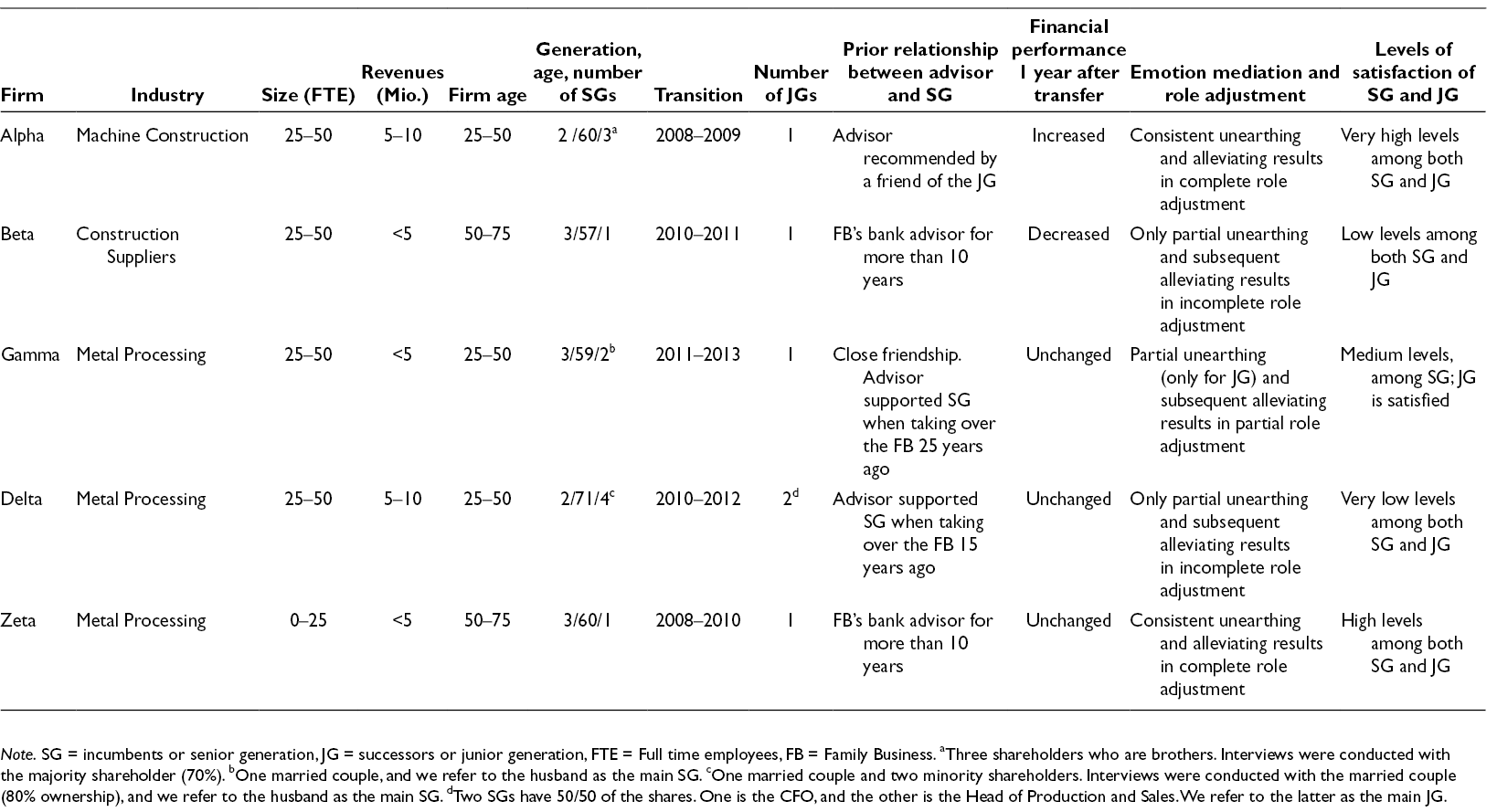
Note. SG = incumbents or senior generation, JG = successors or junior generation, FTE = Full time employees, FB = Family Business. aThree shareholders who are brothers. Interviews were conducted with the majority shareholder (70%). bOne married couple, and we refer to the husband as the main SG. cOne married couple and two minority shareholders. Interviews were conducted with the married couple (80% ownership), and we refer to the husband as the main SG. dTwo SGs have 50/50 of the shares. One is the CFO, and the other is the Head of Production and Sales. We refer to the latter as the main JG.
We chose cases based on three criteria. First, the firms (a) were family firms, 2 (b) were SMEs, (c) operated within a specific region, and (d) had completed a succession process within the last 5 years. The succession plan included transferring leadership and ownership at the same time. All firms were financially stable at the beginning of the succession process. The shared attributes allowed us to compare and identify process-related similarities and heterogeneities, particularly regarding emotional patterns and levels of satisfaction with the succession process.
Second, all five firms were guided by the same advisor, through whom we had unique access to rich data. 3 This advisor had a financial background with more than 40 years of experience with SME family firms (ranging from 5 to 250 employees). In total, he had advised more than 200 family firm successions (of which all but one firm are still active in business) and, over time, increasingly realized the importance of “soft issues” (including emotions) as opposed to “hard issues,” such as financial or tax questions. Over time and via trial and error, the advisor developed a set of mechanisms that allowed him to effectively address these emotional challenges.
Four of the five studied family firms had previously worked with the advisor on financial issues. In two of the cases (Gamma and Delta), the SG had also supported the firms’ previous successions. In the fifth case (Alpha), a friend of the JG recommended the advisor. In all cases, the family members voluntarily opted for the advisor, as there were no extant binding contracts. In four cases (except Alpha), the advisor was asked to help with succession before the JG was officially chosen. In the case of Gamma, the SG proactively approached the advisor with regard to succession support, whereas in the cases of Beta, Delta, and Zeta, the need for succession was identified in the annual strategy meetings. As acknowledged by the interviewees, the trusted relationship with the advisor allowed the advisor to address emotional aspects of succession and helped the SGs and JGs to openly display their authentic emotions. Whereas in the case of Alpha, in which the family had been recently introduced to the advisor, trust was acquired through vicarious trust (see Reddrop & Mapunda, 2015), in the other four cases trust developed over the long-term relationship.
Third, we chose cases for which we had privileged access to not only interviewee partners but also key documents created throughout the succession process, thereby reducing retrospective bias. Moreover, in three out of the five studied succession cases, the first author attended 10 of the succession meetings during the actual processes as a participant-observer (Table 2). The author was able to closely observe SGs and JGs in real time during the meetings. She was able to gain important insights into the dynamics of the succession processes, to take notes for the meeting minutes, and to discuss the observed emotional reactions with the advisor following the meetings. Similar to Salvato and Corbetta’s (2013) approach, this author took the role of an “observing insider,” whereas the second and third authors retained an “outsider perspective.” We drew on the discovery-oriented interpretative approach (Locke, 2011) in which the outside authors adopted the role of devil’s advocate, pushing for clarification, questioning the insider, and identifying themes with which the inside author (dis)agreed and that sometimes required a return to the field for further evidence.
Overview of Data Sources From the Five Main Cases.
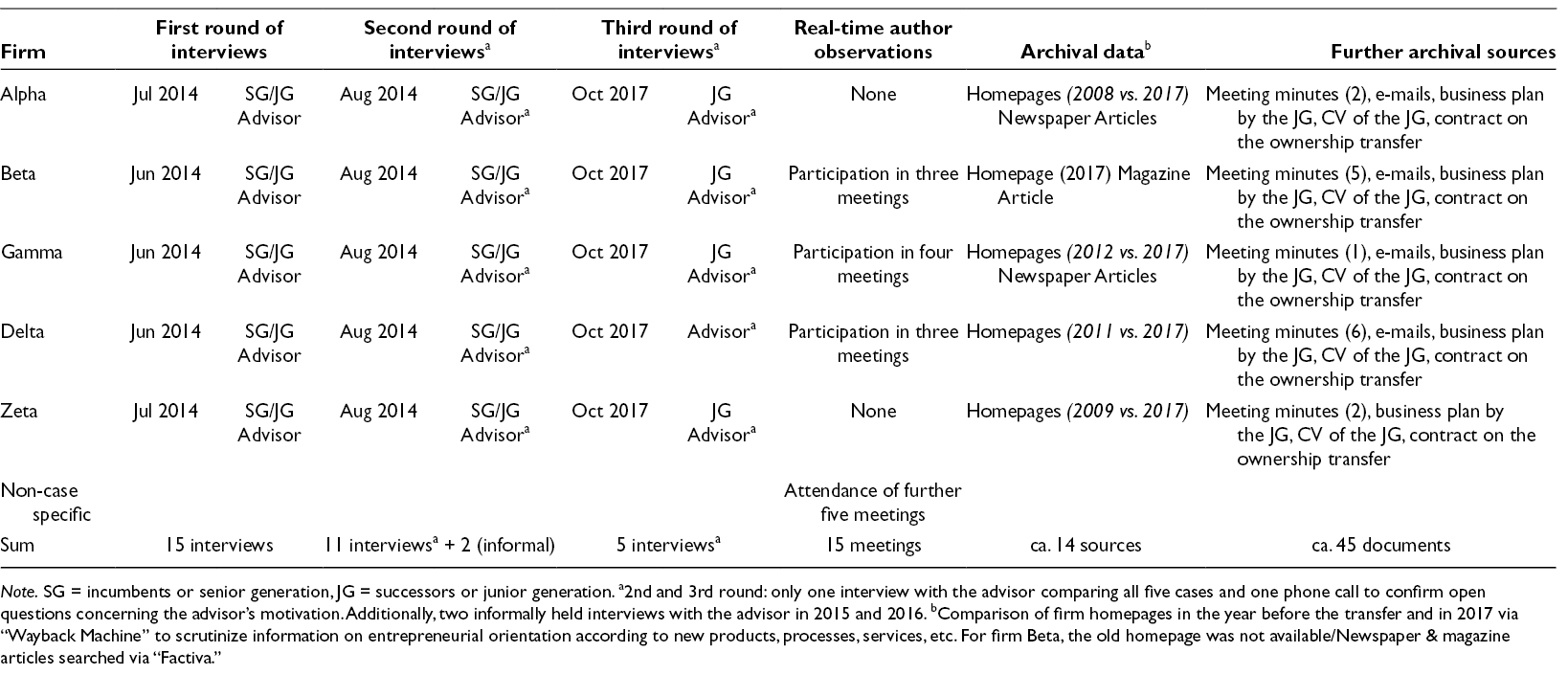
Note. SG = incumbents or senior generation, JG = successors or junior generation. a2nd and 3rd round: only one interview with the advisor comparing all five cases and one phone call to confirm open questions concerning the advisor’s motivation. Additionally, two informally held interviews with the advisor in 2015 and 2016. bComparison of firm homepages in the year before the transfer and in 2017 via “Wayback Machine” to scrutinize information on entrepreneurial orientation according to new products, processes, services, etc. For firm Beta, the old homepage was not available/Newspaper & magazine articles searched via “Factiva.”
Data Collection
Documents
The first step of our data collection process consisted of gathering and analyzing documents on the five selected cases. For primary documentation, we studied the minutes of 16 succession planning meetings. After each meeting, the advisor wrote minutes and sent them to the SGs and JGs to ensure a mutual understanding of what had been discussed and to document next steps. We also reviewed e-mails, business plans, financial statements, and contracts related to succession (for details, see Table 2). Secondary documents included publicly available documents such as company reports, newspaper articles, and company websites. The documents provided us with an initial understanding of the timeline of the succession processes and allowed us to extract the advisor’s activities and emotional reactions in a time-stamped and unbiased manner. The company websites and press releases helped us to gather further information about the firms’ specific characteristics before and after succession. These documents, combined with the personal observations of the first author, allowed us to triangulate the interview data (Jick, 1979) to check for any potential discrepancies between real-time and retrospective data.
Interviews
We conducted 31 semistructured interviews between 2014 and 2017 with the SGs, JGs, and the advisor, in addition to two informal interviews with the advisor. All of the interviews were conducted by the first author and lasted from 50 to 75 min. Interviews were recorded and transcribed, resulting in more than 400 single-spaced pages of transcripts. The semistructured interview guides are available from the first author.
In 2014, we asked participants in two interview rounds how they experienced the succession, how the advisor guided them through the process, and how they felt during the transfer stages. In the first round, we asked each of the interviewees to re-narrate the succession process, to describe the roles of the involved parties, and to openly speak about the observed challenges, their levels of satisfaction and how satisfaction evolved over time. We asked all interviewees to take the other stakeholders’ perspective and to comment on their roles, activities, and related challenges. The intention of this question was to scrutinize the other interview statements. We also asked the SGs and JGs to rate their satisfaction levels during and after the process using the concepts 4 developed by Sharma et al. (2003). In the interviews with the advisor, we focused on the challenges that occurred and the actions and reactions of all involved parties throughout the process. After each interview, we analyzed the statements and compared them with each other and with the archival data. This provided a constant comparison technique that aided our understanding of the data (Strauss & Corbin, 1990). After completion of the first round of interviews, when inductively analyzing the data and looking for recurring themes, emotions emerged as the main driver in the succession process, largely affecting both role adjustment and satisfaction. Two months later, we conducted another round of interviews with the SGs and JGs and the advisor in which we asked specific questions on the experienced emotions. This round of interviews consisted of discussions about the role of the advisor in mediating the emerging emotions, the role adjustments that occurred during succession and the effect of these adjustments on the emotions and satisfaction. We also conducted a member check (Jick, 1979) by sharing our findings and asking for feedback. In 2015 and 2016, we had two informal discussions with the advisor to clarify emotion patterns. In 2017, we conducted a third round of interviews with four JGs (one declined) and the advisor about succession outcomes and the JGs’ satisfaction. Table 2 summarizes the data sources.
In 2018, to scrutinize the initial model that emerged from our data analysis, we conducted semistructured interviews with 15 additional advisors. These advisors were all active in family firm succession but varied in terms of experience (from one to more than 30 years), gender, background (e.g., accountant, banker, coach), family firm background, Family Firm Institute (FFI) certification, and geography (Switzerland, Germany, the Netherlands, and Canada). The interviews ranged from 30 to 75 min in length and were electronically recorded and transcribed. Questions were open-ended regarding trust in family firm succession, roles, emotions and outcomes. In the fall of 2018, the first author attended five additional succession meetings (with the same advisor as in the main study but different family firms) and observed the employed mechanisms and reactions. The rationale was to scrutinize the proposed model. Upon analysis of the new data, we made slight adaptations to the original model yet found substantial approval of the identified mechanisms. 5
Since the study focuses on time-sensitive issues (emotions) and data were collected after the transition, we had to mitigate concerns of retrospective bias. First, we collected insights from three different perspectives (JG, SG, and advisor) allowing us to compare statements within the case interviews. Second, we also had access to real-time documents such as meeting minutes that helped us to further triangulate the validity of the expressed emotions. Third, many of the 15 further advisors were working on succession cases at the time of being interviewed, further reducing the threat of retrospective bias in our model.
Data Analysis
To analyze our data, we combined inductive and deductive strategies (see Langley & Abdallah, 2011). Drawing on a combined methodology allowed us to compare and recognize patterns within and across cases using a multiple case design (e.g., Eisenhardt, 1989). At the same time, our interpretive stance aided us in focusing on the depth of understanding and to purposely choose cases that offered rich and revealing data (Langley & Abdallah, 2011). To understand the development of the SG and JG throughout the succession process, we inductively coded our material. In the first step, we extracted high-level concepts from the interviews. In a subsequent step, we interpreted the respondents’ reactions in light of the corresponding context and compared our interpretations. This allowed us to distil core concepts such as emotion mediation, unearthing, and alleviating (see the Appendix for definitions). One recurring concept was activities related to mediating emotions, which we define as the process through which the advisor unearths and/or alleviates emotions to move a blocked process forward, uncover and address latent issues or conflict, and encourage positive dynamics leading to a satisfied process and outcome. Once the concepts of emotions began to emerge from the data, we coded these with regard to whether the emotions were positive or negative, the type of emotion, the emotional intensity, and the point in time/in the process at which the emotion occurred. Given the scope and aim of our research questions, we focused on negative emotions in the remainder of this article. This choice was also supported by the statements of the additional advisors, who focused primarily on negative emotions when questioned about important emotions during succession. All authors were involved in the data analysis process and interpreted the data independently. In rare cases of disagreement, we discussed until we reached consensus.
We analyzed the data within and across cases, looking for common patterns and differences. We created short summaries and tables for each of the five cases, indicating the key concepts and how we assessed them for each case (Strauss & Corbin, 1990). To ensure the reliability of our analysis we triangulated data whenever possible. For example, we compared real-time data from meeting minutes and e-mails with interview data, compared the assessments of all three interviewed parties with each other, and confronted the inside author’s perspective with the outside authors’ perspectives. Once we had convergence between the theory and the data, we reengaged with our informants to validate our observations and discuss alternative explanations; as noted above, we also discussed our key findings with 15 additional advisors. Three major themes that were repeated by multiple interviewees within and across cases emerged: first, four major activities by the advisor that resulted in emerging emotions (initializing, planning, implementing, and coaching); second, two major mechanisms the advisor consciously pursued to mediate emotions (unearthing and alleviating); and third, the varying levels of satisfaction during and after succession.
Findings
We present our findings deductively for ease of reporting and space considerations. To describe the different succession paths of the five firms, we structure this section according to four major activities during the process that emerged from the data and resulted in varying emotional reactions and ultimately heterogeneity in terms of satisfaction. For each activity, we first describe how emotional challenges emerged throughout the process and how the advisor mediated those by engaging in their unearthing and alleviating. Subsequently, we compare the succession paths across cases in terms of their level of emotion alleviation, the achieved role adjustment, and the corresponding satisfaction. Finally, we present the emergent model.
Initializing
Unearthing emotions
In four of the five cases, the advisor had held the role of the SG’s long-term trusted advisor (e.g., Strike & Rerup, 2016), as the following quote illustrates.
We have been trusting the advisor for many years before succession and we knew that he had been involved in such processes [succession] many times before and hence, was very competent. SG, Gamma
At the beginning of each succession case, the advisor had to ensure that the involved parties, in particular the SGs, were mentally prepared for the succession process. The advisor noted that ensuring that the SG was ready to step back was “one of the most crucial parts.” An SG who was not yet fully ready needed to be confronted, or the succession process could not successfully begin. This confrontation often resulted in bringing forth distressing feelings. In three of the cases, Beta, Delta, and Zeta, the initial challenge was that the SGs, although “aware” of the need for succession, were not really ready to retire. The advisor had to initiate the process through subtle cues and by planting seeds. In one case (Zeta), the SG thought he still had plenty of time to initialize the succession process and reacted initially with anger 6 when the advisor first addressed the topic. In the two other cases, Beta and Delta, the SGs felt considerable resistance toward letting go. As the SGs did not respond to the more subtle cues, the advisor deliberately confronted them with their feelings, explicitly mentioning the inertia, hesitation, anxiety, or apprehension that caused their avoidance of the topic. Bringing these negative emotions to the surface was necessary to move the succession process forward. As a consequence of the advisor’s deliberate effort to bring the emotions to the surface, both SGs and the corresponding meeting minutes reported negative feelings of fear, sadness (Delta), and anger (Beta):
I got very afraid. I had the impression everyone was looking for their own advantages. No one was caring about me. About my responsibilities. I will not get the bank balances anymore, no payroll accountings. This made me very angry. […] However, this had nothing to do with trust. Trust has always been there. SG, Beta
SG started to feel stressed. Refused from time to time to talk about the succession process and tried to change the topic. Meeting minutes, Beta
In the cases of Alpha and Gamma, the succession path began with minimal emotional challenges. In these cases, the SGs were aware of the need for succession and ready to start the process. The respective meeting minutes mention positive feelings of contentedness, happiness, and curiosity of what the next steps would be. The SGs felt optimistic that with the advisor’s support, the succession process would be successful:
Yes, [the advisor’s involvement] resulted in a great deal of happiness—because I was able to hand over huge responsibilities. SG, Alpha
Alleviating emotions
In the cases with negative reactions to the succession initialization (Beta, Delta, and Zeta), the advisor mentally prepared the SGs for the next steps and alleviated their negative emotions by employing several mechanisms. In the case of Zeta, where the SG had not been aware of the impending need for succession, the advisor engaged in rational discussions with the SG. These discussions were effective in raising the SG’s awareness of the need to step back. When the SG of Zeta had taken over the firm from his own father, it had been as a result of his father’s death. Therefore, he was open to having an explicitly planned succession.
I was glad to have initialized succession since I had been working for a long time in the business—I took it from my father in my twenties—and was looking forward to my private life after work. SG, Zeta
In the cases of Beta and Delta, the SGs exhibited extreme levels of emotional attachment to their firms. Over the course of several private meetings with the SGs and, if present, also with their wives, the advisor engaged in frequent, lengthy, emphatic, and open conversations in which he shared his experience from prior succession cases. The purpose of those discussions was to mitigate their fears and increase the SGs’ “readiness to let go.”
The turning point was when I spoke openly and clearly to the SG and told him what he had to do and what the solution could be […]. I did this in a very direct manner. This was extremely difficult because I had to channel the emotions, mostly on behalf of the SG, in the right direction. Advisor, Beta
The JGs of Beta and Delta concurred that the advisor’s purposeful intervention was necessary to advance the succession process. In particular, they stressed that by alleviating their own initial fears, the intervention increased their readiness to cope with the topic of succession.
We always knew what we strove for. This was clear for us but not always for the SG. But then the advisor increased the pressure on the SG, and this was necessary [for the successful continuance of the succession process]. JG, Delta
Analyzing the interview statements and meeting minutes, we observed (in line with Handler’s [1990] observation) that the SGs in this phase, in all five cases, acted as the “sole managers,” and their heirs were newly brought into the role of potential JG while still having “no role” within the firm. The role of the advisor in this phase could be best described as “initiator.”
Planning
Unearthing emotions
When all stakeholders felt ready for succession, the advisor helped the SGs to plan and prepare for the transfer of the business and supported the JGs in preparing for both the process and their future role as the new leader. In connection with these planning activities, the interviewees reported initially negative feelings such as uneasiness (Alpha and Beta) or fear (Gamma, Delta, and Zeta). Such negative emotions may be attributed to the change inherent in this phase of succession. In all five cases, the advisor’s process planning activities contributed to the intensification of negative feelings and of the initial reluctance to continue the process among both the SGs and the JGs, as depicted in the following quote:
This was without a doubt a time that consisted of strong fears and desperation. As a consequence, I also had health problems; I felt really stricken. JG, Zeta
During this phase, the advisor made the scope, intensity, and necessity of the required changes transparent. The JGs of Alpha, Beta, Delta, and Zeta felt uneasy and uncertain about their future and were alarmed by their responsibility for and the enormity of the expected tasks. The advisor considered it his task to expose the negative emotions to ultimately increase the JG’s readiness and willingness to further develop as a future leader.
Sometimes, this [unearthing of negative feelings] is necessary, although not fun. But you have to confront them with the facts and thereby sometimes also trigger negative feelings so that they move on. Advisor, all cases
According to the advisor, this triggering of negative emotions was necessary to avoid the SGs and JGs becoming stuck and consequently delaying further project steps. As future tasks were transparently and comprehensively outlined, the SGs’ negative feelings increased further. Correspondingly, the meeting minutes and interviewee statements suggested apprehension toward succession planning:
The next steps are the following: first, real estate valuation (bank), second, business plan (JG), third, discussion with wife (SG). Advisor will call SG and JG in 2 weeks to ask how they proceeded as they show feelings of uneasiness. Meeting minutes, 18th August 2008, Zeta
Alleviating emotions
After unearthing emotions, the advisor engaged in mitigating the SG’s and JG’s feelings of uneasiness by showing empathy. He explained that he understood their negative emotions and emphasized neutrality and objectivity to gain trust, particularly among the JGs whom he had not known well previously. The following illustrates this approach:
The advisor always gave me the feeling that he is not biased to the SG but that he is also on my side. This was very important to me because otherwise it would not have turned out well, and I would not have been content with the process. He also tried to mediate between the SG and me. JG, Zeta
The advisor provided detailed information to the SGs and JGs about the process steps, future tasks, and how to successfully master them. As explained by one of the SGs, the advisor balanced between pushing the individually designed processes further while at the same time being empathic and reassuring:
I never showed my fears in the big discussion round […]. However, I always had the impression that the advisor knew exactly how I felt. He always assured me that everything would turn out well. But he also tried to convince me that I had to let go. SG, Delta
By being able to recognize and understand the negative emotions, the advisor alleviated the worries of four of the five SGs (Alpha, Beta, Gamma, and Zeta) and one JG (Gamma), who then felt better integrated into, and knowledgeable about, the process. They experienced feelings of hopefulness and excitement about the succession process. As per the Alpha SG, I felt hopeful all the time [during this stage]. The Gamma JG also expressed being fully content throughout this phase and feeling well involved in the succession activities.
Regarding the four doubtful JGs (Alpha, Beta, Delta, and Zeta) and the anxious and apprehensive SG of Delta, the advisor aimed to alleviate their worries by sharing success stories of prior cases with similar challenges and by offering them concrete solutions. In particular, he convinced them to focus on the next milestone (instead of the end of the process) and, in the case of the JGs, to intensively reflect on the required skills. These alleviation mechanisms mitigated the negative emotions of the SGs and JGs:
We often stagnated, however, the advisor always tried to advance the process. This advancement really gave me a good feeling. JG, Delta
As the meeting minutes and interview statements showed, not only the process but also the roles of SG, JG, and advisor advanced. Triggered by the new tasks and the discussions with the advisor, the SGs now acted mainly as a “monarch” instead of “sole operator,” and the JGs proceeded to “helpers” (in line with the original labels created by Handler [1990]). The role of the advisor in this phase could best be described as that of a “planner.”
Implementing
Unearthing emotions
As each of the stakeholders moved through the succession process, the need to communicate the impending succession and to prepare the firm’s financials emerged. Before starting to complete specific tasks, the advisor evaluated the goals of the SGs through lengthy discussions with them to ensure that he understood their priorities.
For this task you need a lot of time, you need several appointments, and you need to clearly discuss the SG’s goals with the SG alone. Here, you need to have the courage to ask whether he has already spoken to the other family members, etc.; this is crucial […]. Advisor, all cases
One major consideration was whether management and ownership should be transferred simultaneously or instead management should be handed over in a first step. Several of the SGs (Beta, Delta, Gamma, and Zeta) were reluctant to speak to other family members about the succession process and the transfer. It was a topic the advisor needed to approach cautiously, and that required high levels of trust among the reluctant SGs. Eventually, the advisor succeeded in addressing this topic and all SGs decided to hand over both leadership and ownership at the same time to fully complete their own succession. However, the SGs first tried to delay the communication of the planned succession because they felt anxious about turning the plans into reality. This was particularly salient in the case of Zeta, in which the SG felt uncertain about the succession and believed that the JG needed more time to develop into the new role. The Zeta SG delayed the process of communicating this decision, which in turn worried the JG as follows:
…and then, another few weeks had passed by without anything happening […]. But the advisor noticed this. When he did not hear anything from us for 2 weeks, he called us and asked us for the reason of this. When I replied to him that several issues still had to be clarified before we could continue, he immediately called the SG and talked to him. JG, Zeta
The JGs of Beta, Gamma, and Delta experienced similar feelings of uneasiness and impatience because of the SGs’ hesitancy. Owing to this, the advisor deliberately confronted the SGs openly with their reluctance. By doing so, he was able to bring their hidden fears to the surface and amplify their negative emotions, leading to increased feelings of sadness (Delta), anger (Beta), and fear (all except for Alpha).
Alleviating emotions
To alleviate the negative emotions in this phase, the advisor needed to balance the JGs’ motivation while relieving the SGs’ fears with regard to communicating the succession. In the case of Alpha, in which the family was open and ready for the transition, the SG and JG proactively fulfilled most of the tasks of this phase on their own, supported by the advisor. Conversely, in the four remaining cases, it was the advisor who structured the tasks, discussed communication options with the SGs, and motivated the JGs to commit themselves to their future role, as demonstrated by the respective meeting minutes:
Definition of next steps: SG and JG together work out a draft of a communication concept internally and externally by the next meeting on the 11th of October 2010. Meeting minutes, 9th September 2010, Beta
The SG’s and the JG’s joint work to generate a document for communicating the succession to both the firm and its stakeholders allowed them to discuss and make sense of important succession aspects and reduce their own fears. In being transparent about the next steps, the advisor aimed to turn the negative feelings into positive ones. One important activity of the advisor was defining clear deadlines for communication and holding the SGs accountable. All five SGs stated that they felt content and happy after the communication because they sensed their business was in “good hands” now.
At this point, I was very content. I felt hopefulness and happiness. I have always thought that he [the JG] would once become the leader in the family firm. However, he never wanted to, and so I was very happy when he finally committed himself to the firm. SG, Beta
Similarly, two JGs (Alpha and Beta) experienced positive feelings of joy and happiness after having been officially communicated as JGs. Three JGs (Gamma, Delta, and Zeta) admitted that they were initially somewhat afraid of their own courage, unsure about what it means to be the JG and about whether they had the required skills. However, they generally felt honored to take over the business, as demonstrated by the following quote:
Of course, this resulted in happiness—happiness that I got the chance to take over this firm. However, it also led to doubts [whether I’m really able to fulfill this role]. JG, Gamma
Moreover, all five JGs explained that as a consequence of the advisor’s intervention, they experienced confidence and generally positive feelings. In this phase (in line with Handler [1990]) all five SGs changed their role to that of a “delegator” as they increasingly passed tasks to the JGs who all became, at least temporarily, the “managers” of the business, whereas the advisor acted mainly as an “implementer.”
Coaching
Unearthing emotions
Before the transfer of ownership and management could occur, agreement concerning the JG’s training needed to be achieved. This required close coaching by the advisor. However, in this phase, not all SGs wholeheartedly aimed to complete the succession process, and two JGs (Beta and Delta) tried to expand the training phase beyond the agreed time span to delay the transfer of responsibilities. These actors experienced feelings of uneasiness, reluctance, anxiety, and even sadness. The advisor provoked and intensified the negative feelings by deliberately confronting the SGs and respective JGs and insisting on understanding the reasons for delaying the closure of the succession process. However, he only managed to consequently unearth (e.g., through amplification) these feelings of reluctance in the cases of Alpha and Zeta; in the other three cases (Beta, Gamma, and Delta), the advisor did not engage in unearthing mechanisms and the actors remained stuck in the prior phase (and prior roles). The SGs of Alpha and Zeta noted anger at the start of this phase when the advisor insisted on moving on with the process, and they engaged in disputes about the training methods and new roles after succession. Temporary disagreements about specific procedures emerged between the advisor and the SGs.
I had to talk to the advisor. Even though we had known each other for many years and we had a good relationship with each other, I had to clarify what went wrong in my opinion. I missed the advisor’s will, his “elan” to support us. At that moment, I thought that we had the wrong advisor. SG, Zeta
As reflected in the above quote, the SG did not believe that the advisor was doing enough to support him. Moreover, the SGs were initially uncertain about whether they would be able to cope with their new role outside of the family firm. The advisor’s reminder to apply their new role after the transfer amplified fears, as the following quote demonstrates:
It was a strange feeling. I was not responsible anymore. I did not see any more how much money comes in and how much goes out […]. Of course, this leads to strong negative emotional reactions. SG, Alpha
The actors of the other three cases (Beta, Delta, and Gamma) experienced negative feelings of frustration, reluctance, and anxiety, as they were stuck in their prior roles and did not advance, yet they did not openly display those emotions, which remained beneath the surface (i.e., not unearthed) due to the advisor’s time constraints.
Alleviating emotions
For Alpha’s and Zeta’s SGs and JGs and for Gamma’s JG, the advisor was able to fully mitigate the negative feelings. He coached them on how to address feelings of uneasiness and anger in discussions about, for instance, the necessity for a change in roles and the proposed training program. At the end of this phase, the meeting minutes stated that the SGs of Alpha and Zeta were very happy and satisfied. Both parties of Alpha and Zeta (and the JG of Gamma) stated that the advisor’s activities led to positive feelings: they were looking forward to the closure of succession and the JGs felt prepared to become the new leaders.
There are still some details to be dealt with …; however, the contentedness and happiness will surely increase toward the end. JG, Alpha
In the three cases of Beta, Gamma, and Delta, the advisor remained focused on implementing activities instead of training and coaching, mainly due to time constraints. Hence, the knowledge transfer of the previous phases had not yet been fully completed. Instead of relaxing and expanding the timeline, the advisor aimed to complete tasks quickly to ensure that the transfer complied with Swiss tax law, 7 , with the result that the coaching activity was not successfully fulfilled in three out of the five cases. The respective SGs and JGs did not experience the unearthing and alleviating of emotions in this phase of the process. In these cases (Beta, Gamma, and Delta), the SGs and JGs reported feeling unhappy and dissatisfied. The SGs noted substantial fear throughout this phase, as they were uncertain about their future roles. Although the advisor also aimed to alleviate the emotions in these three cases through discussions and coaching, he only partially achieved this goal. Each of these cases (Beta, Delta, and Gamma) lacked a prior unearthing of negative feelings compared to the previous phases. The SG of Gamma noted, “at that time, when we [the advisor and I] sat together, he managed to calm me down and reduce my fears.” However, the SGs explained that this initial contentedness decreased again right after the official transfer of the business, as is further illustrated in the following quote:
At first, I was very happy—happy that I had taken over the company. But then, this happiness quickly turned into disillusion […]. Maybe the advisor should have intervened more because he knew the SG’s fears. JG, Beta
[…] sometimes I get very angry, for instance, if I have to wait for an answer about business-related issues from the JG. I would prefer to complete the task immediately and not wait for the decisions of the JG […], and this makes me angry and impatient. I do not want to do that for another 5 years. That would not work […]; I would end up not enjoying the work anymore, and after having decided everything on my own in the last 23 years, this is hard. SG, Gamma
Hence, we observed that in the cases (Beta, Delta, and Gamma) where the advisor could not consistently mediate the emotions in the final phase of the process, despite the official, contractual “closure” of the succession process, the emotions of the SG and JG turned negative soon thereafter, leading to overall stronger negative feelings and dissatisfaction with the succession process. In these three cases in which the advisor failed to (fully) fulfill his coaching activity, the SGs and JGs remained stagnant in their prior roles of “delegator” and “manager” or even reverted back to roles such as “monarch” and “helper” (Beta and Delta). This role reversion and the ongoing negative emotions were observed by the first author in the succession meetings and were later confirmed by three SGs (Beta, Delta, and Gamma) and two JGs (Beta and Delta). Interestingly, although these three processes were not entirely successful, the corresponding level of trust in the advisor remained high, as the following quote demonstrates:
Trust is important, and we can say, trust was always given. Even if we had difficult discussions, we fully trusted the advisor. SG, Delta
In contrast, in the two cases (Alpha and Zeta) in which the advisor engaged in consistent coaching, emotional mediation occurred and all actors completed their role adjustment (including the advisor, who became the “coach”). In line with Handler (1990), the SGs of these cases developed into “consultants,” and the JGs became the “new leaders.” In these cases, we did not observe the disillusion experienced in the cases of Beta, Delta and Gamma. Instead, all actors expressed mostly positive feelings, such as joy and happiness, when reflecting upon the succession. Table 3 summarizes the advisor’s activities and mechanisms that mediated emotions through unearthing and alleviating emotions.
Mechanisms of Unearthing and Alleviating to Address Emotional Challenges With Corresponding Quotes.

Cross-Case Analysis: Variances in Emotion Mediation, Role Adjustment, and Satisfaction
In the following section, we discuss the similarities and differences across cases and link the differences in emotion mediation with the SGs’ and JGs’ role adjustment and levels of satisfaction with the succession process. Additionally, we contrast the emerging patterns on emotions and their meditation with the findings from the discussions with 15 additional family firm advisors that we interviewed as final step of our data collection approach.
Unearthing and alleviating emotions
Throughout the succession process, the involved parties experienced negative emotions such as anxiety, anger, or uneasiness (e.g., Sharma et al., 2001) that were often buried beneath the surface (i.e., not externally displayed). In all cases, the advisor initially unearthed and at times even amplified the negative emotions before engaging in activities targeted at alleviating the negative emotions and triggering positive ones instead. The advisor’s intention when unearthing negative feelings was to bring such emotions to the surface early in the process and enable an open discussion regarding latent issues. The provocation of negative emotions “interrupted” the periods of inertia that occurred and reactivated the succession process. To advance the process and turn the negative into positive emotions, the advisor engaged in alleviating activities (Table 3). The need to first unearth and then alleviate the negative emotions was supported by the other advisors as the following quote exemplifies:
My strategy is first simply to listen, and maybe, you then even leave it for a while. But after that you have to address it again, if you think now it is a good moment. And if you then feel there is still something going on you have to uncover it from deep down. Advisor 2
The interviews also demonstrated that each advisor had different mechanisms to unearth the negative emotions. Whereas the studied advisor used “deliberate confrontation and thus amplification” (akin to Advisor 8), other mechanisms included sharing observations (Advisor 2), involving spouses (Advisor 9), listening (Advisor 2), introducing a mediator/psychologist (Advisors 1, 4, 7 and 12), directly asking (Advisor 6), and naming the emotions (Advisor 14).
To alleviate the emotions, the main advisor used mechanisms such as exhibiting a deep understanding, telling prior success stories, listening, coaching, communicating in an open manner, and focusing on the next milestones. Other advisors confirmed the necessity to alleviate emotions. They engaged in thorough listening (Advisor 3), sharing observations (Advisor 4), including personal experiences (Advisor 9), conversing one-on-one away from the official meetings (Advisor 1), activating positive memories (Advisor 11), focusing on the firm (Advisor 6) and “tools” such as assessment centers (Advisor 10).
The role of trust and role adjustment in the emotion mediation process
The additional interviews also confirmed that emotion alleviation is not an easy task, as it requires trust in the individual (and his or her values and integrity) as opposed to mere trust in the (technical) competences of the advisor (see Advisor 7). The advisors unanimously reported that trust was important for emotion mediation, particularly at the beginning of the process:
The more the SG trusts you, the more he will open up his or her feelings and real worries to you. And these real worries, I always observe this, are not the technical details or financials but always regarding the soft factors. Advisor 3
In my opinion trust is the absolute precondition that you can even talk about emotions. I believe if the clients do not trust you, you can ask as long as you like questions concerning emotions, they will never tell you anything. Advisor 5
Across cases, emotion mediation was observable throughout all phases of the succession process, but with varying extent and intensity. Although the pattern of unearthing and alleviating emotions was consistent across phases in general, the involved emotions and specific activities conducted by the advisor changed over time (Table 3). In the early phases, negative feelings such as fear and anger dominated. In the later phases, impatience and discomfort were the most salient negative emotions, a pattern that was also noted by the additional advisors interviewed:
I think in the subsequent phases emotions usually occur mainly if you fail to follow binding rules and time plans. You need to provide them [SG and JG] with security. Otherwise emotions occur due to uncertainties. […] however, I generally think that this [later] phase is less emotionally laden. Advisor 1
Moreover, our five cases showed that mediating activities by the advisor influenced not only the emotions but also the role adjustment of all three actors in the triadic relationship, a pattern that was also experienced by other advisors, as the following representative quote illustrates:
I often observe that without an advisor they would not succeed at all [in adjusting their roles]. At one point they become stuck within their positions and do not move anymore, and there they really need a mediator who help them to become unstuck and move on. Advisor 3
Heterogeneity across cases regarding levels of satisfaction
Despite those similarities, we observed substantial heterogeneity in the five succession processes. Two of the cases experienced a successful emotion mediation in all phases (Alpha and Zeta), one case had an eventual successful but delayed emotion mediation in all phases (Gamma), and two of the cases experienced emotion mediation only in the first phases (Beta and Delta). In the successful emotion mediation cases, all actors reached role adjustment according to Handler (i.e., the SGs ultimately reached the role of a consultant and the JG the role of the new leader). In contrast, in the two cases without successful emotion mediation in the later phases, the advisor remained focused on the implementation and task completion, although those succession cases were technically also completed with all contracts signed, and tasks and responsibilities formally handed over. In those cases, the SGs and JGs were unable to adjust to their roles to consultants and new leaders, and Beta and Delta reverted back to prior roles (i.e., manager in Beta and helper in Delta).
Finally, our cross-case analysis reveals that the extent to which emotions were mediated is also related to the subsequent levels of satisfaction. We identified substantial variance across cases with regard to SGs’ and JGs’ satisfaction with the succession process. In the following, we focus our analysis on the extreme cases of high and low levels of SG’s and JG’s satisfaction as the case in between (Gamma) was characterized by a medium level of satisfaction. More specifically, the satisfaction was highest in those cases (Alpha and Zeta) in which emotion mediation in all phases was successfully achieved. In these cases, role adjustment to the final roles of consultant and new leader also occurred, and no “emotional liabilities” remained. We theorize that in those cases the SGs were emotionally able to fully hand over responsibilities with positive feelings, which increased their levels of satisfaction. The JGs in those cases were emotionally able and confident coping with their new role, which increased their motivation and resulted in high levels of satisfaction. In contrast, for the succession paths (Beta and Delta) in which emotion mediation and role adjustment were not successfully completed, the level of satisfaction was lowest (see Table II of the supplementary material). A lack of emotion mediation along all phases resulting in uncompleted role adjustment suggests that the SGs are unable to step back. Consequently, JGs are still in search of their new role, which leads both actors to experience a lack of motivation and low levels of satisfaction (Figure 1). The importance of successful emotion mediation, including unearthing and alleviating emotions in all phases to achieve satisfaction, was also highlighted by another advisor:
This is absolutely crucial. If you [as advisor] are not able to alleviate negative emotions and turn them into positive ones, then you might not even reach the closing of the process. Then the whole process is a huge battle and satisfaction will be low anyway. Advisor 3
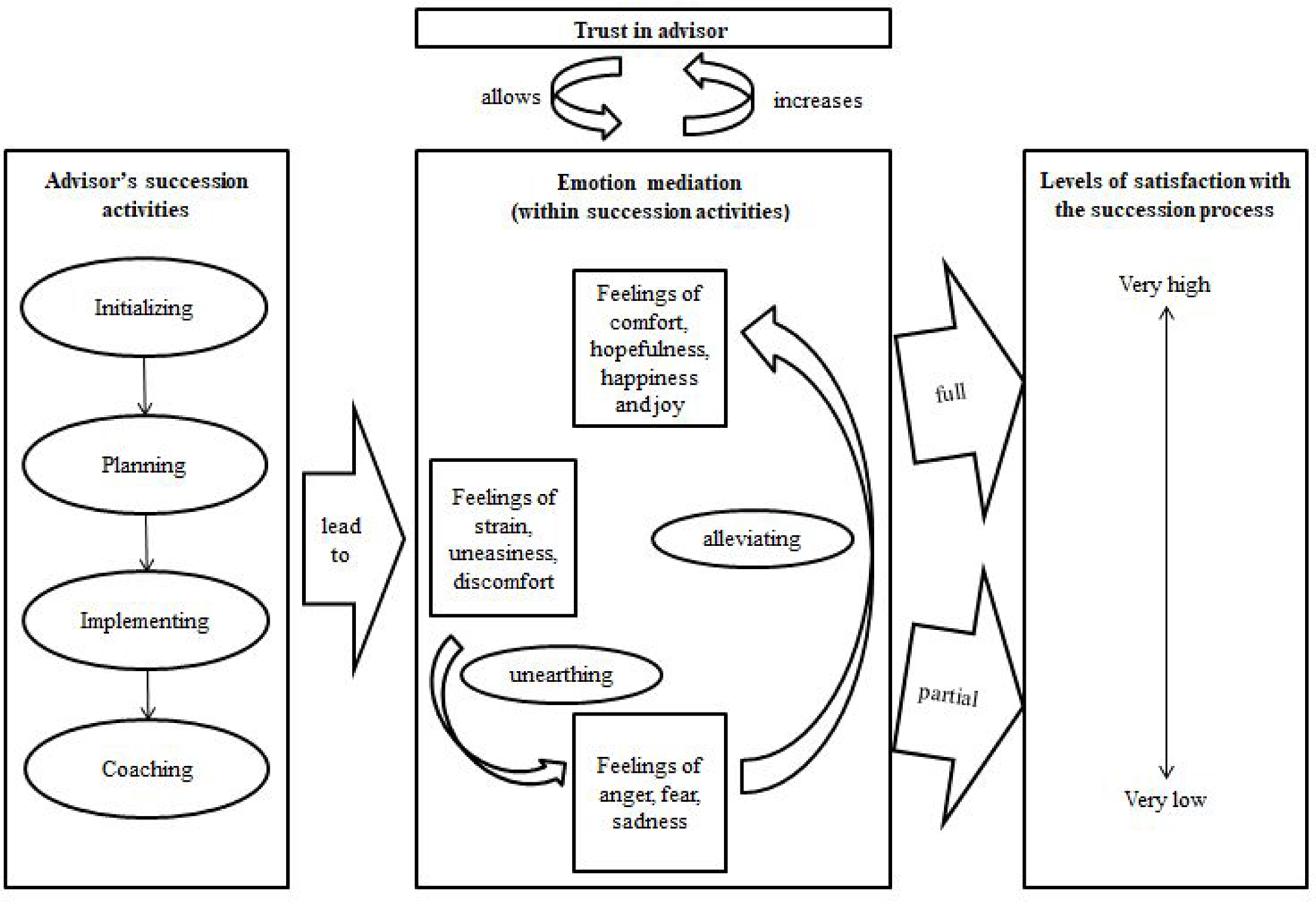
Unearthing and alleviating emotions: variances in mediation and satisfaction levels.
Discussion, Limitations, and Future Research
Contributions to Theory
This study contributes to the literature regarding family firms and entrepreneurship in at least four ways. First, we advance the study of emotions in family firms. Although research agrees that emotions play a major role in family firms (Labaki, Michael-Tsabari, & Zachary, 2013), we have little understanding of how to address these emotions and their consequences (Brundin & Nordqvist, 2008; Shepherd, 2016). We expand this research by demonstrating how emotions can be managed by iteratively unearthing and alleviating them. We illustrate this process by providing rich qualitative evidence from unique private sources about different emotions that can be observed for both the SG and the JG. In particular, we outline how emotions can be addressed by mechanisms to uncover negative feelings (see also Shepherd, Patzelt, & Wolfe, 2011), followed by their mitigation. This finding builds on and extends extant theory from the psychology literature regarding the social interaction model, which argues that to regulate the emotions of others, mutual trust is a needed precondition to “amplify” or “suppress” emotions (Coté, 2005). We advance those findings by providing evidence that to effectively address emotions, amplification is a specific mechanism of bringing latent emotions to the surface. Other mechanisms might be openly addressing these negative feelings or attentively listening. We name this process involving numerous mechanisms unearthing emotions, as the advisor’s purpose is to uncover and disclose those emotions that are otherwise blocking the succession process. Moreover, our data suggest that suppression can be considered as but one mechanism to address emotions. Almost every advisor interviewed confirmed that the process of unearthing emotions is followed by a process of alleviating emotions, in which negative emotions are actively mitigated and turned into positive ones. Suppressing emotions, in turn, simply ceases the external display of the still-present negative emotions, potentially continuing to block the process. While the social interaction model focuses on changing internally felt emotions that are still “under way” (deep acting) and merely altering external displays of emotions that have already manifested themselves (surface acting), our finding show how advisors can help to change the internal feeling of emotions that have already manifested themselves. As such, we use the term “emotion mediation” (following Strike & Rerup, 2016) instead of emotion regulation.
Second, we advance research on family firm advisors by revealing their critical role in managing SGs’ and JGs’ emotions. Only where the advisor was able to alleviate the unearthed negative emotions did the SG and JG successfully proceed with the succession process and exhibit high levels of positive emotions. More specifically, our findings advance prior research regarding family firm advisors (e.g., Michel & Kammerlander, 2015; Strike, 2012, 2013) by distilling specific mechanisms that advisors can use for emotion mediation. In particular, we identify a set of mechanisms used to unearth and alleviate the negative emotions (Table 3). Whereas prior research (Strike & Rerup, 2016) studying mediated sensemaking has focused on positive feelings and on advisors’ activities to slow down the process, we provide evidence that an advisor also needs to unearth and address negative emotions to speed up the process when actors become stuck. Finally, we present evidence that to be able to successfully execute emotion mediation mechanisms, mutual trust between the advisor and the advisees is necessary. These findings are relevant not only for scholars but also for practice. Although those findings were obtained in the context of family firm succession, they provide important insights for research seeking to understand advising of entrepreneurial ventures, which have to address negative emotions such as anxiety (Shepherd, 2003) or grief (Shepherd, 2009).
Third, our cross-case analysis reveals that in cases in which emotions were successfully mediated throughout the process, the satisfaction with the succession process was highest. In contrast, in firms characterized by insufficient emotion mediation, negative emotions prevailed toward the end of the succession process, and satisfaction levels dropped. These findings extend previous research that emotions are not static, as they emerge and evolve given critical events in each family business system (Shepherd, 2003). By conducting investigating satisfaction levels over the succession process, we increase our understanding of “satisfaction” as an important individual-level outcome variable related to the succession process (e.g., Sharma et al., 2001). In doing so, we further extend the work of Sharma et al. (2003), who studied factors that increase the incumbents’ and successors’ satisfaction with the succession process.
Fourth, we contribute to succession research (e.g., Breton-Miller et al., 2004; Daspit et al., 2016; Miller et al., 2003) by identifying emotion mediation as an important driver of the SG’s and JG’s role adjustment (Sonnenfeld & Spence, 1989; Handler, 1990). Our qualitative data demonstrate that when emotion mediation was achieved throughout the process, the actors also adjusted their roles to the ideal ones proposed by Handler, 1990; and further refined by Sonnenfeld, 1991), whereas in contrast, insufficient emotion mediation resulted in incomplete role adjustment. Interestingly, our data are very much in line with and reinforce the specific roles of the incumbent and successor that Handler proposed in her 1990 model. Our data are also in accordance with Sonnenfeld and Spence’s (1989) findings that emotional factors, such as incumbents’ tensions and fears versus excitement toward the next phase of life, determine their exit pattern (e.g., monarchs and generals have trouble with letting go vs. ambassadors and governors who leave the firm more easily) and consequently their individual satisfaction with the succession process. Additionally, we find that not only the SG and JG but also the advisor assume different role-related activities throughout the process, such as initializing, planning, implementing, and coaching. These findings complement Handler’s (1990) model of mutual role adjustment by focusing on, first, drivers of role adjustment and, second, the advisor’s role-related activities within the process. This inspires not only succession but also general family firm research that takes a temporal perspective and acknowledges that roles and corresponding activities might change over time.
Limitations and Future Research
Our study is not without limitations; however, they open up interesting avenues for future research. First, in our manuscript, we use the term emotion quite broadly, as we follow fellow researchers and use the term emotion to encompass the general phenomenon of subjective feelings (Barsade, 2002, p. 646) of pleasure or displeasure. Future research might also study the role of positive emotions and cognition in the succession process.
Second, we studied five cases with diverging outcomes that all involved the same advisor. Whereas this approach is advantageous in terms of ruling out alternative explanations due to advisor characteristics, it also comes with certain shortcomings. In particular, we need to emphasize that the goal of our research was to create a deep understanding of family firm processes, as opposed to generalizability. However, the interviews conducted with 15 additional advisors and the resulting member checks indicate the potential relevance of our model. Future studies might help identify potential other mechanisms that the advisor may draw upon. Additionally, researchers might scrutinize and potentially adapt our model to situations in which the role adjustment does not follow the ideal process suggested by Handler (1990) but rather follows alternative pathways, such as those proposed by Sonnenfeld and Spence (1989).
Finally, a subset of our data are retrospective, raising concerns about bias. We minimized this risk by attending meetings in person, relying on time-stamped archival data, and interviewing 15 additional advisors about ongoing succession cases. Nevertheless, future research might study the emotion mediation process in real time.
Supplemental Material
Supplementary Material 1 - Supplemental material for Unearthing and Alleviating Emotions in Family Business Successions
Supplemental material, Supplementary Material 1, for Unearthing and Alleviating Emotions in Family Business Successions by Alexandra Bertschi-Michel, Nadine Kammerlander and Vanessa M. Strike in Entrepreneurship Theory and Practice
Footnotes
Appendix
Declaration of Conflicting Interests
The author(s) declared no potential conflicts of interest with respect to the research, authorship, and/or publication of this article.
Funding
The author(s) received no financial support for the research, authorship, and/or publication of this article.

Notes
Author Biographies
References
Supplementary Material
Please find the following supplemental material available below.
For Open Access articles published under a Creative Commons License, all supplemental material carries the same license as the article it is associated with.
For non-Open Access articles published, all supplemental material carries a non-exclusive license, and permission requests for re-use of supplemental material or any part of supplemental material shall be sent directly to the copyright owner as specified in the copyright notice associated with the article.
