



Abstract
To better understand how neurodiversity (i.e., neurobiological/brain-related differences) is related to entrepreneurial cognition, this study draws on prior research from entrepreneurship and neuroscience to empirically examine the relationship between attention-deficit/hyperactivity disorder (ADHD) and the entrepreneurial mindset. We examine differences between entrepreneurs with and without ADHD in cognitive style, entrepreneurial alertness, metacognition, and resource-induced coping heuristic (RICH). Our results suggest neurodiversity from ADHD is meaningfully related to aspects of an entrepreneurial mindset. Our results suggest entrepreneurs with ADHD employ a more intuitive cognitive style and demonstrate higher levels of entrepreneurial alertness and RICH, while no significant differences in metacognition were found.
Keywords
As the field of entrepreneurship expands, so have scholarly efforts to understand how neurobiological (i.e., brain-related) differences relate to entrepreneurial factors (Phan & Wright, 2018). In particular, an emerging stream of entrepreneurship research has begun to investigate the effect of mental health and related disorders, such as attention-deficit/hyperactivity disorder (ADHD), on entrepreneurial processes and outcomes (Antshel, 2018; Lerner et al., 2018a; Stephan, 2018; Wiklund et al., 2018; Wiklund et al., 2018). Empirical research suggests the clinical condition of ADHD is positively related to both entrepreneurial intentions and initiation of business ventures (Dimic & Orlov, 2014; Lerner et al., 2018b; Verheul et al., 2015, 2016). Additional empirical research has shown that ADHD is also positively associated with individual-level entrepreneurial orientation (Thurik et al., 2016) and engagement in entrepreneurial actions (Wiklund et al., 2016, 2017). Finally, research from a personality trait perspective further demonstrates that entrepreneurs with ADHD are associated with higher levels of need for achievement, autonomy, and creativity, as well as moderate risk taking (Dimic & Orlov, 2014).
Theoretically, these studies have conceptualized ADHD in terms of behavioral manifestations of the disorder (e.g., hyperactivity and impulsivity) (Antshel, 2018; Dimic & Orlov, 2014; Wiklund et al., 2016, 2017). This approach is similar to historic conceptualizations of ADHD as a behavioral learning disorder (Brown, 2006). Since 1980 1 , however, research across psychiatry, neurology, and psychology domains has led to a neurocognitive conceptualization of the disorder (Barkley, 1997; Brown, 2013). Presently, the dominant paradigm of ADHD etiology is understood as neurobiological (brain-based) differences that impair high-order neurocognitive functions invoked in adaptive or goal-directed behavior (Barkley, 1997, 2011; Brown, 2006, 2009, 2013; Roebers, 2017).
Since the etiology of ADHD is now understood as manifestations of neurobiological differences in cognition, the influence of ADHD is likely to have more proximate effects on entrepreneurs’ cognitions. As such, our empirical study seeks to align contemporary conceptualizations of ADHD as a neurocognitive disorder with cognition-based explanations of individual differences in entrepreneurs. Fortunately, the paradigm shift in the study of ADHD, from behavioral to cognitive, mirrors a paradigm shift in contemporary individual-level entrepreneurship research that employs cognitive science to understand entrepreneurs in terms of cognition (Baron, 2004; Mitchell et al., 2002, 2004, 2007). Thus, cognitive approaches to both the study of ADHD and entrepreneurship are especially suited to draw on contemporary theory in each field, while simultaneously reducing the risk of incommensurate theory development or testing (Kuhn, 1962).
Our study draws on prominent neurocognitive perspectives that conceptualize ADHD in terms of biological differences in specific regions of the brain that cause deficits in high-level cognitive control and reward functions involved in goal-directed decisions (i.e., the brain’s executive functions) (Barkley, 2011; Oosterlaan et al., 2005; Roebers, 2017). Executive functions enable adaptive, goal-directed cognitions and behavior in novel or changing situations (Roebers, 2017)—situations akin to the information-scarce, uncertain conditions experienced by entrepreneurs, who take goal-directed actions in the pursuit of opportunities (Mitchell et al., 2004, 2007). Since these high-level cognitive control and reward functions are directly altered by the neurobiological differences in those with the ADHD pathology, we expect ADHD to be associated with variation in entrepreneurial cognition. Thus, if variation in entrepreneurial cognition is associated with ADHD, then these findings serve as one avenue to contribute to extant social science research regarding neurobiological factors in entrepreneurial cognition research.
Despite acknowledging the role of variations in brain structure or function (Mitchell et al., 2007), entrepreneurial cognition research has generally overlooked recent scholarly efforts to better understand how biological differences, in general (Bönte et al., 2016), and neurobiological differences, in particular (Becker et al., 2011; Nicolaou & Shane, 2014; Wiklund et al., 2018), relate to entrepreneurial thinking and decision making (McMullen et al., 2014; Nofal et al., 2017). Our study contributes to entrepreneurial cognition research by empirically examining focal entrepreneurial cognition patterns in individuals with ADHD who have launched an entrepreneurial venture; cognition patterns that we expect to vary between entrepreneurs with and without ADHD. We selected prominent entrepreneurial cognition constructs that represent conceptually-differentiated aspects of entrepreneurial thought, important for an entrepreneurial mindset (Ireland et al., 2003; Urban, 2012); namely, cognitive style, entrepreneurial alertness, metacognition, and the resource-induced coping heuristic (RICH) (Allinson & Hayes, 1996; Brigham et al., 2007; Kickul et al., 2009; Lanivich, 2015; Tang et al., 2012). Since executive functions are invoked in novel decision-making situations to select, modulate, or construct schema based on environmental stimuli (Gilbert & Burgess, 2008; Norman & Shallice, 1986; Ridderinkhof et al., 2004; Stephan, 2018) we expect the cognitive processes underlying these four entrepreneurial cognition constructs to be related, in some cases positively and in others negatively, to the executive neurocognitive differences in individuals with ADHD.
Additionally, our study contributes to recent developments in entrepreneurship research investigating mental health and disorders in entrepreneurs (e.g., Antshel, 2018; Phan & Wright, 2018; Stephan, 2018; Wiklund et al., 2018) by examining ADHD from a neurodiversity perspective, which urges brain-functionality differences be considered using the same discourse employed when considering biodiversity and cultural diversity (Armstrong, 2011; Jaarsma & Welin, 2012; Ortega, 2009; Singer, 1999; Wiklund et al., 2018). Our findings suggest that ADHD, considered by many as a cognitive deficit or learning disability, is not necessarily a negative disorder for entrepreneurs. Indeed, we find that entrepreneurs with ADHD (Stephan, 2018), when compared to entrepreneurs without ADHD, tend to have more intuitive cognitive styles, and higher levels of entrepreneurial alertness and resource-induced coping heuristics, all of which are especially important in early-stage entrepreneurial activities (Kickul et al., 2009; Lanivich, 2015; Mitchell et al., 2002; Tang et al., 2012). Thus, our findings contribute to the growing stream of entrepreneurship research that investigates mental disorders by providing evidence of neurodiverse entrepreneurs utilizing knowledge structures (e.g., cognitive biases, heuristics, or perceptual processes) commonly used to make judgments regarding opportunity evaluation, venture creation, and business growth under conditions of information-scarcity and uncertainty.
Finally, we build on emerging research in psychiatry, neurology, and psychology that contends the impairments of the brain’s executive function are situationally variable (Sonuga-Barke, 2003; Antshel, 2018). This research has shown that individuals with ADHD not only experience a lack of cognitive dysfunction, but that they often demonstrate supernormal levels of focus and energy, in some activities, situations, or tasks (Brown, 2013). For individuals with ADHD, environments may compound and lead to restricted opportunities for learning and skill development or be compensatory and stimulate the acquisition of different skills and strategies that permit improved functioning (Börger et al., 2000; Sonuga-Barke, 2003). In a recent symposium in the Academy of Management Perspectives, Wiklund et al. (2018) build on the tenets of person-environment fit to argue that “…entrepreneurship can offer unique opportunities for workplace accommodations to accomplish environmental fit for people with a wide range of mental disorders” (p. 183). In fact, Wiklund et al. (2018) provide counterarguments to the negativity of impulsivity of those with ADHD by arguing that the entrepreneurial context is particularly favorable for individuals high in impulsivity, and that impulsivity can actually contribute to opportunity discovery, evaluation, and exploitation. Finally, in that same symposium, Lerner et al. (2018a) offer a dualistic framework that explores possible advantages of brain-functionality differences at some points of the entrepreneurial process that could be disadvantages at other points. Our findings contribute to this burgeoning literature by examining the ADHD—entrepreneurship link in terms of cognition. Within an entrepreneurial context, our findings suggest cognitive-based contingencies that necessitate intuition, alertness, and heuristical coping mechanisms are compensatory, while those requiring metacognitive abilities compound the executive dysfunction of entrepreneurs with ADHD.
Theoretical Overview
Responses to environmental stimuli are governed by sets of cognitive schema. Schema are cognitive frameworks or systems in the mind for categorizing and organizing information. Cognitive schema are the building blocks of cognition (e.g., Rose et al., 2003), wherein the formation of schemas begins in infancy and influences the cognitive processing of information throughout life and learning. As individuals learn, or give meaning to knowledge, they develop a number of cognitive schemas that await selection (Torney-Purta, 1991). In routine situations, schema are selected from information in the environment without conscious control or the need for limited information processing resources because the neural pathways that connect particular environmental events to cognitive or behavioral responses have been acquired through extensive learning or experience (Gilbert & Burgess, 2008; Norman & Shallice, 1986; Ridderinkhof et al., 2004). However, when environmental triggering cannot effectively select existing cognitive shortcuts to translate stimulus-reward contingencies into goal-oriented action repertoires, conscious attention and limited information processing resources are necessary to invoke high-level cognitive control and reward functions to modulate or construct schema (Gilbert & Burgess, 2008; Norman & Shallice, 1986; Otero & Barker, 2014; Roebers, 2017). These cognitive control and reward functions are referred to as executive functions (Ardila, 2008), defined as “…a set of heterogeneous, higher-order cognitive processes involved in goal-directed, flexible, and adaptive behavior and the top-down regulation of cognitive control, which are triggered in novel, challenging, and complex situations (Roebers, 2017).” While executive cognitive control functions inhibit prepotent responses (responses for which immediate reinforcement, positive or negative, is available), filter and process information, and utilize working memory, executive reward functions process emotions and rewards that enable self-regulation of affect, emotion, and motivation (Barkley, 1997; Brown, 2005, 2013; Roebers, 2017; Sonuga-Barke, 1994).
In the prefrontal lobes of the brain, the dorsolateral prefrontal cortex regulates cognitive control functions, while connections of the limbic system to the orbitofrontal and anterior cingulate/medial circuits modulate reward functions (Ardila, 2008). ADHD is a disorder of neurocognitive executive functions that arises from genetic, neurobiological differences in either one or both of two dopaminergic pathways (i.e., a dual pathway model); namely, the mesocortical control circuits in the prefrontal cortex or the mesolimbic reward circuits in the limbic regions (Barkley, 1997; Brown, 2013; Sonuga-Barke, 2002). Executive control functions are mediated by the mesocortical control circuits and enable inhibitory control of automatic responses (i.e., thoughts and behaviors) to stimuli (Barkley, 1997; Otero & Barker, 2014). Inhibitory control dysregulation (i.e., dysfunction in response inhibition) in those with ADHD limits cognitive control processes that impede automatic, prepotent responses to stimuli so that alternative action schema can be modulated or constructed (Ridderinkhof et al., 2004). Executive reward functions are mediated by the mesolimbic reward circuits that regulate the salience of incentives and rewards (Otero & Barker, 2014; Sonuga-Barke, 2002; Sonuga-Barke et al., 2002). Dysfunction in the mesolimbic reward circuits in those with ADHD causes hypersensitivity to delay, as well as problems related to task activation and prioritization (Brown, 2006; Sonuga-Barke, 2002). Consequently, individuals with ADHD tend to dramatically discount future rewards in favor of a significant preference for immediate rewards, which results in a dominant motivation style characterized by impulsive actions to escape or avoid delay (Antshel, 2018; Sonuga-Barke, 1994, 2002, 2003). In other words, individuals with ADHD are cognitively predisposed to prioritizing schema that minimize time between decision and outcome.
Entrepreneurial Cognition
Cognitions are processes that reduce, transform, and use sensory input from the environment, such that behavior results from complex interactions between cognition, environment, and mind (Neisser, 1967). These interactions between mind and environment influence the construction, alteration, and use of mental representations, knowledge structures, and schema (Grégoire et al., 2011). In the complex interactions between cognition, environment, and mind (Neisser, 1967), entrepreneurs combine contextual requirements with environmental information interpretations to organize information into schemas to solve entrepreneurial problems (Gaglio & Katz, 2001). Under conditions of uncertainty and information scarcity, entrepreneurs use mental representations, rules, and scripts (i.e., schema) to interpret information and make sense of the world (Valliere, 2013). As a result, entrepreneurs can reduce information processing complexity and duration by applying learned cognitive shortcuts (e.g., heuristics, biases, and scripts) to relatable situations (Gigerenzer, 2008; Mitchell et al., 2007; Simon, 1979; Tversky & Kahneman, 1974).
These cognitive shortcuts enable quick responses that produce satisficing (i.e., satisfactory and sufficient) rewards compared to fully rational or systematic decision-making models that seek to maximize rewards from all possible alternatives (Gigerenzer, 2008; Simon, 1979; Tversky & Kahneman, 1974). Rational, systematic decision-making significantly increases cognitive load and sustained, conscious attention (Gigerenzer, 2008; Simon, 1979; Tversky & Kahneman, 1974) to invoke executive cognitive control and reward functions that construct, modulate, or orchestrate action schema (Gilbert & Burgess, 2008; Norman & Shallice, 1986; Ridderinkhof et al., 2004). Thus, entrepreneurs develop information processing abilities and knowledge structures (whether heuristically or scripted) that allow relatively quick decisions in uncertain, information scarce environments that minimize cognitive load associated with constructing new schema (Baron, 2004; Busenitz & Barney, 1997; McGrath & MacMillan, 2000; Mitchell et al., 2007; Tversky & Kahneman, 1973, 1974).
Entrepreneurial cognition theorists are especially interested in how entrepreneurs interpret, analyze, remember, and use information, referred to as cognitive style in the environment (Allinson & Hayes, 1996; Brigham et al., 2007) and the cognitive schema (i.e., knowledge structures) that enable entrepreneurial decision-making (Baron, 2004). Research indicates that early-stage entrepreneurs utilize an intuitive cognitive style that enables rapid decisions from limited information, rather than an analytical cognitive style grounded in systematic evaluation (Kickul et al., 2009). Further, entrepreneurial alertness is a schema that enables entrepreneurs to organize and interpret information in various domains of knowledge related to the development of new opportunities (Gaglio & Katz, 2001; Kirzner, 1979, 1999). When heuristic-based logic is viewed from a conservation of resources perspective, Lanivich (2015) argues that this increased entrepreneurial expertise is reflected in an individual’s resource-induced coping heuristic (RICH). Alternatively, entrepreneurial expertise is further reflected in the concept of entrepreneurial metacognition, which is a conscious, executive control function that organizes, monitors, and adapts mental schema to formulate higher-order cognitive strategies and to promote adaptable cognitions (Haynie et al., 2010; Nelson, 1996).
Neurodiversity and Entrepreneurial Cognition
From a neurodiversity perspective, people with ADHD have neurobiological differences that cause variation in executive control (primarily inhibitory control) and reward (delay aversion) functions. The behavioral symptoms associated with ADHD arise from dysfunction or altered executive control and reward functions involved in goal-directed behavior in novel and complex situations (Roebers, 2017). ADHD is therefore understood in terms of executive dysfunction that manifests as situationally variable control of attention and behavior (i.e., inattention and hyperactivity-impulsivity) (Brown, 2013). The degree to which neurocognitive differences of those with ADHD function as executive deficits or assets is contingent on environmental factors. For example, in the workplace, ADHD is associated with poor time management skills, poor job performance, chronic lateness, and missed deadlines (Murphy & Barkley, 1996; Nadeau, 2005). Additionally, individuals with ADHD may have difficulty participating in meetings, collaborating, and coordinating with others on tasks that are not of personal interest (Jackson & Farrugia 1997; Patton, 2009). On the other hand, ADHD is also associated with positive behaviors in the workplace, such as ingenuity, innovation, creativity, determination, perseverance, risk taking, and intense concentration (Nicolaou et al., 2011; White & Shah, 2011). A neurodiversity perspective recognizes individuals with ADHD often experience minimal executive dysfunction, or even supernormal levels of focus and energy, in some activities, situations, or tasks (Brown, 2013).
Findings from extant entrepreneurship research indicates that individuals with ADHD are more likely to self-select new business venturing because entrepreneurial environments are attractive to individuals with ADHD (Lerner et al., 2018a). These entrepreneurial environments align speed of action with the unique traits of these individuals (Wiklund et al., 2017). From a neurodiversity perspective, entrepreneurial environments positively moderate the relationship between cognitive differences associated with ADHD and functional outcomes and/or stimulate learning and skill development (Antshel, 2018). Entrepreneurial environments promote quick action responses and attention to more immediate rewards, thereby enabling people with ADHD to utilize existing schema to mitigate differences in executive control and reward functions (Antshel, 2018; Gilbert & Burgess, 2008). Intuitive cognitive style, as well as heuristical and scripted schema (e.g., entrepreneurial alertness and RICH), are knowledge structures that reduce executive processing and enable use of existing schema in novel, information-scarce environments (Haynie et al., 2010; Mitchell et al., 2007). On the other hand, metacognition requires significant, conscious attention to invoke executive functions to construct and modulate schema. Thus, we expect individuals with ADHD to be associated with higher levels of intuitive cognitive style and cognitive shortcuts (i.e., heuristics and scripts), but lower levels of metacognition. In the following section, we develop specific theoretical rationales to hypothesize differences in entrepreneurial cognition (i.e., cognitive style, alertness, metacognition, and RICH) between entrepreneurs with and without ADHD.
Hypotheses Development
Differences in Styles of Thought
Cognitive processes are often defined as differences in information processing style or cognitive style (Allinson & Hayes, 1996; Kirton, 1976; Witkin & Goodenough, 1981). In general terms, cognitive style reflects individual differences in how people perceive, remember, organize, and process information. Schmeck (1988) proposed two types of cognitive style, (1) intuitive/global-holistic/field dependent/right-brained and (2) analytic/focused-detailed/field independent/left-brained. Cognitive style has also been explored as differences in cognitive structure, differences in cognitive processes, or both (Riding & Cheema, 1991; Tennant, 1988).
According to Allinson and Hayes (1996), intuitive people tend to take a broad perspective on a problem to get an overall feel for it and reach a conclusion rapidly. Analytic people tend to take a logical, step-by-step approach before deciding on a solution, after a period of reflection. In the workplace, intuitive people tend to be nonconformist, prefer a rapid, open-ended approach to decision making and rely on random methods of exploration. On the other hand, analytic people tend to be compliant, prefer a structured approach to decision making, apply systematic methods of investigation, and like to handle problems that require a step-by-step solution (Lynch, 1986). Consequently, the majority of findings from early work on the relationship between cognitive style and entrepreneurship support the belief that entrepreneurs tend to be more intuitive than analytic (Allinson et al., 2000). In particular, individuals with an intuitive cognitive style are more attuned to scanning and searching for information, resulting in an ability to identify and recognize entrepreneurial opportunities (Kickul et al., 2009).
Inhibitory control dysregulation in individuals with ADHD limits self-regulation of inhibitory cognitions and use of working memory necessary for tasks that require systematic planning and information processing (Barkley, 1997). Moreover, delay aversion in individuals with ADHD creates a preference for immediate choices and actions (Sonuga-Barke, 2002). Analytical cognition is deliberate and conscious, requiring executive control functions to inhibit automatic responses, utilize working memory, and actively select and modulate schema (Baddeley, 2003). On the other hand, intuitive cognition involves automatic selection of schema based on pattern recognition that is independent from executive control and unconstrained by working memory (Patterson & Eggleston, 2017). The structured, systematic decision-making processes of an analytic cognitive style require increased planning, attention, and delay of rewards; all of which would be expected to create information- and task-related challenges for individuals with ADHD (Lerner et al., 2018b; Wiklund et al., 2018). Moreover, the delay aversion of entrepreneurs with ADHD would be expected to magnify the existing tendency of entrepreneurs to have intuitive cognitive styles, since intuitive cognitive styles are associated with rapid, unstructured decision-making and require less task engagement (Wiklund et al., 2016).
Differences in Entrepreneurial Alertness
The concept of entrepreneurial alertness was first proposed by Kirzner (1973) to reflect the flashes of superior insight regarding market disequilibrium. He defined alertness as an ability that helps some individuals recognize the economic reward potential from changes, shifts, gaps, and possibilities in a market. Giliad et al. (1988) proposed that the essence of entrepreneurship resides in entrepreneurs’ proficiency in noticing the opportunities in a disequilibrium market context. They argued that alert individuals are ready and able to form a judgment about the existence of an opportunity when it appears. According to Gaglio and Katz (2001), entrepreneurial alertness is a schema that enables people to organize and interpret information in various domains of knowledge related to the development of new opportunities.
The opportunity recognition, evaluation, and exploitation areas are considered by many to be the heart of entrepreneurship (Shane & Venkataraman, 2000), and research has indicated that entrepreneurial alertness plays an important role in that process (Ardichvili et al., 2003; Baron, 2006). Recent work views alertness as a proactive stance based on cognitive capacities and processes such as prior knowledge and experiences, pattern recognition, information processing skills, and social interaction (Ardichvili et al., 2003; Baron, 2006; Gaglio & Katz, 2001; Shane, 2003). Tang et al. (2012) developed a measure of entrepreneurial alertness which is composed of three complementary dimensions: scanning and searching for new information, connecting previously disparate information, and evaluating whether the new information represented an opportunity. They argue that this process is consistent with Kirzner’s early work on scanning, and his later work on connecting disparate pieces of information as well as with McMullen and Shepherd (2006) work on making evaluations and judgments about new information, or changes in information, and then deciding if they would reflect a business opportunity with profit potential.
Reduced inhibitory control in individuals with ADHD is generally viewed as an impairment in many academic, occupational, and social situations (Kessler et al., 2006). However, in creative work contexts, empirical research suggests ADHD is positively associated with aspects of creativity, specifically in terms of the generation, combination, and implementation of new ideas (White & Shah, 2011), and these aspects of creativity are positively associated with entrepreneurship (Brophy, 2001; Lerner et al., 2018a) and workplace innovation (Schweizer, 2006). For individuals with ADHD, these aspects of creativity arise because divergent concepts, ideas, or information are not inhibited by executive functions, especially in working memory (Brown, 2013). Consequently, we expect reduced inhibitory control and these resulting aspects of creativity (i.e., ability to generate, combine, and implement new ideas) associated with ADHD to manifest in entrepreneurs as increased scanning, awareness, and connecting of information, which are reflective of entrepreneurial alertness. Additionally, delay averse motivational style would cause entrepreneurs with ADHD to seek more immediate rewards, which contributes to identifying opportunities with near-term results.
Differences in Entrepreneurial Metacognition
Introduced by Flavell (1979), metacognition is defined as the knowledge and control an individual has regarding their own cognitive processes. This concept parallels the neurological concept of executive function. Metacognition describes the process of formulating strategies positioned to choose from a set of available cognitive mechanisms, given what the individual understands about their own motivations, assumptions, strengths, and weaknesses (Flavell, 1979). Metacognition is not a dispositional trait, it is a conscious cognitive process that organizes, monitors, and adapts mental schema (Nelson, 1996; Schmidt & Ford, 2003).
Haynie et al. (2010) used this lens of thinking about thinking to propose a model of the entrepreneurial mindset based on situated metacognitive processes in the entrepreneurial context, and their expanded framework of the entrepreneurial mindset focuses on metacognitive processes. They argue that individuals who are metacognitively aware are more likely to formulate and evaluate multiple alternatives to process a given task and are highly sensitized and receptive to feedback from the environment that can be incorporated into subsequent decision frameworks (Melot, 1998). Haynie et al. (2010) developed a conceptual framework of entrepreneurial metacognition and suggested the entrepreneurial mindset is metacognitive in nature. Thus, it enables entrepreneurs to formulate higher-order cognitive strategies and to promote adaptable cognitions. Haynie et al. (2012) then provided empirical support for metacognitive ability as an important factor in the development of entrepreneurial expertise.
In order to make substantive changes to the mental schema employed to deal with the environment, metacognitive processes monitor learning outcomes and control current cognitive activities (Flavell, 1979; Haynie et al., 2010). Metacognitive monitoring and control processes rely on executive control functions to maintain or shift attention, update working memory, and inhibit automatic responses (Roebers, 2017). Executive control deficits coupled with delay aversion in those with ADHD would cause entrepreneurs with ADHD to adjust their environment as a mode of change (i.e., move on to a different situation) rather than concentrate on internal refinement of schema (Campbell & Fiske, 1959; Lerner et al., 2018b; Sonuga-Barke, 2002). For these reasons, we expect entrepreneurs with ADHD to report lower levels of metacognition than nonADHD entrepreneurs.
Differences in Resource-Induced Coping Heuristics
Not many people realize uncertainty like entrepreneurs. For these individuals, overcoming the unknown, persevering through adversity, and adapting to change can be business as usual (Holland & Shepherd, 2013; Wiklund et al., 2018). Also, for some, the consequences of losing resources, which can be as serious as bankruptcy, seem to have subdued effects because entrepreneurs deal with resource loss, or potential resource loss, better than nonentrepreneurs (Baron et al., 2012; Uy et al., 2013). Lanivich (2015) showed that, via the resource-induced coping heuristic (RICH), entrepreneurs with a proclivity for resource conservation behaviors (i.e., acquiring, protecting, and developing resources) reported higher financial and perceived venture success.
The RICH is a strategic, conditioned, loss-aversion cognitive short-cut for the attainment, protection, and development of resources in contexts of uncertainty (Lanivich, 2011, 2015). Theory for how the RICH functions as a cognitive coping mechanism stems from a conservation of resources (COR) framework (Hobfoll, 1989; Hobfoll & Shirom, 2001). Regarding COR theory, Hobfoll (2009) asserted “…that people are motivated to create, protect, foster, and nurture their resources. People build social, personal, material, and energy resources to sustain well-being, and to protect against future resource loss. This follows because people are loss-sensitive and gain-insensitive on biological (Cacioppo & Berntson, 1999), cognitive (Tversky & Kahneman, 1992) and social (Hobfoll et al., 1990) levels. Hence, the building and preserving of resources has a primary motivation in prevention of loss, because future, critical loss is inevitable.” Accordingly, the RICH is theorized to alleviate the strain caused by potential or actual resource loss by creating a mental paradigm of resource-based efficacy through habitual, automatic-response relationships with attaining, protecting, and developing resources. In other words, RICH entrepreneurs are better able to cope with uncertainty because they believe they will have access to the resources necessary to overcome threats to their venture goals.
With this in mind, we sought to investigate the way ADHD relates to RICH-adapted entrepreneurs. As a developed heuristic strategy for coping with adversity and uncertainty (Lanivich, 2015), we expect to find a link with entrepreneurs without ADHD. However, much less is known about entrepreneurs with ADHD. We believe that, because of their distinct resource needs, entrepreneurs with ADHD will experience the RICH in different ways than entrepreneurs without ADHD.
For entrepreneurs with ADHD, coping must become a way of life for them to function successfully in a society of people who, for the most part, do not process information as they do. While their entrepreneurial processes may be equifinal in nature (i.e., different paths lead to similar results), their need to develop mechanisms to overcome their pathology, or to enhance their pathology, arises early in life. As noted by Sonuga-Barke (2003), these coping challenges can be either compounded and lead to failure, or compensatory and stimulate the acquisition of different skills and strategies that permit improved functioning. These experiences substantiate executive function toward resource schema that are known to work for their specific symptoms because they have experimented with, and presumably identified, resources that assist them in their unique struggles. Since some of these struggles show overlap with general entrepreneurship struggles (e.g., overcoming uncertainty, persistence through adversity, viewing situations or potential opportunities differently than others), we believe the resource-induced coping heuristic developed by individuals with ADHD will be reported as stronger than the levels of RICH developed by their neurotypical counterparts.
Research Method
Sample
Data were collected from online panelists, who were recruited through a number of different methods, including traditional opt-in recruitment (joining a market research panel through typical website registration) and real-time sourcing (interception via web advertisements, social media, or mobile applications). Respondents were preprofiled from demographic information that was utilized to refine targeting based on employment status (targeting those who identified as self-employed) and conditions that are often associated with ADHD. In conjunction with these preprofiled demographics, we also utilized in-survey screening questions to ensure respondents met sampling criteria. To validate participants identified as entrepreneurs, two screening questions were used: (1) “Are you currently in the process of starting a new business venture in which you will be considered a founder?” and (2) “Are you a founder of a new business venture that was started within the last 2 years?”
One additional screening question was used to identify entrepreneurs who likely have ADD/ADHD: Have you been told or do you think you have Attention Deficit Disorder (ADD) or Attention Deficit with Hyperactivity Disorder (ADHD). This question was utilized to collect a sample size with appropriate power, rather than to determine classification of the respondent as an entrepreneur with ADHD (see our discussion of the ADHD diagnostic screening instrument below). Since the power of analysis of variance designs is limited to the group with the smallest number of observations, we sought to collect a near-balanced factorial design with 250 entrepreneurs with ADHD and 250 without the disorder. Thus, we continued to collect data until we had 250 observations for each response to the ADHD screening question, resulting in a final sample of 581 entrepreneurs that included 318 complete surveys from entrepreneurs that responded “no” and 250 that responded “yes” to the ADHD screening question. Of the 6,667 invitations that were sent, approximately 9% responded. Nineteen respondents were eliminated due to missing data or were outliers on one or more of the variables included in our study. Given our sampling criteria, the statistical results reported herein should not be inferred to nonentrepreneur samples.
From the 250 who responded “yes” to the ADHD screening question, approximately 21% (122 entrepreneurs) actually met criteria for a clinical diagnosis of ADHD (see the discussion below of the Adult ADHD instrument utilized in this study). Although the incidence of ADHD in our sample is higher than that in the adult population, higher incident rates of ADHD in entrepreneur populations of approximately 25% are demonstrated in prior research by (Wiklund et al., 2018) and Dimic and Orlov (2014). In fact, Phan and Wright (2018) state in their editorial introducing a recent, double issue of the Academy of Management Perspectives on mental health and entrepreneurship that conversations that motivated the symposium “started with the observation that entrepreneurs, as a cohort, seemed to report higher-than-average incidence of attention deficit/hyperactivity disorder (ADHD).”
We conducted several analyses to assess potential response or selection biases in our sample. We found no significant differences in mean comparisons between the eliminated respondents and our final sample of 581, nor were early respondents significantly different from later respondents. To assess potential selection bias, we utilized Levene tests of our dependent variables to assess heterogeneity of variances between ADHD and non-ADHD groups (Hochberg & Tamhane, 1987; Keppel, 1993; Tabachnich & Fidell, 2013). Results of the Levene tests indicated no significant difference in between-group variance for any dependent variable. Finally, Pillai’s criterion, in addition to Wilk’s lambda, was utilized to report effect sizes, since it is a more conservative measure of association with unequal group sizes (Olson, 1979; Tabachnich & Fidell, 2013).
Our sample of entrepreneurs consisted of a variety of age groups with similar frequencies across age groups (34.9% ages 20–30, 33.6% ages 31–40, and 31.5% over the age of 40). In terms of gender, 355 respondents (61.1 %) were male and 226 (38.9%) were female. While a majority of our sample consisted of Caucasians (69.7% of respondents), a significant number of other races were represented (28.6% nonCaucasian races). Although most of the respondents were married (53.4%), 35.1% of our sample were single and 11.5% were widowed, divorced, or separated. Our sample consisted of a diverse set of educational experiences, including those with a bachelor’s degree (32.9%), post-graduate degree (16.2%), some higher education or associate’s degree (34.3%), or high school degree (15.7%).
In terms of entrepreneurial or business experience, 68.8% of our respondents had started one business, 24.6% had started two businesses, and 6.5% had started three or more businesses. Finally, respondents included entrepreneurs with the following periods of time for entrepreneurial experience: 34.1% less than 1 year, 46.6% one to 3 years, 13.9% three to 6 years, and 5.3% seven to ten years. The entrepreneurs in our sample participated in a wide variety of industries, including agriculture, forest, and fishing (2.8%), mining (1%), construction (9.3%), manufacturing (6.2%), transportation and public utilities (2%), wholesale (4.5%), retail (21.4%), finance, insurance, and real estate (7.2%), services (25.5%), and public administration (2.2%).
Measures
Independent Variable
ADHD (α = .998). To identify respondents with ADHD, we utilized the Adult ADHD Self-Report Scale (ASRSv1.1), which was developed by a team of psychiatrists and researchers in conjunction with the World Health Organization as a diagnostic instrument for Adult ADHD (Kessler et al., 2005). The full scale has eighteen questions while the Adult Screening subscale, includes the six questions that were found to be the most predictive of symptoms consistent with ADHD. As noted by Verheul et al. (2016), for the purposes of this research, this self-report measure of psychiatric symptoms indicates a tendency to display behaviors consistent with ADHD rather than measuring a full-blown psychiatric disorder. The six questions are rated on a 5-point Likert-type scale ranging from “Never” to “Very Often.” On the first three questions, the subject receives one point if s/he selects “Sometimes,” “Often,” or “Very Often.” On the last three questions, the subject receives one points if s/he selects “Often” or “Very Often.” A score greater than or equal to four indicates that the subject has symptoms highly consistent with ADHD in adults.
Dependent Variables
Cognitive Style (α = .793). To measure intuitive versus analytic-type cognitive styles, we utilized Allinson and Hayes (1996) Cognitive Style Index (CSI). It is composed of 38 questions with available responses of true (2), false (1), or uncertain (0). Lower scores on the scale indicate more intuitive cognitive styles, while higher scores indicate more analytic cognitive styles.
Entrepreneurial Alertness (α = .965). Entrepreneurial alertness was measured with the scale developed by Tang et al. (2012). The scale is composed of thirteen questions composed of three lower-order factors that include scanning and search, association and connection, and evaluation and judgment. The items are measured on 7-point Likert-type scales which range from “Definitely Not Representative” to “Definitely Representative.”
Entrepreneurial Metacognition (α = .901) was measured with the scale consisting of thirty-six questions developed by Haynie and Shepherd (2009). The measure is comprised of five lower order factors that include goal orientation, metacognitive knowledge, metacognitive experience, metacognitive choice, and monitoring. The scale utilizes an 11-point semantic differential measure anchored on the left with the statement “Not very much like me” and on the right with the statement “Very much like me.”
Resource-induced Coping Heuristic (RICH) (α = .920) was measured with the RICH Inventory developed by Lanivich (2015). The scale is composed of 16 items designed to measure acquiring, protecting, and developing resources. The items are measured on 7-point Likert-type scales which range from “Strongly Disagree” to “Strongly Agree.” The scales used for each dependent variable are shown in Supplementary Appendix I.
Control Variables
Prior research suggests cognition, including entrepreneurs’ use of heuristics (Busenitz & Barney, 1997; Lanivich, 2015), cognitive style (Allinson et al., 2000; Brigham et al., 2007), and metacognition (Haynie & Shepherd, 2009; Haynie et al., 2010, 2012; Roebers, 2017; Schmidt & Ford, 2003) vary by demographic characteristics (i.e., including age, gender, race, and education) and experience (i.e., business and start-up experience). Therefore, we controlled for these in our statistical analyses. Age was measured using a 7-point Likert scale with anchors at less than 20 and greater than 80 years of age coupled with 10 years ranges in between. Education was measured using a 7-point Likert scale ranging from “Some High School” to “PhD Degree”. Additional Likert-type scales were used to measure experience, including the number of business ventures the respondent had started (4-point scale) and length of time in the respondent’s current business (5-point scale).
Measurement Assessment
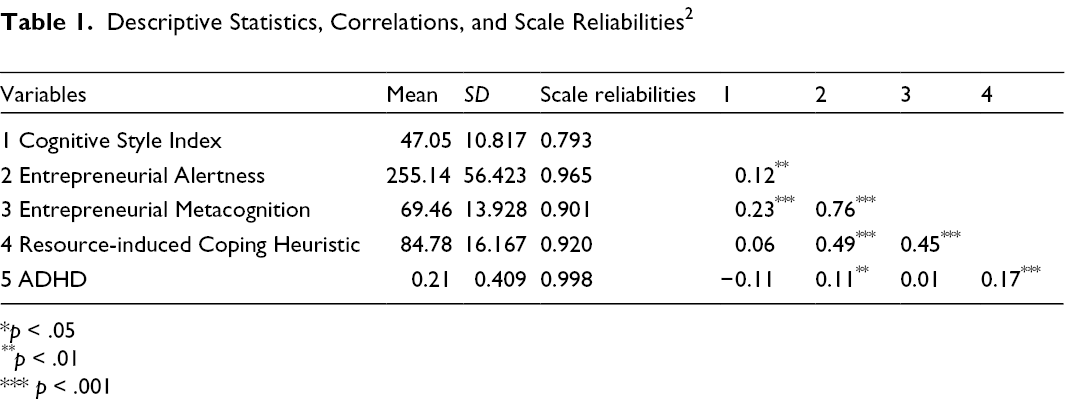
Reliability and Validity: Composite reliabilities (reported in Table 1, ranged from 0.793 to 0.998, demonstrating satisfactory levels of reliability (Nunally, 1978). Convergent validity, the degree of agreement between multiple measures of a construct (Campbell & Fiske, 1959; Cote & Buckley, 1987), was assessed by examining the item loadings from a confirmatory factor analysis (CFA) with each construct modeled as an exogenous construct. Except for the CSI scale, each item loading (λ) on our multi-item constructs was significantly related to its respective underlying factor with an estimate above the 0.5 cutoff (Hair et al., 2010). Regarding the CSI construct, Allinson and Hayes (1996) document the psychometric properties of the instrument across multiple samples and explicitly note that the index tends to have low inter-item correlations primarily due to having thirty-eight items. Our CFA mirrored the analyses by Allinson and Hayes (1996), in which we observed factor loadings below the generally accepted cutoff of 0.50 (Hair et al., 2010). However, all of the factor loadings from the CFA were significant, except for one of the thirty-eight items. Since the removal of this one item had no effect on our hypothesis test, we retained the item. Given the results of our analyses, we conclude that our measures demonstrate acceptable reliability and convergent validity.
Descriptive Statistics, Correlations, and Scale Reliabilities 2
*p < .05
**p < .01
*** p < .001
We assessed discriminant validity (i.e., the degree to which a construct differs from others) using multiple analyses. First, we compared the variance explained in each construct’s observed variables to variance it shared with other constructs (Fornell & Larcker, 1981). We found the square root of the average variance explained (AVE) of each construct was higher than the correlations between respective constructs, indicating discriminant validity. We also assessed discriminant validity using CFA by comparing the relationships of observed variables within the same construct to those of the observed variables across constructs (i.e., multi-trait multi-method [MTMM] matrix analysis) (Campbell & Fiske, 1959; Cote & Buckley, 1987). Building on the traditional MTMM approach, Henseler et al. (2015) suggest the ratio of the observed variables’ average correlation between constructs to the average correlation within a construct (i.e., heterotrait-monotrait [HTMT] ratio) that is less than 0.90 supports discriminant validity. Our analysis resulted in HTMT ratios that generally ranged from 0.281 to 0.590 with a minimum and maximum of 0.099 and 0.860, respectively. Finally, results from partial correlation analyses using a marker variable, which is discussed below, provided further support of discriminant validity (Lindell & Whitney, 2001).
We further assessed convergent and discriminant validity of our measures by retaining all unidimensional constructs as in the previous analyses, while modeling entrepreneurial alertness, metacognition, and RICH as second-order factors consisting of each construct’s underlying dimensions using partial least squares-structural equation modeling (PLS-SEM) (Fornell & Larcker, 1981). The results of this analysis mirrored the results described above, thereby providing further evidence of construct and discriminant validity.
Common Method Variance: Since we relied on self-reported measures of our key constructs, we incorporated several procedural and statistical remedies to control common method variance (CMV) and single source bias. We included several procedural remedies suggested by Podsakoff et al. (2003). These procedural remedies included protecting the anonymity of respondents, reducing item ambiguity by using established scales, separating scale items between predictor and criterion variables, and separating entrepreneurial cognition scale items with theoretically-unrelated items. Also, we utilized additional procedural remedies for each construct by varying response formats (e.g., radio-button and slider scale responses), the number of Likert points (e.g., three, five, or seven point scale points) and scale anchors (e.g., “Never—Very Often”, “Untrue—True”, or “Strongly Disagree—Strongly Agree”). Finally, we included several statements throughout the questionnaire to limit social desirability and related biases (e.g., leniency and acquiescence biases), such as “This is not a test of your ability, and there are no right or wrong answers. Simply choose the one response which comes closest to your own opinion.”
In addition to procedural remedies for CMV, we performed additional analyses to assess CMV using CFA. First, we conducted Harman’s one-factor test, which failed to reveal a single factor accounting for the majority of the variance. Next, we conducted partial correlation analysis to assess CMV based on the procedures by Lindell and Whitney (2001) by using a marker (i.e., theoretically-unrelated) variable as a proxy for CMV. We used the blue attitude marker in our questionnaire, which asked respondents to indicate the degree to which they liked the color blue using a seven-point Likert scale (see Simmering et al., 2015). According to this procedure, estimated predictor-criterion correlations are adjusted for CMV by partialling out the average correlation between the marker variable and other variables. The results of this analysis are then used to determine the statistical and practical significance of CMV. Correlations between the marker variable and our independent and dependent variables ranged from 0.002 to 0.016, none of which were significant. These low, nonsignificant correlations with predictor and criterion variables support discriminant validity. Moreover, partialling out the correlation between the marker variable and other variables did not change the pattern of signs and significances of any pairwise correlation between predictor and criterion variables, nor were there any significant (statistically or practically) changes in these correlations. Finally, we introduced the marker variable as an exogenous effect on each criterion variable in our hypothesized relationships, and subsequently compared this model to one without the marker variable (Podsakoff et al., 2003), which resulted in none of the changes in path estimates being practically or statistically significant.
Analytical Method
To perform our hypotheses tests, we first utilized a Multivariate Analysis of Variance (MANOVA) to test for multivariate differences between entrepreneurs with and without ADHD. This analysis utilized four dependent variables, namely cognitive style, entrepreneurial metacognition, entrepreneurial alertness, and RICH. In addition to Wilk’s lambda, Pillai’s criterion was also utilized to assess multivariate significance of differences between groups, since it is more robust to unequal sample sizes between conditions (Olson, 1979; Tabachnich & Fidell, 2013). Each of the analyses included controls for the respondent’s age, gender, race, marital status, education, number of business start-ups, and length of time in business.
To estimate mean differences in our entrepreneurial cognition constructs, we followed the MANOVA analysis with the same set of controls in an Analysis of Variance (ANOVA) for each entrepreneurial cognition construct as a dependent variable. In the ANOVAs, we utilized a Bonferroni adjustment and Helmert differences to control for inflated Type-I errors of significance tests that arise from multiple comparisons.
Results
Table 1 reports descriptive statistics, correlations, and scale reliabilities. Given the correlations between entrepreneurial metacognition, entrepreneurial alertness, and RICH, we found sufficient pooled, within-cell tolerance for these dependent variables, which suggests MANOVA was appropriate given the correlations among the variables. Therefore, we retained all of the dependent variables in the MANOVA.
Overall, results from the multivariate analysis of variance (MANOVA) reported in Table 2 indicate significant multivariate main effects for ADHD on our dependent variables (Pillai’s criterion = 0.12, F = 27.33, p ~ .000). In terms of controls, these results suggest no differences between individuals were associated with gender, race, education, or time in business controls. However, significant differences were found with age and the number of businesses, suggesting entrepreneurial experience was a significant source of variation in our entrepreneurial cognition variables. Finally, results of the MANOVA indicate significant differences between entrepreneurs with ADHD compared to those without ADHD for three of our four dependent variables. Specifically, significant differences (reported below) were found for cognitive style, entrepreneurial alertness, and resource-induced coping heuristic. Below, we report the MANOVA results for each dependent variable and then decompose these findings by performing analyses of variance (ANOVAs). 3
Multivariate Analysis of Variance Results 2

adf (between, within) = 4, 577.
bExact Statistic.
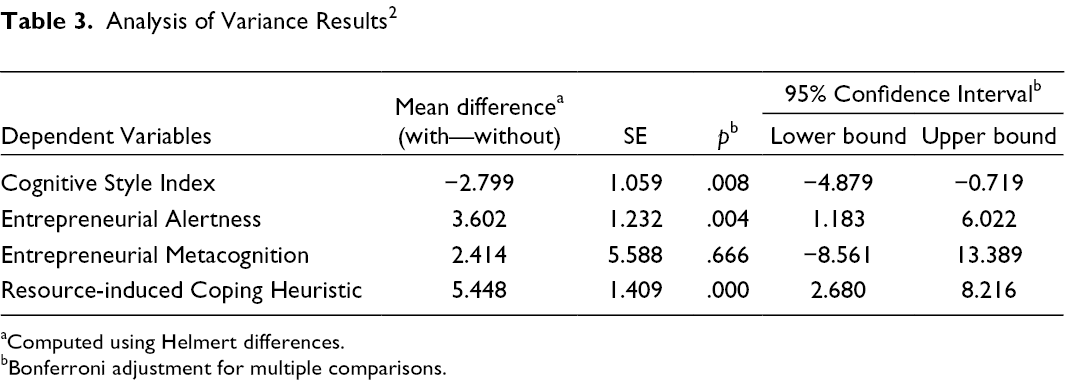
Hypothesis 1 (H1) proposed entrepreneurs with ADHD would have a more intuitive-type cognitive style than those without ADHD. Results (Table 2) indicate that differences in cognitive style between entrepreneurs with ADHD are significantly different (F = 6.83, p = .008). In support of H1, our results (Table 3) further indicate a more intuitive-type cognitive style for entrepreneurs with ADHD compared to those without the condition (β = −2.80, p = .007), since lower values on the cognitive style index indicate a more intuitive cognitive style.
Analysis of Variance Results 2
aComputed using Helmert differences.
bBonferroni adjustment for multiple comparisons.
Hypothesis 2 (H2) proposed higher levels of entrepreneurial alertness for entrepreneurs with ADHD. Results (Table 2) indicate significant differences in entrepreneurial alertness for entrepreneurs with ADHD (F = 8.55, p = .004). Results (Table 3) support H2, indicating entrepreneurs with ADHD demonstrated significantly higher levels of entrepreneurial alertness (β = 3.60, p = .004).
Hypotheses 3 (H3) proposed lower levels of entrepreneurial metacognition for entrepreneurs with ADHD. The MANOVA results presented in Table 2 (F = .187, p = .555) and ANOVA results presented in Table 3 (β = 2.44, p = .666) suggest no significant differences in entrepreneurial metacognition for entrepreneurs with ADHD compared to those without the condition. Our findings did not support H3.
Hypothesis 4 (H4) proposed higher levels of the RICH for entrepreneurs with ADHD. Table 2 displays significant differences in RICH for entrepreneurs with ADHD (F = 14.94, p ~ .000). In support of H4, the results (Table 3) indicate entrepreneurs with ADHD demonstrated significantly higher levels of RICH (β = 5.45, p ~ .000).
Robustness Tests and Post Hoc Analyses
As a robustness test, we performed the same set of MANOVAs and ANOVAs as in our hypotheses tests, but supplemented our control variables with additional industry controls (1-digit SIC codes). This analysis indicated no significant differences across industry classifications in our entrepreneurial cognition variables (Pillai’s criterion = 0.085, F = 1.167, p = .219), and demonstrated the same pattern of results as those reported in our hypotheses tests.
We also performed additional MANOVAs and ANOVAs, using the same models as our hypothesis tests, on the three dependent variables that were multidimensional (i.e., entrepreneurial alertness, metacognition, and RICH). The MANOVA analysis indicated significant multivariate differences for entrepreneurs with ADHD on all three dependent variables. The subsequent ANOVAs provided further insights into variation of the cognition constructs across their subdimensions. The ANOVA results for entrepreneurial alertness indicated entrepreneurs with ADHD were significantly higher on the three entrepreneurial alertness subdimensions proposed by Tang et al. (2012) of scanning & search (β = 1.27.44, p = .041), association & connection (β = 1.52, p ~ .000), and evaluation & judgment (β = 1.16, p = .015). Similar results were found for RICH, indicating entrepreneurs with ADHD were significantly higher on the three subdimensions proposed by Lanivich (2015) of resource acquisition (β = 2.14, p ~ .000), protection (β = 2.01, p = .001), and development (β = 1.85, p = .004). Haynie and Shepherd (2009) proposed five subdimensions of metacognition, which include goal orientation, metacognitive knowledge, metacognitive experience, metacognitive choice, and monitoring. The results of the ANOVA indicated entrepreneurs with ADHD were not significantly different on the goal orientation, metacognitive experience, or metacognitive choice subdimensions. However, the ANOVA results indicated entrepreneurs with ADHD were significantly higher on metacognitive knowledge (β = 3.55, p = .047) and monitoring (β = 2.96, p = .015). More extensive research should be done on the individual dimensions of metacognition.
Discussion
Scholars are striving to understand more about how entrepreneurs think (Baucus et al., 2014; Haynie et al., 2010; Randolph-Seng et al., 2014). Yet, entrepreneurial cognition research has overlooked recent scholarly efforts to better understand how neurobiological differences (Becker et al., 2011; Nicolaou & Shane, 2014) relate to entrepreneurial thinking and decision making (McMullen et al., 2014; Nofal et al., 2017). In this study, we explicitly challenged prior research in entrepreneurship that examines relationships between ADHD and entrepreneurial phenomena based on a conceptualization of the disorder in terms of its behavioral symptoms (i.e., inattention and hyperactivity-impulsivity). The behavioral approach was found inconsistent with the current paradigm dominant in psychiatry, neurology, and psychology where ADHD is conceptualized in terms of cognition. In other words, ADHD is now considered by many studying the pathology to be a neurocognitive, rather than behavioral, disorder (Barkley, 2011; Brown, 2013; Roebers, 2017). Thus, we sought to problematize extant research by challenging its behavioral assumptions based on the approaches suggested by Alvesson and Sandberg (2011). From a cognitive approach, we endeavored to better understand how entrepreneurs’ neurodiversity (i.e., brain-related, biological differences) affects entrepreneurial cognitions, including the relationships between ADHD and four important aspects of entrepreneurial mindset (cognitive style, entrepreneurial alertness, entrepreneurial metacognition, and the resource-induced coping heuristic).
For entrepreneurs with ADHD, we found that they display more intuitive cognitive styles and higher levels of entrepreneurial alertness and stronger RICH than neurotypical entrepreneurs. Our work adds to a growing body of research regarding how entrepreneurs think and contribute to evidence for an entrepreneurial cognition theory (Mitchell et al., 2002). As noted by Kickul et al. (2009), individuals with an intuitive cognitive style are more attuned to scanning and searching for information, and they are more confident in their ability to identify and recognize entrepreneurial opportunities. This finding coincides with recent research regarding the impulsive behavioral tendencies of entrepreneurs with ADHD (e.g., Wiklund et al., 2017). While we cannot yet make causal assertions regarding these parallel findings, we suggest that they go hand in hand.
Impulsivity reflects deficits in executive functions that inhibit automatic responses to environmental stimuli and decisions involving longer-term rewards. Consequently, individuals with ADHD select existing schema rather than constructing new schema. In entrepreneurial cognition research, this schema selection process is viewed in terms of entrepreneurs’ heuristical or scripted knowledge structures that enable quick responses in uncertain environments that result in satisficing (i.e., satisfy and suffice) rewards. From this perspective, impulsive selection of existing action schema enable decision-making and action when stimuli-reward contingencies are unknown, suggesting a more intuitive cognitive style is effective under conditions of uncertainty. Alternatively, intuitive cognitive style may be a product of behavioral conditioning in those with ADHD, since intuition is not dependent upon executive functions. When thought of in the context of an ADHD pathology, and considering the neurological paradigm dominant in ADHD literature, the biological/chemical reaction in the brain may force impulsive behavior that eventually conditions the mindset of individuals with ADHD to consider their intuition as the go-to platform for behavioral decisions. Future studies should focus on determining the causal positioning of these phenomena.
Relatedly, entrepreneurs with ADHD demonstrated significantly higher levels of entrepreneurial alertness, a mental schema conducive to opportunity identification (Gaglio & Katz, 2001; Tang et al., 2012), than those without ADHD. We suggest our finding stem from a biological need to avoid delay that manifests in impulsive or hyperactive behaviors by individuals with ADHD. For entrepreneurs, finding opportunities is imperative for progressing in an entrepreneurial process. We believe the ADHD pathology creates a biological need to avoid stagnation, which logically translates, in the entrepreneurship context, to a heightened need for progressing their venture. To do so, entrepreneurs with ADHD develop strong alertness schema that can help them find ways to keep their business moving. While these finding may be considered, generally, as an advantage for entrepreneurs with ADHD, especially considering the importance of opportunities to the entrepreneurial process (Alvarez et al., 2013), future research should investigate the possibility of ADHD leading to over-alertness. In other words, entrepreneurs with ADHD may find they are always looking for new opportunities because they are biologically programmed to do so, but that this tendency interferes with their ability to focus on any one opportunity long enough to bring it to fruition. On the other hand, since recent research has shown that ADHD can manifest as intense focus on issues of interest, perhaps heightened alertness will help entrepreneurs with ADHD find the opportunity that sparks interest and focus. Either way, this area is ripe for further study.
Heightened alertness, combined with an intuitive cognitive style, provides myriad advantages for entrepreneurs with ADHD. As a function of the entrepreneurial process, both intuitive cognitive style and alertness can increase the ability to act entrepreneurially in the first place because of an increased potential for recognizing ideas that could lead to new ventures (Gaglio & Katz, 2001; Vogel, 2017). Furthermore, cognitive style (as a foundation for scanning the environment) along with alertness (as a set of skills for scanning the environment, associating resources, and evaluating potential venture ideas in the market) can help entrepreneurs identify opportunities for sustaining, growing, and refining their current business venture and competitive advantages. Given that we found entrepreneurs with ADHD reported a higher level of alertness than non-ADHD entrepreneurs, we suspect this may be one reason for the nontrivial proportion of people with ADHD becoming entrepreneurs. Given the number of entrepreneurs who have ADHD, ignoring entrepreneurs’ neurobiological differences can negatively impact entrepreneurship research because scholars could forego important understanding of how this population of entrepreneurs think about and, ultimately, learn from their experiences (e.g., Mitchell et al., 2007).
Relatedly, the RICH acts as a cognitive buffer for the worry of resource loss, which can suppress strain associated with potential losses and resource uncertainty faced by entrepreneurs (Lanivich, 2015). We found that entrepreneurs with ADHD reported higher RICH than non-ADHD entrepreneurs, which means that entrepreneurs with ADHD will be more active in acquiring resources, protecting their resources, and developing the resources they possess. This suggests increased potential for a stockpile of resources that includes what the entrepreneur might need when situations of potential resource loss are encountered. In this way, the entrepreneur with ADHD is better prepared to cope with the uncertainty that accompanies entrepreneurship.
This finding was further supported by the post-hoc MANOVA analysis which indicated that entrepreneurs with ADHD were significantly higher on all three subdimensions: acquisition, protection, and development of resources. This is important to note because resources are critical to the entrepreneurial process. In consideration of the ADHD pathology in entrepreneurial contexts, lacking resources can create situations where delay is inevitable. Coupled with our other results and previous studies regarding the impulsive tendencies of entrepreneurs with ADHD, delays regarding resources could deter venture progression. While acquiring resources is likely a positive aspect of an entrepreneurial mindset that aids in the progress of ventures in most situations, protecting and developing resources could be a drag on the forward progress of a business should unneeded resources be impulsively protected or developed. Future studies should investigate the subdimensions of the RICH to better understand the effects of resource conservation on venture progress, especially for neurodiverse entrepreneurs.
Only Hypotheses four was not supported, which suggested that entrepreneurs with ADHD would demonstrate lower levels of entrepreneurial metacognition. In actuality, there was no significant difference in metacognition between the populations. However, the post hoc MANOVA analysis of metacognition indicated that there was a significant difference between entrepreneurs with ADHD and those without on two subdimensions of metacognition: metacognitive knowledge and monitoring. As noted earlier, ADHD symptoms arise from genetic chemical distribution differences in the prefrontal cortex. An emerging stream of research utilizing magnetic resonance imaging (MRI) technology indicates that the neural system of metacognition also activates the prefrontal cortex (Schmitz et al., 2004), especially the anterior regions including the lateral frontpolar cortex and dorsal anterior cingulate cortex (Qiu et al., 2018). It is possible that the chemical distribution differences experienced by entrepreneurs with ADHD interact with areas of the prefrontal cortex used in metacognitive activities. We did not hypothesize about the individual subdimensions, but it seems logical that entrepreneurs with ADHD who have successfully adapted to their neurodiversity, would pay more attention to things in their environment and would thus be higher in metacognitive knowledge and monitoring. Exploring these subdimensions for individuals with ADHD is a clear area for future research.
We further extend current entrepreneurship knowledge by exploring an under-researched domain: the neurobiological differences of entrepreneurs (in this case, those with ADHD) and the resulting effects on their cognitions and thinking styles. This has the potential to advance entrepreneurial cognition theory by suggesting an initial link between known neurobiological differences and entrepreneurship cognition. Since our study only provides an initial step, future research should expound upon the boundaries of biological mechanisms to explain further entrepreneurship phenomena believed to develop in the brain. For example, the RICH has been shown to affect important outcomes relating to entrepreneurial success (Lanivich, 2015), yet how the coping mechanism is developed cognitively may depend on brain function. Consider the chemical impulse that must occur with enough salience and/or frequency to underpin a heuristic. Our research suggests that biological mechanisms for delay aversion relate to the executive function in choosing a RICH schema. Perhaps some individuals are also biologically inclined to hoard resources, a noted, expected extreme of the RICH phenomena (Lanivich, 2015). Could neuro-diverse individuals with hoarding pathology shed light on the development of resource conservation mechanisms? Merging entrepreneurial cognition theory and theories in the neurosciences expands the nomological net and provides fertile ground for future research. Our study design was particularly helpful in clarifying and advancing knowledge of neurodiversity in the field of entrepreneurship.
Finally, the post hoc analysis provides a great deal of information and direction for future research. First, it indicated that entrepreneurs with ADHD demonstrated significantly higher levels on all three subdimensions of entrepreneurial alertness: scanning and search, association and connection, and evaluation and judgment (Tang et al., 2012). Second, it indicated that entrepreneurs with ADHD scored significantly higher on the three subdimensions of RICH: resource acquisition, protection, and development, and third, entrepreneurs with ADHD scored significantly higher on metacognitive knowledge and monitoring. While we did not hypothesize relationships on subdimensions, these findings strongly suggest that further research exploring the relationship of ADHD to these entrepreneurial constructs is needed. The picture that is painted of entrepreneurs with ADHD is certainly one that helps us understand why a nontrivial number of these individuals choose entrepreneurship and succeed as entrepreneurs.
On a more practical level, these findings may urge those with ADHD to seek out a career path in entrepreneurship. This encouragement should come from family and friends as well as from the educational system. In educational settings, we encourage teachers to acknowledge and even nurture the cognitive differences displayed by those with ADHD. Educational programs could be designed to embrace these differences as positive, career-building attributes. Vocational training to enhance the positive aspects of ADHD could spur even more interest in entrepreneurship and potentially uncover additional positive attributes of people with ADHD pathology.
Conclusion
Our research provides support for the belief that ADHD symptoms are not static and are subject to context. In the entrepreneurial context, we have linked these symptoms to entrepreneurial cognitive processes to illustrate how previously labeled negative disorders are positive outcomes of ADHD in entrepreneurship. Given the percentage of entrepreneurs with ADHD, it is critical for researchers to explore how these neurobiological differences affect the entrepreneur and the entrepreneurial process. Determining how the mind of entrepreneurs with ADHD influences entrepreneurship is an important area of research because, as many have suggested regarding the context of entrepreneurship (e.g., Baron, 1998), cognitive differences provide valuable explanations for entrepreneurship phenomena. To complement the recent investigations of ADHD-related behavioral tendencies linked to entrepreneurship (e.g., Wiklund et al., 2016) and to spur further investigation in this vital domain of entrepreneurs’ neurodiversity, our study provides an initial foray into the impact of cognitive aspects of ADHD-related cognitive variables on entrepreneurship.
Supplemental Material
Supplementary Material 1 - Supplemental material for ADHD-Related Neurodiversity and the Entrepreneurial Mindset
Supplemental material, Supplementary Material 1, for ADHD-Related Neurodiversity and the Entrepreneurial Mindset by Curt B. Moore, Nancy H. McIntyre and Stephen E. Lanivich in Entrepreneurship Theory and Practice
Footnotes
Acknowledgments
The authors would like to thank Robert Baron and Tyge Payne for their very helpful reviews of earlier versions of this paper.
Declaration of Conflicting Interests
The author(s) declared no potential conflicts of interest with respect to the research, authorship, and/or publication of this article.
Funding
The author(s) disclosed receipt of the following financial support for the research, authorship, and/or publication of this article: This study was funded by the John Chamber College of Business & Economics Coffman Chair of Entrepreneurial Studies at WVU.

Supplemental Material
Supplemental material for this article is available online.
Notes
Author Biographies
References
Supplementary Material
Please find the following supplemental material available below.
For Open Access articles published under a Creative Commons License, all supplemental material carries the same license as the article it is associated with.
For non-Open Access articles published, all supplemental material carries a non-exclusive license, and permission requests for re-use of supplemental material or any part of supplemental material shall be sent directly to the copyright owner as specified in the copyright notice associated with the article.
