



Abstract
Recently, scholars have started to investigate the relationship between ADHD (Attention Deficit Hyperactivity Disorder) symptoms and entrepreneurship, finding that ADHD symptoms positively impact entrepreneurial intention and action. However, the performance implications of ADHD symptoms are still unknown. Using two samples of entrepreneurs from the United States and Spain, we find evidence that impulsive and hyperactive symptoms of ADHD are largely conducive to firm performance through entrepreneurial orientation (EO) while inattention symptoms are not. This suggests that the performance advantages of entrepreneurs ADHD symptoms can be derived from greater focus on innovation, proactiveness, and risk-taking. We discuss the implications of our findings for the entrepreneurship literature.
There is increasing interest in the relationship between attention deficit hyperactive disorder (ADHD) symptoms and entrepreneurship. Initial research has suggested that entrepreneurship is attractive to people with ADHD symptoms, resulting in higher entrepreneurial intention and action among these individuals (Lerner et al., 2019; Verheul et al., 2015, 2016; Wiklund et al., 2017), and that ADHD symptoms are related to higher entrepreneurial orientation (EO) among small business owners (Thurik et al., 2016). In addition, there are conceptual arguments suggesting that ADHD symptoms may resonate with the entrepreneurial role and tasks (Wiklund et al., 2016). However, the link between ADHD symptoms and firm performance has received scant attention. Exploring this association bears important theoretical and practical implications as it indicates whether ADHD, a trait with strong negative implications across many walks of life, can actually be functional in the entrepreneurship context (Antshel, 2018).
In this article, we integrate insights from strategic leadership (e.g., Finkelstein et al., 2009), EO (e.g., Lumpkin & Dess, 1996), and clinical psychology (e.g., Barkley, 1997) literatures to develop a conceptual model of how entrepreneurs’ ADHD symptoms can influence firm performance. Specifically, our model suggests that entrepreneurs’ hyperactivity/impulsivity symptoms are positively aligned with the three dimensions of EO (innovativeness, proactiveness, and risk-taking), thus influencing the strategic orientation of EO and then translating into firm performance (e.g., see Finkelstein et al., 2009; Hambrick & Mason, 1984). However, we suggest that inattention symptoms are not likely to lead to such relationships.
We conducted two complementary studies to test our hypotheses. The first study was cross-sectional, was conducted online, relied on single informants, and targeted entrepreneurs from a wide variety of industries. The second study was longitudinal (time lag between the independent variable and the dependent variable), used a paper-and-pencil questionnaire, included secondary data for the dependent variable, and covered only entrepreneurs operating in the Spanish wine industry. Thus, the two studies differ in many important respects, helping establish the robustness and generalizability of our results. We find statistically significant support (p < .05) for the relationship between entrepreneurs’ hyperactivity/impulsivity symptoms, EO and firm performance in Study 1 and statistically marginal support (p < .1) for this relationship in Study 2.
This article stands to make two major contributions. First, a growing number of studies have started to examine mental outliers in entrepreneurship in general (e.g., Stephan & Roesler, 2010; Wiklund et al., 2018b) and ADHD symptoms specifically (e.g., Lerner et al., 2019, Lerner et al., 2018a; Thurik et al., 2016; Verheul et al., 2015, 2016; Wiklund et al., 2016, 2017). However, to date, this research has focused on preferences (Verheul et al., 2015; Wiklund et al., 2017), attitudes (Lerner, 2016), and entry into self-employment (Verheul et al., 2016; Wiklund et al., 2017) but has not addressed whether and how these symptoms could be related to objective firm outcomes or, taking a step further, whether different ADHD symptoms are more or less functional. Examining the performance implications of ADHD symptoms is important to move this research forward. Also, our research has direct practical implications in terms of recommendations to those with ADHD symptoms and their loved ones and to society more broadly. Does entrepreneurship appear to be a wise career choice for somebody exhibiting extensive ADHD symptoms? If the answer is yes, entrepreneurship could be a way for those individuals to effectively use their talents, thus contributing to value creation in society and to personal well-being (Lasky et al., 2016). Of interest to the wider entrepreneurship field, our research helps establish that entrepreneurship is a unique context in need of its own unique theories because relationships established elsewhere do not hold up in this context.
We also contribute to the EO literature. We argue and find that entrepreneurs’ hyperactive and impulsive symptoms are positively related to EO. Both hyperactivity and impulsivity are action-related concepts. Therefore, an action-oriented logic that focuses on experimentation and action speed may be an important precursor to EO, contributing to the literature on the determinants of EO (Wiklund et al., 2009). While anxiety and procrastination can be normal reactions under uncertainty (McMullen & Shepherd, 2006), individuals who favor decision speed over accuracy may skip deliberation and quickly engage in proactive risk-taking actions to grasp opportunities, which in turn lead to better performance in uncertain environments.
Theoretical Framework
ADHD and Entrepreneurship
It is important to distinguish between reporting ADHD symptoms and having an ADHD diagnosis. In this article, we follow previous entrepreneurship research (e.g., Verheul et al., 2015; Wiklund et al., 2017) and focus on the degree of ADHD symptoms reported rather than the ADHD diagnosis. This approach has several advantages. First, many who would qualify for an ADHD diagnosis never receive one, and there is great variance across countries and socioeconomic status in terms of access to adequate diagnostic resources (Wasserstein, 2005). Thus, a focus on the diagnosis would likely miss many with severe symptoms and do so in a nonrandom fashion. Second, many individuals who received a diagnosis at childhood could be in remission as adults and no longer display the symptoms. In fact, until recently, it was a common belief that ADHD symptoms disappeared as people matured (Biederman et al., 2000). Third, most people with an ADHD diagnosis medicate, and many pursue other therapies, which alleviates many of the ADHD symptoms (Halmøy et al., 2009). Again, there is great variance across countries and socioeconomic status in terms of access. Fourth, the diagnosis is a binary yes/no variable although the underlying symptoms leading to the diagnosis represent a continuous variable (Levy et al., 1997). There is a long debate in research about whether to adopt a categorical or a dimensional view on mental disorders including ADHD (e.g., Barkley, 2014; Kessler, 2002). Scholars suggest that using ADHD symptoms may capture the underlying continuous nature of ADHD more accurately (Barkley, 2014). A focus on the symptoms allows for studying the influence of the full range of symptoms, and even consideration of potential nonlinearity. Finally, to qualify for an adult ADHD diagnosis, the ADHD symptoms have to interfere with or reduce the quality of occupational functioning (American Psychiatric Association, 2013). As we are interested in performance implications of ADHD, a focus on the diagnosis would bias results because poor occupational functioning influences performance negatively by definition.
ADHD consists of two clusters of symptoms that do not necessarily covary: inattention and hyperactivity/impulsivity (see e.g., American Psychiatric Association, 2013). The Adult ADHD Self-Report Scale (ASRS) for screening ADHD symptoms forms two separate latent factors along these dimensions (Hesse, 2013). Inattention reflects problems of sustained attention and distraction. Hyperactivity/impulsivity involves having excessive energy levels, easily getting emotionally excited, having problems sitting still, and exhibiting behavioral disinhibition—that is, acting without thinking about consequences. ADHD symptoms are stable and persistent through adult life, reflecting deeply seated individual differences (Guldberg-Kjär et al., 2013).
While ADHD generally has negative implications in the labor market, such negative implications may not materialize within entrepreneurship (see e.g., Antshel, 2018 for detailed discussion). This is because entrepreneurship represents a unique environment characterized by high uncertainty and autonomy. When uncertainly is high, extensive collection of historical information, careful analysis, and an action logic based on consequences (March & Olsen, 2006) are less feasible because planning is of limited value and the past provides limited insights into the future. People high on ADHD symptoms have a bias toward rapid action without much deliberation. This seems to be well adapted to the entrepreneurship context. Moreover, entrepreneurship offers autonomy. It allows people to design their own work tasks to capitalize on their strengths while alleviating many of the consequences of their weaknesses. This is likely of particular value for those individuals who are outliers relative to any statistical average, such as those with severe ADHD symptoms, simply because employers tend to design jobs for more average people (see Wiklund et al., 2018).
Consistent with this logic that ADHD symptoms fit the entrepreneurial context, previous research has found a positive relationship between ADHD symptoms and entrepreneurial intentions (Verheul et al., 2015) and action (Verheul et al., 2016; Wiklund et al., 2017). Studies separating the two clusters of symptoms (inattention vs. hyperactivity/impulsivity) tend to find that it is hyperactivity/impulsivity rather than inattention that positively relates to entrepreneurship (i.e., Wiklund et al., 2017 and Verheul et al., 2016). Beyond this, the mechanisms through which ADHD symptoms relate to entrepreneurship are still unknown and open for debate. In this article, we build on strategic leadership theory (Finkelstein et al., 2009) to suggest that entrepreneurs enact their ADHD symptoms through the strategic orientation of the firms they lead. This view is consistent with prior theorizing linking stable personality characteristics to organizational outcomes (Hambrick, 2007).
Strategic Leadership Theory
Strategic leadership theory (SLT; see Finkelstein et al., 2009) originates in the upper echelons perspective (Hambrick & Mason, 1984) and suggests that an organization reflects its top executives (e.g., CEO). It highlights the importance of executives’ characteristics for the organization’s strategy and performance. Based on SLT, there is extensive empirical evidence of the link between top executive’s personal traits, firm strategy and firm performance (e.g., Nadkarni & Herrmann, 2010; Resick et al., 2009; Wales et al., 2013). Like us, prior studies applying SLT have studied how negative traits associated with mental disorders relate to the strategic orientations of the firms they lead, and to subsequent firm-level performance outcomes. Of particular relevance, scholars have examined narcissistic personality traits of entrepreneurs and CEOs (Chatterjee & Hambrick, 2007; Wales et al., 2013). It is worth noticing that by relating the traits of the CEO to the strategic orientation and the performance of the firm, studies applying SLT connect different levels of analysis, that is, they relate individual-level antecedents to firm-level outcomes. This is common practice in strategy research more broadly, for example, in studies utilizing the related upper echelon perspective (see Hambrick & Mason, 1984) and in entrepreneurship research more generally, which commonly relates individual-level variables such as the human capital of the entrepreneur to firm-level outcomes, such as performance (see the extensive review of dependent variables in entrepreneurship research by Shepherd et al., 2019).
In an entrepreneurial organization, the entrepreneur is the most important individual, having a disproportional influence on firm strategy and outcomes (Miller, 1983). Specifically, according to SLT, the entrepreneur’s psychological characteristics could influence the strategic orientation of the firm through the three-stage process of filtering information: field of vision, selective perception, and interpretation (Hambrick & Mason, 1984). Field of vision represents where the entrepreneur looks for information (i.e., which information sources he or she consults). Selective perception means that an entrepreneur can “selectively perceive only a portion of the stimuli within his or her field of vision.” (Finkelstein et al., 2009, p. 47). Finally, interpretation means that different entrepreneurs attach different meanings to stimuli. Because entrepreneurs’ psychological characteristics influence their scanning, selection, and interpretation of information, there is a direct link between their psychological characteristics and the strategic orientation of the firms they operate (Finkelstein et al., 2009). Further, meta-analytical evidence suggests that entrepreneurs’ personality dimensions (e.g., conscientiousness, need for achievement, and self-efficacy) subsequently translate into performance (Rauch & Frese, 2007; Seibert & Lumpkin, 2010).
Hypothesis Development: Linking ADHD Symptoms to Performance via EO
EO reflects “a firm’s strategic orientation, capturing specific entrepreneurial aspects of decision-making styles, methods, and practices” (Wiklund, 1998, emphasis added: 1308). Miller (1983, p. 771) summarized EO as the characteristics of an entrepreneurial firm that “engages in product-market innovation, undertakes somewhat risky ventures, and is first to come up with ‘proactive’ innovations, beating competitors to the punch.” As such, EO is an umbrella term that represents the entrepreneurial nature of a firm’s strategic choices.
There are three inter-related dimensions of EO: innovativeness, proactiveness, and risk-taking (e.g., Miller, 1983). Innovativeness reflects the firm’s tendency to focus on supporting new ideas and experimenting with new products/services. Proactiveness refers to the firm’s forward-looking posture as it tries to act on future demands and establish first-mover advantage. Risk-taking reflects the firm’s willingness to commit large amounts of resources to uncertain territories with the potential of large loss and failure. There is extensive debate in the previous literature regarding the dimensionality of EO, including whether EO should be treated as a reflective or a formative concept (see Covin & Wales, 2019; George & Marino, 2011). In this article, we take the position of EO as originally proposed by Miller (1983) and Covin & Slevin, 1988, which suggests that EO reflects an overall strategic posture of the firm manifested in several strategic actions. This conceptualization is consistent with our theoretical model (e.g., also see George & Marino, 2011).
EO is likely the most researched concept in the entrepreneurship literature, and its positive influence on performance has been established in hundreds of studies across different countries and types of firms (e.g., see Rauch et al., 2009 for meta-analytical evidence). Moreover, with its emphasis on rapid action under uncertainty and innovation, EO resonates with the symptoms of ADHD (see Wiklund et al., 2017). Finally, prior studies have established positive relationships between ADHD symptoms and EO (Thurik et al., 2016). As such, EO represents an ideal strategic orientation for linking entrepreneurs’ ADHD symptoms to firm performance.
Inattention Symptoms and EO
As noted above, the symptoms of ADHD—inattention and hyperactivity/impulsivity—are not always highly correlated, which likely also applies to their respective relationship with EO and performance. In particular, the relationship between entrepreneurs’ inattention symptoms and EO are likely tenuous and complex, making directional prediction difficult. On the one hand, individuals high on inattention symptoms are cognitively disinhibited, meaning they are easily disrupted by new information and have difficulty disregarding what is irrelevant for the task at hand (e.g., Barkley, 1997). This disinhibition may increase divergent-thinking abilities, which can translate into creativity (White & Shah, 2006), hence more novel ideas. On the other hand, however, inattention reduces convergent thinking, which is essential in completing the innovation process (White & Shah, 2006). Thus, on balance, inattention may lead to the generation of more ideas but not necessarily the implementation of more innovations.
More generally, inattention is related to various outcomes in different ways than hyperactivity/impulsivity, sometimes even in the opposite direction. For example, while hyperactivity/impulsivity is related to risky choices in different games, inattention is not (Drechsler et al., 2008), and while hyperactivity/impulsivity increases decision speed, inattention reduces it (Nigg et al., 2005). Inattention may also be related to low vigilance and alertness and “sluggish cognitive tempo” (McBurnett et al., 2001). Specific to the entrepreneurial context, no relationship has been found between inattention and either entrepreneurial intention (Wiklund et al., 2017) or business start-up (Verheul et al., 2016; Wiklund et al., 2017), while they both relate to hyperactivity/impulsivity.
Hyperactivity/Impulsivity Symptoms and EO
Hyperactivity/impulsivity symptoms are related to quick action without much deliberation (Barkley, 1997), sensation seeking (Miller et al., 2003), and proneness to boredom (Whiteside & Lynam, 2001). Conceptually, these symptoms resonate with the three dimensions of EO. For example, sensation seeking is associated with the risk-taking dimension; the inability to wait is associated with proactiveness, and being easily bored is associated with innovation.
Building on the three-stage filtering process of SLT, we outline how hyperactivity/impulsivity symptoms are likely to influence entrepreneurs’ field of vision, selective perception, and/or interpretation of information, which then predispose entrepreneurs to adopt entrepreneurially oriented strategies of innovation, proactiveness, and risk-taking.
First, individuals high on hyperactivity/impulsivity symptoms get bored easily and need new sensations and stimulations (Barkley, 1997). This characteristic can be reflected in their lack of perseverance with boring tasks once the challenging part is done. Further, sensation seeking is an important aspect of hyperactivity/impulsivity (Wiklund et al., 2017), and previous research has found that sensation seeking is related to openness to new experiences and readiness to change (Aluja et al., 2003). Nigg et al. (2005) also found that hyperactivity/impulsivity symptoms are related to faster output speed that reflects alertness and response readiness. In short, these findings suggest that hyperactivity/impulsivity may be associated with a broad field of vision that is future and opportunity oriented, an important part of EO (Rauch et al., 2009).
Second, we also suggest that hyperactivity/impulsivity symptoms prompt entrepreneurs to selectively perceive new, innovative, and risky opportunities as more salient. Research has shown that individuals with ADHD are better able to sustain their attention when they face attractive tasks (e.g., van der Meere et al., 1991). Due to the connection between hyperactivity/impulsivity and sensation seeking (Wiklund et al., 2017), we expect that such attractive tasks are novel and innovative in nature, which means that individuals with extensive hyperactivity/impulsivity symptoms would pay more attention to novel and innovative opportunities. Indeed, much research has also found that individuals with ADHD, especially those with hyperactivity/impulsivity symptoms, are hypersensitive to rewards—inherent in innovation and risk—due to imbalances in the brain’s reward pathway (e.g., see Luman et al., 2005 for review). Relatedly, emerging research on ADHD and entrepreneurship suggests that hyperactivity/impulsivity is linked to the behavioral approach system being sensitive to rewards (Lerner et al., 2018b). Moreover, it is well established that hyperactivity/impulsivity is related to delay aversion (Sonuga-Barke et al., 1992), and “having a delay-averse motivational style may encourage young adults with ADHD to gravitate toward stimulating, intrinsically interesting, and novel tasks being performed in a busy and fast-paced environment” (Antshel, 2018, p. 246).
Third, hyperactivity/impulsivity symptoms could be related to a different interpretation of risk-related information. Generally, individuals with ADHD show a stronger sensitivity to potential rewards and less regard for potential losses in risky decision-making. Recent research by Shoham et al. (2016) found that ADHD in adults is related not to risk perceptions but to an exaggerated view of potential benefits in risky situations. Similarly, Matthies et al. (2012) argued and found that adults with ADHD have similar intellectual capacity as non-ADHD individuals but are more attracted by rewards and are willing to bear potential losses for the sake of pleasure. Impulsivity has also been found to be related to a lower appraisal of threats and risks (Franken et al., 1992). Taken together, we expect entrepreneurs with higher hyperactivity/impulsivity symptoms to interpret risky and novel situations as less threatening and more attractive.
In short, because of the broad field of vision toward the future, the sensitivity of attention to novelty and action, and the favorable interpretation of risk and innovation they induce, hyperactivity/impulsivity symptoms of entrepreneurs with ADHD are likely to increase the adoption of entrepreneurially oriented strategies. Thus, we hypothesize the following:
EO and Firm Performance
The relationship between EO and firm performance has been extensively examined. Whereas there are certainly contingencies (Wiklund & Shepherd, 2005), a meta-analysis showed that EO has positive implications for firm performance and such effect “can be regarded as moderately large” (Rauch et al., 2009). This positive association stems from the fact that shortening product and business model life cycles makes relying on existing routines and strategies less profitable, while being innovative, proactive, and risk-taking could help establish first-mover advantages and generate above-average returns (Wiklund, 1998). More specifically, each dimension of EO has been found to have positive effect on firm performance. Innovation generates opportunities for extra economic rents compared to competitors (Schumpeter, 1934); Proactiveness provides first-mover opportunity enabling the firm to occupy market space and charge premium price (Zahra & Covin, 1995); Risk-taking may cause higher performance variance but leads to performance advantage in the longer term (Wiklund & Shepherd, 2005). Therefore, we propose the following:
ADHD Symptoms, EO, and Firm Performance
Consistent with our conceptual model, we suggest that the ADHD hyperactivity/impulsivity symptoms of the entrepreneur first influence EO and then transmit into firm performance. Note that this says nothing about other possible relationships between the constructs. For example, it is plausible that there could be multiple other pathways linking the hyperactivity/impulsivity symptoms of ADHD to firm performance (see e.g., Lerner et al., 2018a for a framework detailing the positive and negative influences of ADHD symptoms during different stages of entrepreneurship, or Wiklund et al., 2018 linking impulsivity to positive and negative entrepreneurial outcomes). Likewise, EO is likely influenced by a multitude of other aspects of the entrepreneurs’ personality (see e.g., Miller, 1983 for an example of variables). Our conceptually parsimonious model focuses solely on the one positive pathway from hyperactivity/impulsivity to firm performance through EO. This does not preclude the possibility of other positive and/or negative pathways, as we discuss later. On the basis of this, we hypothesize the following:
Figure 1 outlines our conceptual model. It suggests that ADHD hyperactivity/impulsivity symptoms of the entrepreneur positively influence the EO of the firm. In turn, EO has a positive influence on firm performance.

Conceptual model.
Methods
We test our hypotheses on two distinctly different samples, each with a different research design and with different measures. This approach responds to calls in entrepreneurship (Van Witteloostuijn et al., 2018), and management more generally (Bettis et al., 2016), to replicate studies and to provide greater robustness to research findings. Each study has distinct strengths and weaknesses. Study 1 is cross-sectional, relies on single informants, and uses self-perceived measures for the independent and dependent variables. This design leads to obvious shortcomings such as common method bias (e.g., Podsakoff et al., 2003). These shortcomings are overcome in Study 2, which uses a time lag between the collection of the independent and dependent variables and takes information for the dependent variable from official records. On the other hand, the sample for Study 2 is far smaller, leading to potential issues with statistical power. The two studies’ sampling frames are also vastly different, with Study 1 broadly sampling entrepreneurs across industries and countries and Study 2 sampling a single industry in a single country. Finally, the measurement scales used for the most critical independent and dependent variables differ between Study 1 and Study 2. With the differences across these studies, the overall research design corresponds to quasi-replication (Bettis et al., 2016), or replication with extension (Hubbard et al., 1998). Such replication is essential for testing the robustness and generalizability of results (Bettis et al., 2016). The fact that the hypotheses are supported by both studies suggests that they have great generality and robustness. 1
Study 1: Research Design and Sample
The first study collected online survey data from Young Presidents’ Organization (YPO). To become a member of YPO, individuals need to be under the age of 45 at the time of application and hold a top position (e.g., the president, chairman, or CEO) of a qualifying corporation with at least 50 regular employees and/or sales of more than $13 million. Because we are interested in entrepreneurs, we specifically targeted YPO’s entrepreneurship chapter, which has more than 2,000 members. Members within this chapter are supposed to be individuals who have founded, inherited, or bought a firm; are in the top position of the firm; and are responsible for the strategies and performance of the business.
We distributed the survey through the confidential discussion board of the YPO Innovation and Entrepreneurship Network. We posted a thread explaining the survey and providing a link to the survey. Participation was voluntary and anonymous. The survey was open for 3 months from March to May 2016. During that period, three reminders were sent on the discussion board to promote the survey.
We received a total of 434 responses (anyone who clicked the survey link was recorded), out of which 335 respondents answered more than 50% of all questions. To make maximum use of the data, we imputed missing values if a maximum of two item values were missing for the ADHD and EO scale and if a maximum of one item was missing for the subjective performance scale (Downey & King, 1998; Roth et al., 1999). This procedure led to an imputation for 16 respondents who had skipped individual scale items and the final effective sample size of 222 respondents. Due to the nonminimal shrink of sample size from 335 to 222, we provide the detailed summaries for missing values in Table A1 and Table A2 in Appendix A. Within these 222 individuals, 93% were men, and 64% were from the United States. The average age of respondents was 47.6 years, and the average years of work experience was 24.7 years. Respondents’ firms had median sales of $20 million, and the median number of employees was 100. Further, 87% of our respondents (i.e., 193 respondents) had less than 500 employees, which indicates that most firms in our sample are small businesses according to the criteria developed by SBA (Small Business Association). In other words, entrepreneurs in our sample are likely to have a much larger influence on their businesses compared to CEOs from large corporations, in which the big size usually restricts managerial discretion (Finkelstein et al., 2009). Thus, our sample is an ideal context for applying strategic leadership theory. We compared respondents within our final sample to those who did not complete the survey and did not find any significant differences between the two groups (Table A3 in Appendix A for detailed t-test results).
Study 1: Measures
Dependent variable
As suggested by Wiklund and Shepherd (2003, 2005) and other scholars (e.g., Zahra, 1996), firm performance is multidimensional. Thus, it is beneficial to combine different aspects of firm performance. Following Wiklund and Shepherd (2005), we captured firm performance using both subjective and objective dimensions. Subjective firm performance was measured by subjective ratings of profits, sales development, cash flow, and market value compared to firms’ main competitors on a scale from 1 to 5. This performance measure has been widely used and tested in previous studies (e.g., Lumpkin & Dess, 2001; Wiklund, 1998). Specifically, comparisons to competitors show whether the firm is just following market trends or is deviating from norms, thus reflecting the firm’s competitive advantage. In addition to the subjective performance rating, we also asked respondents to report objective firm performance, including current sales and employment, as well as the corresponding figures 3 years ago. On the basis of this information, we computed the average annual growth rates for both sales and employment. We standardized both subjective and objective performance measures and added them together to form the overall firm performance measure.
Independent variables
We used the ADHD Self-Report Scale (ASRS) developed by the World Health Organization (Kessler et al., 2005) to measure ADHD symptoms. This scale contains 18 questions measuring the inattention, hyperactivity, and impulsivity symptoms typical of ADHD individuals. Specifically, the ASRS-18 scale contains nine questions that measure inattentive symptoms (e.g., “How often do you have difficulty keeping your attention when you are doing boring or repetitive work?”) and nine questions that measure hyperactivity/impulsivity symptoms (e.g., “How often do you feel overly active and compelled to do things, like you were driven by a motor?”; “How often do you have difficulty waiting for your turn in situations when turn taking is required?”). The ASRS-18 scale has demonstrated good predictive validity, test–retest reliability, and internal consistency in many countries (e.g., Adler et al., 2006; Kessler et al., 2006) and has been used in previous ADHD and entrepreneurship studies (e.g., Wiklund et al., 2017).
We used the well-established scale developed by Covin and Slevin (1989) to measure firms’ entrepreneurial orientation. This scale has been demonstrated to be a reliable measure for firm-level entrepreneurship (Wiklund, 1998) and has been used extensively by previous studies (e.g., Wiklund, 1998). The scale measures three inter-related aspects of EO: innovativeness (three items), productiveness (three items), and risk-taking (three items). We treated EO as a reflective second-order construct that in turn manifests in first-order constructs of innovativeness, proactiveness, and risk-taking. Such a formulation of EO is consistent with our theoretical argument and with Miller (1983) and Covin and Slevin (1989).
Control variables
We initially included several control variables based on the previous literature (Wales et al., 2013; Wiklund, 1998). At the individual level, we controlled for the entrepreneur’s age, gender, education level (1 = “education equal to or more than a master’s degree” and 0 = “education less than a master’s degree”), industry experience, start-up experience, and firm status (1 = “the entrepreneur started the focal firm” and 0 = “the entrepreneur bought or inherited the focal firm”). At the firm level, we controlled for firm size as measured by the number of employees and firm age. At the industry level, we controlled for the firms’ different industries to account for the different levels of competitiveness and environmental dynamism in different industries. We log transformed firm age and size to account for outlier influence. As will be shown later, in our final analytical model, we only included entrepreneurs’ age, gender, firm size, and firm age as control variables. The other controls are not significantly related to firm performance and/or EO, and including them largely reduced model fit.
Study 1: Analytical Approach
Considering the multiple constructs and pathways in our model, we used maximum likelihood structural equation modeling (SEM). Compared to modeling methods like sequential ordinary least squares (OLS) regressions, SEM has the benefits of (1) simultaneously testing construct factor structures and structural relationships; (2) taking into account measurement error; and (3) accommodating complex factor structures, such as the second-order reflective construct of EO. We followed the traditional two-step method (Anderson & Gerbing, 1988), examining the measurement model first and the structural models second. Further, due to the assumptions that SEM requires a large sample size and a multivariate normal distribution of data, we adopted bootstrapped standard errors (1,000 bootstrap samples and 95% confidence interval) for coefficients estimated in the structural model.
Study 1: Measurement Model
Before proceeding to our structural model, we checked our measurement model, including model fit and the dimensionality, reliability, and validity of each of our constructs using confirmatory factor analysis (CFA). The initial model had inadequate model fit (χ2 (318): 707.134; p < .001; χ2/DF: 2.22; CFI: 0.86; RMSEA: 0.07; SRMR: 0.07). To improve model fit, we checked modification indices, individual item loadings and cross-loadings, and the face validity of questionable items. We found that one item for the inattention construct (“How often do you have difficulty keeping your attention when you are doing repetitive work?”) and two items for the hyperactivity/impulsivity construct (“When you’re in a conversation, how often do you find yourself finishing the sentences of the people you are talking to before they can finish them themselves?”; “How often do you interrupt others when they are busy?”) had loadings less than 0.4 or cross-loaded to the other construct. Low loadings for some ASRS-18 items are not uncommon in previous literature (e.g., Caci et al., 2009; Carlucci et al., 2017). This may be because the underlying dimensions of ADHD have been under debate (see Stanton et al., 2018), and some items have ambiguous meanings that can correlate with both inattention and hyperactivity/impulsivity dimensions. Further examination of the three items’ content showed that the questions were ambiguous to some extent, meaning that the items could stem from different sources or constructs. For example, having difficulty paying attention may stem from pure mental inattention or from impatience. Thus, we made a reasonable decision to drop those three items. After the modification, we re-ran the measurement model, and model fit improved to a satisfactory level (χ2 (246): 449.30; p < .001; χ2/DF: 1.83; CFI: 0.92; RMSEA: 0.06; SRMR: 0.06).
We then checked our construct reliability and validity after obtaining the acceptable model. All constructs show satisfactory construct reliability, having composite reliability scores greater than the 0.7 benchmark (Lance et al., 2006). All constructs also show good discriminant validity as the square root of average variance extracted for each construct is greater than the inter-construct correlations (Fornell & Larcker, 1981). Table 1 shows the reliability, validity, and correlations of the constructs and variables used in this study.
Reliability, Validity, and Correlations of Constructs for Study 1.
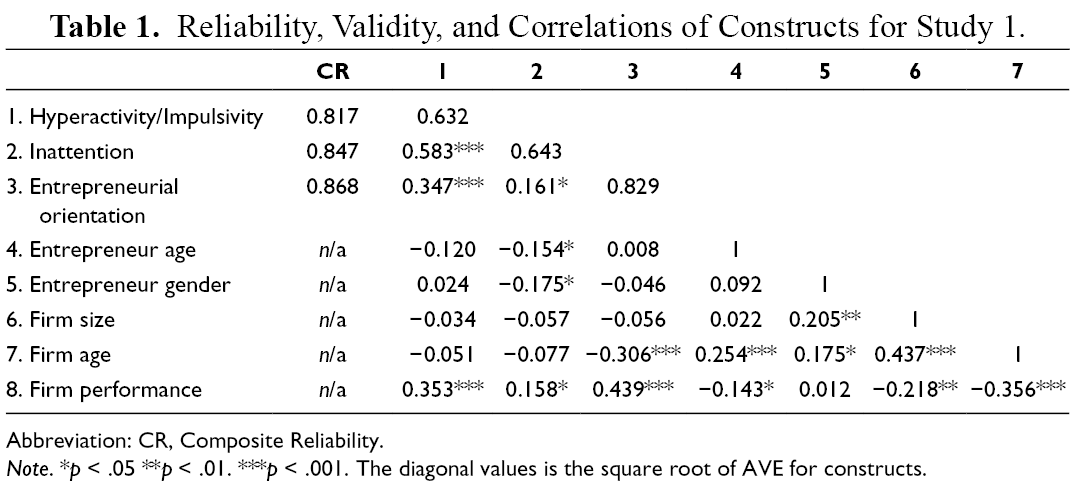
Abbreviation: CR, Composite Reliability.
Note. *p < .05 **p < .01. ***p < .001. The diagonal values is the square root of AVE for constructs.
Study 1: Structural Model and Hypothesis Tests
We proceeded to test our structural model. In addition to latent constructs, we included our dependent variable and control variables in the structural model. Following Williams et al.’s (2009) suggestion, we allowed the control variables to covary with the exogenous variables of inattention and hyperactivity/impulsivity. Further, we also included direct paths from the control variables to all endogenous variables, including EO and firm performance. In our final model, we only included entrepreneurs’ age, gender, firm size, and firm age as control variables because the other controls are not significantly related to firm performance and/or EO and also largely reduced model fit. We ran the structural model, and model fit was satisfactory (χ2 (358): 589.84; p < .001; χ2/DF: 1.65; CFI: 0.91; RMSEA: 0.05; SRMR: 0.06). 2
Table 2 shows the results of the structural model. Table 3 shows the indirect effects for inattention and hyperactivity/impulsivity. In Table 2, we can see that hyperactivity/impulsivity is positive and statistically significantly related to EO (b = .417; p = .002). Thus, Hypothesis 1, which proposed a positive relationship between hyperactivity/impulsivity and EO, is supported. In fact, the effect size for hyperactivity/impulsivity is quite large when compared to control variables in the model, indicating the significance of this characteristic. Further, EO is also positively related to firm performance (b = .409; p = .002), supporting Hypothesis 2, which stated that EO is positively related to firm performance. Table 3 shows the indirect effect using 1,000 bootstrap samples for bias-corrected bootstrap confidence intervals. Hyperactivity/impulsivity shows statistically significant indirect effect through EO on firm performance (standardized indirect effect: 0.171; p = .002), thus supporting Hypothesis 3. 3
SEM Results for Study 1.
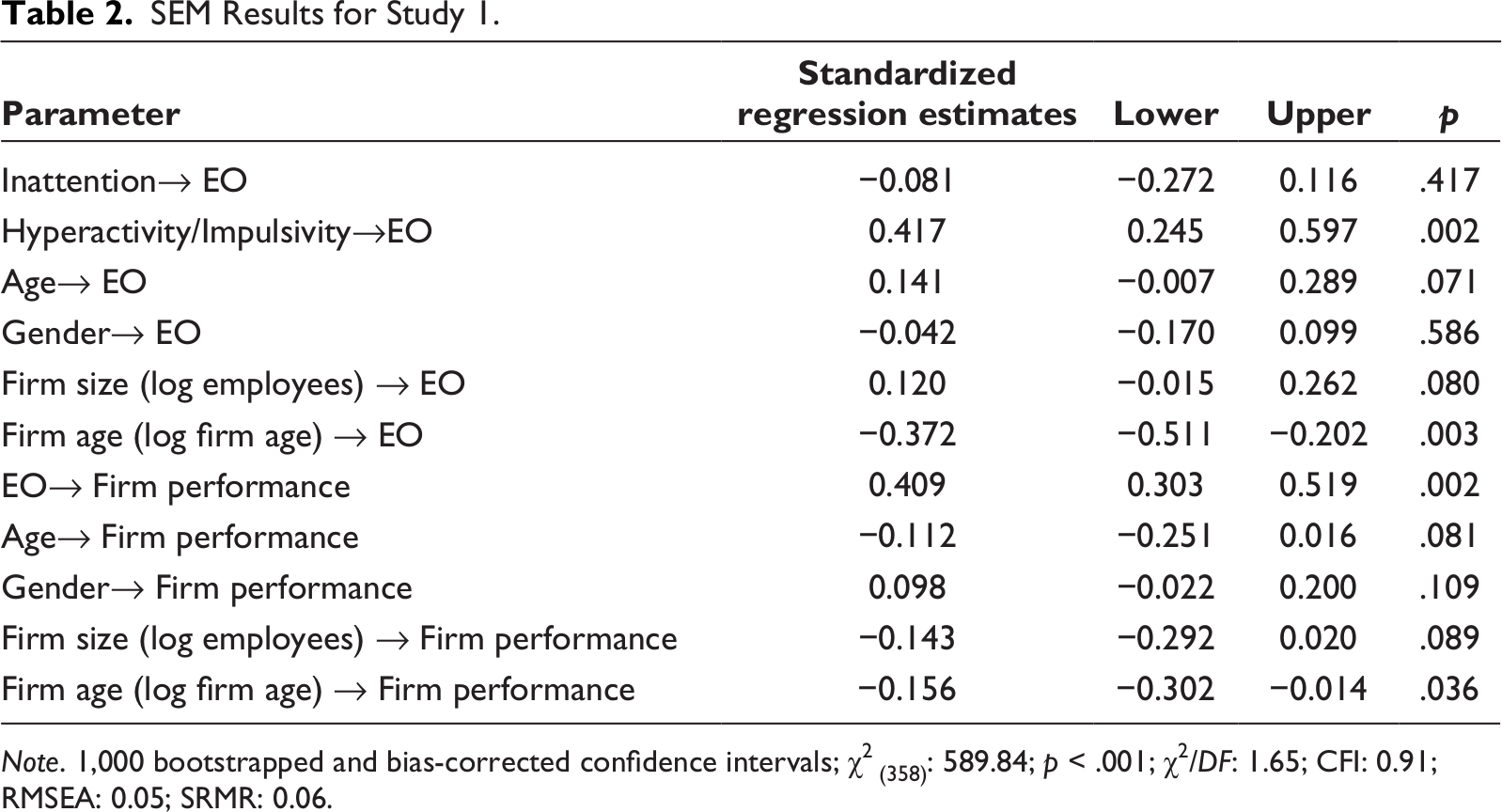
Note. 1,000 bootstrapped and bias-corrected confidence intervals; χ2 (358): 589.84; p < .001; χ2/DF: 1.65; CFI: 0.91; RMSEA: 0.05; SRMR: 0.06.
Indirect Effects for Study 1.
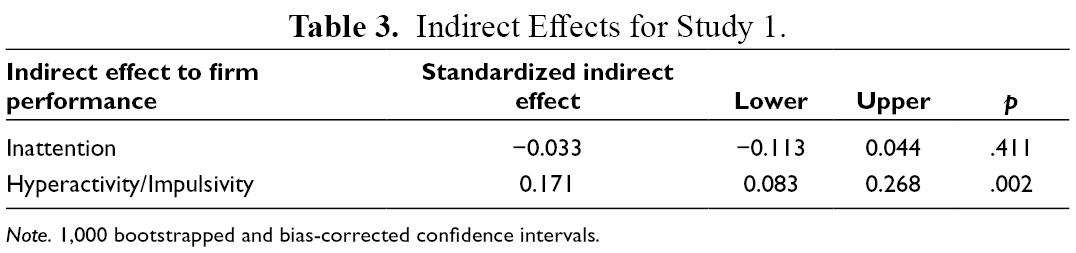
Note. 1,000 bootstrapped and bias-corrected confidence intervals.
Study 2: Research Design and Sample
Next, we tested our hypotheses using a sample of entrepreneurs in the Spanish wine industry, which is extensive by international standards (ICEX, 2014). The industry has more than 4,500 wineries and is dominated by small and medium-sized local firms (Ruiz & Riaño, 2012). To obtain the data, we used the following process. First, we used the SABI/AMADEUS 4 database to identify all Spanish wineries with annual sales above 100,000 euros. Second, in 2015, these firms were contacted by telephone to ensure they belonged to the sample frame. This process resulted in 520 responses. Out of these, 145 wineries’ representatives agreed to take part in our study. Further, to make maximum use of the data, we imputed missing values if a maximum of two item values were missing for the ADHD and EO scale and if a maximum of one item was missing for the subjective performance scale. This led to 122 useable responses for a response rate of 23%. The questionnaire was directed to each winery’s entrepreneur. Objective information about performance was obtained from the SABI/AMADEUS database, reducing the risk of common method bias. We then checked for nonresponse bias, but none was found (Table A4 in Appendix A for detailed t-test results). In the sample, 66% were men. The average age of the entrepreneurs was between 35 and 44 years, and their average industry experience was 15 years. The wineries had median sales of 1,047,000 euros, and the median number of employees was eight.
Study 2: Measures
Dependent variable
Similar to Study 1, we used both subjective and objective performance measures, but the measures were different. Following Zahra (1996), we measured subjective firm performance by asking respondents to give subjective ratings of their satisfaction with their winery’s return on investment, return on equity, sales growth, and net profit margin on a scale from 1 to 5. Satisfaction with firm performance is a sensible performance measure because financial criteria may be imperfect in assessing firm performance (Tsai et al., 1991), especially considering that not every entrepreneur wants to grow as fast as possible (Wiklund et al., 2003). We measured objective firm performance using the SABI/AMADEUS database (objective performance was not given by respondents) by calculating the latest sales growth rate, with most firms (88% or 108 firms) having sales growth rate for 2,016 and some firms (11% or 14 firms) having sales growth rate for 2,015. We standardized the subjective and objective performance measures and integrated them into the final firm performance measure. It is worth noting that we lagged our firm performance variable by 1 year compared to the independent and mediator variables, helping reduce causality concerns.
Independent variable
In Study 2, we used the short screening scale ASRS-6 to measure ADHD symptoms in order to limit survey length. This scale’s reliability and validity are similar to the 18-item ASRS scale (Kessler et al., 2005). It contains six questions measuring a person’s inattention (four items) and hyperactivity/impulsivity symptoms (two items). In terms of entrepreneurial orientation, we used the same scale as in Study 1 (Covin & Slevin, 1989). Similarly, we treated EO as a second-order reflective construct.
Control variables
The control variables we used in the second study were similar to those in Study 1. We initially controlled for the entrepreneur’s age, gender, education level, industry experience, firm size (measured as the number of employees), and firm age. Since all firms belong to the same wine industry, we did not need to control for the different industries. Similar to Study 1, we later dropped some control variables due to their nonstatistically significant relationships with firm performance and/or EO. Keeping them would have largely reduced model fit. The entrepreneur’s gender and age were included in the final model as control variables. 5
Study 2: Analytical Approach and Measurement Model
The analytical approach for Study 2 is the same as in Study 1, utilizing SEM. Our initial measurement model for Study 2 had inadequate model fit (χ2 (84): 147.01; p < .001; χ2/DF: 1.75; CFI: 0.87; RMSEA: 0.08; SRMR: 0.07). We thus checked modification indices, individual item loadings and cross-loadings, and the face validity of questionable items. We found that the first item for EO innovativeness (“In general, the top managers of my firm favor a strong emphasis on the marketing of tried and true products or services”) had a low loading (<.4) and cross-loaded with other constructs. The low loadings for some EO items are not uncommon as found by other studies (e.g., Kreiser et al., 2002). Thus, we decided to drop this one item. After the modification, we re-ran the measurement model, and model fit improved to a satisfactory level (χ2 (71): 93.15; p = .04; χ2/DF: 1.31; CFI: 0.95; RMSEA: 0.05; SRMR: 0.06).
Table 4 shows the reliability, validity, and correlations of the constructs used in this study. All constructs show good discriminant validity. Inattention and EO also have good reliability. Hyperactivity/impulsivity has relatively lower reliability largely because there are only two items for the construct. Moreover, ADHD itself is a heterogeneous latent construct and ASRS-6, when it was initially developed, intends to capture “the least redundant set of symptoms in a set in an effort to maximize prediction of an external criteria, thereby optimizing inconsistency among the items in a way that would be reflected in lower bound estimates of internal consistency” (Kessler et al., 2007, p. 6). Thus, we would not expect high Cronbach’s α. Other entrepreneurship studies on ADHD, such as Wiklund et al. (2017), also showed relatively lower reliability for the two-item hyperactivity/impulsivity construct.
Reliability, Validity, and Correlations of Constructs for Study 2.
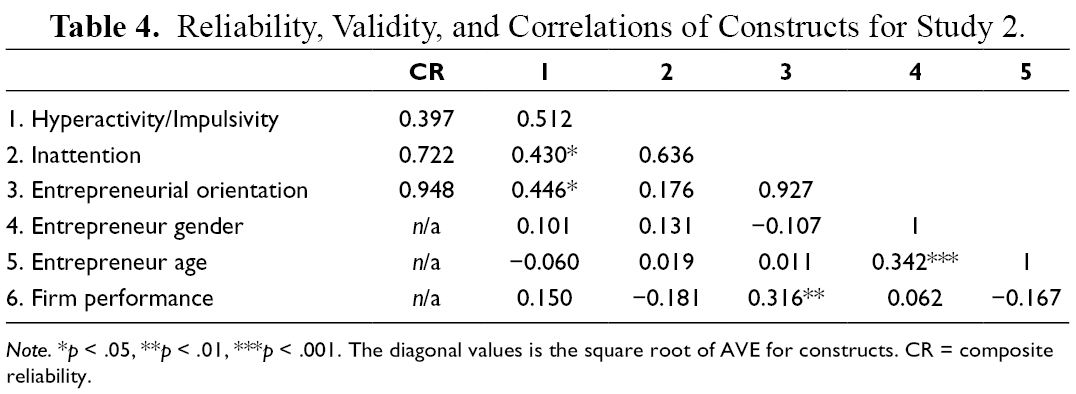
Note. *p < .05, **p < .01, ***p < .001. The diagonal values is the square root of AVE for constructs. CR = composite reliability.
Study 2: Structural Model and Hypothesis Tests
Table 5 shows the results of the structural model of Study 2. The structural model shows satisfactory model fit (χ2 (106): 137.63; p = .021; χ2/DF: 1.298; CFI: 0.93; RMSEA: 0.05; SRMR: 0.07). As can be seen from Table 4, hyperactivity/impulsivity is positively related to EO with a statistical significance level of 10% (b = .487; p = 0.076). This result provides marginal support for Hypothesis 1, which proposed a positive relationship between hyperactivity/impulsivity and EO. The effect size of hyperactivity/impulsivity is comparable to the one found in Study 1, although the statistical significance is weaker possibly due to smaller sample size of Study 2. Further, EO is significantly and positively related to firm performance (b = .334; p = .006), supporting Hypothesis 2.
SEM Estimates for Study 2.
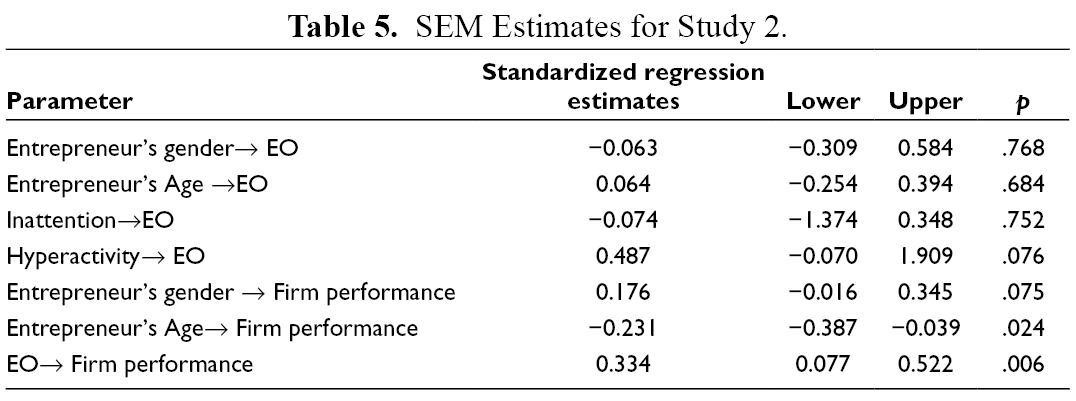
Table 6 shows the indirect effects for inattention and hyperactivity/impulsivity. It is clear that the indirect influence of hyperactivity/impulsivity on firm performance is marginally significant and positive (standardized indirect effect: 0.163; p = .065), thus marginally supporting Hypothesis 3.
Indirect Effects for Study 2.

Note. 1,000 bootstrapped and bias-corrected confidence intervals.
Robustness and Post Hoc Analyses
We conducted a number of robustness tests for both Study 1 and Study 2. First, we tested the robustness of our results without imputing missing values. Results are materially the same, as shown in Table B1 and Table B2 in Appendix B. Second, we also checked if our results are sensitive to the drop of individual scale items. Results are again consistent with the main analyses, as shown in Table B3 and Table B4 in Appendix B. Third, we reckon it would be beneficial to return to Study 1 using the short ASRS-6 as the entrepreneurship literature could benefit from a more parsimonious measure. We find consistent and same results, as shown in Table B5 in Appendix B. Fourth, a key premise of SLT is that the top executive who has more decision autonomy would have stronger influence on firm strategy and performance. Thus, we tested if results would differ for entrepreneurs who start their own businesses versus those who inherited or bought the business, as founding entrepreneurs would have stronger imprinting effect. Results are shown in Table B6 and Table B7 in Appendix B. We find that the indirect effect of hyperactivity/impulsivity is indeed stronger for founding entrepreneurs (0.179, 0 .l66), although the confidence intervals of the two point estimates overlap. Finally, we used composite firm performance measures in the main analyses. A post hoc examination reveals that the correlations between subjective and objective performance are marginal in strength (correlation = .150 for Study 1 and 0.105 for Study 2). This indicates that the influence of hyperactivity/impulsivity may differ for different types of performance. We thus conduct analyses separating subjective and objective growth performance. Results are consistent with the main analyses, as shown in Table B8 to Table B11 in Appendix B. Overall, these additional tests indicate the robustness of our results. 6
Discussion and Implications
There is emerging interest in entrepreneurship concerning how both ADHD symptoms and the ADHD diagnosis manifest in the uncertain and autonomous entrepreneurship context and the extent to which these symptoms are functional and dysfunctional (e.g., Antshel, 2018; Wiklund et al., 2016, 2017). Prior studies have found positive influence of these symptoms on entrepreneurial intentions and entry into entrepreneurship (e.g., Verheul et al., 2016; Wiklund et al., 2017). Sometimes this has been taken as evidence that entrepreneurship is a wise career option for those with ADHD. That is a premature conclusion for three principal reasons. First, that somebody is attracted to and engages in a particular activity says nothing about their eventual success at the activity. Second, most people making this argument confuse ADHD symptoms and the ADHD diagnosis. As prior studies, and for several good reasons, this article focuses on ADHD symptoms, which says nothing about how those with an ADHD diagnosis would perform in entrepreneurship. Third, to make such a claim, we would need to know the counterfactual, that is, having insights into how a person with ADHD would perform in some other profession.
In this article, we built and tested a theoretical model of the relationship between ADHD symptoms and firm performance, rather than studying the ADHD diagnosis. Building on SLT and prior EO research, we argue that the ADHD hyperactivity/impulsivity symptoms of the entrepreneur indirectly influence firm performance mediated by the firm’s EO. To our knowledge, ours is the first study to establish such a relationship. Drawing on two samples of entrepreneurs, each with complementary pros and cons, we find support for our hypotheses. Thus, there seems to be some validity to the claim that those with ADHD symptoms can perform well in entrepreneurship.
By locating EO as a mediator, we were able to tease out some of the mechanisms linking these symptoms to performance. Hyperactivity and impulsivity are related to the motivational tendencies of novelty and sensation seeking (Roberts et al., 2014) and to the behavioral tendency of swift action without much forethought (Dickman, 1990). These characteristics seem to help entrepreneurs successfully navigate the uncertain and changing environment of entrepreneurship. Sensation seeking could be related to a higher action orientation under uncertainty (Grinblatt et al., 2009). Moreover, both hyperactivity and impulsivity symptoms are action-oriented attributes, with hyperactivity leading to excessive activation (e.g., constant moving, “on the go”) and impulsivity to disinhibited action. By extension, this combination suggests that an action logic of the entrepreneur focusing on experimentation and action speed could be a crucial determinant of firm-level EO and entrepreneurial firm performance. The importance of action speed has long been recognized (Eisenhardt, 1989). Entrepreneurial firms have limited resources and face uncertainty regarding the viability of their businesses. As a result, action speed may help their firms quickly establish viable products/services and accumulate resources. Although our data do not allow us to completely unpack the ASRS and EO scales, we can speculate on the relationships with greater granularity. In the ASRS survey, ADHD hyperactivity/impulsivity symptoms emphasize rapid action without careful deliberation and inability to wait. This seems linked to the proactiveness dimension of EO, which emphasizes acting before competitors. The ASRS scale also focuses on novelty seeking and in being easily bored. Both these dimensions could be linked to the innovation dimension of EO. Those that seek novelty and are easily bored are more likely to develop new ideas and products. The sensation-seeking aspect of the ASRS scale seems directly linked to the risk-taking dimension of EO.
Like other studies in the entrepreneurship context, (i.e., Wiklund et al., 2017, and Verheul et al., 2016) we found an influence of hyperactivity/impulsivity but not of inattention (in our case on EO and/or firm performance). The replication of these differential results concerning these two clusters of symptoms provides some comfort in the validity of our data, but runs counter to some arguments suggesting that cognitive disinhibition could be related to higher levels of creativity and innovation (see e.g., Wiklund et al., 2016). It has been suggested that inattentive individuals experience anxiety and worry under uncertainty (Gomez & Corr, 2010), which deters their action. Perhaps that is the case also in our study. One important insight is that it seems necessary to differentiate inattention symptoms from hyperactivity and impulsivity symptoms in studies of ADHD and entrepreneurship. The mechanisms through which they influence the psychology (intentions), actions (entrepreneurial entry, EO), and outcomes (performance) of entrepreneurs seem distinct. Nothing is gained but much is lost if these dimensions are combined.
Our findings have important implications for entrepreneurship theory more generally. An overwhelming amount of research details the negative work implications of ADHD, whether studying the symptoms or the diagnosis (see Antshel, 2018 for review). Our findings of positive relationships between ADHD symptoms, entrepreneurs and the performance of their firms run counter to this massive body of research. Why is this the case? Our theorizing suggests that it is because entrepreneurship represents a unique work context characterized by uncertainty and autonomy.
From a theoretical viewpoint, it is far more interesting that the findings are positive and therefore the opposite in entrepreneurship compared to within other contexts where negative implications dominate. It suggests that entrepreneurship is a unique field of research in need of its own unique theories. We believe that entrepreneurship can make a much larger contribution to social science by examining where established theories do not replicate in entrepreneurship rather than where they do. Apart from establishing new theories in entrepreneurship, it helps establish the boundaries for other theories. Einstein’s theories only outperformed Newton’s under extreme circumstances. But that was enough to rethink the theories of physics. Perhaps the same shift is needed for social sciences.
Implications for the EO and Strategic Leadership Literatures
Our article goes back to the roots of EO by examining how the individual characteristics of leaders influence the EO of small firms. In the foundational EO paper, Miller (1983) argued that leaders in small entrepreneurial firms have a profound influence on the adoption of EO at the firm level. This notion has received scant attention in later research, wherein EO has mainly been used as an explanation of variance in performance (e.g., see Rauch et al., 2009).
We also contribute to strategic leadership theory. Instead of focusing on large firms, we apply strategic leadership theory to entrepreneurial firms, in which there is more uncertainty, flexibility, autonomy, and centrality of power (Miller, 1983). In such an environment, entrepreneurs’ ADHD symptoms—a problematic attribute in many areas of life—could be beneficial. Thus, we heed the call for researchers to examine different firm contexts that may shape the CEO–firm relationship in the strategic leadership framework (Hambrick, 2007). Our post hoc analysis shows that the ADHD symptoms of entrepreneurs who start their own businesses have stronger effects on EO and firm performance than those of entrepreneurs who inherited or bought their businesses. These results imply the importance of considering managerial discretion when exploring the CEO–strategy (and performance) relationship, as suggested by Hambrick (2007).
Limitations and Future Research
Our study has some limitations that also provide opportunities for future research. First, there could be survivor bias. Our results are based on established entrepreneurs, and our research question and the corresponding target population is entrepreneurs, not individuals with ADHD. This suggests that individuals with extreme levels of ADHD symptoms are not likely to be in our sample. Future research could do a comparison study, collecting a sample of more representative entrepreneurs and/or a sample of entrepreneurs at different stages. Examining the performance implications of ADHD symptoms at different stages of entrepreneurship would reveal important theoretical and empirical implications regarding the ADHD and entrepreneurship fit thesis.
Second, we focus on ADHD symptoms not ADHD diagnosis. As we discussed in the theory section, ADHD symptoms may capture the underlying ADHD trait better than the diagnosis. However, it would also be beneficial to examine the actual diagnosis that captures the high end of the ADHD tendencies and also the impairing nature of the disorder. Doing so would significantly bolster the current finding and enrich the emerging ADHD and entrepreneurship literature (see e.g., Lerner et al. (2019)’s study using the actual diagnosis).
Third, in Study 2, our scale on hyperactivity/impulsivity shows low reliability, which may have weakened the results. As suggested, this may due to the low number of items (two items) and the heterogeneous nature of the construct. Despite this, the ASRS six-item scale shows consistent results with the ASRS 18-item scale (see our robustness check using ASRS-6 for Study 1). Coupled with other entrepreneurship studies using the ASRS-6 (e.g., Wiklund et al., 2017), this suggests that the ASRS-6 is a valid and more parsimonious scale for the entrepreneurship literature to use.
Fourth, our theoretical and empirical model concerns relationships that cross different levels. Specifically, ADHD symptoms are an individual-level phenomenon, while EO and firm performance are firm-level constructs. Although we do not expect many problems as CEO characteristics and firm strategy have been studied extensively in the strategy literature concerning much larger firms (e.g., Chatterjee & Hambrick, 2007), readers should be aware that there may be noise when individual characteristics translate into firm strategy and performance, especially considering that many entrepreneurial firms are managed by teams. This limitation opens opportunities for future studies to investigate the detailed process and contingencies that enable entrepreneurs with ADHD to exhibit and use their powers in strategic firm decision-making. Future research could also expand and examine the top management team instead of one individual entrepreneur, which should lead to stronger results.
Finally, we examine one specific pathway in this article, linking ADHD symptoms to EO and then to firm performance. We certainly do not deny other potential mechanisms linking ADHD and firm performance, the investigation of which could bring a more comprehensive understanding of the performance implications of ADHD. For example, research finds that individuals high on ADHD symptoms have problems in interpersonal relationships (Able et al., 2007). Examining the network dynamics between entrepreneurs’ ADHD symptoms and relevant stakeholders (e.g., cofounders and employees) and the potential negative implications could be a fruitful area.
Practical Implications
To some extent, the logic and findings of our article resonate with the central message of Thom Hartmann’s popular book ADHD: A Hunter in a Farmer’s World. In his book, Hartmann essentially suggests that the fundamental ADHD traits are functional in a hunter society but dysfunctional in a farmer society and that those with ADHD should seek out contexts that are more “hunter-like” and less “farmer-like.” Using this vocabulary, by its very nature, with its high level of uncertainty entrepreneurship is more hunter-like than traditional employment. Thanks to autonomy, those with ADHD traits can shape their work to become ever more hunter-like. We can qualify this statement by saying that it applies to the hyperactivity/impulsivity aspect of ADHD.
There is some evidence that educations targeting those with ADHD often emphasize entrepreneurship education (see e.g., Landmark College, which is “exclusively for students who learn differently, including students with a learning disability (such as dyslexia), ADHD, or autism spectrum disorder (ASD)”). Given what we know about the intentions, behavior, and performance of those with ADHD symptoms, this seems like a suitable orientation. Because both ADHD symptoms (Ra et al., 2018) and ADHD diagnoses (Xu et al., 2018) are increasing among youths, it would make sense that educational institutions at all levels focus more on entrepreneurship education for those with ADHD. It also seems that career services would benefit from this information, while at the same acknowledging the potential negative aspects of ADHD that may hamper performance in various other careers. This way, individuals with ADHD symptoms and their loved ones can make informed decision and seek further assistance.
Although our focus was on ADHD symptoms and not the ADHD diagnosis, it seems that our findings resonate with the strength-based view of disability and provides ammunition for a strength-based approach to ADHD specifically. ADHD symptoms were positively related to firm performance, and we saw no evidence of an inverted U-shape. This suggests that these symptoms have some advantages. More realistically for practitioners (such as venture capitalists), the implication is that they could capitalize on ADHD entrepreneurs’ risk-taking and proactive styles in specific context, while at the same time being aware of negative outcomes from ADHD. For example, when facing disruptive innovations in a dynamic industry, certainly investing in an ADHD entrepreneur would seem more appropriate than in stable industries with low technological advancement.
Supplemental Material
Supplementary Material 1 - Supplemental material for ADHD Symptoms, Entrepreneurial Orientation (EO), and Firm Performance
Supplemental material, Supplementary Material 1, for ADHD Symptoms, Entrepreneurial Orientation (EO), and Firm Performance by Wei Yu, Johan Wiklund and Ana Pérez-Luño in Entrepreneurship Theory and Practice
Footnotes
Acknowledgments
We thank Professor John Torrens and the Young President Organization for their support and encouragement.
Declaration of Conflicting Interests
The author(s) declared no potential conflicts of interest with respect to the research, authorship, and/or publication of this article.
Funding
The author(s) disclosed receipt of the following financial support for the research, authorship, and/or publication of this article: Financial support from Singapore Ministry of Education Academic Research Fund Tier 1 (R-266-000-130-133) and from the European FEDER program FEDER Andalucía 2014-2020 is gratefully acknowledged.

Supplemental Material
Supplemental material for this article is available online.
Notes
Author Biographies
References
Supplementary Material
Please find the following supplemental material available below.
For Open Access articles published under a Creative Commons License, all supplemental material carries the same license as the article it is associated with.
For non-Open Access articles published, all supplemental material carries a non-exclusive license, and permission requests for re-use of supplemental material or any part of supplemental material shall be sent directly to the copyright owner as specified in the copyright notice associated with the article.
