



Abstract
In this study, we examine how team diversity contributes to team productivity in nascent ventures depending on family relations. Specifically, we explore how bio-demographic diversity influences team productivity using data from a panel of 285 nascent venture teams over 5 years. Results suggest that age and gender diversity have negative impacts on team productivity, but that family relationships positively moderate these effects. To explain the phenomena, we relied on social identity theory and the discussion of the identity confirmation process. Through this novel theoretical framework, we describe how identity confirmation, through identification with a collective (i.e., family), and cross-categorization of family roles mitigate the negative impact of bio-demographic diversity. Our findings provide valuable insights to scholars interested in bio-demographic team diversity, family relationships, and the new venture creation process.
A wide array of research illustrates that the diversity of teams has important implications for firm outcomes, including productivity, as diversity influences how well teams function (Pelled et al., 1999; Williams & O’Reilly, 1998). However, not all studies of team diversity and performance reveal the same findings (Horwitz & Horwitz, 2007). For example, the effects of bio-demographic diversity (i.e., age, gender, and race) have been particularly ambivalent compared with task diversity (e.g., Horwitz & Horwitz, 2007), thus discouraging researchers who investigate bio-demographic diversity from further inquiry.
In consideration of Bell et al. (2011) findings, which suggest that context must play a critical role when investigating the effects of bio-demographic diversity, we choose to examine the context of nascent ventures in the present work. The negative implications of bio-demographic diversity have been explained by social identity theory (SIT) (Tajfel, 1959), which provides a theoretical framework to examine how identity or sense of self is derived from social categories. One of the tenets of SIT is that accentuation of perceived differences between the self and out-group members leads to negative implications among team members. However, the effects of social identity based on bio-demographic information can be muddled by the existence of other types of identities (e.g., business/professional identities) because a person’s identity is multidimensional (Stets & Burke, 2000) and different types of identities can interact with each other (Burke & Stets, 2009). For instance, in large, established firms in which social identity and business/professional identity coexist, it is highly likely that the effects of bio-demographic diversity become less salient. On the other hand, in the formative stages of new ventures when a business identity has not yet been established (i.e., firms have not yet established organizational norms, routines, roles, and working relationships among team members), organizational outcomes will be more influenced by managerial team characteristics (Finkelstein & Hambrick, 1990) such as bio-demographic characteristics, and by interactions among the entrepreneurial team. Despite the distinct advantages of investigating team diversity in nascent venture contexts, this area of inquiry has received scant attention.
Further, we contend that it is important to consider existing personal relationships beyond the workplace when exploring new venture startups. Most venture teams start from existing personal relationships; such preexisting personal relationships may affect a person’s identity (Blatt, 2009) as well as interactions with other team members. In the current study, we focus on family ties and interactions among family team members. Family relationships are enduring, not substitutable, and therefore strongly influence a person’s identity (Thatcher & Zhu, 2006). In addition, roughly 50% of all new venture teams are composed of individuals that share a family affiliation (Brannon et al., 2013). In this regard, when investigating the effects of bio-demographic diversity in nascent ventures, it is crucial to untangle how family affiliations affect interactions among venture team members and their identities.
To advance the literature, we aim to integrate bio-demographic team diversity and family business literature in the context of nascent entrepreneurial firms while focusing on identity. Identity congruence (i.e., when a perceiver acknowledges a target’s self-identity as the target sees herself) has an influential role in social relations (Tajfel et al., 1971), and thus on organizational outcomes (Ensley et al., 2002). Consistent with the extant literature, we suggest that bio-demographic diversity (gender, age, and ethnicity), constructed from visible and invisible characteristics, negatively affects team productivity. We also suggest that preexisting family ties in a team will mitigate the negative effects associated with bio-demographic diversity. To test our hypotheses, we examine the development of prelaunch entrepreneurial teams by using data from the Panel Study of Entrepreneurial Dynamics (PSED II), a particularly relevant dataset for this context.
Our findings have important implications for team diversity and family business literature. First, we shed light on the importance of bio-demographic diversity in the early stages of nascent venture development. The findings of extant studies on the impact of team diversity in established firms suggest a positive impact of task diversity (e.g., work experiences, functional expertise) on firm outcomes, but a nonsignificant effect of bio-demographic diversity (Horwitz & Horwitz, 2007). Also, consequences of team diversity change over time (Jehn & Mannix, 2001); however, the early stage of new ventures has received little attention in team diversity studies (Schjoedt et al., 2013). We suggest and show that bio-demographic diversity is particularly salient in the early, formative stages of venture development when a business/professional identity is not yet established and team roles have not been defined (Ensley & Pearce, 2001). This implies that when work relationships have not been clearly defined, social identity based on bio-demographic characteristics might have a stronger effect in a team context than identified in extant research.
Second, we advance the team diversity literature by examining how relationships extending beyond the workplace (e.g., family relationships) influence the dynamics of team diversity. Our results show that the unique characteristics of family relationships positively affect the influence of bio-demographic diversity on team productivity in nascent firms. This insight can help explain the diverging and inconclusive results in team diversity literature and help the field move beyond the “demographics only” perspective, which has been criticized for lack of consideration of context (Joshi & Roh, 2009). With relevance to family business literature, we examine nascent entrepreneurial family teams, as little has been discovered about the membership dynamics of such teams to date (Discua Cruz et al., 2013). Our work is particularly interesting as family relationships can be liabilities in large, established family firms (e.g., Schulze et al., 2003), but our results suggest quite a different role of family relationships in the formative stages of nascent ventures.
Third, building on our first two contributions, we propose a general theoretical framework to explain how negative impacts from bio-demographic diversity can be reduced through the identity confirmation process via family ties. Many interpersonal processes have been suggested as moderators that can reduce the negative impacts caused by bio-demographic diversity (Ensley et al., 2002; Jehn, 1994; Smith et al., 1994); however, the literature lacks a clear theoretical framework. And, while extant team diversity studies on the negative effects of bio-demographic diversity have relied on social identity theory (Tajfel, 1959, 1969), one of the most important contexts that affects identity—family ties—has received little attention in the team diversity literature, especially in terms of how family ties help achieve identity confirmation among team members. Although we do not empirically test the identity confirmation process in the current paper, we propose a theoretical framework that explains how family relationships help achieve identity confirmation between two people (i.e., a target and a perceiver) through two mechanisms in the nascent venture context: (1) identification with a collective and (2) cross-categorization of a role identity.
Theoretical Context
Social Identity Theory, Bio-Demographic Team Diversity, and Nascent Startup Teams
Social identity theory posits that a person’s social category affects how they view the world (e.g., Tajfel, 1959). This cognitive perspective, particularly when it is projected toward others, is governed by two motives: uncertainty reduction (Hogg, 2000) and self-enhancement (Hogg & Terry, 2000). Uncertainty toward others is usually reduced by cognitive categorizations that are simple and clear (Hamilton et al., 1998) and by stereotypes. To fulfill the need for self-enhancement, people make comparisons between their own group and relevant out-groups that cast themselves in a positive light. In this regard, the social cognitive processes that lead to uncertainty reduction and self-enhancement also may cause some people to view “different” people not as unique individuals, but as depersonalized embodiments of a relevant category or stereotype (Stets & Burke, 2000), which often imply negative connotations. Not surprisingly, this process produces subtle (and sometimes not subtle) resentments and disagreements (e.g., Walker, 1999) among people in different groups. When a perceiver does not accurately recognize a target’s self-identity, the target may experience interpersonal dissonance between themselves and how they are seen by the perceiver (Swann et al., 1992). This may result in negative emotions and actions that affect group behaviors between people in different categories.
Since social identity theory is particularly useful in explaining the sociocognitive processes of categorizing in-group versus out-group, it has often been used in team diversity studies on separation caused by team members’ differences. Bio-demographic diversity, defined as differences among team members in overt demographic characteristics such as age, gender, and ethnicity (which are often reflected in physical features) (Milliken & Martins, 1996) have been explored using a social identity theory framework. The extant literature describes that individuals can almost immediately make reasonable estimates of the age, gender, or ethnic background of others and therefore of that person’s (dis)similarity to themselves (Jackson et al., 1995). This, in turn, activates one’s collective identity and motivational mechanisms (Turner, 1982) (i.e., uncertainty reduction and self-enhancement) which often lead to prejudice and discrimination toward people in other groups (Tajfel, 1982). In the current investigation, we choose to continue to study age, gender, and ethnicity as bio-demographic diversity variables, which are equivalent to what other researchers have labeled “social category diversity” (Jehn et al., 1999) or “surface-level diversity” (e.g., Harrison et al., 1998). Past research shows that bio-demographic diversity leads to lower social integration (O’Reilly III et al., 1989), decreased team effectiveness and interaction (Williams & O’Reilly, 1998), decreased cohesion and communication (Smith et al., 1994), lower group performance (Pelled et al., 1999), and increased dysfunctional conflict and turnover (Tsui et al., 1992).
Despite the clear theoretical lens of social identity theory and some persuasive empirical findings, the effects of biodemographic diversity have been continuously controversial and ambivalent (Horwitz & Horwitz, 2007; Webber & Donahue, 2001). We suggest that this is largely because the majority of bio-demographic diversity research has been conducted in the context of large, established firms where multiple identities coexist and the effects of bio-demographic diversity (i.e., social identity) become less salient relative to the effects of other types of identities, such as a business-related identity. Put differently, as firms grow and mature, clearer standards, organizational structure, and working relationships among team members are established. The effects of bio-demographic diversity will be overridden by the presence of business-related identities (Verduyn et al., 2014) and people will act upon organizational standards and clearly defined behavioral expectations. In addition, previous studies have shown that when people are engaged in an unfamiliar task, they display more in-group bias (Grieve & Hogg, 1999). Therefore, we situate our work on team diversity in the context of nascent ventures, where unfamiliar tasks and minimum levels of established organizational structure or fixed working relationships are present, thus, highlighting managerial discretion and strength. Here, organizational outcomes will likely be more reflective of members’ attitudes and behaviors about each others’ bio-demographic differences (Finkelstein & Hambrick, 1990).
Identity Confirmation and Family Ties: Identification with a Collective and Cross-Categorization
The negative effects of bio-demographic diversity (categorization and depersonalization), which are caused by cognitive dissonance on individual identities, can be mitigated by “identity confirmation” between the two persons (Milton & Westphal, 2005). Identity confirmation is a state when an individual’s social environment is consistent with their self-identity (Milton, 2008). Here, when a perceiver agrees with a target’s self-identity, the target feels validated and “personalized” in their identity. This grants the target identity confirmation and gives them heightened feelings of coherence and predictability (e.g., Swann et al., 1992). In this state, members who feel understood may come to believe that it is safe to behave authentically, and the positive effect, in turn, motivates cooperative behavior among team members (Isen & Baron, 1991). Earlier research has shown that identity confirmation leads to positive outcomes in intimate and social relations (Swann et al., 1994) and in MBA study groups (Polzer et al., 2002). With particular relevance to the present work, we know that a high level of interpersonal congruence in groups (i.e., group members confirm other members’ perceptions of themselves (Polzer et al., 2002) moderates the relationship between diversity and group effectiveness (Milton, 2008).
We suggest that two underlying mechanisms might effectively enable the identity confirmation process in nascent venture contexts: (1) identification with a collective and (2) cross-categorization of role identity. Identification occurs when individuals see themselves as part of the collective (Ashforth et al., 2008); cross-categorization occurs when one identity (e.g., social identity) crosses with another identity (e.g., functional/role identity). Here, we specifically focus on new venture teams with members who share family relationships, as family ties are uniquely situated to effectively describe the two suggested mechanisms. Also, it will be meaningful to investigate family ties in new venture teams because, although the majority of new venture teams are composed of individuals who share a family affiliation (Brannon et al., 2013; Yang & Aldrich, 2014), the effect of such family relationships on new venture performance has received limited attention in the entrepreneurial team literature (Schjoedt et al., 2013).
Identification with a collective happens when individuals see themselves as part of a superordinate group (Pearson et al., 2008). If two individuals see themselves as part of the same group (e.g., a family), each member’s cognitive uncertainty toward the other is reduced, even though they may have different bio-demographic characteristics. This is because membership in a group may validate social self-identity based on social categories (Swann et al., 2004). In this context, family membership renders a unique frame of reference in which a person can validate their social self-identity as a family member and which is unchanging (e.g., parent, siblings) or constant for a significant time period (e.g., spouse). Furthermore, in fixed, enduring, and hard-to-change relationships, people develop patterns of interactions. The involvement among members of a collective (Pearson et al., 2008) helps them better understand others’ attitudes, feelings, and behaviors, resulting in reduced uncertainty toward others. Also, family members tend to share the family’s unique stories, history, and culture. Through the enduring family ties and cultural assimilation process, family members realize their superordinate group identity: they share the group (family) identity, which will inevitably affect each members’ individual identity. This will diminish an individual’s motivation for self-enhancement over another member in the family group and will minimize individualistic and opportunistic behaviors.
The importance of identification with a superordinate group identity is also bolstered by a self-verification perspective (Swann et al., 2004). This perspective claims that validation of social self-views (i.e., membership in social categories) is critical for self-verification of one’s identity. In this context, a family membership will play a particularly important role in validating one’s identity in a new venture. Acquainted founding members are united with a purpose to create a new venture, but their business (firm) identity is not yet established or stable. Team members’ organizational roles and responsibilities are also undefined in the business context. As a result, it is impractical that team members rely solely on their uncertain and unsettled business to confirm their social self-views. On the other hand, in family settings, social self-views are relatively clear; thus, the established agreements on “who we are” or “who I am” in a family effectively hold the group together and thus facilitate social interactions (e.g., Swann, 1987). In fact, it has been argued that identification is the key link between a family’s resources (e.g., group identity) and corresponding organizational capabilities, such as efficient and collective actions (Pearson et al., 2008), partially because validated social self-views help interactions unfold smoothly. Therefore, two people who are affiliated through family ties and identify with the same collective will improve the organizational capabilities and the productivity of the group (Makadok, 2001) and have a strong and positive influence on the collective actions of their group (Pearson et al., 2008).
The process of cross-categorization occurs when one identity (e.g., ethnicity) crosses with another (e.g., a functional role) (Brickson, 2000). Cross-categorization may confuse a perceiver’s cognitive schema toward a target’s identity, as established based on bio-demographic characteristics, resulting in a canceling-out effect (Brewer et al., 1998) or de-emphasizing of an identity. While the basis of social identity is in the uniformity of perception and action toward a different social group, the basis of role identity resides in the differences in perceptions and actions that accompany a role as it relates to the accomplishment of work. The negative impact of social identity discrepancies, based on bio-demographic social categorization between a target and a perceiver, may be mitigated by a functional role to achieve common goals. If a person, for instance, who belongs to a minority category (e.g., female, a person of color) takes a top management position in a team and other team members (e.g., male, white) are in positions to support her, her social identity triggered by bio-demographic characteristics (e.g., gender) may be buffered by her functional roles in the organization.
The canceling-out effect will be magnified when a person plays an important functional role which has critical implications in everyday interactions among team members. In a nascent venture team, the roles and responsibilities of each member are ambiguous and unclear. However, in family settings, family members’ roles and responsibilities are relatively clear, partially due to social norms and/or their long history of interactions. Therefore, family members may follow their own current family/social roles in a business setting (i.e., new venture), as well. If a team member recognizes another’s important family/social roles, the perceiver’s cognitive system will possibly conflate the two conflicting attributes: family role identity and social identity based on bio-demographic characteristics. Further, the behaviors and attitudes expected from a member’s family role will reduce the uncertainty toward that team member, despite any bio-demographic differences. Likewise, in a relationship connected by family ties, bio-demographic identity characteristics (e.g., female) will be easily crossed with another attribute within a family (e.g., functional/social roles, such as mother). Alternately, family roles can override the bio-demographic group to which a member belongs. Hixon and Swann (1993) found that people tend to seek their identity verification from others when they expect to interact with them for a substantial period. In an uncertain, nascent business setting, people will tend to rely on family relationships and their roles conferred in the relationship, which are permanent or at least enduring, to verify their identities. To summarize, identification as part of the same family and cross-categorization between social identity and family role identity will help the identity confirmation process among nascent venture team members who are demographically different.
Hypothesis Development
We now describe our approach to each construct of bio-demographic diversity—age, gender, and ethnic diversity—as each could have different meanings in family teams and thus interact with family relationships in a particular manner.
Age Diversity
One of the most observable forms of diversity is age diversity, which is an important demographic variable that helps predict an individual’s nonwork-related experiences (Ryder, 1965); people of a similar age have experiences in common, which lead to shared attitudes and beliefs (Rhodes, 1983). With the growing aging population and a fast-changing market environment, age diversity is an important consideration in innovation for both existing and new businesses. Age heterogeneous teams can take advantage of innovative suggestions because they can build on their diverse experiences and validate them based on the diverse cognitions of the team (Kilduff et al., 2000). Furthermore, some scholars have found that mixed-age groups can be viewed positively because of their multitasking capabilities (Mahadeo et al., 2012). Despite some positive findings on age diversity in general, it is not yet clear if age diversity improves organizational performance, because other researchers have found either no significant effects (Bunderson & Sutcliffe, 2002; Simons et al., 1999) or negative effects (e.g., Ely, 2004). Team members with an age difference might experience friction given their dissimilar experiences and, thus, belief systems. Individuals use demographic categories such as age to define psychological groups that reinforce self-identity (Tsui et al., 1992), resulting in negative consequences when interacting with people in other groups. Zalesny and Kirsch (1989) noted that heterogeneity in age is negatively related to peers’ ratings of their co-workers’ performance. Furthermore, we know that heterogeneity in age is positively associated with team turnover and lowers levels of social integration (O’Reilly III et al., 1989; Wiersema & Bird, 1993). We argue that collective identity formed by membership in an age group may provoke negative impacts on a team’s productivity.
Although we expect that differences in age among team members will negatively impact productivity, the implications of age diversity might differ depending on the existence of family relationships. We suggest that identification with a collective (i.e., a family) and cross-categorization evoked by family members’ existing functional roles will mitigate the negative impacts caused by age differences. One family relationship with a high level of age diversity is the relationship between parent and child. The most commonly observed emotion or behavior in the parent–child relationship is altruism (Ling et al., 2001; Schulze et al., 2003). Altruism has been found to have negative effects on family firms because altruism can prompt parents to threaten their children with moral hazard (Buchanan, 1975). It can also create agency challenges, such as freeriding and nepotism (Chua et al., 2009), which can endanger the performance of a family firm (Schulze et al., 2001; Verbeke & Kano, 2012). However, in some situations, altruistic tendencies may have an indirect positive impact on an organizational outcome (e.g., productivity). For instance, in an identification process between two team members with a family tie, altruism may help reduce perceived individual differences. Specifically, altruism helps a family member (perceiver) acknowledge that the emotional well-being of another family member (target) is directly or indirectly connected with the perceiver’s well-being because they share a collective identity. In this circumstance, a team member might sympathize with their family member rather than separating and depersonalizing them. Altruistic family members will also diminish the motivation of self-enhancement for some members (e.g., father and son) because their individual senses of well-being are positively associated (Naldi et al., 2013). As a result, a family’s shared collective identity and the altruism derived thereby may reduce the negative effects of age differences (Eshel et al., 1998).
Further, members affiliated by family relationships may focus more on a person’s role identity (e.g., their functional role in a family) than their bio-demographic category, reducing the negative effects of differences in age. For instance, functional roles between parents and their children are clear; after all, we often use the term “caregiver” to describe a parent–child relationship. Further, this functional role is not temporary. Instead, the role is constant for a significant time (e.g., 20 years) and often requires considerable commitment and sometimes great sacrifice by certain members. The self-views developed based on family role identities provide a lens through which people perceive the world, and the self-views also affect their behaviors. Further, when self-views are socially confirmed by other family members, this helps achieve identity confirmation among two or more people. Therefore, the highlighted functional roles of a family member (e.g., mother) will de-emphasize another bio-demographic factor characterizing the member (e.g., an elderly person).
Gender Diversity
Proponents of the gender diversity perspective often argue for the “business case for diversity” (Cox, 1994). These scholars claim that gender diversity yields good results and represents an appealing interest—an interest that enriches one’s understanding of the marketplace, meets customers’ needs, and enhances the quality of products and services offered (Hubbard, 2004; Richard, 2000). Moreover, it is suggested that gender diversity enriches the workplace by widening employee perspectives, providing greater resources for problem resolution and strengthening teams (Cox, 2001). However, while some research shows that women in the upper echelons of a firm have a positive effect on performance (e.g., Feeney, 2004), other studies find nonsignificant results (Korac‐Kakabadse et al., 1998).
In the present work, we focus on the effects of diversity on team productivity (i.e., the “process” rather than financial outcomes). We assert that the extant studies that examined the effects of gender diversity on team processes may have found negative implications of gender diversity because, like other visible characteristics, individuals use demographic categories such as gender to define psychological groups that reinforce self-identity (Tsui et al., 1992), triggering discomfort, potential conflicts, and lower cohesion with individuals in the other group. Further, critics of the positive effect of gender diversity model are skeptical about the degree to which benefits are tangible (Skerry, 2002). Here, scholars see “diversity as process loss” and argue that gender diversity incurs significant potential costs (Pelled et al., 1999), as gender diversity can diminish group cohesiveness (Tsui et al., 1992) and increase employee absenteeism and turnover.
The relationships that increase gender diversity in a family are diverse: spousal, sibling (brother–sister), or parent–child (father–daughter or mother–son) relationships. Previous literature found that women in the family business are often faced with discrimination and stereotyping because of societal prejudices (Salganicoff, 1990) which might create conflicts. These societal prejudices include expectations for women to perform gender role duties, such as providing childcare and doing household chores. Such expectations may make it difficult for women to visibly contribute to firm development. Consequently, working women may struggle to reconcile societal gender norms with their personal beliefs or desires. Further, traditional and social gender roles hinder from performing correct performance evaluations among team members (Chua et al., 2009), possibly aggravating emotional conflicts. In sibling relationships, the negative impacts of rivalry in family businesses are consistently illustrated (e.g., Vera & Dean, 2005).
Despite, family relationships between different genders (e.g., spouses, brother–sister, or father–daughter) might have a positive impact on a particular mechanism, such as an identification process. People often judge those in a different group based on limited information (e.g., surface-level information such as gender) when they do not have more in-depth information. However, established family relationships will likely facilitate a multidimensional and in-depth understanding (Sharma, 2004) as well as trust among the members (Nahapiet & Ghoshal, 1998). One of the most representative relationships showing gender difference is a spousal relationship. In a spousal relationship, the couple would have had many interactions (before and after marriage) and shared stories to assimilate each other’s behavioral patterns, attitudes, and underlying thoughts. For instance, copreneurs (Barnett & Barnett, 1988) tend to have strong family values, and the emotional bond between partners grows solid when they work together in a venture (Nelton, 1986). Similarly, in most male–female sibling relationships, brothers and sisters grow up together and benefit from the mutual understanding gained through time spent together and shared family dialog, history, and culture. Such accumulated relational capital allows a person to deeply understand a differently gendered person’s characteristics and point of view. Even if understanding family members is sometimes unpleasant or painful, people with such family ties will undergo the process of understanding each other because their membership in a family is most likely permanent, and thus the enduring and nonsubstitutable relationship is highly influential on an individual’s identity. In fact, understanding a person’s family members and how those relationships make them unique may be the only way to explain some aspects of their identity.
In addition, the unspoken but existing gender norms of a family team (Aldrich & Cliff, 2003) are likely to facilitate cross-categorization between people connected with family ties. Here, the possible friction coming from a difference in gender can be mitigated or substituted by acceptance and fulfillment of various functional roles performed by different genders (e.g., a functional/social role performed as husband or wife). For example, the traditional gender role of women includes maintaining stability in personal, family, and business relationships by playing the role of the caretaker (Dumas, 1989, 1998) and giving unconditional support to family members leading entrepreneurial ventures, including spouses, siblings, or children (Martinez-Jimenez, 2009). This unspoken, unofficial role of women will possibly benefit a new venture by easing tension in team dynamics, especially in an uncertain or turbulent situation in a nascent venture. Women may also help cohere and unite team members, even in the absence of financial compensation from the new venture. Most of all, when the unofficial role of women is acknowledged by other family/team members and the social self-views of women are settled in a team, traditional gender norms in fact help ease conflicts between two identities: a business professional and a mother. On the other hand, team members who do not share a family relationship may not appreciate or recognize women’s family roles and responsibilities outside of the venture. Thus, women who perform the role of caregivers for their families outside of a venture may be undervalued, possibly aggravating the negative impacts of gender differences in a business team. Therefore, it is highly possible that women may go through work–family conflicts (Vera & Dean, 2005) with other entrepreneurial team members if they are not connected with family ties. In support of the benefits of gender roles, prior research suggests that negative impacts from bio-demographic diversity could be decreased by established organizational norms (Jehn, 1994) or even by informal norms when a formal institution is lacking (Luo & Chung, 2005). In a nascent venture that lacks established rules and norms among colleagues, preexisting informal and social gender norms in a family and/or a couple would act as intermediary norms in the early stage ventures, reducing negative impacts originated by gender differences.
Ethnic Diversity
When ethnic diversity is present and well managed, it will likely generate positive financial outcomes in a large and expanding organization. However, ethnic diversity also has been found to generate inconsistent or negative outcomes, particularly regarding internal team processes and a team’s behavioral outcomes (Pulakos et al., 1989). Overall, the results of research on ethnic diversity in organizational groups suggest that people who are ethnically different from the majority in an organization may not only experience less positive emotional responses from their employers, but are likely to be evaluated less positively by their supervisors, and are more likely to leave the organization. Ethnic diversity is also linked with conflict, especially emotional conflict among co-workers, and decreased employee satisfaction (Bell et al., 2011; Skerry, 2002). Based on social categorization theory, we believe that ethnic diversity can be a separating factor in an organization, generating potential negative impacts on a team’s productivity.
The circumstance in which we observe the ethnic difference in a family relationship is mostly in a spousal relationship. As interracial marriage has increased dramatically from less than 1% in 1970, 7.4% in 2000, and to 10.2% in 2012–2016 (Rico et al., 2018), interracial marriage has received a considerable amount of attention in family literature (e.g., Fu, 2006). Despite the increasing number of interracial couples, couples with different ethnicities have unique challenges, which might affect their productivity in business settings (e.g., copreneurs). For instance, the homogamy perspective predicts that interracial marriages are less likely to remain intact than same-race marriages (Bratter & King, 2008). Furthermore, as compared to noncopreneurs, copreneurs tend to mix their work and life and view business as a way of life (Fitzgerald & Muske, 2002). This can cause more work and family conflicts and trigger an adverse effect on business sustainability, especially when copreneurs are unable to effectively manage work and family conflicts (Kurniawan & Sanjaya, 2016).
Despite some possible negative impacts, a family relationship with ethnic differences can be a double-edged sword. A romantically involved couple with different ethnicities is likely to have a strong and established connection and an in-depth understanding of each other through extensive interactions even prior to marriage. After marriage, even more extensive and routinized interactions between the couple would deepen the comprehension of other’s behavioral patterns, languages, and cultures. Further, one of the most important social communities—family—would help the development of vision, purpose, and superordinate group identity, despite different backgrounds and cultures associated with ethnicity. In fact, relative to persons dating or marrying within their ethnic group, those dating or marrying outside their ethnic group reported less identification with members of their own ethnicity (Shibazaki & Brennan, 1998), which may strengthen their identification with another type of collective identity, that is, family. Also, it has been found that copreneurs (Barnett & Barnett, 1988) uniquely achieve control and satisfaction in both business and family domains by creating a perfect blend of work and family, seeking greater intimacy with their partner, and strengthening shared goals, visions (Marshack, 1993), and superordinate group identity.
Informal social norms in a family contribute to the identity development of individual members based on functional roles; this results in reduced perceived idiosyncratic characteristics (Dyer, 2003) caused by ethnic differences. In the early stages of venture development, before clear working relationships have been established among team members and before the economic viability of the organization has been validated, family roles can help legitimize members’ identities based on their functional roles in the family. Such roles can help set up clear membership boundaries and facilitate family members’ identification with each other (Gomez-Mejia et al., 2011). Those mutually agreed-upon family identities signal that members are recognized as the persons they believe themselves to be and help interactions occur naturally and effectively (Swann et al., 2004). For example, Astrachan et al. (2002) found that family values, based on established family role identification process, favor the development of a distinct organizational culture and family norms. Similarly, the family identity linked by the distinct roles and unique values of each member helps team members consider themselves as part of the in-group rather than the out-group category (Jehn, 1997), regardless of their possible ethnic differences. Even in the situation where family and business are interwoven, it was found that copreneurs are better satisfied because performing one’s role helps confirm their identities, which are also acknowledged by their partners. This results in strengthening their superordinate group (family/business) identity.
Methods
Research Context and Sample
We investigated the productivity of prelaunch entrepreneurial teams relying on data from the Panel Study of Entrepreneurial Dynamics (PSED II). The PSED II screened 31,845 individuals from the U.S. mainland, aged 18 or older, who were selected using random digital dial sampling (Gartner, 2004). After initial screening interviews, about 87% (1,214) of those identified as nascent entrepreneurs agreed to participate in the study (Reynolds & Curtin, 2009). This dataset is one of the few designed to study new businesses and real-world entrepreneurial teams (Chen et al., 2018; Yang & Aldrich, 2014) and contains representative high-quality longitudinal data, including six waves of interviews from 2005 until 2010. Detailed sampling and data collection process information have been presented elsewhere (see Reynolds & Curtin, 2009).
These data from the PSED II are particularly helpful when studying how team diversity influences entrepreneurial team outcomes. First, these data included detailed individual-level demographic information for up to five people on an entrepreneurial team. This makes it possible to compute a set of detailed elements of team diversity. Second, these PSED II data avoid the survival bias associated with studying established new ventures because many teams disband their efforts before the business is started (Davidsson & Gordon, 2012). Third, the PSED II reported annual data over a 5-year period (2005–2010), which allows for a real-time, longitudinal study of the startup process as it unfolds, reducing the risk of hindsight bias and memory decay (internal validity). Fourth, as previously noted, the concerns about the external validity issues in entrepreneurship research (e.g., nonrepresentative samples, insufficient sample size) are lessened by the nature of this dataset (Chen et al., 2018).
Consistent with best practices when using the PSED II, we organized these data to include only pertinent information that could help us answer our primary research questions (Brannon et al., 2013). To identify entrepreneurial teams that were already formed before the first wave of PSED II interviews and firms that were officially registered, we only used cases that contained more than one owner. However, we excluded teams with more than five owners because the dataset only contains detailed demographic information for up to five members. This resulted in 564 teams. Additionally, to enhance internal validity as well as to decrease unobserved heterogeneity, we only included new ventures that were started during the 1 year prior to the first interview. This led to a sample of 413 new venture teams. We also excluded firms with institutional representatives among owners and any firms that had missing information in key variables for this study. Further, to observe the venture creation process more precisely, we converted these PSED II data into monthly observations. In each of the six waves of interviews, the interviewer asked participants to specify the month each venture activity occurred. Thus, although data are collected annually, it can be converted into monthly observations. Observing monthly activities rather than annual activities enhances the quality of this study as we examine the productivity of nascent ventures. Specifically, we study the gestation activities of startups, which can be very intense and may be completed in a couple of years. Therefore, investigating annual progress in gestation activities would not provide us with sufficient detail of a nascent venture’s productivity. Thus, we used monthly observations instead of annual observations of gestation activities.
In this dataset, teams were observed from their first gestational activity until they were either (1) abandoned, (2) became an actual venture, or (3) the study ended. After taking into consideration missing information in some key variables, the final sample consisted of 285 firms and 6,996 observations. All independent and control variables were collected during the first interview because there were few changes to the teams during the studied period.
Measures
Dependent Variable
In our approach, traditional outcome variables like profitability or firm value are not applicable (Davidsson & Honig, 2003; Samuelsson & Davidsson, 2009). Here, we contend that team outcomes are not always directly aligned with the financial outcomes of organizations (Mathieu et al., 2008). Accordingly, extant work argues that performance “behavior” is a stronger indicator of team dynamics (Beal et al., 2003), particularly when exploring bio-demographic diversity. Therefore, we focus on a team’s productivity as opposed to financial outcomes (e.g., Datta et al., 2005; Grant, 2008). We operationalized nascent venture team productivity as “initiated gestational activities,” which shows the progress of new venture development.
This choice is consistent with research that has reliably used such an approach (for a review see Davidsson & Gordon, 2012). The number of initiated gestational activities, which represents team progress toward organizational creation, is an appropriate indicator of a team’s productivity in nascent ventures (Manolova et al., 2012). In addition, we used the entrepreneurial ladder perspective (van der Zwan et al., 2010), which classifies business creation as a process of 5 steps. People who took entrepreneurial steps, compared to people who thought about creating a business, are highly likely to create and continue their businesses. Therefore, measuring “initiated gestation activities” as a dependent variable is especially relevant in entrepreneurship research. Particularly, the gestational activities in the PSED II dataset capture these four areas required for creating a new venture: intentionality, resources, boundary, and exchange (Manolova et al., 2012). Further, the gestational activities recorded in the PSED II dataset delineate how well entrepreneurial teams coordinate the successful inception of a startup. Examples of extant work adopting this approach include Samuelsson and Davidsson (2009), who adapted a summary of 30 different gestational behaviors as measures of productivity to substantiate the progress of venture development. Other extant work on this approach by Davidsson and Honig (2003) used the number of summated gestational activities to explore how entrepreneurs’ human and social capital might influence the successful exploitation of nascent firms.
Accordingly, our measure captured behavioral performance using a summation of 33 gestational behaviors defined in the PSED II (Reynolds & Curtin, 2007), such as establishing supplier credits, registering legal business forms, etc. During each interview round, respondents were asked which of the 33 activities they had performed and the dates when each activity was started. We coded each gestational activity as a “1” if initiated by the end of each monthly observation, and a “0” otherwise. The activities were summed during the time when the firms were active startups.
Independent Variables
Consistent with much of the top management team literature, bio-demographic diversity was measured by age (e.g., Amason et al., 2006; Wiersema & Bantel, 1992), gender (e.g., Chowdhury, 2005; Williams & O’Reilly, 1998) and ethnicity (e.g., Pelled et al., 1999; Ruef et al., 2003). All these demographic data related to team members (i.e., new venture owners) were captured during the first wave of interviews.
There were two different types of data: continuous data (i.e., age) and categorical data (i.e., gender, ethnicity). In the main analysis, we used a SD to calculate the level of team diversity for continuous data rather than the commonly used coefficient of variation, which divides the SD by the mean. The theory that we use in this study (i.e., social identity theory; social categorization) is relevant to the concept of “separation”. People define social identity or social categorization based on bio-demographic attributes due to the assumption that other groups hold different positions or opinions, primarily of value, belief, or attitude (Harrison & Klein, 2007), and thus, people detach one from the other. According to Harrison and Klein (2007), SD is recommended for team diversity that causes separation, and coefficient of variation is justified to study team diversity that triggers disparity among team members (i.e., composition of vertical differences in proportion of socially valued assets or resources held among unit members; inequality or relative concentration). Therefore, we theorize that the SD is the appropriate measure to use in this study, by following Harrison and Klein (2007) suggestions and precedent (e.g., Bell et al., 2011). As SD is affected by its unit-level mean, we do include the means as control variables, as suggested in the literature (Harrison & Klein, 2007). We also used the logarithm of the diversity measure to capture the anticipated decreasing rate of the effect of dissimilarity of some continuous variables (Wiersema & Bantel, 1992). In this study, the logarithm of age diversity ranges from 0 to 3.32 and its mean is 1.27.
For categorical data, Blau’s heterogeneity index (1977) was calculated:

For this index, P is the proportion of team members in a category and i is the number of different categories represented in the team. For example, if a given team of three members has one woman and two men, then P1 equals 0.33, P2 equals 0.67, and Blau’s index (H) equals 0.44. We used Blau’s index for computing gender diversity and ethnic diversity in the PSED II dataset. The mean of gender diversity, categorized as female/male, is 0.35 and ranges from 0 to 0.5. For ethnic diversity, the categories were White, Black/African American, American Indian, Asian, Pacific Islander, and Other. The mean of ethnic diversity is 0.04 and ranges from 0 to 0.75.
Moderator
To investigate how family ties influence the relationships between bio-demographic diversity and a team’s productivity, we measured the proportion of family ties in the team. We calculated this by dividing the number of family relationships by the number of total relationships. For instance, if there are three team members, the total number of possible dichotomous relationships is three (each one between A and B, B and C, and C and A). If only A and B are associated with a family tie, the proportion of family relationships over total relationships is 1/3, or 33.3%.
Among our 285 firms, 67 firms (23.51%) were identified as not having any family relationships (family proportion of 0). There were 200 firms (70.18%) that were made up solely of family relationships, which makes the proportion of family relationships equal to 1. The proportion of family relationships for the remaining 18 firms (6.31%) is distributed between 0 and 1. All predictors were mean-centered before the calculation of interaction terms (Dawson, 2014).
Control Variables
We examined multiple control variables. “Team size” (the number of owners) was included because team diversity measures are sensitive to team size (Steffens et al., 2012), and larger organizing efforts are less likely to fail than smaller organizing efforts (Delmar & Shane, 2004). “Average age of owners”’ was included because, as individuals approach retirement age, they are less likely to invest in the activities necessary to start a new enterprise (Davidsson & Honig, 2003). “Average startup,” “industry,” and “management experience” of owners were included because, based on human capital approaches (Unger et al., 2011), a team with more relevant experience is likely to perform better than a team that has less experience (Harrison & Klein, 2007). In addition, Delmar and Shane (2004) found that organizing activities may differ depending on the industry, thus “industry” information was included as a control variable. Further, we included some indicators that show strategies of firms such as “special strategy” and “innovativeness” because, depending on firm strategies, the progress of gestation activities can be impacted (Samuelsson & Davidsson, 2009). “Special strategy” measures whether “quality products or services are important for this (new) business to be an effective competitor” (1 = yes, 0 = no) and “nnovativeness” indicates whether “spending on research and development (will) be a major priority for this (new) business” (1 = yes, 0 = no). Further, we included “whether any owners work for other companies for more than 35 hours/week” (1 = yes, 0 = no) because if owners work for other companies for such lengthy hours, it will impact the progress of the venture. Similarly, “why entrepreneurs started a business” can also influence the progress of ventures, thus we included three binary variables: to increase income, to increase work flexibility, and to change careers (all 1 = yes). We also distinguished between “independent versus corporate startups” (Heirman & Clarysse, 2004) because the distinctive set of resources of each type of startup would be conducive to different behaviors, preferences, firm strategies, and governance processes (Lumpkin et al., 2011). Finally, we controlled for the “region where founders reside” (three dummy variables—“South” is the reference group) to address regional differences.
Results
Analytical Approach and Analyses
To analyze these panel data with count outcomes, we relied on a panel negative binomial model (Cameron & Trivedi, 1990) and random effects because our independent variables remained relatively stable over time (Cannella et al., 2008). This approach is indicated in this situation relative to ordinary least squares (OLS) regression (King, 1988), which has issues with misspecification, and exponential Poisson regressions, which require means and variances to be equal.
Observing the descriptions and correlations in Table 1, we note that there is a high correlation between gender diversity and the proportion of family relationships (0.62, p < 0.00). This may imply the existence of a high proportion of copreneurs (Fitzgerald & Muske, 2002) in the sample. In fact, Brannon et al. (2013) also reported the existence of a high proportion of romantic couples in nascent ventures in the United States. Although we thought there may be a high correlation between ethnic diversity and the family variable, the correlation is not that strong (−0.09, p < .00). Surprisingly, further analysis of teams with different diversity levels shows that there is only a minor distinction in ethnic diversity between the teams with only family ties (Blau’s index of ethnic diversity: 0.05) and the teams with only nonfamily ties (Blau’s index of ethnic diversity: 0.06). This might indicate homophily (i.e., the tendency of people to bond with others like them) in team formation among people without family ties (Ruef et al., 2003). We examined the variance inflation factors of all variables which were under 4.0, and therefore safely within the proper range (i.e., <10) (O’brien, 2007).
Descriptive Statistics and Correlations.

Note. † p < .10. *p < .05. **p < .01. ***p < .001.
The actual mean of the logged variables is presented in parenthesis in the column of mean.
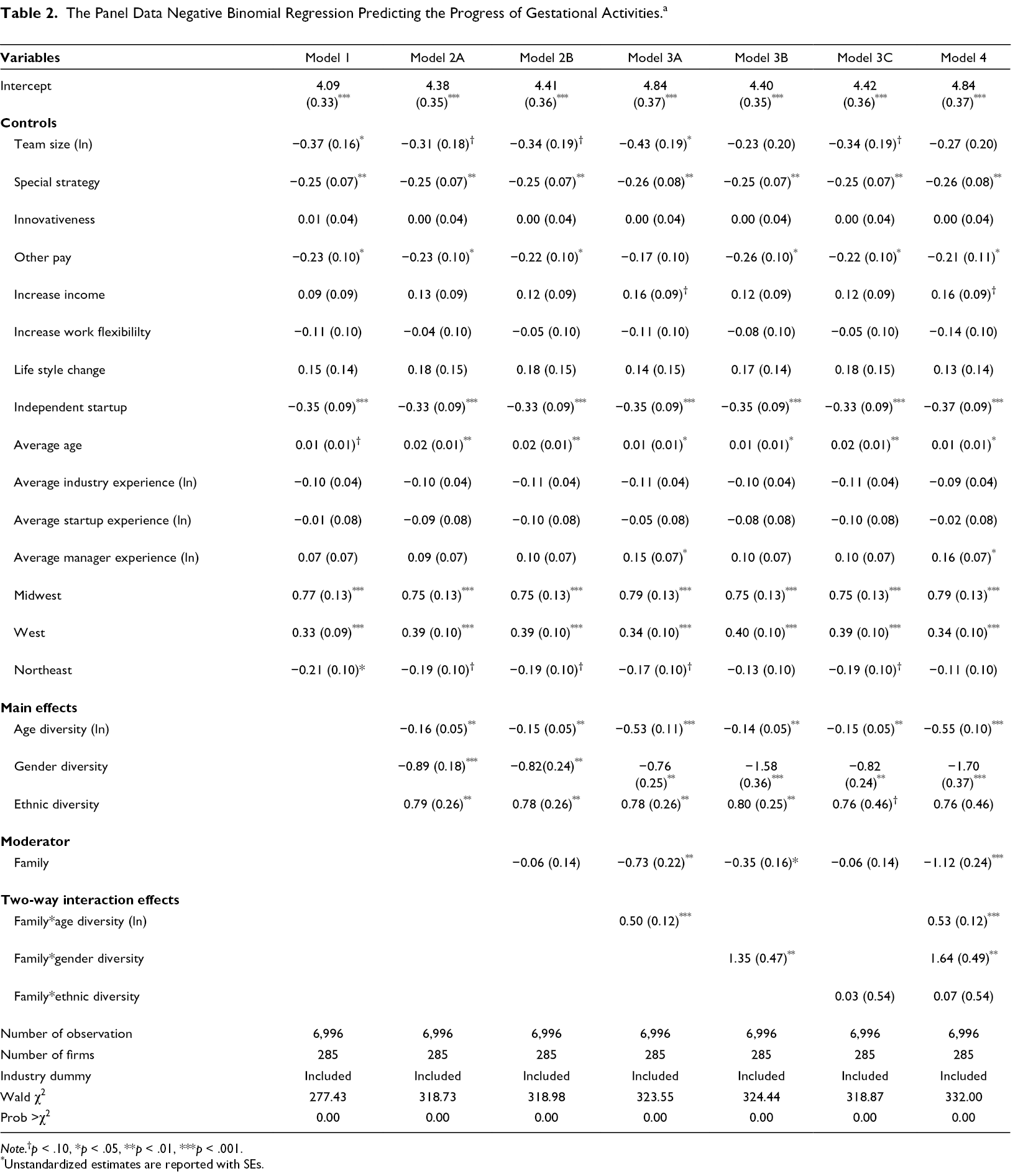
Table 2 reports the results of the panel data negative binomial regressions. Model 1 includes the base model, which contains only the control variables. The results indicate that team size (the number of owners), special strategy, whether any owner works for other companies (other pay), whether the startup is independent (not a subsidiary of other organizations), average industry experience, and location in the Northeast have negative impacts on team productivity. In contrast, average age and locations in Midwest and West affect productivity positively.
The Panel Data Negative Binomial Regression Predicting the Progress of Gestational Activities.a
Note. † p < .10, *p < .05, **p < .01, ***p < .001.
*Unstandardized estimates are reported with SEs.
Model 2A shows the main effects of bio-demographics on initiated gestational activities. Consistent with Hypotheses 1a and 2a, bio-demographic diversity in terms of age (−0.15, p < .01) and gender (−0.89, p < .001) illustrated significant negative main effects on the cumulative number of initiated gestational activities. In contrast to our predictions in Hypothesis 3a, ethnic diversity (0.79, p < .01) illustrated a positive main effect on initiated gestational activities. Additionally, we have examined the impact of the proportion of family relationships on productivity (Model 2B), although it was not included as a hypothesis in this study. The family variable by itself has a negative, though not significant, impact on productivity.
Hypotheses 1b, 2b, and 3b suggested that family relationships in nascent ventures would positively moderate the relationship between initiated gestational activities and bio-demographic diversity as defined via (1) age, (2) gender, and (3) ethnicity. Only the interactions with age diversity (0.50, p < .001) and gender diversity (1.35, p < .01) were significant, supporting Hypotheses 1b and 2b, but not 3b. Models 3A, 3B, and 3C report the interaction models including main effects and the effect of each interaction between the proportion of family relationships and each type of diversity. These effects were also confirmed in the full model (Model 4), which includes all interactions between the proportion of family relationships and all types of bio-demographic diversity. Consistent with best practices in the literature, we probed significant interactions to find the exact nature of the effects by using mean-centered variables (Dawson, 2014). Figure 1(a) shows that, as predicted, initiated gestational activities dramatically decrease as age diversity increases in teams with a low proportion of family relationships. In teams with a high proportion of family relationships, this effect is reversed. Increased age diversity actually increases productivity in this case. Similarly, Figure 1(b) shows that the number of initiated gestational activities dramatically decreased as gender diversity increased in teams with a low proportion of family relationships, but the negative effect of gender diversity is mitigated in teams with a high level of family relationships.

(a) Age diversity and progress of gestational activities. (b) Gender diversity and progress of gestational activities.
Robustness Tests
To establish the robustness of our model, we ran multiple additional analyses. Overall, these results are aligned with the results that we found in our main analysis, suggesting the robustness of the main findings. First, we examined a different outcome variable. Using the milestone of “achieving the first sale” as an alternative productivity measure, we found that family relationships significantly and positively moderated all bio-demographic diversity in terms of age, gender, and ethnic diversity (like our main analyses). Second, we conducted more analyses using just the first year (12 months) of data, since the composition of teams may change over time, and we initially only considered bio-demographical information of team members in year one. Here, we used both the negative binomial and OLS regressions; both models show that bio-demographic diversity, except for ethnic diversity in the negative binomial regression, positively interacts with the family moderator, strengthening our main arguments. Third, we used the yearly observations (instead of monthly observations) to predict the progress of gestation activities year by year. We find that the proportion of family relationships positively moderates the effects of age and gender diversity, confirming our main arguments. However, the interaction between the family variable and ethnic diversity is not significant, which agrees with our main finding. Fourth, to clarify the effects of family ties, we conducted several analyses. We tested whether an alternative measure of family embeddedness (family teams versus nonfamily teams) would produce the same results. The results are robust. We specified that if 50% or more of the relationships in a team were family relationships, the alternative moderator “family team” was coded 1; otherwise, it was coded 0. And, in consideration of the compounding effect between family teams and nonfamily teams, we conducted an analysis excluding mixed teams (i.e., teams consisting of both family and nonfamily members). In family teams, all bio-demographic diversity measures have positive impacts on productivity. On the other hand, gender and age diversities in nonfamily teams have negative impacts, although only gender diversity is significant. Fifth, we examined another type of close relationship, friendships, which might account for the identity confirmation process in teams. We tested whether teams consisting of only friendships experienced the same effects of bio-demographic diversity relative to teams with only family relationships. Results show that all bio-demographic diversity measures are positive and significant in teams with family ties, but not in friendship teams—in short, family ties and friendships are distinct with regards to buffering the effects of bio-demographic diversity. Sixth, we examined a different computation of age diversity. Here, we computed age diversity with the coefficient of variation, as many prior team diversity studies have done, to measure a level of diversity for a continuous variable. The results generated qualitatively the same results (i.e., the proportion of family relationships mitigate the negative impacts of age and gender diversity). Seventh, we conducted the negative binomial regression excluding the ethnic diversity measure in consideration of the potential correlation between ethnic diversity and family relationships. Without ethnic diversity, the results of the main and interaction effects of age and gender diversities are still robust.
Discussion
Extrapolating the extant research findings related to bio-demographic diversity and team performance, we examined age diversity, gender diversity, and ethnic diversity in a representative sample of nascent venture teams in the United States. We found mixed support for our hypotheses related to the main effects of bio-demographic diversity on nascent venture team productivity. Age diversity and gender diversity were both negatively related to nascent venture team productivity, while we found a positive relationship with ethnic diversity. Here, Hypotheses 1a and 2a were supported, but not 3a.
We integrated family business literature and the potential mitigating effects of family relationships with the effects of bio-demographic diversity on team productivity, and again found mixed support for our primary hypotheses. Family relationships moderated the effect of age diversity and gender diversity (but not ethnic diversity) on the outcome of nascent venture team productivity. Here, Hypotheses 1b and 2b were supported, but not 3b. Multiple contributions emerge from our findings.
Theoretical Implications
Our main contribution relates to the examination of bio-demographic diversity in nascent ventures. Explorations of bio-demographic diversity in larger organizations often find no relationship to team performance (e.g., Certo et al., 2006; Chowdhury, 2005; Homberg & Bui, 2013; Horwitz & Horwitz, 2007) or even positive relationships. Pelled et al. (1999) and Jehn (1995) found that performance was not affected because members would simply choose not to work with people with whom they experienced conflict. This extant work, not surprisingly, is ill-suited to explain how bio-demographic diversity might affect nascent venture teams in which members must work together because of the small team size and overlapping, undefined roles and responsibilities. In nascent ventures without defined organizational structures and heightened executive job demands, managerial discretion will be high (Hambrick et al., 2005), which is fundamentally different in top management teams in large firms. The literature supports this distinction, as the impact of executives may not remain constant over time but should be stronger when the firm is smaller (Hatton & Raymond, 1994). Also, when people are engaged in unfamiliar tasks, they display more self-categorization activity (Grieve & Hogg, 1999). Our exploration, situated in the nascent venture context, enables us to observe the implications of biodemographic diversity on a team’s productivity more clearly, which complements existing research with greater nuance.
However, according to Ruef et al. (2003), team formation can be driven by biodemographic homophily in terms of ethnicity and gender. Undoubtedly, homophily would have a great influence on a nascent venture team’s bio-demographic composition, which possibly hinders our investigation. In this vein, our findings on the negative impacts of age and gender diversity on team productivity are notable because, even after considering the effect of homophily, the implications of social identity theory (e.g., categorization and depersonalization) (Tajfel et al., 1971) are still valid. We illustrate that particularly high levels of age and gender diversity could indeed have negative implications on team productivity in a nascent venture, despite familiarity among team members. This may mean that acquaintance or familiarity does not necessarily settle the issue of identity incongruences originated by biodemographic differences. Thus, our study helps resolve inconsistencies and nonfindings regarding the relationship between bio-demographic diversity and team outcomes (Homberg & Bui, 2013; Horwitz & Horwitz, 2007) in the early stages of venture development. This advances current knowledge with regard to the study of social identity theory, broadening its applicability to the earliest stages of venture development.
Our second main contribution stems from our work to advance understanding of family relationships as moderators in the nascent venture context. Multiple processes such as social integration, informal communication (Smith et al., 1994), cohesion (Ensley et al., 2002), and social norms (Jehn, 1994) have been suggested as possible moderators of the negative impacts instigated by biodemographic diversity. Here, it is worthwhile to mention that many studies arguing ‘social identity theory’ are based on groups in which personal relationships are understated, such as sports teams (Fink et al., 2009), artificial and temporary groups for experiments (Eckel & Grossman, 2005), or student project teams (Smith & Woodworth, 2012). In those instances, people work together to achieve common goals, but interpersonal attractions or relationships do not play much of a role in the performance of such groups (Hogg & Hains, 1996). Even though the negative impacts of biodemographic diversity are theoretically rooted in social categorization (and thus in discrepancies between how perceivers see targets and how targets see themselves), it should be noted that one of the contexts that strongly influences identity congruence (French et al., 2000)—family relationships—has received minimal attention in the team diversity literature. By integrating the family business and team diversity literature, we identify new insights into the unique characteristics of family relationships that can mitigate the negative impacts of bio-demographic differences. When we examined the effect of bio-demographic diversity contingent on family relationships, a clear pattern emerged: family relationships positively moderated the negative impact of bio-demographic diversity, particularly age and gender diversity, on a team’s productivity. This robust finding shows that the team members whose relationships are familial effectively overcome the otherwise negative implications of a social categorization process based on age and gender. In other words, the impact of bio-demographic diversity is negative, but these effects depend on context, that is, family relationships. This finding is aligned with conceptual arguments emphasizing the importance of family social capital (Arregle et al., 2007) and social self-identity argued in self-verification theory (Swann et al., 2004).
Our work also heeds the call of family business scholars to further explore family businesses in new venture creation (Sharma et al., 2012). In extant studies, most family business scholars have focused on established family firms and have argued for the negative aspects of family relationships. For instance, altruism can have negative impacts on the performance of a family firm because altruism can prompt parents to threaten their children with moral hazard (Buchanan, 1975; Schulze et al., 2001). Altruism can create agency challenges, such as self-control problems of parents, nepotism, and freeriding (Chrisman et al., 2007; Chua et al., 2009), endangering the performance of a family firm (Schulze et al., 2001; Verbeke & Kano, 2012). Also, women in the family business are often faced with discrimination and stereotyping because of societal prejudices (Salganicoff, 1990). In sibling relationships, the negative impacts of sibling rivalry in family businesses have been repeatedly pointed out (e.g., Vera & Dean, 2005). However, the role of family relationships in new venture creation has received little attention (see Discua Cruz et al., 2013; Habbershon, 2006). Our study, in contrast to the predominant context of the extant family literature, focuses on the positive aspects of family ties in the early stage of firm development: how the unique characteristics of family relationships benefit a new venture’s team productivity. Here, family ties may not have a direct positive impact on a nascent firm but are shown to have indirect positive effects by interacting with bio-demographic diversity among team members. This is consistent with what Blatt (2009) argued, as relational capital (i.e., family ties) can be viewed as an asset of entrepreneurial firms. Thus, without considering the embedded relationships in a new venture team, scholars may misrepresent the implications of bio-demographic diversity or may not see the relational capital in a family. This speaks to the importance of broadly examining the extent and intensity of relationships among team members (Blatt, 2009; Brickson, 2000).
Our last contribution is that we propose a general theoretical framework on how the identity confirmation process can be achieved through identification with a collective and cross-categorization of different types of identities (i.e., social identity versus role identity) through family relationships. As mentioned earlier, multiple moderators have been suggested and empirically proven in team diversity literature (Cox, 1994; Jehn, 1994; Smith et al., 1994). However, previous research has not yet provided a proper explanation as to why those processes are relevant to social identity theory, which most team diversity studies relied on to explain the negative implications of bio-demographic diversity. In this paper, we proposed two theory-based underlying mechanisms of the identity confirmation process.
First, we suggest that potential stereotyping and social categorization associated with bio-demographic differences (Tajfel et al., 1971) can be overcome by identification with a collective (here, family). More specifically, ‘identification’ occurs when individuals see themselves as part of a superordinate group. If two individuals see themselves as part of the same group (e.g., a family), the identification with a collective will reduce members’ cognitive uncertainty toward each other, even if they have different bio-demographic characteristics. Also, when family members share a superordinate group (family) identity, their individual motivation for self-enhancement over others will decrease as will individualistic and opportunistic behaviors. Sherif (1958) argued the importance of superordinate group identity in achieving organizational goals by surmounting challenges associated with any factors triggering conflict among team members. However, attempts to overcome categorizations and resultant stereotypes are daunting in nascent venture contexts because the business identity and associated firm goals are unclear and fluid. Here, we show that the superordinate group identity established outside the business context (i.e., family) can be effective, translating the bio-demographical diversity’s potential into reality. Second, with regard to the process of cross-categorization, in which one identity (e.g., gender) crosses with another identity (e.g., a functional role) (Brickson, 2000), a perceiver’s cognitive schema can get confused resulting in a canceling-out effect (Brewer et al., 1998) or deemphasis of one identity. For example, a role identity that has greater daily practical implications will be a salient identity in a team context. This aids identity confirmation between a target and perceiver as they acknowledge the other’s roles and contributions and will mitigate the negative effects of bio-demographic differences.
Practical Implications
It is clear that we cannot change diversity (e.g., age, gender, ethnicity) nor can we embed family relationships where they do not already exist. We acknowledge that, given limited resources, time, and an unpredictable environment, it might be very challenging for entrepreneurial teams to pay attention to the internal processes of a nascent venture (McMullen & Shepherd, 2006). But, based on our findings, we assert that nascent ventures can increase productivity by effectively managing the identity confirmation process among team members. This can be accomplished by facilitating identification with a collective and intentionally constructed role identity in the nascent venture context (Pelled et al., 1999; Polzer et al., 2002).
First, to facilitate a team member’s identification with the nascent venture, cofounders need to consider the importance of their organization’s identity. Pearson et al. (2008) suggested that structural dimension (e.g., network ties, shared experiences, and interactions) and cognitive dimension (e.g., shared vision, stories, and collective culture) are antecedents to the identification with a collective. In this vein, to develop an organizational identity, the cognitive dimension needs to be taken care of through a shared vision of the new venture and development of organizational culture. If team members acknowledge that their identities relate to the new organization’s identity (preferably as a superordinate group), this will help build socioemotional assets among team members, reducing the impacts of individual differences.
Further, drawing on the premise that distinct roles established from family relationships can lead to team member identification with an in-group rather than an out-group (Astrachan et al., 2002; Jehn, 1997), we advocate that team members in new ventures establish explicit roles and processes to circumvent the potential negative effects of diversity on productivity. For instance, we encourage team members in nascent ventures to develop a robust operating agreement, including the explicit roles and responsibilities of each team member. In addition to the operating agreement, we advocate that team members in nascent ventures draft a shared document that outlines the specific contributions the team members want to make to the nascent venture. We know that, in the unsettled circumstance of nascent startups, cognitive shortcuts (e.g., stereotypes) are prevalent, which can lead to efforts to reduce uncertainty and to preserve self-image. We assert that drafting a ‘contributions document’ may provide a more secure environment for defining a person’s role-based identity in the nascent venture context. We suggest that this can initiate cross-categorization, obscure the boundary based on the bio-demographic characteristics of individual members, and help new venture productivity.
Limitations and Future Research
We note the following limitations and associated future directions for research. First, although we heavily relied on the discussion of identity confirmation (Milton & Westphal, 2005) to propose how the unique characteristics of family relationships affect the mechanism of bio-demographical team diversity, we did not empirically measure team members’ level of identification with a collective and cross-categorization with a role identity. Therefore, future studies that empirically examine the level of perceived identity congruence with a new collective and perceived role identity would be of great value. Second, we entered our team diversity measures as time-invariant variables. However, we note that 13.9% of the teams had some team departure or addition during the 5 years of the study. Although this is a relatively low percentage, such team changes can potentially influence team diversity and thus productivity. Future research would benefit from taking potential team changes into consideration. Third, regarding measures, our assessment of family relationships was broad. Although our main arguments rely on overall characteristics of family relationships, we acknowledge that the strength of each specific relationship may influence the extent to which family relationships moderate the effects of diversity on nascent firm outcomes. In fact, prior research has shown that the type of family relationship (spouse vs. kin) could be important in new venture teams (Brannon et al., 2013), thus it should be noted that the nature and type of family relationships could also have significant impacts on team dynamics, directing future research areas. Fourth, surprisingly, we found that ethnic diversity had a positive impact on productivity. This is an unexpected and very interesting finding, particularly considering that in previous work, ethnic diversity was strongly related to identity and perception of one’s similarity or dissimilarity to others (e.g., Bell et al., 2011). In these data, however, 92.07% of all teams did not have any ethnic diversity (only 23 teams had some level of ethnic diversity, and all other teams were composed of people with the same ethnicity). Among the small number of teams with ethnic diversity, most teams are copreneurs, who might already achieve a considerable level of identity congruence and cohesiveness, even before starting a venture. This shows that our sample has somewhat limited applicability to investigate the true effect of ethnic diversity. Future work is recommended to expand the diversity of samples to model this type of bio-demographic diversity more accurately. Fifth, we focused on entrepreneurial teams of nascent ventures. As a new venture evolves, more stakeholders start to engage in the firm development process. Social categorization (in-group vs. out-group) may not only be based on bio-demographical differences but also other notable characteristics, such as founder versus investor (Lim et al., 2013). Since conflicts between founders and investors are not rare, it will be interesting to examine how expanded entrepreneurial teams overcome such conflicts. Sixth, we recognize constraints on generalizability in our work (Simons et al., 2017). This study does not focus on the direct effects of family relationships on organizational outcomes; therefore, the findings of this study should not be interpreted to mean that family ties have indiscriminate positive impacts on organizational outcomes. In this paper, we examine the interaction of family ties with bio-demographic diversity. Also, we emphasize that the findings of this research are most relevant to the nascent venture context. And, in terms of participants, we note that the database we used contains longitudinal data, including six waves of interviews taken between 2005 and 2010 in the US mainland (Reynolds & Curtin, 2009). Thus, the implications of our findings should be limited within the context of the US as the implications of bio-demographic diversity and family will differ across countries/cultures.
Conclusion
Based on the extant literature, it is tempting and intuitively appealing to consider the relationship between team diversity and team productivity to be straightforward. However, this relationship is much more nuanced than the literature currently portrays, which is especially true regarding nascent ventures. Accordingly, we hope that the insights highlighted by the present work afford future research a more accurate picture of how team diversity and productivity in nascent ventures are affected by family relationships.
Footnotes
Declaration of Conflicting Interests
The author(s) declared no potential conflicts of interest with respect to the research, authorship, and/or publication of this article.
Funding
The author(s) received no financial support for the research, authorship, and/or publication of this article.

Author Biographies