




Abstract
Stringent bankruptcy laws are generally understood to increase the costs of failure and thus not conducive for entrepreneurship. In this paper, theory is developed and tested exploring the moderating influences of the dimensions of culture—individualism—collectivism, masculinity–femininity, uncertainty avoidance, and power distance. Results of this study, from conditional fixed effects Poisson regressions, support that stringent bankruptcy laws are positively associated with the levels of entrepreneurial activity in certain cultural contexts.
There is growing interest among strategy and entrepreneurship scholars in how institutions affect the level of entrepreneurial activity in a country (Alvarez et al., 2015; Busenitz et al., 2000; Casson, 1990; Peng, 2003). The effects of two dimensions of these institutions have received special attention: the impact of bankruptcy laws on entrepreneurial activity (Armour & Cumming, 2008; Fan & White, 2003; Lee et al., 2007, 2011), and the impact of dimensions of culture on entrepreneurial activity (Hayton & Cacciotti, 2013; Hayton et al., 2002; McClelland, 1961; Tiessen, 1997; Weber, 1930; Zahra & George, 2002). Empirically, it has been shown that stringent bankruptcy laws, that is, laws that increase the costs of discharging bankruptcy, are associated with low levels of entrepreneurial activity in a country (e.g., Armour & Cumming, 2008), and that certain aspects of culture (e.g., individualistic, low uncertainty avoidance, and low power distance cultures (Hofstede, 1980)) are associated with high levels of entrepreneurial activity in a country (e.g., Kreiser et al., 2010, Shane, 1992, 1993).
However, while prior work has examined the independent effects of bankruptcy laws and culture on the level of entrepreneurial activity in a country, the effects of the interaction of these two dimensions of country institutions on entrepreneurial activity has not been examined. This is ironic, since, in many circumstances, law and culture are deeply interconnected (Rosen, 2006). Sometimes law codifies and reinforces cultural norms (Posner, 2009). Other times, law and culture may create conflicting incentives for behavior within a country.
The purpose of this paper is to examine the effects of the interaction between bankruptcy law and culture on the level of entrepreneurial activity in a country. After reviewing the prior literature, the paper develops a series of four hypotheses about the effects of stringent bankruptcy laws on the level of entrepreneurial activity in a country, conditional on the kind of culture that dominates that country. Drawing on Hofstede’s (1980) work and prior research on culture and entrepreneurship (Hayton et al., 2002; McGrath et al., 1992; Shane, 1992), the interactive effects of four dimensions of culture are examined: individual versus collective cultures, masculine versus feminine cultures, low versus high uncertainty avoidance cultures, and low versus high power distance cultures. The results show that the impact of stringent bankruptcy laws depends, for some cultural dimensions, on the type of culture within which these laws are operating. Further, the results of this study support that, in some cultural contexts, stringent bankruptcy laws are associated with higher levels of entrepreneurial activity.
Theory Development and Hypotheses
Bankruptcy Laws and Entrepreneurial Activity
Declaring bankruptcy makes business failure visible and imposes legal, social, and psychological costs. Ingbretsen (2003, p. xiv) captures the personal and emotional dimensions associated with entrepreneurial failure in his description of the consequences of a business failure:
“Following the death of the dream comes the nasty publicity and often the litigation, the calls from irate creditors, the moments of terror and self-doubt. And all that is just for starters. Worst of all might be the loss of privacy and dignity that results when news surfaces that a business is about to crash and burn. When that happens, suddenly your life becomes an open book, the butt of jokes, a continuing story on the nightly news.”
In light of the visible nature of bankruptcy, the degree of “forgiveness” or “punishment” entailed by bankruptcy laws is an important factor that determines the consequences of failure and entrepreneurial activity (Armour & Cumming, 2008).
For example, Lee et al. (2007) argue that stringent bankruptcy laws, that is, laws that involve greater punishment for failure, increase the fear of failure and therefore create ex-ante barriers for engaging in entrepreneurial activity. Also, stringent bankruptcy laws which entail costly bankruptcy procedures are likely to deter business exit. Lack of business exit in an economy locks productive resources from being channeled into better opportunities, thus dampening societal level entrepreneurial activities. Consequently, prior work has argued that less stringent bankruptcy laws minimize the downside of failure and act like real options for entrepreneurs where the downside of failure is minimized but the upside of engaging in entrepreneurial activity can be encouraged (Lee et al., 2007).
Following these arguments, differences in bankruptcy laws have been shown empirically to have a direct impact on the levels of entrepreneurial activity across countries. In general, studies show that countries with lenient bankruptcy laws, that is, laws that impose fewer costs on those declaring bankruptcy, have higher levels of entrepreneurial activity compared to countries whose bankruptcy laws impose high costs on failed entrepreneurs (Armour & Cumming, 2008; Lee et al., 2011). These results have been shown to hold for both corporate bankruptcy laws (Peng et al., 2010) and personal bankruptcy laws (Armour & Cumming, 2008).
Cultural Norms Around Entrepreneurship and Entrepreneurial Activity
The relationship between bankruptcy laws and entrepreneurship, however, may also be influenced by other elements in a country context. For example, studies have shown cultural values regarding risk and beliefs about the stigma associated with entrepreneurial failure (Shepherd, 2003) have an impact on the rate of entrepreneurship in a country (Shane, 1996). Countries with cultures that are more accepting of entrepreneurial failure tend to have a higher rate of entrepreneurship compared to countries with less accepting cultures (Begley & Tan, 2001).
Most of the literature on cultural influences on entrepreneurial activity applies Hofstede’s taxonomy of cultural dimensions (Hofstede, 1980). Four of these dimensions–individualism versus collectivism, masculinity versus femininity, high versus low uncertainty avoidance, and high versus low power distance—have received the most attention. It has been hypothesized that entrepreneurship is facilitated by cultures that are high in individualism, low in uncertainty avoidance, low in power-distance, and high in masculinity (Herbig, 1994; Hofstede, 1980; Shane, 1992). Results suggest that the entrepreneurship in countries is higher when a country’s culture is high in individualism, low in uncertainty avoidance, and low in power distance (Shane, 1993). In addition, studies at the level of individuals suggest that high masculinity is positively associated with entrepreneurship (McGrath et al., 1992).
The Effects of Culture and Law on Entrepreneurial Activity
While prior work has focused attention on the direct effects of law or culture, the possible interaction of these country institutions on entrepreneurial activity is yet to be examined. This is likely to be very important because the effectiveness of legal interventions can be deeply affected by the culture in a country (Posner, 2009). In fact, several scholars have suggested the need for studies focused on the interaction of culture and institutions—including the law—for understanding the differences in levels of entrepreneurial activities in different parts of the world (Cumming et al., 2009; Hayton et al., 2002; Peng et al., 2010; Welter, 2011; Zahra & Wright, 2011).
In the next several sections, hypotheses are developed that examine the impact of the interaction between bankruptcy laws and country cultures on the levels of entrepreneurial activities in a country. These hypotheses apply the four most commonly studied dimensions of Hofstede’s taxonomy of culture as moderating influences between the stringency of a country’s bankruptcy laws and the level of entrepreneurial activity in the country.
Bankruptcy Law and Individualistic Versus Collectivistic Cultures
Stringent bankruptcy laws likely impose high costs on failed entrepreneurs (Armour & Cumming, 2008). In individualistic cultures that encourage risk-taking and celebrate individual successes (Hofstede, 1980; Triandis, 1989), failure will be recognized as a possible, almost inevitable, outcome of individual decisions to pursue entrepreneurial activities, and few social costs will be borne by failed entrepreneurs. In these settings, the only significant costs borne by failed entrepreneurs are likely to come from bankruptcy laws. The more stringent these laws, the less likely individuals are to engage in entrepreneurial activities.
On the other hand, in collectivistic cultures which tend to discourage risk-taking (Hofstede, 1980; Kreiser et al., 2010), entrepreneurial failure is likely to be punished through social mechanisms–stigmatization, social ostracization, ridicule, and so forth (Goffman, 1963; Posner, 2009). In this context, highly stringent bankruptcy laws may be perceived to partially offset the level of socially required punishment for failure, and thus may be positively associated with the level of entrepreneurial activity in a country with a collectivistic culture.
Together, these arguments lead to the first hypothesis:
Bankruptcy Law and Masculinity-Femininity
Masculine cultures celebrate success, ambition, and wealth (Hofstede, 1980). Such cultures place a great emphasis on success (Collins et al., 2004; Newman & Nollen, 1996; Rogers, 1983), and thus entrepreneurial failure in these cultures is likely to be punished through social mechanisms. However, stringent bankruptcy laws may be perceived to partially offset the level of social punishment required for failure, and thus may be positively associated with the level of entrepreneurial activity in a country with a masculine culture.
In feminine cultures—cultures that emphasize help, forgiving, and caring for others (Hofstede, 1980)—entrepreneurial failure is likely to be met with empathy and sympathy, not punished through social stigmatization. Thus, the social costs borne by failed entrepreneurs are likely to be small. Stringent bankruptcy laws, in these settings, are likely to be the primary source of costs imposed on failed entrepreneurs, and thus should lead to lower levels of entrepreneurial activity in a country with a feminine culture.
Taken together, these arguments lead to the second hypothesis.
Bankruptcy Law and Uncertainty Avoidance
Uncertainty avoidance refers to rejection of ambiguity or uncertainty in order to avoid anxiety (Hofstede, 1980). In cultures of high uncertainty avoidance, individuals are less comfortable in unstructured, novel or surprising situations versus stable or known situations. This emerges as a fear of uncertain situations, a suppression of deviant ideas and behaviors, adoption of strict codes of behavior, and resistance to innovation (Steenkamp et al., 1999). The feeling of “what is different is dangerous” prevails (Hofstede, 1991, p. 119). In such settings, entrepreneurial failure is likely to be punished through social mechanisms. Bankrupt individuals may be more likely perceived as “different,” mistreated and stigmatized (Goffman, 1963). Under these conditions, stringent bankruptcy laws may be perceived to partially offset the perceived level of socially required punishment for failure, and thus may be positively associated with the level of entrepreneurial activity in a country with a high uncertainty avoidance culture.
On the other hand, in cultures of low uncertainty avoidance, failure and bankruptcy may not be associated with high levels of stigma or other social costs and may be viewed more positively (Barr, 1992). Under such conditions, stringent bankruptcy laws are likely to be the primary source of costs imposed on failed entrepreneurs, and thus should lead to lower levels of entrepreneurial activity in a country with a low uncertainty avoidance culture.
These arguments lead to the third hypothesis:
Bankruptcy Law and Power Distance
Power distance is “the extent to which the less powerful members of institutions and organizations accept that power is distributed unequally” (Hofstede & Bond, 1984, p. 419). To some degree, it also refers to how much individuals believe that unequal distribution of power is the proper way for social systems to be organized (Morrison, 2000; Newman & Nollen, 1996). The emphasis is on maintaining current status in the social order and there is less of an emphasis on social mobility in these societies.
Following the attributes of high power distance cultures, entrepreneurial failure could serve as a way to distinguish between ‘successful’ and ‘failed/bankrupt’ individuals. Consequently, bankrupt individuals are likely to occupy lower status and their social mobility could likely be restricted in societies of high power distance through social norms of shunning and stigmatizing failed individuals. Under these conditions, stringent bankruptcy laws may be perceived to partially offset the level of socially required punishment for failure, and thus may be positively associated with the level of entrepreneurial activity in a country with a high power distance culture.
On the other hand, low power distance cultures encourage individuals to engage in risky behaviors aimed at improving their status (Shane, 1992). Therefore, the social costs of failure and bankruptcy are also likely to be lower in such societies. Under such conditions, stringent bankruptcy laws are likely to be the primary source of costs imposed on failed entrepreneurs, and thus should lead to lower levels of entrepreneurial activity in a country with a low power distance culture.
These arguments lead to the fourth hypothesis:
Method
Data
Data for this study come from several sources. The number of self-employed employers (i.e., the self-employed individuals who have employees working for them) and the total employed by country and by year are obtained from the Labor Statistics of the International Labor Organization. Data regarding the stringency of bankruptcy laws in a country have been obtained from the respective country’s legal documents and International Insolvency Institute reports. 1 Data on GDP growth, total population, life expectancy at birth, corporate and individual tax rates, and unemployment levels have been obtained from the World Bank’s World Development Indices. Tax rate data were manually verified and missing data were filled from PriceWaterhouseCoopers worldwide tax summaries. Favorability of business regulation, credit market controls, and strength of legal system and property rights to promoting business in a country were obtained from the Economic Freedom Indices of Fraser Institute (Gwartney et al., 2013). Hofstede’s scales were used for the cultural variables (Hofstede, 1984, 2001). 2
The time frame is from 1995 to 2013. Twenty seven countries were represented in the study based on the data availability constraints. These are Australia, Belgium, Bulgaria, Canada, the Czech Republic, Denmark, Germany, Greece, Hong Kong, Hungary, Ireland, Israel, Italy, Japan, Malaysia, the Netherlands, New Zealand, Poland, Romania, Singapore, Spain, Sweden, Switzerland, Thailand, Turkey, the United Kingdom, and the United States. 3 Of these countries, 13 of them experienced a bankruptcy law change in terms of decrease in the stringency of their bankruptcy laws. 4
Variables and Measures
Dependent Variable
The dependent variable in this study—the level of entrepreneurial activity in a country–has been operationalized as the total number of ‘self-employed employers’ in a country (in thousands). These ‘self-employed employers’ are individuals who have scaled-up to employ others to work for them on a continuous basis. 5 These entrepreneurs, who own and manage a business, take the risk and bear the consequences of success or failure of the business, which is important for the conceptualization of entrepreneurship underlying this study (Armour & Cumming, 2008; van Stel, 2005). The definition of self-employed employers is from the International Labor Organization Labor Statistics dataset. 6
Independent Variables
The stringency of the bankruptcy laws proxies the costs of bankruptcy. Following Armour and Cumming (2008), the stringency of bankruptcy laws for a country can be gauged from the length of time after which a bankrupt individual is ‘discharged’ from the burden of prebankruptcy indebtedness and allowed a ‘fresh start’ to engage in entrepreneurial activity. 7 This is termed ‘time to discharge.’ The ‘time to discharge’ from bankruptcy has been captured from the legal statutes of various countries as the ‘number of years taken for a person to be discharged from the liability of bankruptcy’ (see Appendix A). When bankruptcy laws are stringent, it takes longer to get a ‘discharge’ from bankruptcy, that is, the ‘time to discharge’ is likely to be longer, and the costs of bankruptcy are likely to be much higher (Armour & Cumming, 2008).
This ‘time to discharge’ varies across and within countries. Across countries, there were differences in whether or not a ‘discharge’ was allowed from bankruptcy and also in terms of the number of years it took to get a ‘discharge,’ where allowed. For example, the US Federal Bankruptcy Code permits immediate discharge (or ‘automatic discharge’) under Chapter 7, which releases the bankrupt individual from prebankruptcy indebtedness. On the other hand, in countries, such as Spain, there is no ‘discharge’ available and a bankrupt individual carries the obligation to repay prebankruptcy creditors for the rest of his or her life. In these latter instances, the ‘time to discharge’ was calculated as the difference between life expectancy at birth and the average age of an entrepreneur. 8 As mentioned earlier, there were also differences between countries in terms of how long it took to get a ‘discharge’ from bankruptcy. For example, in Australia the ‘time to discharge’ was 3 years during the time period of this study; whereas the ‘time to discharge’ was ten years in Greece in the same time period.
Within countries, the ‘time to discharge’ varies with the enactment of changes to their bankruptcy laws. As mentioned previously, there are 13 countries in this sample that experienced a change in their bankruptcy laws in this regard, in the time frame of the study.
To mention a few examples: in Poland, an ‘automatic discharge’ was allowed beginning in 2003; in the UK, a ‘discharge’ was permitted after 3 years until 2004, which was further decreased to 1 year later on; in Germany, a ‘discharge’ from bankruptcy was allowed starting in 1999 and the ‘time to discharge’ was 7 years, which was further reduced to 6 years in 2001; in Singapore, the ‘time to discharge’ was 5 years until a bankruptcy law reform in 1999 lowered it to 3 years.
The cultural dimensions of individualism-collectivism, masculinity-femininity, uncertainty avoidance, and power distance are the other key independent and moderating variables. Hofstede’s cultural scores were used for this purpose (Hofstede, 1984, 2001). Each country was marked ‘individualistic’ or ‘collectivistic’ based on whether the country had an ‘above average’ or ‘below average’ value of ‘individualism,’ respectively, compared to the sample average during the time period of the study. 9 For the countries classified as individualistic cultures, the individualistic cultures dummy was coded “=1” and for the countries classified as ‘collectivistic’ cultures, the individualistic cultures dummy was coded “=0.” The same procedure was applied to group countries into “masculine” or “feminine” (masculine cultures dummy coded =”1” or =“0,” respectively), “high uncertainty avoidance” or “low uncertainty avoidance” (uncertainty avoidance cultures dummy coded = “1” or = “0,” respectively), and “high power distance” or “low power distance” cultures (power distance cultures dummy coded =“1” or =”0,” respectively. 10
Control Variables
Possible alternative explanations of the relationship between bankruptcy laws, culture, and entrepreneurial activity are examined by including a variety of control variables in the estimated models. For example, an increasingly munificent environment may reduce the perceived personal and legal costs of bankruptcy, since such environments hold the promise of additional entrepreneurial opportunities (Pinillos & Reyes, 2011). The possible impact of an increasingly munificent environment on the relationship between law, culture, and the level of entrepreneurship is captured by including a country’s year-on-year GDP growth rate (Dess & Beard, 1984) in the models.
Prior studies have also shown that other aspects of the institutions in a country, besides bankruptcy law and culture, can be associated with both bankruptcy laws and culture, on the one hand, and the level of entrepreneurial activity in a country, on the other. These other dimensions of a country’s institutional context include the level of business regulation (van Stel et al., 2007), credit market controls (Fung et al., 2000), and the strength of legal system and property rights regime (Johnson et al., 2006). To control for the possible impact that these other dimensions of institutions can have on the relationship between bankruptcy laws, culture, and entrepreneurial activity, data on these variables were taken from the Economic Freedom of the World Index and included in the models.
Finally, the levels of unemployment, taxation, and education (secondary level) in a country—all of which have been shown to have an impact on entrepreneurial activity in a country (Armour & Cumming, 2008) and could affect the relationship between bankruptcy law, culture, and entrepreneurial activity–were all used as control variables. In addition, since the dependent variable in this study was the total number of self-employed employers, the total number of employed excluding the total self-employed employers, was also used as a control variable.
Analysis and Results
The data form an unbalanced panel. The study period is from 1995 to 2013. Table 1 shows the summary statistics for two subsamples. Subsample A comprises those countries in which bankruptcy is not discharged. 11 Subsample B includes those countries in which bankruptcy is discharged after a certain time period. For the purposes of this study, these subsamples A and B represent countries with stringent bankruptcy laws (i.e., higher costs of bankruptcy/failure) and those with relatively less stringent or lenient bankruptcy laws (i.e., lower costs of bankruptcy/failure), respectively.
Summary Statistics for Countries with ‘No Discharge’ Allowed and ‘Discharge’ Allowed From Bankruptcy.
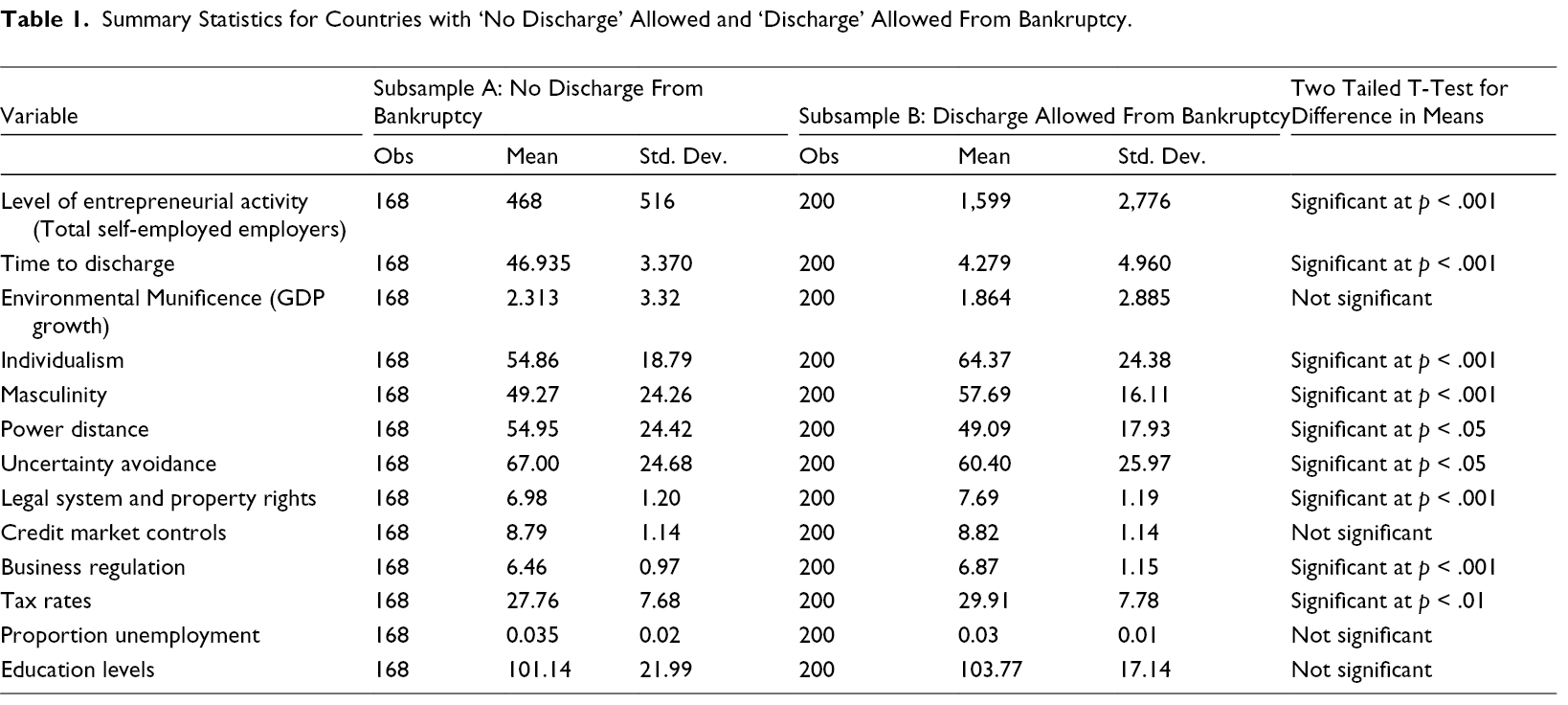
It appears the level of entrepreneurial activity is higher in countries where bankruptcy is discharged as compared to countries in which bankruptcy is not discharged. The result from the t-test for difference in means is significant (in the last column). 12 This suggests that, in general, a lenient (or less stringent) bankruptcy law regime is likely to be conducive for entrepreneurial activity, which is the baseline argument on which the hypotheses of this paper are developed. 13
Further, the countries with no discharge from bankruptcy (i.e., stringent bankruptcy laws) have higher GDP per capita growth, are more collectivistic, are more feminine, have greater uncertainty avoidance, have greater power distance, less favorable legal system and property rights, less favorable business regulation, and less favorable credit market controls. These countries also have lower tax rates, lower levels of education (secondary level), and higher proportion of unemployed compared to countries where bankruptcy was discharged (i.e., countries with lenient bankruptcy laws). The two-tailed t-tests for differences in means (displayed in the last column of Table 1) show that the differences are not significant in case of environmental munificence (GDP growth rate), credit market controls, proportion of unemployment, and education levels, but significant for all the other variables.
Table 2 shows the correlation matrix. In this matrix, the total self-employed employers (proxy for entrepreneurial activity) is negatively related to the ‘time to discharge’ from bankruptcy, as per expectation. Also, while there are significant differences between the cultural dimensions between countries that do not allow discharge from bankruptcy and those that allow discharge from bankruptcy, these cultural dimensions do not exhibit significantly high correlations with the ‘time to discharge’ from bankruptcy. There were, of course, a few variables that were highly correlated with each other, for example, the matrix shows the variable ‘legal systems and property rights’ has a high positive and significant correlation at p < .01 with ‘business regulation.’
Correlation Matrix.
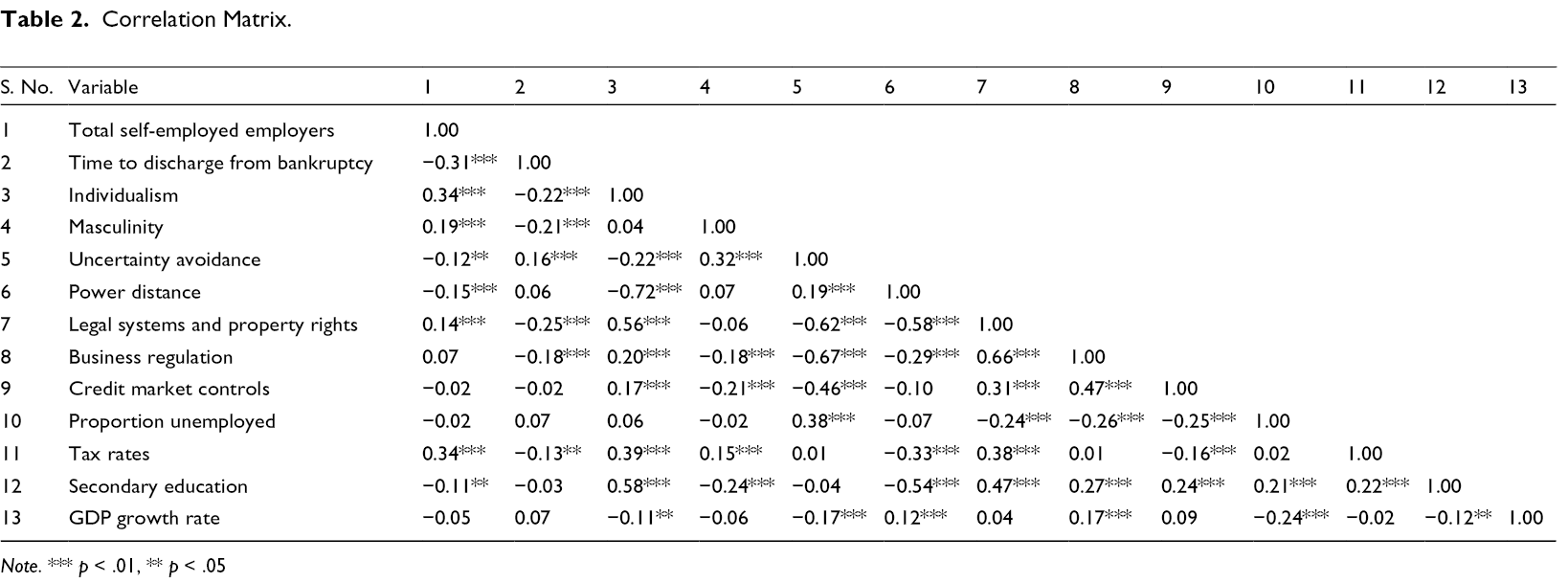
Note. *** p < .01, ** p < .05
The conditional fixed effects Poisson regression models were used for testing Hypotheses 1–4, respectively, since these Poisson regressions make fewer distributional assumptions. 14 These models use robust standard errors that were adjusted within country clusters. The coefficients from these estimations could be directly interpreted for marginal effects.
Models A-E in Table 3 display these results.
Results From Conditional Fixed Effects Poisson Regressions for Hypothesis 1–4+.
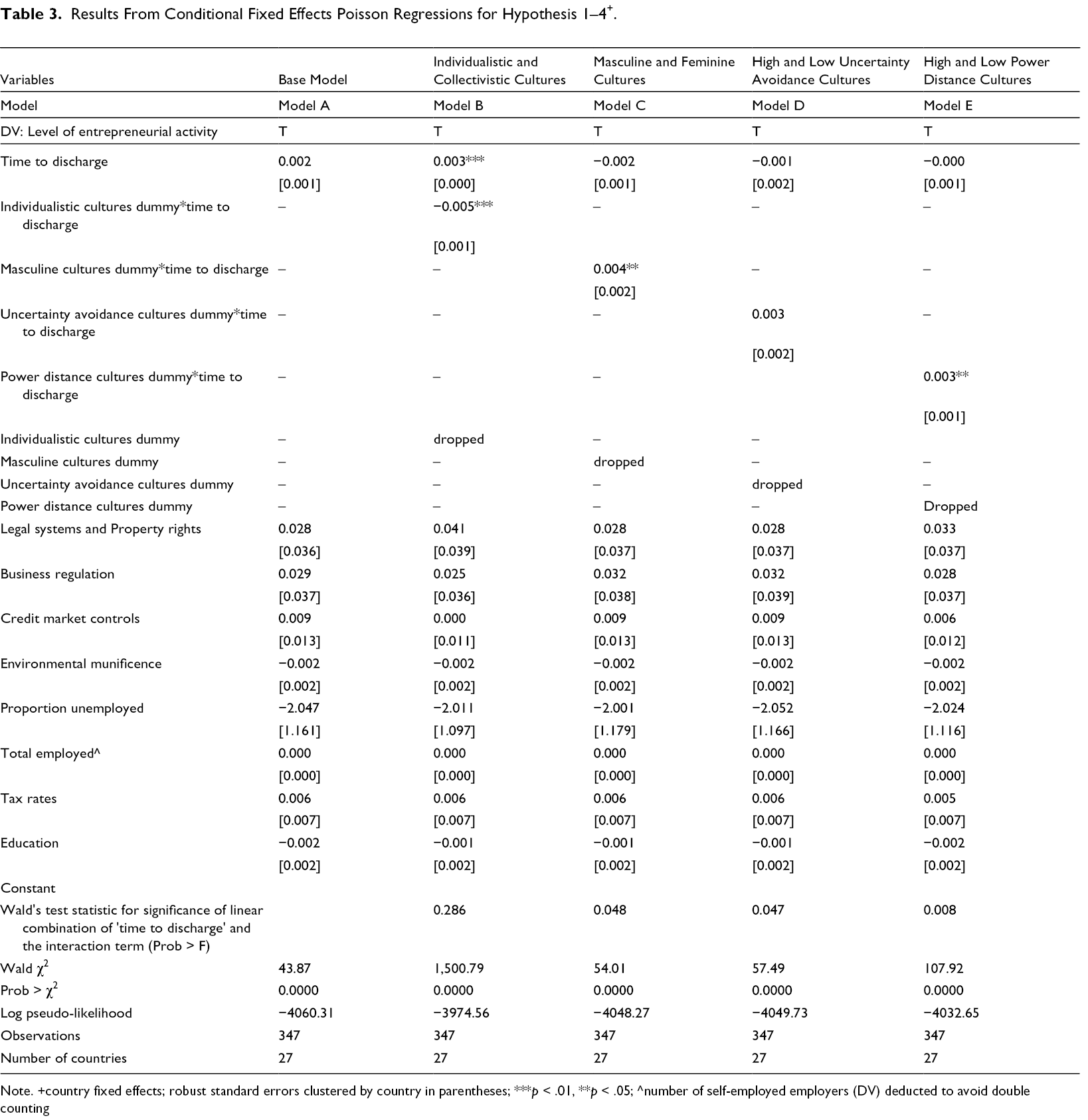
Note. +country fixed effects; robust standard errors clustered by country in parentheses; ***p < .01, **p < .05; ^number of self-employed employers (DV) deducted to avoid double counting
In Model A, which tests the base relationship, the coefficient of ‘time to discharge,’ with p < .1 did not support any significant relationship between stringent bankruptcy laws and the level of entrepreneurial activity in a country.
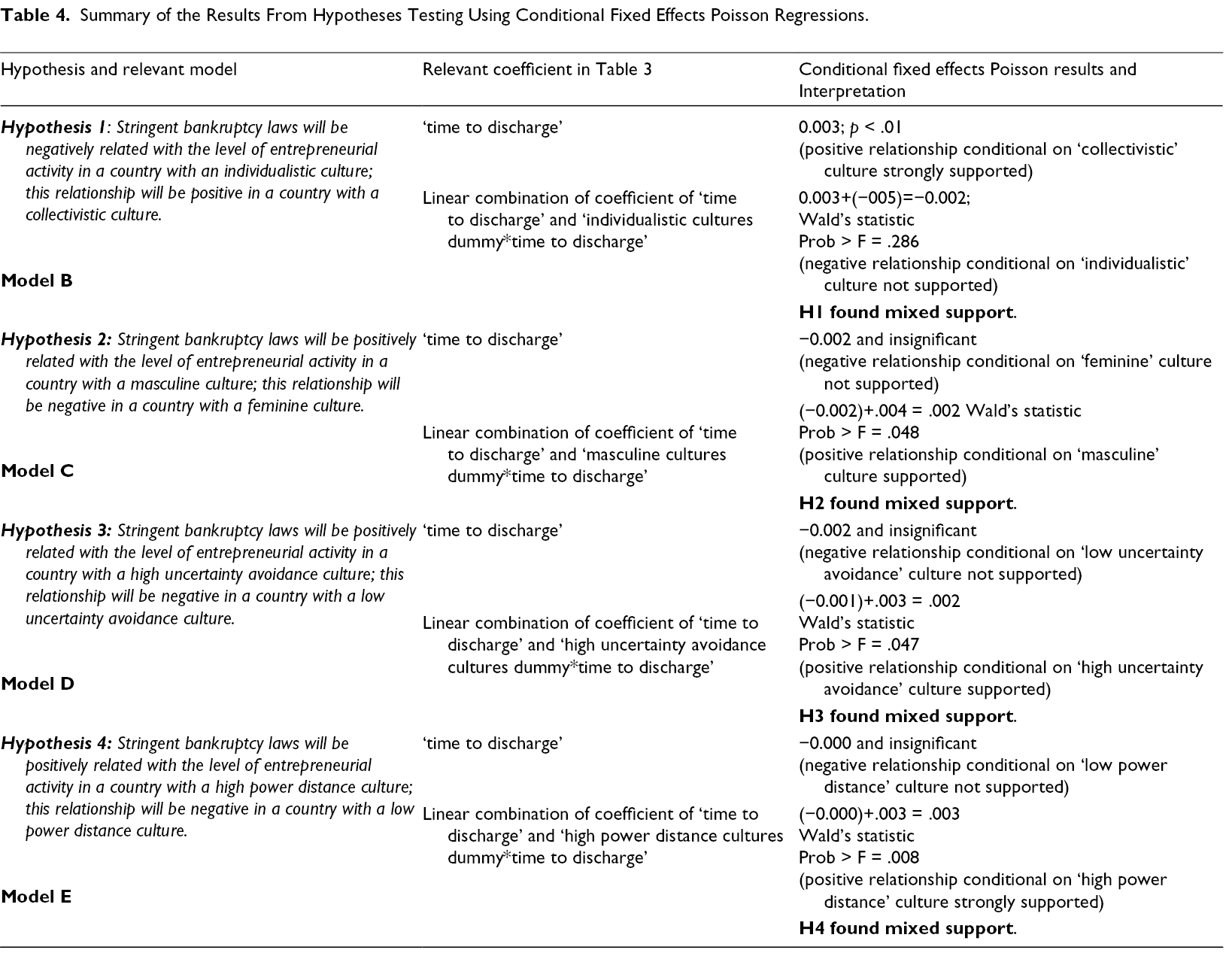
However, in Model B, the coefficient of ‘time to discharge’ was 0.003 and significant at p < .01 (when interaction term ‘individualistic’ cultures dummy*time to discharge = 0). This result strongly supported part of Hypothesis 1 that there will be a positive relationship between stringent bankruptcy laws and the level of entrepreneurial activity in a country with a ‘collectivistic’ culture. However, the conditional effect for a country with an ‘individualistic’ culture, given by the linear combination of coefficients of ‘time to discharge’ and ‘individualistic’ cultures dummy*time to discharge, that is, 0.003+(−0.005)=−0.002, was insignificant (Wald’s statistic Prob > F = .286). Therefore, the negative relationship between stringent bankruptcy laws and the level of entrepreneurial activity in a country with an ‘individualistic’ culture, following Hypothesis 1, was not supported. Therefore, Hypothesis 1 had mixed support.
Similarly, in model C, the linear combination of the coefficients of ‘time to discharge’ and ‘masculine’ cultures dummy*time to discharge was positive, that is, (−0.002)+.004 = .002 with a Wald’s statistic Prob > F = .048. Thus, Hypothesis 2 for the positive relationship between stringent bankruptcy laws and the level of entrepreneurial activity in a country with a ‘masculine’ culture was supported. However, the coefficient of ‘time to discharge’ which captures the conditional effect for a country with a ‘feminine’ culture was negative as expected, but was insignificant. Therefore, there was also mixed support for Hypothesis 2.
In Model D, the coefficient of ‘time to discharge,’ that is, the conditional effect for a country with a ‘low uncertainty avoidance’ culture was negative (−.001), consistent with the expectation from the Hypothesis 3, but was not significant. However, the linear combination of the coefficients of ‘time to discharge’ and ‘uncertainty avoidance’ cultures dummy*time to discharge was positive and significant ((−0.001)+.003 = .002; Wald’s statistic Prob > F = .047). This result supports the positive relationship between stringent bankruptcy laws and the level of entrepreneurial activity within a country with a ‘high uncertainty avoidance’ culture. Thus, Hypothesis 3 also found mixed support.
Finally, in Model E, the linear combination of the coefficients of ‘time to discharge’ and ‘power distance’ cultures dummy*time to discharge was positive and significant ((−.000)+.003 = .003; Wald’s statistic Prob > F = .008). Thus, following Hypothesis 4, the positive relationship between stringent bankruptcy laws and the level of entrepreneurial activity within a country with a ‘high power distance’ culture was strongly supported. However, the coefficient of ‘time to discharge’ was negative and insignificant. Therefore, although consistent in direction, the hypothesized negative relationship between stringent bankruptcy laws and the level of entrepreneurial activity within a country with a ‘low power distance’ culture was not supported. Therefore, the support for Hypothesis 4 was also mixed.
To summarize, the results from the conditional fixed effects Poisson regressions offered mixed support for Hypotheses 1–4. All hypothesized positive relationships of stringent bankruptcy laws with the levels of entrepreneurial activity in respective cultures were supported; whereas, the correspondingly hypothesized negative relationships were not supported. Table 4 shows a summary of these results.
Summary of the Results From Hypotheses Testing Using Conditional Fixed Effects Poisson Regressions.
Economic Significance of the Results
These results are not only statistically significant but also economically significant.
Within a country with a ‘collectivistic’ culture, all else equal, a one unit higher stringency in bankruptcy laws is associated with a 0.3 percent higher entrepreneurial activity (Hypothesis 1). Similarly, all else equal, in a country with a ‘masculine’ culture, a one unit higher stringency in bankruptcy laws is associated with a 0.2 percent higher entrepreneurial activity (Hypothesis 2); in a country with a ‘high uncertainty avoidance’ culture with a 0.2 percent higher entrepreneurial activity (Hypothesis 3); and in a country with a ‘high power distance’ culture with a 0.3 percent higher entrepreneurial activity.
Robustness Checks 15
The following robustness checks were conducted. First, the conditional fixed effects Poisson regressions were repeated using total population of the country as an ‘exposure’ in the regressions to account for differences in country sizes. Results for Hypotheses 1–4 were similar to those obtained without the ‘exposure’ variable, although the conditional effects were weaker in significance for a country with a ‘masculine’ culture, a ‘high uncertainty avoidance’ culture, and a ‘high power distance’ culture.
Second, the conditional fixed effects Poisson regressions were re-run by classifying the cultural subsamples using median Hofstede scores instead of the mean values. Again, there was mixed support for Hypothesis 1 and Hypothesis 3, that is, the positive relationship in a country with a ‘collectivistic’ culture was strongly supported and in a country with a ‘high uncertainty avoidance’ culture was supported . The corresponding negative relationships in these Hypotheses were not supported. Hypothesis 2 and Hypothesis 4 were not supported at all.
Third, the models were also estimated using an updated set of national cultural scores in which the Hofstede’s cultural indices varied across time. These scores were used by Nahata et al. (2014) from a recent meta-analytic study (Taras et al., 2012). Again, following Hypothesis 1, the positive relationship of stringent bankruptcy laws with the level of entrepreneurial activity in a country with a ‘collectivistic’ culture was strongly supported ; whereas the negative relationship in a country with an ‘individualistic’ culture was not supported. Also, the positive relationships of stringent bankruptcy laws with the levels of entrepreneurial activity were supported strongly for a country with a ‘masculine’ culture and a country with a ‘high uncertainty avoidance’ culture . Thus, Hypothesis 1, Hypothesis 2, and Hypothesis 3 found mixed support. Hypothesis 4 was not supported at all.
Discussion
Prior work on a country’s institutional context and level of entrepreneurial activity has shown that both bankruptcy laws and culture can affect entrepreneurship. However, the effects of the interaction between these aspects of a country’s institutional context on entrepreneurial activity had not been examined. One prior might have been that these two variables—bankruptcy law and culture—might simply reinforce each other in a particular country, and that including both in a single study might increase the level of explained variance in the level of entrepreneurship in a country, but not change the relationship between these two independent variables and this dependent variable.
The results in this paper suggest a much more complex and nuanced relationship among bankruptcy law, culture, and the level of entrepreneurship in a country. For example, controlling for different dimensions of culture, sometimes more stringent bankruptcy laws are associated with higher levels of entrepreneurship in a country. Also, controlling for different dimensions of culture, less stringent bankruptcy laws can be associated with lower levels of entrepreneurial activity. The key seems to be the extent to which the costs of bankruptcy created by the law are seen to offset the culturally determined social costs of bankruptcy, and the extent to which these social costs are seen to offset the costs created by bankruptcy law. The results of this study did not support the adverse relationship of stringent bankruptcy laws with levels of entrepreneurial activity.
This study, like all studies, has limitations. For example, the relationships between law, culture, and entrepreneurship examined in this paper are examined at a very high level of aggregation—at the level of countries. And yet, decisions about whether or not to pursue an entrepreneurial course of action take place at the individual or family unit of analysis. This observation does not deny the possible impact of broader institutions—including the law and culture—on these individual decisions. It does suggest however that, now that we know the relationship between law, culture, and entrepreneurship is complex, more micro research that examines how individuals manage the conflicts that can exist among these macro factors seems like a logical next step.
Research on the interaction between the macro and the micro of entrepreneurship may also enable work on the interactive effects of other dimensions of the institutional environment surrounding entrepreneurs and entrepreneurial decisions. For example, it is likely that individuals contemplating entrepreneurship may count on economic safety nets in collectivistic cultures which may not be present in individualistic cultures. The effects of bankruptcy law and culture may also vary based on the legal and social status of different kinds of investors—including banks (Acharya et al., 2011), venture capitalists (Cumming & Li, 2013), and business angels (Cumming & Zhang, 2016), to mention just three as well as on the nature of entrepreneurship, that is, Schumpeterian or otherwise (Henrekson & Sanandaji, 2019).
Indeed, law and culture may not just interact in their effect on entrepreneurial activity in a country, they may also co-evolve. The law, in some circumstances, may change culture; and culture, in some circumstances, may change the law. And both of these processes may occur at the same time. At the highest level, this research suggests that the link between law, culture, and entrepreneurship is complex and requires very careful investigation. This leaves open some avenues for future research as well as the application of additional causal methods (Eberhart et al., 2017).
Supplemental Material
Supplementary Material 1. - Supplemental material for Do Stringent Bankruptcy Laws Always Deter Entrepreneurial Activities? A Study of Cultural Influences
Supplemental material, Supplementary Material 1., for Do Stringent Bankruptcy Laws Always Deter Entrepreneurial Activities? A Study of Cultural Influences by Naga Lakshmi Damaraju, Jay B. Barney and Gregory G. Dess in Entrepreneurship Theory and Practice
Footnotes
Acknowledgments
The authors thank Professors Hariom Manchiraju, Snehal Awate, Shaswat Alok, Amit Jain Chauradia, and Anand Nandkumar from the Indian School of Business (ISB) for their valuable comments and insights on earlier versions of this paper. Late Professor Bhimasankaram Pochiraju, from the ISB, deserves a very special mention for his invaluable statistical support and guidance for this project through several stages of execution. Ms. Manjusha Kancharla and Mr. Ashish Khandelwal (as research associates at ISB) formed the statistical backbone for this project. Ms. Saritha Dasari gets a special mention for her support in several rounds of data collection. Mr. Sridhar Sankranthi provided invaluable inputs for SAS programming. The authors also thank Professor Sharon Alvarez from University of Pittsburgh, Professors Oded Shenkar and Anil Makhija from the Ohio State University, Professor Nilesh Khare from Jagran Lakecity University (India), Professors Seung-Hyun Lee and Clifton Davis from the University of Texas at Dallas for their valuable comments on earlier versions. Professors Nandini Rajagopalan (University of Southern California) and Saras Sarasvathy (University of Virginia) provided invaluable comments and direction. Professor Sridhar Seshadri from the Indian School of Business deserves a special mention for providing critical comments for improvements. Last, but not the least, the authors thank participants at AOM and SMS conferences for their valuable comments on earlier versions of this paper.
Declaration of Conflicting Interests
The author(s) declared no potential conflicts of interest with respect to the research, authorship, and/or publication of this article.
Funding
The author(s) received no financial support for the research, authorship, and/or publication of this article.

Supplemental Material
Supplemental material for this article is available online.
Notes
Author Biographies
References
Supplementary Material
Please find the following supplemental material available below.
For Open Access articles published under a Creative Commons License, all supplemental material carries the same license as the article it is associated with.
For non-Open Access articles published, all supplemental material carries a non-exclusive license, and permission requests for re-use of supplemental material or any part of supplemental material shall be sent directly to the copyright owner as specified in the copyright notice associated with the article.
