




Abstract
This study explores how differences originating in religion and traditions imbue family features and business practices that affect the capacity of family businesses to continue being entrepreneurial across generations; that is, to maintain transgenerational entrepreneurship. Building on an in-depth qualitative study of family businesses, we show how differences in religion and traditions within three subregions of a developing country shape the family structure, the functioning of the family, and the family mindset with concomitant implications on the business practices that foster or hinder transgenerational entrepreneurship. Theoretical and practical contributions are discussed in the context of entrepreneurship and family business.
Family businesses represent an important engine for entrepreneurship in most economies (e.g., Basco et al., 2019; Habbershon & Pistrui, 2002; Nordqvist & Melin, 2010; Zellweger et al., 2012) and provide employment opportunities for both family and nonfamily members (Miller & Le Breton-Miller, 2005; Samara & Arenas, 2017). One of the most important—yet relatively little-studied—phenomena in the family business literature is how to sustain and develop the entrepreneurial capacity of family businesses across generations, also termed transgenerational entrepreneurship (Barbera et al., 2018; Habbershon et al., 2010; Jaskiewicz et al., 2015; Zellweger et al., 2012), which is defined as the “processes through which a family uses and develops entrepreneurial mindsets and family influenced capabilities to create new streams of entrepreneurial, financial, and social value across generations” (Habbershon et al., 2010, p. 1).
Recent studies have discussed various dimensions of transgenerational entrepreneurship such as: entrepreneurial, financial, and social performance (Habbershon et al., 2010); family entrepreneurial orientation (Zellweger et al., 2012); entrepreneurial legacy (Jaskiewicz et al., 2015; Laakkonen et al., 2011); and anticipated futures (Barbera et al., 2018). Furthermore, research suggests that the size and level of cohesiveness of entrepreneurial families matter for transgenerational entrepreneurship (Jaskiewicz et al., 2015; Nordqvist & Melin, 2010; Sieger et al., 2011) and that entrepreneurial orientation and familiness (Habbershon et al., 2003) are key dimensions of transgenerational entrepreneurship (Zellweger et al., 2012). Moreover, Basco et al. (2019) recently posited that the national culture in which family businesses are embedded (Hofstede, 1983) is important for their transgenerational entrepreneurship and that subregional differences within a country may affect governance arrangements and financial performance in family businesses (Miller et al., 2017).
Although recent scholarship has established that national culture influences transgenerational entrepreneurship and that there might be subregional differences in governance and business performance in specific nations, there is still scant research to address specific contextual features such as religious norms and traditions in the subregion that may drive these differences (e.g., Ge et al., 2019; Welter, 2011) and their impact on transgenerational entrepreneurship. In this article, we address this lack of research by focusing on the religion and traditions in the family business’s subregion that influence their capacity to achieve transgenerational entrepreneurship.
Agreeing that culture may have an impact on structural dimensions of entrepreneurial orientation and familiness which are important for transgenerational entrepreneurship (Basco et al., 2019), we build on Miller et al. (2017) and Ge et al. (2019) to further, and in more detail, explore subregional differences in religion and traditions, and their variegated impact on how family and business features come to matter for transgenerational entrepreneurship. This is particularly relevant given recent scholarship showing that religion and the family norms and structures that follow can have a strong impact on family business values, priorities, and behaviors (e.g., Fathallah et al., 2020; Jaskiewicz et al., 2017; Kavas et al., 2020).
Because we aim to explore transgenerational entrepreneurship in a hitherto relatively less-explored research context and expand upon existing theory in this area, we used a qualitative research approach. We interviewed 30 informants (family and nonfamily members) in top-level management positions in 18 multigenerational family businesses, as well as one family business expert. Interviews were conducted in Nigeria, a developing country where different religions are practiced, both Christianity-based and Islam-based, depending on the subregion.
Our findings suggest that religion and traditions in the subregion where family businesses operate have shaped the family structure (more precisely, marriage arrangement and family size) to produce idiosyncratic effects on family functioning (more precisely, the role of wife and transfer of values between generations) and on the family mindset (more precisely, the risk-taking orientation and the feasibility of primogeniture). We found that these factors subsequently shaped how transgenerational entrepreneurship was fostered or hindered through specific business practices adopted.
This article offers the following contributions. First, we add to research on transgenerational entrepreneurship by moving beyond the role of national and regional culture on familiness, entrepreneurial orientation, and performance (Basco et al., 2019; Miller et al., 2017) for transgenerational entrepreneurship. We show that two religions as practiced in one country, one Christianity-based and the other Islam-based in tandem with traditions in each subregion, affect the family structure, functioning, and mindset; and the impact this can have on the business practices that either drive or constrain transgenerational entrepreneurship. This way we also contribute to the emerging literature on the role of religion in family businesses (e.g., Astrachan et al., 2020; Fathallah et al., 2020; Kavas et al., 2020). Next, we add to the literature at the nexus of family science and family business (Jaskiewicz & Dyer, 2017; Jaskiewicz et al., 2017; Randerson et al., 2015) by chalking out some meanings of different family structures, shaped by religion and tradition in subregions, for transgenerational entrepreneurship. Specifically, our findings point to the importance of family structure (monogamous/small family or polygamous/large family) in shaping the role of spouses and business practices for transgenerational entrepreneurship. Our study thus underlines the role of the family system as a critical engine for transgenerational entrepreneurship (Nordqvist & Melin, 2010; Zellweger et al., 2012). Finally, we heed the growing calls to contextualize entrepreneurship and family business research (Randerson et al., 2015; Welter, 2011; Wright et al., 2014; Zahra, 2007) and shed more light on factors that drive or constrain transgenerational entrepreneurship in the developing country context, thereby moving beyond the Western-centric focus of entrepreneurship research (Wright et al., 2014).
Guiding Theory
Transgenerational Entrepreneurship in Family Businesses
A family business is defined as an organization where one or more family members are involved in the firm and where the founders, or the controlling owners, strongly desire to transfer the business to future generations (Chua et al., 1999). The entrepreneurial family is characterized by the impetus for repeated acts of entrepreneurship (Minola et al., 2016) and entrepreneurial growth across generations (Rosa, 2019). When seeking transgenerational succession, family businesses often have to grapple with affective conflicts stemming from ownership dispersion among family members (Lambrecht & Lievens, 2008), which may constitute an obstacle for their entrepreneurial activities (Daspit et al., 2016). Destructive conflicts among siblings and cousins can lead to stagnation and the loss of valuable family resources that enable the continuous pursuit of entrepreneurship (Eddleston & Powell, 2012). Family businesses have also been recurrently described as risk averse, leading to inertia and fewer entrepreneurial endeavors (Chrisman et al., 2012; Miller et al., 2011), especially when the business is transferred to future generations (Le Breton-Miller & Miller, 2015).
At the same time, conceptual arguments and empirical evidence show that family businesses can be instigated to build transgenerational entrepreneurship due to the combination of the unique bundle of resources that stem from family involvement (i.e., familiness) and the entrepreneurial mindsets of the next generation (i.e., entrepreneurial orientation). For example, some research has emphasized that family involvement in ownership and control leads to an automatic alignment of interest between ownership and management, and thus engenders parsimony in resource usage (Jaskiewicz et al., 2016), investments in the tacit business knowledge of future generations, and the transfer of internal and external social capital, eventually providing fertile ground for transgenerational entrepreneurship (e.g., Carney, 2005; Miller & Le Breton-Miller, 2005; Sirmon & Hitt, 2003).
Conflicting evidence has sparked studies investigating the essential ingredients that enable or constrain family businesses in achieving transgenerational entrepreneurship (e.g., Habbershon et al., 2006; Nordqvist & Melin, 2010; Sieger et al., 2011; Zellweger et al., 2012). Familiness and entrepreneurial orientation are central for transgenerational entrepreneurship (Basco et al., 2019; Zellweger et al., 2012), as well as entrepreneurial legacy (Jaskiewicz et al., 2015) and anticipated futures (Barbera et al., 2018). Some family businesses that have a strong entrepreneurial legacy, derived from stories of successful entrepreneurial endeavors of past generations, are more likely to instill entrepreneurial attitudes among subsequent generations through strategic education, entrepreneurial bridging, and a strategic transition leading to transgenerational entrepreneurship (Jaskiewicz et al., 2015; Laakkonen et al., 2011). Conversely, family businesses in which the next generation can imagine an alternative future (i.e., anticipated future) by being forward-looking (e.g., seeking a better life for the family, protection of critical assets, or taking a quality product to the world), can prompt, sustain, and foster entrepreneurship across multiple generations (Barbera et al., 2018), thus reflecting strong familiness (Habbershon et al., 2010).
The concept of familiness (Habbershon et al., 2010) is based on a resource-based view of the firm (Barney, 1991). It postulates that family involvement in the business creates valuable, rare, inimitable, and non-substitutable resources that the family can leverage to achieve transgenerational entrepreneurship (Zellweger & Sieger, 2012). Yet, the presence of familiness alone does not guarantee transgenerational entrepreneurship, which largely depends on the entrepreneurial orientation of individual family members (Basco et al., 2019). Entrepreneurial orientation refers to a mindset characterized by autonomy, proactiveness, risk-taking, innovativeness, and aggressiveness (Lumpkin & Dess, 1996).
By further exploring these two constructs, Basco et al. (2019) show that national culture has an effect on the importance of familiness and entrepreneurial orientation. The authors show that proactiveness and innovativeness, as dimensions of entrepreneurial orientation, commonly lead to transgenerational entrepreneurship in all cultures, but that the importance of other dimensions is context specific. For example, risk-taking is more important in cultures characterized by low uncertainty avoidance and reduced power distance, and aggressiveness is more important in contexts characterized by high uncertainty (Basco et al., 2019).
Regional and National Differences in Transgenerational Entrepreneurship
Recent studies advance what we know about national and cultural nuances of transgenerational entrepreneurship around the world (Basco et al., 2019). Yet, we still know little about how and why different families, embedded within a certain national or regional context, exhibit differences in their transgenerational entrepreneurship (Zellweger et al., 2012). Except for Miller et al. (2017), who show that subregional contexts matter for family business governance arrangements and financial performance, scarce attention has been devoted to understanding how features such as the religious norms practiced and traditions within subregional contexts matter for how individuals and families exhibit an entrepreneurial orientation and build on familiness as they engage in entrepreneurship (Astrachan et al., 2020).
Furthermore, both familiness and entrepreneurial orientation are concepts related to the business system and can be intricately affected by the family system. The family business represents two inextricably intertwined systems: that of business and that of family (Aldrich & Cliff, 2003; Soleimanof et al., 2019; Stafford et al., 1999; Zachary, 2011). Nonetheless, significant work has investigated factors affecting the business system, with less attention paid to studying the family aspect of a family business, such as the role of the family structure (Habbershon et al., 2010; Nordqvist & Melin, 2010). Accordingly, viewing the family as the level of analysis helps examine entrepreneurship within the family context, thus complementing our understanding of the behaviors that determine family business practices.
Hence, we focus on the family as the engine that runs the businesses to understand entrepreneurship in multigenerational family businesses, adopting a multilevel view that considers both micro and macro levels of analysis in entrepreneurship research (Davidsson & Wiklund, 2001). We investigate how religion and traditions emanating from subregional contexts within a national context shape the family structure (Aldrich & Cliff, 2003; Astrachan et al., 2020; Jaskiewicz et al., 2015) and the transgenerational entrepreneurship. A subregion can be defined by geography and by the commonality of norms and values associated with religion and the tradition prevalent therein (Aluko, 2003; Fourchard, 2015; Okwudiri, 2017). Accordingly, we expect that the religion and traditions of business families prevalent in the subregion (Danes et al., 2008) affect the family system and structure (Fathallah et al., 2020; Sharma & Manikutty, 2005) and translate into influences on transgenerational entrepreneurship.
Study Context and Methodology
Study Context
The majority of studies on transgenerational entrepreneurship are contextualized in developed countries, and scant research exists from developing countries in Africa, the Middle East, and Latin America (Basco et al., 2019; Discua Cruz et al., 2013; Samara, 2020). We address this shortcoming and specifically focus on Nigeria, a nation where most businesses are owned and managed by families. The PwC (2018) survey shows that very few businesses have survived past the third generation, similar to their family business counterparts worldwide. The PwC (2018) report suggests that the culprit for this failure is the lack of appropriate structures for ensuring transgenerational entrepreneurship.
We have three reasons for choosing to explore our research question in Nigeria, West Africa. First, Nigeria’s growing population of 202 million (WorldBank, 2016) positions it as a fair representation of the African continent; one out of every five Africans is a Nigerian (Ali-Akpajiak & Pyke, 2003). This growing population presents an employment challenge translated into a need for job creation through entrepreneurship (George et al., 2016).
Second, Nigeria is a developing economy where institutional voids (weak and sometimes nonexistent institutions) are prevalent. In this context, family businesses become essential as social support systems. Indeed, family businesses account for more than 90% of all enterprises in Nigeria (Acquaah, 2016), and scholars often consider family businesses as agents that support the economic and social development of regions across the world (Basco et al., 2019; Miller & Le Breton-Miller, 2005).
Third, although Nigeria is a single nation-state, it is culturally diverse across its three main subregions. Accordingly, and following other important studies from Nigeria, we classify the country into three regions, each of which is naturally connected by shared geography, similar religious beliefs and cultural traditions, and a common history (Aluko, 2003; Fourchard, 2015; Okwudiri, 2017). These regions are East (consisting of Southeast and South-South), West (Southwest), and North (consisting of the Northeast, North-Central, and Northwest). Families in the Eastern, Western, and Northern regions of Nigeria each practice different religions and have different values and traditions, conferring on them unique social backgrounds (Majekodunmi, 2013). The people in the Eastern part of Nigeria speak the Igbo language, are predominantly Christians, and are inclined to monogamous marriages. The inhabitants of the Western parts of Nigeria speak the Yoruba language and are either Christians or Muslims, and many have polygamous families (Omobola, 2014; Opeloye, 2011). The Hausas, who live in the Northern part of Nigeria, speak the Hausa language, have long-standing ties with the Arabs, and are predominantly Muslims (Boserup, 1990). Islam as practiced in the North allows polygamous marriage with a limit of four wives (Bryceson, 2002; Moughtin, 1964). This heterogeneity allowed us to study how the different types of religion—one Christianity-based and the other Islam-based—together with traditions are enacted in subregions of Nigeria, drive or constrain transgenerational entrepreneurship.
Methodology
Research Design
Given the lack of research on how subregional features such as religion and traditions linked to family structures and norms may shape the transgenerational entrepreneurship of family businesses, particularly within the context of developing countries, a qualitative research design is appropriate (Guba & Lincoln, 1994). We used semistructured interviews and our lead author’s deep knowledge of the Nigerian context as a means of allowing our discussions to be informed by the transgenerational entrepreneurship framework (Habbershon et al., 2010; Zellweger et al., 2012). This framework not only advances the entrepreneurial orientation and familiness concepts; it also allows us to pursue unanticipated avenues of interest. We used a theory-building approach inspired by induction (Strauss & Corbin, 1998), sensitized by literature on the role of national and regional contexts for family firm behavior and outcomes (e.g., Basco et al., 2019; Gupta et al., 2010; Miller et al., 2017), family system theory (e.g., Jaskiewicz & Dyer, 2017; Jaskiewicz et al., 2017; Stafford et al., 1999), and entrepreneurial families (e.g., Discua Cruz et al., 2013; Nordqvist & Melin, 2010) to explore the various ways through which dominant religion and traditions in subregions imbue family structures that influence family businesses’ transgenerational entrepreneurship.
Study Sampling
As shown in Table 1, the first author interviewed an expert in family business who has been consulting for family businesses in Africa, as well as 30 informants from 18 family businesses in Nigeria. Informants were of an average age of 49 years and were all in senior management to executive positions; they were either family or nonfamily members. The ages of 18 family businesses from which we interviewed informants ranged from 10 to 100 years (average age = 37.8 years) and are in their first to the third generation, with at least two generations present (hence termed multigenerational family businesses). Furthermore, the family businesses are in the formal sector—that is, registered with Nigeria’s Corporate Affairs Commission (CAC)—and are all limited liability companies with all shares held within the family. These family businesses operate in various industrial sectors, including agriculture, manufacturing, commodity and product trading, real estate, and services. However, we did our best to balance samples from various industries in the three regions of Nigeria. Our sample is drawn from regionally connected family business actors and family businesses, meaning that these informants are family business owners/members or top executive managers who live in the same region where the family business is located.
Interviewees.

aInterviewed together **Of origin and embeddedness of informants and family & family business P1 Purposeful P2 Purposeful T Theoretical T2 Clarifying interviews.
The deep knowledge of our context of the study by the first author was acquired through 13 years of working in family business organizations in Nigeria and having lived in each of Nigeria’s three subregions for over 5 years. This background helped to break the ice in our data collection, as people within our study setting tend not to trust interviewers. This background also proved helpful in understanding the mother-tongue-influenced English used by some participants, and the ethnic expressions used in some instances during the interviews. We conducted a total of 51 interviews with family business informants, with an average interview time for each informant of up to 97 minutes. We followed family businesses during the 18-month period, April 2017–September 2018, inclusive. We used pseudonyms to represent informants and the family business cases according to their regions. Names starting with E, W, and N represent informants and family businesses whose region of origin is the East, West, and North, respectively.
Data Collection
Our initial research interest was focused on how subregional features in a developing country influence the capacity of the family business to achieve transgenerational entrepreneurship. Therefore, our initial sample of seven interviewees was purposefully selected: one expert, who gave an overview of the general attributes of family businesses in Nigeria, and six family business owners, two from each of the three subregions of Nigeria. We started the interviews in an unstructured way by asking the interviewees to tell us their family business stories or give us an introduction to their business (Powell & Baker, 2014). After the initial introduction, the questions became semistructured, considering that we wanted to compare and elicit variations in the answers provided by the interviewees for similar questions regarding our variables of interest. Examining the data from our initial sample, we dropped one interviewee because the family business did not meet the criteria of a multigenerational family business (i.e., the business was in its first generation and did not have two generations in the business). This left us with five family business owners at this stage (Table 1). The initial sample allowed us to obtain insights into the generic characteristics of family businesses within the study (Neergaard, 2007; Rapley, 2014).
Subsequently, we expanded the data collection with seven family business interviewees (Table 1). William, from our initial sample, was again included as he proved to be an open and accessible informant for the study. The extended data collection gained through purposeful sampling allowed us to further balance our sample across the subregions, and further refine the tentative categories as we gained more in-depth and comparative insights (Grodal et al., 2020; Neergaard, 2007; Strauss & Corbin, 1998). Finally, we interviewed a theoretical sample of 19 family business informants (Charmaz, 2006, Charmaz, 2014). The aim was to ask more specific questions about the salient categories (Morse et al., 2016), thus stabilizing the refined categories (Grodal et al., 2020).
Analytical Method
The data analysis was organized using MAXQDA Analytic Pro 2018 following well-established methods for qualitative field research (Bryant & Charmaz, 2015; Charmaz, 2006; Grodal et al., 2020; Strauss & Corbin, 1998) and was structured in four main stages.
Stage 1: Discerning generic characteristics of family businesses impacting transgenerational entrepreneurship. Because our study explored the impact of context emanating from the subregions of interest, after an initial reading of the transcripts of our first interviews, we set out to identify salient factors prevalent across regions. At this stage, we had already identified differences among family businesses in the subregions along broad themes related to culture, values, religion (Islam, Christianity), norms, and traditions. In a later stage of the analytical process, we eventually came to synthesize these broad themes into the overall role of religion and traditions, which we considered the main subregional contextual features instigating family factors leading to the business factors that have implications for transgenerational entrepreneurship.
Stage 2: Generating initial categories. We engaged in an open coding process. Staying close to the data, we assigned codes to the accounts that the family business informants made of how culture, values, norms, religion, and traditions influenced the family structure and dynamics, and eventually the family business (Nordqvist et al., 2009; Strauss & Corbin, 1998). After coding the first interviews, we continually compared the new data with that of the already existing codes to ensure consistency in what the codes represent. Sometimes we had to drop low-frequency codes and merge codes to ensure consistency across our analysis. As our coding progressed, initial codes began to show connected meaning (Bryant & Charmaz, 2015; Charmaz, 2006; Strauss & Corbin, 1998). For instance, codes for “monogamous marriage” and “polygamous marriage” were abstracted to a “marriage arrangement” category; codes for “nuclear family,” “large family,” and “many children” were abstracted to a “family size” category; and codes for “business-sustaining,” “family-sustaining,” and “family-limiting” were abstracted to an “exploiting entrepreneurial opportunities” category. At the end of the coding process of our initial sample, we had several initial categories pointing to the differences among family businesses. For example, differences were found in marriage arrangements, family size, religious practice, risk-taking orientation, accessing start-up finance, accessing land, the feasibility of primogeniture, language homogeneity, the involvement of the spouse in the business, and perceived role of the spouse.
Stage 3: Refining initial categories. We continued the analysis of the transcripts of our expanded sample. Thus, we coded around initial categories, sought new ones, dropped some, and united some (Grodal et al., 2020). The process of refining categories allowed us to obtain more precise meanings for the categories. By the end of this stage, we had more well-refined categories abstracted to concepts (Bryant & Charmaz, 2015; Charmaz, 2006; Strauss & Corbin, 1998). For instance, the categories “marriage arrangement” and “family size” were abstracted to the “family structure” concept; “risk-taking orientation” and “feasibility of primogeniture” were abstracted to the “family mindset” concept; and the categories of “using valuable resources provided by a wife,” “attaining unified business decisions,” “exploiting entrepreneurial opportunities,” and “deploying resources at transition” were abstracted to the “business practices” concept. At the end of this stage, we had main concepts that would help give meaning to “family structure,” “family functioning,” “family mindset,” and “business practices.”
Stage 4: Re-analyses and theoretical integration. The next step was a further analysis of our incoming data from our theoretical sample; by now we had formulated an overarching understanding of our data. We progressed with iterating through our data, to find either confirmatory evidence, spurring us to elaborate the interrelationships among the main concepts, or unsupportive evidence, prompting us to drop such suppositions (Grodal et al., 2020). At the end of this stage, we had substantiated how the family structure, family functioning, and family mindset (family features) were reflected in the business practices (business features; also termed the determinants of transgenerational entrepreneurship) to foster or hinder transgenerational entrepreneurship. We realized we had reached theoretical saturation as no new insights concerning our understanding of the roles of religion and traditions for transgenerational entrepreneurship emerged (Strauss & Corbin, 1998). Figure 1a and b shows our data coding structures for the family and business factors.
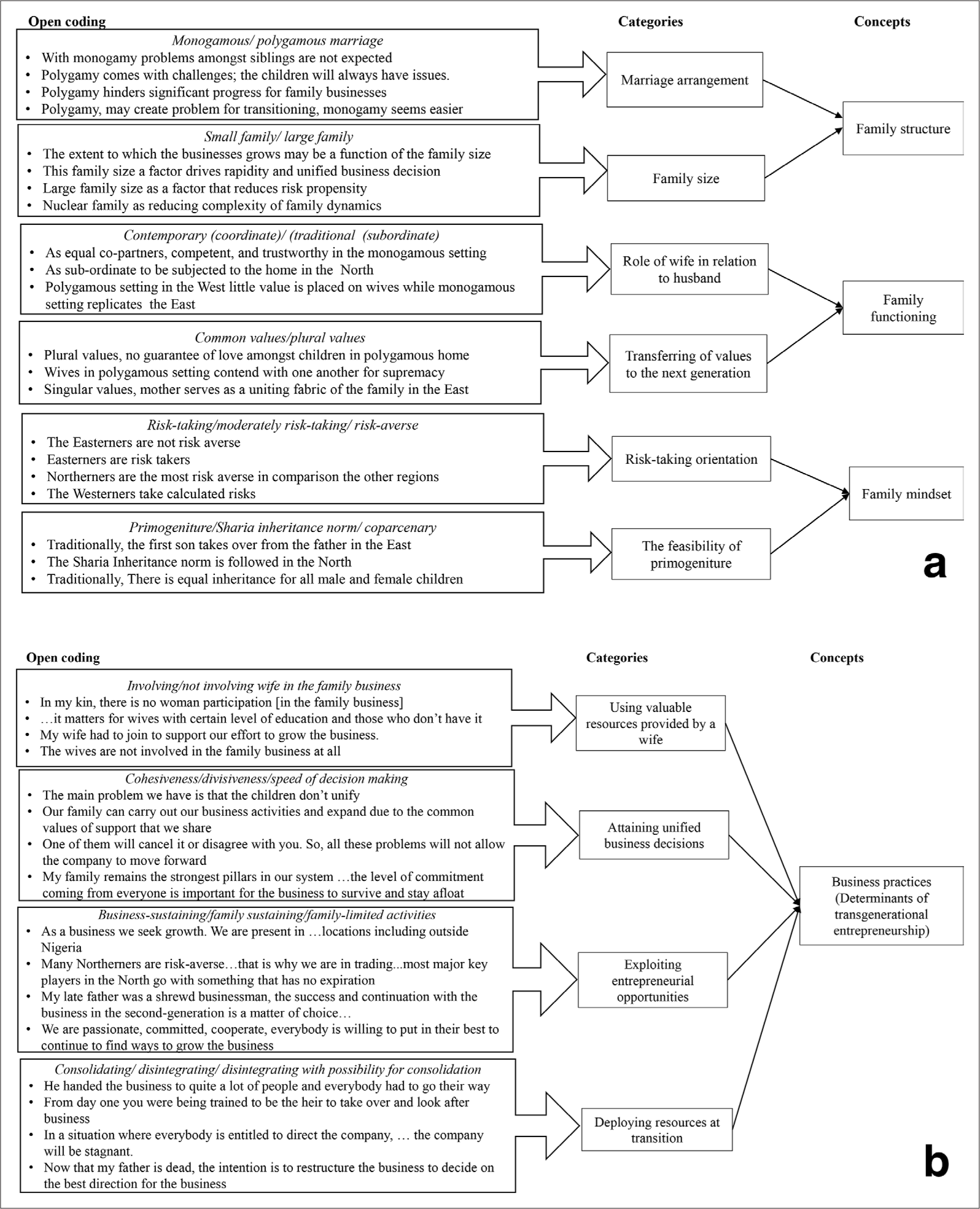
(a) Data coding structure for family factors. (
In the next section, we present our findings, which showcase the differences among the families and their businesses across the three subregions of Nigeria.
Findings
The summary of our findings and data analysis is shown in Table 2. We found that the heterogeneity of the subregions, reflected in particular through religion and traditions, shapes family structure (marriage arrangement and family size), family functioning (role of wife and transfer of values to next generation) and family mindset (risk-taking orientation and the feasibility of primogeniture), and translates into various business practices which influence transgenerational entrepreneurship. Appendix I presents additional quotes from our data to support emerging categories and concepts. Following this, we present three models based on religious beliefs (Christian, Muslim, and mixed contexts) that show how religion and traditions in each subregion imbue family features that drive preferred business practices that, in turn, affect transgenerational entrepreneurship. We then suggest the relationship between these business practices and transgenerational entrepreneurship.
Summary of Findings.

Note. NA = Not available. *The number of children of the family business founder.
The Roles of Religion and Traditions
We identified religion and traditions as the overall salient features that differentiate the three subregions with respect to their effect on the family and business systems. For instance, concerning the transitioning of the family resource from one generation to the next, a second-generation family business owner from the North expressed his adherence to the Islamic Sharia inheritance norm as follows: “It [Sharia inheritance norm] is okay to me being that I believe in my religion” (Nathan, North_15). In another instance, a second-generation family business owner from the East responded to the same question: “Culturally the first son succeeds the father…the tradition is that I am the head of the house” (Eli, East_2). Furthermore, according to a second-generation family business owner from the West: “In Yoruba land, the traditional belief overrides when it comes to inheritance norms, we do not rely on religious laws. We rely more on tradition than religion” (William, West_7).
Concerning religion, our findings, summarized in Table 2, show that the families in regions where they and their businesses are embedded practice either Christianity or Islam. The business families from the East are Christians, those from the West are Christians and Muslims—a mixed composition—while the business families in the North practice Islam.
Families in the East have replaced certain traditional norms such as polygamy with Christian religious norms of monogamy, but they still adhere to other traditions such as primogeniture. The Muslim families in the North did not perceive any conflict between tradition and religious norms, making their religion and traditions a homogeneous pair. For instance, the Islamic religious norm that allows polygamous marriage of up to four wives has historically been, and continues to be, adopted in the North.
The West, with its mixed religious composition, brings about different traditions. On the one hand, when a family in the West is of Islamic faith, adherence to traditions dominates religious adherence. For instance, the tradition of the West places no limit to the number of spouses a man can have, whereas the Islamic religion practice dictates a maximum of four. On the other hand, when a family follows Christian beliefs, both religious norms and traditions in the region prevail. Religious norms for a practicing Christian in the West dictate that marriage must be monogamous. However, both Christians and Muslims in the West adopt the traditions alike when it comes to family mindset:
For the Yoruba tribe, religion has no significant impact on disposition to risk-taking. The tribal influence plays a more significant role than religion, both [Christian and Muslim Westerners] will take the same risk if the opportunity is presented to them. (Wale, West_17)
Family Structure
Respondents emphasized heterogeneity in marriage arrangement and the corresponding family size, which we label as family structure. Family structure is about how the family is composed and determines the relationships among family members. The family is formed by a group of individuals who share family ties of genetics and/or marriage and consider themselves part of the family (Jaskiewicz & Dyer, 2017; Jaskiewicz et al., 2017). Two main family structures imbued by the religious norms of Christianity and Islam that appear in our data are shown in Table 2. The findings show a simple family structure (i.e., monogamous marriage and small family size), and a complex family structure (i.e., polygamous marriage and large family size). In the monogamy cases, there is a sense of corresponding togetherness that comes with the small family size, as indicated by this first-generation family business owner:
The nuclear family it’s better. My wife, [daughter], and myself – just the three of us – this brings family togetherness. We are passionate, committed, cooperate, everybody is willing to put in their best to continue to find ways to grow the business. (Wyatt, West_9)
Even when the number of children in a monogamous family is at a high of eight, we find that a sense of harmony persists among the family members as indicated by this respondent:
“He [first generation family business owner] is married to one wife…he is almost retired, so nowadays he goes to the office to see how his children are managing his business. They coordinate themselves to advance the business forward. (Ezra, East_4)
In contrast, in the case of polygamous marriage arrangements, there is a sense of disorder that accompanies a large family with up to 35 children or a husband having up to seven wives. As reported by this second-generation co-owner of family business from the North about his family with four wives and 25 children:
I cannot say everyone is at peace with one another, you must have one or two grudges, maybe the first wife and the last wife or among them. So, it will affect the children and that is one of the disadvantages of polygamy. (Nathan, North_15)
Even when the number of children in a polygamous family is at a low of 14, there is still a sense of distrust among members of subfamily units:
The current owner has 14 children, he has four wives, we have this Islamic thing in the business, so he picked a male from each of the wives so every son represents the interest of the other children of his mother. (Neil, North_l6)
Therefore, with the simple family structure, we seldom find problems among siblings. However, this is not the case with the complex family structure, which comes with challenges and conflicts among children in the family related to day-to-day interactions and decision-making associated with family functioning. One respondent summarized: “The marriage is a big factor …the larger the family the bigger the disparities, the arguments, and the fights, but when you have a small family there is unity” (Wendy, West_7).
Family Functioning
Extant literature describes family functioning as the role and responsibility of family members, and the way in which family members interact with one another (Jaskiewicz & Dyer, 2017). We find in our study that the wife (wives) stands out in determining how the relationship between family members unfolds. The father’s role seems to be consistent across regions, as he is recognized as the breadwinner irrespective of the marriage type. However, we find notable heterogeneity in the roles that wives play to the husband and children. This heterogeneity is largely influenced by the family structure and religious norms in the subregional context.
Role of Wife in Relation to the Husband
Concerning the role that wives plays as it relates to the husband, the literature shows that wives can play either a traditional role or a contemporary role (Chen et al., 2009; Cuddy et al., 2004). In the North, where Islam is practiced, the traditional role of the wife as submissive and dependent is the dominant norm; she is considered a subordinate to the husband, an assistant to the husband at best. According to a third-generation family member from the North: “In Kano [North], the wives are mostly housewives, they take care of the home and do their business at home” (Nick, North_13).
Concerning the role that women play in the Northern family businesses with Islamic background, this second-generation family business co-owner said: “That’s something in our tradition, the women stay at home to care for the children, the women are basically dependent on their husbands. Many times, they are basically content to be catered for by the male folk” (Nathalie, North_15).
In contrast, in the East and West, where Christianity prevails, wives play a contemporary role as equal, supportive, and consultative partners to the husband. According to a first-generation family business owner from the East who co-founded a family business with his wife:
“Myself and my wife incorporated the company in 1987…currently I am the CEO and my wife is the MD [managing director]” (Edward, East_3).
A shareholder in a second-generation family business that was founded by her father has the following to say about her mother’s role: “She is a very hardworking woman, [one of] those women who support their husbands with everything. She had to leave her job in Lagos to join my father” (Wendy, West_7).
Therefore, the traditional perception of the role of the wife in the subregion shapes how her husband perceives her. In the case of polygamous marriage arrangements, we find that wives play the traditional role restricted to the home front. Some Muslims in the North perceive that Islam dictates that wives remain unseen and unheard because of some misinterpretations of the Islamic religion. Hence most wives in polygamous marriages stay at home, and the husband provides for the needs of his wives (who are more often than not uneducated). In the case of monogamous marriage arrangements, the wife plays a contemporary role, with her husband perceiving her as his equal, competent, and trustworthy co-partner, and holding her ground. Consequently, the perception of the wife by the husband as a coordinator or subordinate matters for her subsequent inclusion or exclusion in key decision making, and the role that she takes on in the business.
Transferring of Values to the Next Generation
The roles of the wives of business owners have traditionally been focused on nurturing the children and which we note across all Nigerian regions. By nurturing the children and being present to a greater extent than the husband, the wife is better positioned than the husband to transfer family values to the next generation. As regards the values that the wife and mother transfers to the next-generation, one respondent says:
It [values that children imbibe] has everything to do with the how the mother raises you because the father wasn’t there to spend time with you, that’s the work of the mother. So, your foundation has always been with your mother. (Wale, West_11)
In the case of a monogamous marriage, values are more homogeneous among children because of similar upbringing. Values that stem from a polygamous marriage are less likely to be unified because children have been raised by different mothers with little interaction and limited relationships with one another (Rau et al., 2019).
The role that the wife/mother plays within the simple family structure is a unifying fabric for the children. A second-generation family business owner from the East suggests that there are “common values” with which a mother in a monogamous marriage raises all her children:
My mother has always created the balance between the family members. Apart from the love we share commonly and the responsibility I feel, she is the fabric that holds everybody together…she glues everybody together. (Eli, East_2)
The mother unites the family by quelling tension and giving love and care, and she leads the children to develop similar and common values. This environment breeds an atmosphere of cohesiveness because family members are connected through similar acquired values.
In contrast, in complex family structures with subfamily units, we found that each mother instills in children their idiosyncratic values borne out of competition for supremacy over one another and competition for limited family resources. Consequently, a “plurality of values” is transferred to the next generation, fueling tension and jealousy among children who become increasingly disconnected. Thus, the polygamous environment creates plural values which breeds an atmosphere of divisiveness with no guarantee of love among the children. In the words of a second-generation Muslim family business owner from the West:
The reality is that you are half-brothers and half-sisters no matter how much you try to love each other you are not from the same mother. The thoughts will still come that he is not even from my mother so why should I care. (Wale, West_11)
Family Mindset
The family mindset refers to the attitude and orientation derived from religious or traditional norms and, to some extent, the family structure. Out of the entrepreneurial orientation concept, one dimension stands out in our findings: the family’s risk-taking orientation. In addition, we unpack family orientation toward primogeniture as important for transgenerational entrepreneurship.
Risk-Taking Orientation of Families
As presented, religion, tradition, and family size play a role in the risk-taking orientation of family members. The Islamic norm does not encourage risk taking; on the contrary, it imbues the family with risk aversion. The risk-averse attitude of the North can be explained by the population’s understanding of Islamic religious teachings. Religion may create complacency in the sense that outcomes are perceived as predetermined. Hence, the Islamic population in Nigeria might have less drive to take risks and relate business outcomes to what is determined by their faith. Talking about taking risks, a third-generation family member from the North comments:
Then the risk, many people here in the North don’t do that kind of research and thinking, they always believe on whatever happens is from God [Allah]. Some people do things off head [without thinking] and they will just say it’s from God: ’hakar Allah ya so.’ (Nick, North_13)
Another example of the risk-averse mindset relates to borrowing money from the bank, which families from the North do not consider because the Islamic religion prohibits borrowing money when interest must be paid. Hence financial resources can only be gathered from family members.
Culture and religion curtail any Muslim from taking a loan from the bank and no business can grow without using other people’s money in terms of a loan. So, because of the interest, religion and culture curtail businesses from taking a loan. (Noel, North_14)
It is not just religious norms influencing the risk aversion of Northern business families. Large families of polygamous marriages further influence the risk-taking propensity. The patriarch in a large family is reluctant to take undue risks because he considers that any attempt to take risks will place his families (from multiple wives) at risk. At a minimum, he wants to maintain his ability to continue to provide for his large family as he does not want to jeopardize what he is already providing. In short, he does not want to destabilize the status quo. Hence the extent to which Northern families recognize and exploit opportunity is also limited by their concern to continue being able to cater financially to their large family. A family member of a third-generation family business from the North, in which his father is currently in control, reports how his father handles the need to provide for the large family.
His [the founder] intention is to make the factory big and stable so it would be enough to keep the family that is why he is focusing almost 100% on the factory. From his own thinking, that’s the only thing he can do for the family that will be sufficient for everybody. (Nick, North_13)
All these factors constrain entrepreneurial activities and, thus, restrict the transgenerational entrepreneurship of family businesses. A second-generation family business owner from the West who has a close relationship to the North summarized the risk-taking mindset of the Northerners as follows:
The Northerners are more risk averse because their religious inclination gives them this feeling that whatever does not work comes from God [Allah]. Also, they usually have large families that they have to cater for, so they are conservative in taking business risks. (William, West_1)
Traditionally, the sociocultural environment in the East imbues families with a restless attitude that gives rise to an entrepreneurial spirit. The risk-taking attitude of Eastern families was further heightened after the Nigerian Civil War of 1967, which left the East desolate and catalyzed a quest for self-sustenance and survival that inspires Easterners to be highly predisposed toward risk-taking. This predisposition drives entrepreneurship. Our data portray Eastern families as very willing to take risks and venture into the unknown. The willingness to take risks can be seen in the extent to which families are prone to engage in entrepreneurial activities. One founder of a first-generation family business in the East puts it this way: “The social-cultural mechanism of this region is very upbeat, and it tends to push everybody to be very entrepreneurially active. The region has zero tolerance for inactivity. We don’t encourage recklessness, but we’re also not risk averse” (Eric, East_1).
Accordingly, the geopolitical past, strong traditions, with few religious obligations or obstacles (for the Muslim Westerners) in the case of the religiously mixed West, bestows a unique sociocultural environment that explains the risk-taking attitudes found in this subregion. The West was the center of Nigeria’s power and its commercial capital during colonial times and for many years afterward. Therefore, families from the West were more likely to obtain white-collar jobs. “When you get to the East, many people are not interested in the civil service, everybody wants to own a business, but in the West, they like doing government work. Easterners have more zeal to own a business than Westerners” (Warren, West_7).
As the population grew, and entrepreneurial opportunities thinned, many families became more apt to take risks. Business families in the West, whether Christian or Muslim, are less likely to take risks than the Christian business families in the East—but they do take more calculated risks. Whereas families in the East have the highest tolerance for risk-taking, those in the West tend to display moderate risk-taking attitudes, and the Muslim families from the North tend to be more risk averse. The point of view of a respondent from the East exemplifies this:
Igbos [Easterners] are risk takers, we are willing to travel to the far North, where people have a different mind-set towards risk. Westerners by virtue of their knowledge are more careful, they would do a proper risk assessment. Northerners are traditional in their approach to things and very laid back. (Evan, East_1)
A respondent from the North compared the risk-taking disposition of families from the three regions:
People from the East are more likely to take risks. Easterners don’t believe in failure, so they take more risks than any other people – including Westerners. The people in the North don’t take any kind of risk. Most people will just pray and do their usual business. (Nick, North_13)
The risk-taking families are more focused on sustaining the business, which provides financial resources for both family and nonfamily stakeholders. For example:
We have about five different divisions doing different things, so we see them standing alone in the future. Some can go to the capital market, that’s the ultimate aim. We embrace diversification and want to get involved in as many areas as possible in the agricultural value chain. (Wade, West_8)
Business families who are more risk averse focus on sustaining the family and using the business to meet family needs. For instance:
We are not running business for us to grow it to certain level that competes with the international companies, no. We run businesses just to survive and to make sure we put food on the table, that is the main reason we run businesses in the North. (Noel, North_14)
Another feature of the risk-taking orientation of families is their willingness to collaborate with external parties. Families in the North are less likely to collaborate or bring external parties into their family business. One respondent says:
The ‘family’ is very tight, they would not let you take ownership in the business. You work, you get paid and that is all! But to enter the inner side – no! It is a family affair. They would not let you in and it is not just our family, it is all families in the North. (Nicholas, North_18)
Business families in the East are more willing to collaborate with nonfamily members as compared to business families in the North. For instance: “Here people come out to create these businesses and sometimes they must collaborate with foreign partners to gain some mileage” (Evelyn, East_1).
However, families in the West are even more willing to collaborate and accept external parties than those in the East. Again, the quote that follows shows how Christian families in the West work with outsiders.
We have our foreign partners, we go to exhibitions in their countries and those that have the same environmental conditions as ours, we mimic their success stories and bring them back here. We leverage on the presence of our partners in European countries. (Wayne, West_8)
Finally, we also see risk-taking orientation as a driving force that determines whether business families expand to other regions in Nigeria, engage in internationalization, and adopt innovations. Northern families are comparatively slow to adopt innovative ways of doing business. For example, in the agricultural industry they tend to stick to selling agricultural produce without adding value by moving up the value chain to processing and packaging:
Northerners never want to travel out of their territory and that is why we chose to go into trading. You will see that someone that owns a shop and 2–3 decades later, the shop is still there, honestly, we lack so much initiative in our businesses. (Noel, North_14)
Family businesses from the East venture not only into other regions but also into other countries, and are more willing to renew their processes and adopt innovation. For instance:
We started production as a purely pharmaceutical company in 1989. In 2010, we expanded into the second factory, and now we are one of the largest pharmaceutical drug manufacturing companies in Nigeria, and one of the largest in West Africa. (Edward, East_3)
Family businesses in the West are less likely to internationalize than those in the East. However, they adopt innovation and process renewals:
It started as door-to-door consulting, then they saw an opportunity to sell and dispense drugs and vaccines to their networks. Fast forward a few years and they started becoming distributors of poultry feed. Today we are present in the North and East, but the head office is still in the West, which is our main base. (Wade, West_8)
With the differing propensities for risk taking, business families from the three regions differ in the extent of the entrepreneurial opportunities they pursue.
The Feasibility of Primogeniture
The feasibility of primogeniture is the transition mindset adopted in families from the various regions because of religion or tradition. Our findings show three different transition mechanisms: primogeniture, Sharia inheritance norm, and coparcenary (i.e., joint and equal heirship).
As tradition in the East prescribes, families there adopt primogeniture for passing the business to the next generation. The primogeniture inheritance norm refers to the transfer of leadership from the father to the first-born son (Calabrò et al., 2018). In this case, the eldest son is the “heir apparent” such that the leadership and the family resources are automatically transferred to him:
I am 104 years and my first son is here, though I have other sons, it is better that he is the one in charge of this business so that he hands it over to his children and children’s children so that the business will still remain and continue to progress. (Elijah, East_5)
Hence, the first son takes charge of the family and control of the business and continues to build the family wealth from where the father stopped. In the discussion of inheritance in the East, the founder’s daughters are disqualified automatically, because it is assumed that including them would fragment the family wealth. After all, whatever belongs to the daughters will transfer to their current or future husbands and children when they get married. In the East, because the first son is nurtured and expected to be the heir, the successor’s identity is clear to the family from the early years. Therefore, cohesiveness is not endangered, even if the father should die prematurely.
Northern families tend to follow the Islamic Sharia inheritance norm during the intergenerational transition. Islamic Sharia law prescribes splitting resources among all of the next generation inheritors (Elbalti, 2018). Primogeniture is not adopted and, as a result, there is significant ambiguity as to who will become the next business leader:
There’s going to be this distribution of his wealth to inheritors. They would not think “let’s allow the business to continue, and out of the dividends everybody takes his share.” No! They shut down the business and they value the business and it’s shared. So, there are many businesses in the North that fold because of this issue. (Noel, North_14)
Tradition is important when it comes to inheritance norms in the West, whether the family is Christian or Muslim, especially when the founders do not leave a will. This traditional inheritance norm is associated with coparcenary, meaning that joint and equal heirship is approved, and all next-generation inheritors are included for the transfer of the family resource, notwithstanding gender. For Christian families, adopting coparcenary does not necessarily mean that the family business is liquidated. Instead, the different inheritors own shares in the family business. However, the member of the next generation who is most interested in the family business continues to drive the family business’s leadership, and may even buy out the other siblings if they are willing to sell their shares. They continue to receive dividends if the business is thriving—as is the case for this second-generation family business owner from the West:
My two elder brothers were not interested and as the last son, I just needed to pick up the responsibility to join him[father] in the business. And now that my father is dead, the intention is to restructure the business. My father has a will … There will be a board meeting afterwards, to decide on the best direction for the business. (William, West_1)
However, our findings show that for Muslim families in the West, adopting coparcenary leads to more fragmentation of the family business resources than the polygamist family business in the North, because there are even more next-generation offspring to accommodate, creating more complexity:
Most polygamists who have a family business suffer a business collapse when alive or after their death because the children won’t be able to manage it, and there won’t be total cooperation. These big businessmen from the West that are Muslims are polygamist. Immediately, they die, the children start fighting until the business collapses. (Wendy, West_7)
Consequently, the extent to which primogeniture is adopted or not adopted affects the continuity of the family business.
Business Practices and Transgenerational Entrepreneurship
The models in Figure 2a, b, and c seeks to illustrate the importance of religion and traditions, in each of the three subregional contexts, in understanding the family structure, family functioning, and family mindset. Since atmospheres prevalent in the family system may be transferred to the business system (Soleimanof et al., 2019; Stafford et al., 1999), we find that family structure, functioning, and mindset have differential impacts on business practices such as drawing on resources provided by the wife, attaining unified business decisions, exploiting entrepreneurial opportunities, and deploying resources at the transition to the next generation. The varying use of these business practices aid in understanding the differences in transgenerational entrepreneurship of family businesses that are either Christian or Muslim, as illustrated in Figure 2a, b and c. We expatiate these business practices in the subsections that follow.
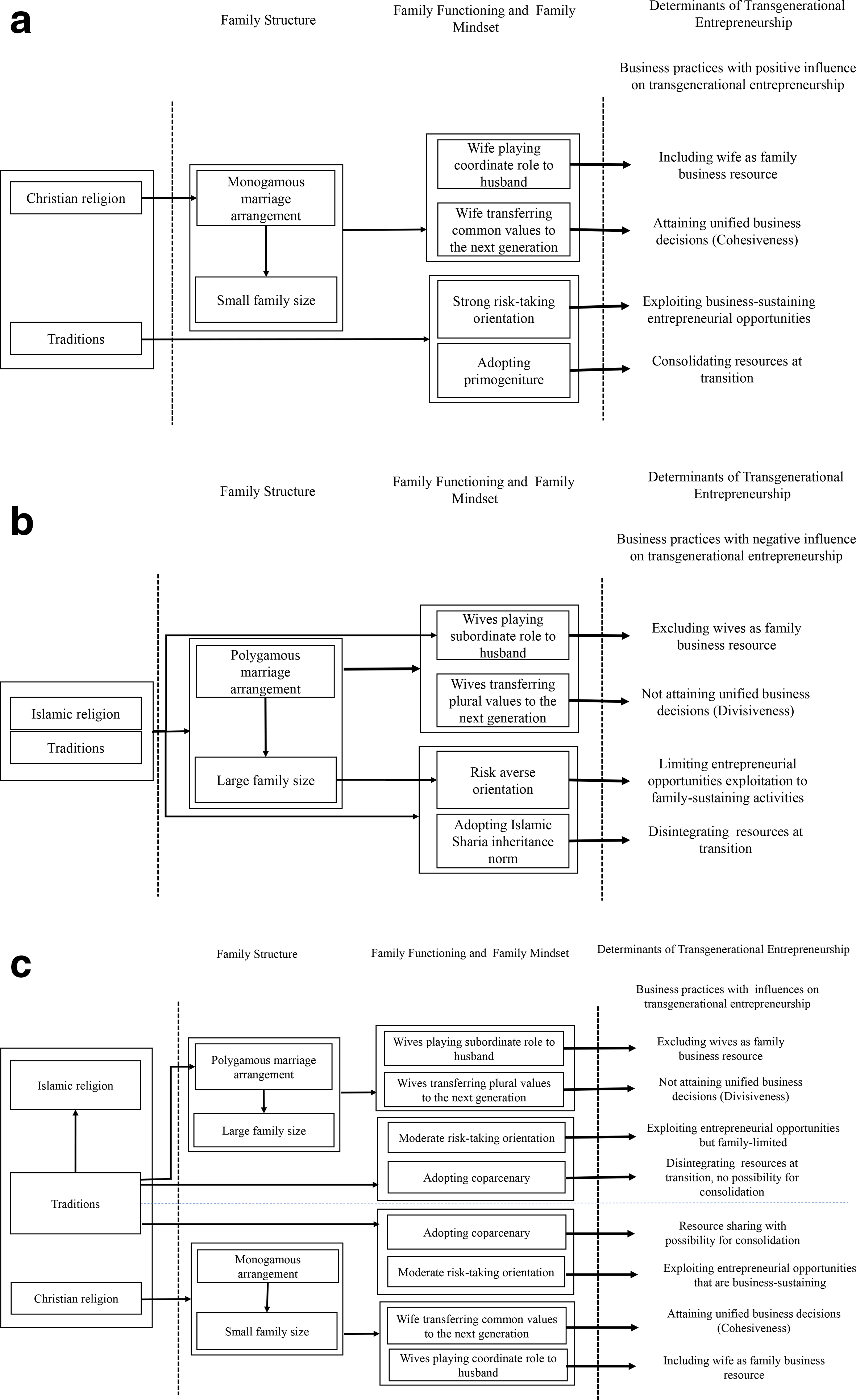
(a) The influence of Christian religion on family structure and functioning and tradition on family mindset, and implications for transgenerational enterpreneurship. (
Using Valuable Resources Provided by a Wife
This dimension refers to how the practice of involving (or not involving) a wife in the family business matters for transgenerational entrepreneurship. The perceived subordinate role of the wife to the husband prevalent in the Northern and Western Muslim families tends not to allow room for the wife’s inclusion, even though she may be—or may become—a vital business resource. Thus, the husband does not even consider his multiple wives as part of the business, especially with their general limited training and relevant educational and professional backgrounds. In the words of one founder of a second-generation family business from the North: “In my kin, there is no woman participation [in the family business], but we know they are there…but not in the business directly” (Nicholas, North_18).
A respondent from a second-generation Muslim family business member from the West adds: “The wives are not involved in the family business at all” (Wale, West_11). In contrast, the perceived coordinate role of a wife in the Christian families in the Eastern and Western subregions enables the inclusion of the wife, which allows the family business to capitalize on her capabilities, skills, and relevant educational and professional backgrounds. A first-generation family business executive director from the West spoke about the role that wives play in the family business:
This may also have to do with the background…it matters for wives with certain level of education and those who don’t have it … So, they do play a big role… whenever the role is exploited in a good way, you take advantage of having that resource. (Willow, West_9)
In support, a first-generation Christian family business founder has this to say about the role that his wife plays in the business:
My wife is very qualified she has considerable employment experience, she had to join to support our effort to grow the business. So, my wife is part of our journey, she’s part of what we’re doing, because she’s eminently qualified to play the roles she has played. (Eric, East_1)
Whereas the Muslim business families in the north of Nigeria in polygamous marriage arrangements did not involve the wife in any capacity, the Christian business families included wives in various functions (e.g., co-founder, shareholder, director, executive director, and managing director). Indeed, to not include all capable family members, both male and female, in the family business may create limits to business development (Samara et al., 2019). Our findings point to the important role of the wives in catalyzing transgenerational entrepreneurship:
She [one wife from a monogamous marriage] is key and without her this business would not be here. She plays the role of the executive vice president. She has a business mind and has been critical to the growth and success of the organization. (Winnie, West_8)
Furthermore, when a mother is involved in the business and transfers legacy information and experience about the business to her children, the next generation begins to gain knowledge about the business early on in life, which helps them develop an interest in the business even before they become involved. In other words, the wife’s involvement in the business facilitates the imprinting of an entrepreneurial legacy from the current generation to the next (Jaskiewicz et al., 2015), thus persuading the younger generation to engage in transgenerational entrepreneurship. Jaskiewicz et al. (2015) argued further that the spouse is essential for family business continuity across generations. For instance, during the succession planning process, the spouse can act as a negotiator and communication mediator to resolve possible arguments among family members (Laakkonen et al., 2011).
Our findings suggest that in the cases where the principal owner’s wife is active in the business, she brings her skills, commitments, and emotions to the pursuit of entrepreneurial opportunities (because “she has her skin in the game,” as one respondent put it). Another respondent said about her mother, who is an executive director:
She played a very important role in expanding the business because of the needs of the business and the knowledge that she has. She recognized opportunities in the market, stemming from her own outside experience. It really was teamwork. (Willow, West_9)
Additionally, because mothers play an essential role in how their children will later behave when they enter the business, wives play a vital role in the subsequent atmosphere that will prevail in the business after transfer to future generations. In the presence of polygamy, wives instill a plurality of values among children of the same family, therefore leading to increased conflict and the depletion of family resources. In contrast, in the presence of monogamy, children have similar values and are more likely to use business resources toward the active pursuit of entrepreneurial opportunities.
Consequently, using the resources provided by a wife will add to the total amount of family resources available for the business, whereas underusing or failing altogether to use the valuable resource provided by a wife reduces the capacity for transgenerational entrepreneurship.
Attaining Unified Business Decisions
Attaining unified business decisions refers to the cohesiveness (or divisiveness) and efficiency with which business decisions are made, and it stems from whether the next generation has imbibed common or plural values.
We found that the cohesiveness and efficiency within Christian family businesses in the East and West puts them in a good position for entrepreneurial activities, the divisiveness present in Muslim family businesses in the North and West jeopardizes their decision making, and so limits their transgenerational entrepreneurship. In the words of a Christian second-generation family business owner: “Our family is able to carry out our business activities and expand due to the common values of support that we share” (Eli, East_2).
Conversely, a second-generation family member of Muslim family business says:
The main problem we have is that the children don’t unify, everybody feels entitled to something bigger than the other, so they won’t agree on a lot of things, they will disagree a lot on minor things, so it crumbles [the business] from there on. (Wale, West_11)
Laakkonen et al. (2011) argued that for entrepreneurial families to build transgenerational entrepreneurship, they must be “characterized by joint family vision-building and decision-making” (p. 195) and that it depends on family business problem solving capacity: “If solutions are found and conflicts resolved, family businesses are more likely to survive” (Laakkonen et al., 2011, p. 196). Our findings support these assertions. We see that divided family businesses cannot attain unified decisions, while those characterized by cohesiveness can achieve unified business decisions.
Furthermore, Nordqvist and Melin (2010) posited that family values tend to drive decisions in family businesses, and entrepreneurial behavior. In the words of a second-generation Christian family business owner with a Muslim uncle in the North:
When you [the founder] have 30-something children, you cannot adequately care for them. Each woman takes care of her children by herself. So, the children don’t have the right upbringing or morals, it becomes very difficult to run a business with such miscreants in the family: they will cause trouble…and then the business will collapse. (William, West_7)
Hence, if business decisions are made from a position where the family members’ values and norms are homogeneous, have a single purpose, and show cohesiveness, this minimizes conflicts and increases the efficiency with which business decisions are made. In contrast, if business decisions are made from a position where the family members’ values and norms are plural, then decision making is weakened as it brings about division, which jeopardizes decisions on which entrepreneurial opportunities are made.
Concerning the speed at which business decisions are achieved, we find that in family businesses with a large family, business decisions are not easily reached because of the diverse interests and opinions expressed by family members, while the opposite is true for small families. Reflecting on challenges encountered in a Muslim family business, a second-generation family member stated: “This family company is owned by 25 children, plus the wives and so whatever you do…one of them will cancel it or disagree with you. So, all these problems will not allow the company to move forward” (Nathan, North_15).
Again, another respondent from a second-generation Muslim family business in the West says:
In a situation where everybody is entitled to his say or to direct the company, you are trying to go straight, but if one is trying to go the right and another is trying to go to the left, the company will be stagnant. (Wale, West_11)
Since effective decision-making enables continuity in a family business (Ensley, 2006; Sharma & Manikutty, 2005), the ability to attain a unified family business decision influences transgenerational entrepreneurship and depends on family size.
Exploiting Entrepreneurial Opportunities
We found that entrepreneurial opportunities exploited by the family businesses could be characterized as either business-sustaining, family-sustaining, or family-limiting. Business-sustaining refers to being more involved in renewal, innovation, and corporate venturing (e.g., building collaborative partnerships, growth in scale and scope, diversification, expansion to other regions, and internationalization). Family-sustaining refers to being more concerned with meeting the family’s myopic financial needs and being less involved in innovative ways of doing business. They do not venture into other regions, nor do they internationalize. Family-limiting refers to opportunities midway between business-sustaining and family-sustaining. On the one hand, it exhibits most attributes of a business-sustaining family business. On the other hand, exploited opportunities are hindered or limited by family features, thereby reducing the capacity for transgenerational entrepreneurship.
Our findings reveal that most Christian family businesses from the East tended to exploit business-sustaining entrepreneurial opportunities. A Christian family business founder from the East states:
As a business we seek growth. We started just selling software that we developed, then advisory services. Today we are a one stop technology shop. We are present in a couple of other locations including outside Nigeria. (Eric, East_1)
Muslim family businesses from the North are conservative, but because a risk-taking mindset is often necessary for entrepreneurship, being risk averse limits the family to specific entrepreneurial activities. For this reason, they tend to explore family-sustaining entrepreneurial opportunities. A family business owner from the North says:
Many Northerners are risk averse … that is why we are in trading, but not just trading. Most major key players in the North go with something that has no expiration – not manufacturing not production but trading. (Noel, North_14)
Both Christian and Muslim family businesses in the West are moderately proactive. However, whereas the Christian family businesses explore opportunities that tend to be business-sustaining, the Muslim families from the West also explore opportunities but are limited by family features (i.e., family-limiting). A second-generation Christian compares Western family businesses of both faith :
Both [Christian and Muslim Westerners] will take equal risk, but when it comes to how they manage the opportunities, Christian Yorubas are better managers than the Muslim Yorubas because they are not prone to practicing polygamy as their Muslim counterpart (William, West_7).
The above assertion is confirmed by another second-generation Muslim family business stakeholder, when he talks about his father:
He [founder] was the number one risk taker and businessman. [But] when he left us [died], the business survived only a year or two before we shut it down, because there were disagreements amongst the children, and because we owe the bank some amount of money. (Wale, West_11)
Given that entrepreneurial performance within the transgenerational entrepreneurship framework is defined as the “sum of an organization’s innovation, renewal, and venturing efforts” and that this has implications for transgenerational entrepreneurship (Habbershon et al., 2010, p. 11), we conclude that Christian family businesses with a focus on exploiting opportunities that sustain the business are in a better position for transgenerational entrepreneurship than family businesses with an emphasis on opportunities that only support the family or are hindered by family factors (family-limiting).
Deploying Resource at Transition
This dimension refers to how the family business allocates resources at the transition from one generation to the next and depends on the inheritance norm adopted.
The alternatives for deploying resources at transition we found are consolidation, disintegration, and disintegration with possible consolidation. Consolidation enables the retention of family business resources in the control of one member of the next generation. Adopting the traditional primogeniture inheritance norm achieves this form of resource deployment. Disintegration allows the family business resource to be distributed in the hands of all family stakeholders, even beyond the next-generation family members. A way of doing this is by adopting the Islamic Sharia inheritance norm. Disintegration with possible consolidation permits the family business resource distribution among only the next generation of family members. Depending on the number of next-generation inheritor, there may be room for consolidation. Coparcenary can lead to this form of resource deployment.
Family businesses will usually allocate their resources and capabilities in line with the values they seek, such as the survival of business and independence (Habbershon et al., 2010). Our findings indicate that, at the point of transition, Christian family businesses in the East adopt consolidation to attain their interest in sustaining the business across generations, which means that family business resources are deployed or handed over to a single successor, for further consolidation in the next generation. This provides the necessary background for transgenerational entrepreneurship:
I was born the first son and then naturally being the first son, there was always the sense of responsibility they will put on you. From day one you were being trained to be the heir to take over and look after business, not to inherit wealth, but to look after a responsibility. Our father died without a will and nobody quarreled about any property. (Eli, East _2)
Thus, when consensus on the successor’s identity is reached far before the time of succession, all the resources from the original family business will be retained, which leads to business consolidation, and the possibility of incorporating other male siblings under a single leadership.
However, when disintegration results from adopting the Sharia inheritance, the next generation successor’s identity is ambiguous, especially when the shares are equally distributed among male siblings and less so among female siblings. This leads to the depletion and fragmentation of the family business resources, especially in polygamy and the prevalence of plurality of values, eventually inhibiting transgenerational entrepreneurship. Muslim family businesses in the North intend to be fair to all family member after the founder is gone:
The Islamic tradition prescribes that you liquidate the asset among the children to avoid any conflicts. How the business will run is entirely dependent on them. When the first owner of the business died, he left 20 children. They split the assets; they liquidated the entire business. (Neil, North_16)
Notwithstanding the disintegration of the family resources at the transition into the hands of the many next generation inheritors, our findings suggest a contingent factor influencing transgenerational entrepreneurship: what each inheritor does with his or her resource. Accordingly, “it is down to their discretion,” as reported by the chief accountant of a third-generation family business from the North: “So, all of them may decide to continue, but how they will proceed will entirely depend on them. Nobody can predict [transitioning the business] outside the Islamic tradition” (Neil, North_16).
Finally, in the West’s mixed religious composition context, family businesses use the disintegration with possible consolidation. In the case of Christian families, the smaller number of next-generation inheritors, the shared values that exist among them, and the intention to take the business to the next generation engender the consolidation family business resources, thus catalyzing transgenerational entrepreneurship. Conversely, for Muslim families in the West, the large family size, plural values, and the quest for independence of each successive generation do not support consolidation. In the words of two different second-generation family members of a Muslim family business from the West, the first claims: “My late father’s business was inherited by quite a lot of people [30 children], and everybody had to go their way” (Wole, West_12). The second asserts:
Once the founder of the company is gone, families are successful in their business because the father mainly gave the business to one of the children to look after – he is the sole decision maker in the company and the rest have to follow, the company will survive. But in a situation where everybody feels entitled to direct the company, you are trying to go straight, this one is trying to go the right and that one is trying to go to the left, the company will be stagnant. (Wale, West_11)
Hence, we posit that how the family business passes its family resource at the point of transition influences the forms of intergenerational value and wealth creation.
Discussion
Existing research on entrepreneurship in family businesses limits the consideration of the role that context plays for transgenerational entrepreneurship to the national context (e.g., Basco et al., 2019; Sharma & Manikutty, 2005). Miller et al. (2017) explored subregional contexts in which family businesses are embedded, but their focus was on governance and on financial performance of family business rather than transgenerational entrepreneurship. Hence, there is still an incomplete picture of how subregional contextual features and norms, such as those related to religion and tradition, play a role in transgenerational entrepreneurship. Further, very little research has unpacked how family structure and other family features affect transgenerational entrepreneurship (Barbera et al., 2018; Basco et al., 2019; Jaskiewicz et al., 2015). Thus, building on previous research focusing on transgenerational entrepreneurship, we examined how subregional variations in religion and tradition affect family structure, functioning, and mindset—and the concomitant implications on business practices for transgenerational entrepreneurship (Figure 2a–c).
We found that family structure (in particular, marriage arrangement and family size) influenced family functioning and determined whether the wife is seen as a resource in the business, and the presence of shared values among family members, leading to unified business decisions. We also found that the family mindset, in particular the family’s attitude toward risk and the likelihood of adopting primogeniture, matters for entrepreneurial performance and for family resource deployment at transition.
In particular, our findings show how the religion and traditions in each subregional context (Welter, 2011; Wright et al., 2014) are intricately linked to the family system (Jaskiewicz & Dyer, 2017; Jaskiewicz et al., 2017), eventually influencing transgenerational entrepreneurship. We found that for Muslim family businesses in the North of Nigeria, wives are not usually considered as a critical resource for the business that can support transgenerational entrepreneurship. Furthermore, the presence of multiple wives in subfamily units and the attendant large family size in Muslim families results in a plurality of values among children that fuels jealousy and conflict. Attaining unified business decisions that can support transgenerational entrepreneurship is then challenging because of the varied opinions and interests of the offspring from different wives. In the case of Muslim families, the main aim of the business is to achieve a level of profit that can sustain the large family size, which leads to more risk aversion with little regard to business growth and competitiveness. When transitioning to the next generation, the family business resources are disintegrated and deployed to the many next-generation successors. There is no clear designated successor, and the family is unlikely to agree on a single leader (again inhibiting transgenerational entrepreneurship).
Christian business families in the Nigerian context represent a different picture of transgenerational entrepreneurship. For instance, through her high-level education and significant work experience, the wife in the Christian family is regarded as a critical business resource and often works in entrepreneurial activities. Furthermore, a monogamous marriage with the attendant small family size in Christian families results in more unified values among the children, which later facilitate effective decision-making and mobilization of resources. The family is also primarily concerned with sustaining and developing the business across generations, rather than merely viewing it as an engine for meeting the family’s current needs. Given that the Christian families in our study’s context are small, risk aversion is lower due to reduced concerns of losing the source of livelihood for a larger family, as in the case of a Muslim family. Hence, having a small family induces a risk-taking behavior among family members that promotes the exploitation of entrepreneurial opportunities. Finally, primogeniture is often adopted and expected as the first son is earmarked as leader and heir apparent.
Our findings regarding the role of religion and tradition for business families’ risk orientation and its impact on the entrepreneurial opportunities that family business exploits is in line with research on family ownership and risk-taking (e.g., Naldi et al., 2007; Zahra, 2005). In their review, Hoskisson et al. (2017) posit that risk-taking behaviors of family principals ultimately impact organizational risks, that is, to what extent new business opportunities are pursued. So, in our study, for instance, we saw that the Muslim family principals are careful to maintain the current income streams into the future so that the financial well-being of their large families is not jeopardized. As a result, they tend to engage in less risky activities, which are needed for transgenerational entrepreneurship.
The varying businesses practices that we found stemming from differences in religion and traditions in each subregion, via family structure, functioning, and mindset also mean differences in the business life cycle from one generation to another (Jaskiewicz et al., 2016; Minola et al., 2016) and their impacts on transgenerational entrepreneurship (Habbershon et al., 2010; Jaskiewicz et al., 2016; Zellweger et al., 2012). On the one hand, for Muslim business families, at the initial stages of a new family business there is a mobilization of resources, which does not include involving the wife as a valuable resource. While the business achieves a certain level of capacity to sustain the family, attaining unified business decisions is challenging because of the varied opinions and interests of the numerous family members. Moreover, the family size, coupled with a submission to “the will of God,” limits risk taking and invariably the extent to which entrepreneurial opportunities are exploited. At generational transition, the family business resources are disintegrated and deployed to the many next-generation successors. Therefore, the business life cycle of Muslim families follows a pattern of mobilization, building family-sustaining capacity, and then disintegration. The disintegration of the family resources at the transition phase does not support transgenerational entrepreneurship in the footsteps of the previous generation. Nevertheless, next-generation successors can sustain entrepreneurship and are free to pursue new independent endeavors such as starting their own business, thus adopting new ways of organizing (Jaskiewicz et al., 2016). Notably, the next generation’s ability to leverage resources derived from previous entrepreneurial activities to support new opportunities and ventures is central to sustained entrepreneurship across generations (Jaskiewicz et al., 2015).
On the other hand, business life cycle of Christian families is different. At the initial stage of mobilizing resources, the wife is included as a critical resource for the family business. The business builds capacity driven by an ambition to build a sustainable business and is not limited by divisiveness among the family stakeholders (because the family is small) or by risk aversion. Finally, when transitioning to the next generation, the family business resource is deployed to a single successor. Hence, the business life cycle for the Christian family follows a pattern to mobilize, build business-sustaining capacity, and consolidate. Therefore, by the transition stage of the Christian family business life cycle, the next generation successor is more likely to have been imprinted with anticipated futures and the idea of an entrepreneurial legacy (Barbera et al., 2018; Jaskiewicz et al., 2015). These transgenerational entrepreneurship features enable successors to continue to sustain and create wealth that endures across generations (Jaskiewicz et al., 2016; Laakkonen et al., 2011; Nordqvist & Melin, 2010).
This phenomenon can be further understood through the family embeddedness approach proposed by Aldrich and Cliff (2003), which outlines how features of family structure and functioning have an important impact on how entrepreneurial opportunities are exploited through new venture creation in business families. More specifically, our findings suggest that integrating a clear prospective successor before he or she takes over the family business will not only lead to new venture creation in the next generation of the business family, but also facilitate intergenerational resource retention and consolidation. On the contrary, too-close family embeddedness involving multiple family members who have equal claims to the family business might lead to intergenerational resource disintegration for the family business. Though transgenerational entrepreneurship may be achieved in these two different settings, the forms of family businesses that emerge in the next generation differ. The form of family business that emerges in the next generation for the Muslim families we may call disjointed individual family businesses, whereas the form that emerges in the Christian context is the family business group in which family members manage a subsidiary, or are working in various capacities (Rosa, 2019). Therefore, we posit that business families may also attain transgenerational entrepreneurship as an offshoot of an original family business and operating independently. Transgenerational entrepreneurship also is attained by consolidating the original family business in the next generation.
Theoretical Contributions
Our main theoretical contribution relates to examining the roles of religion and traditions as subregional contextual features for transgenerational entrepreneurship in family business. Previous literature has emphasized that transgenerational entrepreneurship can be either affected by family-specific attributes such as entrepreneurial legacy (Jaskiewicz et al., 2015; Laakkonen et al., 2011) and anticipated futures (Barbera et al., 2018), or can be moderated by national culture effects on entrepreneurial orientation and familiness (Basco et al., 2019). We contribute to this line of research by integrating the impact of religion and traditions on family structure, functioning, and mindset, and show that these elements influence transgenerational entrepreneurship through preferred business practices.
More specifically, we add to the scant research on entrepreneurial families and transgenerational entrepreneurship in family businesses by moving beyond national context effects on firm familiness and entrepreneurial orientation as determinants of transgenerational entrepreneurship (Basco et al., 2019). We show that subregional contextual features, reflected by religion and traditions, affect the family structure, family functioning, and family mindset, and can lead to varied impact on some dimensions of familiness and entrepreneurial orientation. In particular, we unpack how religion and tradition can lead to varied effects on the risk-taking dimension of entrepreneurial orientation and the impact this can have on transgenerational entrepreneurship.
Our study also contributes to a deeper understanding of the importance of the family structure (monogamous/small family or polygamous/large family) for shaping the role of spouses and business practices that either foster or restrain transgenerational entrepreneurship. Our study thus lends further support to the idea that the family system plays a critical role in transgenerational entrepreneurship (Nordqvist & Melin, 2010; Zellweger et al., 2012). In this way, we add to the literature at the nexus of family science and family business (Jaskiewicz & Dyer, 2017; Jaskiewicz et al., 2017; Randerson et al., 2015), by exploring the influence of different family structures, shaped by religion and tradition, on transgenerational entrepreneurship.
We further bring together the role of wives and family functioning as important dimensions that matter for transgenerational entrepreneurship. Extant literature has confirmed that wives present a vital resource for the family business as a unifying factor for family members (Laakkonen et al., 2011) and as a sounding board by adding points of view toward the development of the family business (Aldrich & Cliff, 2003). We add to this literature by showing that wives (when they have a high level of education and experience and when they play a contemporary role) become a critical resource for transgenerational entrepreneurship. Wives in the context that we have studied become trusted partners of their spouses and become a critical resource for the business to better understand market needs, therefore facilitating the pursuit of entrepreneurial activities.
We thus extend the insights of Jaskiewicz et al. (2015) that the spousal role varies in each family, and culturally, on a continuum from a marginal role to that of a major decision maker. In our study, this is confirmed and manifested by the role played in the businesses by the wives in polygamous and monogamous marriages. We further show that religion and tradition as subregional contextual features impact family structure and family functioning, which provide the essential ingredients for solutions to be found and problems be resolved across generations (Laakkonen et al., 2011). For instance, with respect to the role of the family size, Jaskiewicz et al. (2015) found that large family size has a positive influence on entrepreneurial legacy and transgenerational entrepreneurship. We show, however, that while this may be so in the case of monogamous marriages, in the case of polygamous marriages, large family size seems to have a negative effect on attaining unified decisions, and this inhibits transgenerational entrepreneurship.
Our study also contributes to research that seeks to contextualize entrepreneurship and family business research (Randerson et al., 2015; Welter, 2011; Wright et al., 2014; Zahra, 2007). In particular, our work focuses on what drives or constrains transgenerational entrepreneurship in developing country contexts, such as Nigeria, with the aim of moving beyond the Western-centric focus of entrepreneurship research. We show how primogeniture can be considered as an important element determining transgenerational entrepreneurship. Although in Western-centric literature primogeniture is associated with negative performance outcomes (Calabrò et al., 2018), primogeniture in the Nigerian context of this study serves to remove ambiguity over who will become the next business leader and means no depletion of resources among different siblings that may lead to sibling rivalry. Accordingly, we add to the literature discussing the familiness (Habbershon et al., 2010) by showing how it can be intrinsically linked to the family structure and functioning, which are in turn influenced by the particular subregional religion and tradition emphasis.
Finally, our contribution to the emerging literature on the role of religion in family business development (Astrachan et al., 2020; Fathallah et al., 2020; Kavas et al., 2020) centers around the finding that family businesses in the Muslim and Christian contexts of our study are influenced by religious norms in terms of their capacity for transgenerational entrepreneurship. Thus, we particularly extend the work of Fathallah et al. (2020) by showing that religion and also traditions can produce particular family structure, functioning, and mindsets which translate into business practices that can either foster or hinder transgenerational entrepreneurship in the family business.
Practical Contributions
For practical implications, this study suggests that policymakers interested in supporting transgenerational entrepreneurship as a regional development tool should look into the norms and values that guide the priorities in subregions rather than country needs as a whole. Understanding the family features—family structure, functioning, and mindsets—that drive a business family’s capacity for transgenerational entrepreneurship will aid in understanding which business practices to most effectively implement in a family business. For instance, to support family businesses in the polygamous setting, policymakers can work on spreading awareness about the different dynamics that occur in polygamous marriages and how these dynamics might inhibit transgenerational entrepreneurship.
Because of subregional contextual features linked to religion and tradition some women remain restricted. Policymakers could work on increasing education and encouraging work opportunities for women (Samara et al., 2019), which, as shown in this study, can fuel transgenerational entrepreneurship. In other words, capitalizing on the capabilities provided by women can have a positive impact on transgenerational entrepreneurial families, enabling the creation of new streams of wealth and social development.
Limitations and Future Research
Although we focus on differences in religion linked to Christianity and Islam, our study is limited to how these faiths are enacted in Nigeria; it was never our intention to assess the impact of all forms of Christian and Muslim faith around the world. Also, because our study draws on qualitative research methods, there is a limit to the external validity of our findings. We cannot statistically generalize our findings to the population of businesses from which our sample was selected. The question may also arise as to whether the sample size is adequate given our research method. However, we were able to gain rich insights from our sample and our findings should be relevant for analytical generalizations within the context of the study.
Notwithstanding these limitations, subregional contextual features such as religion and traditions, whether Christian or Muslim, are common to other contexts and are likely to generate, if not corresponding, in many cases at least similar family structures. However, whether the same dynamics will play out concerning, for instance, the role that wives play in the family and business setting, we cannot say. Therefore, this is a promising avenue for future studies. Exploring how religion plays out in another context to affect transgenerational entrepreneurship by comparing wholly Christian and Muslim countries may yield more in-depth insights.
Furthermore, future scholars could study how involving all wives in the polygamous setting affects transgenerational entrepreneurship, in a context where wives have suitable education, competence, and experience. Similarly, we encourage future research that looks at the extent to which polygamous families in some contexts may engage in entrepreneurship, whether risky or not, as a means of offering employment opportunities to a large set of offspring, for example through new venture creation, innovation and corporate venturing. Such a research agenda that takes the entrepreneurial family perspective could also look more closely into how the differences in family structure, functioning, and mindset associated with religion and tradition might drive decisions regarding dissolution and exit of businesses as a way to renew the family’s business portfolio.
The roles of religion and traditions in entrepreneurship is attracting increasing interest from scholars. With a focus on the decision by young people to engage in entrepreneurship, it would be interesting to see how and why there might be differences among those growing up in a Christian versus a Muslim business family context. The observation that there may be intergenerational differences may require further exploration using some of the family science theories suggested by Jaskiewicz et al. (2017), for example imprinting theory (Marquis & Tilcsik, 2013) or self-determination (Deci & Ryan, 2012) theory. Such a research project could also embrace the idea suggested by Fathallah et al. (2020) to study the impact on business and entrepreneurial activities when some family members do not conform to the specific religious beliefs practiced by the rest of the business family. Furthermore, in contexts where primogeniture is the norm, when the first-born of the family are twin boys or when the age gap between first and second son is very close, how will these family factors affect transgenerational entrepreneurship? We encourage more thorough examination of these questions by, for instance, incorporating birth-order theory.
Conclusions
This article provides novel insights into the question of how religion and tradition within a subregional context in a developing country shape the capacity of family businesses to achieve transgenerational entrepreneurship, through family structure, functioning, and mindset. We address the call to contextualize entrepreneurship research in settings not prevalent in mainstream literature and to explore salient dimensions of familiness and entrepreneurial orientation in relation to transgenerational entrepreneurship. By doing so, we bring to light important family and business features that drive or inhibit transgenerational entrepreneurship in Nigeria as family businesses progress from one generation to the next.
Footnotes
Appendix I. Additional Representative Quotes
Acknowledgments
We appreciate the editor and the anonymous reviewers for the many detailed suggestions for improving our paper through the original manuscript’s review stages. We found the editor and the reviewers’ recommendations beneficial and constructive for revising our article to meet the conditions for approval.
Declaration of Conflicting Interests
The author(s) declared no potential conflicts of interest with respect to the research, authorship, and/or publication of this article.
Funding
The author(s) received no financial support for the research, authorship, and/or publication of this article.

Author Biographies