



Abstract
Given the importance of theorizing about an entrepreneurial phenomenon, we seek to highlight the common challenges of entrepreneurship papers’ theorizing and offer suggestions for how we (as a community of scholars) can address these challenges to develop more robust and impactful entrepreneurship papers to advance the entrepreneurship field. Specifically, we identify the following major reviewer comments of entrepreneurship papers regarding their scope, common features (i.e., contextualization, boundary conditions, and time considerations), and “point of view”. Elaborating on these common comments of entrepreneurship theory papers, we offer guidance on incorporating these insights when writing or reviewing entrepreneurship papers.
Keywords
Introduction
Have you received a journal review criticizing your paper for lack of depth in exploring the nuances of the focal entrepreneurial phenomena? We have. Have you received a journal review criticizing your paper for lack of breadth in that it is not sufficiently generalizable beyond the focal entrepreneurial context? We have. Have you received both of these critiques in a round of revision for the same paper? Yes, we have too!
These critiques raise important points and put authors in a difficult position to address the requests for both depth and breadth of a theoretical argument within the constrained possibilities of a single study and the page limits required by journals. Indeed, efforts to extend the depth of an idea may inherently come at the expense of breadth and vice versa. How can we as authors address these seemingly contradicting criticisms to make theoretical contributions? How do we communicate these trade-offs to reviewers, editors, and readers? How can reviewers weigh their own preferences vis-à-vis a paper’s contributions to the field, and how can editors negotiate potentially competing perspectives on a study’s focus? These are important questions that have been and continue to be highly relevant in our field. In this paper, we do not resolve all these issues but instead offer a framework that provides some guidance to (1) entrepreneurship scholars to find a balance to maximize their contributions and (2) reviewers and editors on managing the revise-and-resubmit process to advance the entrepreneurship field.
We recognize that writing theory is challenging and complex (Cornelissen, 2017), especially theory about entrepreneurial phenomena (for useful advice on positioning and articulating contribution of entrepreneurship theory papers, see Chrisman, Fang, and Steier [2021]). Authors must introduce the reader to a specific conversation—often fusing parallel conversations in the process, delineate constructs, establish the scope and boundaries of their theorizing, and articulate a clear claim to a contribution (Fulmer, 2012; Rindova, 2008; Suddaby, 2014; Whetten, 1989). While several editors and scholars have shared critical insights into the craft of writing a theory paper (e.g., Byron & Thatcher, 2016; Cornelissen, 2017; Locke & Golden-Biddle, 1997), there is an essential aspect of publishing a theory paper that is less understood: the process by which expert reviewers and authors engage in the review process, which has a significant influence on the construction of theory. This lack of understanding stems from the challenge of accessing this process—reviewer-author interactions are private, decentralized, and (necessarily) double-blind. However, this lack of knowledge is particularly detrimental to entrepreneurship because, like the phenomena we study, the field is dynamic and emergent (Chandra, 2018; Landström & Harirchi, 2018; McMullen et al., 2021; Shepherd, 2015; van Gelderen et al., 2021), and we are therefore in need of a shared understanding for how to engage in the process of theorizing that benefits the field and its theoretical base.
Entrepreneurship is still relatively new as a field (Combs et al., 2021; McMullen et al., 2021; Shepherd, 2015). Therefore, entrepreneurship scholarship needs to continue to develop new theories and elaborate on existing theories to best explain entrepreneurial phenomena. Although such field development falls mainly on the scholars generating theory-based contributions, some responsibility must fall on the gatekeepers (reviewers and editors) to select high-potential papers, develop these papers through the R&R process, and publish papers that make important contributions to our understanding of entrepreneurial phenomena. Indeed, the double-blind review process has great potential for critical improvements to a theory, thus contributing to the focal paper and ultimately to the entrepreneurship field. However, the review process could also be where unrealistic expectations (i.e., considerable depth and considerable breadth in a single manuscript) undermine emergent theory, delaying or stunting the much-needed development and elaboration of entrepreneurship theory.
Given the unavailability of data on the specifics of the interactions in the double-blind review process, one promising pathway to examine theory critiques and responses is to assess critiques of entrepreneurship theory. These critiques come in the form of dialogues and editorials that analyze attempts at theorizing and offer recommendations for better scholarship. Considering common critiques of entrepreneurship papers holds potential in five primary ways. First, it provides an approach to evaluate the quality of theorizing, which helps validate existing entrepreneurship models. Second, it helps outline possible pathways to future theoretical insights into entrepreneurial phenomena. Third, it demonstrates how entrepreneurship scholars (and the review process) can take a more scientific approach to theorizing, including critiques, responses, and amendments to models advancing our knowledge of entrepreneurship. Fourth, it provides a unique opportunity to gain more comprehensive insights into how entrepreneurship scholars can use more effective theorizing to develop impactful papers (conceptual and empirical). Specifically, criticisms of entrepreneurship papers may explain how scholars can avoid these pitfalls, understand theorizing approaches better to explain the validity of reviewers’ comments and communicate with them and improve theorizing for more impactful contributions to the field of entrepreneurship. Finally, dialogues also show how papers continue to face criticism even after publication, demonstrating how the challenges of making a theoretical contribution extend beyond the review process. However, this is the natural process of conducting scientific research—attempts are made to understand and explain relationships in the world. Then these attempts are evaluated against (potentially better) alternatives. Over time, a body of research emerges and develops, where theory becomes more refined in ways that reveal opportunities to examine greater depth and how a theory generalizes to other domains.
In this editorial, we do not claim to elucidate the precise way every theory paper should be constructed—that would be an unreasonable objective. Instead, we seek to share insights in hopes of helping authors, editors, and reviewers improve our shared aim of developing a deeper and broader body of entrepreneurship theory as a collective effort by facilitating the more effective construction and dissemination of individual theory papers. Therefore, we seek to answer the following research questions: What are the common trade-offs entrepreneurship scholars face in developing a paper’s theorizing, and how can we engage these trade-offs to develop more robust and impactful entrepreneurship papers and advance the entrepreneurship field. In answering these questions, we identify three major challenges of entrepreneurship papers as a basis for improving contributions to knowledge: (1) the scope of the entrepreneurship paper’s theorizing being either too narrow or too shallow; (2) the common features of the paper’s contextualization, boundary conditions, and time considerations; and (3) the “point of view” of the entrepreneurship paper’s perspective—theoretical, philosophical, level, and purpose. In building and expanding our arguments on the main trade-offs of entrepreneurship papers’ theorizing, we use a mapping metaphor to help explain how each of these themes impacts the overall “domain” of an entrepreneurship paper’s contribution. Like written language, maps provide an outward expression of thinking (Wood, 1994) and help identify representations of boundaries that shape the human condition. Indeed, French cartographer J. L. Lagrange noted (in 1770) that a “map is a plane figure representing the surface of the earth, or part of it” (Bagrow, 2017: 22).
We believe that applying a mapping metaphor to an entrepreneurship paper’s contribution helps denote important boundaries, places yet to be explored, and the need for greater clarity. Specifically, we assess entrepreneurship papers regarding their explanatory terrain of the entrepreneurial phenomena (i.e., metaphorical “surface of the earth”). We recognize that entrepreneurship papers covering too little or too much terrain contribute less 1 to the literature than they would between these two alternatives, which we refer to as the optimal explanatory terrain. To be sure, we realize that this notion of the “entrepreneurial-phenomenon terrain covered” by a paper is relatively abstract and subjective. However, we attempt to make this idea more concrete and argue that this approach can improve understanding of the criticisms of a paper to inspire entrepreneurship scholars to improve their papers and advance the field.
Trade-Offs, Explanatory Terrain, and Contribution
Overview and Mapping Framework
This section provides an overview of our mapping framework of a paper’s contribution to entrepreneurship. This framework draws on a mapping metaphor and highlights the relevance of considering breadth and depth for covering an optimal amount of entrepreneurial-phenomenon terrain to contribute to the field of entrepreneurship. Reviewers of theorizing and theory building 2 typically focus on issues related to an entrepreneurship paper’s boundary conditions (contextual, temporal, and theoretical) and theoretical scope (breadth and depth of theorizing). These reviewer comments implicitly or explicitly recommend changing the entrepreneurial-phenomenon terrain covered in a single paper. Thus, these comments (and corresponding recommendations) offer essential clarifying guidance for entrepreneurship scholars on how and in what ways to improve theorizing to enhance a paper’s contribution. In the following sections, we elaborate on the common reviewer comments on entrepreneurship theory papers and offer guidance on how these insights should be incorporated when writing or reviewing entrepreneurship papers.
Theoretical Scope—Trading Off an Entrepreneurship Papers’ Depth and Breadth
Some of the most frequent reviewer comments about entrepreneurship papers relate to deficiencies in breadth and depth of theorizing. Furthermore, reviewer comments frequently note a discrepancy between what the paper claims to do and what it does. For this reason, it is critical that authors clearly define the boundaries and purpose of the theory to help signal the terrain they hope to cover and the orientating framing (breadth or depth) to be employed to accomplish that. This clarity can be achieved by stating the problem to be solved (e.g., lack of integration between similar concepts, lack of understanding of underlying mechanisms) and how the author’s theorizing addresses that problem. Then, the authors can pursue efforts to offer broad or deep contributions to theory more aggressively.
By a paper’s breadth, we refer to the diversity of entrepreneurship domains covered by the paper. The greater the number of domains covered by a model, the more generalized the model to those domains. An example of a broad model is the resource-based view (Peteraf, 1993; Wernerfelt, 1984)—which scholars have applied widely across theoretical domains—wherein it is theorized that competitive advantage is obtained through the possession of valuable, rare, inimitable, and substitutable resources (Barney, 1991). Indeed, classification systems capture the scope of a topic, field, or phenomenon and provide a basis for conceptualizing the breadth of a particular paper—a broader paper is one that involves more classes in the classification system. For example, Sharma and Chrisman (1999) developed a classification system for corporate entrepreneurship that could be used to determine the breadth of a corporate-entrepreneurship paper’s theorizing—a broader study covers more corporate-entrepreneurship classes (i.e., covers internal corporate venturing, external corporate venturing, innovation, and strategic renewal vis-à-vis a narrower paper that focuses exclusively on internal corporate venturing).
By theorizing depth, we refer to the number of links between the elements (e.g., constructs, events, activities, and so on) of a model. Models are deeper when there are more links between their different elements and an elucidation of mechanisms that detail the “workings” of the model. An example of a deep model is the theory on trust in organizations and entrepreneurial firms (Mayer et al., 1995; Rousseau et al., 1998), where theorists detail the mechanisms of trust and how it shapes sub-factors that constitute organizational and entrepreneurial performance (Williams & Shepherd, 2018). Many studies emphasizing depth seek to explain moderators and mechanisms that delve into the ‘black box’ of more generalizable processes. For example, Thompson and Hunt (1996) seek to explain the cognitive factors undergirding attitude structures, Sirmon and colleagues (2007) examine sub-processes of resource advantages by studying the management tactics needed to mobilize resources, and Garg (2013) sought to understand how venture board monitoring tactics influenced the performance of entrepreneurial firms. Despite the seeming polarity of breadth and depth, we argue that a paper’s breadth and depth are not mutually exclusive. However, given publication constraints (e.g., page limits for a theory paper), there is a distinct tradeoff between a paper’s breadth and depth. In building on the map analogy, we propose that breadth and depth establish an “area” of exploration and provide either a more comprehensive view of the referents on a map and their interrelation (breadth) or a narrower, more detailed exposition of a specific section of a map (depth). Furthermore, papers claiming to contribute in the form of depth or breadth may both fail to do so by inadequately exploring relevant terrain. Therefore, we consider how a paper’s breadth and depth determine the conditions for the explanatory terrain it covers.
First, given the publication constraints of a single paper’s length, we consider the optimal amount of entrepreneurial-phenomenon terrain covered by a paper. Like the notion of optimal distinctiveness (Brewer, 2003), this implies an adequate reference to broad map features while similarly acknowledging the relevance of depth regardless of the primary orientation of a theoretical manuscript (deep or broad theorizing). Entrepreneurship papers that fall short of covering this optimally distinct amount of terrain have the underutilized potential for contributing to the entrepreneurship literature. Second, to cover more explanatory terrain, an entrepreneurship scholar could broaden a paper’s scope, deepen (complexify [see Tsoukas, 2017]) the model, or both (until the paper covers the optimal entrepreneurial-phenomenon terrain). Finally, any paper can be criticized for not being broad or deep enough. We take a relatively extreme position here to suggest that such criticisms are appropriate in two cases: (1) an entrepreneurship paper has not covered the optimal amount of explanatory terrain of an entrepreneurial phenomenon or (2) there is a recognition that to increase one (e.g., the paper’s breadth), the author will need to decrease the other (the paper’s depth), and there is a good reason to prefer one ratio of breadth to depth over another ratio of breadth to depth. Thus, entrepreneurship scholars need to more directly acknowledge the potential scope of their papers—the depth-breadth ratio—and not provide content that falls outside the optimal terrain of a paper.
Too Narrow
Consistent with our arguments above, some reviewers criticize papers for being too narrow, allowing the critics to speculate on how to broaden the paper. This common criticism of reviewers furthers our claim that while the criteria for breadth/depth are not explicitly clear to authors, critics can focus on overly narrow arguments. As an example of these reviewer critiques, Harvey (2014) theorizes how some teams rely on processes that facilitate creativity to develop new ideas. One critique points out that Harvey’s (2014) model is overly narrow in two different sections: Theoretically, creative synthesis emphasizes the dynamics of dialectical reasoning through affirmation rather than negation. Although Harvey’s model is compelling, we propose that its contribution be increased by integrating it with negation in dialectical reasoning and the same random variation that it was intended to replace. To this end, we first articulate the assumptions and limitations of creative synthesis, then develop a hybrid model called evolutionary synthesis, and end with further research implications. (Chen & Adamson, 2015: 461, emphasis added) By recognizing the compatibility of different models of the creative process and their limitations, our evolutionary synthesis model may open up exciting avenues for new research beyond explaining the creative process, such as the generation, evolution, and renewal of knowledge, theory, innovation, organization, and entrepreneurial opportunity. (Chen & Adamson, 2015: 463, emphasis added)
As summarized above in Chen and Adamson’s (2015) critique, the primary issue in Harvey’s (2014) theorizing is its failure to broaden the theory to adjacent fields, limiting the potential breadth in covering the terrain of the creative and innovation processes. One conclusion we might draw is this—while the primary purpose of Harvey’s (2014) model was to provide depth, it could have found a greater optimal fit by also acknowledging its relevance to adjacent concepts—despite breadth not being the primary focus of the manuscript.
Too Shallow
In contrast, reviewers can criticize a paper’s model for being too shallow, allowing the critics to speculate about how the focal authors could have deepened their theorizing. For example, Bloodgood (2013: 455) argues that Afuah and Tucci’s article (2013) proposing that crowdsourcing is a solution to distant search is limited in that it does not go deep enough into elaborating the theoretical mechanisms: It is also important how the problem gets solved. Afuah and Tucci do not adequately address the advantages of each of the three approaches they discuss. A primary benefit to internal problem solving is that the answer is more concealed than it would be using contracted problem solving, and significantly more concealed than if crowdsourcing were used. Concealment of the solution—and even the problem in many cases—provides the focal firm with a stronger potential advantage over its rival.
Thus, Bloodgood (2013) argues that failing to provide adequate depth will negatively impact future research seeking to better explain decision-making. The original paper would have made a more substantial contribution had it tied in theories of competitive advantage to explain value capture. In this way, a contribution is less about connecting to a dispersed and broad set of concepts and more about elaborating deeply on the “building blocks” and erring “in favor of including too many factors, recognizing that over time, their [authors’] ideas will be refined [as] it is generally easier to delete unnecessary or invalid elements than it is to justify additions” (Whetten, 1989: 490). A common way of increasing depth is to define and theorize mechanisms that connect key features of a model (i.e., explaining the how what, and why) (Anderson et al., 2006; Shepherd & Suddaby, 2017; Westphal & Zajac, 2013).
Writing Better Scoped Entrepreneurship Papers
In reflecting on the divergent criticisms of a paper as too narrow or too shallow in scope (covering the entrepreneurial phenomenon), it is natural to assume that authors might feel stuck in a Catch 22: too much depth or breadth may expose one to the threat of criticism and rejection. In attempting to offer a path out of this dilemma, in Figure 1, we combine a paper’s breadth (x-axis) and depth (y-axis) and highlight the amount of entrepreneurial-phenomenon terrain covered by the diagonal line. In providing this framework, we propose that criticisms of entrepreneurship papers directed at the breadth and depth are useful for papers below the optimal entrepreneurial-phenomenon terrain covered by a paper but are not particularly useful for those that already cover the optimal amount of entrepreneurial-phenomenon terrain. Breadth, depth, and optimal coverage of the entrepreneurial-orientation terrain.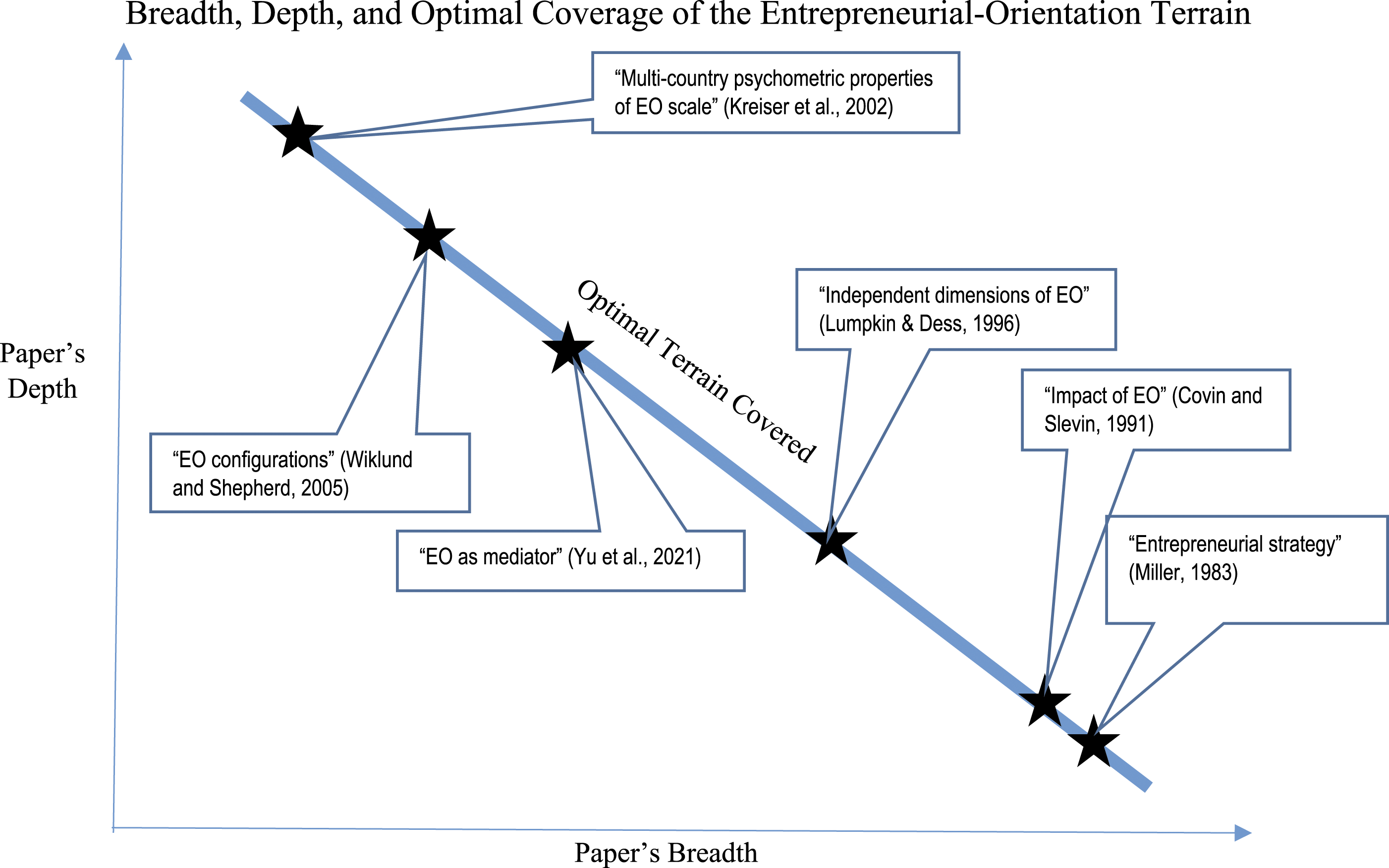
By setting the stage for the relationship between an entrepreneurship paper’s breadth and depth in this way, we hope to create a more objective perspective on theoretical contributions to entrepreneurship that allows us to improve theorizing within and across papers and improve the quality of reviewers’ critiques and recommendations. However, we realize that people can differ on what represents a paper’s breadth, depth, and the ratio of the two. We do not believe that we can reconcile these differences (nor is it important that we do). Still, hopefully, this model provides a framework to (1) understand others differences and (2) communicate those differences in the formation of one’s research questions and anticipated domain of exploration as a way of advancing the contribution of entrepreneurship papers. Therefore, we argue that having a common understanding of the trade-offs between breadth and depth provides clearer guidelines for assessing the often-nebulous notion of a “theoretical contribution” to the entrepreneurship literature.
Elaboration of Figure 1 and exploring different perspectives of E.O. Figure 1 details our interpretation of papers with different breadth-depth ratios, yet each covers an optimal amount of terrain for the paper and contributes to the entrepreneurship literature. The position of a paper’s breadth and depth and optimal terrain covered is somewhat a subjective assessment that we offer as a conceptualization to improve theorizing, the review process, and contributions to the field of entrepreneurship. Despite it being a subjective judgment, we provide several examples in Figure 1 of our assessment of papers on the topic of Entrepreneurial Orientation (EO). We chose EO because it is a popular topic and, as shown in Figure 1, covers a range of ratios that lead to an optimal amount of terrain covered.
We start with the bottom right, where Miller (1983) conceptualizes the notion of an entrepreneurial strategy which was the genesis of the EO construct, and linked it to theories in strategy, organization theory, and economics. Less broad and deeper is Covin and Slevin (1991), which focuses on EO as a strategic posture and explores its antecedents and consequences. Less broad but deeper is Lumpkin and Dess (1996) that clarifies the construct of EO in terms of five dimensions and suggests a range of models that link EO to performance that should be tested by future research. Yu et al. (2021) is less broad and deeper in that the theorizing focuses on the mediating role of EO in the relationship between Attention Deficit Hyperactivity Disorder (ADHD) symptoms and firm performance—provides a richer perspective on individual antecedents to a firm’s EO than the broader study detailed above. Wiklund and Shepherd (2005) add greater depth to our understanding of EO by focusing on different configurations of EO, access to capital, and environmental dynamism (three-way interaction) explaining small businesses’ performance. Finally, Kreiser and colleagues (2002) focus on the operationalization of EO dimensions and whether this measure is robust across countries.
As illustrated by these examples embedded in Figure 1, the early papers on EO are at the broader yet shallower end of the optimal terrain continuum, and then as the research topic matures, research becomes narrower and deeper (but a study may start with a narrow but deep paper [e.g., a thick description of an anomaly] from which subsequent papers generalize from the highly contextualized initial theory). Perhaps entrepreneurship scholars start with a decision about the breadth of the proposed paper and then, given that level of breadth, determine the level of depth needed to cover an optimal amount of terrain. But the reverse is also possible; given the nature of the data available (for a quantitative or qualitative study); what depth should the theorizing be, and given that depth, what is the optimal breadth?
Having provided a general overview of our model, we next examine specific issues relating to breadth and depth, followed by suggestions for how authors can address them. These issue areas relate to a study’s boundary conditions, including contextualization, temporal considerations, and theorizing logic.
Boundary Conditions: Situating Theorizing and Optimizing the Explanatory Terrain
Boundary conditions are a key aspect of a theorizing outcome and refer to the “who, where, and when” of theory (Dubin, 1976; Whetten, 1989), including aspects of context, temporality, and theorizing logic. Boundary-condition issues tend to influence concerns with the breadth and depth of the coverage of entrepreneurial-phenomenon terrain as they shape the overall scope of a manuscript. For example, Coffman and Sunny (2021) offer a recent critique of how Dencker and colleagues (2021) conceptualize necessity entrepreneurship. Specifically, Coffman and Sunny (2021) argue that to eliminate a previously held boundary (dichotomous—push or pull into entrepreneurship) relating to necessity entrepreneurship, Dencker et al. (2021) end up eliminating “the need to group entrepreneurs into either necessity or opportunity categories” altogether. Indeed, Coffman and Sunny (2021: 824) go on to argue that “a needs-based view of entrepreneurial motivation can be broadened to include start-up activity traditionally referred to as opportunity entrepreneurship.” To summarize the critique, Coffman and Sunny (2021) argue that Dencker and colleagues (2021) are too narrow in their boundary conditions and encourage further expansion.
In another example that contrasts the previous one encouraging expansion, Varendh-Mansson et al. (2020: 230) criticize Grimes and colleagues’ (2019) mission-drift theory as being too broad—a “potentially misguided attempt to develop a general theory”—and suggest that more detail is needed: While the treatment that Grimes et al. (2019) develop is likely relevant to some organizations, their argument is built on a shaky foundation, where “mission” is conceptualized in simplistic terms as an organization’s single, orienting purpose. . . . This dialog details our concerns, and suggests that it is vital to go upstream, and theorize mission as a nuanced and variegated construct if we are going to generate meaningful insight about the nature, causes, and consequences of drift. Grimes et al. (2019) open their paper by noting that “organizational mission” is severely undertheorized in extant studies. Yet rather than grappling with the complexity of this construct, the authors assume that all organizations have a clear, singular mission that is understood and accepted by all key stakeholders (230).
Interpreting this critique, we can see that it relates primarily to concerns about where on the map theory development should be focused. Varendh-Mannson et al. (2020) argue that there is a need to go deeper on mission concepts before examining the broader question of mission drift. While potentially valid, it could be argued that Grimes and colleagues had a different objective—to link together a theory on values-based discrepancies, mission drift in social ventures, and broader challenges for organizations in aligning with audience expectations. Put differently; their focus was on breadth, not depth.
Therefore, critics’ comments about boundary conditions primarily relate to either relaxing or restricting these conditions to enhance a paper’s contribution to the literature. Parker et al. (2019: 478) capture the notion of a paper’s optimal theorizing terrain (i.e., criticisms that a paper could do more are always possible but not always useful or productive) in the following response to criticisms of their paper on discretion and firm reputation: “no theoretical framework can be so exhaustive as to adequately address all of the nuances and exceptions that might be fruitful for scholars to pursue, but we believe that our framework is a good first step”.
Addressing General Boundary-Condition Issues
In terms of recommendations, scholars need to be sure to establish the boundary conditions of their papers (Bacharach, 1989; Dubin, 1976; Whetten, 1989) so that their considerations at least inform their readers. Authors should be specific about the problem or gap in the literature and how that problem can be solved within a targeted theoretical boundary. However, Busse et al. (2017: 575) claim that “the most widespread scholarly attitude toward boundary conditions has been inattention.” Boundary conditions are important because they detail the limits of the generalizability of the focal theory (Busse et al., 2017; Whetten, 1989). A more dynamic perspective of boundary conditions involves using boundary conditions as a tool in the theorizing process.
Indeed, Busse and colleagues (2017) offer the following approaches to boundary-condition exploration. First, the inside-out exploration of boundary conditions involves reflection on the boundary conditions—namely, the “when”—of a newly developed theory (Busse et al., 2017; e.g., Green et al., 2008; Townsend et al., 2018). This approach highlights the known territory of a theoretical model and then begins to speculate beyond those boundary conditions into unknown territory. Such speculations are not part of the theoretical model—and therefore have little impact on theorizing breadth and depth—but may stimulate theorizing.
Second, the outside-in exploration of boundary conditions focuses on beginning with a situation (or who, when, where) in which a current theoretical model is expected not to apply. This disconnect (and feedback loops and iterations) then informs theorizing to modify existing accounts to accommodate the unique situation or to create a new (indigenous) theory (Busse et al., 2017; e.g., positioning strategies and complex rules in dynamic markets [Bingham & Eisenhardt, 2011]). Gray and Cooper (2010) refer to this approach as pursuing failure—applying a theoretical approach that is unlikely to be applicable (i.e., one that disfavors a theory)—to develop a theory that better fits this chosen situation. For example, Shepherd (2003) applies learning theories to entrepreneurs of failed businesses to indicate the inapplicability of the assumptions that learning from failure is automatic and instantaneous to replace it with a grief model of learning from failure that requires a process of regulating negative emotions.
Finally, uncertain or serendipitous exploration of boundary conditions involves scholars exploring phenomena they are interested in. While scholars may start with a theoretical perspective, they are unsure whether this theory will be valid (given the uncertainty) or whether opportunities for theorizing will arise by chance (Busse et al., 2017). For example, in one study, the researchers set out to study the positive impact of a social venture (clean water) on rural villages in Africa. Still, they were surprised by the beneficiaries’ lack of gratitude toward the social entrepreneurs, leading them to develop a model of the paradox of prosocial motivation (McMullen & Bergman, 2017).
These approaches for exploring boundary conditions have implications for our contribution framework. Some papers suggest that entrepreneurship papers can make important contributions to the field by relaxing their boundary conditions (Berglund & Korsgaard, 2017; Gupta et al., 2016). In relaxing boundary conditions, a researcher considers more domains and thus broadens coverage of the entrepreneurial-phenomenon terrain—extending the boundary conditions (e.g., Alvarez & Busenitz, 2001; Calás et al., 2009; Dencker et al., 2021). If a paper already covers the optimal entrepreneurial-phenomenon terrain, broadening its scope will require shallower theorizing (e.g., less theorizing on the complexity of relationships, such as possible three-way interactions or moderated mediated relationships) to maintain optimality. In contrast, restricting boundary conditions place greater constraints on the entrepreneurship domains for inclusion. Thus, when an entrepreneurship paper already covers the optimal entrepreneurial-phenomenon terrain, addressing such suggestions will require deeper theorizing about the nuances of a smaller set of entrepreneurship domains.
Having reviewed the general role of boundary conditions in capturing the optimal entrepreneurial-phenomenon terrain covered in a paper, we sought greater clarity regarding the common elements of a “boundary condition” that need to be addressed. Indeed, we note that while critics often mention concerns over the boundary conditions (Whetten, 1989), boundary-condition critiques do not always specify the specific nature of the violation. Clearly explaining the nature of boundary conditions is critical for evaluating the quality of a theoretical contribution (Corley & Gioia, 2011) and is necessary for effective theory building (Dubin, 1976; Smith & Hitt, 2005; Whetten, 2009). In the following sections, we discuss the most common failures to enact appropriate boundary conditions relating to (1) contextualization, (2) temporality, and (3) theorizing logic and how they influence the construction of a contribution to the entrepreneurship literature.
Contextualization
Despite contextualization becoming increasingly important in theorizing in entrepreneurship, criticisms remain that there is insufficient attention to its implications for theory (Welter, 2011; Zahra, 2007; for reviews, see Shepherd et al., 2019; Welter et al., 2019), especially as it relates to a paper’s depth-breadth terrain coverage and ratio. Contextualization (or context) captures the “where” contexts of entrepreneurship, such as the “stage of life-cycles of industries and markets” (business context), “structure of networks” (social context), “characteristics of local communities and regions” (spatial context), and “societal attitudes and norms” (institutional context) (Welter, 2011: 168). When raising concerns over inadequate contextualization, critics often note an overemphasis on a specific context and its lack of relevance to other areas. For example, an excessive focus on entrepreneurship in high-tech businesses is coupled with ignoring the heterogeneity of everyday entrepreneurship (Welter et al., 2017; Welter & Baker, 2021). Criticisms of a lack of sufficient contextualization of entrepreneurship research highlight the lack of attention to contextual nuance that scholars should account for in theorizing. For example, Ahsan (2017: 145–146, emphasis added) makes the following comment about context in Navis and Ozbek’s (2017) theorizing on entrepreneurial entry and successful opportunity realization: Navis and Ozbek implicitly connect venture context to novelty of technology and its related components (2017: 114). For instance, they use examples of early internet companies (eBay, Priceline, Yahoo, Webvan) and technology product companies (Solyndra, satellite-based entertainment) to describe the difference between familiar and novel venture contexts. This is problematic since not all new technologies are the same and vary in terms of complexity and gestation period (e.g., apps, biotechnology, medical devices). This means that in some cases a venture context might be novel for a few months, whereas in other situations a venture context might remain novel for more than a decade. . . . Simply put, Navis and Ozbek’s conceptualization of “context” limits our understanding of how the relationships explored by the authors impact entrepreneurial outcomes. More important, it creates issues in the theoretical development of what the authors describe as the “linchpin constructs for demonstrating how and why ‘context matters’ in entrepreneurship research” (2017: 111), which I discuss next.
This critique suggests that the theorizing could have been better for the field by linking the theorizing to entrepreneurial outcomes. However, we suggest that Navis and Ozbek (2017) had to balance using a discrete context for theorizing that, had it been abandoned, it may have threatened the overall incremental contribution. It could be that this contribution is helpful, and Ahsan could have instead sought to develop a new theory that extended Navis and Ozbek’s theorizing to broader contexts.
In a separate example, Jaskiewicz et al. (2019) suggest that Nason et al. (2019) overly contextualize their model: The situation will be quite different within enmeshed and chaotic families. Enmeshment fuels an internally oriented focus on harmony and sharing time together, while chaos implies a lack of clear leadership and an impulsive responsiveness to new stimuli (Olson, 2000). Accordingly, reference points might shift frequently as these families harmoniously but impulsively respond to each new piece of knowledge contributed by any family member.
Jaskiewicz and colleagues (2019) argue that the failure to incorporate a broad set of family contexts limits the study’s contribution because a relatively narrow theoretical scope (family business) still suffers from a lack of consideration of family firms’ diversity (i.e., a lack of breadth). While perhaps valid, critiques need to account for the different trade-offs—what would we lose in Nason et al. 2019’s model if the context was expanded in such a way?
Recommendations to Address Contextualizing Entrepreneurial Phenomena
Given the gaps in contextualization, what does it mean to give context greater consideration in entrepreneurship studies? Similarly, how can entrepreneurship scholars incorporate context while avoiding overly narrow theoretical arguments? Whetten (2009) proposes that theorizing can involve context in one of two ways: (1) putting theories in context and (2) developing theories of context. Putting theories in context indicates that theorizing is sensitive to the possible role of context. Such theorizing involves “situational linking” that enhances a theoretical model’s accuracy, interpretation, and robustness (Rousseau & Fried, 2001). Bamberger (2008) observes that theories in context typically involve a speculative post hoc discussion of how context may be considered in subsequent theorizing—for example, how meta-analyses may be able to test context as a moderator of a focal relationship across studies (Eden, 2002; although such a meta-analysis of context may be difficult [Johns, 2006]). To put theories in context, theorists need to report the relevant (i.e., to theory) contextual conditions in papers (Whetten, 2009).
To the extent a paper is highly focused on a specific entrepreneurial context, the breadth is narrowed—that is, the scholar restricts the domain of the entrepreneurship paper. Therefore, the generalizability of the paper may be constrained to the focal entrepreneurial context. Given the optimal amount of entrepreneurial-phenomenon terrain covered, we expect that with narrow breadth, a paper needs to go deeper to contribute to the entrepreneurship literature.
Theories of context focus on context as a driver of focal outcomes or a moderator of focal relationships (typically focal relationships at a lower level of analysis than the contextual factor). Such theorizing of context goes beyond simply acknowledging a model’s sensitivity to an entrepreneurial context; instead, it includes contextual factors in a theoretical model that directly account for heterogeneity (Bamberger, 2008; Johns, 2006) across entrepreneurial contexts (e.g., Dencker et al., 2021). Theories of context that consider the direct effect of situational factors on the models’ outcome (Johns, 2018) add factors from a higher level of analysis to the model. In doing so, the theorist is likely adding a new domain and therefore increasing theorizing breadth. Alternatively (or in addition to), theories of context that add moderators to focal relationships (Johns, 2018) change the nature of the relationships between lower-level variables, such as introducing two-way cross-level interactions. In doing so, while adding to the domain of theorizing (i.e., moderator), such an approach mostly explains the greater complexity (or richness) of these relationships by adding links between constructs. This complexity represents a paper’s increased depth. Indeed, investigating theories of context can increase papers’ depth and may require a restriction of domains (i.e., decreasing breadth to avoid doing too much in one paper).
Therefore, greater contextualization appears to narrow breadth and increase depth but for different reasons for different approaches. For the case of an entrepreneurship paper that already optimizes the entrepreneurial-phenomenon terrain covered, theorizing in context narrows breadth, necessitating an increase in depth, whereas theorizing on context increases depth, necessitating a narrowing of breadth.
Temporal Considerations
The second major criticism of a paper’s boundary conditions is inadequate temporal considerations. Addressing temporal considerations is important in answering questions about why and when a theoretical perspective is relevant (Whetten, 1989) as “temporality hugely matters in organizational life” (Langley et al., 2013: 4). Furthermore, temporal considerations guide evaluations of a theory’s quality—its “originality (classified as either incremental or revelatory) and utility (scientific and/or pragmatic usefulness)” (Corley & Gioia, 2011: 26). Temporality has not been sufficiently explored in entrepreneurship research, as evidenced by calls for greater research on time in entrepreneurship and processes and the entrepreneurial journey (McMullen & Dimov, 2013). Indeed, (Bird & West 1998: 5) argue that “temporal dynamics are at the heart of entrepreneurship.” Despite the clear relevance and importance of temporality in entrepreneurship scholarship, many critics raise issues with what they believe is insufficient consideration of the role of time in entrepreneurship models. For example, Berglund and Korsgaard (2017: 731) offer the following critique of Ramoglou and Tsang’s (2016) model of opportunities as propensities: The authors paint a very deterministic picture that downplays the many empirical and conceptual accounts of entrepreneurship as an open ended and collective process that unfolds in real time and transforms individuals, ventures, and environments in largely unpredictable ways. . . . In fact, the analogy of a seed actualizing into a flower treats time as something that influences only whether and how fast a seed becomes a flower; regardless of time passed, the seed will never be anything but a flower.
The critique of Ramoglou and Tsang’s model highlights time and analogies in making a theoretical point. This may (in part) be addressed by a more intentional explanation of limitations and the scope of one’s arguments, but also by highlighting the challenges of incorporating time into our theorizing.
Recommendations for Incorporating Temporal Boundary Conditions in Entrepreneurship Papers
One of the most promising pathways for incorporating temporality into management theory is considering a process perspective (McMullen & Dimov, 2013; see Langley, 1999). Arguments for a process perspective revolve around the notion that time is vital for entrepreneurship because focusing on the “entrepreneurial journey that explicitly transpires over time” can generate new insights and understanding of “the transformative process by which desires become goals, action, and systematic outcomes” and this process may be “the distinctive hallmark of entrepreneurship research” (McMullen & Dimov, 2013: 1482). A process perspective focuses scholarly attention on “how and why things emerge, develop, grow, and terminate over time” (Langley et al., 2013: 1). These explanations often involve interactions between constructs across multiple levels of analysis (Langley et al., 2013), capture the dynamism of activities (Lévesque & Stephan, 2020; Wadhwani et al., 2020), and capture other forms of level-crossing feedback loops (Hofstadter, 2008). A process perspective can generate theorizing on entrepreneurial phenomena that is rich (e.g., Gehman et al., 2013), elegant (e.g., Wright & Zammuto, 2013), integrative (e.g., Pryor et al., 2016), and iterative, which likely more accurately reflects entrepreneurial phenomena than more static theorizing outcomes.
A process perspective does not necessarily add new content domains to a theorizing effort but adds complexity by explaining temporally evolving phenomena (Lévesque & Stephan, 2020; McMullen & Dimov, 2013; Wadhwani et al., 2020). This complexity (or richness) involves depth in covering the entrepreneurial-phenomenon terrain. Therefore, comments for greater temporal considerations or a process perspective highlight the need for a paper to deepen its theorizing. Considering time for entrepreneurship papers that do not cover sufficient entrepreneurial-phenomenon terrain is a way of deepening these papers’ models to cover more terrain. However, for entrepreneurship papers that already cover an optimal amount of entrepreneurial-phenomenon terrain, deeper theorizing may lead these papers to “do too much,” requiring a “corresponding” decrease in breadth, or simply moving the position of these papers along the diagonal with no increase in contribution to the entrepreneurship literature. However, building on the theory of an existing entrepreneurship model, a new paper can potentially contribute to the literature by elaborating on (and thereby complementing) the original theory paper by incorporating a process perspective to deepen the model (by narrowing theorizing) (for a related discussion on the benefits of theory elaboration, see Fisher & Aguinis, 2017).
Contributing to the entrepreneurship literature by incorporating temporality can be further enhanced by providing greater model specificity and expressing the purpose of that model—is it a variance theory (linear and contingency-based) or a process theory (flow, recursive, and outcome-driven) argument? Indeed, as Pratt (2009: 860) argues, traditional “boxes and arrows” models are often interpreted as variance-based theoretical arguments. Thus, he encourages authors to “be especially careful . . . if you are using boxes and arrows to tell a process story, make sure that this [the focus on a process] is clear to the reader.” Process studies, or “progression studies” (Kouamé & Langley, 2018), provide insights into dynamic concepts of entrepreneurial phenomena, which could be employed through several models, such as flow matrices (e.g., Burgelman, 1983) and outcome-driven narratives (e.g., Vuori & Huy, 2016). While a theoretical model often guides readers through different features of a theoretical argument, we recommend careful consideration of how an entrepreneurship model is conceived, framed and communicated to ensure it aligns with the overall logic, assumptions, and purpose of the theorizing. This careful consideration is essential when temporality is concerned (for a review, see Lévesque & Stephan, 2020; McMullen & Dimov, 2013; Wadhwani et al., 2020).
Theorizing Logic Considerations
Another critical boundary condition involves being more precise in explaining the logic and philosophical perspectives in one’s theorizing. This precision could include the specific theoretical “domain” for a theory, the philosophical foundations of a theory, and the level of analysis. For example, entrepreneurship reviewers often come from different theoretical “homes” and may therefore suggest other points of view based on the assumptions associated with their perspectives. For example, in critiquing a theory of compassion-driven social entrepreneurship, Pan et al. (2019: 214, emphasis added) argue for a different theoretical perspective, concluding with the following: If social entrepreneurship is about venturing in the service of others (Miller et al., 2012), then it follows that we should use theoretical lenses that allow us to examine the variance in how social entrepreneurs perceive and support others. Social identity theory allows us to do exactly this and, thus, in our view is essential to the study of social entrepreneurship. Moreover, by combining social identity theory and role identity theory, we can investigate interesting role identity-based variation in social entrepreneurship that exists within the three primary social identities (see Gruber & MacMillan, 2017).
Several other commentaries (e.g., Alvarez & Barney, 2013; Hwang & Colyvas, 2020; McBride & Packard, 2020) explicitly argue for greater precision in specifying the ontological and epistemological foundations of theoretical arguments. Doing so allows for a greater theoretical contribution by (1) establishing the boundary conditions of arguments and (2) forcing authors to “take a stand” on their perspective of reality.
Finally, critics express concern when the level of analysis of boundary conditions is ill-defined and overly narrow. For instance, in critiquing Afuah and Tucci’s (2013) model of crowdsourcing as a solution to distant search, Bloodgood (2013: 456) requests a change of point of view such that it leads to a different purpose for the theorizing: When would crowdsourcing be useful compared to internal and contracted problem solving? Well, the relationships posited by Afuah and Tucci would need to be re-examined to answer this question, but for the most part they may hold with the qualification that value capture is not affected. I argue that this qualification is suspect; however, we can still learn about the relationships between these variables of interest by using it.
Recommendations for Theorizing Logic Considerations
These different perspectives for an entrepreneurship paper—theoretical, philosophical, and level of analysis—have the potential to either increase the paper’s number of domains covered (i.e., increase breadth) or increase the links between the constructs, activities, and events modeled (i.e., increase depth). Understandably, claims for broadening or narrowing scope based on fundamental features (theory, philosophy, level of analysis, and so forth) open up entrepreneurship papers to a vast range of boundaries. Therefore, as described above, such criticisms and the implicit or explicit recommendations to increase breadth, depth, or both are only applicable if that paper does not cover the optimal entrepreneurial-phenomenon terrain and thus needs to cover more terrain to contribute to the entrepreneurship literature. If this is not the case, any entrepreneurship paper could be subject to a nearly infinite number of suggestions to alter or reposition its attempted contribution to the literature.
Therefore, even if a reviewer’s different perspective could lead to a theorizing outcome that covers an optimal entrepreneurial-phenomenon terrain, this is not necessarily a criticism of the focal entrepreneurship paper—the new perspective needs to be better than the focal paper’s perspective (i.e., cover optimal terrain while the focal paper does not) and not simply different. Thus, reviews need to submit to similar rigorous evaluations as that offered of entrepreneurship papers; otherwise, it is a relatively easy (and, we argue, unproductive) task for reviewers to point out domains or phenomena that are potentially relevant for inclusion in an entrepreneurship paper but are currently unlinked to that paper. With that said, a criticism and corresponding recommendation that is simply different (but not superior to the focal theory paper) can still advance theorizing by encouraging future theorizing to build on the lead provided by the focal paper to offer a different ratio of breadth to depth. In such an instance, the comment and recommendation are not so much a criticism of the focal paper (or should not be) but an exercise in disciplined imagination that the author may include in the paper’s future research section so that others can build on the current paper to advance the entrepreneurship field further.
Implications
In the previous sections, we sought to identify and elaborate on the challenges and opportunities contributing to the entrepreneurship literature. Having highlighted the major themes raised by critics (proxies of reviewers) and then offered suggestions to overcome these challenges, we now summarize implications for entrepreneurship scholars—authors and reviewers (and editors).
Author Implication 1: Focus on Covering the Optimal Entrepreneurial-Phenomenon Terrain for a Single Paper
Entrepreneurship scholars (perhaps through friendly reviews) can recognize that their current theorizing has not yet covered an optimal amount of entrepreneurial-phenomenon terrain. Specifically, through this early review process, they can ensure that (1) they are explicitly claiming an area of terrain to explore (breadth or depth) based on theoretical gaps or problematizing of the extant literature and (2) the execution of that focus is aligned with the claim. This proactive approach can increase the terrain covered by expanding their papers’ breadth, increasing the depth, or both. Alternatively, there are instances when an entrepreneurship paper tries to accomplish too much—it attempts to cover too much terrain in one paper. In particular, a revised entrepreneurship paper may cover too much terrain when the author tries to placate reviewers recommending the paper head in different directions. This excessive terrain coverage is unlikely to be effective and leads both reviewers to reject the paper. In such an instance, the author needs to stake a claim about the nature of the contribution (following implication), perhaps informed by the editor’s recommendations.
Author Implication 2: Stake a Claim for the Nature of the Contribution to the Entrepreneurship Literature
Authors can defend themselves from reviewers’ criticisms (in advance, to some extent) by being explicit about the combination of breadth and depth in their papers—that is, they can make the case that their papers cover the optimal amount of entrepreneurial-phenomenon terrain. Such a claim also acknowledges that different combinations of breadth and depth can contribute to the literature but so does the focal paper’s combination of breadth and depth. Indeed, this difference in a paper’s depth-breadth ratio vis-à-vis that of an existing published paper can be the source of a contribution. For example, Simsek and Heavey (2011: 81–82) explain the contribution of their study as follows: In an effort to enrich theoretical explanations of the association between CE [corporate entrepreneurship] and firm performance, we propose a deeper explanation, based on the premise that pursuing CE is a dynamic capability that involves stretching and extending the firm’s knowledge-based resources. . . . Even as the elements of a firm’s knowledge-based capital might take many forms and emphases (Borch et al., 1999; Floyd & Wooldridge, 1999; Hitt et al., 2000), they are fundamentally distinct in how they accumulate and distribute knowledge—namely, through individuals (human capital), relational ties (social capital), and organizational systems (organizational capital).
Additionally, an author can acknowledge alternate combinations of depth and breadth (perhaps suggested by reviewers) in the future research section of his or her entrepreneurship paper. Such an acknowledgment is more than “throwing the reviewer a bone” but instead provides a potentially productive avenue for other scholars to build off the current paper to make an additional contribution to the entrepreneurship literature (see next implication).
Author Implication 3: Generate New Ideas for Future Research by Changing the Ratio of Breadth to Depth of an Existing Entrepreneurship Model
Whether in the future research section of an entrepreneurship paper or as the basis for a new paper, researchers can alter the ratio of breadth to depth (while maintaining the optimal terrain covered) to extend current theorizing and contribute to the entrepreneurship field. Therefore, if scholars are looking for research opportunities to contribute to the entrepreneurship literature, they can start with a published paper they find interesting and then design a study that moves up or down the diagonal line of optimal terrain (see Figure 1). This approach provides an idea for a new paper and the basis for positioning its contribution vis-à-vis the triggering published paper. What do we learn from this new entrepreneurship paper (vis-à-vis the existing paper) by going deeper (with less scope) or broader (with less depth)? For example, Kier et al. (2021: 20) use another study’s call for future research to discuss the contribution of their focal study and then (in the second quote) suggest future research expand the scope beyond their current study: Our findings answer the call by Sleesman and colleagues (2018) for “future research that could offer insight into the escalation literature by examining the degree to which leader attributes influence the commitment to failing endeavors” (p. 190) by explaining heterogeneity among individuals’ decisions to persist in new product development. To operationalize this heterogeneity, we introduced theories of self-regulation, specifically locomotion and assessment (Kruglanski et al., 2000), to explain variance in entrepreneurs’ responsiveness to interpersonal influence from their team to persist. While our study focuses on dispositional approach and avoidance orientations, each may also be evoked situationally (Higgins, 1997), which might be especially relevant during the COVID-19 pandemic that could make even the most eager entrepreneur hyper vigilant. We therefore encourage future research to examine how situational and dispositional approach and avoidance orientations interact to influence undue persistence.
Author Implication 4: Make Explicit the Boundary Conditions to Defend an Entrepreneurship Paper from Some Potential Criticisms
Explicit statements regarding an entrepreneurship paper’s boundary conditions indicate the paper’s position on the “optimal-terrain” frontier to readers. These statements help set readers’ (and reviewers’) expectations and evaluation criteria based on the current paper’s depth-breadth ratio for contributing to the entrepreneurship literature. Scholars typically locate these explicit statements regarding boundary conditions (and key assumptions) early in the theory development section of deductive and conceptual papers. For example, Grégoire and Shepherd (2012),state four key assumptions as the boundary conditions of their theorizing about opportunity ideas and opportunity-belief formation in a deductive study. Inductive studies typically highlight boundary conditions in the discussion section when discussing the transferability of the findings. For example, Powell and Baker (2014) offer a subheading in their discussion titled “Boundary Conditions and Future Research.”
Author Implication 5: Use Context to Problematize a Current Entrepreneurship Model to Motivate Further Theorizing
Future entrepreneurship research can problematize previous studies by inserting context through disciplined imagination. That is, by attempting to put previous theories in context, entrepreneurship researchers can motivate contributions by broadening models (perhaps with less depth). For example, Boso et al. (2013: 710) broaden entrepreneurial orientation models by challenging previous boundary conditions with a new (but important) context: The boundary conditions of the effects of firms’ strategic orientations on performance are under-researched. In particular, the paucity of research into strategic orientations in emerging market contexts is telling, since the literature indicates that the beneficial effects of firms’ strategic orientations may be context specific as opposed to being universally applicable (e.g., Li & Zhou, 2010; Luo et al., 2008; Stam & Elfring, 2008). Accordingly, drawing on the contextual idiosyncrasies of developing economies, we present a modified theory of the likely performance consequences of EO [entrepreneurial orientation] and MO [market orientation] in an emerging market environment.
Researchers can also contribute by offering theories of context such that papers explore the role of macro influences on more micro relationships as a basis for offering deeper and richer entrepreneurship models (perhaps also narrowing the scope of papers). For example, Hmieleski and Baron (2009) offer a theory of context in explaining how the negative relationship between dispositional optimism and new venture performance is strengthened (i.e., is more negative) in more dynamic industries than in less dynamic industries. This study provides a richer perspective of the role of optimism in new venture performance than previously understood.
Author Implication 6: Use Time to Problematize a Current Entrepreneurship Model to Motivate Further Theorizing
Entrepreneurship researchers can contribute to the development of the field by focusing on existing theories of static relationships and variance-based explanations and theorizing about dynamic relationships and process-based models. Lévesque and Stephan (2020) and McMullen and Dimov (2013) highlight the importance of this time-based approach for conducting research that has high potential to contribute to our knowledge of entrepreneurial phenomena. There are numerous exemplars of studies that have incorporated time (e.g., Bakker & Shepherd, 2017; Mittermaier et al., 2022), investigated processes (e.g., Burton, Sorensen, & Dobrev, 2016; Powell & Baker, 2017), and highlighted trajectories (e.g., Henfridsson & Yoo, 2014; Williams & Shepherd, 2021) to contribute to the entrepreneurship literature. For example, Burton and colleagues (2016: 237) problematize entrepreneurial careers by introducing time and setting up their paper’s contribution: To date, a primary focus of entrepreneurship scholars has been on the founding of a new venture as an end in and of itself, or more generally on transitions to entrepreneurship. There can be no doubt that this is an important and fruitful area of research, one that we each have contributed to ourselves. However, as life course scholars have long recognized, “transitions are always embedded in trajectories that give them distinctive form and meaning” (Elder et al., 2013, p. 31). Work transitions, in other words, should be understood in the context of a career—“career” both in the sense of a sequence of past states, and in the sense of an imagined future trajectory. For example, many researchers approach the question of who becomes an entrepreneur by examining the characteristics of the people who become entrepreneurs rather than the characteristics of the pathways that lead to entrepreneurship. To the extent that researchers have considered the role of career experiences, these experiences have been conceptualized as accumulated human capital rather than a series of steps that may or may not build on one another (Spilerman, 1977).
Author Implication 7: Use a Different Perspective to Problematize a Current Entrepreneurship Model to Motivate Further Theorizing
For future research, theorists can problematize previous research by changing perspectives (theoretical, philosophical, or level of analysis) to offer a different combination of breadth and depth to cover the optimal entrepreneurial-phenomenon terrain. For example, Miller and colleagues (2012) use a different theoretical perspective—compassion and prosocial motivation—to provide new insights into social entrepreneurship. Ramoglou and Tsang (2016) use a realist perspective to generate new insights into opportunities (i.e., opportunities as propensities). Shepherd et al. (2021: 1) use a micro perspective of bribery to contribute to the entrepreneurship literature. In contrast to a micro perspective, Peredo and Chrisman (2006: 309) take a macro perspective of entrepreneurship by considering the community as “entrepreneur and enterprise” to provide new insights into “sustainable local development in poor populations.”
Author Implication 8: Avoid Sticking to One Combination of Breadth and Depth vis-à-vis Other Combinations
The field of entrepreneurship benefits from various papers along the length of the optimal-terrain frontier—that is, theorizing that is narrow and deep, broad and shallow, and the points in between. The entrepreneurship field will suffer if papers are constrained to one location on the optimal-terrain frontier. That is, entrepreneurship research (across papers) that is diverse in the ratio of breadth to depth (but still covers the optimal terrain) is likely to produce a “better understanding” of entrepreneurial phenomena. Therefore, if entrepreneurship papers are clustering in one location on an optimal-terrain point (a specific breadth-depth ratio), then there are research opportunities to contribute studies that occupy different positions in the optimal terrain (i.e., the diagonal line of Figure 1)—deeper or broader. Indeed, literature review papers often highlight research activity to point to future research opportunities where less or no work has been done. For example, after reviewing the literature exploring the initiation of entrepreneurial endeavors as the dependent variable, Shepherd, and colleagues (2019: 166) offer the following summary of their detailed recommendations for future research to either go deeper or broader: Although research has substantially increased our knowledge of the initial steps of the entrepreneurial journey, there are many opportunities for future research to contribute to the entrepreneurship literature, including research on (1) a richer and deeper investigation of opportunity, (2) a more micro perspective of self-employment entry, and (3) an expanded range of initiation contexts.
Implications for Reviewers and Editors
In addition to the recommendations for authors, our contribution framework also has implications for reviewers (and editors), which we briefly explore here. Indeed, we hope that reviewers and editors can work more diligently to operate from a common frame of reference to provide a more consistent and reliable review process that focuses on the systematic development of entrepreneurship theory.
Reviewer Implication 1: Start with Authors’ Claims of Breadth and Depth
A good review starts with the authors’ claims about the tradeoff between breadth and depth in positioning the focal study. The reviewer needs to ask, “Does this combination of breadth and depth provide sufficient coverage of the entrepreneurial-phenomenon terrain?” Suppose the answer to this question is yes. In that case, the reviewer should turn their attention toward comments that help the author solidify and deliver on these claimed contributions to the entrepreneurship literature. The reviewer should not suggest how the author can broaden and deepen the model. If the answer to the initial question is that the paper does not cover sufficient terrain, the reviewer can offer suggestions for ways the author might increase the breadth and/or depth. If the answer to the initial question is that the paper does too much, the reviewer can suggest how best to narrow the scope and/or raise the level of abstraction (i.e., reduce depth).
If the reviewer disagrees with the claim (of depth or breadth), they should carefully consider the author’s trade-offs the author(s) face in switching the focus. For example, what would be lost in sacrificing breadth for depth? Are there specific recommendations reviewers can make in certain sections of the paper to allow for a primary focus on one domain (depth/breadth) with an acknowledgment that more is needed in another area (breadth/depth)? Authors face real trade-offs in creating manuscripts that fall within our current limitations—reviewers should make recommendations considering those limitations and trade-offs.
Reviewer Implication 2: Do not Be Egocentric
An author may make decisions that are different from what a reviewer would have made if they were writing the paper, and that is okay. An unproductive review criticizes a paper for not being fully broad (without considering the paper’s depth), not including numerous domains, or for not capturing all possible nuances (without considering the paper’s scope). These reviews can push authors to do too much in their papers, diminishing their contributions to the entrepreneurship literature (and increasing their chances of journal rejection). Such reviewer comments set authors up for failure.
Another form of unproductive review forces authors to change the balance of breadth to depth without increasing the terrain covered—a different, but not necessarily better, contribution. Similarly, another unproductive review criticizes a paper from a different theoretical or philosophical perspective or a different level of analysis than the one stated in the paper. Even if the author takes a different perspective from the one the reviewer would have taken had they written the paper, the author’s perspective can still be valid. Pushing the author to take a different perspective can lead to a different breadth-depth ratio (and no greater contribution to the entrepreneurship literature) or doing too much in the paper (diminishing its potential contribution).
Reviewer Implication 3: Remember That Not All Entrepreneurship Papers Need to Be Highly Contextualized or Widely Generalizable
Although reviewers may believe there is a need for greater contextualization in entrepreneurship, some authors generate papers that offer broad models. Again, the question for reviewers is, “Does the paper provide sufficient breadth to cover the optimal level of entrepreneurial-phenomenon terrain given the lack of depth (that could otherwise have been provided through contextualization)?” Broad papers can also contribute to the entrepreneurship literature and need to be assessed on that possibility, not based on a different research question in a specific entrepreneurial context. Similarly, papers that explore a context in depth should not necessarily be criticized by reviewers for limited generalizability or lack of transferability of the findings to other contexts. Reviewers need to ask, “Does the depth of the paper cover sufficient terrain given the model’s lack of breadth?” Reviewers need to work with the authors’ context choices and critique their papers from that stance.
Editor Implication 1: Watch Out for Unproductive Reviews
We have argued above that it is easy for reviewers to make suggestions on how to increase the breadth and depth of a paper. Still, such suggestions can sometimes detract value and diminish a paper’s contribution, leading to its rejection or reduced impact on the field. As an editor, it is tempting to list all the additions an author could make to a paper, but it is critical to work with reviewers’ comments in a way that helps authors write their papers. This essay focuses on authors’ claims about the ratio of breadth to depth and the amount of the entrepreneurial-phenomenon terrain covered in their papers. We need to assess a paper based on the entrepreneurial-phenomenon terrain that the author wanted to cover and not necessarily the terrain that reviewers would have covered had they been the author. As the old saying goes, “There are many ways to skin a cat” (a rather morbid saying). It is important that editors do not offer authors the various ways that reviewers would have skinned the cat but instead ask how valid is an author’s approach to skinning the cat and what recommendations can enhance the effectiveness of that approach.
Editor Implication 2: Reconcile Opposing Productive Reviews
For papers that have not yet adequately covered sufficient terrain but could do so, reasonable reviewers could differ on how to improve the theorizing—one with recommendation for increasing the breadth of the paper and the other with recommendations for how to increase the depth of the paper. Indeed, reviewers often disagree (Chrisman et al., 2017), providing opposing recommendations. In these situations, the editor needs to give the authors guidance; otherwise, the authors may try to satisfy both reviewers and fail because they try to do too much in one paper. The editor can acknowledge both possibilities and suggest one as a potentially stronger path and/or pursue one path or the other but not both. It may be difficult for the author to go against one of the reviewer’s suggestions, so it is critically important the editor provides a clear guiding statement.
Editors can also be more aggressive in inviting authors to solicit interim feedback when they face opposing reviewers or other difficult decisions. Many authors feel that approaching an editor is taboo. While it is critical to maintaining the open and structured review process for the entire team, it is a shame for high-potential papers to wobble, falter, or die due merely to a lack of communication. Editors are becoming more proactive in guiding authors. Hopefully, the reviewer (whose recommendations are not followed) understands the editor’s decision (and paper revision). Indeed, editors may follow up with reviewers explaining the trade-offs authors face and the rationale for why a direction was chosen. Suppose reviewers fail to help negotiate the process in good faith. In that case, the editor must be prepared to over-rule a reviewer pushing their preference of a ratio of breadth and depth when the authors pursue a different ratio to achieve the optimal terrain covered by the paper.
Editor Implication 3: Reward Different Ratios of the Optimal Terrain for a Paper
Although all papers should offer a ratio of breadth to depth that covers an optimal amount of terrain, not all ratios are equal in contribution. For example, suppose there are many papers on a topic that have approximately the same ratio of breadth to depth (high breadth and low depth). In that case, a paper that offers a different ratio (e.g., less breadth and greater depth) is likely to make a stronger contribution to our understanding of entrepreneurial phenomena (vis-à-vis another paper with similar breadth and depth as those already published) and therefore a greater contribution to the advancement of the field. This recognition is all the more important when the reviewers for the paper are likely to come from those who have published on the topic at the current (populated) ratio of depth and breadth and may expect the new paper to conform with their ratio preferences and the existing norm (despite such preferences for the norm diminishing the contribution of the focal paper). Therefore, a different ratio of breadth to depth (from the papers on the topic and the reviewer’s own papers) could be a more challenging paper to see through the revise-and-resubmit process (which require more work by the editor) and a more worthwhile contribution to the literature. Considering papers with different ratios of breadth to depth than published papers may help the editor balance the quality-quantity trade-off in running the journal (for the editor’s quality-quantity trade-off, see Chrisman et al., (2017)).
Finally, while editors rightly seek to identify and advance papers that are likely to have a significant impact on the field of entrepreneurship, it is important to recognize that progress often comes as a result of many small, incremental contributions. We hope that small-but-useful contributions are not cast aside as editors seek to find and promote only studies that make large theoretical advancements. Instead, there is value in both the incremental and substantial leap in our entrepreneurship knowledge—neither should be ignored nor dismissed out of hand. From this point of view, editors should consider the downside cost of publishing work that is impactful although not necessarily ground-breaking? Is the cost of not adding new theoretical insights greater than publishing it (of course, given that it is of sufficient quality)?
Conclusion
Writing high-impact entrepreneurship papers is challenging, and the notion of a contribution can feel nebulous. Moreover, the appropriate balance between a paper’s breadth and depth is not always clear, and reviewers come from varied (and unknown) backgrounds, which influences how they “receive” entrepreneurship papers. Our objective in this essay is to provide insights to help entrepreneurship scholars improve their papers to advance the field of entrepreneurship (i.e., building a barn) so that others will find it more difficult to criticize those outcomes (i.e., pull the barn down). In addition, we hope that reviewers and editors can consider these concepts to balance the trade-offs that authors face and help them navigate those trade-offs in the review process—rather than ask them to do all things regarding breadth and depth.
Footnotes
Declaration of Conflicting Interests
The author(s) declared no potential conflicts of interest with respect to the research, authorship, and/or publication of this article.
Funding
The author(s) received no financial support for the research, authorship, and/or publication of this article.
