




Abstract
An emerging body of research has documented that self-employed people are more likely to report higher levels of eudaimonic well-being (EWB; e.g., autonomy, competence, meaning) than their employed counterparts. In this paper, we examine why the self-employed perceive their lives as psychologically more fulfilling even though they face more complex and competing occupational demands that can expose them to more stressors. Specifically, we hypothesize that the self-employed are more likely to engage in problem-focused coping—productive and proactive behaviors and thoughts aimed to help them overcome challenges (e.g., planning and active coping)—and less likely to engage in emotion-focused coping—behaviors and thoughts to merely make them feel better (e.g., venting and denial)—which, in turn, can promote higher levels of EWB. Using data from Waves 2 and 3 of the National Study of Midlife in Development in the United States, we find supportive evidence for our theory. More importantly, we show that the well-being benefits from self-employment accrue almost entirely because the self-employed are more likely to use problem-focused coping as opposed to emotion-focused coping. In a series of robustness tests, including random-effects models, matching estimators, and twin and sibling fixed-effects, we further demonstrate the relevance of coping as a key explanatory mechanism in the relationship between self-employment and EWB.
Keywords
Introduction
There is a growing interest in well-being as a key outcome of starting and managing a business (Lerman et al., 2021; Stephan, 2018; Stephan et al., 2020; Wiklund et al., 2019). This is because an increasing number of surveys (e.g., Parker, 2019; Shane, 2011) reveal that one of the main reasons why people want to start new business ventures is not the potential for financial gain but because they want “to achieve greater freedom” (Dellot, 2014, p. 25) by “escaping the drudgery of working for others” (Nikolova et al., 2022, p. 2). 1 In fact, close to two-thirds of all Americans (Swins, 2018) and over a third of all Europeans (European Commission, 2013) aspire to run their own businesses one day, largely because they believe that being in charge of their destiny can bring them greater personal fulfillment, continued growth, and sustained satisfaction. This suggests that well-being is of utmost importance to most people who want to pursue or are already pursuing entrepreneurship (Wach et al., 2016).
Well-being is a complex construct that reflects “optimal experience and functioning” (Ryan & Deci, 2001, p. 141). Research on well-being stems from two main theoretical traditions: (1) the hedonic perspective, which focuses on subjective well-being (SWB) and defines well-being as the presence of positive emotions, absence of negative ones, and positive life evaluations; and (2) the eudaimonic well-being (EWB) perspective, which focuses on self-realization and meaning and defines well-being as the extent to which a person is fully functioning. Prior research in the entrepreneurship literature has mostly focused on hedonic well-being. For example, it is by now well established that despite working longer hours, earning less, and facing greater work demands, the self-employed are more likely to report higher levels of job and life satisfaction (Binder & Coad, 2013, 2016; Hamilton, 2000; Hundley, 2001).
An exciting and promising direction, although surprisingly less common in the literature (Stephan et al., 2020), has been recent research that has started examining the link between self-employment and EWB. This research builds on models of sustainable happiness, which suggest that achieving lasting SWB (happiness and life satisfaction) is a by-product of a life well lived (e.g., see Ryan & Deci, 2001; Sheldon & Lyubomirsky, 2021). In other words, engaging in eudaimonic (virtuous, expansive, integrative, growth promoting) activities helps people satisfy their basic psychological needs, which, in turn, helps them maintain high levels of SWB over time. Indeed, both Nikolaev et al. (2020) and Shir et al. (2019) find that self-employment is associated with higher levels of psychological functioning (e.g., autonomy, competence, positive relations with others), and it is the fulfillment of these basic psychological needs that, in turn, leads to SWB (both hedonic and evaluative). Similarly, Stephan et al. (2020) demonstrate that entrepreneurs experience more meaningfulness and work autonomy (key eudaimonic outcomes), which then drive their sense of subjective vitality (a state of positive energetic activation).
While these papers provide important first insights on the relationship between self-employment and various aspects of EWB (e.g., autonomy, meaning, and competence), and by extension SWB (Nikolaev et al., 2020; Shir et al., 2019; Stephan et al., 2020), we still lack understanding of the psychological mechanisms that drive the link between the two (Ahmed et al., 2022). This is important because engaging in eudaimonic-promoting activities requires the proactive and continuous investment of effort through intentional behaviors. In other words, well-being is “a bicycle tire that needs continued pumping to stay inflated, or a fire that needs continued fuel to burn brightly” (Sheldon & Lyubomirsky, 2021, p. 150). In that sense, it is worth asking how self-employed people respond to complex and competing occupational demands in ways that have the potential to fuel their optimal psychological functioning.
In this paper, integrating insights from the job control (Karasek, 1979) and coping literature (Lazarus & Folkman, 1984), we propose that self-employment increases EWB (Ryff, 1989) through the mediating role of coping—“the thoughts and behaviors used to manage the internal and external demands of situations that are appraised as stressful” (Folkman & Moskowitz, 2004, p. 745). Specifically, as a self-determined activity characterized by higher levels of job control, self-employment is more likely to lead to appraisals of stressful situations as growth-promoting challenges (Lazarus & Folkman, 1984; Lepine et al., 2005). In turn, the self-employed are more likely to engage in problem-focused coping—productive and proactive behaviors and thoughts aimed to help them overcome these challenges (e.g., planning and active coping)—and less likely to engage in emotion-focused coping—behaviors and thoughts to merely make them feel better (e.g., venting and denial)—which can then promote EWB such as a sense of personal growth and meaning.
Our paper contributes to the entrepreneurship, coping, and well-being literature in three ways. First, while previous studies have examined specific eudaimonic outcomes (e.g., autonomy, meaning, competence), we focus on Ryff’s (1989) six-factor model, which more holistically integrates a wider range of eudaimonic outcomes. Thus, we answer recent calls in the literature to focus on “different models of eudaimonic well-being. . .[to] disentangle diverse eudaimonic processes and outcomes and determine which are most relevant for entrepreneurship” (Stephan et al., 2020, p. 20). This approach also allows us to extend prior research (Nikolaev et al., 2020; Shir et al., 2019; Stephan et al., 2020) by investigating key eudaimonic outcomes such as personal growth and self-acceptance that have received relatively little attention in the entrepreneurship literature so far.
More importantly, previous studies have documented a positive link between self-employment and the fulfillment of basic psychological needs such as autonomy, competence, or meaning (Nikolaev et al., 2020; Shir et al., 2019; Stephan et al., 2020). In this study, we go a step further by examining why the self-employed perceive their lives as psychologically more fulfilling even though they face more complex and competing occupational demands that can expose them to more stressors (Cardon & Patel, 2015; Reid et al., 2018). To do so, we highlight the importance of two categories of coping strategies—problem- and emotion-focused coping—as a key explanatory psychological mechanism between self-employment and EWB. In addition, we test differences in coping and EWB between self-employed and employed supervisors and non-supervisors, complementing recent research that has started examining important boundary conditions of the relationship between EWB and self-employment (Nikolova et al., 2022; Stephan et al., 2020).
Second, our study contributes to the coping literature in entrepreneurship. An emerging stream of research suggests that how entrepreneurs cope with stress can explain differences in performance (Drnovsek et al., 2010; Örtqvist et al., 2007), emotional functioning after business failure (Byrne & Shepherd, 2015; Corner et al., 2017), and, more generally, SWB (Ahmed et al., 2022; Uy et al., 2013). However, virtually all studies in this stream of research focus on the benefits of coping for hedonic well-being among subsamples of entrepreneurs (i.e., explore differences among the self-employed). In this paper, while integrating relevant insights from this line of work, we focus on a very different question—does self-employment, relative to wage work, promote more productive coping, which, in turn, can explain differences in EWB between the employed and self-employed. In doing so, we move the conversation to coping-as-mediator approach (i.e., self-employment drives coping) as opposed to the traditionally used coping-as-moderator approach. We further contribute to prior research by examining the unique effect of six distinct coping strategies—planning, positive reinterpretation, active coping, venting, denial, and behavioral disengagement—in a more integrative framework rather than focusing on composite (or single) indicators of coping.
Finally, popular models of well-being suggest that life circumstances account for no more than 10% of the variation in well-being, with genetic factors and intentional behaviors accounting for 50% and 40%, respectively (e.g., Diener et al., 1999; Lyubomirsky et al., 2005). The implication is that studying life circumstances, such as one’s occupational choice, might be fruitless if our goal is to ultimately find ways to increase well-being. However, recent criticisms of this popular view suggest that such models assume life circumstances, intentional activities, and genetic factors to be independent of each other (Brown & Rohrer, 2020). It is entirely possible that the effect of genes or life circumstances is largely mediated by people’s intentional activities (e.g., Lykken, 1999). For example, as we argue in this paper, self-employment, as an occupational choice, 2 can lead to higher levels of well-being through more productive coping strategies (i.e., intentional activities) such as the proactive pursuit of intrinsically valuable life goals that are in accord with one’s individual interests, values, and motives (Emmons & King, 1988; Sheldon & Kasser, 1995). Thus, our theorizing and findings open the door for further inquiry regarding the role of other life circumstances (e.g., one’s socioeconomic status, family upbringing, or social support) in facilitating coping and EWB.
We test our mediation model with data from Waves 2 and 3 of the National Study of Midlife in the United States (MIDUS II and III: Ryff et al., 2012), a nationally representative longitudinal survey of Americans aged 25–74. We find that people’s coping strategies almost entirely mediate the positive effect of self-employment on EWB. Thus, we advance research comparing the well-being of the self-employed and employed by highlighting the role of coping as a key explanatory mechanism.
Self-Employment, Coping, and EWB: An Integrated Framework
In this section, we draw insights from the EWB (Ryff, 1989) and coping (Lazarus, 1966; Lazarus & Folkman, 1984) literature to develop an integrated model of self-employment, coping, and EWB (Figure 1). Our model suggests that the self-employed (relative to wage workers), due to their greater job control and decision authority, are more likely to use productive coping strategies (e.g., planning and active coping) and less likely to use passive and covert coping strategies (e.g., venting and denial). In turn, more productive coping strategies promote higher levels of EWB (e.g., personal growth, meaning, mastery).

Conceptual framework.
Eudaimonic Well-Being
Different theoretical models have been developed to conceptualize EWB (e.g., Huta & Ryan, 2010; Keyes, 2002; Ryan & Deci, 2001; Ryan et al., 2008; Seligman, 2002; Steger et al., 2013). In this paper, we adopt Ryff’s (1989) model of EWB, which suggests that well-being is an outcome of personal fulfillment and expressiveness (Waterman et al., 2010), personal development (Erikson, 1959), self-actualization (Maslow, 1968), individuation (Jung, 1933; Von Franz, 1964), and self-determination (Ryan & Deci, 2000), which reflect a fully functioning and optimal life (Rogers, 1962; Ryff, 1989).
Specifically, Ryff’s model of EWB focuses on six psychological processes, which together encompass living a fully functioning life: (1) having a deep sense of self-determination and ability to evaluate oneself by personal standards (autonomy), (2) shaping the surrounding environment to meet one’s personal needs and values (environmental mastery), (3) self-realization and the continuous development of personal potential (personal growth), (4) developing warm and trusting relationships with others (positive relations with others), (5) having meaning, direction, and goals in life that unify one’s efforts and challenges (purpose in life), and (6) having positive attitudes toward oneself while recognizing one’s own limitations (self-acceptance). 3 Extensive evidence has validated the psychometric properties of the six-dimension model (Ryff, 1989; Ryff & Keyes, 1995) in different cultural and organizational contexts (Ryff, 2014), including self-employment settings (Manchiraju, 2020).
Because self-employment starts with the self-determined choice to pursue such a career in the first place, the personal drive to express one’s identity through work, and allows opportunities to “shape work in line with one’s values, skills and needs” (Stephan et al., 2020, p. 2), it is uniquely positioned to benefit people’s EWB. In fact, EWB occurs when people’s “life activities are deeply congruent or meshing with deeply held values and are holistically or fully engaged” (Ryan & Deci, 2001, p. 146). This relates to “purpose-seeking, realization of personal talents and capabilities, and enlightened self-knowledge” (Ryff, 2014, p. 10), which often require accomplishing challenging tasks and persevering in the face of adversity. Entrepreneurial activities encompass a high degree of stress, uncertainty, and complex task demands (McMullen & Shepherd, 2006) that have the potential to lead to the realization of personal goals and development as entrepreneurs overcome challenges and barriers (Ryff, 2019; Stephan, 2018; Stephan et al., 2020).
EWB among the Self-Employed and Employed
Emerging empirical evidence suggests that self-employment is associated with the fulfillment of basic psychological needs such as autonomy, mastery, personal growth, positive relationships, and meaning (e.g., Nikolaev et al., 2020; Nikolova et al., 2022; Shir et al., 2019; Stephan et al., 2020). Self-employment promotes autonomy because it enables people to make decisions that allow them to live in accordance with their own personal convictions and values, independent of others (Baron, 2010; Benz & Frey, 2004; Nikolaev et al., 2020). Unlike most traditional occupations, the self-employed have more freedom to choose the type and substance of their work, utilize their skills as they see fit, and respond to different challenges and stressors in their environment, which can lead to feelings of environmental mastery (Blanchflower, 2004; Hessels et al., 2017; Shir et al., 2019; Wach et al., 2021).
The self-employed are also more likely to engage in behaviors and pursue goals they find personally relevant and fulfilling, which allows them to express their identity in a more authentic way—one that is consistent with their strengths, values, and competencies (Nikolova et al., 2022). In turn, they are more likely to form deep identity connections with their work and derive a greater sense of meaning from it (Nikolaev et al., 2020; Shir et al., 2019; Stephan et al., 2020).
As a process that entails the development of the founder’s vision (Marvel et al., 2020), which is associated with the continuous investment of time, effort, energy, passion, and iterative learning over time (Carter et al., 1996; Lichtenstein et al., 2007), self-employment can also lead to personal growth (Nikolaev et al., 2020). This process can be profoundly fulfilling and lead to a change from uncertain founder identity to authentic founder identity as it enables self-actualization and promotes self-acceptance (Nikolaev et al., 2020; O’Neil et al., 2022).
Waged employees, on the other hand, tend to have more narrowly defined, specialized, and structured roles. They are more likely to pursue less personally relevant goals, often organizationally determined, and are constantly evaluated and judged by standards set by others, which can diminish their sense of autonomy, meaning, mastery, personal growth, and self-acceptance (Grant & Parker, 2009; Nikolaev et al., 2020; Wrzesniewski & Dutton, 2001).
While self-employment can produce feelings of loneliness and isolation (Akande, 1994; Gumpert & Boyd, 1984), especially in the early stages of the venture creation process, it also grants the freedom necessary to cultivate positive relationships with others (Forbes et al., 2006; Shepherd & Patzelt, 2017). Ultimately, whether “entrepreneurs choose to work with people who match their values, vision, or personality, they make this choice for themselves, and are thus more likely to invest in and maintain the relationships they form” (Shir et al., 2019, p. 6). In contrast, wage workers are more likely to abide by the decisions of others and work with people chosen by higher management (Levitt & March, 1988; Simon, 1991). In sum, we expect that:
H1: The self-employed experience greater EWB (autonomy, personal growth, environmental mastery, meaning, positive relations, and self-acceptance) than wage workers.
While early research in the entrepreneurship literature has started converging toward a positive relationship between self-employment and EWB, we still lack an understanding of the psychological mechanisms that drive the link between the two. Integrating insights from the job control (Karasek, 1979) and coping literature (Lazarus & Folkman, 1984), we next propose that self-employment increases EWB because it promotes more productive coping strategies.
Problem- and Emotion-Focused Coping
Individuals evaluate the meaning of potentially challenging situations through an appraisal process that subsequently drives their coping strategies (Lazarus, 1966, 1991a, 1991b, 1993; Lazarus & Folkman, 1984). Coping strategies are more generally expressed as a two-process model of problem-focused and emotion-focused coping (Lazarus & Folkman, 1984). Problem-focused coping is “aimed at managing or altering the problem causing the distress” and typically involves individuals responding by planning, focusing on the next steps, or moving to directly address problems (Lazarus & Folkman, 1984, p. 150). Emotion-focused coping is “coping that is directed at regulating emotional responses to the problem” and typically involves individuals attempting to regulate negative emotions by engaging in distracting activities and seeking emotional support (Lazarus & Folkman, 1984, p. 150). 4
In general, humans are motivated to control the world around them and actively strive to regulate their development (Carver & Scheier, 1982; Heckhausen & Schulz, 1995; Rothbaum et al., 1982). Given a choice, they prefer problem-focused coping or shaping the environment to suit their needs and self-defined goals (Lazarus & Folkman, 1984). However, problem-focused coping is not always possible, and, in such cases, people often resort to emotion-focused coping (Lazarus & Folkman, 1984). Emotion-focused coping only affects people’s reactions to the environment; such coping strategies only make individuals feel better about the situation (Spector, 2002).
Job Control and Coping Behavior
The job demand–control model (Karasek, 1979; Theorell & Karasek, 1996) suggests that there are two work characteristics, job demand and job control, that are critical to how people appraise and cope with work stressors. Job demands represent sources of stress in the work environment, such as high workload, time pressure, long working hours, or emotional strain (Bakker et al., 2003). Job control refers to the extent to which individuals are able to influence what happens in their work environment (i.e., decision authority), especially in the context of pursuing relevant personal goals. Individuals can have control over many aspects of their job—when and where to work, how to perform their work-related tasks, or influence over how others do their jobs. As a result, job control affects people’s choice of coping strategy (Spector, 2002).
Specifically, work that facilitates job control tends to “lead to constructive coping, whereas . . . lack of control is more likely to lead to destructive coping” (Spector, 2002, p. 135). Individuals who perceive control over job stressors are more likely to see the situation as a challenge rather than a threat (Lazarus & Folkman, 1984; Lepine et al., 2005). In turn, they are more likely to engage in productive and proactive behaviors and thoughts (problem-focused coping) designed to help them overcome the challenge. On the other hand, individuals who feel a lack of control are more likely to engage in covert and passive thoughts and behaviors (emotion-focused coping) to manage their feelings, such as avoiding work or venting (Spector, 2002). 5
Coping Among the Self-Employed and Employed
Compared to wage workers, the self-employed “can choose the type and content of their work, have freedom over how to organize and schedule their tasks, and have no superiors to answer to” (Stephan, 2018, p. 8). Greater degrees of control make the self-employed more likely to assess potential stressors as challenges and opportunities for growth (Lazarus & Folkman, 1984; Spector, 2002). Such perceptions elicit positive affect that promotes approach-oriented coping because of the belief that such coping will facilitate personally valued outcomes (Folkman & Moskowitz, 2000; Khosla, 2006; Lazarus, 1991b). In turn, the self-employed are more likely to leverage problem-focused coping, such as active coping (I take direct action to get rid of the problem), planning (I think about how I might best handle the problem), or positive reinterpretation and growth (I try to grow as a result of the experience). 6
In contrast, wage workers operate within organizational hierarchies and often lack decision authority. They often rely on existing routines and operating procedures while following orders from higher management (Levitt & March, 1988; Simon, 1991). In turn, less job control is likely to lead to more covert or passive coping strategies such as behavioral disengagement (I admit to myself that I can’t deal with it, and quit trying), denial (I pretend that it hasn’t really happened), or venting (I get upset and let my emotions out).
For example, if a self-employed person has a conflict with a coworker, they can exert control over the situation by firing the employee (i.e., active coping). At the same time, an employee in a similar situation may feel out of control, resolving to a more emotional and covert response such as complaining to their spouse (i.e., venting). Similarly, if a self-employed person needs to take care of a stressful situation outside of work (e.g., taking care of a sick family member), they can rearrange their work schedule to cope with the situation in a more proactive way (e.g., decrease the number of hours worked, work from home or different times of the day) (Hundley, 2001). These options are not always available to organizational employees. 7
In addition, self-employment starts with the choice to do what one considers worth doing (Stephan et al., 2020). Most self-employed people are deeply passionate about their ventures beyond the potential for financial gain (Cardon et al., 2012) and form deep identity connections with their businesses. Such profound personal significance can promote initiative and lead to planning and proactive coping (take direct action and concentrate efforts on reaching their self-imposed and personally relevant goals) as they pour effort, time, energy, and passion for making the business successful. On the other hand, because wage workers have more limited responsibility for the success of their organization, they can more easily disengage from their work environments via emotion-focused coping (e.g., Blanchflower, 2004; Buttner, 1992). For example, when facing stressors, wage workers may disengage behaviorally by reducing their effort or by giving up altogether (i.e., Carver et al., 1989; Kling et al., 1997). 8 In sum, we expect that:
H2: The self-employed are more likely to use problem-focused coping (planning, active coping, or positive reinterpretation and growth) and less likely to use emotion-focused coping (denial, behavioral disengagement, or venting) than wage workers.
Coping and EWB
How people choose “to think through, prepare for, and potentially act to alter” current and potential stressors plays a major role in their mental health and well-being (Aspinwall, 2011, p. 334). This is true for any occupational group (not just the self-employed), and hundreds of papers in different contexts suggest that coping is a critical driver of various well-being outcomes—from physical health and positive emotions to the experience of meaning, personal growth, mastery, and self-acceptance (Aspinwall, 2011; Folkman, 2011; Park, 2011).
Along these lines, there are reasons to expect that problem-focused coping will facilitate each element of EWB. First, problem-focused coping is intimately tied to learning across a wide range of occupational contexts (Delahaij & Van Dam, 2017; Engel et al., 2006; Eng & Pai, 2015; Lapina, 2018). This iterative learning process may alleviate feelings of stagnation and help individuals experience personal growth and self-acceptance. Furthermore, those who use problem-focused coping more frequently over time interact with and learn about their external environment regarding how it may influence them and how they can respond to it. This knowledge facilitates more accurate perceptions of stressors and assists in overcoming them, developing and reinforcing autonomy (Van Gelderen, 2016) and a sense of environmental mastery. Finally, problem-focused coping often involves interacting collaboratively with others in occupational environments, including coworkers, bosses, employees, or others. By working in teams to overcome occupational demands, people develop relations with others, and a sense of belonging that may engender purpose in life. In fact, coping can be viewed as a meaning-making process that leads to changes known as meanings made. Prior studies show that meanings made are most often associated with changes in one’s sense of personal growth, global meaning (purpose in life), and self-acceptance (Park, 2011), which are key aspects of EWB.
Conversely, although emotion-focused coping can have positive effects on hedonic well-being (Patzelt & Shepherd, 2011; Uy et al., 2013), overcoming fear of failure (Engel et al., 2021), or coping with failure (Byrne & Shepherd, 2015), it is not necessarily conducive to developing psychological functioning. Disengaging from problems also limits opportunities for the development of growth and environmental mastery. Along these lines, by not enacting environmental challenges, one becomes more vulnerable to environmental influences, hence reducing autonomy (Van Gelderen, 2016) and self-acceptance. Certain forms of emotion-focused coping (but not all) can also lead to withdrawal from others as opposed to promoting engagement, thus lessening the development of positive relations with others. Finally, engagement in goals that are personally meaningful is a core driver of purpose in life (Kashdan & McKnight, 2009), and hence disengagement limits this development. Thus, we propose the following hypothesis:
H3: Coping mediates, at least partially, the relationship between self-employment and EWB, such that self-employed people will be more (less) likely to use problem- (emotion-) focused coping, which, in turn, will increase (decrease) their EWB, relative to wage workers.
Methods
Data Source
To examine the proposed hypotheses, we used data from Waves 2 and 3 of the National Study of MIDUS II and III (Ryff et al., 2012). 9 MIDUS is a nationally representative longitudinal survey of Americans aged 25–74 that took place between 2004 and 2006 (Wave 2, n = 4,963) and 2013 to 2014 (Wave 3, n = 3,294). After deleting missing observations, we were able to match individuals between waves for a final sample of 6,061 observations. 2,140 individuals appeared in both waves (for a total of 4,280 observations), and 1,781 individuals appeared in only one of the waves, with the vast majority of these observations coming from Wave 2 (1,529). Overall, close to two-thirds of individuals in our sample appeared in both waves. Data were collected through a 30-minute phone interview followed by two self-reported questionnaires. Participants received monetary compensation ranging from $20 to $60. The average age of participants was 55.21 (SD = 12.42) in Wave 2 and 63.64 years (SD = 11.35) in Wave 3. Across all waves, the distribution of gender was relatively even. The typical participant reported having at least 2 years of college, with average incomes ranging from $55,000 to $75,000 between waves (cf. Radler & Ryff, 2010).
Variables and Measures
Table 1 presents the summary statistics for all variables used in the study. Table 2 shows a matrix with pairwise correlations. Overall, after eliminating missing observations, 10 our final sample consisted of 6,061 individual-level observations—731 self-employed individuals and 5,330 organizational workers. In additional tests, we also used a subsample of 930 twins (465 pairs) and 714 siblings (357 pairs).
Descriptive Statistics.
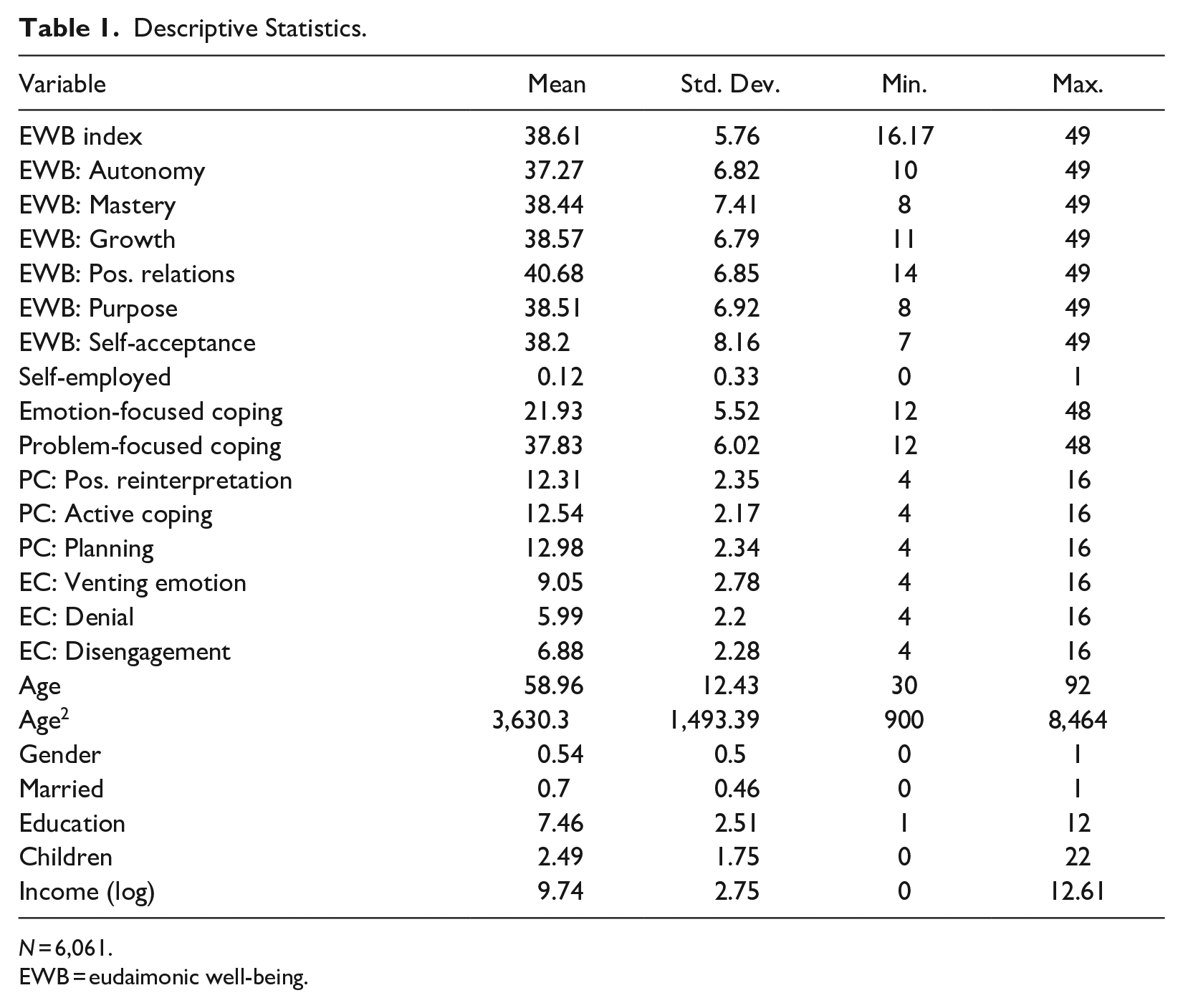
N = 6,061.
EWB = eudaimonic well-being.
Correlation Matrix.
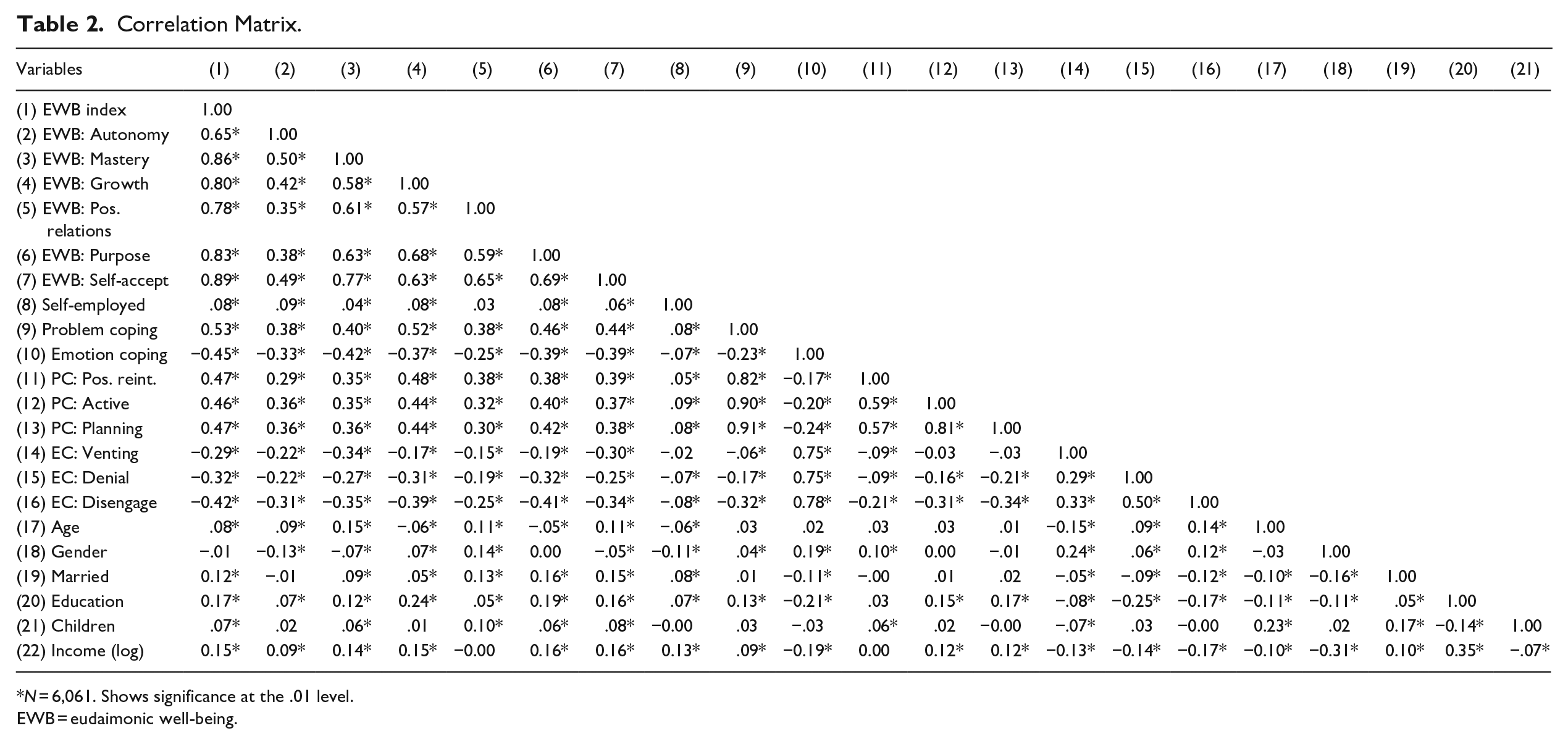
N = 6,061. Shows significance at the .01 level.
EWB = eudaimonic well-being.
Eudaimonic Well-Being
Consistent with our theoretical framework, EWB was assessed using a 42-item version of Ryff’s (1989) scale of psychological functioning. The scale consists of six subscales, each one assessed with seven items. The six subscales (with an example item) are as follows: (1) self-acceptance (e.g., “In general, I feel confident and positive about myself”), (2) positive relations with others (e.g., “Maintaining close relationships has been difficult and frustrating for me”), (3) autonomy (e.g., “My decisions are not usually influenced by what everyone else is doing”), (4) environmental mastery (e.g., “In general, I feel I am in charge of the situation in which I live”), (5) purpose in life (e.g., “I have a sense of direction and purpose in life”), and (6) personal growth (e.g., “I have the sense that I have developed a lot as a person over time”). Each item was scored on a 7-point scale ranging from (1) “strongly agree” to (7) “strongly disagree.” Each subscale was created by calculating the sum of each set of seven items. Some items were reverse coded so that higher scores reflect higher levels of EWB. The overall EWB index was created as an average of the six subscales.
The EWB scales, which were developed by a multidisciplinary team of scholars, have been translated to more than 35 languages and have been used in more than 750 publications (Ryff, 2019). Extensive psychometric work has tested the reliability, validity, and dimensional structure of Ryff’s model (e.g., Ryff, 1989, 2014; Ryff & Keyes, 1995). The overall index is a highly reliable measure of EWB (6-week test–retest reliability for the six scales >0.8, Ryff, 1989). Each one of the six subscales also has adequate reliability (Cronbach’s alpha = 0.7−0.84).
Self-Employment
Self-employment was measured with a dummy variable (taken from the variable A1PB3B), which asked respondents if they were self-employed and coded responses as either yes or no. We recoded the variable as 1 if they answered “yes” and 0 if they answered “no” (i.e., self-employed = 1 and employed = 0). In additional analyses, we further compared subsamples of self-employed people who reported supervising and employing others (entrepreneur supervisors, N = 213) with self-employed people who had no employees (solo entrepreneurs, N = 232), employed people who supervised others (employed supervisors, N = 863), and employed people who did not have supervisory responsibilities (employed non-supervisors, N = 1,132). This allowed us to also explore the well-being benefits of self-employed people who are job creators and have a significantly higher economic impact (Parker, 2009).
Coping Strategies
To measure coping, we used six scales that are part of the COPE Inventory (Carver et al., 1989). 11 Specifically, we used a 12-item scale for problem-focused coping that combined three 4-item subscales measuring (1) positive reinterpretation and growth (e.g., “I try to grow as a person as a result of the experience”), active coping (e.g., “I take direct action to get around the problem”), and planning (e.g., “I try to come up with a strategy about what to do”). We also used a 12-item scale for emotion-focused coping that combined three 4-item subscales for (1) focus on venting of emotion (e.g., “I get upset and let my emotions out”), denial (e.g., “I refuse to believe that it has happened”), and behavioral disengagement (e.g., “I give up trying to reach my goal”). All items were measured on a 4-point scale ranging from (1) “a lot” to (4) “not at all.” All scales were constructed by calculating the sum of the items in each scale. Some items were reverse coded so that higher scores reflected higher standing on the scale (e.g., greater problem- or emotion-focused coping). The scales for problem-focused and emotion-focused coping had strong reliability (Cronbach’s alpha = 0.83 and 0.90, respectively). The six subscales also had adequate reliability (Cronbach’s alpha = 0.73–0.83).
Control Variables
Consistent with the literature, we also included a number of relevant sociodemographic controls that are correlated with both well-being and entrepreneurship. Specifically, we included controls for gender (a dummy equal to 0 if the respondent was male and 1 if female) (Stevenson & Wolfers, 2009); age and its quadratic (Blanchflower & Oswald, 2008; Cheng et al., 2017; Fung et al., 2008); marital status (a dummy equal to 1 if the respondent was married); education (an ordinal variable ranging from 1 to 12 where 0 = no school/some grade school and 12 = Ph.D. or another professional degree) (Campbell, 1981; Nikolaev & Rusakov, 2016); and the logarithmic transformation of self-reported (pretax) personal income (Clarke et al., 2006; Kahneman & Deaton, 2010).
Equation (1) outlines our baseline econometric specification. EWB denotes our dependent variable, eudaimonic well-being; SELF denotes our measure of self-employment;




Empirical Analysis
Before we turn to our results, it is important to discuss whether the main constructs used in our study—problem- and emotion-focused coping and EWB—are distinct from each other. Supplemental Appendix Table 1A reports confirmatory factor analysis (CFA) and shows that the factors have strong reliability with their latent constructs. Supplemental Appendix Table 1B reports the results from a principal component analysis (PCA), which indicates three distinct factors, following the guideline of an Eigenvalue greater than or equal to one (Cliff, 1988). The PCA involves 12 separate items (three items from problem coping, three items from emotional coping, and six items from EWB). Lastly, Supplemental Appendix Table 1C, which reports the factor analysis results, indicates that problem coping loads onto Factor 2, emotional coping loads onto Factor 3, and EWB loads onto Factor 1. The blank cells in Supplemental Appendix Table 1C denote factors with absolute values less than 0.3, which is considered a reasonable cutoff. However, even if we use a higher cutoff of 0.5 or 0.6, we draw the same conclusion.
We conducted the empirical analysis in several steps. First, we estimated ordinary least squares (OLS) well-being regressions to examine whether and to what extent self-employed individuals report higher levels of EWB (and its subcomponents) relative to individuals in traditional occupations while holding relevant sociodemographic characteristics constant. Next, we estimated a structural equation model (SEM) to examine the mediating effect of problem- and emotion-focused coping strategies in the relationship between self-employment and EWB. These first two estimations were based on a pooled cross-sectional sample from both waves. However, we performed several robustness tests using random-effects (RE) models, matching estimators, twin and sibling pair fixed-effects, and further explored heterogeneities based on whether the employed and self-employed supervised others. All models were estimated with the statistical software Stata 15.
OLS Regressions
Table 3.1 presents the results from several multivariate linear regressions of self-employment on EWB (model 1) and its subcomponents (models 2–7). In all models, engaging in self-employment is systematically correlated with higher levels of EWB (β = 1.069, p < .001) including self-acceptance (β = 1.018, p < .001), purpose (β = 1.223, p < .001), growth (β = 1.275, p < .001), positive relations (β = .879, p < .001), and autonomy (β = 1.546, p < .001) compared to traditional employment. The only exception is mastery, which is positively but insignificantly related to self-employment (β = .474, p > 0.10). These relationships hold even after controlling for a set of covariates that have previously been found to correlate with EWB such as age, gender, marital status, education, and personal income (see Ryff, 2019). The magnitude of these relationships is significant—being self-employed is associated with 0.25 standard deviation increase in EWB. Overall, these results provide strong support for H1.
OLS Results, Self-Employment, and EWB.

Note. OLS regressions of EWB and self-employment. See Table 1 for variable summary statistics. Robust errors clustered at the individual level are reported in parenthesis. All models include wave fixed-effects.
p < .01, **p < .05, *p < 0.1.
EWB = eudaimonic well-being; OLS = ordinary least squares.
Table 3.2 presents the results from several multivariate linear regressions of self-employment on problem- and emotion-focused coping. We observe that engaging in self-employment is also associated with higher levels of problem-focused coping (β = 1.480, p < .001) including positive reinterpretation and growth (β = .395, p < .001), active coping (β = .583, p < .001), and planning (β = .502, p < .001), compared to traditional employment. In contrast, we observe that engaging in self-employment is associated with lower levels of emotion-focused coping (β = −.451, p < .001) including denial (β = −.261, p < .001) and behavioral disengagement (β = −.270, p < .001), compared to traditional employment. The only exception is venting, which is positively but insignificantly related to self-employment (β = .082, p > .10). The magnitude of these relationships is significant—being self-employed is associated with 0.25 standard deviation increase in problem-focused coping and a .08 decrease in emotion-focused coping. Overall, these results provide strong support for H2.
OLS Results, Self-Employment, and Coping.
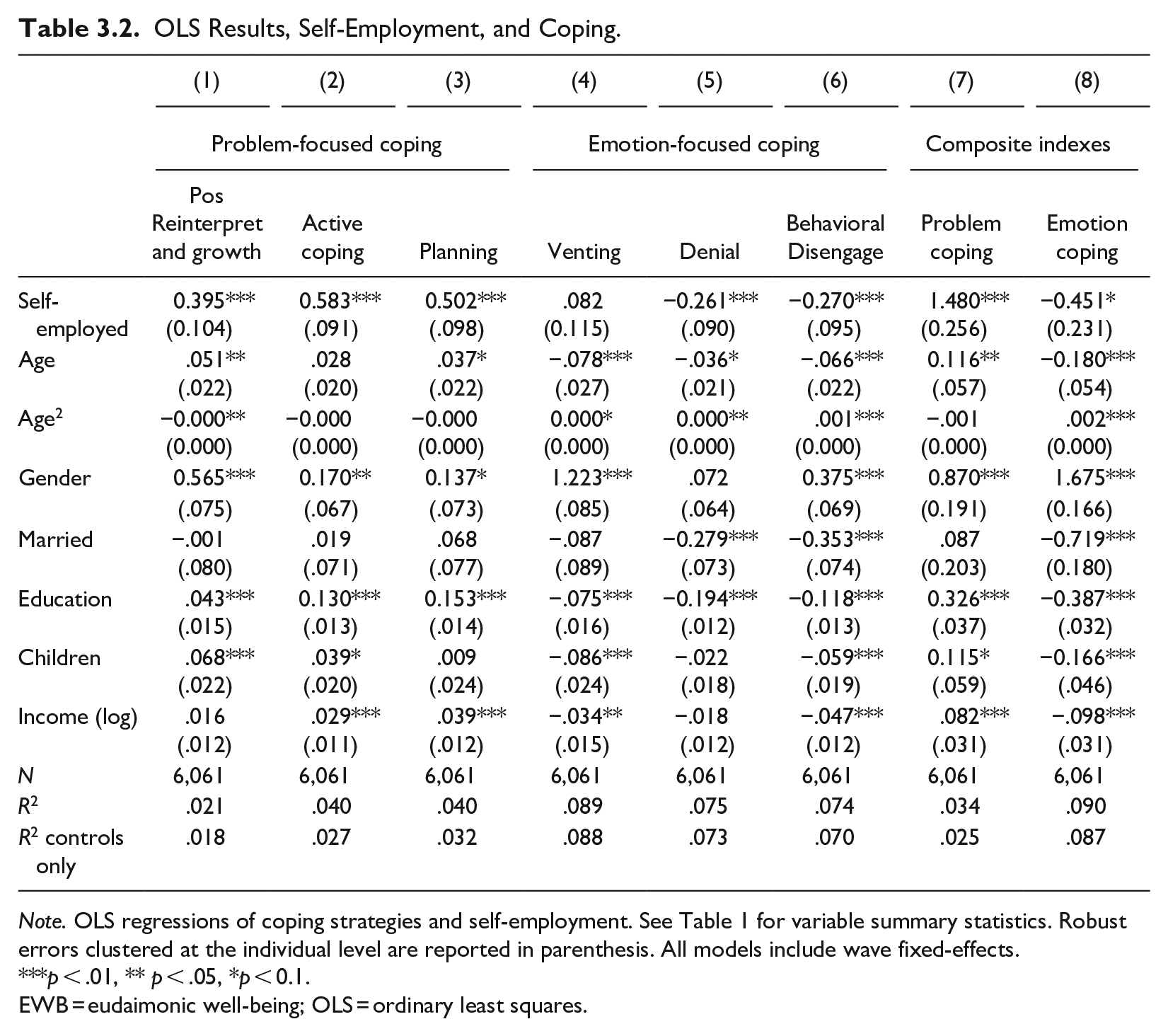
Note. OLS regressions of coping strategies and self-employment. See Table 1 for variable summary statistics. Robust errors clustered at the individual level are reported in parenthesis. All models include wave fixed-effects.
p < .01, ** p < .05, *p < 0.1.
EWB = eudaimonic well-being; OLS = ordinary least squares.
Table 4 introduces our mediating variables—emotion-focused and problem-focused coping strategies—and allows us to examine to what extent the introduction of these variables affects the relationship between self-employment and EWB. We find that emotion-focused coping is negatively correlated with EWB so that one standard deviation increase in emotion-focused coping decreases EWB by almost 0.35 standard deviations. On the other hand, problem-focused coping is associated with higher levels of EWB, with one standard deviation increase in problem-focused coping increasing EWB by almost a half of a standard deviation.
OLS Results, Self-Employment, Coping, and EWB.

Note. OLS regressions of EWB on Self-employment. See Table 1 for variable summary statistics. Robust errors clustered at the individual level are reported in parenthesis. All models include wave fixed-effects.
p < .01, ** p < .05, *p < 0.1.
EWB = eudaimonic well-being; OLS = ordinary least squares.
Overall, the most complete model (4) explains over 40% of the variation in EWB. We note that both the strength and significance of the relationship between self-employment and EWB are greatly diminished once we introduce the coping variables in the model. For example, the magnitude of the estimated coefficient on self-employment decreases from 1.364 to 0.316 (a drop of 77%) and becomes statistically insignificant in model (3), which suggests that much of the effect of self-employment on EWB likely goes through the channel of coping.
SEM Analysis
To investigate the possibility that self-employment leads to higher levels of EWB via differences in coping strategies between self-employed and employed people (H2 and H3), we used SEM. The analysis is closely related to the causal mediation analysis developed by Baron and Kenny (1986) and allowed us to perform a linear partial mediation analysis in which self-employment affects EWB both directly and indirectly through the channels of problem-focused and emotional-focused coping. We used the default estimator in Stata 15, which is based on a maximum likelihood estimator that uses a log-likelihood function. To account for heteroscedasticity and possible autocorrelation of the error terms across different panels, we also used robust standard errors clustered at the individual level. In addition, we allowed the residuals of our mediating variables (problem- and emotion-focused coping) to be correlated with each other to account for the possibility that they may exhibit parallel effects on EWB. We included all relevant controls from Table 4.
Figure 2 presents our main SEM findings. Overall, our model explained close to 36% of the variation in our dependent variable (EWB). Consistent with H2, we found that self-employment is positively associated with problem-focused coping. Specifically, the self-employed are more likely to use positive reinterpretation (β = .33, p < .001), active coping (β = .64, p < .001), and planning (β = .55, p < .001) as coping strategies. In addition, we found that the self-employed are less likely to use emotion-focused coping strategies such as venting of emotion (β = −.16, p = .249), denial (β = −.31, p < .001), and behavioral disengagement (β = −.42, p < .001). These results suggest that the self-employed are more (less) likely to use problem (emotion) focused coping, providing support for H2.
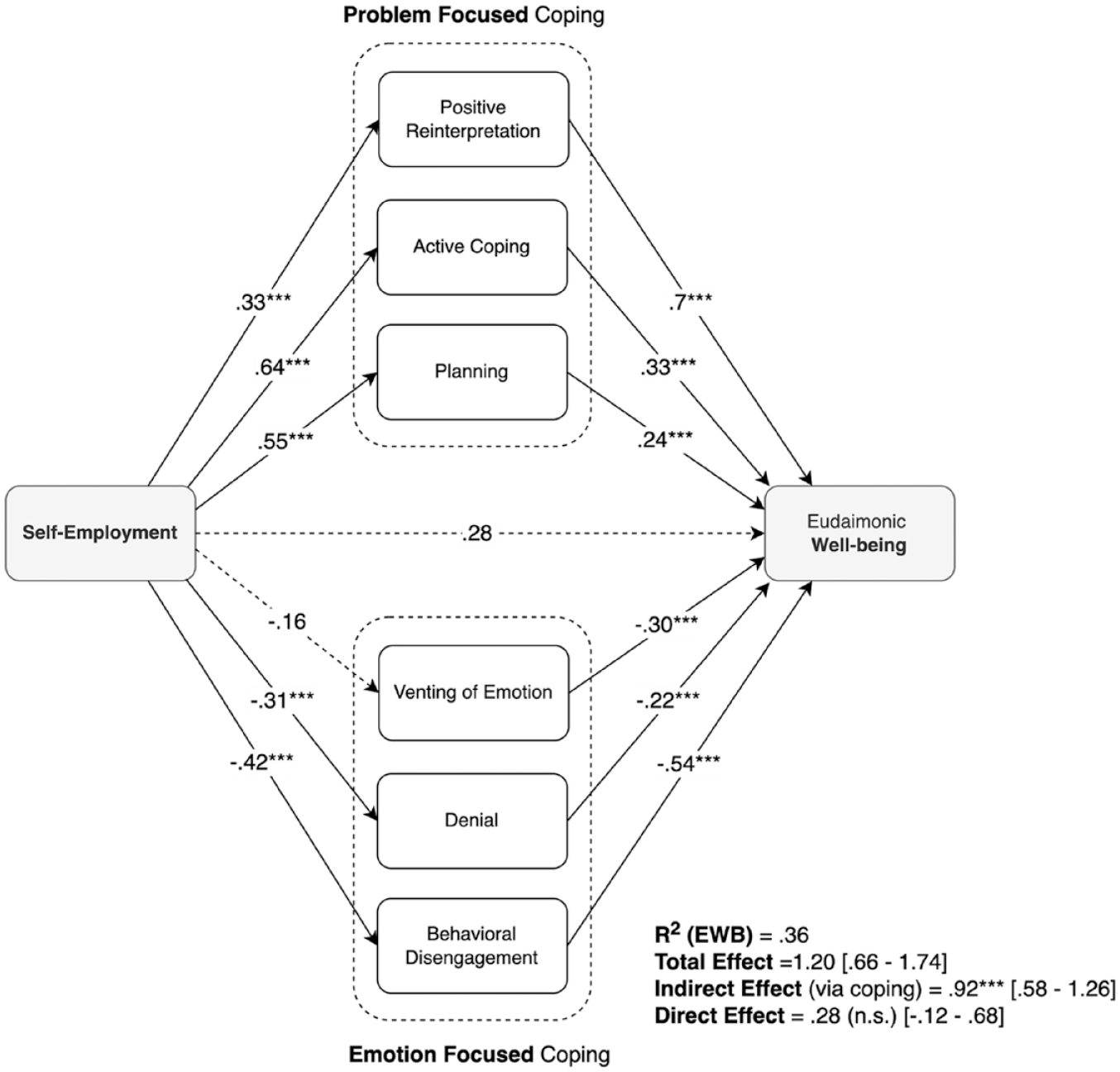
Path model, entrepreneurship, coping, and EWB.
Our findings also provide support for H3. Specifically, people who use positive reinterpretation (β = .70, p < .001), active coping (β = .33, p < .001), and planning (β = .24, p < .001) are more likely to report higher levels of EWB. In turn, using emotion-focused coping strategies such as venting of emotion (β = −.30, p < .001), denial (β = −.22, p < .001), and behavioral disengagement (β = −.54, p < .001) are more likely to report lower EWB. Thus, relative to their employed counterparts, the self-employed are more likely to report higher levels of EWB, partly because they are more (less) likely to use problem (emotion) focused coping.
Table 5 summarizes the direct, indirect, and total effects of our SEM analysis (reported in Figure 2). Overall, the results suggest that the indirect effect of self-employment on EWB via the channels of problem- and emotion-focused coping (β = .92, p < .001) is more than three times larger than the direct effect (β = .28, p < .30), which is also insignificant. Thus, the total effect of self-employment on EWB (β = 1.20, p < .001) largely runs through the channel of coping. This is to say that the self-employed experience higher levels of EWB (autonomy, purpose, personal growth, self-acceptance, etc.) almost entirely because they adopt different coping strategies when dealing with work and life’s challenges than do employees.
Direct and Indirect Effects of Self-Employment on EWB via Coping.
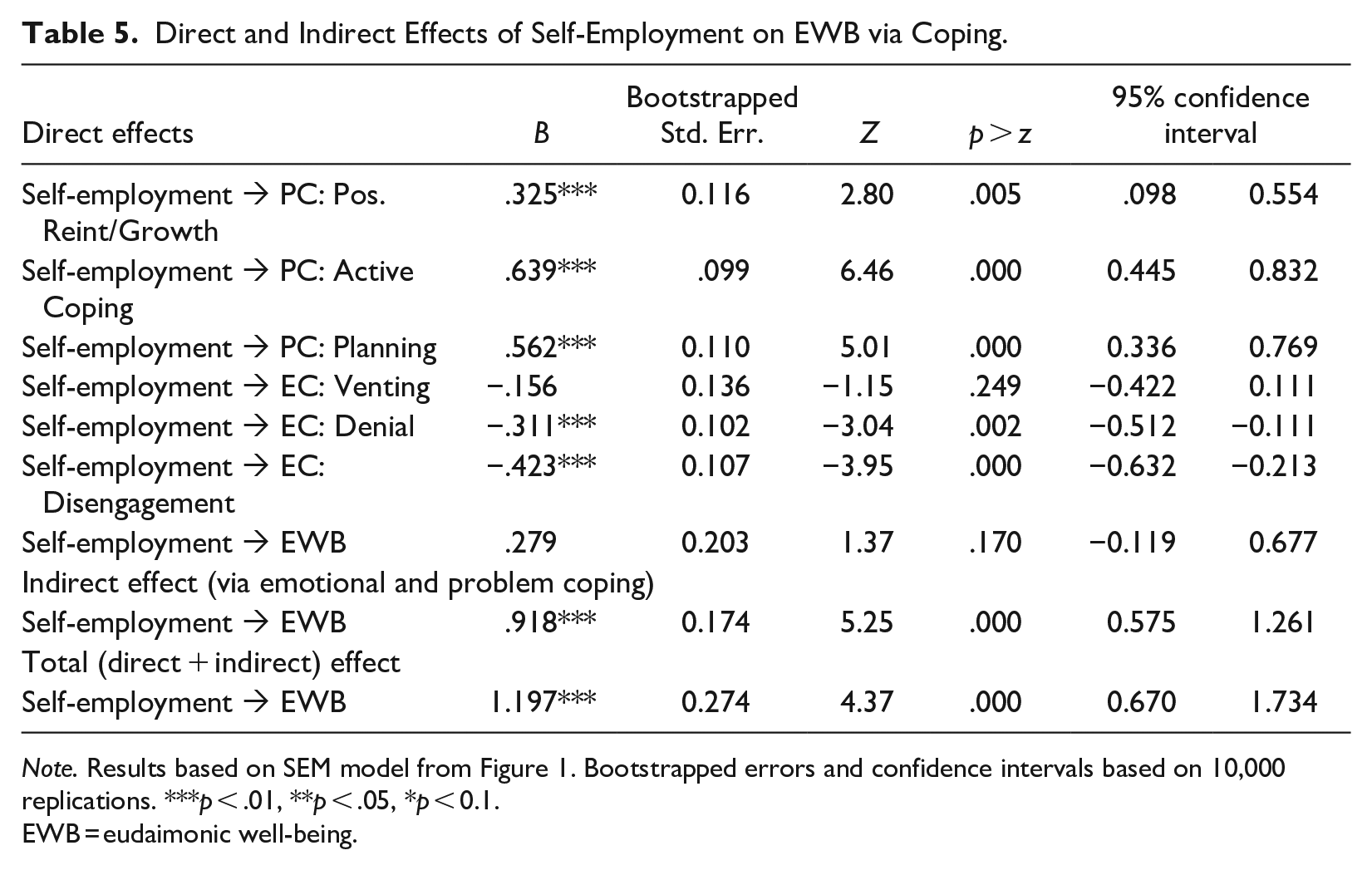
Note. Results based on SEM model from Figure 1. Bootstrapped errors and confidence intervals based on 10,000 replications. ***p < .01, **p < .05, *p < 0.1.
EWB = eudaimonic well-being.
Robustness Checks
We used several robustness tests to examine the sensitivity of our findings to alternative samples, estimators, and procedures. First, we replicated the model in Figure 2 (Supplemental Appendix Figure 1A) while also controlling for the Big Five Personality Traits (extraversion, agreeableness, openness, conscientiousness, and neuroticism). Overall, the results were consistent with our findings in Figure 2 and suggested that our findings are robust even when controlling for alternative psychological mechanisms.
RE (Longitudinal Analysis)
As an additional robustness check, we also took advantage of the longitudinal nature of the MIDUS survey using a RE approach (Supplemental Appendix Tables 2A and 2B). This approach allows us to examine variation in EWB for the same individuals both over time (i.e., between Waves 2 and 3) and between individuals. We choose a RE estimator for several reasons. First, the RE approach is largely preferred in most branches of statistics (Cameron & Trivedi, 2009). Second, previous studies suggest that the RE model is more appropriate in the context of well-being research (Van Praag & Ferrer-i-Carbonell, 2011). This is because the RE model allows for both level and shock effects and is more parsimonious (e.g., a fixed-effects model requires that we estimate 2,140 additional parameters—one for each individual). The RE model allows for an individual-specific intercept in addition to the model intercept. Overall, our findings are consistent and qualitatively similar to the main results using OLS.
Propensity Score Matching
A potential issue with our analysis is that of reverse causality—for example, are the self-employed more likely to use problem-focused coping and experience higher levels of EWB, or are those who have a tendency to use problem-focused coping and experience higher levels of EWB more likely to become self-employed? This is an extremely difficult problem to untangle with observational data, especially since using experimental techniques in this type of setting is unfeasible. Nevertheless, we attempt to address this issue in several ways.
First, we used propensity score matching (PSM), which allows us to examine the relationship between self-employment and EWB for individuals who are very similar along with several covariates yet different in their occupational choices. Following recent papers using matching methods in the entrepreneurship and well-being literature (Binder & Coad, 2013; Kautonen et al., 2017), we use PSM, which allows researchers to mimic randomized control trials and better control for self-selection. PSM matches each individual in the treatment group with a very similar individual in the control group, where similarity is defined as the closest match based on a set of pretreatment characteristics of covariates (Caliendo & Kopeinig, 2008; Li, 2013). After the matching process is completed, there should be few differences between the treatment and control groups. Consequently, the observed difference in outcomes is more reliably attributed to the treatment (Austin, 2011).
Prior to examining the PSM estimates, we must first analyze the balancing diagnostics of the covariates in the model. These findings (Supplemental Appendix Table 3A) indicate the balancing procedure is adequate. This conclusion is also supported by Supplemental Appendix Figure 2A, which depicts the standardized bias (%) for each covariate pre- and post-matching. As Supplemental Appendix Figure 2A illustrates, the matching procedure greatly reduces the standardized bias. Moreover, the PSM estimates (Supplemental Appendix Table 4A) indicate that the self-employed experience greater EWB, denoted by a positive average treatment effect on the treated (ATT = .035; p < .05). The results also indicate that the self-employed experience higher levels of problem-focused coping (ATT = .097; p < .001) through positive reinterpretation (ATT = .038; p < .10), planning (ATT = .091; p < .01), and active coping (ATT = .097; p < .01) and lower levels of emotion-focused coping (ATT = −.014; p > .10) primarily through denial (ATT = −.083; p < .001) and behavioral disengagement (ATT = −.048; p < .001).
Twin Sample
We also took advantage of the MIDUS dataset to examine a subsample of 714 twins (357 pairs) using a twin-pair fixed-effects model. This strategy allowed us to control for shared genetic and environmental factors such as family background and early upbringing. Hence, unobserved factors such as ability and intelligence are less likely to play a role in the observed differences. In turn, the models will be less likely to suffer from an endogeneity problem where the covariates are correlated with the model residuals. Research shows that inherited traits account for approximately 50% of differences in human personalities, with the rest coming from environmental influences (e.g., see Shirey, 2006). Recent studies also show that the propensity to engage in self-employment may have some genetic basis (Nicolaou et al., 2008; Rietveld et al., 2021) via chemical mechanisms in the brain (e.g., leading to extroversion), shaping of preferences (e.g., risk tolerance), selection in environments where entrepreneurship is more common, and responsiveness to business opportunities (Parker, 2019).
The results (Supplemental Appendix Tables 5A and 5B) are again consistent with our main findings. That is, we find that even after accounting for genetic makeup and shared environmental factors and upbringing, twins who choose to become self-employed are significantly more likely to use problem-focused coping, which, in turn, is associated with higher levels of EWB. The twin results suggest that our results are likely driven by problem-focused coping and that self-employment is most likely to promote (causally) one’s sense of personal growth and autonomy.
Sibling Sample
We conducted a very similar test and found the results (Supplemental Appendix Tables 6A and 6B) were robust when we considered a subsample of 930 siblings (465 pairs). Overall, these results provide additional support that choosing self-employment as a career path is associated with higher levels of EWB, higher levels of problem-focused coping, and lower levels of emotion-focused coping.
Post Hoc (Group) Analysis
We replicated our main analysis by further comparing differences in EWB in several subsamples of the self-employed and traditionally employed (see Table 6). Model 1 of Table 6 reports our baseline model, in which we compared the self-employed and the employed (β = 1.069, p < .001). In model 2, we compared the self-employed who reported supervising and employing others (entrepreneur supervisors) with the employed who did not have any supervisory duties. We found that being self-employed and supervising others (relative to being wage employed) has an even stronger positive effect on EWB compared to the overall sample of entrepreneurs (β = 2.253, p < .001). Next, we compared entrepreneur supervisors with solo entrepreneurs (model 3). We found that the self-employed who employ and supervise others report significantly higher levels of EWB relative to solo entrepreneurs (β = 1.832, p < .001). In model 4, we compared entrepreneur supervisors with employed supervisors. Once again, we found that self-employment has a strong and positive effect on EWB (β = 1.106, p < .001). Finally, we compared solo entrepreneurs with employed non-supervisors (model 5) and found a positive but statistically insignificant effect (β = .544, p > .10).
We also replicated our main analysis by comparing differences in problem-focused coping in several subsamples of the self-employed and traditionally employed. We present these results in Supplemental Appendix Table 7A in the Supplemental Appendix. Model 1 of Supplemental Appendix Table 7A reports our baseline model, in which we compared the self-employed and the employed (β = 1.480, p < .001). In model 2, we compared the self-employed who reported supervising and employing others (entrepreneur supervisors) with the employed who did not have any supervisory duties. We found that being self-employed and supervising others (relative to being wage employed) has an even stronger positive effect on problem-focused coping compared to the overall sample of entrepreneurs (β = 2.361, p < .001). Next, we compared entrepreneur supervisors with solo entrepreneurs (model 3). We found that the self-employed who employ and supervise others report significantly higher levels of problem-focused coping relative to solo entrepreneurs (β = 1.279, p < .001). In model 4, we compared entrepreneur supervisors with employed supervisors. Once again, we found that self-employment has a strong and positive effect on problem-focused coping (β = 1.366, p < .001). Finally, we compared solo entrepreneurs with employed non-supervisors (model 5). Here, we found a positive and statistically significant effect (β = 1.176, p < .001).
Supervisors Versus Non-Supervisors.
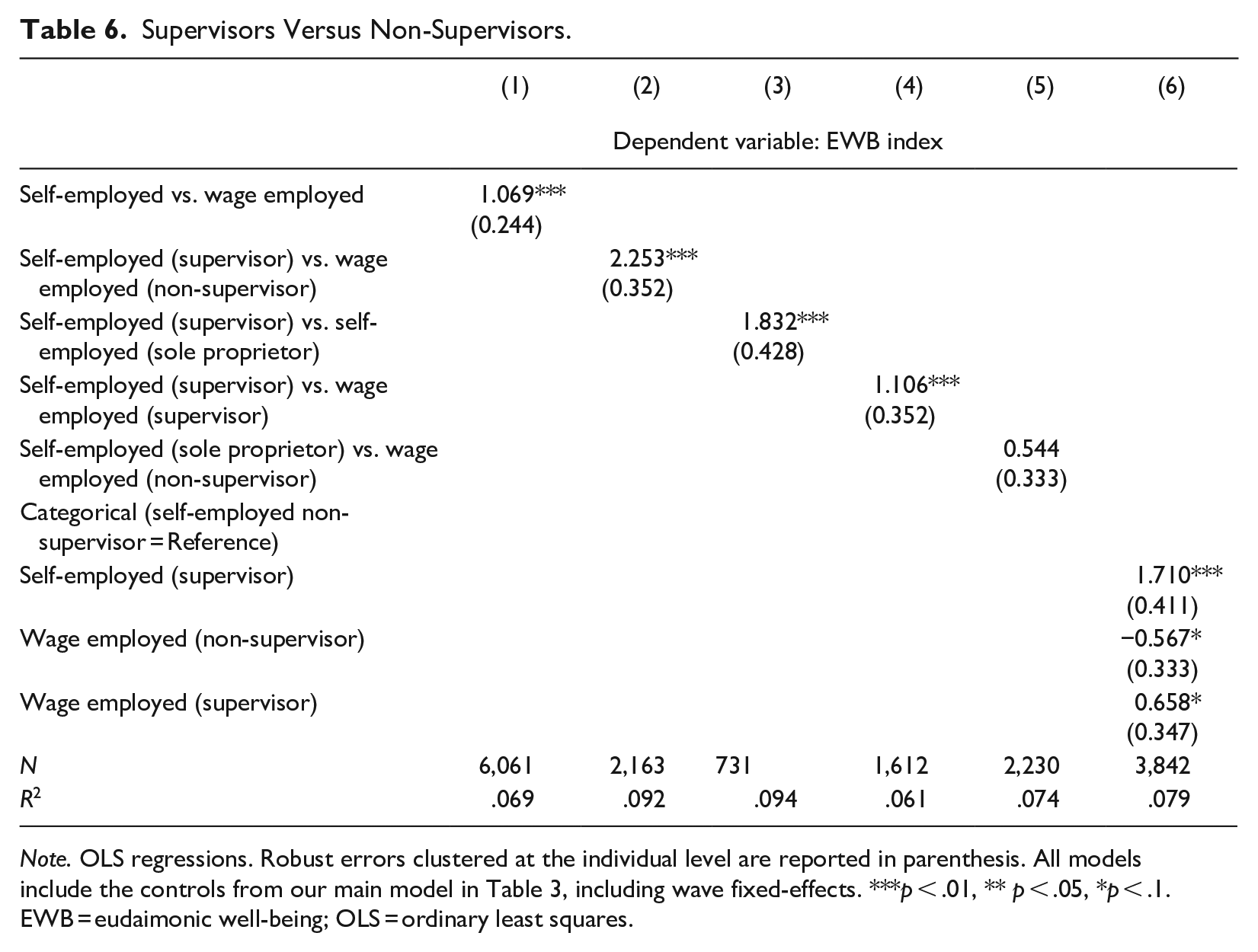
Note. OLS regressions. Robust errors clustered at the individual level are reported in parenthesis. All models include the controls from our main model in Table 3, including wave fixed-effects.
p < .01, ** p < .05, *p < .1.
EWB = eudaimonic well-being; OLS = ordinary least squares.
We performed a similar analysis with respect to emotion-focused coping (Supplemental Appendix Table 7B). Model 1 of Supplemental Appendix Table 7B reports our baseline model, in which we compare the self-employed and the wage-employed (β = −.451, p < .001). In model 2, we compared the self-employed who reported supervising and employing others (entrepreneur supervisors) with the employed who did not have any supervisory duties. We observe that being self-employed and supervising others (relative to being wage-employed) has an even stronger negative effect compared to the overall sample of entrepreneurs (β = −1.153, p < .001). Next, we compared entrepreneur supervisors with solo entrepreneurs (model 3). We found that the self-employed who employ and supervise others report significantly lower levels of emotion-focused coping relative to solo entrepreneurs (β = −1.107, p < .001). In model 4, we compared entrepreneur supervisors with employed supervisors. Once again, we found that self-employment has a strong and negative effect on emotion-focused coping (β = −.688, p < .001). Finally, we compared solo entrepreneurs with employed non-supervisors (model 5) and found a positive but statistically insignificant effect (β = .026, p > .10).
Overall, these findings provide a more nuanced understanding of the hypothesized relationships. Specifically, we found that most of the well-being benefits of self-employment go to people who are job creators and manage and supervise others (Parker, 2019). But our findings also suggest that even solo entrepreneurs experience well-being benefits relative to people in traditional occupations. Supervising others is also strongly and positively associated with problem-focused coping, suggesting that as the business grows, founders gain more job control and decision authority, which allows them to cope with stressful situations more proactively.
Discussion
Drawing insights from the job control (Karasek, 1979) and coping (Lazarus & Folkman, 1984) literature, we develop a model in which two categories of coping—problem- and emotion-focused—mediate the relationship between self-employment and EWB. Using data from Waves 2 and 3 of the National Study of Midlife in Development in the United States (N = 6,061), we then test our model and find that the self-employed experience significantly higher levels of EWB relative to their employed counterparts. We argue and find that these positive well-being benefits accrue almost entirely because the self-employed are more likely to engage in problem-focused coping (active coping, planning, and positive reinterpretation) and less likely to engage in emotion-focused coping (venting, denial, and behavioral disengagement). Thus, our study contributes to the emerging literature on self-employment and EWB by highlighting the role of coping as a key explanatory mechanism.
Theoretical Implications
Entrepreneurship and Well-Being
Our study answers several calls in the entrepreneurship literature to “mov[e] beyond the hedonic to embrace eudaimonic well-being outcomes” (Wiklund et al., 2019, p. 18; Ryff, 2019; Stephan, 2018). Indeed, an emerging stream of research suggests that self-employment, as a self-determined and volitional career choice that requires overcoming challenges and barriers but also promises much in terms of personal fulfillment, is uniquely positioned to benefit people’s EWB (Shir et al., 2019; Stephan et al., 2020). We contribute to this emerging but still scarce research in the entrepreneurship literature in several ways.
First, while previous studies have focused on specific eudaimonic outcomes and processes (e.g., autonomy, meaning, competence), we build our conceptual framework around Ryff’s (1989) six-factor model, which more holistically integrates a wider range of EWB outcomes. Thus, we answer recent calls in the literature to focus on “different models of eudaimonic well-being. . .[in order to] disentangle diverse eudaimonic processes and outcomes and determine which are most relevant for entrepreneurship” (Stephan et al., 2020, p. 20). Similar to previous studies, our findings highlight the importance of autonomy (Shir et al., 2019) and meaning (Stephan et al., 2020), but also underscore that self-employment is strongly related to other key eudaimonic outcomes such as one’s sense of personal growth and self-acceptance that have received relatively little attention in the entrepreneurship literature.
Second, prior research in the entrepreneurship literature builds on models of sustainable happiness that consider engaging in eudaimonic and growth-promoting activities as critical to satisfying people’s basic psychological needs, which, in turn, can promote sustained hedonic well-being over time (Nikolaev et al., 2020; Shir et al., 2019; Stephan et al., 2020). We go a step further by investigating what it is about self-employment that leads to EWB. Specifically, our theory and findings suggest that self-employment, as an occupation characterized by a high degree of decision authority and job control, is more likely to lead to appraisals of stressful situations as growth-promoting challenges (Lazarus & Folkman, 1984; Lepine et al., 2005). Consequently, the self-employed are more likely to engage in productive and proactive behaviors and thoughts (problem-focused coping) aimed to help them overcome these challenges and less likely to engage in behaviors and thoughts to merely make them feel better (emotion-focused coping). Engaging in more productive coping, then, can promote EWB over time—one’s sense of personal growth, meaning, competence, and self-acceptance.
Thus, our approach provides a more nuanced understanding of why the self-employed perceive their lives as psychologically more fulfilling even though they face complex and competing occupational demands that can expose them to more stressors and negatively affect their physical (Cardon & Patel, 2015) and mental health (Reid et al., 2018), at least in the short run. In other words, we identify what fuels EWB and what it is about self-employment, relative to waged work, that kindles the fire. Combining our findings with existing work could suggest that self-employed people are willing to make trade-offs not only in terms of financial stability and gains, but also in terms of occupation-related stress to pursue more meaningful work that offers opportunities for personal growth and fulfillment. It also suggests that while self-employed people may be “unable to fully escape from work demands or the cognitive, stress-related processes associated with work. . .which are both necessary for effective stress recovery” (White & Gupta, 2020, p. 65), they can still more effectively cope with stress through problem-focused coping relative to wage workers.
Third, our post hoc tests draw from recent research that has started examining important boundary conditions in the relationship between self-employment and well-being (Nikolova et al., 2022; Stephan et al., 2020). We document that most of the EWB benefits accrue to those who employ and supervise others. Perhaps this is not surprising because self-employed supervisors have more resources that can allow them to delegate tasks, which can increase their decision authority and sense of job control. Nonetheless, these additional findings are consistent with our hypotheses and provide further confidence in our theory, which links self-employment to coping via job control.
Coping in Entrepreneurship
Our theory and findings also complement research on coping in entrepreneurship. Most studies in this stream of research examine the role of problem- and emotion-focused coping (six out of eight studies in our review, see Supplemental Appendix Table 8A), although by focusing on coping among samples of entrepreneurs and with respect to hedonic well-being (e.g., Drnovsek et al., 2010; Örtqvist et al., 2007; Uy et al., 2013). Our focus on comparing occupational groups, as opposed to focusing on variation across entrepreneurs alone, allows us to integrate theory about control into this literature that highlights what is unique about self-employment relative to other occupations that can lead to more effective coping strategies. Along these lines, our work changes existing theory by moving the narrative of coping as a moderator between self-employment and well-being (e.g., Patel et al., 2019; Patzelt & Shepherd, 2011) to a mediator—suggesting instead that self-employment itself drives coping strategies.
In addition, prior studies predominately leverage composite indicators of problem- and emotion-focused coping. We contribute to this line of work by exploring six distinct coping strategies (planning, positive reinterpretation, active coping, venting, denial, and behavioral disengagement), thus providing a more nuanced understanding of the underlying coping processes and their relationship to well-being. For example, while we find that positive reinterpretation has the strongest effect on EWB, self-employment is substantially more likely to promote active coping. Finally, we highlight EWB as a key outcome of the coping process. This is important because EWB variables such as purpose, autonomy, and competence can also serve as important mediators that underpin the relationship between coping and other relevant venture-related outcomes such as motivation, performance, job satisfaction, or opportunity evaluation.
Broader Coping and Well-Being Literature
Our study also advances the literature on coping and well-being more generally. Specifically, well-being models suggest that life circumstances, such as one’s occupational choice, account for less than 10% of the variation in SWB, with intentional activities and genes explaining the remaining 90% (e.g., Diener et al., 1999; Lyubomirsky et al., 2005; Van Praag & Ferrer-i-Carbonell, 2011). From this perspective, pursuing happiness through changes in occupational status may seem like a “wild goose chase” that may never be attained. We show, however, that life circumstances play a critical role in one’s well-being indirectly by affecting how people cope with different stressors in their life, which, in turn, can have a large effect on their well-being. In fact, including coping increases the explanatory power of our well-being models drastically (our most complete model explains over 40% of the variation in EWB), further stressing the importance of coping as a key determinant of well-being, but also highlighting the interdependence of life circumstances and intentional activities (Brown & Rohrer, 2020).
Thus, our theory and findings open the door for a new line of research that can examine how other life circumstances (e.g., one’s socioeconomic status, family upbringing, or social support) interact with self-employment and influence the psychological mechanisms that underpin the mediation (coping) processes we document. Similarly, examining how specific work characteristics affect people’s sense of job control and, in turn, their coping strategies can be critical to job crafting and the creation of a more psychologically fulfilling workplace. For example, the COVID-19 pandemic has resulted in changes to working arrangements for millions of employees who are now working from home (Oakman et al., 2020). Studying the effects of such changes and their interaction with measures of organizational support, social connectedness, or work–family conflict on workers’ sense of perceived control and coping may provide important insights as employees adapt to their new workplace realities.
Practical Implications
Our study and findings also have practical implications. First, because coping is a key determinant of well-being, entrepreneurship training that focuses not just on the practicalities of running a business (financial accounting, market analysis, managing employees), but also teaches entrepreneurs how to effectively cope with their unique occupational demands can be especially promising in enhancing business outcomes. In this respect, well-being therapy (e.g., Fava, 1999; Fava et al., 1998)—a short, well-being enhancing psychotherapeutic therapy—can be a particularly promising intervention. The therapy, based on Ryff’s cognitive model of psychological well-being, provides a structured, directive, and problem-oriented model that can be used in conjunction with cognitive-behavioral therapy. Some of the techniques include cognitive restructuring (modification of automatic and irrational thoughts), scheduling of activities (mastery, pleasure, and task assignments), and problem solving, which are closely related to the problem-focused coping strategies we discuss in the current paper.
Second, because entrepreneurial narratives in the media influence self-employment intentions (e.g., Laviolette et al., 2012; Radu & Redien-Collot, 2008), policymakers have attempted to enact policies that incentivize start-ups (Eikhof et al., 2013). While existing action has focused on the importance of success stories or representation of minorities, our findings suggest that the personal fulfillment characteristics of EWB may be a worthwhile avenue to incentivize more individuals to start new business ventures. For example, media coverage that focuses on reflective accounts from both breakthrough, but also small business owners, detailing how their self-employment experiences influenced their well-being (both positively and negatively), and the behaviors necessary to facilitate those outcomes, could prove useful in helping aspiring business owners decide if self-employment is right for them. However, we provide policy advice sparingly and cautiously, given that the evidence herein is correlational as opposed to causal.
Limitations and Future Research
It is also important to discuss the limitations of our research and the extent to which our findings are generalizable (Simons et al., 2017). First, we rely on MIDUS, a nationally representative longitudinal study of health and well-being in the United States. The dataset includes a long list of psychological (e.g., personality traits) and biological (e.g., a twin sample) factors that are not available in most studies. By controlling for many of these factors, we account for a host of potential biases that greatly increase the generalizability of our findings relative to most primary data collection studies in the self-employment well-being literature. 12
However, MIDUS relies only on data from the United States, and our sample largely consists of individuals in their midlife. Therefore, future studies will need to provide external validation to our findings in other cultural contexts and among wider age groups. This is especially relevant for our study because the motivation to engage in self-employment action is vastly different across cultural contexts (GEM, 2016). At the same time, well-being can also differ substantially across countries (Mitchell et al., 2013) and different age groups (Ryff & Singer, 2008). For example, Stephan et al. (2020) show that the social legitimacy of entrepreneurship at the country level influences the effect of career choice (self-employment vs. wage-employment) on EWB indicators.
Second, self-employment is highly heterogeneous. Recent studies suggest that business owners differ vastly in terms of their motivation and aspirations, which can affect how they perceive various well-being outcomes (Mmbaga et al., 2020). Some self-employed people are growth-oriented visionaries, while others are motivated primarily by profit; some pursue self-employment for independence or as a creative outlet, while others are pushed into business ownership due to a lack of other options. Similarly, the ventures themselves differ in terms of a focus on survival, lifestyle, sustained growth, or aggressive growth (Morris et al., 2018). This variance is consequential, as the type of firm and founder identity can drastically differ across different types of ventures and subsequently influence key decisions and the self-concept of the founder (Fauchart & Gruber, 2011). Future studies will have to explore the heterogeneity of our findings with respect to different groups of business owners.
Third, several recent studies suggest that restorative (emotion-focused) coping behaviors can have various benefits for entrepreneurs (e.g., Williamson et al., 2021). Along these lines, a recent editorial suggests that emotion-focused behaviors such as respite (e.g., breaks, music, positive reflections) and regimen (e.g., exercise and sleep) are a viable path forward to “apply our knowledge to devise interventions that can make a difference in the lives of entrepreneurs and enhance their well-being” (Williamson et al., 2021, p. 2). The benefits of recovery are theoretically and empirically clear (e.g., Kark & Carmeli, 2009; Shirom, 2011; Sonnentag, 2018; Sonnentag & Fritz, 2007; Wach et al., 2021), and we, therefore, encourage self-employed to utilize such behaviors via interventions. Our findings may seem inconsistent with these studies. However, we examine only a small subset of emotion-focused coping strategies (venting, denial, and behavioral disengagement). Indeed, there are many others. Thus, our results should be interpreted with caution while our knowledge of various coping strategies accumulates in the future.
Along these lines, while we do find that the greater tendency to engage in problem-focused coping is associated with EWB, doing so too often and for too long without proper recovery may also lead to burnout and general ill being (Williamson et al., 2021). These findings are not necessarily surprising. For example, whereas passion can have positive implications (Cardon et al., 2009), obsessive forms of passion may be detrimental to performance (Ho & Pollack, 2014). Similarly, whereas optimism may lead to positive perspectives of self-employment challenges (Hmieleski & Baron, 2009), some people adopt unhealthy forms of optimism (Ucbasaran et al., 2010), which may lead to biases and heuristics that hinder innovation (Amore et al., 2021). Thus, future studies can enhance the understanding gleaned here by better detailing the proper balance and possible interactions between problem-focused coping and necessary restorative (emotion-focused) behaviors.
Fourth, while we incorporate a longitudinal dataset, we utilize only two waves of data and have limited insight into the stage of the venture. Thus, we are unable to explore how the relationship between self-employment, coping, and EWB may evolve over time. It could very well be the case that coping styles and EWB change in a meaningful way during certain stages of the venture creation process. Previous studies, for example, suggest that it takes time for autonomy to unfold (e.g., Stephan, 2018), which implies that some of the EWB benefits from self-employment may materialize later in the venture creation process rather than sooner. Future studies will have to examine how EWB and coping unfold over time as firms get established, grow, or fail.
Fifth, another important limitation of our study is that of reverse causality. For example, people who have a tendency to use problem-coping styles may be more likely to start a business. Similarly, EWB can be a determinant of problem coping (Hahn et al., 2012). While we have provided several robustness checks to mitigate these concerns through RE, matching, and various fixed-effects estimators, no method is perfect. We invite future studies to attempt to examine the proposed relationships with alternative identification strategies.
Finally, our theorizing is based on a global measure of EWB, which has six subcomponents. Thus, our study does not develop detailed theoretical arguments for each of these subcomponents. A more nuanced examination, which we encourage future researchers to undertake, could examine how specific coping tendencies facilitate some but not other EWB outcomes. For example, maintaining positive relationships with some stakeholders, such as investors, may require giving up a board of directors seat. Yet, such a concession may impact autonomy, and to the extent the strategic direction of the firm shifts on the whim of a strong board and vested investor, the self-employed may find their sense of purpose in life from venture activities diminished. This example represents just one of many of the complexities inherent in self-employment and implies more nuanced dynamics between EWB subcomponents than are possible to examine in the current study.
In totality, future research should cautiously interpret our findings, as they may be subject to generality constraints pertaining to culture, individual motivations for pursuing a venture, and the limited coping variables studied.
Conclusion
Integrating insights from the job control (Karasek, 1979) and coping literature (Lazarus & Folkman, 1984), we hypothesize and find that the self-employed experience higher levels of EWB (e.g., personal growth, meaning) relative to their employed counterparts because they adopt different coping strategies when dealing with work and life’s challenges. Specifically, we argue and find that the positive well-being benefits of self-employment accrue almost entirely because the self-employed are more likely to engage in problem-focused coping—productive and proactive behaviors and thoughts aimed to help them overcome challenges (e.g., planning and active coping)—and less likely to engage in emotion-focused coping—behaviors and thoughts to merely make them feel better (e.g., venting and denial). Thus, our theory and findings highlight the importance of coping as a key explanatory psychological mechanism (mediator) between self-employment and EWB.
Supplemental Material
sj-docx-1-etp-10.1177_10422587221126486 – Supplemental material for Self-Employment and Eudaimonic Well-Being: The Mediating Role of Problem- and Emotion-Focused Coping
Supplemental material, sj-docx-1-etp-10.1177_10422587221126486 for Self-Employment and Eudaimonic Well-Being: The Mediating Role of Problem- and Emotion-Focused Coping by Boris N. Nikolaev, Michael P. Lerman, Christopher J. Boudreaux and Brandon A. Mueller in Entrepreneurship Theory and Practice
Footnotes
Declaration of Conflicting Interests
The author(s) declared no potential conflicts of interest with respect to the research, authorship, and/or publication of this article.
Funding
The author(s) received no financial support for the research, authorship, and/or publication of this article.

Supplemental Material
Supplemental material for this article is available online.
Notes
Author Biographies
References
Supplementary Material
Please find the following supplemental material available below.
For Open Access articles published under a Creative Commons License, all supplemental material carries the same license as the article it is associated with.
For non-Open Access articles published, all supplemental material carries a non-exclusive license, and permission requests for re-use of supplemental material or any part of supplemental material shall be sent directly to the copyright owner as specified in the copyright notice associated with the article.
