



Abstract
Entrepreneurship scholars have much to gain from including time perspective in developing theory about entrepreneurs’ alertness. In this study, interviews with 22 French entrepreneurs revealed associations between their alertness and past-positive, present-hedonistic, and future time perspectives. Complementarily, a sample of 376 U.S. entrepreneurs provided evidence that their present-hedonistic and future time perspectives impacted their alertness; we found mixed support for the relationship between past-positive time perspective and entrepreneurial alertness. A replication analysis with 764 U.K. entrepreneurs corroborated support for our hypotheses.
Introduction
Scholars have acknowledged the importance of entrepreneurs’ subjective perspectives on time (Barreto et al., 2022; Lévesque & Stephan, 2020), including the construct of time perspective (Zimbardo & Boyd, 1999), which can be defined as “the totality of the individual’s views of [their] psychological future and psychological past existing at a given time” (Lewin, 1951, p. 75). Time perspective is an important construct that can affect opportunity evaluation and pursuit through entrepreneurs’ decision-making processes (McKelvie et al., 2020). Moreover, considering that venture initialization is “the point in time that an entrepreneur envisages is appropriate for incipient entrepreneurial action” (Wood et al., 2021, p. 150), perceptions of the past, present, and future (i.e., time perspective) can affect how entrepreneurs view their window of opportunity (Wood et al., 2021). For example, those with a past-positive, present-hedonistic, and future time perspective can have a biased perception and might get on board (too) early.
Prior works have highlighted that time perspective is linked to subjective well-being and affective experiences (e.g., Holmes et al., 2008; Ramsey & Gentzler, 2014) and that affect (i.e., individuals’ emotional experiences and states; see: Baron, 2008; Barsade & Gibson, 2007) plays a crucial role in shaping cognitions, behaviors, and outcomes (e.g., Bledow & Rosing, 2013; Dolcos et al., 2011). In parallel, entrepreneurship scholars have highlighted that an important aspect of entrepreneurs’ cognition, entrepreneurial alertness (i.e., the ability to identify and recognize potential opportunities in the environment; see Tang et al., 2012), plays a central role in the context of entrepreneurial opportunities (e.g., Ardichvili et al., 2003; Lanivich et al., 2022; Shane, 2003; Valliere, 2013).
However, problematically, the role that entrepreneurs’ time perspective plays in their cognitions, decisions, and subsequent actions is not well understood, and the related implications have not been extensively discussed. More specifically, a better understanding is needed for how entrepreneurs’ (affective and emotional) experiences and (cognitive) perceptions of their past, present, and future are embedded and (inter)related to other constructs in the entrepreneurial process (e.g., Shane, 2003). By providing new insights regarding how different time perspectives are associated with entrepreneurs’ identification of—and belief formation regarding—opportunities, we enrich understanding of how the identification of opportunities is shaped by subjective experiences and thoughts entrepreneurs have of the past, present, and future (Lévesque & Stephan, 2020). We do this with a specific focus on how affective, cognitive, and temporal dimensions function within the entrepreneur and what role these dimensions play in entrepreneurs’ cognitions, decisions, and subsequent actions.
In this paper, we investigate the research question: How are entrepreneurs’ time perspectives associated with entrepreneurs’ alertness? Based on affect (Baron, 2008; Foo, 2011; Foo et al., 2015; Fredrickson, 2001) and cognition (Baron, 1998, 2006; Baron & Ensley, 2006; Foo et al., 2015) theories, we expected differences in entrepreneurs’ time perspective to influence considerations of information, evaluations of potential opportunity, and perceptions of related uncertainty (Suddaby et al., 2023). Qualitative data collected from 22 French entrepreneurs, along with quantitative data collected from 376 U.S. entrepreneurs and 764 U.K. entrepreneurs, support our contention that past-positive, present-hedonistic, and future time perspectives are positively associated with entrepreneurial alertness, with positive relationships existing between alertness dimensions.
It is important to investigate entrepreneurs’ time perspective through affective and cognitive lenses because affect impacts how entrepreneurs think and what they do (Foo et al., 2014), and “only little entrepreneurial cognition research has investigated how temporal contingencies shape entrepreneurs’ cognitions regarding opportunity evaluation and exploitation” (Tumasjan et al., 2013, p. 859). We contend that entrepreneurs’ positive experiences and thoughts about their past and present enhance their ability to strive for future goals and rewards—and enable them to be entrepreneurially alert and efficiently search for and associate information to evaluate potential opportunities (Tang et al., 2012). By focusing on Zimbardo and Boyd’s (1999) conceptualization of time perspective, we aim to empirically capture the psychological and subjective experience of time (e.g., Shipp & Jansen, 2021).
The present research contributes to literature by providing qualitative and quantitative evidence to enrich theory regarding the relationships between time perspective and entrepreneurial alertness. We shed new empirical light on the nexus between time perspective and entrepreneurial alertness and its related themes by finding that both entrepreneurs’ present and past time perspectives are related to their coping strategies (Lévesque & Stephan, 2020; on coping strategies, see Ahmed et al., 2022) while their future time perspective is related to their goals (Chen et al., 2018) and to a causal or predictive (if-then or when-then) logic (Dew et al., 2009; Lévesque & Stephan, 2020). Also, we provide quantitative and qualitative evidence regarding the processual nature of entrepreneurial alertness (e.g., Levasseur et al., 2022; Tang et al., 2012).
Theoretical Background
Affect and Cognition
Barsade and Gibson (2007, p. 38) defined affect as an “[u]mbrella term encompassing a broad range of feelings that individuals experience, including feeling states, such as moods and discrete emotions, and traits, such as trait positive and negative affectivity.”Matlin (1995, p. 2) defined cognition as a “mental activity [that] involves the acquisition, storage, retrieval, and use of knowledge.” Many studies have shed light on the influence of affect on cognition. For example, Isen (2001) conveyed that positive affect leads to comprehensive, systematic, and careful information processing. Relatedly, Staw and Barsade (1993) highlighted that those with positive affect make deeply analyzed decisions that are informed by previously scanned and searched information. Illustrating the importance of positive affect, Tang and colleagues (2012) found positive correlations with information scanning and search, information association and connection, and opportunity evaluation and judgment. 1 We contend that it is important to investigate the affect-cognition relationship because there is still an ongoing debate on the primacy of affect versus cognition (e.g., Foo et al., 2014; Lazarus, 1984; Zajonc, 1984).
Entrepreneurial Alertness
Alertness is a motivated propensity to formulate an (often speculative) image of the future through prospective resource linkages (or gaps) in the market (e.g., Bull & Willard, 1993; Kirzner, 1985, p. 56; Webb et al., 2009), which plays a crucial role in recognizing opportunities (e.g., Chiles et al., 2007; Kirzner, 1979). Specifically, by being aware of current conditions, identifying potentially profitable situations, and successfully exploiting these situations (e.g., Bailey & Lumpkin, 2021; Barreto, 2011; Gaglio, 2004; McMullen & Shepherd, 2006; Ucbasaran et al., 2001), entrepreneurs enable the economy to move forward despite times of disequilibrium or disruption (e.g., Tang et al., 2021c). Following the cognitive perspective, scholars have posited that entrepreneurs are apt to recognize market patterns or disequilibrium (e.g., Baron, 2006; Baron & Ensley, 2006; Vaghely & Julien, 2010). Also, entrepreneurs are proactive in searching for opportunities, analyzing data (e.g., Short et al., 2010), and thinking counterfactually (e.g., Baron & Ward, 2004; Gaglio, 2004).
Building upon these works, Tang and colleagues (2012) developed a tri-dimensional scale of alertness that comprises associating and connecting information to identify patterns (e.g., Baron, 2006; Baron & Ensley, 2006; Gielnik et al., 2014), scanning and searching for information (e.g., Gielnik et al., 2014; Kaish & Gilad, 1991), and evaluating and judging opportunities (e.g., Autio et al., 2013; Foss & Klein, 2012; McMullen & Shepherd, 2006). More recently, Lanivich and colleagues (2022) reviewed the literature and conveyed that observation of environment, resource association, and evaluation of ideas are a specific bundle of attribute resources that represent entrepreneurial alertness to potential opportunities. Pushing this research stream further, we focus on the association between (positive) thoughts entrepreneurs have about their past, present, and future (i.e., time perspectives) and their alertness.
The relationship between affect and entrepreneurial alertness has been investigated in prior research, but findings have been inconclusive. For example, Yang and Hung (2014) have shown that positive affect can enhance cognitive performance and improve motivation while negative affect has mixed effects on creativity and cognitive performance. Tang (2008) found that environmental munificence, which can elicit positive affect through potential gains (Kirzner, 1979; Tang, 2008), is positively related to entrepreneurial alertness, suggesting that positive affect enhances cognitive processes and increases alertness. In turn, Levasseur and colleagues (2022) found recently that positive affect is positively associated with entrepreneurial alertness.
Time Perspective
Conceived as an affective construct (e.g., Boniwell et al., 2010; Lévesque & Stephan, 2020), time perspective influences entrepreneurial learning, decision-making, and opportunity recognition (e.g., Cope, 2005; Tang et al., 2019). Notably, time perspective shapes an entrepreneur’s perception of time and their ability to create the right time for entrepreneurial action (e.g., Wood et al., 2021). Although some scholars have investigated time in entrepreneurship through subjective dimensions such as temporal depth (Bluedorn & Martin, 2008), temporal distance (Chen et al., 2018), and the expansiveness of entrepreneurs’ future time perspective (Gielnik et al., 2018), most prior entrepreneurship research has captured time through objective (clock) time dimensions, such as polychronicity, deadlines and schedules (Bluedorn & Martin, 2008), timing (Lévesque et al., 2009; Wood et al., 2021), and entrainment (Khavul et al., 2010). Thus, a glaring gap exists regarding how subjective time (Shipp & Jansen, 2021; Tang et al., 2019) and time perspectives impact important factors of entrepreneurship such as entrepreneurial alertness.
Past-positive (past-negative) time perspective represents an individual’s positive (negative) view of their past (Zimbardo & Boyd, 1999). Zaleski and Przepiórka (2015, p. 328) have explained that “[past things] are reinterpreted in many ways, reanalyzed, and reconstructed before use is made of them in the construction of future goals.” Present-hedonistic time perspective represents a positive view of the present and living the present moment to the fullest without thinking about tomorrow. On the other hand, present-fatalistic time perspective denotes a “helpless and hopeless attitude toward the future and life” (Zimbardo & Boyd, 1999, p. 1275). Zaleski and Przepiórka (2015) explained that individuals realize their lives in the present and build their life step by step through contingent activities. Finally, a future time perspective represents decision schema dominated by a striving for future goals and rewards (Zimbardo & Boyd, 1999).
Referring to an individual’s orientation toward the past, present, or future (e.g., Lévesque & Stephan, 2020), Zimbardo and Boyd’s subjective time perspective has been linked to subjective, affective, and emotional experiences (e.g., Cardon et al., 2009). Prior research has shown that some individuals with future time perspective will engage in goal-directed behaviors and experience positive affect when working toward their goals, whereas some individuals with a past (e.g., past-negative) time perspective will ruminate on their past experiences and experience negative affect (e.g., Waller et al., 2001).
Subjective time perspective can vary based on psychological and individuals’ cognitive processes (e.g., Mohammed & Marhefka, 2020) and can have significant effects on various outcomes such as job satisfaction, motivation, well-being, and decision-making (e.g., Baltes et al., 2014; Kim et al., 2019; Korff et al., 2016; Mohammed & Marhefka, 2020; Shipp & Jansen, 2011; Zacher & Rudolph, 2020). Indeed, individuals with a positive future time perspective tend to have high levels of life satisfaction, better academic performance, and engage in more proactive behaviors (e.g., Mohammed & Marhefka, 2020). Also, individuals with a balanced present time perspective tend to experience enhanced mood and life satisfaction (e.g., Waller et al., 2020). Past time perspective has been shown to influence individuals’ perceptions of deadlines and sense of urgency (e.g., Waller et al., 2001).
Toward a Theoretical Model of Time Perspective and Entrepreneurial Alertness
When entrepreneurs have positive affect, they are more likely to make innovative associations and connections of information (Amabile, 1983; Baron & Tang, 2011; Isen et al., 1985). Yet, these associations and connections need be previously informed (Staw & Barsade, 1993)—through the cognitive processing of past, present, and future (e.g., thought experiments, imagination) experiences. We envision that positive affect underlying entrepreneurs’ experiences of—and thoughts about—the past, present, and future influences their activities related to information scanning and search (Gielnik et al., 2014; Kaish & Gilad, 1991; Tang et al., 2012), information association and connection (Baron, 2006; Baron & Ensley, 2006; Tang et al., 2012), and opportunity evaluation and judgment (Autio et al., 2013; Foss & Klein, 2012; McMullen & Shepherd, 2006; Tang et al., 2012). We qualitatively investigate the relationships between time perspective and entrepreneur’s alertness below.
Qualitative Study
Data Collection
The limited attention paid to entrepreneurs’ affective, cognitive, and temporal dimensions investigated through their temporal perspectives—coupled with our awareness of the increasing importance given to alertness as a cognitive construct (e.g., Lanivich et al., 2022; Tang et al., 2021a)—led us to adopt an abductive design, which involved cycles of induction and deduction in our data analysis (e.g., Gioia et al., 2013).
Research Context and Sample
We focused on the French context because the importance of entrepreneurship has been visible through the endeavors of both citizens and the government. According to OECD (2020) 2 data, there are approximately 4 million small and medium enterprises (SMEs) in France. SMEs are vital to the French economy. Indeed, such enterprises employ nearly half of the overall workforce (48.2%). Moreover, SMEs have been supported by government policies (e.g., credit mediation, payment delay reduction) ensuring that these enterprises stay financially viable.
Within the aforementioned context, we identified 22 small firms (10–49 employees) by sending letters to members of the Bpifrance (BPI) Excellence directory (15 out of 467 small firms agreed to an interview conversation), the Entreprendre directory (2 out of 69 small firms agreed), and the directories of the following French clusters, networks, or associations: Energivie, Medicen Paris Région, Numélink, Pôle des Technologies Médicales, France Biotech (no small firm agreed in any of these), and Opticsvalley (1 out of 38 small firms agreed). Our attempts to reach a large and comprehensive group of enterprises led to a total of 18 small firms out of the 654 firms that we had contacted. In addition, we identified four more small firms via the list of subcontractors from one of the top three firms in the French construction industry using the www.societe.com website. Our final sample thus included 22 small firms helmed by entrepreneurs. The details of our final sample are noted in Table 1 alongside pseudonyms for the interviewees and companies interviewed.
Sample Characteristics.
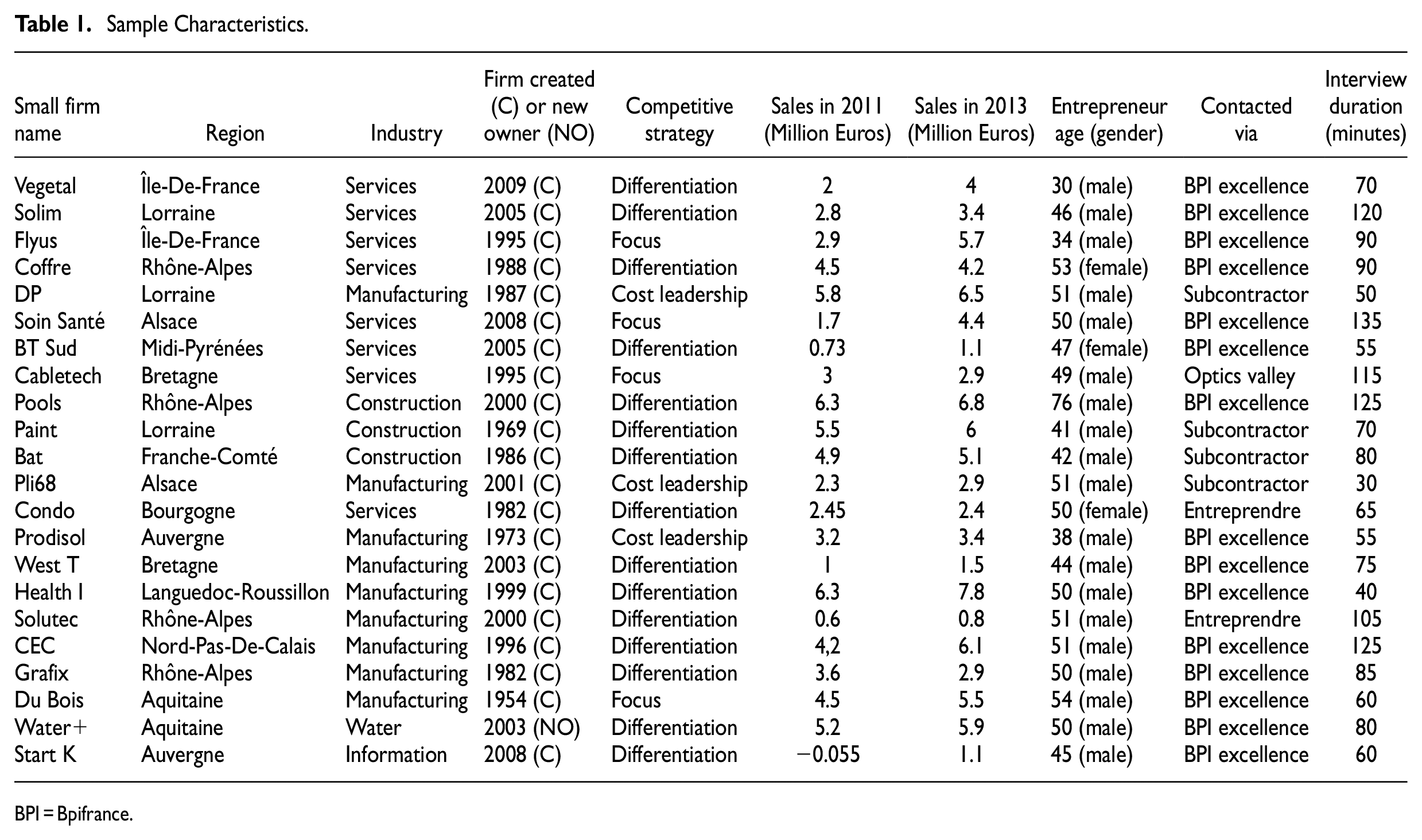
BPI = Bpifrance.
Interviews
Between January and April of 2015, we collected data through semi-structured, one-on-one interviews (with each interview lasting from 30 to 135 minutes). We created an interview guide following qualitative research guidelines (e.g., Creswell, 1998; Kvale, 1996). Specifically, we employed a semi-structured interview format and opened our conversations with “grand tour” questions that were then followed by “mini tour” questions (MacCracken, 2000). Our grand tour questions focused on experiences of the past (e.g., what is it that you think of when you refer to your past entrepreneurial experiences?), present, and the future. Our mini tour and follow-up probes focused on what interviewees had indicated. For example, if interviewees referred to a business opportunity, we asked about how they came up with it. Following aforesaid guidelines, we attended to emergent topics within our conversations. For example, interviewees from Coffre, CEC, Vegetal, and Solim specifically referred to “passion” and we probed what they meant by that. Such probing was also in alignment with our abductive stance. Interviews were held at the small firms’ locations via Skype or via phone depending on interviewees’ preferences and their location. With interviewee permissions, each conversation was recorded and transcribed in full (422 pages in total).
Data Analysis
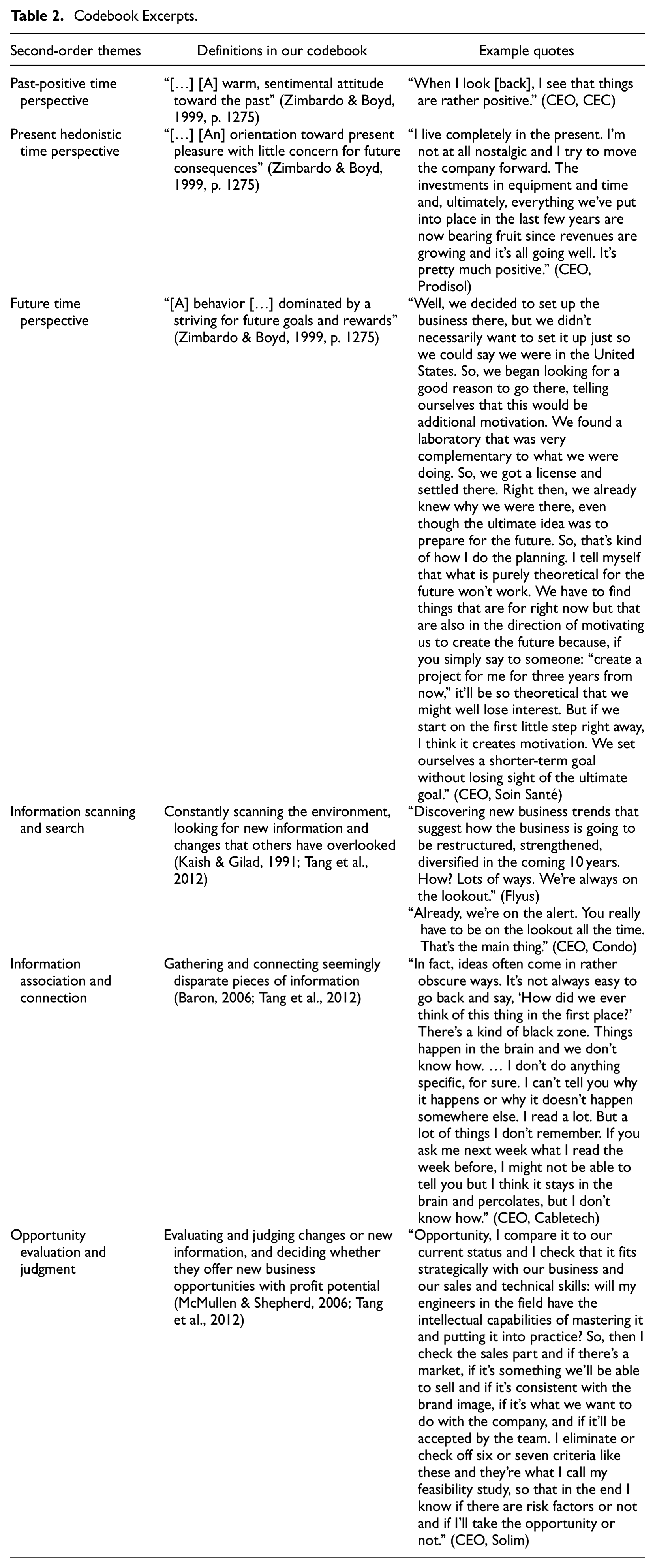
We followed an iterative process where we coded each section of text multiple times as we iterated within and between transcripts alongside our theoretical frames. This meant we engaged in constant comparisons of data to rearrange and merge some themes and revise our codebook accordingly (Neuendorf, 2002). Illustrating the iterative nature of this process, the initially large and less fine-grained (first-order) set of themes were turned into smaller, more fine-grained (second-order) themes and related aggregate dimensions, which addressed overlapping (the mutual exclusivity criterion) and relevance (the exhaustiveness criterion) issues (Neuendorf, 2002). Table 2 presents a few excerpts from our codebook (Crabtree & Miller, 1992), and Figure 1 illustrates our final data structure.
Codebook Excerpts.

Data structure.
This data structure was built utilizing template analysis (e.g., King, 1998, 2004). Accordingly, we produced a list of codes representing the various themes identified. As a final credibility check, we reviewed our data collection and analysis efforts with interviewees (e.g., CEC, Coffre, and Pools) to obtain their feedback and approval (e.g., Lincoln & Guba, 1985).
Findings
Entrepreneurial Alertness
Some comments from our informants conveyed that entrepreneurial alertness is a tri-dimensional and sequential process consisting of information scanning and search, information association and connection, and opportunity evaluation and judgment (Levasseur et al., 2022; Tang et al., 2012). For example, referring to information search, information association and connection (e.g., “the role of creativity”), feasibility (e.g., “to be able to put out a product”), and desirability (e.g., “the volume of this opportunity”), the following informant said: If we try to break down our own process, we see the role of creativity. We actually try, from information that might come from an industry watch, to look around with a creative mindset, to be able to put out a product that responds to something, and to be able to quickly determine the volume of this opportunity and whether it needs a lot of equipment or whether it’s in fact a unit product. (CEO, Solutec)
Regarding the relationship between information scanning and search (e.g., “going after the info”) and information association and connection (e.g., “the puzzle takes shape”; “we see it”), one interviewee said: I tend to say that sometimes I’m in the dark, everything is a big blur. I can’t see. And then, all of a sudden, I do see. I think we see by going after the info. Suddenly, the puzzle takes shape. This is where opportunity and vision meet. First, we have a vision of something we can’t really see (laughs) and, all of a sudden, we see it. (CEO, BT Sud)
Regarding the relationship between information association and connection (e.g., “we could imagine”) and opportunity evaluation and judgment (e.g., “we had know-how”; “using our processes”; “we made a business plan”), one interviewee said: I asked them if we had know-how, if our customers had a need, if we could imagine doing the same or roughly the same thing using our processes, even using a different machine but with a different material. We also started on two possibilities: composite and aluminum. One day, an employee mentioned that aluminum was interesting. So, we started exploring and made progress on the project. We made a business plan and talked to our customers to see if they were interested. (CEO, Coffre)
Table 3 illustrates some patterns of data (Zott & Huy, 2007). In particular, Table 3 includes categories of first-order themes and depicts their frequency, with each cross referring to an excerpt of a respondent’s discourse related to a first-order theme.
Patterns of Data.

Connecting Entrepreneurial Alertness to Opportunities
To identify a potential business opportunity, entrepreneurs scan and search for information, then associate and connect the information, and finally evaluate and judge the potential of their findings. In our data, information rhythm was seen as a catalyst of information scanning and search. One interviewee said he was constantly searching for information: I think you do it without realizing it. Yes. Without it being organized and without it being a deliberate effort. We always have an ear to the ground, we’re always listening, and behind all that, we’re trying to imagine what we can do with it. (CEO, Solutec)
Another catalyst of information scanning and search stemmed from considering multiple sources such as the internet (first excerpt), users (second excerpt), customers (third excerpt), and networks and fairs (fourth excerpt). The last excerpt sheds light on the role of networks in opportunity identification (e.g., Ozgen & Baron, 2007). On the internet, you can find everything. So it’s a good support. … A year ago, we had a problem, so I go to check things out on the internet and it gives me a glimpse of a solution. (CEO, Cabletech) First, it has to meet consumer expectations, or we have to have the firm conviction that we can create a desire by developing the product. In my sector, we tend to respond to an expectation or a problem from an end-user. Someone who operates an airplane and has endless worries; I’ll take that in and try to come up with a solution that will simplify this person’s life. If I worked in new technologies (which is not my case), I wouldn’t try to follow the trends; instead, I’d try to create desire through an object that doesn’t yet exist, but that you’d want to own. Let me answer you about my own sector. An industry watch is one thing; but, above all, it’s listening to the user. (CEO, Flyus) To find a business opportunity, … [it] can also be visits and meetings on industrial sites, listening to customers face to face, or direct contact. (CEO, Solutec) It’s through networks, demonstrations, and conferences that we identify needs. Right now, in our field of activity, there’s a need that is emerging in sub-Saharan Africa. We identified it by participating in events related to the world of health. (CEO, Health I)
In our data, two categories were related to how our informants associated and connected new pieces of information: analogies and counterfactual thinking. Analogies (Cornelissen & Clarke, 2010) were seen as a catalyst of information association and connection. For example: There are several things. We can already be thinking about it. We meet. We know that such and such a manufacturer makes a similar product or one that performs the same functions and we know the selling price. That’s the retail price. Sometimes, by digging a little, you get the professional price. From there, we started building a prototype. (CEO, Grafix) The isolated idea; you get ideas because you see something else and other areas of investigation. I mean, sometimes listening to things that have nothing to do with what you’re doing, it gives you the idea for a new product. Another thing is going to see the competition. It’s all good, in fact. I used to be a researcher. So everything is good for imagining things. (CEO, BT Sud)
Another catalyst of information association and connection came from counterfactual thinking (Baron, 1998; Gaglio, 1997, 2004). For example, the following informant mentioned feedback on experiments and trials: We don’t have a structure for carrying out lots of strategies for doing things with others. Despite everything, yes. We get feedback on experiments and trials of different products. There are people who more or less like the idea of trying things. So yes, indeed. I have a collaborator with whom I speak fairly regularly, even though I can’t talk too much about my development strategy because that remains quite confidential. So, once it’s progressed enough, I still have to talk to my colleagues. (CEO, Paint)
In our data, we found that two categories were related to how our informants evaluated and judged potential business opportunities: feasibility and desirability. Feasibility (i.e., the possession of knowledge internally or externally) was a catalyst of opportunity evaluation and judgment. Two informants mentioned the manufacturing process (both excerpts) and know-how (second excerpt). These two statements illustrate that another catalyst of opportunity evaluation and judgment stemmed from desirability or motivation and profit potential (e.g., “profitability”; “business plan”). If starting a new project means a radical change in the manufacturing process and the work we do, why not! Then you have to look at profitability and whether it’s going to require a big investment in machinery, training and learning time. All this is taken into account. (CEO, Prodisol) I asked them if we had know-how, if our customers had a need, if we could imagine doing the same or roughly the same thing using our processes, even using a different machine but with a different material. We also started on two possibilities: composite and aluminum. One day, an employee mentioned that aluminum was interesting. So we started exploring and made progress on the project. We made a business plan and talked to our customers to see if they were interested. (CEO, Coffre)
The following informants mentioned motivation (e.g., “I don’t launch an innovation, a new project, etc. if I’m not excited about it”) and profit potential (e.g., “potential expected sales”), respectively: Anyway, I don’t launch an innovation, a new project, etc. if I’m not excited about it. That’s quickly settled. When you take over an SME, it’s for personal satisfaction. If that’s not the case, don’t bother. There are a lot of constraints but there’s something thrilling about it, it’s the freedom to embark on something and really enjoy it. That’s it. I don’t do it for the money, but I do it for the freedom of being an entrepreneur, creating and taking risks. So, if I don’t want to do it, I don’t. (CEO, Bat) Possible associated volumes. What are the quantities? Whoever says quantities, says potential expected sales. Before embarking on a complete policy of innovation, new developments and R&D, you have to do a wholesale market study. (CEO, Condo)
Time Perspective and Entrepreneurial Alertness
Prior research has sparked discussion concerning the temporal dimension of entrepreneurial opportunities. For instance, Haynie and colleagues (2009, p. 338) explained that “opportunity evaluation decision policies are constructed as future-oriented, cognitive representations of ‘what will be’ assuming one were to exploit the opportunity under evaluation.” However, few investigations have focused on the process through which entrepreneurs’ thoughts about their past, present, and future shape their entrepreneurial alertness and how these dimensions interacted from a processual perspective (Shane & Venkataraman, 2000). Therefore, we investigated the entrepreneurs’ time perspective-alertness relationship and the dimensions related to the latter construct and process.
We focused on the association of time perspective with the entrepreneurs’ alertness process. Therefore, much of our data analysis centered on understanding how these positive views about entrepreneurs’ past, present, and future are associated with their identification of business opportunities through entrepreneurial alertness. Notably, one reinforcing concept seemed particularly significant: positive affect (e.g., Baron, 2008; Tang et al., 2012). It seems plausible that when entrepreneurs have a positive view of their past, present, and future in mind, they are better able to identify business opportunities. Our data suggest that there are interconnections between entrepreneurs’ time perspective and alertness, and between the activities involved in the latter. For example, one interviewee stated: Here, too, I feel like I’m repeating a truism. It’s obvious that if we approach a situation or an opportunity with a positive and open mind, we can then evaluate it and quickly grasp the possibilities, and we see immediately where it all fits with the needs of the company. So, we seize this opportunity or detect the novelty, the innovation, more quickly and how it can fit in with the company’s global strategy. (CEO, Coffre)
The entrepreneur serves as a point of inflection because time perspective is conceived as a driver of entrepreneurial alertness, which is an important component of opportunity recognition (Ardichvili et al., 2003; Baron, 2006; Baron & Ensley, 2006). Below we share themes that describe the relationship between time perspective and entrepreneurial alertness using our qualitative data from 22 French SMEs.
In our data, a past-positive time perspective emerged from the utilization of past experiences as legitimization points. This is consistent with scholars who explained that “others look to the past because they draw strength from past experiences (past-positive time perspective)” (Lévesque & Stephan, 2020, p. 165). The informants’ statements illustrate this motivational support provided by past experiences, as entrepreneurs refer to legitimization points during information search: In fact, every past experience gives you credibility. So, you’re going to look for new business based on past business. This happens a lot. It’s a virtuous circle, you could say. (CEO, Flyus) It’s like having anchor points for when you have prospects. You’re actually building on those positive experiences and results you’ve had in the past […]. When we’re dealing with innovation or looking for new activities, we tend to look to the past and build on the positive experiences we’ve had. (CEO, Solim)
Although the entrepreneurs recognized the importance of legitimization points in their search activities, this motivational support was also present when they tried to cognitively imagine a solution to a problem by using information, or when they evaluated and judged a potential opportunity, the step before entrepreneurial action (McMullen & Shepherd, 2006): The realization that we had been having problems but were able to find the right solutions has increased our confidence in our own judgment and our capacity to react and act well. All this has been positive, letting us see that, when we’re facing difficulties or new developments, we’re able to use all this experience to take advantage of opportunities or find solutions when we’re dealing with new obstacles. (CEO, Coffre)
Further, legitimization points buttress risk-taking. In short, positive past experiences, which are viewed as motivational support, security, and confidence, promote risk-taking, especially when entrepreneurs evaluate opportunities (Foo, 2011) and subsequently act, as these two informants noted: For me, I would say the word is confidence. That is, the positive parts of the past give us the conviction that we can undertake new innovation projects. By building on the positive, you’re more likely to take risks. … I think that when you have a positive image and an experience tied to this positive event, you feel more inclined to take risks. (CEO, Solim) It’s a whole package. A success or, in any case, a past experience gives you confidence for the future. Yes, I think that’s clear. It makes you want to keep going and take risks. … Yes, pushing one’s limits is a good thing. Our expression is that we “take risks.” We’re always a little “at risk.” We could have a much more reasonable attitude. But that’s not the case. I believe in taking risks to move forward and develop markets and opportunities. (CEO, Solutec)
In sum, many entrepreneurs looked at their past positively and had a positive image of their past because they used their (positive) past experiences as a motivational support and strength (i.e., as legitimization points) to form their positive image of the past (Lévesque & Stephan, 2020). Although we focus on past-positive time perspective, considering all past experiences and associated images could generate a more nuanced view. Negative events such as failure and its associated experiences could also be seen as positive and could lead to positive entrepreneurial outcomes (e.g., being more entrepreneurially alert to business opportunities), as the following two excerpts illustrate: I’ll take an example. I’ve had export failures, like a lot of companies. Exporting is difficult. I feel like I’ve had failures. In my strategic thinking, at one point, I said that I was going to get rid of this or that branch. At one point, since I’m pretty positive, I listened to a little of everything. I looked into it and I told myself that we shouldn’t say that we’re not going to get there. You have to say that you’re going to do things a little differently. When I’m thinking strategically, I make use of the past. … [S]omething that hasn’t worked out, I’ll find a way to approach it differently. That’s it. (CEO, CEC) In fact, having a positive attitude about your past means remembering both the positive things and the lessons that we can learn from our failures or our failings, so we can then use them and keep an open mind to seize opportunities in the present. (CEO, Coffre)
The first informant mentions his failures, but at the same time, he remains positive about his past, and he seeks to obtain information (e.g., “looked into it”), and he considers other information (e.g., “listened to a little of everything”; Kaish & Gilad, 1991). That is, he is in the flow information. Also, he rethinks his current actions (e.g., “approach things differently”) regarding past performance, and he is able to depart from existing cognitive frameworks (Gaglio, 1997). In sum, his positive image incites him to see things differently and to implement coping strategies to go over these initially negative failures for change (Ahmed et al., 2022).
The second informant also seems to consider her failures in her past-positive time perspective. She adopts a lesson-learned mindset (Krueger, 2007; Lévesque & Stephan, 2020; Wood et al., 2017), and she mentions considering past failures and errors (Wood et al., 2017) while evaluating and judging a potential opportunity (McMullen & Shepherd, 2006). In sum, both entrepreneurs tend to use their failures as a motivational strength and support, and to implement strategies related to coping with the past (e.g., “approach [things] differently”) to go over these initially negative events and related experiences (Lévesque & Stephan, 2020).
We found that entrepreneurs display a present-hedonistic time perspective. In our data, a present-hedonistic time perspective emerged from a focus on social relationships and the environment (e.g., “it all came out of conversations, discussions, and suggestions”). This echoes scholars (e.g., Carstensen, 2006) who explained that “an increased focus on the enjoyable aspects of the present such as social relationships […] is consistent with a present-hedonistic time perspective” (Lévesque & Stephan, 2020, p. 169). The following comments from the informants shed light on that focus in their search and cognitive activities (e.g., “to be more reflective”): We’re maybe going to be more attentive, more connected to our environment, more curious and more reflective. We’re going to spend more time building than just moping around. (CEO, Flyus) In that context, it all came out of conversations, discussions, and suggestions. All of a sudden, I had this proposal and I was open to it. I said “Yes. Great. Come and see us,” etc. That’s it. Being open and passionate, saying that it can be really great and not looking at all the negative aspects. (CEO, CEC)
The informant from CEC mentioned a present-positive time perspective and the activities related to his cognitive associations (e.g., “we’ve stepped out of the box”; “We’re trying to reshuffle the cards”) (Amabile et al., 2005; Gaglio, 1997; Hayton & Cholakova, 2012) and evaluation and judgment (e.g., “Before saying no, we’ve looked around”) (McMullen & Shepherd, 2006). The two statements from Pools indicated that the informant had an open mind, and that he broadened his information stock (Hayton & Cholakova, 2012), which was key in his new cognitive associations (e.g., “to deal with a huge amount of information”). This is consistent with the broaden-and-build theory (i.e., positive affect broadens individuals’ thought-action repertoire; see Fredrickson, 2001): That’s it. You have to deal with a huge amount of information coming at you from every which way. (CEO, Pools) I think that being positive about the present breaks down all the barriers to whatever’s in front of you. Instead of seeing risk and difficulties, it’s about seeing positive possibilities, so being open-minded. A “Why not?” instead of “This is stupid!” After all, life is full of all kinds of surprises. Positive means seeing the right side of the coin. Negative meaning seeing the difficulties and risks and shriveling up into a little ball […]. (CEO, Pools) Yes. Yes. That’s it. The ideal, I don’t necessarily do it very well, it’s more like getting myself into a positive frame of mind. We have to try to stay partitioned off. We’re in the present. There’s a topic we’re dealing with. It’s not about yesterday’s or tomorrow’s topics. I open the window on this topic […]. Before saying no, we’ve looked around, we’ve opened up, we’ve stepped out of the box, etc. We’re trying to reshuffle the cards. That’s it. (CEO, CEC)
Finally, having a positive view of the present in mind enhances entrepreneurs’ evaluation of opportunities and the related knowledge (i.e., now that the entrepreneur has assessed their knowledge and opportunity feasibility, they must find the means) and motivation (i.e., the opportunity is desirable; McMullen & Shepherd, 2006), as this informant explained: Yes. That’s for sure. I think that may be where the positive becomes really important, from my analysis of the three points you mentioned. This is when you tell yourself that you’re very positive and you’re ready to go for it. You have to figure out how to make it happen rather than saying, “Well, we tried but it didn’t work so let’s drop it. Let’s go back to what we know how to do.” To seize an opportunity, the importance of a positive attitude is found in all the details that will make the opportunity a reality. (CEO, Soin Santé)
However, we note that this evaluation enhanced by the positive view of the present is possible because the entrepreneur initially wants to cope with the present in a positive way (e.g., “You have to figure out how to make it happen”). Thus, the positive coping with the present plays an important role in that context. In sum, entrepreneurs had a positive image of their present because they coped with the present in a positive way (Lévesque & Stephan, 2020).
Entrepreneurs display a future time perspective. In our data, a future time perspective depended upon the entrepreneur’s age (Gielnik et al., 2018; Lévesque & Stephan, 2020). Entrepreneurs displayed a lower future time perspective as they became older: Then, I’m 54 and I’m starting to work on the transmission and what the business should be like in 4 or 5 years with the people who’ll be running it. That’s it. (CEO, Du Bois) Given my age, I’m now planning on leaving the group, selling my shares, which will mean selling almost a majority share since I had brought a number of organizations into the operation, and preparing for the transition and the transfer of the two main elements: the group’s finances and R&D. (CEO, Pools)
Consistent with prior research (e.g., Dew et al., 2009; Lévesque & Stephan, 2020), a future time perspective was also enhanced by a causal logic. Illustrating causal logic (i.e., if-then or when-then), some interviewees explained their search and cognitive activities as follows: If you’re not in this state of mind, you’re not even seriously looking. (CEO, Cabletech) I would say that when we’re looking to the future, our minds are sharper, more able to detect future opportunities, and we can perhaps consider constructions that are a little more sophisticated to create new opportunities, new applications, and new markets. (CEO, Solutec)
This logic also entered entrepreneurs’ vision (e.g., Baum et al., 1998) and the activities related to opportunity evaluation (e.g., “a factual analysis”): Right there, on the other hand, if you don’t have a positive vision of the future, you won’t take risks. This is … a factual analysis. You can’t pursue any opportunity at all if you don’t have a positive vision of the future and you don’t think you can do better than right now. (CEO, Cabletech)
The following statement from the informant at Coffre conveys the idea that a positive view of the future and lack of fear (a negative emotion; see Foo, 2011) lead to low risk perception associated with potential opportunities. This statement highlights that this logic was also associated with goals (e.g., “to reach our objectives”): It seems obvious. When we’re open, up on the business intelligence, and not afraid of change, very logically, we’ll be able to identify opportunities and, since they won’t scare us, everything will be simply laid out in our minds so that we can set up the means we need to reach our objectives, which seem very clear to us. It’s like being on standby in a positive state of mind. (CEO, Coffre)
Overall, the causal logic (e.g., “everything will be simply laid out”) was associated with all activities.
On the other hand, an effectual logic and an orientation toward means instead of goals did not seem to promote a future time perspective. For example, one informant stated: Business opportunities, you know, they often come from your networks. It’s like: “This doesn’t really fit my business. Would you be interested in teaming up with me? Can we work together?” And there it is. It’s: “I have a machine for sale. Are you interested?” And there it is again. … We’re already part of a trading network that brings together some 20 companies in wood manufacturing and sales, with around 60 warehouses. We meet four times a year. Our employees also meet two or three times a year and everyone shares a lot of stuff. So. Next, it’s the customers you meet and that’s part of your network. Suppliers are also part of your network. All of these are networks. You have either Nebopan-style networks, customer networks, or supplier networks. … In our small businesses, it’s simple: you have a product, either requested by your customers or that you manufacture in-house. Your customers are listening to you and we’re not in a customer/supplier power relationship. We’re not even in a partner/supplier relationship. They trust us and we trust them. We say, “We’re going to develop this, can you put three pallets in stock and you start the thing and that’s it.” We’re not at all into marketing strategies or policies, competitive intelligence, all that stuff. Instead, it’s seeing opportunities, the reality on the ground, common sense and there we go! It’s much simpler, with circuits that are much shorter and much more responsive. Maybe out of ten products, we miss eight. But it doesn’t cost us much. (CEO, Du Bois)
This statement illustrates the effectual logic (Dew et al., 2009; Read et al., 2009; Sarasvathy, 2001) and the related affordable loss principle (e.g., “out of 10 products, we miss 8. But it doesn’t cost us much”), the participants involved (e.g., “Would you be interested in teaming up with me?”), and the resulting outcome of forming partnerships (e.g., “Can we work together?”).
The following statement indicates more of a present orientation (e.g., “That’s it every day. We fight over prices.”) with given means (e.g., “you need volume”) and less of a future orientation: In a shrinking market, it’s complicated. These are markets that have been down from −5% to −10% for 3 or 4 years. So, it’s by adding new ranges, external growth and market share gains. That’s it every day. We fight over prices. Since we have a very light structure, we don’t have huge structural costs. We’re involved in complicated price battles. France is in deflation. So prices are going down and margins are narrowing. So you need volume to absorb your fixed costs. (CEO, Du Bois)
In sum, echoing prior research (Dew et al., 2009; Lévesque & Stephan, 2020), age, goals, and causal logic played an important role in the entrepreneurs’ striving for future goals and rewards.
Quantitative Study
Hypothesizing the Time Perspective-Entrepreneurial Alertness Model
Past-Positive Time Perspective and Alertness Dimensions
Following the literature on affect and emotions in entrepreneurship (e.g., Baron, 2008; Cardon et al., 2012), entrepreneurs scoring high on the past-positive dimension have had positive experiences and emotions (Boniwell et al., 2010). Specifically, building upon prior entrepreneurship studies (e.g., Gielnik et al., 2014; Kaish & Gilad, 1991; Tang et al., 2012), we contend that entrepreneurs are likely to scan and search for information because they are reasonably happy (Zimbardo & Boyd, 1999) with their past (positive) experiences. In turn, their happiness makes them likely to react and adapt to the present situation positively—which can include looking for information (Lyubomirsky, 2001; Lyubomirsky et al., 2005; Tang et al., 2021a). Moreover, we contend that entrepreneurs are likely to associate and connect diverse and previously unrelated pieces of information in an innovative way (Baron, 2006; Tang et al., 2012) because they are reasonably happy with their past experiences. These (positive) experiences and emotions broaden their thought-action repertoires (Fredrickson, 2001; Isen, 2000; Tang et al., 2021a) leading them to exhibit conscientiousness (Shipp et al., 2009; Tang et al., 2021a) and consider multiple possibilities. Finally, building upon the literature conveying that opportunities are evaluated and judged in terms of feasibility and desirability (McMullen & Shepherd, 2006; Tang et al., 2012), and that positive affect is associated with a positive evaluation (Baron, 2008; Burger & Caldwell, 2000), we contend that, because of their positive affect, entrepreneurs who score high on the past-positive dimension perceive fewer risks (Foo, 2011; Tang et al., 2021a).
Present-Hedonistic Time Perspective and Alertness Dimensions
Following the same reasoning, we contend that entrepreneurs scoring high on the present-hedonistic dimension have positive experiences of the present (Boniwell et al., 2010). Thus, being reasonably happy with their present experiences, these entrepreneurs are more likely to react and adapt to the present situation positively and proactively (Lyubomirsky, 2001; Lyubomirsky et al., 2005; Tang et al., 2021a). Thus, we contend that entrepreneurs are likely to associate and connect diverse and previously unrelated pieces of information innovatively (Baron, 2006; Tang et al., 2012, 2021a) because they are reasonably (Baron et al., 2011, 2012; Foo et al., 2015) happy (Boniwell et al., 2010; Zimbardo & Boyd, 1999) with their present experiences and these (positive) experiences and emotions broaden their thought-action repertoires (Fredrickson, 2001; Isen, 2000; Tang et al., 2021a) leading them to consider many options. Last, we contend that, because of their positive affect (e.g., happiness), entrepreneurs who score high on the present-hedonistic dimension may perceive less risks (Foo, 2011; Tang et al., 2021a), be confident when evaluating and judging the potential of the opportunity (McMullen & Shepherd, 2006; Tang et al., 2012), and may finally evaluate that opportunity positively (Baron, 2008; Burger & Caldwell, 2000).
Future Time Perspective and Alertness Dimensions
Echoing the situation in which entrepreneurs with a high past-positive time perspective are more likely to exhibit conscientiousness (Shipp et al., 2009) and consider all possibilities using the information stored from their previous (positive) experiences (Mischel, 1974), we contend that entrepreneurs with a future time perspective are also more likely to exhibit conscientiousness (Shipp et al., 2009; Tang et al., 2021a) and consider all possibilities before making a decision, which can include substantiating that decision with extra information. Moreover, building upon prior management (Amabile et al., 2005; Isen, 2000) and entrepreneurship (Baron & Tang, 2011) works conveying that positive affect improves creative problem solving, we contend that entrepreneurs scoring high on the future dimension are likely to examine how precisely the recently scanned and searched information can be connected because that examination is driven by the positive affect and emotions they have regarding their future (Desmyter & De Raedt, 2012; Tang et al., 2021a). Lastly, regarding opportunity evaluation and judgment, we contend that entrepreneurs scoring high on the future dimension see a better chance for future tasks to succeed (Nisan, 1972; Tang et al., 2021a). Moreover, these entrepreneurs are happy, and their happiness leads them to value desirability more than feasibility (McMullen & Shepherd, 2006; Tang et al., 2012) when evaluating and judging the opportunity at hand (Sagristano et al., 2002; Tang et al., 2021a; Tumasjan et al., 2013), and they may also evaluate that opportunity more positively (Baron, 2008; Burger & Caldwell, 2000).
Relationships Between Alertness Dimensions
Following recent works, we contend entrepreneurs that have scanned and searched for information are likely to associate and connect diverse pieces of information innovatively (Foo et al., 2015; Levasseur et al., 2022; Tang et al., 2012). Moreover, we contend that when an entrepreneur is better able to connect diverse pieces of information that have not been previously connected in an innovative way (Koestler, 1964), they are better able to evaluate and judge opportunity feasibility and desirability.
Data Collection
We collected data from entrepreneurs in the United States of America by using Prolific. The United States of America is a dynamic country in which small- and medium-sized enterprises (SMEs) account for approximately 40% of jobs in the business sector (OECD, 2017). Thus, echoing a global trend, SMEs play a central role in the U.S. economy (OECD, 2017). 3 We collected data between August 2021 and March 2022. The full survey was launched in July 2022 with the active assistance of Prolific.
We pretested our instrument with a small group of entrepreneurship scholars (n = 3) to assess the clarity of the instrument and face and content validity (Reynolds & Diamantopoulos, 1998). This process revealed no major issues regarding either constructs or instruments. A screening question “Are you the founder/entrepreneur of a business and currently operating this business?” was used to help identify respondents as entrepreneurs. Additionally, entrepreneurs were qualified by “I am currently doing this” as an answer to the question: “Have you engaged in entrepreneurship/run your own business?”
To reduce potential bias, we explained the risks and benefits of participating (Dillman, 1991) and ensured confidentiality (Sills & Song, 2002). Also, we used a series of checks and tests to address issues of inattentive and careless respondents, and responses generated from survey farms and bots. First, we designed the questionnaire as a two-part survey. Second, we used a set of marker questions to check for inattentive respondents. Third, we screened replies to open-ended questions for incomplete and inconsistent responses. Fourth, we eliminated responses that were completed in less than a threshold time (90 seconds for each part of the survey). Fifth, we checked for duplicate IP addresses, overlapping longitude and latitude coordinates of respondents, and survey start and end times to check for survey farms and bots. Additionally, we used the “bot.detector” package in R (Prims & Motyl, 2018) to identify potential responses from bots and survey farms. After carefully deleting surveys that were incomplete or marked with inconsistent and incompatible responses, our final dataset consisted of responses from 376 U.S. entrepreneurs (for a detailed discussion, see: Appendix B).
Measures
Time Perspective
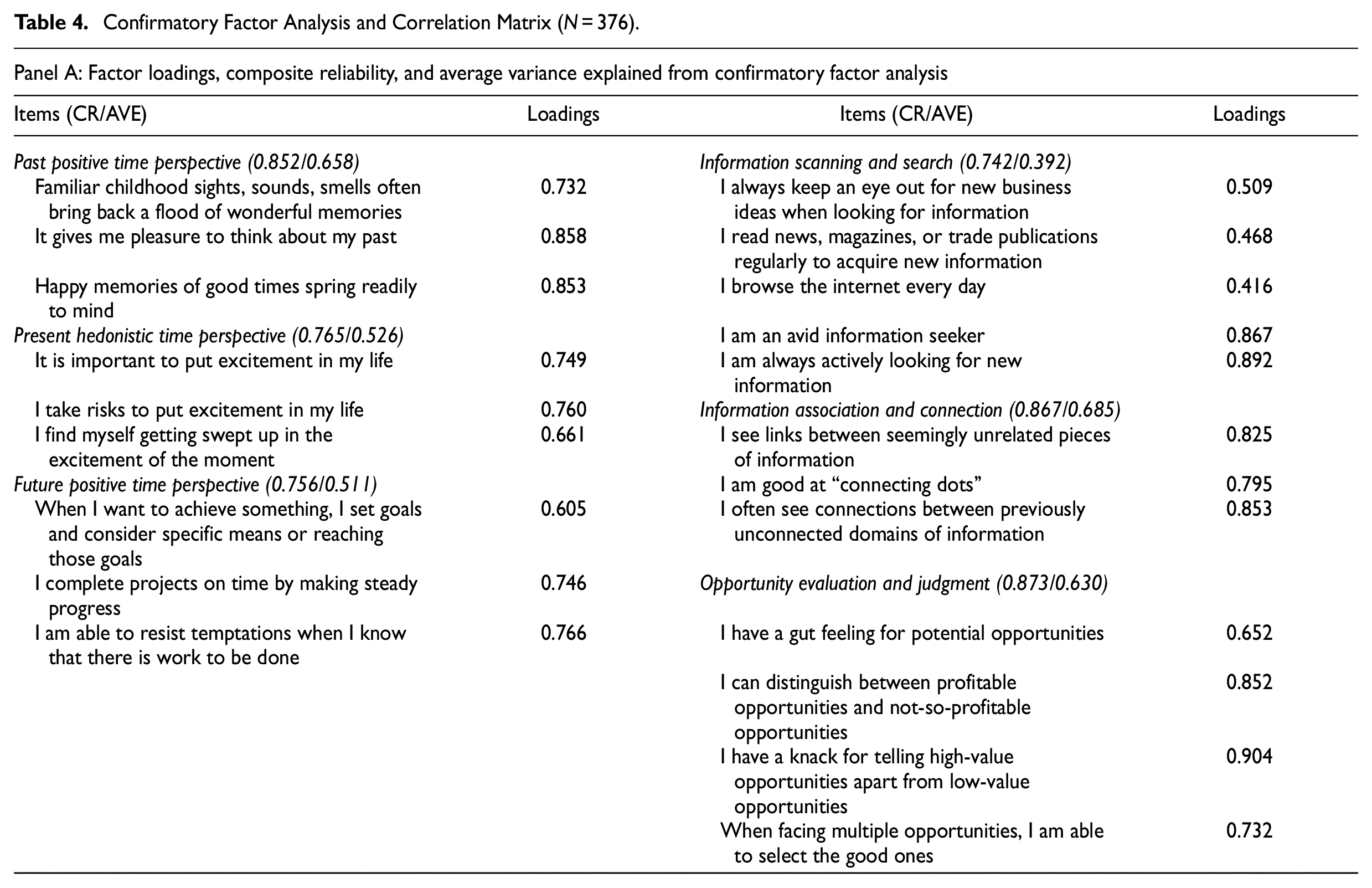
We used a subset of Zimbardo and Boyd’s (1999) original scale. The validity of the subset was verified in prior works (Košt’ál et al., 2016). Respondents answered items on 7-point, Likert-type scales with anchors ranging from “1 = strongly disagree” to “7 = strongly agree” (Table 4).
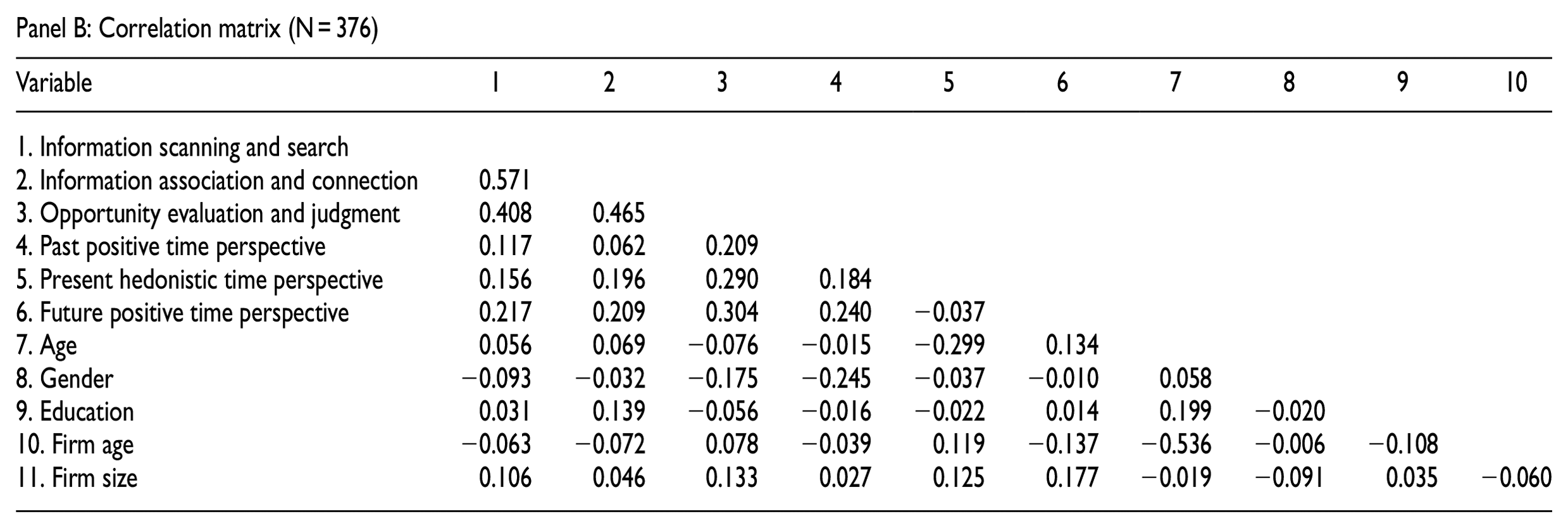
Confirmatory Factor Analysis and Correlation Matrix (N = 376).
Entrepreneurial Alertness
We used Tang et al.’s (2012) scale. The validity of that scale was verified in many works (e.g., Franczak et al., 2023). Respondents answered items on 7-point, Likert-type scales with anchors ranging from “1 = strongly disagree” to “7 = strongly agree” (see Table 4).
Control Variables
We took several variables into account when controlling for potential confounding effects. We controlled for entrepreneurs’ gender (e.g., Engel et al., 2020). Our final sample included 177 female respondents (191 male) and 8 respondents who chose not to disclose their gender. Entrepreneurs’ mean age (e.g., Ruef, 2010) in our sample was 42.098 years (σ = 13.06). Also, we controlled for entrepreneurs’ highest level of education (Ruef, 2010). Our sample included 29 respondents with a high school level (or equivalent), 74 with some college education but no degree, 194 with an undergraduate degree or a technical certification, 65 with a master’s degree, and 14 respondents had a doctoral/terminal degree. Using the incorporation year, we controlled for firm age (e.g., Engel et al., 2020). The median year of incorporation was 2017. We used the number of employees to control for firm size influence (e.g., Engel et al., 2020). The mean was 3.051 employees (σ = 6.078).
Other important characteristics included the years of work experience in the same industry entrepreneurs had before starting their current ventures (µ = 7.50; σ = 7.96), years of prior management experience (µ = 4.23; σ = 6.57), and how many businesses they started before the current venture (µ = 0.93; σ = 1.95) (e.g., Shepherd et al., 2021). Additionally, we included how many individuals co-founded their ventures (e.g., Engel et al., 2020). We had 67 ventures with a single founder, 14 ventures with two co-founders, three ventures with three co-founders, one venture with four to five co-founders, and one venture with more than five co-founders. Our sample included information on entrepreneurs’ ethnicity and the venture industry (e.g., Engel et al., 2020; Grimes et al., 2018) (Appendix A).
Data Analysis and Results
Following Podsakoff and colleagues (2012), we addressed possible common method variance (CMV) concerns through strong confidentiality assured in the introduction to subjects to de-incite them to provide socially desirable responses. Since we used established scales, we ran a confirmatory factor analysis using the “lavaan” package in R (Rossell, 2012). We report the results of the confirmatory analysis in Panel A of Table 4 after retaining items with factor loading greater than 0.4 to help with ease of analysis and interpretation. The model fit indices (CMIN/DF = 2.567, RMSEA = 0.062, SRMR = 0.069, CFI = 0.927) indicate a good model fit. Moreover, Fornell and Larcker’s (1981) procedure helped us to look for the average variance extracted (AVE) and composite reliability (CR) of time perspective and entrepreneurial alertness constructs. AVE values were greater than 0.50 and CR values were greater than 0.6 for latent variables past positive time perspective, present hedonistic time perspective, future positive time perspective, information association and connection, and opportunity evaluation and judgment indicating discriminant validity. Although the AVE value for information scanning and search (AVE = 0.392) is low, the CR is above 0.6. Therefore, we contend that the measurement model using CFA analysis has good fit in line with suggestions by Fornell and Larcker (1981). Moreover, the correlation matrix presented in Panel B in Table 4 does not indicate that multicollinearity is a serious issue for our study.
Hypotheses Tests
With the “lavaan” package in R (Rossell, 2012), we used structural equation modeling (SEM) analysis to test our model. Table 5 and Figure 2 summarize the results. Hypothesis 1a predicted that entrepreneur’s past-positive time perspective is positively related to information scanning and search. This hypothesis is supported (γ = .055, p = .083). Hypothesis 2a predicted that entrepreneur’s past-positive time perspective is positively related to information association and connection. This hypothesis is supported (γ = .123, p = .002). Hypothesis 3a predicted that entrepreneur’s past-positive time perspective is positively related to opportunity evaluation and judgment. This hypothesis finds weak statistical support (γ = .047, p = .319). The fit indices for Model 1 in Table 5 (p-value of χ2 = 0.000, CFI = 0.922, RMSEA = 0.065, SRMR = 0.064) indicate good fit.
Hypothesized Model, Fit Indices, Paths, and Coefficients (N = 376).
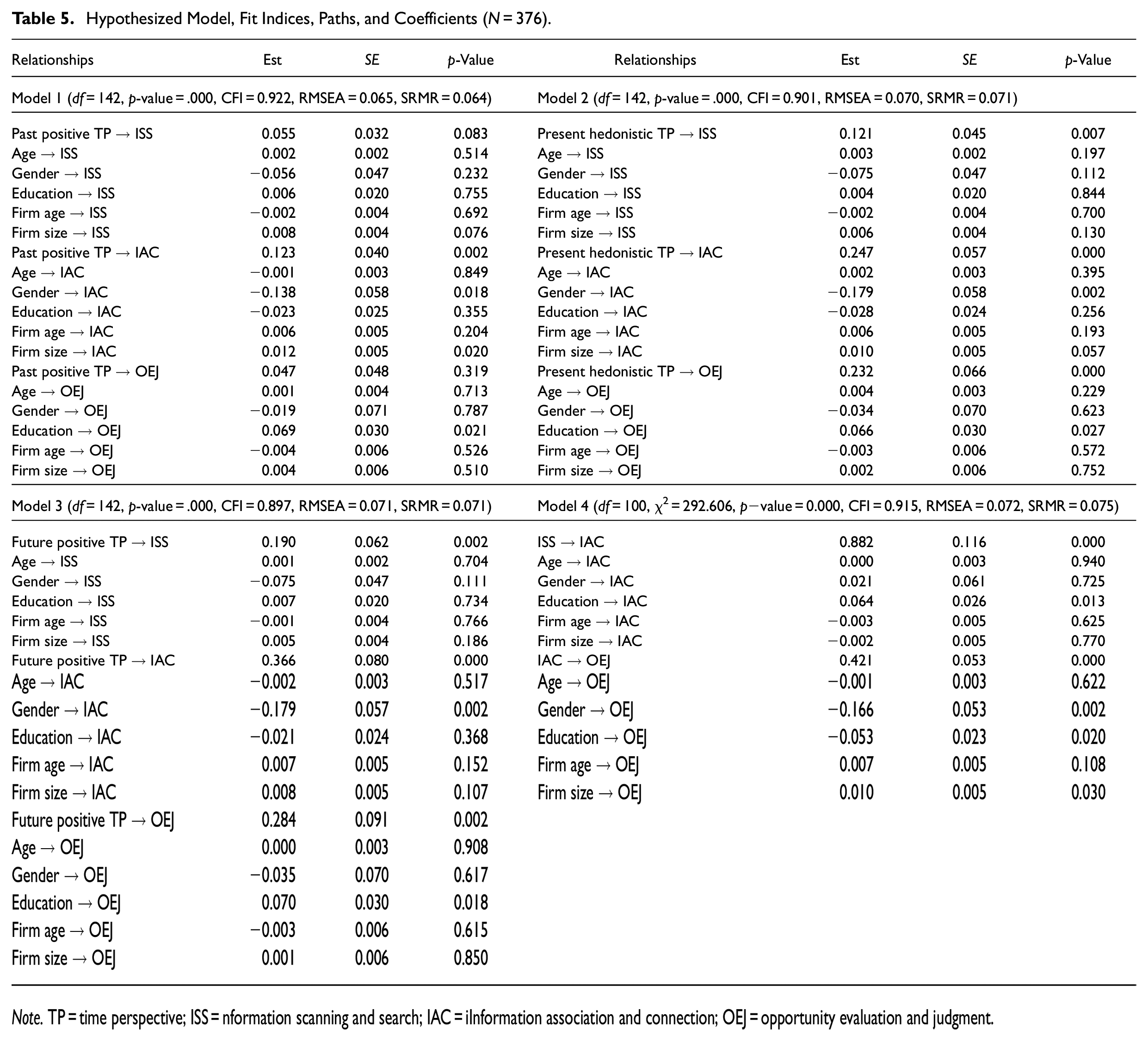
Note. TP = time perspective; ISS = nformation scanning and search; IAC = iInformation association and connection; OEJ = opportunity evaluation and judgment.
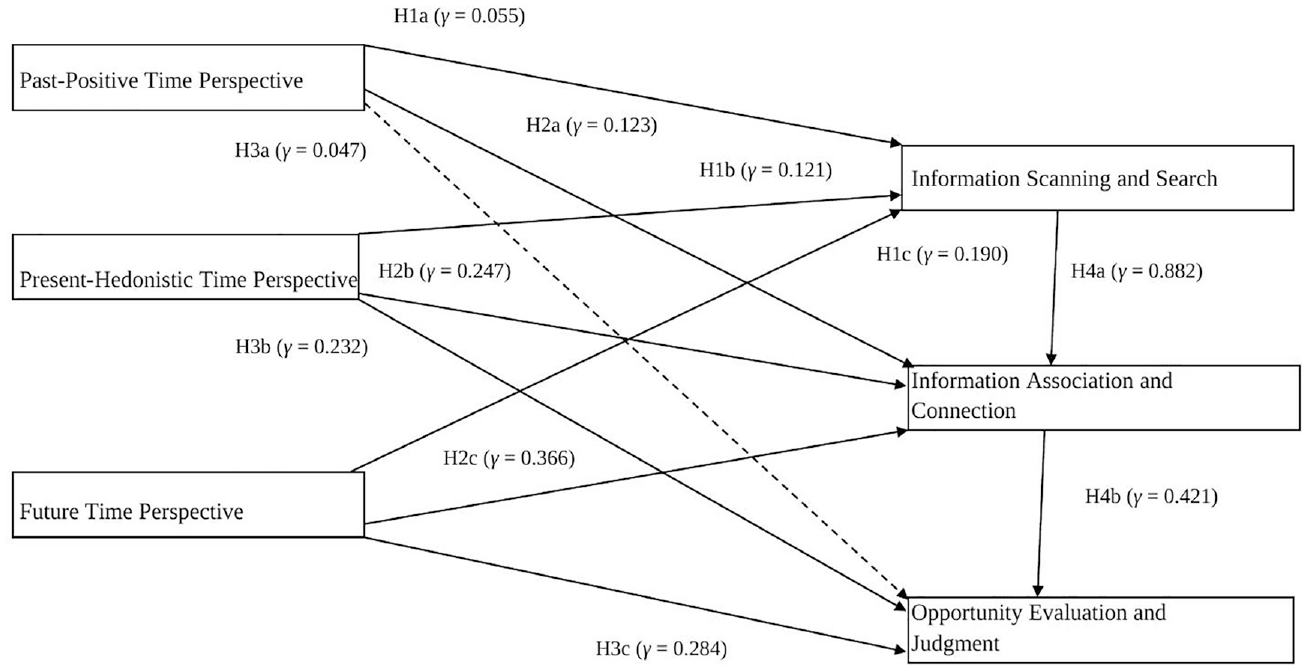
Empirical description of the U.S. study.
We report the results of the SEM testing Hypotheses 1b, 2b, and 3b of Model 2 in Table 5. Hypothesis 1b predicted that entrepreneur’s present-hedonistic time perspective is positively related to information scanning and search. This hypothesis is supported (γ = .121, p = .007). Hypothesis 2b predicted that entrepreneur’s present-hedonistic time perspective is positively related to information association and connection. This hypothesis is supported (γ = .247, p = .000). Hypothesis 3b predicted that entrepreneur’s present-hedonistic time perspective is positively related to opportunity evaluation and judgment. This hypothesis is supported (γ = .232, p = .000). The results of Model 2 in Table 5 indicate support for our Hypotheses 1b, 2b, and 3b. The model fit indices (p-value of χ2 = .000, CFI = .901, RMSEA = .070, SRMR = .071) indicate good model fit.
We report the results of the SEM model testing Hypotheses 1c, 2c, and 3c in Model 3 in Table 5. Hypothesis 1c predicted that entrepreneur’s future time perspective is positively related to information scanning and search. This hypothesis is supported (γ = .190, p = .002). Hypothesis 2c predicted that entrepreneur’s future time perspective is positively related to information association and connection. This hypothesis is supported (γ = .366, p = .000). Hypothesis 3c predicted that entrepreneur’s future time perspective is positively related to opportunity evaluation and judgment. This hypothesis is supported (γ = .284, p = .002). The model fit indices for Model 3 in Table 5 indicate good model fit (p-value of χ2 = 0.000, CFI = 0.897, RMSEA = 0.071, SRMR = 0.071).
We report the results of the test of Hypotheses 4a and 4b in Model 4 in Table 5. Hypothesis 4a predicted that information scanning and search is positively related to information association and connection. This hypothesis is supported (γ = .882, p = .000). Hypothesis 4b predicted that information association and connection is positively related to opportunity evaluation and judgment. This hypothesis is supported (γ = .421, p = .000). The model fit indices (p-value of χ2 = 0.000, CFI = 0.915, RMSEA = 0.072, SRMR = 0.075) indicate good fit for Model 4 in Table 5.
Robustness Check
We used the package “responsePatterns” in R (Řiháček & Gottfried, 2021) and autocorrelation (rp.acor function) and a mechanistic iterative search (rp.patterns function) as two approaches to identify repetitive patterns in our sample. The results of autocorrelation analysis across varying lags of responses for the Likert-type scale response items did not suggest any concerns in our sample. Next, we used the results of the mechanistic iterative search for repetitive patterns to carefully examine the patterns within the top 10 percentile of the sample for potential repetitive patterns. Based on manual inspection of these responses, the repetitive patterns found were in congruence with the theoretical explanation. Specifically, grouping of items for each latent variable would be expected to have repetitive patterns using the rp.patterns (for a detailed discussion, see: Appendix B). As a robustness check, we tested our hypotheses on a subsample of 338 respondents under the 90th percentile threshold from our sample based on the output of the rp.patterns function. Overall, the results of the robustness check support our main findings. We continue to find statistical support for Hypotheses 1b, 2b, and 3b (present hedonistic TP impacting ISS, IAC, and OEJ respectively), Hypotheses 1c, 2c, and 3c (future TP impacting ISS, IAC, and OEJ respectively), Hypothesis 4a (ISS impacting IAC) and Hypothesis 4b (IAC impacting OEJ). In contrast to our main results, in the analysis on the subsample of 338 respondents, we found weak empirical support for Hypothesis 1a (past positive TP impacting ISS; b = 0.055; p = .104), did not find any empirical support for Hypothesis 2a (past positive TP impacting IAC; b = 0.035; p = .487), and found statistical support for Hypothesis 3a (past positive TP impacting OEJ; b = 0.112; p = .006). The model fit indices for the four models are similar to the model fit indices for the four models in our main analysis. Therefore, based on the results of the robustness check, we contend that our main findings are robust.
Replication Study
Following recent works arguing for more replication (e.g., Anderson et al., 2019; Simons et al., 2017), we replicated the results of the U.S.-based study with a sample of entrepreneurs from the United Kingdom.
Data Collection
Using Prolific, we collected data from entrepreneurs in the United Kingdom following the same procedures used in our U.S.-based data collection. The full survey was launched in October 2023 with the active assistance of Prolific. In contrast to the U.S. sample, we administered the U.K. survey in a single wave. Like the U.S. sample, we used a marker question and screened responses to open-ended questions for incomplete and inconsistent responses. Also, we eliminated responses completed in less than an identified threshold time (120 seconds), checked for duplicate IP addresses, overlapping longitude and latitudes, and survey start and end times. Additionally, we used the “bot.detector” package in R (Prims & Motyl, 2018) to identify potential responses from survey farms and bots. We did not find any concerns for spurious responses. After carefully deleting surveys with incomplete and inconsistent responses, we had a final sample of 764 surveys from entrepreneurs in the United Kingdom (for a detailed discussion, see: Appendix B).
Measures
We followed the same procedure as the U.S.-based study to collect responses pertaining to both time perspective and entrepreneurial alertness (see above).
Entrepreneurial Self-Efficacy
We used the 22-item scale developed by Chen et al. (1998). Prior works have highlighted that self-efficacy is a key determinant of entrepreneurial intentions (e.g., Zhao et al., 2005) and entrepreneurship (e.g., Ozgen & Baron, 2007). Prior works have used Chen et al.’s (1998) scale to measure self-efficacy (e.g., Forbes, 2005; Pollack et al., 2012). Specifically, we asked respondents to read the following instruction: “For each of the following items, [choose] the number that corresponds to your degree of certainty in your ability to perform the task described in your capacity as a manager: A ‘1’ indicates that you are completely unsure, and a ‘5’ indicates that you are completely sure of your ability” (Forbes, 2005, p. 625). Then, we asked respondents to answer 22 items on 5-point, Likert-type scales with anchors ranging from “1 = completely unsure” to “5 = completely sure” (see Table 6). The scale included the following items: “Set and meet market share goals”; “Set and meet sales goals”; “Set and attain profit goals”; “Establish position in product market”; “Conduct market analysis”; “Expand business”; “New venturing and new ideas”; “New products and services”; “New markets and geographic territories”; “New methods of production, marketing and management”; “Reduce risk and uncertainty”; “Strategic planning and develop information system”; “Manage time by setting goals”; “Establish and achieve goals and objectives”; “Define organizational roles, responsibilities, and policies”; “Take calculated risks”; “Make decisions under uncertainty and risk”; “Take responsibility for ideas and decisions”; “Work under pressure and conflict”; “Perform financial analysis”; “Develop financial system and internal controls”; and “Control cost.”
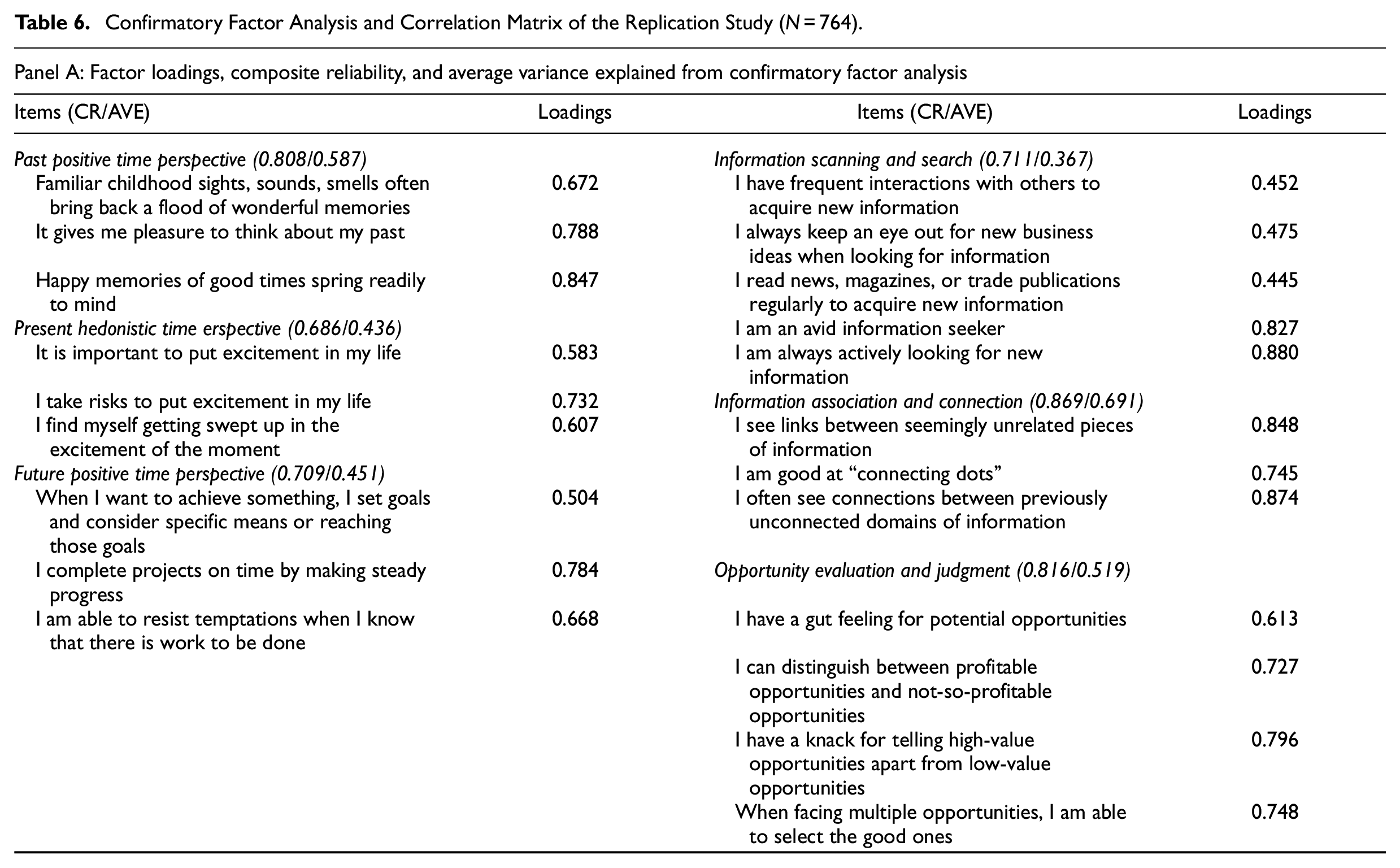
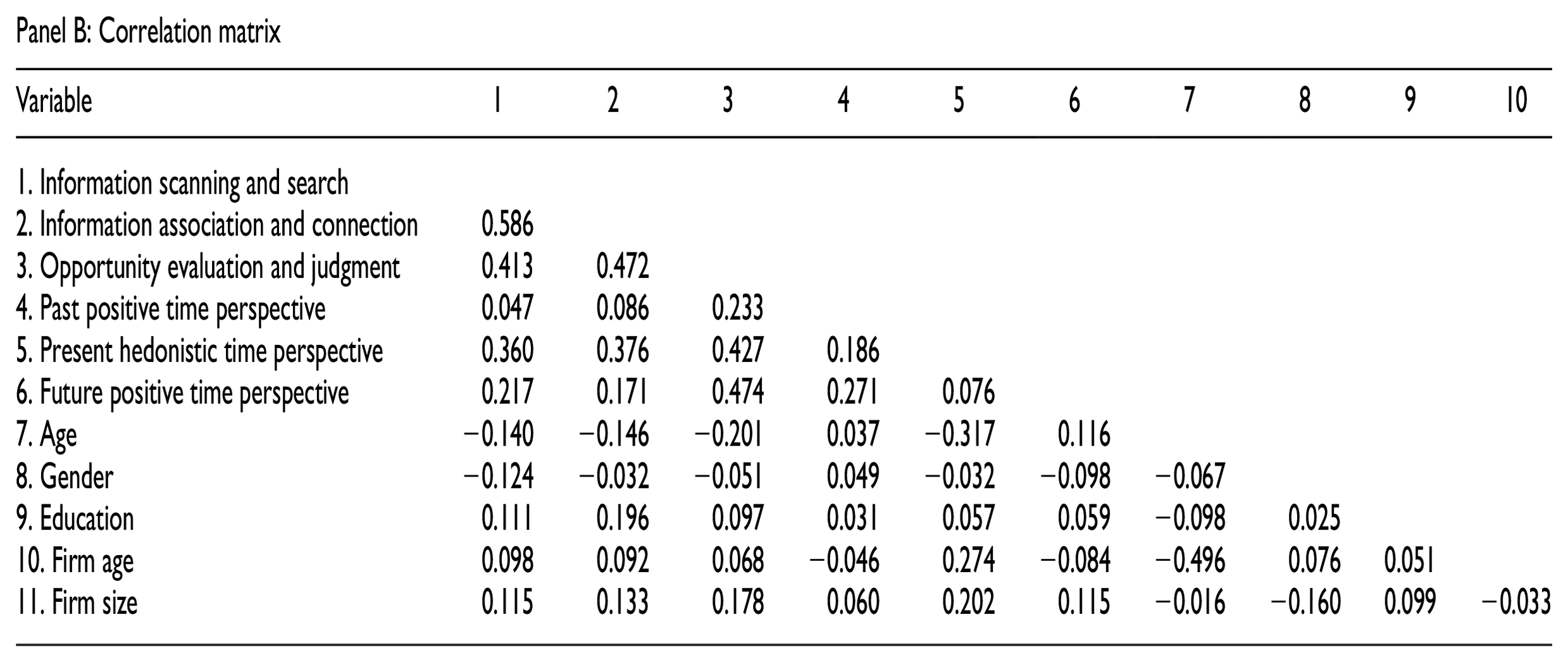
Confirmatory Factor Analysis and Correlation Matrix of the Replication Study (N = 764).
Control Variables
We took several control variables into account including entrepreneurs’ age (µ = 43.14, σ = 12.50), education, and gender, firm age, and firm size. We used the number of employees to measure firm size (µ = 2.02, σ = 4.23). We measured firm age using the year of incorporation; the median incorporation year was 2018. Our final sample included 379 male respondents, 376 female respondents, and 9 respondents who chose not to disclose their gender. Our final sample included 98 respondents with high school (or equivalent) level of education, 127 respondents with some college education but without a degree, 370 respondents with an undergraduate degree or a technical certification, 150 respondents with a master’s degree, and 19 respondents with a doctoral/terminal degree. We captured the number of years of work experience in the same industry before starting their current ventures (µ = 6.93; σ = 7.76), the number of years of prior management experience (µ = 3.94; σ = 6.02), and the number of businesses they started before the current venture (µ = 0.70; σ = 1.55). The U.K. sample included respondents of 131 ventures with a single founder, 33 ventures with two co-founders, 14 ventures with three co-founders, and 2 ventures with four to five co-founders (the other respondents chose not to disclose that information). Last, our sample included information on entrepreneurs’ ethnicity and venture industry (Appendix A).
Data Analysis and Results
Similar to our U.S. study, we addressed possible CMV following Podsakoff and colleagues (2012). Also, in line with the U.S. study, we ran two confirmatory factor analyses using the “lavaan” package in R (Rossell, 2012). First, we used the same items that had a factor loading greater than 0.4. While the indices (CMIN/DF = 3.024, RMSEA = 0.051, SRMR = 0.060, CFI = 0.916) showed good model fit (Fornell & Larcker, 1981), we found that the factor loading for item “I browse the internet every day” was below 0.4. Moreover, the AVE values of past positive time perspective, information association and connection, and opportunity evaluation and judgment were above 0.5 whereas the AVE values for present hedonistic time perspective, future positive time perspective, and information scanning and search were below 0.5. However, the CR was above 0.6 for all latent variables, suggesting good fit (Fornell & Larcker, 1981). The results of the CFA model are available upon request.
Next, we ran the CFA model with all items of the latent variable Information Scanning and Search. We notably found that item “I have frequent interactions with others to acquire new information” had a factor loading lower than 0.4 with the U.S. sample and a factor loading greater than 0.4 with the U.K. sample. The indices for that model (CMIN/DF = 3.359, RMSEA = 0.056, SRMR = 0.066, CFI = 0.905) also showed good model fit. AVE values of past positive time perspective, information association and connection, and opportunity evaluation and judgment were above 0.5 whereas AVE values for present hedonistic time perspective, future positive time perspective, and information scanning and search were below 0.5. However, the CR was above 0.6 for all latent variables. The results of that CFA model presented in Panel A of Table 6 and the correlation matrices for both CFA models presented in Panel B of Table 6 indicated that multicollinearity was not an issue.
Hypotheses Tests
We used structural equation modeling (SEM) to test our model. Below, we summarize the results with factor loadings greater than 0.4 in Table 7 (SEM results with U.S. entrepreneurs are available upon request). SEM results of Hypotheses 1a, 2a, and 3a are reported in Model 1 while SEM results of Hypotheses 1b, 2b, and 3b are reported in Model 2, SEM results of Hypotheses 1c, 2c, and 3c are reported in Model 3, and SEM results of Hypotheses 4a and 4b are reported in Model 4. The model fit indices for Model 1 (p-value of χ2 = 714.277, CFI = 0.888, RMSEA = 0.067, SRMR = 0.070), Model 2 (p-value of χ2 = 951.878, CFI = 0.851, RMSEA = 0.069, SRMR = 0.082), Model 3 (p-value of χ2 = 893.306, CFI = 0.864, RMSEA = 0.066, SRMR = 0.077), and Model 4 (p-value of χ2 = 755.386, CFI = 0.863, RMSEA = 0.071, SRMR = 0.088) indicate good model fit.
Hypothesized Model, Fit Indices, Paths, and Coefficients for Replication Study (N = 764).
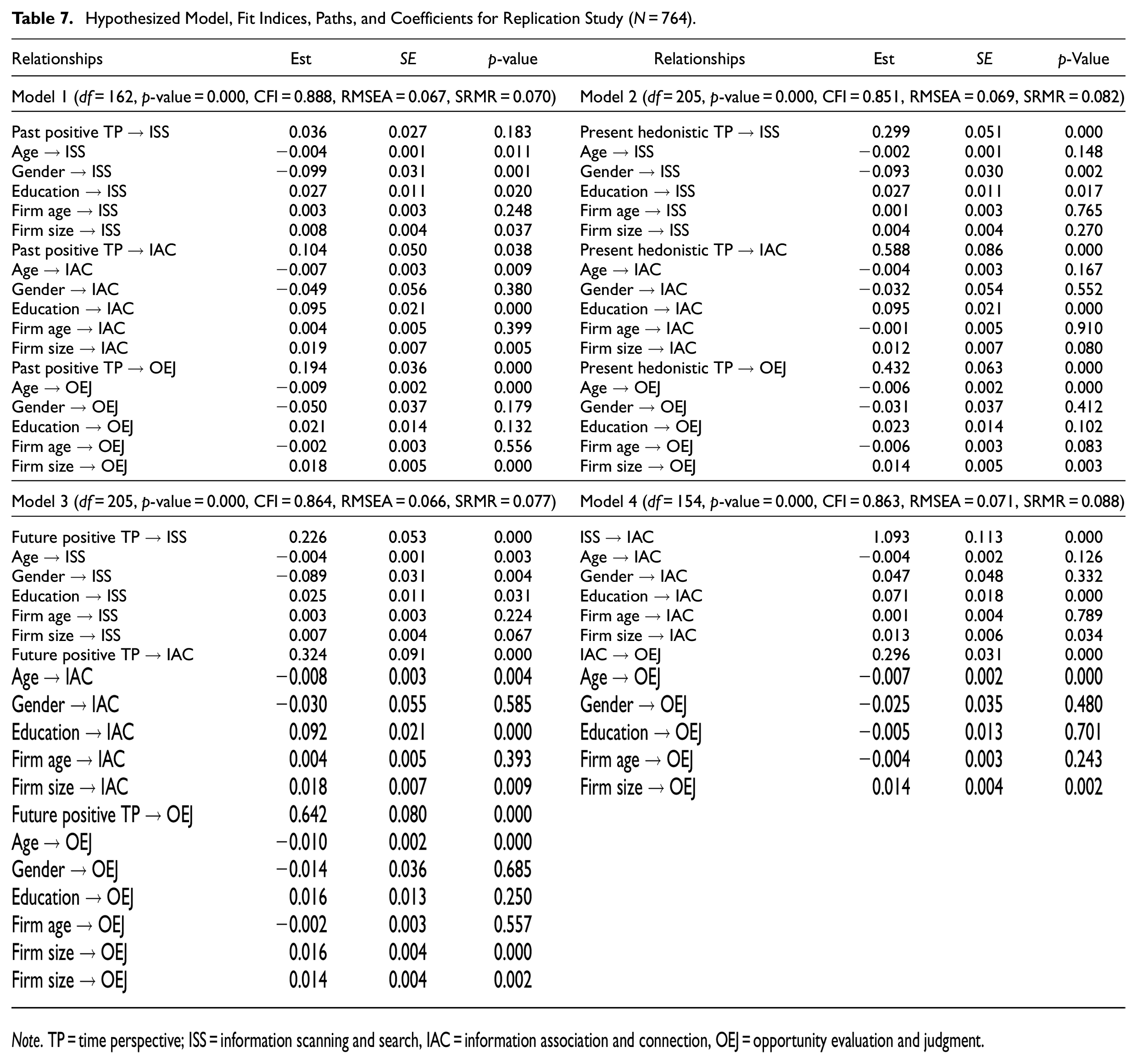
Note. TP = time perspective; ISS = information scanning and search, IAC = information association and connection, OEJ = opportunity evaluation and judgment.
We predicted entrepreneur’s past-positive time perspective is positively related to information scanning and search (Hypothesis 1a). Contrary to the U.S. data, Hypothesis 1a is only weakly supported in the U.K. sample (γ = .036, p = .183). Also, we predicted that entrepreneur’s past-positive time perspective is positively related to information association and connection (Hypothesis 2a). Analysis of the U.K. sample lends statistical support to that hypothesis (γ = .104, p = .038). Last, we predicted that entrepreneur’s past-positive time perspective is positively related to opportunity evaluation and judgment (Hypothesis 3a). Analyzing the U.K. data, we find statistical support for that hypothesis (γ = .194, p = .000). To summarize, we find statistical support across the U.S. and U.K. samples for Hypothesis 2a. However, we only find weak statistical support for Hypothesis 1a when analyzing U.K. data. Regarding Hypothesis 3a, the analysis of U.S. data conveys weak statistical support while the analysis of U.K. data conveys strong statistical support.
We predicted that entrepreneur’s present-hedonistic time perspective is positively related to information scanning and search (Hypothesis 1b). We find statistical support for that hypothesis using the U.K. sample (γ = .299, p = .000). Also, we predicted that entrepreneur’s present-hedonistic time perspective is positively related to information association and connection (Hypothesis 2b). This hypothesis is also supported using the U.K. sample (γ = .324, p = .000). Last, we predicted that entrepreneur’s present-hedonistic time perspective is positively related to opportunity evaluation and judgment (Hypothesis 3b). We find empirical support using the U.K. sample (γ = .642, p = .000). Overall, echoing the U.S. study, we find strong statistical support for Hypotheses 1b, 2b, and 3b when analyzing U.K. data.
We predicted that entrepreneur’s future time perspective is positively related to information scanning and search (Hypothesis 1c). The results of the SEM model with U.K. data lend statistical support to that hypothesis (γ = .226, p = .000). Also, we predicted that entrepreneur’s future time perspective is positively related to information association and connection (Hypothesis 2c). The SEM analysis using the U.K. sample lends statistical support to that hypothesis as well (γ = .324, p = .000). Last, we predicted that entrepreneur’s future time perspective is positively related to opportunity evaluation and judgment (Hypothesis 3c). The SEM results of the model with U.K. data lend statistical support to that hypothesis (γ = .642, p = .000). Overall, both U.S. and U.K. data show statistical support for Hypotheses 1c, 2c, and 3c.
Last, we predicted that information scanning and search is positively related to information association and connection (Hypothesis 4a). The SEM results with the U.K. sample lend statistical support to that hypothesis (γ = 1.093, p = .000). Also, we predicted that information association and connection is positively related to opportunity evaluation and judgment (Hypothesis 4b). That hypothesis is also supported when analyzing U.K. data (γ = .296, p = .000). Overall, the statistical support found for Hypotheses 4a and 4b using the U.K. sample is similar to the statistical support found for these using the U.S. sample.
Robustness Check
We used the “responsePatterns” package in R (Řiháček & Gottfried, 2021) to test for the influence of repetitive patterns in survey responses in our sample. The results of the autocorrelation analysis using the rp.acor function with varying lags did not suggest any concern of repetitive patterns. However, as a robustness check, we tested our hypotheses using a subsample of 687 respondents from the bottom 90 percentile of responses with low repetitive patterns from the output of the mechanistic iterative search using the rp.patterns function. The results of the robustness check are broadly similar to the findings from our main analysis for Hypothesis 1a (past positive TP impacting ISS), Hypotheses 1b, 2b, and 3b (present hedonistic TP impacting ISS, IAC, and OEJ, respectively), Hypotheses 1c, 2c, and 3c (future TP impacting ISS, IAC, and OEJ, respectively), Hypothesis 4a (ISS impacting IAC) and Hypothesis 4b (IAC impacting OEJ). However, in contrast to the results of the main analysis, we find empirical support for Hypothesis 3a (past positive TP impacting OEJ; b = 0.167; p-value < .001) and did not find empirical support for Hypothesis 2a (past positive TP impacting IAC; b = 0.070; p-value = .184). The model fit indices for the four models in the robustness check are similar to the model fit indices of the results in the main analysis. Therefore, we contend that our main findings are robust.
Discussion and Conclusion
Implications for Theory
Seminal works on the psychology of time have highlighted the importance of the cognitive and motivational construct called time perspective (e.g., De Volder & Lens, 1982; Lewin, 1951; Nuttin, 1985; Zimbardo & Boyd, 1999). Building upon these works, our studies provide a novel basis for understanding the affective, cognitive, and temporal mechanisms associated with entrepreneurial alertness (e.g., Lanivich et al., 2022; Tang et al., 2012; Valliere, 2013). Our research conveys that differences in entrepreneurial alertness can be attributed to differences in how entrepreneurs experience and perceive their past, present, and future. These differences are found to impact how entrepreneurs subsequently seek, associate, and connect information to evaluate and judge potential opportunities (e.g., Levasseur et al., 2022; Tang et al., 2012). Thus, our work extends theory for the concepts of opportunity recognition (e.g., Baron, 2006; Baron & Ensley, 2006; Tang et al., 2012; Valliere, 2013) and opportunity evaluation (e.g., Autio et al., 2013; McMullen & Shepherd, 2006; Tang et al., 2012; Wood & McKelvie, 2015) by suggesting that the mechanisms through which patterns are informed and represented in the entrepreneur’s mind can be traced back to the experiences entrepreneurs have of their past, present, and future.
Our expansion of theory regarding opportunity recognition and evaluation to incorporate time perspective is important because opportunity is the basis of entrepreneurship (Shane & Venkataraman, 2000). Moreover, as innovative and cognitive association of previously sought information that has capability, personal, and financial potential, opportunities can only be recognized if an entrepreneur’s past, present, or imagined future encompasses a cognitive framework for exploiting such potential. Similarly, because time perspective molds an entrepreneur’s perception of the window of opportunity, or the right time to pursue action (Wood et al., 2021), the dynamics of a potential opportunity must be in sync with an entrepreneur’s past and present thoughts and experiences—and their conceptualization of the future—to be evaluated positively and subsequently exploited.
Considering the research and analyses presented herein, we propose a specific definition to the field of entrepreneurship that can help elaborate and extend theory (Fisher & Aguinis, 2017) concerning entrepreneurs’ recognition of opportunities. Building upon Zimbardo and Boyd (1999), we define entrepreneurs’ time perspective as a cognitive representation of both positive and negative past and present experiences, and a speculated future. Time perspective is distinguishable from other similar constructs (Fisher & Aguinis, 2017), such as temporal focus (e.g., Shipp et al., 2009), which does not distinguish between positive and negative aspects of each dimension.
Our conceptualization of time perspective is important and advances the literature because it accounts for potential bias stemming from the valence associated with time-bound experiences and thoughts. As such, previous research can be incorporated into the calculus of perspective for which time has effects—broadening the nomological linkage for time perspective as causal antecedent to the important entrepreneurship phenomenon. Individuals scoring high on a past-positive time perspective tend to focus on positive past experiences which are linked to higher life satisfaction and well-being (Perry et al., 2015). Conversely, individuals scoring high on a past-negative time perspective tend to focus on negative past experiences and may exhibit negative affect and depressive symptoms (Bodecka et al., 2021). Moreover, individuals scoring high on a present-hedonistic time perspective prioritize immediate pleasure and are more likely to engage in risk-taking behaviors (Jochemczyk et al., 2017). In contrast, individuals scoring high on a present-fatalistic time perspective (who believe in a lack of control over future) are usually more prone to maladaptive psychological behaviors and outcomes such as negative affect and tense arousal (Chen et al., 2016).
Implications for Practice
Our work on time perspective has practical implications. With the help of professionals, such as coaches and psychologists, entrepreneurs could learn how to maintain positive thoughts about their past, present, and future, an important correlate of well-being (Boniwell et al., 2010). For example, by following the time perspective coaching by Boniwell and colleagues (2015), Boniwell et al. (2014), entrepreneurs who need to improve their past-negative perspective could reflect upon their regretful past actions and write a letter asking for forgiveness. Entrepreneurs who need to improve their past-positive perspective could get involved in community events and activities or recall pleasant past events. They could also visit their colleagues and friends and express their gratitude to them and thank them. Entrepreneurs who want to improve their present-fatalistic perspective could reduce passive activities (e.g., time spent in front of screens) and focus on situations they are able to influence. Finally, entrepreneurs who want to improve their future perspective could set clear professional and personal goals and make lists of priorities.
Limitations
Our work is not without limitations. First, time perspectives can be seen as ongoing assessments (Levine, 1997). Thus, our sample of French entrepreneurs could have different time perspective configurations if we were to interview them today. This paves the way for longitudinal time perspective research. Second, although we interviewed multiple respondents on the same topics, we recognize that other data sources (Nag et al., 2007) such as internal documents and participant observation could help to control for potential social desirability bias and differences between espoused time perspectives and time perspectives in use (Argyris, 1976). Thus, more time perspective research triangulating many types of data is needed. Third, we have collected qualitative data and quantitative data on the time perspective—entrepreneurial alertness relationship and replicated the results of the U.S. sample with a U.K. sample (e.g., Anderson et al., 2019; Simons et al., 2017). However, because time perspective may vary across time, gender, age, and culture, we cannot generalize our results. Following recent works comparing many countries in the same study (e.g., Hechavarría et al., 2023; Tang et al., 2021b), we invite scholars to conduct more cross-cultural research to augment the generalizability of our results.
Future Directions
We envision several directions for future empirical research. First, echoing prior works emphasizing the role of chronology (i.e., “[w]hat an entrepreneur envisages as the appropriate sequencing of actions and events to realize an important milestone”; Wood et al., 2021, p. 152) and related dimensions such as sequencing and synchronization, we see a need to better understand how the development of opportunities is related to chronology and sequencing, and how chronology and sequencing (e.g., Johnsen & Holt, 2023; Wood et al., 2021) interact with entrepreneurs’ time perspective. For instance, does chronology influence time perspective directly or indirectly? Does this dimension have a moderating influence? Does the impact of this dimension lead to changes in time perspectives? Can we have multiple and potentially conflicting time perspectives (e.g., a past-positive and a present-fatalistic time perspective; a past-negative and a present-hedonistic time perspective)? Will the main effect be cancelled due to the opposing dimensions? Considering that women have been shown to be future oriented when they take on responsibilities (Jason et al., 1989), what are the resulting effects on entrepreneurial alertness (e.g., Tang et al., 2012) that include opportunity evaluation and judgment (e.g., McMullen & Shepherd, 2006; Tang et al., 2012)? Does that relationship differ with regard to gender (e.g., Zhang et al., 2023)?
Clearly, we need to know more about how time perspective is related to the entrepreneurial process consisting of both opportunity recognition (e.g., through entrepreneurial alertness) and opportunity exploitation (e.g., through firm-level entrepreneurial orientation). Scholars should examine how cognitive biases, such as overconfidence (e.g., Busenitz & Barney, 1997; Shepherd et al., 2021; Zhang & Cueto, 2017), are related to temporal dimensions and the entrepreneurial alertness process (Tang et al., 2012). Such investigation could be an opportunity for scholars to conduct more multi-level research on how enterprising individuals and teams evaluate opportunities (e.g., Shepherd et al., 2019; Tang et al., 2012) or on firm entrepreneurial orientation and growth (e.g., Achtenhagen et al., 2010; Rauch et al., 2009; Rosenbusch et al., 2013; Wiklund, 1999; Wiklund et al., 2009).
Additionally, further research is needed regarding how time perspective, cognitive biases, and entrepreneurs’ alertness are related to other time dimensions such as pacing (e.g., Levine, 1997; Lévesque & Stephan, 2020), timing (e.g., Wood et al., 2021), and sequencing or synchronization (e.g., Khavul et al., 2010). For instance, how do pace-related dimensions such as time affluence versus pressure (i.e., when individuals have enough time vs when they do not have enough time; Lévesque & Stephan, 2020) impact entrepreneur’s time perspective and alertness in diverse cultural contexts (e.g., Levine, 1997; Stephan, 2021)? Recent works have conveyed that entrepreneurs are more likely to focus on issues they have experienced themselves (e.g., Lévesque & Stephan, 2020). Relatedly, scholars have suggested that negative time perspectives do not always seem to be relevant for entrepreneurs (e.g., Levasseur et al., 2020). Thus, the question arises: How do entrepreneurs scoring high on negative time perspectives sequence their activities? Clearly, more research is needed here.
Conclusion
Our goal was to provide qualitative and quantitative evidence to enrich theory regarding the relationships between time perspective and entrepreneurial alertness. We found that both entrepreneurs’ present and past time perspectives are related to their coping strategies (Lévesque & Stephan, 2020) while their future time perspective is related to their goals (Chen et al., 2018) and causal logic (Dew et al., 2009; Lévesque & Stephan, 2020). Also, we examined how entrepreneurs’ experiences and perceptions of their past, present, and future impacted their alertness. By doing so, we provide an innovative individual-level approach to understanding entrepreneurial activities in different countries through the experiences and perceptions of three temporal dimensions. Overall, qualitative data from 22 French entrepreneurs and quantitative data from 376 U.S. entrepreneurs and 764 U.K. entrepreneurs support our argument that past-positive, present-hedonistic, and future time perspectives are positively associated with entrepreneurial alertness (with positive relationships between alertness dimensions).
Supplemental Material
sj-docx-1-etp-10.1177_10422587241241823 – Supplemental material for Time Perspective and Entrepreneurs’ Alertness
Supplemental material, sj-docx-1-etp-10.1177_10422587241241823 for Time Perspective and Entrepreneurs’ Alertness by Ludvig Levasseur, Stephen E. Lanivich, Sai Chittaranjan Kalubandi and Apurva Sanaria in Entrepreneurship Theory and Practice
Supplemental Material
sj-docx-2-etp-10.1177_10422587241241823 – Supplemental material for Time Perspective and Entrepreneurs’ Alertness
Supplemental material, sj-docx-2-etp-10.1177_10422587241241823 for Time Perspective and Entrepreneurs’ Alertness by Ludvig Levasseur, Stephen E. Lanivich, Sai Chittaranjan Kalubandi and Apurva Sanaria in Entrepreneurship Theory and Practice
Footnotes
Acknowledgements
It should be also acknowledged that a previous version of this paper has been accepted for presentation at the 2019 Southern Management Association Annual Meeting and the INSEAD Doriot Entrepreneurship Conference 2023 and includes very helpful feedback and comments from Melissa Graebner, Denis Grégoire, Mukta Kulkarni, Catherine Léger-Jarniou, Blake Mathias, Evgeny Osin, Michael Pratt, Dean Shepherd, Anne Smith, Ekkirala Srinivas, Jintong Tang, Matthew Wood, Sai Yayavaram, and Wenping Ye. We also thank LabourNet, GAME, and Median India for their help during the data collection process and Manpreet Kaur for her research assistance and Arnab Mukherji and Venkatesh Panchapagesan for their help. The qualitative part is taken from a doctoral dissertation defended in November 2016 at PSL-Université Paris-Dauphine. Last, we would like to thank our Editor and two anonymous reviewers for their excellent guidance and feedback.
Declaration of Conflicting Interests
The author(s) declared no potential conflicts of interest with respect to the research, authorship, and/or publication of this article.
Funding
The author(s) disclosed receipt of the following financial support for the research, authorship, and/or publication of this article: This research received two grants from IIMB (Grants #7399FG and #R&P242-22).

Supplemental Material
Supplemental material for this article is available online.
Notes
Author Biographies
References
Supplementary Material
Please find the following supplemental material available below.
For Open Access articles published under a Creative Commons License, all supplemental material carries the same license as the article it is associated with.
For non-Open Access articles published, all supplemental material carries a non-exclusive license, and permission requests for re-use of supplemental material or any part of supplemental material shall be sent directly to the copyright owner as specified in the copyright notice associated with the article.
