




Abstract
In-group favoritism (e.g. in the context of nationalism or ethnocentrism) has been receiving considerable attention. To explain it, many researches have proposed theoretical models using a tag which was assumed as a variable one. Following the perspective that an ethnicity is invariable, we assume a fixed tag. We also assume that the reputations of others are created and shared within a group. On the basis of these assumptions, we introduce strategies for selecting friends using tags and within-group reputations. We conducted evolutionary simulations and found the emergence of in-group favoritism. The tag in our model is not minimal but highly neutral because it is defined not to cause a direct payoff. In the beginning of a simulation, the identification of a tag is independent of any payoff, but the tag ultimately becomes closely correlated to cooperation and a payoff.
Introduction
In-group favoritism has been a topic of considerable academic interest for a long time. For example, Weber (1911) addresses it within the context of “in-group morality” among ancient Jews. Recently, the increasing ethnocentrism under globalization has heightened interest in this topic. Many evolutionary models have been proposed to explain in-group favoritism, arguing that it has emerged through adaptation (Antal et al., 2009; Fu et al., 2012; Hales and Edmonds, 2003, 2004; Jansen and Van Baalen, 2006; McDonald and Sen, 2004, 2006; Riolo, 1997; Riolo et al., 2001; Hales and Shutters, 2013; Traulsen, 2008; Traulsen and Nowak, 2007). To express a group, all of these models use tags which are assumed to be variable. The variability of tags means that individuals can change his or her group easily.
Is this assumption reasonable? We regard exclusive ethnocentrism as a typical form of in-group favoritism. An ethnic group is a collective of people with a common ethnicity based on language, history, religion, or other characteristics. The variability of this ethnicity has been the subject of a debate between two perspectives: one sees an ethnicity as a permanent one (Geertz, 1963; Isaacs, 1975a, 1975b; Shils, 1957) and the other as a variable one (Barth, 1969). In a study of communities in Indonesia, India, Lebanon, and Nigeria, Geertz (1963) demonstrates that members have strong ties and deep primordial attachments to their ethnicity, thus concluding that an ethnicity is permanent. In contrast, Barth demonstrates a tribe acting differently as the Fur (an agricultural tribe) and as the Baggara (a nomadic tribe), and concludes that an ethnicity is variable. On the basis of this debate, we focus on in-group favoritism in a permanent-identity group and examine the theoretical possibility of emergence of in-group favoritism under a fixed tag.
What causes in-group favoritism? In a variable-tag model, if non-cooperation penetrates into a cooperative group, some members will change their tags and restructure cooperation in a new group. When one cooperative group collapses, another cooperative group emerges. Thus, the variability causes in-group favoritism. Therefore, under the assumption of a fixed tag, another mechanism is needed to replace the variability of tags.
Experiments by Yamagishi et al. (1999) and by Yamagishi and Mifune (2008) demonstrate that in-group favoritism is caused by expectations and fears related to groups. Yamagishi sees the group as a field in which general exchange takes place. An example of general exchange is the situation B is helped by A, who is later helped by a third person X. It is also called indirect reciprocity, as it refers to a chain of cooperation (i.e.
It is not easy to establish indirect reciprocity. Even if a person helps another, he or she cannot be sure of encountering another person who will provide reciprocal assistance in the future. There is no guarantee that a third person will appear and help him or her. If we assume that people are selfish, they are not likely to help others because they consider helping to be a waste of labor. This establishes a chain of non-cooperation. However, previous researches have already proven that if we assume a strategy of cooperating with those who cooperate with others, cooperation will continue in chains (Leimar and Hammerstein, 2001; Novak and Sigmund, 1998a, 1998b; Takagi, 1996; Takahashi, 2000). They all emphasize the importance of the reputation of the person who acted altruistically or who did not as an essential factor in indirect reciprocity.
Therefore, we use reputation to replace the variability of a tag. More specifically, we demonstrate that a fixed tag and reputation cause indirect reciprocity within the group and in-group favoritism. As another model using a fixed tag, we have a group selection model (Chalub et al., 2006; Choi and Bowles, 2007; Garcia and Van den Bergh, 2011; Pacheco et al., 2006). It assumed a priori that two differently tagged groups always fight each other and showed that the intergroup conflict induces within-group cooperation. In contrast, we make no such a priori assumption regarding intergroup conflict. We demonstrate the emergence of both within-group cooperation and intergroup non-cooperation.
Stereotype models are another type of a fixed-tag model (Masuda, 2012; Orbell et al., 1996). Because a stereotype is a specific case of reputation, stereotype models are similar to our model. In stereotype models, individual j’s reputation for individual i is assumed to be group J’s reputation for individual i (stereotype), where j belongs to group J. In our model, individual j’s reputation for individual i is assumed to be j’s reputation in group I, where i belongs to group I. In our research, we regard a group as a collective of people with the same tag and that individuals can recognize whether other individuals have the same tags as him or her. We also assume that the reputations of others are created and shared within a group. More specifically, we assume that group members consider a person’s past actions toward them, evaluate how cooperative he or she was toward them, and share his or her reputation among group members. Anderson (1983) argues that print capitalism and secular language contribute to the sharing of individual experiences among people, thereby establishing nations as imagined communities. In this sense, our reputations can be seen as a kind of public opinion. 1 It is important to note that in our model, we define tags as independent of any payoff. Visibility of membership and shared reputations never guarantee a high payoff.
In the section “Agent-based model of in-group favoritism” of this article, we introduce the agent-based model of generalized exchange, based on the notion of fixed tags and within-group reputation. In the section “Evolutionary simulation of in-group favoritism,” we explain how to conduct evolutionary simulations. In the section “Emergence of in-group favoritism,” we conduct simulations and demonstrate the emergence of in-group favoritism. In the section “Dramas inside model,” we present some artificial dramas taking place inside the model. In the section “Discussion,” we present findings, implications, and limitations of the research, along with suggestions for future research.
Agent-based model of in-group favoritism
Giving game
We begin by formalizing a situation wherein many people are engaged in generalized exchange. To express the generalized exchange, we present the following game, which has been used in many previous studies: the “giving game” (Novak and Sigmund, 1998a). In this game, a one-way action is described as either cooperation or non-cooperation (defection) (Figure 1):
(a) Each player has an idea of who is his or her friend (“my friend”) and enemy (“my enemy”) before playing the game. (We refer to the entirety of these perceptions as a “friend list.”)
(b) In one giving game, each player encounters other players at random. There are N × (N − 1) types of encounters in a society, in which N is the total population and players cannot encounter themselves. We define the matching ratio (m) as the total number of encounters divided by N × (N − 1). In other words, each player can encounter an average of m × (N − 1) other players during one game. For example, m = 1.0 corresponds to a round robin game.
(c) Player i (actor) either cooperates (C) or does not cooperate (D) with player j (acted upon) according to i’s friend list. Player i cooperates with j if j is i’s friend and not if j is i’s enemy.
(d) If i cooperates with j, i pays a cost c and j receives a benefit b (b > c). If i does not cooperate with j, both receive and pay nothing. Hereafter, c is set at 1.0 without loss of generality.
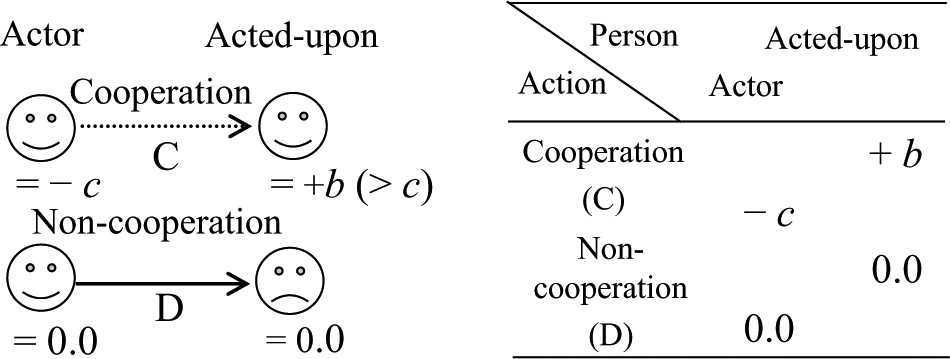
Payoffs for the actors and the acted upon.
In the game, even if a player cooperates with another player, he or she cannot be confident that another player will cooperate with him or her in the future. To selfish people, present cooperation appears foolish. In other words, egoistic actions flourish when there are no guarantees of reciprocation for an altruistic action. This creates a social dilemma and a situation resembling a “war of all against all.” Hereafter, this situation is referred to as the Hobbesian state.
It is important to note that the definition of the giving game is incomplete in that it does not include how to make a friend list. Without this piece, a player cannot interact with anyone. Players need a friend selection strategy (FSS) to determine which players are “my friend” and which are “my enemy.”
FSS based on fixed tag and within-group reputation
We introduce the FSS using a fixed tag and a within-group reputation. Upon encountering player j, it would intuitively seem natural for player i to be interested in whether player j belongs to the same group. In addition, player i will be interested in player j’s reputation. In this context, “reputation” refers to player j’s reputation in player i’s group I (whether player j was cooperative toward group I in the past). Player i can know player j’s reputation only within his or her own group I.
In this model (Figure 2), if player j has recently encountered and cooperated with a member of group I, group I gives one point to player j; however, group I takes one point away from player j if player j did not cooperate. (If player j has not encountered a member of group I, player j neither receives a point from nor loses a point to group I.) Next, player j’s total score is calculated by aggregating the points given to player j. If the total score is positive, player j’s reputation in group I is defined as “a cooperative (friendly) person.” If the total score is negative, player j gains a reputation as a “non-cooperative (hostile) person.” If the total score equals zero, player j’s past reputation is retained.

Within-group reputation.
The strategy is composed of two parts: one corresponds to the case that player j belongs to the same group as player i and the other does to the case that player j belongs to a different group. Each part will be either of the following four sub-strategies:
(a) Sub-strategy C: it regards another player as a friend regardless of another’s good (friendly) or bad (hostile) reputation. Because it is similar to ALL_C, we call it C for short.
(b) Sub-strategy T: it regards another player as a friend if another’s reputation is good and as an enemy if bad. Because it is similar to Tit For Tat, we call it T.
(c) Sub-strategy I: it regards another player as a friend if another’s reputation is bad and as an enemy if good. Because it is similar to Inverted Tit For Tat, we call it I.
(d) Sub-strategy D: it regards another player as an enemy, regardless of his or her good or bad reputation. Because it is similar to ALL_D, we call it D.
At last, we have 16 (=4 × 4) strategies theoretically. Hereafter, strategies refer to “friend selection strategies based on a fixed tag and a within-group reputation,” abbreviated as FSS-TRs. Each of these strategies is denoted by a designation X1X2, where Xi ∈ {C, T, I, D}. For example, a CD player regards any player sharing the same tag as him or her as “my friend” (within-group friendship), and any player with a different tag as “my enemy” (intergroup hostility), independently of the player’s past actions (reputation). As another example, a TD player regards another player who shares the same tag as him or her and who did not cooperate with his or her group (“our group”), as “my enemy” (within-group reciprocity), whereas he or she regards any player with a different tag from him or her own as “my enemy,” regardless of the player’s past actions. A TT player regards any player who has cooperated with his or her own group as “my friend,” while regarding any player who did not cooperate as “my enemy.” A TT player does not care about the tags of other players. Regarding CC and DD, we want to call them ALL_C and ALL_D exceptionally. These 16 FSS-TRs are purely theoretical, and some may appear meaningless at first glance. For example, an II player regards any player who has cooperated with his or her own group as “my enemy,” whereas he or she regards any player who did not cooperate as “my friend,” independently of the player’s tag. To determine whether this is actually the case, we conduct evolutionary simulations with all 16 of the FSS-TRs, including such odd strategies, which should eventually die out if they are indeed meaningless. Some FSS-TRs are described in Table 1.
Descriptions of typical FSS-TRs.
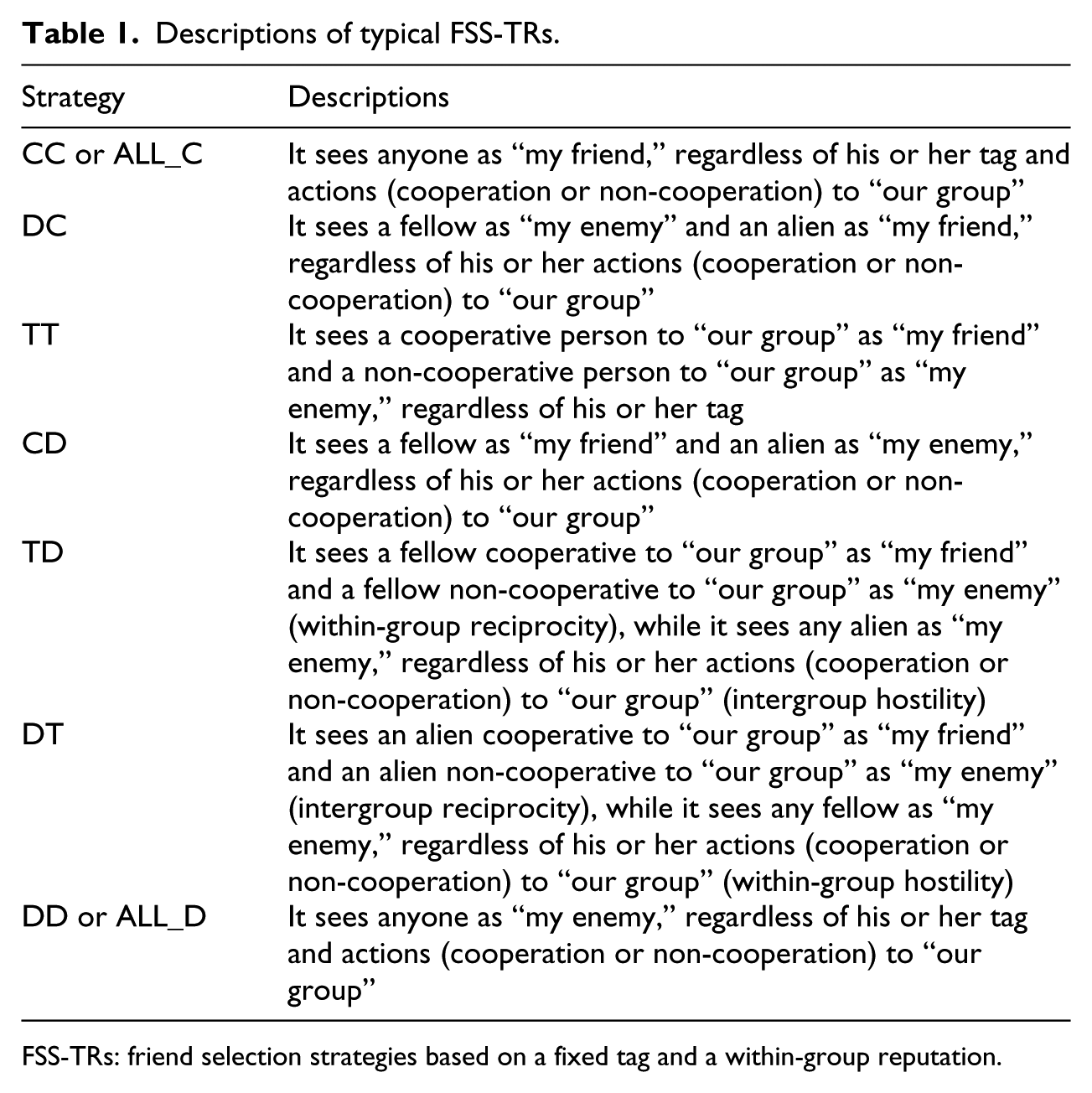
FSS-TRs: friend selection strategies based on a fixed tag and a within-group reputation.
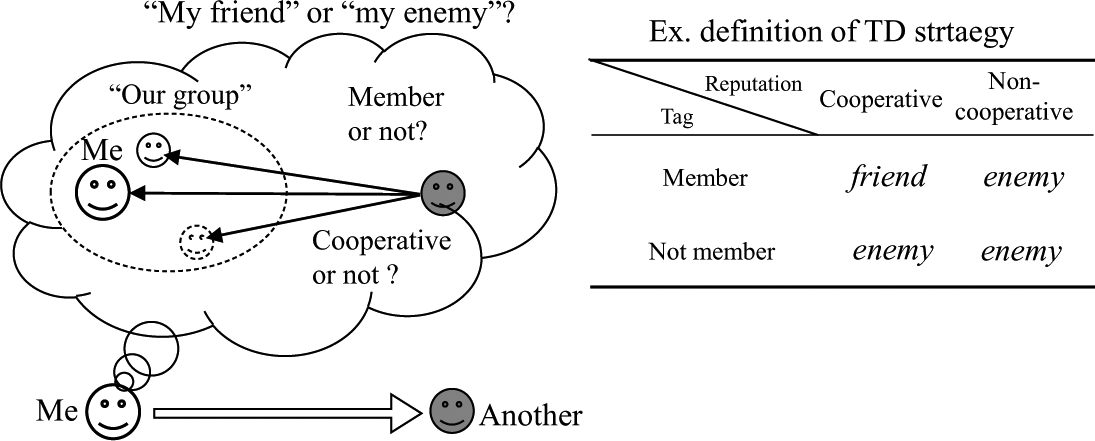
Friend selection strategies based on fixed tag and within-group reputation (FSS-TRs).
Evolutionary simulation of in-group favoritism
In the previous section, we modeled a field of general exchange as a giving game and introduced 16 FSS-TRs. In this section, we examine whether FSS-TRs can develop indirect reciprocity within a group, thereby establishing in-group favoritism. To this end, we define the reference situation as situation RF, in which general exchanges take place among players with either ALL_C or ALL_D. In situation RF, therefore, players act very simply, selecting either cooperation or non-cooperation blindly. We then compare the following situations with the situation RF:
(a) Situation T: general exchange among players with FSS-TRs using only a fixed tag in addition to players of the situation RF.
(b) Situation R: general exchange among players with FSS-TRs using only within-group reputation in addition to players of the situation RF.
(c) Situation TR: general exchange among players using a fixed tag or within-group reputation in addition to players of the situation RF (that is, all FSS-TRs).
It is necessary to specify the strategies composing each situation. In situation T, players can adopt FSS-TRs that rely solely on tags, in addition to ALL_C and ALL_D (the strategies available in situation RF). Following the definitions, the corresponding strategies are CD and DC. The four strategies available within situation R are thus as follows: ALL_C, ALL_D, CD, and DC. In situation R, players can adopt FSS-TRs that rely solely on within-group reputations, in addition to ALL_C and ALL_D. The corresponding strategies are TT and WW. The four strategies available in situation R are thus as follows: ALL_C, ALL_D, TT, and WW. In situation TR, all 16 FSS-TRs are available, including ALL_C and ALL_D (the strategies available in situation RF).
For each situation T, R, and TR, we conducted 2000 evolutionary simulation trials. One trial of a simulation was composed of 500 generations. For simplicity, we assume that each player has either a blue tag or a red tag. Through simulations, we observe friend ratios. The average friend ratio within group I (=blue or red) is defined as the number of friendships within group I divided by the maximum number of friendships of group I (=NI × (NI − 1), where NI is the population of group I). A ratio of 1.0 indicates a perfectly cooperative group. In a similar way, we define the average within-group friend ratio and the average intergroup one. Using these ratios, each generation can be clarified into either of the five states specified as follows:
(a) Hobbesian state: (average friend ratio within a blue group < 20%) and (average friend ratio within a red group < 20%) and (average intergroup friend ratio < 20%);
(b) In-group favoritism state: (average friend ratio within a blue group > 80%) and (average friend ratio within a red group > 80%) and (average intergroup friend ratio < 20%);
(c) Out-group favoritism state: (average friend ratio within a blue group < 20%) and (average friend ratio within a red group < 20%) and (average intergroup friend ratio > 80%);
(d) Philanthropic state: (average friend ratio within a blue group > 80%) and (average friend ratio within a red group > 80%) and (average intergroup friend ratio > 80%);
(e) Others: cases other than those listed above.
From 2000 simulation trials for each situation T, R, and TR, we observed the state achieved in each trial at its final generation. These data yielded a frequency distribution of the five states, thus indicating how many trials fell into each state. As the reference state, the distribution for situation RF is by definition 100% for the Hobbesian state and 0% for all other states. Finally, we tested the independence of each frequency distribution for T, R, and TR from that of RF. The details of one generation are as follows and summarized in Figure 4. (Appendix 2 presents the algorithm pseudo code. The source code can be seen in http://www.openabm.org/.)
(a) Each player has a strategy and a fixed tag (blue or red). He or she cannot change his or her tag (group). A player can change his or her strategy through imitation and mutation.
(b) The blue group is assumed to be larger than the red group. The blue group’s population divided by the total population (N) is noted by the group ratio (g).
(c) Each generation consists of five phases: reputation, perception, action, selection, and mutation.
(d) In the reputation phase, each player is aware of the reputations of who was good or bad in the last generation within his or her own group.
(e) In the perception phase, each player uses his or her present strategy to update his or her friend list (who are “my friends” and “my enemies”). 2 Even if player i considers player j a friend, player j does not necessarily consider player i a friend.
(f) In the action phase, each player encounters m × (N − 1) other players at random (i.e. independent of their tag/group). A player’s decision regarding whether to cooperate with others is based on his or her updated friend list.
(g) In the selection phase, players with lower payoffs (s% of the total population N, where s is the selection ratio) abandon their strategies and imitate the strategy of the player with the highest payoff.
(h) In the mutation phase, some players are assigned at random (according to the mutation rate µ) to abandon their strategies and adopt randomly selected strategies.
(i) At the 0th generation, each player has a randomly selected strategy and a friend list with a random bit array (1: friend, 0: enemy). A friend list continues to be updated until the end of a trial (it is not reset during a trial).

Evolutionary simulation of in-group favoritism.
Emergence of in-group favoritism
Figure 5 shows the frequency distributions of situations T, R, and TR in the settings where the total population (N), the benefit over cost (b/c), the group ratio (g), the matching ratio (m), the selection ratio (s), and the mutation rate (µ) are set at 50, 6.0, 0.5, 0.5, 0.1, and 0.01, respectively. The table also shows results of the independence tests of the distributions of situations T, R, and TR from that of situation RF, with a significance level of 5%:
(a) The distribution of situation T is the same as that of situation RF. Situation T leads only to the Hobbesian state.
(b) The distribution of situation R differs from that of situation RF. Situation R almost always leads to the Hobbesian state and rarely to the philanthropic state.
(c) The distribution of situation TR also differs from that of situation RF. Situation TR frequently leads to the Hobbesian state, as well as to the in-group favoritism state, the out-group favoritism state, 3 and the philanthropic state.
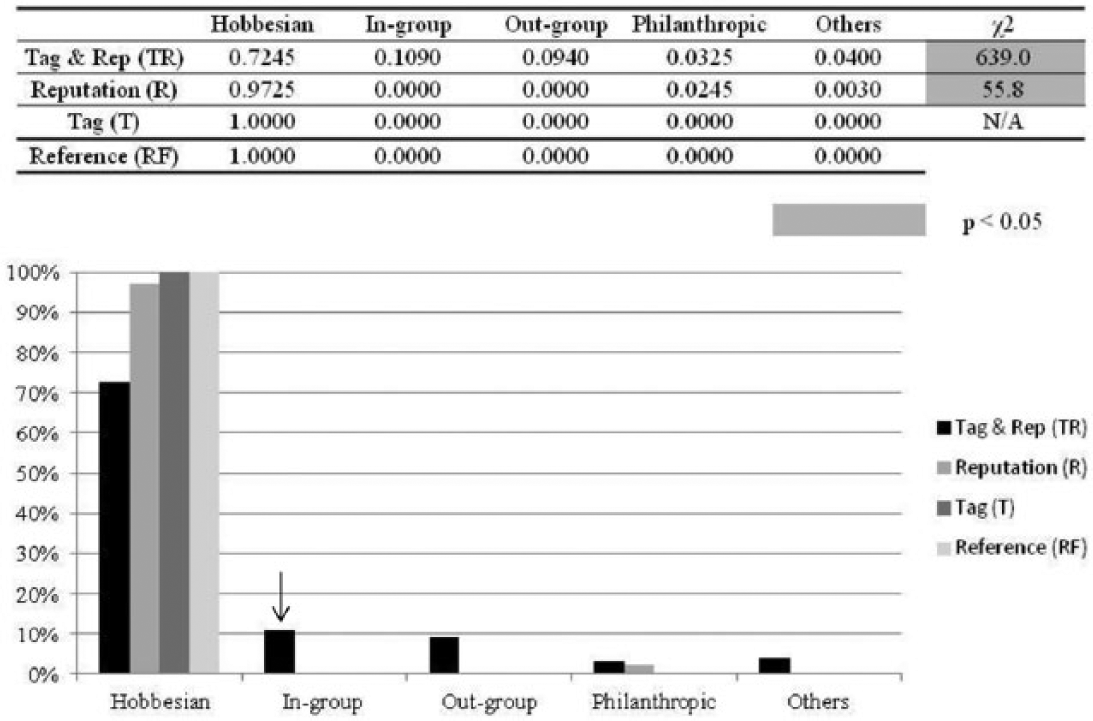
Frequency distributions of situations T, R, TR, and RF.
Therefore, these results indicate that FSS-TRs using both a fixed tag and a within-group reputation can cause in-group favoritism, while FSS-TRs using only a fixed tag and those using only reputation cannot.
The next step involves verifying the emergence of in-group favoritism in the various settings. To this end, N, b/c, g, and m are set at 20/50/100, 2.0/6.0/10.0, 0.5/0.6/0.7/0.8, and 0.1/0.5/1.0, respectively (the selection ratio and mutation rate are fixed), and these 108 (3 × 3 × 4 × 3) cases of simulations for situation TR are conducted in the same way as shown in Figure 5. We also test for independence of the frequency distribution of each case from that of situation RF. Figure 6 thus displays 108 cases regarding the frequency of the in-group favoritism state (with regard to out-group favoritism and other states, see Appendix 1.)
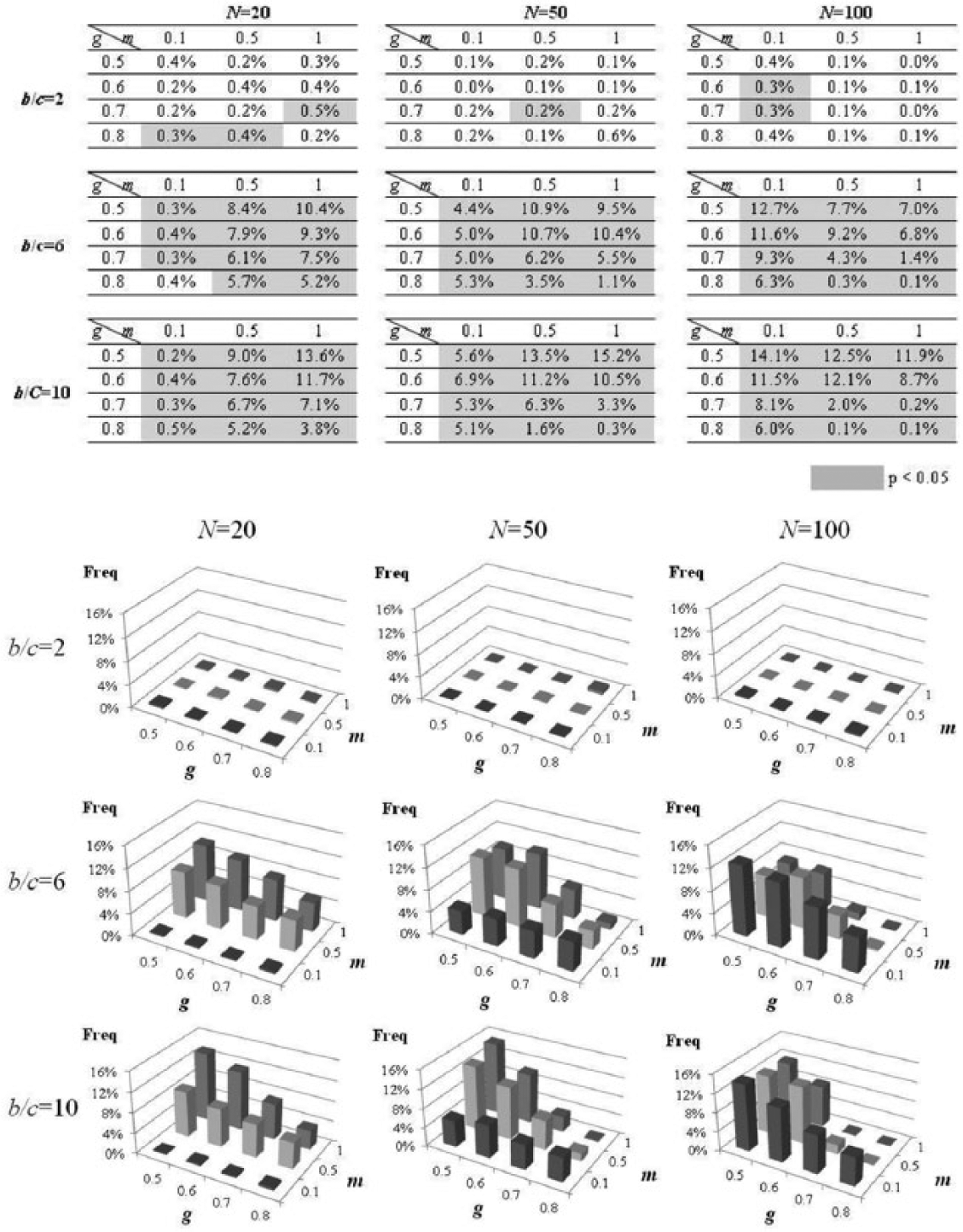
Frequency of in-group favoritism in various settings (FSS-TRs).
These results demonstrate the emergence of in-group favoritism in a lot of cases, with the exception of b/c = 2.0. Based on these results, we can conclude that a fixed tag and a within-group reputation result in the emergence of in-group favoritism. As an example, we present a typical snapshot of a generation series of friend ratios (Figure 7). This snapshot corresponds to the case in which N, b/c, g, and m are set at 50, 10.0, 0.6, and 0.5, respectively. The upper graph presents an average within-group friend ratio and the lower graph presents an average intergroup friend ratio. When the upper ratio is 1.0 and the lower is 0.0, this indicates within-group friendship and intergroup hostility, and thus the emergence of in-group favoritism. We also examined the formation of friendships among players. To this end, we observed a friendship network as a matrix form, as illustrated in Figure 8. One line of the matrix represents a player’s friend list (which other players are “my friends” and which are “my enemies”). When player i regards player j as “my friend,” the matrix element (i, j) is expressed as a white cell. A square on diagonal is important because it indicates emergence of a group of mutually friendly players.

Generation series of friendship ratio (snapshot).
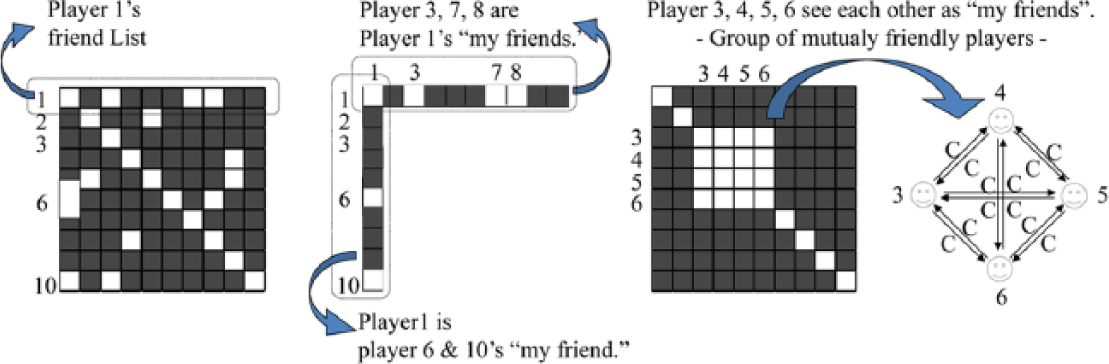
Observation of friendships among players.
The result presented in X of Figure 7 indicates in-group favoritism, in that group members are mutually friendly in both groups, while members of different groups are mutually hostile. In contrast, Z of Figure 7 reflects out-group favoritism, in that group members are mutually hostile in both groups, while members of different groups are mutually friendly. In Y, all players are mutually friendly (the philanthropic state), and in W, all players are mutually hostile (Hobbesian state).
Furthermore, we examined which strategies predominate in each state. To this end, we conducted total 300,000 generations of simulations, classifying each generation into the five states, according to the definitions used in Figure 5. For the dataset of each state, we calculated a component ratio of players with each strategy to total population (N) at every generation of the set, and then averaged the ratios over all generations of the set. The results of the simulations are presented in Figure 9. The four most common strategies in each state are as follows (in descending order):
(a) Hobbesian state: ALL_D (No. 1), TD, DT, TT
(b) In-group favoritism state: TD (No. 1), CD, CT, TT
(c) Out-group favoritism state: DT (No. 1), DC, TT, TC
(d) Philanthropic state: TT (No. 1), CT, ALL_C, TC

Average component ratio of each strategy in each state.
Finally, based on the above discussions, we can conclude that some FSS-TRs (i.e. TD, CD, CT, and TT) generate in-group favoritism.
Here, it is important to note that all FSS-TRs except ALL_C and ALL_D are defined as group-based strategies. The emergence of a mutually cooperative group might therefore be unsurprising. To assure the validity of these outcomes, we must demonstrate the emergence by adding FSSs that are not group-based strategies. In other words, we must provide evidence of in-group favoritism under the condition in which a player has the option of adopting an FSS other than group-based strategies. For this purpose, we adopt the following simple FSS (Nakai and Muto, 2008):
(a) me-TFT (Tit For Tat): The player regards any player who has cooperated with him or her as “my friend” and any player who has not as “my enemy.”
(b) me-CWD: The player regards any player who has cooperated with him or her as “my enemy” and any player who has not as “my friend.” CWD stands for “coward” and it is equivalent to Inverted TFT.
These strategies are clearly not related to any tag or within-group reputation. Instead, a player adopting these strategies focuses on whether others have cooperated with him/herself. Thus, they should not be seen as group-based FSSs, but as individual-based FSSs. Furthermore, individual-based FSSs are obviously the simplest type, and group-based FSSs can thus be seen as variants of them. We added both individual-based FSSs to the previously described 16 FSS-TRs (group-based FSSs) to examine whether in-group favoritism emerged among them. To this end, we conducted simulations for the 108 cases in Figure 6. The procedure of observations and the tests for independence were also the same as those described in Figure 6. The results are presented in Table 2, including the frequency of in-group favoritism for all cases. On the basis of these results, we can conclude that in-group favoritism can emerge even if individual-based FSSs are introduced.
Frequency of in-group favoritism in various settings (FSS-TRs and individual-based FSSs).
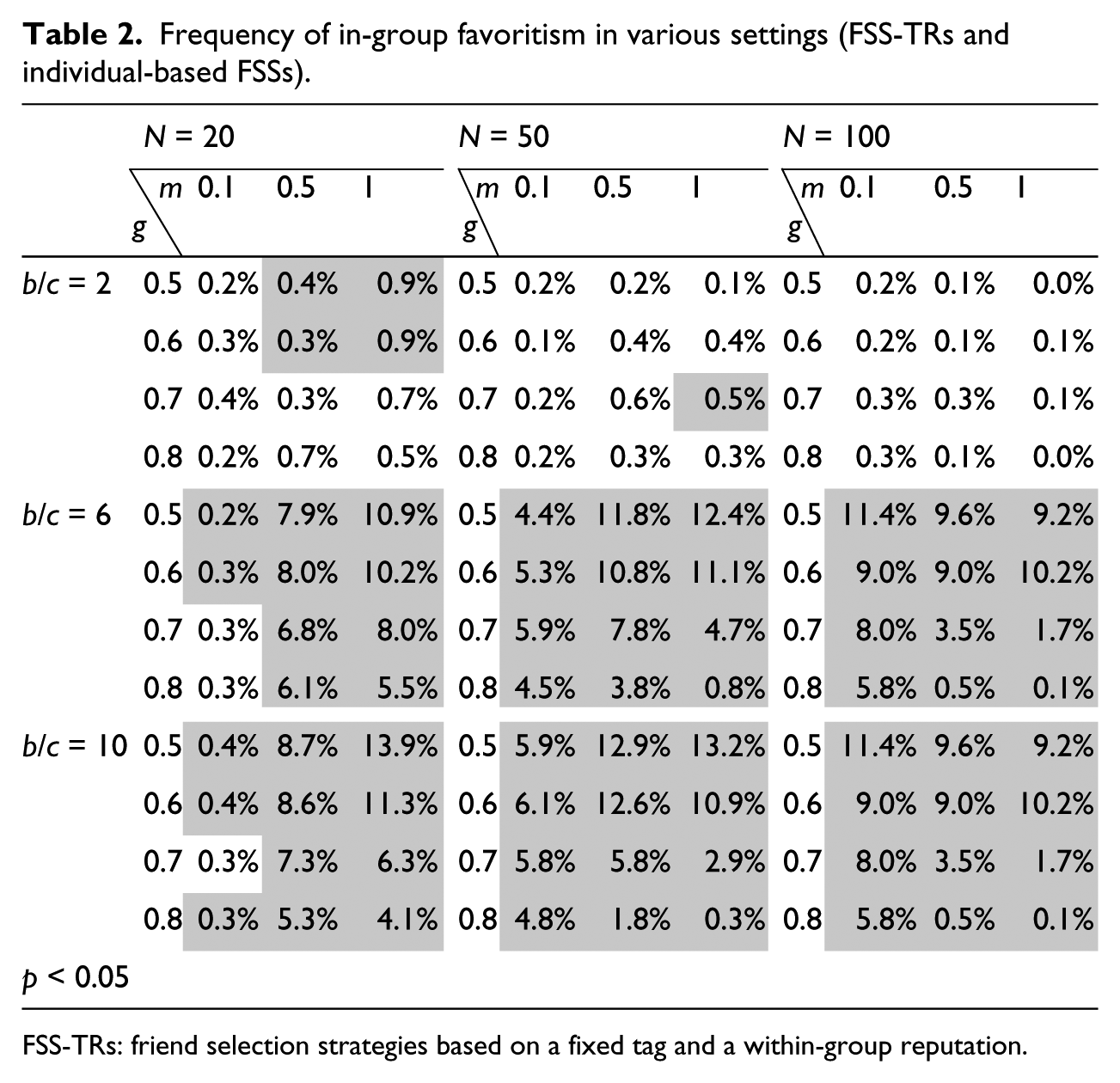
FSS-TRs: friend selection strategies based on a fixed tag and a within-group reputation.
Dramas inside model
In the final step, we examined what takes place in the model, where a lot of complex dramas arise through rise and fall of strategies. We observed events inside the model in detail, extracting three artificial dramas to use as examples, which will be useful for evaluation of the validity of the model. In preparation, we identified a common characteristic of the four most common strategies in each state. As an example, consider the four most common strategies in the in-group favoritism state: TD, CD, CT, and TT. Following the definitions of these strategies, each is capable of causing in-group favoritism. In other words, regardless of which of these four strategies a player adopts, his or her actions will reflect in-group favoritism. In biological terms, the strategies TD, CD, CT, and TT can be seen as different genotypes, which together result in the same phenotype (i.e. cooperation or non-cooperation). Moreover, an arbitrary combination of the four also can lead to in-group favoritism.
Star-like coalition of xenophobias
We refer to the first drama as a star-like coalition of xenophobias, which triggers a chain of within-group cooperation (Figure 10). For simplicity, we assume a Hobbesian state composed of a combination of its four most common strategies: ALL-D, TD, DT, and TT. According to their definitions, players adopting these strategies do not cooperate with all players, and their payoffs are thus equal. In other words, if no mutation is assumed, component ratios of the four strategies vary at random (this situation is known as random drift). It is therefore possible for a TD strategy to take over a society on one occasion. After this has occurred, we assume that a mutation causes one group member to shift to a CD player:
(a) At the Tth generation, the CD member begins cooperating with other members because of his or her within-group friendship, while other TD members continue not cooperating with the CD member.
(b) The CD member loses a payoff. Because the society consists almost entirely of TD players, the CD member is likely to change his or her strategy from CD to TD.
(c) At the T + 1th generation, in response to the former CD member’s last cooperation, other TD members begin cooperating with the former CD member because of their within-group reciprocity.
(d) In contrast, in response to the last non-cooperation of other TD members, the former CD member—now a TD player—stops cooperating with other TD members because of his or her within-group reciprocity.
(e) At the Tth generation, however, a very few TD members do not encounter any member by accident, because of random matching. In other words, because they do not take any hostile actions, their reputations are neutral. In this case, TD strategy requires a TD player to take his or her last action to a neutral member. The former CD member—now a TD player—continues cooperating with them at the T + 1th generation.
(f) At this point, a coalition forms between the former CD member (as a hub) and a few TD members (as nodes). We refer to this coalition as a “star-like coalition of xenophobias.”
(g) The coalition brings its members a payoff that is higher than that of the other members.
(h) The coalition members also gain good within-group reputations because of their mutual cooperation, as long as they do not encounter other members and do not take any hostile action.
(i) Other TD members will subsequently cooperate with the coalition members because of their good reputations, whereby a part of TD members also acquire good within-group reputations.
(j) Because both the coalition members and the others have developed good reputations, new coalitions will emerge among them. These coalitions thus grow into a group following in-group favoritism.
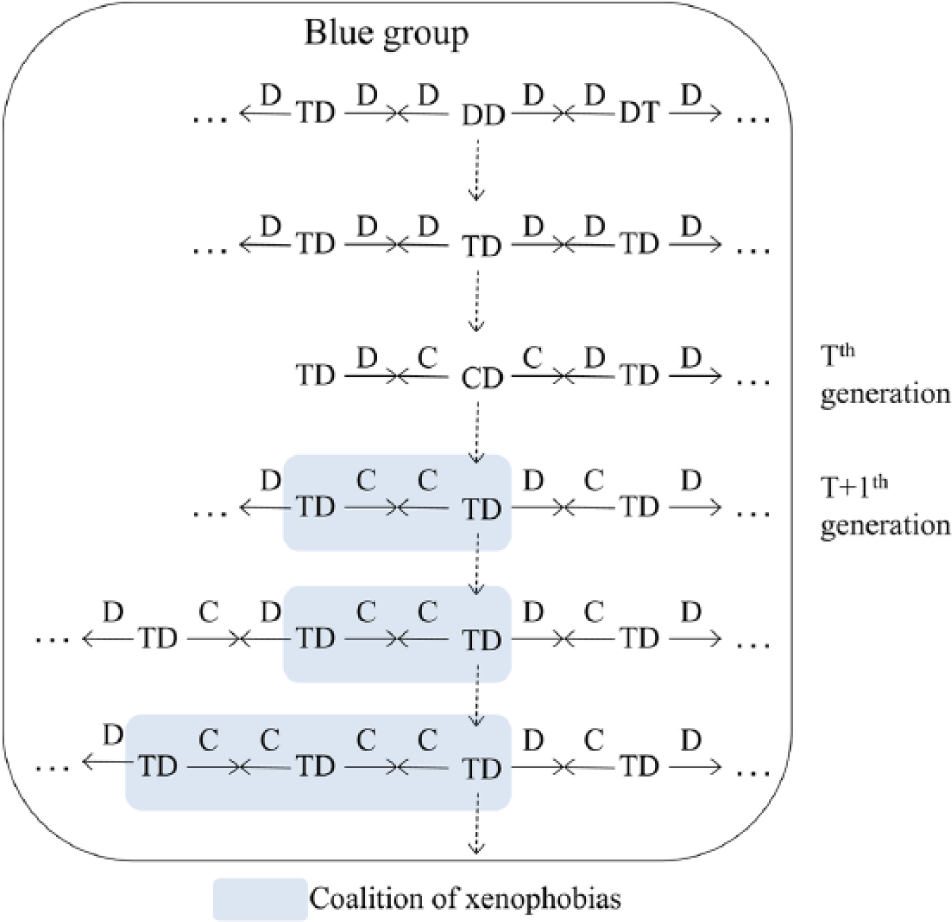
Star-like coalition of xenophobias.
In-group’s revenge on defecting member
We refer to the second drama as the in-group’s revenge on a defecting group member. This drama stabilizes within-group cooperation (Figure 11(a)). We assume that an in-group favoritism state consists of some combination of TD, CD, CT, and TT (the four most common strategies). We also assume that a member changes his or her strategies to D* through mutation (* represents C, D, T, or I):
(a) At the Tth generation, according to the definition, the D* member stops cooperating with other members due to his or her within-group hostility. We refer to this non-cooperation as a member’s defection.
(b) At the T + 1th generation, CD and CT members continue cooperating with the defector, despite the defector’s non-cooperation, given that CD and CT members see all other members (including the defector) as a friend, due to their within-group friendship.
(c) If the group consists primarily of CD and CT, the D* defector is likely to survive, and the D* defector’s invasion is likely to succeed.
(d) On the other hand, TD and TT members stop cooperating with the defector because of their within-group reciprocity. We refer to such non-cooperation as the in-group’s revenge.
(e) For this reason, if the group consists primarily of TD and TT players, many of their revenge actions exclude D*.
(f) Thus, while CD and CT are often excluded as inferior strategies, TD and TT succeed in preventing the invasion of D* as a superior strategy and stabilizing the in-group favoritism group.

(a) In-group’s revenge on a defecting member and (b) inconsistent response to friendship from an out-group.
The revenge’s success is necessary to explain more. For the sake of simplicity, we assume that an in-group favoritism group is composed primarily of TD, and discuss a detailed mechanism of TD’s revenge from the viewpoint of a payoff of each strategy. First, note that a D* player can achieve two types of states (i.e. “D* cheater,” and “D* cold warrior”), depending on other members’ responses to this player’s actions. A D* cheater is a D* player who does not cooperate with members of his or her group, even though they cooperate with him or her. A D* cold warrior is a D* player who does not cooperate with members of his or her group, and they do not cooperate with him or her. Which of a D* cheater, a D* cold warrior, or a TD member gets a higher payoff? Certainly, a D* cheater’s payoff is the highest and a TD member’s payoff is higher than a D* cold warrior’s because TD members cooperate with each other. These strategies can thus be arranged in ascending order according to their payoffs: D* cold warrior, TD member, and D* cheater. This ranking provides additional insight into the in-group revenge. The explanation can be summarized as follows:
(a) At the Tth generation, after a TD member transforms into a D* member by mutation, he or she stops cooperating with TD members while they cooperate with him or her. The D* member receives the highest payoff as a D* cheater.
(b) At the T + 1th generation, however, the D* member’s success does not last long, as TD members identify who cheated them and together refuse to cooperate with the cheater (the in-group’s revenge). At this point, the D* member has no option but to shift from a D* cheater to a D* cold warrior. Because TD members and a D* cold warrior do not cooperate with each other, the D* member succeeds at only one generation as a cheater.
(c) Because a D* cold warrior’s payoff is lower than that of TD members, the D* cold warrior is excluded as an inferior player and subsequently transforms back into a TD member at the T + 2th generation.
(d) The D* cheater’s high payoff at the Tth generation obviously causes other members to follow, but TD members invalidate these copycats one by one after the T + 2th generation.
(e) Regarding (c), the excluded D* cold warrior may choose to imitate a D* cheater rather than a TD member because of the higher payoff.
(f) However, an excluded D* cold warrior can never transform into a D* cheater. It is because he or she abandons D* and adopt D* by imitation. Thus, he or she has to remain a D* cold warrior. D* cheaters cannot increase in this manner.
(g) D* cheaters can increase only if TD members are excluded and they imitate a D* cheater. Because a TD member receives a higher payoff than a D* cold warrior and survives, it is impossible for a new D* cheater to appear.
(h) After all, D* cheaters have changed into D* cold warriors. Then, because a TD member has received the highest payoff, all D* cold warriors imitate TD members, and the D* invasion fails.
When TD and TT gain a majority in an in-group favoritism group, the group will remain stable against the defection. If CD and CT gain a majority in the group, the group will begin to collapse. CD and CT members do not take revenge against defecting members because of their within-group friendship, and thus, a defector can easily exploit CD and CT members. The reason for the stability of an in-group favoritism group is that all TD and TT members collectively take revenge on defecting members as a common enemy. Such a group can be viewed as a kind of collective security system.
Chain of inconsistent responses to friendship from an out-group
We refer to the final drama as a chain of inconsistent responses to a friendship from an out-group, which stabilizes intergroup non-cooperation (see Figure 11(b)). To explain this drama, we assume two in-group favoritism groups that are composed of some combination of CD, CT, TD, and TT (the four most common strategies), regarding a blue group as an in-group and a red group as an out-group. We assume that a red group member changes his or her strategy into *C by a mutation (with * referring to C, D, T, or I). We examine how the blue group responds to the red group member’s action:
(a) At the Tth generation, as specified in the definition, the *C red member begins cooperating with blue members because of his or her intergroup friendship. It does not matter to the *C red member that blue members did not cooperate with him or her in the last generation. We refer to this type of cooperation as friendship from an out-group.
(b) At this point, none of blue members cooperate with the *C red member because of their intergroup hostility. We refer to this event as an inconsistent response to friendship from an out-group.
(c) After losing a payoff, the red member abandons the *C strategy and adopts a TD or CD strategy, which results in a high payoff. (TD and CD receive higher payoffs than TT and CT. See the late descriptions.)
(d) At the T + 1th generation, the red member again stops cooperating with blue members because of his/her intergroup hostility.
(e) At this point, TD and CD blue members continue not cooperating with the red member because of their intergroup hostility.
(f) Because TD and CD blue members do not cooperate in response to the red member’s non-cooperation, they do not lose payoffs. As superior players, TD and CD blue members do not change their strategies.
(g) In contrast, TT and CT blue members begin cooperating with the red member in response to his or her original cooperation because of their intergroup reciprocity.
(h) Because the TT and CT blue members cooperate regardless of red member’s non-cooperation, they lose payoffs. As inferior players, TT and CT blue members change their strategies from TT or CT to TD or CD. We refer to this event as a chain of inconsistent responses to friendship from an out-group.
An out-group player who spontaneously cooperates with an in-group often loses a payoff. In-group members who adopt a TT or CT strategy and are reciprocally cooperative with an out-group are also likely to lose payoffs, whereas those adopting a TD or CD strategy and who do not cooperate with an out-group do not. As a result, mutual hostility between groups grows. This situation illustrates a reflexive chain of mistrust in an out-group as a tragedy. Mistrust in an out-group increases nearly simultaneously on both sides.4,5
Discussion
In this study, we assumed that people have one of two kinds of fixed tags and that they either do or do not cooperate with others. We also assumed that members of a group with the same tag share within-group reputations of others, and then we introduced the friend selection strategies based on a fixed tag and a within-group reputation (FSS-TRs). Using the FSS-TRs, we conducted evolutionary simulations and found that FSS-TRs—more specifically, the TD strategy—cause in-group favoritism. We also found the emergence of the out-group favoritism state and the philanthropic state.
First, we take the emergence of in-group favoritism into consideration in detail. In 1971, Tajfel et al. showed that in-group favoritism can occur even in a “minimal group,” which is a formal collection of people defined by a trivial standard (e.g. a preference for abstract paintings). Since the experiment, many social psychologists have confirmed this finding through further experiments, concluding that altruistic actions can be taken toward in-group members without concrete reason (Brewer, 1999; Gaertner and Insko, 2000; Tajfel, 1982; Tajfel and Turner, 1979; Turner, 1981; Yamagishi et al., 1999). Note that our tag is defined to be independent of a payoff. In other words, group membership never ensures a payoff. Members of the same group do not even encounter each other any more frequently than members of other groups. In the sense, our tag can be seen as a neutral symbol. Obviously, our tag is not purely symbolic, given that it is defined to delineate boundaries within which reputations are exchanged. Even if members of a group share reputations, nobody knows whether such sharing will lead directly to cooperation among members. Thus, our tag is not minimal but highly neutral. 6 In the beginning of a simulation, identification of a tag has nothing to do with any payoff. As a simulation progresses, however, the tag gradually becomes associated with cooperation, and it ultimately becomes very closely related to a payoff. 7 Although our research does not demonstrate the emergence of in-group favoritism in a minimal group, it does present the emergence under a highly neutral tag. In this regard, many previous studies have not assumed a minimal tag. One notable exception is a study by Fu et al. (2012), which addresses in-group favoritism under a minimal tag. In their study, however, the tag is variable. As mentioned earlier, such variability causes in-group favoritism. The emergence of in-group favoritism under a minimal and fixed tag is thus a topic for a future study. Furthermore, remember that TD and TT exclude defecting members by the revenge and that TD and CD survive under the inconsistent response to friendship from an out-group. Therefore, only TD can cope with both the defection of a member and the inconsistent response to friendship. This is the reason that TD ultimately dominates a group, as presented in Figure 9. Therefore, TD players play a central role in the emergence of in-group favoritism. In the in-group’s revenge on defecting member, participations in revenge by all TD players exclude the defector, thereby stabilizing cooperation within a group. Note that in a variable-tag model, if defecting members in a group increases, some members will escape from the group and form a new cooperative group. In contrast, in our model, members do not escape. They do not change their tags. Instead, they sustain cooperation within the group by their revenge. Trust in a tag thus cannot be cultivated without the fixity of a tag. Also note that the revenge by all TD players can be seen as collective direct reciprocity. We assumed that a TD player cooperates with others based on indirect reciprocity. The collective direct reciprocity thus has emerged from individual indirect reciprocity, which has not yet been addressed by related studies.
Second, we are concerned about out-group favoritism. As demonstrated earlier, a competition among 16 FSS-TRs resulted in out-group favoritism due to both DT and DC. Surprisingly, although we had assumed that seemingly odd strategies (e.g. II, DT, and DC) would be excluded, the DT and DC strategies survived in the simulations. As stated above, our model assumes a highly neutral tag. In reality, however, group membership ensures a livelihood, and within-group encounters are sometimes more frequent than intergroup encounters (a situation known as homophily). If we had assumed that group membership achieves a payoff, we would have found that the emergence of out-group favoritism had been suppressed. Then, we conducted additional simulations and examined the emergence under the assumption of homophily (see Appendix 1). As a result, we found that homophily suppresses emergence of the out-group favoritism. We therefore conclude that in our results, out-group favoritism is caused by the high neutrality of our tag. This situation reminds us of an imaginary root in a high-degree algebraic equation.
In the end, we discuss the philanthropic state, which, needless to say, is a form of utopia. In this state, all people are indifferent to others’ tags (i.e. attributes), and they are mutually cooperative. As illustrated in Figure 9, the philanthropic state can be stable under the dominance of TT, which reflects indiscriminate reciprocity in a manner reminiscent of liberalism. Note that tags are not absent in this state; they are simply non-functional. Although people do have their own tags, they do not use them when evaluating others. We therefore consider our results optimistic, given that the philanthropic state can appear even when various ethnicities remain intact. Our model theoretically demonstrates the possibility that indiscriminate reciprocity can lead to a multicultural, symbiotic society.
Footnotes
Appendix 1
Appendix 2
Acknowledgements
The author would like to thank Professor Dirk Helbing, whose support provided the author with the opportunity to stay at ETH in 2011. This research was presented at the ETH “Game Theory and Society” conference in Zurich, 27–30 July 2011. The author would also like to thank Professor Andreas Diekmann and the participants for their helpful conversations. He appreciates Prof. Yuhsuke Koyama for the discussion on a statistical test. He is also grateful to Enago ( ) for the English-language review of this article.
Funding
This research was funded by the Ministry of Education, Culture, Sports, Science and Technology, Japan, as a project within the 21st-century COE program titled “Creation of Agent-Based Social Systems Sciences (ABSSS),” under the direction of Professor Hiroshi Deguchi of the Tokyo Institute of Technology.