




Abstract
Why do states fail? Why do failed states persist without collapsing into complete anarchy? This paper argues that in response to insurgency or weakened state capacity, the best way for rulers to sustain their rule may be, paradoxically, to reduce the amount of political protection they provide to clients or citizens. This behavior recognizes and helps explain a puzzling feature of failed states, namely that central government often functions even when political disorder prevails. To evaluate this argument, the paper analyzes the case of King Stephen’s reign in medieval England. In response to a challenge to his succession, King Stephen dramatically decentralized government, a decision which has long puzzled historians. In addition, although far removed historically from contemporary cases, the reign of King Stephen exhibits just those characteristics of modern, failed states: insurgency, civil war, territorial fragmentation, increasing disorder and violence (even between adherents of the same side of the civil conflict), and yet the persistence of some amount of centralized rule.
Keywords
Introduction
Why do states fail? And why do failed states sometimes persist without collapsing into complete anarchy? This paper argues that an intentional weakening of the state by its central ruler may be a best response to external or internal political crises. This counter-intuitive explanation hinges on both the role and credibility of the ruler as protector of citizens or, more limitedly, important and powerful clients. Ideally, a ruler would prefer to sustain a credible reputation by providing high levels of protection to clients in exchange for relatively high levels of taxes. However, political crises such as civil war, insurgency, or invasion increase the ruler’s costs of providing protection to clients and this makes assurances of protection less credible. Paradoxically, reducing the amount of protection the patron provides can restore the credibility of the ruler’s protection promises. In particular, lower amounts of protection reduce the cost of such services and this keeps protection promises credible and makes it rational for clients to continue to contract for the ruler’s services. Lower levels of protection lead to political disorder: a higher incidence of violence and clients devoting a greater share of resources to self-protection. Yet inasmuch as the ruler provides some amount of protection and clients pay some amount of taxes, a degree of “stateness” nevertheless persists. Although not ideal, this is a situation the ruler prefers to the alternative, which is no protection and no taxes: in short, no state at all. In this sense, an intentional “weakening” of the state, even one that entails higher levels of violence and political disorder, is a strategic, best response to a political crisis.
To explore this argument, this paper also applies the model, in the manner of an “analytic narrative” (Bates et al., 1998; Ermakoff, 2008; Greif, 2006), to the case of King Stephen’s reign in medieval England. Early medieval states provide ideal case studies for exploring state formation and failure since the modern state has its origins in the medieval period and because medieval states often straddled the boundaries between political order and disorder. Indeed, although far removed in time, the similarities between medieval states and modern weak states are frequently observed (Bates et al., 2002: 601–602, 612–613). Furthermore, the medieval English state during Stephen’s reign makes a particularly good case study. For its time, the medieval English state was considered a highly centralized state (Hollister and Baldwin, 1978; Strayer, 1970). Yet during Stephen’s reign, often called “the anarchy,” a civil war prompted him to dramatically decentralize his rule. Thus, during Stephen’s reign one is allowed to observe the transition between a well-ordered and a “failed” state within a single country, culture, and time period. Indeed, the reign of King Stephen exhibits just those characteristics of modern, failed states: insurgency, civil war, territorial fragmentation, increasing disorder and violence (even between adherents of the same side of the civil conflict), and yet the persistence of some amount of centralized rule. 1 Finally, the devolution of political authority undertaken by King Stephen has always posed a puzzle to scholars of the period. Earlier historians interpreted Stephen’s decentralizing steps as the actions of a weak and incompetent ruler. 2 Although more recent assessments have been less condemnatory, a satisfactory explanation for Stephen’s actions arguably still eludes researchers: why would a king actively contribute to the weakening of his state during a time of civil war? This paper provides an alternative assessment of Stephen’s actions, seeing in them not incompetence but rather an instrumentally rational response to the challenge of insurgency and civil war.
This paper’s argument for the causes of state failure differs from other studies of this problem. Several studies direct their attention toward the structural factors that cause or contribute to weak or failed states. For example, ethnic divisions and tensions (Fearon and Laitin, 2003); a post-World War II international system that has condoned and even cultivated the proliferation of weak states susceptible to internal conflict (Hironaka, 2005); the unintended effects of neoliberalization (Reno, 1998); a burgeoning “conflict trade” in diamonds, timber, or other primary commodities (Collier and Hoeffler, 2004; Cooper, 2002); and the proliferation of arms dealers and private military firms (Klare, 2004; Musah, 2002), among others, have all been identified and examined as proximate causes of state failure. This paper agrees that these structural factors are crucial, in fact, indispensable components of state failure. In fact, the paper will highlight such factors as examples (in particular, insurgencies and civil wars) of the exogenous variables used in the formal model. However, by describing such factors as structural, this paper draws attention to the equally important elements of the strategic behavior of rulers, citizens, and clients in the phenomenon of state failure.
Given the focus on agents’ behavior, this paper shares conceptual space with several other well-known works on the strategic foundations of political and quasi-political order. For instance, Dixit (2003, 2004) and Milgrom et al. (1990) model citizens or clients engaged in bilateral exchange or trading opportunities who may call on the services of a judge, patron, or protector when a trading partner reneges. The model presented in this paper is most similar to the one analyzed in Bates et al. (2002), where, rather than trade or exchange, actors and clients of the patron face one another in potential, bilateral conflict modeled along the lines of Grossman and Kim (1995), Hirshleifer (1989, 2000), and Skaperdas (1992, 1996). As in all of the models of credibility-based judging and protection, in this paper’s model the patron provides such services in exchange for a fee or tax, while the patron’s fairness and credibility are based on its reputation. More specifically, the ruler levies taxes in the initial period of the game, promising to provide protection at a later date. But who will enforce the enforcer’s promises? Since providing protection is costly, the ruler has an incentive not to make good on its promise. However, the game is infinitely repeated. If the ruler does not provide protection in the current period, it will lose clients in future periods. It is therefore concern about its reputation that makes the ruler’s promises credible.
However, the model presented in this paper differs from these other strategic models of political order in a fundamental and crucial way. In particular, it recognizes and helps explain a puzzling feature of failed states, namely the fact the central government often functions, albeit with diminished capacity, even when political disorder prevails. Thus, in all previous strategic models political order is dichotomous: the state either exists or it does not. But in fact, empirically the existence of the state is not dichotomous. Rather, the state is better characterized as a “continuum” (Reno, 1998: 3) and ranges from strong states, weak states, and failed states all the way to collapsed states (Rotberg, 2003: 5–6). The model presented in this paper captures this feature of failed states by allowing the ruler to vary the amount of protection it provides. Thus, even if the ruler only provides a little protection, it still keeps its promise. However, lower amounts of protection lead to more self-protection by clients and a greater probability of violence. Furthermore, these two consequences essentially make the quantity of revenue the ruler can secure a concave function of the amount of protection it provides. In this way, the paper’s model is able to capture variation in the degree of “stateness.” More importantly, this feature of the state is essential to the paper’s central insight: that decentralizing political power can be a best response for rulers to maintain some power. Thus, the main message is very different from the kind provided by Bates et al. (2002). In that contribution, the state fails because rulers break their promises and become predatory; in this paper, the state fails despite the fact the ruler is doing its best to keep its promises.
The paper proceeds in the following order. The model and its equilibrium solutions are presented in the second section. Following the presentation of the model, the third section then provides a brief historical background on the reign of King Stephen for the reader’s benefit. After this, the fourth section states five important observable implications that are drawn from the model’s propositions and then provides historical evidence from Stephen’s reign in support of each of these implications. Finally, the fifth section concludes with some thoughts on applying the model to contemporary cases of state failure.
Model and equilibrium
In this section, we present a model of the state, where a ruler provides protection in exchange for a payment of tax or rent. The first subsection analyzes a simple game of conflict between actors without a state. The primary goal of this section will be to establish a baseline model of conflict for the subsequent section. In the subsequent subsection, we will expand upon this baseline model by including a ruler or protector and establish the key propositions of the paper. Before delving into the technicalities of the model, however, let me first provide a brief overview in natural language.
With the model, we seek to demonstrate that when faced with worsening chances of survival (e.g. because of an insurgency) or a weakening of state capacity, a ruler can avoid a complete collapse of the state by reducing the amount of protection it provides to clients (e.g. citizens, clans, or warlords). The key logic underlying this is the ruler’s desire to maintain credibility. When survival chances decrease or state capacity weakens, rulers are tempted to take their clients’ rent payments and then renege on their protection promises. Anticipating this, clients will withhold their payments and withdraw from the state. If this happens, the state collapses and the ruler gets nothing. To prevent this, patrons can reduce the amount of protection they provide, which lowers the cost of providing protection and then in turn makes the ruler’s promises once again credible.
But reducing protection weakens the state, even as some amount of “stateness” remains. One consequence of reducing the amount of protection the ruler provides is that the probability of conflict between clients increases. And as a result of the increased chances of conflict, which is costly to clients, the patron must also reduce the amount of tax she charges in order to keep the clients paying any tax at all. Hence, as both the benefits in taxes and burdens in protection costs decrease, the state begins to fragment: clients provide more for their own protection and contribute less, in taxes, to support the state. Nevertheless, the state persists. How much protection and taxes are reduced and how much the chances of conflict increase depend on how much the ruler needs to reduce protection costs in order to maintain credibility. Thus the state can continue to exist, that is, clients continue to pay the protection rent and the patron continues to provide some protection, even in the midst of positive levels of conflict and disorder.
Conflict without a state
We first analyze a game that has a “state of nature” condition where actors may attack other actors and must defend themselves from attacks through self-protection. We will call this the “conflict game.” Let there be a set of actors N = {1, 2} 3 Each actor has an endowment of size R. In each period, actors allocate their endowments either to consumption ci ≥ 0 or to arming ki ≥ 0, subject to the endowment constraint, ki + ci = R. Payoffs are determined by consumption, and since ci = R − ki we will write payoffs Vi(ki, kj) as a function of R and the choice variable ki. Actors live for one period, after which they “die” and are replaced by a new actor. The primary motivation for this is as a simplifying assumption (see e.g. Kreps, 1990). In any case, as Bates et al. (2002: 608–609) argue, an equilibrium justified by an appeal to the folk theorem where there is neither arming nor conflict in the absence of the state is likely to be fragile.
Following this allocation decision, each actor must decide whether to initiate a conflict or not. If neither actor initiates a conflict, an actor consumes the amount of resource left after arming. If an actor initiates a conflict, the remaining resources of both actors (2R−ki−kj) are subject to seizure and are divided according to the amount each actor allocates to arming

and the timing of events in the conflict game is as follows:
Each actor simultaneously chooses an allocation of arming ki.
Each actor simultaneously decides whether to initiate a conflict.
Given this ordering of events, what are the equilibrium decisions for the respective actors?
Beginning with the stage game and using backward induction, we begin with the decision to initiate a conflict. When k1 = k2,
At this arming allocation, neither actor attacks the other, since this does not improve his payoff. Thus each actor spends half his endowment in arming, does not attack, and consumes the remaining half. This allocation and conflict-decision profile is the unique subgame-perfect equilibrium of the stage game. Moreover, this is the equilibrium outcome in every period of the infinitely repeated game. Because actors live for only one period, strategies in any period cannot depend on what actors have done in previous periods.
Figure 1 provides an example of the conflict game where R = 100 and ki is chosen from the discrete set {0, 1,…, 100}. As can be seen, each actor’s best response level of arming is increasing in the other actor’s arming level until 50 is reached, at which point diminishing returns set in. Also at this level of arming, a Nash equilibrium is identified, since an arming level of 50 is a best response to the other actor for both actors. Finally, note the gray diagonal line in Figure 1. This collection of points represents arming allocations at which neither actor prefers to attack the other. For allocations above the line, actor 1 wishes to attack; for points below, actor 2 wishes to attack. Since the Nash equilibrium is at one of these points, neither actor attacks the other in the conflict game.

The conflict game.
Credible protection and the state
Moving on from the baseline model conflict game, we now introduce the role of the state into the the game of conflict. We will call this the “credible-state game.” We introduce a new actor L, who we will call a patron or protector. 5 The same strategies available to the actors in the conflict game are available in this version of the game that includes the state. But now actors may become clients by paying the patron a protection rent, τ. In exchange, clients receive protection in the form of military support of amount kL ≥ 0 if the opposing actor initiates a conflict. As for the patron, supplying protection incurs a cost. Assume a cost function C(·) which is increasing and convex in kL and where C(0) = 0. 6 We also include a parameter α that indicates the state’s capacity, defined as the cost efficiency with which she can deliver military support. The patron also has a discount factor δ ∈ (0, 1). Finally, we normalize the patron’s reservation utility to zero.
Because the patron takes the protection rent up front and promises to provide protection later, the patron has an incentive to renege on her promises. However, the patron is long-lived and therefore has a reputation based on her history of past action. Although the actors are short-lived, they have knowledge of the patron’s past behavior and therefore may condition their decisions to become a client on the patron’s reputation. In particular, we will assume that every generation of actors has full knowledge of the patron’s past behavior and play a grim-trigger strategy wherein the actors: (1) pay the protection rent as long as the patron credibly provides protection and (2) if in any period the patron does not supply protection as promised, refuse to pay the protection rent in every subsequent period.
The timing of events now proceeds as follows:
The patron chooses the level of the protection tax, τ, and promises protection of amount kL.
Each actor chooses whether to pay the protection tax, τ.
Each actor simultaneously chooses an allocation of arming, ki.
Each actor simultaneously decides whether to initiate a conflict.
The patron chooses whether to supply each actor i with the promised level of protection:
if i is attacked by his opponent;
if i does not attack his opponent; and
if i is a client, that is, paid τ.
When both actors become clients, they then face the following payoffs:

Besides the fact that τ is now paid up front and reflected in the payoffs, the key differences between this version of the game and the previous one are that if an actor i initiates a conflict, j enjoys an additional level of kL military support from the patron, and that the patron only acts in a “defensive” fashion, by contributing support only to the side that is attacked.
What are the equilibrium outcomes of the credible-state game? An example of the credible-state game in which the patron provides a high level of arming, sufficient to prevent arming and conflict by the clients, is depicted in Figure 2. Whereas in Figure 1 a single “line” denoted allocations where neither actor preferred to initiate a conflict, in Figure 2 we now see that there is a much larger “space” of allocations for which neither actor wishes to attack the other. Note also that although some positive arming levels are best responses, none of them are in each actor’s respective “attack regions.” In other words, actors never prefer to initiate an attack at any best-response level of arming. As can also be seen, the allocation profile {0,0} is a best response for both actors and is thus the Nash equilibrium and again neither actor prefers to initiate an attack.

Credible-state game: strong state.
Matters become more interesting when the patron provides lower levels of protection, as can be seen in Figure 3. First, the size of the “no attack” region is smaller than the previous example. Second, although there are best-response levels of arming that do lie within each client’s “attack” region, the clients’ best-response curves never intersect. This implies that there is no pure-strategy equilibrium in the credible-state game when the patron’s protection level is sufficiently low. Nevertheless, mixed-strategy equilibria do exist. Given the size of the choice sets, these mixed-strategy equilibria can be found most conveniently through computation based on a best-response evolutionary dynamic as used in Shamma and Arslan (2005). These probabilistic strategies imply the probabilistic occurrence of conflict. For instance, whenever one client chooses a sufficiently high level of arming and the other a sufficiently low level, the first client will attack the second.
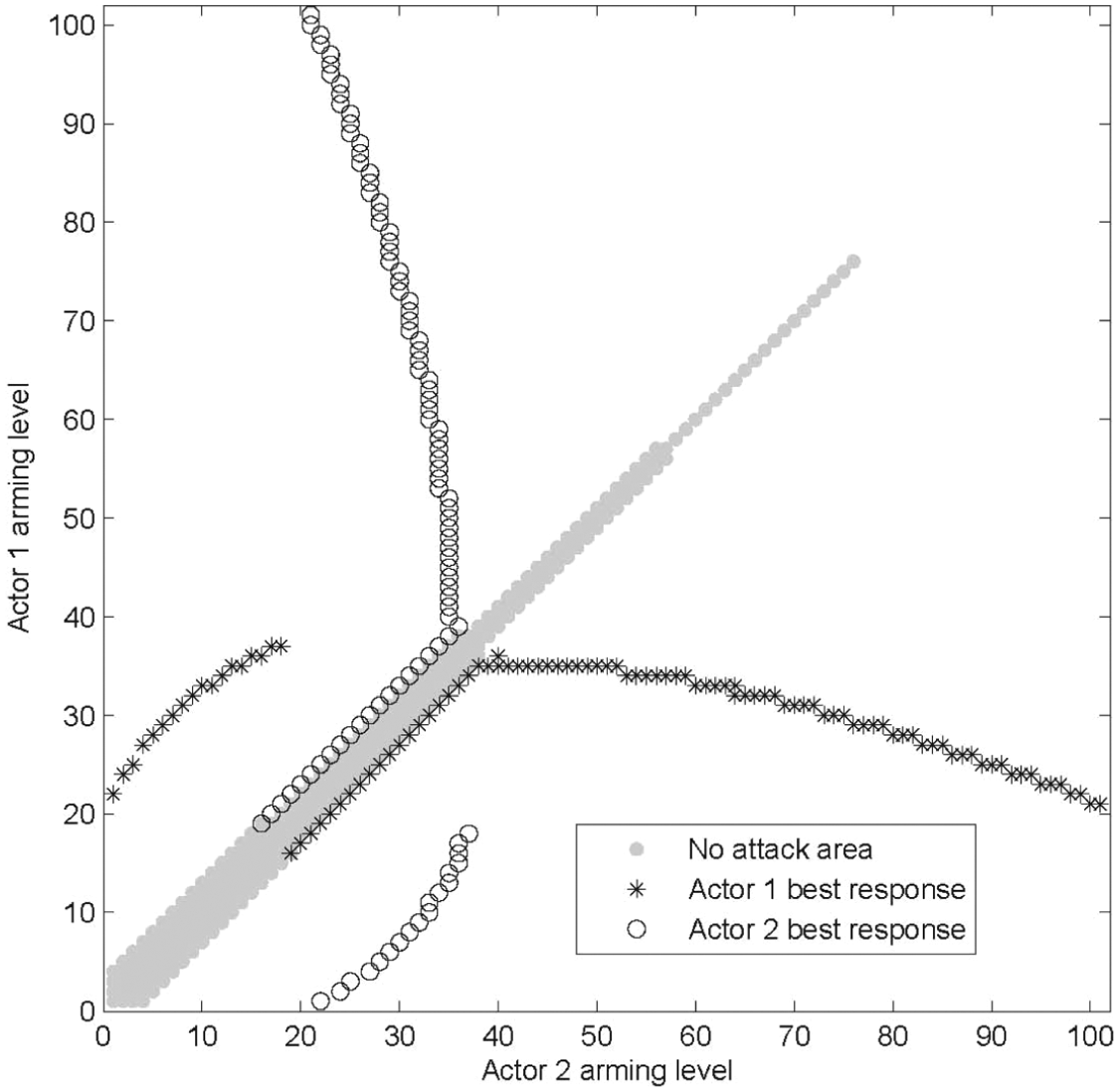
Credible-state game: weak state.
Denoting by p the probability that a conflict occurs, a second proposition can be stated.
Using the computational approach, this proposition can be observed graphically in Figure 4, where the probability of conflict is depicted using a black-to-white gradation: the probability of conflict is higher when the tone is lighter. The figure is constructed from a simulation where for every combination of τ ∈ {0, 1,…, 75} and kL ∈ {0, 1,…, 30}, we let clients choose ki ∈ {0, 1,…, 100} when R = 100 and assume the patron makes good on her protection promises. This simulation generates a probability distribution over the arming set and the probability of conflict is found by summing the joint probabilities that an arming allocation falls into either one of the clients’ conflict regions.
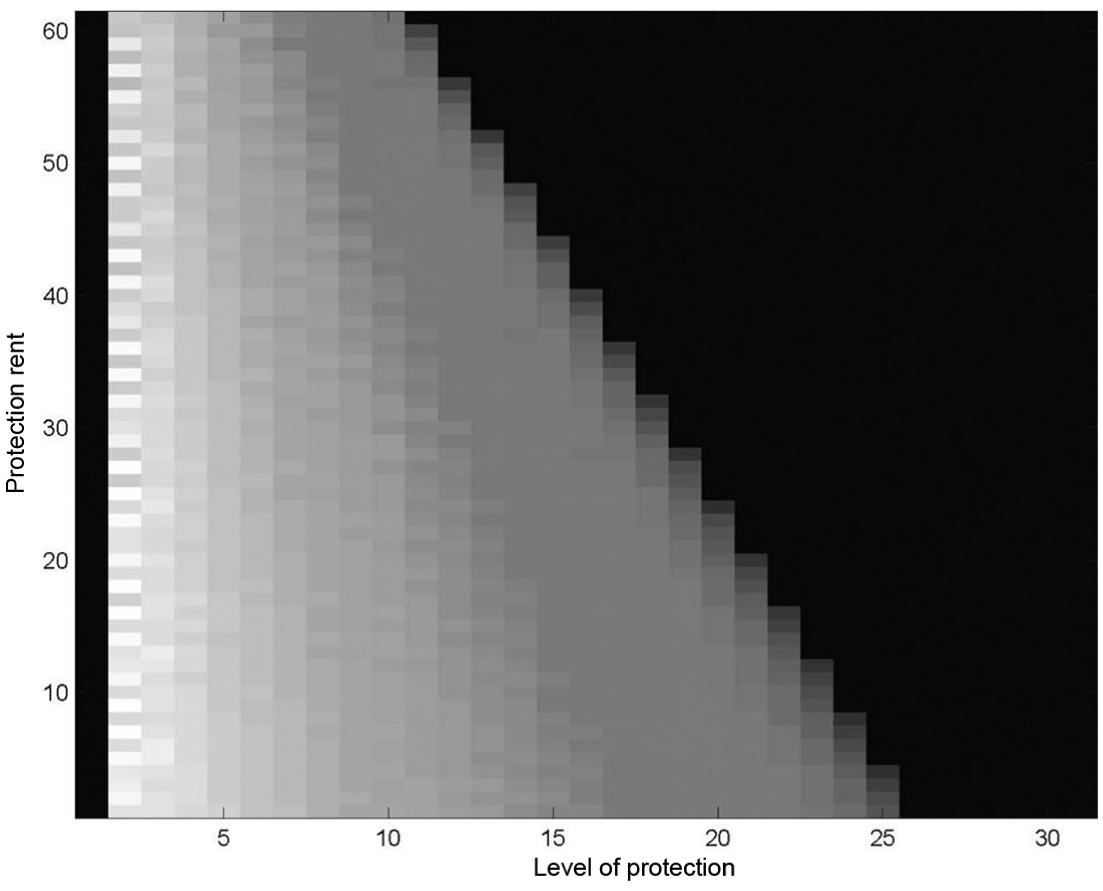
Probability of conflict between clients.
Note that when the patron provides no protection the probability of conflict is (virtually) zero. 7 At this protection level, increasing taxes only reduces the size of each actor’s resource base and the game is identical to the conflict game. Things change as we introduce increasing levels of protection. In general, it can be seen that for a given τ the probability of conflict goes to zero as ki becomes larger. However, as is also seen, the relationship between kL and p is not always monotonic (nor is the relationship between τ and p).
Up until now, we have assumed the clients pay τ. How does the patron’s choices of τ and kL affect the actors’ choices to become clients? To determine whether actors prefer to become clients of the patron, we compare the payoffs actors receive when they are both clients, when one is a client and the other is not, and when they are both not clients (which are equivalent to the payoffs they receive in the baseline, conflict game). We use simulation to answer this question, and again for every combination of τ ∈ {0, 1,…, 75} and kL ∈ {0, 1,…, 30}, clients choose ki ∈ {0, 1,…, 100} when R = 100, and choose whether they prefer to be a client when the other actor is and when the other actor is not.
As can be seen in Figure 5, these comparisons yield four possible outcomes. The black region in the bottom right-hand corner shows the combinations of τ and kL for which an actor prefers to become a client whether the other actor is a client or not. On the other hand, the white region in the top left-hand corner shows combinations where an actor prefers not to become a client whether the other actor is a client or not. In between these regions are two multiple equilibria regions where an actor prefers to be a client if the other actor is a client but prefers to not be a client if the other actor is not. Among the multiple equilibria, the dark gray region depicts combinations of protection and rent where it is Pareto optimal for the actors to become clients while the light gray region shows combinations where they are worse off becoming clients. 8
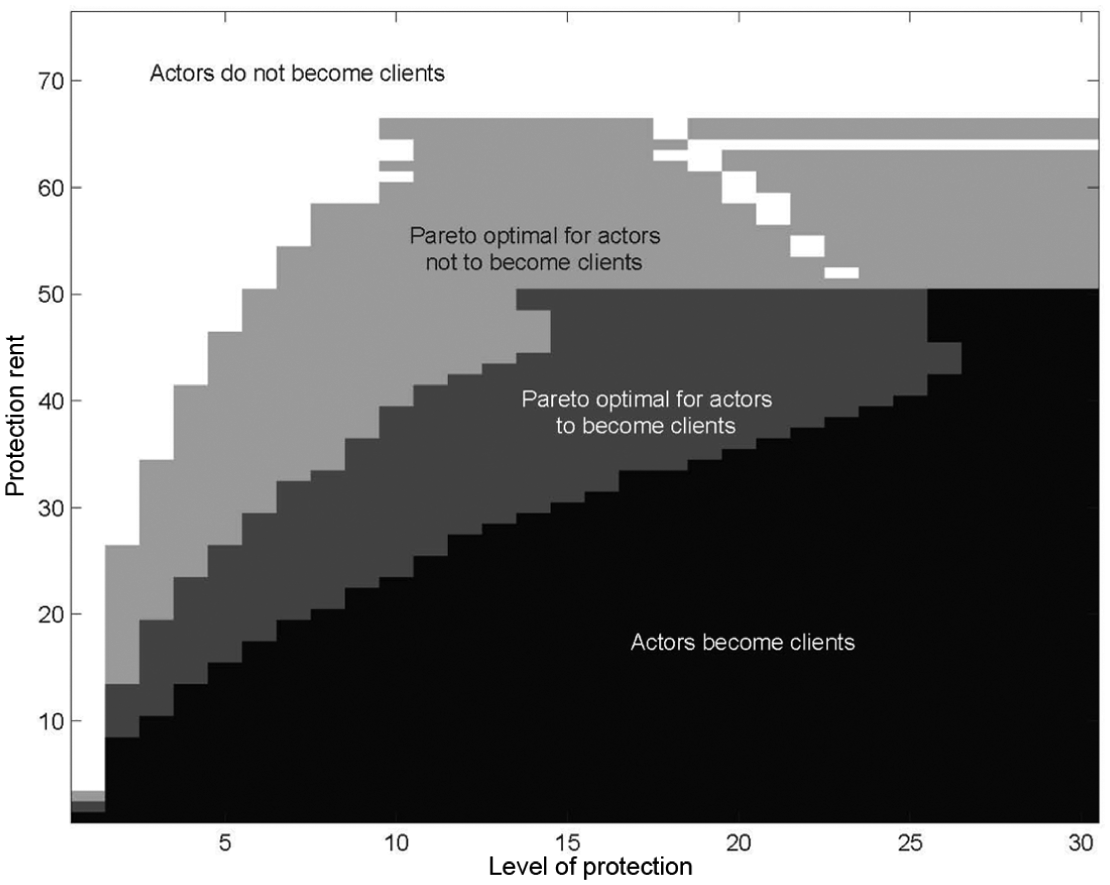
Actors’ client-decision problem.
Given the appearance of these multiple equilibria, we adopt an equilibrium-selection assumption that actors can coordinate on the Pareto-optimal equilibrium. This is a fairly reasonable assumption since there is no conflict of interest between the actors about which equilibrium they prefer. It is also counter-intuitive to expect that actors would choose to become clients when it makes them worse off than when they do not. With this assumption, the border between the two multiple equilibria regions becomes the key decision line for the equilibrium choices of actors’ decisions to become clients, which leads to our next proposition.
That decision line also assists the patron in choosing τ and kL. This can be directly seen in Figure 5. Assuming the patron’s promises of protection are credible, she will want to choose the highest level of protection rent. And since the highest level of rent is determined by the amount of protection provided, she will choose kL to maximize τ.
The final step is to analyze the patron’s incentive-compatibility constraint. If the patron reneges, her maximum deviation is to take the protection rent paid by the two clients and provide no protection. This earns her a payoff of 2τ after which the actors refuse to become clients in every future period. If she holds to her promise, she will receive the protection rent from both clients in every period, but also must incur the cost of protection when a client is attacked. According to the timing of the stage game, since the patron decides whether to provide protection after observing whether a conflict occurs, she knows with certainty if a conflict has occurred or not in the current period of the game. In future periods, she must assess the cost of protection probabilistically, according to p. She also need only incur the cost at most once in a period: if both clients attack each other, she is not obligated to provide protection, but neither is such an outcome possible from the nature of conflict between clients.
The patron will therefore provide protection when the protection rent she receives in every period less the cost of providing protection in the current period and the cost of the probability of providing protection in every future period leaves her at least as well off as taking the protection rent in the current period and providing no protection. 9 We can write this condition formally as

Since the game is recursive, the patron will choose the same level of protection in every period. We can then simplify this inequality to give us

This inequality summarizes some important relationships. First, the more the patron discounts the future (smaller δ), the less likely the inequality will hold. In addition, the smaller the protection rent (smaller τ), the less likely the inequality will hold. Also, the smaller the capacity (or greater inefficiency) of the state (larger α) or the more protection it provides (larger kL) the less likely the inequality will hold. Finally, a greater probability of conflict among clients (larger p) also threatens the patron’s credibility.
This condition also provides us with some intuition into how the patron chooses τ and kL. First, as we have seen, both p and the highest possible τ consistent with the actors becoming clients are determined by the patron’s choice of kL. We can therefore understand the patron’s maximization problem in terms of kL. Second, given the parameter values and the choices of τ and kL, the actors can anticipate whether the patron will renege, given the timing of the credible-state game. This fact prevents the patron’s reneging from ever being part of an equilibrium strategy profile. And given those two facts, the patron will therefore always choose kL to obtain the highest level of τ consistent with her incentive-compatibility constraint, for permissible values of the parameters. Such a choice of kL yields a stream of profits that is the best the patron can obtain. We can now state the next proposition.
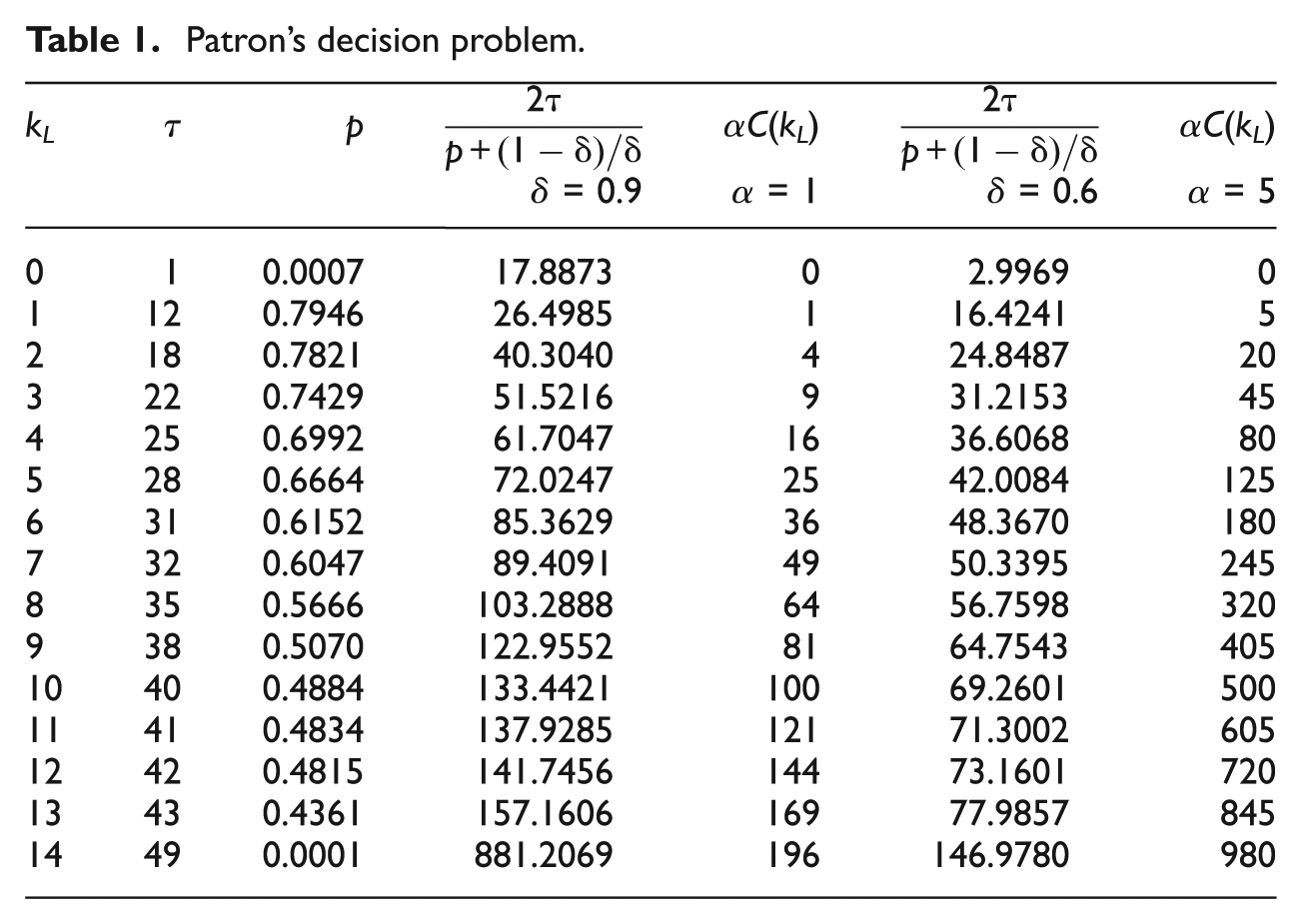
Using the results of computations reported in Figures 4 and 5, Table 1 gives us the probability of conflict, p, that is generated and the maximum rent, τ, that the patron can charge given the amount of protection, kL, she promises. It is also assumed that
Patron’s decision problem.
The reign of King Stephen, 1135–1154
Before applying the model to an analysis of Stephen’s reign, this section provides a very compressed version of the narrative of events during Stephen’s tumultuous reign in order to provide a little background for the benefit of the reader. This section may be skipped by readers who want to plunge directly into the analysis.
On the night of 1 December 1135, King Henry I of England (and Duke of Normandy) died at Lyons-la-Forêt in Normandy. As King (1994a: 8) succinctly puts it: “Fifteen years after the loss of his son and heir he left behind not a secure succession but a power vacuum …”. Henry I’s only legitimate son, William Aetheling, drowned in 1120 in the sinking of the White Ship while crossing the English Channel. This left alive only one legitimate child of Henry I, his daughter, Matilda. Although Henry had made members of the Anglo-Norman nobility swear oaths to recognize Matilda as his lawful successor, she was married to Geoffrey, the count of Anjou, Anjou being the traditional rival of Normandy. The succession therefore had dynastic implications and threatened a shift in power from the Normans to the Angevins. (Matilda had been married to the German Emperor Henry V in 1114, was widowed in 1125, and therefore often called Empress Matilda.) Three weeks after the death of Henry I, the Norman barons had almost decided to elect a nephew of King Henry, Theobald Count of Blois, to become king, “when a messenger arrived from England to say that Theobald’s brother Stephen had already been accepted as king” (Davis, 1990: 15–16) by the citizens of London, leaders of the Church, and other powerful magnates in control of government administration. The mother of Stephen and Theobald was Adela, sister of King Henry and the only daughter of William the Conqueror, the first Norman king of England. Stephen first appears in 1113 as a member of King Henry’s entourage. As a younger son of nobility, Stephen had gone to King Henry’s court to make his way, which was not a bad decision given the contemporary wealth and prestige of King Henry and his kingdom.
Stephen had moved with stunning speed to secure the crown. After first securing the support of London (Davis, 1990: 10), Stephen next traveled to Winchester, where he met his other brother, Henry of Blois, who was also bishop of Winchester. Bishop Henry helped Stephen win the further support of Roger Bishop of Salisbury, who controlled the treasury and government administration. Also through Bishop Henry, Stephen agreed to a charter of liberties for the Church, which played no small part in convincing William de Corbeil, archbishop of Canterbury, to anoint Stephen king, which occurred on 22 December 1135. The result of these maneuvers was that by 22 March 1136, the date of Stephen’s Easter Court, his hold on the kingdom of England seemed secure.
However, in the next few years a series of events would cause Stephen’s political support to unravel and his political survival to be called into serious question. As mentioned, there was significant discord in Normandy as a result of the succession uncertainty; to make matters worse Geoffrey Count of Anjou had invaded the duchy in 1136. Stephen had therefore gone to Normandy to put things in order, but by 1137 had still not been able to conclude a decisive control. On 30 September 1139, Empress Matilda arrived in England and civil war “began in earnest” (Crouch, 2000: 103). Among her entourage was Robert Earl of Gloucester, her half-brother and an illegitimate son of King Henry I, who had formally renounced his homage to Stephen in 1138 and turned over areas of Normandy in his control to Matilda’s husband, Geoffrey of Anjou. A powerful magnate in his own right, Earl Robert’s role and support in his sister’s cause proved to be important.
In early 1140, events show Stephen acting with vigor, racing about England, struggling to address one crisis or another. Nevertheless, it appears that he was able to effectively contain the empress’s party in the southern border of Wales and lower Severn valley. Real disaster seems to have struck Stephen in February of 1141 when he was captured at the Battle of Lincoln. With Stephen imprisoned in Earl Robert’s castle at Bristol, it must have appeared to the empress (and many others) that it was only a matter of time before the kingdom was hers (Davis, 1990: 44–51). However, despite the king’s captivity and the apparent faithlessness of his magnates at Lincoln, Stephen still maintained many dogged supporters, including his queen, also named Matilda; William of Ypres, his Flemish mercenary captain; and the citizens of London. While the empress was besieging Bishop Henry’s castle at Winchester, the queen responded with a force led by William of Ypres. As fate would have it, Earl Robert was captured in the rout. “With the capture of the earl, the Rout of Winchester became the perfect counterpart to the battle of Lincoln, undoing almost everything the earlier battle had done” (Davis, 1990: 60). An exchange of Stephen for Robert was made between 1 and 3 November, allowing the war to continue “as if the thirty-two weeks between the two battles had never existed” (Davis, 1990: 60).
Despite continued attempts by each side to advance its position in 1142, affairs appear to have settled into an even deeper stalemate by 1143. The most decisive event in 1144 occurred not in England, but in Normandy, as Geoffrey of Anjou completed his conquest of the duchy and was invested as duke by the King of France in April. Again, the time seemed ripe for peace talks, but “Stephen was so convinced of his strength in England, and the empress of her husband’s in Normandy, that neither was prepared to compromise” (Davis, 1990: 91). The next most significant event was the death of Earl Robert of Gloucester. While in Bristol attempting to reassemble an army and renew the campaign he became ill and died on 31 October 1147. Crouch (2000: 221) argues that the empress’s campaigns had exhausted her party by 1144, but that it “would not be too far short of the truth to suggest that the death of Earl Robert of Gloucester marked the effective end of the civil war”. “The empress did not stay in England longer than four months after the death of Robert of Gloucester” (Crouch, 2000: 239). She never returned to England.
With the empress now having capitulated, observers looked to her son Henry for an attempt to resume the Angevin claim to the English crown. In 1149, Geoffrey of Anjou handed over the governance of the duchy of Normandy to Henry, who was formally invested by King Louis VII of France in 1151. Eustace, Stephen’s heir, died suddenly in August 1153, an event that actually removed a major obstacle to a final agreement between Stephen and Henry. Under a settlement negotiated by Theobald, archbishop of Canterbury, and Bishop Henry, “Stephen received the homage of Duke Henry” and “Duke Henry …was acknowledged as Stephen’s successor and heir to the kingdom by hereditary right” (Davis, 1990: 119). If the civil war had effectively ended in 1147, its more threatening and imminent legacies were now resolved by 1153. King Stephen died the next year, and Duke Henry came to the throne without incident.
Analysis of Stephen’s reign
Are the events of Stephen’s reign consistent with the predictions of the model? To facilitate the analysis of the historical evidence, five observable implications can be derived from the propositions established in the second section. The fourth proposition by itself generates several observable implications. One (1) implication is that the patron’s credibility will be challenged as a result of either weakened state capacity (a higher α), such as a heightened cost of providing protection, or a lower discount rate (a lower δ), such as a lower chance of survival. A second (2) implication is that the patron must reduce the level of protection she provides (a lower kL) in order to restore credibility to her protection promises. From the second proposition we should observe, third (3), that as the patron lowers the amount of protection promised below a certain threshold, the incidence of violence and disorder increase because the probability of conflict (larger p) between actors increases.
From the third proposition, we should see, fourth (4), that as the patron lowers the level of promised protection, she should also lower the protection tax or rent (lower τ) to keep clients participating in the protection regime. It is of course easiest to see τ as a kind of tax. But it can also be interpreted more broadly as some index of the patron’s or ruler’s total authority. Medieval rulers made several kinds of claims on their subjects (or clients), such as the right to dispense justice in addition to claims of fiscal support. As will be demonstrated below, even these political and judicial “rights” yielded streams of revenue. Thus it is not too far to think of the protection rent as a claim to any kind of governmental authority the king might claim, fiscal or otherwise, since they were often the same thing.
Finally, another implication of the fourth proposition, which is stated at the end because this ordering fits more easily into the narrative, is that (5) despite reduced protection levels, lower rents, and intermittent conflict, the restoration of the patron’s promises of protection may also allow some degree of the state to continue to exist.
In the following analysis, each of these observable implications of the model is addressed in a specific subsection.
Political survival and state capacity
As mentioned in the introduction, much of the state failure literature has highlighted the role played by “structural” factors. Similarly, the model suggests that the patron’s credibility will be affected by two key exogenous variables: the cost of providing protection (more generally, state “capacity”) and the patron’s discount factor, which will be interpreted as the ruler’s “survival probability.” In the case of King Stephen evidence exists that both factors served as precipitating causes leading to a fragmentation of the medieval English state.
First, a serious military challenge to a ruler’s claim to authority, such as that launched by Matilda against her cousin Stephen, obviously throws into doubt the ruler’s future. Second, the allocation of resources to fighting the civil war also increased the cost of Stephen’s protection responsibilities. The Gesta Stephani (Potter and Davis, 1976), written by a royalist chronicler, gives an evocative account of the burdens that Stephen faced: Having finally been victorious over Castle Cary …the king hastened, always armed, always accompanied by a host, to deal with various anxieties and tasks of many kinds which continually dragged him hither and thither all over England. It was like what we read of the fabled hydra of Hercules; when one head was cut off two or more grew in its place. (p. 69)
Such conditions must have taxed Stephen’s resources and peace-keeping duties.
The model also suggests that changes in the cost of protection and/or in the chances of the ruler’s survival will create a credibility problem for the ruler. Interestingly, this is precisely how historians describe Stephen’s dilemma. For instance, Crouch (2000) notes the significance of the king’s capacity for keeping the peace in such cases once the civil war had fully come to a head: [B]y 1140, any such attempt at a public showdown with a rival or with the king could not ignore the fact that there was in the kingdom a conflict going on which was of quite a different order—an open war of succession. All local difficulties then automatically became more serious, because they exerted pressure on a king with few resources and little time to spare. …To maintain credibility, the king had no choice but to take as an act against him any disorder outside the war zone in the Marches. (p. 137; emphasis added)
In this passage, Crouch not only identifies the centrality of protection and the maintenance of public order in medieval governance but also the importance of Stephen’s credibility and the increased difficulty in meeting this obligation in the midst of a civil war.
Reduction of protection and fragmentation of the state
Facing such a credibility crisis, the model argues that a patron can maintain credibility, and some degree of “stateness,” by reducing the level of protection she promises. In the case of King Stephen, perhaps the clearest example of this process is his numerous creations of earldoms (see Table 2). With the creation of these earldoms we see both the reduction of protection responsibility and the reduction of tax and royal authority as new earls became more responsible for providing protection for themselves and for the territorial subunits they governed and as they assumed revenue rights formerly held by the king.
Earls and earldoms.
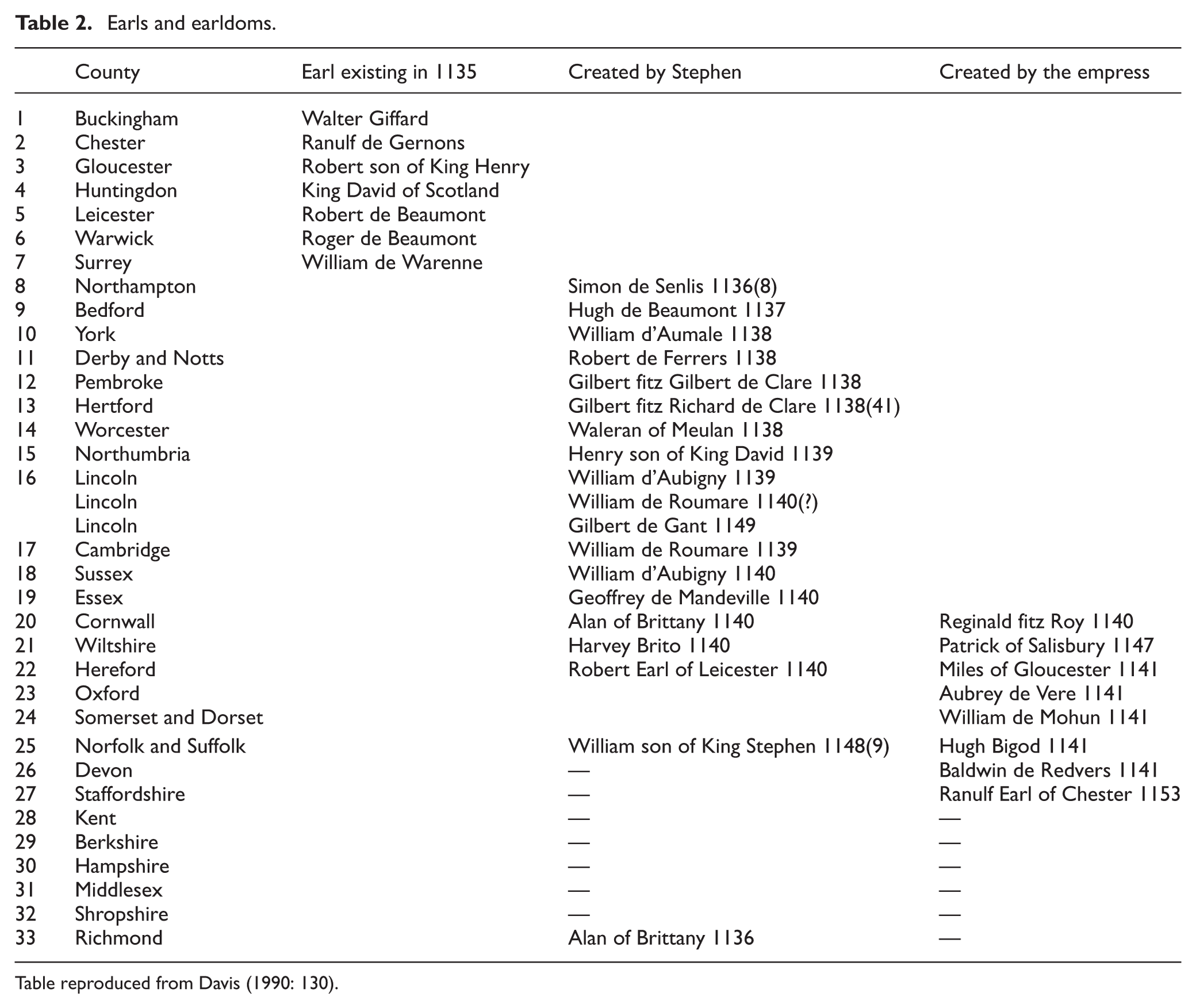
Table reproduced from Davis (1990: 130).
To provide some context, Stephen’s approach to earldoms was novel, both in number and nature, compared to the practice of previous and subsequent kings. Under the previous reigns of William the Conqueror, William Rufus, and Henry I, there were never more than seven earldoms, some lapsing or destroyed under one reign and new ones created or revived under other reigns. “[By] the time of Stephen’s accession in 1135 there were still only seven earldoms: Huntingdon/Northampton, Buckingham, Chester, Gloucester, Leicester, Surrey, and Warwick” (Bartlett, 2000: 208). In contrast to these previous reigns, earldoms proliferated under Stephen. “Stephen created earldoms freely, and made 19 appointments” (Warren, 1987: 92). The timing of these creations is critical and coincide with Earl Robert of Gloucester’s renunciation of his homage to Stephen in 1138. As can be seen in Table 2 and as Hollister (1994: 60) nicely summarizes, Stephen “instigated the policy [regarding earldoms] in the latter part of 1138 and it reached full throttle around 1140”. Thus, Stephen’s earldoms were not part of a preconceived and fundamentally different philosophy of governance, as one historian has suggested (Warren, 1987: 94). Rather, as White (1994: 118–121) carefully demonstrates, prior to Matilda’s insurgency, Stephen’s government exhibited striking continuity with that of his predecessor, Henry I.
Also from Table 2 it will be noticed that five counties did not have earls. In these cases, however, the exception proves the rule. Davis (1990) explains: In Kent William of Ypres had everything but the title of earl, and was probably denied the title so as not to suggest that he was reviving his claim to the county of Flanders. It is likely that in Hampshire, the earl’s duties were performed by the bishop [Henry] of Winchester. Berkshire would have been dependent on Windsor Castle and Middlesex on the Tower of London. (p. 125)
A probable reason why no earl was created in Shropshire was that it was in the hands of Henry I’s widow, Queen Adeliza, who received it by her marriage to the king and who did not die until 1151 (Davis, 1990: 140).
More important than the numbers, however, is the nature of Stephen’s new earldoms. Prior to Stephen’s reign, the status of an earl was largely honorific. 10 Latimer (1986: 137) notes that these “earls were powerful men, but not through the rights conferred on them by comital office”. The only exception in 1135 was the earl of Chester, who held “almost complete lordship” over the shire of his earldom (Latimer, 1986). Yet, while under Henry I, England’s counties (or shires) were “political subdivisions administered by [royal] sheriffs and royal justices,” under Stephen they became “semi-autonomous districts governed by earls” (Hollister, 1994: 55). Hollister elaborates: “[B]y and large earls replaced sheriffs as castellans of formerly royal castles; they became dispensers of formerly royal justice; and in many instances they received great tracts of formerly royal demesne lands. In four shires, earls served as their own sheriffs. Some earls even minted their own coins” (Hollister, 1994: 60).
With more specific reference to the model’s claims, the creation of these earldoms reveal a shift in protection activity from Stephen to these new magnates at the local level. For Davis (1990), the grant of an earldom came with a responsibility to defend the county to which the grant was attached. 11 According to Crouch (2000: 87), “there was a novel military and administrative dimension” to these new earldoms. Dalton’s (1990, 1994) study of Yorkshire brings out this shift of protection in particular detail. Stephen’s initial approach to Yorkshire, a county in the far north of England, was to maintain Henry I’s administrative system (Dalton, 1994: 148). However, by 1138 he was “in danger of losing control in the north” (Dalton, 1994: 150). A chief reason for this potential loss of control was his “failure to provide security” to prominent Yorkshire magnates (Dalton, 1994: 148–151), partly because he was preoccupied with the war in the south (Dalton, 1994: 152). In the same year, Stephen appointed William of Aumale as earl of York to address the problem of security (Dalton, 1994). As with other earls, William assumed control over the key military fortifications that a protector of the county would be expected to have (Dalton, 1994: 152–155).
Thus, consistent with the model, we observe in Stephen’s creation of earldoms a shift in protection away from the king and to the earls themselves. Several other pieces of evidence in support of this view ought also to be mentioned. First, the earls’ new military responsibilities were not simply to carry out the prosecution of the civil war. Though Stephen created earls of the new type in “vulnerable” areas such as York, Pembroke, and Worcester he also granted them in other areas too: “neither Lincoln, Nottingham nor Derby were front-line areas” (Crouch, 2000: 88). Such a policy is consistent with an attempt to respond to problems of credibility by devolving peace-keeping authority even in regions under his control. Second, Stephen’s policy toward earldoms was not peculiar to himself. Matilda also created new earldoms, particularly during her short period of ascendency, as can also be seen in Table 2. Since she undoubtedly had credibility problems of her own, this is consistent with the claims of the model, rather than a theory that Stephen was following a preconceived, personal policy. Finally, another possible motive for the creation of earldoms was patronage. Yet although patronage was undoubtedly part of the rationale, most historians agree that such motives are insufficient explanations. Commenting on their security and administrative roles, Crouch (2000: 87) writes, “[P]atronage and reward were only part of these promotions …”.
Reduction in taxes
To keep clients participating in the protection regime, patrons must reduce tax or other authority claims as well as the amount of protection they provide. Under Stephen, this is displayed in the devolution of regalian rights and in particular fiscal and monetary rights. Furthermore, this shift in fiscal control was closely tied to the shift in control of sheriffs from king to earls previously mentioned. In the Anglo-Norman system of finance, the sheriff for each county was responsible for collecting the king’s revenues and delivering accounts annually at the Exchequer (Bartlett, 2000: 149–151). Revenues came in the form of income from royal lands, feudal aids and incidents, taxes, and the profits of justice. Since the sheriff was expected to deliver a fixed payment and keep the residual, the potential for profit was considerable. During Stephen’s reign, in numerous cases it can be shown either that the earls acted as their own sheriffs in the counties or that the sheriffs simultaneously served as earls’ officials, such as stewards or constables, indicating the extent to which the sheriffs became accountable to the shire’s earl rather than directly to the king (Davis, 1990; Green, 1992). Green (1992: 104) also suggests that it was possible that royal taxes, such as the Danegeld, were shared with local magnates. Finally, Green makes the link between increased military obligation and the reduction of revenue claims direct, even if limitations in the evidence make the king’s explicit acknowledgment of this connection a bit speculative: “If it is borne in mind that earls may have been expected to take over the defence of their counties, and that they could bring strong pressure to bear on their sheriffs, it is possible that they siphoned off royal revenue in recompense for their expenditure on the king’s behalf” (Green, 1992: 102).
Self-protection, arming, and conflict
Another indication of state failure is an increasing level of disorder and violence. In the model, a reduction in the patron’s protection forces clients to shift to a greater amount of self-protection, which in turn leads to an increase in the probability of conflict. Indeed, a florescence of “baronial autonomy” (Stenton, 1961: 218) is a persistent theme in the historical literature, “baron” being the contemporary term for a member of the military elite and “autonomy” referring to the degree to which individual members of this elite became responsible for their own protection and pursuits. There is evidence both that barons increased their expenditure on arming 12 and that the chances of conflict increased.
As to military expenditure, the chronicle sources make plentiful references to the use and construction of castles and other military fortifications. The writer of the Anglo-Saxon Chronicle says: “Every man built castles and held them against the king [Stephen]. They filled the whole land with these castles” (King, 1984: 135). William of Malmesbury tells a similar story: “There were many castles throughout England, each defending its territory or, to tell the truth, plundering it” (Bartlett, 2000: 284). Again, the year 1138, that important year of Earl Robert’s “defiance,” is crucial for the timing. “This was a year, seen from the cloister at Winchester, one of the most stable environments in Britain, when ‘there was no man of any rank or standing in England who did not build anew and munition his fortifications’” (King, 1994a: 14).
If the increase in military fortification is fairly clear, historians disagree about how much violence increased during Stephen’s reign. On the one hand, several historians point to the abundance of violence mentioned in chroniclers’ accounts (Hollister, 1994: 50) and the remarkably high incidence of “waste” in regal financial records (Davis, 1903). On the other hand, different historians see the amount of violence driven by public disorder as “limited” (Crouch, 2000: 161) and the chronicler’s accounts, written by clerics, as “church propaganda.” Though we provide no evidence to settle the debate, it is interesting that the model may be able to theoretically accommodate both views. Since occurrence of conflict is probabilistic rather than dichotomous, the emergence of intermediate levels of conflict is a possibility.
Although Matilda’s challenge and the civil war themselves induced military buildup and conflict, it is important to keep the model’s causal mechanisms distinct. In the model, civil war and insurgency play a role as precipitating causes in a ruler’s credibility crisis. The kind of conflict highlighted by the model is that between clients of the same ruler. Consistent with this, the historical evidence suggests that military build-up was also or even largely an individual and autonomous reaction to Stephen’s weakened capacity to maintain public order. Crouch (2000) gives a compelling account of the individualized dimension of these confrontations among the nobility. Thus the strains of the civil war and the uncertainty of Stephen’s survival created a “new territorial dilemma” at the local level: barons went to war with “their neighbors (of whatever party)” as much as in support of the king or empress (Crouch, 2000: 150–151). Crouch details several cases of regional nobles pursuing their territorial ambitions (Crouch, 2000: 157–160, 162–165). Even magnates that Stephen had appointed as earls, such as William of Aumale, used the weakening of centrally provided protection to pursue their own private objectives, sometimes subverting the king’s own interests (Dalton, 1994: 152–195).
The survival of Stephen and the English state
Despite lower levels of protection from the patron, a shift in finances to the earls and away from the king, and increasing levels of arming and violence, the model is able to capture the continuation of central governance and degrees of “stateness.” In Stephen’s case, the historical record reveals that despite the level and significance of this territorial devolution, a degree of central government remained in operation throughout the civil-war period, though on a reduced scale as should be expected.
For instance, White (1994) finds the central government operating up to the battle of Lincoln in 1141. We have already argued this to be the case up to 1138, when Stephen began creating earldoms. But even between 1138 and 1141, we are given “the impression that the business of government continued much as before, outside the Angevin southwest” (White, 1994: 123). Thus Stephen continued to employ several central government officials, including the chamberlain and chancellor, and there was no drop in the output of royal charters. Further, royal charters indicate that burghal revenues were being handled as usual and that confirmations of property, a routine royal function, were being made. Yoshitake (1988a) also supports the case for the operation of central government up to 1141. He finds “no evidence of a serious shortage of chancery staff” and even discovers some innovation in the legal writ system, “namely, the development from purely executive writs towards judicial writs” (1988a: 105). With regard to finances, if Stephen “was short of money by 1139, this seems to have had far more to do with heavy expenditure than with any problems in raising income” (White, 1994: 192).
What about after the battle of Lincoln? Yoshitake (1988a) makes the case that the king’s capture in 1141 was the real disaster for central government, a view which is endorsed by White (1994). Nevertheless, during the period of Stephen’s captivity, central government appears to survive under the empress. Indeed, the writs and charters issued by Empress Matilda are very illuminating. In a charter issued for Geoffrey de Mandeville, it was specified that the revenues owed from the counties of Essex and Hertford were £300 and £60, respectively (Yoshitake, 1988b: 957). Compare these figures to what they both owed under Henry II: £645 (Yoshitake, 1988b). This agreement is significant in two ways since, on the one hand, it shows that Geoffrey was able to keep a significant share of the county’s revenues, but on the other hand, that revenue was still expected to be paid to the center (White, 1994: 129).
Following Stephen’s release, White (1994: 130) argues that “royal government obviously continued in the period 1142–1153, albeit on a much reduced scale”. Stephen continued to employ a scaled-down, household administrative staff. The condition of royal finances is again revealing. The early Exchequer records of Henry II’s reign record that some county revenues were paid in “tale” (i.e. by the face value of the coins) while others were paid in “blanch” (i.e. in assayed coin). 13 What is interesting is that these groups of counties have a regular geographic distribution: the counties that paid in tale are found in eastern England and those in blanch in western England. Since these regions correspond to the areas of control under the empress and Stephen, respectively, this evidence suggests the continuation of practices under the previous reign and more importantly the continuation of taxation and the survival of the Exchequer during the civil war (see also Cronne, 1970: 221–236). Yoshitake (1988b: 958) concludes that “it is quite plausible that even in the civil war the Exchequer worked to some degree in eastern England under Stephen and in western England under the Empress Matilda, even if with some disorder”. The payment in tale is also another indication of financial devolution, since the practice would benefit the sheriffs (and earls) making payments to the Exchequer. It was not until 1166 that the Exchequer records resume the order and detail of Henry I’s sole surviving financial record of 1130 (Yoshitake, 1988b: 952). Regarding taxes such as the Danegeld, Cronne (1970: 229–230) suggests that if quittances were being granted, then it is likely that the tax was still being levied as well (quittances, but not levies, would have been recorded in royal charters). Also with respect to finances, Green (1992: 91) adds: “[W]hen Stephen was released from captivity he carried on the fighting and did not noticeably run out of funds. He was even able to pay off Henry of Anjou’s mercenaries in 1147, and it was not financial exhaustion that brought him to terms with his rival in 1153 …”.
Conclusion
This paper has argued for a novel explanation for state failure, the process whereby states experience increasing territorial fragmentation, conflict, and violence, and yet some semblance or degree of central state authority persists. The argument hinges on the ruler’s need to maintain credibility. One way to do this is by lowering the amount of protection the ruler provides. This reduces the costs of maintaining the state and therefore makes future promises of protection credible. However, since protection is reduced, clients act more autonomously since they have to provide more for their own protection, and this contributes to a fragmentation of the state and its possession of a “monopoly of violence.” With reduced protection levels also comes increasing probabilities of conflict and violence.
Further, we have argued that the events of King Stephen’s reign can be explained within this model. A contest to claim the crown weakened Stephen’s credibility, who reacted by devolving protection responsibility and revenue claims down to new earls, who as local power holders stepped in to fill the void. And although the civil war between Matilda and Stephen was a source of conflict, more important for the model and the nature of failed states was the degree to which weakening protection and security contributed to an endemic of militarization and probable conflict between local barons and lords of whatever party.
The explanation offered in this paper, the introduction and tolerance of some degree of political disorder as a price to pay to maintain credibility and some state integrity, differs from previous explanations of state failure. Rather than a “penchant for predation” that sends states over the brink, as Bates (2008) emphasizes, this paper claims that the state may weaken even as the ruler makes good on its promises of protection. This is not to discount predation, which is certainly a plausible source of insurgency and loss of legitimacy. But rulers also need allies, even to sustain their illegitimate rule, and this inevitably requires some ability to maintain credibility.
The comparison to Bates’ study of modern state failure raises a question about the generality of the model introduced in this paper. Is the strategy of reducing protection promises or, more broadly, intentional fragmentation of the state relevant to the kinds of state failure observed more recently in Africa and elsewhere? In fact, in his study of warlord politics and African states, Reno (1998: 7) observes: “Paradoxically, rulers of the institutionally weakest states …are the most consistent and thorough in destroying remaining formal state institutions”. Similar to the proposal of this paper, rulers in this account play a key role in promoting “fragmented sovereignty” (Reno, 1997: 493). However, Reno offers a somewhat different rationale for rulers’ behavior than the credibility argument presented in this paper. For Reno (1998: 19), destroying state bureaucracies is a way of denying resources and sources of patronage to rivals. This explanation does not seem inconsistent with a credibility motive that shifts protection and governance to local levels, but more research is required to fully explore this question. For now, it is worthwhile highlighting the intriguing similarities between Stephen’s reign and modern failed states.
Footnotes
Acknowledgements
I wish to thank an anonymous referee, David Crouch, Scott Gehlbach, Daniel Klerman, Pablo Mitnik, and Erik Olin Wright for comments and suggestions. Special thanks go to Ivan Ermakoff for providing detailed comments with every successive draft. Very special thanks go to James Montgomery for insightful assistance in constructing the model and for invaluable help in programming simulations. I also wish to acknowledge the source of the paper’s title from Chapter 9 of Crouch (2000) which in turn owes its inspiration to  .
.
Funding
This research received no specific grant from any funding agency in the public, commercial, or not-for-profit sectors.