



Abstract
This paper investigates whether individuals are loss averse with respect to their status quo wealth level in sharing situations. In a real-effort dictator game, dictators are asked to share their earnings either before or after earning them. The instructions also variably emphasize the amount that the dictator will give or receive at the end of the experiment. This study finds that whether the money is already earned or not has no statistically significant effects on the average sharing behavior, regardless of which instructions are used. The results indicate that dictator game participants are not loss averse with respect to their status quo wealth level.
Introduction
Studies of choice behavior have shown that people often behave as if losses affect utility considerably more than gains do (Camerer, 2000). This phenomenon is known as loss aversion. Behavior consistent with loss aversion has been observed in both field settings and controlled experiments, and the concept explains regularities that appear as anomalies when analyzed with standard expected utility theories. Some examples are preference reversals when lotteries are framed as losses instead of gains (Tversky and Kahneman, 1981) and discrepancies between the willingness-to-pay and the willingness-to-accept for simple goods (Horowitz and McConnell, 2002).
Another well-documented behavioral trait is people’s willingness to pay for fair outcomes (Cappelen et al., 2007; Konow, 2000). Fairness motives are often studied with dictator games, where interaction is anonymous and players singlehandedly decide the allocation of an asset between themselves and a counterpart (Forsythe et al., 1994). Average offers in dictator games typically range between 25 to 40% of the available endowment, with a large share of participants giving away 50% (Camerer, 2003; Engel, 2011). Variations in offer distributions between dictator game treatments indicate that people’s generosity varies according to context.
Given that the willingness to share with others depends on the context, and that loss aversion plays a role in many other settings, it seems natural to ask whether loss aversion is also a concern in sharing decisions. In layman terms, do people perceive it more costly to give away money that they have in their hand (a loss) than to commit to give from future earnings (a reduced gain)? The answer to this question may, for instance, have important implications for the optimal design of tax policies. Under the Norwegian tax code, the estimated income tax for wage earners is deducted before the earnings are received. On the other hand, self-employed individuals are required to pay their estimated income tax from their own bank account in four installments over the year. The difference in the timing of the tax payments suggests that wage earners see their taxes as reductions of gains, while the self-employed perceive their taxes as losses. This would mean that the per krone cost of paying income tax is experienced more intensely by self-employed individuals than by wage earners.
This paper presents results from a real-effort dictator game where the participants decide how much to share either before or after they earn their money. If the participants are loss averse with respect to what they have earned, then earning the money should affect the way potential offers are evaluated by the two groups. Before the earning task, an offer constitutes a reduction of a gain, while after the earning task the same offer constitutes a loss. Loss averse participants are expected to be more willing to share in the before treatment compared to the after treatment. The difference in willingness to share should be evident in both average offers and the fraction of participants choosing to share.
In order to evaluate the robustness of any influences from decision timing, two different formulations are used when the participants are asked to share. In each timing treatment, about half of the participants are asked to state the amount they wish to give away, while the second half are asked to state the amount they wish to receive themselves.
The results indicate that the dictators are not loss averse with respect to their status quo wealth level. The average offers were not statistically significantly different before and after the endowment was earned. The difference in timing also did not generate statistically significant differences in the shares of participants willing to offer positive amounts. The main results were the same regardless of whether the give or the receive formulation was used to present the sharing decision.
Previous findings in experimental economics show that male and female participants may respond differently to contextual changes (Croson and Gneezy, 2009; Eckel and Grossman, 2008). This also appears to be the case in the current experiment. The female participants shared less after earning their money when the give formulation was used. This result could, in isolation, be seen as evidence of loss aversion; but, when the receive formulation was used, the offers from the female participants increased after the earning task. In contrast, the male participants do not appear to be affected by the timing of the decision at all.
Loss aversion theory offers no explanation for why the timing effect depends on context and gender in the way that is observed here. I therefore conclude that the changes in offers by the female participants are due to contextual influences other than loss aversion. If we assume that the results can be extrapolated to other sharing situations, this experiment shows that policy makers do not have to be concerned with loss aversion related to people’s status quo wealth.
The next section relates this paper to the existing literature. The experimental design is described in detail in the third section, and the results are covered in the fourth section. The fifth section draws some conclusions.
Related literature
Loss aversion is perhaps best known to economists as a central concept of the prospect theory developed by Kahneman and Tversky (Kahneman and Tversky, 1979; Tversky and Kahneman, 1991, 1992). 1 Prospect theory assumes that people simplify decisions by evaluating outcomes in terms of the implied changes in wealth, rather than the resulting wealth levels. Sugden (2003) argued that an adequate theory of choice behavior should incorporate concerns for wealth levels as well as changes, and develops an axiomatic version of expected utility theory that incorporates loss aversion.
The classifying of outcomes as gains or losses relies on a reference point. Kahneman and Tversky (1979) wrote that ‘the reference point usually corresponds to the current asset position, in which case gains and losses coincide with the actual amounts that are received or paid’. Similarly, Sugden (2003) opted to ‘interpret an agent’s reference point as her current endowments’. The assumption that the current endowment is an important reference point has experimental support in Bateman et al. (2005) and forms the basis for the experiment in this paper. 2
The implications of loss aversion for prosocial behavior has received little attention from researchers. A notable exception is Buchan et al. (2005) who studied the distributions of positive and negative outcomes in ultimatum games. 3 In their experiments, losses are either hypothetical or deducted from a US$10 show-up fee. The authors found that when participants are bargaining over losses, both offers and demands are higher (proposers are more generous and receivers more demanding). The pattern is the same in four experiments from three different countries, suggesting that their results are relatively robust.
Small (2010) conducted a dictator game treatment where all participants start out with equal endowments. Once the roles are randomly assigned, the researchers removed the receivers’ endowments. This loss of endowment generated higher levels of sympathy, as well as higher offers, from the dictators, compared to a treatment where the receivers never had any endowment to begin with. This experiment suggested that dictators are sensitive to other people’s losses, but it does not establish whether dictators are loss averse with respect to their own endowment.
Other researchers have studied the effect of framing the dictator’s choice as a taking option, rather than a giving option (Dreber et al., 2013; Swope et al., 2008; Visser and Roelofs, 2011). 4 In taking situations, all or half of the endowment is initially allocated with the receiver, but the dictator still decides how the combined endowment is to be split. Any amount taken from the receiver could be seen as a gain for the dictator, and the shares left with the receiver could be seen as a reduction of the dictator’s gain. This suggests that offers will be higher with a take frame, than with a give frame, if the dictators are loss averse. The results of these experiments are mixed, and inferences are hindered by an important confounding effect: the initial allocation of the endowment is intended to influence the perceived property rights. Dictators in taking treatments could be allocating more money to the receiver because they are loss averse, but also because ‘taking’ is seen as less socially acceptable than ‘not giving’ (Krupka and Weber, 2013).
In the give/take dictator games, entitlements to the experimental endowment are indicated with either language frames or by placing the endowment in labeled envelopes. Cappelen et al. (2010) and Konow (2000) show that an alternative, and possibly more salient, method for establishing entitlements is to ask the participants to generate their endowment by taking part in an earning task. The authors’ results suggested that, under ceteris paribus conditions, the principle of equal pay for equal work has broad support.
It appears that no previous dictator games contain treatments where the participants must earn their endowment after deciding on the allocation. Two related papers, namely Cherry et al. (2002) and Hoffman et al. (1994), compare dictator game treatments with and without effort. In Hoffman et al. (1994) the role as dictator is assigned to the best performing participants, while in Cherry et al. (2002) the dictators are paid according to their performance in a quiz. In both cases, the average offers are statistically significantly lower when the participants have to exercise effort, compared to when roles and endowments are distributed randomly. But, as with the give/take experiments, there are (at least) two theories that can explain the result. On the one hand, the effort may have legitimized small offers by making the dictators more deserving. On the other hand, the effort may have increased the sensation of having earned the endowment, making offers more likely to be coded as losses instead of reductions of gains. Both theories predict the observed reductions in average offers.
This paper contributes to the literature by showing how one may test for loss aversion without the confounding influences of varying entitlements or deserts. In the experiment, all participants perform the same earning task in all treatments. This means that there is no difference in entitlements or deserts that can explain potential differences in sharing behavior. On the other hand, if there is no difference in sharing behavior, then the experiment strengthens the suggested interpretations of the experiments referred to above.
The paper also presents a novel mechanism for untangling a confounding issue regarding the reference point. It may be that the status quo only functions as a reference point to the extent that it corresponds with the agent’s expectations about the future. The question of whether ‘present wealth’ or ‘customary wealth’ best captures the concept of a reference point was already raised by Markowitz (1952), but it has gained recent attention with the contributions of Gill and Prowse (2012) and Koszegi and Rabin (2007). The current experiment distinguishes expectations from the status quo by announcing the expected outcome to the participants at the beginning of the experiment. This way, the status quo wealth can be changed without affecting the participants’ expectations. The mechanism thus enables the current experiment to establish whether the status quo wealth serves as an important reference point in its own right.
Experimental design
This paper assumes that people are loss averse with respect to their current endowment when they consider sharing their money with others. By definition, an individual’s current endowment is equal to the individual’s status quo wealth, and does not include expected income. 5 The experiment chosen to test the assumption is a modified version of the dictator game. Dictator games are well suited for studying preferences in sharing situations because strategic motives do not play a role in these games. The current version consists of an earning phase, a distribution phase, a post-experiment questionnaire and anonymous payment procedures. The main treatment is a modification of the timing of the earning phase, relative to the distribution phase. Participants assigned to the before treatments enter the distribution phase immediately before the earning phase, and vice versa for participants in the after treatments. The chronological order of the phases is shown in Table 1.
Experimental phases.
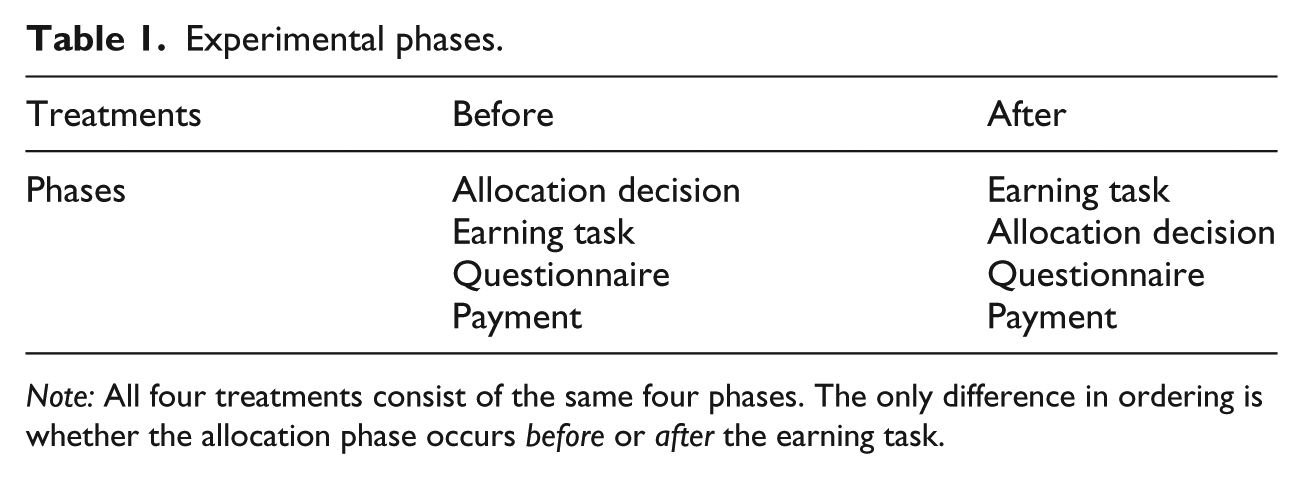
Note: All four treatments consist of the same four phases. The only difference in ordering is whether the allocation phase occurs before or after the earning task.
In the earning phase, the participants are asked to perform two nearly identical tasks on a computer. Both tasks involve identifying a specified three digit number 120 times in tables with several other numbers. 6 The only difference between the tasks is the number to be identified. 7 The time allotted for completing each task is 15 minutes, and a countdown of the remaining time is shown on the screen. The participants are informed from the start that one of the earning tasks will yield a high amount, 175 NOK (≈ US$28), and that the other will yield a low amount, 25 NOK (≈ US$4). They are also told that they will only receive payment from one of the two tasks, decided by a random draw, and about what happens in the distribution phase. 8
The earning phase plays two roles. First, it defines the dictator’s endowment as either expected income or status quo wealth. This distinction is crucial since expected income represents a gain, while status quo wealth is included in the reference point. Figure 1 illustrates how, for loss averse individuals, the utility impact associated with a reduction of a gain is smaller than the utility impact associated with an equally sized loss. The difference is due to the utility function being considerably steeper in the loss domain than in the gain domain. As a consequence, the cost of sharing with others is experienced more intensely if the offer comes from status quo wealth rather than expected income. If the dictators are loss averse then they should be less willing to share after the earning phase.
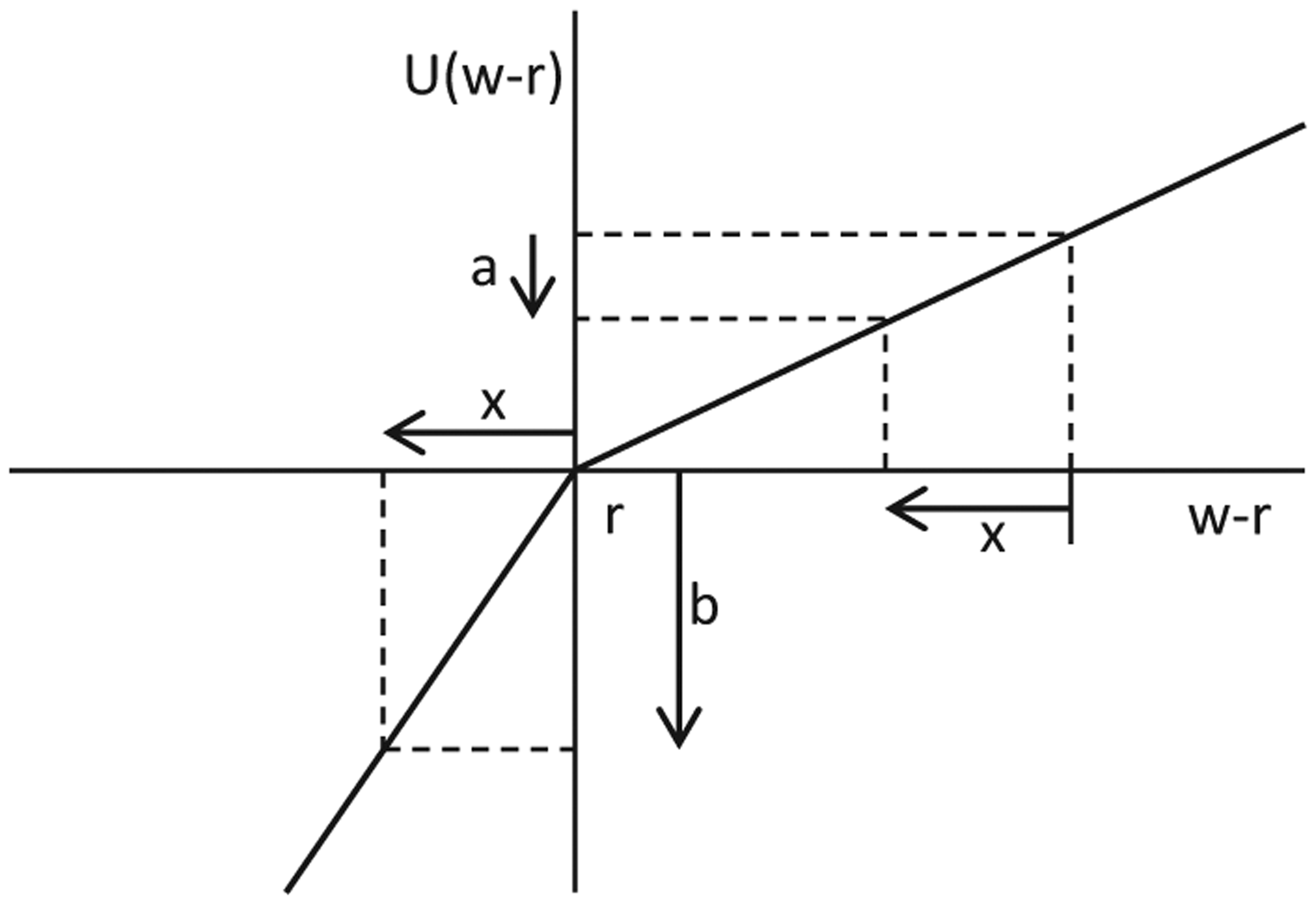
Loss aversion may affect sharing decisions.
The second role of the earning phase is to provide a reason for sharing. The production tasks are deliberately designed so that ability should be an irrelevant factor for the success rate. This feature limits the participants’ opportunity to favor their own effort based on merit. 9 It is also intentional that the tasks should be perceived as boring, so that the monetary earnings will be the sole rewards. Results from previous experiments suggest that since all participants are required to perform the same tasks, most of the participants will think that the fairest distribution of the earnings will be for everyone to receive the same amount (Cappelen et al., 2010; Konow, 2000). It is therefore likely that the earning phase establishes a sense among the participants that the initial distribution of earnings is unfair. 10 The sense of unfairness is expected to be independent of the experimental treatments, meaning that the benefit of sharing is the same in all the treatments.
In the distribution phase, the participants are matched so that one in each pair will receive a high payment and the other will receive a low payment. Every participant is asked to state how much he (or she) will be willing to share if he ends up as the high earner in his pair. 11 The participants are only given authority over their own earnings, meaning that every participant will be rewarded at least 25 NOK for passing the tasks. While this constrains the set of possible allocations of the total earnings, it ensures that the participants have a pecuniary incentive to work on the tasks. Both the earning and the distribution phases are explained to the participants at the beginning of the session, and the participants are encouraged to direct any questions that they might have to the assistants.
At the end of each session, a computer calculates payments for each participant based on the randomly chosen high earners’ allocation decisions. The participants are then informed about their role and about their monetary outcome, including any transfers from the distribution phase. Cash payments are prepared in envelopes by a research assistant outside the lab and handed out without this person being present. Computer-generated payment codes provide the link between the envelopes and the participants. The payment procedure makes sure that neither the experimenters nor other participants can observe the payments to any particular participant. Before the experiment begins, the participants are informed about the payment procedure and that complete anonymity will be facilitated in the experiment.
Several researchers have commented on the sensitivity of dictator behavior with respect to context (Camerer and Fehr, 2004; Cox et al., 2010; Smith, 2010). Because dictator game behavior in general, and the influence of loss aversion on offers in particular, might depend on the way a sharing option is presented, two sets of instructions are used. Half of the participants in each timing treatment are given instructions which state that the high earner can increase the amount that the counterpart receives by choosing to give away some of his earnings. These participants are then asked to record the amount that they would like to give away, provided that they end up as high earners. In the instructions to the remaining participants, it is stated that the counterpart’s payment can be increased if the high earner chooses to reduce the amount that he receives himself. In this version, the participants are asked to record the amount that they would like to receive from their own earnings. These control treatments will be referred to as give and receive treatments, corresponding to whether the dictator states the amount to be given or received. In total, the experiment has four different treatments, organized in a 2×2 design: before-give, after-give, before-receive, and after-receive. 12
The experiment was conducted at the Norwegian School of Economics (NHH) in March 2010 with students from the NHH bachelor’s and master’s programs in economics and business administration. Participants were recruited via email and signed up online in one of the available sessions. A compensation of 100 NOK (≈ US$16) to cover the opportunity cost of participating was announced in the invitation, as well as the opportunity to earn an unspecified amount of money in the experiment.
Eight sessions were conducted in a single day, and each session lasted about 50 minutes, including registration and payment. The lab was set up in a classroom large enough to accommodate at least one free seat between each participant, and dividers were used to limit the participants’ ability to observe each other’s actions. 13 Treatments were randomly assigned to an equal number of participants within each session. Instructions and interaction took place through a computer interface, and all instructions were given in Norwegian. 14
Results
Allocation decisions
Table 2 shows the demographic profile of the participants in each of the four treatments. In total, 197 students showed up for the experiment, of which 177 passed the requirements for being included in the analysis. 15 The average age of the participants was 22.9 years, and 40% were female. The participants were, on average, in their third year at NHH.
Participant descriptive statistics by treatment.
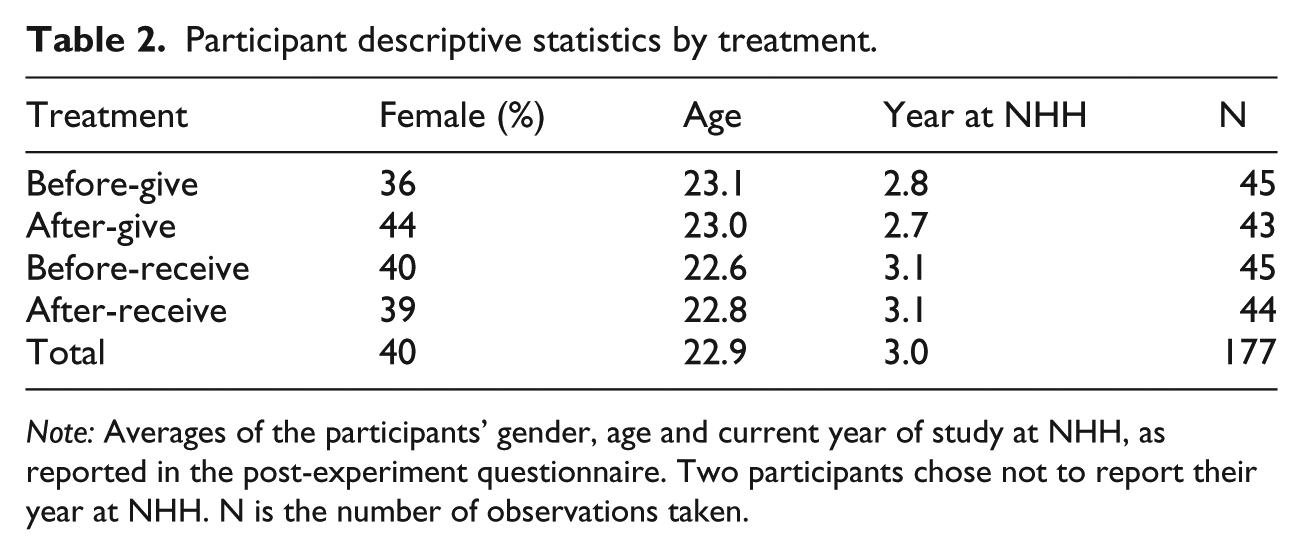
Note: Averages of the participants’ gender, age and current year of study at NHH, as reported in the post-experiment questionnaire. Two participants chose not to report their year at NHH. N is the number of observations taken.
If the participants were loss averse, and the earning task shifted their reference point, then one would expect the average offers to be higher in the before treatments than in the after treatments. One would also expect that a higher percentage of the participants would be willing to share some of their endowment in the before treatments.
As reported in Table 3, the participants in the before treatments offered to share 10.9% of their endowment on average, while participants in the after treatments offered to share 9.6% on average. This difference is not statistically significant (Mann–Whitney p-value = 0.93). When the sharing decision came before the earning task, 56.7% chose not to offer anything. Contrary to what loss aversion would imply, this share decreased in the after treatments to 50.6%. The difference in shares of non-sharing participants is also not statistically significant (Pearson’s
Aggregate results.
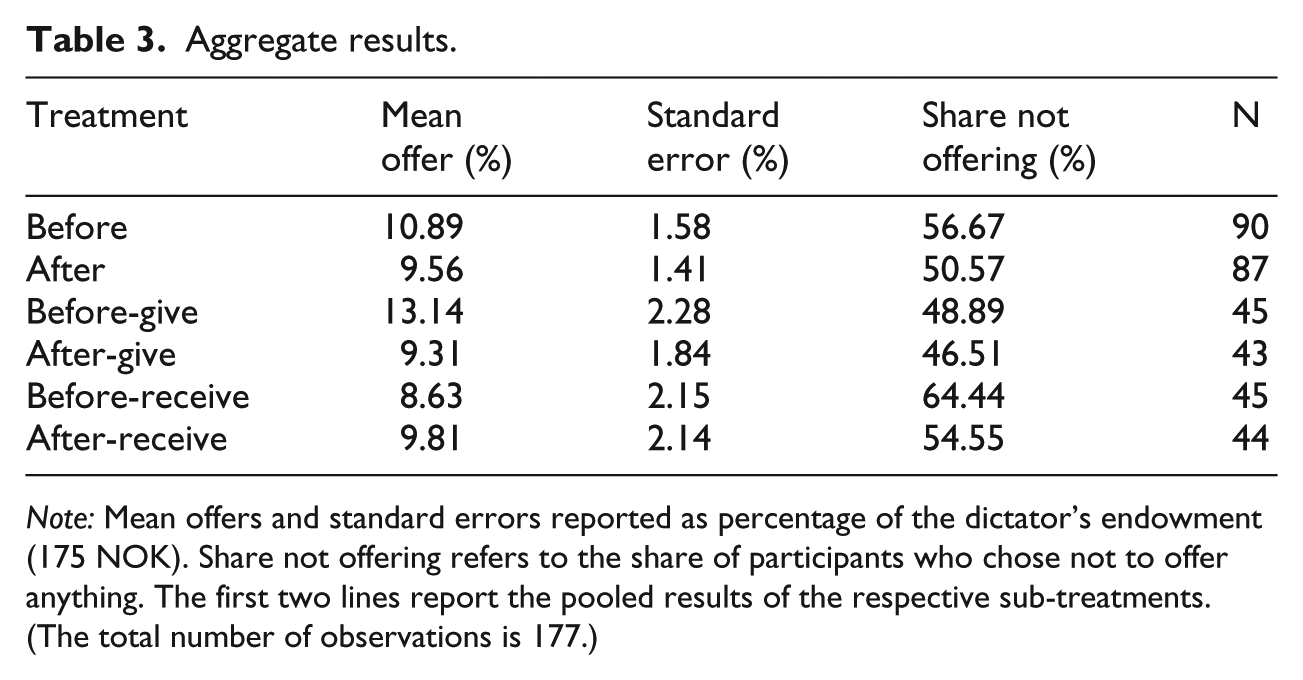
Note: Mean offers and standard errors reported as percentage of the dictator’s endowment (175 NOK). Share not offering refers to the share of participants who chose not to offer anything. The first two lines report the pooled results of the respective sub-treatments. (The total number of observations is 177.)
The aggregated results are robust with respect to both versions of the instructions. The difference in average offers is somewhat larger in the treatments where the give formulation was used to present the sharing option, but it is still not statistically significant (Mann–Whitney p-value = 0.49). Where the receive formulation was used, the difference is smaller, has the opposite sign and remains statistically insignificant (Mann–Whitney p-value = 0.45). The fractions of non-sharing participants are lower after the earning task, regardless of which instructions were used. The largest difference occurred with the receive formulation, with 64.4% keeping everything before the earning task, and 54.6% keeping all they had earned after the earning task. This difference is also statistically insignificant (Pearson’s
In all treatments, the maximum offers were 42.9% (75 NOK) of the dictator’s endowment. An offer of 42.9% meant that the payments to the dictator and the receiver would be equal, since the receiver was sure to receive 25 NOK from his own earning task. This sure payment helps to explain why the average offers were somewhat lower than what is commonly observed in dictator games (Camerer, 2003). The average offer across all treatments was 10.2% of the dictator’s endowment, meaning that the average receiver was paid 21.5% of the total earnings of his pair.
Although the participants were allowed to offer any integer amount up to the full endowment of 175 NOK, Figure 2 shows that the participants generally preferred to make offers that were a multiple of 25 NOK. In all, 89.3% of the offers were either 0, 25, 50 or 75 NOK. This behavior may be linked to the initial distribution of the earned endowments (175 NOK for the high earners and 25 NOK for the low earners). If the participants were rounding off their preferred offers, this may have affected the average levels of sharing, as well as the variances of the offer distributions. Even so, one should still expect to see less sharing in the after treatments, relative to the before treatments, if the participants were loss averse in the sense that is assumed here.
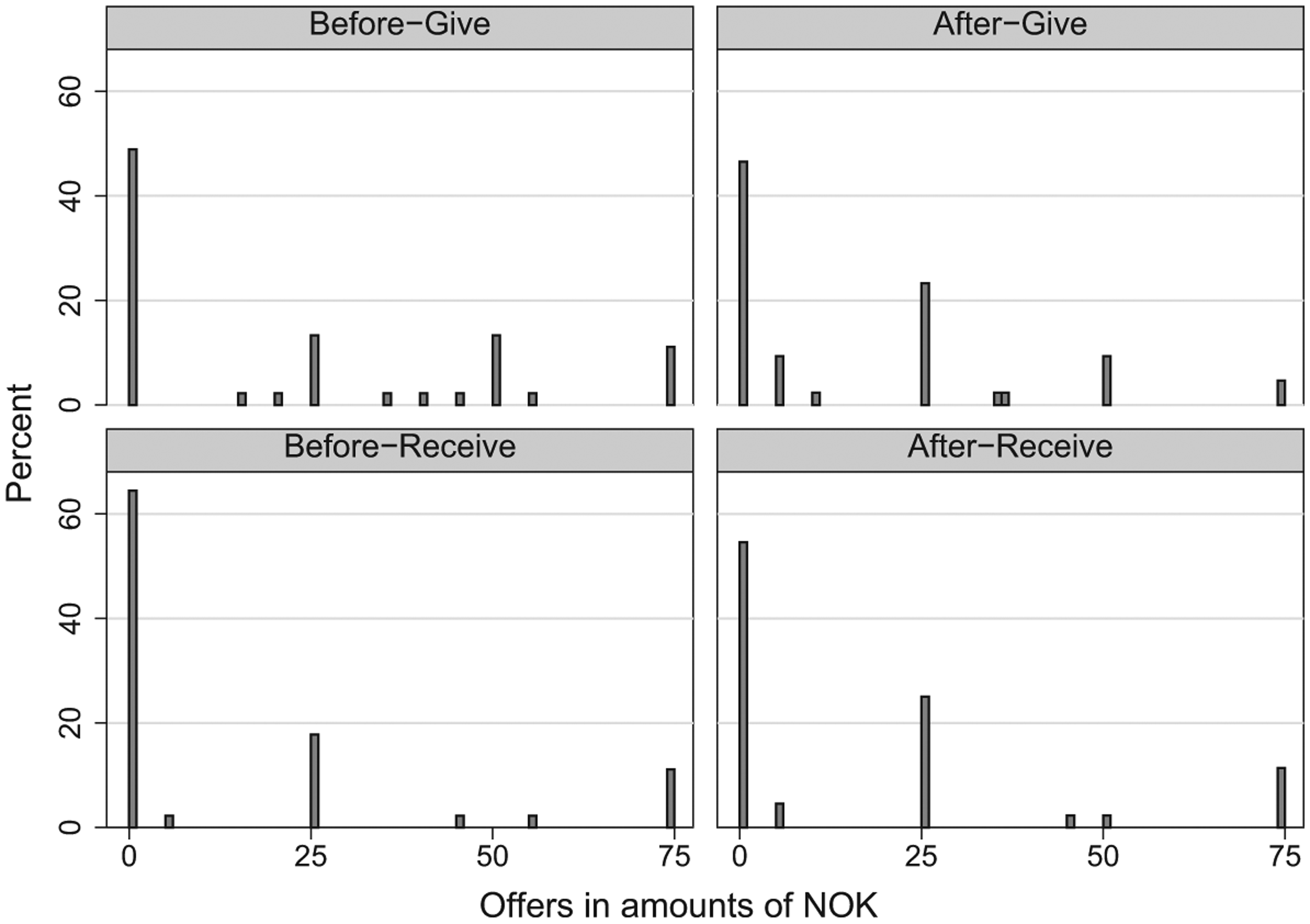
Histograms of offers in each treatment.
Gender differences
Croson and Gneezy (2009) and Eckel and Grossman (2008) have remarked that female dictator game participants generally appear to be more sensitive to contextual cues than are male participants. This is also evident in the current experiment, as there are distinct differences in the way that the male and the female participants responded to the timing treatment. 16 While the male participants did not respond to the timing of the decision in a statistically significant way, the female participants did.
With the give formulation, the female participants reduced their offers from an average of 23.2% before earning their money, to 12.2% on average after the earning phase (Mann–Whitney p-value = 0.03). By itself, this result is consistent with loss aversion theory; however, the timing effect was in the opposite direction when the receive formulation was used. When the female participants were asked to state how much they would like to receive of their own money, the average offer increased from 5.7% in the before treatment, to 11.3% in the after treatment (Mann–Whitney p-value = 0.04).
The average offers from the male participants were 7.6% and 7.1% with the give formulation and 10.6% and 8.9% with the receive formulation, before and after the earning phase, respectively. The differences are in the direction suggested by loss aversion theory, but neither of them are economically or statistically significant (Mann–Whitney p-values = 0.55 and 0.51, respectively).
As shown in Table 4, the percentage of male participants who chose not to share was relatively stable across the treatments. The percentages ranged from 54.2% in the after-give treatment to 69.0% in the before-give treatment. For the female participants, the choice of whether or not to share appears to strongly depend on the treatment. In the before-give treatment only 12.5% chose not to share, while in the before-receive treatment 77.8% chose this option. 17
Results by gender and treatment.
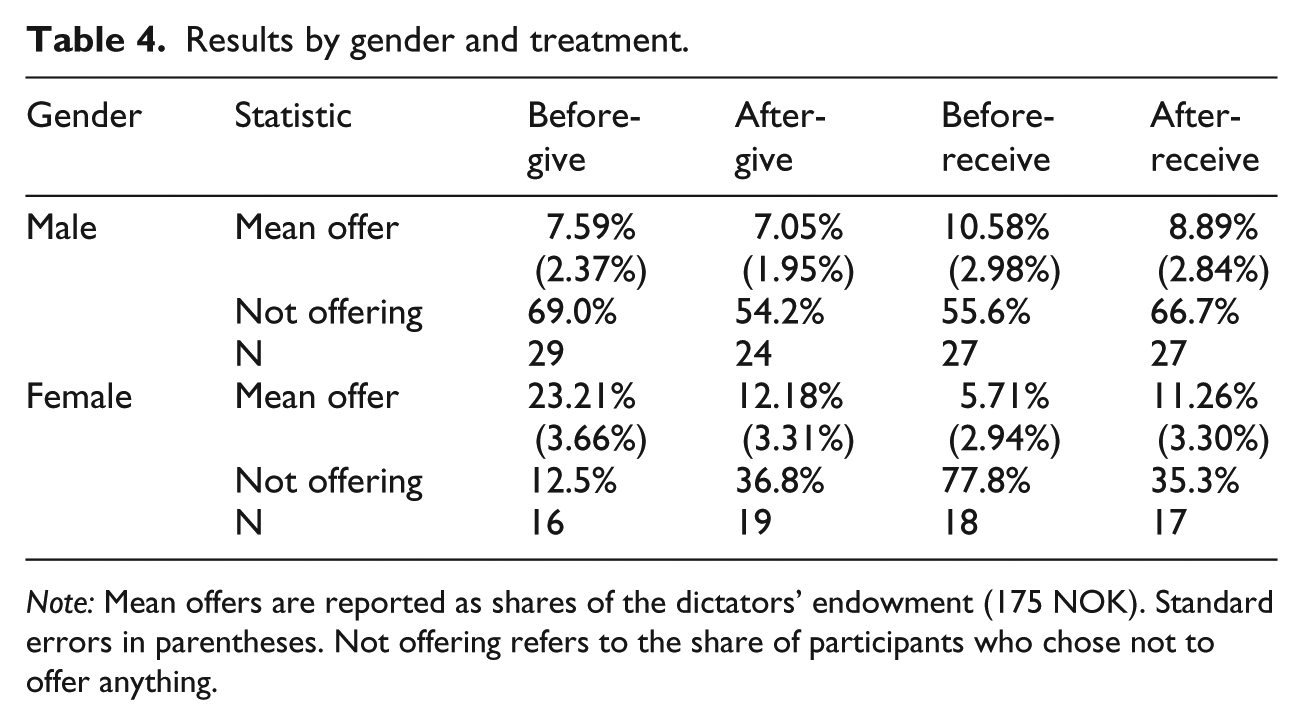
Note: Mean offers are reported as shares of the dictators’ endowment (175 NOK). Standard errors in parentheses. Not offering refers to the share of participants who chose not to offer anything.
The increase in average offers that occurred when the female participants in the receive treatments earned their money goes against the predictions of loss aversion theory. A potential explanation for this result is that the female participants responded to experimenter demand effects before earning their money, but less so after earning it. That is, they may have interpreted the receive (give) formulation as an encouragement from the experimenter to give less (more) than they otherwise would prefer. This interpretation also accounts for the reduction in offers after the earning phase in the give treatments, and why the share of non-giving females varied so much between the before treatments.
Rosnow and Rosenthal (1997) point out that experimenter demand effects tend to be stronger when the experimenter and participant have a different gender. As all assistants in the experiment were male, this may explain why there were no equivalent effects on the male subsample. The dampening of the experimenter demand effect after the earning phase may be due to more salient entitlements in these treatments.
Conclusion
The evidence reported in this paper does not support the idea that individuals are loss averse with respect to their status quo wealth level when they decide how to share their money. Loss aversion theory suggests that individuals experience it as more costly to share money when the offer is perceived as a loss, rather than a reduced gain. Assuming that the reference point is the individual’s net current endowment, this paper asks whether real-effort dictator game participants are more willing to share from expected income than from money they have already earned. The timing of the sharing decision, relative to earning the money, does not affect the sharing decisions made by male participants. While there is a timing effect on sharing by the female participants, this effect is not robust with respect to contextual changes.
The female participants who were asked to report the amount they wished to ‘give’ shared more if they had not yet earned their money. In contrast, the average offers increased after the earning task from the female participants who were asked to report the amount they wished to ‘receive’. There are no elements of loss aversion theory that explain why the timing effect depends on circumstance in the way that is observed here.
A practical implication of the results is that policies directed toward wealth redistribution do not have to be concerned with loss aversion effects. This is relevant for both taxation authorities and charity organizations who could otherwise frame contributions as coming from future income, rather than status quo wealth, in order to lessen the perceived costs of giving. At the same time, the results also illustrate that framing impacts the willingness to share in ways that are still not satisfactorily understood. 18 Further research is required to explain why timing affected the female participants while the male participants were unaffected.
Two caveats should also be noted. First, when the data is broken down by both treatment and gender, the number of observations per cell becomes relatively small. For any treatment, fewer than 20 participants were female. While the number of observations is large enough to detect statistically significant effects, there is also a risk that the small sample is atypical for the wider population.
Second, it may be the case that most people are loss averse, but that the reference point formation takes a different form than is assumed here. Gill and Prowse (2012) and Koszegi and Rabin (2007) argue that expected outcomes are important reference points for individuals. If the expected outcome is the only reference point, this would mean that when the production task and payment mechanism were explained in the beginning of the experiment, the reference point would be set to 100 NOK. 19 Any participant who ended up as a high earner (earning 175 NOK) would therefore have a gain of 75 NOK to give from before incurring losses. This situation would be the same in all the treatments.
Reference-dependent preference theories generally suffer from ambiguity concerning the definition of the reference point. This leaves the theories incomplete and hinders their applicability. Previous research has studied the behavioral effects of fixing the participants’ endowments while manipulating their expectations (Arkes et al., 1994). The current paper shows how to take the opposite approach by fixing the expectations while manipulating the endowments. This procedure adds a new tool to the toolbox for those interested in identifying the nature of reference points.
Footnotes
Appendix
Acknowledgements
I would like to thank Harald Nygård Berg, Bjørn Atle Reme and Helge Sandvig Thorsen for their assistance with conducting the experiment. The comments and suggestions from Alexander W Cappelen, Shachar Kariv, Erik Ø Sørensen, Bertil Tungodden, the two anonymous reviewers and the participants at the sixth Nordic Conference on Behavioral and Experimental Economics improved the paper considerably.
Funding
The author(s) disclosed receipt of the following financial support for the research, authorship, and/or publication of this article: This work was supported by the Research Council of Norway (grant number 185831).