




Abstract
This research asks whether and how institutional trust—trust in the reliability, effectiveness, and legitimacy of public institutions—promotes the provision of public goods. To understand the underlying mechanisms, we apply three choice models to the example of recycling behavior: a standard rational choice model, the low-cost hypothesis, and a dual-process theory. The models carry competing hypotheses about the interplay of trust and incentives in recycling behavior. Using survey data collected in four countries (Sweden, Denmark, the United States, and the United Kingdom), we find a positive and significant interaction effect of institutional trust and recycling costs on self-reported recycling behavior. No such interaction was found using generalized social trust as a second measure of trust. Our results support a dual-process perspective and indicate that high levels of institutional trust can suppress the inhibiting effect of individual costs on cooperation in a collective action dilemma.
Keywords
Introduction
Individual recycling behavior illustrates a typical collective action dilemma. Individual participation in voluntary recycling programs and the adoption of recycling behavior help to cut resource consumption and improve the environment for all. The final outcome can be enjoyed by anyone, whether the individual recycles or not. In other words, recycling is a public good; its provision depends on the successful cooperation of a large number of individuals.
In this article, we develop and test the idea that institutional trust (IT)—trust in the reliability, effectiveness, and legitimacy of public institutions—can foster cooperation in social dilemmas and promote the provision of public goods. Using self-reported recycling behavior as a real-world example, we apply three different theories—a simple rational choice (RC) model, the low-cost hypothesis, and a dual-process theory—in order to explain how incentives and IT impact the provision of public goods. Furthermore, we extend the work of Sønderskov and Daugbjerg (2011) who showed that the positive relation between generalized trust and recycling behavior is moderated by the extent to which individuals perceive of recycling as a collective good.
Actors who maintain a high level of IT assume that the actions of others are effectively regulated and structured by the prevalent norms and rules within the social system (e.g. Giddens, 1990; Lewis and Weigert, 1985a, 1985b, Luhmann, 1979). Importantly, this includes the belief that norm violations will be effectively sanctioned (“structural assurance,” McKnight et al., 1998). Furthermore, it is a very robust finding that potential sanctions raise contributions to public goods (e.g. Fehr and Gächter, 2000; Gürek et al., 2006; Yamagishi, 1986). Hence, the level of IT should be connected to cooperation because it influences the perception of the effectiveness of punishment and sanctioning mechanisms.
Moreover, IT can be regarded as an important part of the prevalent culture of trust in a society (Fukuyama, 1995; Knack and Keefer, 1997; Putnam, 1993; Sztompka, 1999). IT rests on the assumption that other actors in the social system share in this trust. High levels of IT therefore provide actors with a background of taken-for-granted normality on which routine collective action can unfold (Garfinkel, 1963; Giddens, 1990; Misztal, 2001; Möllering, 2006). Apart from sensitizing actors toward the institutional sanctioning and punishment potential, it also encourages them to regard the status quo normative order as legitimate (Lewis and Weigert, 1985a, 1985b; Möllering, 2006; Sztompka, 1999; Zucker, 1986). That is, high IT may shape compliance to norms, institutional regulations, and procedures because institutions, if regarded as natural and legitimate, incline actors to adhere to the “rules of the game.” IT, in this sense, may work akin to a meta-norm (or “trust in trust,” Luhmann, 1979: 66f.) that increases the overall probability of norm compliance across different contexts. In essence, higher IT potentially makes measures of norm enforcement less relevant as persons autonomously and more readily cooperate because “that is what one ought to do.”
Yet, while the importance of IT to the functioning of modern societies has been repeatedly emphasized in social theory, few studies have linked it to individual action and choice. The aim of the present study is threefold: first, we deliver an empirical assessment of the effect of institutional and generalized trust on recycling behavior as a real-world example of collective action. To this end, we use data from a unique survey that was designed to assess the role played by trust in pro-environmental behavior in four countries (see Sønderskov and Daugbjerg, 2011). Second, we use three different theoretical models to derive potential explanations for the impact of IT on recycling behavior. Third, we test the predictive and explanatory power of these models by evaluating these competing hypotheses about the interplay of trust and incentives. Our findings support the view that high levels of IT may lead to unconditional cooperation in collective action problems.
Theory and hypotheses
IT and cooperation
IT refers to abstract institutions or social systems as objects of trust. 1 It is created and sustained by the continual, ongoing, and confirmatory experience of a social system’s functioning. In contrast to generalized social trust (ST), IT does not concern social uncertainty with respect to another’s actions or a generalized expectation of trustworthiness. It addresses the global characteristics of public institutions: their primary goals, legitimacy, structure and operation, and the effectiveness of the sanction mechanisms which structure and control interactions in the social world (e.g. Cook, 2001; Giddens, 1990; Zucker, 1986). It warrants a constant reproduction of social systems in everyday interactions and their aggregation into stable social structure (Lewis and Weigert, 1985a, 1985b). Importantly, IT increases the expectation that norm violations will be punished; it directs attention to the sanctioning potential of institutions (McKnight et al., 1998; Misztal, 1996; Shapiro, 1987). At the same time, the basis of IT is the appearance of normality (Lewis and Weigert, 1985a: 463; Luhmann, 1979: 22; Misztal, 2001). This indicates that IT is related to the concepts of familiarity and confidence: IT manifests in the form of taken-for-granted background assumptions, that is, in familiarity with and confidence in the institutions and their primary goals, rules, and procedures (Möllering, 2006). If actors share the belief that free-riders will be effectively sanctioned, norm compliance is often regarded as a default strategy (Yamagishi et al., 2007). In sum, IT reflects the perceived validity and legitimacy of institutions and creates situational normality and taken-for-grantedness as the basis of routine behavior.
Linking trust to collective action
Of course, the presence or absence of IT alone does not by itself explain cooperation in a collective action dilemma. Sønderskov (2011) established a link between ST and the social exchange heuristic (see Yamagishi et al., 2007). The social exchange heuristic is described as a “cognitive bias that perceives free riding in a situation as neither possible nor desirable” (Yamagishi et al., 2007: 10). As Sønderskov argues, ST promotes a positive expectation of trustworthiness and, coincidentally, one of reciprocal cooperation. By this, it increases the likelihood of the application of the social exchange heuristic and thereby motivates individuals to cooperate. Empirically, Sønderskov (2011) finds a consistent main effect of ST on self-reported recycling behavior.
We propose that IT constitutes an alternative trigger of the social exchange heuristic. According to Yamagishi et al. (2007), the social exchange heuristic is activated by cues that hint at the presence of a situation of social exchange. Actors are assumed to make subjective inferences about a specific situation, and evaluate the potential errors of this inference process. Importantly, such inference process is unconscious and automatic, and it is concerned with the question of whether or not free riding is likely to be detected, and whether or not punishment is a credible threat (Yamagishi et al., 2007: 264f.). In short, whenever a situation is defined as being under institutional control, the alternative of defection is simply excluded from perception. This may lead actors to automatically cooperate in social dilemmas.
This effect may matter even in contexts where a factual sanctioning is unlikely to occur or punishment mechanisms are virtually absent because actors subjectively define a situation accordingly. In essence, we argue that actors with high levels of IT are, in a sense, “biased” toward perceiving situations as being under institutional control. Consequently, with respect to collective action, we hypothesize that IT is positively related to recycling behavior.
This does not exclude the possibility that ST is also connected to recycling behavior. Sønderskov (2011) could already show this relationship to hold empirically, even when statistically controlling for IT. Moreover, IT seems to lay the (causal) ground for ST in a society (Sønderskov and Dinesen, 2016). However, we know little about the underlying processes that produce the link between both kinds of trust and recycling behavior at the individual level.
Trust, incentives, and recycling behavior: Three theoretical models
Previous research has documented the importance of the cost and opportunity structure for recycling behavior (Steg and Vlek, 2009). In the following, we discuss three alternative models that can accommodate both factors, IT as a kind of attitude regarding the perceived norm strength as well as costs and benefits. This allows us to derive hypotheses about the interplay of trust and incentives in recycling behavior.
Value-expectancy (or subjectively expected utility) theories is a widely accepted baseline model that delivers theoretical underpinning for a main effect of the cost-benefit structure on recycling behavior. For the sake of simplicity, we subsequently refer to this model as RC theory. RC models explain behavior as a result of RC among alternatives which, given preferences, constraints and beliefs, actors weigh and evaluate in order to choose the alternative which satisfies their preferences best and maximizes their expected utility (Gintis, 2007). According to this approach, an actor engages in recycling only if the expected utility of recycling, minus the costs associated with it, exceeded that of conventional waste disposal. Thus, RC predicts a negative effect of recycling costs, and a positive effect of recycling benefits on recycling behavior. The “wide” interpretation of RC (Opp, 1999) additionally allows for intrinsic positive utility that is derived from norm conformity, and intrinsic costs (negative utility) from cognitive dissonance in the case of breaking internalized norms. Note that a standard RC model implies additive effects of the cost-benefit structure and intrinsic factors, such as attitudes and internalized norms (Kroneberg et al., 2010).
A second and different view is provided by the “low-cost-hypothesis” (Diekmann and Preisendörfer, 2003). It claims that attitudes and norms influence behavior in low-cost situations only. The additional costs and benefits derived from norm compliance are evaluated relative to the alternative of defection. With respect to recycling behavior, the low-cost hypothesis assumes that an increase in recycling costs may induce a shift to conventional waste disposal, once the costs of recycling (CR) become too high. This is still in line with a standard RC perspective. A more specific version of the low-cost model additionally predicts an interaction effect: the effect of attitudes decreases with increasing costs of norm compliance (Best and Kroneberg, 2012). As the costs increase, the impact of the attitude or norm becomes less important to the choice of action; hence, the probability of norm compliance decreases. This is equivalent to claiming a negative interaction effect between trust and the costs of contributing to the public good. With regard to the effect of benefits, the prediction of the low-cost hypothesis is less clear, especially if these would not map on the same dimension as the costs.
A third model is based on social-psychological dual-process theories. One important difference to RC models and the low-cost hypothesis is the assumption that a high match or “fit” between an accessible attitude and situational cues can trigger an automatic activation of the applicable norm, together with its associated cognitions, affects, and behavioral dispositions (e.g. Chaiken and Trope, 1999). In other words, dual-process models allow for the case that accessible attitudes can immediately lead to norm conformity without a rational evaluation of costs and benefits. In sociology, a formalized version of the dual-process account that models this kind of adaptive rationality is provided by the Model of Frame Selection (MFS; Esser, 2001; Kroneberg, 2011, 2014). In a simplified version of the MFS (Kroneberg et al., 2010), a mode-selection threshold defines the conditions for the activation of the automatic mode. The model implies that as the chronic accessibility of an internalized norm or attitude increases, the activation of the automatic mode becomes more likely. At the same time, this decreases the probability of selecting a reflected or rational mode of information processing. Thus, high attitude accessibility makes a controlled evaluation of costs and benefits action less likely and can lead to automatic norm conformity. Hence, the model predicts decreasing effects of incentives on choice, such as costs or benefits, with increasing attitude strength or norm internalization. Consequently, the MFS predicts a decrease of the effects of the incentive structure with increasing attitude strength, and thus a positive interaction between costs/benefits and trust (Rompf, 2015: 197ff.). In short, and with respect to recycling behavior, if IT is very high, individual costs and benefits of recycling should not matter anymore.
Note that the MFS implies an interaction effect of the opposite sign compared to the low-cost hypothesis. Additionally, the two models postulate different underlying mechanisms for the predicted interactions: based on the low-cost hypothesis, costs moderate the effect of trust on recycling behavior. In contrast, according to the MFS, trust moderates the effect of costs on recycling behavior.
Although our theoretical discussion has focused on the role of IT, our empirical test will also evaluate the trust-behavior link with respect to ST. This allows for a more comprehensive test of the three models and a more differentiated account of the role of different forms of trust for recycling behavior. However, for the ease of exposition, we subsequently formulate our hypotheses with respect to IT only.
Summary of hypotheses
We have argued that IT is an important factor governing the activation of the social exchange heuristic; it focuses actors on the sanctioning potential and threat of punishment by social institutions and also provides the ground for routine conformity:
H1. As IT increases, people recycle more (positive main effect).
We also assume to replicate the finding by Sønderskov (2011) that
H1a. As ST increases, people recycle more (positive main effect).
Concerning the impact of the cost-benefit structure, Sønderskov (2011) tested the hypothesis that an effect of ST on recycling behavior only exists if recycling is perceived as a collective action problem. Thus, he proposes an interaction between ST and the perception as a public good. This perception is operationalized by the item “If I couldn’t recycle, it would be difficult for me to dispose of all my refuse” (0 = agree to 5 = disagree). We propose to use this item reverse-coded, to measure the presence or absence of private benefits (PB) of recycling.
The main effect of benefits can be explained from the RC perspective: all else being equal, PB should encourage recycling behavior, and their absence decreases it:
H2. The perception of recycling as a means to obtain PB increases recycling behavior (positive main effect, RC).
According to the MFS, this effect is counterbalanced by the attitude of trust, which can trigger automatic norm compliance irrespective of incentives. Thus, we can also predict an interaction effect of trust and PB. Note that this argument is analogous to the one by Sønderskov (2011) for ST, as we use the same item for describing benefits he used for measuring the perception of recycling as one of a public good problem:
H2a. The positive effect of PB on recycling behavior is moderated by trust: high trust decreases concerns stemming from private recycling benefits. As trust increases, benefits become more irrelevant (negative interaction, MFS/dual-process theory).
Concerning the effects of recycling costs (operationalized by the item “The recycling options where I live are worse than in most other places”) and trust, all three models unequivocally predict a negative main effect of the costs associated with recycling:
H3. Recycling costs decrease recycling behavior (negative main effect).
Becoming more specific, each of the three models yields a unique prediction regarding the interaction between recycling costs and trust in their effect on recycling behavior:
H3a. The effects of recycling costs and trust on recycling behavior are additive (no interaction, RC).
H3b. The (positive) effect of trust on recycling behavior decreases with increasing recycling costs (negative interaction, low-cost hypothesis).
H3c. The (negative) effect of recycling costs on recycling behavior decreases with increasing trust (positive interaction, MFS/dual-process theory).
In sum, the theories discussed here provide a theoretical underpinning of the interplay between trust and costs and benefits effecting recycling behavior.
Data and methods
The following analyses are based on survey data from the project “Public Policies and Demand for Organic Food: An International Comparison of Policy Effects and Policy Determinants” (COP), a self-administered web survey with participants recruited from standing panels (for details, see Sønderskov and Daugbjerg, 2011). The survey was conducted in April/May 2008 in the United Kingdom, the United States, Denmark, and Sweden. The samples comprise only respondents not living with their parents (or grandparents) but else are representative on various demographic parameters. Most importantly, the survey employed the core measures needed to examine the foregoing hypotheses.
The dependent variable recycling behavior (rec) is an index based on three items measuring paper, battery, and electronics recycling activity. Subjects indicated what share of their waste they recycle, on a 5-point Likert-type scale. The dependent variable then is constructed as the normalized mean of the responses across the three questions and coded to range between zero and one. Note that we interpret this self-report measure as a proxy for actual recycling behavior. Following Sønderskov (2011) and Sønderskov and Daugbjerg (2011), this assumption can be justified based on two empirical arguments: First, recycling is not mandatory but voluntary in all four examined countries. Second, a comparison of the claimed recycling share with the official actual recycling ratings shows perfect correspondence of the rank order of countries (first Denmark, second Sweden, third United Kingdom, and fourth United States).
IT is measured by five questions that prompt the respondent to rate how much he or she “personally trusts each of the following institutions,” on a 10-point Likert-type scale (0 = “no trust at all” to 10 = ”complete trust” separately for the legal system, parliament, police, civil service, and government, respectively). Factor analyses confirm that these items capture a single dimension and that the scale is internally consistent (one factor retained with an eigenvalue of 3.18, Cronbach’s alpha equaling 0.89). IT is constructed as the normalized mean of these items and coded to range between 0 and 1.
ST is measured by the social trust index as utilized in the General Social Survey with the following three items. “Generally speaking, would you say that most people can be trusted, or that you can’t be too careful in dealing with people?” (0 = “You can’t be too careful” to 10 = “Most people can be trusted”); “Do you think that most people would try to take advantage of you if they got the chance, or would they try to be fair?” (0 = “Most people would try to take advantage of me” to “Most people would try to be fair”); “Would you say that most of the time people try to be helpful or that they are mostly looking out for themselves?” (0 = “People mostly look out for themselves” to 10 = “People mostly try to be helpful”). Cronbach’s alpha equals 0.84. ST is constructed as the normalized mean of these items, ranging between zero and one.
We operationalize the cost-benefit structure using two survey questions. By this, we refrain from using one simple composite measure for costs and benefits (e.g. a difference measure) as we intentionally allow for potentially asymmetric effects of both.
First, CR are operationalized by a measure of “recycling convenience.” The item asks whether the local “recycling options where I live are worse than in most other places.” Respondents who agree to this question face fewer recycling opportunities and by this incur larger costs (travel distance, effort, time) when deciding to recycle. The variable originally is coded such that higher values (max. 5 = “disagree”) correspond to better recycling opportunities, and therefore represent lower costs. We use a reverse-coded version of this variable as a cost measure (“costs of recycling”), which is normalized to a range between 0 and 1 (where higher values imply greater costs).
With respect to recycling benefits, Sønderskov (2011) argues that ST should not matter when recycling has direct PB, in contrast to a “pure” public good situation. This perception was measured by the item “If I couldn’t recycle, it would be difficult for me to dispose of all my refuse.” In our perspective, it appears reasonable to interpret this variable as accruing to PB as a part of the incentive structure of recycling behavior. The item will be coded such that higher values display higher PB, once more normalized to the range between 0 and 1.
As control variables, we use Materialism/Post-materialism, age, gender, educational level, income, ethnic minority, place of residence (city size), and trust in recycling authorities as proposed by Sønderskov (2011). Materialism/Post-materialism was measured with Inglehart’s (1997) four-item post-materialism measure. Respondents were categorized as materialist, post-materialist, or mixed. We intentionally used “trust in recycling authorities” as a control variable to examine whether the hypothesized effects and proposed interactions retained relevance over and above such control. In addition, all models shown were re-calculated with environmental concern (“Recycling is good for the environment because it helps reduce the consumption of resources,” 1 = “completely agree” to 5 = “completely disagree”) as an additional control variable, which leave the results structurally unaffected.
Empirical analysis
Table 1 gives the results of a series of ordinary least squares (OLS) regressions that examine the effects of IT on recycling behavior. Model I shows that IT is positively associated with the probability of recycling, not rejecting H1. With respect to a social exchange heuristic explanation, this could be interpreted such that as IT increases, actors are more prone to activate the heuristic and cooperate to the public good of recycling. From the dual-process perspective of the MFS, the result can be interpreted is such a way that the mere accessibility of strong attitudes toward public institutions, their legitimacy, and punishment potential (captured with IT) prompts actors toward automatic norm-compliant behavior.
Testing H1–H3: OLS regressions of recycling behavior.

OLS: ordinary least squares.
p < 0.1; **p < 0.05; ***p < 0.01 (two-sided). Standard errors in parentheses.
Second, Model I shows the relevance of the cost-benefit structure, in line with H2 and H3. As the perceived PB of recycling increase, recycling activity increases as well. Equally as expected, CR are negatively associated with the probability of recycling.
Model II provides a first test of H2a, the hypothesis of an interaction between PB and IT: Does the effect of PB on recycling behavior vanish with increasing IT? The interaction IT × PB is significant and negative, pointing toward a diminishing effect of PB with increasing IT. Thus, the results are in line with H2a.
Moreover, Model II also allows us to test H3a, b, c and to discriminate between a RC explanation, a low-cost hypothesis explanation, and an MFS explanation of recycling behavior. The results rule out H3a and H3b, which predict either a zero or a negative interaction between the CR and IT. The data support the hypothesis derived from the MFS dual-process approach (H3c): the negative effect of recycling costs on recycling decreases with increasing IT.
Based on Model II, Figure 1 depicts the predicted marginal effects of the cost-benefit variables while varying IT and holding all other variables constant at their mean: the marginal effects of both incentive measures approach zero and ultimately become insignificant at the 5% level as IT increases to its maximum. The marginal effect of PB decreases from 0.15 (p < 0.001) to 0.03 (p = 0.38), and the marginal effect of recycling costs decreases from −0.24 (p < 0.001) to −0.04 (p = 0.26). Overall, these results lend support to a dual-process explanation of the trust-recycling behavior link: when IT is high, people’s recycling behavior is not influenced by cost and benefit calculations anymore. In other words, the influence of the incentive structure is moderated by the attitude of IT. As a robustness check, the models were re-estimated using ordered logit specifications. These models do not yield substantially different results, and importantly, the fundamental relationships remain significant at comparable levels.
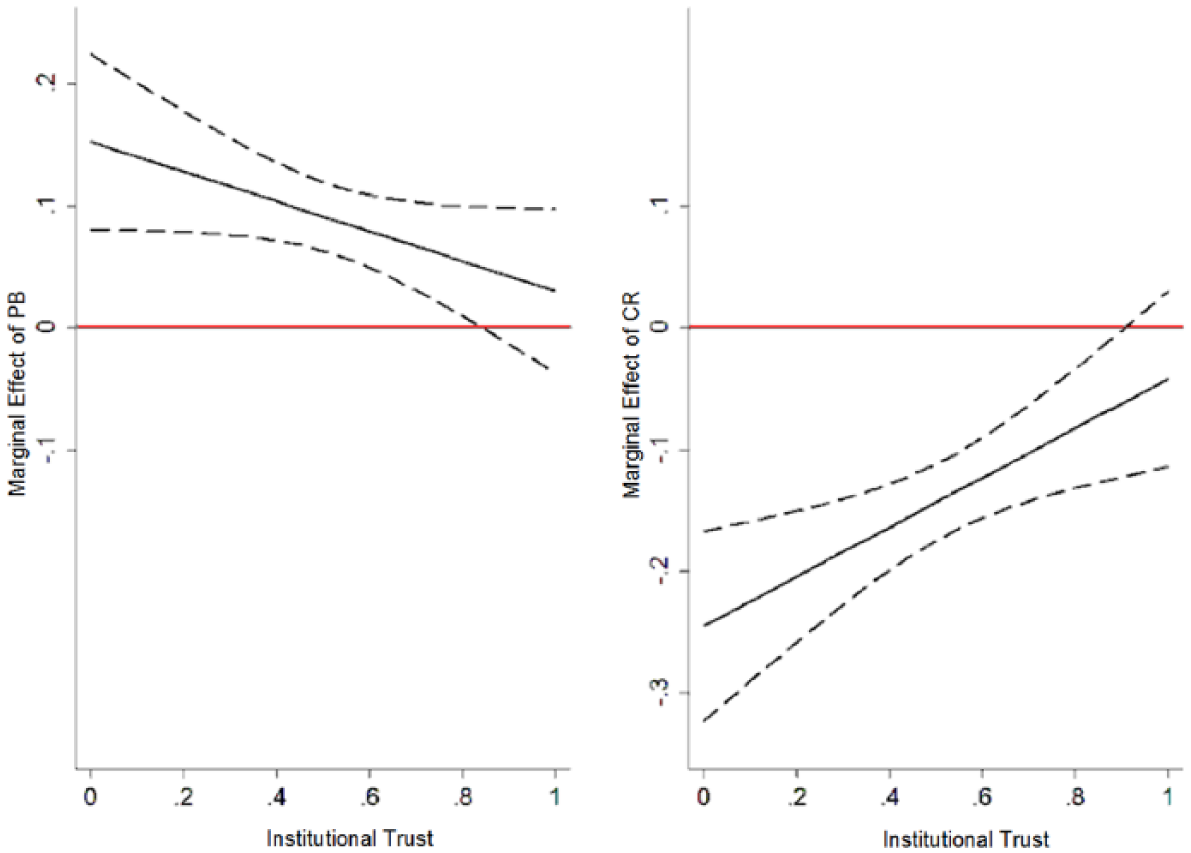
Marginal effects of private benefits (PB) and costs of recycling (CR) by institutional trust (x-axis).
As another robustness check, Model III re-estimates Model II with an alternative measure of recycling costs. As it is, the design of the study is purely correlational, and a potential bias of the estimates can occur if the predictors of the model are not truly independent. In an exploration of this issue, it was found that respondents with low IT also report higher recycling costs than the sample average. This effect disappears with increasing IT, suggesting a non-linear relationship between the two variables. Estimating, in a first stage, a model in which the predictors IT and (IT × IT) are used to predict CR reveals a significant influence of both variables, verifying such a non-linear relationship. This first-stage model explains about 2.5% of the total variability in the cost variable. In Model III, the residuals of this regression were used as an alternative cost measure to represent the “true” cost effect which is unrelated to any systematic influence of IT. As can be seen in Table 1, this modification does not change the sign or significance of any of the other variables in the model. Hence, the relationships among the variables in the model are stable and, what is more, the conditional main effect of IT is now estimated to be strongly positive and significant (see Appendix 1 for additional country-level regression models).
Model IV examines whether these results hold under the control of ST. The theoretical aim of this model is to test whether and, if so, how this kind of trust could deliver an alternative explanation along the hypotheses we set up for IT. The results show that ST is positively associated with recycling behavior. This partial effect is significant (in line with hypothesis H1a) but smaller than the one of IT. All the other coefficients do not change their sign, size, or p-level to a notable degree. This result corresponds with the finding by Sønderskov (2011) who already showed that both kinds of trust exhibit positive partial effects on recycling behavior.
Note that for ST, one could make the same argument already made for IT in Model III, as we find a similar non-linear prediction pattern of ST and ST × ST for CR (now with R2 = .02). As the residuals of both regressions are almost perfectly correlated (r = .99, p < .001), we use only the above-mentioned residuals in Models IV and V.
In a final step, Model V extends Model IV by simultaneously estimating the interaction effects with the incentive measures for both kinds of trust. While the conditional effects of IT and ST both retain significance, the only significant interaction effect is the one of IT and recycling convenience. In line with the MFS and in contrast to the low-cost hypothesis, we still find this interaction to be positive, so that IT moderates the effect of costs on recycling behavior.
Hence, overall, we find that IT, and not generalized trust, diminishes the effects of costs and benefits on recycling behavior. Furthermore, adding the interactions of the incentive structure with generalized trust (Model IV to Model V) did not change R2 significantly, hence these interaction effects did not increase explained variance (ΔF = 1.33, p = .27).
Discussion
IT is a general attitude regarding the validity, legitimacy, and effectiveness of public institutions. In this article, we have argued that IT may work akin to a “meta-norm,” guiding the probability of participation in cooperative action dilemma situations because it furnishes the activation of the social exchange heuristic. This argument, initially brought forward by Sønderskov (2011) was adapted from the case of ST to IT. In contrast to ST, IT addresses the perception of institutional control, sanctioning, and norm enforcement, and thus important factors governing the activation of heuristics. In essence, we argue that actors high in IT are more prone to frame situations as being under institutional control, and this effect affects diverse behaviors, such as cooperation in the everyday public good dilemma of recycling.
Based on survey data collected in four countries (Sweden, Denmark, the United States, and the United Kingdom) by Sønderskov and Daugbjerg (2011), we were able to test competing hypotheses derived from a simple RC model, the low-cost hypothesis, and the MFS. The models differed in their predictions about the interaction between attitudes and incentive structure in the provision of public goods. Our analyses support the dual-process perspective brought forth by the MFS on collective action dilemmas: Instrumental concerns such as costs and benefits, which have long been found to influence environmental behavior, may be suppressed by IT that “takes over” to govern recycling behavior. Specifically, we find considerable effects of IT on norm compliance and that it moderates the effect of the incentive structure. Our results contradict the low-cost hypothesis that implies a decreasing effect of attitudes with increasing behavioral costs.
There are several practical implications for policy and intervention. First, with respect to the effects of IT per se, this study directly reveals how important IT is for individual action and compliance. The study provides micro-foundations for the claim that IT enhances social system stability and forms the “glue” of societies. This is very much in line with recent work showing that ST ultimately is driven by trust in institutions. Applying cross-lagged panel models to two Danish data sets, Sønderskov and Dinesen (2016) showed that IT has a causal impact on generalized trust, but not the other way around. Our results are compatible with these findings, given that the impact of the incentive structure on cooperative behavior in an everyday collective action dilemma is moderated by IT but not ST.
Our results show that actors with high IT more readily engage in norm conformity. In the case of voluntary recycling schemes, this means that actors recycle even when they face additional costs and largely irrespective of PB from it. Future studies could further investigate this link between IT and compliance. For example, one could argue that we overlooked an alternative explanation for the observed patterns of association. Our measures of benefits and CR were rather private in nature. It could be the case that such private costs and benefits matter more in a society with low IT than in one with high IT. In the latter, one could imagine that costs additionally accrue from the social domain: in such an environment, the fear of sanctions that arise from the social network could come into play. For the case of recycling, one might fear neighbors observing one’s non-compliant dispose behavior. This could especially be true for countries where recycling is mandatory, which were not included in the survey on which our analysis was based. To examine this open question, one would need a measure of such social costs that may arise from socially deviant behavior. As the survey used here did not include such a measure, we cannot rule out that social costs might play a crucial role in real-world collective action dilemmas such as recycling, especially in societies with high IT.
This being said, our study provides evidence for the fact that the incentive structure can pose a barrier to pro-environmental action. Structural intervention strategies should aim at changing contextual factors such as the availability of opportunities and the factual costs and benefits of environmental action, for example, by providing feasible alternatives, devising legal regulations which are met with some type of enforcement and punishment, or decreasing the price of pro-environmental behavior. These interventions all aim at altering the incentive structure of the collective dilemma in favor of the pro-environmental solution, and toward successful public good provision. These strategies may be especially relevant for individuals with low norm or attitude accessibility, for example, a low level of IT. As our results suggest that incentive structures are only relevant in societies with low IT, the expenses for such specific interventions might exhibit a larger and more general effect when used for improving the structure and reliability of public institutions. By improving the quality of institutions and, by this, the citizen’s perception that these institutions can be trusted, the positive effects of incentive-independent behavior have the potential to generalize to and solve not only one but many collective action dilemmas.
Footnotes
Appendix 1
To assess the robustness of the results of Model III (alternative costs measure), it was re-estimated for the four individual country samples. In the country-level data, a main effect of institutional trust (IT) cannot be found in Denmark and the United Kingdom (Table 2). At the same time, recycling benefits in the United States have an effect more than three times as large as in Sweden. Furthermore, the United States is the only country where interactions between either of the incentive variables with IT cannot be found. As a preliminary conclusion, to be evaluated in future studies, one could infer that direct incentives are most important to environmental action in the United States. This result could be explained by a difference in national recycling systems (the United States is the only country in the sample that has no nation-wide legal acts and regulations to organize recycling). Moreover, while there is a strong and robust effect of CR and a clear pattern of interaction with IT in all countries, this result does not hold for the case of recycling benefits. This indicates that, in the case of recycling, the direct costs associated with such actions are of more practical relevance than perceived benefits. The fact that we find the interaction of IT only with costs is compatible with the general finding that negative utility (costs) looms larger than gains (benefits) as proposed and empirically shown in the vast literature on prospect theory (Kahneman and Tversky, 1979).
Acknowledgements
We gratefully acknowledge access to the data generously granted by Kim M. Sønderskov and Carsten Daugbjerg. The data were collected for the research project “Public Policies and Demand for Organic Food: An International Comparison of Policy Effects and Policy Determinants” (COP), funded by International Centre for Research in Organic Food Systems (ICROFS) (DARCOF III). We also wish to thank two anonymous reviewers for their helpful comments on an earlier version of this manuscript.
Funding
The author(s) received no financial support for the research, authorship, and/or publication of this article.