



Abstract
This work examines the validity of the two main assumptions of relative risk-aversion models of educational inequality. We compare the Breen-Goldthorpe (BG) and the Breen-Yaish (BY) models in terms of their assumptions about status maintenance motives and beliefs about the occupational risks associated with educational decisions. Concerning the first assumption, our contribution is threefold. First, we criticise the assumption of the BG model that families aim only at avoiding downward mobility and are insensitive to the prospects of upward mobility. We argue that the loss-aversion assumption proposed by BY is a more realistic formulation of status-maintenance motives. Second, we propose and implement a novel empirical approach to assess the validity of the loss-aversion assumption. Third, we present empirical results based on a sample of families of lower secondary school leavers indicating that families are sensitive to the prospects of both upward and downward mobility, and that the loss-aversion hypothesis of BY is empirically supported. As regards the risky choice assumption, we argue that families may not believe that more ambitious educational options entail occupational risks relative to less ambitious ones. We present empirical evidence indicating that, in France, the academic path is not perceived as a risky option. We conclude that, if the restrictive assumptions of the BG model are removed, relative-risk aversion needs not drive educational inequalities.
Keywords
Introduction
Social stratification research has extensively documented that upper-class children are more likely to take academic tracks in secondary education and to enrol in tertiary education than working-class children, even controlling for differences in prior academic performance (Jackson, 2011). The rational choice model proposed by Breen and Goldthorpe (1997, BG henceforth) is one of the most influential sociological explanations for these socioeconomic differentials in educational decisions. Educational investments are assumed to respond to the costs, benefits and chances of success of the different educational options. The distinctive feature of this model is the Relative Risk-Aversion (RRA) mechanism involved in the assessment of the occupational benefits of educational investments. BG argue that the more ambitious educational options are riskier, that is, they involve a greater risk of social demotion if they are not completed, and that upper-class families are more inclined than working-class families to bear these risks in order to minimise the probability that their children experience downward mobility.
The BG model has three major virtues. First, its parsimony: it builds on the existence of a class hierarchy and of status maintenance motives to derive several predictions concerning the pattern of educational inequalities, without introducing any assumption on class differences in values and cultural attitudes. Second, its generality: the explanation is meant to hold across different countries and cohorts, regardless of their national or historical peculiarities. Third, its transparency, due to the mathematical formalisation of the model and of its assumptions.
More than 2200 citations on Google Scholar testify to the impact of the BG model. It is impossible to discuss this massive literature comprehensively in the present work. We would rather stress three points that are more directly relevant to our contribution. First, most of the empirical studies that refer to the BG model do not operationalise RRA. Instead, they derive and test predictions on the pattern of educational decisions across transitions, tracks, fields, cohorts or countries. Overall, these indirect tests of the model report supportive findings, that is, educational decisions indeed seem to be driven by status maintenance motives (Breen et al., 2014; Davies et al., 2002; Van de Werfhorst and Andersen, 2005). At the same time, direct tests of the model, which introduce measures of RRA, indicate that this mechanism accounts for a limited share of socioeconomic differentials in educational choices (Barone et al., 2018; Gabay-Egozi et al., 2010; Stocké, 2007; Van de Werfhorst and Hofstede, 2007). In other words, educational decisions may be shaped by RRA, but this mechanism does not necessarily drive educational inequalities.
Second, Breen and Yaish (2006, BY henceforth) have proposed a reformulation of the BG model that relies more systematically on prospect theory than the original model (Tutic, 2017). With less than one tenth of the citations of the original model, it is fair to say that this reformulation has attracted much less attention. This is surprising because, as discussed below, the BY model makes more realistic assumptions and explains why RRA does not necessarily drive educational inequalities. In other words, these two RRA models formulate different assumptions and have quite distinct implications for educational stratification research.
Finally, we note that the extensive empirical literature on the BG and BY models has paid scant attention to the assessment of the assumptions of these models (Hallsten, 2017). To the best of our knowledge, a systematic theoretical discussion and empirical assessment of the assumptions of these two RRA models is missing. In our view, this research gap is paradoxical, since a major virtue of formalised models is that they make their assumptions transparent, and are thus open to discussion and empirical scrutiny. Crucially, the assumptions of a model define the conditions of its applicability, therefore assessing their validity should be of pivotal importance for empirical researchers.
In this contribution, we begin to fill this gap. In section 2, we discuss the two core assumptions of the BG model related to the perception of educational risks and status maintenance motives. We suggest that these assumptions display a limited degree of realism. Moreover, we argue in section 3 that these assumptions should not be seen as ‘innocuous’ mathematical simplifications, as they play a central role for the predictions that stem from the BG model. In section 4, we suggest that the BY model replaces these assumptions with more realistic and flexible ones, implying different predictions on the relation between RRA and educational inequalities. In section 5, we present the results of a systematic review showing that previous research has paid little attention to the realism of the two above-mentioned assumptions, to their implications for predictions about educational inequality and to the differences between the two RRA models. In section 6, we discuss previous attempts at measuring RRA in direct tests of the BG model and we propose a novel approach, which explicitly draws on the notion of loss-aversion proposed by Kahneman and Tversky (1979). Using data on track choices in France, we implement this approach in section 7, where we present empirical evidence on the two above assumptions. In the concluding remarks (section 8), we suggest that RRA models provide a plausible description of educational decision-making if reformulated as loss-aversion models. However, in this reformulation, they do not necessarily imply the existence of educational inequalities and, due to their assumptions about perceived risks, they may be less generally applicable than is usually assumed. We discuss how these models could be further developed in future research.
Two critical assumptions of the Breen-Goldthorpe model of relative risk-aversion
The BG model analyses the educational prospects of three social classes: the service class, the working class and the underclass. They correspond, respectively, to large entrepreneurs, managers and professionals; skilled manual workers; and routine unskilled workers (Breen and Yaish, 2006). 1
The BG model involves a choice between two educational options: leaving the educational system or staying, that is, continuing to the next educational level. In turn, the latter option involves two alternative outcomes: pass or fail (i.e. failing to complete the next educational level). The model can be applied not only to vertical, continuation decisions, but also to horizontal decisions, such as the choice between academic and vocational secondary school tracks. In this case, the option ‘leave’ is equated with taking vocational tracks to gain rapid access to the labour market, while ‘stay’ means taking the academic track to attend tertiary education, and ‘fail’ involves taking the academic track but failing to obtain a tertiary degree. To be sure, this is only a simplified representation of educational systems for illustrative purposes. For instance, the model can easily incorporate more than two alternatives (e.g. an intermediate secondary school track), and it can be applied to sequential decisions via backward induction, such as choosing among secondary school tracks the one that maximises the chances of attaining a tertiary degree and reaching the upper class (Tutic, 2017).
All social classes are assumed to share the same beliefs about the chances of successful completion (π parameters), conditional on previous academic performance. Children from higher social classes have better performance on average, which in turn raises their expected chances of success. Different social classes also share the same beliefs on the occupational prospects associated with different educational outcomes, conceptualised as the chances that children reach the same three social classes (α, β and γ parameters).
Under certain formalised assumptions concerning the utility function underlying educational decisions and the pattern of the above-mentioned beliefs, the BG model provides a mathematical proof that the service class takes the option ‘stay’ more often than the working class. Importantly, this conclusion holds for any empirical value of the π, α, β and γ parameters: provided that the model’s assumptions are met, service class families will always display higher continuation propensities. In this sense, the model is belief-invariant.
The core explanatory mechanism of the BG model involves the assessment of the occupational benefits of education choices, which is driven by RRA. This mechanism is reinforced by class differences in academic performance, which affect the expected chances of success, and in economic resources, which affect the relative (direct and indirect) costs of educational choices. Here, we focus on the core RRA mechanism, which in the BG model is supposed to operate regardless of the influence of these reinforcing mechanisms. Hence, in what follows we concentrate on two critical assumptions underlying the RRA mechanism.
The risky choice assumption
First, the BG model assumes that educational decisions are perceived as risky, that is, they always involve a trade-off between potential gains and losses (Risky Choice Assumption). More precisely, if students take the option ‘stay’ and pass, they enjoy higher chances of reaching the service class than if they had left the educational system, but if they stay and fail, they face higher risks of demotion into the unskilled occupations of the underclass than if they had left. The more ambitious option, if not completed, is outperformed by the less ambitious one.
The Risky Choice Assumption seems controversial for vertical, continuation decisions. Let us consider, for instance, the prospects of upper secondary graduates who can either continue to tertiary education (‘stay’) or leave the educational system and enter the labour market. The Risky Choice Assumption implies that tertiary education dropouts (‘stay and fail’) would face higher risks of demotion into unskilled jobs than their counterparts who directly enter the labour market after high school graduation (‘leave’). The empirical evidence does not support this assumption: tertiary dropouts display similar, if not better, labour market performance as high school leavers (Hallsten, 2017; Schnepf, 2014). Moreover, the Risky Choice Assumption seems difficult to reconcile with dominant theories of labour market returns to education: tertiary dropouts enter the labour market with the same educational credentials as high school leavers and possibly with higher human capital endowments. Hence, both credentialist and human capital theories would predict that they perform at least as well as high school leavers, in line with the empirical evidence (Hallsten, 2017; Schnepf, 2014). 2 Of course, their failure in tertiary education may be taken as a negative ability signal relative to tertiary graduates, but not to high school leavers, who have not even entered tertiary education.
We stress this point because the BG model has often been applied to vertical decisions, without explicit consideration of the supposed risks that would be implied in this case (see section 5). BG explicitly acknowledge that the model is applicable only when families perceive that there is a trade-off between ‘stay’ and ‘leave’.
The Risky Choice Assumption is instead more plausible for horizontal track decisions. In this case, it implies that graduates of the academic track who fail to obtain a tertiary degree are exposed to higher risks of demotion into unskilled employment than graduates of the vocational track. This corresponds to the well-known hypothesis of vocational education as a ‘safety net’, which ensures better chances of access to skilled manual jobs than the academic track, at the price of reducing the opportunities of access to tertiary education and thus to the upper classes (Shavit and Müller, 2000). Empirical studies provide mixed results concerning this hypothesis (Scholten and Tieben, 2017; Van de Werfhorst, 2011). A limitation of these studies is that they often fail to account for ability selection into tracks.
The most important consideration, however, is that the available evidence involves the actual returns to educational qualifications, while the BG model is concerned with the beliefs that families entertain about these returns (Breen and Yaish, 2006). The BG model rests on bounded rationality (Goldthorpe, 2006), which implies that actual and perceived returns need not coincide and that educational decisions are driven by the latter. We are aware of no study examining whether families actually perceive the academic path as a riskier option than the vocational track, although this is a crucial precondition for the applicability of the BG model.
The downward mobility assumption
The second core assumption of the BG model is that educational decisions are exclusively driven by the concern to avoid downward mobility (Downward Mobility Assumption). This means that families would not differentiate between immobility, short-range upward mobility and long-range upward mobility (Tutic, 2017). For instance, for working-class parents, it would be indifferent that their children stay in the working class, reach white-collar jobs or upper-class jobs: the only relevant concern would be that they avoid descending into the unskilled jobs of the underclass. In other words, families would be insensitive to prospective gains, that is, the possibility that children reach a better social position than their parents. A second implication of the Downward Mobility Assumption is that families do not differentiate between short- and long-range downward mobility either. For instance, for service class parents it would be indifferent that their children descend into white-collar jobs or into unskilled manual jobs. The only relevant consideration driving educational decisions is whether or not the overall downward mobility risks are enhanced.
This assumption is highly counterintuitive. We are not aware of any rational choice theory postulating such an extreme indifference to potential gains; we would even wonder how such a strong indifference could be regarded as rational. At any rate, the Downward Mobility Assumption is contradicted by a large amount of experimental evidence that indicates that individuals are sensitive to both potential gains and losses: as discussed below, the latter are more relevant, but this does not mean that the former are irrelevant (Kahneman, 2012; Kahneman and Tversky, 1979). As noted by Goldthorpe (2006: 30–33) himself, the extensive educational and occupational upward mobility observed for past cohorts across western countries suggests that the lower social classes do aspire to improve their social position.
Do these assumptions matter?
It could be argued that the above assumptions are introduced to facilitate the mathematical treatment of the model and that they should, therefore, not be taken too literally. The relevant question is then whether these assumptions actually matter for the main conclusions that can be drawn from this model. BG explicitly discuss this point. They claim that these assumptions are substantively plausible (Breen and Goldthorpe, 1997: 292). Yet, they acknowledge that, should the Downward Mobility Assumption be removed, the BG model would no longer necessarily imply the existence of educational differentials between social classes. Much would depend, then, on the pattern of beliefs about returns to education: only for some of these patterns would the model predict that the service class takes the ‘stay’ option more often. In other words, if the BG model relaxes this assumption, it is no longer belief-invariant.
The interplay between the two assumptions is indeed what drives the generation of educational inequalities in this model. The more ambitious option ‘stay’ involves higher risks of entering the underclass rather than the working class (Risky Choice Assumption), but this risk matters only for working-class families, not for service-class families, who are indifferent between working-class and underclass destinations (Downward Mobility Assumption). We can thus see why in the BG model ‘riskiness is a cost imposed on the working class, but not the service class, through the possibility of their dropping into the underclass’ (Breen and Goldthorpe, 1997: 293).
We can also show more formally how these assumptions are consequential for the predictions of the BG model by analysing the educational choices of the underclass. For this purpose, it suffices to apply to this class of origin the utility function used by BG for the service class and the working class. In the BG model, students take ‘stay’ if the utility of staying is higher than the utility of leaving, which in turn implies that the ratio between the utility of staying and the sum of the utility of staying and of leaving is higher than 0.5. For underclass students, this ratio is reported in equation 1 and, as can be seen with some simple algebra, it is always equal to 1. In other words, under the assumptions of the BG model, the underclass would be hyper-ambitious: its members would always prefer to continue to the next educational level (or to take the more ambitious academic track).

The underclass would thus be necessarily more ambitious than the skilled working class and at least as ambitious as the service class. Empirical evidence on idealistic educational aspirations contradicts this prediction (Agirdag et al., 2012; Erikson and Jonsson, 1996; Yu and Daraganova, 2014). This prediction is probably unrealistic, but unsurprising given the two above-discussed assumptions. According to the BG model, families refrain from taking the more ambitious ‘stay’ option to reduce the risks of downward mobility, but the underclass is at the bottom of the class hierarchy and therefore faces no risk of downward mobility. After all, underclass families have nothing to lose: the safety net of the ‘leave’ option has no appeal for them.
The assumptions of the Breen-Yaish (BY) model
The RRA model proposed by BY replaces both the above assumptions with more realistic ones. BY remove the restrictive assumption that educational decisions are driven only by the concern to avoid downward mobility (Downward Mobility Assumption). Instead, they introduce the Loss-Aversion Assumption, borrowed from prospect theory (Kahneman and Tversky, 1979). They thus assume that families differentiate between upward mobility, downward mobility and immobility, as well as between short- and long-range mobility, but that the utility of avoiding downward mobility is higher than the utility of achieving upward mobility of the same extent. In other words, losses loom larger than gains. We believe that this is a major improvement over the BG model in terms of realism of the assumptions about the shape of the utility function. Loss-aversion provides a solid behavioural foundation to the RRA models: a large amount of experimental and observational evidence (Barberis, 2013; Kahneman, 2012) supports the hypothesis that individuals frame their potential outcomes relative to a reference threshold (framing) and that losses are stronger motivational devices than gains (loss-aversion).
A well-known limitation of prospect theory, which has restricted its empirical applications in economics, is that it is often difficult to establish which reference point is adopted by decision-makers to evaluate gains and losses. The theory provides few clues in this regard, other than suggesting that the status quo is the reference point (Kahneman, 2012). However, in the case of educational decisions, this simple suggestion seems plausible and sufficient (Boudon, 1974; Keller and Zavalloni, 1964): when evaluating the potential class destinations of their children, parents compare them with their own current social class, and thus perceive them as gains (upward mobility), losses (downward mobility) or as status quo preservation (immobility).
Given this framing mechanism, families respond more to prospective losses than to prospective gains of the same magnitude (Loss-Aversion Assumption). For instance, let us compare the utility that service-class and working-class parents would have if their children reached service-class or working-class destinations. Service-class parents experience a negative utility (loss) if their children descend into the working class; working-class parents experience a positive utility (gain) if their children ascend to the service class. The social distance travelled by the children of these two classes of origin is the same, but the disutility of service-class families is larger – in absolute value – than the utility of working-class families. Briefly, while BG assume that families care only about losses, BY assume more realistically that they care more about losses than gains. The motivational assumption of the BG model implies an extreme form of loss-aversion: the utility curve would be flat on the side of gains.
However, it is unclear whether parents and children share the same views on educational choices (van Zanten, 2009). According to the BG model, they are a ‘single decision-making unit’ (Breen and Goldthorpe, 1997: 302), but this is an additional, untested assumption, which may be more plausible for lower educational transitions, where parents may have a stronger influence on their children’s choices, than for higher educational transitions, where children enjoy greater autonomy. While for parents their own class position seems a ‘default’ reference point, this does not need to be the case for their children, who may take different reference points, such as their peers’ aspirations (Raabe and Wölfer, 2019), or who may be more sensitive to future occupational opportunities than to the past occupational achievements of their parents. As discussed below, our data allow us to test whether the Loss-Aversion Assumption applies to both parents and children alike.
BY preserve but relax the assumption that educational choices are perceived as risky (Risky Choice Assumption). More specifically, they assume that the ‘fail’ outcome does not strictly dominate over ‘leave’. They propose that either: (i) failing enhances the risks of demotion into the underclass relative to leaving education, but it also enhances the chances of reaching the service class; or alternatively (ii) failing reduces the risks of demotion into the underclass relative to leaving education, but it also reduces the chances of reaching the service class. In other words, families must perceive that there is a trade-off between the two options (as in the BG model), but this trade-off can take two different configurations.
This reformulation is more flexible and thus more widely applicable. However, its validity remains questionable. Let us go back to the vertical continuation decisions made by upper secondary graduates: BY assume that (families believe that) tertiary education dropouts either enjoy better prospects of reaching service-class destinations than high school leavers, or that they face lower risks of demotion into unskilled jobs, but they cannot do better in both respects. However, if tertiary education dropouts are equipped with better skills and with the same educational credentials as high school leavers, they could in fact do better in both respects. Similarly, as regards horizontal choices, it is possible that academic diplomas have similar or even better occupational prospects than vocational diplomas in both respects, because they provide more general, transferrable competencies, such as reasoning and communication skills; alternatively, vocational diplomas may enjoy more favourable prospects in both respects, because they provide more readily applicable skills (Van de Werfhorst, 2011). Let us stress again that what ultimately matters is what families believe to be true, rather than the actual returns, and that, to our knowledge, no empirical evidence is available concerning beliefs about class returns to the above educational outcomes.
In the BY model, this second, delicate assumption is necessary to derive the mathematical prediction that the service class takes the ‘stay’ option more often than the working class. Once more, this is not simply a matter of mathematical treatment. The assumption that the more ambitious option involves a risk is necessary because otherwise everyone would prefer to take it (and there would be no room for the generation of educational differentials via RRA alone): it represents the constraining element of RRA models. Loss-aversion can display its effects only if families perceive the risk of a loss.
Overall, the assumptions of the BY model are more realistic, but this greater realism comes at a cost: this model is no longer belief-invariant, that is, it predicts class differentials in education only when beliefs about returns to education have a specific configuration. More formally, this is the specific pattern of beliefs needed to generate higher transition propensities for the service class:

Whether this pattern is observed or not is, in our view, an empirical question, not least because this formula is not intuitively interpretable. 3 As Breen and Yaish (2006: 254) note, ‘our analysis clearly shows the dependence of the success or failure of the BG model on whether or not pupils hold the “right” set of beliefs’. We can thus see one more reason why BY advocate for more research on the actual beliefs of families about class returns to education.
BY suggest one potential solution to avoid the complexities of introducing beliefs on class returns to education in RRA models: it is possible that families take parental education as reference point, rather than parental class. They would then aim at reducing the risks that children reach a lower level of education than their parents. However, in a context of educational expansion, preserving the same level of education as that of the parents is likely not enough to preserve the same occupational position (Van de Werfhorst and Andersen, 2005) – a complication that reintroduces the issue of beliefs on returns to education. At any rate, we have also collected data on parents’ and children’s concerns to preserve the same level of education as that of the parents.
A systematic review of empirical research on the BG model
We have discussed the assumptions of the BG and BY models because we believe that the issues of their realism and of their implications for the predictions of RRA models have received scant attention in empirical research. In this section, we provide evidence that this is indeed the case. We have extracted from the Google Scholar database all English-written journal articles with at least 20 citations that meet the following criteria: (i) they cite the article by Breen and Goldthorpe (1997); (ii) they present the results of empirical research on educational inequalities by family background; (iii) they contain a presentation of the BG model: in 79 of these 109 articles, this model is only cited or mentioned very succinctly. However, the remaining 30 articles present a more articulated discussion. We consider them the most influential empirical research on RRA models and have reviewed them systematically. We find among them 15 direct or indirect tests of the BG model, many of which are key references in the literature on RRA models; we also find several empirical studies on trends over time or across countries in educational inequalities. 4
First, we have assessed how these studies report the Downward Mobility Assumption: only four articles out of 30 explicitly mention that, according to the BG model, educational decisions are motivated only by the objective of avoiding downward mobility or, at least, that families do not differentiate between destinations involving immobility and upward mobility. In seven articles the authors suggest that according to this model families prioritise avoiding downward mobility or are weakly sensitive to upward mobility, which could still be regarded as a partially correct interpretation. The remaining 19 articles only make unspecific statements, suggesting more generically that families are motivated to reduce the risks of downward mobility, but saying nothing about (the lack of) motivations to pursue upward mobility. Only one article out of 30 contains explicit statements concerning the restrictive nature of the Downward Mobility Assumption.
Second, we have assessed whether these articles report the Risky Choice Assumption: only eight point out that, according to the BG model, the more ambitious option is risky, that is, if it is not completed, it enhances the probability of experiencing downward mobility relative to the less ambitious option. Most articles either do not mention this assumption, or generically state that educational choices are risky in the sense that students may drop out, ignoring the key point of the relative occupational prospects of dropouts and school leavers. Only three articles discuss whether or under which conditions this assumption may be problematic.
Finally, it is interesting that, among the 22 articles published after 2006, only 10 cite the study by Breen and Yaish (2006) and all of them present it simply as an empirical test of the BG model, possibly owing to the title of this study. None of these articles refer to the different behavioural assumptions and predictions of the two models.
Data and methods
Data and variables
In order to test the assumptions of the two RRA models, we carried out a survey based on a random sample of 1431 students, who attended 14 schools located in the city of Paris. We administered a paper-and-pencil questionnaire to these students, as well as phone interviews to a random subsample of 400 parents of these students. The population of Paris displays a marked overrepresentation of upper class families relative to the rest of the country. Therefore, we employed a non-proportionally stratified sampling design based on school catchment areas that oversampled schools located in less affluent neighbourhoods (‘education priority areas’) in order to ensure sufficient variability in the socioeconomic and educational profiles of the students. All estimates presented below are weighted to adjust for this sampling design and their standard errors take school clustering into account. 5 The response rate in the student survey was 99%, while in the phone survey with the parents it was 68% (for the latter we replaced cases of nonresponse to reach the sample size of 400). The distributions of the two samples across socio-demographic variables, academic performance and track preferences do not display any statistically significant difference, but parents of female students are slightly overrepresented in the parental survey.
We interviewed all students of the selected schools attending grade 9, which corresponds to the last year of comprehensive lower secondary education in France. Students are normally aged 14–15 and they have to make a choice between the academic track (seconde générale et technologique) and the vocational track (seconde professionnelle) of upper secondary education (lycée). The former is later separated into two streams (general and technological stream). Both the academic and vocational tracks take 3 years to complete and afford access to tertiary education. Upper class children are strongly overrepresented in the academic track, which is associated with higher chances of tertiary education enrolment and completion (Ichou and Vallet, 2011). In France, social class differences in upper secondary and tertiary education enrolment patterns are strong even after allowing for class differences in academic performance (Ichou and Vallet, 2013). In the school year 2017–2018, 72% of the French students opted for the academic track. 6 In our sample of lower secondary students, 78% of the respondents expressed the same intention, which confirms the slightly higher take-up rate of academic education in Paris.
In French schools, educational guidance activities for track choice in grade 9 usually take place between November and December. In February, families communicate their track preferences to the school, but teachers may formulate a conflicting track recommendation, which is usually communicated to families between April and May. Parents can reject such a conflicting recommendation by initiating a formal procedure that involves meeting the head teacher, who then makes a final decision by June, although this rarely occurs in practice (Barg, 2015). We interviewed the students in January 2018 and their parents in May 2018. 7
We collected detailed information on the occupational titles and job tasks of both parents that we coded into the official French classification of occupations (PCS), which we then converted into a five-category version of the Erikson-Goldthorpe-Portocarero (EGP) schema: service class (I-II), skilled white collars (IIIa), self-employed workers (IVabc), skilled manual workers and supervisors (V-VI), unskilled workers (IIIb-VII). 8 We applied the dominance criterion, which selects the highest social class position in the household. We do not analyse the lower and the higher service class separately, due to sample size constraints, but we have checked that the empirical patterns for these two classes are highly similar. The BG and BY models are not applicable to the petty bourgeoisie because they suppose a hierarchical ordering between social classes and because education is less relevant to the intergenerational reproduction of this class (Breen and Goldthorpe, 1997: 287). Hence, we do not consider the empirical patterns for this class (35 cases).
Analytical strategy: Measuring status maintenance motives and beliefs about returns to education
The most direct measurement of RRA can be found in three tests of the BG model that analysed social inequalities in track choices (Gabay-Egozi et al., 2010; Stocké, 2007) or in tertiary enrolment intentions (Van de Werfhorst and Hofstede, 2007). With minor differences in the wording of the questions, all three studies asked interviewees to what extent the concern to avoid social demotion played a role in their decisions. These measures failed to mediate social origin differentials in educational choices. It has been noted that this empirical strategy can be problematic (Barone et al., 2018; Tutic, 2017). In RRA models, RRA is supposed to be constant across social classes. Therefore, there is no reason why this concern should mediate social class differences in educational decisions. The argument of RRA models is that constant RRA results in class differences in absolute risk aversion, given that social classes differ in their reference thresholds (Goldthorpe, 2006). It is therefore important to assess absolute risk aversion and to spell out the role of different reference thresholds.
In our study, we asked parents and children to report the extent to which they would be satisfied (on a scale from 0 to 10) if the children reached four different types of jobs, corresponding to the above-mentioned social classes (minus the self-employed, see footnote 1); we report the wording of this question in the online Appendix 1. If the Downward Mobility Assumption of the BG model is correct, families should differentiate between class destinations involving immobility and downward mobility, but not among those involving immobility and upward mobility.
As regards the Loss-Aversion Assumption of the BY model, we can assess it by means of pairwise comparisons of the ratings given by the parents of two classes of origin concerning the same two classes, conceived as potential destinations for their children. For instance, we can assess how service-class and working-class parents rate the desirability of service-class and working-class jobs for their children. Both classes of origin should regard service-class destinations as more desirable than working-class destinations, but if the Loss-Aversion Assumption is correct, this difference should be stronger for service-class parents than for working-class parents: for the former, it involves downward mobility, while for the latter it involves upward mobility. More generally, for each pairwise comparison of this kind, the asymmetry between gains and losses implies that the variation in the ratings of two classes of destination is larger in absolute value for parents of the higher class of origin. The same ‘objective’ social distance involves a different variation in subjective utility, depending on whether it is travelled upwards or downwards.
As regards beliefs about returns to education, following the conceptual framework of RRA models, we surveyed beliefs about class returns, rather than estimates of earnings returns used in economics. We asked parents to estimate, again on a scale from 0 to 10, the chances of reaching the above four destination classes with different educational qualifications: a tertiary degree, an academic upper secondary school diploma or a vocational diploma. 9 The wording of these questions is reported in Appendix 1.
Since RRA can interact with time-discounting preferences (Breen et al., 2014), we considered the possibility of eliciting parents’ estimates of class returns to educational qualifications at multiple stages of occupational careers (for instance 5, 10 and 15 years after graduation). We eventually refrained from doing so to reduce the time and cognitive burden of these questions and we let parents choose the time frame that was more relevant to them. 10 In the paper-and-pencil questionnaires to the students, we assessed their beliefs about the occupational prospects of different educational qualifications using Likert scales (1-10) for a set of five items, rather than numeric estimates. The wording of these questions is reported in Table 5 in the next section.
Results
Status maintenance motives (Downward Mobility and Loss-Aversion Assumptions)
Figure 1 reports parents’ assessments of the desirability of different social classes as occupational destinations for their children. 11 The average scores by parental class provide descriptive evidence on the patterns of status maintenance motives. These are clearly inconsistent with the motivational assumptions of the BG model. In particular, while class destinations involving downward mobility are indeed associated with lower scores, parents from all social classes do differentiate between destinations involving immobility and upward mobility. For instance, parents of the skilled working class (EGP V-VI) prefer immobility (score of 7.1) over downward mobility into the underclass (5.7), but they also prefer upward mobility to white-collar (8.8) or service-class occupations (9.0) over immobility. In most cases, parents also differentiate between destinations involving short- and long-range upward or downward mobility. These patterns are consistent with the motivational assumptions of the BY model, but not with the Downward Mobility Assumption of the BG model.

Social class of the parents and average parental ratings of the desirability of different class destinations (N = 365).
Interestingly, parents from different social classes do not differ much in the desirability that they assign to service-class destinations. The main differences among social classes are instead related to lower class destinations, which are more acceptable for parents of the lower classes. This pattern is intuitively consistent with the BY assumption that all social classes are sensitive to prospective gains, but that loss-aversion drives a stronger disutility from reaching lower class destinations for the higher social classes (Loss-Aversion Assumption).
We can more directly assess the status maintenance assumption of the BY model by means of the above-described pairwise comparisons of the ratings given by the parents of two classes of origin concerning the same two classes, conceived as destinations for their children. Table 1 reports the ratings of different destination classes made by parents of different social classes. As for mobility tables, the values in the diagonal (highlighted in grey) refer to (ratings of) immobility. As expected, immobility in lower social classes is scored lower. The cells above the diagonal refer to downward mobility trajectories, while those below it refer to upward mobility: for each of these cells, we report the variation in the score of desirability relative to the score assigned to immobility. Unsurprisingly, downward mobility cells involve negative scores and upward mobility cells involve positive scores. Most importantly, in line with the assumptions of the BY model, we detect a clear asymmetry between cells involving the same distance between two classes, travelled either upwards or downwards. For instance, for parents of the skilled working class, upward mobility from the working class to the service class involves a positive variation of 1.8 on average, while for service class parents, downward mobility to the skilled working class involves a larger, negative variation of 2.6; the corresponding values for unskilled working class and service class positions are 2.6 and −4.5. This asymmetric pattern is consistent across the different pairwise comparisons: the same social distance involves a larger change in subjective utility when it corresponds to a loss. Of course, due to small sample size, the confidence intervals for single pairwise comparisons overlap, but it seems unlikely that such a systematic pattern could be generated randomly.
Social class of the parents and average parental ratings of the desirability of different class destinations relative to the destination that entails intergenerational immobility (N = 365).
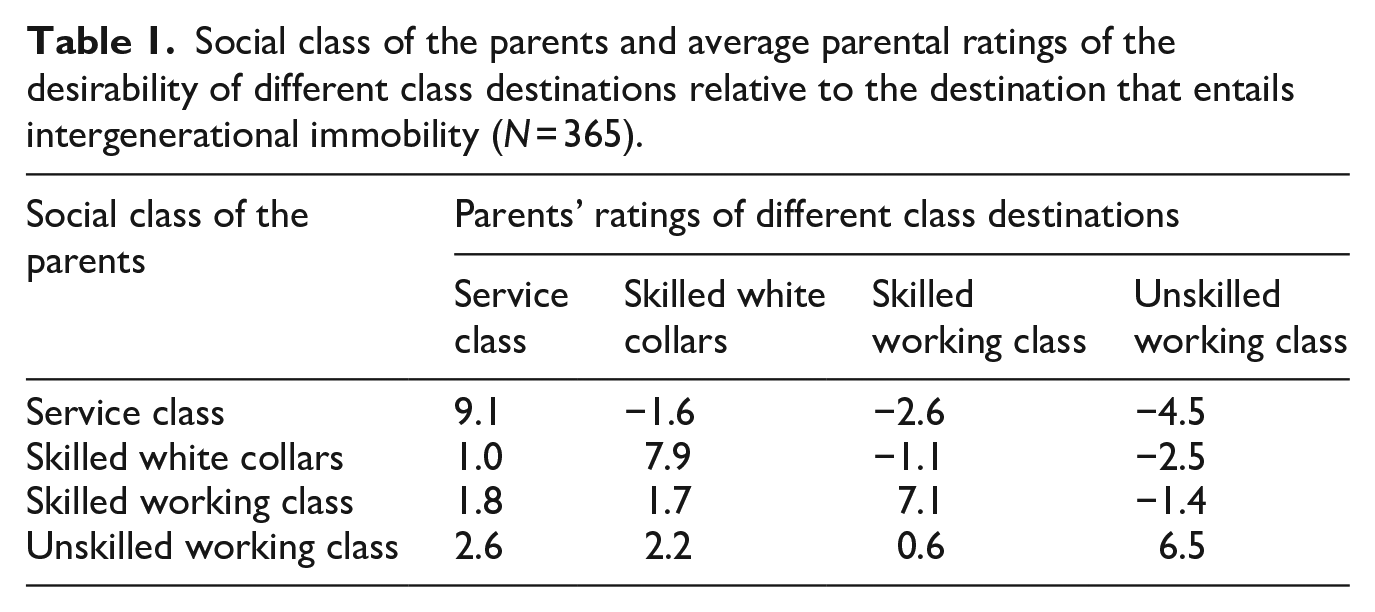
The formalisation of the BY model introduces a slightly more restrictive Loss-Aversion Assumption than the simple asymmetry between upward and downward mobility paths: the change in utility between working-class and service-class destinations, relative to the change in utility between underclass and working-class destinations, must be larger for service-class families than for working-class families:

We have computed this value with our data and, indeed, we observe that this ratio is equal to 14.6 for service class parents and to 6.1 for working-class parents (the range of its values is between −5 and 80). 12 In Table 2, we present the results of multivariate models, where we regress this ratio on parental social class (Model 1). In a second model, we control for two sets of variables. First, socio-demographic variables, that is, country of birth, gender and age of the children. The control for immigration status is particularly relevant, given the large share of immigrant families in Paris, as these families are known to display particularly high social aspirations for their children (Ichou, 2018; Ichou and Oberti, 2014). Second, controls for academic performance of the children and for family economic resources, that is, the two other explanatory mechanisms of educational inequalities postulated by RRA models. These controls are relevant because social aspirations may be adaptive to anticipated constraints (Gambetta, 1996), that is, to the perceived ability or economic barriers to pursue more ambitious educational and occupational paths.
Social class of the parents and relative loss-aversion (N = 365).
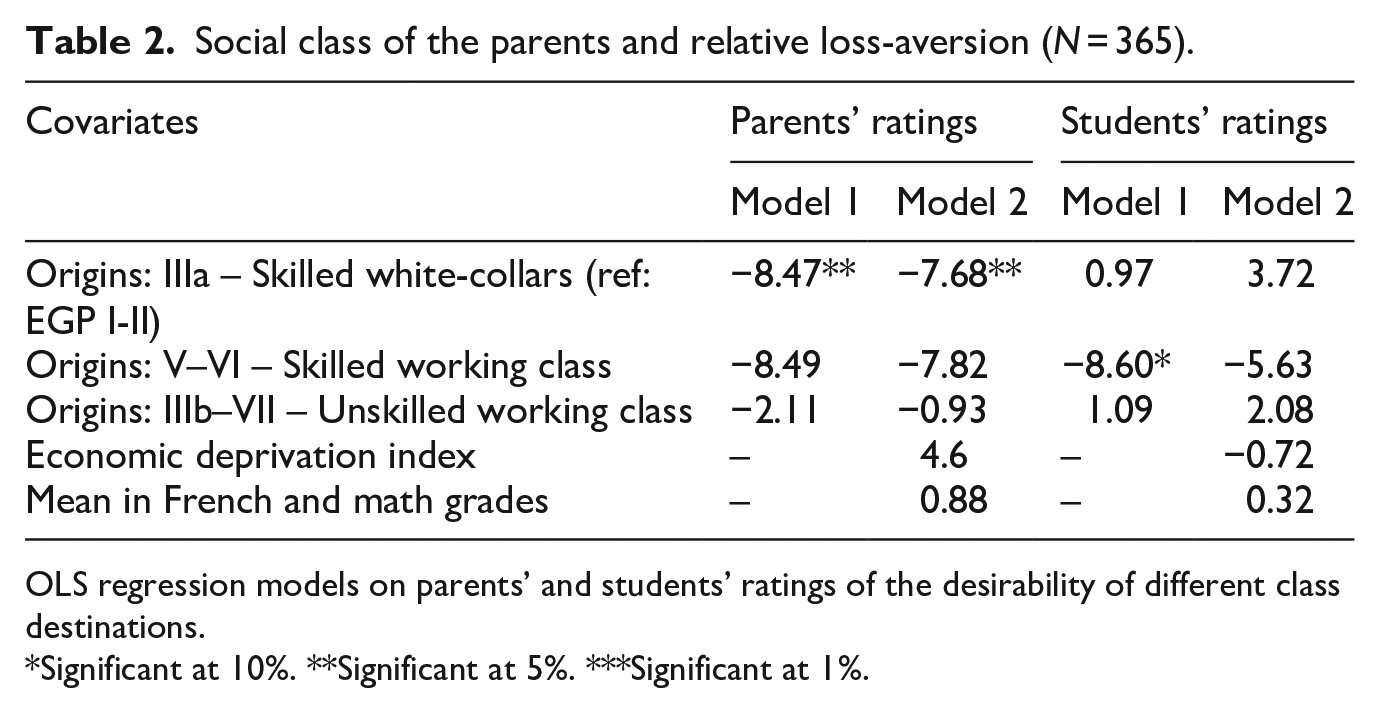
OLS regression models on parents’ and students’ ratings of the desirability of different class destinations.
Significant at 10%. **Significant at 5%. ***Significant at 1%.
As can be seen from the left panel of Table 2, the social origin effects postulated by the BY model follow the expected pattern in both model specifications. In particular, the relative aspirations of skilled working-class parents are lower than those of the service class (reference category) and the same conclusion applies to skilled white-collar parents (but not to their children); the parameter for the skilled working-class parents does not reach statistical significance, while the one for skilled white-collar parents does, despite the small sample size. If we merge these two classes given that the corresponding parameters are virtually identical and rerun the models, the gap relative to the service class reaches statistical significance (results available upon request). However, the predicted pattern is much less visible for parents of the unskilled working class: the corresponding gap is small and non-significant.
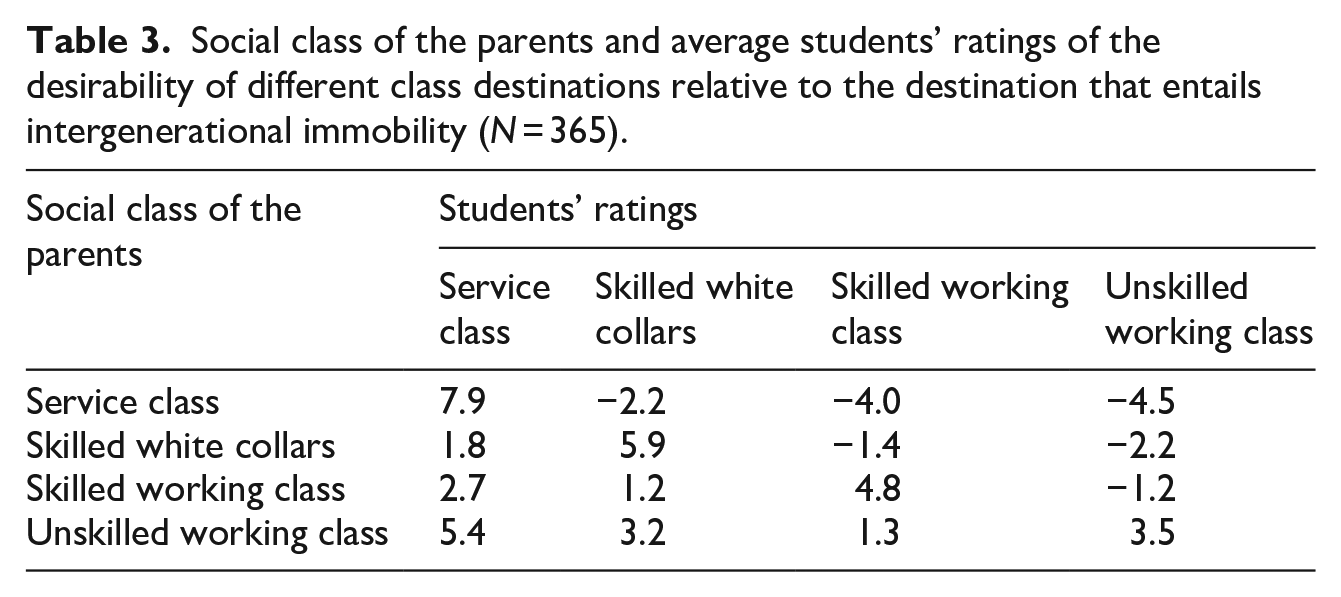
As discussed in section 2, the two RRA models assume that parents and children share broadly similar status maintenance concerns. We have thus collected equivalent data on children’s preferences that we report in Figure 2 and Table 3. Figure 2 shows that, like their parents, students differentiate between immobility, downward and upward mobility, as well as between short- and long-range mobility trajectories. Moreover, we observe again that higher social classes display lower appreciation for lower class destinations, but this pattern is less pronounced for children, particularly because unskilled working-class destinations are highly disvalued by children of all social classes. The estimates for the full student sample, reported in Appendix 1 (Figure A1 and Table A1), are virtually identical.

Social class of the parents and average students’ ratings of the desirability of different class destinations (N = 365).
Moreover, Table 3 suggests that the Loss-Aversion Assumption of the BY model is also met for the children. Again, we detect a pattern of asymmetry between gains and losses, albeit less systematically than for their parents, at least in the case of unskilled working class jobs. Furthermore, we have also run for children the models that refer to the loss-aversion assumption described by the inequality 2. The right panel of Table 2 reports these estimates: we find the expected gap between service class and skilled working class again, but not for skilled white-collar nor for unskilled working-class children. It is possible that the RRA mechanism applies more to parents than to their children: for the former, their own occupation is the most direct, cognitively salient reference point, while children’s ratings may be more forward-looking or more influenced by idealistic aspirations.
Social class of the parents and average students’ ratings of the desirability of different class destinations relative to the destination that entails intergenerational immobility (N = 365).
Finally, we surveyed students on the perceived desirability of leaving the educational system with a lower secondary, upper secondary or a tertiary degree. Their average ratings (on a 0-10 scale) are, respectively, 1.5, 5.1 and 8.1, confirming the high educational aspirations of students. Importantly, the averages by parental education suggest that the loss-aversion mechanism also operates when contrasting children’s and parents’ educational attainment, instead of their class attainment. In particular, if parents left education with a lower secondary degree, their children express lower dissatisfaction (1.7) for this outcome than children of upper secondary (1.3) and tertiary (1.3) graduates. Conversely, children of tertiary graduates express the lowest level of satisfaction for leaving education with an upper secondary degree (4.5), as compared to children of upper secondary (5.4) or lower secondary (5.7) graduates. Here, we have reported the results for children of the parental sub-sample; the results for the full sample, which are virtually identical, are reported in the appendix (Table A2).
Overall, our results confirm that the Downward Mobility Assumption of the BG model does not hold, while the pattern of both parents’ and children’s preferences is more consistent with the BY model, though to a lesser extent for the children than for the parents.
The perceived riskiness of track choices (Risky Choice Assumption)
We can now turn to the second main assumption of RRA models, namely the belief that educational decisions are risky. As discussed above, this assumption seems most plausible for horizontal track choices, where it implies that the academic path is a riskier option than the vocational track. This means that, if students attain an academic diploma but fail to reach a tertiary degree, they will face higher risks of demotion into the unskilled jobs of the underclass than vocational diploma holders.
Parents were asked to rate the chances of accessing the above four destination classes with a tertiary degree, an academic or a vocational upper secondary degree. Figure 3 reports the average scores for these three scenarios. As can be seen, academic diplomas are associated with slightly lower perceived risks of entering the unskilled working class (6.9) than vocational diplomas (7.4). At the same time, the latter are associated with higher likelihood of entering skilled manual jobs (7.4) than the former (6.6). We detect no difference in the chances of access to service-class or white-collar jobs which are perceived to be much higher for tertiary graduates.
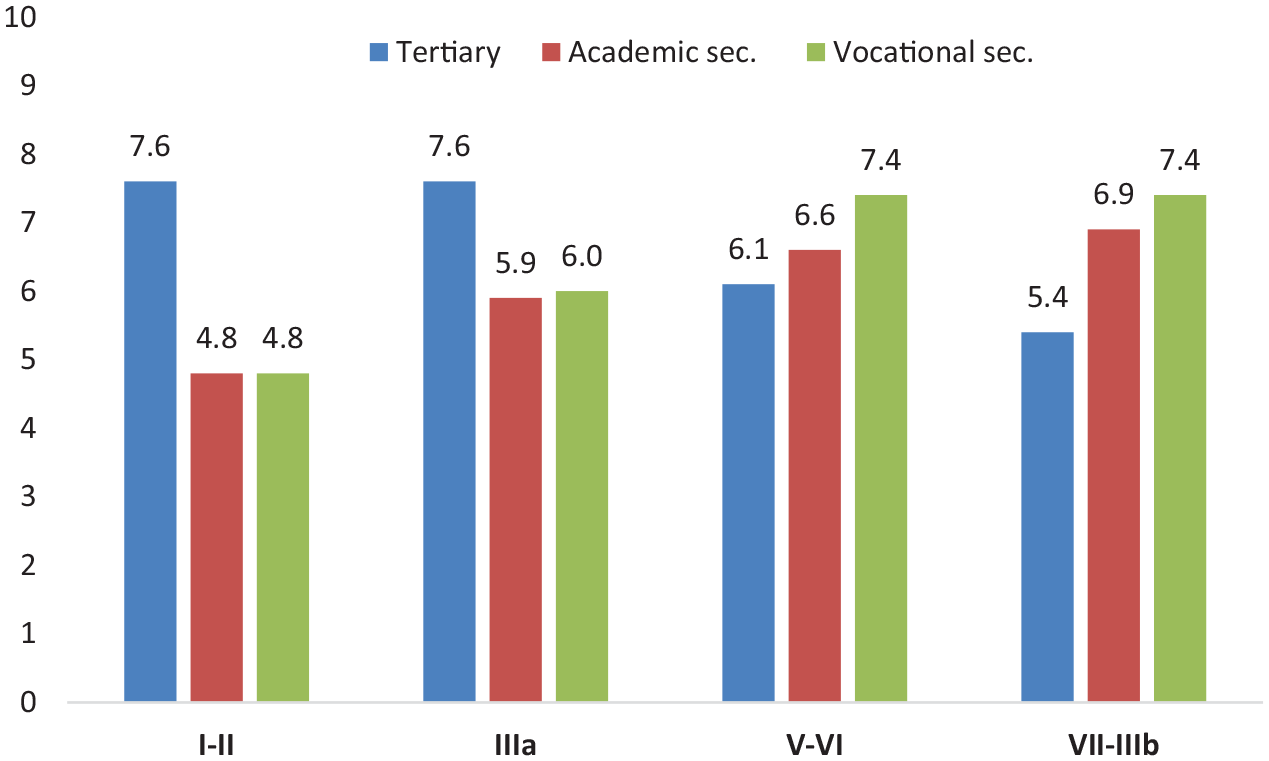
Parents’ beliefs about the likelihood of accessing different class destinations with different educational qualifications (N = 365).
As it was not feasible to ask parents to estimate probability values, we elicited ratings on a 0-10 scale, which do not sum up to a fixed scale of 1 as subjective probabilities do. Hence, a better measure to assess the relative occupational prospects of different educational qualifications is given by the ratio between the estimated chances of entering skilled working-class rather than unskilled working-class occupations with each qualification. As can be seen in Table 4, these relative chances are highly similar among academic (1.07) and vocational (1.11) diploma holders. The results for two other occupational contrasts reported in the second and third row of Table 4 confirm this conclusion. 13 Moreover, the third column shows that the ratios between the values for these two qualifications is always very close to 1 and that its confidence interval contains this value for the first two contrasts. It is thus apparent that parents do not perceive much difference between the occupational risks associated with these two qualifications. The conclusion that the academic track is not perceived as riskier than the vocational track holds similarly across all social classes. 14
Parents’ beliefs about the relative chances of accessing different class destinations with academic and vocational diplomas (N = 365).
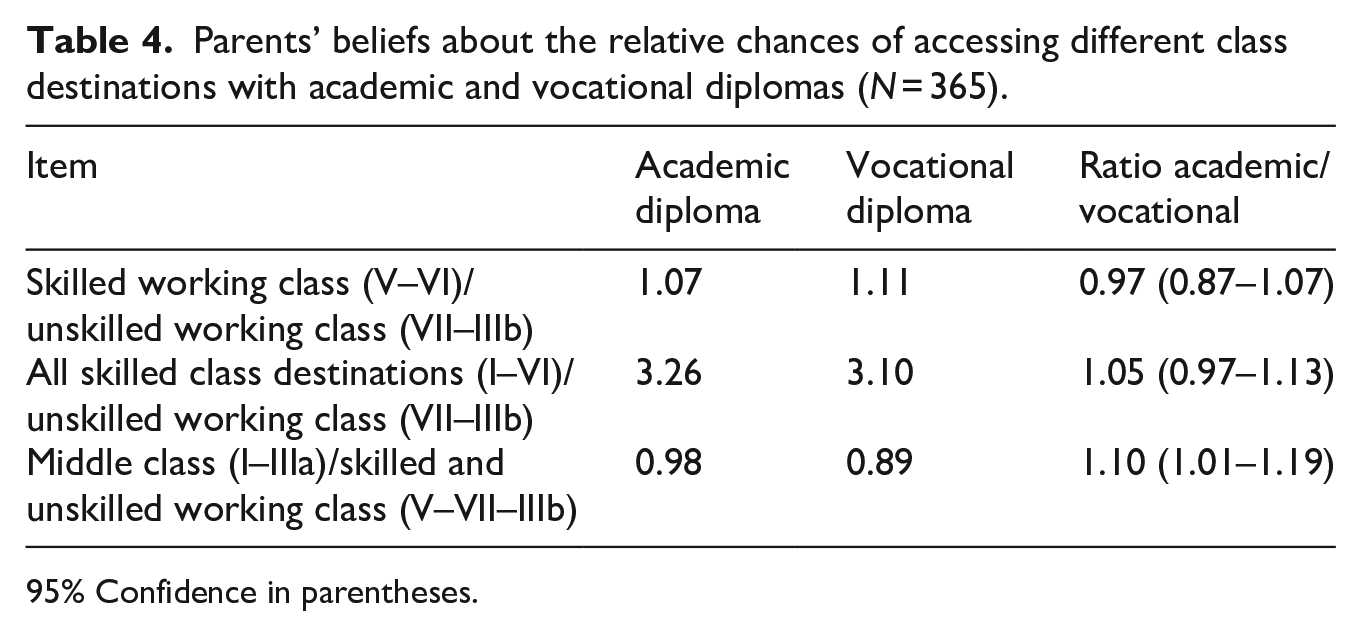
95% Confidence in parentheses.
We have computed similar calculations for the other pairwise comparisons among class destinations accessible with different educational qualifications. The results confirm a pattern that is already apparent in Figure 3 and in Table 4: according to parents, academic and vocational secondary school diplomas face similarly high risks of demotion into skilled and unskilled manual jobs and enjoy similarly low chances of access to the service class. However, academic diplomas offer better relative prospects of access to skilled white-collar occupations. Hence, the option of taking the academic track strictly dominates over the vocational track: it ensures similar or even better occupational prospects even if students with an academic diploma fail to obtain a tertiary degree.
As explained above, we decided not to elicit the same quantitative ratings in the student survey and we opted instead for qualitative items, which are reported in Table 5, asking students to report their agreement on a 1-10 scale. Here, we can differentiate between the two types of academic diplomas (general and technological degrees). We report the percentage of students expressing disagreement with these sentences (ratings below 6), the average ratings and their variations by family background.
Student beliefs about the occupational prospects of high school diplomas by social class of origin (N = 1232); agreement on a 1–10 scale.

The belief that holders of academic diplomas face poor labour market prospects in the absence of a tertiary degree is not consensual at all, and this pattern holds across social classes. Actually, between 51% and 65% of the students express disagreement with the five sentences reported in Table 5. Interestingly, students perceive that technological degrees, which are more applied than general degrees, enjoy somewhat better occupational prospects, but the differences are small. Students from different social classes express similarly sceptical views towards the sentences stating that general or technological degrees are not competitive in the labour market, while the influence of social class is somehow more visible for sentences stating that academic degrees are worth only as gateway to attend higher education. Overall, the assumption that families believe that taking the academic track but failing to attain a tertiary degree is a risky choice is supported neither by the parents’ nor by their children’s responses, and this finding holds across different formats of questions and across social classes.
A simple explanation for this result is that parents and children do not perceive track choices as risky because indeed these choices are not risky, at least in France. Table 6 reports the results of two sets of binomial logit models predicting the chances of demotion into the unskilled working class (using either a broader or a narrower definition) and of access to the service class. We use the data of a large, nationally representative study (FQP survey) and select the population aged 30–59 without a tertiary degree. We consider the gross differentials between vocational diplomas (reference category), technological and general diplomas (Model 1), as well as the differentials when controlling for parental social class and parental education, area of residence, gender, age and ethnic background (Model 2). Additionally, we explore differences between the estimates for the entire country and those for the region of Paris (Ile-de-France).
Type of high school degree and probabilities of entering the unskilled working class (EGP VIIab–IIIb) and the service class (EGP I–II) for high school graduates without a tertiary degree (France, Enquête Formation et Qualification Professionnelle, 30–59 year-olds, N = 2556 for France, N = 324 for the Paris region), average marginal effects, binomial logistic regression.
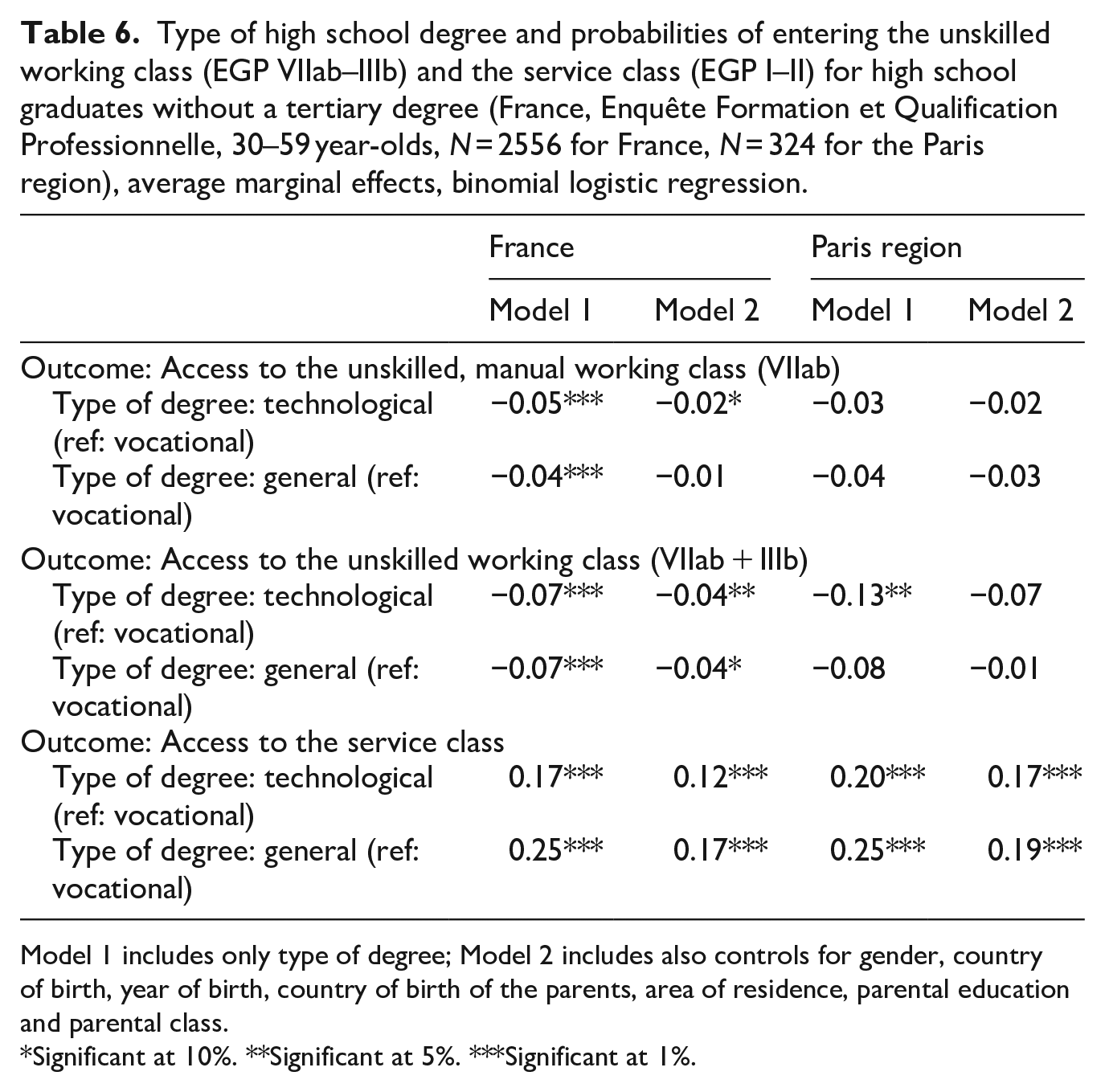
Model 1 includes only type of degree; Model 2 includes also controls for gender, country of birth, year of birth, country of birth of the parents, area of residence, parental education and parental class.
Significant at 10%. **Significant at 5%. ***Significant at 1%.
The results indicate that the risks of demotion into the underclass are actually smaller, not higher, for technological and general diplomas. This result holds for both model specifications, and both nationally and in the region of Paris. The actual differentials between these three types of degrees are quite small, just like the perceived differences reported by the parents. At the same time, the bottom panel of Table 6 shows that both types of academic diplomas are associated with significantly higher chances of access to the service class than vocational diplomas. Hence, the more ambitious option strictly dominates the less ambitious one, in line with the perceptions of the parents. In the online Appendix 2 (Table A3), we use a different data source, based on a recent cohort of upper secondary graduates, to show that this conclusion also holds when controlling for ability selection into tracks.
This conclusion is consistent with the results of a previous study, based on yet another data source (Cereq, 2014). These findings are in our view unsurprising: vocational education in France enjoys low social status and is not perceived to equip students with solid vocational skills (Palheta, 2012). In this respect, France is located at the opposite extreme of the German model of vocational education and training, where the belief that the vocational track works as a safety net could be more plausible (Shavit and Müller, 2000).
Conclusions
RRA models of educational inequalities make the twofold assumption that educational decisions are perceived as risky and that status maintenance concerns drive the upper classes to take these risks more often. In this article, we have argued that the assumption of the BG model describing status maintenance concerns is unrealistic, and that the BY model makes a more realistic assumption, which in turn implies different predictions. In particular, the strong assumption of the BG model that educational decisions are motivated only by the concern to avoid downward mobility implies that the service class makes more ambitious educational choices than the working class regardless of the specific configuration of beliefs that families hold about returns to education. The reason is simple: the more ambitious ‘stay’ option enhances the risk of entering the underclass rather than the working class, but this risk can discourage only working-class families, as the service class is supposed to be indifferent between different lower class destinations.
At the same time, we have demonstrated that this restrictive formulation of status maintenance concerns leads to the prediction that the underclass would always prefer to take the more ambitious educational option. Hence, no other social class would be more ambitious than the class located at the bottom of the class hierarchy, which is unrealistic. This is perhaps the most straightforward indication that this assumption of the BG model is problematic.
If we replace this assumption with the more realistic Loss-Aversion Assumption of the BY model, we obtain a weaker prediction: RRA does not necessarily drive educational inequalities. 15 This may or may not be the case, depending on the specific pattern of beliefs of families about returns to education, as described in equation (2). In this sense, the predictions of the BY model about educational inequalities are belief-conditional. This is intuitively plausible: once we recognise that families care about both downward and upward mobility and that they differentiate between short- and long-range mobility, the utility of each educational option reflects the beliefs about the chances of experiencing these different mobility paths conditional on each possible educational outcome: beliefs about returns to education become crucial.
Hence, discriminating which model assumption about status maintenance motives is more plausible seems important. However, we have documented that the empirical literature on RRA models has paid scant attention to this task. Surprisingly, the BY model has attracted much less attention than the BG model, and the behavioural assumptions of the latter have been often presented in a highly simplified way, and seldom questioned or tested in empirical research. To the best of our knowledge, ours is the first work that proposes a systematic comparison and an empirical assessment of the assumptions of the two models. For this purpose, we have proposed a novel approach to assess the twofold hypothesis that prospective occupational outcomes are framed as gains or losses relative to the social class of the parents (framing) and that losses loom larger than gains of the same magnitude (loss-aversion). We have collected original data specifically designed for this purpose and we have compared the preferences of parents and children.
Our findings indicate that the Downward Mobility Assumption of the BG model is not met, while parents’ and children’s preferences for different class destinations fit closely the Loss-Aversion Assumption inspired by prospect theory. Loss-aversion is a good starting point for a theory of educational preferences. Hence, the BY model marks a significant improvement over the BG model.
In turn, this implies that the relationship between RRA and educational inequalities is less ‘automatic’ than is often presumed, since it is contingent on the empirical patterns of beliefs about returns to education. The problem is that detailed information on these beliefs is seldom available in data about educational choices, which limits the empirical applicability of the BY model. In the absence of data to assess if the pattern of beliefs described in equation (2) holds, we do not know whether the BY model predicts that the upper class makes more ambitious educational decisions than the working class.
The second core assumption of RRA models is that educational decisions are risky. We have suggested that this assumption is not very plausible for vertical continuation decisions. Continuing to the next level and failing would involve a curvilinear pattern of occupational returns, that is, increasing the chances of access to both the top and the bottom, which seems difficult to reconcile with existing theories of returns to education. The problem is that RRA models have been applied to vertical choices without discussing the plausibility of this delicate assumption. Instead, this assumption could be more realistic for track choices, consistent with the so-called ‘safety net’ hypothesis. Importantly, this assumption involves the families’ beliefs rather than the actual empirical patterns, and we have therefore collected data on these beliefs.
Our results indicate that, in the French context, neither parents nor students believe that the academic track is a riskier option than the vocational track. The latter is not perceived to reduce the risks of entering unskilled employment, nor to improve the chances of access to the upper class. This finding contradicts the assumptions of both RRA models. The problem is that, if the more ambitious option entails no occupational risk, everyone will prefer it. Without a perceived risk of social demotion, the constraining element of RRA models is lost, and these models cannot account for inequalities in education. One could of course invoke ability constraints, but RRA is supposed to operate regardless of class differences in academic performance (or income), which should intervene only as a reinforcing mechanism (Breen and Goldthorpe, 1997: 285).
Of course, these empirical findings await further confirmation, not least because they are based on a small local sample. However, we fail to see how the peculiarities of our local context could bias our conclusion that loss-aversion provides a sounder formulation of status maintenance motives than the BG formulation. We would note instead that evidence supporting prospect theory is highly robust across contexts (Barberis, 2013). After all, our results simply show that this general decision-making mechanism is indeed applicable to the framing effects related to family background in educational decisions. In fact, the peculiar characteristics of the local labour market providing the context of our study, characterised by a high share of skilled jobs, may be more influential for the assessment of the second assumption, concerning beliefs on returns to education. However, we have found that in France – not just in Paris – vocational diplomas do not protect from unskilled employment more than academic diplomas. If anything, the opposite is true, even taking into account social and ability selection into tracks.
Hence, we would argue that our conclusions do not reflect the peculiarities of our local context, but rather the awareness of French families of the poor labour market prospects of vocational diplomas. This is a plausible belief, given the characteristics of the French educational system: vocational education is weakly tied to labour market demands and performs poorly in terms of promoting the employability of students. In turn, the same argument suggests that RRA models may be more applicable to countries where vocational education enjoys better labour market prospects. However, even in these contexts, RRA models must further suppose that track choices are irreversible (Breen and Goldthorpe, 1997: 278), that is, if students take the academic track and fail, they cannot switch to vocational education, which may not always be a realistic assumption. At any rate, our findings suggest that the applicability of RRA models may depend on institutional settings. Therefore, it would be interesting to replicate the test of the assumptions of these two RRA models in other countries, where vocational diplomas are more competitive in the labour market.
Another relevant development for future research involves a more detailed assessment of beliefs about returns to education. First, further research could explore data collection methods that would elicit probability estimates of returns to educational outcomes. This would also allow for a direct assessment of the belief condition that is needed in the BY model for RRA to drive educational inequalities. Second, it would be interesting to examine whether families believe that these returns vary over the life course, and which time horizon is more relevant to their educational decisions (Breen and Yaish, 2006; Breen et al., 2014). For instance, vocational diplomas may be regarded as more rewarding in the initial stages of occupational careers and this initial advantage could be more relevant to families with shorter-term preferences. Finally, future research could consider finer-grained distinctions within higher education (such as those between Grandes Écoles, universities and vocationally-oriented institutions in France), which affect the value of tertiary degrees as gateways to the upper classes.
More generally, future research could collect more and better data on status maintenance motivations and the related beliefs: our study is a first exploratory attempt in this direction. Our results point to a rough correspondence between subjective beliefs and actual class returns. Further corroboration of this correspondence would then enable testing the assumptions of RRA models with data on actual returns.
Our main substantive conclusion is that RRA may not drive educational inequality, for two reasons. First, the Downward Mobility Assumption is unrealistic and must be replaced by the Loss-Aversion Assumption. As demonstrated by Breen and Yaish (2006), this in turn implies that RRA fuels educational inequalities only under specific configurations of beliefs about returns to education. Second, families may not believe that educational decisions entail the kind of occupational risks assumed in these models. Then, we miss the constraining element of RRA models that should lead some families not to take the more ambitious option.
To be sure, our conclusions do not imply that educational stratification researchers should abandon RRA models. First, it may be possible to reformulate the BY model to further enhance the plausibility of the Risky Choice Assumption. Second, in this study, we have focused on the BG model (and on its closest reformulation) because of its prominence in empirical research, but other formalised models of RRA are available that could at least in part deal with these problems (Malloy, 2015; Tutic, 2017). Third, RRA per se may not drive educational inequalities, but our results suggest that it represents a plausible description of educational decision-making, if framed via the loss-aversion mechanism. This conclusion is indeed consistent with the results of several empirical tests of the BG model reviewed in section 1: while indirect tests report that RRA shapes educational decisions, direct tests indicate that it only modestly accounts for so-called “secondary effects”. Then, educational inequalities may be generated by the interplay between loss-aversion and other decision-making mechanisms, such as heterogeneous time-discounting preferences (Breen et al., 2014) or the class-biased over-estimation of risks of educational failure (Barone et al., 2018; Erikson and Jonsson, 1996). The interplay between RRA and peer effects is another promising avenue for future research: if the reference threshold of students reflects not only their parents’ occupation, but also their peers’ occupational aspirations, the social segregation of peer networks could foster educational inequalities (Manzo, 2013).
Supplemental Material
sj-pdf-1-rss-10.1177_1043463121994087 – Supplemental material for Relative risk aversion models: How plausible are their assumptions?
Supplemental material, sj-pdf-1-rss-10.1177_1043463121994087 for Relative risk aversion models: How plausible are their assumptions? by Carlo Barone, Katherin Barg and Mathieu Ichou in Rationality and Society
Footnotes
Funding
The author(s) disclosed receipt of the following financial support for the research, authorship, and/or publication of this article: This study benefited from a grant from Sciences Po based on the assessment of its Scientific Advisory Board.

Supplemental material
Supplemental material for this article is available online.
Notes
References
Supplementary Material
Please find the following supplemental material available below.
For Open Access articles published under a Creative Commons License, all supplemental material carries the same license as the article it is associated with.
For non-Open Access articles published, all supplemental material carries a non-exclusive license, and permission requests for re-use of supplemental material or any part of supplemental material shall be sent directly to the copyright owner as specified in the copyright notice associated with the article.
