



Abstract
In this study we investigate the application of the Maxson and Klein gang typology on a dataset of seven Swedish street gangs. Individual-level data on 239 gang members were analyzed. While some Swedish criminologists maintain that no street gangs exist in Sweden, this research project provides evidence to the contrary. Findings support the utility of the Maxson and Klein typology. Results show that the “compressed gang” was the most common type of street gang in the dataset. This finding is also in concert with other European gang studies, adding further evidence for the applicability of the gang typology. Findings also suggest a similar pattern of gang development and structure to that of American and European street gangs.
Introduction
The majority of gang studies have been conducted in the United States using American datasets. However, during the past few years, there has been a growing interest among European researchers to study gang-involved youth (Decker & Pyrooz, 2010; Esbensen & Maxson, 2012; Esbensen & Weerman, 2005; Haymoz & Gatti, 2010). These studies suggest that European street gangs and gang-involved youth may be similar to their American counterparts. These findings would imply that American gang typologies could also be useful in a European context.
Despite recent attempts at developing an “international scope” to the gang problem, Swedish gangs have not yet caught the interest of researchers. Criminological explorations in Sweden have mainly been limited to “juvenile networks” (Sarnecki, 2001). In fact, there has been a widely held research belief among leading Swedish criminologists that street gangs, such as those found in the United States, do not exist in Sweden (Fondén & Sarnecki, 1996; Pettersson, 2002; Sarnecki, 2001; Sarnecki & Pettersson, 2001). These Swedish studies posit that these groups are simply various forms of juvenile delinquent networks. As Klein (1995) points out, however, juvenile offending should not be equated or confused with street gang criminality—that is, not all gang members are juveniles. Klein would argue that some street gang members can be in their 20s or older. We believe, based on our experience working with gangs at the Stockholm County Police, that street gang criminality is more organized than loosely tied networks of delinquent youth. In fact, we have seen some development in our case files that suggests that gang members are older than juvenile delinquents and that they engage in various types of crime, including serious, violent crimes. This phenomenon has also been documented elsewhere (Lindmark, 2005; Rikskriminalpolisen, 2009; Rostami, 2010). This would seem to be in concert with American and European trends. For example, the upper age limit of gang membership in the United States has risen over time, expanding the issue beyond a juvenile matter (e.g., Klein, 1995; Maxson, Curry, & Howell, 2002). This reiterates the need to look beyond the existing Swedish literature on “juvenile networks” and juvenile delinquency and adopt a broader research agenda.
Gang Typologies
The literature shows several methodical attempts at creating a single gang typology. The benefit of a single gang typology is that it would facilitate comparative studies across nations (Maxson, 2001). Some of this work has recently emanated from the Eurogang network, whose primary function is to foster systematic research on gangs and youth groups in Europe. Information gleaned from these studies can be compared to U.S. research findings in an attempt to get a broader understanding of the gang phenomenon from an international perspective—a perspective that, according to some, is long overdue (i.e., Knox, 2009). Such an endeavor, however, is riddled with several difficulties, as noted by Maxson (2001). Most notably is the fact that it requires extensive data collection at the city and neighborhood levels. To date, most typologies have been developed using U.S. datasets. Indeed, various gang typologies have been proposed since the late 1920s. For example, Thrasher’s (1927) seminal work is arguably the first attempt to explain why gangs form and that gangs were the product of “in between” urban spaces, fueled by spontaneity and strengthened by conflict over time (pp. 116-117).These early attempts to describe gangs and to identify types of gangs focused more on gang behavior than structural properties. For example, Yablonsky (1962) continued the work of Thrasher and classified gangs into one of three types: delinquent gangs, violent gangs, and social gangs. Cohen and Short (1958) classified theft, conflict, and addict gangs based on predominant crime orientations within a group (Klein & Maxson, 2006). Likewise, Cloward and Ohlin (1960) put forth their criminal–conflict–retreatist subculture theory of gangs based on the preferred behavior of gang members.
Four years later, Spergel (1964) replicated findings that supported the behavioral–criminal pattern that had been offered by earlier researchers (Klein & Maxson, 2006). Spergel used police records and interview data from “Racketville” and “Slumtown” and observed differential opportunities between gang members in the two study locations (Curry & Decker, 2001). Based on his analysis, Spergel argued that the gangs were “defensive” (Racketville) or “offensive” (Slumtown) in nature, and concluded that status (by way of toughness and fighting ability) and individual reputation were the motivating factors for gang members.
In the late 1960s, Klein evaluated gang intervention programs in Los Angeles. In the course of his research, Klein (1971) noticed that some examined gang interventions actually strengthened the gang label and increased gang cohesiveness. Klein focused on the behavioral aspects of gang membership and noted that the more frequent gang members met, and the more important the gang was perceived by others, the stronger the gang cohesiveness. Klein and Maxson (2006) argued that the Klein’s (1971) study culminated the “classical” era of gang research and moved the field into the “modern” era; an era where typology research would move away from behavior-based typologies to structural typologies—that is, typologies based on structural dimensions such as “gang size, age ranges, gender, ethnicity, locations, leadership, subgroupings, gang cohesiveness, duration over time, and organizational forms” (Klein & Maxson, 2006, p. 172).
Move Toward Structural Typologies
One of the first structural attempts at a gang typology was offered by Martin Sanchez Jankowski in 1991 (Curry & Decker, 2001). By using a dataset consisting of gangs in three major U.S. cities, he suggested that there are three gang structures (vertical, horizontal, and influential) contingent upon the gang leadership or authority structures within the gangs. To Jankowski, gangs have strong organizational structures and well-defined roles, which was a radical shift from previous thoughts on gangs. Moreover, he described gang members as “defiant individuals” who possessed a set of personal traits (e.g., competitiveness, wariness, social isolation, strong survival instincts, etc.) that influences how members found their roles within the gangs. Jankowski argued that gangs functioned much like “private governments” that foster positive relationships with the local communities (Curry & Decker, 2001).
Other structural dimension studies include the works of researchers such as Klein (1971), Moore (1991), and Padilla (1992) to name a few. For example, Padilla (1992) looked at a Chicago drug-selling gang and drew on the work by Moore and Vigil in an attempt to understand the gang by way of ethnic experiences of Puerto Rican youth in Anglo culture, thereby using a structural dimension in explaining gangs (as cited in Curry & Decker, 2001).
However, Klein and Maxson (2006) argued that previous structural efforts have suffered from several limitations that minimize their contributions to the development of gang typologies. For example, previous work has not classified gangs as units and has not explored differences between gangs, which limit the utility in terms of a typology (p. 172). Conceivably, the practical applicability of a gang typology for law enforcement is to differentiate between various gangs and to devise appropriate enforcement responses depending on the type of gang (Leinfelt & Rostami, 2012). As such, a typology that does not make distinctions between gangs has limited utility.
The Maxson and Klein Typology
The present study will use the structural typology developed by Klein and Maxson (2006). Based on the six structural characteristics of size, subgrouping, age range, duration, territoriality, and crime versatility, this typology yields five types of street gangs that account for 75% to 95% of all American street gangs (Klein, Weerman, & Thornberry, 2006). In developing their typology, they used a stratified sample of 59 cities with identified street gangs. The sample came from their previous 1992 survey of 792 cities. Klein and Maxson (2006) used period of gang onset in the cities as a basis for stratification (i.e., 1970 and earlier, 1971 to 1984, 1985 to 1992). They then conducted an analysis of six structural dimensions (subgroups, size, age range, duration, territorial, and crime versatility) searching for patterns of relationships among these dimensions (Klein & Maxson, 2006). This analysis yielded the five types of street gangs: traditional, neotraditional, compressed, collective, and specialty gangs.
In an attempt to validate the typology, Maxson and Klein also conducted a phase II sample analysis (interview data from 201 cities in the United States) and reviewed other existing American and European descriptions of street gangs (Klein & Maxson, 2006). The results of these validations did not deviate significantly from their initial five types of street gangs, which are described as follows:
(Klein & Maxson, 2006, pp. 176-177)
The current study will describe characteristics of 239 gang members representing seven major street gangs in Sweden. We will then examine the extent to which the Klein and Maxson (2006) gang typology (developed to describe American gangs) holds true for Swedish gangs. In contrast to previous Swedish studies, (e.g., Fondén & Sarnecki, 1996; Pettersson, 2002; Sarnecki, 2001; Sarnecki & Pettersson, 2001), we posit that street gangs exist in Sweden. Furthermore, we posit that these street gangs are similar in composition and structure to those found in the United States, although less territorial in nature and less violent in comparison. Such an assertion would be in concert with other findings contrasting gang youth to nongang youth in Europe (e.g., Klein et al., 2006).
Method
The Definitional Issue
There are significant disagreements among researchers about the appropriate conceptual and operational definitions of gang membership (Bjerregaard & Lizotte, 1995; Decker, 1997; Horowitz, 1991). Even among practitioners there is a lack of consensus regarding how to define “gangs.” Agencies such as the Europol and the Swedish National Police have not adopted a gang definition, which complicates matters further, especially for researchers and policymakers in Europe and Sweden. One common approach towards the operationalization of gang membership is to allow gang members to identify themselves as being gang members (Esbensen, Huizinga, & Weiher, 1993; Horowitz, 1983; Huizinga, Loeber, Thornberry, & U.S. Office of Juvenile Justice and Delinquency Prevention, 1994; Miller, Maxson, & Klein, 2001). One of the major disadvantages of this “identification approach,” however, is the possibility that gang members use different definitions of a “gang.” That is, individuals may identify themselves as being gang members, when in fact they are not, while others may fail to self-identify.
Another lingering debate in the literature is whether involvement in criminal activity should be a requirement for a gang definition. We would argue, in consensus with the Eurogang definition, that “. . . group involvement in illegal activity is a critical distinguishing element of youth gangs. Without this illegal activity, the group would not generate the policy interest that gangs currently and historically have” (Weerman et al., 2009, p. 29).
Although our sample would fit the Eurogang definition of street gangs (e.g., a street gang is any durable, street-oriented youth group whose involvement in illegal activity is part of its group identity), this definition was not used as a selection criterion in the current sample since the Swedish Police does not have a working definition of gangs or gang members.
Data
While there are limitations with official data, it is common for researchers to use data based on information collected by law enforcement agencies. In fact, much of the current knowledge on gangs is the result of studies relying on such data (Curry & Spergel, 1988; Klein & Maxson, 1989, 2006; Miller, 1975; Spergel, 1995). Moreover, as described above, Maxson and Klein used police data to develop their gang typology. Furthermore, the largest ongoing gang data collection effort in America—the National Gang Survey—also relies on police data.
Data Source and Context
The National Swedish Police Intelligence (NSPI) recently identified seven gangs as the most notable and prominent street gangs in Sweden (Rostami, 2010). This selection of “prominence” was based on several criteria, including available criminal intelligence (open and covert), the number of current criminal investigations on gang members, and gang member convictions. All seven gangs frequently appear in media reports and some of the members of these gangs have even made “exclusive” interviews in evening newspapers. All seven gangs support their gang identity by way of symbols, signs, clothing, tattoos, etc.
We utilized primary sources from the Police Intelligence Registry (PIR) to identify gang members from these seven gangs. In doing so, we created a dataset of 239 gang members. Once we had established the identity of the gang members, we gathered individual-level data (e.g., age, gender, ethnicity, place of birth, income, place of residency, and criminal record) from various governmental records to get a complete “member profile.” This information was then summarized in a separate electronic dataset. For the purposes of this article, the gangs are fictitiously called ALPHA, BRAVO, CHARLIE, ECHO, FOXTROT, KILO, and ROMEO.
What Is a “Street Gang” and a “Gang Member”?
On street gangs: In Sweden, some sources state that there are approximately 95 different criminal gangs as of 2010 (Wierup & Larsson, 2010). It should be noted, however, that this figure includes all types of gangs and is therefore not limited to street gangs; that is, the figure of 95 is inclusive of outlaw motorcycle gangs, prison gangs, and white extremists. Unfortunately, there are no estimates on how many street gangs there are in Sweden. As such, we do not know how well our seven street gangs compare to other Swedish street gangs. However, the NSPI selected these seven gangs based on their analysis of the current street gang situation in Sweden.
Some of the gangs used in this study established websites where their criminality and criminal lifestyle are promoted and used as a portal for recruiting, which supports a strong gang mentality. Moreover, all gangs used in this study displayed their gang affiliation by way of emblems, tattoos, gang names, and/or particular clothing. In addition, in an attempt to validate the NSPI data, we have conducted in-depth interviews with 24 gang members drawn from the seven gangs used in this study (i.e., roughly 10% of the total sample). Findings from those interviews support the notion of a strong street gang identity.
One discrepancy between the Eurogang definition and gang members in our sample, however, is the youth issue. We would argue that street gangs in Sweden are more than just groups of young adolescents. Our data suggests that gang members in Sweden are much older than what has been found elsewhere. As such, member behavior and belongingness (brotherhood) and wearing a particular symbol, clothing, sign, or tattoo seems to be better descriptors than member age.
On gang members: Data from the Swedish Security Police show that there are approximately 4,000 individuals involved in criminal gangs in Sweden as of 2010 (Säkerhetspolisen, 2009). Again, this figure is not exclusive to just street gangs but includes all types of gangs. An exact figure of the total number of street gang members in Sweden is not available.
Information on the gang members in this study was primarily gathered from two sources: (1) police officers and (2) external or investigative sources. Patrol officers working in uniform or in plain clothes may, for example, observe or interact with gang members as part of their normal duties. They are encouraged to report this observation to their local criminal intelligence unit by filing an intelligence report. There is, however, no guarantee that officers always file a report. As such, we do not know how many potential gang members are missed from these interactions.
Information about gang members can also be derived from other sources, such as witnesses, admissions, confidential informants, etc. This information is compiled into a PIR. However, although the information is initially recorded in an intelligence registry, there are certain criteria that have to be met before an individual is classified as a full-worthy gang member, regardless of the number of observations and/or other available personal information. This is a quality control procedure employed by the Police to guarantee the integrity of the gang information. All individuals used in this sample were classified by the police as a full-worthy gang member (e.g., they were not wannabes or prospective members).
Results
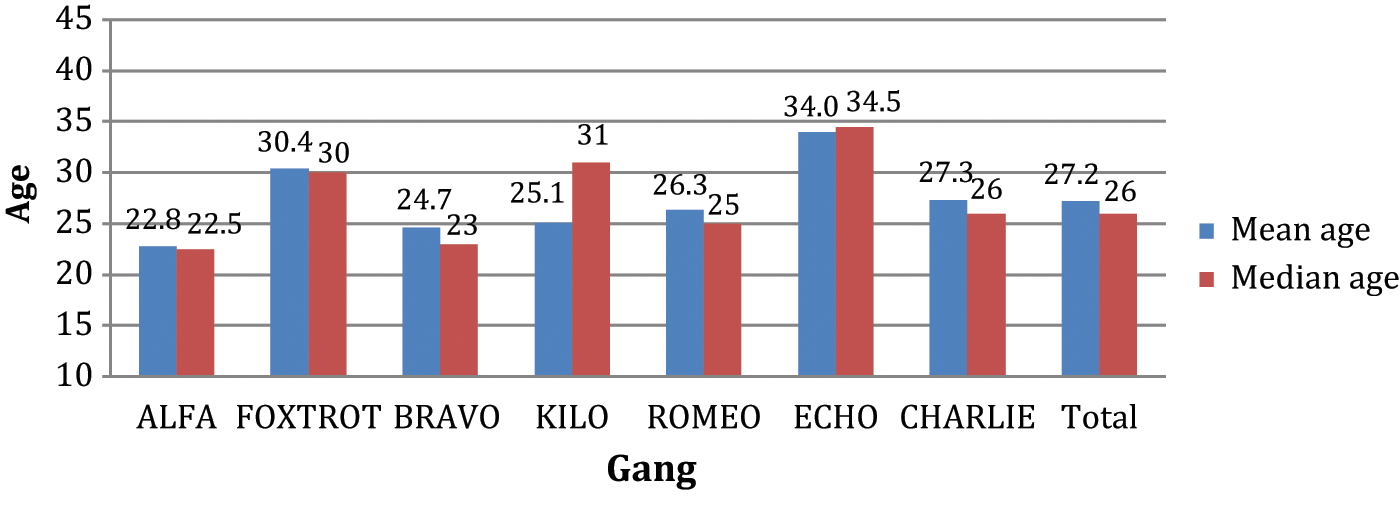
Mean and median age of gang members by gang are shown in Figure 1. As shown, the mean and median age varied between the examined gangs, ranging from a mean age of 22.8 (ALPHA) to a mean age of 34 (FOXTROT). This is an interesting finding given that some criminologists in Sweden posit that “street gangs” are only loosely tied networks of juveniles. Our data suggest that street gang members in the examined sample are in their early to late 20s. The gang members range in age from 15 to 49; data also show that 43 out of 239 (18%) were between the ages of 15 and 21. 1 The largest age group was 22 to 28 year olds (112 members, 47%), followed by 29 to 35 year olds (63 members, 26%). The conclusion seems to be that most gang members are adults not juveniles. Gang members in this Swedish dataset have a higher mean age than what has previously been reported in American street gangs, but are in concert with other European findings (Klein et al., 2006).
Gang members’ mean and median age
All gang members in the dataset study were men. Swedish gangs are predominantly, or even exclusively, male. However, survey research tends to report higher female participation than do observational studies (Klein et al., 2006). Self-report data from the United States typically show that approximately 25% to roughly 50% of gang members are female. This is a striking contrast to the law-enforcement estimate, which is somewhere around 6% (Klein & Maxson, 2006). The lack of females in our dataset could potentially be explained by the use of law-enforcement data, as females tend to show up less frequently in arrest records (Klein & Maxson, 2006), although a different picture tends to emerge from survey data. For descriptive purposes, we report the race/ethnicity of gang members included in this study. We categorize the gang members by (1) country of birth and (2) their parent’s county of birth to identify the members’ ethnic group tie. Data show that roughly 42% of members are born in Sweden with a large population of ethnic Swedes (24%). We do not find a large concentration of members from one particular area or country. To the contrary, we find wide variation in countries with 35 different countries represented in our dataset (representing 40 different ethnicities). We grouped the members’ place of birth in geographical subregions according to the United Nations geographical classification. 2 Table 1 shows that the majority of gang members were born in Northern Europe (45%) followed by Western Asia (24%), and when we examine the member’s ethnic ties, we find that members from Western Asia were the dominating group in the sample (35%), followed by members with ethnic ties from Northern Europe (27%).
Gang Member (Country of Births–Ethnicity) by Geographical Subregion
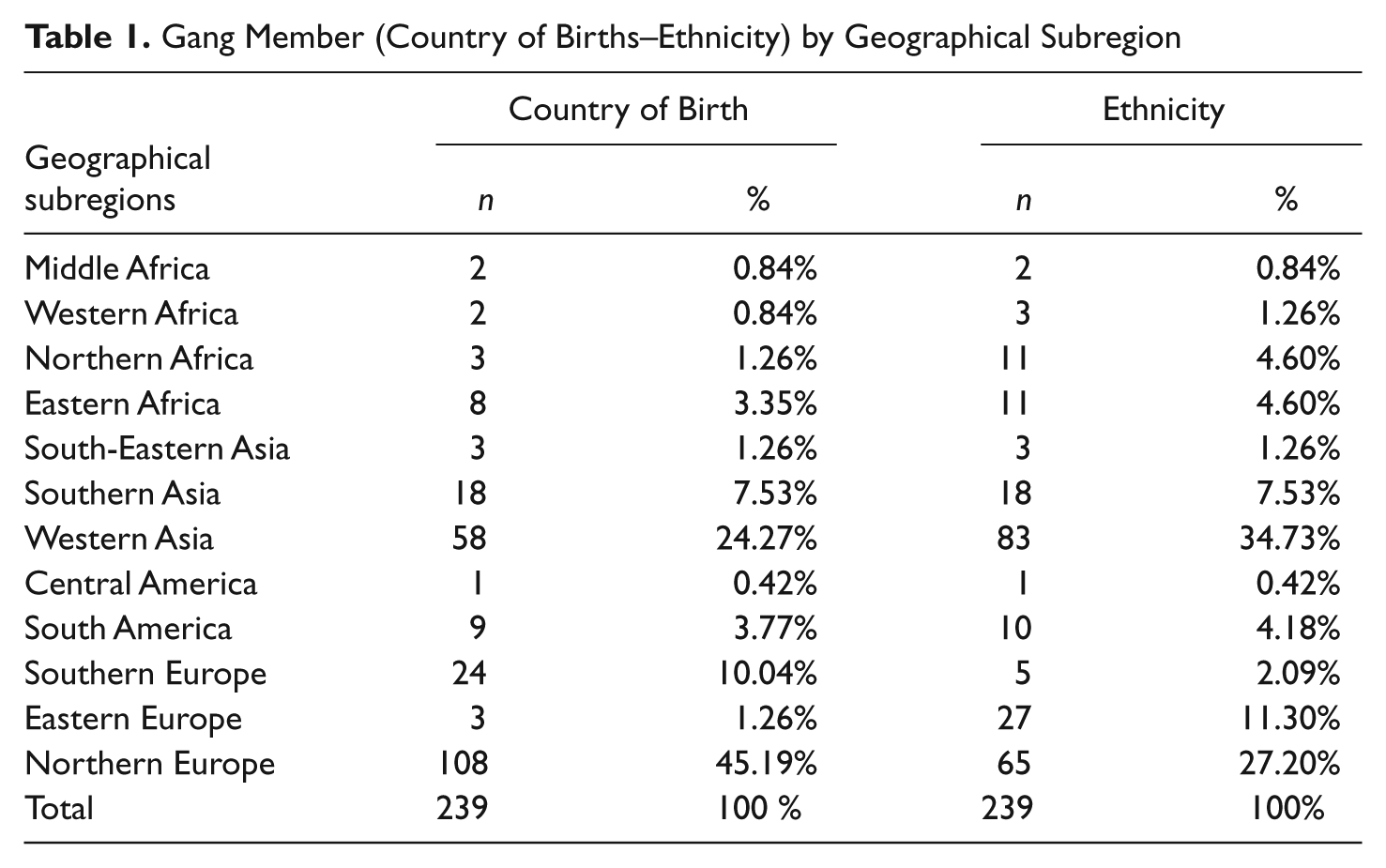
Consequently, the data show ethnically heterogeneous gang members both in terms of ethnic ties and country of birth. For example, 76% of members are first- or second-generation immigrants from a number of different countries and regions. Our results indicate that the gang situation in Sweden is a multiethnic phenomenon and, accordingly, not related to a specific country, ethnicity, region, or culture.
Gang Characteristics and Structure
Size and Duration
The development of street gangs in Europe is a recent phenomenon when compared to the United States. As such, street gangs with durations exceeding 10 to 15 years are not very common, as street gangs have not had a chance to stabilize over time. Only in Kazan (Russia) have researchers found gangs exceeding 20 years duration. Moreover, most European street gangs tend to have 50 or fewer members (Klein et al., 2006).
All of the five types of gangs presented in the Klein and Maxson (2006) gang typology have been represented for more than 40 years in the United States, even though three of the five types of gangs are described as having a relatively short life span. Nonetheless, the likelihood of finding gangs with long duration is much greater in the United States than in Europe. Even so, the most common type of gang found in the United States, when applying the Maxson and Klein typology, is the compressed gang with a 5-year duration and with 10 to 50 members (Klein et al., 2006).
In our dataset, none of the examined gangs have a longer duration than 18 years. ROMEO was the gang with the longest duration (18 years), followed by FOXTROT (11 years), KILO (6 years), ALPHA (6 years), ECHO (3 years), CHARLIE (3 years), and BRAVO (2 years). It would seem that ROMEO is an exception, mainly because there are no police reports of any other street gang prior to 1999 in Sweden. As such, ROMEO could be seen as the first Swedish street gang.
If we look closer at the size, we find that there is no correlation between size and duration. ROMEO is, for example, not the largest gang (n = 44) but has the longest duration. BRAVO is the largest gang (n = 73) but has the shortest duration. Perhaps BRAVO’s great numbers could be explained by a recruitment campaign intended to facilitate a claim to territory, or to gain a criminal reputation, and/or to gain violent capital and “respect” (Rostami, 2010). Taken together, our results are in concert with previous studies on European street gangs, which is that most street gangs have 50 or fewer members and a duration of less than 15 years (Klein et al., 2006).
Criminal Behavior Pattern
It is widely recognized among researchers that street gangs are connected with violence. Aggressive and violent youths are at greater risk of joining street gangs (Klein et al., 2006). But it is equally true that such groups promote and facilitate violence. The most common pattern regarding street gangs’ criminal behavior is that they engage in a cafeteria-style offending (Curry & Decker, 2001; Esbensen & Huizinga, 1993; Esbensen, Peterson, Taylor, Freng, & Wayne, 2001; Esbensen & Winfree, 1998; Klein & Maxson, 2006; Thornberry, Burch, & U.S. Office of Juvenile Justice and Delinquency Prevention, 1997; Thornberry & Krohn, 2003).
How researchers identify crime versatility can differ from study to study, since crime can be grouped in slightly different ways. For example, police may vary in how they classify offenses and some offenses may not be offenses at all in other countries. Naturally, this procedure will influence the various depictions of gang crime. Self-report and interview studies sometime query subjects about illegal activities in their gangs, but patterns are reported by individuals rather than by gang (Decker, 1997; Esbensen et al., 2001).
We lack a coding system of gang crimes in Sweden; neither law enforcement nor the Swedish National Council for Crime Prevention (BRÅ) keep records of gang crime. Therefore, our data are based on crimes committed by individual gang members. Our findings do not tell us much about gang crime patterns at the group level, but we can identify the crime pattern of the gang members and find a distinct pattern.
The predominant form of street gangs in both Europe and the United States is the compressed gang according to the Klein and Maxson typology—that is, gangs with a versatile criminal behavior pattern. The second most common type of gang in Europe is specialty gang, with a predominantly narrow criminal focus (Klein et al., 2006). Traditional or neotraditional gangs with versatile crime pattern are common in the United States but not seen very often in Europe (Klein et al., 2006).
One of the characteristics that determines the type of gang, and makes it possible to compare gangs, between countries, is the crime pattern of gang members. For example, the major distinction between the “compressed gang” versus the “specialty gang” is the criminal behavior pattern. The compressed gang is versatile in its offending, whereas the specialty gang is focused on a few offenses. We present the criminal behavior profile of the examined street gangs in Table 2. This profile was derived from analyzing each gang member’s criminal records (convictions).
Gang Members’ Criminal Convictions, Rates Per Gang Member, by Gang
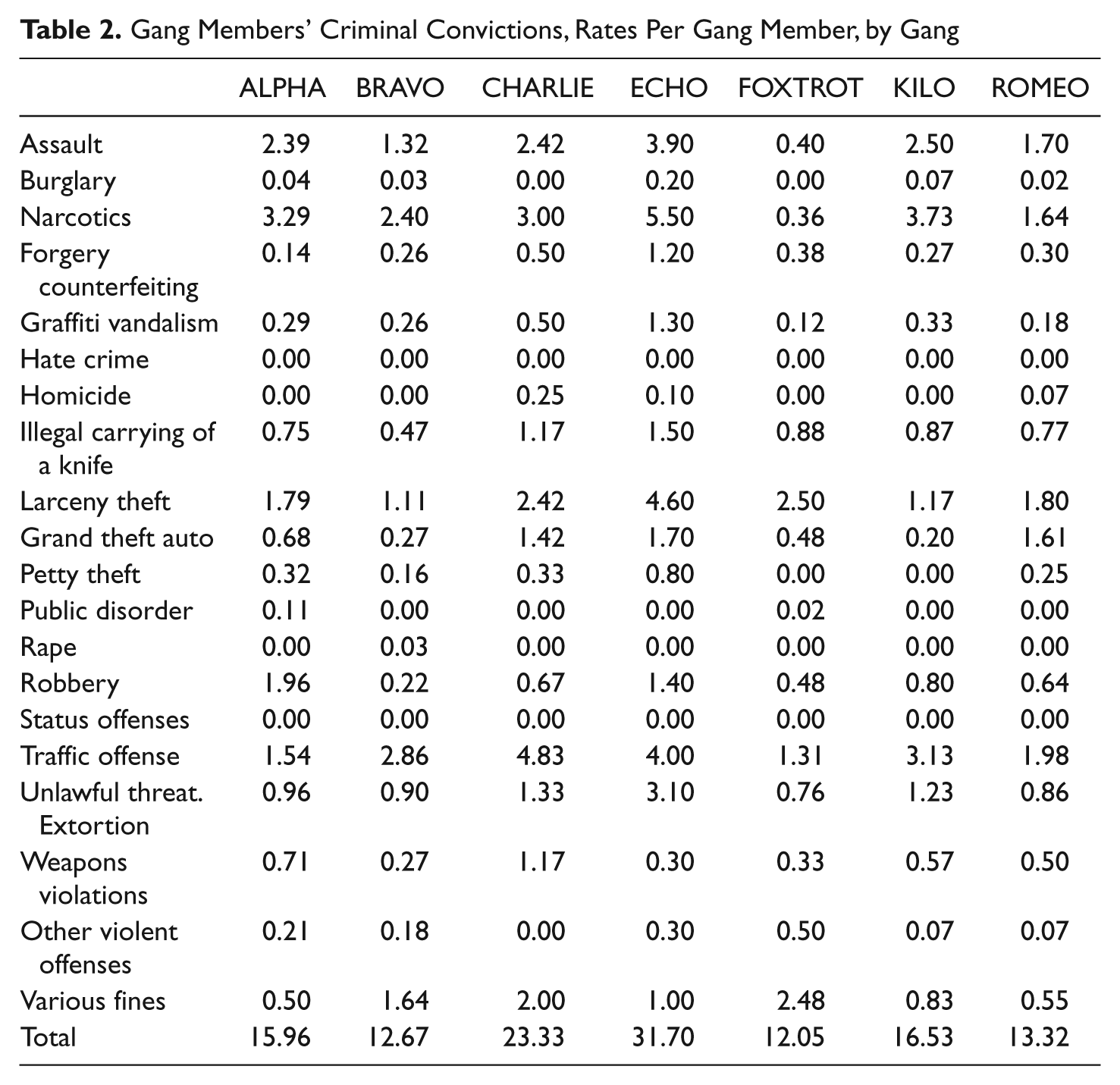
Our analysis is based on a wide range of offenses, from minor to serious, including property offenses, drug-related offenses, public disorder, weapon offenses, and various violent crimes such as robberies, assaults, and homicide. Findings suggest that we have street gangs with very different criminal behavior patterns.
When we exclude traffic offenses and administrative fines, findings suggest that FOXTROT is the only street gang that is not versatile in its offending. FOXTROT seems to be focused on larceny and theft-related offenses at a rate of 2.5 per gang member, whereas most other types of crimes have a close to zero rate of convictions per member. The high level of regulation fine and traffic offenses for FOXTROT could be explained by the use of “stop and search” tactics by the police. For quite some time, the police have increased their presence in the area where most of the FOXTROT gang members live.
ALPHA, ECHO, ROMEO, CHARLIE, AND KILO show a comparable pattern when we look at the rate of convictions, with not only high levels of violence and drug-related crimes but also involvement in different kind of thefts. ALPHA stands out with a high level of robbery convictions (rate of 1.96 per member). Results also indicate that the levels of firearms and homicides are very low. CHARLIE shows a rate of 1.17 convictions per member for weapon offenses, whereas all other street gangs have rates below 1.0 per member. These results are in line with previous European gang studies that show that European gangs are less violent than U.S.-based gangs (Klein et al., 2006). With the exception of FOXTROT, all other gangs have relatively high rates of drug offending (includes both possession and possession with intent to distribute). 3
To summarize, the data suggest that the examined gangs concentrate on income rewarding crimes and that all gangs, with the exception of FOXTROT, display and engage in a crime versatility pattern. These results are in concert with previous studies on European street gangs, which is that most street gangs have a crime versatility pattern (Klein et al., 2006).
Territoriality
The concept of territoriality has been important when “outsiders” have tried to describe, define, and understand gangs. In addition to structural characteristics, Miller (1982) defined the gang as a group involved in the conduct of illegal activity and control of a particular territory, facility, or enterprise.” Similarly, Curry and Spergel (1988) described gangs as possessing distinctive territory, or turf, colors, and hand signs. Taylor (1988) argued that the gangs of Detroit have joined forces with drug dealers to form powerful drug distribution alliances, which ruthlessly maintain violent control over their territory. In order to identify gang territoriality in our dataset, we decided upon a bifurcated approach. The first aspect is the gang member’s place of residence as listed in governmental records. If there is a high concentration of the members living in the same residential area, it can give us some indication that the neighborhood in which the gang members live in can be of importance, at least for social networking and gang joining. The second aspect is to measure in which extent the gang members commit crimes in the residential area where they live. A higher degree of criminal activity in the area where gang members live can give an indication of how geographically connected the gangs are.
None of the examined gangs have a clear pattern regarding living in a specific residential area. However, we find some areas that have a higher gang representation, but not to the extent that we can argue that the gangs are geographically tied to that particular location. For example ALPHA has some concentration in southern parts of Stockholm County, but the distance between members is too great in order for us to describe ALPHA as a geographically connected gang. Table 3 shows a summary of the data in terms of gang size by regions and places. 4
Summary of the Swedish Gang Dataset, Size, Regions, Places, and Crime Committed Within or Outside Area of Residence
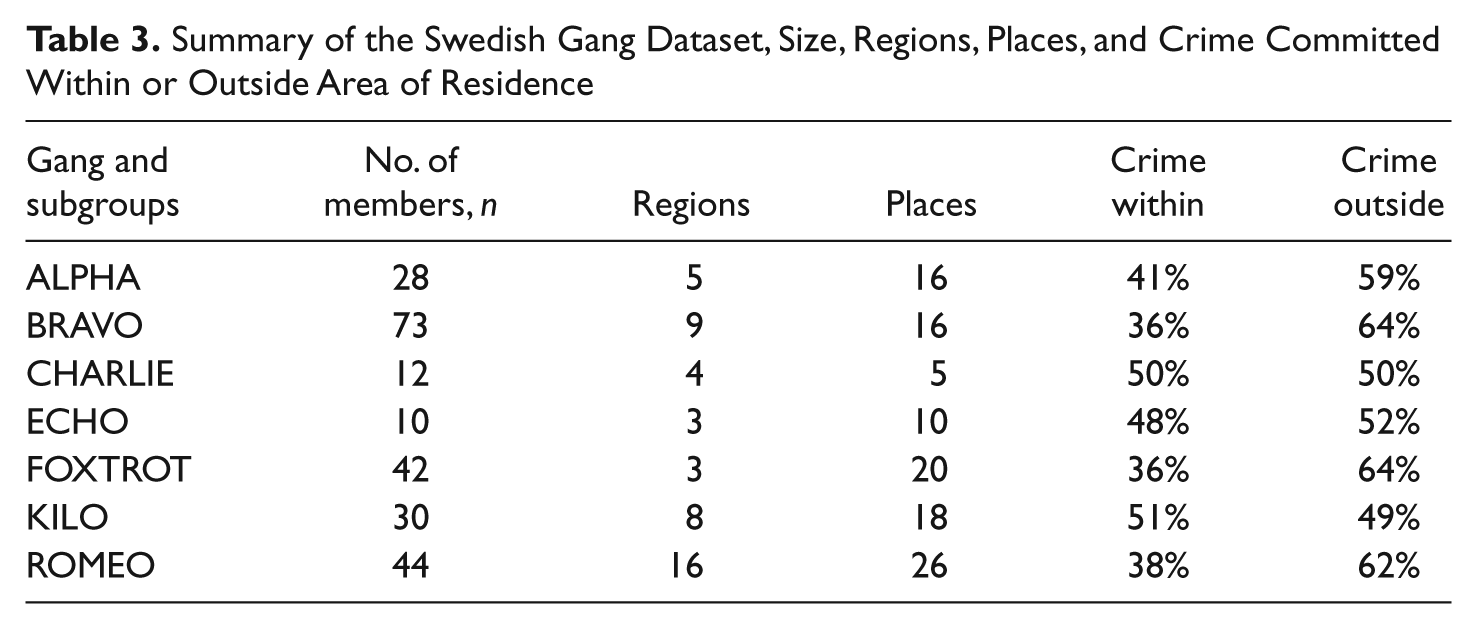
Even from our second approach, we reach the same conclusion. Table 4 shows that a majority of crimes are committed outside of the members’ residential area (e.g., “place”), and with no distinctive pattern. Gangs with members from isolated areas have a higher degree of criminal activity in the area where they live, but the majority of crimes are still committed outside of their own residential area and with no identifiable pattern and with no correlation with type of crime. None of the gangs in our dataset display a clear pattern of being geographically connected.
The Klein and Maxson (2006) Typology Compared to the Swedish Gang Dataset

Note: (n) = Type of gang
However, Klein (1995) notes that this “territorial gang structure” is more common in cities with well-established gangs and among gangs in which membership is intergenerational—two conditions that are not met in Sweden. Klein (1995) also reports, however, that the traditional gang structure is no longer the predominant form. His survey of 261 police agencies revealed that 65% of the cities’ gang structures did not demonstrate the traditional profile. The most predominant structure today is less vertical and age-graded.
The typical gang is autonomous, claims less territory, and tends to have a shorter existence (Klein, 1995; Klein & Maxson, 2006). Some 20% of the respondents reported geographically connected gangs with a horizontal structure.
Table 4 shows a summary of the Maxson and Klein typology in the present Swedish gang dataset. As shown, BRAVO and ROMEO are similar to a “Neotraditional gang” with a shorter lifespan and less than 100 members with a versatile crime pattern. ALPHA, CHARLIE, ECHO, AND KILO can be compared with the “Compressed gang” with up to 50 or so members who are both territorial and nonterritorial. Moreover, these types of gangs have a short lifespan, typically less than 10 years. Data also show that FOXTROT is the only gang that shows tendencies toward a “Specialty gang” where members are nonversatile in their offending (in our case, specialized in armed robberies and aggravated theft) and with fewer but typically tighter members (core of members). The data do not support the existence of a “Traditional gang,” which may not be surprising given the current development of gangs in Sweden (and Europe) in that gangs are a fairly recent phenomenon. That is, gangs have not yet become “entrenched” and/or multigenerational.
Discussion
During the 1990s and onward, the focus among Swedish scholars has been to argue that gangs are not a widespread phenomenon and, if gangs existed, they do not have the same characteristics and structure as their American counterparts. Some have even implied that the concept of organized crime groups is a police construction—a strategy for gaining more resources, new policies, and expanded criminal laws (Flyghed, 2007). Nonetheless, the Swedish government has made it clear that criminal networks and gangs, in addition to organized crime, are becoming a serious problem (SOU 2010:15, 2010).
We have examined seven Swedish street gangs through American lenses by applying the Maxson and Klein gang typology to ascertain whether Swedish street gangs show a similar pattern as their American counterparts. If Swedish street gangs are similar in their structure, organization, and development, then policies or methods in gang prevention from other countries could be useful for Swedish policymakers. At the same time, we would glean valuable insight into how Swedish street gangs have developed in a welfare state such as Sweden—a nation that is known for its generous social welfare programs designed to reduce gaps between classes and, in a Mertonian sense, reduce strain.
However, it is not fair to generalize “American” street gangs as one entity. This is why we have adopted the Maxson and Klein gang typology to our current Swedish dataset. The justification for this, naturally, is an attempt to develop a structural typology of street gangs that can be used for comparative research over time and place. Indeed, the typology has been used in numerous comparative research studies (Klein & Maxson, 2006) but the idea here is to see how it holds up against a dataset of seven Swedish street gangs.
Our results are in concert with many other European studies. For example, Klein et al. (2006) summarized numerous European street gang studies under the Eurogang Program 5 and found that the pattern of violence was far greater among gang youth than among non-gang youth, but largely less serious than in the United States. Klein et al. concluded that this difference could be attributable to the lower levels of firearms availability and lower level of gang territoriality in Europe.
Our results also show that the compressed gang was the most common gang in the examined dataset, which is also in concert with previous European and American studies (Klein et al., 2006). Our findings are ambiguous with respect to territoriality, but consistent with previous European studies that seem to suggest that territoriality is absent in European gangs. Our study suggests that street gangs and their members leave their place of residence when committing crimes. The Swedish gangs, however, have a similar pattern with their European counterpart regarding durability, size, age, crime pattern, and gender compositions, meaning that most of the street gangs have 50 or fewer members, primarily adolescent or early adult character, no duration longer than 10 to 15 years and with versatile criminal behavior pattern.
Our findings are consistent with the long research tradition that has failed to find a link between ethnicity and crime. In our study we do not find any ethnic homogeneous gangs, or a dominating ethnic group with the exception that ethnic Swedes are overrepresented in this population and account for a majority of the gang members in our dataset. We find that street gangs come from suburbs to larger cities with a population composed mostly by first- and second-generation immigrants.
We conclude that the Swedish welfare society has street gangs—in contrast to what previous researchers have argued—and consequently a gang problem. Klein and Maxson (2006) describe the U.S. gang situation as a problem out of control and dreaming back to the 1940s and 1950s, when gangs were found in a number of major cities. Gang crime was relatively minor and gang violence was committed without resorting to sophisticated firearms. The situation in America has since then escalated to include smaller cities and communities, and gang violence is becoming more violent with the use of firearms. The situation in Europe seems to be similar to that of the 1940 to 1950 America. As such, we must continue to study the European gang phenomenon in order to utilize the current knowledge of American street gangs and adopt policies to treat and combat the gang problem. We should not consider the problem as a passing youth culture.
Footnotes
Declaration of Conflicting Interests
The author(s) declared no potential conflicts of interest with respect to the research, authorship, and/or publication of this article.
Funding
The research was funded with the support of the Prevention of and Fight against Crime Programme European Commission Directorate General Justice, Freedom and Security.