



Abstract

Self-report studies are a true treasure trove of insights into delinquency, substance use, and victimization among youth, but they are typically limited to one or just a handful of countries. The bulk of analyses of youth crime and victimization that draw upon survey data from multiple countries are not explicitly comparative by design, making comparisons between youth in different countries problematic and limited in scope. The articles published in this issue use data collected from the Second International Self-Report Delinquency study (ISRD-2), one of the first large-scale cross-national studies of juvenile delinquency with an explicitly comparative design and methodology, with 31 participating countries. Data were collected between 2005 and 2007. Those of us who were involved in the early beginnings of the International Self-Report Delinquency study (ISRD-1) some 20 years ago have argued from its inception that an explicitly comparative design is by far the strongest approach to cross-national survey research (e.g., Junger-Tas, Marshall, & Ribeaud, 2003; Junger-Tas, Terlouw, & Klein, 1994). We think that the results of the ISRD-2 project—as exemplified by the eight articles in this issue—support our optimistic assessment.
Because of space limitations, we can provide only a brief introduction to the ISRD-2. The history of the International Self-Report Delinquency study may be found elsewhere (Junger-Tas et al., 2010; Junger-Tas & Marshall, 2012). The number of publications reporting on the substantive findings of this large international collaborative project is growing fast (e.g., Junger-Tas, Enzmann, Steketee, & Marshall, 2012), 1 frequently in languages other than English. The methodological challenges associated with a cross-national survey study such as the ISRD-2 have been amply discussed (e.g., Enzmann et al., 2010; Marshall, 2010; Marshall & Enzmann, 2012). To avoid repetition in each of the individual articles in this issue, we summarize below the main design features (i.e., survey instrument and sampling) of the ISRD-2, but we suggest consulting the publications on ISRD-2 methodology listed above for additional background.
The Questionnaire
The ISRD-2 uses paper-and-pencil self-administered questionnaires conducted in a school setting administered to a probability sample of students in seventh-, eighth-, and ninth-grade classrooms (i.e., approximately 12 to 16 year olds). 2 English was used as the common language for the ISRD-2 project. The questionnaire was translated in 23 languages by the national participants. We used several well-established measures that have been validated by others. We borrowed items and scales that already have been shown to “work,” with occasionally some adaptations to better fit our purposes. A copy of the questionnaire is available through http://webapp5.rrz.uni-hamburg.de/ISRD/JDEB/. 3 ISRD-2 Workinggroup (2005).
We designed the ISRD-2 questionnaire to obtain data that would allow us to describe the cross-national variability in the prevalence and incidence of delinquency and victimization, to test for national differences in the theoretical correlates of delinquency, substance use, and victimization and to describe cross-national variability in selected dimensions of delinquency such as versatility, age of onset, and co-offending. The questions about self-reported illegal and risk behavior are modeled after the core measurement of self-reported delinquency used in the original National Youth Survey (Elliott et al., 1985). We used a similar measurement in ISRD-1, and it has been validated in different national contexts (i.e., Marshall & Webb, 1990; Zhang, Benson, & Deng, 2000; see also Enzmann’s article in this issue). With regard to the theoretical variables, the ISRD-2 study opted to include measures to tap social control (social bonding) theory, self-control theory, routine activities/opportunity theory, and social disorganization/collective efficacy theory (see Marshall & Enzmann, 2012, for details). These theories are among the most influential, and as the different contributions to this special volume demonstrate, the ISRD-2 provides a unique opportunity to test these U.S.-based theories in other national contexts.
The Sample
A total of 31 countries participated in the ISRD-2. The ISRD-2 design preferred city-based random sampling to national random sampling. However, the individual objectives of the ISRD-2 participants were quite diverse, which resulted in a mixed sampling strategy. Those participants whose major objective was to use the ISRD-2 data to describe the amount of crime in their country or who lived in small countries tended to prefer national random sampling, whereas those whose research interests were more focused on explaining local differences and testing criminological theories preferred city-based sampling. Nine of the 31 participating countries had a national sample: Bosnia-Herzegovina, Czech Republic, Estonia, France, Hungary, Portugal, Spain, Suriname, and Switzerland (see Table 1 below). 4 With the exception of one country (Spain), the countries with a national sample oversampled at least one large city to make analyses on the level of cities possible for all countries.
Country Samples by City Size.
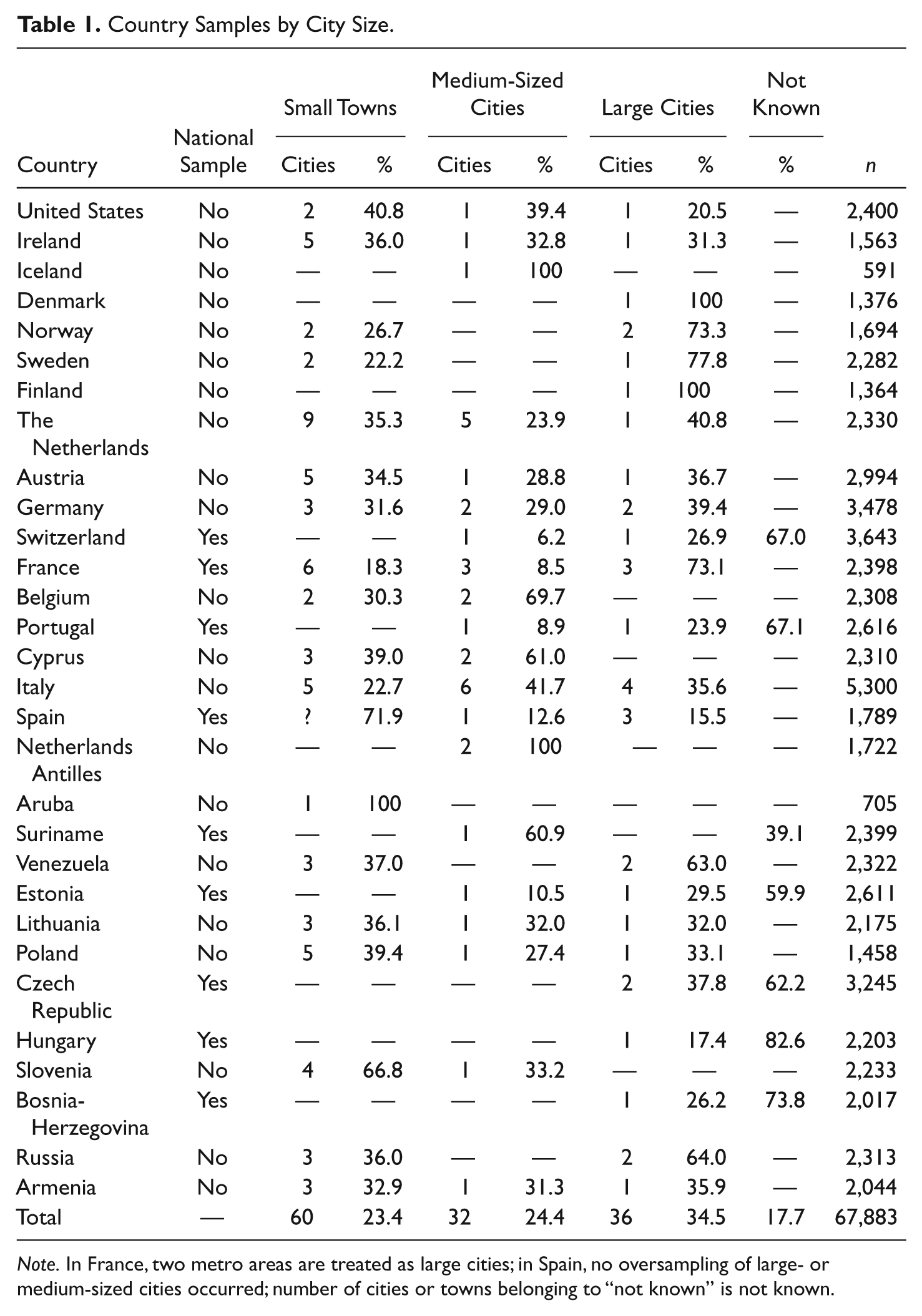
Note. In France, two metro areas are treated as large cities; in Spain, no oversampling of large- or medium-sized cities occurred; number of cities or towns belonging to “not known” is not known.
The classroom-based sampling design produced a total of 67,883 questionnaires, collected in 30 countries (excluding Canada), in 1,536 schools, and 3,339 class rooms. Although the majority of participating countries planned to include equal samples in large, medium, and small cities, some participants drew predominantly large city samples (e.g., Norway, Sweden, and Finland). Per definition, the countries that drew national samples do not have a small town sample but rather tend to have large or medium city samples (e.g., Switzerland, France, Portugal, Estonia, Czech Republic, Hungary, and Bosnia-Herzegovina).
In fact, all samples (except the isle of Aruba) include large and/or medium cities, but not all samples include small cities. Overall, the city-based samples are dominated by large cities (37.6%), with about equal representation of medium cities (30.9%) and small towns (30.9%). An additional complicating factor is that the size of the city-based samples differs significantly between countries. To accommodate the mixed sampling strategy, we have recommended basically two strategies, which reflect the two primary purposes of the analysis. (1) For purely descriptive purposes (i.e., for describing the prevalence of delinquency or of victimization experiences), the comparability of samples across countries is important. Because on the level of cities sampling was random in nearly all participating countries, we recommend to base such analyses on students of large- and medium-sized cities only (be it city based or national samples). One should note that maximum comparability across countries is thus achieved at the expense of (a) restricting the generalizability to students from large- and medium-sized cities (which is not a huge price considering the fact that the majority of the population lives in urbanized regions) and (b) reducing the sample size from 67,883 to 40,678 cases. (2) However, for theory-testing, the comparability of samples across countries is not as crucial (assuming no interaction of the sampling location such as cities or the country side with relationships under investigation). Here, the best strategy is to use the total and maximum sample (67,883).
Thirty-One Countries and Six Country Clusters
ISRD-2 was conducted in 15 Western European countries (Austria, Belgium, Denmark, Finland, France, Germany, Ireland, Italy, the Netherlands, Portugal, Spain, Sweden, Iceland, Norway, and Switzerland). Ten countries in the eastern part of Europe did participate: Cyprus, the Czech Republic, Estonia, Hungary, Lithuania, Poland, Slovenia, Armenia, Bosnia-Herzegovina, and Russia. Canada and the United States (represented by four states) were also part of the study, and some countries outside Europe and North America did participate: Aruba together with the Netherlands Antilles, Suriname, and Venezuela. Although China did not participate in the original wave of data collection (2005 to 2007) and is thus not included in the merged data set, a pilot study of the ISRD-2 study was successfully conducted in Hangzhou (n = 1,043) in 2010 (see the article by Lu in this issue).
For both practical and theoretical reasons, in much prior ISRD-2 work, we have used country-clustering to make analyses of the 31 countries more manageable. We have chosen a classification of countries based on a theoretical perspective related to the different national welfare regimes (Esping-Andersen, 1990). Expanding on Esping-Andersen’s ideas, Saint-Arnaud and Bernard (2003) have developed an empirical grouping of countries, reflecting different welfare regimes (social democratic, liberal, conservative, and “Latin,” a family-oriented regime, where the family plays the determining role in ensuring material security). The clustering developed by Saint-Arnaud and Bernard is based on three distinct sets of social indicators: indicators of social situations (e.g., economic growth or life expectancy), of public policy (e.g., income tax or social security transfers), and of civic participation by citizens (e.g., voter turnout or level of trust). We have expanded the clusters by adding a Post-Socialist (see Lappi-Seppala, 2007; Smit, Marshall, & van Gammeren, 2008) and a Latin American cluster, thus grouping the countries into six clusters: Anglo-Saxon, Northern Europe, Western Europe, Mediterranean, Latin America, and Post-Socialist.
The Anglo-Saxon cluster, including the United States, Canada, and Ireland
The West-European cluster, grouping Germany, France, Belgium, the Netherlands, Austria, and Switzerland
The Scandinavian cluster, covering all Northern countries (Finland, Sweden, Norway, Denmark, and Iceland)
The South-European cluster, including Spain, Italy, Portugal, and Cyprus
The Post-Socialist countries, which are considered as a category apart and comprise the Czech Republic, Poland, Hungary, Estonia, Lithuania, Slovenia, Bosnia, Armenia, and Russia
A rather heterogeneous Latin American cluster, including Venezuela, Netherlands Antilles, Aruba, and Surinam
Although this particular clustering approach has shown to be quite useful in previous analysis, this method is not without its critics and therefore remains an important candidate for continuous empirical scrutiny (see, for example, the article by C. Marshall in this volume).
The Articles in This Issue
We count ourselves very fortunate to have been able to solicit contributions from the Czech Republic, Estonia, the Netherlands, Germany, Belgium, the United States, and China. We have eight articles, three using data from one country (China, Belgium, and Germany, respectively), one using data from three countries (Czech Republic, Hungary, and Estonia), one analyzing the 25 European countries, and the remaining three articles using the total data set of 30 countries. Six of the articles are explicitly focused on assessing theory, and two of the articles are purely methodological in focus. Alcohol use is the dependent variable in three of the articles, while four articles focus on delinquency; victimization is a main research question in one article.
The Belgian authors Gavray, Vettenburg, Pauwels, and Rubens use self-control as the dependent variable in their analysis of the ISRD-2 data for Belgium. Of particular interest here is that they position their analysis in the context of the theory of societal vulnerability (Vettenburg, 1988), which has been developed by Belgian criminologists in the 1980s. The findings suggest that violent values mediate the relationship between societal vulnerability and self-control. When conducting the analyses separately by gender, they found that the relationship between societal vulnerability and self-control was very similar for boys and girls, and they conclude that societally vulnerable boys and girls are equally affected by the intermediate mechanism of violent values.
Self-control is also a main focus in the article by Yi-fen Lu et al. The article by Yi-Fen Lu et al. based on a pilot study conducted in Hangzhou, China (n = 1,043) suggests, first and foremost, that—as appears to be the case for Venezuela, the Netherlands Antilles, and Surinam—the ISRD-2 research design appears to work well in non-Western contexts. Noteworthy finding is that, although the level of self-reported delinquency and substance use in the Chinese data is rather low, low self-control and social bonding factors were found to be the significant predictors of risky behavior and minor delinquency in the Chinese data set, illustrating the theoretical robustness of these predictors.
The article by Estonian criminologists Anna Markina and Kristjan Kask examines the effects of family factors on adolescent alcohol consumption in three East European countries: the Czech Republic, Estonia, and Hungary, former socialist countries with comparable levels of alcohol consumption. Family social control is found to be a universal protective factor against heavy drinking, but the results with regard to other factors are more mixed.
Zuzana Podaná and Jiří Buriánek, researchers from the Czech Republic, also focus on problematic alcohol use as the dependent variable, but they single out the interaction between self-control and opportunity, and their units of analysis are countries, rather than individual-level relationships. Their multilevel analysis shows the importance of using multiple measures of alcohol use as well as what may be gained when adding additional indicators to the country-level models. They use a large subset of the ISRD-2 data, the 25 European countries. Interestingly, in their analysis, they supplement the survey data with national-level indicators regarding national alcohol policy. The results emphasize the importance of the overall cultural context for the possibly different effects of risk factors on alcohol consumption among juveniles.
The article by Steketee, Junger, and Junger-Tas uses the total ISRD-2 sample to investigate whether well-established risk factors for delinquency among adolescents are equally important for males and females. The risk factors used are derived from four theoretical approaches: social bonding/social control theory, self-control theory, routine activities/opportunity theory, and social disorganization theory. The results show that most elements of the social bond, social disorganization, routine activities/opportunity, and attitudes toward violence are equally related to delinquent behavior among males and among females. However, two important concepts (family disruption and deviant group behavior) are more strongly related to delinquency in females, while self-control is more strongly related to delinquency in males.
The Posick article, emphasizing the crucial role of family bonding and self-control in both offending and victimization, shows that there is a consistent positive relationship between all forms of offending and victimization; that is, offenders tend to be victims and vice versa. Offending and victimization are also accounted for using similar explanatory frameworks (self-control and social bonding perspectives). These results provide strong support to the generalizability of the victim–offender overlap and its theoretical correlates.
Finally, the two articles by C. Marshall and Enzmann provide interesting examples of the methodological challenges—and opportunities—provided by self-report surveys such as the ISRD-2. C. Marshall uses a multivariate exploratory data analysis technique, nonlinear principle components analysis (NPCA), to illustrate the usefulness of thorough descriptive analysis in a multivariate setting before proceeding with theory-testing data analysis. Using data on all 30 countries, C. Marshall finds that the country-level property crime variables seem to group around two underlying dimensions. This article further suggests some support for the usefulness of the Esping-Andersen/ISRD-2 cluster system as a tool for grouping country property crime patterns. In the second methodological article, Dirk Enzmann reports on a careful test of modifying the design (not the wording) of the ISRD-2 self-report questionnaire on prevalences and incidences of delinquency. Using two samples of German juveniles, he attempts to answer a number of questions: Do rates of self-reported delinquency differ by questionnaire design? Are there differences in item nonresponse? Do these effects differ by person characteristics, especially self-control? Do effect sizes of predictors of offending differ by questionnaire design? His final conclusion—that questionnaire design does make a difference in the responses—should give pause to local as well as international survey researchers.
We invite our colleagues—in Europe and beyond—to take up where we left off and continue the analysis of the rich ISRD-2 data set. Meanwhile, we have started preparations for the third International Self-Report Delinquency Study (ISRD-3).