



Abstract
This article examines age homophily among co-offenders, using data on approximately 440,000 co-offenses recorded by police in Canada during 2006 to 2009. Log-linear models for social mobility tables are applied to an 86-by-86 table of frequencies of co-offending among year-of-age groups for individuals from 3 to 88 years old. The results indicate strong age homophily for co-offenders of all ages, but decreasing with age. There is further structuration into four age groups: children (3-11 years), youth (12-17 years), young adults (18-45 years), and older adults (46-88 years). The “Fagin” hypothesis that offenders below the age of criminal responsibility are particularly attractive as co-offenders for older offenders is disconfirmed.
In their seminal review of the topic, McPherson, Smith-Lovin, and Cook (2001) defined homophily as “the principle that a contact between similar people occurs at a higher rate than among dissimilar people” (p. 416). The result of homophily is that personal networks tend to be homogeneous with respect to such variables as age, gender, race, religion, education, occupation, geographic location, and affiliations with formal organizations; and social networks tend to be segmented into clusters of similar people. Illicit activities are also characterized by homophily. Weerman (2003) identified group homogeneity as one of the eight characteristics of co-offending groups, and according to the review by van Mastrigt and Carrington (2014), co-offenders have repeatedly been found to be similar in age, sex or gender, ethnicity or race, geographic location, and criminal experience.
Research has found strong evidence of age homophily among co-offenders. This evidence is typically reported as small mean age differences within co-offending groups, and/or common membership of co-offenders in the same age group. Reiss and Farrington (1991) reported that the ages of 54% of co-offenders in the Cambridge Study were within a year of their co-offenders’ ages, and that only 16% were 5 or more years apart. Using self-reported data from the National Survey of Youth, Warr (1996) reported a mean age difference among co-offenders of less than 1 year. In his study of young offenders in Stockholm, Sarnecki (2001) reported that the mean age difference with their co-offenders was 1.3 years. Results from the 2003 British Crime and Justice Survey of self-reported offending by a national sample of 10 to 65 year olds indicated that “co-offenders tended to be within the same age group as the respondent” (Budd, Sharp, & Mayhew, 2005, p. 61). Using data on 10,997 co-offending groups reported for 2002 to 2005 by a large British police force, van Mastrigt and Carrington (2014) found that 83% of groups were either all-adult or all-youth.
The few studies that have examined variations with age in age homophily among co-offenders have generally found that it tends to be more pronounced among younger offenders. In Sarnecki’s (2001) study, average age differences were smaller among co-offenders aged 11 to 18 (the averages ranged from 0.9 to 1.5 years), than among 19 to 21 year olds, where average age differences ranged from 1.4 to 1.8 years. However, the greatest average age difference of 4.0 years was for the youngest offenders: those under 10 years old. Budd et al. (2005) reported that co-offenders aged 10 to 15 were within the same age group in 83% of incidents, but in only 75% of incidents involving 16- to 25-year-olds. van Mastrigt and Carrington (2014) found that observed age homophily was “much higher” among adults than among youths, but when the measure of homophily was normalized to account for the relatively large number of adults and small number of youth in the co-offending population, it was “far lower” for adults.
The study by van Mastrigt and Carrington (2014) highlights the issue first identified by Carrington (2002): that observed homophily may be (partly) due to the composition of the co-offending population. For example, the common observation that females co-offend more with males than vice versa was shown by van Mastrigt and Carrington (2014) to be accounted for by the preponderance of males in the offending population. Similarly, the higher level of age homophily among adults was found by van Mastrigt and Carrington (2014) to be more than accounted for by the much larger number of adults in the co-offending population. In the extreme case, if a population consisted entirely of males, or of one age group, then there would be 100% observed sex or age homophily. Thus, in assessing homophily on a variable such as age or sex, it is necessary to control for the composition of the population, or to put it differently, for the marginal distribution of the variable of interest.
Hypotheses
This review of research on age homophily among co-offenders motivates two hypotheses:
The second hypothesis suggests a linear or at least continuous curvilinear relationship between age homophily and age. However, neither social age nor legal age is continuously related to biological age. In Canada, 12 years is the minimum age of criminal responsibility: Children under 12 who are identified by police as offenders cannot be prosecuted, although police can take action against them under other legislation, primarily child welfare laws (Bala & Anand, 2013). The 18th birthday is a second criminal threshold, because in Canada the youth justice system has jurisdiction up to that age. Therefore, relationships between age and offending and co-offending may be structured by age group: persons under 12, those aged 12 to 17, and those who are 18 or older:
An additional hypothesis concerning age groupings refers to the “Fagin effect.” Fagin is the character in the Charles Dickens novel Oliver Twist who had a gang of children working for him in criminal activities, primarily as pickpockets. The character Fagin was based on a real person, who was an example of a type of Victorian criminal known as a “kidsman”: an adult criminal who recruited and trained child thieves (Bradlow, 1984). Children were attractive criminal assistants for several reasons, including their immunity or quasi-immunity from prosecution under the principle of doli incapax (Bala & Anand, 2013), or their expectation of less severe sentences if prosecuted and convicted (McIntosh, 1973). The belief in the existence of “kidsmen” has persisted into modern times, although there is little research evidence to support it. As Sarnecki (2001) remarks, “In police circles we hear sometimes of older, more experienced criminals co-offending with much younger persons. Such cases seem to be rare, however” (p. 53). While there is some research evidence of recruitment of younger, less experienced accomplices by older, more experienced offenders, the consensus among researchers is that both recruiters and recruits tend to be relatively young, and that recruiters tend to be only a little older than their recruits (this issue and related research are reviewed in van Mastrigt & Farrington, 2011). The factor of immunity from prosecution is not mentioned or tested in the research literature; however, this may be due to the paucity of data on offending by children below the age of criminal responsibility. If the “Fagin effect” does exist in Canada, or elsewhere, it would have some relevance to the periodic debate about lowering the age of criminal responsibility (reviewed in Bala & Anand, 2013).
Method
Measurement of Age
In most of the following analyses, “offender’s age” is treated as a discrete variable, used to classify offenders into year-of-age groups, aged 3, 4, . . . 88 years old. Discrete age was coded in the conventional way as the latest birthday reached at the time of the incident: For example, an offender whose exact age was greater than or equal to 5.0 years and less than 6.0 years was coded as 5 years old. A few analyses using continuous rather than discrete methods use the “exact age” of co-offenders, which was calculated as the number of days, converted to years, between the offender’s birth date and the date of the incident.
Data Source
The data are taken from the Canadian Incident-Based Uniform Crime Reporting Survey (“UCR2”), a database maintained by Statistics Canada, which captures detailed information about each recorded criminal incident and identified offender and victim from the information systems of participating Canadian police services (Canadian Centre for Justice Statistics, 2012). Data from 2006 to 2009 are used. During those years, police forces serving 90% to 100% of Canada reported to the UCR2 (Taylor-Butts & Bressan, 2008). The UCR2 records all incidents in which there were violations of federal and provincial criminal and quasi-criminal statutes enforced by police. Only federal offenses were included in this study.
Unlike the American UCR Survey, the Canadian UCR2 captures data on every person who has been identified by police as “chargeable”—that is, a person who has “been identified as an accused person in an incident and against whom a charge may be laid in connection with that incident” (Canadian Centre for Justice Statistics, 2008, p. 17)—whether the person was actually arrested or charged. Therefore, offenders and co-offenders in the Canadian UCR2 include all persons whom the police reasonably believe to be criminally implicated in the incident. The minimum age of criminal liability in Canada is 12 years at the time of the incident, so that children alleged to have committed offenses before their 12th birthday cannot be charged; however, they are recorded in the UCR2. 1 Offenders (referred to as “participations” in this article) whose age or sex was unknown (1.7% of the total) were omitted from the study.
Units of Analysis and Study Population
Descriptive analyses of observed age homophily were based on the incident (i.e., co-offense, or co-offending group) or co-offending dyad or pair as the unit of count—to provide statistics that are comparable with those reported elsewhere. A co-offending dyad or pair refers to the participation of two offenders in the same incident. Thus, a co-offense with only two participants yields one dyad; one with three participants yields three dyads; one with four participants yields six dyads, and so on. Of the 4,394,884 participations in incidents recorded by police in Canada during 2006-2009, 1,067,484 were in co-offenses. Co-offenders’ ages ranged from 3 to 106 years, and the sizes of individual co-offenses (the number of participants in the incident) ranged from 2 to 111.
Two exclusion criteria were applied. Participations (n = 29) in which the offender was 89 or older were omitted from the research because there were fewer than 10 such participations for each year of age, making statistical analysis unreliable. Incidents with more than 50 recorded co-offenders were omitted, partly because anecdotal evidence suggested that these “co-offenses” may be artifacts of police recording practices (e.g., numerous offenders picked up during a “sweep” and recorded as one incident) rather than genuine co-offending, and partly because, as Schaefer (2012, p. 143) has argued, participants in such large co-offending “groups” are unlikely to have had the kind of “social relationship” that makes homophily a meaningful concept. There were 15 such incidents, accounting for a total of 1,074 participations. The resulting study population numbered 1,066,381 participations in 443,056 incidents, ranging in size from 2 to 44 co-offenders.
Analytic Approach
Analysis of homophily that exceeds what would be expected by chance—that is, inbreeding homophily (van Mastrigt & Carrington, 2014)—requires a statistical model in which observed homophily can be compared with, or adjusted for, homophily expected from the marginal distribution (the “null model”). This comparison is available for two group-based indices of homogeneity/heterogeneity: the E-I Index (Krackhardt & Stern, 1988) and the index of inbreeding homophily (van Mastrigt & Carrington, 2014). Both indices have two serious limitations in relation to the present application. First, they are intended for use with a relatively small number of unordered groups: that is, a group variable that is nominal and has only two or relatively few values; whereas in the present data, the age variable has 86 values, which are ordered, and, indeed, interval level. Second, these indices of homophily are not readily incorporated into standard multivariate methods of analysis; whereas, the approach adopted here involves fitting a sequence of multivariate models, comparing their fit with the data.
An alternative approach to measuring and modeling homophily that has neither of these limitations is the exponential random graph model (Lusher, Koskinen, & Robins, 2013). However, an exponential random graph model is not appropriate here, for two reasons. First, knowledge of the links between co-offenses formed by common co-offenders is needed to convert the data from the current form of a list of unconnected co-offending incidents to a co-offending graph; these links are currently not available. This limits the analysis to modeling “dyadic independent” processes, for which conventional logistic or log-linear models are adequate (Handcock, Hunter, Butts, Goodreau, & Morris, 2008, p. 5). Second, even if the co-offending graph could be constructed, it would be too large for an exponential random graph model to be estimated. With currently available hardware and software, estimation of exponential random graph models is limited to graphs with no more than a few thousand nodes (Robins & Lusher, 2013).
The strategy used here—adapted from Stegbauer and Rausch (2012)—is to reduce the number of nodes to manageable size, and eliminate the problem of unknown intra-offender, inter-incident linkages, by aggregating offenders into groups with the same year of age, resulting in a square, symmetric matrix, with 86 rows and 86 columns representing the years of age from 3 to 88, and cell entries reporting the number of co-offending pairs, or dyads, of the two indexed age groups. The 443,056 co-offenses (incidents) generated a total of 970,084 co-offending dyads: 176,503 dyads where both offenders were the same year of age (i.e., on the main diagonal of the matrix), and 793,581 dyads involving offenders of different ages.
Inbreeding age homophily is indicated by cell counts on or near the main diagonal of this matrix that are larger, and off-diagonal cell counts that are smaller, than expected by chance. This matrix can be modeled with log-linear models that were developed by Haberman (1974), Goodman (1979), Breiger (1981), and others for square ordinal social mobility tables, in which cell counts i,j indicate the number of father–son dyads for which father is in the ith social class, and son is in the jth social class. The log-linear analysis of social mobility tables is adaptable to the analysis of age homophily, because social mobility—like age heterophily—is indicated by cell counts on or near the main diagonal that are smaller than expected, and “status inheritance”—like age homophily—is indicated by larger than expected counts on or near the main diagonal. The models are discussed in more detail in the “Results” section. All models were fitted using PROC GENMOD in SAS (SAS Institute Inc., 2008).
Results
Descriptive results for observed age homophily, which is uncorrected for the age composition of the co-offending population, are reported first. These are followed by the results of the tests of the hypotheses, utilizing inbreeding age homophily, which is corrected for the age composition of the population.
Observed Age Homophily
These co-offenders exhibit strong observed age homophily. The correlation between the exact ages of the two co-offenders over all 970,084 dyads is .69 (p < .0001). The (discrete) ages of co-offenders range from 3 to 88, but their exact ages are within 1 year or less of each other in 33% of dyads, within 2 years or less in 50%, and within 5.8 years or less in 75% of dyads. The mean age difference over all dyads is 4.96 years. These age differences are larger than those reported by Reiss and Farrington (1991), Warr (1996), and Sarnecki (2001), but those samples were limited to youthful co-offenders.
Looking at co-offending incidents rather than dyads, the range of ages (the difference in exact age between the oldest and youngest co-offender in the incident) is within a year or less in 27% of incidents, within 2.5 years or less in 50% of incidents, and within 6.8 years in 75% of incidents. The mean age range over all incidents is 5.5 years.
Observed age homophily decreases with increasing ages of co-offenders, except for the youngest co-offenders. Figure 1 is a scattergram with the discrete ages of the two co-offenders in each dyad on the x- and y-axes. There is strong clustering on and near the diagonal, suggesting age homophily, at least up to the early 30s and perhaps as far as the early 50s. There is very little scatter off the diagonal for co-offenders up to about 17 years of age, suggesting that age homophily is much stronger in childhood and adolescence. This is consistent with other reported research (see above).
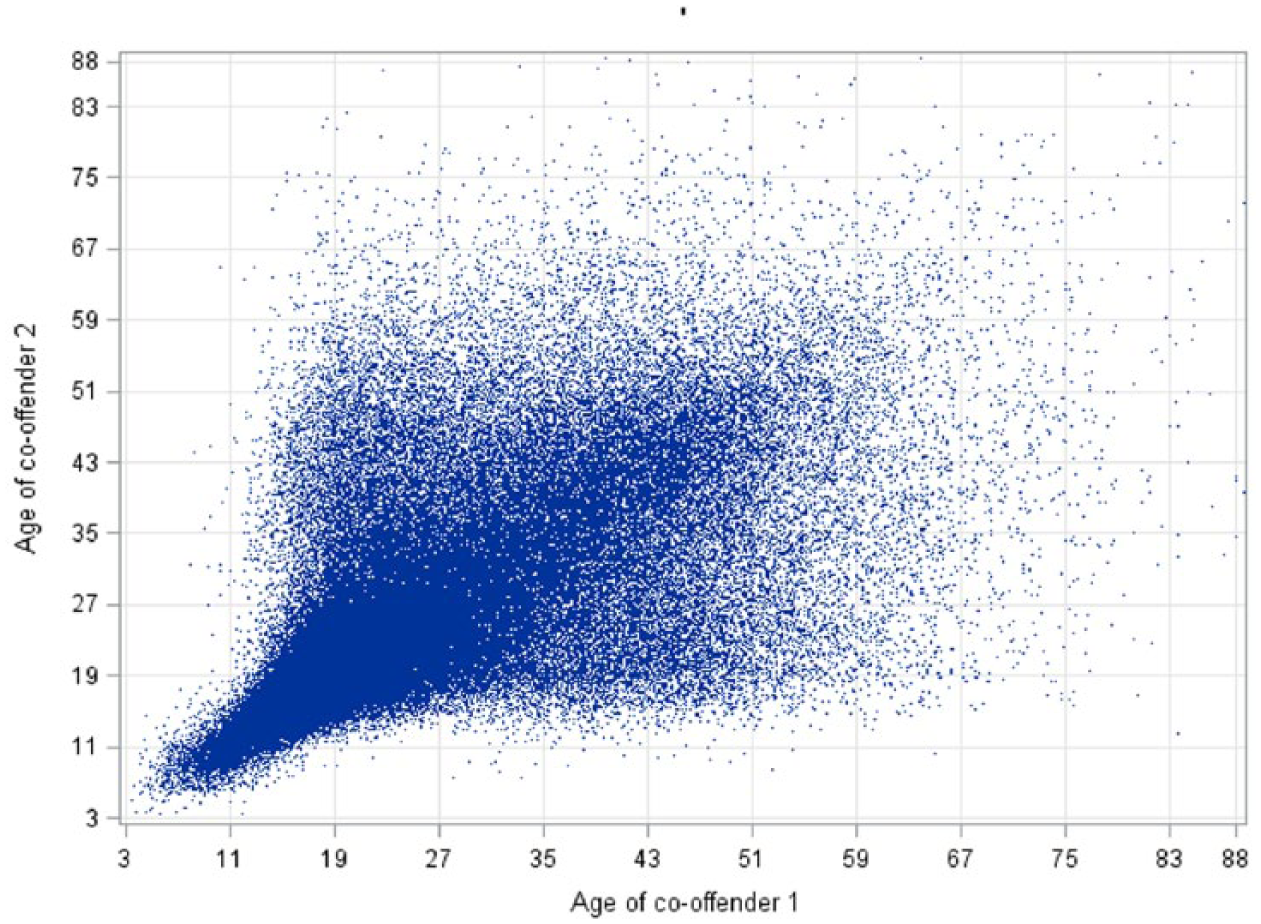
Scattergram of ages of dyadic co-offenders.
These visual impressions are confirmed by the statistics shown in Table 1. As offenders’ ages increase, so do the means and standard deviations of their (exact) age differences with their co-offenders. Co-offenders’ ages are most strongly correlated in the 12 to 20 age group, 2 less so in the 3 to 11 and 21 to 30 age groups, and minimally if one co-offender is 41 or older. However, the correlations between the ages of co-offenders are positive and statistically significant in all age groups except the oldest. Among 81 to 88 year olds, there is a (barely) significant negative correlation of −.10, indicating a weak tendency to co-offend with people of dissimilar, rather than similar, ages. The mean age differences among younger co-offenders in this population are somewhat greater than those reported by Warr (1996) or Sarnecki (2001): Both the authors reported mean age differences between young co-offenders in the range of 1 year, whereas in this population the mean age difference between co-offenders aged 3 to 20 years is approximately 2 years.
Dyadic Age Differences and Correlations, by Age Group.
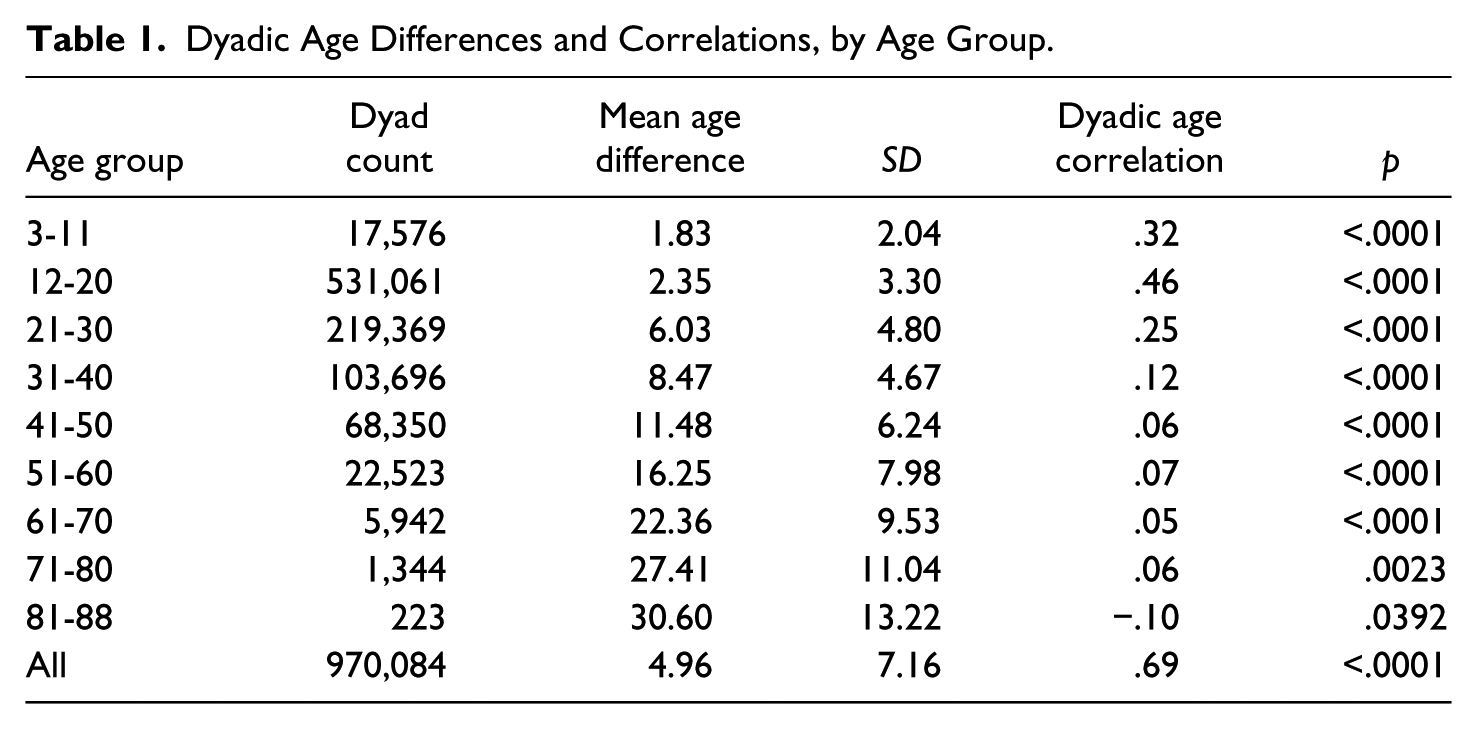
However, all of this evidence of observed age homophily and its relationship to co-offenders’ ages may be partly or entirely due to the age distribution of the pool of offenders and co-offenders. The relatively large number of teenaged co-offenders, and the small number of co-offenders above 40 years (Table 1), may fully or partly explain the observed decrease with age in age homophily. Consequently, the hypotheses are tested using inbreeding homophily, which is corrected for the age distribution of the population of co-offenders.
Inbreeding Homophily
The following analysis use log-linear models of the 86-by-86 age-by-age table of co-offending frequencies to estimate age homophily while controlling for the marginal distribution of co-offenders of each age. The results of the tests of Hypotheses 1 and 2 are compared with the results based on two age groups (“youth” and “adults”) that were reported by van Mastrigt and Carrington (2014) 3 —the only other research on co-offending homophily known to the author that controlled for age composition.
The baseline log-linear Model 0 fitted to the co-offender age-by-age table is the independence model, which models cell frequencies as functions only of the marginal frequencies (Agresti, 2013, p. 339):

where X, Y are the row and column variables, indexed by i and j.
The lack of fit is evident from the statistics shown in the first row of Table 2.
Fit Statistics for Log-Linear Models of Age-by-Age Co-Offending Cross-Tabulation.

Note. AIC = Akaike information criterion; BIC = Bayesian information criterion.
Hypothesis 1
Age homophily is captured by Model 1: the “fixed distance” model (Model 7 in Goodman, 1979; Haberman, 1974; Lawal, 2003), which includes a parameter for the difference in the co-offenders’ ages, to capture the distance of each cell from the main diagonal. A positive value for this parameter would indicate that cell counts become increasingly larger than expected as the age difference (the distance from the main diagonal) increases. Thus, the parameter β1 actually captures age heterophily, and a negative value would indicate age homophily.

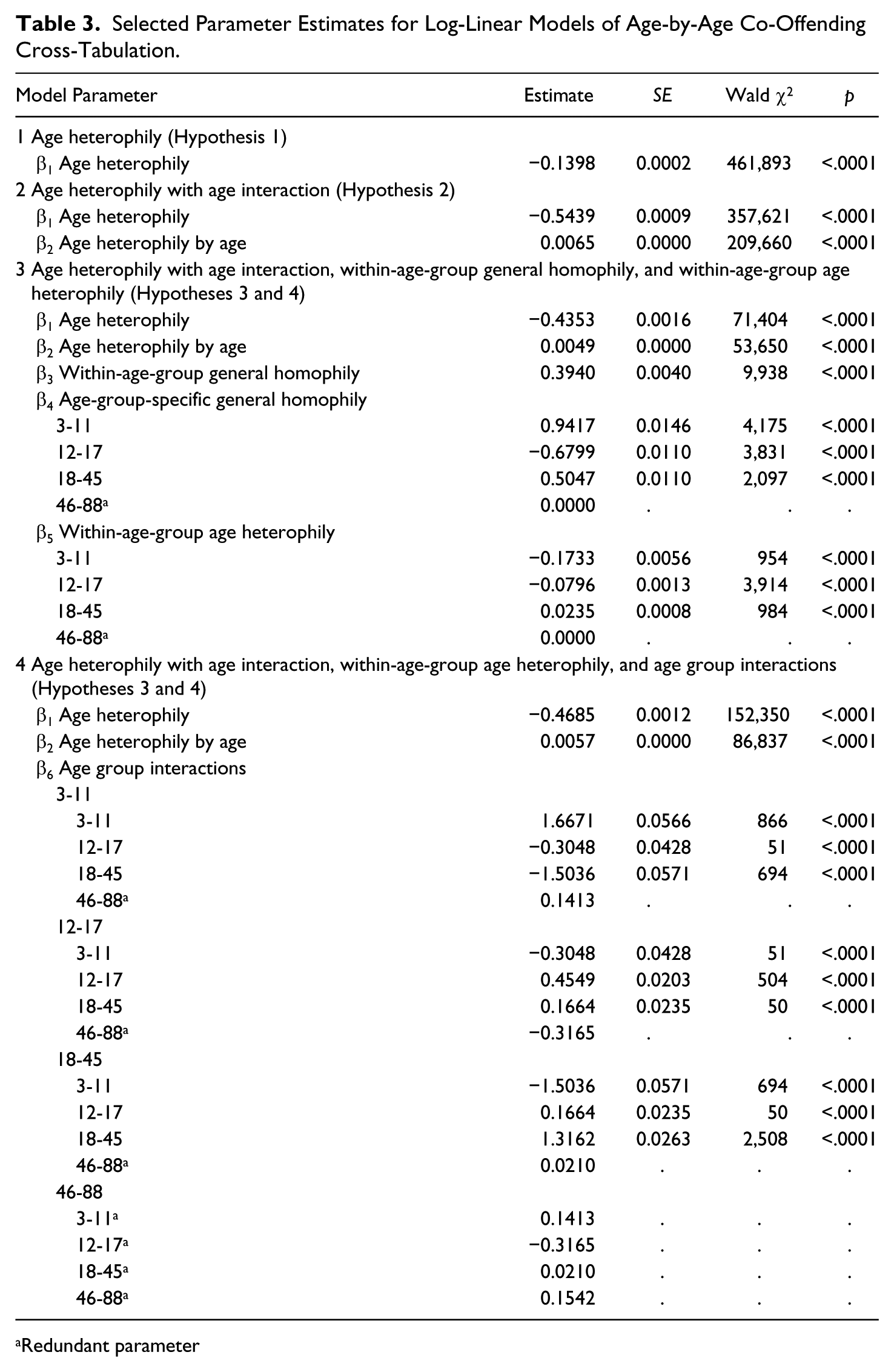
(I have modified Goodman’s [1979] formulation slightly by adding 1 to the value of d to avoid zero-valued interaction terms in the following models.) The fit statistics (Table 2) are substantially improved over the independence model. The significant negative estimate for the age heterophily parameter β1 (Table 3) indicates age homophily: Cell counts become smaller as age differences (distances from the main diagonal) increase. Hypothesis 1 is supported. This is consistent with results reported by van Mastrigt and Carrington (2014).
Selected Parameter Estimates for Log-Linear Models of Age-by-Age Co-Offending Cross-Tabulation.
Redundant parameter
Hypothesis 2
A decrease with age in age homophily is represented in Model 2, which includes a parameter for an interaction between the summed ages of the co-offenders and the term (β2) for age heterophily:

The fit is substantially improved over Model 2 (Table 2), and the age interaction parameter estimate (β2, Table 3) is positive and significant, indicating an increase in age heterophily, or a decrease in age homophily, with increasing age of either co-offender. Hypothesis 2 is supported. This is consistent with results reported by van Mastrigt and Carrington (2014).
Hypotheses 3 and 4
To test Hypothesis 3, concerning the structuration of age homophily into aggregated age groups, a plausible set of aggregated age groups was identified, using a multidimensional scaling (MDS) of the year-of-age groups, with the standardized deviance residuals from Model 2 as input (Figure 2). Visual inspection of Figure 2 suggested four aggregated age groups: 3 to 11, 12 to 17, 18 to 45, and 46 to 88 years. Although based on inspection of the MDS plot, the cutoff ages of 12 and 18 correspond to the legal thresholds discussed in the “Hypotheses” section, above. This result suggests a modification of Hypothesis 3, in which there are four, rather than the initially hypothesized three, aggregated age groups.

Two-dimensional multidimensional scaling (MDS) plot of co-offender ages, using normalized residuals from model 2, showing four clusters.
Model 3 tests both the modified Hypothesis 3 and Hypothesis 4. Variables m and n identify the four age groups, and parameters are included in the model to estimate general homophily within age groups (β3), age-group-specific general homophily (β4), and age-group-specific age heterophily (β5).
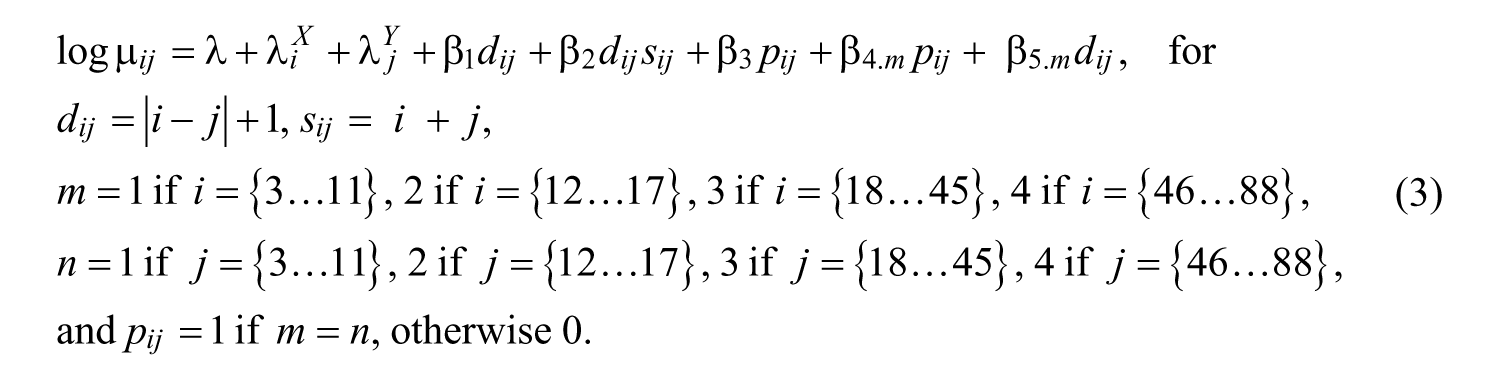
The fit of Model 3 is substantially better than that of Model 2 (Table 2). The positive estimates for β4 for the first and third age groups (Table 3) indicate that general within-age-group homophily exists among members of those age groups, even when the effects of simple age homophily, age-varying age homophily, and within-age-group age homophily are controlled. The relatively large estimate for 3 to 11 year olds (.94) disconfirms the hypothesized Fagin effect (Hypothesis 4). There is a relatively large tendency of 3 to 11 year olds to co-offend with others in the same age group rather than with older offenders. The negative estimate of β4 for 12 to 17 year olds indicate a residual tendency not to co-offend with members of the same aggregated age group, once the effect of age homophily is taken into account: that is, a tendency for co-offending among 12- to 17-year-olds to be restricted to their immediate age peers rather than members of the 12 to 17 group in general. The negative estimates for age heterophily (β5) for the two youngest age groups confirm that age homophily is especially strong in those age groups. Hypothesis 3—modified to include four age groups—is confirmed. Although co-offending does decrease with age (Hypothesis 2), these co-offenders fall into four aggregated age groups, each with its own level of age homophily and each with its own level of within-age-group co-offending, regardless of general age homophily.
A second model (Model 4) was constructed to explore in more detail the structuring of age homophily within and among the four aggregated age groups. In Model 4, there is a parameter for the cell count in each of the 16 blocks in the aggregated age-by-age matrix formed by blocking the year-of-age groups into four aggregated age groups:
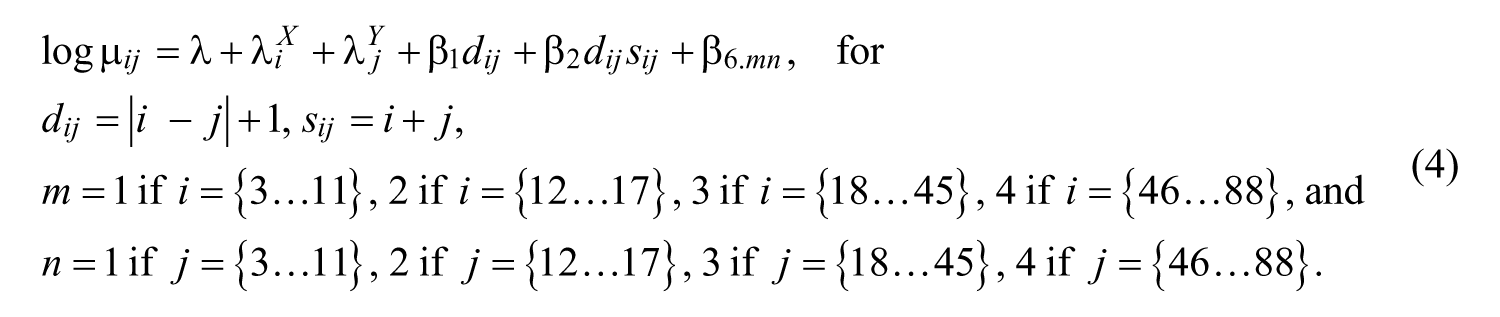
This model fits the data slightly less well than Model 3 (Table 2). However, its value lies in the more detailed picture its parameterization provides of the patterns of age homophily of co-offenders in each of the four aggregated age groups. Net of age homophily and age-varying age homophily, each of the age groups is internally homophilous: That is, its members are more likely than expected to co-offend with one another and less likely to co-offend with members of other age groups. In relation specifically to 3 to 11 year olds, there is further disconfirmation of Hypothesis 4 (the Fagin effect): 12 to 45 year olds (who makes up 96% of 12-88 year olds) are less likely to co-offend with 3 to 11 year olds than expected, and this is especially true of 18 to 45 year olds (β6.13 = −1.5); conversely, 3 to 11 year olds are much more likely to co-offend with members of their own age group than with older offenders (β6.11 = 1.67).
Discussion
This research tested hypotheses about age homophily among co-offenders, using log-linear models originally developed for the analysis of social mobility tables. The log-linear models incorporated controls for the marginal distribution of ages in the co-offending population so that conclusions could be drawn that were not biased by its age composition, particularly the preponderance of teenagers and the relatively small numbers of children and older adult co-offenders.
The results indicate strong age homophily in the population, which decreases with increasing age of co-offenders. However, this decrease with age is not smoothly linear or curvilinear, but is structured within four aggregated age groups, the first three of which are bounded by the legally significant 12th and 18th birthdays: children (3-11 years), youth (12-17 years), young adults (18-45 years), and older adults (46-88 years). Each of these age groups has a characteristic pattern of age homophily, overlaid on the general tendency to age homophily that decreases with age. Youth (12-17 years) have the strongest and most narrowly defined age homophily, tending to co-offend with others who are within a year or so of their own age. Children also exhibit strong age homophily, but their co-offending is less narrowly age-exclusive and more dispersed among members of their own aggregated age group, regardless of their specific ages. While the age homophily of young adult co-offenders is, as expected, weaker than among younger offenders, they (like 3-11 year olds) exhibit a strong tendency to co-offend with members of their own age group, regardless of specific age. Finally, older adults have both the weakest age homophily and the weakest tendency to within-age-group co-offending. The “Fagin” hypothesis that offenders below the age of criminal responsibility (i.e., children under 12) are particularly attractive co-offenders for older offenders is disconfirmed by the data: Children have the strongest tendency to offending endogamy of any age group.
This research extends knowledge about age homophily among co-offenders in several ways. First, it is the first large-scale, fine-grained study of age homophily among co-offenders with a wide range of ages—from 3 to 88 years. Budd et al. (2005) and van Mastrigt (2008; van Mastrigt & Carrington, 2014) also studied samples of co-offenders with wide age ranges (10-65 years in the former study and 10-74 in the latter), but because their samples were much smaller than the present one and the proportion of offenders and co-offenders over 30 is always small, their analyses were limited to highly aggregated age categories; in contrast, the present study was able to classify co-offenders by their year of age. Second, by using log-linear models, it reports “inbreeding homophily” rather than the “observed homophily,” which is described in almost all of the extant literature, and which is almost certainly strongly biased by the heavily skewed age composition of the co-offending population under study (the exception is the study by van Mastrigt and Carrington [2014], but that study used highly aggregated age groups of “youth” and “adults,” and tested only the first two hypotheses of the present study). Third, this study demonstrates that although there is age homophily among co-offenders of all ages, it becomes weaker with age. Fourth, it shows that with respect to age homophily, co-offenders fall into four age groups (children, youth, young adults, and older adults), each with its own pattern of age-related co-offending. In particular, the “Fagin” hypothesis that offenders below 12 are especially attractive as co-offenders for older offenders is disconfirmed: Controlling for the population age distribution, children below 12 are unlikely to co-offend with 12-17 year olds, and very unlikely to co-offend with offenders who are 18 or older.
This research was limited by the available data. First, data were not available to link multiple incidents involving the same individual. Consequently, it was not possible to control for multiple appearances of the same individual in the data (“nesting” of observations), and it was not possible to link incidents into a graph to control for graph structure while estimating homophily (Robins & Daraganova, 2013, p. 93). However, other research using data from the same database (Carrington, 2009) suggests that the nesting of observations within individuals’ criminal careers is not a significant issue. Graph structure may also have minimal impact on estimates of homophily in these data, because of the relative sparseness of the co-offending graph that would result from linking incidents in this data set: Based on co-offending career statistics reported in Carrington (2009), most offenders probably appear only once as co-offenders during the 4-year observation window.
The second limitation arises from the use of police data, which are subject to the “dark figures” of unreported crime, unsolved incidents, and unidentified co-offenders (Frank & Carrington, 2007). There are several reasons why this limitation is not as serious as it is in much criminological research. First, this research is not concerned with the volume of offenders or co-offenders, so underreporting in general does not threaten the validity of the results. Second, unlike the American UCR, the Canadian UCR Survey includes all identified offenders, whether or not they were arrested or charged. Consequently, police charging biases do not affect the data. However, the possibility remains that police reporting biases related to the age of the offender might have resulted in selective omission of co-offenders of some ages, especially younger co-offenders, from the data. The author is not aware of any research on the subject of age-related police reporting bias, but one might speculate that police would be more likely to fail to report child co-offenders, as they would be of less interest to the police, because they could not be charged. However, this too is not as serious an issue as it might appear. The research is not concerned with the volume of co-offenders of different ages, but only with age-related homophily (vs. heterophily) among co-offenders. To bias the results of this research, age-related police reporting bias would have to selectively underreport age-homophilous or age-heterophilous co-offenders in certain age groups. For example, if police systematically failed to report incidents involving exclusively child offenders, or failed to report one or more of the children implicated in such incidents, this would result in a downward bias in the estimate of child homophily (and make the tests of Hypotheses 3 and 4 conservative). On the contrary, if police failed to report incidents involving a child and adult (or teenaged) offender, or (perhaps more plausibly) reported only the adult offender in such incidents, this would result in a downward bias in the estimate of age-related heterophily, and threaten the validity of the confirmation of Hypotheses 3 and 4. The significance of this limitation will remain unknown until more is known about age-related police reporting biases, or until adequate data on co-offending are available from other sources.
Footnotes
Acknowledgements
I thank the participants in the workshop and the editor and anonymous reviewers of this special issue for their helpful comments on previous drafts of the article. I gratefully acknowledge the support and assistance of Julie McAuley, Anthony Matarazzo, and Marian Radulescu of the Canadian Centre for Justice Statistics, Statistics Canada, in accessing the co-offending data.
Author’s Note
An earlier version of this article was read at the Fifth Annual Illicit Networks Workshop, Los Angeles, California, October, 2013. The opinions expressed in this article do not represent the opinions of Statistics Canada.
Declaration of Conflicting Interests
The author(s) declared no potential conflicts of interest with respect to the research, authorship, and/or publication of this article.
Funding
The author(s) disclosed receipt of the following financial support for the research, authorship, and/or publication of this article: Preparation of this article was supported by a research grant from the Social Sciences and Humanities Research Council of Canada.