




Abstract
Using a sample of sibling pairs from the National Survey of Adolescent to Adult Health (Add Health), the relationship between child and adolescent maltreatment and intimate partner violence (IPV) perpetration was examined within a genetically sensitive framework. After accounting for within-family similarities, maltreatment during childhood did not predict IPV. Maltreatment in adolescence, however, predicted increases in the likelihood of threatening an intimate partner as well as a combined measure of IPV. These results indicate that maltreatment represents only a single facet of the larger suite of family-level influences that contribute to the development of IPV perpetration.
Keywords
Introduction
In the United States, more than one in three women and one in four men will be the victim of intimate partner violence (IPV) at some point in their lifetime (Black et al., 2011), with nearly 95,000 individuals arrested for violence against the family and children during 2015 in the United States (Federal Bureau of Investigation [FBI], 2015). Although family violence and IPV perpetration are commonly linked to men, a well-developed literature identifies both men and women as perpetrators (Archer, 2000). Previous research indicates that women not only engage in IPV but also, in some instances, report a higher prevalence of IPV perpetration than men (Archer, 2000). Although this finding may seem counterintuitive, it falls in line with exchange theory which posits that female perpetration may be greater than male perpetration if the potential costs of engaging in IPV (i.e., criminal sanctions) are perceived as being less certain or severe for females relative to males (Straus, 1999, 2006). Also in line with exchange theory, previous research has indicated that females may be more likely to report perpetration compared with males because the stigma that accompanies male perpetration is arguably greater (Stets & Straus, 1990).
Despite the prevalence of IPV perpetration among both males and females, the underlying processes that contribute to IPV remain less understood (Hines & Saudino, 2004). Much of the existing literature has focused on the role of adverse childhood experiences (ACEs; Pinto et al., 2010), examining factors such as maltreatment, economic hardship, and exposure to other types of violence (Langhinrichsen-Rohling, Neidig, & Thorn, 1995; Mair, Cunradi, & Todd, 2012; Pournaghash-Tehrani, & Feizabadi, 2009; Stith et al., 2000). Based on these results, previous studies have pointed to social learning processes as the primary mechanisms contributing to the intergenerational transmission of violence (Akers & Jensen, 2006; Bandura, 1973; Mihalic & Elliott, 1997). Within the family context, social learning theory states that children who are abused or witness violence may come to view violence as an acceptable means of conflict resolution or a mechanism to cope with stress (Mihalic & Elliott, 1997). Techniques of violence are reinforced in abusive homes, ultimately teaching children to cope with stress in intimate relationships through violence and aggression (Gelles, 1972). In addition, abusive relationships can inhibit the development of normal coping mechanisms resulting in heightened risk of responding to stress and conflict with violence (Finkelhor et al., 1988).
In addition to learning processes contributing to the transmission of violence from one generation to the next, a complementary line of research has recognized that parents and their offspring also share genetic predisposition for problem behaviors (Barnes, TenEyck, Boutwell, & Beaver, 2013; D’Onofrio et al., 2007; Hines & Saudino, 2002; Lynch et al., 2006). In other words, abusive parents not only model violent behavior, but may also share genetic predispositions toward aggressive behaviors (Herzberger, 1983). This finding aligns with Moffitt’s (1993) developmental taxonomy, in which children who exhibit persistent and severe behavioral problems (i.e., life-course persistent offenders) tend to have experienced a combination of both environmental and biological risk factors. These results indicate that the underlying mechanisms linking maltreatment and IPV perpetration are likely multifaceted and include a combination of both environmental and genetic influences. Directly in line with these observations, the current study aims to examine the relationship between maltreatment and IPV perpetration while accounting for genetic and environmental influences that cluster within families by examining five hypotheses:
Method
Sample
The current study analyzed data from the National Longitudinal Study of Adolescent to Adult Health (Add Health), a longitudinal and nationally representative sample of American youth enrolled in middle and high school during the 1994-1995 academic year (Harris, 2013). This study uses in-home interviews from Waves I (including a parental questionnaire), III, and IV (with a fifth wave currently in progress), which were collected when participants were between 12 and 21 years old (n = 20,745; collected in 1995), 18 and 26 years old (n = 15,170; collected from 2001 to 2002), and 24 and 32 years old (n = 15,701; collected in 2008), respectively. Nested within the Add Health sample is a subsample of approximately 3,000 twin, sibling, and cousin dyads. The final analytic sample for the current study consisted of same-sex dyads living in the same household and included monozygotic (MZ; 282 pairs) and dizygotic (DZ; 245 pairs) twins, full siblings (606 pairs), half-siblings (185 pairs), first cousins (84 pairs), and unrelated siblings (i.e., step-siblings; 154 pairs), resulting in a total of 1,556 same-sex pairs (3,112 individuals). Inclusion criteria included (a) participation in Waves III and IV, (b) having a co-sibling who participated in Waves III and IV, (c) reported being in a romantic relationship within the year prior to the Wave IV interview, and (d) having complete data on at least some of the study measures. 1
Measures
Dependent variable—IPV
Following previous research (Barnes et al., 2013), IPV was measured using four items collected at Wave IV. Participants were asked how often in the past year (a) they threatened their partner with violence, pushed or shoved them, or threw something at them that could hurt; (b) they slapped, hit, or kicked their partner; (c) their partner suffered an injury, such as a sprain, bruise, or cut because of a fight with the participant; and (d) they insisted that they have sexual relations, when their partner did not want to. Response categories included 0 (never), 1 (this has happened, but not in the last year), 2 (once in the last year of the relationship), 3 (twice in the last year of the relationship), 4 (3 to 5 times in the last year of the relationship), 5 (6 to 10 times in the last year of the relationship), 6 (11 to 20 times in the last year of the relationship), and 7 (more than 20 times in the last year of the relationship). A majority (<90%) of responses for the IPV measures fell into the two least frequent categories (i.e., never or has not happened within the past year). As a result, each item was dichotomized (0 = no abuse and 1 = abuse occurring one or more times at any point in the relationship). A final composite IPV measure (i.e., any perpetration) was also included in the analysis and coded such that 0 = no abuse and 1 = at least one form of abuse.
Independent variables—Maltreatment
Maltreatment was assessed using two sets of retrospective measures tapping maltreatment in both childhood and adolescence. During Wave III interviews, participants were asked how often they experienced four potentially harmful interactions with a parent or caregiver by the time they started sixth grade: (a) were left home alone when they should not have been; (b) did not receive care for basic needs; (c) were slapped, hit, or kicked; and (d) were touched in a sexual way, or were forced to touch someone else in a sexual way, or forced to have sexual relations. Response categories ranged from never to more than 10 times. Due to the low prevalence of maltreatment (65%-92% in first two categories), the measures were dichotomized (0 = no maltreatment and 1 = maltreatment occurred one or more times). These four items were then summed to create a variety maltreatment index that ranged from 0 to 4 possible incidents.
During the Wave IV interview, participants were also asked how often they experienced two different experiences with a parent or caregiver before their 18th birthday: (a) were hit with a fist, kicked, or thrown down on the floor, into a wall, or downstairs, and (b) were touched in a sexual way, forced to touch someone in a sexual way, or forced to have sexual relations. Response categories were similar to those used for the childhood maltreatment measures (ranging from never to more than 10 times) and were dichotomized (0 = no maltreatment and 1 = maltreatment occurred one or more times). These two items were summed to create an adolescent maltreatment variety index that ranged from 0 to 2 possible incidents.
Covariates
In addition to the variables discussed above, eight statistical covariates were included in the estimated models. Early victimization is a summed index indicating the frequency in which each respondent reported experiencing four types of victimization during the Wave I interview: (a) having a knife/gun pulled on them, (b) being shot, (c) being stabbed, and (d) being jumped. Items were coded dichotomously (0 = never and 1 = at least once in the past year) and summed. To tap early life experiences, four covariates were also included from the Wave I parent questionnaire: parental marital status (0 = married and 1 = not married), whether parents worked outside the home (0 = no and 1 = yes), whether parents received public assistance (0 = no and 1 = yes), and parental alcohol consumption (ranged between 0 = once a week or less and 6 = everyday). Age (measured continuously in years), race (0 = Caucasian and 1 = all other races), and gender (0 = female and 1 = male) as reported at Wave I were also included. Univariate statistics for these covariates and all other study measures are reported in Table 1.
Descriptive Statistics of Intimate Partner Violence, Maltreatment, and Covariates.

Note. Intimate partner violence measures: Threat = threatened their partner with violence, pushed or shoved them, or threw something at them that could hurt; physical = slapped, hit, or kicked their partner; injury = their partner suffered an injury, such as a sprain, bruise, or cut because of a fight with the participant; sexual = insisted that they have sexual relations, when their partner did not want to; any violence = composite measure of IPV variables. Childhood maltreatment measures: Left alone = left home alone when they should not have been; basic needs = did not receive care for basic needs; hit = slapped, hit, or kicked; touched sexually = touched in a sexual way, or were forced to touch someone else in a sexual way, or forced to have sexual relations. Adolescent maltreatment measures: Hit = hit with a fist, kicked, or thrown down on the floor, into a wall, or downstairs; touched sexually = touched in a sexual way, forced to touch someone in a sexual way, or forced to have sexual relations. Covariates: victimization = summed index of dichotomous variables (0 = never and 1 = at least one in the past year) having a knife/gun pulled on them, being shot, being stabbed, and being jumped; parents married = 0 (married) and 1 (not married); parent works outside home = 0 (no) and 1 (yes); parent public assistance = 0 (no) and 1 (yes); parental alcohol consumption = 0 (once a week or less) through 6 (everyday); race = 0 (Caucasian) and 1 (all other races); gender = 0 (male) and 1 (female). MZ = monozygotic twin; DZ = dizygotic twin; FS = full sibling; HS = half sibling; US = unrelated siblings; W1 = Wave I (collected in 1995); W3 = Wave III (collected from 2001 to 2002); W4 = Wave IV (collected in 2008).
Plan of Analysis
Before analyses were performed, the prevalence of missing data was examined. Missing values ranged between 0.74% (other early victimization) and 20.98% (any IPV perpetration) and were addressed using multiple imputation via chained equation procedures which included all variables and interaction terms as covariates to generate 20 imputed data sets (Graham, Olchowski, & Gilreath, 2007), with imputed values estimated from the posterior predictive distribution and then combined using Rubin’s rules (Rubin, 1987).
As the final analytic sample consisted of sibling pairs nested within families and all examined outcomes were dichotomous, logistic fixed effects equations were estimated with robust standard errors. Fixed effects equations are necessary in this context as the nested nature of the data (siblings nested within families) violates a basic assumption of more traditional regression-based approaches (i.e., autocorrelation). Fixed effects equations effectively account for within-family clustering and adjust estimated standard errors accordingly (Raudenbush & Bryk, 2002).
The plan of analysis involved the estimation of three sets of fixed effects equations. First, the first set of models were estimated to examine the unadjusted associations between maltreatment and IPV after controlling for observed covariates (but not within-family genetic and environmental influences). Second, a series of sibling comparison models were estimated. These models follow the same underlying logic as other genetically informed modeling approaches (i.e., MZ difference score approach) and are popular within behavioral genetics (D’Onofrio et al., 2016; Ellingson, Goodnight, Van Hulle, Waldman, & D’Onofrio, 2014; Goodnight et al., 2016). Because similarities between siblings from the same household are the result of a combination of (shared) environmental and genetic influences, controlling for such similarities would effectively remove any variance in the examined source of influence (i.e., maltreatment) that may be the result of environmental and genetic influences that cluster within families. In this way, heritability is not directly estimated, but the proportion of the variance explained by shared genetic influences is effectively removed (Turkheimer & Harden, 2014).
Sibling comparison models use the average maltreatment scores for each sibling pair (pairwise average), where higher values indicate a greater overall prevalence of maltreatment among siblings from the same household (D’Onofrio et al., 2005; Turkheimer & Harden, 2014). Individual deviation scores, calculated as the difference between individual maltreatment scores and the pairwise maltreatment average (i.e., group mean centered within families), are also included in the estimated equation. Participants with negative values on the resulting deviation score experienced less maltreatment compared with their co-sibling, participants with values of 0 reported levels of maltreatment that were concordant with their co-sibling, and participants with positive values reported greater levels of maltreatment compared with their co-sibling. The resulting pairwise averages and deviation scores, along with the statistical covariates, were included in the sibling-comparison fixed effects equations. The pairwise average coefficient is an estimate of the association between experiencing maltreatment and perpetrating IPV between all examined families. The between-family effect is similar to the results obtained from a study of individuals. This effect, however, is at least potentially confounded by genetic and environmental factors shared within families. The individual-level deviation coefficient provides an estimate of the same association within all examined families, effectively comparing siblings discordant on the examined maltreatment measures across the examined outcomes. A positive and significant within-family coefficient would indicate that, even after controlling for within-family influences, maltreated siblings are more likely to engage in IPV compared with their siblings who experienced lower overall levels of maltreatment.
The final stage of the analysis was aimed at examining the moderating effect of gender on maltreatment during childhood and adolescence. Bivariate logistic regression models were estimated to examine the relationship between gender and IPV perpetration. Finally, sibling comparison models were estimated a second time, but an interaction term between gender and the within-family effect of childhood and adolescent maltreatment was added to the equation. All analyses were performed in Stata 14.1 (StataCorp, 2015).
Results
Baseline Fixed Effects Logistic Regression Models
The results from the baseline fixed effects logistic regression models are presented in Table 2. The results (presented as Model 1 in the Table) indicated significant associations between experiencing childhood maltreatment and each of the examined IPV measures except for physical violence (adjusted odds ratio [AOR] = 1.13, p = .072). A Bonferroni correction (p < .005) was considered to account for the multiple comparisons. Based on this more stringent criterion, only the associations involving sexual coercion (AOR = 1.35, p < .001) and any violence (AOR = 1.20, p < .001) remained significant. The results of the models examining adolescent maltreatment all revealed an association significant at the Bonferroni-corrected alpha level (p < .005; presented as Model 2 in the Table).
Odds Ratios for Individuals on the Association Between Maltreatment and Intimate Partner Violence.
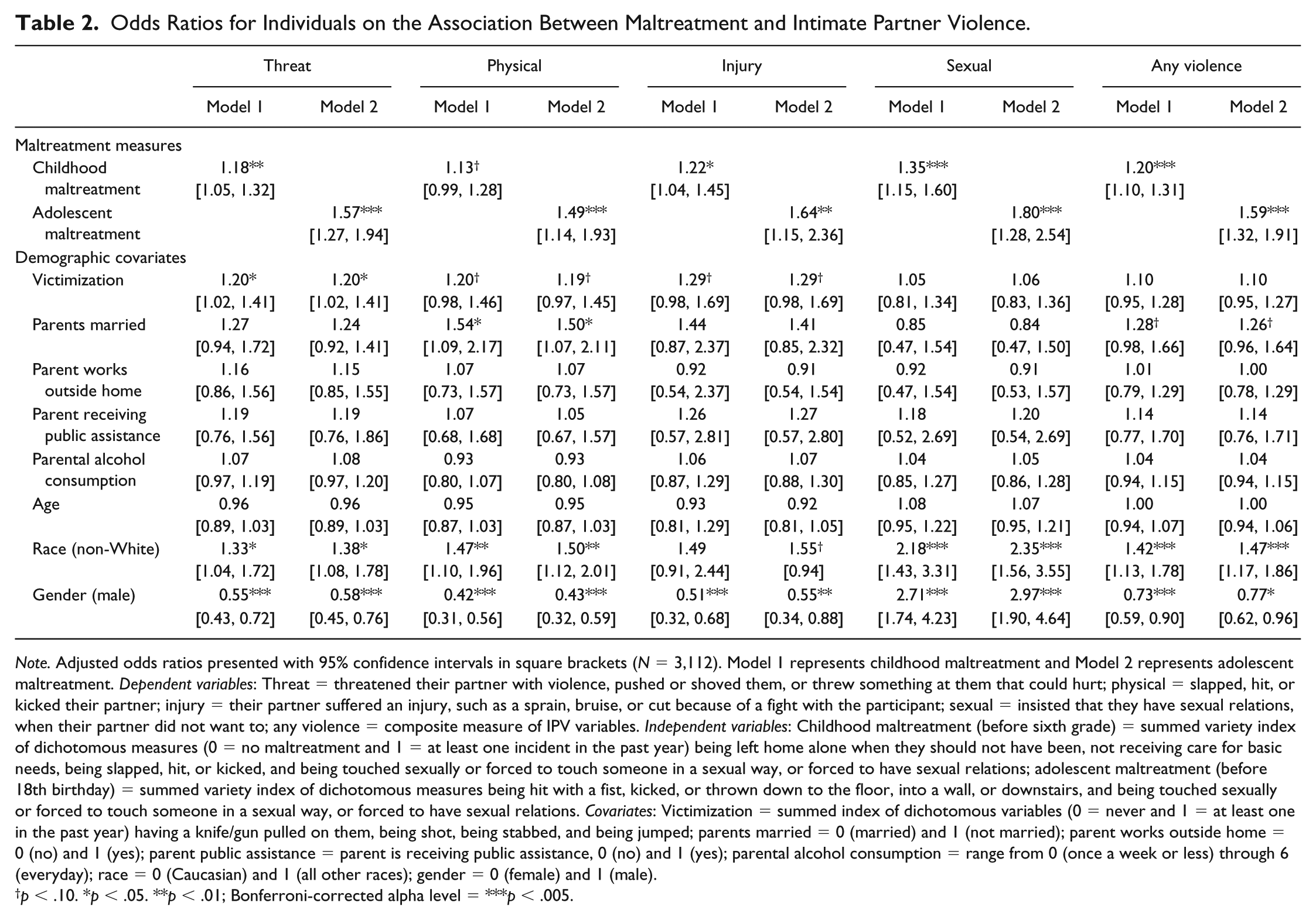
Note. Adjusted odds ratios presented with 95% confidence intervals in square brackets (N = 3,112). Model 1 represents childhood maltreatment and Model 2 represents adolescent maltreatment. Dependent variables: Threat = threatened their partner with violence, pushed or shoved them, or threw something at them that could hurt; physical = slapped, hit, or kicked their partner; injury = their partner suffered an injury, such as a sprain, bruise, or cut because of a fight with the participant; sexual = insisted that they have sexual relations, when their partner did not want to; any violence = composite measure of IPV variables. Independent variables: Childhood maltreatment (before sixth grade) = summed variety index of dichotomous measures (0 = no maltreatment and 1 = at least one incident in the past year) being left home alone when they should not have been, not receiving care for basic needs, being slapped, hit, or kicked, and being touched sexually or forced to touch someone in a sexual way, or forced to have sexual relations; adolescent maltreatment (before 18th birthday) = summed variety index of dichotomous measures being hit with a fist, kicked, or thrown down to the floor, into a wall, or downstairs, and being touched sexually or forced to touch someone in a sexual way, or forced to have sexual relations. Covariates: Victimization = summed index of dichotomous variables (0 = never and 1 = at least one in the past year) having a knife/gun pulled on them, being shot, being stabbed, and being jumped; parents married = 0 (married) and 1 (not married); parent works outside home = 0 (no) and 1 (yes); parent public assistance = parent is receiving public assistance, 0 (no) and 1 (yes); parental alcohol consumption = range from 0 (once a week or less) through 6 (everyday); race = 0 (Caucasian) and 1 (all other races); gender = 0 (female) and 1 (male).
p < .10. *p < .05. **p < .01; Bonferroni-corrected alpha level = ***p < .005.
Sibling-Comparison Models for Childhood Maltreatment
The sibling comparison models examining the associations between childhood maltreatment and the IPV measures are presented in Table 3. The results indicate that children from families with greater levels of childhood maltreatment are significantly more likely to engage in all examined forms of IPV (aside from physical violence). 2 However, within the examined families, siblings who experienced greater levels of childhood maltreatment were not significantly more likely to engage in any of the examined forms of IPV.
Adjusted Odds Ratios From Sibling-Comparison Models Examining the Association Between Childhood Maltreatment and Intimate Partner Violence.
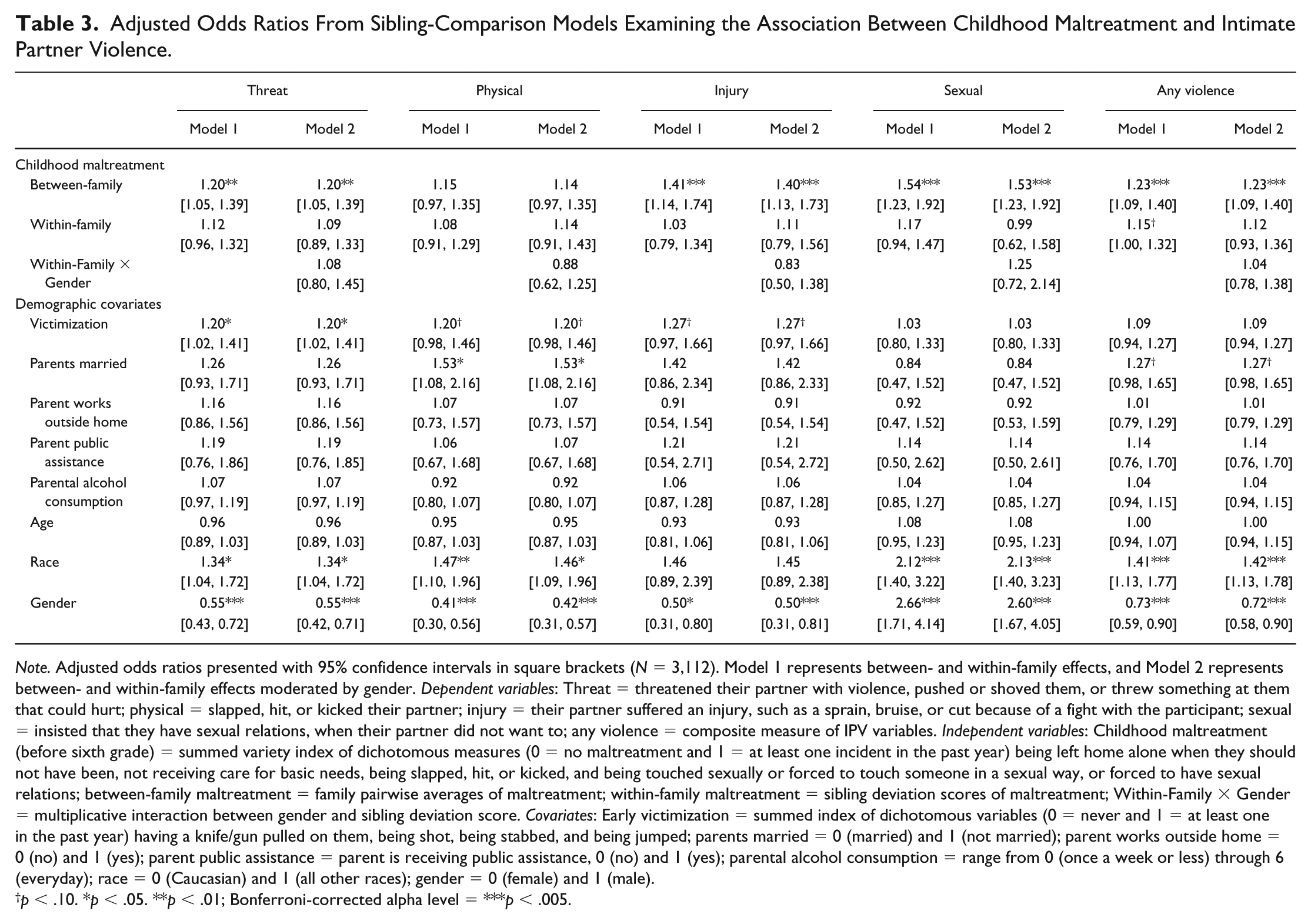
Note. Adjusted odds ratios presented with 95% confidence intervals in square brackets (N = 3,112). Model 1 represents between- and within-family effects, and Model 2 represents between- and within-family effects moderated by gender. Dependent variables: Threat = threatened their partner with violence, pushed or shoved them, or threw something at them that could hurt; physical = slapped, hit, or kicked their partner; injury = their partner suffered an injury, such as a sprain, bruise, or cut because of a fight with the participant; sexual = insisted that they have sexual relations, when their partner did not want to; any violence = composite measure of IPV variables. Independent variables: Childhood maltreatment (before sixth grade) = summed variety index of dichotomous measures (0 = no maltreatment and 1 = at least one incident in the past year) being left home alone when they should not have been, not receiving care for basic needs, being slapped, hit, or kicked, and being touched sexually or forced to touch someone in a sexual way, or forced to have sexual relations; between-family maltreatment = family pairwise averages of maltreatment; within-family maltreatment = sibling deviation scores of maltreatment; Within-Family × Gender = multiplicative interaction between gender and sibling deviation score. Covariates: Early victimization = summed index of dichotomous variables (0 = never and 1 = at least one in the past year) having a knife/gun pulled on them, being shot, being stabbed, and being jumped; parents married = 0 (married) and 1 (not married); parent works outside home = 0 (no) and 1 (yes); parent public assistance = parent is receiving public assistance, 0 (no) and 1 (yes); parental alcohol consumption = range from 0 (once a week or less) through 6 (everyday); race = 0 (Caucasian) and 1 (all other races); gender = 0 (female) and 1 (male).
p < .10. *p < .05. **p < .01; Bonferroni-corrected alpha level = ***p < .005.
Sibling-Comparison Models for Adolescent Maltreatment
The results of the sibling comparison models examining the associations between adolescent maltreatment and IPV are presented in Table 4. Similar to the childhood maltreatment models, all between-family effects involving adolescent maltreatment were significant. However, unlike the childhood maltreatment models, the within-family effects for adolescent maltreatment indicated that siblings who were maltreated during adolescence were significantly more likely to engage in threatening behavior (AOR = 1.41, p = .04) and overall IPV violence (AOR = 1.38, p = .03).
Adjusted Odds Ratios From Sibling-Comparison Models Examining the Association Between Adolescent Maltreatment and Intimate Partner Violence.

Note. Adjusted odds ratios presented with 95% confidence intervals in square brackets (N = 3,112). Model 1 represents between- and within-family effects, and Model 2 represents between- and within-family effects moderated by gender. Dependent variables: Threat = threatened their partner with violence, pushed or shoved them, or threw something at them that could hurt; physical = slapped, hit, or kicked their partner; injury = their partner suffered an injury, such as a sprain, bruise, or cut because of a fight with the participant; sexual = insisted that they have sexual relations, when their partner did not want to; any violence = composite measure of IPV variables. Independent variables: Adolescent maltreatment (before 18th birthday) = summed variety index of dichotomous measures (0 = no maltreatment and 1 = at least one incident in the past year) being hit with a fist, kicked, or thrown down to the floor, into a wall, or downstairs, and being touched sexually or forced to touch someone in a sexual way, or forced to have sexual relations; between-family maltreatment = family pairwise averages; within-family maltreatment = sibling deviation scores; Within-Family × Gender = multiplicative interaction between gender and sibling deviation score. Covariates: Early victimization = summed index of dichotomous variables (0 = never and 1 = at least one in the past year) having a knife/gun pulled on them, being shot, being stabbed, and being jumped; parents married = 0 (married) and 1 (not married); parent works outside home = 0 (no) and 1 (yes); parent public assistance = parent is receiving public assistance, 0 (no) and 1 (yes); parental alcohol consumption = range from 0 (once a week or less) through 6 (everyday); race = 0 (Caucasian) and 1 (all other races); gender = 0 (female) and 1 (male).
p < .10. *p < .05. **p < .01; Bonferroni-corrected alpha level = ***p < .005.
Models Examining the Moderating Effects of Gender
The final stage of the analysis was aimed at examining whether gender differences moderated the between- and within-family effects observed in the previous stages of the analysis. The result of bivariate logistic regression models in which each IPV measure was separately regressed on gender are presented in Table 5 and revealed that females were significantly more likely to threaten (b = –.51, p < .001), hit (b = –.81, p < .001), and injure (b = –.56, p = .015) their partner compared with males. Males, however, were significantly more likely to engage in sexual coercion (b = –.26, p = .013). The results of models examining the potential moderating effects of gender on within-family effects of childhood maltreatment on IPV perpetration is presented in Table 3 (Model 2). None of the examined interactions between childhood maltreatment and gender reached conventional levels of significance. The moderating relationship between gender on the within-family effect of adolescent maltreatment on IPV perpetration is presented in Table 4 (Model 2). Once again, all of the examined interaction terms were nonsignificant.
Gender Comparisons (Logit Models) Across all Intimate Partner Violence Measures.

Note. Threat = threatened their partner with violence, pushed or shoved them, or threw something at them that could hurt; physical = slapped, hit, or kicked their partner; injury = their partner suffered an injury, such as a sprain, bruise, or cut because of a fight with the participant; sexual = insisted that they have sexual relations, when their partner did not want to; any violence = composite measure of IPV variables. 0 = female; 1 = male. Coef. = unstandardized logistic regression coefficients; SE = standard error.
p < .10. *p < .05. **p < .01; Bonferroni-corrected alpha level = ***p < .005.
Discussion
The numerous consequences of IPV have been extensively documented in previous research (Campbell et al., 2002; Ehrensaft, Moffitt, & Caspi, 2006). Based on these observations, it comes as little surprise that a developed line of research has focused on identifying potential influences that ultimately contribute to IPV perpetration. Although a significant portion of this literature has identified various family-level influences as key factors in the development of IPV, studies indicate that variation in IPV perpetration is shaped by a combination of environmental and biological influences (Barnes et al., 2013; Hines & Saudino, 2004). The current study attempted to take both sets of influences into account by employing sibling comparison models to address five hypotheses.
Based on the genetically sensitive design employed, the results of the current study provide partial support for Hypothesis 1. Specifically, families with greater average levels of childhood maltreatment were more likely to engage in IPV during early adulthood; however, this same pattern of results was not observed for physical violence. Although the association between childhood maltreatment and IPV perpetration were largely significant, the results did not support the within-family effects outlined in Hypothesis 2. Results indicated when maltreatment was discordant among siblings from the same family, those siblings who experienced maltreatment during childhood were no more likely to engage in IPV than their co-sibling who was not maltreated. This pattern of results does not mean childhood maltreatment is inconsequential to child development, well-being, or behavioral outcomes, but rather suggests that childhood maltreatment represents only a single symptom of the larger and more encompassing context of ACEs. Consequently, additional sources of ACEs that co-occur with maltreatment may effectively contribute to increases in the likelihood of IPV perpetration later in the life course. Similarly, these findings could be a consequence of a vicarious or spillover effect where witnessing a sibling’s maltreatment could result in the nonmaltreated sibling learning maladaptive behaviors as well. Future research may benefit from examining a broader conceptualization of childhood adversity to better identify the potential etiological pathways that ultimately connect family influences and IPV perpetration within the context of a genetically informed framework.
The results provided support for Hypothesis 3, indicating that families with children maltreated during adolescence also displayed greater levels of IPV perpetration in early adulthood compared with families in which children did not experience adolescent maltreatment. Hypothesis 4 received partial support such that when comparing siblings from the same household, children who suffered maltreatment during adolescence were significantly more likely to engage in the composite IPV measure (i.e., any perpetration) and threaten their partner, but physical violence, injuring their partner, and sexual coercion were not found to be significant when compared with co-siblings who were not maltreated. 3 The observed differences for between- and within-family effects may be due to confounding stemming from environmental and/or genetic influences that cluster within families. Specifically, the attenuation of these results could be an indication that latent sources of shared family influences are also contributing to the development of IPV perpetration. Future research would benefit from further investigation into how the timing of maltreatment influences this relationship as the results of the current study indicated that adolescent maltreatment was more consistently associated with IPV perpetration compared with childhood maltreatment.
Finally, the results of a set of fixed effects models examining the potential moderating effects of gender on the observed associations did not provide support for Hypothesis 5. Although the resulting pattern of findings did not reveal significant interactions involving gender, the results did indicate the prevalence of threatening, hitting, and injuring one’s partner was higher among females compared with males. Although this finding may seem counterintuitive, it aligns with the extant literature (Straus, 2006) and may partially result from social desirability bias wherein men are less willing to admit perpetration compared with women (Stets & Straus, 1990). Considering these findings, future research would benefit from examining multiple reporting sources (e.g., official records, self-reports, etc.) to obtain a more comprehensive measure of male and female IPV.
Although the current study is the first to examine the association between maltreatment and IPV perpetration within a genetically informed framework, it is not without limitation. First, a limited number of items were used to measure each form of IPV. The employed measures are drawn from the Revised Conflict Tactics Scales (CTS2), but only four of the 78 items were included in the final Add Health interview instrument. Second, the examined maltreatment measures are retrospective, which previous research has indicated has the potential to introduce multiple forms of bias, including recall bias (Hardt & Rutter, 2004). Third, differences in individual maltreatment scores may be influenced by individual perceptions of maltreatment, resulting in biased estimates. Fourth, while the full Add Health sample is nationally representative, findings from the sibling subsample may not enjoy the same level of generalizability. Results from a recent study indicate that a wide range of concepts do not systematically vary between the twin subsample and the larger overall sample (Barnes & Boutwell, 2013), but similar analyses have not yet been performed for the full sibling subsample. Finally, the adolescent maltreatment measure included maltreatment that occurred before the age of 18 years which could encompass both childhood and adolescent maltreatment. However, analyses were estimated where participants who reported both childhood and adolescent maltreatment were removed; results revealed similar findings when compared with the original models (results not presented, but available upon request). Thus, all participants were retained in the final sample to improve statistical power.
Taken together, this research provides evidence that the effects of maltreatment are multifaceted and may perpetuate future victimization experiences and violence. Specifically, maltreatment appears to set in motion a cycle of violence that may ultimately translate into the subsequent victimization of future intimate partners. Understanding maltreatment after accounting for family similarities is essential in identifying and assisting individuals who are most susceptible to engage in IPV, which, in turn, would aid in properly pairing the needs of at-risk individuals with the most appropriate services and interventions available.
Footnotes
Authors’ Note
The findings from this article were presented at the 72nd Annual American Society of Criminology Meeting in New Orleans, LA, in November 2016. This research uses data from Add Health, a program project directed by Kathleen Mullan Harris and designed by J. Richard Udry, Peter S. Bearman, and Kathleen Mullan Harris at the University of North Carolina at Chapel Hill, and funded by grant P01-HD31921 from the Eunice Kennedy Shriver National Institute of Child Health and Human Development, with cooperative funding from 23 other federal agencies and foundations. Special acknowledgment is due Ronald R. Rindfuss and Barbara Entwisle for assistance in the original design. Information on how to obtain the Add Health data files is available on the Add Health website ( ). No direct support was received from grant P01-HD31921 for this analysis.
Declaration of Conflicting Interests
The author(s) declared no potential conflicts of interest with respect to the research, authorship, and/or publication of this article.
Funding
The author(s) disclosed receipt of the following financial support for the research, authorship, and/or publication of this article: This work was supported by the Office of Research and Creative Activities at the University of Nebraska Omaha.