




Abstract
Police officers are highly criticized for their differential policing of people categorized by identity. One such group who has experienced differential policing is the lesbian, gay, bisexual, transgender, intersex, and queer (LGBTIQ+) community. Contributing new knowledge to the extant policing literature regarding intersectional identities of Australian police officers and perceptions of policing, this research applies Social Identity Theory to understand differences between lesbian, gay, bisexual, and transgender and heterosexual self-identified general-duties police officers (N = 349) and policing of LGBTIQ+ people. Using an online survey, results suggest the sexual identity of a general-duties police officer does shape perceptions of policing of LGBTIQ+ people. Furthermore, there are distinct differences in the way heterosexual and lesbian, gay, and bisexual (LGB) self-identified officers perceive police engagement with LGBTIQ+ people, with LGB and heterosexual self-identified officers equally compensating for their sexual identity in terms of policing LGBTIQ+ people and distancing themselves from the LGBTIQ+ community.
Introduction
In Western societies, social structures uphold the idea that dominant groups such as the police have the potential to enforce value systems and ideologies upon minor groups such as members of the lesbian, gay, bisexual, transgender, intersex and queer (LGBTIQ+) community (Miles-Johnson, 2016; Pratto et al., 2013). As such police have discretionary power to utilize policing practices influenced by officers’ value systems and ideologies (Dai et al., 2011). The interaction between LGBTIQ+ people and law enforcement officers has often been dictated by the reinforcement of values and ideologies based on heteronormative perceptions of behavior (Owen et al., 2018). Many incidents of policing between officers and LGBTIQ+ people in Australia, the United States, and the United Kingdom, have resulted in negative outcomes for LGBTIQ+ people with numerous pieces of literature demonstrating problematic relationships between Australian police as one dominant social group and LGBTIQ+ people as another less powerful social group 1 (Dwyer et al., 2017; Mennicke et al., 2018; Owen et al., 2018).
Under Social Identity theory (SIT), when a person identifies with a social group, the idea is that this categorization provides a definition of who that individual is in terms of the defining attributes or characteristics of the group’s collective identity. In this way, the categorization becomes the individual’s self-definition of their identity and shapes a person’s identity individually and as a group member (ingroup membership) (Tajfel, 2010). Social identity based on self-categorization within a group becomes a vital part of an individual’s self-concept, and to maintain positive self-esteem of the group and the individuals within it, people within groups strive to differentiate themselves and their group from others (Miles-Johnson, 2016; Robinson, 1996). Unlike other exclusionary and inclusionary practices such as “othering” (which explains power dynamics within relationships), social identity is established through comparative analysis of one group against another regardless of whether there is basis for comparison or an actual, imaginary, or vicarious relationship between groups.
For example, if an individual from one group perceives a threat to their identity by an individual or others from another group (either actual or perceived threat) the individual will act upon the threat thereby differentiating behaviorally or communicatively from the individual or group who may threaten their identity (Miles-Johnson, 2016; Robinson, 1996). The strength of SIT therefore is that it can capture the complex dynamics of intergroup perceptions at both an individual and group level. The complex dynamics between police and members of LGBTIQ+ communities have been researched in many studies examining policing of minority group members (see Dario et al., 2019; Israel et al., 2016).
There is however, little research which examines how Australian LGBTIQ+ police officers who work as general-duties police officers (and not as community liaison officers) police members of the LGBTIQ+ community in comparison to heterosexual general-duties officers. Canales (2000) and Miles-Johnson (2016) state that grouping LGBTIQ+ people into a homogeneous group may contribute to the “othering” of sexual identity associated with the LGBTIQ+ community by agencies such as the police. Yet grouped sexual identity based on heteronormative assumptions of sexual identity and consequently nonnormative sexual identities such as those expressed by members of the LGBTIQ+ community is one of the salient identity markers many cultures use to categorize and judge others.
Grouping people into ingroup and outgroup categories based on sexual identities associated with clusters or homogeneous self-identified groups becomes therefore a normative practice in terms of self-identification, group identification, and the identification of people considered “others” or separate to a dominant ingroup. Under SIT, this is a normative practice regarding perceptions of intergroup difference. Applying SIT, this research will therefore examine differences between self-identified LGBTIQ+ officers (n = 83) and self-identified heterosexual officers (n = 266) (working in one Australian police organization) to understand differences between each group and their perceptions of policing the LGBTIQ+ community. In addition, to understand intragroup differences between the perceptions of self-identified LGBTIQ+ officers and policing of LGBTIQ+ people, their perceptions will be analyzed in relation to membership within the ingroup (as members of the police) and in relation to membership in the outgroup by their self-disclosed sexuality (the LGBTIQ+ community) and whether the intersectionality of identity LGBTIQ+ police officers share between membership in the ingroup (police) and the outgroup (LGBTIQ+ community) shapes their perceptions of policing of the LGBTIQ+ people. Since police officers are highly criticized for their differential policing of people categorized by identity and outgroup identification (such as members of the LGBTIQ+ community) understanding differences between the perceptions of self-identified LGBTIQ+ police officers and self-identified heterosexual officers regarding policing of LGBTIQ+ people will contribute new knowledge to the extant policing literature regarding intersectional identities of Australian police officers and policing of minority groups.
Literature Review
Like the experiences of LGBTIQ+ people in other parts of the world (such as in the United Kingdom or the United States), LGBTIQ+ people in Australia mistrust the police, and many LGBTIQ+ people have suffered rejection and social isolation from police due to identification as a member of the LGBTIQ+ community (Miles-Johnson, 2016). Experiencing actual or perceived rejection and persecution from social institutions such as the police, results in many LGBTIQ+ people experiencing heightened harassment due to ingroup identification as an LGBTIQ+ person. According to research by Leonard et al. (2008), Miles-Johnson (2016), and Owen et al. (2018), this is reflected in the way LGBTIQ+ people purposefully avoid contact with institutions such as the police because of fear of stigmatization. Members of the LGBTIQ+ community also perceive police as unwilling to help LGBTIQ+ people and offer “protect and serve” responses to LGBTIQ+ people because officers are frequently described as being “indifferent” toward LGBTIQ+ victims of crime (Israel et al., 2016). This results in high levels of reported victimization and revictimization of LGBTIQ+ people, particularly when LGBTIQ+ people interact with officers who display discriminatory practices (and at times both verbal and physical abuse) toward LGBTIQ+ community members.
Discriminatory policing practices (either implicit or explicit), and lack of sensitivity when interacting with LGBTIQ+ people, is frequently reported by members of the LGBTIQ+ community regarding police engagement (Owen et al., 2018). Negativity regarding perceptions of police and interaction between police and LGBTIQ+ people is a global problem and as such has instilled a lack of mutual trust and confidence between both parties (Miles-Johnson, 2013b, 2016). Establishing trust between police and members of minority groups such as the LGBTIQ+ community is critical in ensuring cooperation and in turn building police legitimacy (Miles-Johnson & Pickering, 2018). Although there is a wide body of literature examining the effects of trust on police–citizen engagement (which is beyond the scope of this article), the overall argument that a lack of trust between citizens and police diminishes confidence in police and police organizations to effectively engage with all members of society, has affected relations between police and members of the LGBTIQ+ community (Miles-Johnson & Pickering, 2018).
Despite important initiatives by many police organizations around the world to build good relationships with members of minority communities such as the LGBTIQ+ community, poor policing of LGBTIQ+ people is echoed in places such as the United Kingdom, United States, and Australia where tension between police and LGBTIQ+ people have resulted in numerous complaints. Police mistrust of diverse people has serious outcomes for police organizations because it erodes police confidence in their ability to fulfill duties and responsibilities and increases the likelihood that officers will not provide the same level of service to all members of the community, often resulting in differential or over-policing of minority group members (Miles-Johnson & Pickering, 2018). Agency cost-cutting and the dissolution of many LGBTIQ+ liaison units developed to meet the needs of LGBTIQ+ people have also contributed to a lack of understanding and increased harassment of LGBTIQ+ people in the United States and in Australia (Labbe-DeBose, 2009; Miles-Johnson, 2013a). While many US police organizations implement awareness training programs regarding police response to minority group members (e.g., Alabama, Arizona, California, Florida, Michigan, New York, Texas, and West Virginia), critics argue that these programs lack information regarding the specific needs of LGBTIQ+ people and focus more on racial and ethnic minority groups (Israel et al., 2016).
In addition, multiple police agencies in US cities such as Washington, DC, New York City, and San Francisco have pared down awareness training programs tailored for specific communities and have dissolved specific community liaison units created to respond to members of minority groups such as the LGBTIQ+ community) (Israel et al., 2016). Some police organizations in the United States (such as Atlanta Police Department) have introduced mandatory awareness training courses for groups such as the LGBTIQ+ community; however, many US police agencies dissolved specific awareness training programs expecting police officers to include minority policing techniques into regular police duties (Israel et al., 2016; Labbe-DeBose, 2009). Miles-Johnson (2016) argues that providing ineffective training regarding policing of minority group members is just as harmful as providing no training at all.
One strategy implemented by police organizations around the globe and in Australia over and above police training programs initiated to increase officer’s awareness of minority group members is to diversify the workplace and personnel of officers (Colvin, 2014; Mennicke et al., 2018). Executed under notions of “representative bureaucracy,” these inclusionary strategies suggest that a police workforce which is representative of the community it serves will help ensure that the interests of all members of a community being policed will be considered during bureaucratic decision-making processes (Bradbury & Kellough, 2011; Wilkins & Williams, 2008). According to research by Colvin (2014) and Miles-Johnson (2016), law enforcement organizations also need to reflect the demographics of the communities they serve to adequately respond to and protect all members of society. Recruiting individuals from minority groups into police agencies therefore has become a priority for many police organizations.
Yet despite exerted efforts by police organizations to recruit across communities, police organizations in Australia are unable to strategically recruit people from diverse groups generally, and are unable to effectively deploy specifically diverse officers into the community to police members of diverse groups such as members of the LGBTIQ+ community during police–citizen encounters (Miles-Johnson & Pickering, 2018). The strategic recruitment drive of police agencies to not only recruit more culturally diverse people but also to recruit people from specific racial and ethnic groups has meant the numbers of diverse police officers are slowly increasing (Shjarback et al., 2017). In Australia, many police organizations strategically employ people who identify with culturally diverse communities such as members of Asian, Sudanese, or Muslim communities, as well as people from other diverse groups such as LGBTIQ+ self-identified people (Miles-Johnson, 2016).
According to Shjarback et al., (2017), the strategic employment of people from diverse groups such as the LGBTIQ+ community in police organizations may produce positive outcomes regarding police–citizen encounters because the workplace environment in which police operate highly influences officer behaviors. In Australia, this is an area of policing that is under researched, and it is not yet known how effective this will be over time because research examining the effects of strategic recruitment drives by police organizations is still in its infancy (Miles-Johnson, 2016). Although diversification of police organizations is a priority for many agencies, in Australia and around the globe, there is little research examining how general-duties police officers (who identify as a member of a specific minority group) perceive policing of members of the same minority group with whom they also identify. There is also little research examining whether the intersectionality of identity shared between being a member of an ingroup (the police) and an outgroup (in this research also being a member of the LGBTIQ+ community) shapes perceptions of policing generally; and/or in relation to policing of other outgroup members.
Existing literature has examined perceptions of police officers toward members of the LGBTIQ+ community (for example, see Mallory et al., 2015), as well as lesbian, gay, and bisexual (LGB) community police liaison officer’s perceptions of LGB people (for example see Dwyer et al., 2017). It has also examined the experiences of LGB officer’s perceptions of working in a predominantly outward heteronormative organization (for example see Bernstein & Kostelac, 2002), but little research exists regarding perceptions of policing of a specific minority group (such as the LGBTIQ+ community) by general-duties police officers who also share membership or self-identify with the specific minority group.
Targeted recruitment of people who self-identify as a member of a sexually diverse group, such as the LGBTIQ+ community presents police organizations with a unique challenge since sexual orientation and sexual identity, regardless of self-acknowledgment, are not always overtly apparent or openly expressed (Colvin, 2014). Some officers may choose to disclose their sexual identity to colleagues and/or the organization, while others may choose to conceal this part of their identity to avoid differential treatment (Bernstein & Kostelac, 2002; Colvin, 2014). There is a wide body of literature which examines disclosure of sexuality in the workplace and how this affects police officers (see Bernstein & Swartwout, 2012; Miller et al., 2003). The diversification of police organizations has created opportunities for recruitment of officers from diverse groups, yet critics argue members of the LGBTIQ+ community who join police agencies remain significantly underrepresented within police organizations (Workman-Stark, 2015) and (when discovered to self-identify with the LGBTIQ+ community) are often relegated to liaison roles or police work considered “less dangerous” or “less manly.”
When examining police officer perceptions of policing, police attitudes toward diverse people may be significantly shaped by the influence of other ingroup members and ingroup norms long before members of the ingroup have had actual contact with and/or experiences with diverse individuals as police officers. Heterosexual and LGBTIQ+ self-identified police officers’ conscious acknowledgment and endorsement of ingroup membership (and ingroup status) within an ingroup whose membership is endorsed and underpinned by male notions of behavior and heteronormative ideals may influence perceptions of policing of LGBTIQ+ people. They may also be indicative of how police officers as a collective ingroup express intergroup bias toward LGBTIQ+ people since the conscious separation of police officers as a distinct ingroup may override individual notions of identity, particularly the identity of police officers who self-identify as LGBTIQ+.
Hitherto, the research presented in this study, police research examining how ingroup identity and ingroup membership within a police organization overrides outgroup identities and outgroup memberships has been under researched, particularly in relation to LGBTIQ+ self-identified general-duties officers within an Australian context. Therefore, to better understand intergroup membership and differences between self-identified heterosexual and LGBTIQ+ general-duties officers within the ingroup membership of a police organization, research was conducted with officers in one of the largest state-based police organizations within Australia (de-identified for ethics reasons).
Data and Method
The Online Survey
Due to restrictions imposed by the police organization, an email containing a link to the online survey was sent out by civilian administrators working within the organization to all uniformed general-duties police officers. The email link was sent at the beginning of each month over a 12-month period. The email contained details of the survey, an information sheet, and other material required by the ethics committee. All respondents participating in the survey were informed that participation in the survey was not a test, and all officers completing the survey were encouraged to be honest in their responses. In addition, all participants were informed that responses were anonymous and would not impact on professional relationships within (or with) the police organization.
The Sample/Population
The participants in this research were identified and separated into two groups by the disclosure of their sexuality, self-identifying either as LGBTIQ+ (and as a member of the LGBTIQ+ community) or as heterosexual (and as a member of the heterosexual community). None of the officers worked as liaison officers to the LGBTIQ+ community and all officers included in this research were classified as general-duties police in terms of their responsibilities and related police work. Although the exact number of officers emailed was not disclosed by the organization, the final sample comprised more heterosexual self-identified officers (n = 266) than LGBTIQ+ self-identified officers (n = 83). While 23.8% (n = 83) of the sample identified as an LGB police officer, with more lesbian female police officers 36.1% (n = 30) in the sample than gay male police officers 24.1% (n = 20), and more bisexual female police officers 24.1% (n = 20), than bisexual male police officers 15.7% (n = 13) in the sample, there were no self-identified transgender, intersex, or queer police officers who participated in this study.
It is acknowledged that overall response rate from the officers is small; however, low survey response rates from Australian officers is often expected when conducting research with Australian police organizations. This is because most Australian police officers are over-surveyed by external researchers and agencies, and over-surveyed within their organizations by internal workplace surveys, thereby suffering “survey-fatigue” and a lack of interest in survey participation (Miles-Johnson & Pickering, 2018). In addition, general-duties police officers are usually “time-poor,” and participation in the survey was voluntary not mandatory. According to Nix et al. (2019), a low response rate from survey participants is no reason to dismiss the findings of a survey, particularly when surveys examine professions like policing. It may also be that police officers participating in the research who self-identify as a member of the LGBTIQ+ community are not open about certain aspects of their identity or felt comfortable to acknowledge intersectional identities within the workplace (even though it was a confidential and anonymous survey). Since none of the police officers in this research self-identified as transgender, intersex, or queer, analysis of the items in the survey were conducted in such a way so as not to elicit results that could negate or possibly diminish the experience or perceptions of self-identified transgender, intersex, or queer self-identified police officers in relation to the same issues.
The sample of self-identified LGB police officers in this research 23.8% (n = 83) included more female police officers 60.2% (n = 50) than male police officers 39.8% (n = 33), and the sample of self-identified heterosexual police officers 76.2 (n = 266) included more male police officers (n = 182) than female police officers (n = 84). The age range of all the police officers in the overall sample (n = 349) ranged from 19 to 52 years, with the average age of all the participants being 29 years. The age range of the LGB police officers was from 20 to 47 years, and the age range of heterosexual police officers was from 19 to 52 years. A very small number of the total participants 4.3% (n = 15) self-identified as a member of a minority racial group or as a member of a minority ethnic group 4% (n = 14), which was also reflected in the subsample of LGB officers since a smaller number of police officers self-identifying as a member of a minority racial group 12.05% (n = 10) or as a member of a minority ethnic group 8.4% (n = 7), while 1.9% (n = 5) of heterosexual police officers self-identified as a member of a minority racial group or as a member of a minority ethnic group 2.6% (n = 7).
The Variables, Ingroup, and Outgroup Identity
Occupational attitudes and background characteristics
During the construction of the variables, we acknowledged that perceptions of policing of LGBTIQ+ people may vary in terms of participant responses to different characteristics, and as such each of the items in this scale were based on previous items successfully used in police research (see Miles-Johnson, 2016; and the police officer training research survey “PMC Police Survey” by Miles-Johnson et al., 2018). To understand ingroup membership within the police organization and whether there are differences between self-identified heterosexual and LGBTIQ+ police officers and perceptions of policing of LGBTIQ+ people, and as well as to determine whether membership within the ingroup (as police officers) influences the perceptions of self-identified LGBTIQ+ police officers and their perceptions of policing members of the LGBTIQ+ community, scales were created from participant responses as independent variables and grouped together as either “occupational attitude measures” or “background characteristics” in the final analysis. Strategically placed items were also included in the online survey to capture police officer perceptions of prejudice, discrimination, ethnocentrism, stereotyping, intergroup conflict, conformity, normative behavior, and group cohesiveness of police officers as ingroup members in relation to perceptions of policing. Each of the items in the survey used a 5-point Likert-type scale ranging from 1 = “extremely likely” to 5 = “extremely unlikely.” It was found that the adapted items used in the online survey all had good or excellent internal consistency.
Occupational attitudes (six scales) included items asking about police officer general work attitudes (six items, Cronbach alpha = .81), officer disposition and policing work (six items, Cronbach alpha = .88), use of force and policing work (eight items, Cronbach alpha = .91), rule breaking and policing work (six items, Cronbach alpha = .69), influence of supervisors and senior offices on police work (four items, Cronbach alpha = .88), and how pride in their work (four items, Cronbach alpha = .71) shapes perceptions of policing LGBTIQ+ people. These measures were included in the final analyzes because previous literature (MacVean & Cox, 2012; Miles-Johnson, 2016; Miles-Johnson et al., 2018) indicates that police perceptions of professional engagement are strongly influenced by each of these variables, and ingroup membership is typically upheld by members of the group through their adherence to attitudes, beliefs, and behaviors expressed by the group.
Background characteristics (six scales) included items asking about police officers trust in members of the LGBTIQ+ community (10 items, Cronbach alpha = .89), frequency of social contact with members of the LGBTIQ+ community (six items, Cronbach alpha = .77), social experiences with LGBTIQ+ people (six items, Cronbach alpha = .92), police officer friendship groups in relation to members of the LGBTIQ+ community (six items, Cronbach alpha = .77), their living and working choices in relation to living and working alongside members of the LGBTIQ+ community (six items, Cronbach alpha = .81), and their awareness of the diversity within the LGBTIQ+ community (10 items, Cronbach alpha = .89). All the items used within each scale are shown in Supplemental Appendix A.
Since the data were collected via an online survey administered by email to police officers as a convenience sample, nonparametric statistical analysis techniques were applied to analyze the results. The nonparametric analyzes techniques included in the study were Kruskal–Wallis H statistical analysis tests, and Mann–Whitney U statistical analysis tests. In addition to these tests, a factorial multivariate analysis of variance (MANOVA; a parametric multivariate test) was also applied to analyze the data set. It is acknowledged that using a parametric multivariate test with a convenient sample, assumptions about the populations from which the sample was drawn are not necessarily generalizable, but results of this study would speak to the broader issues regarding ingroup perceptions of the police, ingroup identity of police and membership within the group, and specifically whether membership within the ingroup (as police officers) influences the perceptions of self-identified LGBTIQ+ police officers and perceptions of policing LGBTIQ+ people.
Mann–Whitney U tests and Gender Identities of Officers
For the series of Mann–Whitney U tests and gender, the dependent variables used each time were the occupational attitude and background characteristic scales, and the independent variable was the gender age of officers. The results of the Mann–Whitney U test for gender identity show that the gender of some of the officers did have a significant relationship on their perceptions of use of force and policing of LGBTIQ+ people (U = 10,258, z = −4.56, p = .00, r = .25), (one of the occupational attitude scales) and a significant relationship on officer’s perceptions of trust in members of the LGBTIQ+ community (U = 10,996, z = −3.75, p = .00, r = .21), officer’s frequency of social contact with members of the LGBTIQ+ community (U = 17,744, z = 3.65, p = .00, r = .20), officer’s friendships with members of the LGBTIQ+ community (U = 16,895, z = 2.72, p = .006, r = .15), the living and work choices officers make in relation to living and working alongside members of the LGBTIQ+ community (U = 18,064, z = 4.09, p = .00, r = .23), and the officer’s perceptions of the general diversity of people within the LGBTIQ+ community (U = 17,494, z = 3.39, p = .001, r = .19) (five of the background characteristics scales).
Kruskal–Wallis H test and Comparison of Individual Sexual Identity of Officers (Self-Identified as LGB or Heterosexual)
For the Kruskal–Wallis H tests and the individual sexual identity of officers, the dependent variables used each time were the occupational attitude and background characteristic scales, and the independent variable was sexuality of officers. The results of the Kruskal–Wallis H test for individual sexual identity of officers self-identified as LGB or heterosexual show that the individual sexual identity of officers did have a significant relationship with five out of the six occupational attitude scales. A significant relationship was found between the individual sexual identity of officers and general work attitude, H (3) = 131.29, p = .00, officer disposition and policing work, H (3) = 8.09, p = .04, officer perceptions of use of force and policing of LGBTIQ+ people, H (3) = 79.25, p = .00, the influence of senior officers on perceptions of policing LGBTIQ+ people, H (3) = 17.75, p = .00, and the levels of pride in their work that shape officer perceptions of policing of LGBTIQ+ people, H (3) = 137.34, p = .00. The results of the Kruskal–Wallis H test for individual sexual identity of officers self-identified as LGB or heterosexual also show that the individual sexual identity of officers did have a significant relationship with five out of the six background characteristic scales. A significant relationship was found between the individual sexual identity of officers and officer’s perceptions of trust in members of the LGBTIQ+ community, H (3) = 192.48, p = .00, officer’s frequency of social contact with members of the LGBTIQ+ community, H (3) = 158.43, p = .00, officer’s friendships with members of the LGBTIQ+ community, H (3) = 128.95, p = .00, the living and work choices officers make in relation to living and working alongside members of the LGBTIQ+ community, H (3) = 84.66, p = .00, and the officer’s perceptions of the general diversity of people within the LGBTIQ+ community, H (3) = 191.70, p = .00. Since the number of officers included within each of the individual LGB self-identified categories of sexual identity were relatively small, it was decided that officers would be grouped into two homogeneous groups (identified as either LGB officers or heterosexual officers), and both groups would be included in further statistical analyzes.
Mann–Whitney U tests and Comparison of Grouped Sexual Identity of Officers (LGB Self-Identified Officers and Heterosexual Self-Identified Officers)
For the series of Mann–Whitney U tests and grouped sexual identity of officers, the dependent variables used each time were the occupational attitude and background characteristic scales and the independent variable was the grouped sexuality of officers. The results of the Mann–Whitney U test for grouped sexual identity of officers (one group categorized as LGBT self-identified officers and the other group categorized as heterosexual self-identified officers) show that the difference between LGB self-identified officers and heterosexual self-identified officers did have a significant relationship on officer’s general work attitude (U = 1,938, z = −11.41, p = .00, r = .63), officer’s perceptions of use of force and policing of LGBTIQ+ people (U = 18,065, z = 8.82, p = .00, r = .50), the influence of senior officers on perceptions of policing LGBTIQ+ people (U = 8,067, z = −3.85, p = .00, r = .21), the levels of pride in their work that shape officer perceptions of policing of LGBTIQ+ people (U = 1,731, z = −11.69, p = .00, r = .65), (four of the occupational attitude scales) and a significant relationship on officer’s perceptions of trust in members of the LGBTIQ+ community (U = 22,078, z = 13.87, p = .00, r = .77), officer’s frequency of social contact with members of the LGBTIQ+ community (U = 999, z = −12.54, p = .00, r = .70), officer’s friendships with members of the LGBTIQ+ community (U = 1,967, z = −11.34, p = .00, r = .63), the living and work choices officers make in relation to living and working alongside members of the LGBTIQ+ community (U = 39,997, z = −8.99, p = .00, r = .50), and the officer’s perceptions of the general diversity of people within the LGBTIQ+ community (U = 35,511, z = −13.83, p = .00, r = .77) (five of the background characteristics scales).
Kruskal–Wallis H test and Age of Officers
For the Kruskal–Wallis H tests and age of officers, the dependent variables used each time were the occupational attitude and background characteristic scales, and the independent variable was age of officers. The results of the Kruskal–Wallis H test for age (clustered into three age categories (18–30, 31–45, 46+) show that the age of the officers did not have a significant relationship on the occupational attitudes and background characteristics variables and officer perceptions of policing of LGBTIQ+ people. This is an important point since previous research indicates that the age of an officer may impact on their perceptions of policing (and actual engagement when policing) members of minority groups (Miles-Johnson & Pickering, 2018). Yet in this research, the age of an officer was not a significant influence on perceptions of policing of LGBTIQ+ people.
Mann–Whitney U tests and Racial and Ethnic Identities of Officers
For the series of Mann–Whitney U tests and racial and ethnic identities of officers, the dependent variables used each time were the occupational attitude and background characteristic scales and the independent variable was the racial and ethnic identity of officers. The results of the Mann–Whitney U tests regarding the influence of racial and ethnic identities of officers and occupational attitudes and background characteristics in relation to perceptions of policing of LGBTIQ+ people show that the racial identity of some of the officers did have a significant relationship on their general work attitude (U = 1,384, z = −2.95, p = .003, r = .16), their perceptions of use of force and policing of LGBTIQ+ people (U = 3,488, z = 2.59, p = .01, r = .14), the levels of pride in their work that shape officer perceptions of policing of LGBTIQ+ people (U = 1,426, z = −2.85, p = .004, r = .16) (three of the occupational attitudes scales) and a significant relationship on officer’s perceptions of trust in members of the LGBTIQ+ community (U = 3,630, z = 2.97, p = .003, r = .17), officer’s frequency of social contact with members of the LGBTIQ+ community (U = 1,489, z = −2.67, p = .008, r = .15), officer’s friendships with members of the LGBTIQ+ community (U = 1,501, z = −2.64, p = .008, r = .15), the living and work choices officers make in relation to living and working alongside members of the LGBTIQ+ community (U = 1,710, z = −2.13, p = .033, r = .12), and officer’s perceptions of general diversity of people within the LGBTIQ+ community (U = 1,463, z = −2.74, p = .006, r = .15) (five of the background characteristics scales). The results also show that the ethnic identity of some of the officers did have a significant relationship on general work attitude (U = 1,537, z = −2.20, p = .03, r = .12), and officer disposition and policing work (U = 1,548, z = −2.21, p = .03, r = .12) (two of the occupational attitude scales) and on officer’s frequency of social contact with members of the LGBTIQ+ community (U = 1,597, z = −2.03, p = .04, r = .11) (one of the background characteristic scales).
Results From the MANOVA Analyzes
To further understand whether there are differences between self-identified heterosexual and LGBTIQ+ police officers and perceptions of policing of LGBTIQ+ people, it was decided that a factorial MANOVA would be an ideal statistical tool to analyze responses. While it is acknowledged that assumptions about the populations from which the sample is drawn is not necessarily generalizable, the results would provide insight regarding differences between police officers and perceptions of policing LGBTIQ+ people based on an officer’s self-identified sexuality. The independent variables used in the factorial MANOVA were the sexual identity of officers (LGB self-identified officers and heterosexual self-identified officers). Preliminary assumption testing indicated that no serious violations were noted.
A significant main effect was found on the combined dependent variables for officers self-identified as LGB and officers self-identified as heterosexual and perceptions of policing of LGBTIQ+ people (F [12, 336] = 775.24, p < .01, Wilks’s lambda = .04, ηp2 = .97). When the results for the dependent variables were considered separately, the results of the factorial MANOVA supported the results from the series of Mann–Whitney U tests and Kruskal–Wallis H tests, with four of the occupational attitude scales (officer’s general work attitude (F [1, 347] = 242.44, p < .01, ηp2 = .41), officer’s perceptions of use of force and policing of LGBTIQ+ people (F [1, 347] = 74.61, p < .01, ηp2 = .18), the influence of senior officers on officer’s perceptions of policing LGBTIQ+ people (F [1, 347] = 12.44, p < .01, ηp2 = .04), and levels of pride officers have in their work that perceptions of policing of LGBTIQ+ people (F [1, 347] = 283.10, p < .01, ηp2 = .45), all reached statistical significance regarding differences between self-identified LGB officers and self-identified heterosexual officers and perceptions of policing of LGBTIQ+ people.
In addition, five of the background characteristics scales also reached statistical significance regarding differences between self-identified LGB officers and self-identified heterosexual officers and perceptions of policing of LGBTIQ+ people. These included officer’s perceptions of trust in members of the LGBTIQ+ community (F (1, 347) = 4,752.06, p < .01, ηp2 = .93), frequency of social contact between officers and members of the LGBTIQ+ community (F [1, 347] = 484.25, p < .01, ηp2 = .58), officer’s friendships with members of the LGBTIQ+ community (F [1, 347] = 244.72, p < .01, ηp2 = .41), the living and work choices officers make in relation to living and working alongside members of the LGBTIQ+ community (F [1, 347] = 95.39, p < .01, ηp2 = .22), and perceptions of general diversity of people within the LGBTIQ+ community (F [1, 347] = 2,318.55, p < .01, ηp2 = .87). The multivariate and univariate results are presented in Table 1.
MANOVA and Perceptions of Policing LGBTIQ+ People.
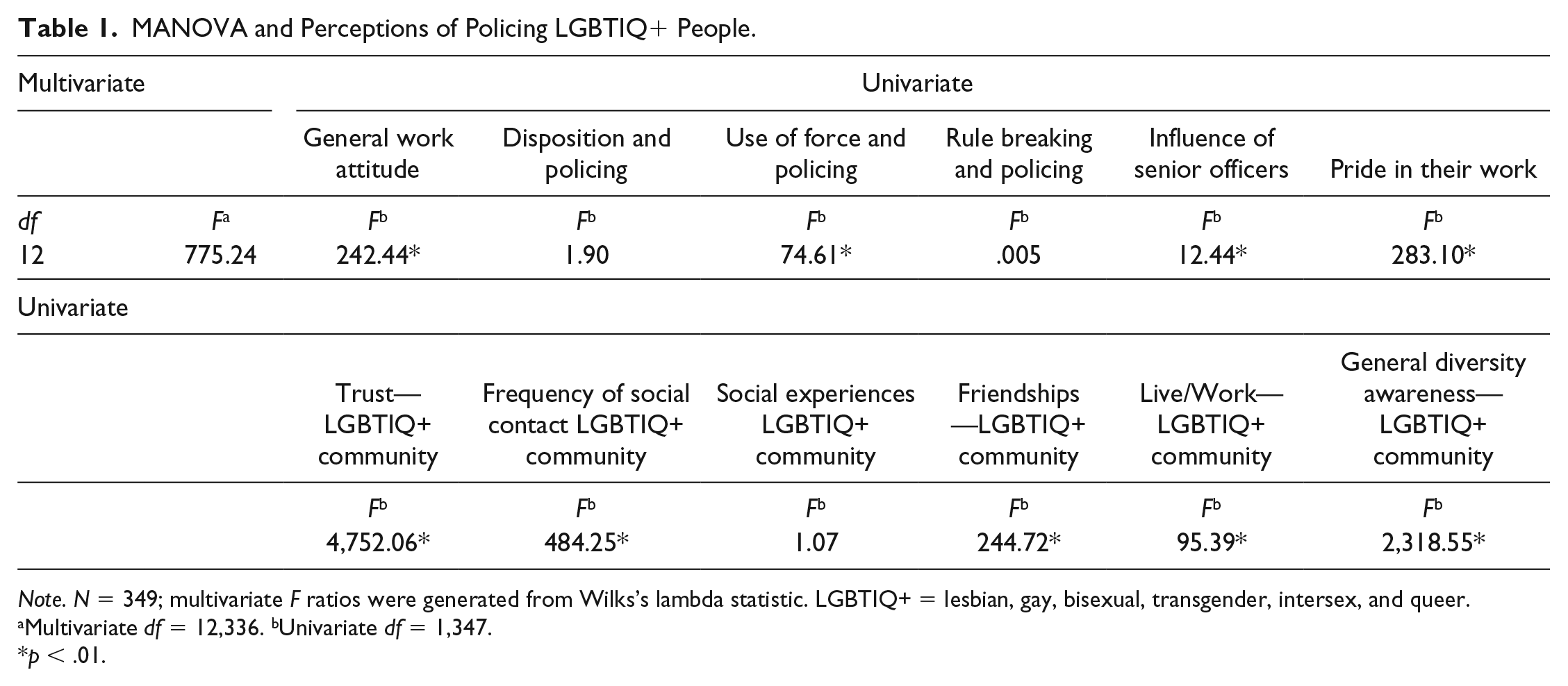
Note. N = 349; multivariate F ratios were generated from Wilks’s lambda statistic. LGBTIQ+ = lesbian, gay, bisexual, transgender, intersex, and queer.
Multivariate df = 12,336. bUnivariate df = 1,347.
p < .01.
Inspection of the mean scores showed that officers self-identified as LGB and officers self-identified as heterosexual varied in their perceptions of policing of LGBTIQ+ people, with LGB self-identified officers reporting mostly higher scores (and therefore more positive perceptions of LGBTIQ+ people) in relation to policing of the LGBTIQ+ community. Higher scores and more positive perceptions of policing of the LGBTIQ+ community were found in the mean scores for LGB self-identified officers and officer’s general work attitude (M = 18.95, SD = 3.99), levels of pride officers have in their work and perceptions of policing of LGBTIQ+ people (M = 21.86, SD = 3.57), frequency of social contact between officers and members of the LGBTIQ+ community (M = 29.60, SD = 4.04), officer’s friendships with members of the LGBTIQ+ community (M = 24.43, SD = 3.94), the living and work choices officers make in relation to living and working alongside members of the LGBTIQ+ community (M = 24.61, SD = 3.63), and the officer’s perceptions of general diversity of people within the LGBTIQ+ community (M = 16.23, SD = 2.46). Higher scores and more positive perceptions of policing of the LGBTIQ+ community were found in the mean scores for heterosexual self-identified officers and officer’s perceptions of use of force and policing of LGBTIQ+ people (M = 13.92, SD = 5.24) and heterosexual self-identified officer’s perceptions of trust in members of the LGBTIQ+ community (M =29.55, SD = 3.71). The mean scores and standard deviations and differences in LGB self-identified and heterosexual self-identified officer’s perceptions of policing of LGBTIQ+ people are shown in Table 2.
Mean Scores and Standard Deviations.
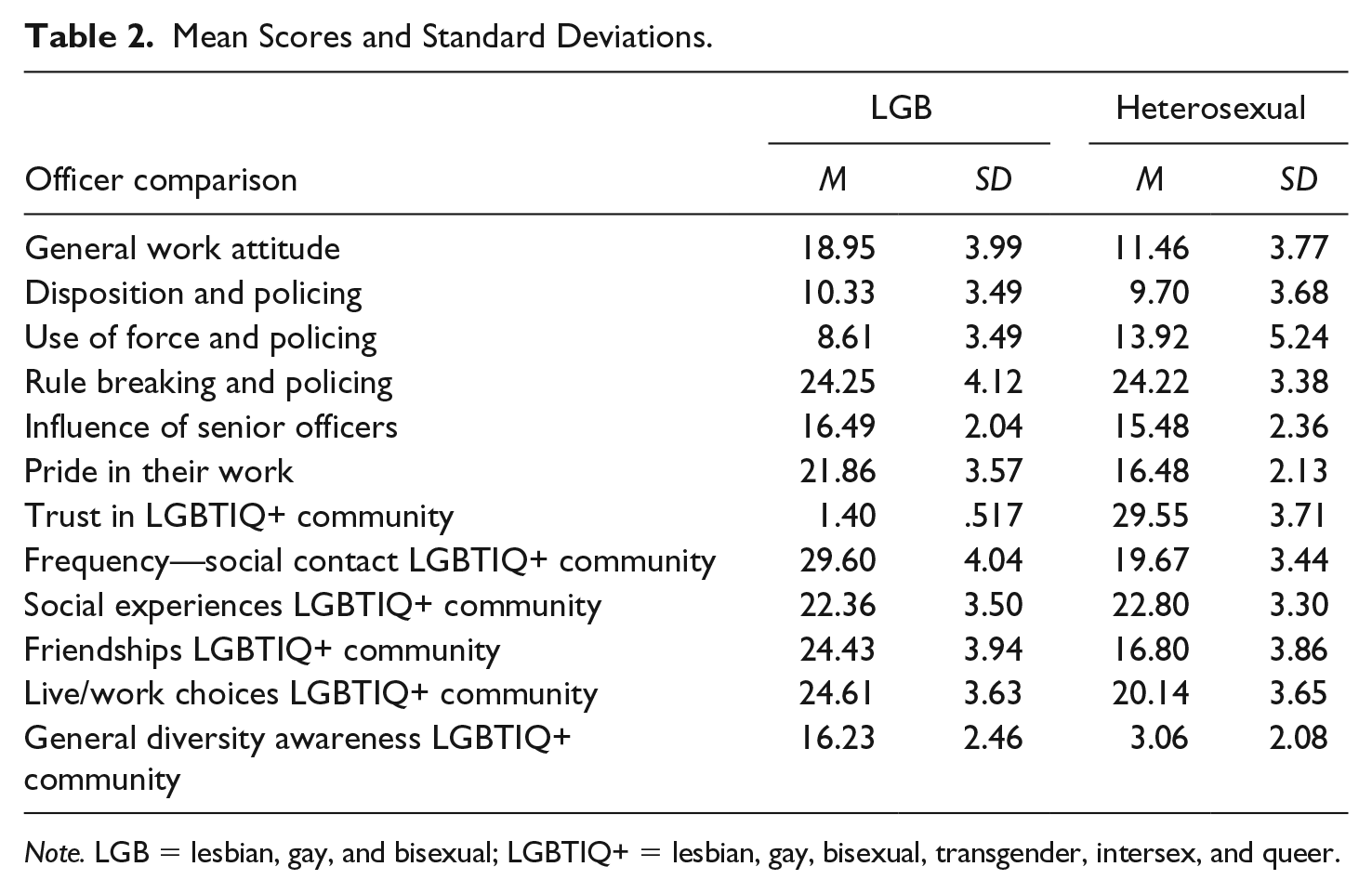
Note. LGB = lesbian, gay, and bisexual; LGBTIQ+ = lesbian, gay, bisexual, transgender, intersex, and queer.
Discussion
Limitations
It should be noted that the research only engaged with LGB self-identified 2 and heterosexual self-identified general-duties police officer’s perceptions of policing of LGBTIQ+ people; consequently, there was no discussion about transgender general-duties police officer’s perceptions of policing of LGBTIQ+ people or of the issues faced by transgender police officers when policing members of the LGBTIQ+ community. Officer responses to the survey items may have been subject to levels of socially desirable responses; therefore, future research in this area could replicate the study at different points in police officer’s careers. The influence of police culture and/or notions of hypermasculinity in relation to police work and attitudes toward policing of LGBTIQ+ people were not examined in this research. This research did not compare general-duties police officer perceptions of policing of LGBTIQ+ with LGBTIQ+ liaison officer perceptions of policing of LGBTIQ+ people. Finally, this research only examined general-duties officer perceptions from police officers employed in one Australian state-based police organization as such further research is needed in different police organizations across Australia. Although this study has several limitations, the implications from the results have relevance to police organizations in Australia (and around the world) regarding general-duties police officer perceptions of policing of LGBTIQ+ people in relation to an officer’s sexual identity and what this means for potential future engagement.
Implications
The results of this study suggest that an officer’s sexual identity does have an impact on perceptions of policing, since significant differences were found between heterosexual self-identified officers and LGB self-identified officers and their perceptions of policing LGBTIQ+ people. While it may be reasonable to argue that it is unsurprising that LGB officers would have more positive perceptions of LGBTIQ+ people due to frequency of contact with other members of the LGBTIQ+ community, thereby resulting in positive social experiences with other LGBTIQ+ people and enhanced levels of the general awareness of the diversity of people within the LGBTIQ+ community, it was interesting to note that LGB self-identified officers have more positive general work attitudes than heterosexual self-identified officers and higher levels of pride in their work than heterosexual self-identified officers. Research by Conway et al. (2015) suggests professional conduct and attitudes to work are linked to an individual’s temperament expressed during work-related activities. Although there is little research to determine how sexual identity shapes work-related performance, the results of this study suggest that the sexuality of an officer may shape how officers react to certain groups in society and how they perceive engagement with groups in society identified by differences in sexuality.
Martin et al. (2013) argue rule-breaking behavior and poor policing of certain groups in society can often be an ongoing pattern of behavior once codes of professional conduct have been breached during interaction and engagement with certain groups of people in context. The historic policing of LGBTIQ+ people is shaped by inequitable treatment of LGBTIQ+ people who suffered stigma, rejection, persecution, and discrimination by police officers and police institutions often reflected in the way LGBTIQ+ people express their mistrust of police (Miles-Johnson, 2013a, 2016). This is not to suggest that the relationship between police and LGBTIQ+ people is static or that police organizations have not attempted to make significant changes to policy and policing practices implemented toward LGBTIQ+ people, but the relationship between police and LGBTIQ+ people in many parts of the world remains problematic (Miles-Johnson & Pickering, 2018).
Research argues that LGBTIQ+ people have been subject to police discretionary power and differential policing resulting in incidents of police maltreatment (Miles-Johnson, 2016). Over-policing of LGBTIQ+ people, numerous documented cases of police homophobia directed toward LGBTIQ+ people, police distrust of LGBTIQ+ people, and the overt use of force when policing LGBTIQ+ people, have all contributed to a lack of trust between LGBTIQ+ people and police. Numerous pieces of research also note negative perceptions of engagement between police and LGBTIQ+ people, which highlight the contextual issues that mediate problematic interactions between police and LGBTIQ+ people (See Dworkin & Yi, 2003; Miles-Johnson, 2013a; Wolff & Cokely, 2007), yet in this research, higher scores and more positive perceptions of policing LGBTIQ+ people in relation to disagreeing with use of force and policing of LGBTIQ+ people were found for heterosexual self-identified officers over LGB self-identified officers with heterosexual self-identified officers perceiving use of force negatively when policing LGBTIQ+ people than LGB self-identified officers.
It could be that the higher scores and more positive responses of self-identified heterosexual officers in relation to negative perceptions of use of force and policing LGBTIQ+ people were influenced by levels of social desirability (due to the self-report nature of the survey) and a desire to not be viewed as homophobic since previous research argues police officers (who predominantly self-identify as heterosexual) have been constantly criticized for over-policing of LGBTIQ+ people and condemned for their overt use of force when interacting with LGBTIQ+ people (see Mallory et al., 2015; Miles-Johnson, 2013a). Lower scores and more negative responses of LGB self-identified officers in relation to agreeing with the use of force and perceptions of policing of LGBTIQ+ people could be due to LGB officers not being afraid of being accused of homophobia in relation to policing LGBTIQ+ people. It could also be a result of heteronormative and hypermasculine ideals of behavior often associated with policing and police work and/or the adoption of aspects of police culture, which pertain that police are generally mistrusting of citizens and minority group members thereby creating a cynical approach to police–citizen engagement when police interact with minority group members such as has been the case with members of the LGBTIQ+ community (see Miles-Johnson, 2013a).
In this research, perceptions of hypermasculine ideals of police behavior and the influences of police culture on perceptions of police engagement with minority group members such as the LGBTIQ+ community were not included. As stated, under SIT, membership within an ingroup based on shared identifiers differentiates ingroup members from outgroup members. Low scores and more negative perceptions regarding acceptance of use of force and policing of LGBTIQ+ people shown by LGB officers could be due to LGB self-identified officers separating themselves from the outgroup “LGBTIQ+ people.” Engaging in police behavior and practices perceived to be deemed acceptable by the ingroup may reinforce ingroup membership for LGB officers who also share (by self-identified disclosure) identifying attributes associated with the outgroup (nonheterosexual sexual identities). Reinforcing ingroup membership by supporting or espousing behaviors deemed acceptable by the ingroup thereby differentiates LGB officers from the outgroup, placing them as members within the ingroup (police) over and above their own self-identified sexual identities, which could include or identify them as outgroup members.
Heterosexual self-identified officers also had higher levels of perceived trust in members of the LGBTIQ+ community than self-identified LGB officers. From a policing perspective, trust is based on notions of predictability and trust is created when a reciprocal exchange is enacted between police and members of the public when services are used or provided. For many police officers, police officer trust in minority group members is based on beliefs grounded in evidence from experience gained when policing and is also based on generalizations about people and the type of people thought to be reliable and honest (Balliet & Van Lange, 2013); historically, this has not included LGBTIQ+ people. Research suggests that when officers trust members of the public such as members of the LGBTIQ+ community, they are more likely to effectively perform duties and police people in a competent and professional manner (Miles-Johnson & Pickering, 2018). It also increases the likelihood that officers will provide the same level of service to all members of the community without bias (Innes et al., 2009).
Yet research examining police perceptions of trust in the public, and specifically police officer perceptions of trust in diverse groups of people is lacking in the extant literature (Miles-Johnson & Pickering, 2018). Trust is a vague concept; it is elusive and hard to define and is often used to understand or make the future behavior of others more predictable (Evans & Krueger, 2014; Miles-Johnson & Pickering, 2018). Certainly, the idea of behavior predictability has had negative connotations for LGBTIQ+ people whose perceived behaviors associated with nonnormative sexual identities were deemed (at times) as being illegal, antisocial, immoral, and deviant, resulting in a lack of understanding from predominantly heterosexual police officers and limited reciprocity between police officers and members of the community during times of engagement. Citizens and police officers alike pay the price when police officers mistrust members of diverse groups such as members of the LGBTIQ+ community (see Miles-Johnson & Pickering, 2018).
Lack of trust between officers and citizens is associated with negative perceptions of quality of contact and unprofessional engagement when interaction between police and citizens occurs. Police mistrust in members of the LGBTIQ+ community has serious outcomes for police organizations in terms of diminished confidence between police officers and LGBTIQ+ people. Yet, in this research, heterosexual self-identified officers showed higher levels of perceived trust in members of the LGBTIQ+ community than self-identified LGB officers. Given that the heterosexual self-identified officers comprised the larger subsample of participants in this study, it was interesting to note that the differences in the mean scores regarding perceived trust in members of the LGBTIQ+ community was significantly higher in heterosexual self-identified officers than LGB self-identified officers who indicated they had more frequency of social contact with members of the LGBTIQ+ community, had more friendships with members of the LGBTIQ+ community, and more awareness of the diversity of people within the LGBTIQ+ community than heterosexual self-identified officers. It could be that some of the heterosexual self-identified officers may have formed positive relationships and levels of trust with members of the LGBTIQ+ community before commencing work as a police officer, yet due to the social desirability of the nature of this research this is difficult to determine.
What is important to note is the separation of LGB self-identified officers in their levels of trust in members of the LGBTIQ+ community in which they share aspects of identity based on sexual identifiers. Under SIT, the separation of ingroup identity from other groups considered outgroups and the resultant lack of trust in outgroup members increases levels of trust within the ingroup expressed through a number of psychological channels primarily focused on distrust of outgroup members (Balliet et al., 2014). For LGB police officers, strengthening ingroup membership within the ingroup (police) means increasing levels of trust in the ingroup and its members (other police officers) and decreasing levels of trust in members of the outgroup (the LGBTIQ+ community), which in turn rewards LGB self-identified officers with a secure place within the ingroup (Miles-Johnson, 2016).
The decreased levels of trust in outgroup members also differentiates LGB self-identified officers from inclusion within the outgroup based on their sexual identity. Trusting in ingroup identity allows LGB officers to subjectively perceive membership within the ingroup which allows them to be rewarded by inclusion within the ingroup. By not trusting in members of the LGBTIQ+ community, it also allows LGB self-identified officers to perceive that they will be able to do their job properly, adhere to training and procedures, and police members of the LGBTIQ+ community objectively when it is required. Lack of trust between officers and citizens is associated with negative perceptions of quality of contact and unprofessional engagement when interaction between police and citizens occurs.
This may be reflected in the higher levels of pride LGB self-identified showed than heterosexual self-identified officers regarding levels of pride in their work when policing members of the LGBTIQ+ community. Thus, ingroup membership in the police (and as a police officer) overrides the individual sexual identity of LGB self-identified officers placing LGB self-identified officers firmly within the ingroup of police. Ingroup membership as a police officer becomes the dominant identifier for LGB self-identified officers over and above membership by sexual identity in the LGBTIQ+ community. This may be particularly important for these self-identified LGB officers because as stated, they all work as general-duties police officers and are not employed as liaison officers to the LGBTIQ+ community and/or do not work in liaison outreach programs tailored for LGBTIQ+ people.
While there is a small body of work examining the perceptions of LGBTIQ+ liaison officers regarding perceptions of policing of LGBTIQ+ people (see Colvin, 2014; Jones, 2015), comparative analyzes between heterosexual and LGB general-duties police officers are scarce in the extant policing literature; particularly in an Australian context. As such, working as a general-duties officer may further enhance the LGB officer’s status as an ingroup member within the police since additional duties or specific work roles such as being a liaison officer to the LGBTIQ+ community may be perceived as detriment to perceived ingroup membership by other (heterosexual) officers and/or may diminish their perceived status within the ingroup or levels or self-esteem associated with stigma and the outgroup (Hogg & Vaughan, 2002). According to SIT, distancing oneself from outgroup members and any potential links that may disassociate an individual with an ingroup by association with outgroup members is a normative behavior when individuals or groups of people establishing ingroup membership. Research by Mennicke et al. (2018) suggests that liaison officers to the LGBTIQ+ community are prone to severe overt and covert discrimination within police organizations, and as such act in ways deemed or perceived to be acceptable by other officers or the police organization so as not to raise suspicions about sexual identity and to address presumptions about workplace competency.
Research by Jones (2015) suggests that LGB self-identified officers are less likely than heterosexual officers to volunteer for liaison officer duties or responsibilities, given that historically LGB officers were stigmatized and rejected by fellow police officers as being incompetent within the workplace. Intergroup relation research suggests that outgroup perceptions often elicit negative affective reactions such as disgust, which may arise when an outgroup (such as the LGBTIQ+ community) is appraised as violating moral standards (in this instance, having nonheteronormative sexualities) (Norton & Herek, 2012). Research by Miles-Johnson (2013b) suggests police organizations (along with other institutions of power) frequently assign negative stereotypes to LGBTIQ+ people and that such stereotypes are based on the notion that all GLBTIQ+ people share the same attributes. Furthermore, police officers (and police organizations) are highly attuned to individuals who could compromise ingroup values, especially those based on reciprocity, trust, social coordination, the health of the ingroup members, and ingroup reproduction such as recruitment.
Recognition of outgroup membership and/or association with outgroup identifiers places LGB self-identified officers in a precarious position because associated cognitive and social processes associated with outgroup members could stigmatize LGB self-identified officers in terms of notions of effective ingroup functioning (Neuberg & Cottrell, 2002). Levels of positive self-esteem achieved by membership within the ingroup, therefore, enable LGB self-identified officers to self-define the sense of who they are in relation to other ingroup members, in this instance other police officers, and accordingly be perceived by other ingroup members (fellow officers) as acceptable.
Conclusion
Professional conduct and police work are intrinsically linked to an officer’s attitudes toward certain groups and individuals when policing in context. The distinct differences between LGB self-identified and heterosexual self-identified officer’s attitudes toward perceptions of policing of LGBTIQ+ people in this research indicate that the sexual identity of an officer does significantly influence perceptions of policing practice. Results of this research determine this is particularly salient when heterosexual self-identified officers police LGBTIQ+ people (as outgroup members) and when LGB self-identified officers police LGBTIQ+ people in terms of needing to distance themselves from other LGBTIQ+ people in relation to shared identifiers based on nonheteronormative (outgroup) sexuality. LGB self-identified officers are self-conscious of their identity and of the impression identifying factors relating to sexuality may bring to ingroup membership and perceptions of effective policing. Both LGB self-identified officers and heterosexual self-identified officers compensate for their sexual identity in terms of policing LGBTIQ+ people. For LGB self-identified officers, this means policing in a way which may reduce exposure of differentness (such as in relation to being perceived as different to other ingroup members) or by policing LGBTIQ+ people in ways which differentiate themselves from membership within the LGBTIQ+ community. For heterosexual self-identified officers, this means policing in a way which compensates for phenomena such as perceptions of prejudice, and discrimination associated with police and policing practice toward LGBTIQ+ people. Officer’s perceptions of ingroup membership as police officers in relation to notions of conformity and the cohesiveness of police work override the sexual identity of LGB self-identified police officers in terms perceptions of policing of LGBTIQ+ people.
Supplemental Material
APPENDIX_ccj – Supplemental material for Compensating for Sexual Identity: How LGB and Heterosexual Australian Police Officers Perceive Policing of LGBTIQ+ People
Supplemental material, APPENDIX_ccj for Compensating for Sexual Identity: How LGB and Heterosexual Australian Police Officers Perceive Policing of LGBTIQ+ People by Toby Miles-Johnson and Death Jodi in Journal of Contemporary Criminal Justice
Footnotes
Declaration of Conflicting Interests
The author(s) declared no potential conflicts of interest with respect to the research, authorship, and/or publication of this article.
Funding
The author(s) received no financial support for the research, authorship, and/or publication of this article.
Supplemental Material
Supplemental material for this article is available online.
Notes
Author Biography
References
Supplementary Material
Please find the following supplemental material available below.
For Open Access articles published under a Creative Commons License, all supplemental material carries the same license as the article it is associated with.
For non-Open Access articles published, all supplemental material carries a non-exclusive license, and permission requests for re-use of supplemental material or any part of supplemental material shall be sent directly to the copyright owner as specified in the copyright notice associated with the article.
