



Abstract
Counter-mapping refers to the public dissemination by activist groups of maps that visually document particular harms and offenders or sites of justice and prior ownership. Drawing upon green criminology, this article analyses the consequences of using counter-mapping as an activist tool. It examines how media framing of the Aussie Farms map is constructed around particularly polarizing narratives. This interactive map demonstrates the location and proliferation of animal agriculture and animal exploitation industries within Australia. Media framing has generated heated debate among Australian farmers and activists alike by inciting deeply emotional responses to the issues. We explore these common media narratives and their consequences for activists and tools such as counter-maps.
Introduction
One of the most significant contributions to the field of criminology is the way in which green criminologists approach the study of environmental issues. As Natali (2016) emphasizes, green criminology allows wide scope for connecting serious issues, which are at the forefront of worldly concern including environmental crimes and harms affecting humans and nonhuman entities. This intellectual space allows researchers to rethink and reexamine how the biophysical and the socioeconomic components interact to impact the environment. Considerations include the pollution and deterioration of natural resources and the reframing of these as theft against nature (Brisman et al., 2017), through to elaborating the relationships between organized crime networks, toxic pollution, corporate crime, and the injuries caused to land-based and aquatic wildlife (South, 2014).
For this article, our focus is on activism and how visual tools—in this case that take the form of interactive maps—are used to disrupt existing systems of animal use and exploitation. Although our concerns touch upon themes relevant to a green nonspeciesist criminology (see Sollund, 2015; White, 2013), the focus is less on this than on the dynamics of public presentations of issues pertaining to animals and activists. For present purposes, this includes an analysis of how media outlets frame responses to the “Aussie Farms map” through the lens of public emotions in ways that stoke particular affective responses while simultaneously distracting attention to other equally important issues.
Academics and Activists
Green criminology examines issues such as the nature and dynamics of environmental crimes and harms (that may incorporate wider definitions of crime than that provided in strictly legal definitions); environmental laws (including enforcement, prosecution and sentencing practices); environmental regulation (systems of administrative, civil and criminal law that are designed to manage, protect and preserve specified environments and species, and to manage the negative consequences of particular industrial processes); and eco-justice (the valuing of and respect for humans, ecosystems and nonhuman animals and plants) (White, 2013; White & Heckenberg, 2014). As part of their endeavors, green criminologists may use mapping as a research method for instigating greater public and academic attention on harms that are at present largely ignored—such as environmental damage stemming from deforestation, pollution events, and the killing and suffering of nonhuman animals (Donovan, 2006; Donovan & Adams, 1996). Academics use maps as part of scientific endeavor. That is, their use is informed by values (such as ecocentrism and nonspeciesism) but is not intrinsically about activism as such. The objective in using maps is to contribute to knowledge production and exchange.
Activists likewise use mapping as a form of highlighting cases of injustice and spreading public awareness. Here the main objective is social change, where maps are used as tools to change the world and not solely for scientific purposes. Many academics are also activists, but many are not. Activists may draw upon the work of academics such as green criminologists, but many do not undertake grounded research and scholarship themselves. The “organic intellectual” in the Gramscian sense is one who ties their intellectual labor directly into grassroots activism and social movements; again, not all green criminologists do this, although many are influenced by the politics of animal rights and environmental activist movements (see, for example, Beirne, 2009). For activists, their primary site for activity is the public domains of the street and social media.
The generic title “green criminology” refers to a variety of approaches, theories, and perspectives (see; Beirne & South, 2007; Ruggiero & South, 2010; South & Brisman, 2013; White, 2011; White & Heckenberg, 2014). Green criminologists vary in ideological orientation and activist participation. In addition to theoretical differences within the field (as indicated in titles such as “conservation criminology,” “eco-global criminology,” and “green cultural criminology”), there are political differences between mainstream and critical variations. For example, a distinguishing characteristic of critical criminology is that it is generally associated with an oppositional position in relation to much of the work of conventional criminology, and also to many contemporary policy developments in the field of criminal justice. It also has a strong tendency toward transformational politics—to not only provide understanding of the wider world but to engage in actions that will substantially change it (White, 2018).
Not all green criminology can be characterized as “critical criminology” from the point of view of engagement in transformative politics and/or radical critique of existing political economic systems. Indeed, some variants largely mirror conventional criminology in regard to techniques (use of situation crime prevention in combating illegal wildlife trafficking) and adherence to mainstream definitions of crime (such as natural resource and conservation criminology). Here the main emphasis is on crime control and better systems of regulation and law enforcement, rather than radical shifts in eco-justice perspective or practice (Gibbs et al., 2009; Lemieux, 2014). While also directed at better protection of environments and species, critical green criminology nonetheless challenges the baseline definitions of “environmental harm” (White, 2013) and is critical of the dominant institutions of contemporary capitalism that prop up the environmental status quo (Stretesky et al., 2013).
Nonspeciesist criminology, as a particular subfield, is similarly connected to the more radical wings of green criminology. It aims to extend the moral and legal scope to include consideration of nonhuman animals (Benton, 1998) and is frequently associated with “activist scholarship,” a form of intellectual labor that challenges systems designed primarily for humans and that lead to nonhuman species injustice (Drew & Taylor, 2014; Sollund, 2008; Taylor & Fitzgerald, 2018; Taylor & Twine, 2014). Committed activists of ecology and animal rights organizations likewise both express a moral concern that consideration should be extended beyond the boundaries of our own species, and that nonhuman beings should be recognized as having value in their own right.
The methods of activists mirror recent innovations in green cultural criminology. For example, the use of photography (and photo-elicitation) as a methodological tool for criminological research assists in documenting environmental harm and also provides evidence of its impact on vulnerable people. Natali (2016) observes that narratives of personal experiences of environmental injustices can be reimagined and recontextualized by using photography. Images elevate consciousness of environmental harm and the processes of denial and habituation that exists structurally, often providing opportunity for the most deeply affected people to accept their fate or oppose it. They promote new “ways of looking” at the relationships between human interaction, wildlife, and environment. In doing so, images have the capacity to evoke deeper elements of human consciousness (more so than just words alone), bringing a different kind of information to stimulate emotion (Harper, 2002).
In this article, we explore the ways in which visual representations of animal use and environmental harm are presented through maps and satellite imagery, and the emotions that arise from this. We also consider how the ability to visualize linkages between various social actors, materials, and their environmental impact also helps shift the conversation from local to global. For instance, when mapping global conflicts demonstrates environmental racism, environmental issues suddenly become even more politically charged. This includes increasing awareness of otherwise silent environmental and cultural issues such as the links between resource exploitation, slave labor and displacement of people—for example, hundreds have been killed over illegal sand-mining (Beiser, 2015) and many Indigenous people displaced due to the advent of the mass palm oil and sugarcane industries (Robinson, 2017). These issues gain legitimacy and become a lived reality by making them visual and thereby presenting as evidence for change. Such imagery is now used in a variety and diverse ways within the social sciences (Clark-Ibáñez, 2004; Hadi & Damayanti, 2019) including through visual criminology and the use of “counter-mapping.”
Counter-Mapping
Counter-mapping refers to the use of maps to reframe the world in such a way as to challenge the dominant power structures and to articulate progressive, alternative, and, sometimes, radical interests (Kindynis, 2014). It consists of the public dissemination by activist groups of maps that visually document particular harms and offenders or sites of justice and prior ownership. The creation of maps aims to distort the existing perspectives of “official” representations of space. For example, The Southern Poverty Law Center (2019), based in Alabama, the United States, is a nonprofit legal advocacy organization whose members promote civil rights and public interest litigation for those affected by hate groups. The organization has collected and continuously updates their “Hate Map,” an interactive online map that documents active hate groups, a total of 1,020 assemblies across the United States. This map places markers within each state to demonstrate the saturation of particular groups per capita, including categorization of hate groups based on ideology, city, or states and whether there is an official headquarter for the group. For green criminologists, this map is also of interest in regard to environmental issues. For example, there is emerging research on the link between hate groups and climate change denial. “Alt-right” conservative groups have used climate change to incite hateful abuse for prominent advocates such as climate scientists (Dunlap & McCright, 2011; Leber, 2018; Saad, 2018). Counter-mapping is a research tool which crosses paths with different political and social issues, and academically has links to radical geography (DePryck & Gemenne, 2017; Pickerill, 2017). Although still relatively underdeveloped, in recent years, it has been increasingly utilized in both academic and activist circles.
The practices of “counter-mapping” have also been used as a tool for strengthening the territorial claims of Indigenous and marginalized populations, demonstrating other socially or culturally dominating practices, such as the extent of animal agriculture and damage to the environment by various resource-intensive practices. It has been used as a technique to visually represent injustice and the consequences of colonialization. For instance, First Languages Australia launched an interactive map in 2016, called “Gambay,” which uses Google Maps software and colored dots to display Indigenous languages, not only reconstructing the political boundaries which are found on Australia’s territorial maps, but simultaneously giving ancestral strength and preserving language. This is now seen as a significant body of evidence in maintaining Indigenous cultural heritage, displaying more than 795 languages that would otherwise be lost (First Languages Australia, 2016).
Colored dots have also been used in the Environmental Justice Atlas (EJ Atlas). The EJ Atlas is a collaborative research project between activists and academics (see Map 1). This map compiles data across the globe onto a satellite map, focusing on land grabbing, renewable energy, mega-mining, unburnable fuels (such as fracking), sand drilling, arctic drilling and deep-water petroleum sources, waste, fish, nuclear power, pesticides, and contamination of land, water, soil, and air (Snorek, 2018). The EJ Atlas demonstrates the interconnected ways in which environmental injustice occurs and where, through collaborative collecting of statistics and information involving two-way communication between activists and scientists (Martinez-Alier et al., 2010). The EJ Atlas is a continuous investigation of the causes and consequences of conflicts which are generated by the exploitation of lands and natural resources, leading to toxicity, waste, and land degradation. First released in March 2014 at the United Nations Environmental office in Brussels, it was composed of 920 cases and by 2015, had increased to more than 1,560 cases, and is still growing (Temper, 2015, Temper et al., 2015).
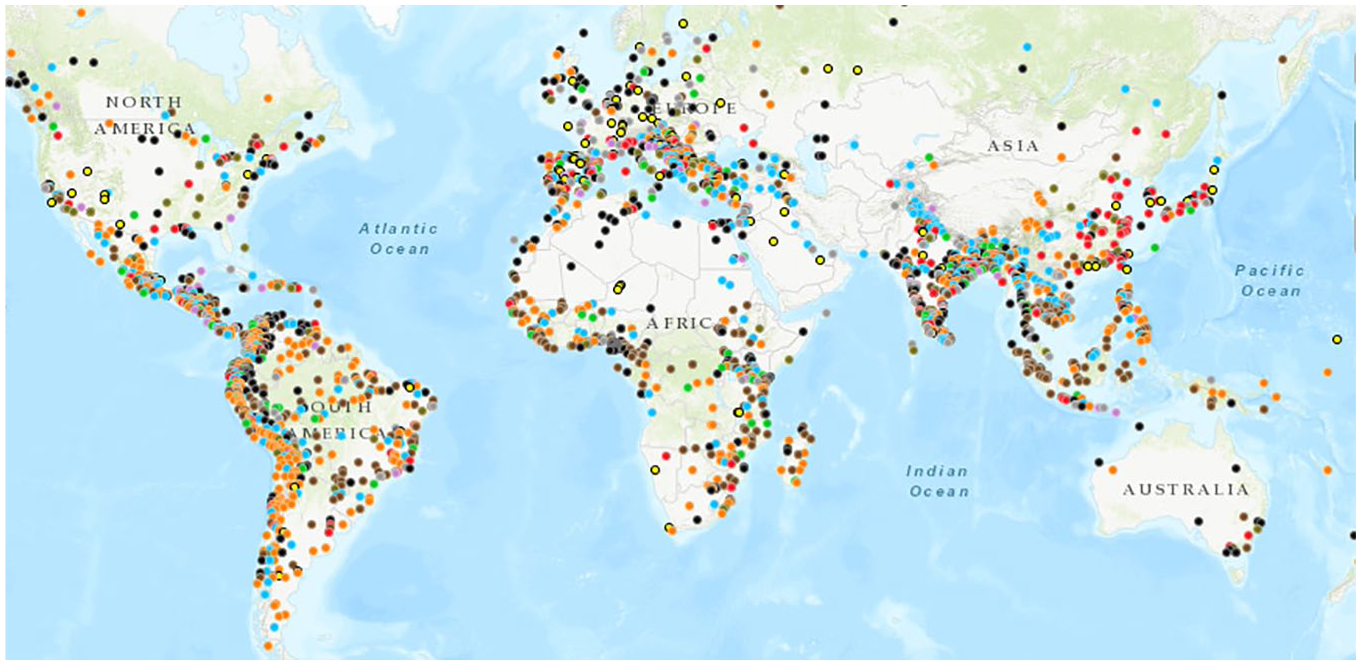
Global environmental conflicts.
The map is also a tool used by activists to magnify their voice in times of limited coverage by the commercial media. For example, when an activist was arrested for resisting a landfill deposit in Montenegro, which was located on a significant cultural heritage site, only local news reported it. By having this event on the EJ Atlas, the community could use this as a basis for future cases and have their voices recognized globally, including as an illustration of how urban development can cause environmental and cultural destruction (Temper, 2015). As Temper (2015) says, no matter how governments and companies try to frame it, it is not a balance between development and conservation, but who sacrifices in the name of progress and who decides.
The ability to “zoom in” on maps also assists when issues arise over how data are aggregated. Without detailed mapping of specific harm, critical data can be missed. For example, the Cancer Register used by the Health Department in Tasmania collects data on cancer rates in particular geographical locations. However, this tends to aggregate data at a fairly high level. This is demonstrated in a case of alleged toxic contamination stemming from a former rubbish tip on the Eastern shore of Hobart city. According to Cancer Register data, there was no apparent problem since the unit of measurement was the locality as a whole. However, when a local resident, Poppy Lopatniuk, mapped out the health profile of her immediate neighbors, she found there was a cluster of more than 40 cancer diagnoses that were mostly associated with two small residential streets (that included her own; Lopatniuk, 2012; White & Heckenberg, 2014). The Cancer Register was used by the Health Department to dismiss the issue (by arguing that there is not an unusual pattern of cancer types and rates over the locality as a whole) rather than to suggest the need for more precise analysis of the clustering of local cancers and other ills. Poppy’s mapping contradicted the official government view. Therefore, maps as activist tools can be used for disseminating multiple forms of data, from broad geographical overviews through to specific data sites.
As Collier (1967) observed many years ago, imagery can serve as a tool through which people can share knowledge, intense feelings, and comfort as they come to terms with their own truths. Action toward social change can be fostered by the collective awareness found in and through imagery (Richard & Lahman, 2015). Maps likewise have the capacity to be used to not only quantify qualitative data, but to enhance and even drive activism in some circumstances.
Animal activists have developed their own “counter-map” to demonstrate the intensity of animal agriculture and exploitative practices in Australia. The Aussie Farm Map demonstrates the ability for modern technology to be used by activist groups even without them holding specialized knowledge of geography or cartography (see Map 2). This map demonstrates Kindynis (2014) claim that digital maps are becoming increasingly universal, mobile, immersive, and interactive, a situation in which our relationship with mapping has begun to provide new definitive models of qualitative analysis. The Aussie Farms map uses Google Maps to place specific markers that represent various industries that use animals for profit. This comprehensive map involved more than 50 activists in its creation. It took more than 8 years before publication and includes an online database with links to captured footage, imagery, and cases of animal cruelty (Moret, 2019).

The Aussie Farms map and database.
The Aussie Farms Repository declares that the motivation for the map is . . . a comprehensive, interactive map of factory farms, slaughterhouses and other animal exploitation facilities across Australia, launched publicly in January 2019. This map, linked with the Aussie Farms Repository, is an effort to force transparency on an industry dependent on secrecy. We believe in freedom of information as a powerful tool in the fight against animal abuse and exploitation. If you find a facility that hasn’t been marked, you can login, right-click the facility on the map and choose to submit it for approval. You can also submit information about any facility already marked, and upload photos, videos and documents relating to that facility. (Aussie Farms, 2019)
The map presented on the Aussie Farms Repository is interactive and updated regularly.
The data represented on this visual map generates a table of Australia’s closed and current operations, including markers of legitimate businesses and “unknown” farming residences, covering everything from abattoirs to clothing and entertainment industries such as zoos and greyhound racing (Aussie Farms, 2019). This is accompanied by the “Aussie Farms Repository,” which is an online data set where anyone can submit photo and video evidence of malpractice and animal abuse, as well as weblinks to the associated campaigns, sorted by categories such as wildlife, entertainment, animals used for food, clothing, and animal testing. Although this is the first map of its kind in the world, there has been virtually no mention or coverage of it within the social sciences.
A large concern for criminology as a whole is the crime-media nexus (Clifford & White, 2017). As Brown (2014) explains, much of criminological research focuses on the ways in which the media fuels the public perception of crime, often encouraging the fear of potential crimes—for the sake of a media spectacle. Most importantly, when using photography in qualitative analysis, issues arise in terms of decontextualizing photos and thus disempowering or manipulating the original context of its creation (Richard & Lahman, 2015). It is the job of visual criminology to analyze what lies beyond the visual image of crime, such as privilege, Whiteness, authority, and patriarchy. As a result, how we frame, view, and punish crime is never politically neutral. It is by reimagining it in a strange, defamiliarized, and deconstructed way that we can challenge these powers. This is essentially the core motivation for visual criminology, with scholars in this field calling for interrogation of visual material to enhance interpretation and communication of these complex issues (Natali & McClanahan, 2017; Thomson et al., 2019). With this in mind, we turn now to analyze the way in which activists are using mapping and visual tools, and how commercial media groups are responding to this activist innovation.
Animal activists are not afraid of or unfamiliar with public discrimination and media backlash. With the release of the Aussie Farms map, commercial news coverage has conveyed very specific messages to readers: The map is a planned, targeted act that constitutes a violent threat against producers of all animal-invested industries across the country. Moreover, activists are using their “charity status” to disguise their true pernicious purposes (Foley, 2019). A Western Australian TV presenter, for example, labeled the vegan activists responsible for the map as being bullies (Peterson, 2019). The federal Minister of Agriculture and Water Resources advocated that Aussie Farms have their charity status revoked. This included a declaration that the map is inaccurate and that it encourages harm against farming families and their children (Littleproud, 2019). To date, however, there has been no record of activists entering homes. As one activist commented, Farmers and their families do not live inside their farming sheds, neither are their children running around and playing on the kill floors of abattoirs. To suggest farmers have had their privacy invaded is blatantly untrue but aims to deliberately mislead the public. (Meddick, cited in Church, 2019, p. 18)
Nonetheless, in January 2019, the Minister issued a media release calling for the government to enforce tougher penalties for trespass, claiming that “the risk of trespass and farm vandalism is higher since the release of the map” and the government should “respond with laws that punish trespassers and vigilantes” (Littleproud, cited in Sarre, 2019). Whether there has been an increase of activist activity since the release of the map is unknown. However, we have already seen that there is an increase of the fear of crime spreading from government officials to the small business owner, crystallized by the labeling of activists as “terrorists.”
Other farm-affiliated interests likewise suggest that the map encourages terrorist acts. Activists have been described as “do-gooder” animal welfare warriors who will trespass and break into animal enclosures to threaten farmer’s way of life (Townsville Bulletin, 2019). The National Farmers Federation president, Fiona Simson, has made several statements describing the map as a gross invasion of privacy and an “attack list,” claiming that farmers are being branded as evil targets for terrorist activity (Simson, cited in Moret, 2019; see also Moret & Verley, 2019). Yet, while details of properties and businesses are indeed on the map, they are compiled by readily available and publicly accessible information, mostly supplied from online sources, such as business webpages and geographical satellite photos supplied by Google Maps. Therefore, the map itself is not illegal in its creation. Nor does it involve invasion of privacy as such.
The map has, however, fuelled a deeply emotional conflict between activists and farmers. Sarre (2019) discusses how the National Farmers Federation of Australia is encouraging people to “fight back” against Aussie Farms by requesting removal of personal details from the map and to file a complaint to the Office of the Information Commissioner. This is so despite the fact that legally there is no breach of law unless property owners can establish under defamation laws that they have suffered injury to their character via publication.
This is defended by the map makers who present their engagement as simple information-spreading, as “people have the right to see what modern farming looks like” (Delforce, cited in Coughlan, 2019a).
However, the purpose for the map is to be used as an activist tool. The map is precisely intended to illustrate the extent in which Australia has invested in animal agriculture, which is “essentially taking over the country” (Delforce, cited in Coughlan, 2019b). Chris Delforce, a key member of Aussie Farms an animal activist group in Australia, said that while they encourage various industries to be more transparent and to make “consumers aware of what they support with their purchases” through submitting photographs and information to the Aussie Farms website, Aussie Farms do not endorse illegal activity to collect material (Delforce, cited in Moret, 2019).
Weeks after the release of the Aussie Farms map, a U.K.-based group released information about more than 9,000 dairy farms on Google Maps across England and Wales called “Project Calf” (see Map 3). Similar to the Aussie Farms map, Project Calf attempts to combat the romanticized view of the countryside. This was met with the same media backlash as in Australia, with consumers on social media suggesting that this behavior should be punished by law, as it increased vulnerability to farmers who are subjected to school-yard taunting, with the threat of potential rise in trespass and burglaries (Dean, 2019). In contrast to the Aussie Farms map, Project Calf dictates very clearly that their map’s purpose is to be used as a tool for locating and directly engaging with farmers: “visit, document, expose” (Project Calf, 2019). It is evident through the map that there is an immense saturation of dairy farms, so much so that many cities and town names are obscured by the blue markers.

Project Calf map.
The narratives produced by media demonstrate two very different views of deviance. The people interviewed across various commercial news outlets are often people deeply invested within animal agriculture, such as members of government boards who represent the agriculture sector, farmers, and small business owners. They do not discuss their loss of profits as a potential consequence of these maps, but instead view the satellite imagery as a planned, personal attack on their family’s lives. The Aussie Farms and U.K. Project Calf maps have caused identical narratives in their residing countries: that the maps reinforce crime and pose an increased risk to human families and children. This is framed as an invasion of personal privacy, where the addresses are presented, not as units on an industrial estate, but a place where children live (Hay, 2019; Sandhu, 2019).
The issue is represented as a clash of moral policing, a battle between what is ethical and the irreconcilable and unbreakable dilemma of employment: economy and self-sustainability versus health and environment (Natali, 2010). The animal activists are punished via public discourse for exercising their democratic rights to organize and question existing farming practices, and specific interests see this behavior as detrimental to their business and profits (Salama & White, 2017). This includes all levels of agriculture, from the low-income local farmer to the mega-corporations and distributors.
Green Criminology, Emotions, and Mapping
Animal exploitation relates to the many diverse ways in which human interaction with nonhuman animals directly or indirectly contributes to the unnecessary suffering, death, or adverse effects to their welfare. This includes physical, sexual, emotional, or psychological abuse of nonhuman animals, such as exploitation of their bodies for profit, passive neglect, or mismanagement (Beirne, 2009). Crimes against animals is fundamentally driven through carnist ideologies and technologies: methods which facilitate, enact, or reinforce dominant narratives that the use of animals especially as a source of food is deemed “normal” or ethical (Laestadius et al., 2018). For green criminology, animal agriculture is an industry which faces many ethical issues, especially as climate change takes effect and farmers face an increased demand for food production, increased drought, rapidly changing weather conditions, and environmental degradation where as a result, some farmers may engage in behavior which they know is ethically wrong for the sake of getting by—such as using a particularly dangerous pesticide or risking animal welfare by overcrowding animals (Croall, 2013; James, 2018). Green criminology must therefore forge new and inventive methodologies and methods to synthesize existing knowledge and to create new ways in which we can observe the way green crimes and harms exist within our daily lives, challenging these for the sake of the future planet and generations (South & Brisman, 2013).
The examination of the Aussie Farms map and responses to it provides insight into how mapping can stir emotions. In explaining the emotional and transgressive responses and resistances which have occurred due to the counter-mapping efforts of animal activists, cultural green criminology can provide important insights (Brisman & South, 2013). Cultural green criminology is an intertwined perspective that brings together green criminology and cultural criminology. As Ferrell (2013) comments, this type of criminology aims to investigate how crime and crime control operate as a deeply cultural process, whose consequences emerge due to contested symbolism and collective interpretation, including the ways in which various political institutions use their power to inform what is legal or illegal, where media institutions portray (or ignore) particular events to assist in constructing crime, control, and reinforcing capitalist inequalities and resistances. Most importantly for activism and counter-mapping, a major concern is with how emotions come into these constructions and what meanings underpin these emotional responses. This includes an exploration of various forms of confrontation and the complex web which social resistance and social control may take (Brisman & South, 2013; Ferrell, 2003). The ways in which emotions have been salient throughout the media coverage of the Aussie Farms map and Project Calf demonstrate that while both the maps and registered farming practices are legal, the media have increased coverage of their stories through stoking the heightened emotions that lie at the heart of the problem.
The maps described above have demonstrated the intensive practices of various industries that contribute to environmental harm or use of animals that, for some, is problematic. For the EJ Atlas, the motivation behind the mapping technique is obvious but impersonal, as the focus is on the damage created mostly by big business. However, when the names of various animal agricultural industries are paired with cases of animal abuse and exploitation, as seen on the Aussie Farms map, the response can be deeply personal. The narratives generated by media, especially the commercial media, have been divisive between activists and business owners, fuelling the long-standing battle between two groups who believe they have greater moral standing when discussing the lives of animals. This demonstrates how media framing can spiral and reinforce particular news stories, where maps (a nonphysical entity) are taken to become real, with real consequences for the people whose properties are listed (Ferrell, 2013). As a result, the emotional responses generated stronger social solidarity on the part of each side.
Certain common contrasted narratives became apparent in contextual analysis of the emerging news stories on the Aussie Farms map. These are shown in Table 1.
Contrasting Narratives About the Aussie Farms Map.

Media framing has been used strategically to make activists appear dangerous and farmers have reacted to this. The satellite images are just markers on a map; it is the interpretation of the images which generates our understanding. Although the Aussie Farms map and U.K. Project Calf aim to demonstrate the systematic mass production of animal agriculture, the media have reframed this as a terrorist act. We end up “re-seeing” the nature of the image by the captions which follow it, even if the message is something different to the photo’s original meaning (Clifford & White, 2017). Although the Aussie Farms map is an online tool, not a “terrorist toolkit,” farmers have nonetheless continued to protest against it. They have claimed that the map causes distress for families who have their workplace incorrectly linked with animal cruelty and that their workplace and home have become a target for extreme and dangerous activities (Coughlan, 2019b). The agriculture-affiliated journalists report that the map is sinister in nature.
Meanwhile, farmers reject the assumption that intensive farming equates to animal distress. They assert that the footage taken by activist is largely misinformation that portrays animals as sad and unhappy within their environment (Jurd, 2019). For example, a Piggery was filmed live on Facebook, which shared graphic images of piles of dead pigs. The farm owners responsible claim that the footage was misleading, selective, and sensationalized (Pancia, 2019). In another instance, a different Piggery owner, who had found activist cameras in their shed, similarly commented that that the footage collected was meant to mislead the viewer, as indicated by the addition of “sad” music and again highly selective imagery. Regardless of this kind of negative coverage, many of these family farmers continue to express pride in their business, even without the Royal Society for the Prevention of Cruelty to Animals (RSPCA) tick of approval (Bearup, 2019).
Commercial news outlets have encouraged the fear of crime, making the effect of the Aussie Farms map so as to encourage deviance, insofar as the motivations of activists are continuously linked back to the map as a main motivator and contributor to their activity. However, activists have previously and will continue to perform demonstrations in farms, abattoirs, and public spaces with or without the assistance of the map (Paytas, 2018). Hobby groups such as pro-gun groups are claiming that activists “attack all things non-vegan or inner city. Many are unemployed, and some are relying on welfare payments from the public purse to support their trespass, theft and property damage” (Gibson, 2019). Opinions such as these assist the media to reframe activist-related stories to assert that certain acts (such as animal activism) are an insult to the moral values of Australian communities (Clifford & White, 2017). Fitzgerald and Taylor (2014) argue that the media bolster the acceptability of animal consumption as a part of everyday life and that, conversely, those who take a stance against animal exploitation are marginalized. Likewise, thematic analyses of media reports demonstrate that mainstream media coverage almost always marginalizes vegan activist groups at the expense of normalizing human violence against nonhuman animals on a global industrial scale (Cole & Morgan, 2011; Masterman-Smith et al., 2014).
Interestingly, all media reports have been centered between these narratives and have not addressed the key issue which lies within both courts—that Australia’s modern farming is being consumed by “mega-factory” operations (Coughlan, 2019) which have contributed to a 40% decline in Australian family farms over the past 35 years (Holt-Giménez & Perroni, 2018). This means that while activists and farmers are being distracted by the fear of each other, corporations have been investing in larger farms with greater risk to the environment, degradation of land, pollution of waterways, and increase in slaughter numbers. For some Australian dairy farmers, the Aussie Farms map may be a distraction from the fact that their industry is plummeting. In 2017, Australia produced 700 million L less dairy (Long, 2017), with a drop in more than 3,000 registered dairy farms in 2018 (Dairy Farms Australia, 2018). The power of emotions is what generates these news articles, where people respond irrationally (i.e., emotionally, in defense of their specific interests), framing the intended images around themes of “cruelty” and “terrorism,” “lives,” and “jobs,” rather than transformations across whole industries.
Ag-Gag Laws and Visual Harms
Activists who aim to monitor the welfare of animals and the pollution generated by animal agriculture are constantly facing the threat of criminalization. Although the commercial media uses loaded language such “terrorists” or “extremists” (Mcgrath, 2019), so too does the legal system. For example, in 1992, the United States passed the Animal Enterprise Protection Act (AEPA), which criminalized any “physical disruption” to an animal enterprise (which at the time targeted activists who released laboratory animals). This type of legislation has grown to include making all photography and videos of agricultural operations illegal without the consent of the property’s owner, including the distribution of findings (Shea, 2014). Because of this, an activist in Utah was prosecuted for videotaping a slaughterhouse cow that appeared sick and injured. The findings from this caused one of the largest meat recalls in U.S. history as it was revealed that these cows were fed to school children as a part of their school lunch program (Potter, 2014). However, this discovery did not result in positive media for the activist, or a discussion of repealing so-called ag-gag laws.
Small family farms and large corporations who are heavily invested in natural resources and animal agriculture rely on their stockholders and consumers. To some extent, their practices can be safeguarded by ag-gag laws and through favorable coverage from commercial media outlets. Every activist who trespasses to gain footage and other documentation for investigations into animal cruelty is deeply aware of the risk to their personal freedom. Animal activists understand that there are times when there is no other way in which they can exercise their political agency but to engage in illegal activity, as mega-farms operate on the basis of secrecy. The ideology here is deeply wound up in personal emotions, ethics, and compassion for animals. One goal is to distribute relevant information that may perhaps change consumer’s minds on what they purchase. Activists believe that if information was given freely about the legal methods that agricultural industries use, such as grinders and agonizing gas chambers, people would divest in these industries because they are not “right” (Clench, 2019).
Not all exposure of animal cruelty results in the desired effect. For example, recent claims of animal cruelty across abattoirs in Tasmania have been met with inaction by the government and dismissal of claims. Grenta Quality Meats, an abattoir in Tasmania, was cleared of all charges of animal cruelty after a 20-month investigation, which found that the facility complied with all animal welfare requirements (Gooch & Dunlevie, 2018). This was so even though footage collected from the site by Animal Liberation demonstrated inadequate stunning of animals, being shot with rifles, killing animals in front of each other and being beaten with pipes (Aussie Farms, 2016). This campaign gained attention from accredited welfare groups which called for the facility to be closed due to these claims (Whitson & Carlyon, 2016). Public attention was focused on animal welfare claims, not liberation of the use of animals entirely, nor was it a critique of the carnist mentality. Regardless as to whether animal activists use a welfarist approach or not, the community outrage in this instance was simply absent.
Similar to crimes of the powerful more generally, this demonstrates a general ambivalence and lack of outcry when an investigation exposes deeply entrenched and harmful practices, especially when related to environmental harms (Clifford & White, 2017). Having activists directly engage with the public or using satellite imagery may be one of the only methods in which to directly highlight cases of animal cruelty, especially if the “legal” methods are not being adequately prosecuted through the criminal justice system.
The Aussie Farms map mitigates activist risks of this kind through reliance upon satellite imagery. This has been used by activists and artists alike. For example, artist Mishka Henner uses Google Images to photograph feedlots across the United States, including an acre-sized bloody red lake which is composed of cattle waste in Colorado, Texas (Henner, 2013), as given in Figure 1.

Colorado feeders, Dalhart, Texas.
When interviewed on the artwork, Henner stated, “I don’t just see gigantic farms, I see an attitude toward life and death that exists throughout contemporary culture. These images reflect a blueprint and a horror that lie at the heart of the way we live” (Henner, 2015). Most important for cultural green criminology is that this artwork challenged anti-whistle-blower laws, which state that while farm operations cannot be photographed, satellite images fall outside of this clarification (Grefter, 2015). Although having a farm or animal-orientated business is not illegal, the environmental destruction that it causes can be monumental. When governments and companies harm the environment, they often do so quite legally (Salama & White, 2017). Although clear-felling forests or owning a slaughterhouse is not criminal, the methods in which these are operated can be ecologically disastrous, exceedingly cruel, and/or ethically questionable. Activists who expose cases of ecological and species harm, poor regulation, and destructive practices contribute to their reduction both formally and informally.
Responses by the commercial media have encouraged stricter trespassing laws for activists. Agricultural organizations have begun to campaign for greater protection laws for farmers and others in the “livestock supply chain,” due to the increased fear of trespassing activists, encouraged by the Aussie Farms map “sinister agenda” (Jurd, 2019). For example, Western Australian police organized a “calm the farm” meeting to discuss farmer’s legal rights and how to respond to activist’s trespassing onto their property. This meeting was held after video footage of a farmer firing his shotgun after an altercation with two activists who were filming his calves (Brammer, 2019). The confrontation was then used by the federal Agricultural Minister as an example of increased dangerous behavior generated by the Aussie Farms map (Clench, 2019). Regardless of veracity, these stories are simply repacked and sold to news outlets, with the Aussie Farms map branded as a key contributor to the rise of criminal activity. This is particularly important to watch unfold as they will impact future ag-gag laws, which have traditionally been used to silence activism, not in protecting farmers or to maintain animal welfare.
Environmental and animal rights activists may achieve their goals by engaging with the public, only to be met with harsh penalties by industries and corporations. Sometimes, this can ultimately work in their favor. For example, a large Tasmanian forestry company, Gunns, attempted to sue environmental protestors for their multipronged campaigns against them. At the same time that the company attempted to sue protestors to dampen their activism, protestors released “So Sue Me” stickers, thereby generating even greater public debate about the case. This led to an increase of public dissatisfaction with Gunns, making their share price plummet and investors go elsewhere. This also stirred greater interest on the public’s “right to know” about corporate interactions with state agencies (White, 2005). In relation to animal welfare, Robbins et al. (2016) demonstrated that people who were unaware of ag-gag rules, upon learning about them, express a deep sense of mistrust in farmers and increase their support for animal welfare regulations. However, since first writing this article, we have seen harsh anti-protest laws being debated and in some instances passed in different Australian states.
For instance, the Right to Farm Bill was recently brought to the New South Wales Parliament (New South Wales Parliament, 2019). The purpose of the proposed legislation is to create a new combined anti-protest and trespassing bill. Designed to protect farmers, the bill aims to amend the Inclosed Lands Protection Act of 1901, such that agricultural businesses will now be defined as “inclosed lands” (Becker & Condon, 2019). This would mean that any movement of gates and machinery or disabling of any fencing would be subject to penalties of up to AUD 1,650 per offense. The bill further proposes that unlawful entry or disruption of business should be punished with up to 3 years imprisonment, or fines ranging between AUD 5,500 and AUD 22,000, or both. Any groups practicing civil disobedience by trespass, sit-ins, or “lock ons,” or simply disrupting “business as usual” could be affected (Visentin, 2019; Zhou & Cox, 2019).
Interestingly, these sorts of anti-protest laws are also relevant to farmers themselves, especially in regard to “Lock the Gate” campaigns against fracking. Farmers have been on the front lines and prominent in protecting their properties against mining companies which have a legal right to mine on their lands. They have also been involved in picketing supermarkets which they accuse of underpaying for their products (Gambian, 2019). Although initiated for specific purposes, anti-protest legislation has potentially significant ramifications for democratic engagement across a range of important public issues.
Conclusion
This article has described emerging trends in using maps as activist tools, and media and farmer responses to its use. There still remains ambiguity in relation to the effectiveness of maps as a methodological tool for social sciences and as an activist tool, and how these maps mobilize people with respect to environmental issues and animal rights.
The maps referred to in this article attempt to “counter” dominant narratives of the common conceptions of environmental and social harms. During the period when writing this article, we have seen an increase of news reports on animal activists entering farms throughout Australia as well as renewed pushes for legislative change. Although animal activists may have previously stated that any news coverage is “good coverage” for investigating the maltreatment of animals, such as in the case of footage of animal mistreatment in slaughterhouses, the stance of animal liberation has steadily increased fears of safety by farmers who then engage in a concerted push for increased penalties for trespass (Australian Broadcasting Corporation, 2019). There are important tactical and strategic questions that are yet to be answered adequately in regard to effective protesting for animal rights activism.
We believe that counter-mapping is important for green criminologists as a means to quantify and demonstrate environmental harms, including harms to nonhuman animals. However, along with other counter-mapping examples illustrated here, tools such as maps are an effective method for engaging with the public and to actively change what they critique requires further investigation. This is an empirical question that goes to the heart of the academic and activist project alike.
Footnotes
Declaration of Conflicting Interests
The author(s) declared no potential conflicts of interest with respect to the research, authorship, and/or publication of this article.
Funding
The author(s) received no financial support for the research, authorship, and/or publication of this article.