




Abstract
This study explores how residents govern security in two middle-class neighborhoods in Londrina, the fourth largest city in southern Brazil. Utilizing nodal governance theory, it analyses a security program called Solidary Neighbor (Vizinho Solidário, in Portuguese) in both neighborhoods, in place since the early 2010s. Document analysis, direct observation, and interviews with 26 respondents comprising mostly residents, but also police officers, sex workers, and homeless people, were conducted to assess how the program works and what implications it has for the governance of public spaces. The findings show that the Solidary Neighbor program functions as a community governance node oriented toward reducing criminal opportunities with the use of technologies to monitor outsiders and displace sex workers and homeless people. The article concludes that particularly in contexts such as in Brazil, bottom-up security initiatives have the potential to produce hostile and exclusionary public spaces.
Introduction
Since the 1980s, the study of community involvement in the control of crime and disorder has been extensively explored in the criminology literature. Most of this literature has focused on more formal initiatives like neighborhood watch (NW), installed in middle-class areas in the global north and often in partnership with the police (Bennett et al., 2008; Lub, 2018; Rosenbaum, 1988). Another portion of this literature has been devoted to more informal initiatives put in place by occupational groups like taxi drivers, vigilante groups, or criminal organizations operating mainly in the margins of the state in countries in Africa and Latin America, including Brazil (Arias & Barnes, 2017; Feltran, 2020; Paes-Machado & Nascimento, 2014). Surprisingly, fewer global south studies have been carried out around the involvement of middle-class communities in crime and disorder control in public spaces.
This article contributes to filling the gap in the criminological literature of community involvement in crime control programs in Latin America. Utilizing nodal governance theory (Johnston & Shearing, 2003; Wood & Shearing, 2007), it analyses a security program called Solidary Neighbor (Vizinho Solidário, in Portuguese) in two middle-class neighborhoods in Londrina, the fourth largest city in southern Brazil.
The article is organized in four parts. First, we introduce the theoretical framework of nodal governance and its relevance to this study. Second, we outline our methodology and the cases we explored. Third, we present our analysis of the Solidary Neighbor program in terms of the four elements that Burris et al. (2005) define as the geographical sites of nodal governance: the institutional setting, the resources, the mentality, and the technologies used. Finally, we consider the particularities of bottom-up community crime prevention initiatives in contexts like Brazil, and the impacts that these have for residential areas where order is imposed on public space.
Theoretical Discussion: Community Security and Nodal Governance
The problematic criminal and institutional context in Brazil has created conditions for different social groups to seek protection on the margins of the state, as shown by the literature on vigilantism and criminal governance in poor communities (Arias & Barnes, 2017; Feltran, 2020). Homicide rates in the country have grown almost continuously since the so-called democratic reopening in the 1980s, reaching in 2017 the highest figure ever recorded in history (31.6 cases per 100,000 inhabitants) (IPEA, 2020). Fear of crime is also pervasive in Brazilian society. At the same time, formal criminal justice has been marked by inefficiency, corruption, violence, and a lack of legitimacy. In this context, middle-class citizens tend to engage in crime control in a more informal and autonomous way in relation to the state than in the NW initiatives of the global north. Thus, studying the participation of citizens in the control of crime and disorder in the Brazilian context demands a theoretical approach that is less centered on the state and more sensitive to the interplays between informal arrangements and formal institutions of security provision.
In this work, we are suggesting the use of nodal governance theory, an approach that was developed throughout the 2000s to capture the global pluralization of policing (Johnston & Shearing, 2003; Wood & Shearing, 2007). Although developed predominantly from research conducted in North America and Europe on state, commercial, community, and hybrid security providers, nodal governance theory has been increasingly used to understand the security landscape in global southern countries such as South Africa and Brazil, where informal agents act as important security providers (Martin, 2013; Paes-Machado & Nascimento, 2014). In fact, as noted by Martin (2013, p. 146), this theoretical perspective seems to be flexible enough for researchers to be able to analyze the functions and characteristics of different governing sites and networks, regardless of size, level or state composition and geographic, cultural, or temporal contexts.
While theoretical perspectives influenced by new public management (Osborne & Gaebler, 1993) and models of neoliberal governmentality (Rose & Miller, 1992) tend to interpret the growing involvement of non-state actors in policing practices as a change in the way the state governs security, nodal governance regards this as a more fundamental shift, transforming the very nature of governance. According to this approach, what has been happening is not simply a shift in the control of crime and disorder from the police to non-state actors, but rather a recalibration of the ability to define what should, and should not, be controlled and ordered. This has occurred because corporations and communities have been enabled to govern matters of security, both directing and executing actions to create orderly spaces of living, work, and leisure. This transformation has resulted in a plural and complex landscape composed of multiple nodes of governance.
Nodal governance focuses its analytical attention not only on specific nodes but also the relationships they establish with each other. According to Burris et al. (2005), a node is a site of governance formed by four elements: mentalities, institutions, resources, and technologies. Mentalities are the structures that shape the way people think about and react to the world, and the circumstances and situations of their daily lives. They allow for the framing of particular problems and the terms upon which a situation is defined as a security issue. Mentality links to the other elements by framing the way technologies, resources, and institutions should be employed in the governing of security.
Technologies are broadly defined as the set of techniques and methods used by the nodes to influence a course of events. They are utilized through the mobilization of various types of resources which Dupont (2004), inspired by Bourdieu (1986), calls capital. The nodes mobilize five types of capital: economic, political, cultural, social, and symbolic. Economic capital refers to the accumulated financial resources or the ability to obtain them. Political capital is the ability to influence the state or to explore political processes in favor of the interests of the nodes. Cultural capital includes technical knowledge and expertise found in the nodes. Social capital involves the ability to initiate and maintain social relationships within or between nodes. Finally, symbolic capital results from the combination of the other types of capital, giving the nodes authority and legitimacy. The mobilization of capital and technologies depends on the existence of institutions, the final defining element of a node. Institutions are ongoing organizational structures that allow for the mobilization of technologies and resources based on a specific mentality. These structures can be formal, like public or private bureaucracies, or informal, such as vigilante groups, mafias, and gangs.
The concept of a node as a site of governance takes account of, and reveals, the complexity and plurality of the contemporary security landscape. This landscape comprises state nodes, such as the police and other institutions of the criminal justice system; corporate nodes such as security companies; and formal and informal community nodes such as NW programs, vigilante groups, gangs, militias, and the like. However, the nodal perspective is concerned not only with the characterization of nodes, but also with how they relate. Relationships between nodes can be either conflictual, resulting in contested and uncoordinated governance, or cooperative, producing networks that coordinate and co-produce security (Burris et al., 2005; Dupont, 2004). Whatever the outcome, the nodal approach considers that non-state actors can be as prominent as state actors in contemporary security governance. This possibility has been viewed with optimism by some scholars of nodal governance. Wood and Shearing (2007), for example, argue that this plural landscape allows security to be reimagined. Deficits associated with state security governance, which has delivered poor quality police services, and frequently oppressed disadvantaged communities, could be overcome by benign non-state nodules. Thus, instead of reaffirming the role of the state in the governance of security, Wood and Shearing (2007) claim the empowerment of local communities to build their own governance projects.
To traverse different analytical terrain, we apply the nodal perspective to the Solidary Neighbor programs in the security governance of two different middle-class neighborhoods in the city of Londrina, Brazil. In doing so, we assume the pluralist premise that the state is not necessarily the most important actor in the security governance of these communities, and that citizens can institute their own order and define how such order will be achieved. Notwithstanding this, we reject the normative premise that the involvement of the community in combating crime and disorder necessarily produces more efficient and fairer forms of security governance.
Methodological Approach
The research was carried out in the city of Londrina, Brazil. With 575,375 inhabitants in 2020, Londrina is the second largest city in the State of Paraná and the fourth largest in the South Region of Brazil. Two middle-class neighborhoods were selected: Shangri-Lá and Santa Monica. Located in the central region of the city, Shangri-Lá pioneered the implementation of the Solidary Neighbor initiative in mid-2010. The program covers an area that counts about 320 residences and also contains an important shopping quarter. We estimate that about 30% of these residences participate in the program. The program was created by residents who were dissatisfied with the way the state was dealing with issues of property crime (mainly home robbery and burglary) and social and physical disorder attributed to sex workers, homeless people, and young people.
The second case studied is that of Santa Monica, a residential neighborhood located in the northern part of the city which adapted the Solidary Neighbor program to its particularities in late 2011. The area covered by the program includes about 460 residences. We estimate that approximately half of these residences have had some kind of engagement with the activities of the program. Our analysis focused on a subgroup of residences in three street blocks that had a more active participation in the program. Home robbery and burglary were the central concerns of the residents of these places.
Both programs result less from state actions to mobilize the community and govern crime at a distance, and more from the collective organization of middle-class neighborhood residents tired of waiting for the state to solve security problems. In some cases, the members of the program focused their actions on putting pressure on the government to meet their demands, while in others they acted directly, taking their own initiatives to promote security governance. The Solidary Neighbor is then more than a single NW application but an actual program endowed with its own mentality, institutional setting, resources and technologies.
Data were collected in the two neighborhoods between December 2018 and August 2020. The majority of the data collection was conducted during 2019 by the second author of this article, who was not a resident of the studied sites and had to resort to the identification of acquaintances and snowball recruitment strategies to gain access to the field. The data collection occurred through: (a) observation of five meetings and participant observation in a protest reclaiming improvements in traffic safety in Santa Monica; (b) analysis of seven documents published in the press and seven sets of minutes of meetings and letters sent to public authorities; and (c) semi-structured interviews with 26 respondents (Table 1). These interviews make up the central empirical corpus of the work, which used the other sources of information for the purpose of methodological triangulation.
Characteristics of Respondents and Semi-Structured Interviews.

Note. F = female; M = male; T = trans.
Results
Institutions and Resources
The Solidary Neighbor program functions as a set of community security governance nodes. They are voluntary and informal institutions that connect to several other institutions (or nodes) to provide security and govern local order, notably residents’ associations, the police (Military Police), and private security companies. These connections create a security network, from which community nodes seek to take advantage to build governance capacities. The informal setting of the nodes, for instance, represents an obstacle to putting political pressure on public authorities. To circumvent this type of obstacle, the nodes create, or link to, formally constituted residents’ associations. Shangri-Lá represents an example of a residents’ association that was created to support the activities of the community security governance node. Santa Monica is an example of a community node that was organized with the support of a previously existing residents’ association. Both these associations act as facilitators of collective action and as spokespeople for the demands of community nodes with the public authorities. Another important institution for community nodes is the Military Police, seen in both cases as a partner that has supported the program through sharing knowledge about criminal dynamics and the promotion of prevention measures. Finally, in the experience of the Santa Monica neighborhood, the private security sector has also contributed to the functioning of the node, providing surveillance cameras and a cell phone application that allows residents to watch these cameras and monitor in real time what is happening in the streets of the neighborhood.
To achieve their objectives, community nodes use different resources or forms of capital. The primary resource is social capital, understood as the ability to initiate and maintain social relationships with individuals and authorities. Accumulating social capital and using it to control threats perceived by residents were the primary objectives of the studied nodes, as can be inferred from the following quotes:
What do you think was the exact reason for the creation of the Solidarity Neighbor program?
Security. To improve neighbourhood security. And as a way for us to get to know each other, right? [. . .] We created a registration system to know who the people are [. . .] to know who your neighbour is, to establish contact so we are able to chat with neighbours, in case a neighbour says, “Look, I’m going to be away, keep an eye on my house.” It’s perfect, the group looks after each other. (R19, Shangri-Lá) The neighbours here are all old residents, right? Most are people who . . . they are not tenants. There are houses where people have been living for many years. [. . .] You know them. So, in a way, if someone strange arrives, you then [. . .] It is a sort of care among the neighbours. (R8, Santa Monica)
The above excerpts reveal how the totality of social capital present in community security governance nodes is affected by both the characteristics of the neighborhood and the agency of the actors. On the one hand, residential stability is a fundamental element so that residents can get to know each other, trust each other and share expectations about security problems and solutions, as predicted by collective efficacy theory (Sampson, 2012). This stability creates favorable conditions for the formation of social capital, which can be invested in programs like Solidary Neighbor, as suggested by R8. On the other hand, as illustrated by R19, social capital is also created when actors intentionally fashion a network that increases vigilance between neighbors.
As the literature on social capital points out, the relationships and connections that constitute it guarantee access to real or potential resources that allow for the achievement of collective objectives (Bourdieu, 1986; Lin, 2002). In the case of community nodes, social capital is the elementary resource from which other capital is accessed, accumulated and used by residents to solve their security issues. In this respect, political capital is particularly important. It is a resource that, accumulated through social capital, gives actors the ability to influence the state according to their interests. In this way, it facilitates collective action and increases the probability of public authorities reacting positively to the demands of the community nodes.
While social and political capital is relatively abundant in community security nodes, economic, cultural and symbolic capital is less apparent. In relation to economic capital, the voluntary nature of the nodes makes them highly dependent on spontaneous financial contributions from their participants, or from actors sympathetic to them. Despite these difficulties, community nodes work relatively well because the accumulated social capital is potentially productive for security governance, since it can be directed to increase surveillance and social control in the neighborhood without high economic costs.
Cultural capital and symbolic capital are also reduced and largely dependent on the use of police resources. Cultural capital is accumulated through three processes: (a) partnerships with the Military Police, who are invited to participate in meetings and regularly transfer knowledge to these community initiatives; (b) taking advantage of the cultural capital available in the neighborhood, accessed by virtue of the social capital that connects people and brings the expertise of different kind of professionals; and (c) the accumulated experience of leaders involved in the construction of the program, who gain visibility through the media and are invited to transfer their knowledge to other communities. While the first two processes were notable in both cases, the second was more characteristic of Shangri-Lá.
Finally, the symbolic capital of community security nodes is both fragile and highly dependent on residents’ ability to attract police and media attention to their initiatives. Symbolic capital results both from previously analyzed capital and from long-term processes that give legitimacy to an organization and its agents, who acquire the power to speak to other actors in the security field (Bourdieu, 1986; Dupont, 2004). Research on policing has shown that, despite the pluralization of the security field, the police continue to be dominant, mainly because of the legitimacy they have vis-à-vis other actors (Loader & Mulcahy, 2003). Thus, the symbolic capital of the police is a coveted resource for non-state nodes that govern security, and who seek to capture it in different ways. In the cases we studied, this capture process occurred through informal partnerships with police organizations and by the incorporation of the Military Police, Civil Police and Municipal Guard insignia on the program’s public signs (such as those in front of members’ houses) and communication material.
Mentality and Technologies
As noted above, the community nodes were created in response to security events considered to be disturbing to the local order, and which from the residents’ point of view were not governed effectively by the state. However, such events differed between our cases. The main disruptive events for the residents of Santa Monica were crimes against property, pedestrians being hit by cars and variant occurrences of illegality and disorder in the use of public spaces. For the residents of Shangri-Lá, disruptive events were not only focused on crimes against property but also on physical and social disorder attributed to the presence of sex workers and their clients, the homeless and young people, as can be seen in the quotes below: I can’t let my daughter see these people [sex workers and transvestites] exposing themselves in that way. Nothing against them, or in favour, but we have to be careful, we also have to do something about it. If we keep waiting for a public institution [. . .]. [T]hey also can’t perform miracles. (R19, Shangri-Lá) They [homeless people] are always causing problems. It’s disorder, dirt, insecurity, you know? [. . .] In the past, about 5 years ago, they gathered together [. . .] [T]here was a guy who made sandwiches in Rio Branco street . . . people ate sandwiches, were fed there, all minors. They got blind drunk as much as they wanted, they had sex in the street, defecated in the street, urinated in the street, they threatened residents. (R11, Shangri-Lá) [The main motivation for creating Solidarity Neighbour] was really the robberies [. . .]. It started this way. We pressured the residents’ association, for us to mobilize and do something to make things better, but it took time, you know. There are meetings, but nobody wants to spend money. Everyone wants to wait for the government, the public sector. You know, there is not enough police to have officers in every neighbourhood. This is a utopia. Is it the duty of the state to provide security services? For sure! But if you don’t do something, they won’t do it either. (R12, Santa Monica)
Situations such as those described above serve to incite the anxieties and fears that fuel residents’ desire to mobilize and restore, or maintain, their places of residence to ones they deem to be safe, clean and respectful of family values. These actions were guided by what we regard as a mentality of reducing opportunities, and echoes what Garland (2001, p. 127) calls the “new criminologies of everyday life.” This includes theories like “routine activities,” “situational crime prevention” and “broken windows,” where crime and disorder arise from the actions of opportunistic individuals, taking advantage of situations where reduced effort and risk can elicit high rewards. These theories were not directly, or explicitly, mobilized by the community nodes, but they did reflect similar assumptions about human behavior and associated cognitive frameworks about crime and disorder. These can be discerned from the discourses and actions of the actors who governed security in the communities we studied. The quotes below exemplify this rationale of reducing opportunities: There is an incidence of home theft. It’s a small thing. They are not those robberies. How should I say that . . . it is that opportunist person. They don’t even know who they’re going to rob. They pass by the street, they see the opportunity and . . . they see someone sweeping the sidewalk, they see someone entering their car . . . it is that person who is always on the lookout. (R12, Santa Monica) These beggars, if they have the opportunity, if you leave [a gate] open and no one is watching, they enter and take whatever they can, whatever they can carry [. . .]. [S]ome places were robbed, yes, break-ins [. . .]. There were two kids, someone told me [. . .]. They took it [a car]. But someone facilitated it, right? Because the gate was open. (R7, Shangri-Lá)
According to the rationale of reducing opportunities, if such openings generate crime and disorder, they must be governed. Such governance does not require special authority to use physical force, or to prosecute and punish criminals; the nodes analyzed in this research used ordinary and sometimes subtle technologies of deterrence, hindrance, and removal. Table 2 shows the main characteristics of these technologies.
Technologies Deployed by Community Security Governance Nodes.
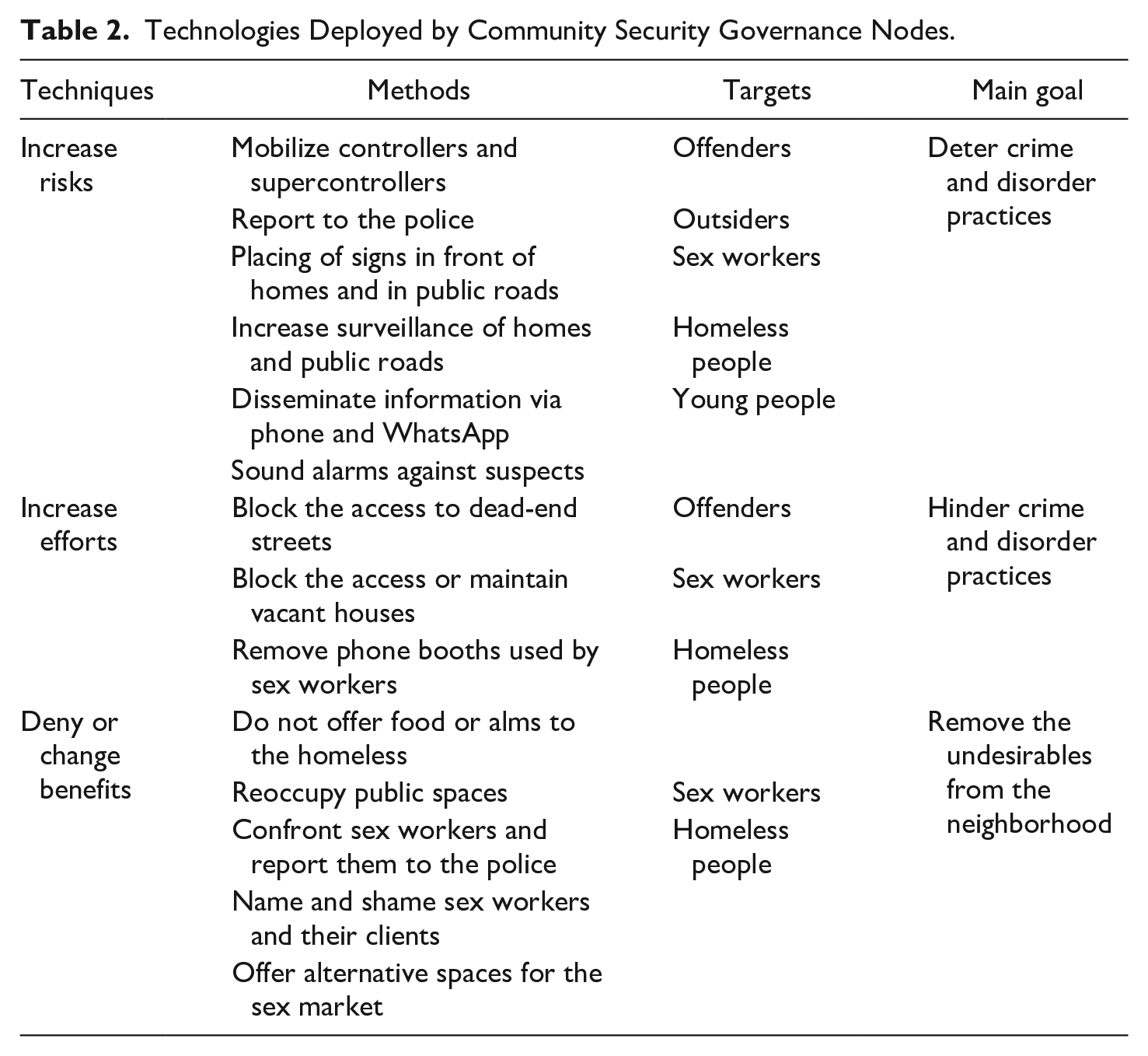
Technologies for deterring criminal or disorderly events are based on the belief that offenders will be discouraged when they realize that the risks of being caught are high. To manipulate this perception, the nodes used methods such as (a) signaling that the streets were monitored and that the residents were members of the Solidary Neighbor program; (b) natural or camera surveillance—private and aimed at monitoring homes in the case of Shangri-Lá, or community-based and focused on monitoring the streets and public spaces in the case of Santa Monica; (c) dissemination of information about people, vehicles or suspicious activities first by phone calls and SMS and later through WhatsApp groups created for this purpose; (d) sound signaling against suspects—initially made by means of a whistle distributed to residents, later replaced by an alarm installed on poles and activated by remote control; (e) reporting to the police and requesting they take action against suspects; and (f) mobilization of “controllers,” such as parents of young people responsible for crimes or disorders, and of “super controllers,” as public bodies with the authority to regulate other controllers or managers of problematic spaces. While the latter method was only found in Shangri-Lá, where it was used primarily to deal with parties and youth gatherings, all of the former were systematically used in both neighborhoods to monitor and keep potential offenders under control. The passage below exemplifies how these methods operated: We have a deterrent, you know. There is a sign saying that the place is being monitored 24/7 [. . .]. [T]here are people who don’t care, but if they don’t care and if they pass by a street that is public . . . . [W]e are in a neighbourhood that is not a gated community. It’s public! You can spend as much time here as you want. Anyone can pass by. But if it happens once, if it happens twice . . . wait [. . .] we immediately send out an alert, we already warn our people [on WhatsApp], “Look, . . . if they keep doing the same, you call the police.” Then sometimes the police come, catch the guy walking there, already give him a stern warning. [. . .] “What were you doing there? Are you looking for someone?” It may actually be the case. Once a guy said, “Guys, guys . . . there’s a stranger.” It was the pizza delivery guy! Do you get it? That happens too. We are afraid precisely because of the insecurity that we have [. . .]. Because a lot of people pass by, okay? These people who we can tell are not from the neighbourhood, their way of walking, their way of looking. Those who live there don’t look at the houses, you know. And we in this group ended up getting to know each other, right? This brought the neighbourhood together. We know each other. (R12, Santa Monica)
As the comments of R12 indicate, community nodes do govern public areas, but they cannot use the type of access control methods employed by gated communities and other facilities, whose use of space necessitates authorization. To circumvent these limitations, they use the methods described above to manipulate the perception of risk and deter potential offenders. Nevertheless, the sentiments of R12 reveal the way in which the community nodes juxtapose positive notions, such as “from the neighborhood,” with the negative insinuation implicit in “from outside the neighbourhood.” By connecting neighbors and allowing people to get to know each other, the nodes create the conditions for residents to more effectively govern those they consider outsiders, who can then be more easily identified and policed. This policing is commonly directed toward those who circulate in the neighborhood making use of local services (more common in Shangri-Lá), or to provide services like delivery (more common in Santa Monica), as evinced in the passage above. In Shangri-Lá, the policing of the node is also directed at the poor, the homeless and sex workers and their clients.
Community nodes employ a different type of technology which aims to hinder criminal or disorderly events. Such technologies are predicated on the idea that offenders will give up committing crimes and disorderly activities in situations where the effort required is perceived as too arduous. In addition to encouraging the use of individual protection measures, such as perimeter barriers, the nodes also act to ensure that vacant houses are not squatted in by drug users, or enable broader interventions in equipment and areas, such as vacant lots, alleys and nearby woods, all considered facilitators of crime and disorder. Given that measures such as these require interventions that reconfigure areas and equipment under the governance of public agencies, the nodes need to mobilize their political capital to ensure these authorities act according to the residents’ interests. This also occurs with technologies of deterrence that aim to increase surveillance in the neighborhood, such as improvements in public lighting and tree pruning. Security governance in the neighborhoods, then, is effectively carried out by both community nodes and public bodies, who together form a broader network that enables other governance technologies, like those which deter and hinder crime and disorder.
Partnerships between community nodes and public bodies can also be seen in technologies used for removing those perceived as undesirable. These forms of technology were used only by the community node of Shangri-Lá in governing the homeless, sex workers and their clients—“trouble” populations not visible in Santa Monica. They operated by denying or remodeling the incentives that attracted these populations to the neighborhood: the existence of a discreet, but well-known, urban area for encounters between sex workers and clients; and the existence of an area perceived as functional for homeless people. Removal technologies were used to disrupt these conditions. The excerpts below show both the incentives that attract the homeless to the neighborhood and the methods used by residents to interfere with them: We have been on this square [Dom Pedro square] for 18 years [. . .] because we are visible to society, when the police pass by and see us, they know us, that’s why we are here. [. . .] I don’t have a star on my forehead, but they [shop owners and neighbourhood residents] have known us for over 18 years [. . .]. [T]here are shop owners who don’t play a fair game, but there are shop owners who offer us things . . . they even help us with food [. . .]. I’ve been going to a shelter, but it didn’t work out because it was overcrowded, a lot of people discriminate against us, the social workers, they want to treat us like that, but it doesn’t work, due to our condition of addiction [alcohol dependence]. We want our independence. [Here in the streets] it is more relaxed, because rules don’t sit well with us . . . what you can, or what you can’t do. This land is ours, regardless of money, regardless of the value of cash, this land is ours too. (H1, Shangri-Lá) On Sunday there was a person circulating in the neighbourhood [homeless person]. He had already circled the neighbourhood, got food from a neighbour, who we advised not to do this kind of thing. They [the homeless] are sometimes spotters. (R3, Shangri-Lá) There was a time until . . . the RPC and the RICTV . . . [TV stations based in the neighbourhood]. RIC even adopted that Dom Pedro square and reactivated the children’s playgrounds and those public gyms for the elderly. [. . .] Because there was a very large group of homeless people who robbed people at the bus stop, they used to make a mess, to create trouble, they had sex there, you know. It was not a good thing. So, what do we do? When this becomes intense, we go to the city hall and try to relocate these people. (R11, Shangri-Lá)
The comments of H1 reveal how the Dom Pedro square and its surroundings were seen by homeless people as spaces that provided benefits such as protection, support and freedom for the use of drugs, advantages absent from shelters. Being aware of this, the community security governance node sought to deny them access to these benefits by making the neighborhood inhospitable to street populations. This was done by utilizing methods such as (a) guidelines for residents not to give food or handouts to homeless people; (b) support for revitalization projects that made the square a place that residents would frequent, hence it would be uncomfortable to homeless people; and (c) pressuring public agencies to displace, or relocate, homeless people. Whatever method was deployed, the principal goal was the same: to remove homeless people to reduce the disorders attributed to them.
Techniques of denying access, and the remodeling of perceived benefits, were also used by the community node of Shangri-Lá against sex workers and clients. These techniques deployed methods to make the neighborhood streets unattractive for encounters between sex workers and clients. These methods included (a) confronting sex workers; (b) exposure of clients through ostentatious filming and the threat of making footage public; and (c) attempts to move the street sex market to other areas of the city. R19 offers an informative account of the first two methods: I already ended up being taken to the police station because of this [. . .] because of a prostitute [. . .]. [I]t was an ugly fight because I couldn’t take it anymore. I was leaving the house—I have two little daughters—I left the house, that animal, with everything exposed, her boobs were really out, [not] to say the bad word, her thing out. I said ah . . . I can’t take it. [. . .] We argued. It was bad [. . .]. From [street name A] to [street name B] on the corner, I started a fight. I got a bit of fame. [. . .] Myself, my wife, my neighbour, we got the reputation for blowing the whistle. They don’t hang out here anymore. (R19, Shangri-Lá) The prostitute comes, what do we do? We open the door, put a chair on the sidewalk. [. . .] The client arrives, sees us there [. . .] taking pictures. [. . .] Because, in fact, the guy is married. [. . .] You go with your cell phone close to the guy and the guy “poof.” [I did it] a lot of times, it wasn’t just a few times, it was a lot of times. I still do it today. (R19, Shangri-Lá)
As these excerpts suggest, both the confrontation with sex workers and the exposure of clients served to disturb the street sex market. In the first case, it sought to undermine the tranquility of known locations for prostitution and sex workers. Sometimes this was achieved without direct confrontation, as R19 described: “[T]here are some houses where sirens were installed [. . .]. [T]he siren was installed because of prostitution. When they arrived, ohnnnn, the siren went off.” (R19, Shangri-Lá) In the second case, the aim was to deny the benefit of anonymity to those people looking for sexual services in the neighborhood, as a strategy to compromise the demand side of the street sexual market. To make this method more efficient, residents at different times publicized it in the press. Different media publicized the method of exposing people looking for sexual services in the neighborhood. An article published in 2010 on the “Prostitutas incomodam moradores do Shangri-la” (2010) includes the following passage: “According to the resident, the neighbours are taking down license plates for cars [looking for sex workers in the neighbourhood] filmed by home security cameras.”
Finally, residents also attempted to create an alternative space where the sex market could be displaced. To achieve this, in 2013 they signed a petition and convinced a city councilor (named Roberto Fu) to take over this fight. This initiative was described by a sex worker who worked in Shangri-Lá: If transvestites, for example, are in a prime area, they bother people. They should stay away. And that was Roberto Fu’s project. When he came to talk to me saying that he had a petition from Shangri-la, [. . .]. A petition . . . they had done all this work of collecting signatures to get the transvestites out of there and take them to the end, out of the city [. . .]. Why don’t you mobilize, you know, for . . . you know . . . for something else? Why don’t these people . . . why don’t you as a professional, who have a company, hire a transvestite, you know? (SW3, Shangri-Lá)
In addition to exposing the attempt by residents and the councilman to remove sex workers to a remote and relatively invisible place in the city, SW3’s testimonial is interesting because it highlights the existence of alternative mentalities to the issue of reducing opportunities as a strategy to govern situations like the street sex market. This type of situation can be framed as a social problem that requires community initiatives, guided by what Rosenbaum (Rosenbaum, 1988, p. 350) called the “social problems approach,” which suggests mobilizing the community around social inclusion projects that aim to attack the root causes of crime and disorder in the neighborhood.
Conclusion
Two main findings emerged from our analyses. First, the governance of security in these middle-class neighborhoods was undertaken by security networks where citizens were more than the eyes and ears of the police. Instead of top-down requests from the police to engage citizens, the initiative here was bottom-up and initiated by the citizens themselves. When the state was perceived to have withdrawn, either by a lack of capability or as simply inefficiency in the promotion of security, citizens were inclined to take action and promote prevention and policing actions themselves. Nodal governance theory was a critical tool in explaining how citizens formed community nodes to govern security and impose a local order in line with their values. However, at the same time that local actors used the said absence of the state to justify their initiatives, they kept building relations with police. This is only possible because for these middle-class groups the police are not seen as a threat but as legit partners. The interplay between community nodes and the police is complementary rather than a form of competition: the police seek to take advantage of community nodes to overcome their institutional limitations and impose public order defined by state rules, while community nodes seek to take advantage of the police to circumvent its disadvantages and impose a local order that does not necessarily coincide with the state public order.
Second, the nature of the order that the nodes seek to impose and the technologies used for this seem to be situationally dependent. The security governance carried out by the Santa Monica node was basically focused on the imposition of public order defined by the state. This governance was carried out through technologies that aimed to increase risks and efforts to commit crimes in the hope of deterring offenders. This concern with public order and the use of technologies aimed at increasing risks and efforts to commit crimes was also present at Shangri-Lá. However, in this neighborhood the quest for security was seen to unfold as part of a broader aspiration of order and territorial control. As our excerpts illustrated, the Solidary Neighborhood program in Shangri-Lá concentrated efforts in the ordering and control of public spaces. This ordering and control were done through removal technologies that include methods of confrontations with, and displacement of, the homeless and sex workers, groups considered undesirable by these middle-class residents. The search for local order was, then, not only related to crime control itself but also reflected a plea for a vision of public decency and cleanliness, which denies the inherent heterogeneous and conflictual character of public spaces. Additional research should be done in other social contexts to better understand the drivers of these variations. In the context we have studied, they seem to be largely situational, that is, dependent on the nature of existing and perceived problems by the communities. But the focus of our study only in the Brazilian context and in two particular cases does not allow any further extrapolation.
Although our study does not allow us to identify the conditions under which community involvement in crime control produces beneficial or harmful social consequences, it raises at least a warning about the enthusiasm with which much of the international criminological literature has addressed community involvement in crime control and disorder. In fact, there are many positive aspects to this involvement. Our analysis confirms that the Solidary Neighbor program is made up of residents who know, trust and support each other. Thus, the communities where they exist seem to be endowed with collective effectiveness, a characteristic that criminological theory has pointed out is fundamental for the control of crime and disorder (Sampson, 2012). However, our analysis also shows that this solidarity between residents can be used to generate offensive practices against populations perceived as undesirable, as the case of Shangri-Lá shows. Given that a strikingly unequal and violent society like that of Brazil produces so many undesirables, the emergence of bottom-up initiatives to promote security in middle-class neighborhoods should be viewed with caution, as these initiatives are often accompanied by the production of hostile and exclusionary spaces against these same undesirables. After all, these so-called solidary neighbors are not always so solidary to the excluded who insist on invading their living spaces.
Footnotes
Declaration of Conflicting Interests
The author(s) declared no potential conflicts of interest with respect to the research, authorship, and/or publication of this article.
Funding
The author(s) received no financial support for the research, authorship, and/or publication of this article.