



Abstract
Racial and ethnic disparities in the criminal justice system have been well documented in prior research. Despite this, few studies have explored the extent of disparities after accepting a plea bargain compared with proceeding to trial. The distinction between plea bargaining and going to trial is highlighted because judicial officials are more constrained by the law when making punitive decisions following a trial. Thus, there should be fewer disparities in punitive outcomes among defendants who went to trial. Using Florida Sentencing Guidelines data from 2010 to 2017 combined with county-level data from the 2010 United States Census, the current study contributes to prior research by investigating whether the size of the Black and Latino populations influences disparities in punitive outcomes among Black, White, and Latino defendants after accepting a plea bargain and going to trial. The results suggest that Blacks sentenced in counties with a growing Black population are less likely to receive a jail sentence but more likely to receive a prison sentence after accepting a plea bargain. However, they are less likely to receive a prison sentence after proceeding to trial when sentenced in areas with a larger share of Black residents. In contrast, Latino defendants who accept a plea bargain are more likely to receive a jail sentence but less likely to be sentenced to prison in areas with a growing ethnic presence. Furthermore, Black defendants sentenced in areas with a change in Black populations receive shorter sentences after accepting a plea bargain. Our analyses provide an intricate story about race/ethnicity, place, and threat in the state of Florida. Overall, the results show that the social context matters, but differently pertaining to punishment outcomes disposed of by plea bargains and trials.
Introduction
Racial and ethnic disparities in the criminal justice system have been well documented in prior research (see Feldmeyer et al., 2015; Johnson, 2019; Mitchell, 2005; Steffensmeier & Demuth, 2000; Zatz, 2000). Although some scholars note that the observed disparities reflect differential rates of offending, others note that the stable disparities across criminal justice decision points potentially reflect other processes like the mode of disposition (i.e., plea bargain and trial) (Albonetti, 1990; Kutateladze et al., 2014; Spohn & Holleran, 2000; Steffensmeier & Demuth, 2006; Wooldredge et al., 2015). In his work, Johnson (2003) highlights the importance of the mode of disposition in producing disparities because of the discretion utilized by different courtroom actors (see also Padgett, 1985; Tonry, 1996). Prosecutors, for example, have significant influence on the plea bargaining decision and to the extent that minority defendants are offered pleas with more severe punitive sanctions, it will have a substantial impact on racial and ethnic variation in the incarceration and sentence length decisions.
Recently, scholars have devoted more attention toward understanding how plea bargaining and trials impact variation in punitive outcomes (Kutateladze et al., 2014; Lehmann et al., 2018). Lehmann et al. (2018) found that among juveniles transferred to adult court, disparities were weaker and smaller among cases that went to trial compared with those that accepted pleas. The process of deciding when to enter a plea agreement with the hopes of receiving a lighter sentence may operate differently for minority defendants. For example, Frenzel and Ball (2008) argued that minority defendants often hold lower levels of legitimacy and trust in the criminal justice system. As a result, they may be more likely than other groups to take their chance at a trial with the goal of appealing to their fellow peers or to the judge. In another study, Metcalfe and Chiricos (2018) found that Black males were most disadvantaged in a system that relied more heavily on plea bargaining (see also Kellough & Wortley, 2002).
The current study revisits the mode of disposition and its impact on disparities in punishment outcomes by situating the plea bargaining and trial outcome decisions within a broader macrosocial context. Utilizing the racial and ethnic threat perspective, we examine whether the effect of the mode of disposition on the punitive decision for Black, White, and Latino defendants is influenced by the size of the Black and Latino populations. The racial and ethnic threat perspective, first articulated by Blalock (1967), posits that as the minority population increases (or is perceived to have increased), Whites feel threatened and believe their power is being jeopardized. Thus, they defend their positions by using increased social control measures, such as arrests and incarceration, to control minority populations (Blalock, 1967; Eitle et al., 2002; Feldmeyer et al., 2015; Johnson et al., 2008; King & Wheelock, 2007). In the context of punishment, the salience of racial and ethnic threat is not yet a settled issue. While some scholars find significant effects, others do not (Britt, 2000; Jordan & Maroun, 2016). The mixed findings potentially reflect the lack of adequate attention investigating whether the effects of racial and ethnic threat are influenced by the decision to accept a plea agreement or go to trial.
To address this gap in prior research, using the 2010–2017 Florida Sentencing Guideline Data this study explores whether a growing Black and Latino population impacts the incarceration and sentence length decisions among Black, White, and Latino defendants across two modes of disposition—plea bargains and trials. By doing so, we contribute to the study of punishment in several important ways. First, by assessing disparities across two modes of disposition, we highlight how different courtroom actors (e.g., prosecutors and judicial officials) use of discretion impact disparities in punitive outcomes. When defendants go to trial, judicial officials learn more about both the case and the defendant. This potentially reduces the reliance on stereotypes and other extralegal factors that can increase the size of disparities. In the plea-bargaining decision, judges know less about the defendants, and prosecutors and other courtroom actors have significant impact on the punishment decision. Second, we investigate both the incarceration and sentence length decision to access decision-making across multiple decision points. Third, we examine the effects of jail and prison separately (see Holleran & Spohn, 2004) because they are qualitatively different punishment outcomes. Defendants sentenced to jail serve less than a year and in Florida the average jail sentence is less than 120 days compared with prison which is approximately 24–30 months. Fourth, the data utilized in the present study reflect geographical areas with a sizable Black and Latino population. Florida has the fourth largest minority population in the United States; thus, it is an excellent context to explore disparities in punishment at both the individual and contextual levels.
Background
In the United States, 95% of all convictions are settled by a guilty plea (Johnson et al., 2008; Metcalfe & Chiricos, 2018). A plea bargain is an agreement between a prosecutor and defendant in which the defendant agrees to plead guilty in return for some concession from the prosecutor (Kutateladze et al., 2016). Theoretically, a plea agreement offered by a prosecutor provides the defendant an opportunity to plead guilty to a lesser charge or to an original charge, but with a lesser sentence. In practice, this should minimize the risk of going to trial (Kutateladze & Lawson, 2018). Bar-Gill and Ben-Shahar (2009) note that defendants often accept a plea bargain because it is impossible to predict what a jury will decide, therefore reducing the risk of being sentenced harshly. It is not clear whether accepting a plea always results in a reduced sentence or whether proceeding to trial consistently results in more severe criminal sanctions. Nevertheless, plea bargaining has become the dominant mode of case disposition in part because of heavy caseloads and the ongoing pressure placed on courts to operate efficiently and to process cases in a timely manner (Spohn, 2018). Heumann’s (1978) study using Connecticut court data found that plea bargaining is an inevitable part of the American justice system and is an important mechanism for moving cases through the justice system more efficiently.
The evidence exploring the influence of the defendant’s race and ethnicity on plea and trial outcomes is relatively mixed. Some scholars have found that race/ethnicity does not affect plea bargains (Franklin, 2010; Shermer & Johnson, 2010; Wooldredge & Griffin, 2005) while other scholars have found that Whites are offered plea bargains more frequently than minorities and are given better deals (Kutateladze et al., 2014, 2016). In a recent study, Kutateladze and colleagues (2014) explored racial and ethnic disparities in plea bargains offered to defendants arrested for misdemeanor marijuana offenses. The authors found that Black and Latino defendants were more likely to receive custodial pleas than Whites. Kutateladze and colleagues (2014) concluded that these disparities reflect the stereotypes that portray minorities in a violent and dangerous manner. Similarly, Ulmer and Bradley (2006) examined the differences in sentencing outcomes among those who pled guilty and those who were convicted by a jury trial for serious violent offenses in Pennsylvania from 1997 to 2000. They found that the “trial penalty” is not evenly distributed because Blacks experienced greater trial penalties (Ulmer & Bradley, 2006). That is, they were sentenced to more punitive sentencing outcomes after a trial.
Despite the aforementioned findings, other scholars have found no support that race and ethnicity influence plea bargaining and the resulting punitive outcomes. D. A. Smith (1987) examined plea bargaining using felony cases from six different states and found that Black defendants did not suffer from trial penalties; however, Whites were treated more punitively when their cases went to trial. Similarly, Myers (1982) found that there were no significant racial/ethnic differences for misdemeanors across these modes of disposition (i.e., plea bargain and trial).
The mixed evidence likely reflects two things. First, prior research has explored racial and ethnic disparities using a mixed sample of felony and misdemeanor cases. By combining misdemeanors and felonies, scholars are potentially over-inflating the effects for misdemeanors and masking the effects for felonies. In the current study, the data represent felony convictions only to explore whether differences are observed for defendants who commit more severe criminal acts. The mixed findings might also result from scholars not situating the effects within a broader macrosocial context. The current study overcomes these shortcomings by specifically assessing whether the racial and ethnic composition of an area moderates the effect of race and ethnicity on the punitive decision following a plea agreement and a trial.
Racial/Ethnic Threat
Recently, scholars have explored whether racial and ethnic disparities in punishment are shaped by the community context. Blalock (1967) who first articulated the racial threat thesis argues that as the minority population grows compared to the White majority group, minorities are better able to compete for scarce economic resources, political influence, and power (Blalock, 1967). When the minority population increases, majority groups respond by using social control mechanisms to thwart the posing threat. Blalock (1967) suggested there are three ways a growing minority population would be seen as threatening—economic, political, and social. As their economic, political, and social threat increases, so does the use of social controls that are employed against them (see also Eitle et al., 2002). Perceptions of economic threat occur when majority group members become increasingly concerned about competition for jobs, desirable housing, and other economic resources. Likewise, political and social threat occur when a large or growing minority population is perceived as threatening to the majority group’s political dominance. Under this premise, minority group members grow in their ability to exert greater political power and influence, such that the majority could no longer unilaterally impose their will (Kent & Jacobs, 2005; Liska, 1992). As it relates to criminal threat, Blalock (1967) maintains that as minorities grow in size, the perceptions of criminality that often get linked to them are used as justifications to employ social control agents against them. Thus, an increase in the Black population potentially increases the perception of crime and Whites’ level of fear (Chiricos et al., 1997). Despite the use of social control agents, Blalock (1967) maintains that as minority groups grow in size, the power of Whites to utilize increased social control responses reaches a tipping point because minorities are better able to mobilize their resources for collective action. This limits the way agents of social control can be employed against them.
Existing research has found some support for the racial/ethnic threat arguments. Specifically, the racial and ethnic composition of an area influences the police force size as well as the relative amount of tax dollars spent on policing (Chamlin, 1989; Jacobs & Helms, 1999; Stucky, 2005). Stults and Baumer (2007) found that as the percentage of Blacks in the population increases, city officials’ use of law enforcement expenditures (larger police force size) increases as well. Liska and Chamlin (1984) found that areas with a higher percentage of Blacks lead to more arrests for non-Whites. Similarly, Eitle et al. (2002) found that Black-on-White crime substantially increased Black arrest rates as the minority population increased in South Carolina.
As it relates to punishment outcomes, areas with a larger and growing minority population have increased disparities in imprisonment for Blacks (Wang & Mears, 2010a); longer sentence lengths for Blacks and Latinos (Ulmer & Johnson, 2004); and greater departures from recommended punitive outcomes (Johnson, 2005). In addition, Bontrager et al. (2005) found that legal actors are less likely to withhold adjudication (i.e., order some sanctions but does not formally convict) for Blacks as their presence in the community increases. Similarly, Feldmeyer et al. (2015) found that Black defendants received more custodial and longer sentences in counties with substantial minority population growth.
Despite the above results supporting the effects of racial and ethnic threat on punitive outcomes, other studies have yielded mixed findings. Ulmer and Johnson (2004) found that county-level Black and Latino populations were positively related to racial disparities in state court sentence lengths, but not for the incarceration decision. Weidner et al. (2005) found that defendants sentenced in communities with a higher proportion of Black residents were more likely to receive shorter sentence lengths. Likewise, Arazan (2018) reports that Black offenders sentenced in counties characterized by greater proportions of Blacks are less likely to receive an incarceration sentence and receive shorter prison sentences. Feldmeyer and Ulmer (2011) found that Latinos in areas with a large Latino population received shorter sentence lengths in federal district courts.
Overall, the research highlighted above demonstrates mixed support for the racial and ethnic threat perspective, though it has been widely examined in criminological research. The inconsistencies in the literature could result in part from scholars failing to disaggregate the punitive decisions. That is, exploring the mode of disposition in which the case was disposed could potentially uncover processes that are masked when relying solely on punishment outcomes. The current study extends prior research by examining both plea and trial outcomes among minority defendants across racial and ethnic contexts.
The Current Study
In the United States, the number of cases settled by a plea bargain rather than a trial continues to increase. Convictions from plea bargains in U.S. district courts were 90% in 2014 compared to 60% in 1970 (Spohn, 2018). Notably, Reaves (2013) argues that plea bargains are more common today than ever before in U.S. history. Kramer and Ulmer (2009) noted that defendants often believe that going to trial results in a higher rate of conviction and longer sentence lengths compared with accepting a plea bargain. Thus, going to trial is a “risky” proposition that defendants, especially minority defendants, are likely to consider.
There are ongoing questions about the plea bargaining versus trial decision resulting in less or more punitive sanctions for racial and ethnic minorities. To date, few studies have explored how the size of the racial and ethnic composition of an area influences the punitive outcomes across the plea bargaining and trial decisions for Black, White, and Latino defendants. We highlight the salience of racial/ethnic threat because larger minority populations may be perceived as dangerous and threatening which could result in minority defendants entering plea agreements with more punitive sanctions (Johnson et al., 2008; Ulmer et al., 2007). In addition, as theorized by other scholars, we expect minority defendants who go to trial to also receive increased punitive outcomes for two reasons (Metcalfe & Chiricos, 2018; Ulmer & Bradley, 2006). First, some legal actors and juries might view going to trial as a refusal to accept responsibility for the illegal activity. Next, it might also be viewed as a waste of court resources. We expect effects to be more pronounced for minority citizens, when they are sentenced in court jurisdictions with larger or growing populations of minority residents. Taken together, to better understand racial and ethnic disparities in criminal punishments, we explore whether the racial and ethnic context of an area moderate the relationship between race/ethnicity, plea bargain, and trial sentencing outcomes. The current body of evidence exploring disparities in punitive outcomes has yet to disentangle these possibilities.
It has long been recognized that agencies such as courthouses and legal actors are influenced by the various environmental contingencies and that the plea bargaining and trial processes, including final convictions, vary across jurisdictions (Eisenstein & Jacob, 1977; Metcalfe & Chiricos, 2018). Utilizing the threat perspective along with examining outcomes after both the plea bargain and trial decisions may provide clarity regarding sentencing disparities among minority defendants. Thus, the following hypotheses emerge:
Data and Methods
The data used to assess the hypotheses incorporate individual-level sentencing and county-level data. The individual-level data were obtained from the Florida Department of Corrections (FDOC) Sentencing Guidelines database and matched to the Offender-based Information System (OBIS) data. In 1983, the Florida sentencing guidelines were created and then revised in 1998 due to the Florida legislature’s passage of the Criminal Punishment Code. The revised guidelines provide comprehensive information on convicted felons, including a rich array of legally relevant factors that are important in sentencing research. Thus, these data are uniquely suited to address our research hypotheses (see Bontrager et al., 2005). This data set has several strengths that make it ideal for the proposed analyses. First, this data set includes detailed information on sentencing and offender characteristics, including demographics such as race, ethnicity, and whether the sentence was disposed of by a plea or a trial for every convicted felony offender. This is beneficial to the current study because it provides a wide array of information about defendants, which can be used to examine legal and extralegal factors used in criminal sentences (Bontrager et al., 2005). Next, the data are felony convictions from all of the counties in Florida. Because the data include the counties in which individuals were sentenced, it provides an opportunity to study contextual effects on sentencing. The contextual-level data are taken from the 2010 decennial census obtained from the United States Census Bureau. The county-level crime rates were obtained from the 2010 Uniform Crime Report (UCR) collected by the Federal Bureau of Investigation (FBI). The aggregate-level data were then merged with the individual-level records obtained from the FDOC. Overall, the data permit an assessment of both individual and contextual influences on punishment decisions. The final sample includes 720,090 defendants who accepted a plea and 15,448 who went to trial nested in the 67 counties across Florida from 2010 to 2017.
Dependent Variables
For the present study, there are two dependent variables— sentence disposition and sentence length. A categorical dependent variable is utilized— sentence disposition which includes the three categories of jail (plea = 30%, trial = 13%), prison (plea = 28%, trial = 47%), and community supervision (plea = 42%, trial = 40%). The reference category is community supervision. Criminological scholars contend that it is important to distinguish between sentencing decisions to truly understand where disparities exist (Harrington & Spohn, 2007; Johnson, 2006; Warren et al., 2020).
Since the sentencing decision is a two-stage process, we also explore sentence length (plea M = 19.74, SD = 42.79; trial M = 50.73, SD = 81.67) after accepting a plea bargain or going to trial. Sentence length is measured using a continuous variable reflecting the length of months of the total incarceration term. In the present analyses, we use the logarithmic transformation of sentence length to account for positive skewness and to impose a more normal distribution (Bushway & Piehl, 2001).
Independent Variables
This current study focuses mainly on how the effects of race and ethnicity across minority contexts intersect to influence disparities in plea and trial punishment outcomes. One of the key predictor variables is the offender status characteristic measure of race/ethnicity, measured using dummy variables for non-Latino Black (Black = 1; non-Latino White = reference) and Latino (Latino = 1; non-Latino White = reference). Inspection of defendants’ status characteristics presented in Table 1 shows that those who accept a plea bargain are majority White at 53%, while 35% are Black, and 12% are Latino. On the other hand, the majority of Black defendants who proceed to trial is 55%, while 33% are White, and 12% are Latino. Racial and ethnic threat are key aggregate-level predictors used in this study. Previous research has suggested that a growing racial and ethnic population may be a source of threat to the majority group. Although static measures of racial and ethnic composition (e.g., percent Black and Latino) have traditionally been used as indicators of minority threat, Zane (2018) maintain that dynamic measures of racial and ethnic threat are more consistent with Blalock’s (1967) original depiction of group threat (see also Caravelis et al., 2011; Chamlin, 1989). Therefore, the current research utilizes a dynamic measure of an area’s racial and ethnic composition as an indicator of minority threat (see Caravelis et al., 2011; Feldmeyer et al., 2015; Wang & Mears, 2010a). Drawing on the 2010 and 2000 U.S. Census data, racial threat is measured as growth of the Black population, calculated by the percent change of the Black population between 2000 and 2010 (plea proportion = 0.02, SD = 0.02; trial proportion = 0.04, SD = 0.02). Ethnic threat is captured as the percent change of the Latino population in each of the 67 counties (plea proportion = 0.06, SD = 0.03; trial proportion = 0.07, SD = 0.02).
Descriptive Statistics for Dependent and Explanatory Variables.

Signifies significant differences among variables across the modes of convictions.
Offense-Level Variables
Prior research suggests that legal factors consistently affect sentencing severity (Doerner & Demuth, 2014; Wooldredge et al., 2015). Therefore, the current study includes various offense-type control variables in the analyses. The defendant’s primary offense type is measured using four dummy variables, violent (1 = violent offense; 0 = non-violent offenses), property (1 = property offense; 0 = non-property offenses), drug (1 = drug offense; 0 = non-drug offenses), and other (1 = other offense; 0 = non-other offenses). The most common offense type reported were other crimes (37%), followed by drug crimes (30%), then property crimes (17%), and violent offenses (16%) for those that chose to accept a plea bargain. For offenders who proceeded to trial, the most common offense type were other crimes (35%), drug crimes (24%), violent crimes (25%), and property crimes (16%). A defendant’s prior record strongly affects racial and ethnic disparities in punishment (Kleck, 1981). Prior record points (plea M = 1.20, SD = 1.56; trial M = 1.38, SD = 1.72) are measured as the defendant’s prior convictions. It is measured as the total sentencing guideline points associated with the individual’s prior record. To impose a more normal distribution and to account for positive skewness, the logarithmic transformation of prior record points was used in the analyses (Bushway & Piehl, 2001). In addition, whether or not a defendant was on supervision at the time of sentencing (yes = 1; no = 0) is included in the analyses (see Metcalfe & Chiricos, 2018). Approximately 31% of offenders who accepted a plea bargain and 22% who went to trial sentenced in Florida were on supervision at the time of sentencing. Pretrial detention (plea M = 9%, trial M = 12%) is included because prior research has shown that being incarcerated before the punishment decision may increase the likelihood of being incarcerated (Engen & Gainey, 2000). The sentencing year (plea proportion = 0.03, trial proportion = 0.04) is controlled for because criminological scholars suggest that there might be variations in sentencing stemming from year-specific changes in law, policies, or court practices (Wang et al., 2013). A control for the defendant’s gender is measured as male (1 = male; 0 = female). Moreover, males are more likely to accept a plea (78%) and proceed to trial (84%) than women (plea M = 22%, trial M = 16%). Furthermore, the age (plea M = 33.36, SD = 11.24; trial M = 33.91, SD = 11.73) at the time of sentencing for each defendant is captured using a continuous measure. These measures have been identified in the previous literature as important influences on sentencing decisions (see Metcalfe & Chiricos, 2018; Testa & Johnson, 2020).
County-Level Variables
Socioeconomic and demographic measures that are linked to patterns of sentencing are incorporated. Obtained from the UCR, the index crime rate is included to account for the variation in reported crime rates among the Florida counties in 2010. Consistent with prior research, index crime rates are controlled for because scholars have suggested that the level of crime seriousness in a community will affect the criminal justice system’s treatment of offenders (Britt, 2000; Ulmer & Johnson, 2004). Thus, where crime rates are higher, the criminal justice system is expected to increase the severity of punishment to control or regulate the amount of crime (Lizotte & Bordua, 1980). This measure is calculated as the total reported crimes divided by that county’s total population per 100,000 persons. Among the 67 counties in the state of Florida, the average index crime rate per 100,000 residents was 3,983 and 4,321. Concentrated disadvantage (plea proportion = 0.02, SD = 3.05; trial proportion = 0.71, SD = 1.77) is a variable measured by three county-level items indicating the level of disadvantage that have been linked to punitiveness and punishment outcomes (Arazan, 2018; Bontrager et al., 2005). The three items include percentage of households living below the poverty line, the percentage of residents receiving public assistance, and the percentage of residents who are unemployed; the α coefficient was .76. Finally, population density (plea M = 872.92, SD = 844.62; trial M = 1245.64, SD = 528.43) was included to account for the number of residents in each of the Florida counties per square mile of land area (see Johnson, 2006). The measures included were linked to each individual’s residential county.
Analytic Strategy and Procedures
In the present study, the research hypotheses are examined using multilevel modeling techniques to examine the effects of threat on the likelihood that minorities will receive different sentencing outcomes than Whites after accepting a plea and going to trial. Multilevel models were used because they account for the nonindependence of observations within higher order structural groupings. In our analysis, defendants are nested within the same counties, they may be more similar to one another than defendants in another county and, therefore, may not provide independent observations. Ignoring this clustering risks underestimation of standard errors (Raudenbush & Bryk, 2002). To produce more accurate estimates of the standard errors and less potential bias in results, multilevel models were estimated (Raudenbush & Bryk, 2002). Furthermore, this modeling strategy allows for estimation of cross-level interaction effects, indicating whether the effects of race and ethnicity on sentencing outcomes are conditioned by the county-level context (racial/ethnic growth) across modes of conviction.
First, we estimated multilevel multinomial logistic regressions because our case disposition outcome has three categories. Next, we estimated multilevel linear regression techniques to assess the extent of threat, plea bargaining, and trial on the length of sentences that minority defendants receive.
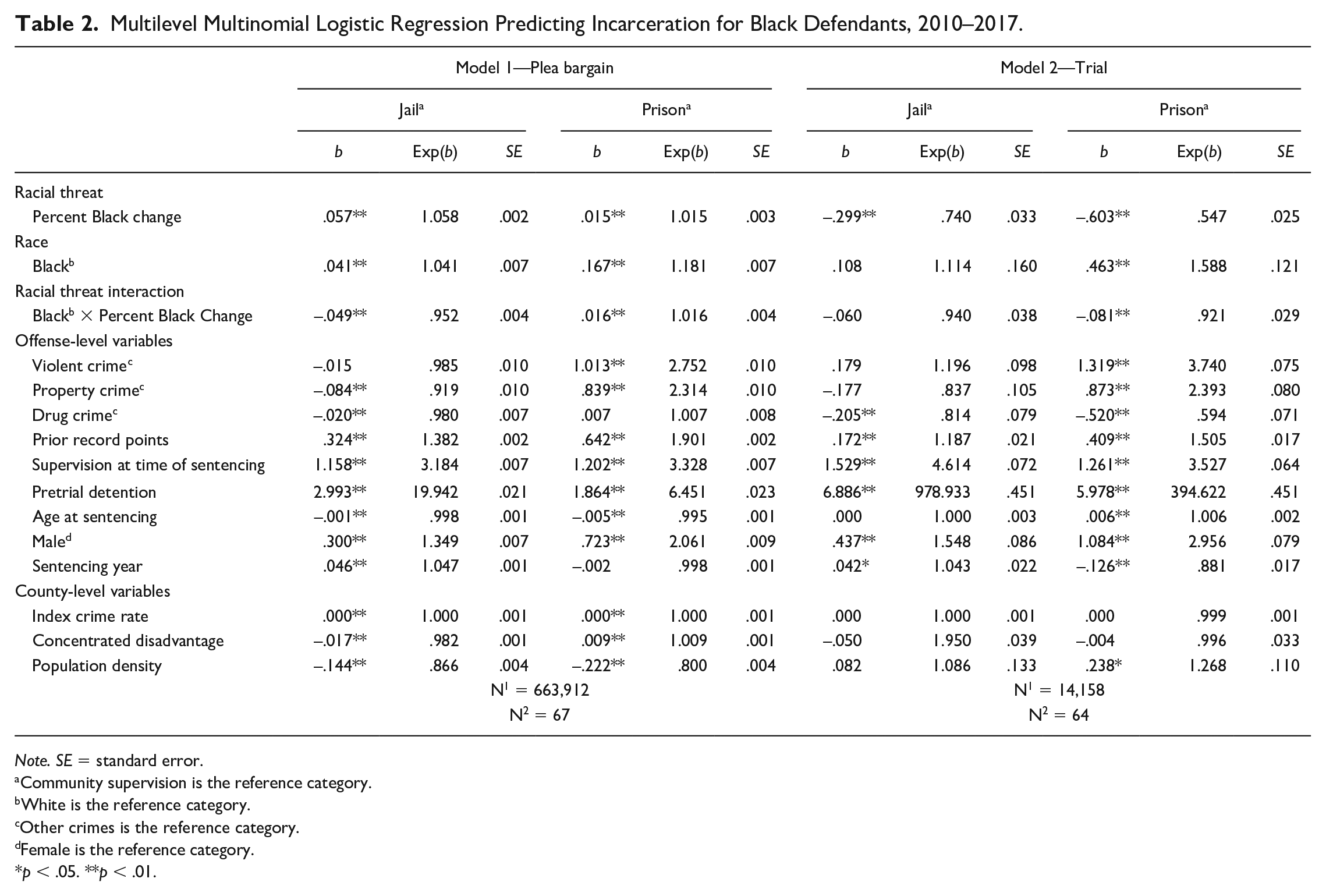
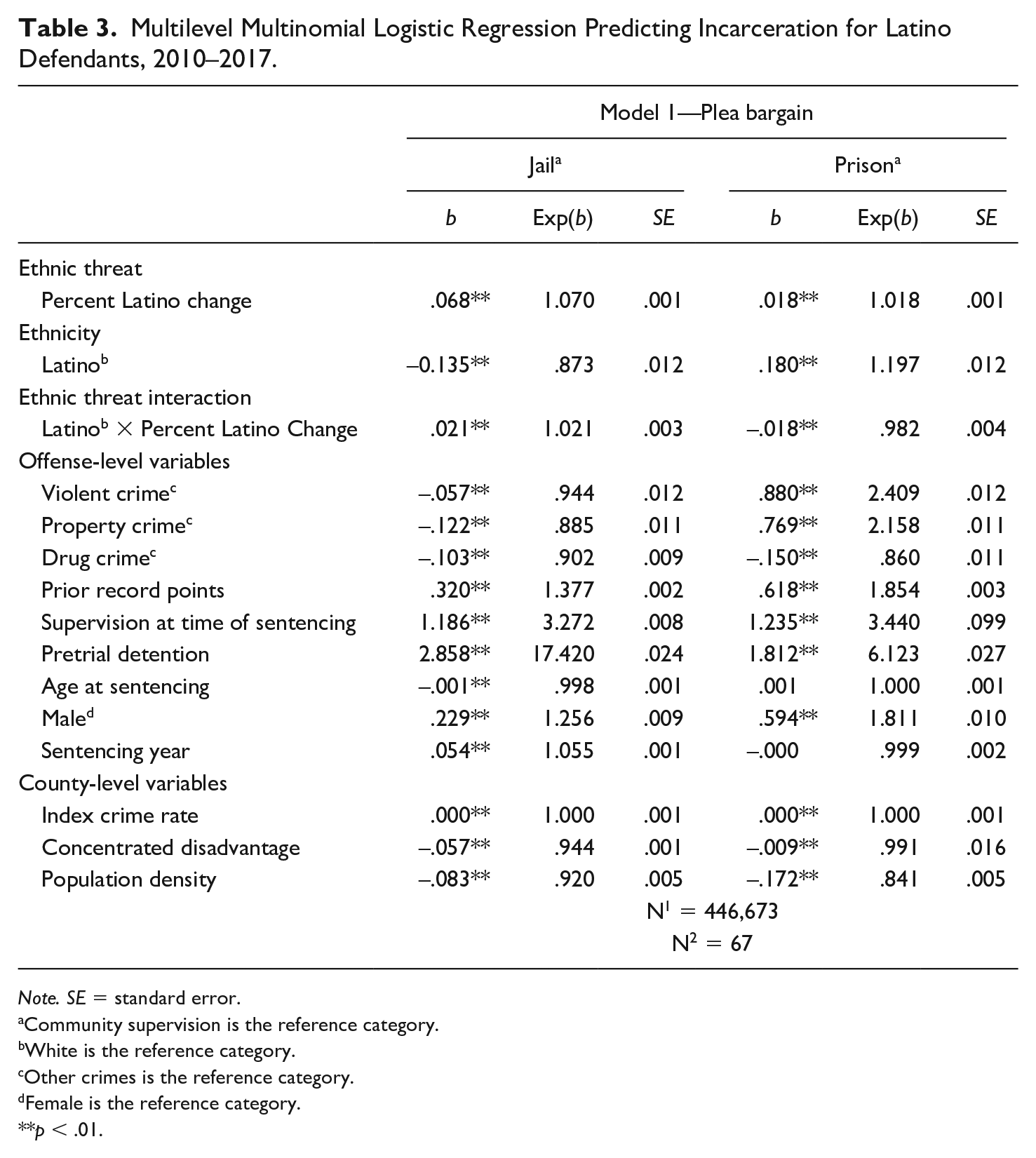
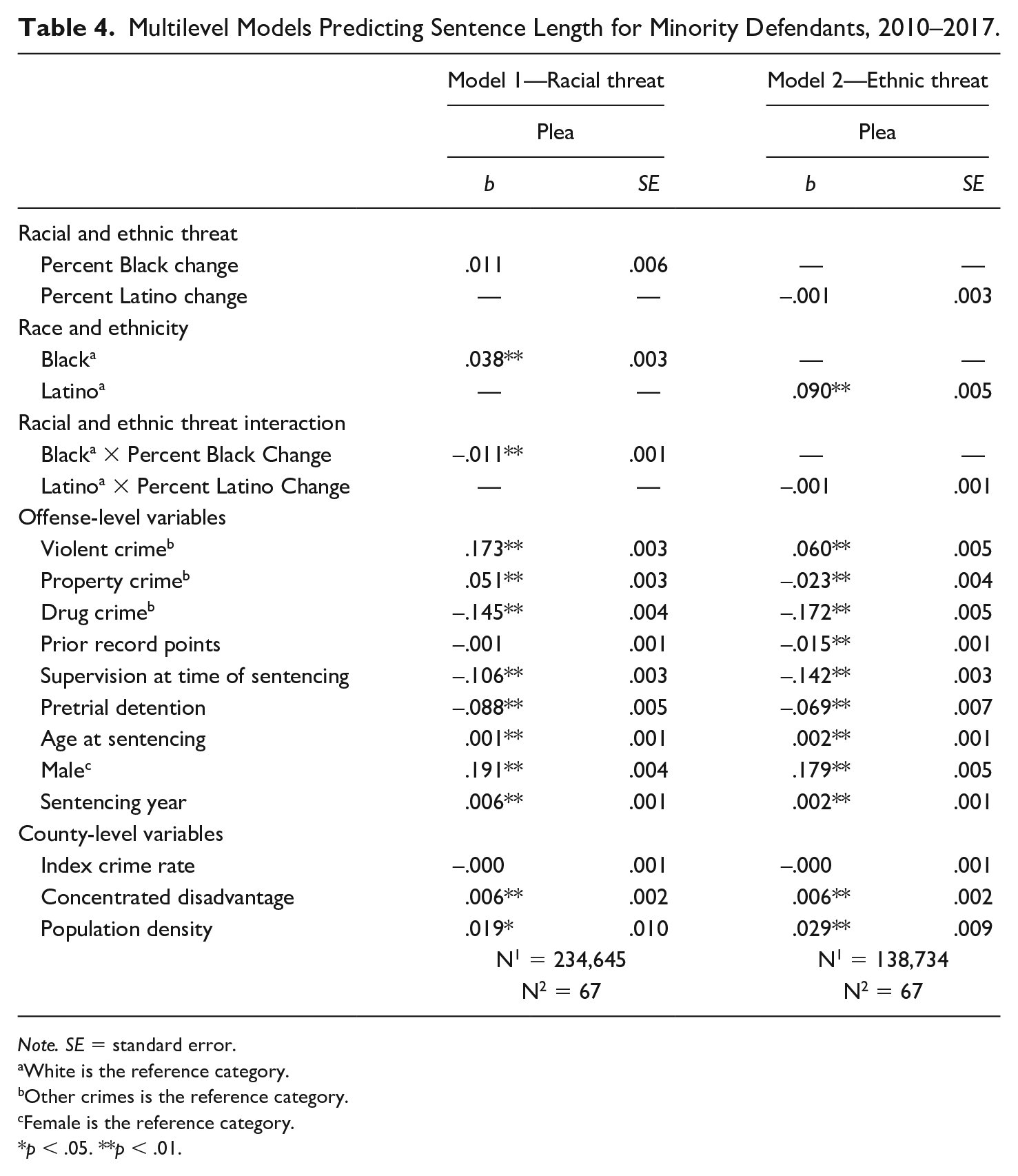
The present analyses will proceed in multiple steps. First, we examine the descriptive statistics for our dependent and independent measures. Next, we present the results of our multilevel multinomial logistic regression models estimated to highlight racial and ethnic threat given the varying sentence dispositions. Table 2 provides our estimates for the racial threat and case disposition after accepting a plea bargain and going to trial, including the cross-level interactions. Table 3 displays the analyses for ethnic threat and case disposition for those who decided to accept a plea with cross-level interactions. 1 Table 4 shows the sentence length decisions for racial and ethnic threat using the same measures explained previously. 2 Moreover, the predicted probabilities and values of significant punishment outcomes for minorities compared with Whites are presented in the figures.
Multilevel Multinomial Logistic Regression Predicting Incarceration for Black Defendants, 2010–2017.
Note. SE = standard error.
Community supervision is the reference category.
White is the reference category.
Other crimes is the reference category.
Female is the reference category.
p < .05. **p < .01.
Multilevel Multinomial Logistic Regression Predicting Incarceration for Latino Defendants, 2010–2017.
Note. SE = standard error.
Community supervision is the reference category.
White is the reference category.
Other crimes is the reference category.
Female is the reference category.
**p < .01.
Multilevel Models Predicting Sentence Length for Minority Defendants, 2010–2017.
Note. SE = standard error.
White is the reference category.
Other crimes is the reference category.
Female is the reference category.
p < .05. **p < .01.
Results
Multivariate Analysis of Sentence Disposition
Table 2 presents the racial threat effects from our multilevel multinomial logistic regression analysis modeling the decision to sentence a defendant to jail, prison, or community supervision. Model 1 displays the results for those who choose to accept a plea bargain. The results show that the odds of a Black defendant receiving a jail sentence is lower in places that experienced greater Black population growth after the acceptance of a plea bargain. Specifically, Blacks sentenced in counties with higher levels of Black residents are less likely to be sentenced to jail after accepting a plea bargain. However, the interaction between defendant’s race and percent Black change is positive and significant for the prison decision. In other words, the odds of a Black defendant receiving a prison sentence is higher in places that experienced greater Black population growth.
Nevertheless, several offense-level factors increase the probability of defendants receiving an incarceration sentence after accepting a plea bargain. Regarding offense type, defendants who committed a property and drug crime who chose to accept a plea were less likely to go to jail than community supervision but those who committed a violent and property crime were more likely to be sentenced to prison. The results of other covariates are also consistent with those reported in prior studies. Male defendants have increased odds of receiving jail and prison sentences after accepting a plea bargain.
Figure 1 illustrates the results presented in Table 2. Figure 1A displays the predicted probabilities of a jail and prison sentence for Black defendants who accept a plea bargain at low (1 SD below the mean) and high (1 SD above the mean) levels of percent Black change. The probability of a jail sentence is significantly lower for Blacks when sentenced in areas with a larger share of Black residents. Moreover, the probability of a prison sentence is significantly higher for Blacks when sentenced in areas with a larger share of Black residents.
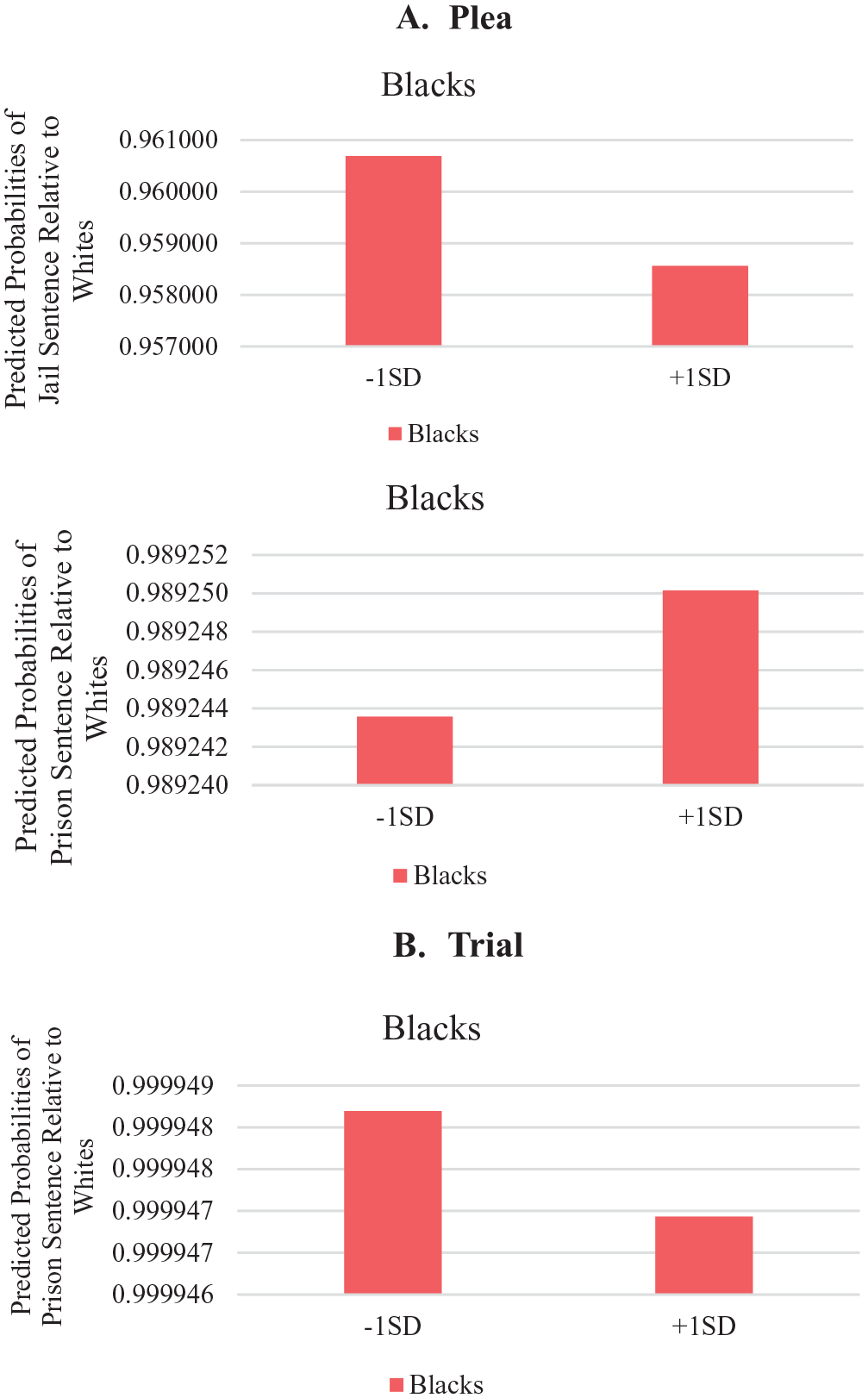
Interactive effects of racial threat on likelihood of Blacks incarceration.
In Model 2, the interaction between Black defendants who proceed to trial and racial threat significantly influences the sentences that they receive. Specifically, Blacks who go to trial are less likely to receive a prison decision when sentenced in counties with large Black populations. The model also shows that defendants’ prior record points, supervision at the time of sentencing, and pretrial detention significantly increased the likelihood that individuals would receive a jail and prison sentence after going to trial.
Figure 1 illustrates the results presented in Table 2. Figure 1B provides a parallel illustration but focuses on those that proceed to trial. Specifically, the probability of a prison sentence is lower for Blacks who go to trial at low (1 SD below the mean) and high (1 SD above the mean) levels of percent Black.
Table 3 illustrates the multilevel multinomial logistic regression analysis results for the effects of ethnic threat on sentencing decisions disposed of by a plea. Model 1 demonstrates that the punishment Latinos receive after accepting a plea bargain is shaped by the percent change of the Latino population in a county. Specifically, the odds of Latinos receiving a jail sentence after accepting a plea bargain is significantly higher than Whites in areas with a larger increase in the percent of ethnic citizens. However, the odds of a Latino defendant receiving a prison sentence is smaller in places that experienced greater Latino population growth. Moreover, defendants with prior record points, on supervision at the time of sentencing, and detained before conviction significantly increase the odds of receiving a jail and prison sentence after accepting a plea agreement. Individuals who committed violent and property crimes are more likely to receive prison sentences. However, those who have committed a violent and property offense are less likely to receive a jail sanction. The odds of receiving an incarceration sentence is significantly lower for defendants who have committed drug offenses. Finally, population density and concentrated disadvantage significantly reduce the likelihood that defendants will receive an incarceration sentence.
Figure 2 illustrates the results presented in Table 3. Figure 2A displays the predicted probabilities of a jail and prison sentence for Latino defendants who accept a plea bargain at low (1 SD below the mean) and high (1 SD above the mean) levels of percent Latino. The probability of a jail sentence is significantly higher for Latinos when sentenced in areas with a larger share of Latino residents. Although, the probability of a prison sentence is significantly lower for Latinos in counties with greater Latino population growth.
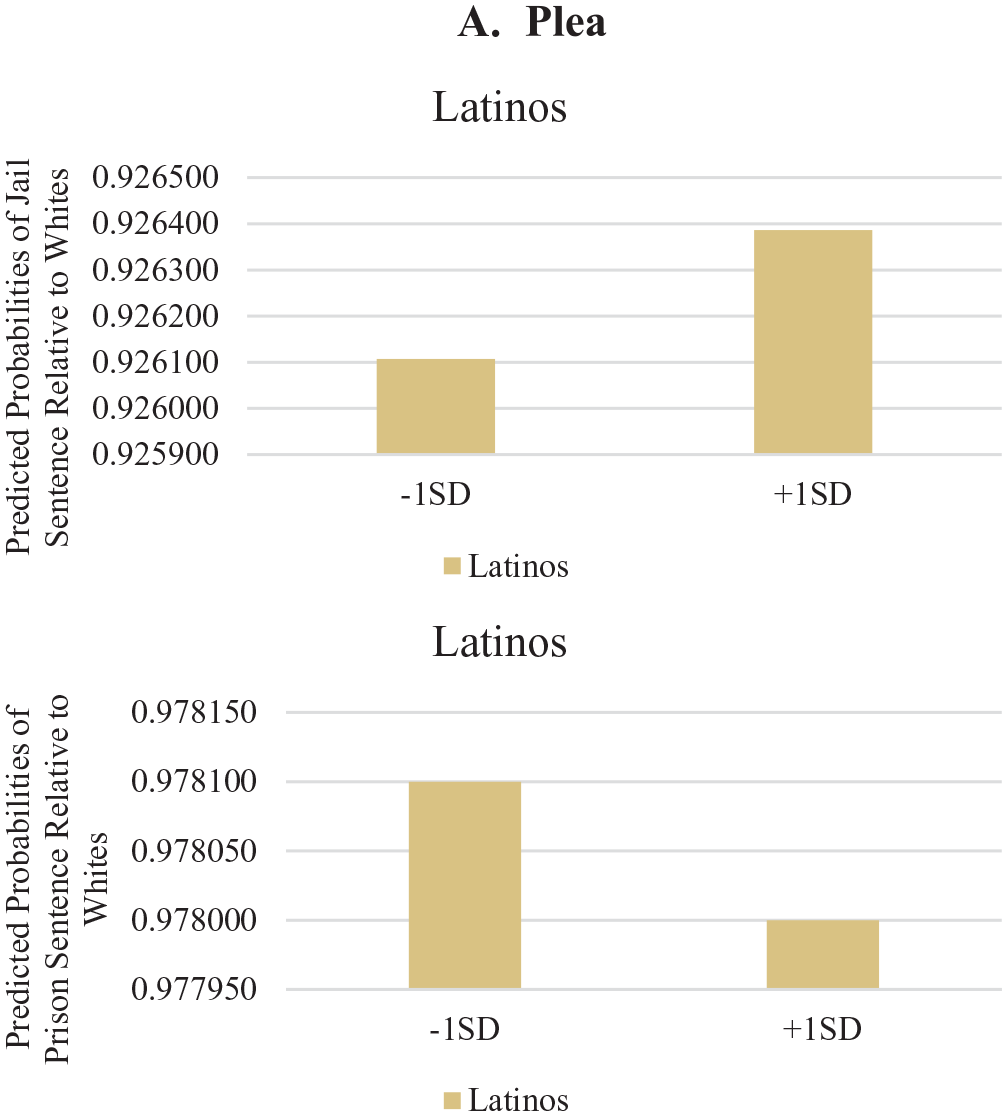
Interactive effects of ethnic threat on likelihood of Latinos incarceration.
Multivariate Analysis of Sentence Length
Table 4 shows the results for the multilevel linear regression analyses predicting sentence length for minority defendants. Model 1 illustrates the effects of racial threat on sentence lengths after accepting a plea. The negative cross-level interaction between defendant’s race and percent Black change indicates that Black defendants receive shorter sentences in places with growing Black populations after accepting a plea. However, the results are insignificant for Latino defendants sentenced in areas with a larger share of Latino residents in Model 2. Several offense-level factors increase the length of sentences that offenders receive. As it relates to offense type, defendants who committed violent and property crimes receive longer sentences after accepting a plea. Consistent with past research, male defendants receive significantly longer sentences than females. Furthermore, concentrated disadvantage and population density significantly increases the length of sentence.
Figure 3 illustrates the results presented in Table 4. Figure 3A displays the predicted values of sentence length for Black defendants who accept a plea bargain at low (1 SD below the mean) and high (1 SD above the mean) levels of percent Black. The incarceration length is significantly lower for Blacks who are sentenced in areas with a larger share of Black residents.
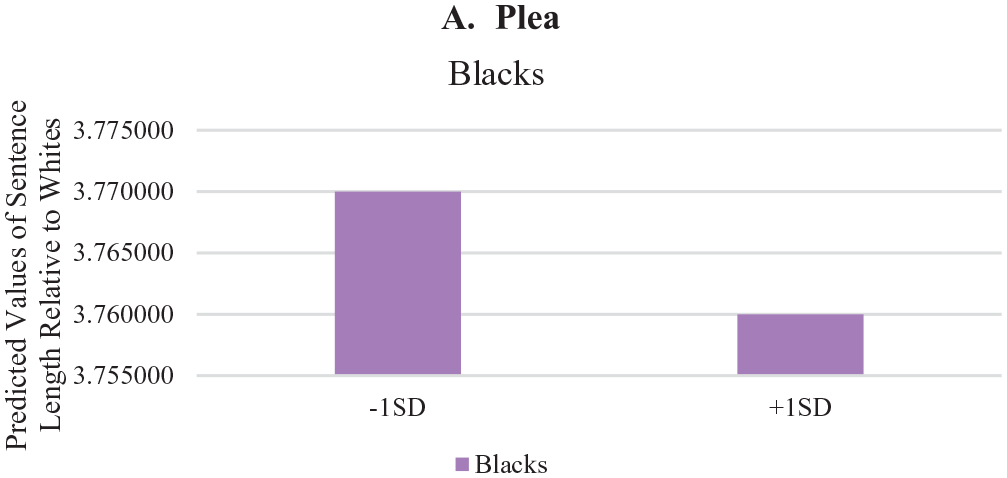
Interactive effects of racial threat on sentence length for Blacks.
Discussion and Conclusion
The current study addressed a gap in prior research by assessing whether the size of Black and Latino populations influences punitive decisions—incarceration and sentence length—following two modes of disposition—plea bargaining and trial—for Black, White, and Latino defendants in Florida. Our analyses provided mixed support for our research hypotheses. First, Black defendants are less likely to receive a jail sentence but more likely to receive a prison sentence in counties with a relatively high Black population after a plea bargain. However, they are less likely to receive a prison decision after proceeding to trial when sentenced in areas with a larger share of Black residents. In addition, on average Black defendants receive shorter sentence lengths in areas with a growing Black population after a plea bargain. When assessing ethnic threat, different patterns emerge. Latino defendants had higher odds of being sentenced to jail but lower odds of receiving a prison decision as the size of their population increased after accepting a plea bargain. However, the sentence length results were not significant for Latinos sentenced in areas with a growing ethnic presence.
The mixed findings on racial and ethnic threat might stem from several things. First, some scholars predict that racial and ethnic disparities may manifest as benign neglect, resulting in less formal social control and under-protection of minority residents (Chamlin & Liska, 1992; Liska & Chamlin, 1984). The benign neglect thesis suggests that the size of the minority population contributes to less state-sanctioned social controls being administered against racial and ethnic minority citizens (Liska, 1992). The logic of this approach hinges on the premise that crime in minority spaces is likely to be intra-racial and not of interest to the White majority group, resulting in lower formal social control responses and disparities in criminal punishments (Liska, 1992; Liska & Chamlin, 1984). Thus, criminal justice actors may believe that crimes in these areas are personal matters that should be handled informally (Black, 2010). This narrative supports the notion that Black and sometimes Latino lives are potentially less valuable. Indeed, Blacks have a long and tenuous history with U.S. institutions where they have faced generations of discriminatory practices than many other racial/ethnic groups (Charles, 2003).
Next, the results of ethnic threat potentially suggest that for the jail decision, the increased fears of ethnic groups have translated into more punitive treatment by judges due to the recent growth in the Latino populations. Florida is not a new destination state for Latinos. Latinos hold high-ranking political positions and are well established. Thus, the stereotypes associated with Latinos in new destination areas might operate differently (see Hirschman & Massey, 2008).
The present research demonstrates that the macrosocial context has significantly influenced punishment decisions in various ways for minority defendants in Florida. It appears that the punishment decisions for Blacks are most punitive following a plea bargain. For Latinos, they have a higher likelihood of being sentenced to jail; remaining outside of prison reduces the time away from family and the broader impact on economic and occupational outcomes.
Increased public attention to racial/ethnic disparities in the criminal justice system has been highlighted by the Black Lives Matter movement and other policy-makers. The explicit and/or unconscious racial biases that may influence punishment decisions have come under great scrutiny across court contexts. Despite this, prosecutorial discretion, which is largely unchecked, can result in detrimental effects for minorities because they are charged at higher rates than others with more serious crimes. Thus, the pressure to admit guilt and enter a plea agreement becomes more intense (R. J. Smith & Levinson, 2011; Starr & Rehavi, 2013). Scholars and policy-makers alike should continue to identify the varied ways that race/ethnicity matters across context and promote transparency and fairness in all sentencing outcomes. By doing so, this can potentially reduce and/or eliminate the long-standing disparities in sentencing across modes of conviction (i.e., plea bargains and trials). Currently, 25 states and the federal government have enacted sentencing commissions that evaluate the sentencing practices across their states. Sentencing commissions are a legitimate and proven way to reduce disparities. Florida does not currently have a sentencing commission, but implementing one might reduce the racial and ethnic disparities in punishment outcomes across context and modes of disposition.
As with any research, the present study is not without limitations. First, the analyses lack information on the defendant’s employment and socioeconomic status. Education and employment may be related to the defendant’s bargaining power and their ability to secure adequate counsel (Wood & May, 2003). Second, the current study examined the sentencing decisions among Black and Latino populations. However, the perceptions of threat may be connected to foreign-born groups. Some scholars have suggested that an offenders’ immigrant citizenship status and nationality can influence punitiveness (see Martinez, 2002). Future investigations should examine the perception of threat across these immigrant groups.
Finally, the present analyses focus on sentencing disposition and sentence length. However, prior research has also shown that disparities occur at multiple decision points in the justice system—including bail and pretrial detention (Donnelly & MacDonald, 2018; Johnson, 2003). Furthermore, future research can build on the current analysis to assessing whether racial and ethnic threat shapes the application of social control across the criminal justice process, prior to determining the mode of disposition.
Footnotes
Declaration of Conflicting Interests
The author(s) declared no potential conflicts of interest with respect to the research, authorship, and/or publication of this article.
Funding
The author(s) received no financial support for the research, authorship, and/or publication of this article.