




Abstract
Law enforcement are tasked with confronting a variety of crimes on a daily basis, ranging from traditional offenses, such as burglary or assault, to online crimes, such as identity theft. The expansion of the internet has provided a new realm for investigatory consideration as buyers seek the tools of the crime as well as illegal products online. Since the inception of the Silk Road, the Dark Web’s first darknet marketplace, buyers and sellers have worked together to distribute and obtain products and services that were previously only available offline. For example, drugs, weapons, consumer data such as credit cards numbers, and other illicit products are all available for purchase on the Dark Web. Early on, Ross Ulbricht, founder of the original Silk Road Dark Web marketplace, incorporated consumer “reviews” on illegal websites to protect customers and to ensure that sellers were not taking advantage of potential buyers. The nature of illicit markets, where websites, vendors, or markets themselves can be online one day and gone the next, present challenges to developing a complete understanding as to how these networks operate. This study builds on existing research by providing an exploratory examination of the prevalence of consumer feedback and review indicators on approximately 50 Dark Web marketplaces. Findings indicate that more than half of explored sites displayed consumer reviews on their postings. Policies incorporating feedback indicators may be implemented to both identify and target for investigation and prosecution highly rated and high-profile sellers on Dark Web markets.
Introduction
How do consumers know which restaurants to avoid when visiting a new city or which brand of a particular item they should purchase? Consumer reviews are often used by new customers before making purchasing decisions or choosing where to eat. Today, websites, such as Amazon, TripAdvisor, and Yelp, allow people to share detailed accounts of their experiences online, which may contribute to establishing authenticity, reliability, and a creation of trust (Kim & Kim, 2020). The process for reviews on these websites is no different for sellers offering goods or services on the Dark Web, where customers may be similarly swayed from purchasing drugs on an illegal marketplace with a low rating, in the same way they might avoid a restaurant that has a one-star rating in the real world. Indeed, business will flock to services displaying an ample amount of good reviews, thus, enhancing the confidence of the buyer as well as the overall profit for the business. The ever evolving and expanding nature of Dark Web marketplaces since the inception of the Silk Road, suggests that the demand for anonymous marketplaces to carry out transactions of illegal products and services remains prevalent. At its core, the Dark Web hinges on a libertarian framework, built upon the belief that the land of the free should be exactly that (Belshaw, 2020); the principal notion of anonymity spawned from this perspective, reflecting the belief that the role of government interaction or interference between individual entities is in direct contrast with the Constitution and the freedoms it grants its people. The right to privacy suggests that a person’s private information should be free from public scrutiny, and privacy and anonymity are considered vital to a healthy, functioning, and free society. Today, the advancement of technology allows consumers on the Dark Web have access to feedback and trust indicators that may contribute to transactional trust, without fear of their purchases being tracked. Given the importance of consumer reviews on the surface web, it would seem that Dark Web sellers may be similarly interested in establishing a reputation as a legitimate seller, while consumers would be interested in assurance they are purchasing quality products from a reputable seller. The experiences of earlier customers can then influence future customers’ trust in a website’s product, which over time will build the reputation of the website as a known quality seller. Rather, a buyer’s overall opinion is formed based on past experiences built over a period of days, weeks, months, and even years, thus establishing a reputation, whether good or bad, which constitutes a measure of trust allowing customers to make the best choice (Botsman, 2018).
This study uses data collected from Dark Web marketplaces to explore the use of feedback for illicit products. First, we establish the importance and relevance of using feedback indicators to generate trust in online markets. Then we specifically explore the prevalence of use of feedback indicators to determine those products that appear most frequently in these markets. Findings from the study will contribute to the growing body of knowledge surrounding purchases made, and purchasers, on the Dark Web (Broséus et al., 2016), as well as inform policies that can be used by law enforcement to target sellers based on this feedback.
Literature Review
In recent years, Dark Web markets have become consistent suppliers of many kinds of illegal goods and services, including illicit drugs (Aldridge & Décary-Hétu, 2014; Barratt, 2012; Barratt et al., 2013, 2016; Broséus et al., 2016; Jardine, 2021; Martin, 2014; Soska & Christin, 2015), firearms (Copeland et al., 2020; Holt & Lee, 2022b; Lee et al., 2022; Paoli et al., 2017), identity documents (Ablon et al., 2014; Holt, 2013; Holt et al., 2013, 2016; Holt & Lee, 2022a; Hutchings & Holt, 2015, 2017; Smirnova & Holt, 2017; Steel, 2019; Wehinger, 2011), and contracted violence providers (Roddy & Holt, 2022). In response, empirical studies have begun to explore the customer experience on the Dark Web, in particular the impact of trust and reputation in Dark Web markets (Espinosa, 2019; Hardy & Norgaard, 2016). The literature reviewed here first examines feedback and trust indicators on the surface web before exploring these concepts in Dark Web markets in relation to the establishment of transactional trust.
Feedback and Trust on the Surface Web
The process of providing feedback is critical to establishing trust in cyberspace. Trust refers to buyer faith that an online seller/business is honest, consistent, and reliable in providing superior services and products (Fang et al., 2014). This trust reduces customer concerns about perceived risks during online shopping and thus influences their (re)purchasing intentions (Liu & Tang, 2018). Meanwhile, trust in an e-marketplace refers to a potential buyer’s belief that the brand itself has developed, and imposes reasonable regulation, guarantees its competence, and operates with veracity (Pavlou & Gefen, 2004). A trustworthy online marketplace provides a safe and reliable environment and eliminates problematic e-sellers (Pavlou & Gefen, 2004). Therefore, trust in an e-marketplace can influence buyers to believe they are making purchases risk free, despite not knowing the e-seller (Hong & Cho, 2011; Kim & Ahn, 2007; Pavlou & Gefen, 2004).
Maintaining relevance in an extremely competitive environment is critical for e-sellers as research suggests that, approximately, 41% of total online revenue in the United States is generated by repeat customers (Adobe, 2012). Customer trust is as important in the digital world as it is in the real world to building a successful and profitable company or brand (Liu & Tang, 2018). Successful retailers establish customer trust by providing consistent and transparent purchasing experiences and quality products (Liu & Tang, 2018). For example, Amazon launched more than 25 years ago and has become a familiar household name. It remains the largest and most well-known online retailer (Mohsin, 2021), with an established reputation as one of the most reliable markets for e-commerce on the internet through competitive pricing, fast and efficient shipping, and reliable customer service (Dayton, 2021). With more than 197 million people visiting Amazon.com each month (Dayton, 2021), brands and retailers, such as Amazon, are committed to providing a consistency and reliability factor within their online retail market, so customers know exactly what to expect when making a purchase, thereby increasing the likelihood that they will return to the marketplace for future purchases. To accomplish this, well-known name brands earn customer trust by delivering the commodities their customers want, on time, intact, in the exact same boxes—consistently (Smith, 2017). Consumer trust is further influenced by information obtained from multiple sources, including the e-seller’s ability to establish rapport with consumers, previous customers providing their shared experiences through online feedback and reputation systems, and third-party ratings providing independent verification of a retailer’s quality and/or preservation of the transaction processes (Daignault et al., 2002; Kim & Kim, 2005; Liu & Tang, 2018). Liu and Tang’s (2018) examination of trust-building indicators on eBay suggests that previous customers’ feedback and comments about a seller’s reputation, online product reviews and ratings, and refund guarantees, will both generate new customers as well as retain existing customers (Liu & Tang, 2018). There is further evidence suggesting that, by fostering customer trust, an online store can reduce a buyer’s potential risk concerns, increasing the likelihood that they make future purchases and increasing purchasing intentions (Gefen et al., 2003; Schlosser et al., 2006; Van der Heijden et al., 2003).
With more than 200 million Americans purchasing goods from online retail marketplaces each year, e-marketplaces have become some of the fastest growing sales channels in the country (Coppola, 2021). However, it remains unclear whether the same trust and feedback indicators are used on the Dark Web as the surface web. Understanding how trust may be established on Dark Web marketplaces necessitates familiarity with the foundation and principles on which the Dark Web was created. For example, Belshaw (2020) suggests the necessity for examining these marketplaces from a privacy perspective, or from a technological institution of good or bad. Bellaby (2018) further argues that there is not only a right to privacy online, but there is also a moral obligation to establish such privacy protections at all levels of cyberspace. Research has begun to explore the impact of reputation and trust in online purchases in Dark Web marketplaces.
Establishing Trust on the Dark Web
The Silk Road, known as the first darknet marketplace, was launched in 2011 by Ross Ulbricht to connect illicit drug dealers, or e-sellers, with interested buyers while protecting their identities and transactions through anonymization techniques. The marketplace grew to include sales of a variety of illegal products and activities. The popularity of the Silk Road sparked the attention of federal law enforcement who shut down the marketplace by 2013. Known for providing a safe haven for drug traders through the combination of data anonymization technology and a feedback system (Frankenfield, 2021), the Silk Road established itself as one of the first platforms for building anonymous, trustworthy relationships on the Dark Web where buyers and sellers were anonymous to each other (Hardy & Norgaard, 2016). Given the specialization of these markets in the buying and selling of illegal goods and services, there are neither legal nor formal enforcement mechanisms for problematic transactions on the Dark Web (Hardy & Norgaard, 2016). Similar to the feedback systems of online marketplaces on the surface web (e.g., Amazon, Airbnb, or Yelp) buyers were able to provide feedback or “reviews” regarding their purchased goods and experiences with e-sellers. The Silk Road administrators then used this feedback to eliminate counterfeit sellers, whereas highly regarded sellers saw continued sales and growth, suggesting that these indicators promoted buyer confidence on this Dark Web marketplace (Frankenfield, 2021). The Silk Road was able to exist because of reputation mechanisms used to instill confidence in the buyers and sellers, which facilitated repeat transactions (Greif, 1993). Hirschman’s (1974) distinction between “exit” and “voice” also has relevance to feedback and trust on the Dark Web. Customers who are unhappy with their purchase are now able to express their “voice” through feedback, and can “exit” a bad vendor in exchange for another (Hirschman, 1974). With the power now making its way back to the consumer, sellers are forced to compete for business and are constrained by their own review system. Exit and voice on Dark Web markets are doing precisely what economics textbooks predict: insinuating the best deal for customers (Bartlett, 2015).
Since the collapse of the Silk Road, researchers have sought a better understanding of the use, operation, and continued success of these marketplaces. The establishment of trust in anonymous communities appears to be an important part of their operation. For example, Nahai (2017) argues that people make subconscious judgments about websites based on “trust cues” related to how well a website is designed, including the presence of high-definition logos, recognizable brands/logos, page symmetry, profile pages, product listings, and the ability to create an account. Hardy and Norgaard (2016) examined the relationship between seller reputation and sales on the Silk Road. Their findings suggest that feedback mechanisms, including promotional discounts (i.e., free shipping), advertising, and seller reputation significantly influence prices on cannabis listings. Espinosa (2019) examined the role of seller reputation on illegal platforms specializing in drug sales, where customers have no legal protections to estimate the risk of scamming on darknet markets and understand the efficiency of environments outside of the Law. Their findings indicate that prices for three drug types (i.e., Weed, Hash, and Ecstasy) were significantly higher for sellers with positive feedback, whereas sellers with negative feedback were associated with lower prices. Together, these findings indicate that feedback indicators appear to have some influence on drug pricing in Dark Web markets.
Dark Web markets also compete for customers in a similar manner to traditional businesses or brands, and inevitably seek ways to distinguish themselves from other sellers. For example, Atlantis, a Silk Road rival, ran a persistent campaign in 2013 to encourage users to switch to their marketplace, emphasizing a similar purchasing experience but with better security, cheaper rates (for both vendors and commission accounts), faster website speed, customer support, and feedback implementation (Buxton & Bingham, 2015; Van Hout & Bingham, 2014). Relatedly, evidence suggests that some sellers on Dark Web marketplaces are highly specialized in selling one type of drug, whereas others are more diverse both in the types of drugs they sell as well as the marketplaces on which they sell, with many sellers maintaining multiple accounts across different marketplaces (Broséus et al., 2016).
Trust of any kind is difficult to establish in a place such as the Dark Web. However, technology is a driving force that has allowed for once outwardly illegal and traceable transactions to go undiscovered. The illegal purchase of firearms, drugs, hacking services, or even body parts has been transformed into a simple, anonymous transaction between empowered buyers and responsive sellers. Although there is some evidence to suggest that feedback and trust indicators are at least partially responsible for the continued success of Dark Web markets (Buxton & Bingham, 2015; Van Hout & Bingham, 2014), the type and prevalence of these indicators has yet to be explored.
Method
Data Collection
Data for this study were collected through direct observation of Dark Web marketplaces (n = 53) between January and March 2022. Observations were conducted by researchers in a university cyber forensics lab, with prior approval to access and conduct research on the Dark Web. Data collection originated on the unmirrored Hidden Wiki, which is a starting place for accessing the Dark Web, and includes onion directory links–organized by-product or service type. The Dark Web links were randomly selected from forums and marketplaces selling or advertising products or services, including drugs, hacking services, financial services, weapons, identity services, account information, and electronics. The Dark Web forums are websites that provide access to various marketplaces on one site, for example, Dark Net Live, dread, Tor2Door Market, Recon, and Dark.Fail. Forums have easily accessible links, so that users do not have to search for specific products, for example, images of products that are for sale on the marketplace. Examples of marketplaces examined include Vice City (mainly drugs), Dark Web Hackers (hacking services), Cardshop (financial services), UK Guns and Ammo (weapons), identity services (USfakeIDs), AccMarket (account information), and Mobile Store (electronics). Researchers randomly clicked on individual links to check for functionality with the goal to find the first 50 working links. Fifty-three total links were selected; three nonfunctional websites were not included in the data collection as we were unable to view these sites to collect any data. Data collection ended after 50 usable links were located. The final sample comprised approximately 50 marketplaces with working links. Marketplace links that were down or returned messages to contact system administrator were excluded from the sample as there was no way to collect data from these sites. Dark Web marketplace variables that were observed, included website names, URL addresses, revenue source (e.g., type of product or service being sold), an option to review or leave feedback, FAQ section, deals or promotions, username necessary, shipping information, international shipping, and the country of origin of the seller.
Observed Feedback Indicators
The revenue source for each marketplace was recorded to indicate the types of products or services being sold on each marketplace (see Table 1). On drug marketplaces, the number one drug across all domains was marijuana, followed by stimulants and opioids. Although all types of drugs can be found on the Dark Web, this study explored drug marketplaces that had these categories as their top products. Weapon marketplaces mainly comprised automatic and semiautomatic firearms, although other types of weapons, such as grenades or even flame throwers were found. Marketplaces advertising the sale of electronics had ATM and gas pump skimming devices as the main products being sold, where marketplaces such as financial services boasted the sales of different types of payment accounts. For example, bank accounts, PayPal accounts, CashApp, Venmo, Zelle, and other types of money accounts were shown, with the overall balance of each account available for buyers to see. Sometimes, credit scores were also shown. Identity service marketplaces advertised passports, ID cards, driver’s licenses, birth certificates, and citizenship documents that could be forged. The first revenue source comprised forums (n = 8) where multiple marketplaces could be accessed from the same starting point. The next revenue source, hacking marketplaces (n = 1), were those selling various hacking services (e.g., password hacking, gaining access to someone’s social media without permission). Drug marketplaces (n = 32) represented the largest number of marketplaces reviewed, where drugs of all kinds were available for purchase. Weapons marketplaces (n = 2) were any marketplace that explicitly advertised the sale of firearms or other weapons for purchase. The next type of revenue source, identity papers (n = 3), were any marketplace that sold social security numbers, IDs, or passports. Account information marketplaces (n = 2) were those that sold account numbers, passwords, and other identifying information that would allow buyers to use the information as if they were the person the information belonged to. There was one marketplace in the data that exclusively sold bitcoins (n = 1). In addition, there were several marketplaces that sold books (n = 2), or comic books (n = 1). Electronics (n = 1) marketplaces were the final type of revenue source recorded.
Descriptives (n = 53).

The remaining variables were recorded as either being present on the marketplace or not present on the marketplace. If a marketplace had a clear place to leave a review (n = 30), this variable was coded as yes. Marketplaces that had a FAQ (n = 43) section were coded as yes on this variable. Those that clearly advertised deals or promotions (n = 33), either with a special banner, tab, or link, were coded as yes. If users have to create a username (n = 9) to log in to the marketplace, this variable was coded as yes. Shipping information (n = 37) may include what shipping company a seller uses, timing for shipping, packaging, and so on; if shipping information was provided on the marketplace, this variable was coded as yes. Marketplaces indicating international shipping (n = 31) availability were coded as yes, and the country of origin was coded as yes for sellers based outside of the United States (n = 22).
Results
Descriptive statistics displayed in Table 2 represent the results of the study and are provided as a count of the number of marketplaces that possess the observed indicators. There were a total of eight forum/marketplaces examined in the study. The only characteristic that was present across these sites was the presence of a FAQs section. Seven forums required users to sign up with a username to access the marketplace. One forum allowed users to leave reviews, two forums promoted deals, one provided shipping information, one was based outside of the United States, and one provided international shipping. There was one hacking marketplace represented in the data, and the only characteristics of this marketplace that were present were a FAQ section and the designation that they were based outside of the United States. Drug marketplaces represented the majority of those examined in the study, at 32 websites. Among these, 27 displayed customer reviews, 30 displayed a FAQ section, 30 promoted deals, two required usernames, 31 provided shipping information, 20 were based outside of the United States, and 27 provided international shipping. Two weapons marketplaces were reviewed; they both displayed reviews, FAQs, shipping information, and provided international shipping services. One of these marketplaces promoted deals. There was no information available for the three marketplaces selling identity papers, the two marketplaces selling account information, or the one marketplace selling bitcoins; the only content on these pages was specifically related to the products that were being sold. The two book marketplaces displayed a FAQ section as well as provided shipping information. The one comic book marketplace only displayed shipping information, and the one electronics marketplace only indicated that international shipping was available.
Website Characteristics by Revenue Source (n = 53).
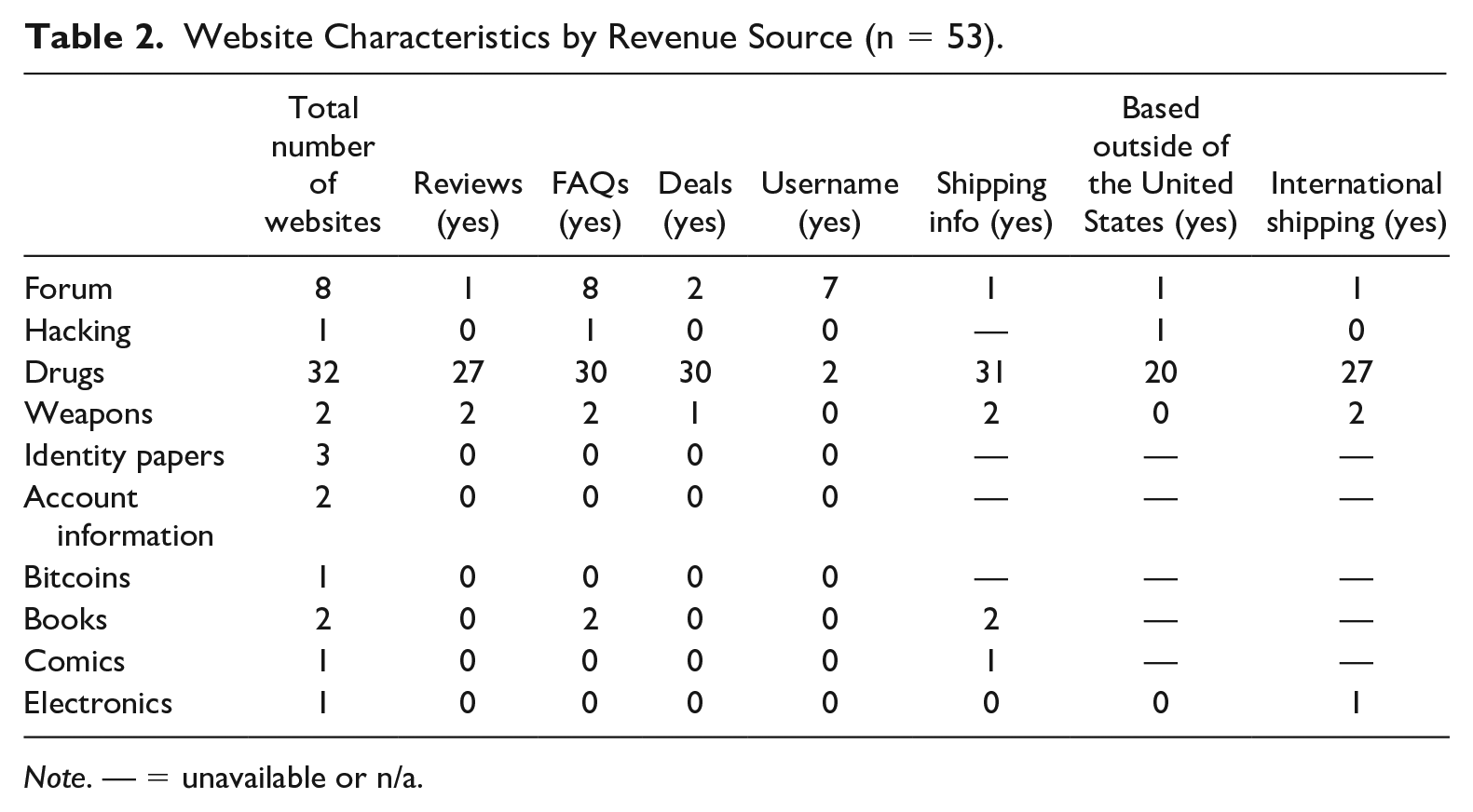
Note. — = unavailable or n/a.
There was no single observed characteristic that was displayed for all marketplaces. Drug marketplaces represented the majority of the marketplaces reviewed, but were also the only type of marketplace to have all characteristics represented on at least some of these sites. Twenty-seven of the 32 marketplaces observed, for example, displayed customer reviews, indicating this is likely an important consideration for sellers to establish their business and show buyers that they have an established reputation of being a trustworthy seller.
Discussion
Online purchases have become increasingly popular with the expansion of the internet. Ultimately, some consumers sought ways to buy and sell illicit goods and services online in a format similar to more traditional online marketplaces. The prevalent use of traditional feedback and trust indicators on the Dark Web may, then, represent a similar interest in developing reputation and trust as a buyer or seller in these marketplaces. Feedback indicators, such as customer reviews, create a definitive permanent record of customer satisfaction and product quality as neither positive nor negative feedback can be deleted from Dark Web sites. Website reputation provides an overall sense of expectation, while that expectation provides a sense of comfort and purchasing protection (Pavlou & Dimoka, 2006). Legal e-commerce would not work without user reviews (Upchurch, 2018). Reviews allow consumers to make informed decisions about their product choices, while also allowing the vendor to build a reputation and name recognition. Most of the Dark Web markets we observed included review or feedback options. For example, these reviews are accompanied by a rating in the form of stars where 1/5 stars is considered a bad rating and 5/5 is a perfect one. Reputation-based trading generates a potent but informal consumer-led system of self-regulation, which allows users to be more informed about their decision whether or not to make a purchase. When purchasing drugs from a “friend-of-a-friend,” consumers likely are unsure of what they are actually purchasing, and not knowing what substance will be put into their body can have a multitude of negative consequences (Bartlett, 2015). The user-response system used in many Dark Web markets offers people a safer, more efficient, and reliable way of determining the purity of their desired products. Dark Web vendors appear to be ranked in accordance with how quick, precise, and hidden their packages are; however, reputable and trustworthy Dark Web marketplaces are more frequently displaying a “tab” that slightly explains the delivery packing and process. The results of this study suggest that sellers are aware of the importance of feedback ratings as more than half (56.6%) of sites we observed make consumer reviews of their products available on their websites. Drug sales were the primary product being sold on the majority of these sites, which may suggest that buyers have a particular interest in ensuring that the products they are purchasing are of good quality and that the seller is trustworthy and reliable (Hardy & Norgaard, 2016). Future studies should directly examine the content of these reviews across market and product types to determine what factors of the customer reviews themselves may be influencing sales and purchasing decisions.
A more informed understanding of consumer feedback and trust in Dark Web markets may contribute to the development of investigation and prevention practices in these spaces. The anonymous nature of these marketplaces presents investigatory challenges for law enforcement as well as prosecutorial limitations that may be improved upon if law enforcement and other regulatory agencies were able to understand the role of trust mechanisms and use them to target highly rated individuals who are also likely to have higher sales and a more visible presence. Law enforcement and prosecutors could then better identify the most reputable and prominent Dark Web sellers, leading to interventions strategies targeting these individuals. Future studies examining the qualitative content of consumer and feedback reviews would contribute valuable insight into the nature of each seller’s business beyond products or services.
Presentation and marketing strategies used on the Dark Web resemble those seen on traditional websites and offline. For example, a vendor’s website on the Dark Web contains much of the same information as traditional surface web marketplaces, such as Amazon, that include tabs providing information regarding the number of completed transactions, when the vendor was registered, when the vendor last visited their site, as well as FAQs or Contact Us links (Zetter, 2014). In addition, established websites also feature detailed descriptions of their products explaining why their products are better than others, refund policy information, and delivery options to ensure a safe and stealthy delivery. The development of a system similar to that used on trusted surface web websites demonstrates a passion for the vendor’s craft and business model, establishing a desire for trust from their consumers (Etzioni, 2017). The findings from this study indicate that Dark Web sellers often include these indicators on their sites as well. For example, more than 80% of the websites observed presented answers to FAQs and clearly outlined shipping information, and more than 60% presented information related to current deals or promotions. The use of promotions on Dark Web marketplaces demonstrates recognition that these strategies can contribute to establishing customer rapport and increase the potential market for their business (Zetter, 2014). Related, bulk-buying discounts, loyalty program incentives, buy-one-get-one-free deals, and guaranteed refunds for dissatisfied customers were also common across observed websites. For example, several marijuana vendors appeared to target a particular community of consumers as they portrayed their products as being organic, untreated or uncut, or all-natural, potentially appealing to the ethics of a particular smoking community. In addition, emphasis on job creation for cultivators and support of the local community reinforces the notion that the buyer is not financing drug cartels. All of this information closely represents what consumers on the surface web have come to expect from online retailers. This suggests that similarities between surface and Dark Web markets may influence buyers in making purchasing decisions if they observe one site displaying multiple trust indicators in comparison with those who do not. Future studies should examine the nature of decision-making in Dark Web markets by both buyers and sellers to develop an understanding of this relationship.
In exploring feedback and reviews on Dark Web marketplaces, this article provides important information on some of the most common feedback and trust indicators displayed on these websites. This is, however, an exploratory descriptive study that necessitates the discussion of several limitations. First, due to the small sample size and nominal-level data, we were not able to use more advanced methods or analyses. For example, the use of binary indicators only allows for the discussion of whether or not trust indicators are present on a particular website. Future studies should consider the types, content, and quality of the feedback provided on the Dark Web to provide a more detailed account of the use of trust indicators on these marketplaces. The inclusion of additional variables, such as the method of user authentication, encryption techniques that are used, and the available modes of delivery are important areas for consideration. Furthermore, a more qualitative understanding of sales indicators such as the structure and content of customer reviews as well as the level of detail of information provided by the seller would provide a depth of understanding related to transactions on the Dark Web.
Next, the majority of the markets explored were related to drug sales, so it remains unclear whether feedback is less prevalent in other market types, or whether it just appears to be so due to the small sample. Furthermore, this limits the generalizability of these findings to the websites that were observed. Future studies should obtain a larger, more representative sample to more effectively inform policy creation and enforcement practices on the Dark Web. Similarly, the nature of the Dark Web itself makes obtaining a representative sample of Dark Web marketplaces challenging at best. While each of the URLs used for data collection were working at the time of data collection, the nature of the Dark Web means that URLs change sometimes daily and that what was available for observation one day, may not have been available the next day, week, or month. For example, online traffic on the Dark Webs sometimes overloads individual websites, making them no longer available. Similar to the surface web, when too many people visit a website at the same time, the website may have problems continuing supporting normal operations. Another limitation is related to the use of The Onion Router (TOR) Services and their switch from V2 to V3 websites. Prior to October 2021, TOR was using V2 onion services, where websites were identified by their 16-character length. After the implementation of V3 services, Dark Web websites transitioned to using a 56-character length. This is important because this change affects how users can identify the legitimacy of “real” Dark Web websites from “mirror” or “scam” websites. While most Dark Web users will have this updated within their browser, finding the old 16-character websites may not be an issue at all. Future studies should make effort to collect as much data as possible in as short a time as possible. Selecting a smaller window of time in which data are collected would ensure that researchers are able to access observed websites repeatedly, if necessary, to obtain more detailed information.
Conclusion
Although novel technologies continue to thrive, academics, law enforcement, and other government agencies seem to be a few steps behind. Prosecution of criminal activity on the Dark Web remains difficult as there is a general lack of understanding of, or training in, the Dark Web (Belshaw, 2019). This study identified characteristics used by Dark Web marketplaces to provide feedback and consumer reviews commonly used to establish buyer trust and seller reputation. By finding ways to extend a circle of trust, technology is expanding markets and prospects. Previous research suggests that people may be more honest online due to the anonymity of the internet, which could be particularly true for the Dark Web that is grounded in the idea of privacy (BBC, 2015). Given the nature of its commodities, the Dark Web may seem like an alien and cavernous world; but at its core, the Dark Web is a place where people are connecting with other people—another manifestation of the new kind of trust-building that technology has facilitated. It is possible, then, that the same dynamics and principles that encompass building real, human relationships, apply in this realm as well. Future research should focus on the internet workings of the Dark Web, navigating the process of knowing how to differentiate mirror sites from “real” sites, how to communicate within the culture of the Dark Web, and how to ultimately keep oneself safe in the process. Future research should also focus on specific marketplaces, for example, drugs or firearms, to better grasp how these products are being bought, shipped, and ultimately completed. Finally, future research regarding crime and deviance on the Dark Web should not be ignored as technology empowers the consumer to hold vendors accountable and, ultimately, it will only be the trustworthy vendors who prevail.
Footnotes
Declaration of Conflicting Interests
The author(s) declared no potential conflicts of interest with respect to the research, authorship, and/or publication of this article.
Funding
The author(s) received no financial support for the research, authorship, and/or publication of this article.