



Abstract
A matrix is proposed to characterize mental health diversion programs and standardize the reporting of program context, outputs, outcomes, and community settings. Data collection for program reporting is challenging because individual programs report on what is relevant to local conditions and may omit or overlook important contextual or structural factors that are key to programmatic success or failure. This limits generalizability and comparability. Using a standard matrix reporting framework clearly lists the constructs of the program, context, and community systems. Two diversion programs are reported demonstrating the use of the matrix. Although different jurisdictions have a wide spectrum of agencies and resources available to support diversion, and may approach the concept differently, standardizing and streamlining reporting will assist with evaluation of diversion and the creation of sustainable programs.
Introduction
Diversion programs of justice-involved individuals with mental health issues exist at multiple levels within the criminal justice system. Programs are aimed to shift the justice-involved individual from punishment into mental health treatment (Lange et al., 2011). The philosophy of diversion suggests mental health treatment in jail is less effective than in a community-based option (Ryan et al., 2010). Whereas jail provides a controlled environment for a medication regimen, incarceration separates individuals from support networks and jobs, which exacerbates stigma and alienation from the community, thereby creating a revolving door of reincarceration and recidivism that diversion programs seek to mitigate: We measure what we value, and for that reason any metric we select is likely to tell us as much about those who operate the criminal justice system as it is to tell us about the effectiveness of the system itself. (Klingele, 2019)
There are a myriad of different diversion programs for justice-involved individuals with mental illness all adapted to their local conditions using good practices (Perla et al., 2013). There is persistent tension between “top-down” versus “bottom-up” approaches to best practices in mental health diversion. However, “bottom-up,” local adaptation, carries an inherent risk that little of the program could be generalizable if some sort of standardization was not applied (Øvretveit et al., 2011; Sorenson & Sørensen, 2001). It is important for diversion programs to function within their context and community setting so local needs are not subsumed or local innovation stifled in the push to standardize reporting, but adaptation to local conditions does not preclude standardized definitions. The standard report matrix is not the end goal or a “top-down” requirement, rather standard definitions will make the entire system more measurable, streamline evidence for best practices (Øvretveit et al., 2011) and provide sufficient evidence for implementation in another jurisdiction (Bardach & Patashnik, 2019).
Standardization of definition when discussing, evaluating, and reporting diversion programs provides the ability to characterize programs across jurisdictional settings and allows better understanding of the fit between program, organizational context, and ecological settings. A standardization of program reporting enables jurisdictions to better manage the fit between their resources, needs, and diversion programs, including generating consistent feedback on how the programs are delivered to diverse clients and the resulting outputs and outcomes. More than 3,000 (LEAD and CIT) diversion programs (Paccone, 2020), ~300 pretrial diversion programs, and >150 pre-plea diversionary adult court programs (“No Entry a National Survey of Criminal Justice Diversion Programs and Initiatives,” 2013) have been implemented across the United States, with the goal of reducing the number of individuals with mental illness in the criminal justice system. But there are many more types of diversion programs; thus, 3,000 does not capture other types of programs with diversionary functions for justice-involved individuals with mental health issues (e.g., mental health courts, pretrial diversion initiatives). Comparing programs can be difficult because different programs rarely report the same output and/or outcome measures nor do they describe the setting context and broader ecological system similarly. Issues with diversion program evaluation are not new; concerns date back to the 1970s (Agopian, 1977; Blomberg, 1983). This article focuses on mental health diversion but may be broadly applicable to other diversion programs. Currently, diversion program evaluation uses criminal justice system outputs (e.g., length of incarceration, recidivism, time between arrests, failure to appear) rather than functional individual outcomes (e.g., vocational and social functioning) or clinical outcomes (e.g., symptom management and resolution) (Remington, 2010; Rempel et al., 2018).
Reporting on both process outputs and individual-level outcomes as part of diversion program evaluation is necessary to understand the chronic effect these programs have on individuals. Evaluation of individual-level outcomes is especially important when the individual being diverted has mental illness or substance use disorder (SUD) because they are more likely to be re-incarcerated or have their probation or parole revoked (Lange et al., 2011). Diversion for justice-involved individuals with mental illness program differences can be substantial and affect evaluation of the program’s effect on a multitude of criminal justice outputs (e.g., recidivism, new charges, failure to appear, lengths of stay) and complicates comparisons across jurisdictions. Depending on a justice-involved individual with mental illness’s point of contact with the criminal justice system, either through arrest or through the emergency room, very different types of diversion could be offered (Draine et al., 2005). Mental illness outcomes are rarely reported on in criminal justice diversion programs because the programs are short-term acute interventions to keep individuals out of jail, with main outputs reported as shortened jail length of stay, reduction in new arrests or technical rule violations, and failure to appear to court. Conversely, in health care, mental health interventions typically involve continuous community-based treatment, with main outcomes reported as stabilization of symptoms and compliance with medication and treatment. The use of health care by diverted individuals is difficult to quantify, and mental illness and SUDs may be comorbid with physical issues requiring treatment. Evaluation difficulties are compounded because definitions and methods are not shared between criminal justice and health care agencies conducting diversion, making unified analysis of diversion extremely challenging (Rogers et al., 2019).
Comparing Diversion Programs
Prior work suggests standard definitions for diversion program context (Potter, 2010), content and outputs/outcomes (Sirotich, 2009), and the limits of generalizability (Bardach, 2004) necessary for comparison. Lack of definitions for demographics and individual outcomes limit evaluation (Sirotich, 2009). Juvenile justice diversion programs (excludes mental health) do a better job of standardizing measures for program comparison. Juvenile justice diversion programs provide reporting definitions to compare programs including the following components: (a) method of entry, (b) jurisdiction, (c) structure (e.g., extent of control), (d) enrollment (by offense category), (e) type of services, and (f) program sanctions (Development_Services_Group_Inc., 2017). However, juvenile justice diversion programs are very different than adult programs, and a 2012 meta-analysis showed the major program type to reduce recidivism was family-based programming (Schwalbe et al., 2012), which would not be appropriate in adult situations. The criminal justice system diverts adults and juveniles differently; adults are prosecuted for crimes and punished, whereas juveniles are prosecuted for delinquent acts and rehabilitated. The focus of diversion is different; juveniles are taught skills to change current behaviors enabling them to grow into responsible young adults, while adults are held accountable for their actions with interventions focusing on being productive citizens. In addition, the meta-analysis also suggested that there is a high degree of variability in diversion programs again pointing to the need for the field to strengthen standardized program reporting so jurisdictional comparisons can be made (Schwalbe et al., 2012). Diversion conceptualized as a public health issue provides a system-level understanding of the totality of resources to treat, maintain, and minimize recidivism for individuals with chronic mental illness (L. Gittner & Dennis, 2021).
The sequential intercept model (SIM) defines processes to divert individuals with mental illness and SUDs (The Sequential Intercept Model, 2020). Unfortunately, SIM does not provide definitions necessary for evaluation or comparisons across programs (Data Collection Across the Sequential Intercept Model, 2019). Context of the setting often interacts with programs and needs to be defined during evaluation; interactions between the program, context, and ecological system likely affect the transferability of a program from one jurisdiction to another and also make an assessment of comparability more difficult (Rychetnik et al., 2002). Standardized comparison of diversion program components would greatly improve the ability to evaluate and compare costs, successes, and failures. However, diversion program structure is dependent on program implementation via local governments by the presence and participation of supporting health care and criminal justice organizations, local policies, and local politics. The multiplicity of diversion programs across the United States cannot be standardized in form because agencies, resources, and objectives will always differ by locality, yet a standardized matrix stands to provide insight into how diversion programs differently approach and measure outputs and outcomes.
Diversion programs, as currently evaluated, typically capture only criminal justice system measures rather than also encompassing health care system measures (L. Gittner & Dennis, 2021). Potter (2010) used a “public health lens” to compare diversion and jail outcomes but found the comparison challenging because of the lack of shared definitions between different agencies (Potter, 2010). A public health lens prioritizes prevention over treatment and the community over an individual; thus, multiple contexts need to be defined and measured to explain a program. In addition, evaluation of mental health diversion programs using health care concepts leads to the conclusion that the programs are not scientifically rigorous and too diverse to classify (Sirotich, 2009). A systematic matrix for adult mental health diversion program evaluation and reporting can provide a methodical and rigorous appraisal that is embedded not only within the program but also within the complex inter-organizational (context) and community politics (ecological system) that determine diversion program policies and practices. Solutions are complex for criminal justice problems such as recidivism of individuals with mental illness. The problems require diversion programs to “cut across sectors to take account of the broader social, cultural, economic, political and physical environments which shape people’s experiences” (Morgan & Ziglio, 2007). Previous definitions from the public health context (Potter, 2010; Rychetnik et al., 2002) accounting for the broader context can be built upon to develop a matrix to compare diversion programs.
Dynamic Sustainability framework
The Dynamic Sustainability framework adapted in Figure 1, models the factors that contribute to the sustainability of a program in the real world over time. It considers three dimensions of sustainability: broader system (e.g., structure, climate, culture, resources), setting (e.g., context the program is delivered within), and individual program (e.g., eligibility, use, and delivery mode) (Chambers et al., 2013) and the change that occurs over time. The proposed matrix provides definitions for this framework anchoring the ultimate benefit (e.g., functional outcomes) in terms of a program’s ability to be implemented in a real-world setting. Thus, the proposed matrix provides definitional context using the framework to categorize a diversion program (intervention type, actors, outputs, outcomes, delivery mode) within a context (resources, culture, training), and the community system (policies, regulations, population characteristics).
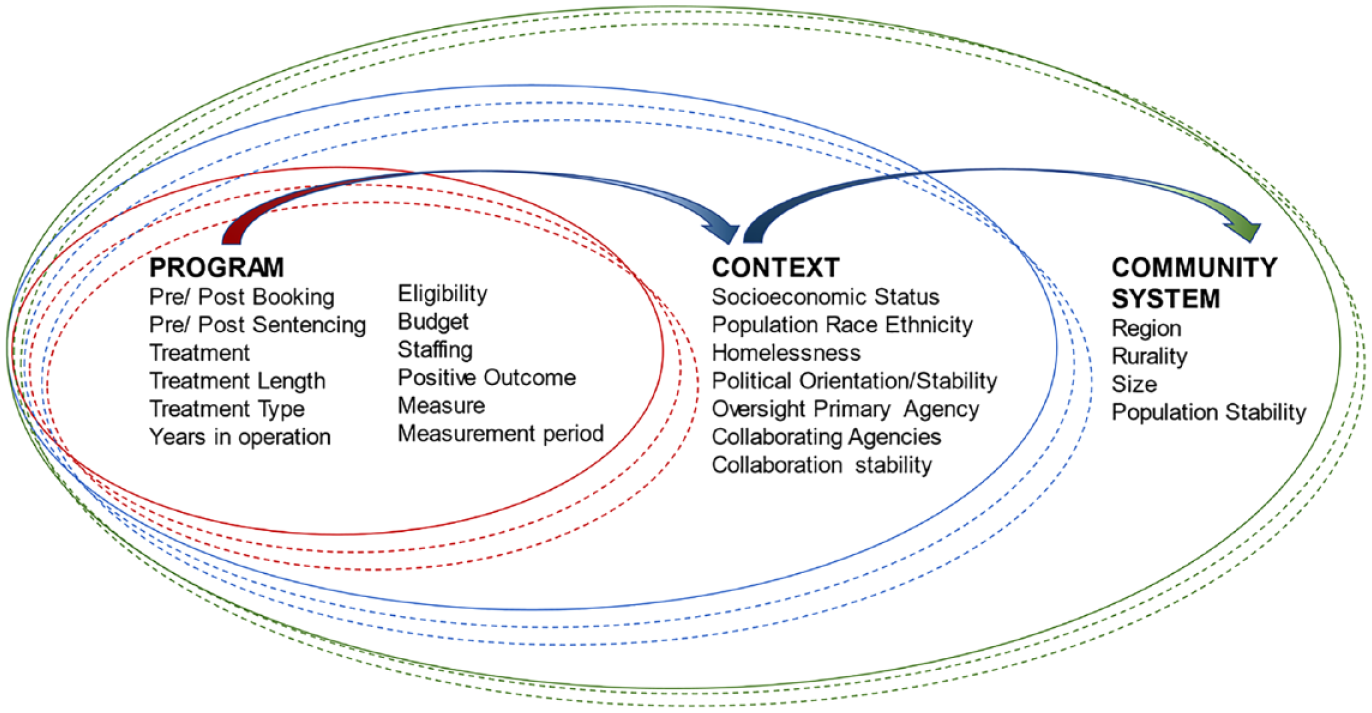
Dynamic Sustainability Framework for Diversion Programs. Modified from Chambers, et al., 2013 to include diversion constructs (Chambers, Glasgow and Stange, 2013).
Although diversion programs differ in nature, the common goal is reduction in organizational burden for correctional and legal agencies. The definition of diversion most often mentioned is the suspension of formal criminal proceedings against an individual with outcomes listed as reduced incarceration time, transfer into a non-criminal justice program, and program completion. All of these outcome factors are important, however, the relationship between the program with its context within the broader community system is just as important as outcomes. Thus, we propose a standard reporting matrix of evidence based on public health program evaluation standards when reporting diversion program evaluations, outputs, and outcomes. The three previous meta-analysis of mental health court adult diversion programs all point to the heterogeneity among participants, treatment types, evaluation methodology, and design leaving uncertainty regarding to whom, what conditions, and which diversion program designs actually provide positive mental health outcomes (Fox et al., 2021; Lowder et al., 2018; Sarteschi et al., 2011). The following matrix is proposed to assist program reporting, so a standardized system is used regardless of where the diversion program is administered; standard reporting will advance both research and policy.
Materials and Methods
Proceedure
A comprehensive literature review of adult mental health diversion programs from 2000 to 2022 was performed using EBSCO academic search using the key phrases: mental health diversion, mental health treatment diversion, adult diversion, mental health court diversion, pre-arrest diversion, and criminal justice mental health diversion. There were 400 results and once duplicates, editorials, commentaries, and citations were removed, there were 109 unique articles; the articles were sorted by date and intervention type. The articles were scanned for descriptors of program types, setting context, and ecological system definitions and components. The constructs were grouped according to the Dynamic Sustainability Framework as a definition in one of the following elements: (a) program, (b) setting context, and (c) community system.
Definitions
The Matrix displayed in Table 1 was developed to compare diversion programs. The Dynamic Sustainability Framework is an implementation model and, as adapted to diversion programs, uses three major elements to frame and define a program. The main elements are the actual program type, the setting in which the diversion program is delivered, and the broader ecological system within which the diversion program setting exists and operates. A stability construct is included within each element to capture program drift and voltage drop that could explain outcome variability and non-jurisdictional transferability. This is a measure of how well a program maintains its original design and intent over time. Program drift occurs when a program changes in ways that are not intended, such as when staff members make changes to the program during implementation. Voltage drop occurs when a program’s effectiveness is reduced due to factors such as staff turnover, budget cuts, or changes in the target population.
Proposed Matrix for Diversion Program Reporting.

Data for the Matrix Exemplar
Two community mental health diversion programs were compared. The programs are VetStar in Lubbock County Texas and the Miami Model Eleventh Judicial Circuit Criminal Mental Health Project. The two programs were purposively selected to show how programs appearing disparate may have commonalities once standard reporting is used. The programs examined are not intended to be representative of U.S. diversion programs, but rather they represent two different types of programs having available data to make a comparison using the matrix. Data regarding community characteristics were from the U.S. Census Bureau (US_Census_Bureau, 2019) American Community Survey 1-year estimates. Retrieved from Census Reporter Profile page for Lubbock, TX http://censusreporter.org/profiles/16000US4845000-lubbock-tx/ and Miami-Dade County, FL http://censusreporter.org/profiles/05000US12086-miami-dade-county-fl/; The Department of Housing and Urban Development Point in Time Count for Lubbock and Miami-Dade (The 2022 Annual Homelessness Assessment Report [AHAR] to Congress Point-in-Time Estimates of Homelessness, 2023) political orientation for Lubbock at (https://www.votelubbock.org/election-information/historical-election-results/) and Miami-Dade at (https://enr.electionsfl.org/DAD/2779/Summary/). Data for the program jurisdiction and attributes were obtained from: Lubbock County Detention Center website, the final P & I Guide for FY17 JMHCP Lubbock Category 1 Collaborative County grant project MO-BX-0031, and VetStar Stakeholder reports (VetStar, 2017, 2018); for Miami-Dade Department of Corrections and Rehabilitation website, Florida Department Of Corrections 2016–2017 Annual Report, and GOB Project 193—Mental Health Diversion Facility Service Capacity and Fiscal Impact Estimates June 9, 2016 Report (GOB Project 193—Mental Health Diversion Facility Service Capacity and Fiscal Impact Estimates June 9, 2016, 2016).
Results and Discussion
Matrix Components
Definition and delineation of the program external context and factors within each program allows: (a) insight regarding the potential to translate the program to other sites, (b) understanding of mechanisms and/or connections needed for implementation, and (c) exact definitions of outcomes. By using a matrix, connections between the components can further understanding about what makes a program successful, or not, and may provide insight into previously unobserved macro-contextual factors.
Program Explained
Comparing pre- versus post-booking diversion programs is almost impossible because the programs serve different sub-populations (Draine et al., 2005). Mental health courts also involved in diversion programs vary dramatically and are typically developed at the local level by communities in response to specific local issues (Frisman et al., 2017; Hiday & Moloney, 2014; Steadman et al., 2005). In addition, there are informal diversion programs that rely on first responders for referrals to community-based treatment, potentially using the threat of arrest for the individual to accept diversion to treatment (L. Gittner & Dennis, 2021; Kopak & Frost, 2017). Thus, clear description of the programs is needed (Potter, 2010). To fully define a program, the following constructs should be reported: (a) Engagement, (b) Treatment Venue, (c) Length of Service, (d) Treatment Type(s), (e) Eligibility, (f) Budget, (g) Staffing, (h) Outcome Measures, and (i) Stability. Table 2 displays the constructs needed for complete program description reporting.
Program Variable Definitions Explained.

Context Explained
From evaluation of public health programs, we have learned context matters because community factors do affect program output and outcomes (Morgan & Ziglio, 2007). Just as in a public health program, descriptions of a diversion program’s context should include (a) the setting and environmental influences (e.g., history, geography, politics, social and economic conditions) and (b) the processes involved (e.g., between related or competing organizations within which the program operates) (Milstein & Wetterhall, 1999). To fully define a context of the program setting, the following constructs should be reported: (a) Socioeconomic Status (SES), (b) Racial Demographics, (c) Homelessness, (d) Politics, (e) Oversight/Primary Agency, (f) Collaborating Agencies, and (g) Stability. Table 3 displays the constructs needed for thorough context reporting.
Context Variable Definitions Explained.

Community System Explained
The politics of local diversion programs are divided by party and race interacting to produce very different viewpoints on issues related to crime (Eckhouse, 2019) and subsequently affecting reporting funding decisions and sustainability of the programs. Understanding program influences (e.g., history, geography, politics, social and economic conditions, efforts of related or competing programs) is essential for a context-sensitive evaluation and aid with interpreting findings accurately and assessing generalizability (Milstein & Wetterhall, 1999). To fully define the community system, the program within the following constructs should be reported: (a) Region, (b) Rurality, (c) Size, and (d) Population Stability. Table 4 displays the constructs needed for describing the community the program is contained within.
Community System Variable Definitions Explained.

Using the Matrix
Reporting the program, context, and community system using shared definitions makes it easier to decide if a program implemented in one city can be transferred to another setting. Diversion programs are designed to address specific problems in a specific community; it is important to understand if context and community systems are similar. The matrix is designed to provide the information needed to assess the similarity and applicability of programs in different jurisdictions.
Exemplar
The proposed matrix model was used to compare Lubbock County Justice-Involved Veteran Diversion (K. B. Gittner et al., 2022) to Miami-Dade County SMI Diversion (GOB Project 193—Mental Health Diversion Facility Service Capacity and Fiscal Impact Estimates June 9, 2016, 2016) in Table 5. The matrix identifies similarities and differences when comparing programs and may provide insight into the potential to successfully implement a program across jurisdictions (e.g., external validity; clientele, context, and system similarities; understand nuances; define policy; Bardach & Patashnik, 2019).
Using the Matrix for Different Programs.

The two program exemplars presented demonstrate the complexity of comparison. The two programs are both in the southern United States, serve similar SES communities, and are administered by jails. One program is in a geographically isolated, moderate size city surrounded by a large rural area, predominantly conservative politically and 50% White, 7% Black, and ~40% Hispanic. The other is in a large urban area, predominantly liberal politically with 13% White, 15% Black, and 70% Hispanic. The communities are different politically (conservative vs. liberal) and majority White versus non-White. Program jurisdiction policy choices for jurisdiction, treatment site, eligibility, funding, and services offered are not the same. The politics of crime come into play in the conservative rural community with punitive public opinion shaping the types and populations as deserving of diversion (Wozniak, 2016); veterans, for example, with any type of criminal charges are eligible for diversion. This contrasts with the politics of a predominantly liberal non-White community using the severity of mental illness as the guiding force of who should be treated by diversion (Nelson, 2010). Co-occurring SUD (Broner et al., 2004) complicates the understanding of outcomes. The number and types of collaborating agencies is very different (5 + 25 vs. 2 agencies); types of agencies for the one program are diverse (courts, mental health providers, social service providers, government agencies, large network of secondary collaborators) and the other has only two collaborating agencies, the Crisis Intervention Team and the Diversion Facility. Many factors are different between the programs: diversion timing (post-booking vs. pre- and post-booking), site (incarceration vs. no incarceration), and length of service (long vs. short term). Services are different but both include crisis stabilization and various levels of in- and outpatient treatment; however, the biggest difference is the follow up with legal and peer support services provided by one program.
Program eligibility is the biggest difference between the programs. One program only serves veterans regardless of mental health or SUD diagnosis; the other serves only individuals with a serious mental illness diagnosis. The other significant eligibility difference is one program serves veterans with any charge (except capital murder) while the other program only serves individuals with non-violent less serious misdemeanor and felony offenses. Mental health and SUD diagnoses and treatments cannot be fully separated, so it is difficult to determine the effect on outcomes. Some diversion programs such as the Miami-Dade, for example, restrict the definition of mental illness to serious mental illness versus broad definitions of mental illness (Hiday & Moloney, 2014). The eligibility criteria create very different service populations between the programs. Program outcomes cannot easily be compared, and the costs are reported differently. Interestingly, the number of diverted individuals being reported on is similar, even though the service communities have a 10-fold population difference; but we do not know the reporting timeframes. Both programs reduced length of stay, but this result needs to be tempered by the fact that the program with a lower reduction begins and provides treatment while the individual is still incarcerated.
The outcomes appear better for the program serving only individuals with serious mental illness, but the other program serves individuals with much more serious crimes. Thus, comparing outcomes is not possible because the population served is not the same and outcomes may differ between the program participants because of baseline differences that cannot be matched or accounted for (Petticrew et al., 2005). Program type and treatments offered are similar for crisis stabilization; employment, housing, and co-morbidity treatment but there are interventional difference in duration long versus short term; services wrap around services with peer support versus outpatient treatment; and case management versus outpatient primary care treatment. The matrix demonstrates program participants are not the same and more than likely programs are not comparable because of selection bias. Selection bias is confounded with both program eligibility, program type and treatments offered (Draine et al., 2005).
Limitations
The study limitations are the lack of previously published diversion program standards, the wide comprehensive collection of constructs that have not been tested empirically for relevance to a diversion program, and the rudimentary nature of the exemplar (because of the lack of published information that is the same between programs). Until more programs report the same set of constructs, it will be difficult to test the applicability of the matrix to compare programs. Nevertheless, our focus remains on standardizing a reporting system of program, context, and community system constructs rather than reporting program comparisons.
Conclusion
Using a standard reporting matrix to understand diversion of justice-involved individuals with serious mental illness has the potential to assist policy makers and practitioners with understanding diversion and the creation of sustainable diversion programs (L. Gittner & Dennis, 2021). The proliferation of diversion programs for justice-involved individuals with mental illness has far outpaced the development and use of common definitions and standard reporting techniques and subsequently, the language used to describe alternatives has become muddled (“No Entry a National Survey of Criminal Justice Diversion Programs and Initiatives,” 2013). Scrutinizing diversion program features, including purpose and place in a larger context (e.g., political pressures, strength of community involvement, social and health assets, financial capacity), can describe the way the program was intended to function and the way it was actually implemented (Milstein & Wetterhall, 1999).
The need for specificity when describing diversion programs will become of increasing importance in the growing exchange of ideas, innovations, and best practices for both local officials, practitioners, policy makers, and researchers. The proposed matrix provides standards for reporting diversion program evaluations and outputs/outcomes and can clarify nuances especially when there is a proliferation of similar programs. Standard reporting provides a path toward more generalizable assessment of diversion that would allow policy makers and practitioners to make informed decisions about how best to utilize existing programs within their jurisdiction.
Footnotes
Declaration of Conflicting Interests
The author(s) declared no potential conflicts of interest with respect to the research, authorship, and/or publication of this article.
Funding
The author(s) disclosed receipt of the following financial support for the research, authorship, and/or publication of this article: Drs. Gittner and Dennis from the United States Department of Justice Bureau of Justice Assistance Award MO-BX-0031 and MO-BX-0030.