



Abstract
This study examined the reciprocal causal effect between academic self-concept and academic achievement with family SES and parent involvement as predictive factors. Elementary and secondary groups were also compared. Data were drawn from the Special Education Elementary Longitudinal Study (SEELS). The sample consisted of 2,950 students ages 8 to 14 (Grades 1 -9) at the time of Wave 1 data collection. Structural equation modeling (SEM) was used in the data analysis. It was found that, at the elementary level, Wave 1 academic achievement predicted Wave 2 self-concept and Wave 1 self-concept predicted Wave 2 achievement. Parent home involvement was a significant predictor for Wave 1 academic achievement. At the secondary level, family SES was a significant predictor for both Wave 1 academic achievement and self-concept. Implications of the findings are discussed.
Improving the academic achievement of students with disabilities has become a critical goal for public schools. The No Child Left Behind Act of 2002 (NCLB) and the Individuals With Disabilities Education Act (IDEA) of 2004 require that students with disabilities be held to the same standards as students without disabilities with regard to participating in statewide assessment and making adequate yearly progress (AYP) toward proficiency in reading and mathematics. However, achieving AYP is often challenging. For example, in 2007–2008, only 45.54% of elementary-aged students with disabilities, 36.54% of middle school students, and 34.39% of high school students with disabilities scored at the proficiency level in reading across the states. Similarly, in mathematics, only 47.53% of elementary-aged students with disabilities, 31.30% of middle school students, and 28.80% of high school students with disabilities scored at the proficiency level (Altman, Thurlow, & Vang, 2010).
The poor achievement demonstrated by students with disabilities has traditionally been attributed to many factors, including inadequate instruction, past failure experiences, low expectations, and learned helplessness. That is, these experiences shape how students view their competence (academic self-concept), and this view, in turn, potentially affects their academic achievement because self-concept is centrally involved in the learning process as either a predictor or an outcome (Zeleke, 2004b).
Research, primarily involving general education students at the secondary level, has established a mutual correlation between academic self-concept and achievement (Coleman, 1985; Guay, Marsh, & Boivin, 2003; Marsh & Yeung, 1997; Moller, Streblow, & Pohlmann, 2009). One study (Muijs, 1997) even found that these two variables were strong predictors of each other. However, most of the research was conducted in cultural contexts outside the United States, with general education students, or with a single disability group (e.g., learning disability [LD], dyslexia). The present study filled a research gap by focusing on U.S. students with various types of disabilities and specifically examined the causal relationship between academic self-concept and academic achievement for this population.
Theoretical Base
The term self-concept generally refers to a person’s set of beliefs about himself or herself across multidimensional sets of domain-specific perceptions (Eccles, 2005; Hilton, 1986). Gresham, Elliott, and Evans-Fernandez (1993) defined self-concept as a complex and interactive network of self-perceptions about one’s confidence in enacting behaviors and having personal attributes that are acceptable to one’s culture. When examining relationships between self-concept and academic achievement, recent research tends to separate academic from nonacademic components (Marsh & Yeung, 1997) because students’ academic self-concept provides a basis for their motivation (Polychroni, Koukoura, & Anagnostou, 2006) and, therefore, impact academic achievement.
Gresham et al. (1993) divided self-concept into three domains: self-image, academic, and social. Academic self-concept is defined as an individual’s perception of self-efficacy in academic subjects (Bong & Skaalvik, 2003). Academic achievement has been found to be substantially related to academic self-concept but weakly related or unrelated to nonacademic components of self-concept (Marsh, 1993).
From a theoretical or methodological perspective, research that examined the relationships between academic self-concept and academic achievement approached the issue in various ways. Some studies primarily viewed this relationship as unidirectional: Academic achievement affects academic self-concept or vice versa (e.g., Hilton, 1986; Marsh & Yeung, 1997). More recently, the focus has shifted to examine the mutual relationships between the two variables, even attempting to examine the order of the reciprocal relationship (e.g., Guay et al., 2003; Muijs, 1997). Furthermore, because this relationship is often affected by other variables in the social context, some studies have begun to examine this relationship within the context of social environment. For example, Gonzalez-Pienda and colleagues (2002) included parental involvement, while Muijs (1997) added parental socioeconomic status (SES). Other researchers have included factors such as ethnicity (Awad, 2007; Widaman, MacMillan, Hemsley, Little, & Balow, 1992), gender (Widaman et al., 1992), and students with disabilities (Bear, Kortering, & Braziel, 2006; Gresham, 1995; Moller et al., 2009; Rothman & Cosden, 1995; Zeleke, 2004a).
Research Findings
Research on the relationship between academic self-concept and achievement has produced mixed results. A number of studies only found evidence to support unidirectional relationship. For example, Gonzalez-Pienda et al. (2002) noted that academic self-concept affects achievement, but not vice versa. In contrast, Chapman, Lambourne, and Silva (1990) and Newman (1984) concluded that academic achievement determined academic self-concept. However, some support exists for a reciprocal relationship between these variables (e.g., Guay et al., 2003; Marsh, Byrne, & Yeung, 1999), indicating that achievement has an effect on academic self-concept and academic self-concept has an effect on achievement. More specifically, Guay et al. (2003) found that prior academic self-concept affects subsequent academic achievement and prior academic achievement affects subsequent academic self-concept.
Studies on students with disabilities also revealed that academic achievement and self-concept are correlated with each other. For example, students with LDs who had less negative perceptions (through Self-Perceptions of One’s Learning Disability, Heyman, 1990; Self-Perception Profile for Learning Disabled Students, Renick & Harter, 1988; The Social Support Scale for Children, Harter, 1985) of their LD had higher math achievement scores and more positive global self-concept (Rothman & Cosden, 1995; Zeleke, 2004a). For this population, achievement in a subject has a positive effect on students’ self-concept related to the same subject (Moller et al., 2009).
Parental involvement has been reported to have a positive effect on a child’s academic self-concept and, in turn, academic achievement. As reported by Gonzalez-Pienda and colleagues (2002), parental involvement had a positive and significant influence on students’ academic aptitude and self-concept. A causal relationship was noted between self-concept and academic achievement, and self-concept had a dominant effect on achievement when compared to aptitude. Parental SES has also been found to predict academic self-concept and achievement (Muijs, 1997).
Student age is another variable that has been found to affect academic self-concept and achievement. There is increasing evidence that students’ views of their own competence have an effect on achievement among secondary-age students; unfortunately, there is limited and often inconsistent support of this link for children in the early elementary school years (Guay et al., 2003; Hanich & Jordan, 2004; Muijs, 1997). Overall, research in this area is limited, particularly regarding the relationship between self-concept and academic achievement for students with disabilities within the context of parent involvement.
Purpose and Model of Study
The purpose of our study was to investigate the relationship between academic self-concept and academic achievement of students with disabilities using nationally representative data from the Special Education Elementary Longitudinal Study (SEELS; Wagner, Kutash, Duchnowski, & Epstein, 2005). Because academic achievement has been found to be influenced by family SES and parent involvement (e.g., Gonzalez-Pienda et al., 2002; Muijs, 1997; Zhang, Hsu, Kwok, Benz, & Bowman-Perrott, 2011), these two variables served as predictive factors in our model (see Figure 1 for a graphical representation of the model). To minimize the possible effect of age and gender on our model, these two variables were controlled in the analyses. The research questions were as follows:
Research Question 1: Is there a reciprocal causal effect between academic self-concept and academic achievement for students with disabilities? If yes, what is the order of the relationship (i.e., does prior academic self-concept affect subsequent academic achievement or does prior academic achievement affect subsequent academic self-concept)?
Research Question 2: Do parent involvement and family SES affect Wave 1 academic self-concept and academic achievement?
Research Question 3: Are there any differences between elementary- and secondary-age students?
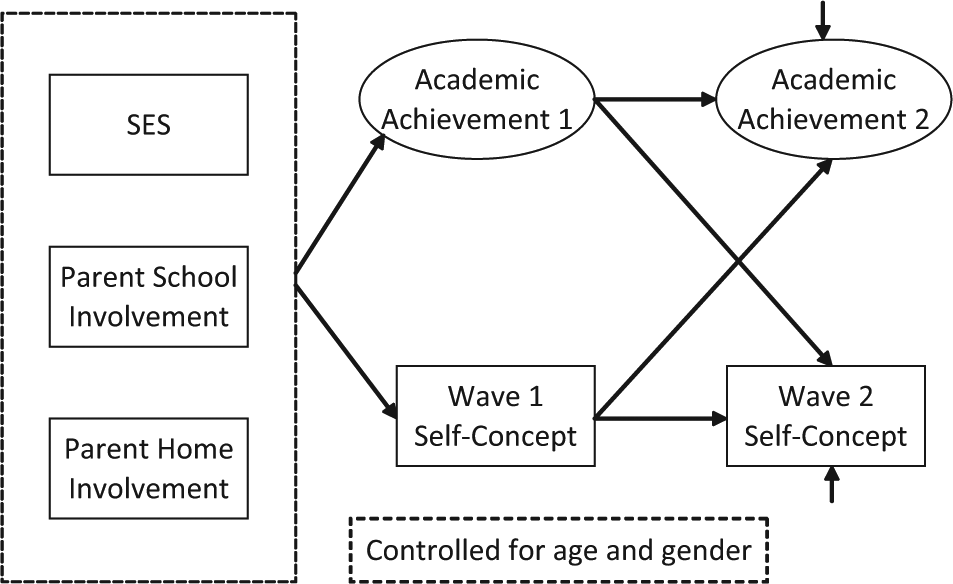
Hypothesized model.
Method
Data Source
Data used in the study were drawn from the SEELS, a federally funded longitudinal study designed to obtain a national picture of the characteristics, experiences, and achievements of students with disabilities aged 6 through 12 on September 1, 1999. A target sample of approximately 11,500 students was selected from 245 local education agencies (LEAs) and 35 special schools across the country. Data were gathered in the following areas: student characteristics, self-concept, achievement, and experience; school program characteristics; and familial characteristics and parental involvement (Blackorby, Levine, & Wagner, 2002).
As a longitudinal project, SEELS collected three waves of data over a 5-year period starting in 2000. Students from 0 to ninth grade were included in the data collection in the base year of 2001, followed by two repeated measures in 2002 and 2004. Because data were not collected at equally spaced time points among the three waves, only Wave 1 and Wave 2 data were used in the present study because of the nature of our analysis. To ensure national representativeness of the student sample, a two-stage stratified random sampling strategy was employed in SEELS. The sample was first stratified based on LEA-related characteristics, such as geographic region, size, and wealth, and then by special education disability category.
Data were collected from multiple sources, including the following: (a) Direct or alternate assessments were conducted to obtain information on academic achievement and student self-concept; (b) two surveys were completed by school staff and administrators to collect information on school programs and school characteristics; (c) teacher questionnaires were used to gather information about instructional settings, student performance, and family support; and, finally, (d) telephone interviews with parents/guardians were used to collect family information (e.g., household characteristics and parental involvement in their child’s education). In Wave 1, the response rates for direct or alternate assessment, school program questionnaires, and teacher questionnaires were 63%, 60%, and 60%, respectively (Godard et al., 2007). In the current study, we selected variables from the following sources: direct assessment, school program questionnaires, and parents/guardians interviews.
Sample
The sample for this study was selected based on three criteria: (a) students participated in direct assessments in Wave 1 and Wave 2 (students received the standard assessment as long as they were able to complete the first item on WJ-III letter–word identification test; 4,912 of 7,806 students had completed direct assessments); (b) self-concept measures were available; and (c) student grade level information was available. The final sample consisted of 2,950 students, who were between the ages of 8 and 14 (Grades 1 to 9) at the time of Wave 1.
Measures
Demographic variables
Information on demographic variables such as gender, ethnicity, age, and grade level was drawn from the school program questionnaire. Based on our analysis plan, demographic information in Wave 1 for (a) the entire sample, (b) students in first to sixth grade, and (c) students in seventh to ninth grade is presented separately in Table 1.
Demographic Information in Wave 1 for Overall, Elementary and Secondary Student Sample.
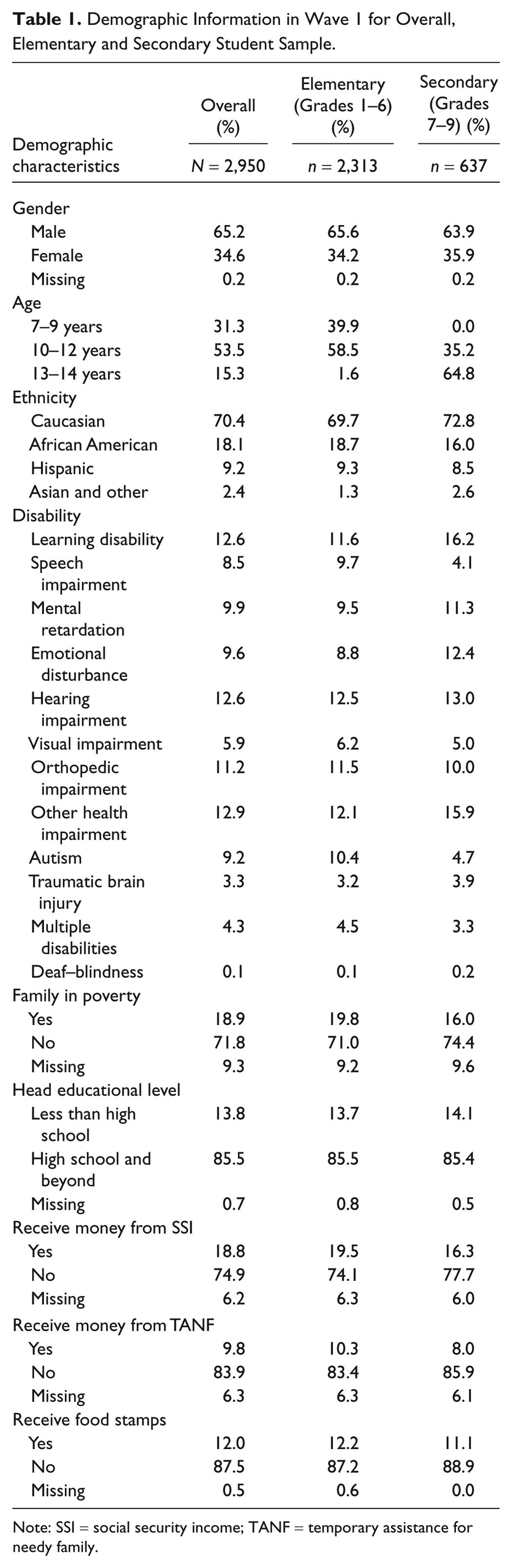
Note: SSI = social security income; TANF = temporary assistance for needy family.
SES variable
The SES variable was a composite score computed based on a method adopted from a previous study (Zhang et al., 2011). Specifically, five variables from the parent interview that indicated family SES were selected: (a) family in poverty with two levels (i.e., yes or no); (b) head of household’s educational level with four levels (i.e., “less than high school,” “high school graduate or GED,” “some college,” or “BA/BS or higher degree”); (c) receiving money from Temporary Assistance for Needy Family/state welfare program in the past 2 years; (d) receiving food stamps; and (e) receiving money for the child from Social Security Income in the past 2 years. Items (c), (d), and (e) are nominal scaled variables with responses of “yes” or “no.”
Variables were coded before creating the composite SES score in following ways: Item (a) was coded as 0 if response was “yes” and as 1 if response was “no”; Item (b) was coded as 0 if the response was “Less than high school,” and as 1 if the response belonged to any other levels; Items (c), (d), and (e) were combined and coded as 0 if the response to any of them was “yes,” and coded as 1 if all three responses were “no.” After coding, three scores were added up, including Item (a), new Item (b), and new combined score from Items (c), (d), and (e). The new SES composite scores ranged from 0 to 3, representing the order of low to high SES.
Parent involvement variables
Two measures of parent involvement were used, parent school involvement and home involvement. For school involvement, we used a created variable directly from the SEELS database, which was computed by adding the scores of three items, including frequency of attending a general school meeting, frequency of attending a school/class event, and frequency of volunteering at school (Godard et al., 2007). The parent school involvement composite score ranged from 0 to 12, indicating a low to high level of involvement. The SEELS database also provided a created variable of parent home involvement, which was used in our study. This variable was a sum of two items (i.e., the frequency of talking with the child about school and the frequency of helping with homework; Godard et al., 2007). It was rated on a scale from 1 to 9, representing a low to high involvement level, respectively.
Academic achievement
Students’ academic achievement was measured by the Woodcock–Johnson III (WJ-III; Woodcock, McGrew, & Mather, 2001), which consists of a variety of subtests on reading and math domains. We used four standardized achievement scores from the SEELS’s direct assessment database in Waves 1 and 2, including two reading achievement measures on passage comprehension and letter–word identification and two math achievement measures on applied problem and calculation. Standardized W scores were used, which were centered on a value of 500. All W scores were divided by 100 for the purpose of scale adjustment, resulting in a range from 3.26 to 5.68.
Academic self-concept
Student self-concept was measured by the Student Self Concept Scale (SSCS; Gresham & Elliott, 1990). The SSCS measures self-concept in three content domains: academic, social, and self-image. Out of a total of 72 items, 18 fall under the domain of academic self-concept (Gresham, 1995). Items in the academic subscale include “I follow classroom rules”, “I can do my homework on time”, “I can listen when my teacher is presenting a lesson”, “I can speak in class when my teacher calls on me”, and “I can finish my schoolwork easily” (Wei & Marder, 2011). Students were asked to rate each item on a 3-point rating scale (1 = not at all, 2 = not sure, 3 = confident). In the present study, we used the academic self-concept measure from the SEELS’s direct assessment database which has an α equals to .73.
Data Analysis
The purpose of our study was to examine reciprocal causal relationships between academic achievement and academic self-concept, as well as the influences of SES and parental involvement on Wave 1 academic achievement and self-concept. Age differences were also examined by dividing the sample into two age groups: elementary (Grades 1–6) and secondary (Grades 7–9), as recommended by Gresham (1995). We used structural equation modeling (SEM) in our analyses because it is a powerful technique for modeling multiple causal relationships among multiple predictor and outcome variables, performing path analysis with latent variables, and comparing group differences (Chin, 1998). Analyses were performed in SPSS V.17.0 and Mplus V. 5.2 (Muthén & Muthén, 2007). Missing data were retained in the analysis and were treated in Mplus using the full information maximum likelihood approach.
Various types of data analyses were conducted. First, to obtain an overall picture of the sample, we did descriptive analyses for the whole sample, the elementary subgroup, and the secondary subgroup. A confirmatory factor analysis was then conducted to obtain measurement models of academic achievement, followed by structural regression modeling for the whole sample. In addition, a multiple-group analysis of the elementary and secondary groups was conducted in two stages: (a) measurement model evaluation and (b) comparison of cause–effect paths in the structural model (Farrell, 1994). Separate tests were conducted to test measurement and structural invariance based on the chi-square difference test, comparing chi-square values between the configural and other models with imposed constraints on specified parameters (Byrne, 2009).
Results
Descriptive Statistics
Table 1 presents demographic information for the whole sample as well as the elementary and secondary subgroups. Of the 2,950 students in the whole sample, 2,313 were from elementary and 637 from secondary levels. As illustrated, for the whole sample, the majority of students were males (65.2%) and Caucasians (70.4%), with similar patterns observed for both subgroups. Means and standard deviations are presented in Table 2. For the whole sample and both subgroups, Wave 2 academic achievement scores were higher than Wave 1 academic achievement scores. Furthermore, academic self-concept scores were generally higher for the elementary subgroup than for the secondary subgroup (e.g., 13.12 vs. 12.86 in Wave 1). For the elementary subgroup, academic self-concept scores decreased from Wave 1 to Wave 2 (13.12 vs. 13.01) whereas it increased for the secondary subgroup (12.86 vs. 12.90).
Ms and SDs for SES, School Involvement, Home Involvement, Academic Achievement, and Academic Self-Concept.
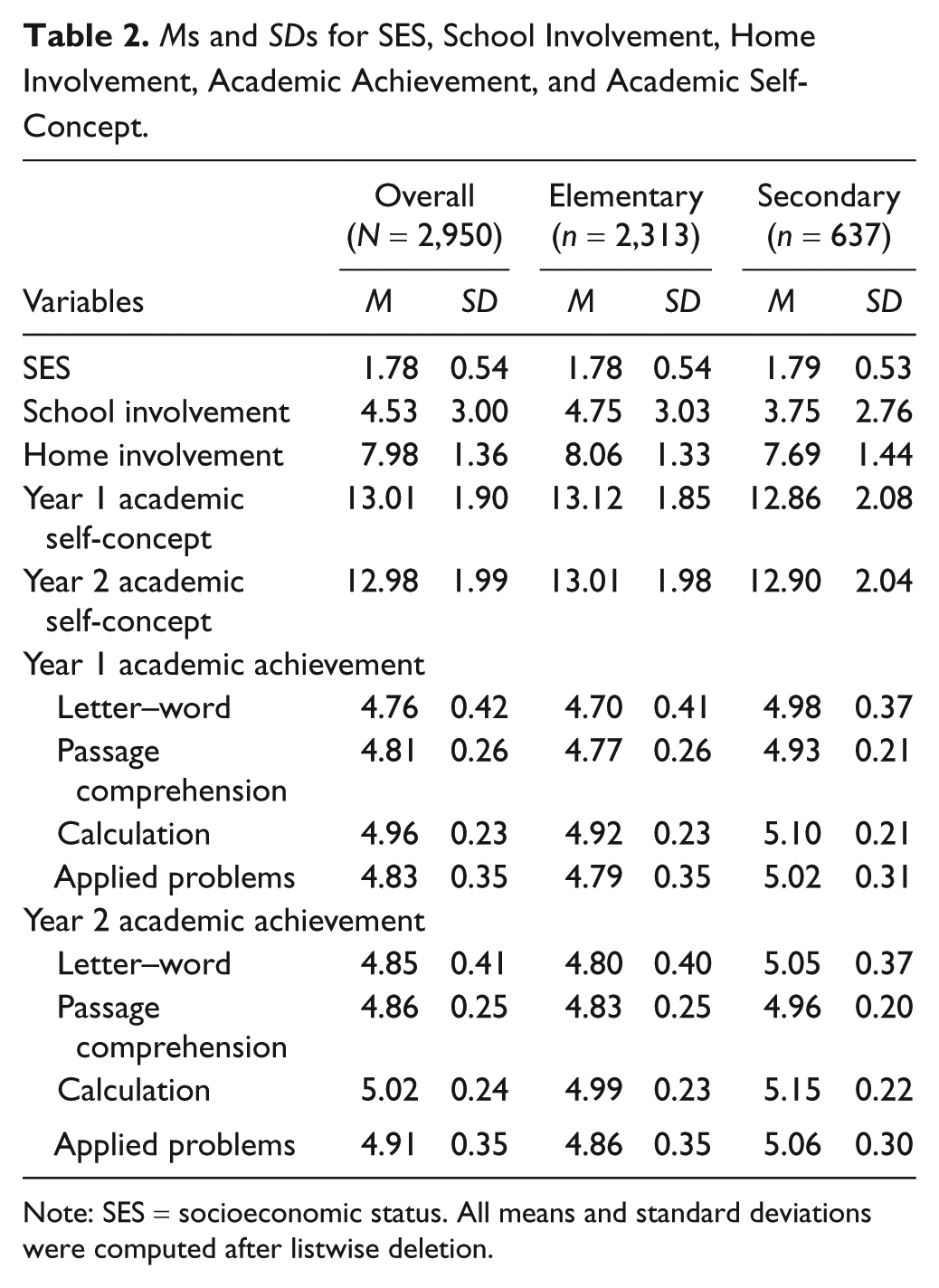
Note: SES = socioeconomic status. All means and standard deviations were computed after listwise deletion.
Table 3 shows zero-order correlations among all measured variables for the total sample and the two subgroups. Strong correlations among academic achievement measures within Wave 1 and Wave 2 were observed for the whole sample as well as the two subgroups. We also found strong correlations between Wave 1 and Wave 2’s corresponding academic achievement measures. Specifically, for the total sample, the correlations between Waves 1 and 2 were .91 for letter–word, .80 for passage comprehension, .80 for calculation, and .85 for applied problems, all of them statistically significant (p < .01). Similar patterns were also observed for both subgroups. For example, the correlation between letter–word measures for Wave 1 and Wave 2 was .90 (p < .01) for elementary and secondary student groups.
Correlations Among Measured Variables for the Overall Student Sample.
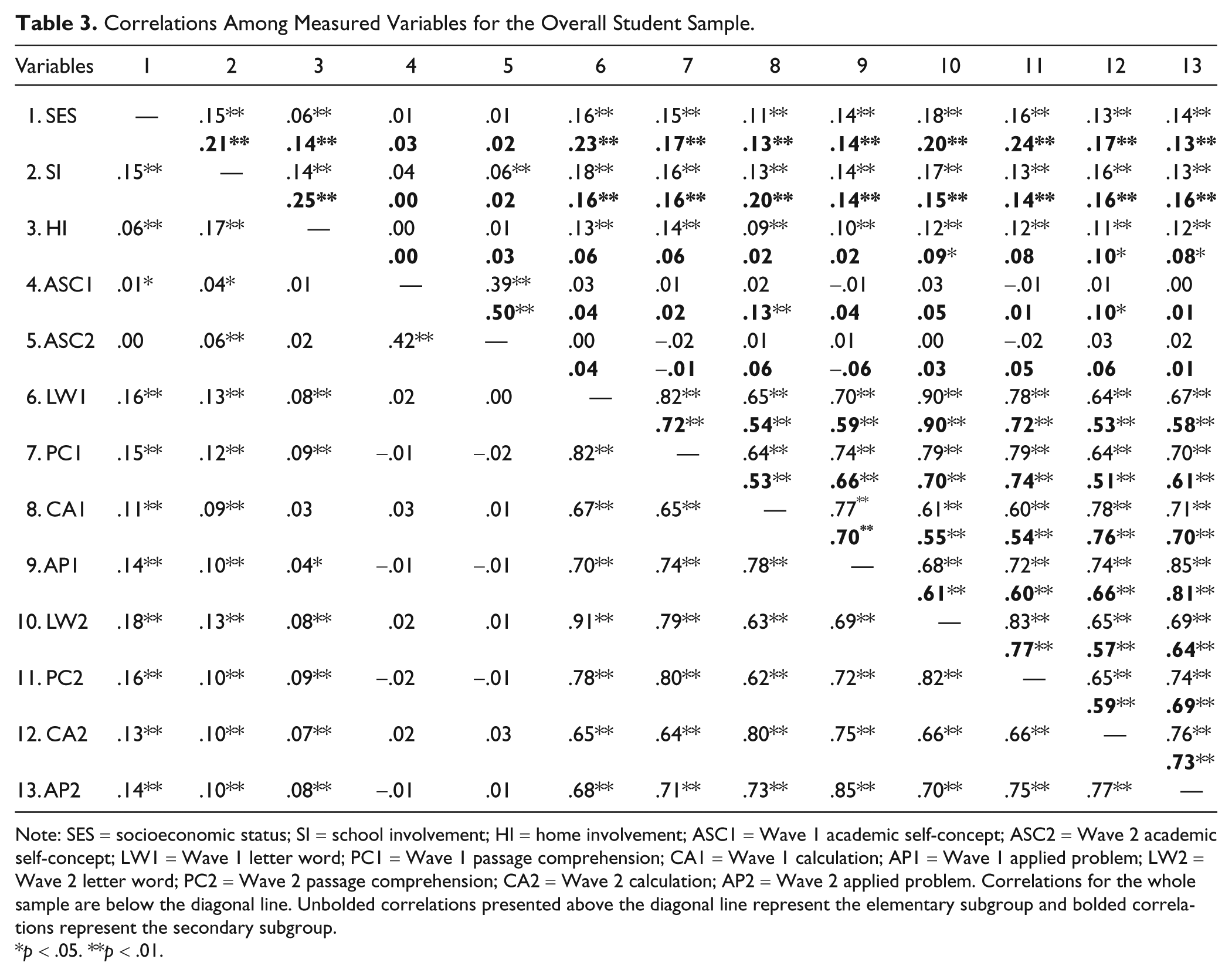
Note: SES = socioeconomic status; SI = school involvement; HI = home involvement; ASC1 = Wave 1 academic self-concept; ASC2 = Wave 2 academic self-concept; LW1 = Wave 1 letter word; PC1 = Wave 1 passage comprehension; CA1 = Wave 1 calculation; AP1 = Wave 1 applied problem; LW2 = Wave 2 letter word; PC2 = Wave 2 passage comprehension; CA2 = Wave 2 calculation; AP2 = Wave 2 applied problem. Correlations for the whole sample are below the diagonal line. Unbolded correlations presented above the diagonal line represent the elementary subgroup and bolded correlations represent the secondary subgroup.
p < .05. **p < .01.
Overall Model
To answer the primary research question, we tested the hypothesized model (see Figure 1) based on the whole sample. The overall model chi-square was statistically significant, χ2 = 445.875, df = 71, p < .01, suggesting a poor fit of the hypothesized model. Because chi-square statistics can be affected by sample size, we made model-fit decisions based on some commonly used fit indexes, including comparative fit index (CFI), root mean square error of approximation (RMSEA), and standardized root mean square residual (SRMR). Fit index statistics (i.e., CFI = .92, RMSEA = .04, SRMR = .03) indicated a good fit for the overall model. However, for longitudinal data, the same measurements for different time points can have correlated uniquenesses; therefore, it is recommended that they be tested (Guay et al., 2003).
As a result, we examined an alternative model by adding correlated uniquenesses between corresponding academic achievement measures in Wave 1 and Wave 2. Compared to the a priori model based on a chi-square difference test, this model had a better model fit: χ2 = 170.827, df = 67, p < .01, CFI = .98, RMSEA = .02, and SRMR = .02. For Waves 1 and 2 academic constructs, all factor loadings were substantial, ranging from .45 to .62. As a result, the hypothesized model with correlated uniquenesses between Wave 1 and Wave 2 latent constructs was used for total-model analysis and multiple-group analysis.
Reciprocal Causal Relationship
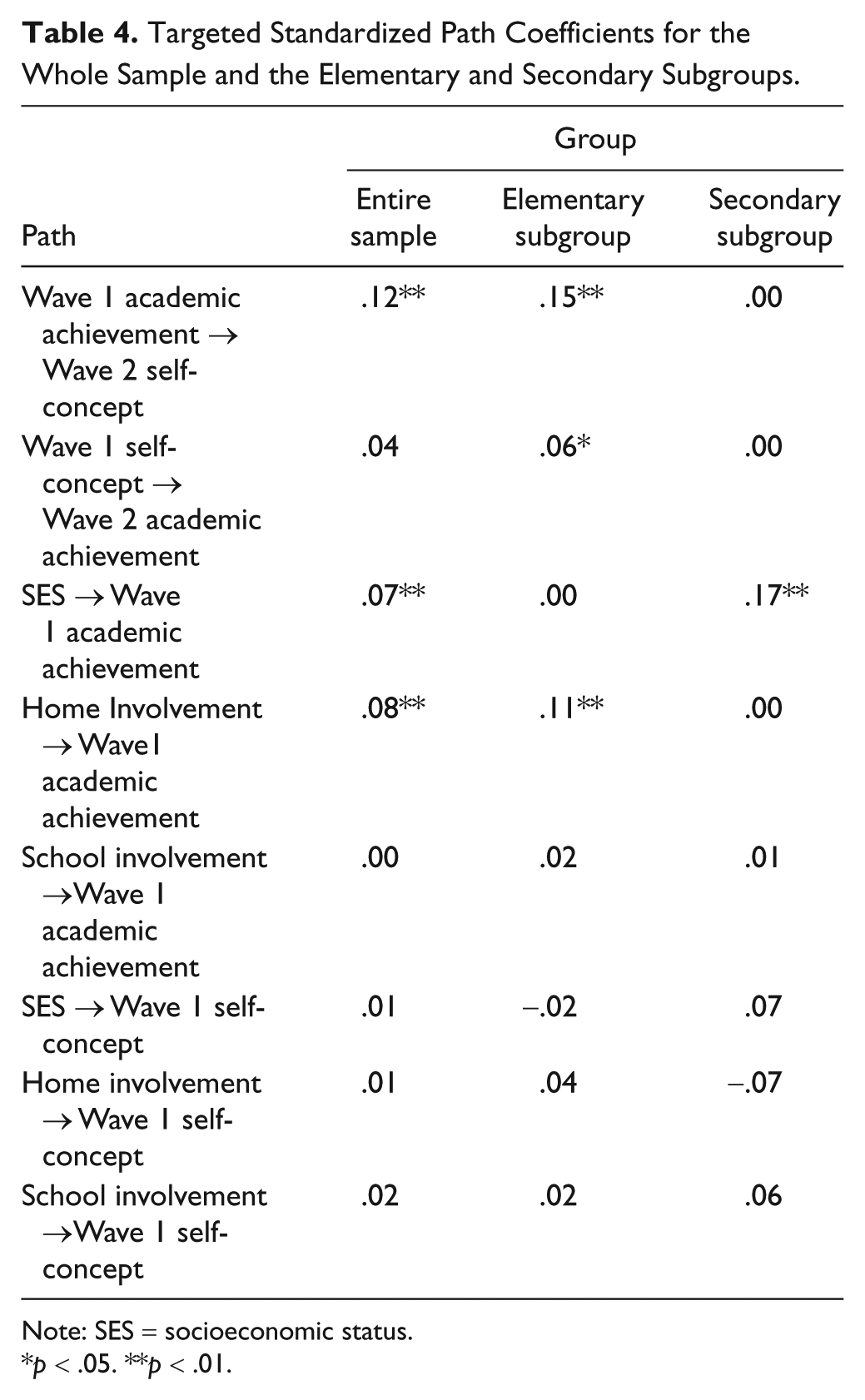
Results from the total-sample SEM are presented in Table 4. Two path coefficients are critical for examining the reciprocal causal relationships between academic achievement and self-concept: Wave 1 self-concept on Wave 2 achievement and Wave 1 achievement on Wave 2 self-concept. The coefficient for the path leading from Wave 1 self-concept to Wave 2 achievement was .04 and not significant (p = .07); the coefficient for the path leading from Wave 1 achievement to Wave 2 self-concept was .12 and significant (p < .01). Thus, reciprocal causal relationships between achievement and self-concept were not established.
Targeted Standardized Path Coefficients for the Whole Sample and the Elementary and Secondary Subgroups.
Note: SES = socioeconomic status.
p < .05. **p < .01.
Influences of Parental Involvement and Family SES
The influences of SES and parent involvement on Wave 1 achievement and self-concept were also tested (see Table 4). Both were found to be significant predictors for academic achievement. The standardized path coefficient from SES to achievement was .07 (p < .01), indicating that students from families with higher SES had higher academic achievement. The path coefficient of parent home involvement was .08 (p < .01), indicating that higher parent home engagement had a positive effect on student academic achievement.
Multiple-Group Analyses: Comparisons Between Elementary and Secondary Groups
In accordance with Farrell (1994), we examined the invariance for the measurement model and the invariance of parameters for the structural part. First, we fit the overall model (i.e., Model 1) with freely estimated factor loadings for both elementary and secondary groups and obtain the baseline chi-square statistics, χ2 = 333.03, df = 140, p < .01. In Model 2, factor loadings were constrained to be invariant for both groups, χ2 = 342.569, df = 146, p < .01, and the fit of this model did not differ significantly from the baseline model, Δχ2 = 9.539, Δdf = 6, p < .01. In Model 3, both factor loadings and correlated uniquenesses were constrained to be invariant for both groups, χ2 = 349.218, df = 150, p < .01, and the model fit did not differ significantly from that of Model 2, Δχ2 = 6.649, Δdf = 4, p < .01. Thus, the results indicate the invariance of the measurement model for both groups.
Next, we evaluated whether path coefficients differ between two groups by constraining all path coefficients to be equal for both elementary and secondary student groups. The chi-square difference statistics, Δχ2 = 42.099, Δdf = 13, p < .01, indicated that there were differences in the path coefficients for elementary and secondary groups. As a result, path coefficients were estimated independently for each group.
Differences Between Elementary and Secondary Groups
Table 4 presents path coefficients for elementary and secondary subgroups separately. For the elementary group, we found reciprocal causal relationships between academic achievement and self-concept. Both paths from Wave 1 academic achievement to Wave 2 self-concept (.15, p < .01) and Wave 1 self-concept to Wave 2 academic achievement (.06, p < .05) were significant. Home involvement was a significant predictor for Wave 1 achievement (.11, p < .01). In contrast, for the secondary group, no causal relationships were found between academic achievement and self-concept. Parent home involvement was a significant predictor for academic achievement (.11, p < .01); SES was a significant predictor of Wave 1 academic achievement (.17, p < .01) for the secondary group, indicating that students from higher SES families had higher academic achievement.
Discussion
This study examined the reciprocal causal effect between academic self-concept and academic achievement with family SES and parent involvement (i.e., school involvement and home involvement) as predictive factors by controlling age and gender. According to the results, (a) at the elementary level, a reciprocal causal relationship was found, with the paths from Wave 1 academic achievement to Wave 2 self-concept and from Wave 1 self-concept to Wave 2 achievement being significant; (b) family SES was a significant predictor of academic achievement and self-concept; and (c) parent home involvement was a significant predictor for Wave 1 academic achievement for the elementary group. These findings are particularly important because of the use of the national level longitudinal data set (SEELS) and the examination of the relationship between academic self-concept and academic achievement within the context of family involvement and SES.
These findings are consistent with previous research establishing the reciprocal effects of self-concept and academic achievement, particularly for the elementary group (Guay et al., 2003; Marsh et al., 1999; Marsh & Yeung, 1997). Clearly, academic success and positive self-concept in Wave 1 had a powerful effect on academic success (Wave 2). This finding underscores the importance of early intervention/prevention to maximize the potential for academic success and school engagement. Specifically, early intervention/prevention efforts under the Response to Intervention (RTI) provide a framework for addressing the needs of students who are at risk for academic failure (National Center on Response to Intervention, 2010). RTI involves “implementing scientifically, research-based instructional practices and interventions, monitoring student progress, and adjusting those practices based upon the student’s response within a multi-level prevention system” (National Center on Response to Intervention, 2010). Similarly, school/districtwide behavioral support systems (i.e., schoolwide positive behavioral interventions and supports [PBIS]) aim to create positive and effective learning environments in which students receive supports based on their behavioral responsiveness to intervention (Positive Behavioral Interventions and Supports, 2011).
Similarly, the positive effect of parent home involvement on self-concept and academic achievement is consistent with prior research (Carter, 2002; Gonzalez-Pienda et al., 2002; Miedel & Reynolds, 1999). This finding underscores the importance of such involvement, particularly for the elementary-age group. Creating a positive learning environment at home, homework assistance, and implementation of reinforcement strategies in a consistent manner are some of the techniques reflected in the literature as being effective in improving self-concept and academic achievement (Carter, 2002; Gonzalez-Pienda et al., 2002).
Schools can capitalize on these positive effects on academic achievement associated with parent involvement through training programs. Such programs should be family centered and aim for meaningful parental involvement in the child’s overall functioning (Muscott, 2002).
Implication
Findings of this study point to the need to employ strategies that improve the self-concept of elementary students with disabilities, because doing so is likely to result in improved academic outcomes. For example, Elbaum and Vaughn (2001) conducted a meta-analysis of 64 intervention studies published between 1975 and1997 on the effects of school-based interventions on the self-concept of students with LDs. These authors found that students generally benefited from interventions that focused on improving self-concept. More specifically, counseling interventions tended to be more effective for secondary students whereas academic skill interventions were most effective for elementary students. However, it takes considerably longer time to implement academic interventions targeting academic self-concept than counseling interventions.
More recently, Elbaum and Vaughn (2009) suggested three interventions for enhancing self-concept among students with LD: (a) use of cooperative learning strategies that pair students with LDs with same-age peers on academic tasks with frequent feedback on their work from the teacher and their classmates, (b) group counseling sessions by a trained facilitator, and (c) training programs for parents (see also Yager, Johnson, Johnson, & Snider, 1985, on the effects of cooperative learning).
Technology may also be a promising intervention. For example, Chiang and Jacobs (2009) investigated the effects of computer-based instruction (CBI) on the self-perceptions of 50 high school students with LDs. This randomized control trial involved the CBI group utilizing the Kurzweil 3000 (K-3000) assistive reading software for 10 weeks while the control group received instruction in a traditional English language arts classroom. Results suggested that the K-3000 software program improved the academic self-perception of students with LDs.
Finally, the use of evidence-based instructional and behavioral interventions is essential in improving academic achievement and self-concept. Both NCLB and IDEA 2004 emphasize implementation of such interventions to improve academic outcomes. Guidance on these practices is available from What Works Clearinghouse under the auspices of the U.S. Department of Education, Institute of Education Sciences (n. d.). In addition, systematic efforts associated with early intervention/prevention (e.g., RTI, PBIS) along with school-sponsored programs to expand parental involvement must be mounted.
Limitations and Recommendation for Future Research
The data analyzed in this study came from large-scale research that collected data in numerous areas related to student school program, family information, and student assessment. Despite this broad coverage, some aspects of the variables under investigation were not considered in the original data collection. For example, the measure of academic self-concept was general and did not include subject-specific self-concept. This general academic self-concept may not capture the true academic self-concept of some students with disabilities who are good at certain subjects, but not at others. Moreover, information about parent involvement was limited to a few items that did not include specific types of parent involvement or the degree of parent involvement. For example, information was not available on the specific types of school activities parents participated in, leadership/organizational roles they played, length of their participation in a specific meeting, role during Individualized Education Program meetings, and the way they communicated expectations to their child. In addition, the only achievement data in SEELS were Woodcock–Johnson math and reading scores, with the exception of some teacher-reported data about student reading levels were available. For example, student grades from schools, which might be as important a measure of student achievement as standard scores, were not available for analyses. Future research can build on this national study and focus on collecting more detailed data on subject-specific academic self-concept and its relationship to the academic performance on the specific subject.
The second limitation of the study has to do with the way we treated the factors that might have an interfering effect on academic self-concept and academic achievement. Because of our interest in examining the reciprocal causal relationship between academic self-concept and achievement with parent involvement and family SES as predictive factors, we employed a statistical procedure to control for other factors (i.e., age and gender). Although this was methodologically appropriate, the effect of other student factors was not specifically or individually examined. Therefore, future research is needed to analyze the SEELS data to specifically examine the impact of these factors.
Conclusion
In conclusion, the findings of the current study provide empirical evidence that, at the elementary level, prior academic self-concept predicts subsequent academic achievement. Prior academic achievement also predicts subsequent academic self-concept, and parent home involvement is an important predictor of student achievement. This evidence is especially compelling because it is based on analyses of data from a large national sample. In light of these findings, teachers and parents should engage in practices that promote student self-concept. LEAs are responsible for increasing student academic achievement.
Footnotes
Declaration of Conflicting Interests
The author(s) declared no potential conflicts of interest with respect to the research, authorship, and/or publication of this article.
Funding
The author(s) received no financial support for the research, authorship, and/or publication of this article.