



Abstract
To obtain and maintain employment, workers with disabilities may need services and supports that are not covered by private or public health insurance plans. This study explores the services, supports, and accommodations that people with disabilities use to find and keep competitive employment; how they obtain needed supports; and the extent to which they pay out of pocket for work-related supports. We conducted an exploratory study using in-depth interviews with 15 workers with disabilities who in 2013 earned at least 250% of the poverty level, or about US$28,000 a year for a single person. Most respondents needed some supports or accommodations to sustain their employment, but on the whole, these supports were neither costly nor resource intensive for employers to provide. The most frequently used supports were assistive technology (AT), including wheelchairs, communication devices such as video relay phones, and visual aids to enhance individuals’ access to information. Respondents also used staff supports and modified work schedules. Out-of-pocket costs for services and supports used on and off the job ranged from US$0 to US$14,800 per year for personal care assistants, medical goods and services, coinsurance payments, AT, and service animals. Individual needs, the nature of the job, and the extent to which health insurance or other sources covered the costs for work-related services and supports all factored into the challenges these workers with disabilities encountered and the solutions they devised to find and keep jobs that pay at least a moderate salary.
Despite their goals and intentions to work, people with disabilities face myriad barriers to employment that leave them underrepresented in the workforce (Hernandez et al., 2007). Although existing research shows that only a minority of workers with disabilities report a need for workplace accommodations to find a job or stay employed, accommodations could potentially improve the employment prospects for many people with disabilities (Loprest, 2007). Workplace accommodations can include changes to the worksite to facilitate environmental access, changes to the individual workstations such as accessibility software, and adaptive strategies to facilitate job performance such as flexible scheduling, job modification, or job coaching (Sabata, Williams, Milchus, Baker, & Sanford, 2008).
Few studies have examined the number and types of accommodations that are used to facilitate a worker’s job performance (Loprest, 2007). In a survey of 308 employed consumers of Centers for Independent Living in California, 54% used assistive technology (AT), accessibility features, or other accommodations at work; most respondents said that the AT increased their work productivity and self-esteem (Yeager, Kaye, Reed, & Doe, 2006). AT refers to any item, piece of equipment, or product system that increases, maintains, or improves the functional capabilities of individuals with disabilities. It includes glasses, hearing aids, prosthetics, canes, reachers, and other devices.
In addition, few studies have explored how workers with disabilities obtain services and supports needed to work. Some supports, such as medication and limited physical or occupational therapy, may be covered through employer-sponsored health insurance (Hanson, Neuman, Dutwin, & Kasper, 2003). Accommodations, such as employment-related AT or adaptive furniture, may be provided directly by the employer, assuming that the worker has chosen to disclose her or his disability (Chow, 2012; Goldberg, Killeen, & O’Day, 2003) and that the employer is committed to an inclusive work environment (MacDonald-Wilson, 2005). Some of these services and supports may be covered by public health insurance programs, such as Medicaid. However, to qualify for Medicaid, workers’ incomes must remain below levels set by their state’s Medicaid program. Workers who choose not to limit their income must find other funding sources to obtain needed supports or may need to pay for essential work-related costs out of pocket, particularly the expenses of preparing for and traveling to and from work (National Council on Disability, 2009).
This exploratory study sought to learn the following from a sample of 15 workers with disabilities who earned more than US$28,000 per year:
What services and supports did they use to find work and stay employed?
How did they obtain these supports?
Who provided and paid for these supports?
We chose to interview a small sample of higher wage earners to better understand what supports this population needed to become successfully employed and how they obtained them. Our findings can be used to craft larger qualitative studies and surveys of workers with moderately high wages. As policies are strengthened to promote earnings and employment, assuring workers with disabilities that they have dependable access to the services they need could entice greater numbers of them to find and keep competitive employment and discourage them from limiting their earnings to retain their eligibility for public benefits, such as Medicaid, Social Security, and Supplemental Security Income (SSI) (Stapleton, O’Day, Livermore, & Imparato, 2006).
Method
Convenience sampling was used to identify and recruit participants for this exploratory study. We contacted disability service and advocacy organizations, such as the National Association of State Directors of Developmental Disabilities Services, the National Council on Independent Living, and the American Foundation for the Blind, to request their assistance in recruiting participants. Organizations agreed to share information about the project with their staff and workers with disabilities. We also recruited participants using listservs for visually and hearing-impaired individuals.
We developed two interview guides: one guide for individuals with physical and sensory disabilities and the other for individuals with intellectual and psychiatric disabilities. We pilot tested them with a worker with a physical disability, then modified the guides based on his feedback.
We screened study candidates by phone to ensure that they met the study criteria, which included individuals who
have a visual, hearing, psychiatric, physical, or intellectual disability;
are employed at least 20 hr per week;
earn at least 250% of the federal poverty level in 2013, or about US$28,000 or more for a single person;
have work support needs related to their disabilities.
We screened 18 individuals, 15 of whom met the study criteria and participated in an interview. We conducted the interviews during February and March 2013 by phone or via Google chat at the participant’s request. We provided each participant with a US$50 gift card as a token of our appreciation for taking part in the interview.
We took detailed notes of each interview and then compared the notes with the audio recordings to correct errors and omissions. We then summarized the data into concepts and organized them in a matrix framework for analysis. The team also grouped the types of accommodations respondents cited into types of services and supports, used on and off the job, by purchaser/provider type. We constructed categories of the support or accommodation used, as shown in Figure 1.

Number and types of employment supports and workplace accommodations used on and off the job.
Results
Demographic and Disability Characteristics of Study Participants
We interviewed 15 workers with disabilities who resided in ten states throughout the country. Respondents had a mean age of 39 and tended to be Caucasian and highly educated (see Table 1). Eight respondents had household income greater than US$50,000. Of the 15 respondents, 11 had been recipients of Social Security disability benefits at some point in the past; 1 was receiving such benefits at the time of the interview. We chose to interview individuals with four different types of impairments (intellectual, physical, psychiatric, and sensory) to capture the perspectives of workers with diverse support needs.
Demographic and Disability Characteristics of Study Participants (N = 15).
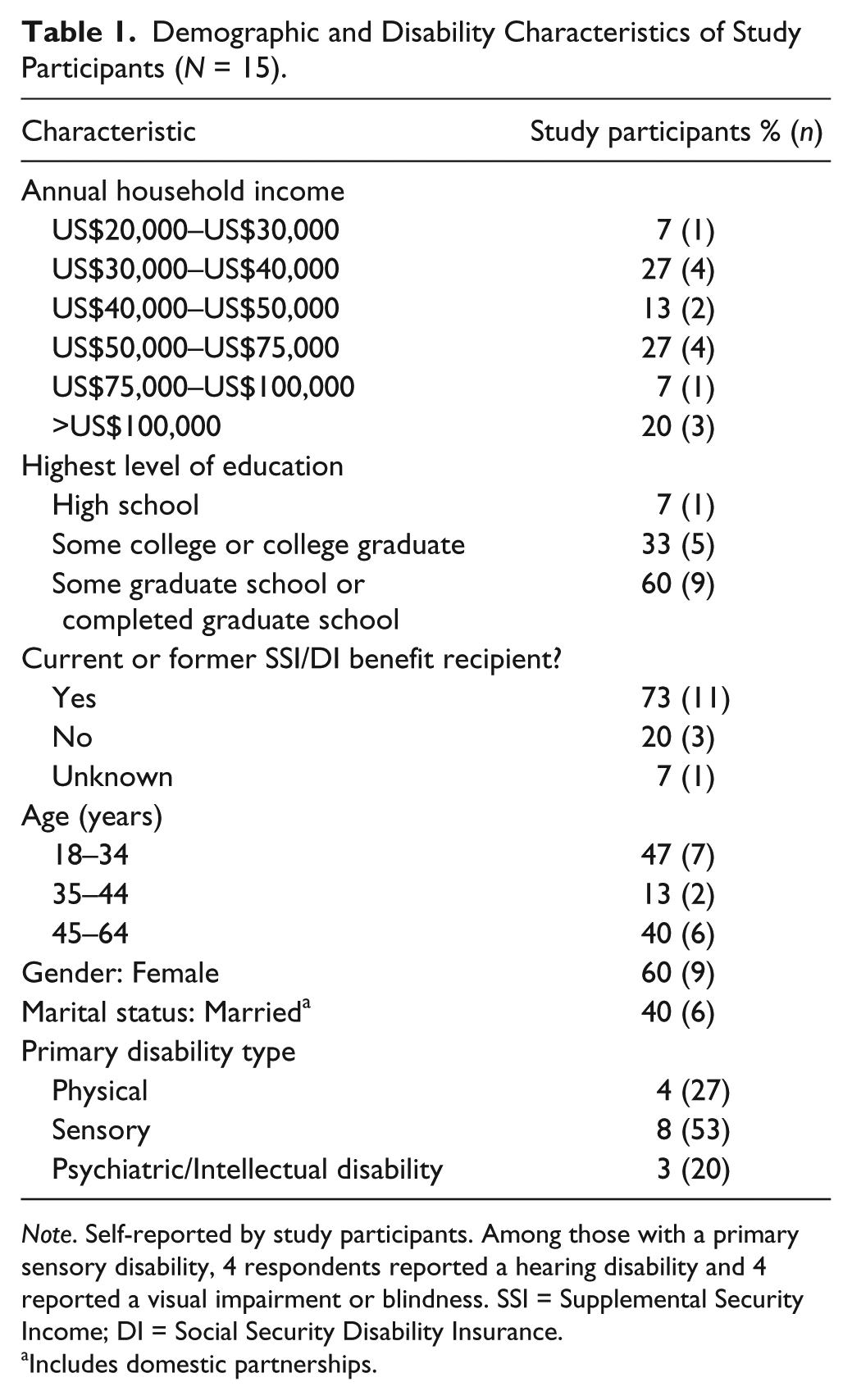
Note. Self-reported by study participants. Among those with a primary sensory disability, 4 respondents reported a hearing disability and 4 reported a visual impairment or blindness. SSI = Supplemental Security Income; DI = Social Security Disability Insurance.
Includes domestic partnerships.
Overall, about half of all respondents reported a primary sensory disability and an additional 27% reported a primary physical disability. Five respondents reported one or more secondary disabilities, in addition to their primary one. Considering both the primary and secondary disabilities, 6 of the 15 respondents had a physical disability, 9 had a sensory disability, 4 had a psychiatric disability, and 3 had an intellectual/developmental or learning disability.
Employment Status of Study Participants
All of the respondents were employed full time; individuals worked in a variety of industries, including government, education, human services, advocacy, business, and retail (see Table 2). Thirteen respondents were competitively employed and two were self-employed.
Employment Industry of Study Participants (N = 15).
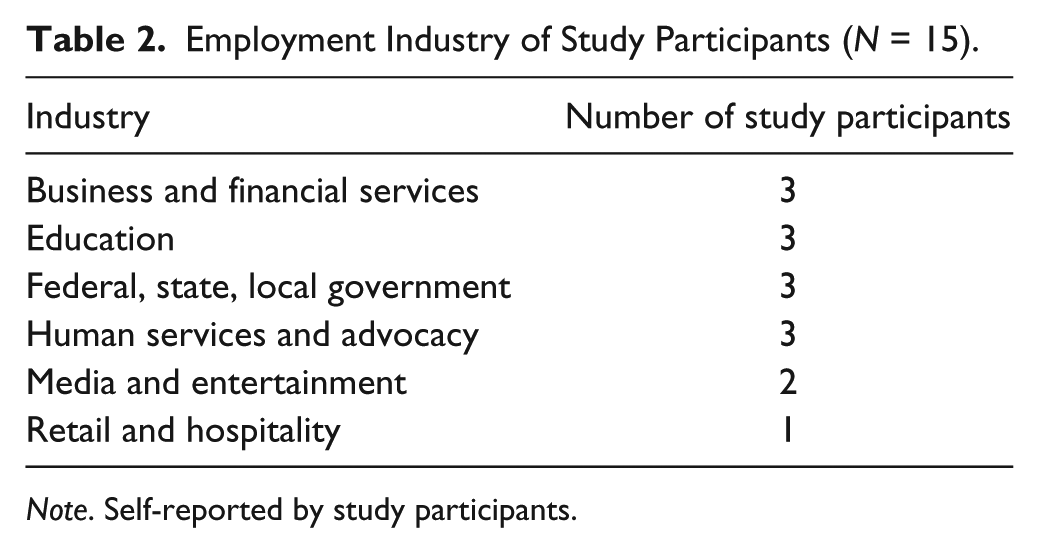
Note. Self-reported by study participants.
Services and Supports Used On the Job
Although respondents were purposefully selected for the study because of their need for some supports and accommodations to sustain their employment, these supports were neither costly nor resource intensive for employers to provide. Respondents reported receiving between three and twelve on-the-job supports provided by employers, most of which were categorized as AT, formal and informal staff support, modified work schedules and leave, and modifications to individual workstations (see Figure 1).
The most frequently cited support used on the job was AT, and this was most often used by participants with sensory impairments, who accounted for half of the study sample. Respondents, particularly those with sensory impairments, reported using communication devices and visual aids such as a laptop screen reader, Braille embosser, and Braille note taker, as well as Apple iPhones with built-in accessibility applications to complete job tasks and participate more fully in the workplace. The next most commonly cited support provided on the job was staff support, which encompassed informal and formal supports, as well as additional supervision. For many respondents, these supports were informal and were most often put in place as needs were identified on the job. For example, one respondent who was deaf reported that when she participated in a large group meeting, her colleagues send her notes summarizing information covered. Four respondents with sensory and psychiatric impairments reported receiving formal staff supports on the job; these supports included a paid reader, a proofreader, a teacher’s aide, and a secretary who assists with producing emails and documents that the respondent dictates. A modified work schedule was the next most frequently cited accommodation, reported by nine respondents receiving 17 total accommodations in this category. Individuals noted that enhanced flexibility, such as a flexible work schedule, ability to work remotely from home, or emergency paid time off, facilitated their effective job performance. Several respondents accepted their position because they knew it would offer flexibility to accommodate their disability.
Modifications to the workstation were also common—seven respondents received 11 modifications to their workstation. Not surprisingly, the modifications differed based on the worker’s functional limitations. For example, for workers with severe physical disabilities, employers modified the height or configuration of their desks to remove physical barriers and provided wireless keyboards to facilitate access to their computer. For two respondents with sensory impairments, employers provided a large computer monitor and high-speed Internet connection to enable the employee to place and receive calls using a video relay phone. Many employers also provided AT, such as computer screen readers or video telephones, to assist employees with sensory impairments to access information easily.
Respondents reported relying on universal design features that are commonly used by all employees in the workplace, such as large computer monitors, wireless keyboards, and phones with accessibility features. Universal design, which refers to products or environments that are designed to be usable by all people with a range of abilities, reading levels, and communication and learning styles, has made workplaces more accessible in recent years. Several respondents also reported that certain devices, such as Apple iPhones and iPads, enabled them to easily access an array of AT applications. Apple includes as standard in its products accessibility features such as speech output, speech input, and large print. For example, one respondent, who is blind, uses Apple products on the job, just as her sighted peers do, to assist customers with making purchases and to browse the web for her job. She also uses Apple products to complete daily activities, such as listening to music, watching television, and even purchasing coffee.
Respondents utilized a wide variety of employment supports and accommodations on the job; not surprisingly, the type of supports used often differed based on the functional needs of workers. Respondents with physical disabilities used durable medical equipment such as wheelchairs, including a motorized wheelchair with a function that raises and lowers its seat. Respondents with physical disabilities were provided with an ergonomic chair, a wireless keyboard, or a raised or corner desk. Respondents with sensory impairments reported using a telescopic lens, software applications that translate text into speech, a videophone, and nonvisual communication devices, such as a Braille note taker, to complete job duties. Some individuals with sensory impairments also required interpreter services. For example, to accommodate his hearing impairment, one respondent used a hearing aid, an interpreter, and other supports on the job to communicate with individuals who were not proficient in sign language. He chose the appropriate tool depending on the length of the communication and the location of the other individual (in the office or off site).
Respondents with intellectual or psychiatric disabilities usually used different types of accommodations. One respondent with an intellectual disability received informal job coaching from a colleague in addition to extra supervisory support. Individuals with psychiatric impairments tended to use flexible work arrangements, prescription medications, and outpatient therapy.
Supports Used to Prepare for or Get to Work
Accessible and reliable transportation is critically important to finding and keeping a job, according to study participants. For respondents with significant physical and sensory disabilities, reliable transportation not only increased their independence and integration in the community, but it also made competitive employment possible. Three respondents with physical disabilities reported using a modified vehicle to travel to and from work. Family members of two other respondents drove them to and from work each day, and respondents with visual impairments took public transportation, walked, or took a taxi to and from work. Assistance with personal care needs and household activities was important for individuals with significant physical disabilities and for some individuals with visual impairments. Two respondents with physical disabilities received personal assistance with their activities of daily living, a service that is not covered through their employer-sponsored health insurance plan. Most respondents with physical disabilities and some respondents with visual impairments also reported needing assistance with activities such as shopping, reading mail, laundry, and housekeeping.
Strategies for Obtaining Adaptive Equipment and Supports
Overall, study participants used resourceful strategies to obtain adaptive equipment and supports that effectively met their needs. Their strategies differed depending upon the type of accommodation needed and their personal circumstances. One respondent with a significant physical disability relied on handmade adaptive equipment to address her personal care needs. She designed, and a family member constructed, a self-standing transfer board, a raised toilet seat that can be used with that board, and a reacher to help her gain control of objects beyond her reach. Two individuals leveraged their resources to obtain at a discounted price wheelchairs that properly fit them and met their needs. For example, one respondent reported that after his motorized wheelchair malfunctioned some years ago, he obtained employment at a wheelchair manufacturer, where as an employee benefit, he received free power wheelchairs. Another respondent purchased a discounted wheelchair from a wheelchair manufacturer that employed one of her friends. When she first learned to drive, her state vocational rehabilitation (VR) agency would not pay for a modified car with hand controls because the vehicle she hoped to purchase was not less than 3 years old. Consequently, her parents purchased the car, and she obtained funding from a nonprofit organization to install hand controls for her vehicle. Other individuals negotiated with former employers to take their equipment with them when they left their jobs. Still others obtained their equipment from the state VR agency.
The process of identifying and providing needed supports was very individualized, according to respondents. Most respondents negotiated with their employer to set up needed supports and accommodations at the start of their employment, then adjusted accommodations while on the job. Respondents identified for employers at the time of hiring the types of supports and reasonable accommodations they needed on the job, and worked directly with employers to ensure that these supports were put in place. In some cases, additional supports were later provided in response to evolving needs or changes in job duties. For example, one respondent with a visual impairment reported that his colleagues identified errors in documents that he produced. To address this issue, additional staff support was provided to proofread his documents. Another respondent with visual and physical impairments used a paid reader to read documents to her; however, she recently required less assistance because many documents have become accessible online.
Many respondents noted that they sought employment at organizations that provide services primarily to individuals with disabilities or that have a record of reaching out to individuals with disabilities. Of the 15 people we interviewed, 7 worked for disability service organizations or for companies that offered unique accommodations. Employers that reach out to people with disabilities, including disability service and advocacy organizations, human service organizations, companies that manufacture durable medical equipment, and companies that value making their services and products accessible, made it easier for individuals to obtain necessary supports and accommodations on the job. Another respondent attended a school for deaf individuals and obtained her job at a government organization through a job fair held at that school. Meeting the employer at the job fair convinced her that the employer valued deaf employees. Another respondent with a sensory disability started his own business, using equipment that was purchased by the state VR agency, to ensure that his business would meet his needs for accessing information and for a flexible work schedule.
Out-of-Pocket Expenses for Needed Supports
Out-of-pocket costs for personal health services and employment supports varied substantially and ranged from US$0 to US$14,800 per year. Two individuals with sensory impairments reported incurring no out-of-pocket costs. Five respondents reported spending US$1,000 to US$2,500 on costs for durable medical equipment, a tablet PC with accessibility features, a vibrating alarm clock, an iPhone, and coinsurance payments for prescription drugs and outpatient therapy. One respondent spent US$5,000 per year of her own funds to cover transportation, medication, and a concierge service for a primary care physician that offered around-the-clock access. Two respondents spend more than US$8,000 per year on out-of-pocket costs for personal care assistance, orthopedic shoes, wellness tools, and a psychiatric service dog.
The variation in out-of-pocket costs was due in large part to differences among individuals’ limitations as well as the scope of insurance coverage. For example, one respondent with a physical disability employed a personal care assistant (PCA) to help her shower and dress each day. Her employer-sponsored health insurance did not cover her PCA services; therefore, she paid more than US$8,000 each year out of pocket for this expense. However, another respondent, a visually impaired state employee, needed telescopic lenses to work. His employer-sponsored health insurance refused to cover this expense; however, his employer agreed to pay for the lenses and any associated repairs. Because he does not use any additional medical supports off the job, he does not incur any out-of-pocket costs related to his visual impairment.

Estimated annual out-of-pocket costs for services and supports used on and off the job self-reported by study participants (n=15).
Four respondents said that they went without services or supports they needed because of high out-of-pocket costs. Respondents expressed a need for physical therapy (PT), speech therapy, and PCA services. Although some of these services were covered by employer-sponsored insurance, three respondents said that the coinsurance payments were too costly or the number of sessions was too limited. Although these individuals believed that these services would have been beneficial, they decided to forgo receiving them because they could not afford the out-of-pocket cost. For example, one respondent said that he needed to attend PT three to four times a week for his multiple sclerosis. Although his insurance covers the PT, he is unable to afford the US$40 to US$60 coinsurance payment for each visit. He was able to negotiate with his PT provider to pay what he can afford, and therefore, he could attend some PT sessions. However, even at a reduced cost, he ultimately had to discontinue PT because of the recurring expense. These sessions had helped him reduce the pain of moving his neck, hands, and arms, which, in turn, made it easier for him to work on his computer. Although this respondent learned some PT exercises that he can do at home, he believes that discontinuing PT has adversely affected his ability to do his job. In another example, a hearing-impaired respondent attended speech therapy as a child but stopped after he went to college. Interested in improving his ability to speak to coworkers, he recently decided to resume speech therapy sessions. His employer-sponsored health insurance covered only 11 sessions. Unable to pay the full cost of additional sessions on his own, he decided to discontinue them.
Other Findings
We asked study participants whether their families expected them to work and whether they had received Social Security disability benefits in the past. Most of these workers said that their family members expected them to work and that they themselves never questioned that they would do so. Some of these participants said they realized that they would be consigned to a life of poverty and would live outside of mainstream society if they did not pursue employment and earn enough to forgo public disability benefits.
Most participants who had received Social Security disability benefits in the past did, in fact, earn enough to transition off the benefit rolls. Eleven respondents received SSI or Social Security Disability Insurance (DI) benefits at some point in the past, five received SSI, and six received both SSI and DI benefits. Ten of these individuals subsequently transitioned off the disability rolls, because their earnings reached a level that made them ineligible for these benefits. Through individual effort, tenacity, and the high expectations of family, friends, and doctors, these individuals sought an education, established careers, and marshaled the resources they needed to be successful. For example, one respondent received SSI and Medicaid from childhood through college. The VR agency paid for her tuition and books during her undergraduate career and her last year of graduate school (she has both a law degree and a master’s degree in business administration). After completing her education, she was consistently employed and received employer-sponsored health insurance. As a result, since she completed her education, this respondent neither received nor needed SSI or other public benefits.
Discussion
As individuals with disabilities achieve sustained employment, they have more experience with using services and supports and have an informed perspective on their needs that can help inform state and federal policy. This study provides a snapshot, from their own perspectives, of the support needs of 15 workers with disabilities. The individuals we interviewed earned annual income of at least US$28,000 and were generally not eligible for public benefits, such as Social Security disability or Medicaid benefits. Although based upon a small, nonrandom sample of individuals that may not necessarily reflect what the overall population of workers with disabilities might need or how those needs might be supported, this study provides insights into the support needs of workers with disabilities who have successfully sustained competitive employment.
Not surprisingly, the types of supports and accommodations used on the job varied based on the functional needs of workers; many supports, such as adaptive office equipment, flexible work schedule, and informal supports, were not costly or resource intensive for employers to provide. The process of identifying and providing needed supports was very individualized, and most participants negotiated with their employer up front to have needed supports in place when they started working, and then adjustments were made while on the job. Most study participants conveyed that a flexible work environment was very important. They benefited from modified work schedules, emergency paid time off, and the ability to work remotely from home. They also benefited from occasional assistance from coworkers and the purchase of AT, equipment such as large computer monitors, or specialized furniture. Although some of these items were costly, they lasted for several years, and therefore, the costs could be amortized over time. The availability of mainstream products that facilitate accessibility has decreased the need for more specialized technology and reduced employer costs, according to some study participants.
Individuals were resourceful and strategic in obtaining equipment and supports that effectively met their needs. When searching for employment, some tried to identify employers who value workers with disabilities, including disability service and advocacy organizations or organizations that place a high value on providing accessible services or products to customers with disabilities. One respondent with a sensory disability started his own business, in part to ensure that his need for a flexible work schedule was met.
Most participants said that having readily accessible public transportation and someone to assist with personal assistance or household activities was important in helping them prepare for and travel to work. They paid for these services themselves or relied on family members or friends to provide the support. The out-of-pocket expenses our study participants incurred for personal health services and employment supports varied substantially, from US$0 to about US$14,000 annually, in large part because of differences in functional limitations, scope of insurance coverage, and availability of natural supports. Out-of-pocket expenses included a PCA, medical equipment, coinsurance for prescription drugs and outpatient therapy, AT, service animals, and other supports.
The results of this study underscore the diverse strategies that workers with disabilities use to overcome the barriers associated with finding and keeping a job that pays at least a moderate salary. Individual needs, the nature of the job, and the extent to which the costs for services and supports are covered by health insurance or other sources all play a role in determining the challenges that workers with disabilities will encounter and the solutions they will have to devise to keep working at jobs that pay them enough to stay off public disability programs. Some respondents must incur relatively high out-of-pocket costs to maintain access to the services and supports they need.
Public policies that allow flexible design of supports customized to meet the unique needs of these workers would reinforce their efforts. For example, a customized package of supports could include an allowance to purchase needed training or accommodations, vocational counseling, an earned income tax credit, subsidies to purchase disability-related equipment, and other employment services (Mann & Stapleton, 2011). A well-funded employer education campaign that would inform employers of the low costs of accommodating and the benefits of hiring workers with disabilities might encourage some employers to hire, retain, and accommodate workers with disabilities (Hernandez et al., 2007). Broader access to diverse services and supports can also play a critical role in supporting people with disabilities in gaining competitive employment. This study provides a glimpse at a point in time into how 15 individuals have accomplished their goal of earning a moderate income in competitive employment.
Footnotes
Acknowledgements
This article reflects the contributions of many individuals. We would especially like to thank the study participants, whose willingness to share their experiences, views, and time made this study possible. Staff members at the Center for Medicare & Medicaid Services (CMS), Division of Community Services Transformation also provided valuable support throughout this study, including assistance recruiting study participants and input on the protocol design.
Authors’ Note
The contents of this article do not necessarily represent the policy of the Center for Medicare & Medicaid Services (CMS) or any other federal agency. The authors are solely responsible for all views expressed and any errors or omissions.
Declaration of Conflicting Interests
The author(s) declared no potential conflicts of interest with respect to the research, authorship, and/or publication of this article.
Funding
The author(s) disclosed receipt of the following financial support for the research, authorship, and/or publication of this article: This study was supported by the Centers for Medicare & Medicaid Services, Division of Community Services Transformation under Contract No. HHSM-500-2005-00025I (0008).